Ask ChatGPT
 Passion Struck with John R. Miles
19 Nov 2026 · 1h 5m · 21 chapters
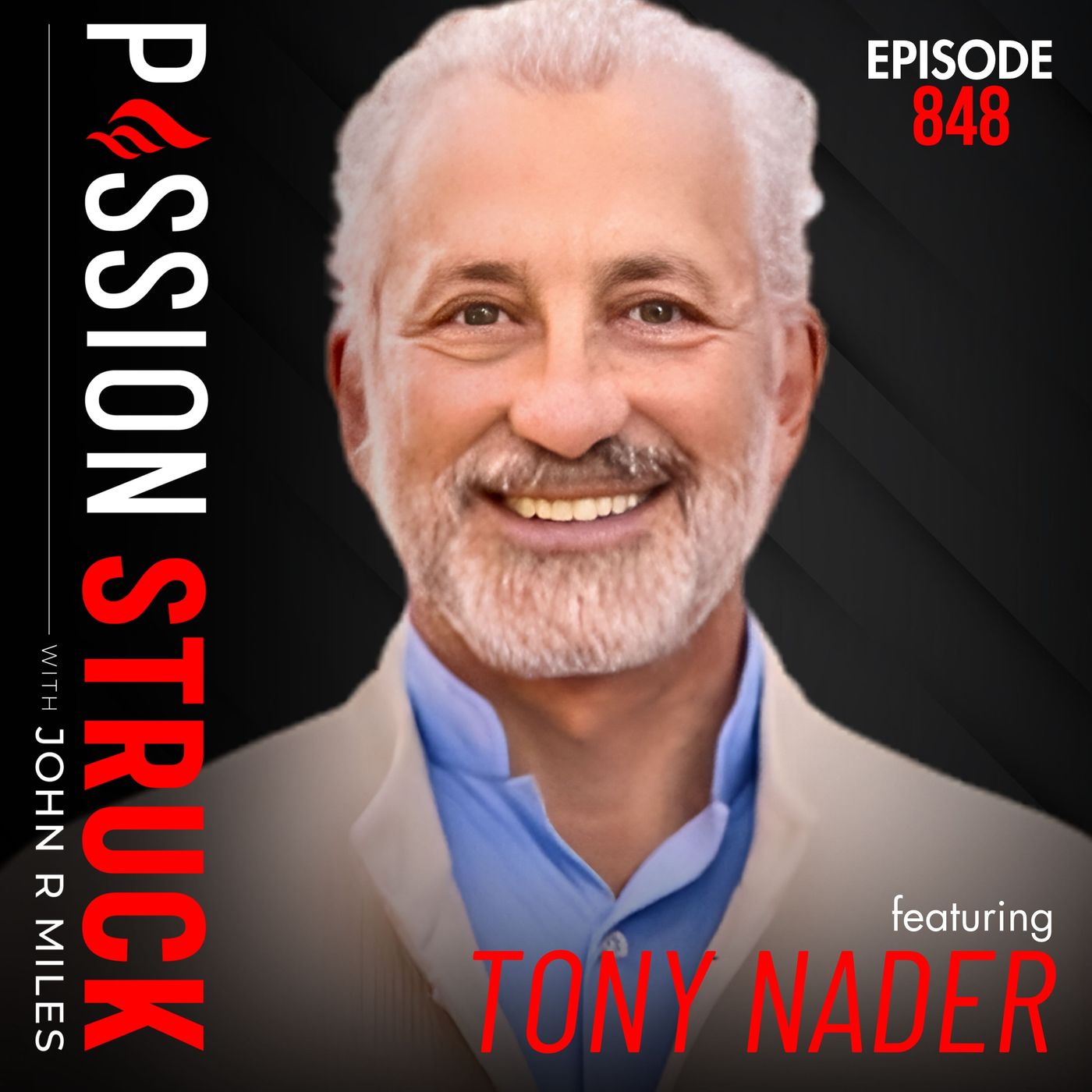
Why people say “I don’t care” as a defense, and how to care wisely instead of care more/less. Dr. Tony Nader argues indifference can signal hurt, burnout, and a narrowed state of consciousness; caring is a biological and moral capacity that becomes unsustainable when driven by obligation or overwhelm.
Dr. Tony Nader is a physician and neuroscientist, an internationally recognized consciousness expert, and author of The Power of Caring. He discusses consciousness as primary (a field) and links caring to physiology (oxytocin, dopamine, serotonin, endorphins, parasympathetic balance). He also promotes transcendental meditation.
Caring is wired into humans; “moral obligation” caring leads to performance and burnout. Social media/constant outrage can overwhelm people exposed to the “whole world” daily. Reconnect through inner ground, self-care, discernment (“what is mine to do”), and small, balanced acts that ripple.
COVID-era physician burnout/PTSD; pilots’ emergency focus causing accidents (narrow awareness); “I don’t care” as a macho medal masking isolation; small acts like planting one tree or students cleaning a river triggering broader movements.
Written by AI. May contain mistakes.
Discussion on how caring can become overwhelming and the need for conscious caring.
“Hey friends, welcome to episode 848 of Passion Struck.”
Exploring the paradox of caring in modern life and the importance of self-care.
“others and why the quality of our inner life influences the way we show up in the world.”
Dr. Nader outlines three choices people make regarding caring and their implications.
“but to learn how to care wisely so it's sustainable and it's enjoyable and it brings greater fulfillment and a connected life.”
Discussion on the impact of social media on feelings of care and connection.
“And we know we're wired to care through evolution.”
Explore how social media influences feelings of loneliness and depression.
“whole concept of learned helplessness again, and he was looking pretty critically at Jonathan Haidt's work, trying to prove him wrong.”
Understand how extending care to others can combat loneliness and enhance personal happiness.
“caring comes from a strength within because you can only give strength if you have strength you You can give happiness if you have happiness.”
Learn about the relationship between caring for others and our sense of self-worth.
“we can tell them that if you extend your care to others and see the others as yourself, you can yourself overcome solitude.”
Delve into the significance of consciousness in understanding our ability to care.
“And that shows that there is a wholeness, in fact.”
Exploration of whether life is predetermined or random, leading to a study of consciousness.
“What is the interplay and what is the meaning of life if one is true and the other is not true?”
Discussion on viewing consciousness as a unified field that connects all beings.
“And so my worldview is that there is one field and that field appears as many, like an ocean appears as many waves.”
A detailed examination of different levels of consciousness and their implications.
“Tony, I want to go into consciousness just a little bit deeper.”
How states of consciousness influence decision-making and perception of reality.
“If I'm understanding this correctly, what you're saying is obviously consciousness and transcendental meditation is something that we can learn through practice.”
Explore how consciousness affects our emotions and experiences.
“And you make the wrong choices and things don't happen the right way.”
Learn about the reasons behind emotional indifference and its impact.
“Because we hear it so often, I don't care.”
Discuss the significance of caring for oneself and others in life.
“And therefore, our interpretation is that we are not able to achieve what we want to do.”
Understand the progression of caring from self to community and society.
“It's controlled by laws, which include the other person's life, the other person's situation, the society, where it is there.”
Discover how effective leaders can foster care within their teams.
“Can you just go into that a little bit more?”
Explore how caring is integral to effective leadership and decision-making.
“Care is not an effortful thing and care comes from truly being able to think holistically and know that others are part of yourself, particularly those you lead.”
Understand the three aspects of experience that influence caring: observer, object, and impression.
“for how we can start caring more without losing ourselves.”
Learn steps to gradually expand your caring from self to others and create a fulfilling life.
“Purpose is consciousness gradually becoming aware of itself through increasing expansive caring.”
Discover how caring can be balanced with personal well-being and the impact of relationships.
“Tony, thank you so much for joining me today.”

Get the gist, explore an idea or ask about something said.
 Claude
On Passion Struck with John R. Miles, what are the key points of this episode?
Searching your listeningAutomatic transcript. May contain errors.
0:00Still wearing the same old underwear? Chances are it's time for an upgrade. Start with Tommy John, a 2026 Men's Health Editor's Choice in Best Men's Underwear. Experience exceptionally soft fabrics, a fit that moves with you, and all-day comfort across our premium underwear, sleepwear, and loungewear. One less gift to worry about. One more reason to treat yourself. Own gifting season with 40 % off site-wide at TommyJohn.com slash podcast and use code podcast. Coming up next on Passion Struck. What happens when caring about the world becomes so overwhelming that we convince ourselves we don't care anymore?
0:40We withdraw, we protect ourselves, we tell ourselves we've become stronger by not letting things affect us. But what if indifference isn't the absence of caring? What if it's evidence of how deeply we've been hurt? Dr. Tony Nader offers a fascinating perspective on why we disconnect from others, why caring can become exhausting, and how we can rediscover the joy of caring without losing ourselves. Listen to this. When you are in danger or when you are hurt, you withdraw. And then you have to be sure that what is the mechanism? Why did you get there? People sometimes go around carrying the I don't care as a medal.
1:26I am a macho, I am a strong person and I don't care about anything but they deeply care and life will bring them back to caring because otherwise there is isolation, there is sense of solitude and the pleasure of caring is lost because caring is one of the pleasures of life, one of the nourishing powers of life. Hey it's your friend John and And welcome to PassionStruck. I'm so glad you're here. Whether you're a longtime listener or someone who just discovered the show, thank you for pressing play today. Maybe you've built the life you were supposed to want, but you've quietly wondered why it still doesn't feel like enough.
2:11If that's you, you're in the right place. Every week, I sit down with the world's top scientists, researchers, and thinkers to uncover what it actually takes to build an intentional life that matters. Thanks for joining me. Let's get into it.
2:32Hey friends, welcome to episode 848 of Passion Struck. We're continuing our November series, The Art of a Life Well-Lived, exploring how we nourish ourselves, discover what matters, and build lives guided by purpose. Earlier this week, I sat down with Pat Croce for a conversation about achievement, identity, mindfulness, and what it means to truly enjoy the life we're living. Pat shared how his extraordinary journey led him to question the identities we construct, the voices in our heads, and whether external success can ever deliver the fulfillment we're ultimately seeking. Today we're building on that conversation by exploring another dimension of a life well lived, caring.
3:15My guest today is Dr. Tony Nader, a physician, neuroscientist, and internationally recognized expert on consciousness. He's also the author of The Power of Caring, a new book that challenges us to reconsider what caring really means and how it shapes our lives. And I think this conversation comes at an important moment. We're living in a world where the problems can feel endless. We're surrounded by conflict, uncertainty, suffering, and information about things happening far beyond our immediate lives. Many people feel a deep responsibility to care, but that responsibility can become exhausting.
3:54We can become overwhelmed, burned out, or so disappointed that we begin to withdraw. Dr. Nader makes a distinction that I found particularly powerful. The answer isn't necessarily to care more or care less, it's to learn how to care wisely. We explore why caring can become a burden when it's driven by obligation rather than understanding, why people sometimes hide their compassion behind the declaration that they don't care, and how we can reconnect with caring as something nourishing rather than depleting. We also talk about consciousness, the relationship between caring for ourselves and caring for others and why the quality of our inner life influences the way we show up in the world.
4:40Before we get started, I want to introduce you to our new speakers bureau called Passion Struck Speakers. In it you'll find amazing voices that you can bring to a stage or conference near you, including Nir Bishan, Aaron Deal, Dori Clark, astronaut Chris Cassidy, former Thunderbird pilot Michelle Curran and so many more. It's designed to connect meaningful voices with opportunities to inspire, educate, and make a difference through speaking. You can find it at PassionStruck Speakers or through the link in the show notes. Now, let's get into my conversation with Dr. Tony Nader. Thank you for choosing PassionStruck and choosing me to be your host and guide on your journey to creating an intentional life that matters.
5:29Now, let that journey begin.
5:37I am absolutely honored and thrilled today to welcome Dr. Tony Nader to PassionStruck. Hi, Tony. How are you today? Fine. Nice to be with you. Wonderful. I am so excited to have this conversation because when I first saw the title, The Power of Caring, I thought it was going to be another book telling people to simply just care more. But Tony, as I was reading the book, I don't think that's actually what you're arguing. I think you're arguing that caring is one of the deepest organizing principles of human life. What made you believe caring deserved an entire book? Because caring is what we do for everything.
6:15Actually, caring is an extension of desiring, wanting, hoping for. We care to breathe. We care to eat. There are basic needs that we have. But also, we are wired to care as humans. and therefore there are systems in our physiology that are geared to feel the other. We have mirror neurons, we have hormones, and it's a very complex aspect of life that can take us in any direction. So I've seen people care too much and get burned out, care too little and feel isolated in the medical profession and the teachers, parents, and so they think they should care more, but they're not caring in a conscious way, in a proper way.
7:02So I felt caring for so many things from so many angles under so many conditions of life and crisis and family and children that I was hoping it can help, which I hope it will, to care wisely, not to care more, not to care less, but to learn how to care wisely so it's sustainable and it's enjoyable and it brings greater fulfillment and a connected life. Thank you for sharing that, Tony. I think one of the things that you just highlighted there was that we seem to be living through a paradox right now. And it's a paradox that I've been exploring pretty deeply. I think people care deeply about their families.
7:45They care deeply about their work. They care deeply about the world, at least most of us do. Yet what I keep seeing is that more and more people, not just in Western countries, but everywhere, feel more and more emotionally exhausted and disconnected from life. So is that part of the reason you believe you needed this book is because it seems like caring has become more and more difficult in modern life? Yes, exactly. And we know we're wired to care through evolution. And so caring leads to changes in the physiology, which are positive bonding hormones, oxytocin, reinforcement hormones, dopamine, feeling well hormones, serotonin, endorphin, parasympathetic system getting balanced.
8:36And yet due to stress and strain, this caring, which is reflex caring in a sense, gets out of tune with the reality. There is another aspect of caring that is what we can call the moral aspect the obligation aspect i have to care because that's the good thing to do this is how to behave under this circumstance under that circumstance that's what a good person would do if they were in my place and so therefore i should follow that and that becomes the moral obligation that has very good positive aspects but unfortunately there is a trouble with that also because their caring becomes performance and obligation and that leads to an appropriate assessment of the proper situation and of our proper ability to care and our what is a mind to take care of what is mine to do rather than I should do whatever has been sought to be the best thing to do and I should keep doing it even extending myself beyond my physical and mental possibilities.
9:47And so caring is no more sustainable. It gets to burnout and overwhelm and either avoidance or excessive burnout. I've seen this in physicians during COVID, getting PTSD, getting even depression, insomnia, and even suicide. So I was alerted by this. And And of course, our new generation, which is exposed to the world problems, and they feel they have to care about everything. They wake up in the morning and the whole world, due to the media, appears to them to be broken. There are broken things in the world, but it's not all broken. And there are so many factors that require attention in terms of decision making.
10:35And that's why I differentiate just general caring with what I call conscious caring. I want to explore a bunch of things that you just said, and I'm going to try to take them in sequence. So one thing that you've talked about a few times now is evolution. And when I think about this topic, I often go back to Robin Dunbar and the famous studies of we're kind of wired to be in a tribe of 150. But as you were just saying, we now feel like we're morally obligated to have to respond to what's happening across billions of people. And obviously, that wears us out. So one of the things as I was reading the book is I kind of started thinking about this in terms of free choices.
11:25The first choice is the one that you were just talking about, kind of our moral obligation, which is we try to care about everything and we burn out. And I think there's a second choice that we care selectively, but then we feel guilty. And then I think there's a third choice that we stop caring altogether. Why do you think so many people today feel trapped between those three choices? Because they are good people and they want to do the best they can. and if they have been hurt or burnt out, then they get into the avoidance group. If they feel they want to continue and be strong, they don't listen to their bodies, they don't listen to their mind, to their feelings, to what their capacity is and they get overwhelmed and burned out.
12:18Or they get reflex reactions and they respond to the loudest person in the room and do not care in a way that is discriminating, not in terms of discriminating with others, but I would say discerning, that there is discernment that is missing. And they don't care necessarily from an inner settled ground. This is the big difference. From which platform we are caring, as a reflex based on stress or moral obligation based on what we feel we should do, even if our body has reached its limit. And then if you have reached your limit, you end up not being able to care. So you get hurt and you get resentful and then you withdraw.
13:08And so all of these have to be balanced so that first we know that the most important care to start with is to care for ourself and not see this as selfish, but see it as a necessity so that we can start caring for others from a highest level of possibilities and platform rather than from fatigue or fear or anxiety, which usually is felt by the other. Others will feel that you are reacting or acting with a resentment. And so the giving is not full and the receiving is damaged also. Thank you for sharing that, Tony. I wanted to go back to this idea of our moral need to care. I was recently doing an interview with Marty Seligman, and Marty has been examining his whole concept of learned helplessness again, and he was looking pretty critically at Jonathan Haidt's work, trying to prove him wrong.
14:16And he told me he has come to the conclusion more and more that he thinks height is right, and that this inflection point that we're seeing in people not caring, people feeling lonely, people feeling more depressed, is because of this spike in use of social media and digital technologies. Do you think that's correct? Or do you think it's more that these digital technologies are an accelerant to an evolutionary process that's been happening in the background? There are different sides to increase in information and knowledge. If it's properly directed and properly filtered and balanced, and if one is established within oneself in a stable inner ground, then one can manage the situation.
15:07If one is being, in a sense, constantly bombarded by something without the ability to refer to oneself, then we get into that overwhelm because the whole world is falling on our heads. As you said beautifully, our physiology has been evolving to deal with small tribes and now we are exposed. In the morning you wake up you have the whole world on your plate our teenagers they get exposed to something our grandparents spent a whole lifetime and didn't get exposed to so all of this is the media so there is knowledge where we can compare traditions compare feelings compare things so that knowledge is great because it enhances one's optics one's vision one's dimension of a human being rather than being stuck there is no question that there is something like that but the media's algorithms they favor outrage because this is what gets read this is what gets important and therefore the exposure to outrage all the time gives the impression to our young generation and even all generations that everything is broken in the world again the world is not perfect but it's not broken.
16:32There are so many good things happening and we should be able to realize longevity, medical help, greater human resources, greater freedom, greater ability to help each other and human rights and so many infant mortality. There are many beautiful things happening and therefore there is a sense of importance of necessity for discernment, which means I often say when you wake up in the morning ask yourself what is mine to do today what is something that i can care about not things that i have to carry on my shoulder the problems of the world and so first caring comes from a strength within because you can only give strength if you have strength you You can give happiness if you have happiness.
17:26You can give knowledge and guidance and peace and harmony if you have that within you. So with the idea of being as altruistic as you want, be the maximum you are or you can be so that you can help the maximum. I first heard of this concept called moral beauty from University of California professor Dacher Keltner. And I've been hearing it used more and more by Arthur Brooks as he's been discussing his new book, The Meaning of Life. And it seems like what you were just describing is advocating that people should be focusing more on moral beauty, meaning focusing on caring for each other, sharing kindness with each other, et cetera.
18:15The reason I'm bringing moral beauty up is, as you have probably gathered looking at my work, I spend a lot of my time studying the science of mattering, basically the human need to feel valued and significant. And it seems more and more as I'm listening to you, that there seems to be a link between the relationship between our ability to care and our ability to feel like we matter and to show others that they matter. Do you see that link as well? Absolutely. In my worldview, which I also present in the book and in my previous book, Consciousness is All There Is, I discuss the purpose of life.
18:59I discuss meaning. And I see it as a field of consciousness manifesting itself as different values. And that we are one like an ocean is one with the waves being different on the surface. We are all waves of that ocean of being. And what I see is that the other is also myself. And this is where most wisdom, great spiritual teachings and religions and great philosophers, particularly, of course, the idealists and those who promote that sense of unity at the basis of diversity, have promoted and have taught. And so when you expand yourself from being that small individual encapsulated in this skin or in this body, to see yourself on the level of awareness of consciousness as part of a wholeness, then when you care for others, you are really ultimately also caring for yourself.
20:07and there is a principle in nature action and reaction so sometimes the giver gains more than the receiver and if you do it with this attitude where the attachment is a healthy attachment rather than anxious attachment or avoidant attachment these are what the psychologists describe as different kinds of attachment then you give and know that it's a ripple and the ripple is going to reach its goal and it's going to pay you off even more. So that is a benefit actually for the caring person as much as for the receiving person. And we know it even physiologically, the different changes and the parasympathetic system, the hormones that get secreted.
20:57And also for the generation that is now, it seems from the studies that are suffering from loneliness and sense of solitude, and they're waiting for care to be given to them, we can tell them that if you extend your care to others and see the others as yourself, you can yourself overcome solitude. So caring is a technique also that can be learned and that can have great aspects of bringing fulfillment and happiness and the beauty you are talking about.
21:51this show is worth recommending to other listeners. That means your follow can help these conversations reach someone who hasn't discovered PassionStruck yet. And if something in this conversation makes you think of someone who's feeling overwhelmed by everything happening in the world, or someone who's become so exhausted by caring that they've started to disconnect, share this episode with them. Sometimes the right conversation can remind someone that caring doesn't have to mean caring everything. Thank you for listening and for helping us grow this community. It really does make a difference.
22:25Now a quick break for our sponsors. Thank you for supporting those who support the show.
22:37You're listening to PassionStruck on the PassionStruck Network. Now let's get back to my conversation with Dr. Tony Nader. I want to get to how you do that in just a second. I want to back up just for one second, Tony, because one of the things that stopped me when I was reading the first four chapters of the book is that you and I have stumbled on something very similar through each of our own work. And that is modern people aren't exhausted like we've been talking about because they've stopped caring. I think we've both realized that they're not caring as much because they're trying to care care inside systems that are constantly overloading the human nervous system.
23:22And I refer to it as signal loss, which I think is similar to what you're talking about. And so I think the question that you're trying to ask at the beginning of the book is not, do we care? I think it's more, how does caring arise? And the way I saw you trying to look at that is you're trying to look at it through a biological lens, things like reciprocity, fairness, empathy. You're trying to look at it through a physiological lens. Humans don't simply survive through caring. They create their very identities through caring, which is where my mattering work comes into it. And then you're using it through a third lens, which I think is consciousness.
24:10Is that a good way to think about the way you examine this? Absolutely. You just nailed it. And that shows that there is a wholeness, in fact. Yes. What is the wholeness? When you look at the fact that all of these converge, which means your physiology, the way it reacts, your mind, the way it thinks, the philosophy of it, the physics of the universe, the spiritual teachings, and you find them to be converging to one conclusion or similar conclusions that means we have a truth that is beyond necessarily the empirical research although empirical research supports that people who for example practice techniques of transcendental meditation gain greater inner ground expand their awareness they naturally care more they naturally commit communicate and connect and live a more fulfilling life.
25:12So there are conversions of aspects that you mentioned, the highlights of, that actually show that caring consciously, caring properly in a balanced way is something that is part of experiencing others as part of oneself and experiencing life as wholeness. Tony, I was hoping you might be able to expand upon, because you wrote a whole book before this one on consciousness. Why is this exploration of consciousness so important to understanding how we regain our ability to care? We have worldviews, the different worldviews, whatever we are, wherever we are, even if we are not a philosopher or a thinker or even ask ourselves about what is reality about.
26:08Everyone has their own worldview. So they come out, some will think the world is structured, organized, there are laws and you can't escape the laws and everything is deterministic. Others might say, no, it's randomness, look at the suffering, look at the problems, look at things, how they happen in a way that is not proper. Some they think of a mixed thing, some they think of powers that are beyond our control, that are actually controlling us, or sometimes they like us, sometimes they don't like us. Different forms of belief, of ideas about the world and existence. And based on those worldviews, we make decisions.
26:52We make decisions about behavior, about morality, about necessity, about importance of family or nation. We can have a worldview that society is my thing, or my world is my thing, or my fellow friends are, or my race is, or my different worldviews. So I wanted to look deeper into what can be the worldview that supports the maximum truth about reality. Some people call it search for truth. It's a big word, ultimate big truth with a big T. And this has been a philosophical and scientific question throughout time. And so I came to the conclusion of asking a primordial question. There is a physical body and there is a mental, personal, subjective experience, which we call consciousness.
27:49So there is material and there is non-material, something that is subjective, that is personal. Which one creates which? How they interact with each other? What is the interplay and what is the meaning of life if one is true and the other is not true? if there is randomness if there is freedom or is it all predetermined and deterministic so we don't have choice anyway so why should we discuss anything and so that's a big problem and so i actually almost i can say spent my life researching this from a scientific perspective from a spiritual perspective from religious perspectives from practicing techniques of contemplation and meditation and i came to some conclusions and i thought i should share my conclusions with the seekers of this question answer to this question and that's why i went deep into the study of consciousness and wrote the book consciousness is all there is which is the conclusion that i have come to from all of these different angles the objective approach the subjective approach, the spiritual approach, I got convinced that there is a field of consciousness which is primary and that matter and physicality are dynamics within that field.
29:20So this might seem esoteric or complicated, but I tried to put it in scientific terms, in philosophical terms, and that's what I truly believe in. And so my worldview is that there is one field and that field appears as many, like an ocean appears as many waves. We are the waves. If our vision is narrow, we only see one wave. If it's bigger, we might see other waves. If we dive deep into the ocean of being, the ocean of consciousness, we realize our consciousness is the ocean and the waves are expressions of the same ocean. So the sense of self expands to include not only other human beings, but all that there is.
30:12And that's how we can interact with others as if they are ourselves. Thus, the golden rule, do unto others what you want to be done unto yourself or don't do unto others what you don't want to be unto yourself, which is usually a moral teaching, but what it actually in essence is saying is that the other is you. The other do unto them what you want to do unto yourself because you are one and the same but appearing differently. And so this leads to a change of perspective and an understanding of meaning and purpose and growth and relationships from quite, I feel humbly, quite a complete worldview.
31:02you? Tony, I want to go into consciousness just a little bit deeper. Last year, I had two really interesting conversations. One was with David Vago, who formerly, you might know, is a neuroscientist who formerly taught at Vanderbilt. And then I had a subsequent conversation with Jon Kabat-Zinn. And we were trying to go deep into the difference between awareness or consciousness and meta awareness how do you apply this difference when it comes to caring awareness and consciousness can also be seen as different and awareness is to be aware of something specific consciousness as a whole is to be a conscious being or have consciousness as a platform it's like consciousness when it puts its attention on something, it is aware of that thing.
32:00But consciousness is an underlying field as far as I see it. And then it focuses on something and you say, now I am aware that we are talking about this. Now I am not aware we are talking about that. Which means when we are sitting on a chair, for example, our body is having a subliminal consciousness about everything that comes. but our awareness is focusing on what we are saying. So these fall back into what usually is called the subconscious or the unconscious, but they are still there. And I call them a lower or a hidden level of consciousness. So that is that aspect in terms of difference.
32:42Meta consciousness is to be aware that we are aware, is to have that other layer of consciousness. So in my description of consciousness, there is a spectrum of consciousness. See, we as humans, we try to see everything from our perspective. That's what we call the anthropomorphic view, which means we project on the world what we are. So we project our consciousness as being the only way to be conscious. The only way to be conscious is a human consciousness. so that's the what's that they say that's not what I believe that I have a spectrum of consciousness and so when you look at a cat or a dog they used to think these animals are not conscious so they are like machines or something that we can dispose of any way we like or do whatever we like because they're not conscious beings and this was not a long time ago I'm talking 100 years or less even And maybe today even people think that animals are not conscious.
33:47But whoever had a pet, whoever has lived with a dog or a cat or whatever, they see the consciousness is lively there. Now, people say, what do you mean? They have an idea about themselves. They have a sense of being, a sense of future, a sense of past. Maybe not. But it doesn't mean they don't have a certain degree of consciousness. So there are these levels of consciousness. I see that anything that detects, interacts, reacts is an expression of consciousness from a meager, minor level, which can be even just particles interacting with each other, all the way to the sunflower turning towards the sun.
34:34it has a sensing, it has a mechanism, it doesn't have a decision making, it doesn't have a choice, it doesn't have a feeling, it doesn't see itself as a sunflower, it doesn't have that level of consciousness, yet it has a small level of consciousness. And you go to the different grades in animal life, and then they have their own level of consciousness. When you come to humans, Humans can also at certain moments just be like robotic and acting in a way that is almost like a machine. They are conscious of this, conscious of that, doing this, doing that, but they are activated by some subconscious or unconscious levels that make them work the way they do.
35:21And there is science that shows that, yeah, this is possible. Then you can have a higher level of consciousness, a consciousness that is more expanded, where you evaluate things, where you see things in perspective of your life, who you are, where you want to go, broad awareness, broad comprehension. And that happens when the mind and body are more relaxed and more settled. And that's why removal of stress and strain, and that's why techniques like what I practice is transcendental meditation is very fundamental because it releases the stresses and strains, and even physiologically we know it opens the higher brain values, great coherence in the brain, it reduces stress hormones, cortisol level, improves blood pressure, etc.
36:09So it has physiological counterparts, and yet on the level of experience there is a settled broad comprehension state where consciousness is expanded. Now that consciousness can expand to the point where you are always conscious of the self you're always aware of being who you are without analyzing the details of who you are but there is a sense of being established in the self yet when you perform action on the outside you are not a football of situations and circumstance you are a master of your destiny and that is when one is established on what i call higher and higher states of consciousness, where, if you like, metaconsciousness comes into play in a sense, but not as somebody sitting and constantly analyzing, I am conscious of being conscious, et cetera, which can waste your time and your energy and prevent you from focusing on something because you're being philosopher while you have to drive a car or fly a plane or do surgery in the surgical room.
37:20So it's something that is established gradually with broadening awareness where you have this inner silence at the same time, the ability to project yourself fully to the outside. Thank you for sharing that, Tony. If I'm understanding this correctly, what you're saying is obviously consciousness and transcendental meditation is something that we can learn through practice. and our consciousness shapes our perception of reality. So if that's the case, is it possible, based on what you just said, that many of the problems people believe are external are actually rooted in the state of consciousness that they're actually bringing to those experiences?
38:11Beautifully said. I would answer yes and be satisfied, but you probably want me to comment more. Yes, the state of consciousness determines how you make decisions. Your higher state of consciousness increases your degrees of freedom. And we can take a simple example. When you're under stress, there is a system in the nervous system, which is adapted through evolution, that takes the blood flow from the higher cortical areas and take them into the limbic system, which is an inside part of the brain that prepares you to fight or flight. Everybody knows fight or flight or freeze response. And there you have to absolutely focus on something.
38:55Your eyes focus, your muscle, your blood goes to the muscles. You're ready to fight or to freeze, to be not seen by the prey, by the danger, by the attacking danger, or to run away or to go ahead and fight. At these moments, your brain is almost not used as it should be because you are preparing for the danger. In fact, it is used properly when the danger is real. So you don't see any more. That's where we call narrow perspective. And we've seen this in pilots who fly planes. For example, at the beginning when pilots were being trained, when they get into emergency situation, they focus so much on the emergency that they forget the whole thing and there were accidents like that happened in the 1970s it's an unfortunate accident it was a full of passengers and one little light went started blinking and turning on and off so the pilots were so busy with it they forgot that they have discontinued the autopilot by mistake because they were focused and their brain was just narrow on this one thing and unfortunately the plane crashed and it was many casualties almost everyone didn't make it that is an example of narrow awareness since then of course the pilots have been trained to have what we call broad comprehension and situational awareness which means your consciousness is able to see more and you learn steps so that you don't get bogged down by small things so you want to put money in the stock market if you see only one value your consciousness is narrow oh this stock went up so i let me put money there that is narrow consciousness if your consciousness is wider you can say wait a minute i want to see if this product is demanded in the market if there is competition who are the managers of this company, how it has done before, what is the demand, you look at so many factors.
41:04The more factors you look at, the better decisions you can make. That is what I say increased in awareness and increased in freedom. Because if you're stuck and you have only two or three choices, then your freedom is limited to one or two, three choices. If your awareness is broad and you have broad comprehension and you can see 100 choices, then we can say your freedom of choice is increased. So increase in consciousness and awareness and settled being leads to increased freedom and better decision making because you have a broad comprehension about the situation. So when people say, let's take a small example, you wake up in the morning after a good night's You can solve things, you feel happy, you take care of things.
41:56You wake up in the morning, you didn't sleep well, you didn't eat well, you are tired, you are exhausted. Small thing appears like a mountain. And you make the wrong choices and things don't happen the right way. And you fall apart and things don't work well. Your consciousness is clouded. Your awareness is clouded. It's tired and mind and body are intimately connected. When you're tired physically, the consciousness can also be exhausted and tired. So all our life is lived through consciousness. We remember that. In anesthesia, you are the wealthiest person in the world, the most loved person in the world, the most cherished person in the world.
42:38It means nothing. it's through consciousness that you experience happiness that you experience love that you experience care that you are making decisions that you get knowledge that you grow that you through what through consciousness and so that is why consciousness is primary in so many ways well i love that we just did a deeper dive in this because i want to take a big step back and And I'm doing this purposely because now that we've explained consciousness and its importance, one of the chapters that really caused me to pause, and I sat with it longer than others in the book, was a fascinating chapter you have on why we pretend not to care.
43:24Because we hear it so often, I don't care. And I think this is becoming more and more what I hear, especially from younger generations. And I think this becomes of a defensive language. People stop expressing care because, let's face it, disappointment hurts. Brief hurts. Rejection hurts. Burnout, I can tell you, hurts a lot. And what I am seeing, and I think what you are seeing as well, is that more and more people are becoming indifferent. And when we become indifferent, we stop wearing a mask, is the way I like to frame it, because caring becomes emotionally difficult. So it's easier to wear the mask and pretend we don't care than it is to actually care.
44:14So given what you just said about consciousness, do you think that this growing indifference that we're feeling is because we're trying to protect ourself from the hurt that caring carries forward, and therefore we're unconsciously becoming less and less conscious about the role that we're taking in the world? Am I framing this correctly? Yes, absolutely. It's a mechanism of defense. In itself, it is starting correctly. When you are in danger or when you are hurt, you withdraw. And then you have to be sure that what is the mechanism? Why did you get there? Sometimes it's even physical. Some people who care a lot, they can have changes in their physiology, inflammation, changes in the way the body works.
45:14And even if mentally they want to do something, the body kind of stops wanting to respond. and that is how the mind says, okay, I have to explain why I cannot do it. And then it gets into isolation and avoidance and saying, I don't care. But that's one reason. Another reason is to be hurt on an emotional level because sometimes it's the kind of attachment that we have. If it is anxious attachment where we expect the others to behave in a certain way based on our action towards them or on our care, and we find that they don't follow that, then we are attached to how we want them to be. And therefore, our interpretation is that we are not able to achieve what we want to do.
46:10So there is both the hurt and also at the same time, the sense of I'm not able to do anything. So I better say I don't care. So that is where you fall into what we call avoidant attachment. When I say in the book that people sometimes go around carrying the I don't care as a medal. I am macho, I am a strong person and I don't care about anything. but they deeply care and life will bring them back to caring because otherwise there is isolation, there is sense of solitude and the pleasure of caring is lost because caring is one of the pleasures of life, one of the nourishing powers of life. So what do we do in this situation?
46:58First we have to accept the situation, we don't put value judgment on it, People are justified to withdraw when they are facing conditions that are there. But then we have to retrain and re-educate so that small acts of care, well balanced towards people who are able to respond to our care, has to be selective. So there is a mechanism by which one can regain that trust and how caring can help and how caring can respond. And one of the things is to know that everything we do ripples out and the ripple comes back. And so maybe the ripple, you don't see it come back right away because there is time and space in life.
47:49But trusting life is very important. So there is this fact that caring shouldn't be thought as an effort. It should be allowed to come from an inner ground, an inner feeling, a conscious caring. And that comes from a settled self. So first, care for yourself. So that's fine if you are avoidant or you say, I don't care. care for yourself and feel that caring building you up to be able then to start caring consciously under situations that are likely to bring you the response that you want is small steps and if they don't if the situation doesn't trust life discernment and trust are very important and the knowledge that care shouldn't be an effort.
48:43It's something that comes from within. We are wired for that. And so trusting life is very important. So do the thing and then let go. There is great wisdom about non-attachment to the fruit of action. And it's part of all the ancient kind of wisdom, wise people, wise knowledge and wise teaching, where you do your action and your action is something you control, but know that the fruits of your action, the result of your action, is not really under your control. It's controlled by laws, which include the other person's life, the other person's situation, the society, where it is there. You do from your side and let go.
49:31That is something really to learn. And care to do the right thing. Give a little kindness here, something there. And then you will see that your sense of wellness, your sense of wholeness and connectedness grows in your life. For the listener, I want to pause here because what Tony is saying is extremely important to understand. And when I started to write my upcoming book, The Mattering Effect, and I started to look at mattering at first, I kept focusing on mattering starts with relationships. And the more I started to studying the science and really looking at it, I came to the same conclusion that Tony did in his book.
50:18Similar to caring, mattering starts not with the relationship, it starts with the individual, It starts with you. And if you don't have a firm basis of mattering or caring, then it's almost impossible to then bring this into relationships, which is exactly what I think your work found as well, Tony. So it begins with the individual, then it moves to relationships, then it moves to those communities that we surround ourselves with, then to society, then to creativity, then to purpose. And I think it's very important to understand this because there's systematic methodology behind this. Can you just go into that a little bit more?
51:05Because I think this is one of the most important takeaways that your whole book brings. Yes, exactly. I call it the spiral of care, where we first have to care for the basis, the baseline, which is yourself. And caring for the first home, which is our house, which is our first home, which is our body, is also important. And we don't dissociate that. We don't think that caring is only moral or mental obligation. Caring also depends on a body that can carry the caring and that can make it happen. So have a healthy life, a healthy body. That's very important. And then from there, look in your environment.
51:52What is mine to care for? So I often say when you wake up in the morning, ask yourself this question. What is mine to care for today? What is mine that I can take care of today and what I will be able to do? Don't think like the whole world problems are going to be carrying them is not caring for them. So don't carry the world problems. Decide what you want to do. And then in your day, you will see that small acts are sometimes very important. So that is another aspect. So your discernment, caring, deciding what is yours to care for, and then accept that small acts can do a huge thing. Matariwagai planted a plant, one tree, and it became a whole movement in the world.
52:43Different things we can discuss where small actions, some students cleaned up a river somewhere and it became a whole movement. So small acts even don't have to be on that dimension. They ripple. That is what is called behavioral contagion. You do something nice to somebody and they're likely to do something nice to someone else. And that can carry two, three levels and more. So you will never meet the person who benefited from your doing something nice to somebody or calling some friend, opening the door to somebody, helping some older person if they are in difficulty going into the bus or whatever, something like that.
53:28Small acts of care are powerful and beneficial for yourself and they ripple around. So that is how, as you described, John, how this spiral builds up. And then gradually one can care for a community. You can participate in something in your environment, if you like, in your community or your family and something like that. Gradually and gradually you build up that ability to care for higher values. There is one aspect which is very interesting and sometimes not easy to explain, and that is through transcendental meditation. We have found that when a large group of people practice this program together, they have an influence on the whole society, which is something I use also because there are 116 different scientific research studies that have shown that consciousness is not limited.
54:27it's delocalized it's not localized to the specific place and when many people practice this transcendence together we have seen changes in crime rate accidents of the roads hospital admissions infant mortality things that are amazing and that is really the sense of You can even care from that level by being yourself peaceful, happy, and transcend. You are also helping and contributing to others indirectly or actually directly without having to do the actions. So small actions are very important, gradual, based on a solid mind and body. caring can grow and as we go through the different situations one can learn specific attitudes what to do take time take deep breaths relax your shoulders put your hand on your heart there are small techniques that help us to actually be able to care in a sustainable way tony i want to bring some application to what we've been discussing today for the listeners so perhaps we can bring this into, let's say, leadership.
55:44You've worked with leaders around the world. What separates a leader who cares from one who doesn't? And what are some practices that a leader who's listening can start using today? I think develop the inner ground, which means act from an inner level of settled being, and then care comes naturally. Care is not an effortful thing and care comes from truly being able to think holistically and know that others are part of yourself, particularly those you lead. And I would say most leaders ask themselves, what more can I do for my people? and that's something that actually is part of leadership and what they can do is first tune with themselves be healthy be balanced themselves and think of the higher good and then automatically the solutions will come they have a lot to take care of it's not an easy job to be a leader and it's important that they remember most importantly to take their time and not react reflexly by feelings or impressions or reactions.
57:15The leader has to take the time to consider very wisely and carefully and then project themselves and their decisions based on an inner ground that is settled and peaceful. And there are techniques for that, of course. And then I want to explore maybe your takeaway for how we can start caring more without losing ourselves. So you introduce a three-part model later on in the book. And I like this model because I just interviewed Angela Duckworth and we spent a lot of time talking about situations or the environments. that we find ourselves in. And in here, you have the subject, the object, and the process.
58:02And I'm hoping that you could maybe explain this in a kind of a quick way so listeners can get it and how they can start using this to show caring from an individual standpoint. For a quick one, basically realize that any moment of experience in your life involves three aspects, not just the object that you're looking at. It involves you because you are the observer and the quality of lenses that you are wearing, if you're wearing yellow glasses, then that will color the vision of what you are seeing. So there is the observer, the observer's consciousness, the observer's quality of awareness. Then there is the object, of course, the object, the situation, what is happening, who is there.
58:52These are, of course, important. And most people think they are the only thing, but they are not. And then there is your impression about them. What you have as prejudice, what you have been told about it, what are the connections, how are the people who told you the story, what are the circumstances that are around, in which way it was presented. And so this is the connecting part between you and the object of experience or the situation that you are facing. So remember that these three are what leads to a conclusion about the situation. And conscious caring is a caring that takes into consideration these three factors so that your decision is most appropriate for the situation and you are not biased by colored vision or by the means of getting to know something.
59:47So in brief, these are the three aspects. My last question for you, Tony, is one of the biggest conclusions I took from the book is purpose isn't something external waiting to be discovered. Purpose is consciousness gradually becoming aware of itself through increasing expansive caring. How can a listener who's tuned in for this episode start to expand their expansive caring today? Gradually through small steps starting from the first home, our body, our mind, where we are, caring for oneself, and then transcending, going deep within and discovering that there is an inner ground that is the inner self, which is not a small s ultimately, it's a big s, and that self is the self of everything and everyone and that's how as you grow in that direction you start seeing the others naturally as yourself rather than a moral imposition and then let that grow gradually from people who are close to you people you love people you normally care for and then let that seed of caring developed into a tree and a forest and a whole ecosystem of caring that can carry you beyond isolation into a fulfilling and connected life.
1:01:24Tony, thank you so much for joining me today. Where's the best place listeners can learn more about you, your books, and your work? I have a website called drtonynader.com, D-R-T-O-N-Y-N-A-D-E-R.com. There is a website for the book. It's called thepowerofcaringbook.com that can be pre-ordered. The book is coming in less than a couple of weeks. I have my websites, webinars. I am on YouTube. You can check Dr. Tony Nader and hopefully you will find all these things. We are offering webinars, amazing webinars. Actually, I really like them because I put a lot of energy to have them done. One first was caring across divides, political divides.
1:02:11The second one was love, loss, and relationships. And there is one coming up on this coming two days, Monday or Sunday, actually Sunday. It's called, Does the Universe Care? It asks the big question about, is there a universe that actually anywhere in the universe or does the universe itself cares? And like that, there are many webinars and many podcasts like this one that we have together. And I hope your listener will enjoy this and others. Tony, thank you so much for joining us on PassionStruck. It was a huge honor to have you. Thank you, John. My honor and pleasure to be with you. Tony, thank you for this conversation.
1:02:56What stayed with me is your distinction between caring more, caring less, and learning to care wisely. So many of us want to make a difference, but we can become overwhelmed by everything happening around us, and sometimes when caring begins to feel exhausting, we mistake withdrawal for strength. Your perspective reminded me that caring doesn't have to come at the expense of our own well-being. It can begin with how we relate to ourselves, extend to the people closest to us, and gradually become something that nourishes rather than depletes us. If you'd like to explore Tony's work in his new book, The Power of Caring, we'll include links in the show notes.
1:03:36And if this conversation has you thinking about how you can live and lead with greater intention, I also want to mention Passion Struck Speaker School. It's designed to help people develop their voice, communicate their ideas with confidence, and turn their experience into messages that can genuinely make a difference in their lives and the lives of others. You can learn more at passionstruckspeakers.com or links are in the show notes. As we close today, I want to leave you with one more thought. Caring isn't only something we extend to the world around us. It's also something we practice in the relationships that shape our lives most deeply.
1:04:13In my next conversation, I sit down with Larry Hagner, founder of The Dad Edge, to explore one of those relationships that can profoundly transform us, fatherhood. Larry shares a powerful moment when he looked at his behavior toward his son and asked himself, oh my gosh, what have I done? Who have I become? Who is this guy? Take a listen to this. Oh my gosh. I was like, what have I done? Who have I become? Who is this guy? Could I actually learn how to be a good dad? Could I learn how to be married? And I went on this quest and the answer to that question is yes. You can actually learn all of these things.
1:04:54Until next time, I'm John Miles. Stay curious, stay intentional, and stay passion-struck.
What happens when caring about everything around you becomes so exhausting that you start convincing yourself you don't care anymore?
We live in a world that constantly exposes us to suffering, conflict, uncertainty, and problems that can feel impossible to solve. We want to make a difference, but the pressure to care about everything can leave us overwhelmed, emotionally depleted, and increasingly disconnected. Sometimes, indifference becomes a form of self-protection.
Dr. Tony Nader believes the answer isn't to care more or care less. It's to learn how to care wisely.
Tony is a physician, neuroscientist, and internationally recognized expert on consciousness. In his book, The Power of Caring, he explores caring as a fundamental organizing principle of human life, connecting our biology, psychology, relationships, and experience of consciousness.
In this conversation, John R. Miles and Dr. Nader examine why caring can become exhausting, how we sometimes hide our compassion behind the declaration that we don't care, and why sustainable caring begins with the relationship we have with ourselves. They also explore the connection between caring and mattering, how our state of consciousness shapes the way we experience the world, and why small acts of care can create ripples far beyond what we see.
In this episode, you'll discover:
One of the most important ideas in this conversation is that caring doesn't have to mean carrying the weight of the world. Tony encourages us to begin with a simple question: What is mine to care for today?
That question can change how we spend our energy, how we show up for others, and how we create a more connected life.
Because when caring comes from a grounded place, it becomes one of the most powerful ways we experience meaning, connection, and purpose.
Check the full shownotes here.
About Dr. Tony NaderDr. Tony Nader is a physician, neuroscientist, and internationally recognized expert on consciousness. His work explores the relationship between the mind, body, consciousness, and human development. He is the author of The Power of Caring and Consciousness Is All There Is. Learn more at DrTonyNader.com.
Thank you to our sponsors.
Uncommon Goods: Discover unique, meaningful holiday gifts from independent artists and small businesses. Get 15% off your next order at uncommongoods.com/passionstruck.
Shopify: It’s time to turn those “What Ifs” into SFX: CHA-CHING with Shopify today. Sign up for your one-dollar-per-month trial today at SHOPIFY DOT COM SLASH passionstruck.
Get your copy of The Mattering Effect
What happens when you spend so much of your life showing up for everyone else that you start to disappear from yourself? Take the 90-second diagnostic to discover whether you're experiencing the signs of unmattering.
Explore the Passion Struck Starter Packs
Not sure where to begin? Discover curated episode collections designed to help you explore the ideas, conversations, and questions that matter most.
Every human deserves to feel seen, valued, and significant. Help make that belief visible. Wear it. Live it. Show it.
Passion Struck with John R. Miles
The #1 Health & Fitness Podcast. More than 85 million downloads.
Passion Struck is provided for educational and entertainment purposes only. The views and opinions expressed by guests are their own and do not necessarily reflect those of Passion Struck or its affiliates. Nothing shared on this podcast should be considered medical, mental health, or psychological advice, or a substitute for consultation with a qualified professional.
Hosted by Simplecast, an AdsWizz company. See pcm.adswizz.com for information about our collection and use of personal data for advertising.