Ask ChatGPT

 Passion Struck with John R. Miles
10 Nov 2026 · 1h 8m · 24 chapters
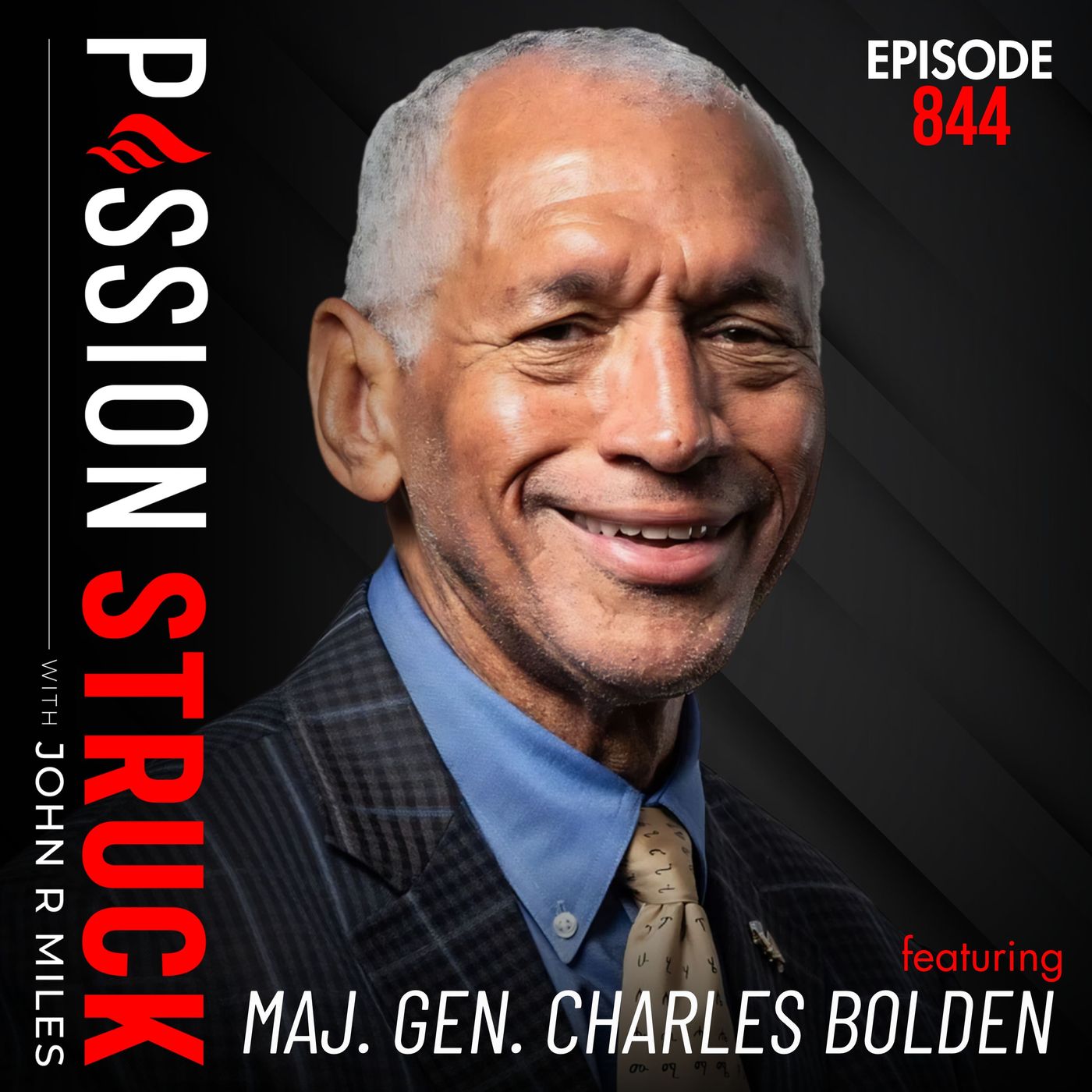
Major General Charles Bolden discusses finding common ground in a divided world through constitutional responsibility, civil discourse, and the “overview effect” perspective from space. He also recounts how personal relationships with Russian cosmonauts replaced Cold War enemy assumptions.
Major General Charles Bolden is a former NASA Administrator, Marine combat pilot, and astronaut who flew four Space Shuttle missions. He’s a Naval Academy graduate and grew up in the Jim Crow South in Columbia, South Carolina, with a family of educators and a father who served in a segregated Army during WWII.
Leadership means “take care of your people.” The Constitution (not parties or personalities) should guide national decisions. Democracy is being harmed by declining constitutional literacy, rule of law, and civility. Governments should cooperate like astronauts do, using science and evidence. Young people must understand “we the people” as an active responsibility.
His dinner with Russian cosmonauts Sergei Krikalov and Vladimir Titov—centered on their children—after initially fearing he’d be flying with an enemy. His space perspective: seeing Earth as a thin “blue” atmosphere and feeling human insignificance, which reframed polarization.
Written by AI. May contain mistakes.
Learn how to approach family gatherings with a fresh perspective.
“you feel guilty saying no or getting pulled into the same family arguments year after year.”
Explore General Bolden's inspiring life and his experiences as a leader.
“Whether you're a longtime listener or someone who just discovered the show, thank you for pressing play today.”
Understand the importance of leadership and community responsibility.
“It's also about what we contribute to others, how we lead, and whether we recognize our responsibility to something bigger than ourselves.”
A deep dive into General Bolden's perspective on service and American identity.
“Alumni Association with Major General Charles Baldwin.”
Learn about Major General Bolden's early career and experiences in the Marine Corps.
“My dad, although he went to UDT school, he was a Marine.”
Discover insights from Major General Bolden's shuttle mission and family connections.
“So I remember it vividly because your son and I are classmates.”
Explore the risks associated with flying on the space shuttle and Major General Bolden's perspective.
“And a question I always am interested in, because I don't think people realized at the time how risky, in hindsight, flying on the space shuttle was.”
Gain insight into the Overview Effect and its implications for understanding humanity's challenges.
“Now let's get back to my conversation with Major General Charles Bolden.”
Understand Major General Bolden's perspective on overcoming adversarial views during his missions.
“And then you, like your son of a guy, kind of grew up with understanding that the former Soviet Union was our enemy.”
Learn how Major General Bolden transformed his views on a Russian cosmonaut into a lasting friendship through shared experiences and family values.
“subship, radar system, aircraft that they had, and then the wall comes down and you find yourself on your fourth space shuttle mission with this opportunity to take a Russian cosmonaut up with you.”
Discover Major General Bolden's thoughts on the significance of the Constitution and the need for a more engaged citizenry in democracy.
“Sergei runs the human space flight program for Roscosmos.”
Hear about the mission of Astronauts for America and its aim to inspire youth to take responsibility for their democracy and societal norms.
“their critical importance and the importance of the vote.”
Learn about the necessity of educating the youth on government functions and engagement.
“And without calling names, it's say, okay, tell me what kind of world you want for your kids.”
Hear personal anecdotes about the challenges and growth during military training.
“but I found working on the board, the foundation board, most of the work we do, we're never going to see.”
Discover strategies for bridging the gap between old and new leadership mindsets.
“And they said, yeah, that's your basic stuff, your canteen, your bayonet belt and all this.”
Explore effective communication strategies to foster collaboration in difficult situations.
“And what was happening was at that point in time, a vice president who was coming in from the outside, and just so you understand, Dell was very glad.”
Understand the significance of global partnerships in space missions today.
“Earlier, before I was at Dell, I was at Loza McRibbon.”
Learn how collaboration can lead to mutual support and achievements.
“And our boss, who was the CIO, basically did what you're suggesting.”
Explore the complexities of international cooperation in space exploration.
“The other thing when you were the NASA administrator that I want to touch on that I think is important is today we go up to space with many people in the European Union.”
Understand the significance of inclusion and belonging in society today.
“spacecraft to fly to the International Space Station and we're going to fly an American spacecraft to Chiangang, to the Chinese space station, and we're going to begin to collaborate.”
Reflect on the responsibility we hold towards future generations and democracy.
“Because I believe that what you guys are doing is needed.”
Learn how to engage with those you disagree with to foster understanding.
“Find someone you don't see eye to eye with, sit down, start with something you can agree on, then work outward from there.”
Discover the insights on enhancing performance and recovery from Dr. Kristin Holmes.
“conversation goes into what is the key to performing better and building our capacity to recover adapt and live in alignment with what matters I'll be joined by dr.”
Understand the significance of building capacity for sustainable performance.
“Her central message is both simple and consequential.”

Get the gist, explore an idea or ask about something said.
 Claude
On Passion Struck with John R. Miles, what are the key points of this episode?
Searching your listeningAutomatic transcript. May contain errors.
0:00Host Thanksgiving with industry-leading quality standards from Whole Foods Market. There are no antibiotics in their meat department, ever. So carve up turkey and spiral-cut ham with peace of mind. Shop organic sides like stuffing mix and cranberry sauce from 365 brand. And guess what? All their delectable pies are made with no high-fructose corn syrup. Gourmet Thanksgiving flavors with the quality you want. Only at Whole Foods Market. it. The holidays have a way of bringing out old habits, saying yes to every invitation because you feel guilty saying no or getting pulled into the same family arguments year after year.
0:40But what if this year you gave yourself permission to do things differently? Maybe you skip an event you don't have the energy for or take a breath instead of reacting to that comment that always gets under your skin. Those small moments can change how you feel and how you show up for the people you love. That's what growing feels like. Growth Therapy makes finding care easier. Find a licensed therapist who fits your needs, book your first session in minutes, and start in as little as two days. Prepare for holiday glimmers instead of holiday stress. Visit growththerapy.com slash book now. That's growththerapy.com slash book now.
1:18Availability and coverage vary by state and insurance plan. Coming up next on Passion Struck. I trained all my life to kill those guys and I don't want to fly with no damn Russian cosmonaut. That's how Major General Charles Bolden initially felt about flying with a Russian cosmonaut. But one dinner changed his perspective. What happened when two men who had been trained to see each other as enemies sat down and started talking about their children. Listen to this. I trained all my life to kill those guys, and they trained all their lives to kill me, and I don't want to fly with no damn Russian cosmonaut.
1:57I went to dinner prepared to go hand-to-hand combat with these guys or something. Sergei Krikalov, who ended up flying with me, came to the door and let me in. Spoke fluent English, tall. He had been a flight controller, so he was a unique cosmonaut. He was not a military cosmonaut. First thing we started talking about was our kids. I talked about Shay and Kelly, my son and daughter. All we talked about that night was our families and our kids and what kind of world we wanted to leave for them. And how could we take this gift that had been given us with the wall coming down and bring our people together and make the world a better place?
2:33Hey, it's your friend, John, and welcome to PassionStruck. I'm so glad you're here. Whether you're a longtime listener or someone who just discovered the show, thank you for pressing play today. Maybe you've felt the life you were supposed to want, but you've quietly wondered why it still doesn't feel like enough. If that's you, you're in the right place. Every week, I sit down with the world's top scientists, researchers, and thinkers to uncover what it actually takes to build an intentional life that matters. Thanks for joining me. Let's get into it.
3:13Hey, friends. Welcome back to this special Veterans Day episode of PassionStruck. Last week we explored two important dimensions of what it means to live well. Last Tuesday in my conversation with Lee Cotton, we examined our relationship with food and why believing we are worthy of nourishment matters. Then last Thursday, Carly Beaudrug showed us how to turn that understanding into practical choices that make taking better care of ourselves possible in everyday life. Today, we're continuing our series, The Art of a Life Well-Lived, where we're exploring how we nourish ourselves, discover what matters, and build lives guided by purpose.
3:55This week, we're widening the lens, because a life well-lived isn't just about what we accomplish for ourselves, It's also about what we contribute to others, how we lead, and whether we recognize our responsibility to something bigger than ourselves. My guest today is Major General Charles Bolden, former NASA Administrator, Marine Combat Pilot, and astronaut who flew four space shuttle missions. A fellow Naval Academy graduate, General Bolden has lived an extraordinary life. From growing up in the segregated South to serving at the highest levels of military leadership, space exploration, and public service.
4:38We had the privilege of recording this conversation at the U.S. Naval Academy Alumni Association, which made it an especially meaningful setting for two Naval Academy graduates to come together and discuss service, leadership, and our responsibility to the future. I want to extend my sincere thanks to John Schofield, Executive Director of Communications and his entire team, for graciously hosting us. But what makes this conversation particularly important isn't simply General Bolden's extraordinary career, it's what his experiences have taught him about the responsibilities we share. One of the central themes is a question that I think every generation has to confront.
5:25What does it mean to take responsibility for the country and the world we're leaving to the next generation? General Bolden shares why he helped form Astronauts for America, a non-partisan organization focused on supporting and defending the Constitution. He talks about the importance of constitutional literacy, the rule of law, civil discourse, and relying on science and evidence when making decisions. He also explains why he's trying to help young people understand that the words, we the people, aren't simply a phrase in a founding document. They carry a responsibility. The future of a country isn't something that happens to us, it's something we help shape.
6:10And there's a powerful connection between the ideas from our conversation and the lessons General Bolden learned throughout his military and NASA careers. Leadership begins with taking care of people, and progress depends on remembering that we're part of something larger than ourselves. For me, that's what makes this conversation especially meaningful during Veterans Day. Service doesn't end when someone takes off a uniform. It continues in the choices we make, the responsibilities we accept, and the future we help create. Before we begin, I want to introduce you to another show on the PassionStruck Podcast Network, Building a Champion for Life.
6:54It's a podcast about the values, choices, and experiences that shape who we become, not just in our careers, but in the way we live, lead, and contribute to the world around us. If you enjoy conversations about character, purpose, and what it means to build a meaningful life, I think you'll enjoy it. Now, let's get into my conversation with Major General Charles Bolden. Thank you for choosing PassionStruck and choosing me to be your host and guide on your journey to creating an intentional life that matters. Now, let that journey begin. Okay, friends, don't panic, but the holidays are closing in fast and that gift list isn't going to shop for itself.
7:38Luckily, I've got you. Uncommon Goods makes finding unique gifts for everyone on your list easy. I actually found something really special for my mom, a Chicago Tribune custom birthday book featuring front pages from every year since her birth. It's such a thoughtful way to revisit the headlines and history that shaped her lifetime. It's personal, nostalgic, and the kind of gift that makes someone feel truly seen. Uncommon Goods is filled with personalized keepsakes, handmade jewelry, clever gadgets, and gifts you simply won't find anywhere else. And when you shop there, you're supporting independent artists and small businesses.
8:22Plus, they donate$1 from every purchase to a nonprofit partner of your choice. The clock is ticking, so don't wait. Cross those names off your list before the rush. To get 15 % off your next gift, go to UncommonGoods.com slash PassionStruck. That's UncommonGoods.com slash PassionStruck for 15 % off. Uncommon Goods, or all out of ordinary.
8:57I am absolutely thrilled and honored today to be here at the United States Naval Academy Alumni Association with Major General Charles Baldwin. Charlie, it is so great to see you. Thank you so much for doing this. Thanks very much. Please call me Charlie. That was the rule. Charlie, when I look back at your career, it really is the definition in many ways of the American dream. You, Naval Academy graduate, Marine combat pilot, selected for the astronaut corps after being a test pilot, four missions, and end up becoming the NASA administrator, and then an entrepreneur in your latest venture. But I guess it leads to me, given how much the American dream has been represented in you, what does it mean for you to be an American?
9:51Oh, what does it mean for me to be an American? My mom and dad were teachers. I come from a family of educators. I grew up in Columbia, South Carolina. I'm a product of the Jim Crow South. My wife is, we've known each other since we were three. Her parents were schoolteachers. Our parents had played together and everything. And they grew up. They went through the Depression. They grew up when it was, you had to count jelly beans in a jar to be able to vote. So for me to be able to do all the things that I've done, it's just, it couldn't happen anywhere other than in this country. We have troubles and problems, but we managed to fight our way through it.
10:28I forget who it is. I think it was Winston Churchill that once said, Americans always do the right thing after they've tried everything else. So we're in the process of trying everything else right now. The second part of that is, what did it mean for you to serve your country, and why was that such an important part? I didn't know. My dad served in the Army in World War II. He was graduated from Johnson C. Smith in the class of 1940, taught for a year, and then was drafted along with a lot of other young black men who were drafted to go serve in a segregated army. He and my three uncles, my wife, my mother's three brothers, they were all in the same unit.
11:08They went to North Africa, to Europe and everything. He was a clerk typist. And he left in 1941-ish and came home in 1945 when the war ended. So I talk about people talking about long deployments. That's a long deployment. But just knowing what they went through and the struggles that they had, it's very special for me to serve. They both instilled in me a spirit of service, doing stuff for other people, not worrying about yourself. In fact, my mantra to everybody when I was with NASA and the Marine Corps and everything was take care of your people. If you're worrying about yourself, you're just going to honk it up.
11:45Take care of your people. That's your charge. And so be sure you do that. And just having an opportunity to serve in the military. Why the Naval Academy? I saw a program on television called Men of Annapolis about life at the Naval Academy when I was 12. And sight unseen, never having been here, I fell in love with it. Why? I do not know because there was nothing in the story of the Naval Academy that would entice me to come here. It was all white. There was nobody that looked like me on the show ever, other than the custodians and stuff like that. But there was something about this institution.
12:23The uniform helped. I loved the whites, the dress whites back then with the high collar. And the fact that although I was 12, I was beginning to, puberty was just right around the corner, and so girls were beginning to come into my mind. And I remember how all the beautiful girls came from Hood and Goucher and all the surrounding colleges to this men's institution looking for husbands and stuff like that. And so I said, I want to go there. I didn't know a thing about the Naval Academy. And all I knew was the Army because my dad would take us out to Fort Jackson. I grew up in Columbia, South Carolina.
12:56Fort Jackson was the largest basic training center in the world at the time. And he loved his time in the Army, and he would always take us out there over what used to be called Armed Forces Weekend, Memorial Day weekend, and everything. So I got a good look at the Army but didn't like it and fell in love with the Navy. Decided I wanted to be a frog man, as a matter of fact. I came here to be a UDT guy. Found out I couldn't do that out of here. My father was UDT class of 16. My grandfather served in Army Airborne. Your father probably served with Admiral Kaufman, with Draper Kaufman, who was the father of UDT.
13:33And when I came here as a midshipman, I was very active from the time I got here until I graduated. I saw the Admiral quite a bit, and he was the one that broke the news to me that you could not come out of the Naval Academy and go into UDT, that they grew their own. That has, thank goodness, changed, but that was a crushing blow to me. to be here after trying since 12 to get here to be a UDT guy and finding out I couldn't do that. You would find this interesting. My dad, although he went to UDT school, he was a Marine. So there were two classes of Force Recon Marines that when they reinitiated Force Recon, they didn't have a school for them.
14:14So they sent them in 57, 58 years. See, my son probably knew that because he's an aviator who did not want to serve with his dad when he came back from one of his overseas tours and he called the sergeant major of First Force Reconnaissance Company out in Camp Pendleton and said, hey, Sergeant Major introduced himself. This is, I think he was captain at the time, this is Captain Bolden. You raid an air officer and you don't have one. I would like to come to be your air officer. And the sergeant major said, well, let me talk to the CO. And I think I got the story right. And so the CO said, sounds good to me.
14:48So they hired him to be the air officer at First Force and I don't think he had been there a year when their S3, the ops officer, left for some reason. And it was a major's billet and got promoted, something like that. And so the CO came and said, hey, Bolden, you've been doing pretty well. You think you could handle being the three? And he said, yes, I can do it. And so he took a six-month tour with First Force and turned it into two years or something like that. Did the recon test, flunked it the first time. They said, you don't have to do that. He said, no, but I'm going to do it, and came back the second time and passed it.
15:25So he became at least a certified force recon guy. And so that was the beginning of his Marine Corps career, doing that stuff. Was this when you were at Miramar? At the time, I was at Miramar. And I think it was my first time out there when I was the assistant wing commander, and he didn't want to be on the base with his dad. So he ended up up the road at Camp Pendleton. But then he came back and served with his dad when I was the commanding general because he's an F-18 WIZO, or was. And I was an A-6 pilot from Vietnam who had transitioned to the F-18, but I was not a fighter pilot, but I liked to fly the airplane, so I would.
16:00And every once in a while after the... I went down to his squadron one day to fly, and I walked in the ready room, and on the board was Bolden and Bolden. And I went, what is this? And they said, oh yeah, Che is going to be your WIZO. So I ended up going out to... We did not tell his mother until after it was all done, and she was not happy that we had done that, but he was an incredible wizzo. I'll tell you a short story that you probably did not see in my bio. I was stationed in San Diego, and I got out, and I was working with Booz Allen, and I happened to be at this convention, and it was boring.
16:38So I decided to take a break, and I go to the back of the room into kind of a break room that they had. And there's a gentleman there sitting with a Corvette jacket on. And I loved antique Corvettes. So I start talking to him. And he asked me this question, does Booz Allen do anything with distance learning? And I had just been back to Reston recently, got briefed up that we had just completed the program for the Army National Guard. So probably the biggest distance learning program ever free. Well, about 10 minutes later, I find out his name is Wayne Hamiloth and he's the lead civilian instructor at Top Gun.
17:15Whoa. So this ended up turning into what today is$150 million a year program for Booz Allen. But the first project we did was we built Strike Fighter Online. So little, that's my Strike Fighter background. Tidbit. That's good. Yours is more than mine. I wanted to talk a little bit about your time as an astronaut. So I remember it vividly because your son and I are classmates. Classmates. And I think it was 1990, you were on a shuttle mission. Yeah. We were both there. And I remember he got to talk to you while you were on the shuttle. Yeah. What was that like? It was awesome then because that was so rare.
17:55During the shuttle era, most people don't even remember it. A lot of kids don't know what it is. but during the shuttle area, you had to go over a certain amount of time before they cut out any time for you to talk to your family because you're only going to be up for a month, for a week or something like that. Not like today when they spend six months there and they talk to them all the time. So we had this hookup through a ham radio operator. So you would contact the ham radio operator who would make a phone call to your house, wherever it was. So that meant though, you got five minutes because it was line of sight.
18:27But to get to talk to two of them, my son and daughter, at different times was just incredible. I'm not sure he believed fully that I was there. He had been through my first launch, which took forever. I think he managed to stay. Somebody brought him down, but we had five attempts. I think he had to come back up here to go to school since. But it was just thrilling to have an opportunity to talk to my son from space. Yes. And a question I always am interested in, because I don't think people realized at the time how risky, in hindsight, flying on the space shuttle was. And I've had seven or eight other astronauts on the show, and I think it was Mike Massimino who gave me the odds that were put into place over the success rate of space shuttle missions.
19:13Did that ever? Did it ever phase me? No. One, I was a test pilot. But I was accustomed to people who did work every day when they might not come home. When I drove my family into, if Che were sitting here, I don't know that he would even remember because he was so young. But we drove into St. Mary's County, Maryland, Patuxent River. And the day that I drove into town, they lost a T-38 doing touch-and-go landings at the field. And I found out about it over the news. And then I later found out it was my roommate, my four-year roommate here at the Naval Academy, his younger brother. And I was crushed, but I was starting my training as a test pilot.
19:53So that was just another example of the fact that we do risky things, but you have to be smart. And if fate happens to come your way, just hope you've done the best you could do while you were here so somebody will at least benefit from your having been here. But I don't think I ever worried about that, even after Challenger, because there was work to be done. I remember after Challenger because my flight had landed 10 days before they launched. And the guy that is responsible for me sitting here talking to you is the late, great Dr. Ron McNair. Ron was a member of the Challenger crew. And I remember after the accident, I, like everybody else in the office, I think, thought, do I want to stay around and do this anymore?
20:29And it took me about a nanosecond to say, boy, Ron would kill me if he knew that I had walked away from this just because he was lost. Piece of cake. I can do this. Yeah. Before we continue, I have a quick favor to ask. If you're listening to PassionStruck and haven't followed or subscribed yet, take a moment to hit that button. It's free, takes just a few seconds, and it helps podcast platforms recognize that this show is worth recommending to other listeners. That means your follow can help these conversations reach someone who hasn't discovered PassionStruck yet. And if something in this episode makes you think of a fellow veteran, friend, family member, or colleague, share it with them.
21:13Maybe it's someone who cares deeply about the future of our country, someone trying to find common ground with people who see the world differently, or someone who needs a reminder that their participation matters. Thank you for listening and for helping us grow this community. It really does make a difference. Now, a quick break for our sponsors. Thank you for supporting those who support the show.
21:39Okay friends, don't panic, but the holidays are closing in fast and that gift list isn't going to shop for itself. Luckily, I've got you. Uncommon Goods makes finding unique gifts for everyone on your list easy. I actually found something really special for my mom, a Chicago Tribune custom birthday book featuring front pages from every year since her birth. It's such a thoughtful way to revisit the headlines and history that shaped her lifetime. It's personal, nostalgic, and the kind of gift that makes someone feel truly seen. Uncommon Goods is filled with personalized keepsakes, handmade jewelry, clever gadgets, and gifts you simply won't find anywhere else.
22:25And when you shop there, you're supporting independent artists and small businesses. Plus, they donate$1 from every purchase to a non-profit partner of your choice. The clock is ticking, so don't wait. Cross those names off your list before the rush. To get 15 % off your next gift, go to uncommongoods.com slash passion struck. That's uncommongoods.com slash passionstruck for 15 % off. Uncommon goods or all out of ordinary.
23:05You're listening to Passion Struck. Now let's get back to my conversation with Major General Charles Bolden. One of the things that I've heard from many astronauts I've talked to is the overview effect. And I remember I was talking to Chris Cassidy about it one time. He and I have had many conversations, but he said he vividly remembers one time being on the ISS, and they happened to be crossing over in New York City. And it was during rush hour. He said, I just imagined what it was like being in one of those cars down there where they're so upset over the most minuscule things. And I'm looking at this, and you realize how none of it matters.
23:47And And my question for you on this is we live in so much polarization right now. Having been one of the few people who's had the opportunity to see that world that way, what are your thoughts? You mentioned the Overview Effect. My son Shea was the one that introduced me to the Overview Effect because he knew Frank White or he had met Frank White. I'd never heard of it, but I had lived it. And once he explained it to me, I said, you're absolutely right. And I think Chris and I had the same experience, the same, and I'll use the term spiritual, for lack of a better word, but in different ways. Mine was a daytime, which is every 45 minutes.
24:25You're going around the planet once every 90 minutes, so you see the sunrise, sunset, 16 times every normal Earth day, and there's 45 minutes of daylight, 45 minutes of darkness. And when you're in the daylight, you don't see people. You can't see buildings. You can't see cars. For large cities, you see this gray blob down there. And every time I flew, I would look down at the planet, And I would say, if I were a Martian coming down here and I got this low, I'd turn around and go back. And I'd say, there's nothing down there. I said, the thing that captured me every time I went to space was the insignificance of me, of us as people.
25:03That you don't see us on the planet. You do see this incredibly beautiful ball down there with this really thin blue, usually blue, kind of glow around it, which is our atmosphere. And it's not very thick. It's 10 ,000 feet of it allows us to stay alive, to breathe. And you sit there and you look and you say, boy, it's amazing how we can and are screwing that up. And everybody worries about the planet when they ought to be worrying about us. Can we survive? And we can't if we destroy it or if we let it be destroyed. That's one of the things that really bothers me about this inability to get along today is that what we're doing is we're destroying the world that supports us, that sustains us, because we just, we're all full of ourselves.
25:51When if you go to space, I think every single human being ought to have an opportunity to go to space, even if it's on a doggone New Shepard, just a suborbital space flight. Because when you look at the planet from that perspective, it takes on a whole different meaning. Flying on an airplane is pretty close, but it's not like that. Yeah, not the same. I've been lucky enough to be in about 50 countries. And I always wished more people could travel to the world because you've seen a different perspective, but that would be an even better outcome. My international affairs guys counted up the countries I visited in the two terms of the Obama administration that I was the NASA administrator.
26:31We visited 52 countries. And that's not we passed through 52 countries. We went in and talked to the leaders of 52 countries or worked with their space agency or other kinds of things. And everywhere I went, I was impressed with every single one of those 52 countries. But I was also impressed with the fact that none of them are anywhere close to us. And we don't understand that. We don't grasp the critical importance of us as the leaders, not of the free world, but as the leaders of the world. People everywhere I went, they want to be like us because they have this idea of what the U.S. is like.
27:10They don't know. They just have this idea. People have gone over. You read these stories about people who transit over oceans and stuff like that to get here. Everybody wants to come to this place that President Reagan, who I was not a big fan of, but I loved his shining city on the hill. And I still use that to this day everywhere I travel. And I acknowledge to people that I realize, I hope we still represent the shining city on the hill to you. We got some warts and some flaws, but we are still the shining city on the hill. And I promise you, we're going to live up to that. Yeah. You fought in Vietnam.
27:44And then you, like your son of a guy, kind of grew up with understanding that the former Soviet Union was our enemy. And I remember when I was at the academy, everything we were learning was pretty much everything that you could think of about every sub, subship, radar system, aircraft that they had, and then the wall comes down and you find yourself on your fourth space shuttle mission with this opportunity to take a Russian cosmonaut up with you. And I imagine that had to be kind of difficult for you when you're kind of brought up to seeing someone as the enemy. Yeah. But I understand that you got a chance to interact with his family and interact with him, and it kind of changed.
28:38Didn't kind of. People ask all the time, what's your favorite mission? And I say, I don't have one. They were all different, distinctly different. Each one had a specific mission. I loved all my missions. The one I cherished the most was my final flight on Discovery, where Sergei Krikalov was one of my crew members, and his backup was a guy named Vladimir Titov. And I happened to be in Washington, D.C., detailed from the astronaut office to between flights to help the brand new administrator come on. And after about a year, I think he knew I hated being in D.C. and the bureaucracy of it. And he said, he called me in one day and he said, hey, I'd like for you to go back to Houston to fly, to command another mission.
29:16I said, shoot, I'm ready. When do I go? And I said, is it going to be the, it wouldn't happen to be the Hubble servicing mission, would it? because we had not gone up to service the Hubble Space Telescope yet from the time I left it there in 1990 with a damaged, not a damaged, but an ill-formed mirror. He said, no, we already have the crew for that. I said, well, what do you have in mind? He said, well, we have these two cosmonauts. I said, stop. I said, stop, Dan. I trained all my life to kill those guys, and they trained all their lives to kill me, and I don't want to fly with no damn Russian cosmonaut.
29:50And the guy who hired me in the NASA guy named George Abbey was a special assistant at that time to Dan. He came over and grabbed me on my shoulder. He said, calm down. He said, they're already here. They're going to have dinner tonight over at Friends of Yours. So why don't you just go meet them and then come back in tomorrow and tell us what you think? And so I did. I went to dinner, prepared to go hand-to-hand combat with these guys or something. And Sergei Krikalov, who ended up flying with me, came to the door and let me in. spoke fluent English, tall. He had been a flight controller, so he was a unique cosmonaut.
30:21He was not a military cosmonaut. He had been recruited from among the ranks of the flight controllers, but spoke fluent English. His backup, who I met, was the guy I was thinking about. He was Vladimir Titov, who was a colonel in the Russian Air Force, flew MiG-21s. And I said, that's the kind of guy I was worried about. And he didn't speak a word of English. So everything was just the stuff. But we sat down at dinner. First thing we started talking about was our kids. I talked about Che and Kelly, my son and daughter. I had the old kids. Sergei's daughter, Olga, was four. Vladimir's son was Yuri, who was eight.
30:56And his daughter, Marina, was 17, had already come ahead of the family and enrolled in junior college at San Jacinto Junior College in Houston because she wanted to be an international business person. And all we talked about that night was our families and our kids and what kind of world we wanted to leave for them. And how could we take this gift that had been given us with the wall coming down and bring our people together and make the world a better place. I went in the next morning. I said, okay, I give. I said, you got me. I'm in. I'm in all the way. And it is something I cherish because we are dear friends to this day.
31:30Sergei runs the human space flight program for Roscosmos. I understand he's a Putin supporter, which is neither here nor there because we never talked about that kind of stuff when we were flying. And he's probably as proud of his country as I am of mine, but still he's a dear friend. And I get a chance to talk to him when he comes over here every once in a while for meetings and stuff like that. And we've watched their kids grow up and he knows about my kids and all that. We have not had a second since 2000 when the first crew went into the International Space Station. There was two modules at that time, Zvezda, the power and propulsion module from Russia, and Unity, the habitation module from the United States.
32:11Ever since then, there has not been a second when there haven't been at least two people on the station, a Russian cosmonaut and an American astronaut, with all the other countries that participate. And that's because we work at it. We figure that we have a mission to do to make the world a better place and all that. And so we cooperate. And we can't figure out why we can't get our governments to do the same thing. It's interesting because when I asked Chris after flying on the space station, and it was having to go out to Russia to fly on their aircraft. And he said, no, I was actually happy because it has a better safe.
32:44And he goes, and it has a parachute too. But I remember I watched his time on the Disney program and I saw his interactions with the Russian cousin he was going up with. And unfortunately for the two primary members, one of them got hurt running. and so Chris went up with the backup, but he said he really felt bad for those two guys because one of them had never flown and it's so hard for them to get a ride that the other gentleman never flew. And he's, like you, stays in touch with them to this day. Well, when you think about that experience with that cosmonaut and he's still your friend, everything that we've got going on today with Iran, with China, with Russia and our ties, what would you want to say to panel about what could we learn from your experience that we need to apply?
33:36Well, I'm a boy here for a little while. I don't know. Talk to your audience because I want to say you did the same thing I did when you come here. That's the first time I raised my right hand and I repeated after whoever was administering the oath that day. And I said, I do solemnly swear that I will support and defend the constitution of the United States against all enemies, foreign and domestic. And I will bear true faith and allegiance to the same. that I take this obligation freely without any mental reservation or purpose of evasion, and I will well and faithfully carry out the duties of the officers appointed over me.
34:06And I never forgot that. And I tell every single young enlisted person or officer or civil servant that I've sworn in, think about it, and then every once in a while go back home, stand in front of your mirror, raise your right hand, and say that oath. Because now, more than ever, it's critically important for us to understand And we didn't swear allegiance to a person. We swore an oath to support and defend the Constitution, which is the embodiment of the idea that founded this nation. And you probably know because we talked a little bit about Astronauts for America, but there were a group of us who were really bothered, not by any single thing, but the gradual progression of the deterioration of respect for the Constitution, knowledge of the Constitution, let alone respect for it.
34:55But the gradual deterioration in respect for the Constitution and the rule of law, civil discourse, relying on science and data to make decisions. We could all go back. I'm the old guy in the group because I'm the 80-year-old. So I go back to when John Glenn flew his last flight to space, it was on the shuttle. And Steve Lindsay is one of our founders, and he actually was on John Glenn's flight. And he told the story of almost 20 years ago when Glenn was getting ready to leave the Senate. And he asked him why. He said, I just, I can't take it anymore. Whereas civility is going out the window. That was that long ago.
35:31So we have been seeing this deterioration that has all of a sudden accelerated. And I fear that democracy may get overrun by this accelerating effort to really destroy democracy. And so we formed Astronauts for America. And we're focused on our mission, which is to support and defend the Constitution. Our vision, which is to make the world a better, safer place and to try to help kids understand their critical importance and the importance of the vote. So we're getting ready to go on a college tour. I did my first event last night. Unexpectedly, I went to my graduate alma mater, the University of Southern California.
36:08We have a campus in D.C. called the Capitol Campus. And I got an opportunity to, every semester, we bring a group of freshmen in who have not even been on the campus out in LA yet and they go through their first semester in DC where they get this they get to be in the seat of government and I was talking to them last night and I usually talk about the space program and stuff and I had my typical slides and all that but I started out with a picture of Earth taken by the Artemis crew coming back from the moon and then went into one of the photos that I took from with an IMAX camera on my Hubble Space Telescope mission where you get to see the planet the way we see it in daytime where there you can't see cities you can't see people you can't see any of that stuff, tell them about how insignificant I felt and why it's so critical for us.
36:52If we love this planet and we want to preserve it, we've got to do better. We've got to demand that the members of our Congress and the members of the executive branch and the courts, all three branches that are co-equal, we've got to remind them of what they should know as being members of those co-equal branches of government. So that's Astronauts for America, and we're getting ready to go out and try to convince young kids that it's their duty because everything they read, whether it's the Declaration of Independence or the Constitution, this thing keeps coming up that says, we the people. And so it's our responsibility to make the country the way we want to do it.
37:28And that's what we're focused on doing. When I first found out about it, and I was sold the minute I heard about it, I think there were only about 10 astronauts that were involved. And I happen to know two of them. So it was personal. So it was you and Wendy, who I'm not sure about today, but She's been a longtime mentor for me ever since she was my physics teacher. But I kind of saw the mission that you were doing, and I understand now there are over 100 astronauts that are part of this. Is it going to be the core initial group of 10 who's going out to the universities? Anybody who will and wants to can go.
38:00And the thing I try to explain to some of the younger guys is don't treat this as anything special. You've gone to college campuses. You do it all the time, and you go talk about the space program. And many of us talk about the environment. its critical importance, the importance of science, the importance of teamwork, because we always talk about the way that a crew is trained, that there are rules and stuff, and that you may want to do something right now because you think it's the expedient thing to do, but we've got this doggone list of flight rules that have stood the test of time. They've been stress tested and everything else, and so you may think it's a good idea, but no, we're not going to do that.
38:37We're going to talk to the ground, and we're going to collaborate and figure out what's the right thing to do, and then we're going to do it. So it's pretty good. Pretty good. And as your approach is about, are you also trying to interface with the top, meaning Congress? Oh, now you get it. Let me be very candid, very, very frank. We've got Democrats, Republicans, independents, conservative, liberal. I'm not sure where I classify myself, but I am an activist. So we all admit that the problem, the big problem is trying to get people in government. at the seat of government to understand their duties and their responsibilities under the Constitution, which means if we're going to get something done, because everybody wants to know what are we as astronauts going to do.
39:24Whenever you go out and tell people we need some money to help us, they say, well, what are you going to do? And I think they're expecting us to say, well, we're going to change this or change that. We're change agents, but we don't make things happen. We've got to understand that the people that make things happen, the people who respond to we, the people, are the president and the executive branch, the Congress, and the courts. And they are separate and equal branches of our government whose role is to put checks and balances on each other and to disagree from time to time. But we have a system of government that says, okay, I hate what the court just decided, but that's the law.
40:05And so we're going to go back and we're going to work on it again and we're going to go back to Congress because they make the laws. And if we think the court made this ruling because the law sucks, then I need to go tell Congress, straighten this out, change the law so that we don't ever find ourselves in this situation again. So it's, we are going to have to challenge members of Congress and the executive branch and everybody else while staying nonpartisan. And we can't, we can't go out and campaign for somebody because that takes away our nonpartisanship. And it also takes away our C3 status or three, whatever it is, all these nonprofit statuses and everything, because we don't campaign for people.
40:45We try to identify, we try to help the American public identify people who are in sync with their desire, their vision of what the country's like. I spent 34 years on active duty in the Marine Corps and 20 years with NASA. And people will tell you they hated coming to me for a decision because I would always tell them I'm not ready. And they said, but we need a decision. I said, okay, have you talked to, in the Marine Corps, have you talked to PFC Schmatz, who is going to have to execute this thing? I said, because I want to hear what he or she says before we go do this. Have you talked to the young engineer who actually helped to design this system?
41:22Is this thing you all want to do? Does that make sense to them? And what they call a participant, I apologize for hitting my mic here. what I call myself a participatory leader. I'm looking for input from everybody so that we make sure that everyone is informed and understands what it is we're about to do. Go to war. Do other things. You mentioned these. We don't feel that the country is there right now. We feel that the body that's empowered by the Constitution to declare war, the Congress, have abdicated. So our job is to try to, as best we can, by going to their constituents to say, go wake them up.
42:01And without calling names, it's say, okay, tell me what kind of world you want for your kids. And then you go tell the members of Congress, senators and representatives, this is the kind of world I want for my kids, and you're not doing that. You're either going to do that or you're going to go. And everybody likes to say, Congress really sucks, except for my representative. Well, if your representative is in Congress and they're not doing anything, they suck too. So you need to tell them okay straighten up or fly right as they used to say back in the old days. I Remember as a kid growing up. I'm sure Jay and Kelly do as well that conjunction junction.
42:40I mean that television show but that show we had but the one I Always remember the most is I'm just I'm only a bill. Yes I'm only a bill. I'm made on capital. I love it Why don't we do more of that type of stuff? Because my kids now are 22 and 28. And what scares me is when I talk to them, and they have absolutely no faith in the government. But when I dive deeper, I'd say 75, 80 % of them don't understand how the government works and the checks and balances and who does what and what it takes. And so it seems to me that we have some remedial work that we need to do to re-educate people on the fundamentals.
43:24See, as much as you and I, we're veterans of the military, and as much as we can find things that we hated about the military, all the things that you're talking about, like conjunction, junction, and I'm only a bill, those all came to us over armed forces television and radio. And kids in normal schools didn't get that. Now, they can get it today through PBS and NPR. name some of these kid games. One of the things we're trying to do, there's a group of us in Astronauts for America that's trying to go out and find out if we can't get some network or some group of networks to bring that back as a public service announcement, play the bill song and that kind of stuff, because as painful as it is, we're not engaged in a battle right now that's going to be over in two years.
44:10I have to remind my friends, the damage that we're doing to our democracy is generational damage. And so this is like my mom and dad. My mom and dad worked their entire life to make things good for my brother and me, and my wife and I worked our entire lives, so still going, to make things better for Che and Kelly, knowing that we wouldn't see a lot of it. You're here at the Naval Academy, your alma mater, but I found working on the board, the foundation board, most of the work we do, we're never going to see. its result because we're going to die just because we're old. And so someone else will come in here.
44:50Imagine you probably, in your wildest imagination, never dreamed of a Grace Harper Hall, a place that would be the center for cybersecurity for the world, where people would come from all over the world to go to a facility like this. And that's at the Naval Academy. And that's to a large extent because of what the alumni have done, because the government has some obligations to do some funding, but they don't do funding like international programs for midshipmen, like a lot of the midshipmen activities and stuff like that. That comes out of the coffers of the alumni. And so if we want our graduates to be imbued with the highest ideals of whatever else it says there, we've got to contribute to that and actually make sure that these programs are available for them.
45:35My son came here and he had a rocky time. And I knew he would because I had a rocky town, and I did not want him to come here. I just did not want him to come to the Naval Academy. And he told me when he announced that he was going to apply, he said, Dad, I'm not asking for permission. I'm telling you what I'm going to do. I went, okay, I got it, smartass. Go ahead and do it. And sure enough, he gets a presidential appointment here because he went out and found out how you do it. And then he came here, he played football, ran track. Just he was a really good midshipman. He enjoyed his time just like I did.
46:09but it was hard. And so, you know, he's stretching his eyes going, but he had a good time. He doesn't. I honestly think, and when I've talked to my classmates from NAPS, I think we almost, to a person, say that that was one of the smartest opportunities probably none of us ever, because I, by the time I became a plea, that was a cakewalk. Yeah, we looked up to NAPS guys. Because when I came here, I never heard of NAPS. But I learned very quickly that if I wanted to get through here, find somebody in my company who had been to NAPS. They could tell you how you tie your knots and how do you wear your uniform.
46:48Same thing when I opted to go into the Marine Corps out of here. I had zero, zero experience. I had not been through any officer training program other than here. And this is not, back then, was not geared for the Marine Corps. In fact, they didn't care. So I got any more, but I got down to basic school. They said, okay, go draw your 782 gear. And I went, what? And they said, yeah, that's your basic stuff, your canteen, your bayonet belt and all this. I said, oh, man. So I found very quickly somebody who had been through platoon leaders class or OCC, and they showed me how you do all this stuff.
47:25But they had been through that very specialized training to make it easier for them. It was a breeze going through the basic school for them. I'm struggling because I just didn't know the basics of being a Marine. And so it's changed. It's changed. We've adapted and now it's, if you're going to be a Marine, you got to go through something here, some training for the Marine Corps. Same thing for all the occupational fields now. We select them as opposed to them picking us. When we were going through, we had the Devil Dog again. I did Devil Dog with General Cruelax on Cod, out of all people. Charlie, there are two aspects of your career I wanted to talk to you about.
48:01now that we've introduced Astronauts for America, because as I've looked at your career, what you are talking to Americans about, talking to students about, asking of people is something where you yourself as a leader have sat in the middle of some pretty bad quagmars yourself having to deal with the issues. And I think a lot of people think you're the NASA administrator administrator under President Obama. You probably had this big relationship with President Obama. I did not. You'd never met him, from what I understand. Exactly. But he kind of threw you into a mess at the time. Not really. Not really.
48:41Not really. I mean, he challenged me. He put me in a situation. I think he felt he didn't know me. You're absolutely right. And I still don't know how he happened to, out of all these people that he had talked to and everything else, I still don't have a clue why he decided that he was going to bet on me, but he loves science and technology. He's a geek, an incredible lawyer, but an incredible technology kind of guy. So he's a big tech guy. He was the guy who had the idea about commercializing the space program, but he was not the first to think about it. We tried to do that. When I first came into the space program in 1980, into the astronaut office, we hadn't even flown the shuttle, and one of the administrators who happened to have been an executive with General Dynamics or somebody was already thinking about how do we commercialize this thing?
49:28How do we get industry to take over the day-to-day operation, build the vehicle, own and operate it, and we'll go fly it like we do now with SpaceX and other companies? But President Obama really believed in it, but I did not. And so it took me a while to go out to SpaceX, go to Orbital, go to all these companies and get to meet the... I wasn't interested in their technology because there was no new technology, to be quite honest. I don't think SpaceX brought a single new technology to the game when they first came in. But what they did, their new thing was how do you operate? And that was mind-boggling, to be quite honest.
50:06But I got a chance to meet them and satisfy myself that, no, they were as focused on safety as I was, probably more so because they recognized the fact we lose a vehicle, they're probably out of business. Everybody had seen us stand down for almost three years when we lost Challenger, and then stand down for a little bit shorter time, but still a long time after we lost Columbia. And so I think industry knew we've got to be pretty sharp, pretty smart about safety stuff. So I got that thing, that part of me satisfied, and I feel that it was the right thing to do, and it's worked out really well for us.
50:40Well, let me rephrase this. Where I was really trying to go with this is I think today in America, we have some people who are part of the old guard. We have people who are part of the new guard. I happened to get hired at a, since we're talking about technology for a large technology company called Dell. And I remember the CEO of that company, because I was leading a lot of the technology there, came to me and said, we need to change. And you need to be a change catalyst. But when I walked in, the old guard was so adamant that they did not want the change. And what was happening was at that point in time, a vice president who was coming in from the outside, and just so you understand, Dell was very glad.
51:29So there weren't a whole bunch of us. Their average tenure was three to six months because the organization would, they'd bring in these new ideas, they'd chew them up, spin them out. Yeah. So you're in this role at NASA, though, where you have a lot of the old guard. You yourself... I'm a part of the old guard. I'm one of them. And then the new mindset. So how did you forge that gap? And how do you think we can apply this on kind of a bigger scale? When all else fails, fall back on what you've done all your life that's worked. And what has always worked for me has been focus on the people. You've got really smart folk who work for you.
52:07I am neither people are startled when I tell them I am neither an engineer nor a scientist I have no credentials to lay claim to that but I'm a graduate of the United States Naval Academy which is the number one maybe not number one but it is a highly ranked engineering school among the best so I came out of here knowing what I needed to know that I didn't know but knowing where to find it and my professors here and in test pilot school and everywhere would say don't waste time trying to memorize formulas. Know where to go look for it when you do. I love the movie Hidden Figures. I know I'm rambling all over the place here, but it's a great example.
52:44Katherine Johnson, who is credited with being among the thousands of women, white and black, by the way, who hand-calculated all the stuff that we needed to know to get John Glenn, the original seven to space and all that, when they were trying to figure out how do we go to the moon, nobody knew. Nobody knew. They couldn't figure out how you got out of this Earth orbit into a lunar orbit? How do you make that transition? Katherine Johnson had bulldozed her way in among all these white male engineers, and she sheepishly raised her hand one day and said, I think I know how we do that. Unbeknownst to people, she had gone to the library, and she had watched them struggle with this, and she went and she got a book out that she remembered from one of her math courses, and it was a book that talked about the Euler equations.
53:31And she went back and reviewed it, and why is that important? and it showed us how we make the transition. How do we do translunar injection and all that kind of stuff? And she went back and she drew all the stuff on the board for all these old guard guys, and they were all mesmerized. Most of them didn't appreciate it because, one, it had come from a woman, and two, it had come from a black woman in that day and age, but that one act was what gained her a lot of respect among the decision makers. And so I was always, my first two years, I tell people all the time, I mean this. I suck. And I mean it that way as the NASA administrator.
54:05I struggled with how to do, how to deal with DC. How do I, as a lowly, everybody thinks the administrator is some big, the administrator is another employee in the government. I felt my job was to bring the people in the big building down on that end called the Capitol together with the people up on this end called the White House. How do I bring them together for the betterment of government and the people? And so I was always talking to the members to help them understand what the president wanted to do so that we could do like we once did. When LBJ used to come up and smoke cigars with the president when he was the leader of the Senate and the way that Tip O 'Neill, at least the stories go, Tip O 'Neill and Ronald Reagan, they would come together and sit down and say, okay, we both know what needs to be done.
54:57How do we get these people to do this? And it was leadership. That's what we need more than anything today is people who are willing to sit with each other. I would tell my, I started out with this, I would tell my Marines and the people at NASA, I said, when things get really difficult, find somebody in the room that you just cannot get along with. Somebody that is diametrically opposed to you, whether it's on a scientific principle or something else and say, hey, can we go have a cup of coffee and sit down and say, okay, you don't like me, do you? And And if they're honest, they'll say, no, I don't.
55:27And then say, well, I don't like you either. But we have a job to do. So can we start, can we find a place somewhere in the middle on something, some little thing that we agree on, and then work our way out from there until we get to the solution for this big problem that we have that nobody's been able to solve? And it's amazing how that works. Absolutely great advice. Earlier, before I was at Dell, I was at Loza McRibbon. And I had a peer who was an army veteran and extremely talented gentleman, but boy, he and I just, we did not see eye to eye. And our boss, who was the CIO, basically did what you're suggesting.
56:06He put us in a room, locked the door. You're not coming out. You're not coming out until you have a kumbaya of sorts. And he and I, to this day, became extremely huge supporters of each other. because we realized, although we had different ways, I'm more of a strategic high picture guy. He's more of a - Get it done. But we realized that at the end of the day, we both wanted the same thing and that if we combined our talents, we were much better together than we were trying to fight each other. And it was amazing what we could accomplish after that. The other thing when you were the NASA administrator that I want to touch on that I think is important is today we go up to space with many people in the European Union.
56:52We go up with cosmonauts. We do not go up to space. Not my fault. People from China. Not President Obama's fault either. So you took a trip and I understand, I'm going to do this off of memory, that when you took this trip out there, it was kind of controversial. Very controversial. But you were trying to get reciprocity, mutual respect, and I can't remember what the third one was. You got it, you got it. I can't remember what the third one was. I'll think of it when I talk. But you went out there with this goal of... Mutual benefit. Mutual benefit. Reciprocity, mutual benefit, and actually transparency, mutual respect.
57:30You're right. But you thought it's better, instead of being against each other, kind of like my story of Ron and I, that maybe we can learn from each other if we share. Yeah. Why was that trip so important? Well, it was important for one big reason was because the president told me to go. And people have a hard time believing this or understanding this. I'll tell you how brilliant I thought President Obama was. President Obama, I think, really wanted to, he didn't want to bring the Chinese into the International Space Station program, but I think he recognized the fact that if we're going to go to the moon and go on to Mars, we are not going alone.
58:08And why try to isolate one of the countries that probably knows as much or close to as much as we do and has a budget that they adhere to, that they set up a 50-year strategic plan. And then they come back every five years and they fund it. We fund for a year at a time. You know this from business. That kills businesses. This thing we brag about. But it kills American industry. And so he said, look, I want you to go over. I took Peggy Whitson, who is the premier woman of space. She's now flown. She's done it all. She's done it all. She was my principal investigator on my last flight on STS-60 before she became an astronaut.
58:51She applied to the astronaut program, I want to say, 11 times. So that's over a period of two decades. And finally, Iowa Farm Girl finally came in and became the consummate astronaut. three tours on the International Space Station, defied the rules about how many times you can fly, all that kind of stuff, which is neither here nor there, and then converted to civilian. She's been now a commander on two Axiom missions, one of which I think was the premier mission that's been flown so far, which was two Saudi Arabian astronauts, one scientist, one female, first Arab woman to go to space. from Saudi Arabia, and her crew member was an F-15 pilot, but smart guy anyway.
59:38So I took Peggy Whitson and a guy named Bill Gerstenmaier, who's now with SpaceX, but Bill ran human spaceflight for NASA. And we went over with a legislative affairs team and some communicators and spent 10 days traveling all over China. They welcomed us with open arms because they wanted to fly with us. And my charge was to go over and determine whether or not that was feasible. I had been counseled by Congressman Frank Wolf, who became a dear friend of mine. He's out here in Fairfax. And he was a strident human rights advocate. And he decided that we can't work with the Chinese. We've just got to hold them at arm's length until they come to see our way of thinking and stuff.
1:00:21And I said, Congressman, I served 34 years in the Marine Corps, and I have worked with some people that I hated, that I don't, they were bad people. but we needed to collaborate with them to get the mission done. And so we're not going to isolate that many billions of people. And so I went over and I came back. We met with the CIA, the DIA, every intelligence organization there was before we went. And when we came back, completely debriefed them. And everybody was perfectly happy. But Congressman Wolf wrote a little amendment in the 2011 NASA budget, which said, that thou shalt not engage in any bilateral activities with China, period.
1:01:01That's the way the original Wolf Amendment was. And we, over time, we got him to soften it a little bit so he limited it to human spaceflight. But that was something, we worked until the very last day of the Obama administration to get a package together that President Obama could sign to say, we are going to get a Chinese spacecraft to fly to the International Space Station and we're going to fly an American spacecraft to Chiangang, to the Chinese space station, and we're going to begin to collaborate. We're not bringing them into the International Space Station program, that's too hard. But we're going to collaborate because we're going to uphold the space rescue.
1:01:40It's an international agreement about rescues at sea and space and everything else. How are we going to do that if we don't even know if our equipment is compatible? So we took a copy of what we called the interoperability standards for docking and gave it to the Chinese. My hope is, we never know, but my hope is that they incorporated that into all their spacecraft so that if push comes to shove, we can go and dock with each other's vehicles and stuff. That was my biggest disappointment in my eight years in the Obama administration, was not being able to bring that through for the... Well, one of my favorite moments in that movie Martian was when they go to China and China gives them the technology to rescue Watney.
1:02:22That's exactly right. Absolutely. Throughout the earlier part of the conversation, Charlie, you mentioned the word insignificance. Yeah. And I want to talk about this from a different perspective. You talked about how insignificant you felt looking down on Earth. A lot of my work, and I would have never thought this would have been my passion when I was at the Naval Academy, me, but I am now in the midst of getting a master's degree in psychology in the science of mattering. And I've recently written a book on the topic because when I think of insignificance, it's very worrisome right now. We have 35 % of kids who are three to eight years old do not feel like they matter.
1:03:06We have 55 % of teenagers who have mental health issues. 64 % of Americans do not feel like they belong at work. 66 % believe they don't belong in their communities, as high as 74 % and almost 20 % believe they don't belong anywhere. It's just heartbreaking for me to realize how insignificant people feel. So as you think about this and your career and everything else, like what would be your message for the youngsters coming up today? Like what would be your words of hope? We used to be a nation of people who believed in diversity, equity, and inclusion. And I tell people all the time, the diversity part's important, the equity is important.
1:03:54the most important one is inclusion, which is belonging. If we can't find a way to include these youngsters who are marginalized and on the outside or their families, let me tell you, American farmers today, they don't feel like they're included. Trust me, they don't feel like they're included, grand new world or whatever it is. So we've got to find a way to reach out to them. And that means Democrats, Republicans, independents are going to have to sit at the table and say, okay, And we've done this. Trust me. You know this. The House of Representatives has done it sometimes. The Senate has done it sometimes.
1:04:31But they can never come together and have the courage to pass the laws that they know need to be passed. immigration reform. Who led the immigration reform, the most recent immigration reform package? A Republican who could not get it passed. I won't say where he couldn't get it passed, but it was going to pass. And we opted out of that. Those are basic things that allow us to include everybody in the American dream. You started this session talking about the American, I have lived the American dream. You have lived the American dream. As we have formed Astronauts for America, we realized we don't have any well-to-do people.
1:05:14They weren't well-to-do coming up. They may be well-to-do now because they've gone into business and stuff. But every one of us, when you hear our stories, there are some heartbreaking stories. You got a guy, Jose Hernandez, who was a migrant worker in the farms, farm in the fields in Southern California, you know, picking grapes. An astronaut. You took a lot of attempts. Unbelievable. Daniel Levis. His family came across the Mexican border. He grew up in El Paso. They came here because they wanted to live the American dream, and they're doing it. They have been allowed to do that. But that was, we weren't doing everything we needed to do, but there was once a time when the people who mattered, people in positions of responsibility, felt that, yeah, we do need to figure out a way to include everybody, to be inclusive in this society.
1:06:02Because first of all, that's what the damn Declaration of Independence said. And then we memorialized the idea of this nation under God, if you will, to be inclusive, to include everybody. We walked away when it came to slavery and stuff like that, but it wasn't that they didn't think it was important. They just said, we'll never get this damn constitution passed if we try to tackle that right now. So let's push that, let's kick that can down the road and we'll let future generations do that. We did that. 1964, when I graduated from high school, got to the Naval Academy, that was the year we passed the Civil Rights Act, where people didn't supposedly wouldn't have to stand in different lines to go get a drink of water or stuff like that.
1:06:4365, the next year, we passed the Voting Rights Act, so people didn't have to count jelly beans in a jar anymore or pay a poll tax or stuff like that. But we have gradually walked away from that. That's what has just garnered the ire of all of us in Astronauts for America. This is not about today. It is about today because things have accelerated so rapidly. But this is about generational changes that we have seen in our country that are not good. There are generational changes that are trying to steal from the average American the right to live a decent life, the right to life, liberty, and the pursuit of happiness, all those familiar words and stuff like that, the right to fair trial and to due process.
1:07:30And you look at what's happening now, we have thrown that out the window. And we've got to be able to sit down. And I've got to be able to go over and find somebody who is as conservative can be and is anti-immigration, is anti-everything. And I've got to be able to sit with them and say, okay, let's talk about this a little bit because here's the way I think you grew up. I mean, here's what your mom and dad told you. They didn't tell you to hate people, I don't think. I hope not. But at one time in your life, you really did believe in the principles imbued in the Constitution of the United States.
1:08:04So can we find a way that we can start with something really basic and then work our way out, outward from that agreed to middle point? I'm going to just end by saying that Astronauts for America, I'll put this in the show notes, but they have an invitation that for anyone, you don't have to be an astronaut to sign up. Be a team member. If you believe in what the organization is doing, you can sign up. I did today. Because I believe that what you guys are doing is needed. Thank you. Thanks for including me. This is great. I love it. Thank you. Thank you so much. Go Navy beat Army. There are several moments from this conversation that stayed with me, but I keep coming back to one idea.
1:08:46We have a responsibility to the future that goes beyond our individual lives. General Bolden has seen our planet from a perspective very few people ever will. Looking down from orbit, he describes seeing an extraordinarily beautiful, fragile world surrounded by a thin atmosphere that makes life possible. From that distance, the things that divide us become difficult to see. What becomes visible instead is how much we share and how dependent we are on the same world. But what makes this conversation especially important is that General Bolden doesn't leave that perspective in space. He brings it back to the responsibilities we have here on Earth.
1:09:27That's why he helped form Astronauts for America. As he explains, the organization grew out of concern about the gradual erosion of respect for the Constitution, the rule of law, civil discourse, and the use of science and data to guide decisions. One of the most important points he makes is that those who serve in uniform swear an oath to the Constitution. It's a distinction that speaks to something fundamental about service, citizenship, and the institutions that hold a democracy together. He also offers a practical lesson about what it takes to move forward when people disagree. Find someone you don't see eye to eye with, sit down, start with something you can agree on, then work outward from there.
1:10:11It's not about abandoning your convictions, it's about recognizing that solving difficult problems requires us to remain willing to talk to one another. That may be one of the most important lessons in this entire conversation. General Bolden, thank you for your service, your leadership, and for reminding us that the future is not something we simply inherit, it's something we have a responsibility to build. And if this conversation has you thinking about what makes a life meaningful, our next conversation goes into what is the key to performing better and building our capacity to recover adapt and live in alignment with what matters I'll be joined by dr.
1:10:52Kristin Holmes global head of human performance and principal scientist at whoop to explore the science of sustainable performance in human flourishing we explore circadian alignment sleep-awake consistency recovery, resilience, identity, and the role our values play in shaping our daily behavior. Her central message is both simple and consequential. Performance is an expression of capacity. Take a listen to this. I think we need to be in parallel to building capabilities. We also need to be building capacity. And I would say if I were to sum it up, I think that's where we lose the plot. And when you're not actively or intentionally building capacity, you end up adapting to a lower level of functioning mentally, physically, emotionally over time.
1:11:48Thank you for joining me this special Veterans Day conversation. Until next time, I'm John Miles. Stay curious, stay intentional, and stay passion-struck.
1:12:08Thank you.
What does it mean to live the American dream? And what responsibility do we have to make that dream possible for others?
In this special Veterans Day episode of Passion Struck, John R. Miles sits down with Major General Charles Bolden, former NASA administrator, Marine combat pilot, and astronaut, for a powerful conversation about Astronauts for America, the Constitution, democracy, and our shared responsibility to bridge America's growing divisions.
Growing up in the Jim Crow South, Bolden experienced firsthand how exclusion can limit people's opportunities. His parents, both educators, instilled in him the importance of education, responsibility, and service. Those values would guide him through a remarkable career spanning military aviation, space exploration, and national leadership.
In this conversation, you'll discover:
Bolden's message is both challenging and hopeful: we don't have to agree on everything to work toward something better. We can begin by listening, finding what we share, and remembering that the people on the other side of a disagreement are human beings with families, hopes, and futures of their own.
Through Astronauts for America, he is putting those principles into action, encouraging Americans to engage, learn, participate, and rediscover the common ground that makes collective progress possible.
This conversation challenges us to consider a fundamental question: What does it mean to defend America's principles and help create a future where everyone has the opportunity to belong?
Thank you to our sponsors
Uncommon Goods: Discover unique, meaningful holiday gifts from independent artists and small businesses. Get 15% off your next order at uncommongoods.com/passionstruck.
Shopify: It’s time to turn those “What Ifs” into SFX: CHA-CHING with Shopify today. Sign up for your one-dollar-per-month trial today at SHOPIFY DOT COM SLASH passionstruck.
Get your copy of The Mattering Effect
What happens when you spend so much of your life showing up for everyone else that you start to disappear from yourself? Take the 90-second diagnostic to discover whether you're experiencing the signs of unmattering.
Explore the Passion Struck Starter Packs
Not sure where to begin? Discover curated episode collections designed to help you explore the ideas, conversations, and questions that matter most.
Every human deserves to feel seen, valued, and significant. Help make that belief visible. Wear it. Live it. Show it.
Passion Struck with John R. Miles
The #1 Health & Fitness Podcast. More than 85 million downloads.
Passion Struck is provided for educational and entertainment purposes only. The views and opinions expressed by guests are their own and do not necessarily reflect those of Passion Struck or its affiliates. Nothing shared on this podcast should be considered medical, mental health, or psychological advice, or a substitute for consultation with a qualified professional.
Hosted by Simplecast, an AdsWizz company. See pcm.adswizz.com for information about our collection and use of personal data for advertising.