
In short
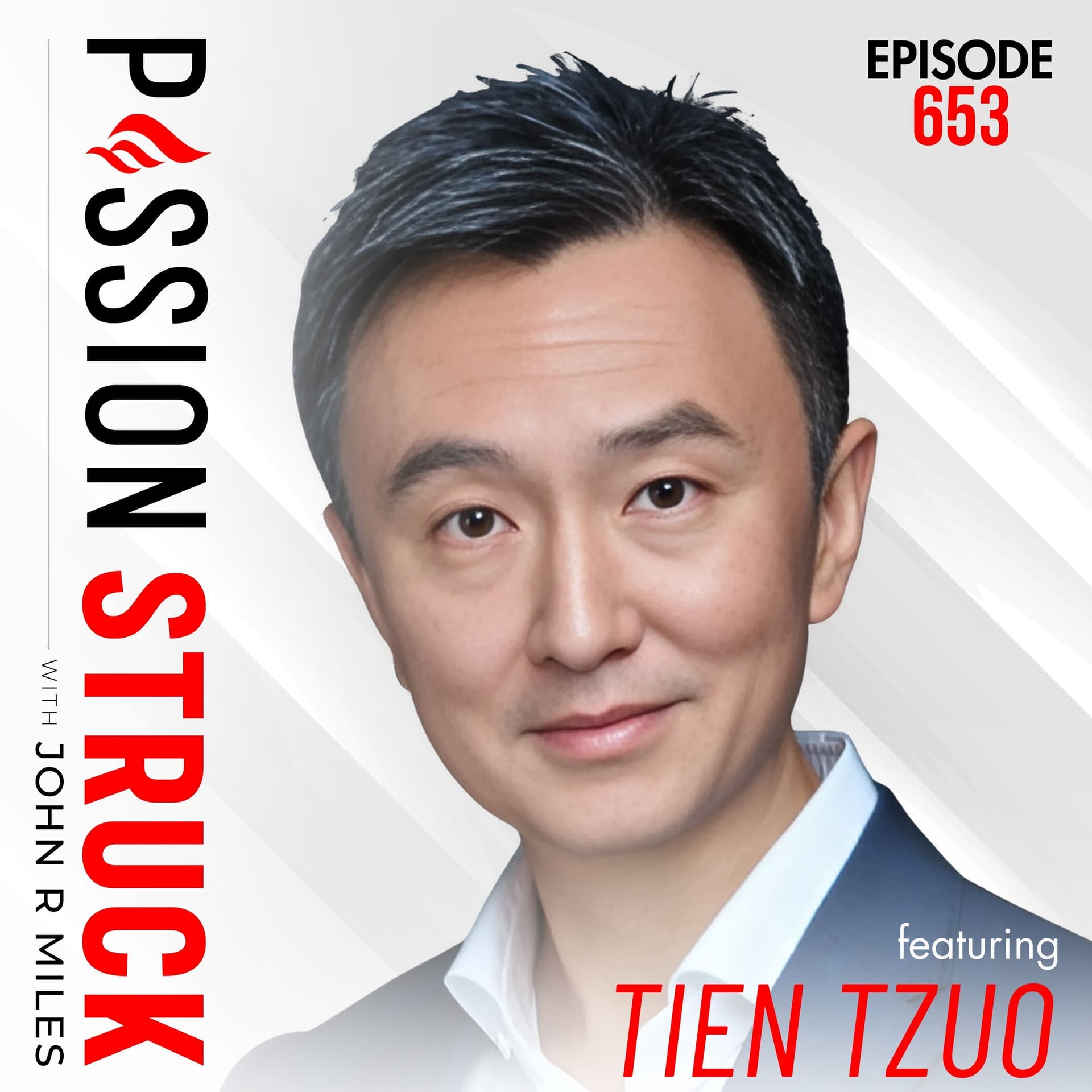
Podcast Summary: Passion Struck with John R. Miles - Episode 653
Episode Title
Tien Tzuo on Why Agility Is the Key to Finding Fulfillment
Episode Overview
In this episode, John R. Miles interviews Tien Tzuo, founder and CEO of Zuora, about the concepts of agility, transformation, and purpose in redefining business success and personal fulfillment. The discussion emphasizes the necessity for leaders to prioritize relationships over products and adopt a transformational mindset amidst constant change.
Key Guests
- John R. Miles: Host, bestselling author, and human performance expert.
- Tien Tzuo: Visionary founder and CEO of Zuora, author of *Subscribed* and *Founders, Keepers*, and early architect of Salesforce.
Main Themes and Concepts
Agility and Transformation
- Agility as a Lifelong Practice: Tzuo emphasizes agility not just as a necessity for business operations but as a crucial aspect of personal wellness and fulfillment.
- Leadership Mindset: He advocates for leaders to cultivate a transformational mindset, adapting to changes while prioritizing relationship-building over transactional interactions.
The Role of Founders
- Impact on Culture: Founders have a significant impact on company culture, which directly influences employee motivation and performance.
- Phantom Limb Metaphor: Tzuo discusses how founders often cling to outdated instincts tied to previous versions of their businesses, leading to potential misalignment with current needs.
Leadership Styles
- Three Types of Leadership Archetypes:
- Manager of Execution: Focused on operational discipline; often atypical among founders.
- Relationship Builder: Prioritizes interpersonal connections and team dynamics.
- Visionary and Evangelist: Drives the organization with a strong, strategic vision.
Self-Awareness and Adaptability
- Self-Reflection: Tzuo highlights the importance of self-awareness for founders, enabling them to recognize their strengths and limitations.
- Adaptability: Successful founders are characterized by their ability to adapt to changing circumstances and work collaboratively with their teams.
Key Takeaways
- Relationship over Product: The future of business success lies in building meaningful relationships rather than merely focusing on products.
- Iterative Transformation: Change is not linear; it involves ongoing adaptations and a willingness to learn and evolve.
- Culture vs. Strategy: Culture drives behavior within organizations and must align closely with strategy for effective execution.
- The Importance of Systems: Establishing operational systems is crucial as companies scale to ensure efficiency and clarity in roles.
Conclusion
This episode encourages listeners to rethink their approach to leadership, emphasizing the need for agility, self-awareness, and a focus on relationships in achieving both business success and personal fulfillment. Tzuo’s insights serve as a guide for embracing the complexities of leadership in a fast-evolving landscape.
---
Additional Resources
- Visit Tien Tzuo's Website: [Founders Keepers](http://www.founders-keepers.com)
- Subscribe to The Ignited Life: [The Ignited Life Substack](https://www.theignitedlife.net/)
- Full Episode on YouTube: [Passion Struck Channel](https://www.youtube.com/@JohnRMiles)
Upcoming Episode
Next, John R. Miles will host Jodi Blanco for a conversation on resilience and self-discovery.
---
Call to Action
If you found value in this episode, please consider leaving a review on Apple or Spotify to help spread the word and grow the Passion Struck community!
Written by AI. May contain mistakes. Listen to the episode to check what was said.
Transcript
Automatic transcript. May contain errors.0:00Coming up next on PassionStruck. What I've really learned is you have to understand people for who they are. You got to have to understand what motivates them. And if you can create an environment that creates the right motivation, then people will put their heart and souls into the company. And look, not everyone's going to be aligned to what you want to create. But how do you create an environment that allows people to bring their best selves? How do you create a vision that inspires them to say, hey, this is something I want to work towards? and then how do you give them the freedom to really bring the best selves to work, right?
0:36Including understanding that a lot of that freedom is dependent on the coworkers. Welcome to PassionStruck. Hi, I'm your host, John R. Miles. And on the show, we decipher the secrets, tips, and guidance of the world's most inspiring people and turn their wisdom into practical advice for you and those around you. Our mission is to help you unlock the power of intentionality so that you can become the best version of yourself. If you're new to the show, I offer advice and answer listener questions on Fridays. We have long-form interviews the rest of the week with guests ranging from astronauts to authors, CEOs, creators, innovators, scientists, military leaders, visionaries, and athletes.
1:20Now, let's go out there and become passion struck. Welcome back, friends, to episode 653 of PassionStruck, the show where we explore the mindset, science, and strategies that help you live with intention, work with purpose, and unlock your fullest potential. Whether this is your first time joining us or you've been with us from the very beginning, thank you. Your presence here matters. Together, we're building a global movement of thinkers, doers, and changemakers committed to leading with purpose and living intentionally. Before we dive in to today's episode, let's recap some of our recent episodes.
1:55On Tuesday, I sat down with Christopher Wong Mickelson and Jennifer Toste-Karis to unpack one of life's most pressing questions. Is your work worth it? We explored what meaningful work really looks like and how to align careers with values in a culture of burnout. And last Friday in my solo episode, I tackled the exposure gap, the growing distance between the challenges we think we can handle and the challenges real life will inevitably hand us. Both conversations lay the groundwork for today's discussion because at the heart of them all is a central question. How do we thrive in a world of constant change?
2:31My guest today is Teen Su, visionary founder and CEO of Zura, bestselling author of Subscribed and the End of Ownership, and one of the leading voices behind the subscription economy. Teen helped scale Salesforce in its earliest days with Mark Benioff and Parker Harris before pioneering a business revolution centered not on products, but on relationships. In today's episode, we explore why agility beats control in today's fast-changing world, what the end of ownership really means, and how it's reshaping business and personal identity. We discuss how leaders can balance long-term vision and near-term adaptability, and why the most successful people and companies treat transformation, not as a phase, but as a mindset.
3:12And if you're ready to take this episode a step further, head over to the ignitedlife.net. That's where I share curated playlists like the psychology of success, the inner voice, and the space where you matter, along with tools, reflections, and behind the scenes insights from these conversations. Want to watch the episode? You can find full length interviews, shorts, and exclusive content on our YouTube channels, at John R. Miles and PassionStruck Clips. Want to wear your purpose? Then visit our recently revamped PassionStruck store to explore intention-driven apparel designed to remind you, you matter, live like it.
3:46You can find the link at passionstruck.com. Now let's dive into this mind-shifting conversation. Thank you for choosing PassionStruck and choosing me to be your host and guide on your journey to creating an intentional life. Now, let that journey begin.
4:01Hey friends, it's the beginning of 2026, and if you're like me, you didn't come into this year to coast. You came to live with purpose, to show up with energy, clarity, and intention. That's why how you start your day matters. And for me, that starts with Huel. Every morning, I reach for two things. First, Huel Daily Greens ready to drink. The peach and hibiscus flavor is crisp and refreshing. with 42 superfoods, vitamins, and minerals, all in just 25 calories and one gram of sugar. Then I turned to Huel Black Edition ready to drink. With 35 grams of protein, 27 essential nutrients, and no junk, it's a full meal that fuels focus, not fatigue.
4:40I start with Huel because I want to be present, intentional, and ready. Not just today, but every day. Start 2026 likey minute. Grab Huel today with my exclusive offer of 15 % off online with my code PASSION15 at Huel.com slash PASSION15. New customers only. Thank you to Huel for partnering and supporting our show.
5:06I am so excited today to have my friend, Tin Zou on Passionstruck. How are you today, Tin? Good to see you, John. Good to see you. Glad we can talk. I have to tell you, it's been almost 17 years We've known each other now, and we met under kind of a pressure-baked situation. At the time, I was a CIO at Dell, and to give the audience some appreciation of the dynamics that were going on, we were the largest customer of Oracle at the time, and my boss had signed, our predecessor had signed this mega deal with Oracle, and we were putting in this solution called Cash to Collect. And I came to the conclusion that given the new direction, the way the business was going, that after we had installed this whole thing globally, it wasn't going to meet our customers' needs.
6:04And so I had this controversial opinion that we needed to do something completely different. And so we ended up surrounding ourselves with Salesforce and then plugged you in as the major vendor for subscription billing. And at the time you were a tiny startup. And I think Dell was probably your largest client at the time by far. And so to have to bring you in on that environment where it was, we cannot fail at any cost, it was kind of an interesting environment for you to walk into. What are your memories of those times? It was pretty intense. Certainly we started the company, and this is very early with primarily working with other startups, right?
6:48Some of the companies we work with like Zoom and Box are gigantic companies today. But at the time they were doing single digit, double digit million dollars, 1 million, 3 million, 30 million. But I do remember that Dell was going through saying, hey, we want to go beyond just selling PCs and we'll continue selling quite a bit of those, but let's try selling software. And given the software is moving into software as a service, let's see if we can be inspired by these other software as a service companies. And you did give us a chance. You did give us a chance and it was definitely a pressure situation, but the advantage of sometimes of being a startup and then being a founder of a startup is you can move quickly, you can move fast and you can direct resources.
7:33And we worked really closely with your team and I think was one of the fastest cool lives that you all had experienced and hopefully in hindsight, a successful project. Well, I remember after I had left, I got a call from our CFO Gladden, and he was not a supporter of moving. Yeah, he was very risk averse, very risk averse. Yeah. And I remember after I had left, I got a call from Andy Karabusta, who had taken my position, and she said, you're not going to believe what happened in this meeting. Gladden actually stood in front of everyone and said, Miles had it right all along and we should have listened because we were spending like 125 millions a year trying to roll out this Oracle solution.
8:19It was going to take six or seven years where we were able to get this alternative solution up in well under a year and in a fraction of the cost. So I think it shows the ability to be a visionary leader, but that it comes with risks, as all things do. I know, look, we're here to talk really about the new book and founders and startups and that whole psychology. And the story really does bring it home. We certainly saw that what Dell was trying to do at the time was to do a series of acquisitions. You find it funny, I was just talking to some of the folks over at Boomi that ultimately did its turn inside of Dell.
8:59And it was just the pace of the existing infrastructure was not really built for an environment where a company of Dell size would be doing six, seven, eight acquisitions a year and just didn't give Dell the agility. And founders tend to have an ability to see those opportunities and take a leap of faith and get customers and employees and investors to take that leap of faith with them. And I don't want to take credit. I think your vision at Dell certainly was really important. But I think that story of saying how a startup can go and displace a large incumbent like Oracle, I think it is ultimately what founders really dream of.
9:34Thank you for giving us the opportunity to. Well, and look at where the company has gone since then. So I'm just excited for you and all that you've accomplished. And as you mentioned, today we're talking about your new book, Founders Keepers, Why Founders Are Built to Fail and What It Takes to Succeed. And why did you think now was the right time for this book to come out? Well, it's probably two dimensions. Part of it certainly is personal. I've been working with Rich Hagberg, my coach, for the better part of 15 years. And I credit Rich a lot with my ability to break through some fundamental flaws that are built into that founder character, right?
10:16Everything has two sides, if you will. So the same energy and vision and risk-taking that allows founders to do what we do can actually trip us up as the company scales and grows. And so Rich was a critical person to help me work through some of those things. And Rich has a very specific framework that's data-driven. And so we just started looking at the data. He's got a data about thousands and thousands of executives and close to 200 founders. And we kept the names anonymous, but some of these are the folks that you would know, right, and read about in the press. And so we were able to really tap into that data to find patterns.
10:52And look, part of it was saying, hey, this is certainly very therapeutic in terms of seeing myself in some of the data. But what we found was this wasn't necessarily unique to me. This was unique to the founders as a species, if you will. The second thing is on an external basis, you hear it all the time, right? We hear all these stories in the book starts off with a count of how many people on the Forbes 30 under 30 list actually want to be convicted for a crime. And you just see stories of founders blowing up. There's HBO specials being created of founders blowing up. And so I think given where the world is going, I certainly believe we continue to need innovation.
11:34We continue to need the spark that founders bring. But if we can tame it and really direct it towards positive ways, I think it could be a really powerful thing. so in the book you use a number of metaphors which i love one of them that you talk about is that founders have a phantom limb the old company that doesn't exist anymore but they try to run when did you realize your instincts were wired for an earlier version of your business and how did you begin to catch up to the company you had actually built in hindsight the data is all there right and the question is as the founders can you really spot it so this would be three four years into the company probably we were successful with what you did with us at dell whether it was feedback from we did a culture survey from employees where there's hallway conversations whether it's what the board was trying to tell me what the executives were trying to tell me there's a sense and when i talk to earlier stage founders sometimes i see them i see them go through that I can pick it up in their eyes.
12:37And there's a sense that the company is starting to fray at the seams, right? That the wheels are starting to come off the bus, if you will. For us, the feedback was, hey, we used to have a fantastic culture. And now all of a sudden, we've lost our culture, right? We don't really know what our values are anymore. It seems like management is in an ivory tower, and they don't really know what's going on anymore. We seem very uncoordinated, right? The left hand doesn't really know what the right hand is doing. And the problem with that is when you hear these things, the founder instinct is to take greater control of things, right?
13:13That's really what allows you to power your way through the initial product market fit. And what you find is the more control you try to exert on the system, the more it actually starts to fray. And so through conversations with the rich, this is when, you know, the stories in the book when Peter Fenton, the venture capitalist that funded us from Benchmark Capital, Benchmark Partners, really introduced me to Rich. And that was a journey of self-discovery to really see my personalities, the decisions I was making, and the way I was leading was actually a big contributing factor to what we were experiencing as a company.
13:54To go on with that, you say that one of the hardest moments in any founder's journey is realizing when the company starts to outgrow their own instincts. What was one instinct that you had to unlearn as you were going through this process and getting mentored in order to lead at scale? Well, I mean, there can be countless. In the early stages as a founder, you're so close to the problem, right? There's only a few customers. You're in the technology. You might even be coding the solution. You're talking to the customers. You know what every employee is thinking. And so you can almost run based on instinct.
14:31But once again, we were about 150, 200 employees by the time I was experiencing this. You can't really know what's going on anymore, right? You don't have a necessarily a visceral sense. You don't know every single customer situation. I certainly threw myself into our Dell implementation, but we had a lot of customers by then. And so you have to really allow the organization to start making decisions. Right. You have to start, let the organization and make sure information from one part of the organization flows to another. So it could be anything from pricing. Right. I would just go with my gut.
15:08And a lot of our folks are coming back saying, look, I think we're pricing the product wrong. I think in these situations, we can price it higher. In these situations, we can price it lower. In these situations, you actually a higher price actually drives a stronger customer commitment that allows us to get through the deployment process. because we're all in the boat together, right? And so they have all these subtle information that they have. And what I found was, again, as a founder, you tend to question everything. You're in meetings. Your mind is just trying to understand the scope of the problem.
15:42You step into it and everyone winds up looking at you and saying, well, look, we're just going to wait until you make a decision. But you might not be the best person to really make that decision. And all of a sudden, the feedback comes back that the founders can be very indecisive, which is odd because founders certainly took the leap. And the risk-taking, that decision-making actually causes them to make rash decisions. But when they don't have all the information anymore, they slow down their decision-making. The rest of the company is still looking to them to make decisions. And that's where things, that's a good example of where things really start to get bogged down.
16:17It reminds me of when I was at Lowe's before I was at Dell, we were purchasing a new warehouse management solution for some of our facilities. And this was a new startup SaaS company. And they came in with their bid and it may be the only time I've ever done this in my career, but we actually told them that they bid it too low and we offered an additional 25 % on top of their bid. And the reason I did that, which listeners might think is crazy, is we didn't want them to go out of business. We didn't want them to get to a point where they were spending as much as we knew that they were going to have to invest and not have the capital to keep going with the project.
17:01So to us, it made sense to support a new partner like that when we knew we were going to be the biggest fish in their pond to ensure that we not only got the service we needed, but that we were going to help fund their growth so that they would be along in the future. Because you never know with these startups, if they're going to be able to get over that hump. And I think all the founders that might be listening, all the startup founders are hearing this and saying, gosh, we wish we had more customers like John. It's to create that win-win situation is really what founders are after. It's interesting.
17:40Last year, I got to interview Gary Vaynerchuk. And I remember when Gary first started to speak, he used to talk about, you need speed. I remember him saying that all the time. You need to be fast. You need to be quick. You need to be experimenting. And then I remember he started to switch his dialogue to trade urgency for patients, which is something that you talk about. Was there a particular moment when going slower for you actually led to better decisions or deeper growth? It's an age-old tension, right? Certainly, if you look at what's going on in tech right now, there's a force called AI that every company is trying to wrestle with.
18:20And so that sense of urgency is certainly there. The question really is, how do you balance that, right? It's an age-old tension of saying, if I get too involved in that, a company slows down, but you don't want to completely disengage. And that tension is really a key theme in the book, even for places like how do we hold executives accountable? Right. That's something that founders struggle with all the time. And they tend to be on either extreme. They tend to be micromanaging the people that they're hiring because they want to be in all the details or they say, OK, you've got this and I don't even think about you anymore.
18:53And that can be a problem as well. And so that whole tension of trying to find the right balance is really key. And I say, listen to Gary, there are times where you really want to move fast. And there are times where you have to learn patience and let the organization, give the organization time and space to learn and to develop. And so when I talk to like earlier stage or younger founders, I'll ask them, like, is there a time where you actually do disengage from the company? Perhaps once a quarter, you can actually go on a retreat or just go on the road. If you're a B2B SaaS company and you're working with large companies, go on the road and just spend time with customers.
19:31Get out of the office. Let the executives do their thing. Check back in in two weeks, four weeks, set a date and go do your thing. Be available. We founders are always 24 by 7. But find techniques and find rhythms in how you manage the company that allow you to find really that balance. So you lay out three different types of leadership archetypes, the manager of execution, the relationship builder, and the visionary and evangelist. Why is it that the manager of execution archetype is so atypical among founders? Well, you talk about these three archetypes, maybe just a couple of minutes on that.
20:12What we really try to do in the book to make it different from other books is it's very data driven. And so, again, we had data. So Rich has a what I'll call a framework of leadership that has 46 specific leadership competencies. And he's developed this over the decades at all sorts of companies, large companies, small companies, media supplies, companies, technology companies, biotech companies, service companies, really all sorts of organizations. So it's a great generic framework for leadership. and over the last 15 years or so, I think I was the second founder that he worked with. He's been applying that framework to founders and so we started the project really looking at the data, understanding and the last thing is he actually collects information on personality about 100 or something, maybe 130, 140 personality attributes of who you are and in working with rich, you first take a self-assessment that identifies your personality traits.
21:12And then you do a 360 process where the board, your executives, your investors, you try to get about 20 people, all provide feedback of what are you like as a leader. And the last thing we threw into the data was some measure of success measured by multiple invested capital as a measure of success. And so we're able to skis apart what makes a founder different than a traditional non-founder executive, a good leader. And then what makes unsuccessful founders different from successful founders, right? Just tease it apart. So you can imagine one source of one audience that really wanted to get their hands on the book.
21:49We're the venture capitalists, right? We're betting millions of dollars of capital on this person. And how do we know? Is there any way to predict or to see the trends of, is this going to be a founder that's going to last a test of time and create hundreds of billions of dollars of value? Or is this a founder that's going to blow up once a company's at scale? And let's see if we can diffuse a time bomb and help them really last the test of time. Now, what the research shows you is that leadership competencies come in clusters, right? If you're good at this competency, you tend to be good at overall at this cluster.
22:22And when you looked at the cluster, which is the three leadership styles, that people either lead by vision. So think of Steve Jobs as your prototypical founder that leads by vision or a leader that leads by vision. They lead by execution. So think about Jack Welch, right? As a person that knows the numbers based execution always delivers a train on time or then lead by relationship. And so in the tech fact sector, probably John Chambers or Meg Whitman is often described as people will follow them to the ends of the earth because of the relationship skills and that they loyalty that they're able to generate from that.
22:57And so founders, unsurprisingly, index very strongly on vision. And what you find is some of the founders that we work with really started their company early. They hadn't seen scale before. They don't necessarily appreciate execution. They see a whole execution processes as systems, as bureaucratic. There's a part of them that wanted to rip it down in the first place, right, which is what inspired them to create the thing that they created. And so a big part of the journey is to help founders understand, look, once you get to scale, if you don't have the right systems, and yeah, don't put in systems that are more appropriate for a larger company and slow people down, but systems actually help you run faster.
23:42Systems help people understand, this is my role, this is how I fit, right? These are my dependencies. And just like you need to know what your role is on a team, right? And to reframe systems as a way to help the organization run faster is often what Rich tries to do to help founders appreciate the importance of having systems. So for the audience who is unaware of your background, before you founded Xura, you were one of the first 15 employees at Salesforce, if I have my numbers correct. And you got to work very closely with Mark Benioff, who most people probably recognize the name and Parker Harris, who some might not recognize Parker's name quite as much, but he played just as pivotal a role.
24:30When you think of these archetypes, how would you describe Mark and how would you describe Parker and why did the combination of those two together work so well? That's a great question. Look, Mark is clearly a visionary. And so he is probably a classic founder that indexes very strong on vision. Again, these are the specific competencies. If you look at the specific competencies under vision, which whether it's to be able to create meaning, the ability to tell a great story, to strategic vision, being received around corners, right? These are all aspects of skills that visionaries often have.
25:07Mark index is incredibly high in all these things. And if anything, he was an inspiration to me and certainly a source that I try to learn from. And look, I remember conversations with Mark where he actually really looked up the Steve Jobs and saw Steve as the ultimate visionary, if you will. But I think what you get at is Mark also knew how to surround himself with strong execution-oriented folks. And Parker was certainly one of those, right? Parker's really kept the trains running. Parker knew how to hire. Parker knew how to deliver on time. Parker knew how to build systems and hire people to build systems around whether it's testing or development processes.
25:43I remember Parker also had his growth. And we were probably about 100 developers plus product managers at the time. And he was running systems that was, I wonder if he'll hear this, right? That was more appropriate for a smaller company when he had control of everything. And I remember folks like Chris Fry would come to him and say, look, you really want to rebuild the systems using this agile methodology, using a scrum team and retrospectives. And to Parker's credit, Parker really listened and gave people room to do that and really break through some of the size and scale limitations we were starting to experience.
Read the full transcript
26:20And even Parker has a level of self-awareness to know, hey, what are the things that I'm doing and at different points in the company scale, how do I evolve to have a different set of leadership or build a new set of leadership competencies that are more appropriate for companies at that scale? But to your point, the combination of Parker and Mark certainly was really important. Similarities on the go-to-market side. Again, I'll cite some of the early days. Frank Viedendahl was another executive that was very operationally centric, really knew how to build systems, really knew how to create roles, as well as keep their team motivated.
26:55So I'd say Frank was probably in a strong execution, strong relationship type of leader, probably a little more towards execution. But Mark really knew how to surround himself with complementary folks that can really take his vision and drive it at scale. One of the things that always impressed me about Salesforce was for a very long time, the core team stayed in place, which in many cases, people leave far sooner than a lot of the executives did who were on Mark's executive team. So that continuity for me was something that I always really cherished about Salesforce because you're not always going to be able to pick up the phone and get Mark, but it was nice to have relationships with so many execs.
27:40And those relationships helped us get things done as the company was going through pain. One of the other things, because I got to travel a lot with Mark, is that he was really a workaholic. and you write that most founders assume people will work the way that they do. And I think a lot of founders are like Mark. They become workaholics. They pour every ounce of energy they have into the company. But you can't expect the people who work for you to work that same way. I found the same thing when I was a senior exec. So when did you realize that people weren't going to do that? and what changes did you have to make yourself to get over that hump?
28:27And how did you get more people, I guess as a secondary question, to get the energy that you had and the love that you had for the company so that they would pour more into it? That's a really great question. Look, I was there in the early days of Salesforce. I'd say probably we were all workaholics. A lot of decisions were made over email. at 9, 10, 11 PM. And look, I think that maybe a few dimensions to that question. I think founders are 24 by seven, but I think good founders find balance. And Rich, my coauthor just wrote a post about the founder burnout. And I have seen this when I coach or mentor younger founders, and I do counsel that they find space.
29:14Mark was really good at that. and you could tell Mark was 24 by seven, but Mark would go off to Hawaii and he didn't even have the compound then. It was just an apartment in Hawaii and really find the time and space, right. To give the right perspective, to let the company run and, and to find the balance that he has. Mark has a number of other interests as well. Right. And so the balance is really important when you're 24 by seven. And so I don't know that, you know, that framing founders as workaholic is necessarily the right thing. It's got a bit of a judgment in it, but look, this is our inspiration.
29:53This is what we do. This gives us energy, if you will, but finding the balance and being able to recharge and otherwise you're just going to drive your people crazy. And I've had situations where I've told executives, look, take your founder and just send them on the road. Just kick them out of the office for a week or two. The other aspect is, if your question is, Is it fair to expect that mindset from everybody? And I think ultimately what you learn as a founder is everybody is different. True confessions, right? My leadership style, John, was high vision. It was medium execution because I think I started my company maybe after having had a career at Salesforce and Oracle and other places.
30:29And so I saw execution. I saw systems. I saw mature companies at scale, but I ended up really low on relationship. and so the journey with rich often has been to really understand those leadership skills whether it's building relationships or listening or being open to input and and what i've really learned is you have to understand people for who they are you got to have to understand what motivates them and if you can create an environment that creates the right motivation then people will put their heart and souls into the company. And look, not everyone's going to be aligned to what you want to create, but how do you create an environment that allows people to bring their best selves?
31:13How do you create a vision that inspires them to say, hey, this is something I want to work towards? And then how do you give them the freedom to really bring the best selves to work, right? Including understanding that a lot of that freedom is dependent on their co-workers. So how do you create an environment where the collaboration with coworkers is strong, but you can still have hard dialogue when you're in the trenches trying to figure out what it is that we should be doing? And so that's a tricky balance, certainly. But if you can create that and it's work that you constantly have to work at, then hopefully a good culture really emerges from that environment.
31:53I remember after I left Dell, I was doing interviews with some private equity firms that I would later join. And I remember I was talking to one of the partners and he asked me this question, how would you describe your leadership style? And I told him that it was situational. At the time, I was really a servant leader. But the reason I picked that answer was because of something that you just said, and that is every single employee who works for you is different. They have a different motivational system that you have to understand to get them to do what you want them to output. it. And so I said it was situational because depending on what is going on, the situation determines a different type of leadership.
32:41And the situation is also different for every person that you interact with. And for me, that was one of the hardest things for me to learn was I used to try to do a one size fits all leadership approach. And I learned it really doesn't work. You really have to, if you want to motivate people the right way, you have to approach each one of them for their inner strengths. Did you find the same thing? I would suspect, John, that you probably had a great intuitive feel for what people were like. And that might be more of a skill that I really had to work on it and learn. But yeah, absolutely. One of the core lessons of the book and of the coaching is you cannot scale as an individual.
33:26You can only get your idea so far. And so if you want your idea to have the biggest impact on the world and have a chance to really grow with it, you've got to learn a whole set of skills. And ultimately, the reason there's three pillars is all three pillars are necessary. You have to have vision and be a bit of a set direction. You have to have relationship skills to create a bunch of folks that will follow you on the journey. And then you've got to deliver, right? And delivering ultimately requires the execution skills. All month long in July, we're doing a series on the power to do more. And it's really about how do you change?
34:06And this is something that Rich introduces when he explores the idea of cognitive reframing, which is really shifting your inner story so that you drive better outer results. When did you realize the importance of this cognitive of reframing and that this inner awareness really drives the better results that you want. You try to prescribe techniques that are appropriate for the person. And what I try to bring it to in talking to founders is to bring it back to their fundamental nature. So founders are very able to discard status quo and drive change. And so if you can bring that skill set to yourself and your own leadership styles, then that might help you tap into how to overcome the, what we call the ticking time bomb or how to diffuse that time bomb.
35:06And so one thing I do try to practice and I coach other founders on is to say, look, whether it's once a quarter, it's probably more like once a year, right? Take out a blank sheet paper and try to redefine your roles and do your founder thing. Extrapolate this as if this is the current situation, the company's this large, we have these competitive forces, these are the things that we have to accomplish, then what does the organization need to do? And then how do I really help the organization? And that's the key framing is to say, how does the organization do that versus how do you do it? And then how do you as a founder, what is your specific role in helping the organization, shape the organization to do what they need to do.
35:49And so this year, perhaps I need to help the organization figure out the strategy. So let me go create a set of systems and processes that help us do that. Or this year, what I really need to do is I really need to get on the road and evangelize, right? I am the best evangelist and we're helping the company see a new Zora or a new Dell or whatever it happens to be. But that whole process is, well, that's what you're really good at. You're really good at taking a blank sheet of paper, starting from fundamental principles that feeds into your creative energy, but channel that in a positive way and channel that really on yourself.
36:24And I find the same thing with that execution. A lot of founders tend to be product centric or some of them are engineers. And so you understand software, you understand tech, you understand how tech comes together as an overall system, how the different pieces of the software architecture fit together. Well, why not apply the same skillset to look at organizations and understand what are the ways that you want to put the organization together, if you will, in a cohesive whole. And then what are the systems that you have to build so that this part of the organization, this part of the system is able to coordinate well with this part of the system.
36:58And so again, just trying to tap into what I see founders really good at and allowing them to apply those same skill sets and shaping themselves as leaders in their organizations. So I wanted to talk about blind spots for a second. I have coached a lot of founders. And one of the common problems that I have found is that one of the most common blind spots that founders have is they don't know what they don't know. And a lot of them get into this motion that they seem to know everything. And outside advisors try to give them advice. And I realize that advice is what it is, but sometimes that advice gets ignored when it could really help drive the company forward.
37:46What do you suggest for a founder who you come across who feels like they're a know-it-all and is resistant to take advice that could move them forward and it ends up costing them a lot of the momentum and potentially the breakthroughs that they would have had they been more open to outside feedback? If you simplify the book down, it really comes in three sections. The first section is about what makes a founder. We contrast that with non-founders and really bring out the aspects of their personality. The second part of the book really looks at what makes a successful founder different than an unsuccessful founder.
38:25And we found really five key traits. And we found that, again, this is really delving into the data, if you will. We found that successful founders are more adaptable. Successful founders really learn how to work through others. Successful founders learn how to execute at scale. Successful grounders are personally grounded. They have a grounding that allows them to be the rock in the stream, if you will. But most importantly, and this is an attribute that cuts across everything else, there's a level of self-awareness that successful founders demonstrate that allow them to work on themselves. Right.
39:00And that was the key thing, because without that, it's hard to progress. And so the first phase of a coaching session that Rich does is to help them understand that, is to help develop a level of self-awareness. And this is why the data is so important. Founders respond to data. This is what the data shows of this is who you are. This is your personality. And let me trace why that leads to the feedback that you're getting in terms of the pluses and minuses of your leadership style. We also then boil it down to say, OK, if you know that, then out of the 46 competencies, these are the 10, right?
39:35These are the 10 that come up repeatedly in terms of the biggest gaps. what investors and the board member wants to see more of founders that they tend not to be good at. And then there's specific techniques of how to do that. And so to your question, there's a whole chapter on how to build a strategic planning process. And those words, right, are like, you know, founders shudder and run away from those words. But what, and there's a story there of how I learned what a strategic planning process looked like really by spending some time with a really successful executive. In this case, it was the ex-CEO of Intuit, Brad Smith.
40:13He actually took the time out to describe over multiple sessions what his strategic planning process was like. And I just, my initial instinct was, well, Intuit's so big, they're like 50 times bigger than us. How could this possibly apply? But again, as a founder, you're able to just really listen to all that, deconstruct it, right? And then rebuild it back up in the context of what we sit in. And so we really morphed from a strategic planning process of, it used to just be two-day off-site in December, which was really just a budgeting process. So actually a six-month planning cycle that creates much better alignment, much better being in touch with the big issues that we were facing as an organization, either internally or externally, but more importantly, getting people to buy into what those things are.
41:01And so the more you do, the more you realize that you don't have all the answers, that you hired all these folks, you've got a great intuition, you can help people glean insight as to whether the decision maker, what they're missing in their decision making process. But you've hired some great folks, you built the company, and you really want to allow them to scale in the organization. If you don't let them do that, they're not going to stay in the organization. And so there are specific techniques in there, either on a system level with strategic planning processes or on a personal level with developing your level of self-awareness that really help founders see ultimately, hopefully, the limitations that they have.
41:41I got to interview Brad about six or seven years ago. I was introduced to him by Keith Crotch. And when you look at what he accomplished at Intuit, it is really remarkable how much he transformed that company. And everything I've ever heard about Brad, everyone I met who knew him talked about just how great a mentor he was. Did you find that true in your relationship with him? And he was incredibly generous with his time. He's busy running a university these days. And so it's harder to get his time. But what I loved about Brad was everything we wrestled with, he would have a framework. He would have a system.
42:21He would say, okay, got it. Hey, here's what we actually did. And here are the tools and techniques and frameworks and mental models. And so it was something that, again, as a founder, I really appreciated it because it gave me a set of tools and give me a set of things to think about that I could actually bring it to my company. And so he's an amazing leader, amazing mentor, and a debt of gratitude. So, Tien, in the book you write, a famous Peter Drucker line is that culture eats strategy for breakfast, but that assumes that culture and strategy are mutually exclusive. Why is this simply not true?
42:58I think that was a chapter on culture and understanding how important it is. Look, I think there's two views. I think they're both valid. But certainly the view that we were trying to get across is you can put the best strategy together in the world. But if you're going to get an organization to tackle this, the culture ultimately drives the behavior of your organization, especially when you're not in the room, right? And you can't be in all places at all times. And so that becomes really important. I had a Stanford professor Bergman that also probably showed these things more as a rubber band, which is, I think, more realistically what it is.
43:32And so culture and strategy have to have an alignment. And at times, they can be separated. But how do you build the forces of a rubber band to keep them constantly aligned so they don't stretch too far apart? And when they do, they get pulled back together into alignment. And Bergman applies that to about five or six different forces and shows a diagram of how they're all linked together through rubber bands. It's probably a little bit more realistic or more of a map of what reality is like. But certainly, look, we're not trying to spark the debate of what's more important. We're really trying to spark the debate that both, you have to focus on both.
44:07You have to have the right strategy. You have to have the people that are able to execute the strategy. And you have to build the systems that allow your organization to truly scale. And one of the things about those systems and processes is that you write that they're often invisible until they fail. What finally convinced you that scaling required more than hustle and that you needed that operational discipline just as much as you needed product vision? Over time, I probably developed a way of thinking about this. Again, as a founder, I'm trying to seek the system as a product-oriented founder.
44:40And so when I looked at, when I brought that mindset to tackle organizations, what I really saw was, again, it's pretty simple. It's organizational size. and what I saw was that layers of management has a big impact on the type of systems that you need within an organization and by systems I'm talking about communication systems decision making systems the type of meetings that you have who's working with whom roles responsibilities things like that and so what I saw was if you just assume that on average a manager has seven direct reports then a one layer system is just one person. A two layer system is eight people.
45:22A three layer system goes up to about 57, right? And a four layer system actually goes up to 400. It's like an exact number, 400. And so what I find is, okay, in between those numbers are really when your company is evolving and adding a layer of management. And look, you can say, I want the number eight instead of seven and number 10 instead of seven, whatever it happens to be. But that simple model allows you to say, okay, at different points, if I'm more dominated by managers or if my direct reports, for example, are really second layer management, then the systems that I need and the teaming that I need of how I run my leadership team has to be very different.
46:04If I'm only 30 people and my direct reports are just running the individual contributors directly. And so what I try to show is at every level of scale, when a new layer of management has to be brought into the company, take a step back, bring that spirit of reinvention. And so, for example, we used to do, this is me talking to a founder, if you used to do weekly all hands, at some point, that might not be very helpful. You want to move to monthly all hands. At some point, you want to move to quarterly all hands. How you run your leadership meetings every single week for a two-layer organization versus three-layer organization versus a four-layer organization is very different.
46:44How you keep in touch with what's going on at the individual contributor level is going to be very different whether you have two, three, or four layers of management in between you. And so just really seeing that and then being open to rebuilding those systems, right, as the company breaks through those levels of scale, it's just a simple framework that I use to help understand my company and that I share with earlier stage founders as they go through those similar breakpoints. And then lastly, Tien, I just wanted to ask you a couple lightning round questions. Just whatever comes off the top of your mind.
47:20What's one trait every founder underestimates in themselves? What is one trait? I'd say the impact that they have on the people that work for them. And it's something that it truly might not understand intellectually, but to really understand that, hey, you've got a really outsized impact on the company. And that requires you to really think through what that impact should be. Okay. And then lastly, one book that changed how you lead. there's quite a bit but i would say maybe going back to the principles of the book there's patterns and certainly but every founder is going to have a different set of things that they should be working on and when i realized that teamwork building teams was one of the top skill sets out of rich's 46 skill sets that i really had to work on as a good founder i just started eating into the available literature to help myself understand this and i'd say there's two books that ultimately made a big difference to me.
48:28One was The Five Dysfunctions of Team. To an certain extent, Death by Meeting, which I thought was completely different than it actually is, was really important. And the second one was probably a lesser known book called Teamwork. I'm trying to remember the full title, but it's called Teamwork if you go to Amazon, but it's more of a research book about the eight properties of effective teams. It's a little light on the techniques you do within those eight properties. But the eight properties have since been a checklist that I actually apply when I look at how teams are operating inside of Zora to say, hey, is this team really set up for success?
49:06But for me, it was a journey of understanding how teams work. Well, Tien, it was such an honor to have you today on the program. Where's the best place for listeners to go to learn the most about you? Well, we just set up our website, www.founders-keepers. dot com. But it's a place where we will keep things up to book, up to speed on the book. Rich actually has a newsletter on LinkedIn called Founders Keepers as well that I recommend, highly recommend for people to subscribe to. But read the book and feel free to reach out to me over LinkedIn or whatever technique you have. And I'd love to hear more about what you think.
49:43Thank you so much for joining us again. And congratulations on this latest book and your many that I think are going to be coming out from you, including the ones you've written. And thanks again for coming on. Thanks for having me. It was fun. It was fun. That's a wrap on today's conversation with Teen Zoe. And I hope it left you rethinking what it truly means to lead, evolve, and create in a world of constant change. Here are a few powerful reminders from today's episode. Teen reminds us that transformation isn't linear. It's iterative. The future belongs to those who build relationships, not just products.
50:17And true agility starts with mindset, being willing to question what you've outgrown and step boldly into what's next. If today's episode stuck a chord with you, I'd love for you to take 30 seconds to leave a five-star review on Apple or Spotify. It's the best way to help more people discover this movement. Want to go deeper? Join me at the ignitedlife.net for weekly insights, curated episode playlists, and exclusive tools that help you live intentionally. Explore our YouTube channels, John R. Miles and PassionStruck clips for full episodes, video shorts, and behind the scenes moments. And visit our PassionStruck store to wear what matters most.
50:51and remind yourself daily that you were made to live with purpose. Coming up next on Passion Struck, I'm joined by Jodi Blanco for a powerful conversation on resilience, self-discovery, and what it means to thrive after profound challenges. I think we can all relate to knowing what it feels like when you have to look in the mirror or look at that stuck point and say, oh, I really don't like the way that feels. I really don't like that I've done that or said that, or that's the pattern that I'm in. And I think we look at that from a place of judgment. And so that creates a whole host of feelings that go with that.
51:28Whether we feel disappointed in ourselves, we feel ashamed, guilt, which I think is also very common. And so it's easier to stay in that stuck point when we don't pull it out, look at it, and address it. We just push it away. Until then, be bold, stay agile, and as always, live life passion-struck. Thank you.
From the publisher
In this Passion Struck episode, I sit down with Tien Tzuo—visionary founder and CEO of Zuora, bestselling author of Subscribed and Founders, Keepers, and one of the early architects of Salesforce—to explore how agility, transformation, and purpose can redefine not just business success but personal fulfillment. Together, we explore why the future belongs to those who prioritize relationships over products, why agility is a lifelong wellness practice, and how leaders can adopt a transformational mindset to thrive in a world of constant change.
Visit this link for the full show notes
Go Deeper: The Ignited Life Substack
If this episode stirred something in you, The Ignited Life is where the transformation continues. Each week, I share behind-the-scenes insights, science-backed tools, and personal reflections to help you turn intention into action.
Subscribe🔗 and get the companion resources delivered straight to your inbox.
Catch more of Tien Tzuo: https://tientzuo.medium.com/
If you liked the show, please leave us a review—it only takes a moment and helps us reach more people! Don’t forget to include your Twitter or Instagram handle so we can thank you personally.
Get the full companion workbook at TheIgnitedLife.net
Full episode on YouTube: https://www.youtube.com/@JohnRMiles
Listen on Apple Podcasts, Spotify, or wherever you get your podcasts
Everyone deserves to feel valued and important. Show it by wearing it: https://startmattering.com/
See Privacy Policy at https://art19.com/privacy and California Privacy Notice at https://art19.com/privacy#do-not-sell-my-info.


