
In short
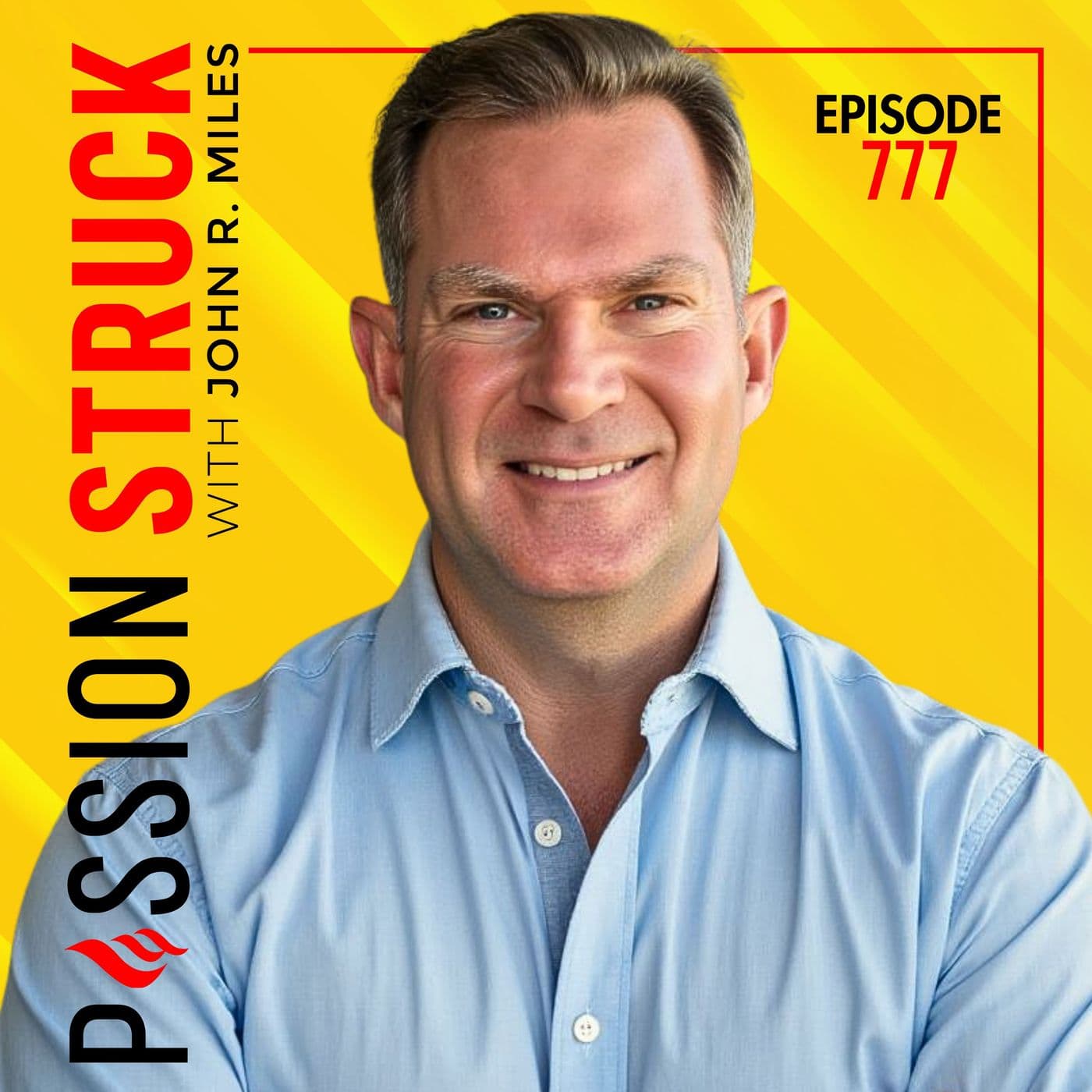
Solo episode (EP 777) arguing that people feel “invisible” in a hyper-connected world because institutions and modern life optimize metrics over human trust, creating a “mattering gap.” It links emotional silence to AI-driven white-collar disruption, indoor living, and over-functioning parenting, then offers a “rescue manual” to retune life through presence.
Guest backgrounds
No guests in this episode. Host John Miles references prior conversations with Eric Ries (Connection Crisis series) and Dr. John LaPuma (indoor epidemic).
Key claims
Scale/abstraction erodes trust; AI and automation trigger survival-mode performance; indoor/digital proximity increases structural isolation; mattering is a frequency tuned by grounding in presence, not proof.
Notable examples
Acoustic shadow at Chancellorsville; “WALL-E” and “Axiom” passengers; John and Mary screens knocked away; dinner-table spectator parent; “pinball” survival loop.
Written by AI. May contain mistakes. Listen to the episode to check what was said.
Chapters
Tap a time to open that second in VOExploring the Connection Crisis
0:00 to 0:27
Discussion on the modern feelings of isolation and the impact of institutional structures.
“It's Bretzky, and America is turning 250.”
Exploring the Connection Crisis
3:15 to 5:32
Discussion on the modern feelings of isolation and the impact of institutional structures.
“On Tuesday, we officially kicked off our brand new series, The Connection Crisis, with Eric Ries.”
The Impact of Institutional Coldness
5:32 to 7:30
Analyzing how large organizations contribute to feelings of disconnection and insecurity.
“Thank you for choosing PassionStruck and choosing me to be your host and guide on your journey to creating an intentional life that matters.”
The Erosion of the Social Contract
7:30 to 9:24
Discussion on the changing expectations in the professional world and its effects.
“Work hard, develop real skills, show up with judgment and expertise, and you'll earn security, visibility, and respect.”
The Indoor Epidemic
9:24 to 10:40
Examining how spending time indoors affects our social interactions and well-being.
“You suppress your creativity and intuition.”
The Burden of Modern Parenting
10:40 to 13:08
Exploring how the pressures of modern life affect parenting and personal identity.
“We cut ourselves off from the casual, spontaneous interactions on the sidewalk.”
The Mattering Gap
13:08 to 14:00
Delving into the emotional impact of feeling undervalued in personal and professional spheres.
“You become emotionally available to absolutely everyone except yourself.”
The Mattering Gap: Understanding Disconnection
14:00 to 18:46
Explore the widening mattering gap affecting modern lives and its implications.
“You have built a beautiful, protective sanctuary for your own household.”
Breaking Free from Reactive Living
18:46 to 24:13
Learn how to transition from a reactive life to one filled with intention and presence.
“Think about how the awakening begins on the axiom.”
Cultivating Genuine Connections
24:13 to 26:06
Understand the importance of authentic human connections and mutual significance.
“You begin to understand that your significance is not a future reward you earn by surviving another chaotic week.”
Show all 11 chapters
Cultivating Genuine Connections
28:26 to 28:42
Understand the importance of authentic human connections and mutual significance.
“You can even get a$30 coin pack for just$10.”
Transcript
Automatic transcript. May contain errors.0:00What's up, everybody? It's Bretzky, and America is turning 250. And I can't think of a better way to celebrate that than playing on an American-owned social casino, SpinQuest.com. With all of your favorite games, live craps, bubble craps, live blackjack, there's no better place to play for free and win real cash prizes. SpinQuest.com. SpinQuest is a free-to-play social casino. Avoid where prohibited. Visit SpinQuest.com for more details. 102 miles ago, the oil light came on. 100 miles ago, you noticed. Now, it's time to head to Take 5. This oil change, fall in love with your car all over again.
0:42In just 10 minutes, your dream technician will check your tire pressure, top off fluids, change your oil, and verify with Carfax exactly what your car really needs. All while keeping you in the driver's seat. Take 5, the stay-in-your-car 10-minute oil change. Save up to 30 % on your next oil change at Take 5. $15 value, valid to participating locations, terms and conditions apply. Coming up next on Passion Struck. During the American Civil War, military commanders frequently noticed something strange called an acoustic shadow. At the Battle of Chancellorsville, an entire Army division sat eating dinner in a sunny clearing.
1:17The woods were quiet. The air was still. Yet, just two miles away, a massive battle was raging. Thousands of men were fighting for their lives. The sound waves bent upward and passed right over them. The soldiers remained in a pocket of perfect, deceptive silence, completely unaware of the chaos unfolding nearby. That acoustic shadow is where many of us are living today. We're in the most hyper-connected era in human history, yet millions of us are trapped in profound emotional silence. The signals of belonging, trust, and intrinsic worth are bending right over our heads. You don't have to be failing to feel invisible.
2:00It's happening to the young professional staring at a screen, watching their career path get rewritten by machines. It's happening to the parent sitting at the kitchen table, over-functioning to hold everything together while their own presence slowly disappears. This is the quiet grief of vanishing in plain sight. And if we want to find our way back, we have to face the great disconnection. Welcome to PassionStruck. I'm your host, John Miles. This is the show where we explore the art of human flourishing and what it truly means to live like it matters. Each week, I sit down with changemakers, creators, scientists, and everyday heroes to decode the human experience and uncover the tools that help us lead with meaning, heal what hurts, and pursue the fullest expression of who we're capable of becoming.
2:52Whether you're designing your future, developing as a leader, or seeking deeper alignment in your life, this show is your invitation to grow with purpose and act with intention. Because the secret to a life of deep purpose, connection, and impact is choosing to live like you matter.
3:14Hello, friends, and welcome back to episode 777 of Passion Struck. On Tuesday, we officially kicked off our brand new series, The Connection Crisis, with Eric Ries. Yesterday, I sat down with Dr. John LaPuma to explore the indoor epidemic and how our disconnection from the natural world is quietly harming our health and relationships. Today, I'm bringing you the first solo episode of the series, written specifically for anyone navigating that quiet, persistent sense of existential vertigo. Over the next few weeks, we're going to explore why so many of us feel isolated from ourselves, from our health, and from each other.
3:54This episode is designed to give you a practical rescue manual, real tools to stop vanishing in plain sight, move beyond self-blame, and step out of the performance traps that are quietly draining your life. This series flows directly from where we've been. Last month in our adversity series, we examined how life breaks us open, the armor we build for survival, and the alchemical fire that reveals who we really are. But stepping out of that forge reveals a hard truth. The modern world we return to is often engineered to optimize us rather than preserve our humanity. If you're a young professional watching the ground shift beneath your career or a parent over-functioning just to keep your household from sliding into chaos, you know this feeling.
4:40You're doing everything right, yet you still feel like you don't fully count. Bringing these forces down to the kitchen tables and home offices where real life happens is the very heartbeat of my upcoming book, The Mattering Effect, releasing October 6, 2026. Before we dive in, if the show has helped you feel less alone or given you language for your unseen battles, I'd be grateful if you'd share this episode with one person who's in the middle of their own messy transition. You can find us on YouTube, and taking just 60 seconds to leave a rating or review on Spotify or Apple Podcasts makes a real difference.
5:14And if you want the accompanying workbook for today's episode to help you map these ideas into your own life, you can grab it at my sub stack at the ignitedlife.net. Today, we're going to look closely at why we feel so erased by the unknown and how we can begin to retune our lives from the inside out. Let's dive in. Thank you for choosing PassionStruck and choosing me to be your host and guide on your journey to creating an intentional life that matters. Now, let that journey begin. Hey guys, Lady Luck here. Are you going on any road trips this summer? I know I'm going to be going on a bunch of road trips.
5:50And being that I'm going to be Passenger Princess, I love playing on SpinQuest.com. SpinQuest has all of my favorite slot games, live blackjack, live craps. Head on over to SpinQuest right now and get yourself a$30 coin pack for just$10. SpinQuest is a free-to-play social casino. Avoid where prohibited. Visit SpendQuest.com for more details.
6:16To understand our growing sense of isolation, we have to look at the institutional structures that shape our daily lives. Massive corporations, healthcare systems, educational institutions, and government bodies wield enormous influence over our security and well-being. Yet they often feel mechanical, distant, and strangely indifferent to our individual humanity. As Eric Ries and I discussed, this coldness isn't usually born from malice. It's the natural consequence of scale and abstraction. When organizations prioritize metrics and optimization over human relationships, people are gradually reduced to data points on a spreadsheet.
6:57This systemic shift slowly erodes trust, the invisible foundation that allows society to function. When the institutions we rely on for livelihood and stability begin serving their own bureaucratic survival instead of the people inside them, we naturally retreat. We grow more cynical. We close our doors. We stop expecting support from the broader community. We're left carrying the weight of modern life largely alone. Nowhere is this more acutely felt today than in the professional world. For generations, we believed in a simple social contract. Work hard, develop real skills, show up with judgment and expertise, and you'll earn security, visibility, and respect.
7:41If you dedicated your mind to a craft, the system would recognize your dedication and provide a stable foundation for your life. That contract is being torn up right in front of us. In Silicon Valley and across the entire knowledge economy, leaders are privately admitting that advancing AI is driving a white-collar reckoning. Frontier models are matching or exceeding human experts in banking, law, consulting, and even medicine. Companies are responding with accelerated layoffs and hiring freezes because they're racing for efficiency. For young professionals, this isn't abstract. It's the exhausting reality of sending hundreds of applications into automated systems and receiving nothing but silence.
8:30It's the sinking feeling every morning, wondering whether the field you poured your education and youth into will even need human judgment five years from now. Or perhaps you already have a job, but you're watching your team shrink around you. Roles are disappearing, timelines are compressing. The corporate mandate demands more output with fewer resources. Your instinct is to kick into overdrive, work 80 hours a week running every automation tool, keeping your laptop open until midnight, desperately trying to prove that you're indispensable. But let's call it what it is. That's not disciplined ambition.
9:08That's survival mode wearing the costume of success. It's an exhausted nervous system trying to outrun a threat it can't clearly see. You stop creating from purpose and start performing out of fear. To stay relevant, you begin treating yourself like a machine. You suppress your creativity and intuition. You turn every interaction into a transaction and every project into a metric. On paper, your achievements look impressive. Inside, though, there's a deep fracture, the painful realization that the systems value your output, but not your humanity. This is the mattering gap. You become a ghost in the very machine you are breaking yourself to feed, carrying the quiet anxiety that your presence is entirely optional.
9:58This sense of erasure doesn't just happen in our minds or behind corporate office doors. It is physically built into the spaces we occupy every single day. In my conversation yesterday with Dr. John LaPuma, we impact a quiet crisis that he calls the indoor epidemic. The average adult now spends roughly 90 % of their life indoors, transitioning seamlessly from an enclosed home to an enclosed car to an enclosed office building, viewing the broader world through double-paned glass. We willingly trade the messy, unpredictable friction of nature and community for private comfort and total predictability.
10:37But that comfort has a devastating cost. We cut ourselves off from the casual, spontaneous interactions on the sidewalk. at the local market, or over the garden fence that used to form the invisible bedrock of human connection. The physical shrinking of our world finds its most painful expression in the next generation. Because we have pulled back from shared public spaces, our kids have migrated en masse into digital environments. They spend their most formative years chasing visibility through social algorithms that were never designed to give them genuine human significance. Digital proximity is an emotional mirage.
11:18It simulates the appearance of closeness while driving them deeper into a profound structural isolation. Our children are hyper-visible to the world via their devices, yet they feel entirely unseen as individuals. This physical retreat into indoor enclosures isn't just a lifestyle trend, it's a psychological baseline. When we choose synthetic comfort over real-world friction, we are trying to control an uncertain environment. And inside those very indoor fortresses, attempting to engineer that exact same flawless predictability is the exhausted modern parent. Because the world outside the front door feels so volatile, the role of parenting has been systematically stripped of its quiet relational margin.
12:08It has been transformed from an organic, nurturing role into a high-stakes, exhausting logistical operation. The modern parent frequently functions as the operational manager of a micro-enterprise, entirely consumed with managing chaotic schedules and trying to shield their children from the digital anxiety that's flooding their home. When you carry the silent wait of that unknown future, your instinctual response is to over-function. You try to become the ultimate, flawless shock absorber for your family. You convince yourself that if you can just control every variable, you can guarantee safety and success for the people you love.
12:51But as we explored in our Forged in Adversity series, the armor that once protected you can eventually become your prison. In the relentless effort to serve as the household fortress, your own internal presence slowly goes silent. You become emotionally available to absolutely everyone except yourself. Think about what this actually looks like on an ordinary weekday night. You're sitting at the dinner table, passing the food, and listening to your family talk about their day. The room is alive with the voices of the people you love most, but you feel like a spectator in your own life. You look around the table and you realize you've become the invisible infrastructure of your own home.
13:37They see the meals you prepare, the schedules you organize, and the emotional stability you provide, but they aren't actually looking at you. You sit there, nodding along, carrying a quiet mountain of anxiety about the future because you've convinced yourself, you have to be the unshakable anchor. You are over-functioning with every single ounce of your energy on the outside while slowly, imperceptibly disappearing on the inside. You have built a beautiful, protective sanctuary for your own household. But when the dinner is over and the kitchen finally goes dark, you stand there alone and completely spent, realizing you have left absolutely no sanctuary for yourself.
14:20And if you're feeling this, you're not alone. This is happening to millions of people around the world. The common thread between the anxious professional and the exhausted parent is the widening mattering gap. We all need two distinct confirmations to feel grounded, to know we are seen and valued, and to believe our presence makes a real difference to the world around us. When those signals disappear, especially during a period of rapid, unpredictable change, our nervous system treats the uncertainty as a constant existential threat. It registers the lack of predictability as a crisis, keeping us in a state of low-grade, chronic fight or flight.
15:04To cope with that fear, the mind reaches for the familiar. Work harder, control more, polish the armor. But let's look closely at what happens when we handle the crisis this way. You aren't actually playing the game of life anymore. You have become the pinball. Instead of moving through your days with intention, you are simply reacting to the launch mechanism of a chaotic world. You spend your waking hours violently bouncing off a relentless series of bumpers, an AI update that threatens your career, a text message demanding immediate attention, an unexpected shift in the household schedule, or a metric on a screen.
15:42Because you're moving so fast and because the bouncing is so intense, you convince yourself that you are being productive. But it is a seductive illusion. You aren't driving your life, you are just surviving the velocity of the machine. Our brains have an automatic rapid-fire setting designed for pure survival. It operates entirely on unconscious reaction, dodging immediate threats and chasing quick wins just to get through the day. It's an essential evolutionary tool, but the tragedy of modern life is that the sheer volume of digital noise and structural anxiety traps us in that survival loop permanently.
16:22We start living completely unconsciously. We make rapid-fire choices just to survive the next bounce on that cultural scoreboard, while completely abandoning our capacity for deep presence, deliberate choice, and genuine connection. When you treat your worth as a negotiation on a scoreboard, you hand the control of your identity over to an unseeing machine, ensuring that no matter how hard you bounce, you never feel like you truly count. This is exactly the kind of world we see depicted in the film WALL-E. Humanity lives aboard a massive spaceship called the Axiom, a perfectly optimized, fully automated environment.
17:07The passengers are the ultimate expression of this unconscious, reactive pinball life. They float through their days in hover chairs, their eyes permanently glued to screens just inches from their faces. They don't have to think, calculate, or make deliberate choices. They move along rigid, pre-programmed tracks consumed by endless digital feeds while machines handle every single human function. From the outside, it looks like a paradise of absolute convenience, but look closer at the human reality inside that enclosure. Because they're trapped in a perpetual loop of unconscious reaction, the passengers have become profoundly, tragically disconnected.
17:49They don't touch, they don't really see each other, and they move in linear lanes. completely oblivious to the person floating mere inches away from them. This is the exact world many of us are quietly living in right now. Highly optimized on the outside, but slowly disappearing on the inside. We are floating on pre-programmed tracks, letting an unseen mechanical script dictate every single bounce of our lives. So how do we begin to close this mattering gap? In my research for the mattering effect, the central breakthrough is this. Mattering is not something you achieve by chasing proof. It's a frequency you tune into by grounding yourself in presence.
18:34To step out of this quiet disorientation, you have to transition out of the fast, unconscious reactions of survival mode and deliberately activate your slow, intentional awareness. Think about how the awakening begins on the axiom. It doesn't happen because someone optimizes their schedule or works harder within the system. It begins with a tiny unscripted moment of friction that interrupts the bounce. Two passengers, John and Mary, have their screens accidentally knocked away. For the first time in their lives, they are forced to pause. They look up. They truly see each other. They touch hands.
19:15They look around the ship and notice the stars. By introducing a single moment of conscious friction, they break the unconscious loop, step off their pre-programmed tracks, and choose to actively participate in life rather than simply consume it. Reclaiming your coordinates from a world engineered for efficiency requires three radical choices that mirror this awakening. Choices that deliberately shift you from reaction to intention, altering how you occupy your space right now. First, you have to break the frantic cycle. For John and Mary, that meant looking away from the screen. For you, it means looking honestly at the spaces you walk into every day and refusing to let them control how you feel.
20:02If you're a young professional in a workplace that treats you like you are replaceable, or a parent trapped in the never-ending loop of household logistics, you have to draw a hard line around your piece. You stop treating every single notification or corporate metric like a five-alarm fire. You intentionally step out of the frantic lanes and find a quiet space, even if it's just stepping outside to look at the trees, where your mind can finally drop its guard and remember what it feels like to just breathe safely. Second, you have to wake up to the present moment. In WALL-E, everything changes when the captain looks at the history of what Earth used to be, a place of soil, green trees, and real human life.
20:43He realizes that the sterile comfort of the ship is slowly erasing who he is. In a clumsy, agonizing struggle, he forces himself out of his chair and stands up on his own two feet for the first time, feeling the heavy, unfamiliar weight of his own gravity. To find your own worth, you have to face that exact same discomfort. You have to step away from the endless pressure to constantly perform and produce, and just learn how to rest. Breaking that pinball life means carving out moments where you have absolutely nothing to fix, nothing to manage, and nothing to win. Simply existing without an agenda tells your mind and body, I am enough right here, just as I am.
21:29Third, you have to shine that light on someone else. The captain didn't find the courage to stand up in a vacuum. He saw the spark in those two passengers, John and Mary, who broke their screens and chose real human closeness. Love and significance flow both ways. When we feel invisible, our natural instinct is to pull inward, isolate, and hide behind closed doors. But the quickest way to feel seen again is to turn outward and make sure someone else knows they matter. Pick one person in your immediate orbit, a colleague who feels replaceable, a friend navigating a dark season, or a neighbor behind a closed garage door.
22:08Give them your undivided, unhurried attention. Do not just hand them a generic compliment. Tell them exactly how their presence changes the room. Or name a specific moment where their support shaped who you are. By helping another human being step out of the shadows, you rebuild the connection in your own life, transforming your immediate environment from an isolated space into a place where you both truly belong. When the captain finally masters these choices, he faces a definitive confrontation with the ship's mechanical status quo. The machine points to the old protocols of safety and efficiency, begging him to stay inside the cage.
22:47But the captain looks at the script and delivers the line that defines this entire journey. I don't want to survive. I want to live. He breaks the unconscious programming, turns the ship around, and leads humanity back home to plant a single seed in the messy, unpredictable soil. Your way out of the acoustic shadow requires this exact same rebellion. You have to stop looking to transactional metrics to tell you that you count. The real work begins when you refuse to let the machine dictate your direction, step out of the reactive chair, stand up, and claim your presence in a reality that actually belongs to you.
23:34This shift from chasing proof to claiming your presence is the ultimate turning point. It is the moment where you look at the track you've been running on and realize it was engineered to optimize your output, not to preserve your humanity. Reclaiming your life is never about trying to win a game that is fundamentally rigged against your well-being. It's about having the courage to step off the manufactured stage entirely and choose reality over optimization. When you refuse to let the unconscious momentum of the modern world dictate your value, the entire layout of your life shifts. You stop viewing yourself as a tool to be utilized or as a resource to be spent.
24:17You begin to understand that your significance is not a future reward you earn by surviving another chaotic week. It is an immediate reality you claim the moment you look up, ground yourself in the present, and choose to truly see the people right in front of you. The real work doesn't require you to fix the massive indifference systems of the world overnight. It simply requires you to stop breaking yourself to feed them. It begins when you step out of the reactive cycle, plant your feet, and claim your presence in a life that actually belongs to you. The great disconnection we are living through today is not an inescapable terminal diagnosis for our culture.
25:00It's a temporary structural dislocation, and we possess the deep internal power to correct it. The persistent feeling of being lost, the quiet loneliness you feel at the kitchen table, and the underlying anxiety that you are somehow vanishing from your own life are not signs that you're broken. They are the brilliant, resilient protests of your core humanity. They are waking you up, reminding you that you were made for something infinitely deeper than digital proximity, professional utility, or performative success. You were engineered for authentic presence, deep mutual trust, and true communal significance.
25:44The path back to one another begins with a quiet, deliberate decision to step out of the acoustic shadow, to turn your face directly toward the human beings in your immediate landscape, and to actively listen for the deeper frequencies of life. It is found in the willingness to set down your armor, the courage to offer your presence without distraction and the steady commitment to remind one another that our lives possess an irreplaceable significance. The heartbeat of this entire series flows directly from my upcoming book, The Mattering Effect, which is now available for pre-order on all the major platforms.
26:23If you're ready to stop chasing proof of your worth and start building a life rooted in genuine significance, I invite you to secure your copy today and join this global movement towards restoration. As we progress through this new series on the connection crisis, we're going to move systematically from diagnosing the origins of our modern isolation to actively constructing its enduring remedies. Next week, we step decisively into the next phase of this journey as we explore the profound architecture of belonging. I'll be joined by Greg McKeown to discuss the specific cultural distractions and emotional fragmentation that caused this devastating signal loss of mattering.
27:03Together, Greg and I are going to outline a practical path for how we can protect our limited attention, tune back into the mattering signal, and remain genuinely present for the people who matter most. For 10 years, I have been asking the question, what is the primary bottleneck to living out essentialism or effortless ideas in practice in the world of relationships, teams, organizations? What's the primary bottleneck? And the answer, to my surprise, is that it isn't talent. It's not strategy. It's not execution. The primary bottleneck is like confident misunderstanding. We are wrong. We think we're right.
Read the full transcript
27:45And we act upon that. And that's it. That's it. Until next time, remember that flourishing is rarely found by adding more to our lives. Often it begins by reconnecting with what has always been there all along. I'm John Miles, and you've been PassionStruck.
28:25All of my favorite games, slot games, live blackjack craps, and bubble craps. You can even get a$30 coin pack for just$10. $10 for$30? I'm headed over to SpinQuest.com right now. SpinQuest is a free-to-play social casino. Avoid where prohibited. Visit SpinQuest.com for more details.
From the publisher
As artificial intelligence reshapes careers, institutions become more impersonal, and digital life pulls us further indoors, many people find themselves trapped in what John calls the "pinball life"—a reactive existence spent bouncing between demands, notifications, metrics, and expectations. The result is a growing mattering gap: the painful feeling that your output is valued while your humanity is overlooked.
Through powerful examples from WALL-E, modern workplace culture, parenting, environmental psychology, and behavioral science, John explains why optimization alone cannot solve our loneliness, why survival mode often disguises itself as ambition, and how reclaiming presence is the first step toward rebuilding a life rooted in significance rather than performance.
In this episode, you'll learn:
- The Civil War phenomenon of acoustic shadows offers a powerful metaphor for modern loneliness and disconnection.
- How AI-driven uncertainty is reshaping careers and contributing to a growing crisis of visibility and relevance.
- The hidden psychological cost of treating yourself like a machine in a performance-driven culture.
- Why many high achievers are trapped in survival mode while mistaking it for ambition.
- How the Indoor Epidemic is shrinking our world and weakening the everyday interactions that build belonging.
- Why digital proximity often creates the illusion of connection without delivering genuine human significance.
- The concept of the "pinball life" and how reactive living erodes agency, presence, and self-worth.
- What WALL-E teaches us about optimization, awareness, and reclaiming our humanity.
- Three practical ways to step out of survival mode and reconnect with yourself and the people around you.
- Why mattering is not something you achieve through proof, but something you experience through presence.
Passion Struck is the #1 alternative health and personal growth podcast dedicated to helping people live intentionally, unlock human potential, and create lives filled with meaning, purpose, and mattering.
Limited Time Offers
FODZYME: Get 30% off your first order at ICanEatAgain.com/PASSIONSTRUCK
Shopify: Sign up for your one-dollar-per-month trial at SHOPIFY.COM/PASSIONSTRUCK
Resources:
- Get the Companion Workbook:
- Full Show Notes
Connect with John
- Pre-Order The Mattering Effect: https://matteringeffect.com/
- Book John to Speak: https://johnrmiles.com/speaking/
- Keynotes, books, podcast, and resources: https://linktr.ee/John_R_Miles
- Children’s Book — You Matter, Luma: https://youmatterluma.com/
- Substack: https://www.theignitedlife.net/
Support the Movement: https://startmattering.com/. Every human deserves to feel seen, valued, and like they matter. Wear it. Live it. Show it.
Disclaimer
The Passion Struck podcast is for educational and entertainment purposes only. The views and opinions expressed do not necessarily reflect those of Passion Struck or its affiliates. This podcast is not a substitute for professional medical or psychological advice.


