 Professional Jealousy Podcast: Founder Stories, Brands and Business Innovation
17 Nov 2026 · 56m

 Add vo to ChatGPT or Claude to ask about everything you hear
vo listened to this episode to put together the overview and transcript, so there may be the odd mistake.
Stacy Taffet (Hershey’s Chief Growth/Marketing leader) discusses modernizing a 130-year-old candy company while protecting brand equity. She explains how her “chief growth” scope ties marketing, innovation, consumer insights, portfolio strategy, and now R&D to business outcomes, and how Hershey uses stories + systems, data/AI measurement, and “velocity labs” to test innovations faster. She also covers disciplined innovation/brand stretching, when to launch new brands vs acquire (e.g., LesserEvil), and how GLP-1-driven eating changes affect candy and adjacent categories. She shares career lessons: optimize for learning, “who knows what you know,” and using AI critically.
Stacey Taffet, Chief Growth and Marketing Officer (Chief Growth Officer mentioned) at The Hershey Company; previously at PepsiCo for ~17 years across marketing, innovation, commercial, customer, and international roles. Host: Natasha Jakubowski, Chief Innovation Officer at Anomaly (marketing agency in New York).
Big brands must innovate with restraint; best innovations reinforce core equity. Velocity labs reduce time-to-learning without skipping food safety. Emerging brands often fail on claim discipline and scaling distribution.
Hershey’s Jolly Rancher expanding into gummies/ropes/freeze-dried; acquisition of LesserEvil for salty snacks; Poppy (PepsiCo acquisition) claim/PR tradeoffs; Disney and LIGO as brand examples; Hershey/ICEBREAKERS relevance to GLP-1 consumers; SkinnyPop and Pure Leaf as personal favorites.
0:00Natasha: Coming up in this episode of Professional Jealousy. It was the hardest decision professionally I've ever had to make and I lost a lot of sleep over it. I do very much love all the experiences that I had at PepsiCo, but there were a couple of things. One, I've always really admired the Hershey Company. I certainly wasn't going to leave. The number of companies I would have left PepsiCo for was very, very small. And I found out a couple weeks later that I was like the fifth person they asked for. And they had all said no. And, you know, the fact that I went into that job, I did a great job. You know, I did well at it.
0:38It totally accelerated my career. The worst thing I ever heard was stay in your lane. I don't do that. I like to get out of my lane. This is the best piece of business, of professional advice I ever received. or one of them was, it's not who you know or what you know, it's who knows what you know.
1:03Natasha: Hi, I'm Natasha Jakubowski, Chief Innovation Officer at Anomaly, a global marketing agency based in New York. And this is my podcast, Professional Jealousy, where I'm lucky enough to talk to founders, business leaders, and innovators that I'm impressed by, and yes, just a little envious of. And today I'm talking with Stacey Taffet, Chief Growth Officer at the Hershey's Company. I first met Stacey, oh my gosh, ages ago, probably 15 years ago, at least when she was working at PepsiCo on the marketing side. And since then, I've worked with her on innovation projects too. I'm interested to see how she's found her recent move and role.
1:49Natasha: Hi, Stacey. Hi, Natasha. It's great to see you. It's good to see you too. For people who don't know you, can you give us a quick intro to who you are and your current role and what it means to be a chief growth officer? Absolutely. Well, thank you for having me. I'm delighted to be here. As you said, I'm the chief growth and marketing officer at the Hershey company. I've been there about a year and a half. And in that role, I lead our growth agenda across marketing, innovation, consumer insights, portfolio strategy, a few other odds and ends. And I really help ensure that we're building our brands and experiences that consumers love while driving long-term growth.
2:31And it's really a dream job for me. So up until this point, my career has been driven by curiosity about consumers and what motivates people. I've worked across brand marketing, innovation, commercial functions, and today I get to bring all of that together at Hershey. And I think what excites me most about this role is helping a company that's 130 years old continue to evolve, combining the power of iconic brands with modern capabilities and ways of working and data, AI, consumer-centric marketing. And I really think about it. at the end of the day, my job is simple, understand consumers deeply, create meaningful connections, and turn those insights into business outcomes.
3:15Natasha: Yeah, amazing. I do think it's interesting that it's kind of taken an accumulation of like experiences, roles, and then kind of built it into one big encompassing role. If I could have designed it myself, I will not. I know. Yes, that doesn't surprise me. I'm pretty sure you probably did design it yourself. How do you think about, you know, having the extra responsibility and the importance of that today versus a traditional CMO role? Yeah, I really love it because it's, you know, traditionally in marketing, we think about brand outcomes. And this role is designed to be thinking more about, yes, brand and portfolio, but more holistically about business outcomes and business impact.
4:04and the connection of connecting the dots in service of the big picture, the enterprise picture, how we're going to grow our business into the future, bringing multiple functions together. So we're really able to activate every part of the business to drive growth. Yeah. What do you think's next? CEO? Out of interest? I'm really enjoying this role. So in all honesty, I my career has has I've always focused on the role that I'm in and, and honest to God, I have, and just get as much out of it as I can, learn as much as I can and, and have as big an impact as possible. And wherever it goes from there, you know, I'm open.
4:47Okay.
4:48Natasha: Uh, good answer. Good answer. Um, just functionally, is there anything that you've taken on in this new role that, that is actually new to you, or you felt like all of it has you've kind of touched upon in the past you just have more responsibility or is there anything new or surprising that you've kind of found yeah no i so r &d is part of my organization now and while i've worked closely with r &d in the past um and certainly as we've worked on innovation together you know we've touched that area but it's never been part of my team and i love it first of all because i've always been a science nerd i've always loved science and fascinated by it.
5:28I'm kind of jealous that I'm not a scientist. In another life, I'd be a scientist. But it's been great. It's been really eye-opening. It's just another way to learn about things that I didn't know. I know more about the cocoa crop and the global supply chain of cocoa and the properties of cocoa, as well as peanuts and many other crops and how you turn those things into something delicious than I ever thought I would.
5:54Natasha: Yeah, it's interesting being able to presumably drive both the innovation kind of objectives with actually inspiring the organization that's got to not just deliver, but hopefully help come up with some of these ideas. Yeah, I'm actually surprised that more organizations don't have those functions together because I do think the magic comes from both the technical innovators and the marketeers being really focused on the problems to solve for the consumer and collectively and collaboratively coming up with solutions, both conceptually, but then the product that actually needs to deliver it. Yeah.
6:36Natasha: I think, yeah, if I think about companies that I've worked with, I think P &G probably does this quite well, where you'll actually get ideas coming from R &D versus just briefing in ideas. How have you found the transition from PepsiCo to Hershey? Both, you know, huge legacy with rich histories, amazing brands. How have you found the kind of move from PepsiCo to Hershey's? Yeah, it's been a really good transition. I, there's, PepsiCo is an outstanding company, of course, and I've learned so much from that company and from the scale. You know, growing up in a big organization like that,$100 billion, enables you to be in a lot of different parts of the business.
7:28So I worked across food and beverage and food service and innovation and commercial and customer and, you know, got a chance over 17 years to really build my critical skills, my relationships, et cetera. And so that as a foundation was a really great jumping off point to Hershey. It does feel different being in a smaller company. So Hershey is still a big company, but$12 billion is a lot different than$100 billion. And so the breadth that I'm seeing at Hershey is different. and I'm able to get a much sort of broader view of the business and have a seat at the executive table than I was in a prior role.
8:07And that's been really energizing. And it's also been exciting to take what I know about the best of both companies and the best of both cultures and start to build them in. So Hershey is an incredibly collaborative, community-oriented culture. There's a special sauce that comes from our founder, Milton Hershey, and everything that he put into the town and the community and the company and the philanthropy and I love that and there's a little bit of competitive fire and sense of urgency that I bring from PepsiCo that I'm now bringing into this role and so the combination of both of those things I think is really exciting.
8:43Natasha: Yeah no interesting I hadn't really thought about the fact that actually the scale could bring quite a difference um yeah um any any thoughts on um obviously you know you you've created and I've got no doubt that you've managed to create kind of the perfect role to move into um but any specific reasons uh for for the move as you said 17 years at PepsiCo is a pretty amazing time like why did now feel right yeah it was the hardest decision professionally I've ever had to make and I lost a lot of sleep over it I do I do very much love all the experiences that I that I had at PepsiCo but I just you know there were a couple things one I've always really admired the Hershey company you know I certainly wasn't going to leave the number of companies I would have left PepsiCo for was very, very small.
9:49And Hershey was on that list. And the reason it has a legacy of great business performance, yes, but the way that the company was founded on, again, philanthropy, community, the legacy that that company has in American history and tradition, I just always thought is such an interesting model. And to be able to be in a corporate environment that still feels like almost a community kind of family run business. I always thought it was very special and the portfolio as well. So the, you know, the combination of the legacy of the company, plus the portfolio, plus the business performance and how well it's done over time, you know, made it a place that I was always interested in.
10:30So, you know, when that opportunity presents itself and it's also all the functions that you love the most put together in one kind
10:37Natasha: a mega job it was hard to say now yeah it's funny anomaly's actually done quite a bit of work on hershey brands where i think for us what was interesting is you have these amazing you know amazing trademarks and brands uh but some of them do you know have an opportunity to kind of you know taken more maybe maybe it's all done now but you know modernizing figuring out how to how to take a legacy brand into you know new new generations new media new kind of tactics and ways of marketing um when you when you think about how to market and innovate on a on a legacy brand how do you think about that?
11:28Natasha: Like what's important to make it work? Yeah, it's my favorite challenge. It's really hard, but it has been what I've been focused on for the last 18 months. That is the challenge at hand. And I think about it, we talk a lot about a stories and systems construct. So the stories being the timeless way that your brand interacts with people, right? The connection that a legacy brand can have with someone based on trust and nostalgia and all the wonderful things that a brand like Hershey's or Reese's already has built in, that piece of what the brand stands for and the trust that it provides is the timeless part.
12:09How to tell that timeless story in a timely way comes into the systems, right? So it's the articulation based on a more modern way of of distributing that content, the type of content that comes from that, you know, what the brand is standing for. And then the way that data and measurement and all the tools that we have today can make that process really quick and agile is what I think is really exciting. So we're modernizing everything about how we do marketing, but we're not changing what's so special about the brands. We're honoring the heritage of the brands, just making sure that what those brands stand for is connecting with people in a way that is meaningful today.
12:53So that's the challenge. And we're very intentional about it. The worst thing we could do would be to change what people love about, you know, change something about a flagship, one of our flagship brands and lose the magic.
13:04Natasha: Yeah, totally. I think that is, yeah, interesting when it comes to the innovation side um obviously taking that uh that magic of the brand and you know uh historically kind of focused on one kind of product often um how do you think about the kind of guardrails and and leaning into consumer trends which you know the kind of palette the you know from glp ones to younger palettes are so different like how do you think about that how do you plan for that how do you literally start kind of briefing, for example, R &D? Yeah. You know, it's a great question. And I do think that people often assume innovation is harder at big companies and on big brands.
13:55But I think in reality, you know, big brands give you something that startups and small companies are trying to build for years. It's awareness, trust, distribution, emotional connection that I mentioned. And so the challenge isn't whether you can innovate, it's how you innovate without losing what made the brand so special in the first place. So for us, we look at does the innovation space we're looking at, the trend, the place we want to go, does it strengthen the brand or detract from it? Because the best innovations can create new growth while reinforcing the core equity that consumers already love.
14:36I think part of the hardest, one of the hardest traits or behaviors is actually restraint. Because you'll take a brand like we have, like Reese's, and we have so much research that says you just put the Reese's brand on anything and it will sell. Because people will assume it tastes great and it's a terrific brand, on the number one brand in the category. But the truth is, of course, we shouldn't be doing that. We should only be innovating into places where Reese's can uniquely bring something to that category and then that new category can uniquely bring something back to Reese's. So we're very disciplined about doing it.
15:13I do think the hard part about innovating in a big company is balancing discipline and agility, right? So we have lots of resources, we have lots of capabilities. We have, of course, a perfect track record on safety and quality and all of those things. But with that can sometimes come complexity and process. And those things exist for a reason and are sometimes at odds with being able to react really quickly to a trend that you see in the market. So that's the constant balancing act, I think, at a big company. And we're working on it at Hershey. we're creating some processes that allow us to go a lot faster to test.
15:54We call it velocity labs, to test in the market in a lower risk way that allows us to learn in the real world versus consumer research and then scale up. But it doesn't come without risk because when you don't go through all the processes and we're talking about food, we have to make sure that we are certainly following the right way to bring food into the market so consumers can feel great about
16:19Natasha: yeah so kind of figuring out ways to lean into trends test small um and not take a year or two about it exactly because then you miss the whole thing yeah yeah so the first is deciding where to play and and we're reading signals all the time and so we take our best shot it's hard to tell but of what is a consistent sort of trend versus what's an in and out kind of fad and if we decide we want to play somewhere we go through the process of okay well do we have a brand that we think can stretch into that space because it is bringing something new to that space it's not just a copycat and it helps our brand and if we do that's great i mean an example of that would be you know jolly rancher which is iconic for flavors and hard candy well we have successfully moved that brand into gummies and ropes and freeze-dried and a ton of different areas because the brand stands for iconic bold flavors.
17:16Jolly Rancher, watermelon, Jolly Rancher, sour apple. Those are flavors people love. And so putting them into new forms has been accretive to the brand and great for those categories. And they've all been successful. But it's not always so easy, right? If it's a space where we don't have a brand that can stretch, then we make a decision. Do we launch a new brand? Do we look at M &A activity? And, you know, we've done that as well. We just recently welcomed Lesser Evil into the Hershey family. Yes, great brand. It is. And it was an example of, hey, we knew we wanted to play in a salty snack segment that was more about the quality of ingredients and, you know, sort of how more of the better for you health and wellness space across categories.
18:02And we didn't have a brand that we felt like could do that and still build us equity. And so we went out and got one.
18:09Natasha: Yeah. no it's interesting I mean this balance between being able to create a brand versus buy a an emerging brand uh thoughts on you know it's I we've worked on new brands as well as new products and I'm always like some of my you know saddest moments are seeing new brands I've I've uh created and thought were amazing actually just fail because of, you know, not being able to actually just even logistically, like big companies trying to grow small things is so hard. But I'd love your thoughts on this. Yeah. Well, it's another good question. You're good at this, Natasha. yeah i think it's all about patience i mean part of there's there's nothing about the people in a big company that can like it it it does the company have 10 years of patience to grow something from scratch and as i've now studied this in candy and beverages and snacks we've looked at beauty like every category tends to be similar where it really takes a while.
19:25Most five to 10 years at the minimum, right, to get to a scale where a company like Hershey would even notice. And so that's a long time for a public company in particular to be able to incubate and nurture a brand. And that's where the rum comes. Now, where there's exceptions and where I think, you know, we is where we act, when we look at M &A activity, it's because the company has taken that time and has reached a certain size, and we see it as having future growth potential either in the market or in a new market or into new categories. And so that's when we'll typically do diligence on a brand.
20:09When we launch ourselves, though, there's a couple of reasons we would launch a brand ourselves. One would be we have a capability that we think, you know, we can uniquely bring to that category. And we are working on a few new brands that we can talk about at a later date where we think there's something that we can bring to a category. And we think it will scale faster than it typically takes because of what we're bringing. So that's an example. Or it's a segment that kind of already exists and is established. and we're bringing and we have a way to scale faster so we're doing it with a partner there's a creator involved um it's a customer you know a customer is leaning in with us and when we do those things we know we're going to we're going to shortcut that that 10 year and it'll probably only take three or four then we'd be more willing to look at launching something yeah it's interesting
21:01Natasha: being able to kind of shorten the innovation timeline i think actually is an interesting way to play with experiments or another way of talking about experiments are kind of almost like more limited time offerings. I do actually think there's something interesting about big brands playing with kind of disposable product lines or products just to create some of the interests and tap the holes. Have you thought about other ways that, you know, Hershey's and or PepsiCo kind of can think about keeping up with just the explosion of new products competing? You're exactly right. That's how we think about it is there are some spaces where we have different innovation archetypes.
21:57I'm sure many companies do, that do different jobs for why we would bring something in. And some of those archetypes are more about category expansion and truly reaching new consumer occasions, a new consumer cohort. And those, we hope, will stick around forever. And the way that we plan for them, the way we support them, is over multiple years, and we want them to last a long time. Then we have types of innovation that are more for just keeping light buyers engaged in the category, right? That is your LTOs. Those are the new to the trends, flavor trends, texture trends. And those can either be, some of them are real limited time, like eight or 12 weeks.
22:39And that's usually tied to a season or a temple or a sporting event or something that's happening in culture that we want to bring something into. And then sometimes they last a year or two, but we know they're only going to last a year or two. And those tend to be innovations on our base brands that we know people are going to really enjoy. It's going to bring those light buyers back in, but probably won't earn its keep over the long term because the core is so strong. It's really hard to add a lot more things on a big brand that's so productive because it won't. So we plan for a year or two.
23:14You know, we think about like flavor of the year type innovation or a partnership or a collab with another brand. And we plan for those things. We support them heavily in the first year. And then we always have a plan to replace it with the next thing so that, you know, you're not losing space. You're not contracting, but you're continuing to keep it fresh. And I think we have to think, you know, that that's going to have to be something that categories like like ours just do in perpetuity because you have to keep you have to stay fresh. But you can't do it at the expense of you can't do these in and out at the expense of category growing innovation.
23:48You still have to make sure we're resourcing that and you're finding the big things that will be sustainable.
23:54Natasha: Yeah. Yeah. Interesting. It's funny when I talk to founders, I often ask them about, you know, what is it that the big guys don't understand about consumers or, you know, the kinds of products or marketing. If I was to flip it, when you think about, you know, all of these emerging brands that can be cool, some of them, you know, do incredibly well. Like what do you think are the mistakes or the traps that you think some of these emerging brands fall into? Yeah, I think there's a couple. One, it depends on the category, but the discipline around claims, I think, is really interesting. There are a lot of brands.
24:42Natasha: Discipline or could be, yeah. You know, I mean, and I think if you, you know, don't have a lot of experience in that or you don't or you have a big appetite for risk, you'll see a lot of brands out there with, you know, claiming to do things that are not fully supported by clinical trials that do not fall. And I think, you know, and we have seen that sometimes founders and new brands can fall into a trap where down the road they'd have to remove a claim and suddenly their brand is not about what they thought it was about. And so that's something that, you know, we're very cognizant of when we launch something new or when we're looking at a transaction.
25:21You know, will we still be able to, does the product still really deliver what it says? So that's one thing. And then the other piece is just the distribution and scale and making and having the, once you get the consumer demand, I think a lot of these emerging brands are great at building consumer demand. And there's a lot for us to learn from them. When we bring a new brand into the family like a Lesser Evil or Sour Ships, we really spend time understanding and protecting what made that part of their business so successful, how they created that demand with consumers. How you then take that, though, and scale it to a really big billion-dollar-plus business, getting into every channel of trade, true ubiquity, that's really hard if you're not set up with that as part of a big company.
26:08Natasha: Yeah, no, interesting. I mean, it's funny on your first point. I mean, yeah, that's a plus and minus for some big companies. You know, having, you know, proper legal restrictions or capability could be the, depending on how you think about it. I always wondered about your thoughts on something like a poppy in that sense. So obviously poppy bought by PepsiCo, grounded in something that PepsiCo probably wouldn't have claimed. Thoughts? Yeah, you may not surprise you to know that I was there during the diligence part of that project. Um, yeah, I mean, look, I think I would, I assume positive intent with 99 % of companies and there are typically the, you know, ingredients in the product and the formulations are there to get you to some sort of, um, you know, to what, to what the brand is telling you.
27:14Is it fully supported by the proper clinical trials following the scientific method? Surely not always. And I do think it's a risk that when a company like that is bought by a bigger company and has to face whether they will leave those claims on packaging or in marketing versus not. I mean, you're either risking potential litigation and PR risk or you're risking removing what was special about the brand in the first place. And I think each case is different and you have to weigh it. um, you know, over time, I will say with Poppy, you know, even, even though the claims have changed over time, I do think the concept of it's a great tasting better for you soda really resonates with people.
28:03And so regardless of the specific claims, I think that one was okay.
28:06Natasha: Yeah. Yeah. I don't think, I think even if they lost their ingredients, they'll be fine. Yeah. Interesting. I'm curious for you, how do you describe what makes a good brand for you? Like what's a good brand and what are brands not touching the food, you know, the Hershey's or PepsiCo world? Like, I'm just curious if you had to like describe some of your favorite brands, what do they consist of? And give me some examples of ones that I wouldn't have known you love. Oh, interesting. When I think about a great brand, for me, it is clear and consistent and relevant at all the right times. So I'll take each one of those.
28:54But clear is, I love a brand that you just can say in two or three words what the brand stands for. and you know one of my favorites has always been disney and it's just disney and magic it's a magic and will forever be from the time i could just you know walk disney always brought magic and you know 40 plus years later it still is and so that's the second piece which is once you're clear about what you stand for just being consistent not with the tactics or how the marketing works that has to evolve, of course, but always coming back to the core of what your brand is about, I think is, again, it's restraint.
29:36It's really hard for people to do, but when the brands that do it, I think do it beautifully. And then the last thing is just showing up in the places that your consumer is at the right moment to accept your brand message. That's true relevance to me. Your brand showing up at the moment, just knowing the right moments to be there, I'm trying to think of one that's another one Yeah, I would say I'm super impressed also with what LIGO does I just Maybe that's cliche, but I just can't I'm always surprised That they tend to be With the right partners In the right retail environments For a toy Now we take it for granted But what they did from just being a toy to being something so integrated with culture and so relevant to so many different occasions, I think is really, really impressive.
30:34Natasha: Yeah. Yeah, no, that is an amazing, an amazing example. Yeah, it always makes me laugh about the Disney example, actually. We worked for Disney. We worked on the creation of the figuring out technology for the parks experience. And, you know, our placeholder name for the Disney Magic Band was the Magic Band just as a, you know, but it became the name by accident because obviously it's about magic. And I think when you just really know who you're serving and you know what your brand stands for deep down, you know, the best part about that is that everyone who touches and works for it develops a gut for what works and what doesn't.
31:19And for brands that aren't clear, and certainly I've worked on plenty of those, I'm sure you have as well, you never really know if what you're doing is the right thing because you're not super clear on what the brand stands for. Yeah.
31:31Natasha: I'm curious about, especially working within kind of food and beverage, you know, the introduction of something like GLP-1s is so massive change making in terms of consumer behavior, how they think, what kinds of food they not just look for, but what they even taste and think of as good. How have you thought about kind of thinking about who you're for and how you navigate this new kind of changed consumer landscape? Yeah, it's super fascinating to me. And we've spent lots of time with, you know, all different types of consumers, but certainly with that cohort in particular. and you hear a lot of interesting things, some of which are headwinds for our category and some of which are actually tailwinds.
32:33So, you know, the headwind is they're just eating less, right? They're just eating a little bit less food. Categories like treats like ours are a little less impacted actually than more center of plate food because it's not as filling and they don't eat as much. So that's good, but it's still a headwind because it's still less. The tailwind comes from a couple places. One, in candy, we hear a lot about, I could never keep candy or chocolate in my house because the food noise was so much. I had to eat the whole thing, right? That like, so I just didn't buy it. I didn't have it. And now you actually hear people say, oh, I just keep a Hershey bar in the fridge and I take one pip.
33:19That little square is a pip. That's totally satisfied. And that's actually an incremental sale for us because those people were not buying candy because they didn't trust themselves. So that's interesting and it's a tailwind. The other is that there are categories like mint and gum and popcorn and protein that are growing pretty significantly with that population. And you hear things like for mint and gum, you hear things like nausea and breath. And those are categories that haven't seen a lot of growth in the past few years. And now suddenly this year, you're starting to see uptick. And we have a big business.
33:57We have a brand called Icebreakers, really big business. So it's a little bit of a mixed bag, but the nuance of understanding who you're serving, how you message them across the portfolio, you know, is the challenge and the opportunity. And it's pretty fascinating.
34:13Natasha: Yeah. No, amazing. I could talk to you about that for ages, but I'm going to move on. We'll have a drink another day. I know, exactly. Exactly. I'm curious. It's funny, you know, you did spend 17 or so years at PepsiCo and as someone that has stayed at a role, maybe too long, I don't know. Anyway. Yeah, I'm curious, how did you think? I mean, I actually, I was amazed to see how long you were there. But I also have always been impressed by your purposeful move across categories, across brands, across brands. business kind of functions. Can you talk a little bit, give me some advice for people out there navigating versus job hopping?
34:58Natasha: Like, how do you think about, you know, making sure you progress versus having to leave a company? Yeah, if there's one piece of advice that I've heard and I'd give, it's, you know, to optimize for learning, not for titles. So, you know, I never, I think maybe when I started my career, I thought I was thinking, oh, you climb the ladder. And but it's really not. It's every job is just a collection and a portfolio of experiences and and relationships, especially when you're navigating inside a company or an industry. So, you know, I would say, you know, as you think about different roles and it's it's it's be curious, you know, willing to take some calculated risks.
35:41And but the biggest thing is be open to new experiences that expand your perspective. Because every role should teach you a new skill or expose you to a different part of the business or help you understand consumers more deeply. So I think for me, it was always, and it's true, I was always focused on the role I was in and that role helping to, you know, helping to give me a new set of knowledge or a new experience that I never had before and that can help me stretch. So I think about, you know, I took international roles, I took customer roles, and those, you know, were really hard when I was in them because they stretched me to a place I wasn't comfortable.
36:24But they were my, looking back, they were my favorites because it really, it made me a better leader. Amazing.
36:32Natasha: What about the kind of, any kind of insight into learning how to figure out relationships and politics, which I assume probably is quite important in bigger companies. Any thoughts there? Any advice? Yeah, this is the best piece of business of professional advice I ever received, or one of them was, it's not who you know, or what you know, it's who knows what you know. But isn't that brilliant? When you think about it, But it's like brilliant because, you know, if you the spirit of it is if you sit with your head down and do your work and no one ever sees you, you're not going to be navigate. You're not going to get sponsors in an organization.
37:20If you are purely networking to try and get everybody to meet everybody in the building, they're going to be annoyed with you because you're wasting their time. But finding ways to meet people in the proper business context and actually, you know, show them something that they didn't maybe know before or help them solve a business problem that they're working on or make a connection that maybe wasn't there before. That's how you get sponsors in an organization. And that's the part to navigate is how you create those opportunities for yourselves. And then when you're a leader, how you create them for the people on your team so that when opportunities come up or, you know, senior leaders are in a room talking about talent, It's, oh, I remember, you know, this person did that, you know, help me with this problem or raise their hand for an assignment.
38:12So who knows what you know?
38:14Natasha: Yeah. I'd love some examples. I know that's hard of that because it's funny. Whenever I speak to kind of junior strategists or just people about how to get noticed, Like I'm always amazed that, you know, sending an article or, you know, writing a piece or getting known for, you know, picking that you're going to be known for understanding Gen Alpha. I don't know what it is, but something is always, you know, people are always amazed that they, you know, they haven't thought of something like that. So I'd love some like examples of things that people can do, literally that people just don't, but it can get you noticed in ways that aren't so arduous.
39:00You know, it's, I'm always afraid to give a piece of advice like this because I don't know what, people could take it the wrong way. But so take this with a grain of salt. I had a town hall one. I have one example that came to mind. I led a town hall recently and someone on my team who I didn't know who was more junior in the organization. I was talking about a Hershey syrup, I think, or something. And then after the meeting, it was part of the presentation. But then after the meeting, you know, we were just standing around and she pulled me aside and she said, you know, I've had this really good idea.
39:33I've had this idea and I just I'd love your thoughts. And she told me this great idea that she had about how to drive that business. but she did it in a way that was, it was not salesy. It was not, I'm trying to get a job. It was, Hey, we, I heard you talk about this. I have this really great idea. And, and she made an impact on me. And I've had people send me emails, um, that are similar again, not because they're necessarily, it doesn't come off like they're trying to impress someone. It's more, I think I can help with the business. Here's a thought, here's an idea. And, and it, you make an impression that way.
40:08And I think, you know, it doesn't mean that every single person needs to write an email to their, their CMO, but it does mean when you would be curious, have ideas. And when you have them and you think you can really be useful and you can really add value, don't be shy about bringing, finding the right ways to bring them up.
40:25Natasha: Yeah. I think that's a great idea. Well, also one other thing, one other thing on that is just raise your hand for every opportunity. So I was always, and I love doing this, but I was always the first to be like, I'll help with recruiting or, you know, there's a side project on, you know, this problem. Please pick me. It just goes a long way, I think. If you love your job and you're enthusiastic about what you do, you know, volunteering to be part of more solutions and more projects, that could never hurt either. I mean, that's such good. I mean, I, one of the things both across the people I've spoken to for the podcast is generally these, you know, all of these successful people have always said yes, you know, even, even when they internally might've thought, I don't know if I can handle it, you know, bandwidth wise or literally know how to do that.
41:21Natasha: But yes. I tell one quick story. Yeah. So when I was about to become a director level and our CMO called me and told me about this job that was an opportunity at the director level. It was like international sales kind of job and I was a brand marketer. And so I had at that moment, I was like, oh, of course you're asking me to do it. Yes, yes, yes. And I found out a couple of weeks later that I was like the fifth person they asked. And they had all said no. And, you know, the fact that I went into that job, I did a great job. You know, I did well at it. It totally accelerated my career. But it wasn't even that I did well.
42:03It was that I was willing to try something different. And I would never have said no when an opportunity like that came to me. So it always reminds me that I was feeling so good that they offered it to me. And then I found out I was the fifth person.
42:17Natasha: No, I've definitely done things and then kind of thought, you know, basically the equivalent of Googling what does this mean? I mean, like, I do think there's a little bit of like the thing that I always like quite admire in the people that are, yeah, they just say yes without even thinking about it. I'm definitely more of a warrior, think about it, but ultimately push myself to do it. And now we have AI to teach us. I know. Yes. AI, can you do this to me, for me? Do you worry about the quality of work? I'm not even talking about marketing or IT. I've started worrying about team members, people just kind of pressing go on their AI, you know, box and then coming back with drivel and then losing the ability to think?
43:14Natasha: Am I being an old person? No, I mean, yes, I'm worried about it. I think it's the people, when you can use it, but you're still self-editing and you're still bringing critical thinking, I think it's amazing. And I use it every day, like I'm sure we all do. But yeah, the risk is certainly that you don't actually internalize or bring critical thinking to what you're prompting. And I think I can go terribly wrong. I was actually, I was with a friend and we were prompting, it's like the World Cup, I can't even remember the exact thing. But the agent came back with something that was totally out of left field and then literally a minute later said, I'm sorry, I just hallucinated.
44:00Like the AI said, I hallucinated. And I was like, wow, this can really go wrong. Like, and if that was a business, you know, so I think you just have to bring, you have to bring a critical eye to it. But if this can help people get past the rote part of doing work and actually get to synthesis and thinking and strategic planning and analysis, then I think it's going to be great in the end. But it's a big if for if people are there.
44:29Natasha: Another thing to talk about another time. All right. We're going to go into the quick fire kind of section. So we're going to I'm going to start easy. OK. What is your desert island snack or beverage?
44:46You're asking me to choose amongst my children. But I will. Remember, you're going to have to eat this a lot. Yeah.
44:59I have to eat it a lot. It would be skinny pop, original popcorn. I could devour an entire bag of Skinny Pop popcorn. So it would be that. And then I think it would be Pure Leaf Ice Tea. I love, I still love unsweetened Pure Leaf is my favorite drink.
45:20Natasha: A few antioxidants and some fiber. You'll do well.
45:26Natasha: What's the best career advice, worst career advice you've ever had? I told you one of the best. I think, you know, the other one that I alluded to this is don't work on the next job, work on the job that you're in. That really landed with me. And you can see people go wrong there. So that's the best. The worst thing I ever heard was stay in your lane. I don't do that. I like to get out of my lane. So I didn't like that. Do you think getting out of your lane and just thinking more broadly is one of the reasons you've done well? I do. I do. I think being a, you know, when you're more junior, I think staying in your lane is probably fine.
46:12But, you know, as you want to get a bigger seat at the table, you know, I don't sit at the executive table because I'm only representing one function. where it's because, you know, we all are solving the problem, the business problems together. And if you stay in your lane, you're not seeing the big picture and you're not contributing to the, to the business. So yeah, I'm not one to say that to people.
46:37Natasha: Do you have mentors? Do you have people that you, do you have, I'm always curious people have literal mentors. What do you mean by literal? I don't know. People that you actually formally consider a mentor? I do. You know, I think I had more formal, like, program-type mentors earlier when I was coming up. And this is also one of the magical things about PepsiCo is, like, the leadership is so fantastic. The talent is so terrific that getting access to senior leaders as you're coming up as mentors is tremendously valuable. Now, I have a lot of more, I think, informal mentors. So, you know, bosses and colleagues that I've worked with over the years, I keep in touch with virtually all of them.
47:26And I still learn from all of them. I do periodic lunches with a group of incredible women that I worked with over the years at PepsiCo. And we sort of do like a lunch, but it's a mentoring circle kind of thing. So yeah, I don't think I would be where I am. And I certainly wouldn't be able to make a lot of the decisions that I make without having great mentors. Interesting. Anything that you wish you'd learned earlier in your career? Yeah, you know, I think it's hard to learn not to sweat the small stuff early in your career. You know, I certainly worried a lot about every mistake I made, every number I put in the spreadsheet.
48:11Like, it's certainly, I was a bit of a perfectionist and I really took it to heart when something went wrong. And now I certainly strive to do is, you know, work with the highest quality output I can, but I recognize that it's all perspective and that you do the best you can. If you make a mistake, you learn from it and you don't repeat that mistake. And getting to that point where you can keep, you can keep that perspective and stay focused on the positive outcomes and how you can learn. um you know gee I wish I wish coming right up from the beginning that I would have I would
48:46Natasha: have slept better early in my career yeah I I definitely agree I was I used to worry about everything and I think that's partly what drove you know the quality of work yeah yeah but it would have been a lot less painful I do think when the when the kids came along I think I didn't have enough space to worry about all of it. So I worried less about work and worried more about the kids. Yeah, I completely agree. I actually think that was the trigger for me suddenly being a little more like, fuck it, it really doesn't matter. And, you know, being a little more relaxed and time efficient. Yeah. And I actually think it's made me better.
49:38You know, being a little bit more relaxed and time efficient has made the quality of my work better, for sure.
49:46Natasha: Yeah, it's interesting. Anyway, what do you think your superpower or powers have been that have helped you be successful? Oh, well, my real superpower is actually sleeping. Now, I'm jealous of. I don't mean to brag, but I have a really good sleeper. I could sleep anywhere for a long time. So yeah, maybe a work one is, you know, I've always been really balanced on kind of left brain, right brain, like coming up through school, like people you say are a math person, arguing. And I was always down the middle, like both. And I switched pretty easily between the two of them, I think. And that's in this line of work that that serves you really well.
50:36I can kind of go from, you know, being loving spending three days on a shoot and, you know, getting into the art with the director and doing all of that and then spending the next three days like deep been a P &L and equally loving that. And so I think I enjoy it.
50:54Natasha: And so it's been good for me. Amazing. Anything you're trying to get better at? Yeah, always. I'll tell you what I'm working on in my personal life. So I used to play the piano really well and I lost it for a long time. And now my kids play the piano better than me. And so I am trying to to go back and and learn the piano um and same with golf everyone in my family's had better golf than me and so i'm trying to to get better at golf so that's what i'm doing to the side um in my in work uh i am always trying to be more externally focused so it's um i'm decently okay at it i think but it's it's too easy to be sucked into your just what's going on within in your company and your business.
51:43And you have to make a real effort to step away and go get inspired or see what's happening in the industry and spend real quality time outside of your business. And so I'm continuing to work on that with my team too.
51:58Natasha: Interesting. I feel like I spend all my time just thinking about externally focused stuff. Yeah. That's why we work with you. I want to do it myself as well. I'd never thought of it as a strength, but yeah, interesting. And there's so many hours in the day, so you have to choose how to prioritize, and that can be hard sometimes, I think. Biggest misconception about being a good marketer? Hmm.
52:32um you know i think sometimes people say good marketers are you know just doing cool things in culture or stunty kinds of you know activations and you know something that won an award here and sometimes i think that's that's true but if it's disconnected from business performance I would throw it out. Like it has to be all in service of what you're trying to accomplish for your business or your brand or your organization. And I think sometimes marketers can get a bad name because they could be perceived as disconnected from that. So I think it's our job as the industry to make sure that we're developing marketers who are really connected to driving growth and not just out there, you know, making cool creative or playing culture.
53:24Yeah.
53:25Natasha: All right. Last question. Tell me about someone or something that you're professionally jealous of. Well, I think it's riskier to say a name. So I will give you an example. You know, I am the most jealous of companies, and I already talked about a few of them, but that really have built consumer obsession into their DNA. You know, and I think if I had to pick one, it's Amazon. The fact that they ask not what should I sell, but what problem can we solve for consumers? And it's real. You know, I've worked with enough people now that come from that company. That is truly what they are obsessed with, is how can we solve the next consumer problem, the next consumer problem.
54:09And I think that's a profound difference. It's something that I'm trying to bring to Hershey. And I think all CPG leaders are trying to build, you know, bring to our industry. But we could always get better at it.
54:24Natasha: Amazing. Thank you so much, Stacey. This was fun, Natasha. Thank you. So good. There's so many other questions I have. I feel like I need to take you to lunch or something. I want to be part of your lunch circle. Oh, you know what? Well, I'll thank you for sure. you got it perfect um all right then thank you so much for listening um i i've always been super impressed by uh stacy and actually i i feel like i lost touch with uh her for a good 10 years and i went through this exercise of like who would i like to work with again and she was one of the names and that's why i reached out to her again a few years ago um but she really is a balance of both sides of the brain, which I think is surprisingly rare, actually.
55:19Natasha: And I love how she, without making it look hard or like it's, you know, Machiavellian really got so many different interesting experiences. And I've really watched her, you know, take on new challenges and grow and progress in a way that is so natural and effortless. So there's so much to learn. Anyway, for anyone listening, please take a look at other episodes, like, share, you can find them wherever you get podcasts, get in touch if you have any questions, feedback, or people that you want featured on Professional Jealousy. Thank you for listening.
56:10Thank you.
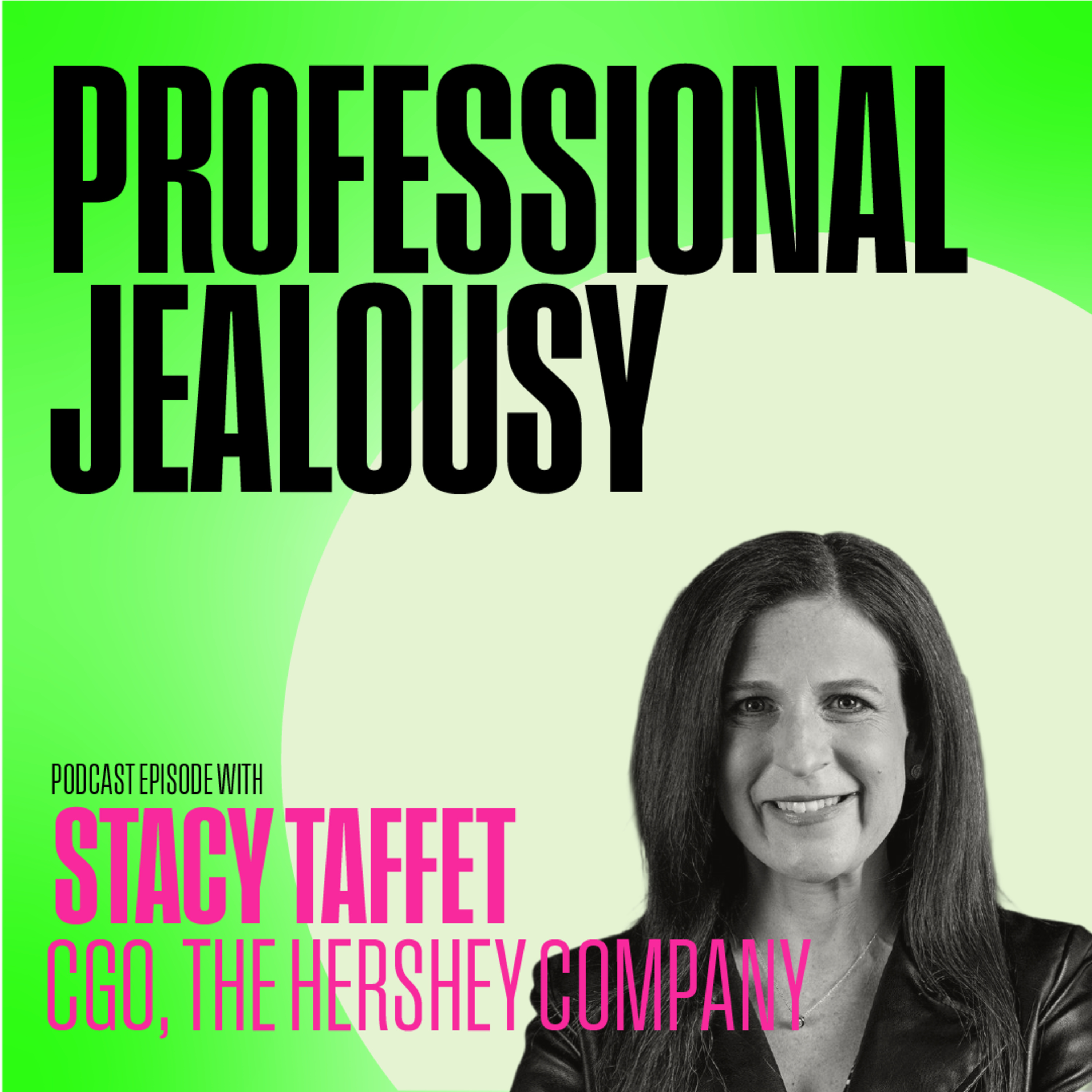
Hershey’s Stacy Taffet on how to modernize a 130-year-old brand without losing the magic, when to build vs buy, and why restraint is the hardest discipline in innovation.
Stacy is Chief Growth and Marketing Officer of The Hershey Company, where she leads marketing, innovation, consumer insights, portfolio strategy and R&D across Hershey’s, Reese’s, Jolly Rancher and more. After 17 years at PepsiCo, she joined Hershey about a year and a half before this recording. Natasha and Stacy talk about “stories and systems,” why big brands start with advantages startups spend years building, how Hershey decides whether to build a brand or buy one, why R&D and marketing belong on one team, what makes a great brand, and what GLP-1s mean for the candy aisle. Plus Stacy’s best career advice (it’s not who you know or what you know, it’s who knows what you know) and who she’s professionally jealous of.
In this episode:
Professional Jealousy is the podcast where Natasha Jakubowski, Chief Innovation Officer at Anomaly, talks to founders, CEOs and creatives she admires and is just a little bit jealous of.
Watch the full episode on YouTube: @professional-jealousy
More episodes: professionaljealousy.com
Scan the code with your iPhone camera
Listen in the app.