In short
Rich Habits Podcast Episode 7: Building an Investment Portfolio from Scratch
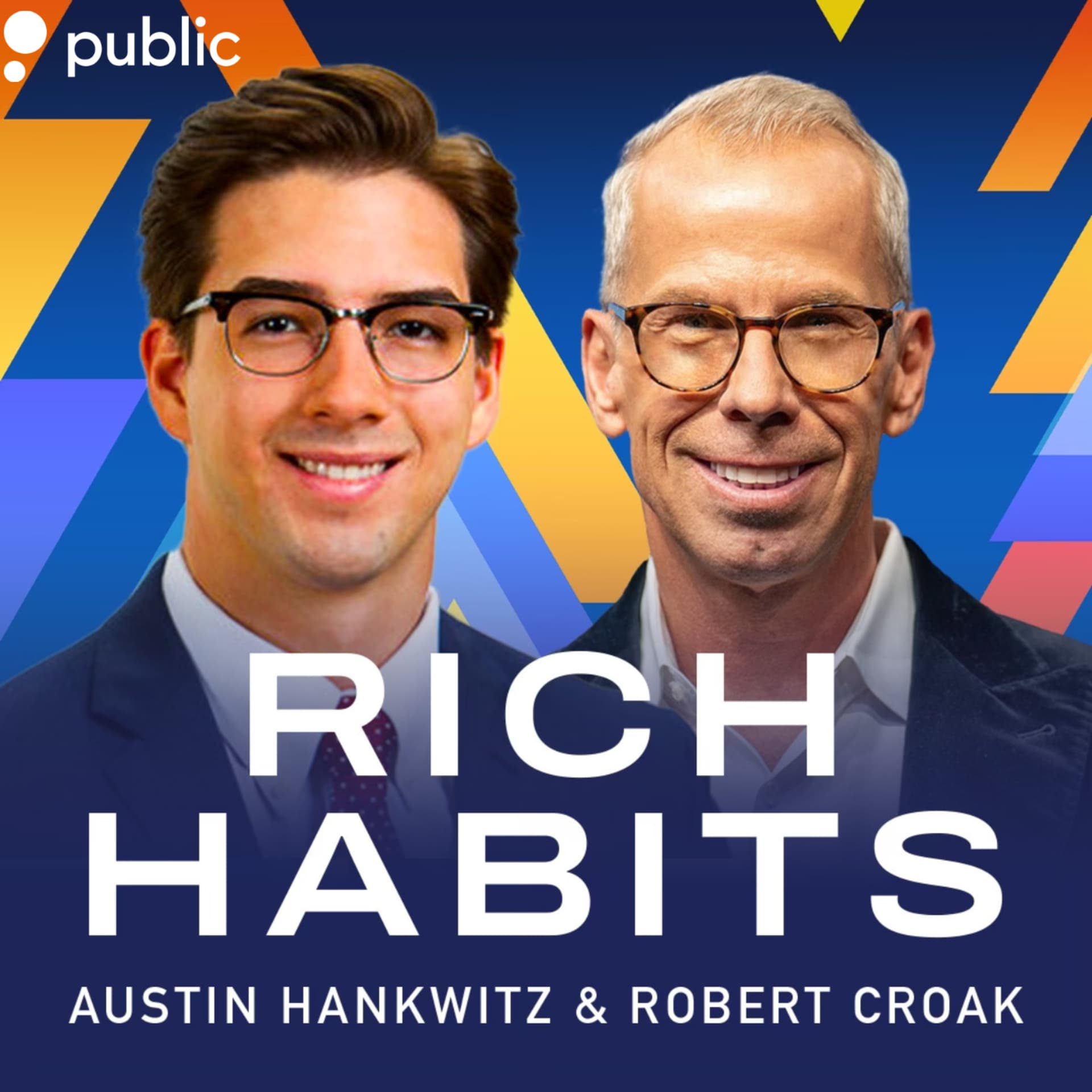
Episode Overview In this episode of the Rich Habits Podcast, hosts Robert Croak and Austin Hankwitz guide listeners through the essential steps of building an investment portfolio from scratch. The discussion is focused on three main investment categories: stocks, real estate, and alternative assets. The episode aims to equip listeners with practical knowledge and specific investment options to help them succeed in their financial journey.
Key Contributors
- Robert Croak: A decamillionaire with over 30 years of business experience and substantial company exits.
- Austin Hankwitz: A young entrepreneur eager to learn and grow his wealth.
Main Topics Discussed
- Importance of Stocks in a Portfolio
- Key Insight: Stocks are foundational to a diversified investment portfolio.
- Recommended ETFs:
- S&P 500 (VOO): Represents a broad market index.
- Big Tech (VGT): Focuses on major technology companies.
- Dividend Growth (SCHD): Provides passive income through regular dividends, irrespective of stock price fluctuations.
- NextGen Technology (QQQ): Targets innovative tech companies.
- Dollar-Cost Averaging: Suggested strategy for investing in ETFs consistently over time.
- Real Estate Investments
- Long-Term Appreciation: Historical data shows that real estate values generally rise over time. For instance, the median home price increased from $238,000 in 2012 to $467,000 in 2022.
- Recommended Platform:
- Fundrise: Enables investment in real estate with a low minimum of $10, allowing for diversification across various properties.
- Mindset Shift: Investing in real estate, even in small amounts, helps cultivate the mindset of a real estate investor.
- Alternative Assets
- Definition: Includes investments in assets like cryptocurrency, gold, silver, collectibles, etc.
- Recommended Resource:
- MoneyMade.io: A platform that provides research and insights on alternative investments.
- Benefits: Alternative assets can offer a hedge during volatile market conditions.
- Discussion on Treasury Bills (T-Bills)
- Risk-Free Investment: T-Bills are a reliable vehicle for earning interest on cash while maintaining liquidity.
- Platform Mentioned: Public.com offers T-Bills, simplifying the investment process for everyday investors.
- Portfolio Allocation Guidelines
- Stock Allocation: Suggested range of 60-70% in stocks.
- Real Estate Allocation: Generally recommended to be around 20% depending on individual goals.
- Alternative Assets: Advise allocating 5-15% of the portfolio to alternatives, with a caution on the speculative nature of such investments.
Conclusion & Call to Action The hosts encourage listeners to share this episode with those interested in investing to help them start building their portfolios. Key investment platforms and ETFs are reiterated, emphasizing the importance of informed choices in wealth creation.
Key Resources Mentioned
- Public.com for brokerage and T-Bills
- Fundrise for real estate investments
- MoneyMade.io for alternative asset insights
- Recommended ETFs: VOO, VGT, SCHD, QQQ
Contact Information
- Email: richhabitspodcast@gmail.com
Closing Remarks Listeners are encouraged to rate and share the podcast, ensuring that more individuals can benefit from financial literacy resources and investment knowledge.
Written by AI. May contain mistakes. Listen to the episode to check what was said.
Transcript
Automatic transcript. May contain errors.0:28Welcome back to the Rich Habits Podcast. Every episode, we talk about rich habits as they relate to business, finance, and mindset. However, we try to bring you two unique perspectives. One from an industry veteran, Robert, and the other myself, someone who's kind of still in the process of building wealth and figuring it all out. So, Robert, why don't we jump into things? What are we going to be talking about in today's episode? We had a ton of you find our at rich habits podcast Instagram last week and sent over 50 DMs about your favorite financial literacy books. We then asked all of you in the DMs to share some of your favorite topics and questions for us to talk about on today's podcast.
1:06And this was by far the most requested. How to build an investment portfolio from scratch. So we're going to assume you're starting with a brand new brokerage account. And by the time we finish this episode, you'll have a diversified portfolio. We're going to share with you the play-by-play of how we would build it. That's what's so important about this episode. it's how we would do it ourselves, right? How we would do it. So this investment portfolio contains three sections, stocks, real estate, and alternative assets. And as a quick reminder, you can do this in your Roth IRA or your traditional brokerage account using public.com.
1:44There's going to be a link in the show notes below to open that up and learn more about public. Okay, Robert, talk to me about stocks, why they're important, and how they fit into someone's diversified portfolio? Stocks are just the most important part because index funds are king. If you're an international listener and restricted to investing in only one of these three sections, stocks are definitely it. Our key insight is really to keep it simple. The four themes we like are S &P 500, which is VOO is a great example. Big tech, which we love VGT. Dividend growth, which we love, SCHD, so you make that money even when the stock price might not be going up.
2:25And number four is NextGen Technology, which we love, QQQ. That's a really good one to have in your portfolio. I love the call that you made about the dividend growth, SCHD. You mentioned even when the stock prices are going down. What is about that? Walk us through why you said that and what exactly that means with the passive income, the dividend payments, and how they're not exactly correlated to the ups and downs of the stock price. Yeah, it's a great part of dividend stocks that a lot of people just don't realize of why we like them. And what that means is the company pays you a dividend on the stocks that you own, a percentage of each share you own, whether the stock price is going up or down.
3:06So you get the passive income from owning those stocks, no matter what the share price is. A lot of us hear online the idea of passive income and how do I make money in my sleep, things of that nature. Dividend growth investing is the solution for that, right? I mean, at the end of the day, we have companies like Apple and Microsoft or Visa, MasterCard, or even Pepsi and Coca-Cola that have all these extra profits, right? And from their profits, they say, you know what? Our shareholders deserve some of this. Let's pay them cash dividends every single quarter without worry of the stock price being up or down or left or right or going in circles, you can expect that passive income.
3:45So I think that's a really good call out there with SCHD. Robert likes the S &P 500. I also like that. We like the big tech, right? VGT, dividend growth, SCHD, and next-gen technology through QQQ. Those are the tickers for going on your online brokerage account. Again, we like public.com. You just type in those VOO, VGT, SCHD, QQQ, and start dollar cost averaging into these specific ETFs. Yeah, let's talk about one more thing that I think is really important, especially in a market like right now. You know, high inflation, interest rates, where the dollar is. Let's talk about the T-bill and what that means to someone's portfolio and why we like adding that into the portfolio in a market like this.
4:32it's a good idea to always have your money be earning money and i'm all for trying to figure out like hey i'm a little scared i'm going to stay on the sidelines for a little bit i did the same thing in 2022 i was not trying to jump into that market but i'll tell you what i did do is i parked my money into a vehicle that made me money on my cash risk-free and that's what t-bills are so these are treasury bills from the u.s government that essentially is an iou where the government says, hey, we're going to take your money, but after a specific period of time, we'll pay you that money back with interest.
5:05And so public.com has an awesome T-Bills product where you can deposit any amount of money and it's very liquid. So you can take it out the next day if you want to. But instead of just keeping all that money in cash in your brokerage account, you can have that money working for you in their T-Bill account. I'll actually jump in right now with a quick conversation between me and Sam who helped to build the product to add a little bit more clarity, and then we'll bring you right back. So most of T-bill investors are big corporations, pension funds, insurance companies, but it's never really been available to that average retail member.
5:34And so what we've done is we've devised our product and take out all of the complexity and just give you a very, very simple way to put your money into an account. All treasury bills are automatically purchased for you. All reinvestments happen automatically. All you have to do is put money into the account. It starts investing in treasury bills, earning interest, and then whenever you want that money, you can just take it out. So that's part of what we designed this for is to be a very simple and effective product. You really only get two options. You can put money in and start earning yield or you can take money out and there's really no limitations beyond that.
6:05Love it. Thanks so much, Sam. Now let's jump back to our portfolio. So you said stocks, real estate, and alternative assets. Talk to me a little bit about real estate. Where does real estate fit in your portfolio and what's really important about real estate, especially as we think about a long time horizon. Contrary to what some of the fake gurus say, real estate over the long term just always goes up. The median sale price of a home in America has climbed from$238 ,000 in 2012 to$467 ,000 in 2022. The capital appreciation is just always there. Now there's down markets. Sometimes there's markets that don't recover as fast, but in the long run and overall, real estate always goes up.
6:48So I just think that it's really important for everyone at some point in their wealth journey to be in real estate as a portion of their portfolio. And we really like starting out with Fundrise for someone that's just getting started. So let's tell our listeners a little bit about that. For those that aren't familiar, Fundrise, F-U-N-D-R-I-S-E, and we'll have a link in the show notes below, is a real estate investment platform that essentially unlocks institutional level real estate for as little as$10. So if we rewind to when Austin was trying to build wealth back in 2018, I just graduated from college, I started using Fundrise as a way to invest in real estate.
7:26Now, back then, I think they had investment minimums of a couple thousand dollars, but they've since brought that down to make it more accessible for everyone. I like Fundrise for two reasons. One, for that$10. Two, for the diversification of that type of real estate. So for example, my portfolio right now, I believe, is invested into 76 different properties that range from industrial warehouses, single family homes, neighborhood developments, apartment complexes, and everything in between. So you're not just doubling down on the idea of maybe single family homes or just these warehouses. You are very well diversified across a ton of different actual real estate type properties, and it's all over the country.
8:06What I love about Fundrise for a lot of you that are starting out is I think it just gives you that really good mindset shift that you're finally in the real estate game. Because let's face it, when we're starting out, we don't have 10 ,000, we don't have 20 ,000. We're afraid that the down payment is too much or interest rates are too high. So what I like about Fundrise is getting the mindset shift that as soon as you deposit those funds and you're invested in one, two, three, five deals, you now have the mindset of a real estate investor. And that really is key to getting you started and getting you excited about real estate.
8:42Then as you build up, you can look at REITs, you can look at syndications, going out on your own and doing your first deal. But I think Fundrise is the best baby step for the mindset shift to get you started in real estate and really start to take ownership. The best baby step for anyone to start getting into real estate. And I've really thought about it like that. But if I kind of reflect on when I was, you know, call it 22 or 23 years old, right when I started investing with Fundrise, that's kind of what it was for me, right? I didn't have the money, the funds to go out and buy a home or an investment property, but I did have a couple thousand to invest into this institutional level real estate deal.
9:17So I like that call out a lot. Now, just as a quick follow up with real estate, I want to know, as someone kind of graduates past that baby step, you mentioned the REITs, you mentioned the syndications. Do you have any ideas or resources or even hacks for someone to think about to learn more about that once they're ready to take that next step? Yeah, I really do. I think, you know, one of the important parts about it is, is networking. because so many people I'm fearful when they're starting out in real estate and let's say they don't take our advice and they go, well, I've got 10 grand and I'm gonna rip it into this single family home that I'm gonna fix and flip.
9:50It takes twice as long, way too much money. They get burned, then they get sour on real estate. And so I think it's just really all about, you can get into these networking events. There's a lot of free, there's free ones in every market and just really start to link up with people that are doing it. people that have done it a bunch of times, maybe they got 10 or 20 flips under their belt. And with that networking, then you can just learn a lot while studying on your own to see what the next steps for you as you graduate from, say, Fundrise to joining a syndication or more. So I think that's a good next step is the networking part of it and the studying part of it, because you just don't want to jump in feet first and then find out you didn't know what you're doing or you get burned by a contractor.
10:37Now, Robert, the last thing I want to touch on here with real estate is sort of the allocation of someone's portfolio that goes to real estate, right? So for me, I'm sort of in this like 60 or 70 % in stocks and now this 10 or 20 % or so in real estate. And we'll get to the last one here of alternative assets that make up the other 10 or 20%, but that's kind of where I'm coming from. Do you have any different perspective on real estate, bigger, smaller asset allocation? I think it's really up to the individual person and what their goals are. I've always had a larger percentage in real estate and less in stocks.
11:08And that has flip-flopped since COVID because I stopped flipping homes during COVID for the last three years. So yeah, I think it's just really up to the individual. I would say, you know, for the average person, they should probably have 20 % in the real estate market. I think that's a good place to be. But because the real estate market takes time to build up a portfolio, It can be a longer play to get to the 20%, but it really just depends on what you enjoy. If you're a guy or a girl that loves design and you love construction, then you might not care as much about having your index fund portfolio or your diversified stock portfolio or alternative asset portfolio.
11:51So I think it really just depends on the individual, but real estate is really important to be part of the overall strategy. It just depends on what amount you want to have. Let's now round things off with our third part of the investment portfolio of alternative assets such as crypto, gold, silver, collectibles, and other alternatives. If you are someone who's new to this, and I was new to this four or five years ago, so I wish this platform was around when I was still learning, but it is today. It's called moneymade.io. So M-O-N-E-Y-M-A-D-E dot I-O. And essentially what they are is a resource for alternative asset investments, specifically their returns, research, headline news articles about them, and even the platforms that offer exposure to those specific asset investments.
12:44So for example, I own some fine wine through VinoVest, but I own fine wine through their platform and I found that platform on MoneyMade. Same thing with some cool sneakers. I've got, I think it's like the, I know you just saw the movie Air, Robert. You've got shares of like quote unquote stock in these shattered backboard Air Jordans through public.com, another platform that allows for investables. I think I also have some stock in like an Hermes bag and a couple other like really cool things like that on public. But so regardless, check out moneymade.io if you want to learn all about different types of alternative assets, as well as the platforms that offer them.
13:20Yeah, let's touch a little bit more about why we like alternative investments in a time like this. Because during tough economic times, while the stock market is volatile, and everything seems to be chaotic, it's really good to park some of your money in alternative assets, because it's just such a great hedge in tougher markets. And that's why I like gold and silver. I like crypto for this. You know, we've talked about some of the other alternative investments. I like luxury vintage watches is a great one as well. I've also collected classic cars over the years. So it's just a way to look at things a little differently when it's not the set it and forget it kind of market, because you have to look for other ways to make money during these tough times.
14:04And that's why I think that gold and silver are important as well as crypto. So let's touch a little bit more on those two items for the listeners. There's two ways that someone can go get it right. You can go down the street to your physical, we buy gold, we sell gold, we buy silver, we sell silver store. Do you want to buy an ounce, a gram, whatever that might be. It might be in the form of a coin, maybe some bars, things of that nature. Very tangible. You can feel it. You can touch it. Gold and silver. There you go. So Robert's holding up a really cool silver coin right now. But if you do not want to go down and see Hank at We Buy Gold, you can always buy the ETF GLD.
14:44it actually trades synonymously one-to-one with the price of gold and same thing with silver's slv that is another etf that trades one-to-one with the price of silver so as the price of gold and the price of silver increase these etfs also increase as well so you can realize the value of the appreciating assets inside of your portfolio you're not buying the silver and lugging around a bunch of big silver bars because you think the price is going to skyrocket although i think silver will be at$100 an ounce in the next three years. You're really doing it as a hedge because of the de-dollarization that's happening right now, what the government's doing with Fed now.
15:22And it's just really a hedge with fear to try and have yourself diversified out in a good way. So if things do really hit the fan, you're still in a really good spot. So that's why we like these alternative investments and think they should be a part of your portfolio for the long term. Wow,$100 an ounce in the next couple of years That is a bold prediction If I've ever heard one, Robert Good for you, man, for making that publicly I said three years, but yes Three years, okay All right, well, wait, wait, wait, wait So let's do a little bet here A little steak dinner bet, me and you I love it, okay So is that your kind of over-under mark there?
16:02$100 in three years? Yeah Okay, so let's fast forward now to We're filming this on Easter Sunday of 2023. Yep. So let's fast forward now to Easter Sunday of 2026. And if silver is trading at over$100 an ounce, I will fly to wherever you are and I'll buy you dinner the next weekend. Victorious. Okay. Sounds amazing. Yes. I love it. Love it. I like Bitcoin. I really like Bitcoin, especially right now after the Fed injected$370 billion into the markets after what happened with SVB. There's a ton of different people. I think Eric, I might be saying his name, I'm not even going to try. He's predicting for a million dollar Bitcoin over the coming months.
16:44I don't know if that's going to happen, but I do know Bitcoin is going to continue to go up into the right over the long term. You have to understand a lot of people forget one simple math equation. Bitcoin is finite, fiat dollars are not. So you have to remember that with Bitcoin only having a finite amount of units available, as the use case expands and as the investment in Bitcoin expands, there's so much pressure for it to continue to rise because you can only get so much. So let's talk about that, though, for a moment and bring it back to this conversation of kind of allocation in an investment portfolio.
17:20So admittedly, I have a little too much cryptocurrency. I have a ton of Bitcoin, Ethereum and Chainlink. I bought a bunch in 2016, 2017, and it's really just appreciated in value tremendously since then. So that's why it makes up such of a big chunk of my investment portfolio. But if I was building one from scratch and someone said, hey, how much of my portfolio should I have in alternative assets? I would say between five and 15%, maybe up to 20 if you want to be aggressive and you're younger, but I really wouldn't keep more than, you know, a fifth of your entire investment portfolio in these alternative assets such as fine wines, luxury watches, crypto, gold, silver, all this fun stuff that we've discussed.
18:01Because at the end of the day, investing into collectibles is highly speculative and takes a ton of knowledge to get it right. So really, just be careful here. Yeah, I agree. I think that crypto alone should be 5 % to 10%. And then if you had another 5 % of that in other alternative investments, I think you'd be in great shape at that 15 % range. Cool, cool. Yeah, and just a quick reminder as well, you can also buy Bitcoin and other cryptocurrencies on public.com. Everyone, thanks so much for hanging out with us on this episode of the Rich Habits Podcast. Do us a favor. If you know someone who has recently started sharing their interest in investing, or maybe it's someone who you know should be investing by now, send them this episode.
18:41Click the share button on Apple Podcasts or Spotify or wherever you're listening to this, and just text them this episode and say, listen to this right now so you know it's time to invest and what to invest into. We gave you the names of the tickers, right? V-O-O, V-G-T, S-C-H-D, and Q-Q-Q. We gave you the name of the real estate platform that I personally used when I was starting in real estate, Fundrise. And we gave you the name of the awesome research platform, LennyMade.io, that's got a ton of different platforms to explore and learn about these alternative assets, as well as public.com as one of the best places to holistically build one of these portfolios from scratch.
19:19Thanks, everyone. Be sure to give us a rating, a review. Give us a thumbs up if you're watching this on YouTube. Be sure to follow us on whatever platform you're listening to. And we'll see you in the next episode of the Rich Habits Podcast.
From the publisher
In this episode of the Rich Habits Podcast, Robert Croak & Austin Hankwitz walkthrough how to build an investment portfolio from scratch. Specifically, they share the specific names of tickers they'd build a new stock portfolio around, their real estate investment platform of choice, and alternative asset ideas.
---
Be sure to check out Public's new High Yield Cash Account paying 5.1% APY. This is higher than anything else on the market and is FDIC insured up to $5M.
---
Earn 5.1% APY using a Public HYCA, click here!
Opt-in and share your email, click here!
Learn more about our 4-module video course!
Download our FREE Budget Template, click here!
To learn more about Robert: https://stan.store/RobertJCroak
To learn more about Austin: https://stan.store/austinhankwitz
Contact: richhabitspodcast@gmail.com
---
Hankwitz Group LLC has an existing business relationship with NEOS Investment Management LLC. The opinions expressed are those of the author, and the author owns several NEOS ETFs.