In short
Weekly money/news roundup (Rich Habits Radar) covering: Nvidia’s earnings and guidance, Meta’s teen safety settlement, and Fed Chair Kevin Warsh’s Jackson Hole speech; plus “radar points” on Cisco’s enterprise AI agents, Oura Ring’s IPO, crypto-collateral mortgages, and a real-estate hotel-flip strategy.
Guests
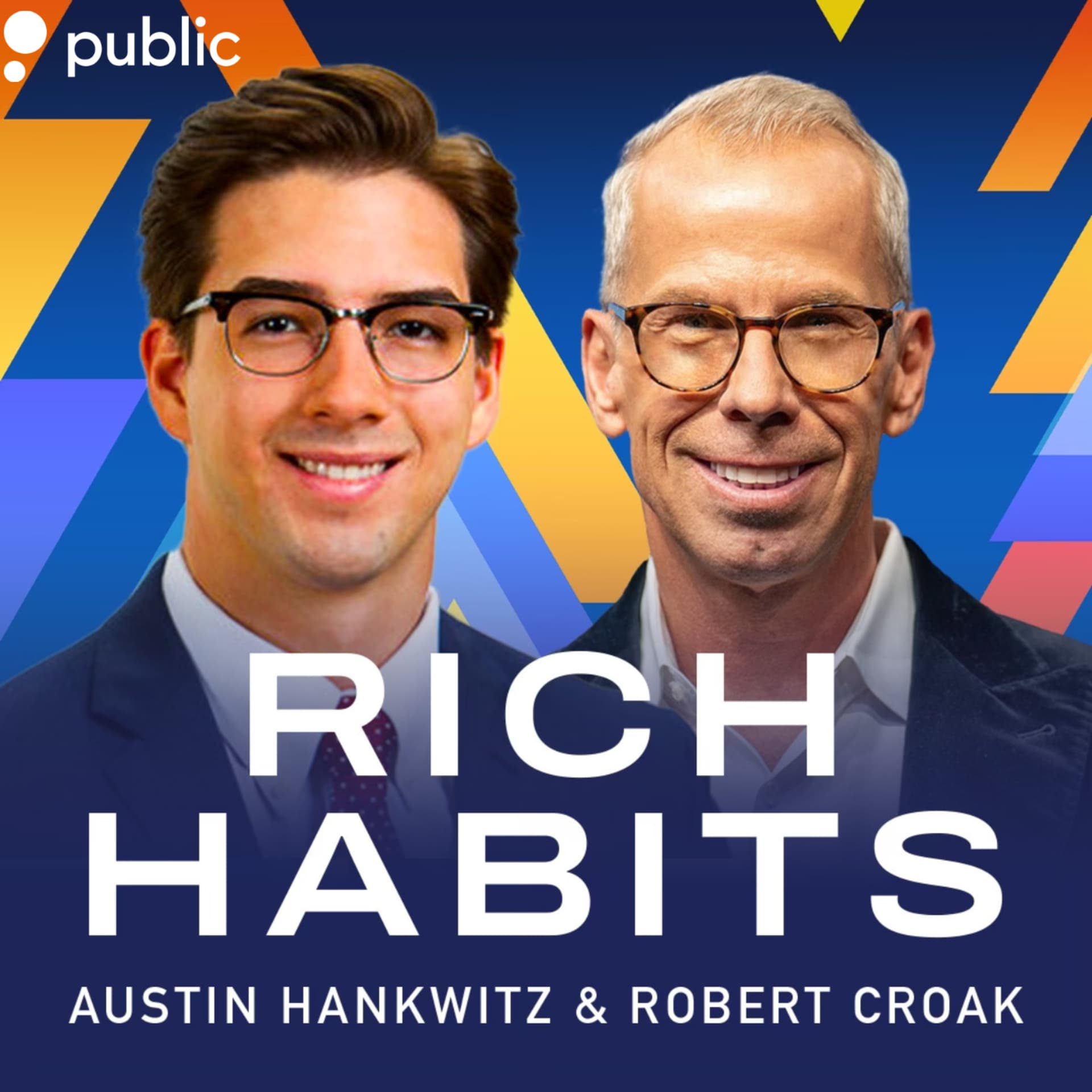
No guests. Hosts are Austin Hankwitz and Robert Croak.
Key claims
- Nvidia: Q2 revenue $96.2B (+106% YoY) and EPS $2.22 beat; stock rose ~10% on guidance—fiscal 2028 revenue growth floor 70% (vs ~44% expected), CFO said demand could be ~100% if unconstrained; gross margin guided down to 72–73%; Q3 assumes zero China revenue.
- Meta: Settled teen safety lawsuit for ~$16.7–$17.1B total (~$18B paid over 10 years). States get ~$12.7B guaranteed; remaining ~$5.3B only if YouTube and TikTok adopt similar limits (daily time limits, age verification, night mode).
- Fed: Warsh’s Jackson Hole speech is high-stakes due to reduced forward guidance; market split between hawkish inflation signals and weak labor data.
Notable examples
- Cisco MyAgent for 90,000 employees; uses secure connectors and routes tokens to cheapest capable model, with 50–60% to Cisco open-weight models.
- Oura Ring IPO targeting September, ~$16B+ valuation, ~$3B raise.
- Bitcoin-backed mortgages via Coinbase One/BETTER Mortgage using crypto for down payment without selling.
Written by AI. May contain mistakes. Listen to the episode to check what was said.
Chapters
Tap a time to open that second in VONVIDIA's Earnings Report and Growth Projections
1:49 to 7:22
Discussion on NVIDIA's impressive earnings and future growth expectations.
“NVIDIA reported earnings early after the bell, and the stock is up 10 % as we're recording this episode.”
Meta's Lawsuit Settlement Analysis
7:22 to 14:00
Analysis of Meta's recent lawsuit settlement and its implications.
“NVIDIA just answered that question with a number that no analyst on Wall Street was expecting.”
Meta's Legal Landscape and Stock Insights
14:00 to 15:36
Learn about Meta's lawsuit implications and market expectations for its stock.
“The company is only worth 1.4 trillion, right?”
Meta's Legal Landscape and Stock Insights
15:37 to 16:36
Learn about Meta's lawsuit implications and market expectations for its stock.
“For generations, American companies have moved the world forward through their ingenuity and determination.”
Meta's Legal Landscape and Stock Insights
16:41 to 16:56
Learn about Meta's lawsuit implications and market expectations for its stock.
“Carefully consider the investment material before investing, including objectives, risk charges, and expenses.”
The Upcoming Jackson Hole Symposium
16:57 to 23:06
Understand the significance of the Jackson Hole Symposium and its market impact.
“So we're filming this on Thursday afternoon, August 27.”
Radar Points: AI Innovations and Market Trends
23:07 to 28:00
Explore key developments in AI and their implications within large companies.
“All right, Robert, let's now jump to our radar points.”
AI Adoption in Corporations
28:00 to 31:11
Explore how Fortune 1000 companies are adopting AI to enhance productivity.
“But yet we keep hearing about all these massive firms using agents to replace humans.”
AI Adoption in Corporations
31:14 to 31:24
Explore how Fortune 1000 companies are adopting AI to enhance productivity.
“And be sure to use their AI tool that analyzes your portfolio with AI.”
Real Estate Investment Strategies
31:24 to 37:07
Discover innovative real estate investment strategies focusing on hotel renovations.
“So, Robert, I need to hear your radar points.”
Show all 11 chapters
Oura Ring IPO Insights
37:07 to 40:05
Analysis of Oura Ring's upcoming IPO and its market potential.
“what Aura's moat is because I don't believe the technology is any different than any of the bands that you wear on your wrist.”
Transcript
Automatic transcript. May contain errors.0:00This episode is brought to you by Accenture. When your advertising operations fall out of sync, everything else follows. Spotify and Accenture are working together to reinvent the rhythm of ad sales, using automation, analytics, and smarter workflows to simplify campaign delivery and access better data across the business. The result? Less time spent on operations, more time connecting brands with the moments and fandoms that matter most. Learn more at Accenture.com slash Spotify. Labor Day savings are happening now at the Home Depot with select appliances starting at$399. Plus, save up to an extra$1 ,000 and get free delivery on appliance purchases of$998 or more.
0:41Get a Whirlpool laundry tower featuring industry-first UV clean technology designed to reduce bacteria in the wash without fading fabrics. Plus, with great prices at the Home Depot, you can save on select appliances designed to make laundry day easier. Shop Labor Day savings at the Home Depot today. Offer valid August 27th through September 16th. USLAC store online for details. You are tuning in to the Rich Habits Radar, our Friday episode of the Rich Habits Podcast, where every Friday morning, we're coming at you with the biggest headlines impacting you and your money. This episode is brought to you by VCX, the public ticker for private tech.
1:14My name's Austin Hankwitz, and I'm joined by my co-host, Robert Croak, and the three things sitting at the top of our Rich Habits Radar this week include NVIDIA's unbelievable quarterly earnings report, Meta settling a teen safety lawsuit for$17 billion. And, of course, what to expect at Jackson Hole with the Federal Reserve taking place, I guess, today now, Robert, as people listen to this episode. Be sure to stick around to the end where we talk about the newest way real estate investors are making millions of dollars, and that is by buying up old, dilapidated hotels. Robert, let's dig into our first story.
1:50Definitely. NVIDIA reported earnings early after the bell, and the stock is up 10 % as we're recording this episode. So let's start with the numbers everyone already knew were coming, then get to the number that actually moved the stock. Let's do it. So fiscal Q2 revenue came in at$96.2 billion, up nearly 106 % year over year, which blew past Wall Street's expectations of$92 billion. Adjusted earnings per share was$2.22, beating Wall Street's estimates by$0.13 per share. Now, data center revenue, the whole ballgame at this point, hit$89 billion against expectations of$85 billion, increasing 117 % year-over-year.
2:38Unbelievable numbers. Gross profit margins held at 75%, which was right in line with Wall Street's expectations. The company threw off over$21 billion of free cash flow during that three-month period of time. NVIDIA also handed$26 billion back to shareholders during the quarter in both buybacks and dividends, and they still have$99 billion left on that repurchase authorization. So all of that's great, but that's not why the stock went up 10%. Robert, break that down. Yes, the number that broke Wall Street's model was the guidance. CFO Colette Kress told investors NVIDIA expects fiscal 2028 revenue to grow 70 % year over year.
3:22You heard it, 70%. Analysts were modeling 44%. So off of a roughly$396 billion fiscal 2027 base, and that 70 % floor puts fiscal 2028 revenue around$673 billion, which would put NVIDIA ahead of Apple and Alphabet and behind only Amazon in total company revenue. And the wild part is Colette Kress, their chief financial officer, said that that 70 % number is the floor. And it's the floor because it's the supply constrained floor of their guidance, right? So unconstrained demand puts them closer to 100 % revenue growth, which is bonkers. I mean, literally, like you're saying 2027 base is essentially 400 billion.
4:09You slap 70 % growth on top of that, which gets you to 675 billion. But if they weren't supply constrained, that number could actually be closer to$800 billion in annualized revenue in 2028 for NVIDIA. Which is just crazy. We've owned NVIDIA now for years. We've seen this massive rise in these companies like NVIDIA and Micron and all that. And to see that, and it's even funny, Austin, because we've been saying for a long time to our listeners in the Rich Habits Network and here on the podcast that we believe NVIDIA is underpriced. And these numbers really show that in the current stock price. And Jeffrey's analyst, Blaine Curtis, titled his note, The Emperor Strikes Back, and wrote that the 70 % growth floor is$200 billion above the prior Blackwell plus Rubin framework Wall Street had built its models around.
5:01He sees a clear path to$1 trillion of revenue in fiscal year 2029, and he kept his buy rating around that$300 price point. But that price target is not where other Wall Street price targets are being shared right now. Evercore has a price target of$465. Their analyst is saying that NVIDIA is one of the most compelling risk-reward ratios in their entire coverage universe right now, trading at just 13 times 2027 earnings per share. For context, Robert, the S &P 500 as an index on average right now is trading at 20 times. So NVIDIA right now is cheaper than the S &P 500, which is bonkers. There is one wrinkle.
5:47Gross margins are guided down to 72 % to 73 % for calendar year 2027 from the mid-70s previously. And Q3 guidance came in at$108 billion, ahead of the$104.86 billion Wall Street wanted. But NVIDIA explicitly said it's assuming zero revenue from China in that number, zero. And that's not a hidden risk. That's a stated one. And they're still guiding above what the street expected. So I think it's all good news and smooth sailing for NVIDIA right now. So Robert, break that down a little bit more. What does this earnings now mean for our listeners and their money? For me, I think this is the moment NVIDIA stopped being the beat and guide conservatively story and started openly telling Wall Street its models are just too small.
6:32And so when a company comes out and says our floor is 70 % growth, but our actual demand is closer to 100%, that's just not corporate hedge fund speak. That's a company that has more customers than compute available. And I pulled up NVIDIA on WallStreetFavorites.com this morning before today's pop, and it was sitting at around$229 a share against a consensus analyst target of$365 a share. Over 50 % upside is already priced in by the street before this print. Now bake it in at$465 price target from Evercore and a guidance number$200 billion above that old framework. And you start to understand why the stock ripped double digits.
7:16And we here at the Rich Habits Podcast believe it's going to continue to grow in the coming years. Yeah, for me, a big takeaway is that for two years, the AI trade has had to defend itself against when does the spending stop? NVIDIA just answered that question with a number that no analyst on Wall Street was expecting. That paired with$160 billion of its own money, guaranteeing that its customers can keep buying, which was sort of the circular financing stuff that was also talked about during the earnings call. That's either the most confident guidance that we've heard from a company like ever in the history of the semiconductor industry or the clearest sign yet of how tightly NVIDIA's fortunes are now wound around its own customers.
7:56and the balance sheet and the circular financing. You can either think of it as a good thing or a bad thing. But my take is that NVIDIA is a monster. And, you know, Robert, we were talking about it a couple weeks ago. We saw NVIDIA was trading at like$192,$195 a share. And I was like, wait, NVIDIA is priced right now as if it's like, you know, the cheapest name ever. Like, what's going on? Let's go put money. And, like, I remember before we were filming, we were, you know, outlining the episode and I was like, let's go put$10 ,000 in NVIDIA real quick. And so we both did. And now it's at$2.30 a share or whatever.
8:29It's just like the entire world is being rebuilt right now with AI in mind. NVIDIA will be one of the largest beneficiaries of that infrastructure build out over the next decade, full stop. And NVIDIA's CFO just told us that that's going to be the case and is going to remain the case because the demand is just insatiable. Yeah, 100%. I agree. And I'm so glad we've been early and right about NVIDIA. And so many people, you know, are sitting there, when's the next NVIDIA going to happen? When's this going to happen? And I'm sitting there thinking, you know, you and I are talking about it, how inexpensive it is as a target price right now, when we were talking about it at 196.
9:06And now it's a two something. And I think it's just going to continue to grow. And I love them as a company, you know, being kind of that granddaddy in the center of it all, you know, along with AMD and Micron and like Taiwan Semiconductor. And, Dr., you mentioned ASML. So I think that collective right there is just a great way to be in this AI trade for the long term. 100%. So let's then jump to our next story. Robert, you actually talked about this one recently. You flagged that Oakland trial of that$1.4 trillion threat for Meta could be very bad. Coalition of state attorney generals were going after Meta over child safety.
9:43Meta's own filings put the theoretical ceiling at$1.4 trillion in damages. All that's behind us now. $1.4 trillion was just a headline number. Walk us through it. Yeah, I definitely wanted to follow up on this because we're fans of Meta as a stock, and we believe there's a lot of upside. And on Wednesday, Meta settled with a bipartisan coalition of 51 attorneys general, which is basically built out of 47 states plus D.C. and U.S. territories, ending the federal trial in Oakland before it ever even reached a jury. And the total number being reported ranges from$16.7 billion to$17.1 billion, depending on how you count it.
10:21And Meta itself says the settlement includes a payment of approximately$18 billion. But here's the catch. Paid out over 10 years. So for all of us, you know, that's pennies out of the pocket of someone as large as Meta. And the gap in those numbers comes down to what's bundled in. There's about$459 million tied to an old Cambridge Analytica claim mixed into the bigger figure, plus a separate$1 billion Texas settlement on its own outside of this group deal. Yeah, right. So let's kind of talk about how this$18 billion that Meta is now going to have to pay in damages, who it's going to, how much is going where, and what are the stipulations around that.
11:01So the participating states in this lawsuit get about$12.7 billion, which is about 70 % of that total. It's guaranteed and it's paid annually over, to Robert's point, a decade. The remaining$5.3 billion, so that 30 % delta, only gets paid out if YouTube and TikTok also agree to make the same kind of changes that Meta just agreed to. Those changes include daily time limits for teens, age verification technology, and a night mode. And now this is interesting. Google and TikTok would each have to pay an amount matching that remaining 30 % themselves. So Meta basically just said, hey, I will settle with you.
11:44No problem. We can make sure this does not go to court. But I also want to make sure my two biggest competitors are also adopting the exact same restrictions on their platforms. or Meta doesn't have to pay that last big chunk of$5 billion. So Robert, I think this is pretty clever, right? Say, hey, I'm not going to play by these new rules if my competitors aren't also playing by them. Yeah, I think this settlement is really good news for the American families that are out there that are worried about their children and what's happening on the internet. And by having these guardrails and these restrictions like night mode and all that, I think it's really good long-term for social media because I feel it's long overdue.
12:23And Meta says it will take roughly$10 billion legal charge in Q3 of 2026 for this. And it's money that wasn't previously baked in any of Wall Street's financial models. And here's the market reaction that tells you everything and matters most. Meta's stock actually rose on the news. So maybe there's a little bit of relief there. Maybe people are worried that that$1.4 trillion number could be somewhat real. And it wasn't. And CNBC reported that shares were up about 4.4 % in pre-market on the news because Wall Street read an$18 billion decade-long spread out payment as a massive win compared to a jury trial that had$1.4 trillion sitting on the table as the worst case scenario for Meta.
13:09Yeah, that's crazy. This, though, doesn't mean that all of Meta's legal problems go away. There's still thousands of personal injury claims and a consolidated nationwide school district case that has been widening right now through federal court. 3 ,300 cases in that one MDL alone. Plaintiffs' lawyers have said flatly that they're not backing off Meta, they're not backing off TikTok, Snapchat, YouTube. Like, this settlement closes one very expensive door for the company, but not all of them. So Austin, I think this is really good news, probably settles things a little bit for meta because that was the big headline everyone was talking about.
13:47So walk us through what does this mean for you and your money? I think this was a masterclass in how mega cap massive big tech companies can de-risk a big event like this. 1.4 trillion was obviously never a realistic outcome. The company is only worth 1.4 trillion, right? Like that doesn't make sense. But the states themselves had reportedly floated something closer to$200 billion as a more grounded target for their lawsuit. But even that$200 billion was sitting over Meta's head as a jury trial possibility. That's now gone, right? So it's now$18 billion, which is less than 10 % of what they were looking for for that$200 billion.
14:24And it's spread out over 10 years against a company generating$46 billion of free cash flow. Now, if you pull up WallStreetFavorites.com and you type in Meta in the deep search, you'll see that the Wall Street price target is$727, which represents a 30 % upside that Wall Street thinks Meta can experience in their stock price between the next 12 to 18 months. Robert, we were talking about Meta before we recorded here. I'm buying at 500 bucks a share. This thing is going to be eight, nine, maybe a thousand dollars a share by the end of the decade. I'm going to go double my money while everyone worries about some crazy lawsuit that obviously was not going to be the case.
15:02Yeah, I think the biggest takeaway for me is that markets don't punish companies for paying fines. They punish uncertainty. We talk about this all the time. Markets don't like uncertainty, whether it's headlines or fines or whatever it may be. And secondarily for me is meta converted an unknowable, potentially civilization-altering number into a fixed 10-year budgetable line item. And the stock went up. And that's the lesson for any name you own that's facing a legal overhang. The number rarely matters as much as removing the unknowns. Couldn't agree more, Robert. So Austin, before we jump into our third story today, support from the show comes from VCX, the public ticker for private tech.
15:45For generations, American companies have moved the world forward through their ingenuity and determination. And for generations, everyday Americans could be a part of that journey through perhaps the greatest innovation of all, the U.S. stock market. It didn't matter whether you were a factory worker in Detroit or a farmer in Omaha, anyone can own a piece of the great American companies. But now that has changed. Today, our most innovative companies are staying private rather than going public. And the result is that everyday Americans are excluded from investing and they're getting left further and further behind, while a select few reap all of the benefits.
16:19But that changes now, Robert. That's right. Introducing VCX, the public ticker for private tech. VCX by Fundrise gives everyone the opportunity to invest in the next generation of innovation, including the companies leading the AI revolution, space exploration, defense tech, and so much more. So visit GetVCX.com for more information. That is GetVCX.com. Carefully consider the investment material before investing, including objectives, risk charges, and expenses. This and other information can be found in the fund's prospectus at GetVCX.com. This is a paid sponsorship. So our final headline story here, Robert, is what's happening probably right now as people listen to this podcast.
17:03So we're filming this on Thursday afternoon, August 27. By the time we're listening to this on Friday morning or maybe Friday afternoon, Fed Chair Kevin Warsh may have already spoken at Jackson Hole or he's about to. So some of what we might say could be old news by the time you hit play on this episode. But here's why we wanted to break it down anyway. because the setup going into this speech tells you almost everything about where the market actually stands right now. So, Robert, walk us through it. Yeah, the Kansas City Fed's Jackson Hole Symposium runs through August 27th through the 29th up in Grand Teton National Park.
17:38And this year's official theme is financial innovation and payments like stable coins, tokenized deposits, that entire stratosphere of the financial world. But nobody's really there for the academic papers. They're there for one thing. Kevin Warsh's speech expected around 10 a.m. Eastern on Friday, his first Jackson Hole keynote as the new federal chair. And here's where the stakes are unusually high for a speech, because on paper, it's just a philosophical address. But Warsh took over as Fed chair back in May with the narrowest confirmation vote in the position's history, 54 to 45. And since taking office, he's deliberately stripped down Fed communication.
18:20Post-meeting statements are half the length they used to be. He's the first Fed chair since the DOT plot was introduced in 2012 to decline submitting his own rate projections. At his July press conference, he described his own upcoming Jackson Hole speech as like a blank sheet of paper. He genuinely hadn't decided what kind of speech it would be yet. And this vagueness definitely has consequences. The Fed held rates steady at 3.5 % to 3.75 % in July for a fifth straight meeting, but on a 9-3 vote, the most hawkish dissent the committee's produced since 2016. And three regional Fed presidents, Hammack, Kashkari, and Logan, voted for an immediate hike, citing five years plus of above-target inflation.
19:06And the bond market noticed. The 30-year Treasury yield jumped to its highest level since 2007. the day of that vote, and it's been sitting near 5.27 % heading into this week. July non-farm payrolls came in at a negative 23 ,000, one of the worst readings since the pandemic against a forecast of a positive 85 ,000. That alone knocked September hike odds from near 60 % down to about one in three, 30, 33 % or so. July CPI printed right at that 3.4%, double the Fed's 2 % target. PPI showed a hidden acceleration in core prices. So Robert, you've got a labor market that's telling the Fed, cut, cut, cut.
19:48You've got inflation that's telling the Fed, hold interest rates steady or even raise them higher. And that's now landing right on Warsh's desk at the exact time. And now he has to go to Jackson Hole and look everyone and say, listen, here's what's going to happen. Now remember, Robert, last year when Jerome Powell went there, he said, and this was like a really big, you know, kind of shift in the narrative. Jerome Powell said the threat of the labor market deteriorating was more important than inflation at the time, which is why we started cutting interest rates. Now, who knows what he's going to say?
20:24Because whatever gets told at this symposium, I mean, that's really going to move the markets. Yeah, and definitely. And then the Treasury waded right into the mess. Two weeks ago, the same week the national debt formally crossed$40 trillion, Treasury Secretary Scott Besant announced without warning that the Treasury would more than double its bond buyback operations to try and bring long yields down. It worked for about 48 hours. Then yields erased the entire move and climbed right back. Analysts at Evercore called it a weak form of operation twist, and RSM's chief economist argued it actually undermines the Fed if Treasury is artificially suppressing the long end of the curve, that muddies the signal the Fed's own rate policy is supposed to send.
21:08So Robert, what does this mean for you and your money? Here's the honest framing. By the time you all hear this, you may already know what he said. But regardless of the outcome Friday, what this whole setup tells you that we're in a genuinely split decision with the Fed for the first time in many, many years. And that's different from the last two years where the direction was fairly obvious, even if the timing wasn't. So for me right now, you've got real hawks on the committee, a treasury secretary getting involved in ways that usually spook bond markets, and a chair who's chosen opacity as his actual strategy.
21:42So for your portfolio, that argues for not making big directional bets on rates in either direction right now. If Warsh comes in dovish, long bonds and rate-sensitive names like homebuilders and small caps could rip, And if he comes in even mildly hawkish, that trade reverses very, very quickly. Yeah, for 15 years, the Fed told you exactly what it was going to do before it did it. Warsh has broken that pattern. Less forward guidance, no dot plot submission, a blank sheet of paper quote, you know, like biggest speech of the year. I don't know what I'm going to say. Figure it out when I give it, right?
22:15It's like whether that's strategic, a nice little reset, maybe it's adding unforced uncertainty into a fractured committee. We're going to find out. Again, it's Thursday. excited to see what they talk about tomorrow. So I'm sure whatever it is, we'll talk about it next week. And if you want some maybe faster insight, join the Rich Habits Network because I'm sure we'll be talking about it in there. Yeah, for me, I think there's two words that really play into all of this with Warsh and that is forward guidance. Like him or hate him, but with Jerome Powell, we had a guideline and we understood what we were looking at and we could make some pretty educated guesses going into these Fed meetings.
22:52And now that's all gone. This whole blank sheet of paper, I'm not sure what's going to happen without giving us any guidance ahead of time or any insight ahead of time really makes it harder for people to gauge which way the markets are going to go. So we'll see what happens. So hopefully we get some good news as we produce this podcast. All right, Robert, let's now jump to our radar points. I've got three, you've got three, and I'm excited to dig in. I'll be talking about Cisco giving their 90 ,000 employees their own personal AI agent and the implications around that. I'll also talk about Stan Druckenmiller using AI recently to talk about Scott Besant in his Wall Street Journal op-ed.
23:30And finally, I'll be covering OpenAI's head of data center heading out for the door right before an IPO, which I think is really interesting. So let's talk about Cisco. Cisco rolled out something called MyAgent to every one of its 90 ,000 global employees earlier this week, which is a personalized AI agent accessed through desktop, mobile, or WebEx chat that pulls real-time context on you through secure enterprise connectors and calls on over 800 sub-agents on the back end to actually get things done. Employees have used it so far to manage their inboxes, summarize and filter emails, draft some responses, analyze market news, forecast variances in sales numbers.
24:11But here's the part that I think is the most interesting headline of the week for me. Here's the part. Ready? Listen up. The design is locked down. Agents only take requests from their assigned humans. They don't talk to any other agents. And anything external needs a human sign-off. They have a policy server that blocks agents from deleting data or leaking it to third-party models. And Cisco built their own intelligent router that sends requests to the cheapest capable model. Not OpenAI, not Anthropic, the cheapest capable model. Which means 50-60 % of these tokens are getting routed to Cisco's own open-weight models.
24:53Say that again, open-weight. They're not using CLOD or ChatGPT. they built their own models on their own GPUs rather than paying for an Anthropic or an open AI model provider every time they want to have some intelligence. First example, in my opinion, of a good rollout for agents for, you know, at the enterprise scale. And it's the kind of demand that's, you know, really, you know, these GPUs are obviously NVIDIA's GPUs, right? Like, or so like, that's good for NVIDIA, but it just goes to show that like, as excited as you might be about Claude or ChatGPT, these enterprises are saying those tokens are expensive.
25:29Let's go use these open weight tokens over here. So I'm sure I'll have some feedback on that. But before I get it, let's talk about Stan Druckenmiller, which actually ties back to our third story. So legendary hedge fund investor Stanley Druckenmiller wrote a Wall Street Journal op-ed ripping Treasury Secretary Scott Besant over that bond buyback intervention that you were just talking about, saying there was no real dysfunction to justify it. Inflation and runaway debt are exactly what's driving up yields. The internet sleuths then took his op-ed and ran it through AI detection tools and said, I think Stanley Druckenmiller just used AI to write this.
26:04What the heck? And when they confronted him, he said, yeah, I was a B student in English, but A plus in economics, which like more power to you, dude. He said that he's been, uh, you know, holding these same ideas for 15 plus years. He thinks AI is like using a speech writer or a calculator. All of his family offices use AI. The Wall Street Journal's editorial, you know, backed him on this. They said that the real question is whether the argument is genuinely his, which no one doubts that it is. This is his argument. He just used a little bit of AI to make it sound easier, easier to read for the common folk on Wall Street Journal.
Read the full transcript
26:37So I like that. Shout out Stanley Druckenmiller, who's a, what is it, 73-year-old investor using AI. He's 73. What's your excuse? And lastly, Chris Malone, the executive who oversaw OpenAI's entire data center buildout, including Stargate, left OpenAI last week. And he's not alone. He joins the chief revenue officer, their COO, and Sam Altman's own second-in-command, all who left in recent weeks. Four major executives leaving right as OpenAI heads towards a big IPO, trillion dollar IPO in 2027 to compete with Anthropic. Really interesting stuff. I don't know why that's taking place, but I thought that I'd put that on people's radar.
27:23I love your radar points today. And my question is in something to consider, and I'd love to hear your takeaway. So Cisco's got 90 ,000 employees that get their own AI agent that's going to make them more efficient. Now, my question is, are they using these and paying for these AI agents to train the AI agents on exactly what each employee does? And then they're going to do a massive layoff six, nine months from now. And the agent itself is going to fire its own human or will the management actually do it? I know that's not funny, but it's a crazy thought that all of a sudden Cisco is going to have this agent helping you.
28:00But yet we keep hearing about all these massive firms using agents to replace humans. So interesting radar point that I really, really enjoyed. Yeah, no, I agree. I wonder how that's going to take place. You know, it's funny. I was talking to Ireland. I was like, oh, yeah, just like, you know, why don't you use your Claude or your chat GPT or whatever to like go analyze your inbox and tell you like what you have to get done or, you know, whatever. Like we're just like the simplest thing that I've been doing. And I'm sure you've been doing a lot of people have been doing with AI agents for, I don't know, nine months now, six, nine months now.
28:29And she's like, oh, I can't do that. And I was like, why? And they're like, oh, we don't have like the enterprise version of Claude to like do this because like co-pilot doesn't or whatever. And I was like, how dumb is that? Like, why? Why doesn't everyone have an agent that's working for like maybe so much more productive? and I was talking to my accountant about it. It's like, oh yeah, we don't use AI at all for this stuff because we don't yet know how secure it is to share this with Anthropic or OpenAI. And so it's really telling to me that Cisco built their own open weight model on their own GPUs and rolled it out to 90 ,000 employees.
29:02Like I, I'm saying it right now in this podcast, we are gonna see that times 100 over the next 12 to 18 months. Every single Fortune 1000 company is going to have their own open weight model. They're going to have their own intelligent router and they're going to be using their own everything for their own employees. And a lot of this, you know, Anthropic open AI, like, don't get me wrong, I'm still excited about these companies, but a lot of these companies are getting more weary about, wait a second. And we talked about this a couple months ago, maybe weeks ago, Robert, on the show, where Palantir's CEO, Alex Karp, had that big spaz on CNBC.
29:36He's like, I'll say the quiet part out loud because none of these Fortune 100 companies want to say it. everyone's terrified that Anthropic has everyone's data now. And everyone wants to have and own their own data. They don't want Anthropic to be building models on their own like IP and their processes as a business. And so everyone's like, how do we do this and make it open weight? Cisco figured it out. So Robert, I've yapped enough. Let's jump over to your radar points. But maybe before that, let's talk a little bit about uncertainty and the markets. Remind everyone, what's been our plan? Yeah, it's never been more important in these uncertain markets to have a plan and stick to it.
30:11And if you're a long-term investor like us and you've been following along in the Rich Habits podcast and the Rich Habits network, you know that it's never been easier to come up with and implement dollar cost averaging and ride the wave in your portfolio. That's right. We've been talking about how important it is to dollar cost average for years now. And when the market feels shaky and it's hard to see your progress, that's exactly when you need a portfolio tracker and a social platform like Blossom Social. On Blossom, you're able to see your entire portfolio in a simple, clean way, including your holdings, performance, and dividends.
30:45Yeah, you're also able to follow other long-term investors on the platform like Austin and myself, helping you stay motivated during these uncertain times. Not to mention the portfolios on Blossom are all verified. So if you're seeing someone buy or sell a name, it's because they actually did it in their own brokerage account, which is attached to their Blossom profile. I'm on Blossom. Robert's on Blossom. Our portfolios are over there. So if you want to join us, just search Blossom Social on the App Store. Head over to BlossomSocial.com. Follow myself. Follow Robert. Link in the show notes below.
31:17And be sure to use their AI tool that analyzes your portfolio with AI. It's pretty interesting. I think it's called Beavis. Go check that one out. So, Robert, I need to hear your radar points. Tell me about these hotels. What's going on? I'm excited about it. This has been something I've been talking about for years now. And there's a strategy that wealthy real estate investors have quietly figured out. Go find the hotel with the worst online reviews, buy it cheap, flip it into something nice. So JMI Realty did exactly that. They bought a rundown Austin Hilton Garden Hotel that guest called a complete nightmare.
31:49And they paid around$100 ,000 per room. They put another$65 ,000 per room in to renovate it. And one buyer is literally running AI on Negative TripAdvisor and Yelp reviews to help source these deals. I thought that was genius. The worst complaints, the more attractive the price is. So what a really, really cool hack. And it's working because of a supply squeeze. New hotel construction is running at just about a half percent of existing supply this year, which is way below the expected 1.6%. So if you can't build new, you buy old and broken and you just fix it. And debt strapped owners who've been skipping required renovations for years are finally being forced to sell rather than upgrade.
32:32Park Hotels just sold in New Jersey Hilton for$12 million. Less than half what was mandated renovations would have cost them. And overall, U.S. hotel sales are up 28 % this year. As investors realize the fastest way into hospitality right now is in building. It's buying someone else's project. This is my favorite radar point today because living in Florida where I do, there are older hotels everywhere that might only be 12 units or 24 units or 36 units. But they're on a beach or they're in a beautiful area near the beach. But the owner is in his 80s and hasn't touched it in 30 years. And you can really buy these for reasonable door prices, value add and renovate them, make them trendy and just make a ton of money.
33:16whether you keep it as a long-term project or you buy it, renovate it, and flip it. So I love this radar point. Number two for me today is Oura Ring is about to go public at$16 billion. Oura Ring, the smart ring that tracks your sleep, heart rate, and recovery, is targeting a September IPO that could raise up to$3 billion and value the company north of$16 billion, up from$10.9 billion just two years ago. Goldman Sachs and Morgan Stanley are leading it, And that valuation isn't just hype off of nothing. Oura Rings have sold over 5.5 million units and is on pace to surpass 5 million paid subscribers this year, with revenue up over fourfold over the last two fiscal years.
33:59The company did roughly$1 billion in sales in 2025, and CEO Tom Hale says they're on track for close to$2 billion in 2026, basically doubling again. And what makes their model so interesting is they're not just selling this$300 ring once. It's selling the recurring subscription model that everyone complains about online inside of the app for the insights, which is why the revenue keeps doubling. So I like it. I think Aura's cool. Elizabeth swears by it. I don't personally own it, but we'll definitely be keeping an eye on this IPO. And then lastly for me today is you can now use your Bitcoin as collateral without selling it to back a mortgage.
34:40I think this is really, really cool. Better Mortgage and Coinbase just took their crypto-backed mortgage nationwide for Coinbase One members after closing their first ever Bitcoin-backed Fannie Mae loan back in June. Here's how it works. You get a standard confirming mortgage under Fannie Mae guidelines, but you can pledge crypto towards the down payment. And instead of selling it and triggering a taxable event, Coinbase One members can get approved and also get a lender credit worth 1 % of the loan up to$10 ,000. And the demand here, this is what shocked me, Austin. Demand is real. A waitlist opened in June and generated over$260 million in projected loan value with 76 % of respondents already having Coinbase One members and 60 % of them plan to buy within six months.
35:28So I really love this because what people need to realize, just like if you have a stock portfolio, you can now take your Bitcoin. If you have a bunch of Bitcoin sitting in your Coinbase One membership, you can now borrow against it for a very low interest rate and use that as your down payment without having to sell your Bitcoin or having that taxable event. I think this is a really smart move by better loans and also Coinbase to be able to allow people to do this. so many people out there own Bitcoin and now they can borrow against it very inexpensively. Great radar points. I think Oura Ring going public will be an interesting tell because it kind of reminds me of Fitbit or, you know, because like at the end of the day, it's like, what has to happen?
36:11Oura Ring has to sell more rings so they can make money and either keep the subscription price the same so they can keep that recurring revenue or increase the subscription price every single year like a Netflix kind of does. So you're paying$300 to buy the ring and then you're paying$70 a year to like keep the ring and operate it. I guess the question's like, does that 70 go up more? Because like you think the only way businesses are really successful is if they make more money and more profits for their shareholders. So I'd be curious to know, what is Aura? What's their strategy for achieving that?
36:43Is it selling more rings? Can they go from$1 billion in sales? They talked about$2 billion this year. Is there a road to $5 billion, you know, how much, how many people are going to buy a$300 ring and keep something like that? It's especially now with the K-shaped economy. Like, I'd just be really curious to see how this shakes out. I'm not a shareholder in Aura. Congratulations to those that might've invested early. I won't be buying the IPO, but I'll certainly be keeping an eye on the stock. Yeah, I agree with you because technology is moving so fast and I don't really understand what Aura's moat is because I don't believe the technology is any different than any of the bands that you wear on your wrist.
37:17And so I believe there could be a world where aura gets disrupted and they'd have to dramatically change their business model to where it's a different kind of a wearable. Maybe it's a stick on patch that you wear, like I wear my G7 patch or something like that. So it's less cumbersome because the ring, you know, especially if you're active and it's for active people, the ring is metal. It does get slippery. It's not great when you're sweating or in the water. So it'll be interesting to watch. I know they're crushing it right now, But like you said, I don't know if they can continue this growth or if they'll get disrupted because I don't believe they have enough of a technological moat to be able to protect it long term.
37:54Yeah, I mean, you think about Whoop, you think about Fitbit, you think about Apple Watch. Like, I don't know. It'll be interesting. I've got a ton of friends that have Oura rings, but I also have a ton of friends that have Whoops and the other things. It'll be cool to see. Everyone, thanks so much for tuning in to this week's episode of the Rich Habits Radar. If you learned something, please consider sharing this episode with a friend. and do us a favor. Join the Rich Habits Network with that seven-day free trial. The first week of your learning is on us. We'll pay for it. Rich Habits Network, seven-day free trial.
38:20Right now, Robert, we're investing into a brain-computer interface company that's a competitor with Elon Musk's Neuralink. That one's pre-IPO we're really excited about. It's our third time investing into that company. So yeah, we're doing some cool stuff over there. Two-hour weekly live stream. Today, actually, we're hosting a webinar with Katie Stockton, a CNBC regular, to talk about a new ETF that she's come up with. We're doing a lot of cool stuff in the Rich Habits Network. So please, seven-day free trial. Go check it out. You're not going to regret it. Yeah, 100%. Not only just the lives, the investment opportunities, but the community itself because I believe we built the best and coolest financial business and mindset community.
38:58So if you're looking to level up, it costs you nothing to try the seven-day free trial. Get in there, poke around, check out the coursework, all of the cool stuff that's happening. and if you don't feel it's going to move the needle enough for you, no harm, no foul. But I think it's just an incredible place that over a thousand members now have decided that they love it, they've stuck around, and we'd love you to check it out as well. Thanks, everyone, and we'll see you on Monday.
40:05We'll be right back. Save on select appliances designed to make laundry day easier. Shop Labor Day Savings at The Home Depot today. Offer valid August 27th through September 16th. US and LAC store online for details. I didn't like what you said, Odin pauses, about the future. This is the love story of real hinge couple Odin and Edward. Written and read by me, Curtis Garner. Listen to the free audiobook now.
From the publisher
🚀 Invest alongside Robert and Austin inside the Rich Habits Network, click here!
---
🤖 VCX: the public ticker for private tech -- click here or visit https://getvcx.com/ to learn more!
---
🌸 Join 500,000+ investors using Blossom to track portfolios, dividends, and see what real investors are buying -- all in one social investing app.
Click here!
---
🏆 Wall Street Favorites is LIVE! Click here to see what Wall Street is buying before everyone else.
---
🧿 Protect your family with term life insurance from Suriance! Get a $1M+ policy for $50 or less per month. Click here!
---
🧠 Ready to build your own investable index using AI? Generated Assets on Public makes it easy.
Click here to try Generated Assets!
---
✅ Ready to start investing?
Open a brokerage account on Public.com/richhabits and get a FREE 1% match on all IRA deposits, transfers, and rollovers!
---
‼️ Have feedback to share? Please let us a comment on Spotify! We're excited to mold these new weekly episodes to be exactly what our listeners want.
---
🚀 Join 1,000+ fellow podcast listeners inside the Rich Habits Network!
Unlock 8 hours of video course work, ask us questions directly, participating in exclusive weekly livestreams, and invest alongside us in pre-IPO deals. Click here!
---
⚡️ Sign up for the Rich Habits Newsletter and never miss a market-moving headline again, click here!
---
⭐ Download our FREE Financial Planner – click here
⭐ Download our FREE Budgeting Template – click here
⭐ Earn 3.8% on your savings with a High-Yield Cash Account – click here
⭐ Automatically buy stock where you shop with Grifin – click here
⭐ Protect your family with term life insurance from Suriance – click here
⭐ Use code “Spotify” for 15% off our 4-module video course – click here
---
📬 Inquire about working together – christian@witz.vc
---
This content is sponsored by NEOS Investments. The creator is compensated by NEOS to discuss NEOS ETFs. This content is for informational purposes only, and is not personalized investment, tax, or legal advice, and does not constitute an offer to buy or sell any security. Investing involves risk, including possible loss of principal. Before investing, carefully review the NEOS ETFs prospectus at neosfunds.com.