In short
Rich Habits Podcast - Episode Summary
Podcast Title
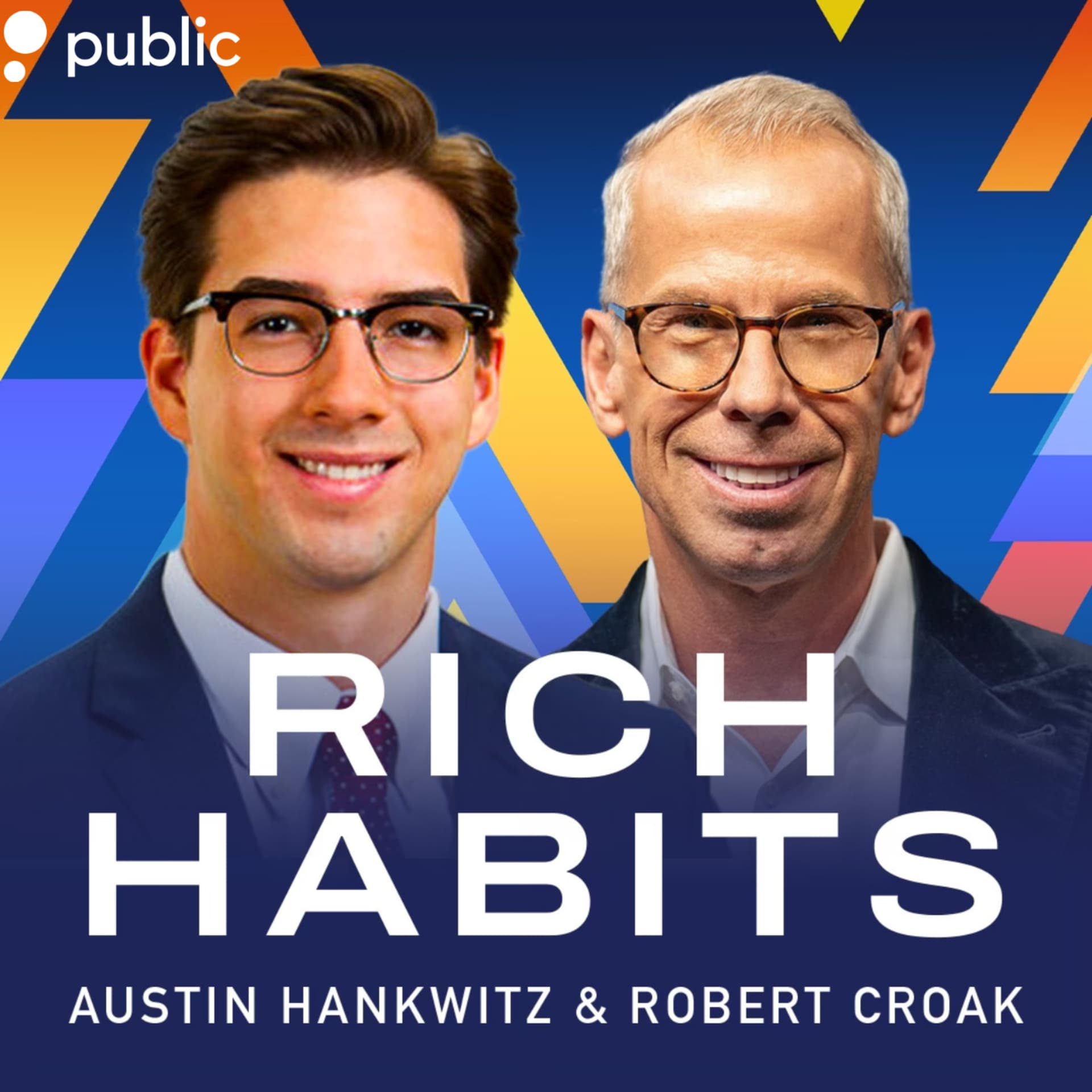
Rich Habits Podcast
Description
The Rich Habits Podcast focuses on financial literacy, helping listeners take control of their money through the development of new financial habits. Hosts Robert Croak and Austin Hankwitz share insights from their experiences in business and finance, aiming to guide their audience towards achieving financial success.
---
Episode Title
Q&A: Retiring at 54, Becoming an Overseas Landlord & Trading Oil Futures
Episode Description
In this episode, hosts Robert Croak and Austin Hankwitz engage with audience questions on various financial topics, including retirement strategies, real estate investments, and trading oil futures.
---
Key Takeaways
Introduction (01:00)
- Hosts discuss their excitement for the new year and the upcoming 2026 Rich Habits Rodeo event planned in Nashville.
- Introduction of new tools and resources available for listeners to enhance their financial literacy.
Question 1
Amber S's 401k Dilemma (05:00)
- Situation: Amber has a 401k from a previous employer, which is underperforming. She contemplates rolling it into a Roth IRA.
- Advice:
- Recommended rolling over to a traditional IRA first to avoid immediate tax liabilities.
- Suggested contributing to a Roth IRA annually for future tax-free growth.
Question 2
Sam J's Investment Strategy (18:00)
- Situation: 19-year-old Sam has $30,000 invested but lacks taxable income to contribute to a Roth IRA.
- Advice:
- Recommended paying self-employment taxes on income to qualify for Roth contributions.
- Suggested forming a single-member LLC for tax write-offs.
Question 3
Oil Trading Insights (30:00)
- Situation: Fernanz asks about investing in oil and the implications of geopolitical factors.
- Advice:
- Caution against trading commodities due to high volatility and risks.
- Encouraged investing in shares of companies with strong growth potential instead.
Question 4
Long-Distance Landlording (42:00)
- Situation: EF inquires about becoming a landlord from afar, referencing a friend's successful investment in Dubai.
- Advice:
- Suggestion to avoid international investments without extensive experience.
- Emphasis on using technology and reputable property management firms for US-based investments.
Question 5
Solo 401k Considerations (50:00)
- Situation: Shane W. has two small businesses and is considering the best solo 401k provider.
- Advice:
- Recommended using Carry.com for setting up a solo 401k.
- Emphasized maximizing contributions to an IRA alongside a solo 401k.
Question 6
Selling a Rental Property at 54 (58:00)
- Situation: Pia's husband wants to sell their rental property to invest in other financial instruments.
- Advice:
- Suggest selling the property to reinvest the proceeds for potentially higher returns.
- Discussed balancing mortgage payments with investment income in retirement.
Conclusion (01:10:00)
- Hosts emphasize the importance of aligning financial goals within relationships and the value of open discussions about finances.
- Encouraged listeners to anticipate upcoming episodes and participate in the Rich Habits Network.
---
Resources Mentioned
- Public: Investing platform for building portfolios.
- Rich Habits Network: Community for financial strategies and tools.
- NEOS Funds: ETFs for generating income through real estate investments.
---
Final Thoughts
The episode highlights the dynamic nature of financial planning, emphasizing the need for personalized strategies that align with individual circumstances. The hosts encourage listeners to adopt a proactive approach in managing their finances for long-term success.
Written by AI. May contain mistakes. Listen to the episode to check what was said.
Chapters
Tap a time to open that second in VOExciting Plans for 2026
0:45 to 1:49
Hosts discuss their personal and professional aspirations for the new year.
“Or you've helped us so much financially.”
401k vs Roth IRA: Amber's Dilemma
3:21 to 4:48
Amber asks about managing her 401k and whether to roll it into a Roth IRA.
“and for those of you that haven't joined the Rich Habits Network yet, you can get all of our generated asset strategies right in the Rich Habits Network and there is a seven-day free trial in the show notes below.”
Tax Implications and Investment Strategies
4:48 to 8:30
Discussion on the implications of rolling over retirement accounts and investment strategies.
“You've got, I'm assuming this $164 ,000 in a 401k.”
Self-Employment and Roth IRA: Sam's Situation
8:30 to 10:03
Sam, a 19-year-old, asks about contributing to a Roth IRA with limited income.
“Sam says, Hey, Austin and Robert, I found your podcast almost a year ago, and I can't thank you guys enough.”
Investing in Oil: Fernanz's Inquiry
10:03 to 11:28
Fernanz seeks insights on investing in oil amidst changing prices and geopolitics.
“So if you're claiming$7 ,000 of income and then you have write-offs of$3 ,000.”
Understanding Commodities vs Investments
11:28 to 14:00
The hosts explain the differences between investing in commodities versus stocks.
“I think sometimes people try to get too fancy, especially earlier on in their financial careers.”
Investing in Oil Futures: Risks and Recommendations
14:00 to 15:27
Learn about the risks of investing in oil futures and better investment alternatives.
“something or I don't know, like insert whatever your idea is here, then theoretically you could use a CFD to profit from that.”
Long Distance Landlording: Pros and Cons
15:27 to 19:05
Discover the challenges and considerations of long distance real estate investing.
“Because if you're going to trade Forex or you want to day trade and you want to do all these things, it's a full-time job.”
Choosing the Right Solo 401k Provider
19:05 to 21:38
Understand the basics of solo 401k accounts and the importance of choosing the right provider.
“invests in real estate for you and then pays you a monthly distribution yield and all that other fun stuff.”
Combining Finances After Marriage: Key Strategies
23:53 to 28:00
Explore effective strategies for managing finances as a married couple.
“My name's Chase, and I'm a loyal listener to the show.”
Show all 14 chapters
The Importance of Financial Alignment in Relationships
28:00 to 29:50
Learn how to ensure both partners in a relationship are aligned financially to avoid conflicts.
“and married and up and running and everything.”
Real-Life Example of Misaligned Finances
29:50 to 31:00
Hear a story illustrating the challenges of financial misalignment in long-term relationships.
“that piggybacks it perfectly, and that is a really good added take to this.”
Evaluating Real Estate Investment Decisions
31:00 to 33:13
Understand the factors to consider when deciding whether to sell a rental property.
“Pia says, I'm a new listener and I just listened to your December 3rd podcast episode.”
The Impact of Selling Property on Retirement Strategy
33:13 to 35:08
Learn about the financial implications of selling a property for retirement income.
“the growth in the$600 ,000 would give them more income than the net of the$2 ,000 a month, the$1 ,400.”
Transcript
Automatic transcript. May contain errors.0:00Hey, everyone, and welcome back to the Rich Habits Podcast. question and answer edition brought to you by public.com and a very exciting happy new year. Today is January 1st, 2026. We've got so many tools and resources that have been published here on Spotify through, of course, the Rich Habits podcast that are going to help you win with money in 2026. Robert, what are you most excited about personally for 2026? I just think it's about having that abundant growth mindset and there being so many secular growth trends that we've been right about for the last three years in this podcast and in the Rich Habits Network.
0:39And it's just more of that growing the network because the coolest thing for me in life, I'll be honest, is walking down the street or in an airport and a family stops me and says, hey, can we take a picture? You've changed our lives. We love the Rich Habits Podcast. Or you've helped us so much financially. So that's it for me is more of that. Helping people figure out their money, figure out their mindset and figure out their businesses so they can live financially free. So that's it for me. That's exciting. I think the thing I'm personally most excited about for 2026 is the introduction of what we hope to have at least one, maybe two live events.
1:17Inviting as many of you as possible here to Nashville to host some sort of master series over the course of a weekend. Calling it the Rich Habits Rodeo, perhaps. we'll figure out some fun stuff with that but 2026 I think is the year that we really try and introduce a in real life event where we get to meet all of you and learn and we all get to you know incorporate a bunch of different cool speakers and a lot of fun things of that nature so 2026 is going to be the year where we do a little in-person stuff and I could not be more excited about it but we're wishing everyone a happy new year we hope you're not too hung over this morning considering last night was new year's eve at time of filming this I'm in Nashville but on actual New Year's, I will be in West Palm Beach, Florida, celebrating the new year with my fiance and Christian.
1:59And I'm just so excited for 2026 and so grateful that so many of you are following us into the new year and tuning into the show on a weekly basis. Well, make sure if we do this event, you do not talk me into riding a mechanical bull. I want to keep this body intact for 2026. So we'll have a lot of fun, but no mechanical bulls for me. No mechanical bulls. Now, this episode of the Rich Habits podcast, of course, is powered by Public, the investing platform for those who take it seriously. Because on Public, you can build a multi-asset portfolio of stocks, bonds, crypto options, and now generated assets, which allow you to turn any idea into an investable index using AI.
2:39And it all starts with your prompt. From renewable energy companies with high free cash flow to semiconductor suppliers growing revenue 20 % year over year, you can literally type any prompt and let AI do the work. It screens thousands of stocks and builds you a one-of-a-kind index and lets you backtest it against the S &P 500, all within a few clicks. Generated assets are like ETFs with infinite possibilities, completely customizable and based on your thesis, not someone else's. So go to public.com forward slash rich habits and earn an uncapped 1 % bonus when you transfer your portfolio. That's public.com forward slash rich habits.
3:20Paid for by public investing and full disclosure in the podcast description. and for those of you that haven't joined the Rich Habits Network yet, you can get all of our generated asset strategies right in the Rich Habits Network and there is a seven-day free trial in the show notes below. So our first question comes from Amber S. Amber says, hey Austin and Robert, I recently found your podcast on a long drive and I started back at episode one. I'm currently at episode 100 and doing my best to get caught up. I really enjoy the nuggets of knowledge you guys share in every episode. Here's my question.
3:52I have money in a 401k from a previous employer that recently got moved by the employer from Mutual of Omaha to John Hancock. After looking at the statement, it is definitely underperforming. On a previous episode, you had talked about moving a 401k from a previous employer into a Roth IRA. And as I consider the taxes at the point of moving, it might cost me north of$34 ,000 to do this. Is it better for me to take the loss now so that I've got the money growing for me tax-free versus later? Or should I just keep it in this 401k, adjusting the investments into something with a better rate of return, and then perhaps adding to a Roth IRA elsewhere?
4:34For context, I'm married. I'm 42 years old. I have$164 ,000 in a 401k, and my husband has$24 ,000 in a 403b. Or maybe I should roll it into public and get that uncapped 1 % match. Thank you so much. Looking forward to your feedback. Amber, love where you're at. So let's talk about your situation. You've got, I'm assuming this $164 ,000 in a 401k. Maybe that's what the number is here. So you've got this$160 ,000 in your 401k from a previous employer. Because you no longer work at that employer, you are able to roll over that 401k without any penalties, taxes, nothing into a traditional IRA, which is a pre-tax IRA, where you have full autonomy over how that money is invested.
5:18That is super simple. You can do that today and you can go open up this IRA on public, roll over, get your bonus match and have some extra money and make your investments work harder for you. That is totally something you can do right now. But you're asking if instead of rolling it over into a traditional IRA, completely normal, free, like no taxes, right? You are considering rolling it over into a Roth IRA. And remember, Roth IRAs are all after tax contributions, so you would have to pay taxes on this entire rolled over amount. This is a really, really tricky question because, in my opinion, you are in that kind of gray area.
5:57You're not so old where it's an immediate no, right? If you're like 55 and you've got money, roll it over to it. Like, no, it's all right. Just, I mean, you're gonna be able to touch the money in 5, 10 years anyway. Like, just don't worry about the taxes. Just do your thing. You're also not young enough where you're in your 20s or 30s where I could say, yeah, like roll it over to a Roth, pay your taxes now so you're good in the future. You're 42. You're about 20 years away from being able to really enjoy this money. But again, we're only talking about$160 ,000. I wish I had a better framework or sort of equation that I can share with you that's rules based.
6:32But to be quite honest with you, I'm just going to go off vibes on this one. I'm going to say no. I'm going to say take that money, roll it out of your John Hancock or whatever it is into a traditional IRA on public.com and then what I want you to do is contribute to your Roth IRA. So literally put it in a traditional IRA, let it grow and compound for you over decades, make sure it's invested into the index funds and ETFs we talk about and then all of your contributions going forward are going to go toward a Roth IRA. You're going to max that out every single year and you're off to the races. Now, the only part where this gets a little convoluted is when you want to start doing backdoor Roth IRA contributions because you make more than the income limits.
7:16To do a backdoor Roth IRA, you're not supposed to have any money in pre-tax IRAs like a traditional IRA, like messes up the conversion there. So it gets a little convoluted that way. But depending on your income and the way you describe this, I'd probably argue you and your husband make below that$236 ,000 a year. You said he's contributing to a 403B, which makes me think he's maybe a teacher or somebody like that. So if you're making more than 236, of course, like just do the Roth, pay the taxes, get over it. But if you're not, then I would do what I'd said before. I agree 100%, Austin. Get that rolled over.
7:50No penalties, no fees, just rock and roll. Let it perform better because you have autonomy now and then start maxing out that Roth IRA every year. You still have 20, 25 years of a really strong horizon to build your wealth. And getting the Roth started now is better late than never. And that's exactly the playbook I agree with you, Austin, that I would do. Yeah, just kind of zooming out, right? I mean, at the end of the day here, you're$160 ,000, assuming that's what you're rolling over to your traditional IRA. The rule of 72 tells us the stock market doubles every seven years or so. So this$165 ,000, assuming it doubles four times, is north of$2.5 million.
8:27You're going to have so much money. Don't even worry about it. You're going to do just fine. So our next question comes from Sam J. Sam says, Hey, Austin and Robert, I found your podcast almost a year ago, and I can't thank you guys enough. For some background, I'm 19 years old. I live in California, and I've got 30 ,000 in investments. I do dump runs in odd jobs for work. However, the issue is I have$0 in my Roth IRA due to not having any taxable income. My question is, should I take the hit and pay the 15.3 % self-employment tax on my 7 ,000 so I can invest that into the Roth IRA? Or should I just keep piling into a traditional brokerage account until I have taxable income?
9:05I personally would take the hit. I feel like if, well, also it's like, what do you mean you don't have any taxable income? Like I understand like the odd jobs and stuff, but like, yeah, like just pay your taxes, dude. Like I don't know what to tell you, like let's not do tax evasion, right? Let's pay our taxes, which is really not that much money, especially if you just need to do that$7 ,000 to invest in the Roth. And then yeah, rock and roll that way. Robert, what do you think? Yeah, I would just form a single member LLC. So you could get the tax write-offs against your gas and your auto repairs.
9:34And you probably have a dump trailer repairs and all those things. You can also write off some internet and mileage and all these other things. And I would just claim the income. So many people try to cheat the system to save a little money, but you end up cheating yourself because like you said, you can't open the Roth without taxable income. So I would do that. Get yourself rocking and rolling. Keep hustling. Do things the right way now. Set up that foundation the right way and build your wealth along the way and you'll do just fine. Yeah. The thing that you need to be careful of, though, is to make sure that you are, you know, if you do this single member LLC and you've got these write-offs, you're not writing off everything because, again, you have to pay taxes on some sort of income of$7 ,000 or more.
10:15So if you're claiming$7 ,000 of income and then you have write-offs of$3 ,000. Well, now your taxable income is only$4 ,000, which means you can only contribute$4 ,000 to your Roth. So make sure that your taxable income after your write-offs is that$7 ,000 a year. Our next question comes from Fernanz S on Instagram. Fernanz says, Hi, I'm a big fan of your podcast and I appreciate all the insights and work you do and want to genuinely thank you for that. I was wondering what your take is on oil and oil pricing for 2026, considering geopolitical changes in CFDs being and what to buy if I want to invest in energy, primarily oil.
10:53Thank you very much. Robert, I'll let you kick this one off. Yeah, this is a tough one because we don't really have a backstory. We don't know what this person's net worth is. We don't know their age. We don't know if they're trying to get too fancy with their money. So we'll make some assumptions. I'm going to say Farnas is 40 years old, has a net worth of a million dollars and wants to dabble in the fine art of contracts for difference. So what does this mean? You don't own any physical oil. You're not a JV or a GP or any of these in any of these funds. If I can understand this correctly, you're basically just investing in the difference.
11:27You're trying to arbitrage the difference on these oil contracts to be able to make a profit. So I wouldn't do it. I think sometimes people try to get too fancy, especially earlier on in their financial careers. So I personally wouldn't touch it. I've had bad experiences with investing in oil myself, just illiquid and some other things and a lot of volatility. But that's what I would do because you have to be careful here because you're going to have a lot of leverage and you're going to have just a lot of volatility. And I just don't think it's a great strategy unless you're very well versed in it and understand what you're getting yourself into.
12:02That would be my take. So I'm looking at the price of crude oil right now. I'm doing this on tradingeconomics.com. A barrel of crude oil is currently at$56 a barrel, 57, somewhere in that range here. It's down 20 % over the last 12 months. And it's down dramatically, actually, from the peak that it experienced in 2022. It peaked at 116 a barrel. Now it's down to 56, which I think is just great in general because I don't like paying an arm and a leg for putting gas in my car, which also it's good because it should make it cheaper for people to move and companies to move goods around the world, therefore bringing down inflation.
12:42But again, who knows because capitalism. But anyway, to answer your question, would I invest in oil right now? What do I think of 2026 oil? Here's my perspective. And this is coming from a guy that is no expert by any stretch of the imagination in oil or many other commodities, but I don't invest in commodities. No one invests in commodities. In general, they trade commodities. Investing means, my name's Austin. I have a thesis that this is going to profit over the next three, five, seven, 10 years, and I'm going to invest my money into this underlying thesis because I think it's going to go up in value, and that is defined as dividends or share price appreciation or whatever else, corporate profits, however you want to think about that, right?
13:29But it's like that's investing. Commodities are different. The price of a commodity is a function of supply and demand. And a commodity is defined as a good. Think soybeans. Think oil. Think gold. Silver. Precious metals are commodities, right? Commodities are things. And things don't pay you dividends. Things don't report earnings. Things don't have profits. They're just things. And the price of that thing goes up or down, again, as a function of supply and demand for that thing. And so if you think that crude oil will go up in price because of geopolitical something or I don't know, like insert whatever your idea is here, then theoretically you could use a CFD to profit from that.
14:15A CFD is just making a bet on the price going up, kind of like a call option is for a stock. And so if that's what you want to do, rock and roll. I don't know enough about oil to want to put my hard-earned money at risk to potentially go down if I'm wrong. But I do know a lot about companies. I do have conviction into Amazon. I'll buy Amazon stocks. I know I understand it. It's hard for me to put my money into things I don't understand. Now, I guess the flip side of that is I do have money in things like gold and silver and palladium and different types of precious metals. But I see that more as a hedge against volatility than I see it as a trade to make a lot of money, if that makes any sense.
14:56So my opinion, I wouldn't do this. I think you're better off just putting your money into the S &P 500, the NASDAQ. Maybe you're better off putting your money into a specific company that you really are passionate about and understand their growth trajectory for the next three, five, seven years. Buy NVIDIA. Heck, I don't know. Like, put your money into something that you clearly see as operating in a secular growth trend. Cybersecurity, talking about that for a long time. Cloudflare, CrowdStrike, those names are crushing it. So I would put my money in something like that versus trying to roll the dice on the price of barrels of oil.
15:26Yeah. And the other thing I want to add to this for everyone else is to understand the opportunity costs. Because if you're going to trade Forex or you want to day trade and you want to do all these things, it's a full-time job. You have to be watching the markets. You have to understand why oil is going up, down, sideways. And this is a full-time job. So you have to ask yourself, is it worth me spending three, four, five hours a day to do this strategy, are the profits going to be there enough and consistently enough to do this versus being a long-term investor, finding your convictions, finding the right stocks and ETFs that we talk about, and just investing in dollar cost averaging?
16:05So that is another consideration when you're looking at these types of strategies. Our next question comes from EF on Instagram. EF says, Hi, Robert and Austin. What an amazing job you guys do. I really appreciate it. I built my base and I'm still adding to it. I've got no debt, but I don't really have any real estate either. I now wonder whether it's time for me to enter the real estate game as well. I do have a friend who purchased a apartment in Dubai and they have an agreement with a property management firm and he's got some tenants, he's making some money from it, and they of course take care of the maintenance.
16:35Do you think someone should do this with real estate? Be a long distance landlord. Thank you very much. Keep up the good work. E-F. Robert, what do you think about long distance landlording? What's been your experience as a long distance landlord? I think in the short term, if you're just getting started, it's a terrible idea. Because if you have something, especially out of the country, which is, you know, another level of long distance, I just don't like it. Because if something happens, you have to sue somebody, you have to chase somebody. Guess what? Depending on the contracts, you're going to have to go to that country to fight for your money and your rights.
17:10So just keep that in mind. I've lost millions of dollars with international contracts where I've had to fight them in other countries. And I don't like that idea. Now, long distance, if it's in the United States, and I'm assuming you are, I'm OK with that because I can get in a car. I can get on a two hour flight in most instances, go to the property, go fight it, do what I need to do and fix the problem. But for any of you that are just starting out, don't fall for this because right now it's all the rage because Dubai has all these tax breaks. and all of these really cool features for US citizens to be able to go buy real estate.
17:45But I don't like it because you can't touch it, you can't feel it, and you can't control it. I would stick to the basics to get started. If you get yourself into millions of dollars of real estate deals and you want to venture out of the country, go for it. But not until then. You're just trying to get too fancy, chasing a trend, and it's not worth it. So what advice would you give someone that is trying to do long distance landlording for their first time in general here in the United States. Use technology as your friend. I would find the right rental apps, the right management firms. You want to check out and make sure whatever area you're buying, you have a really good management company that can handle it all.
18:25And that's okay with me because if you have an established rental company that manages properties and you can verify that they're good at what they do, you're going to be in really good hands 95 % of the time. And if not, then I would just stay out of the real estate game and invest in REITs like on Fundrise or something like that, where they do all the work for you and it's just passive income. If you are someone who is long distance landlording, just think about the opportunity cost on your time, right? Is the money you're earning long distance landlording worth the time and headache that might come with being a long distance landlord, like Robert said, having to hop on a flight or drive a couple hours, whatever it might be, versus just passively investing into real estate via the IYRI, NEOS funds ETF that invests in real estate for you and then pays you a monthly distribution yield and all that other fun stuff.
19:15So yeah, really, it's just balancing how you prefer to have exposure to the asset class that is real estate. Yeah, I agree with that 100%. Real estate is something everyone should own, But I always like to tell people, start out small, get your feet wet, understand what you're doing, do your research, become good at it, and then expand and get a little fancier and do bigger projects elsewhere. But in the beginning, keep it simple, make the money, and learn the industry. So our next question comes from Shane W. Shane says, hello, gentlemen. I've been listening to the show for a while, and I really enjoy it.
19:48I was wondering if you could provide your opinion on who the best solo 401k provider is. I've got two small businesses and two rental properties. I also have an IRA with about$190 ,000 inside of it. My wife is working in corporate America where she has good benefits and stock options. Should we open up a solo 401k and max it out yearly? Do we keep maxing out our IRA, our bridge account? What do you guys think? So in your situation, it seems like you've got two small businesses and two rental incomes, which is awesome because I'm assuming that means you've got some business profits. Now, how a solo 401k works is you're essentially creating a 401k account, except you're a solopreneur, right?
20:29So it's like you're working for yourself here. You're a self-employed individual and you're creating your own 401k because you work for yourself. You don't have a 401k elsewhere. Like you're going to do it that way. That's what I have. So Robert has, it's a very simple way to do it. We use carry.com, C-A-R-R-Y.com to do that. I do something called a mega backdoor Roth solo 401k. I'm not positive if you'll be able to do that because I don't know if you pay yourself a salary. You need to pay yourself a salary to do the mega backdoor Roth, but assuming you do pay yourself a salary and it's not all just self-employment tax, you should be able to contribute to a mega backdoor Roth solo 401k in that instance.
21:08Go check out kerry.com. They've got a bunch of awesome tools and resources here. The big thing you have to remember with a solo 401k is you don't have other employees in your business. You mentioned you have two small businesses and two rental incomes. If you have any employees on payroll and those two small businesses are those two rental incomes, that's not your spouse. You cannot do this, right? This is only for people who are solo, right? No employees plus solo 401k. It doesn't work like that. Yeah, I like that breakdown, Austin. And definitely, Shane, keep maxing out the IRA. Always, always do that.
21:42You want to make sure you get as many benefits as you can every single year. And just like we always say, just don't get too fancy. It's not necessary. Austin laid out the blueprint. Hope this helps. And just keep rocking and rolling and do things right. Robert, speaking of getting fancy though, we have been getting fancy behind the scenes when it comes to using Publix generated assets. We've created 13 strategies of our own generated assets inside the rich habits network they are the rich habits generated asset strategies and they are awesome they what's so cool about generated assets on public is you can benchmark your strategy against the s &p 500 over the last 10 years and like all of our strategies are in the you know 800 900 a thousand percent return back test over the last 10 years which is sick so if you want to start using generated assets go to public.com slash rich habits type in your own strategy, something like one that has worked well for us that I think y 'all should just steal and use is investing into companies that are growing revenue and their annual dividend by at least 10 % per year over the last, I think it was like three or five years or whatever I ended up using as a parameter there.
22:49Pretty good one. It's a good strategy. Back test pretty well. So stuff like that, right? Come up with your own strategy that you think will perform well, right? We did one with R &D, companies that are reinvesting at least 15 % of their market cap into research and development. That one backtested well. So one, go check out Generated Assets, public.com slash rich habits. And if you want more Generated Assets ideas, join the Rich Habits Network, and it's just pinned right there at the top. And I just want to put something out there for all the new people around here. We have been talking about public.com for years now.
23:21The reason is, and why we love them so much, not just for you and for ourselves, as our main sponsor, is because they build the coolest stuff to make your lives easier, our lives easier, and help us make more money. So I want to clear that up because people are probably like, why do they talk about Publix so much? Because it's awesome. It's a really great platform that helps all of us build wealth. So make sure you check it out. If you're new around here, public.com. There's a link in our bios. There's a link in the show notes. And it's just a great platform. Our next question comes from Chase M.
23:54Chase says, hey, Austin and Robert. My name's Chase, and I'm a loyal listener to the show. Listen for about a year and a half and implementing your financial strategies. I'm 20 years old. I got engaged recently to my fiance. We're both still in college, but started to contribute to our Roth IRAs and brokerage accounts last year. Obviously, we're only just starting with a little bit of money each month, but a little bit is better than nothing. While our wedding is still well over a year out, I was wondering what your thoughts are and how we could continue our investing journey after we get married.
24:23We're gonna graduate from college the year after we get married, We are currently investing through Robinhood, but I was wondering if we should roll over our investments to a joint account or remain separate after the wedding. When we get married, we plan to have both personal accounts and a joint bank account. What is your advice when it comes to combining finances? Thank you so much. Chase, Chase, Chase, if I give you a high five through the monitor here, I would. Good for you. That is so exciting. Well, congrats on getting engaged. Nothing better than falling in love. And it's just, it's great.
24:53As someone who's also engaged right now. It's incredible. Okay. So my best advice for building wealth after you get married, three things. One, you need to be maxing out your Roth IRA. She needs to be maxing out her Roth IRA. And y 'all do that congruently side by side until y 'all are in retirement, right? Despite being married, she has her retirement account. You've got your retirement account rock and roll because that's how you double dip essentially, right? You just keep on rocking. So do that VOO, QQQ, VGT, all the normal index funds and ETFs we talk about. The second part, when it comes to combining finances, when I talk about combining finances, I don't mean so literally that you guys share Venmo accounts and you guys share PayPal accounts and you guys share, like, I don't mean it that literally.
Read the full transcript
25:44I more mean it in a sense of every month you and your fiance or your spouse now, sit down and say, cool, we are graduated from college. We are living our lives. This month, we're going to bring in$5 ,800 in income. We have our bills to pay. We have expenses. But like at the beginning of every month, we are combining, we're sitting down and we're saying, okay, our money goes into this one joint account. Let's now make sure that we're actually spending that money while we agree on how it should get spent on the same page with money, right? That's the goal here. Yes, let's pay this bill. Oh, honey, you want to get your nails done.
26:16You deserve that. Absolutely. Oh, I'm actually going to go, you know, I want to pick up a prime rib from Costco. I love prime rib. That's going to come out of this account, right? It's like you're combining your finances in the sense that you guys are aligned with your budget before the month even starts. 100%. Now, if you want to have your own checking account over here, and she has a checking account there for maybe other expenses, but as long as you guys are not in an abusive relationship and everything's rocking and rolling there, having a combined joint checking account that some paychecks go into, money's flowing in and out of.
26:48I think that's totally perfect, right? Assuming again, it's a happy, healthy marriage. If there's any sort of abuse or any sort of addiction or like separate, see you later, bye. You can't trust people at that level and stage of craziness. But all is good. Rock and roll. Have a good time. And the last thing I'll add, and it's more of a high level mindset than it is a tactical step, which is make sure that it's not, hi, honey, this is what we're doing with our money. It's, hi, let's sit down and talk about what we both want to do, get on the same page with why it's important so that we both are on, you know, we are aligned with where we're going with our money.
27:28I'm not telling you what to do with your money, just like you're not telling me what to do with my money. We are on the same page as to why this is an important thing for us both to do together. That is how you avoid money fights and money problems and money fights and any problems are the number one reason for divorce. Well, you took the words right out of my mouth. The biggest takeaway from your breakdown, which was incredible, was alignment. But I'm going to back the train up just a little bit and add one more piece to it. Before your knee hits the ground, you need to have this conversation because you want to make sure you don't get all the way down and married and up and running and everything.
28:02And you didn't have the tough conversation of, hey, what are our financial goals? How is this going to work? And are we fully aligned? Because one of you might be a spendthrift and one of you might be really frugal and you want to make sure you're on the same page so you don't get into those money fights later. So I agree with Austin on everything, but have the conversation earlier than later. If you're in love, it's okay to have this tough conversation because you don't want to wait until it's too late and then find yourselves fighting down the road because you can't get where you want to go collectively because one of you is not in alignment with the other financially.
28:39Yeah. And I think something else too that people do that maybe isn't a mistake, but can cause a riff is one person is hyper focused on getting as much invested. I want to hit these goals, like let's rock and roll. And the other person's aligned, but they're not like hyper obsessed like the other person, right? I know some money nerds are listening to this episode and they're like, oh yeah, I'm hyper obsessed with money. I want to make sure I'm hitting my goals and doing it all right and tracking everything. And their spouse who's listening, who might not be listening is like, yeah, I mean, I'm cool with money, but like, I'm not crazy obsessed.
29:11Just make sure that if your spouse who is not the one that is crazy obsessed with money, like you are listening to this episode, because it's the Rich Habits Podcast, make sure that you are not taking away from their joy with money in the sense that, honey, we got to invest tens of thousands this year. Like, oh my gosh. Meanwhile, while your spouse is still driving a 14-year-old car, right? It's like there's some things that you guys need to kind of trade off on. Like it's cool to be investing. Like we're talking about that, but don't do it to the expense of your spouse's happiness. I don't think I explained that too well, but I hope you guys are kind of understanding what I'm trying to say.
29:48I've got an immediate story just from the other day that piggybacks it perfectly, and that is a really good added take to this. And that is I had a call with an anonymous person. She's been married to her husband for 20-some years, and right now he gives her$2 ,000 a month. He handles everything else, all the money. She doesn't know where they're at and the 2 ,000 is supposed to cover all of her joys, all of her bills, her daughter's bills, all these things. That is not alignment. You both need to be on the same page because even though one person might be hyper-focused, which is too much and it's hard to deal with because you're not having any fun in life and you're not being able to enjoy life to the way you want because one person won't allow it, That's alignment as well that you have to figure out.
30:34So I think you did a great job, Austin. And it's such an important thing because I was thinking about this call I did and I felt terrible. It's 2026 and$2 ,000 is just not enough in this era to live a meaningful, enjoyable life, especially if you're paying for all your own bills and your daughter's bills to be able to make this happen. So I'm happy you went that route because I think it was important to understand. Yeah, that is definitely not alignment with money. I don't like that at all. So our last question comes from Pia. Pia says, I'm a new listener and I just listened to your December 3rd podcast episode.
31:08I have a question which I hope you can answer. My husband spent 25 years as a teacher from Mountain View School District. He wants to retire early as he said he's been working since he was 14. Today, he's 54 years old. We have a paid off rental property valued at$600 ,000, which he bought 25 years ago for$180 ,000. He wants to sell it and invest the proceeds into stocks, bonds, T-bills, and other things. Basically, make that money work for him to supplement his pension of about$4 ,000 a month. We're currently getting$2 ,000 a month of rental income from that property, which we use to pay our$200 HOA, and the rest goes toward paying our primary residence, which has been mortgaged for the last 10 years at a$1 ,400 a month payment, 3 % interest rate.
31:55Do you think selling our rental property is a good idea or not? I've always believe that it's better to invest in real estate because property values always go up. Thank you in advance for your help. What a good question and a very interesting situation to be in. Robert, what do you think about this situation? Well, real estate doesn't always go up in value. There are a lot of markets around the country that are flat and go up 2-3 % a year, sometimes 4%, which is still better than nothing. But there are other ways to invest money and make more money with your money. In this instance, I would probably sell it because condos do appreciate less than primary homes and single family homes.
32:33So in that instance, I think you're definitely on track. I would sell the condo, take all that money, get it invested, get that additional income, and you guys will be set. Because at 54 years old, you're right. You guys have made some good decisions and this money could really set you up because$600 ,000 invested right now, make an 8%, 9%, 10 % a year is going to give you$50 ,000,$60 ,000 in income. You could use part of that as income and roll over the rest into growth. And I think it's a great situation to be in. Now, what do you think about how they're paying their mortgage right now from the rental income?
33:06So their rental income would go away and they wouldn't be able to pay their mortgage with it. True that, but they would have the growth, which I believe would be higher than the rental income. the growth in the$600 ,000 would give them more income than the net of the$2 ,000 a month, the$1 ,400. So I still think it's the right financial move long term. Yeah, I agree with that. Looking at some of these numbers after taxes, because you will owe taxes on your capital gain here of about$420 ,000. After taxes, you should have about$515 ,000 to play with. So you'd still have like$500 ,000 after, let's say, you put$15 ,000 aside and upgraded your lifestyle, got a new car, went on a vacation, something cool.
33:46Congrats, you're retired. Have a little celebration. Enjoy it. But with that$500 ,000, you mentioned stocks, bonds, T-bills, things like that. I think that's totally fine. I would also really encourage you to think about NEOS funds. NEOS funds ETFs do a really good job of generating tax-efficient monthly income. If you want to be more on the risk off side there. You can do their hedged equity ETFs like SPYH, QQQH. You can also have some of their bond BNDI ETF. They have a T-bill one as well, CSHI. They've got a lot of really interesting ETFs that'll pay you. I would say, depending on how you pull this$500 ,000 portfolio together, you could probably earn between, I would say,$40 ,000 to$50 ,000 a year in extra income.
34:36So call it$3 ,000-ish a month, depending on how you break that out. So that would definitely supplement your monthly mortgage and some. That's kind of how I think I'd play that game, Robert. Yeah, they did a great job. They're definitely thinking in the right direction of what to do. And I would sell it and move on just because the capital appreciation on most condos around the country is probably two or 3%. And there just isn't enough growth there. And they'd make more money elsewhere to help him retire early. Now, the thing that I also really believe in, and of course, you don't have to have this done at 54, but I don't know, maybe like I really hate seeing people go into their, you know, 60s and 70s, their retirement years with a monthly mortgage payment.
35:19I'd love to have people have their house paid off by the time they're 65 or 70, right? Like no one wants to retire with a mortgage still. And so of course it's at 3%, so there's no reason to pay this off. You said you have 10 more years. So I think that's good to know that by the time your 54-year-old husband is 64, right, starts collecting on Social Security, you guys really will be able to take advantage because now you've got extra Social Security, you've got a pension, You've got your portfolio growing for you, and you've gotten rid of a$1 ,400 a month payment. Got it. Yeah, I agree. That's another way to look at it for sure.
35:52I mean, the number one thing is for people in this situation is to understand, don't pay off a house and leave yourself cash broke and poor. So let's say you do retire early, but you don't have access to any funds to be able to live the life you desire. So you just have to make sure you balance and understand not being a net worth millionaire, but you don't have access to the capital yet because you retired early. That's right. Everybody, welcome to 2026. We're wishing you a very happy new year. We're so grateful that you've joined us into this new calendar year here at the Rich Habits Podcast.
36:24And so many of you, 77 ,000, according to our Spotify rap data, have us at the very top of your podcast rotation. Maybe in 2026, that number hits 100 ,000, Robert. Maybe get 100 ,000 people to have us as their number one show. Who knows? I think we can get there because we get to wake up every day and let's get this straight. You guys bring us so much joy as well, because Austin and I both love educating and really sharing the good, the bad, and the ugly of all of our concepts and ideas and learnings and all the things we've done over the years, especially me being the older guard. And so we just really appreciate each and every one of you and we wanted you to know that.
37:02Do not forget, we're still running a seven-day free trial to join the Rich Habits Network. We've also published a ton of recent podcast episodes about helping you win with money in 2026. Please give those a listen. Please continue to come back every week as we've got tons of cool interviews, tons of cool topics, and maybe a weekend event in 2026 here in Nashville that I just, I can't get over the cool title of Rich Habits Rodeo. It's going to be called the Rich Habits Rodeo. It has to, Robert. We just got to take the maybe out. We just got to put the stake in the ground, pick a date and get it done because we're doing the Rich Habits Rodeo this year, no matter what.
37:39So y 'all stay tuned for that. And also stay tuned for a Friday episode. We're skipping it again this week as, you know, these Q &As are a little bit on the prerecorded side. Right now I'm actually, like I said, in West Palm Beach. We're enjoying our New Year's. We hope you all are enjoying it as well. So no Friday episode tomorrow, but come next week, the Rich Habits Radar weekly episodes are back. So be sure to tune into those. Thanks everyone and see you on Monday.
38:35Transcription by CastingWords Transcription by ESO. Translation by —
From the publisher
In this week's episode of the Rich Habits Podcast, Robert Croak and Austin Hankwitz answer your questions!
---
🧠 Ready to build your own investable index using AI? Generated Assets on Public makes it easy.
Click here to try Generated Assets!
---
💰 Download the 2025 Wealth-Building Workbook, click here!
---
🚀 Join 830+ other podcast listeners inside of the Rich Habits Network and invest alongside Robert and Austin, click here!
---
⚡️ Sign up for the Rich Habits Newsletter and never miss a market-moving headline again, click here!
---
⭐ Download our FREE Financial Planner – click here
⭐ Download our FREE Budgeting Template – click here
⭐ Earn 3.8% on your savings with a High-Yield Cash Account – click here
⭐ Trade stocks, options, music royalties and crypto on Public – click here
⭐ Automatically buy stock where you shop with Grifin – click here
⭐ Protect your family with term life insurance from Suriance – click here
---
👤 Explore everything Austin does – click here
👤 Explore everything Robert does – click here
❓ Ask us questions for our Q&A episodes – @richhabitspodcast on Instagram
📬 Inquire about working together – christian@witz.vc
---
Disclosure: All investing involves the risk of loss, including loss of principal. Brokerage services for US-listed, registered securities, options and bonds in a self-directed account are offered by Public Investing, Inc., member FINRA & SIPC. Public Investing offers a High-Yield Cash Account where funds from this account are automatically deposited into partner banks where they earn interest and are eligible for FDIC insurance; Public Investing is not a bank. Cryptocurrency trading services are offered by Bakkt Crypto Solutions, LLC (NMLS ID 1890144), which is licensed to engage in virtual currency business activity by the NYSDFS. Cryptocurrency is highly speculative, involves a high degree of risk, and has the potential for loss of the entire amount of an investment. Cryptocurrency holdings are not protected by the FDIC or SIPC.
Alpha is an experimental AI tool powered by GPT-4. Its output may be inaccurate and is not investment advice. Public makes no guarantees about its accuracy or reliability—verify independently before use.
*Rate as of 11/6/25. APY is variable and subject to change.
See terms and conditions of Public’s ACATS & IRA Match Program. Matched funds must remain in the account for at least 5 years to avoid an early removal fee. Match rate and other terms of the Match Program are subject to change at any time.
Hankwitz Group LLC has an existing business relationship with NEOS Investment Management LLC. The opinions expressed are those of the author, and the author owns several NEOS ETFs.