In short
Rich Habits Podcast Episode Summary: Q&A: Spot Bitcoin ETFs, Shiny Ball Syndrome, and Revocable Trusts
Podcast Overview
- Title: Rich Habits Podcast
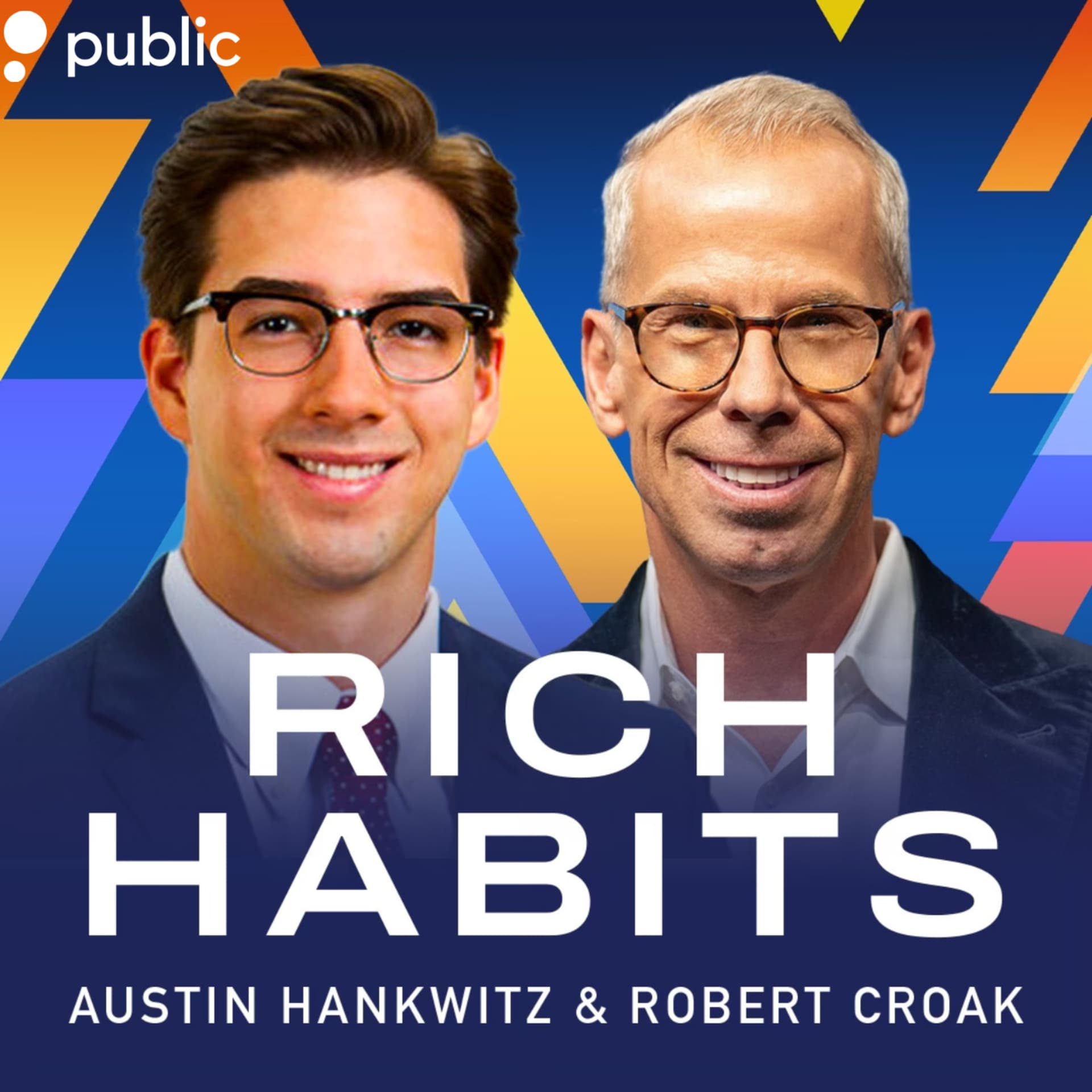
- Hosts: Robert Croak and Austin Hankwitz
- Episode Air Date: [Insert Date]
- Episode Focus: A question-and-answer format addressing various financial topics, including investing strategies, recent financial news, and personal finance management.
Key Themes and Concepts
Introduction
- The hosts express gratitude for their sponsor, Public.com, which offers a high-yield cash account with a competitive APY.
- The episode format centers around listener questions sourced from Public.com.
Listener Q&A
- Shiny Ball Syndrome in Investing
- Question by Omar: How to manage the instinct of investing amidst constant new opportunities?
- Key Points:
- Shiny Ball Syndrome refers to the tendency to jump from one investment idea to another, losing focus on a solid strategy.
- Strategy Suggested:
- Establish a three-pronged investment approach:
- Retirement Investments: Long-term safety (e.g., Roth IRA).
- Brokerage Account: More aggressive, riskier investments.
- Diversified Investments: Alternatives like real estate and fine art.
- Advice: Automate investments to maintain focus and avoid impulsive decisions.
- T-bills vs. High Yield Savings Accounts
- Question by Jonathan: Should one maintain a high-yield savings account when T-bills often yield higher returns?
- Key Points:
- T-bills are more tax-efficient and liquid compared to traditional high-yield savings accounts.
- Encouragement to optimize savings by considering T-bills for emergency funds.
- Bitcoin ETFs
- Question by Luke: Can the hosts explain the recent approval of spot Bitcoin ETFs?
- Key Points:
- Spot Bitcoin ETFs allow direct ownership of Bitcoin, unlike futures ETFs which are derivatives.
- The approval could lead to significant institutional investment, enhancing Bitcoin's market credibility.
- Current market reactions and potential price movements discussed, with predictions of market behavior following the ETF approval.
- Alternative Education for Entrepreneurs
- Question by C.T.: What are alternatives to traditional college for aspiring entrepreneurs?
- Key Points:
- Emphasizes self-directed learning through podcasts, YouTube, and online resources.
- Importance of understanding fundamental business concepts, especially finance and accounting.
- Portfolio Allocation
- Question by Luke: Is a 92% allocation to domestic stocks too aggressive?
- Key Points:
- At 27, this allocation is not considered overly aggressive, given his long investment horizon.
- Suggestion to consider adding international exposure as a diversification strategy.
- Need for a Revocable Trust
- Question by Terry B.: Does she need a trust given her property assets and children?
- Key Points:
- Establishing a revocable trust is advised for asset protection and ensuring smoother inheritance.
- Discussion on the importance of structuring assets properly to avoid probate and protect against liabilities.
Key Takeaways
- Investing Mindset: Focus on building a structured investment strategy to avoid impulsive decisions.
- Financial Optimization: Evaluate and switch to more lucrative investment vehicles like T-bills when advantageous.
- Cryptocurrency Trends: Spot Bitcoin ETFs are a game-changer for institutional investment in cryptocurrencies.
- Education for Entrepreneurs: Utilize available resources to learn essential business skills outside traditional education.
- Estate Planning: Prioritize setting up trusts to protect assets and ensure a seamless transfer to heirs.
Conclusion
- The hosts wrap up the episode by encouraging listeners to continue engaging with financial literacy. They express gratitude for listener support and highlight the importance of building wealth through informed decision-making.
Additional Information
- Contact: richhabitspodcast@gmail.com
- Links:
- [Public's High Yield Cash Account](https://public.com/richhabits)
- [Free Budget Template](https://stan.store/robertjcroak/p/get-my-budgeting-template-now)
- Social Media Mentions: The hosts appreciate audience engagement on platforms like Instagram.
--- This structured summary encapsulates the essence of the podcast episode, providing insight into key discussions and takeaways while remaining accessible for the reader.
Written by AI. May contain mistakes. Listen to the episode to check what was said.
Transcript
Automatic transcript. May contain errors.0:01The world moves fast. Your workday? Even faster. pitching products, drafting reports, analyzing data, Microsoft 365 Copilot is your AI assistant for work built into Word, Excel, PowerPoint, and other Microsoft 365 apps you use, helping you quickly write, analyze, create, and summarize so you can cut through clutter and clear a path to your best work. Learn more at Microsoft.com slash M365 Copilot. Hey everyone, and welcome back to the rich habits podcast question and answer edition we continue to be super grateful and happy that public.com is the exclusive title sponsor for these question and answer episodes now as a reminder public.com is one of our favorite online brokerage platforms because they offer much more than just stocks they give investors the opportunity to own cryptocurrency t-bills bonds and even music royalties they even just launched their own high yield cash account that pays a higher yield than Robinhood, M1 Finance, Ally Financial, and literally everyone else at 5.1 % with no subscription fees required.
1:09Did I mention the funds are insured up to$5 million? They're also fully liquid, so you can withdraw your funds at any time. Be sure to move your existing savings over to Publix High Yield Cash Account by visiting public.com front slash rich habits. Yes, they even built us our own awesome landing page. Yeah, if you visit public.com forward slash rich habits, there's also a link in the description below. You're going to find all the information you need to make an educated decision with your money as it relates to not only their high yield cash account, but their bonds, their T-bills, their music royalties, all different ways that you can earn yield with your portfolio in 2024.
1:48So with that being said, we're actually going to switch things up a little bit on this episode of the podcast. We are going to still do the question and answers, but we're actually going to get all of our questions today from the public.com platform. As you all might know, public.com is kind of like a Twitter vibe, right? They've also got people that ask questions, give hot takes, kind of stuff like that. And we posted earlier in the week saying, hey, we're going to take some questions, shoot us with them. And we got 18 questions in like two days. So we're really excited about it with our first question being Omar asks, What do you think about managing the instinct of investing?
2:25I feel like I walk on a tightrope sometimes trying to balance my long-term investing with my short-term ideas. How do you keep things straight when new ideas and opportunities pop up all the time? This is a great question. I don't think we've ever been asked this question. And really, the shiny ball syndrome is problematic. It has a cute name, but it can kill people's investment strategies. And what does that mean? The shiny ball syndrome basically means when people bounce from idea to idea to idea and they just really never focus in on a plan and what their goals are financially. I've suffered from it.
3:02Millions of other people do as well. So it's a really, really great question. And my take on this is really simple. Figure out kind of your three-pronged approach of what you're trying to do with your money and your investment style and strategy. You might have one prong be your retirement. What are we doing with that money? That's the money that we put away for the long term. Hopefully it's through a Roth IRA. You're not touching that money. You're not getting in and out of that money. So then that second prong could be a traditional brokerage account. So that one's going to be your riskier investments.
3:33You're going to really go pedal to the metal with those and really push hard. Make sure your dollar costs averaging into a lot of your favorite investment vehicles. And then I would say your third prong might be diversified investments. It could be real estate, cryptocurrency, maybe fine art. Who knows? It could be whiskey and wine. But that's the one you want to have in those alternative investment strategies. And you want to try to stick to those core three prongs. And then if you wanted to add a four, which is your YOLO money, where you're just trying to get out there, find that next hot crypto, invest in some more risky items.
4:08that's okay as well, as long as you're really focusing on having your key three elements of your base, that those are dialed in and you don't sway from those strategies very much. I largely agree with this, Robert, because the first prong is that retirement. That's the money I don't want to touch. I want to make sure that's an incredibly safe long-term ideas like the S &P B500, the NASDAQ, QQQ, VOO, Moat, SPYI, the names that we know and love and have been talking about for several months now. That's my long term. The second one that you mentioned, that taxable brokerage account, I'm right there with you.
4:47I'm doing some long term stuff in there because I do want to build out a bridge account, but I do see the single stock names that get me excited. And when I see those names and I do want to have a little bit into that, I'm okay with allocating five or 10 % of my total invested capital to those more interesting opportunities, right? And the last thing you mentioned here, which I would argue is probably something not everyone might have the opportunity to do, but there definitely should be some diversification in people's portfolios beyond just these riskier ideas, right? The fine arts, the wines, the whiskeys, the cryptocurrencies, the real estate, stuff like that.
5:22We definitely want people to have as much capital as possible invested into these long-term index funds. But as things might get turbulent, it is a good idea to have different types of outperforming asset classes like fine art, whiskey, wine, real estate, all the fun things that we talk about on the podcast as well. So if it were me, I think the biggest thing that's going to help me stay on track is automating the process, right? I know a lot of the brokerage platforms that we use and that our listeners use have this sort of auto-invest feature. So if you can go into your brokerage account, into your IRA or your 401k or whatever the thing is and automate the process of putting it into these S &P 500 NASDAQ long-term index funds and automate the process of having a nest egg by the time you're 59 and a half, 60, 65 years old.
6:08And then you still have a little bit of money left over to have some fun with and do the shiny ball syndrome stuff. I'm not mad at it, right? I want you to have some fun. That's what investing is all about, but do it after you already have your future figured out? For me, it's all about once you get your base built, we're talking about getting the retirement account up and running, have that Roth maxed out, have that traditional account as well, where you've got some of these stocks you like. Once you get that base at say$100 ,000 and that's working for you, then I think it's okay to venture out into a couple of these.
6:40Maybe you want to buy a small business. You want to invest in that restaurant or buying that laundromat. I think that's okay, but you have to have your base first because you want your money automated as much as possible and you want it working for you. But then when you get to a point where you're comfortable, the money's coming in, you've got your base built, then I think it's okay to start venturing out. Just don't get lost in the shiny ball syndrome that so many people do where they're bouncing from each new item every six months and they really end up never seeing anything through because then you'll find yourself continuously chasing money and not building wealth.
7:15Really good question, Omar. And shout out to you for asking us this question on public.com. Our next question comes from Jonathan. Jonathan says, hey, Robert and Austin. I love the podcast and I've learned a ton from you two over the past year. Here's my question. T-bills often have a higher yield than a high yield savings account. And they also have tax advantages while still being liquid. Is there any reason to maintain a high yield savings account at that point? Couldn't I just dump all of my emergency fund into T-bills instead? Robert, you want to kick this one off? I would love to. That is a great question, Jonathan, and you're absolutely correct.
7:50Note state and local taxes as far as for your gains in a T-bill. Super easy to buy through public.com, and they pay better in most instances than a high-yield savings account. So there is no real advantage. So many people feel that a high-yield savings account is the way to go because they believe it's liquid and maybe a T-bill is not. but T-bills are fully 100 % liquid with no penalties. So for me, you're 100 % correct. I don't see a reason not to because so many people get caught up in the liquidity issue of even owning stocks or other types of investments. And in most cases, you can get your money out within a few hours.
8:30So I love that you understand this with T-bills and I agree totally. Yeah, I'm right there with you, man. You know, Jonathan, I have a high yield savings account and I did it. I created this account maybe two years ago because the platform I used was paying a great yield and I love it. It's also the platform I use to invest. It's all in one place. But I've now realized after earning over$3 ,000 in 2023 on my high yield savings account, it's like, wait a second, couldn't I have earned more and maybe not have to pay any state or local taxes if I just did this with T-bills? So this is something I'm also trying to optimize for here in 2024.
9:04That's kind of what's frustrating though is it's the get over the hurdle type vibe of like people see, okay, I'm here, I'm comfy, I'm fine, I'm earning this. But wait, they do the math and they realize they can earn four, six,$800 more with their money over an annualized basis by moving it into T-bills versus SoFi's 4.25 % APY. That's not bad, but I'd rather have 5.25 % APY in T-bills, right? Think about it. Every$10 ,000, that's an extra$100 on top of what you're already earning in free money just by moving it over. And if you have a$30 ,000 emergency fund, I mean, I'm not sneezing at 300 bucks a year.
9:41That's a lot of money. So I totally agree with you here, Jonathan. Liquidity is the most important part to realize. And a lot of people don't realize that. But public.coms, T-bills, and I guess anywhere else you have T-bills, CSHI is a T-bill ETF you can get inside of your online broker if you want to do it that way. But T-bills in general, they're very liquid and it's super easy for people to earn more yield with them while also optimizing from a tax perspective. And I love this point, Austin, and I'm so glad that you enjoy touching on it. I think one of the biggest things that people get wrong in their wealth building journeys, especially early on, let's say they have$3 ,000,$5 ,000,$10 ,000 is they look at the return and they're like, oh, well, I only earned$300.
10:23I only earned$100. I only earned $400. They look at the return in the dollar amount rather than the ROI. What is the rate of return? And I think people struggle with that because they don't realize the power of compounding. Once you keep letting that money roll over and you're rolling those profits over and letting them compound, they look at the actual dollar amount and be like, oh, so what? I earned an extra$400 switching this to a 5.1 account with public versus a 4.3 % with SoFi. And what they're not understanding is I talk about it all the time, positive arbitrage with your money. You want to squeeze out every percentage you can in your favor and not someone else's.
11:01And that's why actively managing your money and going where the best return is and the best gain is with the best tax structures is so important. So whether you're early on in your journey and you feel like that money's not making a difference, trust me, it is because when you get your account to 100 ,000, 200 ,000, a million dollars, then all of a sudden that 0.75 % of that 2 % is wildly different in your your returns. Trust me, I've been there. I'm there now. And it's amazing when you optimize your money that way. Really, really good question, Jonathan. We appreciate it. Our next question comes from Luke.
11:35Luke says, Hey guys, love the podcast. I know the Bitcoin ETF approval was recent news. Can you all break that down for us? Robert, you've been following this one very closely. Perhaps you could even start by just introducing what a spot Bitcoin ETF is and how that's different from what has been on the market now kind of for a while, which are these futures ETFs. Yeah. So the reason the spot Bitcoin ETFs are so groundbreaking and so different is it's allowing all of the institutional firms now for people to actually own Bitcoin itself rather than a derivative or just owning the rights to the Bitcoin.
12:16It's owning it themselves. And why the approval of the spot Bitcoin ETFs is so monumental is now the average family office, the average investor that didn't want to invest through, you know, a crypto platform can now go right to that big broker that they trust, whether it's BlackRock or Fidelity or ARK or whoever. And with tens of billions of dollars pouring into the market, it's going to finally give crypto, specifically Bitcoin right now, that credibility that all of the big institutional investors always wanted and giving them a legal mechanism. Because before they spot Bitcoin ETFs, you couldn't just go to your broker and say, hey, I want to put 100K in Bitcoin.
12:57There wasn't a correct mechanism to be able to do that, a proper mechanism. And now there is. So it is monumental that this occurred last week. Now let's talk about what happened. A lot of people are really nervous and I'm getting a ton of DMs is why did Bitcoin not skyrocket upon the approval and why is the market now in crypto been down about 7 % in the past four or five days? And let me explain that. I believe that the reason that is the case is it's buy the rumor, sell the news. I believe that the price of Bitcoin has risen so much because everyone was buying the rumor that the ETFs were going to get approved and that a lot of people were taking profits upon the approval.
13:37On top of that, just because the ETFs got approved did not mean that all of them we're trading at full volume day one. Deploying that much capital takes time and energy to get it out there. It's obviously moving very swiftly. So in my opinion, we might see a couple more weeks of sideways action in Bitcoin and in other cryptocurrencies that follow. And we could even see Bitcoin, if it really languishes under that$41 ,500 amount, we could see it go down to even as low as maybe 32 to 35 ,000. But if it holds above 41.5 in the coming days, then I believe Bitcoin will then tear up to around 55 ,000 in the next few weeks.
14:22That's my opinion based on my research, my team and everything that I follow. That's where I think it'll be. So very, very, very good question and very important and topical right now because the spot Bitcoin ETFs are changing the game for the cryptocurrency space. Because remember, that's just the start. We're going to see XRP ETFs. We're going to see Ethereum ETFs in the coming months. All of that is really going to help us get across the finish line and really probably go into the best bull run crypto has ever seen. And just to add some additional color as to why Robert thinks the price is going to continue to go up over the coming months and quarters is with the derivatives, these futures Bitcoin ETFs that have been around for several years, there's no actual Bitcoin that's changing hands, right?
15:11They're just betting on the price. And if the price goes up, then the derivative product goes up, which means ETF goes up. It's kind of confusing, but there's no real Bitcoin that's being invested into. With spot Bitcoin ETFs, what happened last week, there are now, and I just got the data here, I pulled it up,$4.6 billion worth of assets were invested into these ETFs last week. That caused all of these ETFs to go to their custodian, which I believe is Coinbase, and they had to go purchase over 11 ,000 Bitcoin like that. That purchasing volume of 11 ,000 Bitcoin to maintain that spot asset under management sort of threshold there for these ETFs is why Robert and I think the purchasing power is going to continue to bid up the price of Bitcoin over the coming months and quarters, right?
15:58As more and more people go to their brokers and say, hey, I want to put 10 grand, 20 grand, 50 grand, 100 grand into Bitcoin through Fidelity, through whomever else, then those companies go purchase them in these spot Bitcoin ETFs. Every week, the spot Bitcoin ETF says, okay, we got another billion dollars worth. We got to go back to Coinbase and now purchase a billion dollars more worth of Bitcoin. And that purchasing over time is what's going to bid the price of Bitcoin higher and higher, which is why this is massive, in my opinion, for Bitcoin as well. Now, to give you a perspective into what Wall Street analysts think about these Bitcoin ETFs.
16:33One analyst from Standard Charter projects that these ETFs could draw between 50 and 100 billion dollars of assets under management in 2024, while Alliance Bernstein expects about 10 to 15 billion. So we're kind of drawn on two different sides. But long story short, tens of billions of dollars seems to be projected to flow into these ETFs. And that's now tens of billions of dollars worth of Bitcoin that have to be purchased at market prices and will likely push the price of Bitcoin higher over time? Really, really good question. And I'm so glad we got to talk about it. And the other thing that we didn't even touch on is the Bitcoin halving is coming up soon, which will be around April 18th of 2024.
17:14So that is going to put more pressure on the volume of Bitcoin that is available and upward pressure in the pricing because of supply and demand issues. So keep that in mind as well as your dollar cost averaging or considering getting into Bitcoin. And as always want to just reiterate, we think everyone should have five to 15 % of their total net worth invested into these sort of blue chip cryptocurrencies. If it's Bitcoin and Ethereum or Chainlink or XRP, whatever you kind of want to do there. Personally, I'm a Bitcoin, Ethereum, Chainlink guy, and that's the way I like to do it, but to each their own, of course.
17:49Our next question from public.com comes from someone with the username that I can't really say. It's like C-T-S-S-H-A-H, but it's a good question nonetheless. What are some alternatives to traditional four-year colleges that can help prepare someone for a life of entrepreneurship? C-T, great question. I would say you have so many amazing tools out there right now that you can pretty much learn anything you want to learn through listening to podcasts like The Rich Habits. YouTube channels are great as well. Reddit can be really good. Books, there's just so many ways and so many tools now to learn just about anything you need to know to run your business, be an entrepreneur and grow yourself that I think you just really have to dive in and figure out what works for you.
18:38I learn a lot through TikTok and YouTube and books and news channels and investment channels. There's just so many platforms out there that I think college, unless you're gonna get a specified degree in maybe being an engineer or a doctor isn't necessary in this day and age. So for me, it's all about just picking platforms that work for you, that you feel you learn the most from, and then really going all in on those to learn as much as you can about your field and to improve your skillsets. As someone who's on the younger side and recently graduated college, and if I was trying to be an entrepreneur and I did not want to go to college, but I did want to try and learn some stuff that college might have been able to teach me.
19:20I would say the biggest thing that I reflect upon now that is really crucial for entrepreneurs to understand is accounting and finance. You need to know your numbers. You need to know exactly how much your revenue is, your expenses. You need to know how to run payroll, what that looks like. You need to understand your taxes. You need to understand depreciation and amortization. You need to understand all these other different accounting terms. You need to know the balance sheet, an income statement, and a cashflow statement like the back of your hand. And you can go learn all that stuff. That's on YouTube.
19:50That's on Twitter. That's on Investopedia, right? There are a ton of different places for you to learn about those financial statements. But once you understand accounting and finance as an entrepreneur, things begin to get easier because then you can say, okay, I can make a widget for$5 and sell it for 20. And my marketing cost is only$5 per widget as well. And my average cost per unit is only$10. So now I'm profiting$10 on my$20 in revenue. and I can now take that$10 to go reinvest back. Understanding those things and knowing one, what those things are and two, how to calculate them is gonna set you up for so much success.
20:26And a really cool creator that I think everyone who's an entrepreneur out there should go check out right now, his name is Vinader, V-A-N-A-D-E-R, Vinader Growth, I think might be some things that he's known as on a couple of platforms, but he's got a great YouTube channel, great TikTok, great Instagram as well. It does really, really good breakdowns as to what he does as an entrepreneur. He has these little things called torch markers, and it's for people that do arts and crafts. And bro makes a killing. He sells like hundreds of thousands of dollars worth on like Etsy and Pinterest and stuff.
20:54And so he's like an entrepreneur and he's not a crazy entrepreneur that's like doing content creator, YouTube, hack, drop ship, whatever. He's a guy in his garage making some stuff and selling it on the internet and making cool money, right? And I think when I think entrepreneur, I think that's what a lot of people tend to go to, right? The solopreneur, the small business owner, not so much the crazy Lambo drop shipper going to tell you how to make a billion dollars. Right. That's a great point. And I would just like to add a little bit more to that. And it really comes down to your right understanding your numbers.
21:24You'd be shocked at how many business owners and entrepreneurs I meet with or have a call with a month that really don't understand their numbers. And so many people, even from the beginning, it behooves anyone considering launching that widget, launching that clothing brand, opening that beauty salon to really run the numbers in advance and understand, is the opportunity sound enough for you to make money? Most people just get an idea. I'm guilty of it back in the day. They say, yeah, this is amazing. I'm going to make the best spam sandwiches in the world and I'm going to get rich. The problem is once you start analyzing the numbers, how big is the market?
22:04If it's a localized store, how many people go to the other stores like it? What's your competitive advantage? You need to understand all that before you spend a dime because many times once you run the numbers and you go through the customer acquisition cost and try to figure it all out, you'll find out that you're going to be working for less than minimum wage because you didn't flush out the numbers in advance to understand the total market share you might get. It's just like Austin and I as content creators. We might have a million followers, but if we put something up for sale, we have to understand if we want to sell that rich habits journal or that money mindset hoodie, how many people from that million are going to see it?
22:46Then how many people are going to click on it? Then how many people are actually going to buy it? You know, the age old adage that you need seven touch points just to sell something. All of these things are the things entrepreneurs need to understand before they go all in on a project, because many times you'll just be spinning your wheels and you may not ever make money. And everyone needs to understand that from the beginning. We could do a whole episode about entrepreneurship, Robert. I've learned so much over the last four and a half years now being an entrepreneur. If you have any specific questions regarding entrepreneurship or small business ownership or solopreneurship, something Robert and I are very keen to, definitely ask them.
23:25Send us an email at richhabitspodcast at gmail.com, specifically our email address. We'll check it. We'll look for those entrepreneurship questions and answer them in next week's episode. We could do a four-day, 10-hour-a-day mastermind on the, and this just happened recently with my acquisition of the pizza store, is so many people are like, I would love to be a fly on the wall to see every little micro decision and every little value engineering thing you do versus the beginning entrepreneur. Because like when I went in, I immediately looked at all the processes in the kitchen. They weren't weighing their cheese when they make a pizza.
24:04They were just eyeballing it. They weren't measuring their sauce on each pizza. They were just eyeballing it. And it's just shocking. We talked about that. Elizabeth and I did yesterday that it's really crazy that Chipotle is a multi-billion dollar organization, yet their chicken, when you order your chicken bowl, it's free-handed. And half the time you get one person that puts a ton of chicken on and somebody else gives you like three little dribbles. That should be automated with a ladle that fits exactly what they want. So you know where it's at. So anything you can do to automate your spending and automate your processes is going to equate to much more profits.
24:43And yes, we could talk about this. It's one of my favorite things to talk about is value engineering and understanding how to extract the most profit and the best customer experience out of that business that you own or you're scaling. Really good question, CT. We appreciate it. Our next question comes from Luke. Luke says, I'm 27 years old and I'm now taking control of my finances. My portfolio is 92 % domestic stock allocation with the other 8 % international and foreign. Am I being too aggressive? Luke, really good question. 92 % invested into domestic is not too aggressive, in my opinion, right?
25:23I think everyone should be fully invested into the markets, whatever the markets are to you. And then a lot of people, I'm super cool with them being 100 % invested into the S &P, the NASDAQ, these sort of index funds that track the largest and most profitable companies in the United States, right? The S &P 500 doesn't have Nintendo in it or Toyota in it because those are foreign entities in foreign countries. And the S &P is all about the United States, 500 largest and most profitable companies. So I don't think you're being too aggressive, dude, you're 27 years old, you got 30 good years ahead of you of investing, just keep at it, right?
Read the full transcript
26:00Add Add the NASDAQ, add Moat, add VOO, add VGT, SPYI, these big, awesome index funds we talk about all the time. I don't think you're being too aggressive at all because, I mean, you got 30 years of ups and downs. As long as you can stomach those, you'll be just fine. Yeah, I'd like to see a little more diversity, but that's me. I have a very high risk tolerance, but you're definitely not being too aggressive. I just always look to have good diversity. So I'm not really stuck in one sector if that sector were to correct or have a downturn, but you're definitely not being too aggressive. And I couldn't agree with Austin anymore.
26:35Really good question, Luke. Thanks so much. Before we jump into the next question, I want to remind everyone how excited I am about the new public.com high yield cash account. The account pays 5.1 % APY on your savings. And to put that into perspective, if you're an average American with three months of savings in a checking account, you could expect to earn an additional$1 ,000 every year on your$19 ,000 in savings. Don't forget, every single dollar you save on Publix platform is insured by the FDIC up to$5 million. There's full liquidity and there's no subscription required. Be sure to click the link in the show notes below or visit public.com slash rich habits.
27:16I checked it today, Robert. Over 80 people have already switched from their existing savings went to our landing page and put in their savings on a public high yield cash account. That's 80 people who just got more free money because they have the industry leading 5.1 % APY. It makes me so happy that people really do take notes and take action around the content and the information we provide because that's what we're here for. We are here to help people understand how to build rich habits, become wealthy, own their time. And it starts by incremental change to get the positive arbitrage in your account and in your pocket versus someone else's.
27:57So that's so exciting that we already had 80 people use the link because getting that extra one or 2 % makes all the difference in the world over time. So that's amazing. Absolutely. Now, our next question comes from Christopher. Christopher says he's 49 years old. He does not have a Roth IRA, but he's investing into his TSP at his employer. His employer has a 5 % match. He's feeling pretty good about his investments. His question is, does it make sense for me to also open up a Roth IRA and max that out every year at my age now of 49? Or should I just keep doing my TSP with my employer? Robert, I feel like we're both kind of bubbling inside knowing that this guy's doing a little bit of good, but oh my gosh, bro.
28:42Absolutely. Go open up that Roth IRA. You're 49. You've got another, what is it? 15, 20 years before you have these required minimum distributions where you have to take money out of your Roth IRA. That's 20 years of compounding, my friend. Yeah. I mean, you know what I say. Every person on earth on their 18th birthday, instead of worrying about where they're going that night, or if they're going to, you know, what pizza place they're going to go to. They should be looking at, I'm going to open the Roth IRA one minute after I turn 18 and start putting in as much money as I can to max out that Roth IRA.
29:19100%. Absolutely. You should go get the Roth IRA up and running. You should be maxing it out. Love the TSP. Good for you, but you need to have that tax-free money upon retirement and you have plenty of time to still do that. We always talk about this rule, Robert, match beats Roth beats traditional. The match that you're investing and getting from your employer right now, this 5 % match, Christopher, that's great. You're doing it right. You want to get that 5 % match, get the free money. But after you get that free money, do the next best thing, which is that Roth IRA. And you can max that out now at$7 ,000 in 2024.
29:56If you still have funds beyond that, then you can go to that traditional brokerage account that Robert and I talk about. if it's public, if it's Fidelity, if it's wherever you want to go. And maybe you want to buy some of these index funds. Maybe you want to get a little bit of cryptocurrency. Maybe you want to do some vino vest, you know, wine and whiskey, or maybe some artwork on public or masterworks, wherever you want to do your stuff here, you can do that. But you've got to get the match beats Roth beats traditional in that order. And you can't go straight to traditional without doing the Roth, man.
30:26Come on, Christopher. I love it. Yes, definitely. We are always 100 % on the same page when it comes to that? Really good question, man. So our last question on this episode of the Rich Habits podcast comes from Terry B. Terry's trying to figure out if she needs a trust. Terry says, I have three properties, two of which I own free and clear, and one of them has 120 ,000 mortgage left to be paid. Terry says, I have two younger children, I'm not married, and I plan to continue to build my portfolio, and I want to ensure my children inherit everything when I die. I'm seeing mixed reviews in my research that if just having a will is enough for my situation.
31:05I understand that a revocable trust in a holding company within an LLC for each property can protect my assets, but I'm also concerned about investing$4 ,000 to$5 ,000 to just have a trust written, knowing that I'll have to rewrite it after I get married, potentially in the unforeseeable future. I really don't want to waste my money. I'd love to know your thoughts on this, love the podcast, and thanks for all the content you share. Robert, I've got a couple thoughts, but I want to hear yours first. She is on the right track 100%, but we need to lose the mindset about wasting money. You're not wasting any money.
31:38Number one, if you spend$4 ,000 or$5 ,000 setting up that trust, but it gives you full isolation and full protection with those properties now and in the future, it's fantastic. So the proper structure is exactly what you said. Each property is in a separate LLC. those LLCs are wholly owned by the holding company and the revocable trust then wholly owns the holding company and you being the beneficiary. And what is good about this is not only the protection right now from, you know, an inside attack or an outside attack, but also it's down the road at your passing. Your kids are not going to have to go through probate.
32:16You're not going to have to spend all of that money. You're not going to have to sell off the properties to pay anything because you're going to leave it in that trust and it's going to pass down through to your children and save everyone a lot of money and a lot of headache. And so it's just really important to understand you're definitely on the right track. And even if you did get married down the road, there is no waste of money. If you want to adapt those contracts to include your future potential husband or wife, so be it. The bottom line is, is it's the smart thing to do now because you want to make sure you have all the protective mechanisms and layerings you can for the best possible strategies and protection for your future, period.
32:58Yeah, I think I was listening to an interview with like Graham Stephan or one of these real estate guys pretty recently. And their sort of rule of thumb is once you've got one or two properties that are, you know, the equity is really starting to build up in them. And in this person's case, she has three properties. Two of them are owned entirely. So a lot of equity. you want to begin to isolate that from yourself, right? You can get sued, you can get in trouble, you can do a bunch of weird things as a human being. But that is completely different from your revocable trust, right? Those are completely separated.
33:30As you can tell, I've not done this. I'm not an expert in this, which is why we have Robert, the veteran here, the older statesman that has done all this. So hopefully, whenever I get wealthy enough to want to do this, I can lean on some of these resources. But what I'm trying to get at here is, Terry, you're on the right track and I wholly believe that you are not wasting four or five thousand dollars by doing this in the interim because something could happen to you god forbid tomorrow next week's next year before you're even married and knowing that you have this irrevocable trust with these different LLCs and these you know the holding company things like that set in place your children are taken care of you can sleep well at night knowing everything's going to be fine if something god forbid happen to you here in the coming years before you get married and have to rewrite this well.
34:17Yeah. I mean, we touched on the inside attack or the outside attack, and it's just so important for people to understand that it could be as simple as someone slips and falls on the stairway and blames it on you in one of the apartment buildings, or worse, you get in a car accident, you get sued, and they pierce the corporate veil and get to your LLC money because you didn't set it up properly, and they get to your personal assets, and then all of a sudden, all that you've worked for is gone. And that's why proper structure and protection is so important in these instances as you build wealth.
34:48Really good question, Terry. And I hope a lot of people who are also in the real estate game or the business game or whatever you're doing right now, if you've got something you're working on outside of just your normal social security number human being W-2, and you've got some big assets, you should probably think about wrapping those up in a revocable trust, similar to how Robert has outlined it here for Terry. With that being said, everyone, We just hit 3 ,000 reviews on Spotify with an average 4.9 out of five stars. Can you believe this, Robert? 3 ,000 people have gone to Spotify, left us a review of an average of 4.9.
35:25I just want to know the list if we can tell who did not give us a five-star review to put us down to 4.9. I'm going to go egg their house. I mean, I want to know. Come on now. We do this for free. We work our butts off every week, people. Let's go. five stars all the way. No, that's amazing. I'm just kidding. I would never waste eggs on a house because I don't get mad at people. But no, I love it. It's so amazing just how far we've come on this Rich Habits journey and coming up on a year now, which is amazing. I remember the day you reached out to me and we had our first call and you explained it all to me of what you saw in our future.
36:00And it was probably one of the best business decisions I've made in my life is moving forward in this journey with you on the Rich Habits podcast. And I'm now super excited moving forward in 2024 of all the great things we have in the works, not only for ourselves financially, but for everyone that follows along in this journey. So thank you all for following along each and every week, sharing the podcast, talking about the podcast, checking out our community, and just really joining in on this journey. Yeah, we've gotten a lot of really positive feedback, specifically on our Instagram, right?
36:33Monday mornings. I don't know if you can see this, Robert, but we get like the people who've mentioned you on their story notification, we get like four or five people every Monday throwing us up on their Instagram story whenever we come out the new episode and with a link to go listen. So we really appreciate that, right? This is a grassroots, boots on the ground community that we've built here, people who are sharing our podcast and who've joined us in this wealth building journey throughout 2023 and now going into 2024. So lots to come. If you've not yet shared your email address with us, there's a link below to do that.
37:02We have a February challenge coming around, but January's challenge is still live. We've talked about tracking your net worth, automating your investments, having velocity with your money and diversification for things that are all really, really important for everyone to consider as we head into 2024. February is going to be great because we're going to be talking all about optimizing your spending, right? How to come up with thousands of extra dollars per year by using a specific credit card, by putting something over here on this account or by doing this or that, right? So wait for that. It's gonna be great.
37:34I'll share everything I did and how I optimized my spending. I think I made$4 ,000, Robert, in 2023 by optimizing my spending. It's unreal. So really excited to share that here in February. So if you've not yet put your email address on the Google form below, go do that. And as always, have a great rest of your week.
From the publisher
In this episode of the Rich Habits Podcast, Robert Croak and Austin Hankwitz answer your questions!
---
Be sure to check out Public's new High Yield Cash Account paying 5.1% APY. This is higher than anything else on the market and is FDIC insured up to $5M.
---
Earn 5.1% APY using a Public HYCA, click here!
Opt-in and share your email, click here!
Learn more about our 4-module video course!
Download our FREE Budget Template, click here!
To learn more about Robert: https://stan.store/RobertJCroak
To learn more about Austin: https://stan.store/austinhankwitz
Contact: richhabitspodcast@gmail.com