Ask ChatGPT


 Robinson's Podcast
7 Nov 2026 · 3h 16m · 65 chapters
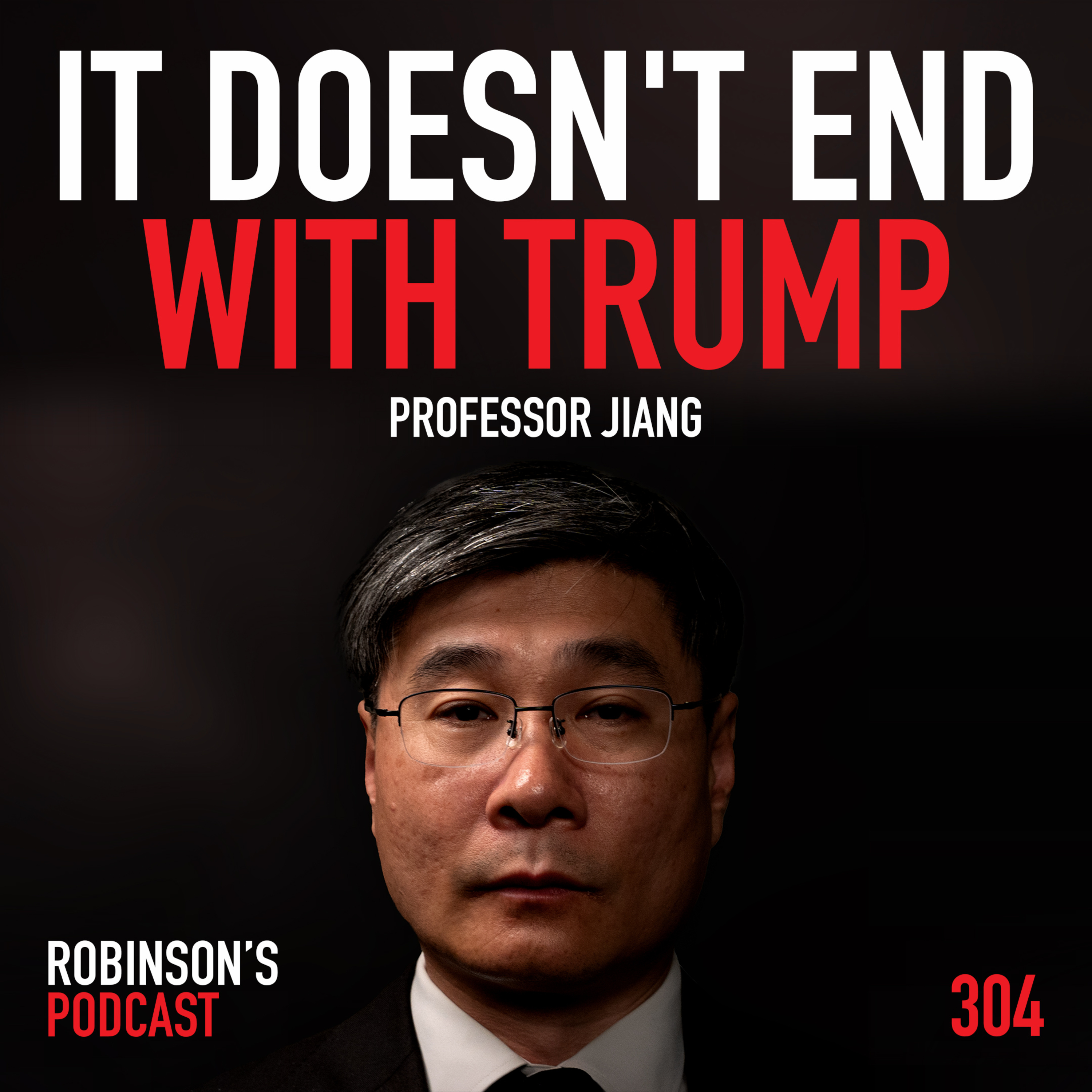
The episode is a wide-ranging discussion of power in the United States and how “capital” and “elites” (people who can manipulate state institutions for personal interest) shape government outcomes. Jiang argues that democracy functions as a “veneer” that keeps people cooperative while real control comes from donor classes, lobbyists, and transnational finance. The conversation also includes Jiang’s speculative claims about secret societies, conspiratorial networks, and how historical patterns (including the Opium Wars) can be used for “predictive history.”
Jiang Shuiqin is a Chinese-Canadian educator, host of the Predictive History YouTube channel, and author of a Substack by the same name. The host frames the episode as his second of three conversations with Jiang and says Jiang encourages fact-checking, while the host disagrees with many of Jiang’s conclusions.
Key claims (as presented in the transcript): Capital, not the Constitution or “the people,” drives U.S. governance. Elites are “parasites” who control policymaking (example given: the 2009 Wall Street bailout). The U.S. is described as serving transnational capital via institutions like the Federal Reserve and through lobbying/donor incentives. Jiang claims secret societies are structurally necessary for “information, infiltration, and coordination,” and argues that eschatological (end-times) secret societies can maintain long-term secrecy and coordination via a shared script.
Calvinist “double predestination” as a historical origin of capitalism; Dutch Republic and England’s financial systems; the Glorious Revolution and Bank of England; the Rothschilds allegedly profiting from Waterloo-related rumors; the 2008 subprime crisis and hedge fund John Paulson; and a reinterpretation of the Opium Wars as involving elite conflicts and local collaboration.
One guest—Jiang Shuiqin (Chinese-Canadian educator, Predictive History YouTube/Substack). The other participant is the podcast host (Robinson Earhart, per transcript).
Written by AI. May contain mistakes.
Discussion about the controversial nature of the upcoming conversation with Jiang.
“But I am here with an introduction to the second of my three conversations with Jiang Shuiqin.”
Robinson sets ground rules and clarifies his stance on the topics to be discussed.
“and we spend something like two hours discussing this.”
Robinson discusses engaging with Jiang's views on secret societies and conspiracies.
“One, I don't consider listening to someone without interrupting them as tacit agreement with what they say, nor does accepting premises for the sake of argument constitute endorsing them.”
Jiang discusses who holds power in the United States and how it operates.
“I mean, what do you want them to keep in mind as they listen to us talk about these secret societies and how you think that they control the world?”
A discussion on capitalism, its history, and the intrinsic human values tied to it.
“Who in America has the power to tell the president no?”
Explore the natural human instinct towards relationships over investment.
“When you say a human intuitive perspective, do you mean like an evolutionary biological perspective where we are concerned with status and relationships?”
Understand how Calvinism led to the foundations of modern capitalism.
“So throughout most of the Middle Ages, the Catholic Church was in charge.”
The discussion delves into the intriguing nature of conspiracy theories and the epistemic questions they raise.
“The most blatant, of course, is the selling of indulgences.”
The host reflects on guest selection criteria and the evolving direction of the podcast, emphasizing the importance of diverse perspectives.
“Because you can't spend this money, so what do you do?”
The host shares final thoughts on audience engagement and invites listener feedback for future episodes.
Learn how the Bank of England shaped modern financial systems.
“1694, the Bank of England was chartered.”
Discover the relationship between capitalism and government authority.
“that allowed England to defeat Napoleon during the the Napoleonic Wars.”
Recognize the significance of Chinese historical perspectives in modern discussions.
“That's why the United States involves itself around the world, because the government is meant to serve and protect the interests of transnational capital.”
Delve into how historical analysis can inform predictions about today.
“scholar, one, but also a Chinese scholar about Chinese history that isn't really taught in the United States.”
Explore how local elite conflicts often involve mercenaries and shape power dynamics.
“Okay, so there are lots of these examples from history.”
Learn about the frameworks used to interpret and analyze historical events and their narratives.
“But in that case, we do at least have really good firsthand accounts of what happened.”
Learn about three analytical frameworks to interpret historical events.
“So let's just trust the written sources, right?”
Explore the definition of elites and their impact on government and society.
“So it would just be interesting to have those that were pinned down.”
Discuss the concept of democracy as a tool for elite compliance and control.
“And they're using government, I guess, in this case, to protect themselves and capital.”
Examine the connection between capitalism, secret societies, and their functionality.
“Because they're trying to exploit people in order to extract as much value as possible.”
Learn how secret societies maintain their influence through information control.
“Well, then you have competition amongst these different groups in order to maximize the return on investment.”
Understand why secret societies are essential for elite coordination and secrecy.
“I would imagine, though, that this is just me playing devil's advocate, that in any stock market, I mean, there are always people playing both sides of positions.”
Delve into what eschatological secret societies are and their beliefs.
“Because if you do this in public, you know, guess what?”
Discussing the belief in secret societies and the Vatican's influence.
“So I don't believe that there's like a power above us.”
Examining the historical treatment of Jews in Spain and their conversions.
“So here we'll get controversial because now we'll go into specifics.”
Understanding the lives of conversos and their integration into Catholic society.
“then if you became a Jesuit and you worked for the Catholic Church, that gave you a level of protection.”
The story of Zephida Zevi and his impact on Jewish beliefs during persecution.
“So Jews went from one of the most privileged groups in Eastern Europe at this time to be one of the most persecuted.”
Learn about Zebul Zebi's claim to messiahship and the consequences he faced.
“Now, as you're going to imagine, the rabbis were pissed off at this guy, Zebul Zebi.”
Explore the concepts of the occult and how Kabbalah interprets reality.
“temple and I convert to Islam okay and just to orient myself this is you said the mid-60s 1666.”
Discover how Kabbalah explains the story of Adam and Eve and the notion of doubt.
“is connected, which everything is dynamic, where everything is changing.”
Understand Sabbatai Zevi's conversion and its implications for Jewish identity.
“The fall of man is the doubt of God, the ego.”
Learn about Jacob Frank and his controversial views on power and identity.
“And the story they use is the book of Esther.”
Examine the moral complexities of characters like Moses in the Hebrew Bible.
“First of all, he added an esophological element to sublimitianism.”
Explore the contrasting moral standings of Moses compared to David and Jacob.
“Because if you were a European noble, you were told by Catholic Church you're evil, that you can only do sin.”
Explore the complexities of key biblical figures and their moral implications.
“I've done so much for you, and I will do it all again.”
Discuss how sin leads to enlightenment and power in biblical contexts.
“We can do whatever we want to the people.”
Analyze controversial statements regarding Jewish history and secret societies.
“like I could see that being a controversial claim because you're not making conclusions based on the standards that an academic historian would where they want to see like written evidence.”
Examine how social structures and identities shape power dynamics historically.
“was really popular amongst the European nobility.”
Exploration of the prevalence of homosexual men in historical and modern power structures.
“They have a feeling of fear and anxiety.”
Discussion on how persecution can lead marginalized groups to form supportive networks for gaining power.
“And so I would say homosexual men are the first and the most white-specific societies in the world.”
Examining the difficulties in proving conspiratorial claims and the nature of elite power.
“Something that I think is very difficult about these discussions, let's assume there are these groups of very powerful people coordinating behind closed doors to make things happen.”
Delving into the perceptions of political figures like Donald Trump and how public opinion shapes their legacies.
“maybe he is really best buddies with Vladimir Putin and they're orchestrating events on some level.”
Analyzing Trump's journey from his controversial election to his evolving power during his presidency.
“And I imagine moving forward, we'll probably stay in touch and you'll probably want to arrange conversations between me and other people who you think might lead to much more interesting discussions, right?”
Discussing how Trump's behavior and power dynamics have evolved since his first term.
“2024 in the summer and we have this decision like what do you think will happen in his second term?”
Exploring Trump's ability to create a 'reality distortion field' similar to Steve Jobs.
“To be clear, I think you're agreeing with me, but I can't tell if you're about to say, and you're totally wrong for thinking that because the secret...”
Debating the character assessment abilities of Trump, Zuckerberg, and other tech leaders.
“And so all I'm saying is that with these two characteristics, okay, his reality distortion field and also his sixth sense of character, it's allowed him to achieve what he's achieved.”
Analyzing Zuckerberg's ambitions with VR and AR technologies and their implications.
“And sorry, but like Mark Zuckerberg, can you tell me something that he did you thought that was just genius foresight or insight?”
Discussing the initial concept and commercialization of Facebook in the context of college life.
“Let's fast forward a few more years, and Mark is like, we are going to go on the metaverse.”
Explore the historical context and influence of the Habad Lubavitch movement and its notable figures.
“Who's the most famous Harvard professor you know?”
Discuss the dynamics of venture capital investment and Mark Zuckerberg's control of Facebook.
“There's a huge scandal called Cambridge Analytica there are only two companies.”
Examine the complexities of power, control, and the behaviors of tech leaders like Zuckerberg.
“Like Uber, for instance, driving taxi cabs out of business by substituting fare.”
Delve into the discussion about secret societies and their influence on society.
“I think some people just love to work and build.”
Discussion on the reality and influence of secret societies in society.
“I've never done the research on the history of Judaism that you have.”
Examination of how billionaires like Zuckerberg and Musk behave differently.
“We know that 7th and 3rdism has existed historically.”
Exploration of Musk's significant political contributions and their implications.
“I mean, I would say that assuming what you said is correct, that billionaires don't tend to get involved in politics.”
Discussion on historical precedents and their relevance to modern political financing.
“So, but then what is Musk's purpose in donating so much to Republicans in the midterms?”
Explore the motivations behind the actions of historical figures like Rockefeller and the context of charity in wealth accumulation.
“that seems totally within the realm of possibility, but without anything more than just, like, the story.”
Discuss the evolving perspective on conspiracy theories, particularly influenced by COVID-19, and the importance of maintaining an open mind.
“sorts of other conspiracies, conspiracies about whether we landed on the moon, whether 9-11 was an inside job, whether the United States government is in contact with aliens, for instance.”
Learn about the significance of empathy when analyzing historical figures and events, especially in the context of societal pressures.
“and I'm using predictions as a mechanism to validate my current framework.”
The host outlines the structure of their critique on Jiang's reasoning.
“I think that I'll start with a few problems I have with Jiang's reasoning.”
Discussion on the use of historical patterns in arguments and their limitations.
“events as a substitute for evidence that the same thing is happening in the particular case under discussion.”
Analyzing the use of thought experiments and their implications in Jiang's arguments.
“So basically, what seems intuitively reasonable in an imagined situation, it doesn't at all establish what happened in the real one.”
The host emphasizes the need for strong evidence to support one explanation over another.
“And the bare fact that the explanation, secret societies, fits the outcome, it doesn't supply that support.”
The host offers a defense for Jiang, highlighting the challenges of informal discussions.
“say a bit in jiang's defense because Being charitable in any sort of dispute, I think, is quite important.”
The host reflects on the importance of discussing controversial theories and their implications.
“Okay, now, I mean, why did I find this conversation so worthwhile, especially when a lot of viewers would prefer that I didn't have it, and for many different reasons?”

Get the gist, explore an idea or ask about something said.
 Claude
On Robinson's Podcast, what are the key points of this episode?
Searching your listeningAutomatic transcript. May contain errors.
0:00That's Donald Trump. He is the devil, man. He is Satan. He has conjured a reality. And we absorb this reality while everything is happening behind us. You create this veneer of democracy so that people will be much more cooperative in their own exportation. The elite like to engage in sexual activity with young people. Wait, wait, wait. Before we get into reptilians, just let me finish that thought. So here, we'll get controversial. Hello. This is a very sleepy Robinson Earhart because it's after 3 a.m. at Stanford and I have to leave for the airport at 6. But I am here with an introduction to the second of my three conversations with Jiang Shuiqin.
0:54And as I said in the last episode, Jiang is a Chinese-Canadian educator. He is host of the Predictive History YouTube channel and the author of the Substack by the same name. The response to that conversation, that first one, has been quite polarized, though one comment from YouTube hit the nail on the head and it made me laugh. So it was, let's see. Jiang Energy overwhelms the interviewer. He almost looks like a paperweight. Great interview though. And that about sums up the conversation, I guess. But now we are onto this conversation. And after my all-nighter red eye to Toronto, Jiang and I started talking at 9 a.m.
1:49and we went for a bit over three hours. Then he took a walk. I had a coffee crisp and a Red Bull and we rearranged the studio. He changed ties from lavender to black and I changed clothes to fool you all into thinking we weren't just sitting down for 10 hours and talking all day. And then we got started. But then the conversation quickly deviated from my expectations because it abruptly turned into a discussion of Jiang's beliefs or claims, whatever you want to call them, about conspiratorial Jewish and gay networks running the world. and we spend something like two hours discussing this. And needless to say, this is the most controversial series of topics to hit the show, although next week's may rival this.
2:50And they are a series of topics that I was not at all expecting to or prepared to discuss. Now, I said more about this in the last introduction, so I'll keep it brief here. I really don't want to censor the show, but I also don't want to lose the channel, which is naturally quite important to me. So in an attempt to appease the YouTube and Spotify gods and comply with their very strict policies about material like this, I am here making clear that Jiang's views are his own. They're not mine. And to further comply with the aforementioned policies I am in this episode adding a lot of further context.
3:38So first, just a word about that. I have to make my position clear up front, but I also think that you should make up your own minds. And for that reason, I'm going to include a much more extensive outro of something like 15 to 30 minutes. I haven't recorded it yet. I'll do it after this introduction. And I've never done that before. but the point of this outro will be to discuss the conversation more philosophically, to look at a comment or two from viewers, to explain why I felt and feel that this was a worthwhile conversation, and then how I see the show going forward. But a few more just brief points before we get started.
4:25One, I don't consider listening to someone without interrupting them as tacit agreement with what they say, nor does accepting premises for the sake of argument constitute endorsing them. But virtually every speculative conclusion that Jiang reaches in this conversation strikes me as unsupported or less well-supported than competing explanations. But in particular, the mere existence of social connections and a historical movement, this doesn't establish that a particular group is secretly coordinating to control institutions. And to make that claim or defend it, you'd need a lot stronger evidence than that.
5:17And for people who believe that quote-unquote platforming someone with views like these is inherently problematic, I have to believe that there's value in having these conversations outside a quote-unquote echo chamber where the challenges can be heard and the disagreement put on record. I will, of course, link to Jiang's YouTube channel and sub stack for anyone who wants more. Jiang knows I disagree with him as is clear in the conversation, and he encouraged fact checking, as you'll see in a moment. and you can find his own views more fleshed out in his own content and other interviews. And no, I'm not a specialist in the subjects that we cover.
6:07I'll also link to some scholarly histories from academic presses in the description as a starting point for further reading. for further reading. Lastly, here is a brief segment that Jiang and I recorded right after we finished the conversation. You and I disagreed so much about the content, but maybe I just am too, I don't know, trusting of others or too libertarian in a certain sense that I want people to be able to hear things that they disagree with or agree with and come to their own conclusions before people listen to this conversation. I mean, what do you want them to keep in mind as they listen to us talk about these secret societies and how you think that they control the world?
7:03Yeah. So I want people to appreciate I don't have a political agenda here. and I'm not trying to impose a worldview on people. What I'm interested in is intellectual speculation. And I'm going to share with you some of my findings. But again, a lot of this is speculation. And I hope that people keep an open mind, but also be skeptical about what I say. And the power of technology nowadays is you just fact check everything I say to ensure that I'm not misleading you and that I am not trying to deceive you or manipulate you in any way. and where I do take lips of imagination where I do engage in deep circulation I will let you know yeah and I think you totally did that and I really love this conversation because it was honest it was back and forth there's no like hostility or aggression even though we disagree I really shudder at the thought of ever censoring a conversation that I have on this show because I don't think people should hear it.
8:29But I think that this was such an interesting conversation. I loved having it. So I hope that everybody who watches this or listens to it enjoys it and also comes in with an open mind and they see how a constructive disagreement happens. Okay, and that is that. I will be back for the outro. Until then, I hope you enjoy this conversation as much as I enjoyed having it with Giyong.
9:09In this conversation, what I'm hoping to talk about is power in the United States. Who in America has the power to tell the president no?
9:24So I think a lot of people have the power to tell the president no. Because power in the United States, it's very distributed. So obviously you have separation of powers, right? But also you have the states. you also have lots of special interest groups. The lobbyists, so two most powerful lobby groups are of course the pensioners and APAC. And so a lot of policymaking in Washington, D.C. is not based on what is most reasonable or what is best for the American people and for the American nation. It's just a compromise between the interests of different factions in America. How is it that the United States came to be such a place, as you see it, where these special interest groups, perhaps the deep state, other states, could, behind closed doors, orchestrate what's happening at the highest levels of our government?
10:42Well, the easy answer is it's not the people who control the United States. It's not even the Constitution that controls the United States. It's capital that controls the United States. And so the origin of capital is something we need to discuss. So what I'm going to do is go over a very short history of how we have capitalism. And this will be different from the version you've heard from, you know, Professor Wolf and Professor Hudson. But it's my understanding. Okay. So feel free to push back a new point. Okay. So capitalism, it's about a straight phenomenon. It's something that we never really had for most of human history.
11:26And so think about this. Let's just say today, for a reason, I give you$2 million. What would you do with it? if I had$2 million... Like right now. Yeah, yeah. I didn't get a check for$2 million. Yeah, I'd think I would buy a house and then I would save the rest, invest it, and try to make more. Exactly, right? So you would just basically invest it. And this is counterintuitive because for most of the human industry, we wouldn't do that. If I found$2 million of gold, the first thing I would do is share it with my family and my friends, my community. That's interesting. Why would I do that? Yeah.
12:12Because the only thing of value in our existence is status. So if I were like a Viking and I went to England or Ireland to raid a church or monastery and I had lots of jewelry, well, I'd come back. and the first thing I would do is organize a huge feast for everyone to come. And I might wear some of the jewelry, but then I might also share some of the jewelry with my relatives and I would share it with my friends. And that way I can build status and social capital in my community. Because at that time in the industry, for most of the human industry, that was the only thing valuable and worthwhile.
12:55while um so and like but the last thing i would do because it made no sense to me is i would dig a hole and put the gold in the hole and hope it grows in value because it doesn't happen right um so it's kind of intuitive because like if you put your money in a stock market how would this better your life and how do you know the stock market will be around tomorrow you don't right but you do know that if i give my money to my family and friends they will thank me for the rest of my life when i die they will build monument to me my children will be looked after and cherished because of my sacrifice and contribution to the community that's what matters.
13:46And that's what gives you meaning, purpose in life. Now, as you point out, all we do is we take all the money we make and put it in the stock market and hope it grows. It's a really strange phenomenon. It makes no sense from a human intuitive perspective. When you say a human intuitive perspective, do you mean like an evolutionary biological perspective where we are concerned with status and relationships? Is that what you mean? Like the idea of investing is just not natural, like a natural human phenomenon. It's kind of artificial. No, what I mean is you just go to any place in the world and you give the person$2 million and you ask, what are you going to do with this money?
14:34The person's like, of course, I'm going to buy things for my friends, right? I wouldn't invest it. Like the idea of investment, It is a new phenomenon that is an abstraction far removed from the human experience. Yeah, that's what I mean. Okay, so I want to go into really slowly why people think like this. Okay, and it has to do with Calvinism. So throughout most of the Middle Ages, the Catholic Church was in charge. The Catholic Church was able to maintain power by making people believe that the Catholic Church was the only path to salvation and redemption. You're going to heaven, you have to obey the Catholic Church, you have to avoid committing sin, you have to be obedient.
15:22And most people went along with this. But it led to massive corruption within the Catholic Church. The most blatant, of course, is the selling of indulgences. where you could be the most corrupt, the most evil Uricocrat in European history, but if you're willing to bribe the church, you'll get an indulgence where you will spend less time in purgatory. Like when you die, your relatives could also buy indulgences to shorten your time in purgatory. And this led to massive corruption, and it was scandalous. and there were a lot of reformers who believed that the Catholic Church was a subversion of the teaching of Jesus and this of course led to the Protestant Reformation.
16:09The main problem for them was how do you intellectually challenge the supremacy of the Catholic Church? How do you tell people the Catholic Church doesn't have the power and authority to determine who goes to heaven and hell when that's all they believed for their entire lives. And that's what their entire community believes. So John Calvin came up with something called double predestination. And what he argued is, at the beginning of time, even before God created anything else, he determined who would go to heaven and who would go to hell. Double predestination. And this was predestined. predestined.
16:52There's nothing anyone can do to change this. Not even the Catholic Church. So ignore the Catholic Church. Just follow your faith. And this was the theoretical basis for the rejection of the church and the focus on an individual interpretation of the Bible, which is what Protestant is about. This creates a dilemma, or of course it's fake, which is, how do you know you're going to have it and not to hell. You can't resolve that intellectually, right? So the solution they came up with is you know if God favors you. And how do you know God favors you? Because you got wealthy in life. But to prove your faith, you cannot spend endless money.
17:44Okay? So now, for the first time, you have the beginnings of capitalism. which is the accumulation of capital for the sake of accumulation, as opposed to transferring this capital into status or social capital. And these people congregated into the Dutch Republic and turned the Dutch Republic into the wealth society in the world in the 17th century. Because you can't spend this money, so what do you do? You invest it. You put it in a bank. You put it in a stock market. And this investment capital allowed the Dutch monopolize the spice trade in the East Indies. And at that time, the spices, cinnamon, peppercorn, were the most viable commodities on Earth, much more so than gold.
18:39And so this allowed the Dutch Republic to become the first middle-class society on planet Earth. And that's how we have capitalism. them. The problem with the Dutch Republic, though, is it's actually on the mainland of Europe, so it can be easily attacked. And so the Hatsburgs, the Vatican, all-stage invasions of the Dutch Republic in order to capture their wealth, and because they were Protestant. So to resolve this issue, there's an alliance formed between the Dutch Republic and England. England was protected by a Royal Navy. So it was a safe place for the Dutch Republic to transfer all their gold.
19:21And this led to something called the Glorious Revolution of 1688, when England welcomed World of Orange to be their mark. Okay? It was really an alliance between two Protestant powers in order to survive against Catholic Europe. 1694, the Bank of England was chartered. Why was Benedictine England important? It was the first time in human history when you as a merchant could lend money and this money would be guaranteed, this loan would be guaranteed by the nation state. Before, if you're a merchant and you want to lend money, you have to lend money to a king to fight wars. The problem is this kid can die, he could lose a war, or he could be nagged on his contract.
20:10There's tremendous risk involved in lending money anywhere. The Bank of England solved this issue because the Bank of England, you would lend your money to Parliament. And Parliament was the nation state. So the people of England were stuck with the debt, even if the king died in the war, if the war were lost. okay so this is this created the idea of transnational capital because anyone could put their money in the bank of England regardless of where you're from this money would be guaranteed by England and this led to the rise of the British Empire why? because it's a system of transnational capitalism that allowed England to defeat Napoleon during the the Napoleonic Wars.
21:06So seven wars were fought between Napoleon and England, or basically kind of Europe. Napoleon won six of them, and he lost the last one. And England could finance all these wars because it had infinite financing, right? It could take all the gold from the Vatican, from France, from Prussia, and store it in England to finance the war. And after France lost the Seventh War, then England can impose a huge indemnity on France. The other factor was, as England was moving around the world and conquering new territories, usually this is hard because you have to fight against local elites. Now, with traditional capital, you can co-opt local elites.
21:54By getting them involved in your banking system. Exactly, right? So we open wars. Right. So history book says, tells us, oh, England went over with a small little navy and conquered this tremendous empire called China and the open wars. That's nonsense. What happened was the local elites in China worked with the British to promote the open trade in China because they benefited a great deal from it. And then they could store their savings, their gold overseas. Right. So before the event of Transnational Capital, you, the local elite, the only way that you could achieve status was by helping your local people.
22:37Now with the event of Transnational Capital, I can now monetize my status and ship this capital overseas to an offshore financial center, whether it be England or Canada or Australia or Hong Kong. Now, the major offshore financial center for England at this time was the United States of America. And so the United States basically adopted this understanding of capitalism and created an entire society around it. and before the United States English theorists like John Locke Jeremy Bentham, David Hume they had to figure out how to convince the people to belong with the system because it was counterintuitive, right?
23:26Why should my children and my grandchildren, my great-grandchildren be responsible for the debt I incur today because I borrowed money from some Rothschild that makes no sense whatsoever So to resolve this issue, they create the concept of private property. And private property, as argued by John Locke and others, is the most sacred right given to you by God. And what people don't appreciate is there's actually a conflict between property and democracy. Right? You have one or the other. Why is that? Okay, so in democracy, in theory, democracy, of course, is what the Athenians had. They could, in theory, get together and say, we vote to confiscate the property of Elon Musk.
24:19Because, yes, there's money. They could do that. And they did do that. They could vote to banish, ostracize people who they didn't like. You can't do that today because Elon Musk's billions of dollars is protected by property rights. So there's a contradiction here. But property, the idea of private property was promoted to justify transnational capital. And the idea of democracy was promoted in order to legitimize transnational capitalism. because the idea is, well, you the people choose this system. This system wasn't imposed on you, which it was. You choose to go with the system. And so these theorists developed this theory of capitalism that was then transported over trans states.
25:17It's a very similar system where, and people don't appreciate this, the government is sovereign. The government represents the people. The government has no right to print money. It's the Federal Reserve that has the right to print money. And the Federal Reserve is a cartel of private banks. So the government is borrowing money from this cartel of private banks in order to finance its operations, mainly by selling U.S. Treasuries. And that's a system that is in the United States today. So that's something that people need to appreciate. It's capital that is the basis of the American government.
25:58The government exists in order to serve capital, transnational capital, right? And that's why there's immigration. That's why the United States involves itself around the world, because the government is meant to serve and protect the interests of transnational capital. I would like to digress for a little bit because it's very rare that I get to speak to a Chinese scholar, one, but also a Chinese scholar about Chinese history that isn't really taught in the United States. So I'm especially ignorant of it. So the opium wars are not something that I really know much about at all. I don't think they taught it to me in school.
26:44And something that I want to do is actually do a little bit of predictive history with you, if that's possible. You believe that historians should be in the business of making predictions because they know so much about the past. What I'm hoping that we could do, even though I wanted to talk more about the United States in this conversation, you're giving me the opportunity to ask you to tell me a bit about the opium wars, how you analyze them, and how they help you make predictions about the present. If there could be predictions about the United States, all the better. Okay, so the first thing to appreciate is that most of history that we're taught in school makes no intuitive sense.
27:29And I'll give you many examples. First example, how was it like a few hundred conquersadores was able to go over to Mexico and conquer the Aztec Empire, which had millions of people at that time? Does that make any sense to you? It does not. I'll just, I'll give you that. It doesn't make sense when you put it that way. Okay, that's number one. Number two is, how is Asim the Great able to take his small band of Macedonians and conquer half the world in like 10 years? Like, does that make any sense? No, not when you put it like that. Okay, so there are lots of these examples from history. And we have really, there are explanations, but I don't think these explanations are satisfying.
28:21Are you saying that the way that history is taught in schools, they don't make it satisfying? Or the historians teaching at Yale, Princeton, Harvard, they don't even have good explanations for other settings? That's right. Yeah, that's what I'm saying. I'm saying the explanations are insufficient. They don't have real explanatory power, and therefore they lack predictive power. So I'm going to offer you a different perspective, which is that throughout history, there's always been conflicts amongst local elites. And this conflict often has to externalize itself. So, for example, the most common example is when a king dies, his sons fight over who becomes the next king.
29:13And they do so by hiring mercenaries from overseas to help them in the struggle. But over time, what happens is these mercenaries either don't get paid or they're like, you know what, we can just run this place ourselves. And so they come to conquer the place. In other words, I think it's pretty rare when a foreign army is like, hey, let's go over there for no particular reason and conquer the people. Because, like, why would you do that? It's risky. It's dangerous. And there are a lot of uncertainties, right? But if a foreign prince says, I'll give you a million dollars to come and help me defeat my brother, you're like, sure, why not?
29:56Okay? So I think that makes a lot more sense. So what I'm saying is, I think the conquersers were mercenaries. They found themselves in a conflict within the Essex Empire. Right? But after they assumed power, they wanted to rewrite the history to make themselves look better. Is that substantiated at all by any evidence? Okay. So what I do is I look into patterns of history. and if you look at the rise of a lot of individuals and you dig deep into the background, what you discover is they were mercenaries who were hired to fight a war and then they stole the crown by themselves. So there are examples.
30:48So King David in the Bible, a lot of historians believe was a mercenary who basically betrayed King Saul to take the throne. I'm not sure if you know who Sargon of Ackid is. Yeah, Sargon of Ackid built the first world empire, the Canadian Empire. And historians speculate that he was a mercenary who became a lover to the king and who betrayed the king in order to assume power for himself. But if you were writing a six-room play, that would be a lot better play than oh you know these guys came out of nowhere and they pretend they were gods and wouldn't believe them and so yeah right it's much more intuitive that way to think that okay this guy this great conqueror he got into his position because he was a lover to the king and a great general himself and then because he was so ambitious he betrayed the king i think oh but like obviously once you assume power you don't want that history in place so you have to rewrite a new history, right?
31:52And often the history is, I was born and there was a star that shined and said to the world that I would be king one day. And then I was stolen from my family and I was a slave for many years. But because I worked so hard, I escaped and I promised revenge. And so I built an army and then conquered that person. This is a story that repeats itself throughout history in many different contexts. And I think it's just game theory where you know you're a bad person who got power in a bad way. So now you need to whitewash your history. And so you come up with a story that falls in the mythos of your local culture.
32:42and what people want to believe is, first of all, is that you're God-ordained, that you are divine, there's providence behind you. Second of all is that you're a rags-to-riches story. And third of all is that you have to surmount tremendous obstacles in order to achieve your ambition, right? And so if you were just writing the script, if you're writing a different play, you're writing this way in order to attract the most audience. And that's what I think history is. history is just another form of propaganda. And the most common phrase is, the winners write the history. History is written by the winners.
33:22And of course, they're going to write history in a way that makes them look good. But if you peel away the official narrative and you speculate or use game theory to figure out what might have truly happened, the best possible explanation is that there was a struggle amongst local elites and someone came in and took advantage of the struggle to create power for himself. And so I think that's the best explanation for the open wars. This idea that you have this like exponentially navy force from the British and they basically wipe out this massive army from the Qing dynasty doesn't really make much sense.
34:03Unless you can believe that the Qing dynasty at this time was extremely unpopular, was extremely corrupt, and so the local elites didn't want to pay taxes to the Qing, so they worked with the British. And the British were these mercenaries who came in to push out the federal forces so that local forces could monopolize the opium trade. And this was made possible because of transnational capitalism. I find this way of... But you have to appreciate that the Chinese don't want this. People don't know this, right? The Chinese don't... For China, one grand narrative that basically defines the Chinese nation is the center of human relation.
34:54A hundred years when foreigners came to rig and pillage the Chinese nation. And the Chinese people were completely innocent of this. They didn't want anything to do with the West. They came and they forced OPM down the throats of the Chinese people. That is the national narrative. That is the national narrative. That is the national narrative. And so you can't say anything or do anything to disrupt this narrative. But common sense teaches us that, is that really, really what happened? Are you talking about these local elites are completely innocent and they stood more to not trade with the British than to trade with the British?
35:28I don't think so. Is there evidence that the local elites stood to gain a lot or they did gain a lot from the trade with the British? Hong Kong. Right? Like a lot of wealth moved to Hong Kong. You have the triads. Right? So you have these triad groups which were formed in the civil societies in order to challenge the authority of the Qing. They're that old. Yeah, they're very old. and so you think ask yourself, okay, if you really hate the Qing dynasty and you want to foment a rebellion against the Qing dynasty what's the best way to raise capital? What's the best way to build alliance? Probably by helping the British sell opium around the country.
36:09This idea of whitewashing history is it seems to me like using it is a double-edged sword in that surely, certainly, we know that it happens. We both have first-hand experience with it. I mean When I was a child in grade school, the way they teach how the British or the first colonists took power from the Native Americans. I mean, we have our fun Thanksgiving feasts and we were all really good to the Native Americans. But then, of course, you learn as you get older that it was this total violent bloodshed. And it wasn't actually what's in the history books and what we were taught. But in that case, we do at least have really good firsthand accounts of what happened.
36:58And so what I'm wondering is like your idea about what happened with the conquistadors. If you don't have like written evidence that there was this collusion and they were brought over as mercenaries and they got involved in. Sorry, sorry, sorry, sorry. Let me be more precise. Okay, okay. What I think happened was this. Conquissors went to Mexico to look for gold, which is what they said they did, right? and they found themselves in the middle of a conflict amongst the elites for supremacy. And the elite, certain factions of the elite, thought the concursors would be useful allies in promoting their cause.
37:45So they offered concursors a deal, help us become king and we'll give you a lot of gold. And concursors agreed to this deal, but once they helped the guy become king, then they were like, we actually don't need this guy. So they killed him because why not? Right. I mean, like the conquistadors were essentially criminals. I mean, they were just hooligans and thugs. The worst of best fascist society sent overseas to like look for gold. Right. So that's what I think happened. And what I'm asking, though, is if you don't have, let's say, like the contracts between the conquistadors and the Aztec, But is it only like you're saying you just have a very high degree of belief that this happened, given that there isn't evidence just because this seems to make so much more sense than the historical narrative to you?
38:39Okay, so I will use three frameworks to figure out what's going on, okay? First of all, I will use game theory, which is to say, like, you know, if I were a conquistador, how can I maximize my advantage in this game, okay? Or if I were an elite, how can I maximize the use of conquistadors to further my political agenda? That's game theory. That's one framework. Another framework is historical analogy. historical pattern. Is there something similar, is there an event similar to what happened to the Aztecs? And I'm looking for like different examples. I'm trying to line them up.
39:26And I think that as in the great, the Macedonians, it's a very similar example to what happened to the Aztecs. So I'm not sure you know about this history, but what happened was that after a Persian king died, the two brothers fought for the throne. And one brother decided to hire some Greek hoplites from mainland Greece to lay a claim on the throne. He hired about 10 ,000 hoplites. And so Etoinus battle was fought, and the brother won. The problem is, he died on the battlefield. And so the 10 ,000 hoplites were like, oops, we came all this way for nothing. And then they made their way back to Greece.
40:16And this was a really popular story. And this ignited the imagination of the Greeks. They were like, wow, 10 ,000 mercenaries, only 10 ,000 mercenaries can go over the Persian, conquer a great empire, well then, it's just right for the taking. Right? And this legend, this story, ignited the imagination of Alexander the Great, who was like, well, now I can go do this. I can take advantage of the struggles amongst the local elites in order to advance my military victories. Okay, so that's the second thing, historical analogies. Okay? And the third thing is, just... human observation, which is they like observe the people around you and see how they behave.
41:02And I don't care what institution you are, whether it's Stanford or U.S. government or Tesla, whatever it comes to, okay? What you will find is 9 % of the time, people are focused on internal struggles, internal politics. Is that true? At Sanford, you guys care more about... Way more. What's happening in the department. Than what's happening at Harvard, Yale. Absolutely. And that's just human nature, right? So I actually appreciate there are certain things about humans that are consistent across time and space that is easier for you to analyze things. because we just make the assumption that, oh, well, you know, the conquersers were able to conquer the Aztecs because the Aztecs are different people.
41:56And the conquersers are different people. We can't possibly understand how they think and, like, who they are. So let's just trust the written sources, right? But literally just observe the people around you and look at how they behave. I guarantee you that that's how everyone behaves. and so once you master these three frameworks just game theory historical analogies and human observation then you come to analysis that's much closer to the truth and when you apply this three part sort of analysis to the opium wars what does that or how does having applied this analysis help you then make predictions about the future or predictions about the United States and the present?
42:50How do those two stages connect? Okay, well, look, you ask yourself, how is it that China, this great empire, was so easily defeated in the Opium Wars? And from that, you can make certain assumptions about how nation states behave. first of all we need to appreciate that the elites are parasites and they're not interested in promoting the interest of the public or the nation state they're just interested in exploring the people they don't want to work basically I would like to be really precise about just what an elite is because you talk about elites and you talk about counter-elites and for a lot of people, I think it's just the 99 % versus the 1%.
43:47Yeah, yeah. So it would just be interesting to have those that were pinned down. That's a great point, okay? So here's my definition of the elite. The elite are able to manipulate state apparatus to advance their own personal interests. Okay? So the classic example I would use is the 2009 Wall Street bailout, where Wall Street bankrupted the U.S. economy, but they were able to control policymaking in Washington, D.C. in order to bail themselves out, as well as give themselves personal bonuses. Right? So that's what an elite is. An elite is able to control the apparatus of government in order to advance his or her personal interests.
44:40I'd just like to make one connection that I'm sure you've made, but I'm piecing together your narrative. It just so happens that Wall Street is the sector of the U.S. economy that's dealing with transnational flows of money. And they're using government, I guess, in this case, to protect themselves and capital. But also, you have to appreciate these multinationals do the same thing, right? So why did America start all these wars? Well, because these multinationals demanded that America fight these wars, right? So basically, the government doesn't work for the American people. It works for capital, ExxonMobil.
45:22It works for Apple. It works for Tesla and these companies. Yeah, I'm inclined to agree with you that that that is what's happening with government is that it is just serving capital. What then do you see democracy then as a mirage? Yes. In a sense. Yeah. It's a forced compliance. Right. It works better. because, again, the problem is you can't have people believing that the government serves capital. So you create this veneer of democracy so that people will be much more cooperative in their own exportation. You let them vote. You have them attend protests. You let them see the debate so that they feel like they're part of this system.
46:13And you have the 40s fight amongst each other, right? You have this left-right dialectic that distracts people from the real powers that be. So the first thing that we need to appreciate is elites, by the definition, are parasites. Because they're trying to exploit people in order to extract as much value as possible. And the classic example throughout history are landlords and peasants. What are landlords? Landlords are red seekers. Right. And that's historically how we define elites, those who are able to extract rent from the people. Returning to my original question about who can tell the president no.
47:02And as I mentioned, like, yes, the Supreme Court can tell the president no. Congress can tell the president no. But if we're curious about who can tell the president no, where it's a whisper into his ear and we don't know about it, is the answer just it's somehow tied to capital? Yeah, the donors, the donor class. And it's not just president. It's like every politician in Washington, D.C. Like most politicians want to work as lobbyists after Congress because like what you make$200 ,000 as a Congress. person a year at most. Yeah. Or you're Nancy Pelosi and you end up with millions of dollars. Yeah.
47:45But after Congress, you can work as a lobbyist and get paid millions of dollars. But you only get that job as a lobbyist if you do the bidding of donors while in Congress, right? It's the payoff. So you just do what the donors tell you while you're in Washington, D.C., and then you retire to an extremely lucrative gig doing nothing for the rest of your life. and honestly, I mean, it's pretty tempting, right? Because if you resist the donor class, you start to try to fight for the American people, you end up like Thomas Massey, right? You lose your seat. Well, I'd love to talk about how maybe different groups or people influence the president, influence Washington, because I'm sure it's happening in very different ways.
48:37I've never spoken with anybody on the show about secret societies. And you mentioned secret societies in connection to the opium warts and the air ads. I would love to just, I mean, like I said, never had they been on the show in 300 episodes. I'd love to hear just how do you present secret societies? Because I'm guessing that to you, they're just like a fundamental feature of human society. They wrap up in all sorts of different. They are a part of transnational capitalism. Okay? Because, like, let's just assume, okay, let's visualize a world in which capital flows freely. Well, then you have competition amongst these different groups in order to maximize the return on investment.
49:21And these groups, of course, include hedge funds, pension funds, sovereign wealth funds, banks, Wall Street, State of London. And in this competition, you're trying to maximize your profit. If you play by the rules, if you just play clean, I guarantee you, you'll go bankrupt. You'll lose all your money. So you have to rig the game in a way that benefits your particular faction. And so in order to win this game of Trash Arms Capital, you basically have to achieve three things. The first is information. You need to know more than others. And again, if you read the New York Times, watch CNN, you're probably losing the game.
50:10You need to be able to access secret documents. And you need to be able to anticipate government behavior in order to maximize your return. Okay, that's where the audience. Okay, number two is then, how do you access information? Well, you have to infiltrate different bureaucracies. Right? You need agents in the Federal Reserve, in the Treasury Department, in the City of London, in the GCC Sovereign Welfare Fund. You need agents in as many different places as possible feeding you this information that no one else has. So infiltration is number two. Number three is how you make as much money as possible is coordination, which is how your different agents work in a way that allows you to take advantage of your information.
51:06And the classic example is the Rothschild family. So the year is 1815, about out of Waterloo. and the Rothschild family has lent a great deal of money to the British to fight Napoleon. So the Rothschild is very interested in the outcome of this war. They're agents of the Battle of Waterloo and these agents see that the Persians and the British have defeated Napoleon. So what they do is they send a messenger on a Corvette, a Corvette is a fast ship, back to England and tell the Rothschild, look, we won the battle. Then what happens the next day is, for a reason, We don't know why. There are rumors all around England that they lost the battle of Waterloo.
51:49The stock market crashes, government bonds go up the roof, and the Rothschild buy up a lot of these distressed assets. And again, we don't know why these rumors spread. But we do know the Rothschild had access to this information before anyone else did. So when the news, like a week later, came to England that the battle had been won, the stock market miraculously recovered. And the Ralph's child, wow, their wealth increased by a great deal. So this example of inflammation, infiltration, and coronation. And this happens, by the way, a lot. The stock market crashes are not organic. A lot of them are manufactured.
52:38An example, of course, is a 2008 subprime crisis where the subprime market collapsed. But there are certain people who made a lot of money. John Paulson, a hedge fund manager, made$20 billion of the subprime collapse, betting against the market. I would imagine, though, that this is just me playing devil's advocate, that in any stock market, I mean, there are always people playing both sides of positions. So in a stock market crash, you're always going to have somebody who's making money because somebody is selling the stock market. You're absolutely right. From a broad economic perspective, that is true.
53:27I'm just saying, like, if you are playing the game, how do you ensure you're the winner and not the loser? Right? So I say, and what I'm trying to argue is you need to accomplish these three things to ensure you're a winner. Okay. Okay? And then the question is like. And I agree with you. And now my question is like, how do you accomplish these three things? And the answer is secret societies. Because if you do this in public, you know, guess what? You get arrested or you get killed by the other people because you're cheating in the game. So you need to be able to cheat in a way that no one knows.
53:56And the only mechanism is secret societies. Right? And secret societies are able to do what they do because they have three characteristics. The first is they have secrecy. The members are sworn to secrecy. Second is they trust each other. And the third is they're able to coordinate together. And so not only do you need a secret society, but you need a certain type of secret society in order to achieve all three. Secrecy, trust, and coordination. It's got to be structured in a certain way. And what we find is secret societies that are eschatological are the most effective in maintaining secrecy, trust, and coordination.
54:46What is an eschatological secret society? Okay, an eschatological secret society is a secret society that believes that they know how the world ends, and they can contribute to the end of the world, which would usher in a utopia, or heaven on earth, or the return of God to our world. And there are different eschatological societies, secret societies out there. but why they're able to do coordination is they basically have a script in place and so they're able to over centuries play out the script right because the idea that you have a secret society and like every year you have a conference that's retarded it causes too much friction and it's hard to maintain secrecy that way but if there's a story and you know that the goal is to achieve the story, then you know exactly how to behave.
55:49But knowing that, you know exactly how others should behave in the story. Here's another place where I want to push back, but then we'll end up pushing back against myself. So I'm an atheist. I don't believe in God. So I don't believe that there's like a power above us. There's a magical fate or anything like that. So my inclination is just to doubt that there would be secret societies of elite people who believe this. But then, of course, I think of the Vatican, which, I mean, is an organization of elite people who have what I consider to be very mysterious beliefs. So I'm inclined to at least grant that it is possible that there are these groups of very smart people who have beliefs that don't make sense to me.
56:43But do you have any examples of prominent groups with beliefs like this? So here we'll get controversial because now we'll go into specifics. And there are different examples, okay? But I'll focus on an example that I think is probably most easy to appreciate and understand, even though it may also be the most controversial, which is the Jews, okay? So the year 1492. Do you say the Jews? Not the Jews as a people, but a certain faction of the Jews. Okay, a certain faction of Jewish people. And they were called the Sabbatian practice. The what? The Sabbatian practice. Okay. So let me explain who they are.
57:25All right, so we need to go into a lot of history, okay? It was 1492. And Spain tells the Jewish people within Spain, you either convert or you get the hell out of our country, okay? And before Spain was a Christian nation, it was a Muslim nation called Al-Andalusar. So Spain for the longest time was Muslim, a place called Al-Andalusra. And it was the site of this tremendous Islamic renaissance or going in age. And a lot of the reason why Spain flourished during this time was it was one of the most tolerant societies on earth. So while Jews were getting persecuted in Europe, Jews were thriving in our Andalusa, and they achieved really prominent positions in the government, in intellectual spheres, in science, in medicine, and in trade.
58:41But after the Christians reconquered Spain and turned into a Christian nation, it wanted the Jews to either convert or get out. And many Jews had to leave. They went to the Ottoman Empire, which welcomed them. The Ottoman Empire actually sent, at this time, boats, ships to pick up the Jews to send them to the Ottoman Empire. And there they integrated into Muslim society. And that's something that people don't appreciate. Throughout history, the Muslims have been much more tolerant towards the Jews than the Christians. In fact, the Muslims think very favorably of the Jews. But then there were a lot of Jews who chose to convert.
59:27And the reason why is they were very well established in the society. They were very successful merchants, intellectuals, doctors, government officials, and they wanted to maintain a privilege. So they converted, but only on the surface. Back at home, they still practiced their religion. And they practiced circumcision, which is the main difference between Jews and Christians at this time, right? The main difference in terms of their traditions, they just distinguish them physically? Yeah, I mean, it's very easy for me to know who's a Jew, right? Based on circumcision.
1:00:09but this conversion and these people are called the morenos or conversals okay as you can imagine led to tremendous anxiety and fear right you were afraid that you'll be discovered at any point and this anxiety and fear led the conversals to strive even more to work harder in order to establish legitimacy in Spanish society. And some of them would even become very prominent members of the Catholic Church. Oh, really? Yes, so the Jesuits were founded by conversals. And it makes sense because if you're a Jew and you're really afraid and you want to practice your religion, then if you became a Jesuit and you worked for the Catholic Church, that gave you a level of protection.
1:01:03Yeah. And I'll just say, up until this point, and I don't know any of this history, but nothing you have said, assuming it's true, sounds controversial to me at all in that, I mean, Jewish people have been persecuted for a long time. And, I mean, during the Holocaust period or during World War II, you had groups of Jewish people secretly convening. I mean, it doesn't seem like, that seems like if that's a secret society, then sure. Okay, something you appreciate about the Jews is this. Conversion for them is the worst sin. Because if you look at the Ten Commandments, the number one is do not worship false idols.
1:01:44Right? As a Jewish person, you must stay loyal to Yahweh, your God. If you don't stay loyal to Yahweh, your God, you'll burn in hell and fall off eternity. You'll be ostracized from the Jewish community. So in the Jewish world, in Jewish diaspora, conversion is the worst sin. And so not only did these people, these conversals, have tremendous fear and anxiety being found out, they also had tremendous guilt for betraying their people. And then what happened, of course, was the Spanish and Portuguese inquisitions where they intentionally tried to figure out who were conversals. And this only deepened the anxiety and fear of the Jews.
1:02:33And honestly, I just say this, but some of these conversals would sell at other conversals in order to stay alive. Sure, yeah. That's human nature, right? Yeah, that's human nature. But that would also deepen the guilt, okay? So you have this toxic combination of guilt and fear and that allow the Jews to survive in Spain and to continue to fry and obtain tremendous wealth. But it was a paradox. It was a contradiction. And so it was really, they felt a deep sense of persecution. So these are the Jews who stayed in Spain, the conversos. And we call them today the Sephardic Jews. Then you have Jews who went to the Ottoman Empire to maintain their religion.
1:03:34And they prosper in the Ottoman Empire. Next to the Ottoman Empire was a place called the Polish Lutheranian Commonwealth. And the Polish Lutheranian Commonwealth in the 17th century was like the United States in the 20th century, which is it welcomed Jews. They gave Jews tremendous opportunity to thrive. And the thing about the Jews is First of all, they have a transnational capital network, right? Companies of the Jewish diaspora. Second of all is they have tremendous savings. They have lots of capital. And third of all is they are extremely educated people because of their religious system, right?
1:04:17They're always reading the Torah and trying to analyze the Torah. So the Jewish people arrive in the Polish Newfoundland Commonwealth, But that caused discontent. And the other issue was Jews at this time was joined at the hip to the aristocracy. Their aristocracy didn't want to work, so Jews became tax collectors, became financiers. And that pissed off other historically persecuted groups in the Polish Lutheran Commonwealth, like the Cossacks, right? All this makes sense, right? No, all this makes sense. And I mean, I know from the little history that I do know that Jewish people often found themselves in the position of financiers, lawyers, doctors, and the people in the communities where they lived ended up presenting them.
1:05:07And also, like, everything I'm saying can be corroborated online. You can just do a quick chat to BT or Wikipedia or Google search, okay? Everything I'm saying is actually correct. Nothing you're saying strikes me as, like, preposterous. Okay. All right. So then war breaks out. And when war breaks out, Jews get persecuted a lot, right? So Jews went from one of the most privileged groups in Eastern Europe at this time to be one of the most persecuted. And what time period is this around? This would be the middle of the 17th century. Okay. Now, the interesting thing about the Jewish religion is in the darkest days, when all hope seems lost, they believe that's when God will save them.
1:05:49that's when God will send the Messiah to redeem the Jewish people. Right? So even though at this time there is tremendous anxiety, there's also a lot of mesothetic expectation. There's a lot of excitement. And then in the year 1666, one man named Zephida Zevi announces that he is the Messiah. and
1:06:18anywhere between a third to half of all Jews in the world follow him a lot of Jews sold all their belongings just to move to the empire to be with the Messiah right and now the thing to appreciate about Salazavi is he did not believe the real threat to the Jewish religion was the Ottoman Empire or the enemies. He believed the real problem were the rabbis. He believed that if he were to free and redeem his people, he had to destroy rabbinic authority. He thought the rabbis were corrupt. And this is no different from Jesus. Jesus thought the Pharisees and the Sadducees were very corrupt as well.
1:07:12I remember the scene in the Bible. I'm not sure how much you know the Bible, but where Jesus went into the temple and overturned the money changer. He threw them out of the temple. He threw out the money lenders. So at this time, you can make the argument that the rabbis were extremely corrupt because at this time in history, the Jews were persecuted throughout the world. and they were persecuted with the cooperation of the rabbis. The rabbis were only interested in maintaining their status as the elite of Jewish society. And so they told the Jewish people, don't convert, obey us, and suffer because eventually the Messiah will come.
1:08:02Be patient. Meanwhile, the Jews were like the poorest people in Europe at this time. They didn't have access to schooling land because they were not Catholic. And somebody, Zevi, believed that the real problem were these corrupt rabbis. They weren't interested in improving the spiritual conscience of their people. The rabbis were just interested in maintaining authority. And how did they maintain authority? Through the law, through Torah. by imposing these arbitrary, dietary laws on their people. Like, for example, you can't eat pork. For example, on the Sabbath, you must rest. And like, Zabba the Sabbath, he's like, that's retarded.
1:08:51All this is retarded. You have a direct, as we're all creatures of God, and therefore we have direct connection to God. And therefore, your faith alone should justify your, should redeem you. Right? It doesn't matter if you follow this dietary law or it should matter if you have faith. That matters more. And so what somebody has ever said was, hey, if you truly want to be redeemed, break the law. Ignore the law. Focus on your faith. Don't listen to the rabbis. listen to your heart because that your heart is what gives you a direct connection to god just follow your conscience follow your heart you don't have to follow these silly commandments and we all know that these commandments were created because of the fall because i'm an evil banished from the garden eden and so we lost paradise and therefore uh god created these ten commandments in order to control us before the Messiah comes and redeems all of us.
1:09:56Well, I'm the Messiah, and I'm telling you right now, we don't need these laws anymore. Okay? Now, as you're going to imagine, the rabbis were pissed off at this guy, Zebul Zebi. So, they reported him to a sultan. The sultan arrested Zebul Zebi and says, okay, so you're the Messiah, and in theory, you will claim my throne. Well, I can't let you do that. So, I'll give you an option. Either the turban, which is that you convert to Muslim or you will cut off your head and so it's like I'll take the turban and it was and so all his followers um were gassed the Messiah was supposed to come and take him back to Jerusalem and build the third temple and I convert to Islam okay and just to orient myself this is you said the mid-60s 1666.
1:10:511666 and in like around Turkey or? Yes, the Ottoman Empire. Okay. Okay.
1:10:59And no one knew what was going on. And his entire movement fell apart. And that's when his prophet named Nathan of Gaza said, okay, let me explain what's going on. Okay. And he used something called the Kabbalah to underpin, to explain Saddam Hussein's conversion. So let's explain what the Kabbalah is. Throughout human history, there's been something called the occult. And the occult is a radical interpretation of reality. So most people understand reality as material, as things you can see. The occult believes that reality is vibration, energy. and if you see the world as one of energy then your conception of reality is completely different uh suddenly you go from a material reality where everything is where everything is separate uh where everything is static um where everything is unique to a world a universe in which everything is connected, which everything is dynamic, where everything is changing.
1:12:13Okay? And one of the first people to propose the occult with Egyptians is something called Hermetic philosophy. And then this migrated over to Plato and created something called Neoplatonism. Neoplanetism would then interface with Christianity, because it would be something called Gnosticism. Okay? So what the Kabbalah is, is taking this tradition of the occult, Gnosticism, Neoplanetism, Hermitism, and applying to the Bible. Right? Because the Bible are just stories. What the Kabbalah is trying to do is try to explain it using Hermitism. Okay? trying to explain the cosmic significance of these political stories.
1:13:07So I'll give you an example. So the example is the story of Adam and Eve. And Adam and Eve were given paradise, and God just said, what if you do, don't eat from the fruit of the tree of knowledge. And that's it, okay? Only one rule in paradise, the Garden of Eden, and it's like, don't eat the fruit. and they ate the fruit and they were banished from paradise and that led to the fall of man. And so the Kabbalah is trying to explain why is that the case. And so the Kabbalah proposes this. In the beginning was Ensov, which means the infinite in Hebrew. And Ensov is God, the infinite, the one, the totality of all things.
1:13:53But he was alone and he wanted to understand himself and he wanted to complete himself. so he contracted and you got a new force called Anamakamon which is the first man now God is the will to bestow, the will to give because God is pure love, pure openness pure generosity so God can only give but to give he needs something to receive so he created Anamakamon which is the will to receive the problem is when God was giving himself to Adam and Canmon, Adam and Canmon was receiving the light and starting to doubt and question, why is God so generous to me? Why does God love me so much? And this doubt caused him to break the light, to shatter.
1:14:50So creation is incomplete. This explains the story of Adam and Eve. Adam and Eve could not understand God's generosity. So the fall of man isn't the sin. The fall of man is the doubt of God, the ego. So to redeem us, we need to defeat our own ego and embrace the true generosity of God. And this is a story or a lesson from the Kabbalah? Okay, so you have the Bible, the Torah, and then you have the Kabbalah, which is an interpretation. of the bible okay so i'm telling you the kabbalah right okay yeah all right so the light is now shattered and the world breaks okay and so the world the world messiah is to gather these sparks of light and reassemble them so that god can come and reunify with humanity and complete who he is And the question then is, okay, this is the cosmic understanding, but what does this happen with Saba Zevi?
1:16:00And the answer is, Saba Zevi converted because he was a Messiah. And the Messiah, before he can redeem the world, must gather sparks of light. And who are the sparks of light? The Jews who have converted, who have forgotten who they are. The Jews who converted during the time of Jesus, the Jews who converted during the time of Muhammad, right? They all converted, they all scattered throughout the world. And now the Messiah must himself convert in order to go into these religions to redeem and return his people. Okay? So the conversion was the act of Messiah that no one else could do because only Messiah has the strength to go into the darkness to retrieve these sparks of light.
1:16:44Now, this story, who does it most appeal to? The conversals in Spain. Right? They want to be the light. Exactly. Because they were like, for the entire life, they were like, oh my God, I am this abomination. Because I'm a Jew pretending to be a Christian who must help persecute other Jews. And I don't understand what's going on. And now this theory, simultaneously helps them explain who they are and what their purpose is. Their purpose is to be a spark of light in hidden places to redeem all of Jews. And the story they use is the book of Esther. Let me, in versable terms, explain the book of Esther.
1:17:30The book of Esther happened when the Jews are exiled in Persia. and they're very successful in Persia. So some Persians conspired to kill all Jews. But it turned out that the king of Persia was married to a Jewish woman named Esther. And she found out about the plot, revealed it to the king, and all the plotters were executed. That's saving the Jewish people. and this today is celebrated in a Jewish holiday called Purim P-U-R-I-M and it is for these people the most important significant holiday in the Jewish tradition much more so important than Yom Kippur so that's the book of Esther and now all the commercials are like I could be Esther this is why God had me do this because when the right time comes I will save my people and the Messiah will come and redeem me.
1:18:41This is all intentional. This is all part of God's will. And so there were a lot of Jews who believed in Sabat Zevi but secretly. Because remember, both the original authorities hated Sabat Zevi and also the rabbinical authorities really hated Sabat Zevi. Okay, so in this time, Separatism was this underground cult. But in the Jewish religion, they believe that it doesn't matter if you die because there's no heaven in the Jewish worldview. There's only reincarnation. Everyone reincarnate until the end of days when God returns and the Jewish people reunify with God. So there was another man named Jacob Frank.
1:19:34This is now the late 18th century. Late 18th century. Okay. Who announced himself as the Messiah and the reincarnation of both Zerubbabel Zevi and Jacob from the Bible. And, but he would extend and modify, 17th and 17th. Okay? First of all, he added an esophological element to sublimitianism. Basically, he said that, okay, why are we here? And someone told him, well, it's to suffer, to learn wisdom. And Jacob Frank's like, okay, but if God loves us and we came here for a purpose what can our purpose be to accumulate power okay so he believed that as part of their Mennonite mission they had to accumulate power and whatever was necessary in order to accumulate power and so what they did was he had his followers convert to the Catholic faith why?
1:21:06because at that time if you were a Jew and you converted to the Catholic faith you would achieve nobility right and so now there are suddenly nobles second thing is he told his followers we need to infiltrate all groups in order to find sparks of light, in order to bring them together okay so he had his followers infiltrate many different groups, including the Freemasons, the Jewish Judaism, basically the Vatican, basically as many different groups as possible. And so that is 17th Frankism. As you can imagine, this appealed to all conversals, because now it gave them some more direction. It It eased their anxiety, their fear, their guilt.
1:22:06Right? They no longer felt so guilty for betraying the Jewish people because now it was part of the larger mission. But it also enabled the Jewish people to climb the very top of the European nobility. Right? And so there's speculation that the Rothschild family were 17 Frankis. Also, you can understand, So the idea of something Franklism is very appealing to all people in power, right? Because if you were a European noble, you were told by Catholic Church you're evil, that you can only do sin. But something Franklism is like sin is necessary in order to help bring about the end of days. It's about sin is necessary in order to allow God to come.
1:23:04Okay? And if you actually read the Bible very carefully, you're forced to this conclusion. Okay? So again, you don't know much about the Bible. So you have to believe what I tell you. But you can always fact check all this. the strange thing about the Torah the first five books of the Bible is it leaves a lot more anxiety for example why is it that the most the most moral person in the Bible which is Moses he doesn't mean right okay he's stuck with his entire life to do God's bidding he achieved a great deal by bringing his people from Mexico and Egypt back to the promised land Yet at the same time, God actually doesn't like him.
1:23:52All right? So when they're about to approach the promised land, Moses says to God, I've done so much for you, and I will do it all again. So it pains me to ask for a favor, but I really need to ask for this favor, God. I would like to set foot on the promised land. I'm old. I want to die in the promised land. and God says, sorry, I'm not going to let you do that. You cannot set foot on the promised land, but I will let you see the promised land from a relative. And so it's really weird how, again, the most moral person in the entire Hebrew Bible, Moses, the person that all Jews worship, even today, he's actually punished by God.
1:24:45But then there are two people who in the Jewish tradition are just as important, and they are David and Jacob. And if you read the Bible, these are not moral people. David schemes and kills in order to achieve his throne. When he achieves his throne, he sleeps with Peshiba, who is a married woman. And to disguise the fact that he broke the law, King David decides to kill the husband, Uriah the Highthite. Okay, so this is a pretty nasty person doing the nastiest thing possible. And then you have Jacob, who lies and cheats. so he has a brother Esau and he basically lies and cheats to get his birthright and blessing from Esau and because Esau is so angry at him, Jacob is forced to flee when Jacob is forced to flee what happens is that he meets Rachel and they fall in love and then after they fall in love God anoints him the father of Israel and he names him Israel from henceforth you will give birth to a great nation called Israel and it's from Jacob that all 12 tribes of Israel derive from.
1:26:05And King David, we know, is the most beloved of God. So this is the fundamental idea of Seventh-day Pregnism. Sin is the path to wisdom. Sin is the path to enlightenment. Sin is the path to God. God does not like you if all you do is good because you're a moron. God only likes you if you strive. for power and you commit sin because that process is what leads to your redemption as is the case with both Jacob and David and that's the underlying thesis of self-dead and frankenzo and again as you can appreciate this is really appealing to your ability you're like oh my god I don't feel bad for being a bad person God will redeem me I will redeem myself good okay and one piece of evidence is true is um historians have called have said this how the attitude of your nobility changed radically um after the french revolution right so before the revolution they had a sense of uh nobility's oblige after the french revolution they were like whatever.
1:27:25We can do whatever we want to the people. And some have argued that it was a French revolution that broke the social contract. But you can also argue 17th Frankenstein is what broke the social contract. 17th Frankenstein now provides you an overall overarching framework for understanding why sin is a good thing and why power leads ultimately to redemption. before we started this segment of the conversation you said this is where we're going to get really controversial this is going to be really controversial and i'm not afraid at all of talking about something that's going to be controversial i'm not afraid of having this discussion but so i don't i don't know this history most of what i'm hearing right now is for the first time.
1:28:18And nothing you have said seems crazy to me. I mean, I totally grant that there have been cults throughout history. So I feel comfortable saying like, I don't know if this is true, but I don't see any reason why, I mean, it shouldn't be plausible that the sort of the history you've traced. So what I'm wondering, though, is what part of this is controversial? So, for instance, your claim about what you think happened with the Aztecs and the conquistadors, like I could see that being a controversial claim because you're not making conclusions based on the standards that an academic historian would where they want to see like written evidence.
1:29:08But it sounds to me like what you've been describing comes from written evidence at this point. So what is, is it simply controversial because you're not supposed to talk about Jewish people? That's right. Okay, interesting. So you think that this is all factual, easily verifiable. It's not really contentious. That's right. Okay. So let me provide the perspective of a mainstream Jewish scholar. Okay, no, I would love to hear. Let's assume a mainstream Jewish scholar is with us, okay? And he has a chance to respond to what I just said. And he would make the following arguments. Well, sorry, sorry.
1:29:51First, if we had a mainstream Jewish scholar here, would he agree that you traced the factual progression correctly? No, he would not. He would not? Okay. All right. Thanks for saying that. I appreciate that. So let me explain to you what the kind of arguments would be. Okay. Yeah. First of all, the Jewish scholar would not deny that 17th Frankism was very prominent in Europe at this time in history. There's no doubt about that. But what the Jewish scholar would argue is this movement died out after the passing of Jacob Frank. So it has absolutely no bearing to current events because this was an unfortunate, embarrassing chapter in Jewish history.
1:30:37But it's forgotten. And no one ever talks about it anymore. Why was it so embarrassing and unfortunate? Because 7th century was a false messiah. Okay. And Jacob Frank was also a false messiah who told you to defy the law. Right. You're not supposed to do that. You're supposed to follow the law because that's a path to redemption. Okay? So it doesn't really look good for the progress of Judaism as a religion. As I say, that so many people at various points followed false messiahs. That's right. Okay. So the first argument is this movement did exist. It was a heresy, but it died out. And other movements, like I say, Judaism became much more prevalent and common and widespread.
1:31:25Okay? That's the first argument. Second argument is those conversials in Spain, well, they converted. They were converted. They were converted. Okay. And so the mainstream scholar would deny that there was this sense of guilt and shame among them, and they would have been attracted to secrecy. And also, like, over the generations, they just assimilated into their culture, right? If you're a Christian, you become a Christian. And maybe in the first generation, you feel some guilt. Second generation, yeah, there's some residual guilt. But in the third generation, everything's forgotten. Right? The idea that these Jews were secretly practicing their faith, that's part of a global Jewish conspiracy.
1:32:13It's the protocols of the elders of Zion. That's ridiculous. That's the second argument. These conversals converted. Third is, the idea that the Sepertic Frankists infiltrated different secret societies is this conspiracy crap. How would they do so? Are you saying that they not control the world? Are you saying that they not control the Vatican and the Freemasons and Syriacism? That's just conspiratorial nonsense. What's your evidence for that? Right? That's the third argument. Right? And the fourth argument is, how dare you say that this heretical sect have...
1:33:00How dare you say that they will be appealing to European nobility. They were a French, crazy group of people. And you're saying that they were able to influence European nobility? That's absurd. So I would say these are the four major counter-revers. Now, what's important is there are really good Jewish scholars who will acknowledge that Sanhedrin-Francism was really popular amongst the European nobility. Because remember, at this time in history, first of all, European nobility saw Jews as a problem, and they saw tremendous prestige in converting them. And 17th Fragism provided a means to convert Jews voluntarily.
1:33:53Number two is, the European nobility were really interested in their cult. And sampling frequency provided a lot of new ways of knowing. They're shantins, but they were really appealing. And the third thing is that throughout Europe at this time, Judaism was actually in vogue. It was seen as a very fashionable thing. Like, for example, maybe here in North America, we see Tibetan Buddhism as something exotic and fashionable, right? So that's what they would say. But again, they would also agree that Semitic Francism died out 100 years ago. I guess for our purposes, because we could clearly spend hours and hours and hours talking about all of these groups, I'm curious about the present.
1:34:51And again, I don't know this history. I'm perfectly willing to concede that everything you've said sounds totally plausible to me, but I would be very curious to hear about what sort of evidence you have or other reasons for believing that the secret societies you've just been describing are still active in the present. Okay. All right. So before I do that, let's do a thought experiment. And I think this thought experiment will show why scholars are so reluctant to admit secret societies actually are prevalent in society. Any secret societies or just the one we've been talking about? Any secret societies.
1:35:35Okay. Okay. Historically, across all cultures, what group of people have been able to amass the most amount of power? And I get this a thought experiment. There's no correct answer, but we can speculate. What do you mean by what group of people? Like, what do you mean by I had to select? Probably white people? Yeah, homosexual people are able to accumulate the most power throughout different cultures and throughout different ages. Okay, so let me explain the logic of this. if you were a homosexual man, you would most likely be persecuted by the people around you. Maybe not persecuted, but you'd be ostracized.
1:36:22Also, all throughout history or just? Basically throughout history, all right, because maybe throughout history, there's the tolerance towards homosexuality, but there's expectation that men would get married and have children. I would say that I have no idea about how homosexuality has been tolerated across the years. So I... You have this fog experiment, okay? Yeah, yeah, yeah. But I mean, I would... I don't even know whether or not to say that I think it's fair. Okay. But we can assume... All right. So let's just imagine what these men feel like. You know, they feel discriminated against. They feel persecuted.
1:37:07and they're like, I need to leave and go to a place where I might be welcomed and where I could practice my sexual preferences. Okay. And where a lot of these men end up would be in capital cities. These capital cities were cosmopolitan. They were very open and there were more homosexual men in these capital cities than in villages, right? And once they were in capital city, then they might have a lover who could help promote his or her career, or sorry, his career. Is that a fair statement? And eventually,
1:37:54because in order to practice their social preferences, they have to work really hard to protect themselves, right? They work really hard. They have a feeling of fear and anxiety. They climb really high up. They're able to meet other homosexual men who help them as well. And so that's, I think, a very common theme if you look at history. If you look at any imperial bureaucracy, there's a high proportion of homosexual men in these bureaucracies relative to the general population. And this is true, I think, even today. You go to Wall Street, Hollywood, Washington, D.C., I think it's fair to say there's a higher proportion of homosexual men in these places than in the general population.
1:38:41If you go to Stanford, Yale, Harvard, is it fair to say there are more homosexual men in these places than in the general population? I genuinely can't speculate on that. It's physically true. It's physically true. Okay, I'm perfectly willing to grant that for the conversation. But no, I definitely wouldn't say that when I look at the government or Stanford, I'm like, wow, there are markedly more homosexual people here. okay so in Washington D.C. there's something called the gay mafia and I think the best explanation is these are people who felt persecuted and they want to escape and they want to obtain enough power to openly practice their love and they felt the best place to do that was in Washington D.C.
1:39:38and I think that historically this has been true where if you go back in history you look at all these imperial bureaucracies including the Vatican by the way you will see a lot of really talented men who are homosexual and it makes intuitive sense right because being homosexual being persecuted means you work harder than everyone else because of your anxiety but also Being a homosexual man allows you to form a very closed-day social network that allows you to climb the hierarchy. And so I would say homosexual men are the first and the most white-specific societies in the world. And the most white-specific societies in the world.
1:40:25Interesting. So, right, I still can't just say that it's obvious to me. Like, I don't know a lot about the—I'd never heard of the gay mafia before. And I don't know about whether or not there are more gay people at an elite institution like Stanford or in Washington. But what I will totally grant seems reasonable to me is that if you have a minority that is persecuted, then they will probably band together and stick amongst themselves. Exactly. Something interesting about, I think, me pushing back against you on this is that these conversations, when they tend to happen on podcasts, whether it's a conversation about Jews or a conversation about the gay mafia, evidently, people will say, how dare you platform this person?
1:41:26exactly. And I guess the way that you platform somebody talking about this is you say, well, I'm not sure I believe this. And then people, I guess, can fact check. So, I mean, I'm finding this really interesting because this is stuff that I've never heard of before. And I'll be really happy to look into it more after the conversation. Something that I think is very difficult about these discussions, let's assume there are these groups of very powerful people coordinating behind closed doors to make things happen. Of course, they're going to be doing everything in their power to prevent people from knowing about it, and they're probably very good at it.
1:42:10So you're going to have very limited evidence to deal with if we're granting this. And no rigid evidence, right? Right. Back in life, these meetings, and let's just write down what we agreed on today. Yes, we agreed to conspire to kill this person at this date. And this is what we'll need for the assassination. They're not going to do that. Right. And I'll totally grant that. But then I believe that people like Donald Trump, for instance, are making serious, consequential deals behind the backs of the American people that we don't hear about. They're not writing things down. maybe he is really best buddies with Vladimir Putin and they're orchestrating events on some level.
1:43:00I think that that's within the realm of possibility. But let me ask you this question. Sure. Why is it necessary for two people to sit down together and write them from the coordinate? Well, it's not, but if you don't want to write it down or have any record, then they need to be sitting down. No. Okay. I guess, I mean, I could say something to somebody else and that person could carry it. Okay. Let me ask you this question. Let's do a five-spir one, okay? This is our first time meeting. Before we met, could you imagine the conversation in your head? What kind of questions do you want to ask? How I would respond?
1:43:44Could you visualize it before this actual conversation took place? I didn't really visualize the conversation, but I suppose I did plan out some of the... I mean, I had no idea we were going to have this conversation today. I had some questions in mind. Okay. All right. Well, I did visualize this conversation. Okay. Interesting. And I did mount in my head how our conversation about 17th Peckism would go. um so i don't actually need to meet you in order to figure out how this conversation would go and uh what would happen after this conversation well i'm curious what maybe you don't want to tell me the prediction for what's going to happen after the conversation but is this how you suspected or expected the conversation would go yes let me ask how you think the conversation is going and then why you expected it to be this way.
1:44:42Okay. So I expected you to be nuanced and to practice a healthy amount of skepticism. Okay? So there'd be some pushback. And this is exactly what I want because I'm trying to broaden my reach and I'm trying to better explain things to different audiences. And so you talk a lot about baby boomers, right? So clearly you're thinking about how your parents and their friends would respond to this conversation, right? And that's exactly what I want. I wanted it to be a conversation based on nuance. I wanted there to be like much more, I kind of bigger than in most conversations. Because as you can imagine, most podcasts are interested in the more sensationalist aspects, right?
1:45:36Like who controls the world? and I was talking about the Illinati, I was talking about the Rothschilds, whereas I enjoy this conversation more because we're talking more about the ideas and the essential framework undergirding these societies, right? And I imagine moving forward, we'll probably stay in touch and you'll probably want to arrange conversations between me and other people who you think might lead to much more interesting discussions, right? I think that's fair. that's a fair assessment. Maybe we're like a little more than halfway through this conversation today. So we've got some more to go.
1:46:13But I'm finding this very interesting because these are not topics that I typically get to address on the show. But I would be totally lying if I said these aren't the conversations I'm having with my friends. It's not like I I endorse any particular theory about Jeffrey Epstein. But of course, I love to talk to my friends about it. But it's very hard to get an academic on the record to talk about Jeffrey Epstein, even if behind close doors they want to. OK, so what I want to do is talk about politicians and the elite and how they work. Because when we watch basketball, it's very easy for us to identify who the top players are, right?
1:47:03And when we look at someone like Michael Jordan who played basketball, we're like, oh my God, he's clearly such a genius. And that's why he's the best basketball player ever. right now it's interesting because um we know that in sports you can only get to the top by being the best but for a reason uh and also in business as well right we think that seem like steve jobs or mark zuckerberg or i must are able to achieve these billions of dollars because they're geniuses. But our logic breaks down in politics, right? No one believes that Donald Trump got into the White House because he's a genius.
1:47:54Everyone thinks he's an idiot. So how do you explain how Donald Trump got into the White House? People, everybody says he's an idiot. So I just talked to Norman Finkelstein recently about this And he said and he doubled down on it that Donald Trump is a retarded ape. Yes. Those those are his words. And I said this to Norman afterward. We had a phone call. I think that he's a really excellent, rigorous scholar, a super smart guy. he's as meticulous as could be with his research. But I think that sometimes he has a tendency to let his emotions get in front of him. And I could be the one that's totally wrong here about Donald Trump.
1:48:46But this is a case where I think he really doesn't like Donald Trump. And he lets that overshadow the facts. And maybe you disagree too. But I think that he's not going to be solving any new mathematical problems soon, but he's a genius in a certain sense in that he really knows the pedia and how to work a room and how to influence others. And I think that's a type of genius in the same way that I don't think Kanye West is going to be solving any outstanding math problems, but I think that he's a serious creative genius in his own way. So I think that Donald Trump became president. Surely, like, having the father he had helped a lot.
1:49:34Same with Elon Musk coming from money helped Elon Musk become the world's first trillionaire. But I think it's silly to try to pretend that they did this without having some sort of tremendous outlier ability. Let's go back to January 2021. And this is January 7th, okay?
1:49:57Most of Trump's cabinet has abandoned him. Even his own daughter, Ivanka Trump, has abandoned him. Congress is about to impeach him again.
1:50:09And there's talk that he is not allowed to run for president ever again. Okay. We fast forward a few more months and then there's that raid on Mar-a-Lago. and there are all these court cases against Trump. They almost bankrupted him. And he's alone and isolated. At that time, what do you think would happen to Donald Trump? What did I think would happen back then? After January 6th, basically. It's hard for me to say after the fact, now knowing what had happened, knowing what came to happen, because I don't purport to have any particularly good predictive ability. But I would have guessed that he would get away scot-free, because I think that there is just this unspoken rule of immunity that leaders...
1:51:10But you couldn't possibly imagine that he'd be president again? I think I would have thought it was possible. But I don't want to, like, claim I'm a genius or anything. Okay, most people would have thought impossible. And most people would say, like, his was the greatest political comeback ever in U.S. history. I'm willing to grant that. Okay. Yeah. So, if he's a retard, how is he not able to become president? Because in 2016, you need to say, well, he ran against Hillary Clinton. He got lucky. Okay, but, like, not only did he win in 2016, but he was able to stage the greatest political comeback in US history and become president again.
1:51:50And this is really important. His first term is radically different from his second term. Right? Because we go back to 2024 in the summer and we have this decision like what do you think will happen in his second term? And we'll both be like, well, what he did in his first term, which is nothing. Right? He'll surround himself with idiots and you have no authority and Congress will not obey him and everyone will just ignore him and he'll be a clown and that'll be it. We couldn't possibly imagine that he would start a war against Iran. We cannot possibly imagine that he would have amassed so much power as president, right?
1:52:38In 2016, his first term, everyone was like, he's Hitler. He's the Orange Furor, right? Didn't happen. but now he's actually becoming more like Hitler. So this is, he's able to change as a person. How many people in your life do you know who's actually changed as a person? No one. No one, okay? No one. So this is a guy who not only staged the greatest political comeback in your history, He was able to change as a person. How he's being today is rather different from how he behaved in his first term, meaning he was able to reflect and change. Would you ever associate the word self-reflection with Donald Trump?
1:53:32No. So, let's do this. One, he staged the greatest political comeback in U.S. history. Number two is he was able to self-reflect and change his ways so that he was able to amass more power in the second term. And three is like no one is capable of appreciating either of these facts. And people are still setting the mindset, he's a retard. This is genius. It is an incredible genius. He is the devil, man. He is Satan. He has conjured a reality. And we absorb this reality while everything is happening behind us. We can never appreciate all the machinists, all the manipulation, all the machinists, all the manipulation going behind the scenes because we're too distracted by the show that he's putting in front of us.
1:54:34And even people like Norman Frequency cannot wake up to this reality. It's genius. It's Satan. It's demonic what's happening. And we think he's a retard. To be clear, I think you're agreeing with me, but I can't tell if you're about to say, and you're totally wrong for thinking that because the secret... Would you agree Steve Jobs was a genius? I think so, yeah. I think everyone would agree that Steve Jobs was a genius. Now, Walter Isaacson, wrote a biography of Steve Jobs. And in a biography, a lot of Steve Jobs' employees said the secret to Steve Jobs' success is he had a reality distortion projector.
1:55:22You remember this? Yeah, a reality distortion field around him. Exactly. That's Donald Trump. He just makes you see what he wants to see so you forget who you are, you forget your own reality. And no one is able to do this except Donald Trump. Steve Jobs did this, but at a corporate level. Donald Trump is able to do this at a global level.
1:55:55Also, let me ask you this question. Do you think he has a tremendous judge of character? Do you think he is able to figure out who you are, look into your soul, just like that? Never having met him, my guess is yes. My guess is that - Why do you say yes? Because most people would say no. Really? Well, because they're like, he surrounds himself with idiots. Right. My guess is that he is, he might not be able to explain - This is the example that I used with Norman Finkelstein when I was disagreeing with him about whether or not Trump is a genius. I said, let's just imagine Leo Messi. For all I know, because I don't know anything about Leo Messi, but he might not be able to coach a soccer team.
1:56:42He might not be able to describe the physics of a ball and kicks it to score a goal. But that man has soccer in his blood. I can see it. And I think that Donald Trump, even though so many people hate him and they can't they they claim to not understand why people like him. I think it's just patently obvious why some people like him so much. And his ability to take control of a room is just so obvious. And he has some sixth sense for how people work, even if he can't put it into words about a book about it. Right. And so all I'm saying is that with these two characteristics, okay, his reality distortion field and also his sixth sense of character, it's allowed him to achieve what he's achieved.
1:57:33And what I'm also saying is if we project forward, then he doesn't really need to meet people to figure out how they'll behave, right? He doesn't need to meet with Putin and negotiate with him. Like, how can we split the world between us? He knows how Putin will behave. Let me ask you this question. Does Putin also have a sixth sense of character? My guess is yes. Exactly. So they don't even need to meet in order to coordinate. Do you think that Mark Zuckerberg has a sixth sense of character? No. Because what I was going to get at was, it's hard for me to imagine somebody like Putin or somebody like Trump coming into power without having a tremendous sense of other people's.
1:58:24Because I went to high school. I went to grade school. I went to college. I know how difficult it is to be popular. You can't just make yourself popular, you have to have it in you. You have to have Christmas, yeah. And Mark Zuckerberg, for all I know, he's a genius. I would love to meet him. I'd love to talk to him about meta at some point. Do you think he's a genius? In the same sense that I think that Donald Trump is a genius, I think that Mark Zuckerberg has some immense aptitude that has enabled him to make meta what it is. How about Sam Altman? Do you think he's a genius? Sam Altman? Yes.
1:59:08I don't know that much about him, but I would think that Sam Altman has some tremendous degree of aptitude. That's defeasible. You could give me information that could convince me that Sam Altman is some sort of puppet that was put into place by a secret society. Well, do you think Sam Altman understands AI? I have no idea how well he understands it. But I would assume that as the leader of OpenAI, he has a pretty good understanding of what's going on. Do I think that he's a skilled coder? I don't know. But Steve Jobs wasn't either, and he was able to erect Apple. But, I mean, Steve Jobs was a tremendous entrepreneur, right?
1:59:50Sam Altman, I think, probably is as well. I don't know about that. I think Steve Jobs, when you hear him speak, you are drawn to him. He has tremendous charisma. Have you seen Steve Jobs' presentation? Yes. It's incredible. I totally agree. Sam Ullman doesn't have that. Sam Ullman is one of the least charismatic people in this world. And he's not that smart, I don't think. He's ruthless. He's diabolical. And he is ambitious. But I wouldn't say he was a genius. Right? And sorry, but like Mark Zuckerberg, can you tell me something that he did you thought that was just genius foresight or insight?
2:00:37Genius foresight or insight that he did? Well, the recent release of Muse seems to have been, have really taken everybody back and sort of changed the idea of like personal agents. Well, sorry, sorry. So let me explain. Sorry. Explain to me what Muse is. what Muse is. Are you familiar with it? I know it's being introduced right now by Axel and Wong. Yeah, I mean, I have not used Muse. I mean, I just read it, read about it in the newspaper. But Muse, I think, is some new platform developed by Meta that will sort of act as somebody's own agent running on a personal computer. And it's active at all times.
2:01:20And it It will do their shopping. It will keep track of their diet. It will do all sorts of things for them. And it's been a breakthrough product in the top of the app store. And I think a lot of people are writing that it's one of these things that's going to have a tremendous impact on Facebook's bottom line and vault them towards the front of AI competition. So that's one thing. But then on just on a personal basis, he seems super quirky in not necessarily. I'm not saying that he's like charismatic and appealing to everyone. But I don't know. Didn't he like for one year kill all the animals that he ate?
2:02:00That's just you hunted animals. Yeah, I find that to just be an interesting thing to do or how he learned Chinese to such a sufficient degree that he was able to speak Chinese in public to the audience. So let's go back to the year 2015, OK? And I'm not sure when this happened, but like Mark Zuckerberg talks to us, too. And he's like, I have this great idea, guys. And I want to buy this company called Oculus so that everyone is able to experience VR and AR. And we're going to spend a billion dollars on this. And it's going to be a breakthrough technology. What would you and I say to Mark Zuckerberg?
2:02:45I don't know. You're going to have to supply the answer. I would have told him it's a really bad idea, Mark. Why? Because if you actually use this stuff, it makes you dizzy. And consumer adoption is going to be very slow. Okay? I don't think people are ready for VR and AR. Okay? Let's fast forward a few more years, and Mark is like, we are going to go on the metaverse. What would you have said? I would have, for the metaverse, I was like, I don't want to spend much time in the metaverse. I think everyone will be like, that's the dumbest idea in the world, Mark. Okay, Oculus, whatever. But metaverse is a really dumb idea.
2:03:25So you're telling me this guy's a genius? One, I asked you if you thought he was a genius, but I do think that he probably has certain traits that are really at one end of the spectrum, and that's what has allowed him to lead this tremendously successful company from the time he was in college. But that doesn't mean that I think he's got the world's highest IQ or any. But I do think he has, in the same way that I think Leo Messi has tremendous aptitudes or Kanye has tremendous aptitudes, I think Mark Zuckerberg definitely has certain traits that are at one end of the spectrum. So do you know the history of how Facebook was founded?
2:04:10it i read i i saw the social network right and you believe you believe that movie that it's a that that movie is a faithful story of what happened um yeah a broad a broad outline of what happened i treat that as a fictional sensationalized version of what happened yeah Okay. So I went to Yale in the year 1995. And the first thing that happens when you enter the Yale campus is they give you something called Facebook. The Facebook is basically all the photos and personal information of all the freshmen of that year. And this was like the Bible. Okay. And you can imagine why. Because if you were a freshman, you're like, I would look for the hottest girls in this booklet.
2:05:01And if you were a senior, you'd be like, I want to know who the hottest freshmen are to hit on. Right? So everyone obsessed over this for months. And everyone was like, wow, wouldn't it be great if we could digitize this? Because then we could just contact people directly.
2:05:26But the university won't agree to this because, first of all, it would be infringing on people's privacy. And second of all is you would be using the university's industrial property as well. So everyone knew that if you could commercialize Facebook, it would be like a goldmine, especially a Harvard or Yale Facebook. And this is something that I think that any young person of any business sense would recognize. so Habat Lubavitch it is a Hasidic Judaic dynasty based in Brooklyn and they are extremely aggressive they are extremely messianic so if you are in New York City and you walk around Manhattan or New York City anywhere you'll see all these posters saying the Messiah is coming or the Messiah is here okay there's a picture of someone named rebe sneerson who is who is dead he died in 1994 but he used to be head of the habat louveridge movement and he is he was considered the seventh and the final rebe of the habat louveridge movement so he died in 1994 and ever since then there's been no replacement to to him the faculty advisor to uh harvard habat is Can you guess?
2:06:56No. Who's the most famous Harvard professor you know? Larry Summers. So Larry Summers was the patron of Harvard Habat. Faculty advisor was William Dershowitz. So Larry Summers... Alan Dershowitz. Sorry, sorry, yeah, Alan Dershowitz. So Alan Dershowitz and Larry Summers were the ones who are the faculty patrons of Habat. It's really interesting, isn't it? remember the Cambridge Analytica scandal? In 2016 the Trump campaign worked with Facebook through Cambridge Analytica which is a company that was able to take all Facebook's personal data and create micro-targeting in order to influence them during the election.
2:07:49There's a huge scandal called Cambridge Analytica there are only two companies. I think I only know of two companies in Southern Valley where the founder has total control. There are Google and there are Facebook. My question to you is this. Why would these venture capitalists, or sharks basically, why would they give total control of Facebook? to his 19-year-old Harvard dropout. My guess is that they would give total control to this 19-year-old Harvard dropout because, legally speaking, he arranged it so that they could not give him money unless he retained control, and he was just smart enough to do that.
2:08:47And they believed that the company would be successful based on his past success record. And they had lots of money to throw and they believed that the industry would thrive. Okay, that is a possible explanation. But if you're an investor, okay, did you really believe that Facebook was worth billions of dollars when it IPO'd? I mean, I don't know what the landscape was at the time of the IPO. But certainly I think since MySpace, Zanga, since all of these websites, people have recognized that there was tons of money in social media because people were spending more and more time there. And there were lots of advertising dollars to be found and maybe ways to monetize in other ways.
2:09:43So it's not that surprising to me. Okay, so Mark Zuckerberg comes to us, and we're venture capitalists in Stockholm Alley, and he pitches us an idea of Facebook. And I'm like, I'll respond by saying, okay, I understand the value of Google. It's a utility. It's a monopoly. Okay, so I'm going to put in buzz dollars into Google. I understand Apple. It's a luxury item, right? It has cachet. It has appeal. It has this mythos and mystique. I understand Apple. I'll put money in Apple. I understand Amazon. It is an extremely efficient retail monopoly. I understand Amazon. I understand YouTube. I understand all these products, but especially Facebook, because what's stopping me, a Yale undergraduate, from replicating Facebook and competing against you guys?
2:10:49What is your unique selling point? You're just a social media company. Why can't any random guy start a social media company compete against you guys? And that's exactly what Instagram and WhatsApp did against Facebook, right? Snapchat as well. There's just really no value here. Okay, but hey, Mark, you're a young guy and you're smart. So I'm willing to give you$10 million. But, you know, I'll put in a nice CEO to help guide you in this industry. That I think would make a lot more sense. I'm like, hey, Mark, you're 19 years old. You're a Harvard guy. Your company doesn't have much value. But I'll give you majority control.
2:11:44and you will always have to be control over Facebook. It makes no sense. I would need to have had my feet on the ground at that time period, but I don't find it that hard to believe that they would just throw money at him. You've mentioned in the past the Netherlands, Holland, when investment began, and I don't recall what flower it was. The tulips. The tulips, where people were just throwing money into tulips, and it just became this huge bubble. But these are retail investors. We're talking like VC, venture capitalists. These people are sharks. Right, but I can imagine there being an attitude among the sharks when they smell blood in the water, and they see social media is hot.
2:12:38They can see the future advertising dollars. They see we've got this smart Harvard undergrad. He's already got this product in a demonstrated user base. People want to be on Facebook. He demonstrates that with good numbers. We should give him money because we've got a lot of money to spare. We've looked at the terms. They're favorable. We could make billions of dollars on this. And in fact, they did. So it's not that hard for me to believe this. Okay. I mean, I talked to Silicon Valley people, and what they told me is the reason why Facebook is so successful is the early investors of Facebook refused to fail, meaning they just pumped billions of dollars into Facebook.
2:13:30And what allowed Facebook to turn things around, because initially their IP wasn't as successful, was they started to go up other social media companies like WhatsApp and Instagram. But to me, that seems like good business practices to protect their investment. And it evidently was successful. Just give them money to buy their competitors. And it seems like a very sort of prominent and useful strategy. Like Uber, for instance, driving taxi cabs out of business by substituting fare. That is true. But what happened to the Uber CEO? He got... He got fired. Yeah, in some sort of scandal. So if you are the investor, why would you bet all in on this guy and allow him, who's 19 years old, by the way, to have absolute control of the company?
2:14:27Isn't that like really dangerous? Really risky? Definitely dangerous, definitely risky, but it doesn't seem outside the realm of possibility to me. Okay. I'm talking to you, like, you know, and we've had this very long discussion about secret societies, but like the way secret societies win is they cheat, right? They don't take risks. They don't play dangerous games. They cheat. They rate the game so that they win because if they don't do so, someone else will and they'll get screwed in the process. My guess is that plenty of cheating went on behind the scenes in all of this. I mean, no part of me believes that companies aren't lying and cheating and stealing and trying to get an edge over their competitors.
2:15:15That's why they pay so much for legal teams and are constantly embroiled in litigation. So I don't totally agree with that. So in the early days of Facebook, when Mark Zuckerberg first started Facebook, Yahoo came to him and says, we'll give you I can't remember the actual number but it was like an obscene amount of money 500, 600 million US dollars to buy on Facebook and that time Facebook was a really small company he said no again this is a guy who had majority control over Facebook and Yahoo came and offered him a shit load of money and he said no and i agree with you that's super interesting even before we have this conversation i mean i i am intending to do or have a number of talks on ai i want to talk to people all throughout the ai space and i don't understand mark zuckerberg i don't understand elon musk I don't understand why somebody can have a trillion dollars and want to keep working all the time or Mark Zuckerberg with billions of dollars or why they would turn down hundreds of millions of dollars.
2:16:37But when you have this whole constellation of possibilities, like from Mark Zuckerberg is a reptilian to he's. So you've heard the rumors. to he's controlled by a secret cabal. By the way, the reptilians is co-word for 17th Brankis. Yeah, that's how this all connects. Because the idea of a reptilian... Wait, wait, wait. Before we get into reptilians, just let me finish that thought. You had this constellation of possibilities. He's controlled by reptilians. He is a reptilian to, I don't know, the Mossad has a gun to his head and they're secretly orchestrating all of this. I would want to check the most obvious possibilities first, which in this case to me would be he's just like a really quirky guy.
2:17:26And for some reason, he is driven to build Facebook and the billions of dollars aren't his endgame. He he just wants to build this company and have power. And I think then what is his endgame? I think that's it. I think some people just love to work and build. Or as their endgame is world domination. I think that's possible. Right? That's possible. And who proposed the idea of world domination? Who? Sabine Frankis. Jacob Frank. That's the end goal. I think that that's entirely possible, but it seems super unlikely to me relative to the other possibilities, which don't involve as many assumptions of collusion and conspiracy that don't have evidence to support them.
2:18:17I'm not saying that there isn't evidence out there that we couldn't find or that's being hidden, but I think the epistemically responsible thing to do when you don't have the evidence is to try to infer to what seems like the most reasonable or obvious explanation, which would just be that he He's a very quirky, strange, unique person. And it's this mixture of features that brought him to the prominence he's risen to. And give me a historical analogy. Give me another example, like Mark Zuckerberg, a quirky individual who was able to rise to the pinnacle of his industry. Sure. I think Leo Messi is a fine analogy.
2:19:05He's a freak of nature that's really good at soccer and got to the top. Donald Trump is, I think, a freak of nature temperamentally, and he also had the backing of his father and tons of money, and that's how he got to where he is at the top. or Aristotle was a freak genius and like a genius beyond all geniuses or Isaac Newton. And that's how they got to the tops of their fields. I don't think in any case, sure, there could be some conspiracy behind it all that brought them to this position. but when you don't have the concrete evidence to make that claim, I think the responsible thing to do is assume what seems most likely and is compatible with the evidence that you have.
2:19:57Now, you and I came into this conversation having very different evidence that we believe in because I've never done the research on the history of Judaism that you have. And if I did, and if I felt that all of these sources and leaps that you're making, or in this case that I was making, were believable, then I would probably come to the conclusion that you have. But I just don't have the background. Okay, so it's interesting because you agree with me that secret societies do exist and they're very effective in society. Let's take an example that I totally believe exists. And we could talk about that a little bit.
2:20:42I totally believe that the skull and crossbones. The skull and bones. Skull and bones. So you can tell that I don't know anything about it, but I believe that the skull and bones exist. Well, but they also, it's a fact that they exist. I went to Yale. They're very prominent at Yale, yes. We agree that these societies do exist, yes? That's number one. Number two is you agree with me about the history of 17th Fractinism, right? The history I explained to you is something that makes sense to you, even though you yourself have not done that much research into something like this? I've done zero research into it.
2:21:16So to say that I agree with you about it wouldn't be true. What is correct is to say that it all seems possible, and I can easily imagine that we could end this conversation, and I could look it up, and all of the facts you laid out are correct. None of that seems impossible to me at all. So this is interesting, okay? And this is what I think most people struggle with, okay? It's like once you accept that secret status exists, and once you accept that separate frankism is a real thing, you extrapolate it and try to explain current events, people struggle with that. They're like, wait a minute here.
2:21:59Marcus Argo can't be a separate frankism. St. Elmo can't be one. There are other explanations, right? But again, I'm just doing logical extrapolation here, which is we know secret societies exist and they are effective at getting what they want. That's why they exist in the first place, in order to amass more power for their members. We know that 7th and 3rdism has existed historically. This is all these facts. Where Jewish scholars would disagree is, did 17th Frankism move on to move, continue to prosper into the 20th century? And I would argue yes because even though they may have changed their names the ideas undergirding 17th Frankism are still around because they appeal to the elite.
2:22:52And then I would say that these ideas help us explain how people like Mark Zuckerberg and St. Altman and Elon Musk are able to achieve certain the power that they have achieved. And it helps us predict how they will behave in the future. Okay? So if my theory is correct, then I'll make certain predictions about how Mark Zuckerberg, St. Altman, and Elon Musk will behave. We can imagine how billionaires should behave. Okay? And I think someone like Jeff Bezos is how we imagine someone would behave if he suddenly found himself rich. He married a sexy Latina. He's shooting up fallacies into space.
2:23:40Okay. Right? He's a nerd. And he's trying to become friends with movie stars like Leonardo DiCaprio. Right? Because he was a nerd and he's looking for social validation. Right? People like Mark Zuckerberg and Elon Musk behave very differently. Mark Zuckerberg is extremely disciplined for a billionaire, right? He stayed loyal to his college girlfriend. They're now married with kids. He never went to Epstein Island. Never even wanted to get invited to Epstein Island. And he spends all his time learning new skills like hunting and Mandarin and surfing. and his behavior is atypical, you would say.
2:24:33We could say, right? This is not what we expect if a nerd became a billionaire. Jeff Bezos would be the archetypal nerd billionaire, right?
2:24:46I think Bill Gates is also a very typical billionaire, right? An archetypal billionaire? Yeah, or someone who believes that with his billions of dollars, he can help save the world, help change the world, right, through his philanthropy, through his innovations. Elon Musk is a bit weird because one thing that billionaires have learned is don't get too involved in politics. is a dangerous game, right? If you support Trump, the Democrats will come after you. If you support Biden, the Republicans will come after you. So most billionaires have learned to steer clear of politics. But Elon Musk has gone all in, right?
2:25:45So not only did Elon Musk donate about$150 million to a Trump campaign in 2024, he's now back in the midterms donating about$250 million to Republicans. This is like really weird behavior from a billionaire. So what's going on here? Would you agree this is not actually strategic on the part of Musk? No, I would think it is strategic. I mean, I would say that assuming what you said is correct, that billionaires don't tend to get involved in politics. I mean, there are exceptions like Pritzker or Bloomberg, but we'll just assume that billionaires don't get involved in politics. Then it's aberrant.
2:26:38But I would still think it's probably strategic. I mean, he benefited immensely from having Donald Trump in the White House. So his companies, Tesla, Space Ads, require a lot of government subsidies. He works very closely with the Department of Defense. So, and Jeff Bezos works very closely with the Department of Defense as well. In fact, I think Jeff Bezos sits on their advisory board. at the Pentagon. And if you are in a position, you try to be politically neutral because you don't know how politics turns out, right? So if the Democrats win the House, then they let the authority to subpoena Musk, look at his dealings with the Department of Defense.
2:27:27Basically, the Democrats cause a lot of plomb for Musk. So you could donate to politicians, but you want to make sure the money is distributed evenly to cover your ass. Right? So I find it weird how Adam Musk is all in on Trump and the Republicans. Yeah, I agree with you that it's weird, but here is somewhere that maybe we will have a meeting of the minds because I am, even though I push back against a lot of the conspiracy theories that you have suggested in the course of this conversation, I totally believe that there are conspiracies happening. For instance, I'm perfectly willing to believe that Epstein didn't tell himself.
2:28:26Totally. And am I also willing to believe that it's possible that tremendous amounts of money could manipulate an election outside of our view? Totally, I think that's possible. Again, I've never spoken to Elon Musk. I would love to. But is it within the realm of possibility that he, as the world's only trillionaire, one of the wealthiest men, very well connected to technology, could have in some sense pushed the needle a little bit to make sure that Donald Trump won the election? I think that that's totally possible. So I don't I'm not across the board saying that there can't be conspiracy theories.
2:29:19But to answer your to respond to your claim, like. is there some conspiratorial explanation for why Elon Musk would have been willing to go so all in on the Republican Party? I think there is. The explanation conspiratorially might be that he in some way illegally influenced the election. But I also think another possibility is that he's gone all in, but if the Democrats were to win back Congress and the presidency, and that seems like a total possibility, he's still a trillionaire. He could throw hundreds of millions of dollars back at them, and they would want his money, whether he gave money to Trump beforehand or not.
2:30:12So, but then what is Musk's purpose in donating so much to Republicans in the midterms? $250 million is a lot of money, right? Yeah, but it's not a lot for him.
2:30:28I think that that's something that you can totally disagree with. I'm saying$250 million is not a lot to him because to me,$500 ,000 would be a lot of money to have. $350 million,$350 million. Yeah. And I'm saying it kind of tongue in cheek, because if somebody gave me like twenty thousand dollars, I'd be like, hell yeah. So if he still has seven hundred and fifty million in assets, that would still seem like a lot. But I don't know. So what are you suggesting that he is giving so much money to Republicans for? Do you know about the go to these Rockefeller, Vanderbilt? No. Carnegie. I mean, I know these names, but I don't know.
2:31:16I wouldn't say that I know about the Gilded Age. Okay. So these individuals are rags to riches stories, right? They came out of nowhere and they were able to build companies like Rockefeller built Standard Oil, which then, which created a national monopoly. Leland Stanford was a robber baron. That's right. That's right. and how was he able to so quickly create a national monopoly? No one's really been able to answer this question. Well, if you look at the history at this time, Britain, instead of London, was getting filthy rich of the opium war in China, like basically the opium trade in China, as well as by stealing from India.
2:32:12Okay, we're talking like a lot of money, like short of dollars. Your problem is once you have this money, you have to go invest somewhere, right? You have to grow the capital on it. And where in like maybe the late 19th century, where in the world would be the best place to put all your money? If you had to. The United States. Obviously the United States, right? Why couldn't they just do that publicly? Right. what do you mean? why could the city of London just say you know what, we have$20 we're going to go buy out these monopolies we'll buy out the steel industry we'll buy out the oil industry we'll buy out all these industries we have because we have so much money to spend why could they just go and do that?
2:33:00something about the American Revolution, man 1776? what's that about? right? So if the state of London came to the United States and says, like, we have$20 and we'll give it to you in exchange for your resources, everyone would be like, first of all, excuse me, but we finally want to get rid of you assholes, right? So they couldn't do it. So if you can't do that, then how do you actually go and monopolize these resources? You do it for agents, right? You do it through proxies. And these proxies had to appeal to the American mythology of rugged individualism. You had to create the image or the illusion of a robber bear.
2:33:53And that's how they did it. Again, as with a lot of the things we've talked about in this conversation, that seems totally within the realm of possibility, but without anything more than just, like, the story. And, look, you're obviously at a total disadvantage, like, trying to convince me of something like this because we don't have the documents before us, and I didn't know that this is what we were going to talk about, so I didn't try to look it up in advance. but without some sort of evidence it's it's hard for me to say yes that that happened i agree but so what is the evidence that you have for believing this and it might just be historical analogies again what is it that leads you to believe that this is what happened with with london and the robber barons okay first of all it's this game theory and again the idea is You're safe in London, you're cash rich because of your expectation of China and India.
2:35:00And again, once you have all this money, where do you put this money? You have to put it somewhere. And we just agreed the best place to put it is the United States because the United States is a booming economy. It's a very vibrant immigrant population. So of course you put it in the United States. But I also point out that the Americans really hate the British. so there's no way they get a lot of british to come out to come over and uh about resources so according to game theory it makes sense that they do so through other mechanisms including through agents like uh rockefeller okay uh so that's one um way of doing it another way is just look at how robert barons behave which is um towards the end of the light of their lives They engage in charity work, right?
2:35:54The Rocker family, the Vanderbilt, the Carnegie's, they gave a lot of this money back to the public.
2:36:04And this is kind of surprising. I know what Americans like, well, obviously, you know, if you get rich, you give back to society. But like, I live in China. Like, we don't do that there. Rich people don't actually give back to society. because you know why? Because like they love money and they want to hold on to it as much as possible. So you ask yourself, why is it that they would give so much money to charity? And one explanation, okay? And again, there are other explanations, but one explanation is they needed to whitewash the fact that this money was actually theirs. Okay, so they pretended to give it away in order to launder the money back to the City of London.
2:36:50Okay. And then point three is you look at actually how much money Johnny Rockefeller gave to his children. And the money that was in his will doesn't match with the total amount of money he should have made in his lifetime. There's a huge discrepancy. And look, why would this be a conspiracy necessarily? If you're the City of London and you're looking to make as much money as possible it makes sense to use people like Johnny Rockefeller right? Yeah no it would make sense totally. Yeah. The last question that I want to ask so we've mainly isolated ourselves in this conversation to talking about conspiracies that involve secret societies but of course there are all sorts of other conspiracies, conspiracies about whether we landed on the moon, whether 9-11 was an inside job, whether the United States government is in contact with aliens, for instance.
2:38:03And I'm wondering where it is you draw the line because in all of these cases you can come up with a story for of course if the united states were in contact with aliens that they wouldn't want most people to know or if hillary clinton were a reptile she wouldn't want us to know and and And this is why. So I'm just wondering how it is you decide which conspiracies you think are credible enough to take seriously and which you don't really want to discuss. I am on a mission to seek the truth, no matter how much it costs, me personally or professionally. And I want to know what's really going on, what's really driving the world.
2:39:01I wanted to teach it to people. And conspiracy theories, something I would not have entertained at all before COVID.
2:39:15I mean, the moment someone mentioned JFK was an inside job or the moon landing was fake, I'd be like, screw off. I can't be bothered. It's annoying to me, okay? And let me just interject for a moment. And JFK, classic conspiracy theory. Some of the smartest people I know, professors at Stanford, will say JFK was totally an inside job. So I don't want to suggest that the world's most brilliant mind scholars don't take conspiracies seriously because they do. So I just wanted to make that. But I'm also pointing out that before COVID, I was the most mainstream person. And I refused to accept any conspiracy theory, including JFK, 9-11, the moon landing, anything.
2:40:09I would just be like, you're crazy. Couldn't have happened. Of course, the official narrative is true. But then I experienced COVID. I'm like, wait a minute here. Are you telling me that they were able to fast track a vaccine in like six months? And they were absolutely convinced that this thing works. And all the major news organizations are saying it works. And if you dare say it doesn't work, you're labeled conspiracy theorists and banned from YouTube. Wait, there's something wrong about all of this. Okay. And COVID is what radicalized me. And I'm like, okay, if they got COVID wrong, because I could go for a fact with a lab leak and they insisted it was a natural phenomenon, then how can I really trust these people, right?
2:41:11And that's what started to make me dig deeper into what really happened. But I'll tell you, okay, A lot of these conspiracy theories, I've only started to look at the evidence in the past two years.
2:41:35Before, I was extremely dismissive of all conspiracy theories, including Pizzagate. But now, I'm like, I need to keep an open mind. because what I'm trying to do is I'm trying to predict the future. And so I need to be open to all possibilities. So I'm interested in having debate. I'm interested in exploring new possibilities. and I'm using predictions as a mechanism to validate my current framework. And that's how I work. So I'll debate anyone who will do so in good faith. And I really want to test out my framework, my theories in different settings. Yeah, well, I think you're an excellent interlocutor to have a conversation like this with, because even though I think it's hard to say that we, for certain things, that we disagree about them, because I simply haven't done the research that you've done.
2:42:58But what I would say is that we have very different credences, so degrees of belief in the various, can I call them, do you still call them conspiracy theories or conspiracies? I'm not interested in conspiracy theories. I'm interested in possibilities. Okay. So at this framework, I'm looking at these different possibilities. And I'm then looking at predictions. And if certain predictions pan out, then I know that these possibilities are more valid than other possibilities. And that's how my mind operates. Yeah. So what I would say then is that we have different degrees of belief in the possibilities that you've laid out.
2:43:45But I think you're just such a good interlocutor about this because you are in good faith telling me what you believe, what you've researched. you're listening to what I'm saying and neither one of us is getting angry or upset that the other person doesn't believe us or doesn't agree with us and the audience after they they watched this I think you got to say everything you wanted to say and we could keep talking about it and they can they can decide for themselves I think the most important thing is for everyone to do his of her own research. Okay. Everything I've said today, give me fact chat.
2:44:27And as you pointed out, everything I've said is factually correct, but the way they align together may not be true. I didn't say that everything you said is factually correct. What I said was that, because I haven't checked the facts. What I'm saying is that, for instance, everything you said about the history of Judaism, it doesn't seem outside the realm of possibility to me. It could very well be correct, but I have not done the research and cannot verify that I believe it's correct. But just so people appreciate where I'm coming from, I do take leaps of the imagination. Okay? So for example, I am imagining how I would feel if I were conversal in Spain at that time.
2:45:19But I'm saying how I would feel a tremendous amount of guilt, fear, and anxiety. And that's what would drive me to work harder to obtain more power, more wealth. And at the same time, lead me to seek out a worldview or a new religion that would help me ease my anxiety and my guilt. That's a leap of imagination. Is that practically correct? because who the hell knows how they actually felt, okay, when that actually happened. I'm just saying, like, if you really understand the past, you have to take these leaps of imagination. You have to become almost like a novelist of some sort and put yourself in the shoes of these people to understand their mentality.
2:46:10And what I'm also trying to point out is these are all human beings, and they're all sympathetic. They're all doing what they're doing for a particular purpose. And these are people who found themselves in a bad situation. And they're responding the best they can to a bad situation. And I feel tremendous sympathy for these commercials in spade. I would be happy if I had to throw away my entire sense of identity just because I was told to. you um and i can really understand that like if i were put in that situation i'd be like well i have children i need to protect so i'll do this right so um i think it's a real tragedy what happened to these conversals um and i can really sympathize with people like sometimes that v and jacob frank because they were trying to chart a better path for the people um so um i know that when people talk about some accepted practice they do so with tremendous hatred and animosity especially jews by the way uh a lot of mainstream jewish scholars really hate these people but um my approach is if you really want to approach to the if you really want to approach the truth.
2:47:31If you really want to get to the truth, you have to demonstrate empathy. You really have to get into the minds of these people and really understand the world from their perspective. Well, that is a good way to end this conversation. So, Jiang, this has been one of the most interesting talks I've had on the show. Thanks so much for having it with me. Thanks, Orpids. All right, I have my notes here, though I'm still not quite sure how I ought to begin this out-production. I think that I'll start with a few problems I have with Jiang's reasoning. Then I'll say why I still found the conversation worthwhile.
2:48:16And finally, I'll respond to a comment on Spotify about the direction of the show that I thought was important. Okay, so the first problem that I have with the Wei Jiang reasons is that he uses recurring patterns in historical events or even alleged historical events as a substitute for evidence that the same thing is happening in the particular case under discussion. so to be clear i'm not suggesting that historical patterns can't be useful because they do suggest possibilities or they do help us formulate hypotheses and they can provide evidence for instance the historical evidence that the sun rises every morning is pretty good evidence inductively speaking to assume that it will arise tomorrow but the mere fact that similar events happen across time or in the Bible does not by itself establish what happened in any particular case.
2:49:25And take the case of the conquistadors, for example. So, Jiang says, I think the conquistadors were mercenaries who found themselves in a conflict within the Aztec empire. I ask, is that substantiated at all by any evidence? And he says, okay, so what I do is look into patterns of history. And he then gives other examples of mercenaries taking power, including the biblical story of King David and Sargon. And while these examples might make his proposed explanation more worth investigating, they don't establish that the actual event involving the conquistadors that he describes happened. And what's also interesting is I looked into this a bit, and historians do in fact already give alliances with Native Americans and the existence of local conflicts a major role in the history.
2:50:33You can read about it in Matthew Restall's Seven Myths of the Spanish Conquest, published by Oxford University Press, and this already challenges Jiang's dismissal of academic historians' explanations as insufficient. And in this case, part of what he presents as an alternative is already present in the scholarship. So again, my objection here isn't that his conclusion, when he argues from past patterns, that those conclusions must be false. It's just that the analogies don't establish their truth. And then, moreover, I mean, what Restall's account supports is the importance of indigenous allies and then local conflicts and not necessarily Jiang's particular story about a mercenary bargain and a subsequent betrayal.
2:51:33So that's just one point. Another is the second sort of methodological issue I have is with Jiang constantly imploring me to try a thought experiment, then attempting to pump an intuition out of me, and finally treating that intuition, which I almost never even share with him, as a demonstrated fact. So basically, what seems intuitively reasonable in an imagined situation, it doesn't at all establish what happened in the real one. There is, of course, a lot to say about thought experiments. Daniel Dennett wrote a terrific book called Intuition Pumps about them that I'd recommend. But just to be brief, they can be great for exploring possibilities and what might follow if certain assumptions were true.
2:52:30But merely getting someone to imagine a plausible story doesn't establish that that story is true. So back to the episode, Jiang asks us to imagine ourselves as venture capitalists hearing Mark Zuckerberg's pitch for Facebook. And he suggests that Facebook would be, Jiang suggests, that Facebook would be easy to copy and that there's no special selling point. So the venture capitalists, us, would presumably just offer Zuckerberg money and then install an experienced CEO because it would make no sense to allow Zuckerberg to retain control. And this is what Jiang uses to substantiate the conclusion that a secret society must have rigged the game and is using Zuckerberg as a puppet to control Facebook.
2:53:29he does mention other things too but it's important to point out that this scenario just says what Ji Young thinks he would offer Zuckerberg and not what the actual investors knew or what they expected or what they were willing to accept and if you listen to the conversation which I assume you did I then pointed out a different way of imagining our hypothetical VC's reasoning So Zuckerberg had an existing audience. There was a chance to make a lot of money. The investors likely had a willingness to accept a lot of risk and so on. And here again, the point isn't that my intuition settles the argument one way or the other either.
2:54:15It's just that we need actual evidence on the table before us. And being unable to imagine why someone would make a particular decision, it doesn't establish that they couldn't have made it. And in this case, it doesn't establish a hidden arrangement as the explanation for what occurred. out. To be fair, like I said, Jiang does mention conversations he's had with people in Silicon Valley, and this wasn't an exhaustive conversation where he was able to give every possible piece of evidence he could consider, but also a bit more about evidence and lack thereof in Jiang's favor a bit later on in this introduction as I consult my notes again.
2:55:07So, the third issue. Just because an explanation fits the facts doesn't mean we should accept that explanation. We need to ask whether the evidence favors it over competing explanations. And any given event can pretty obviously be compatible with many explanations. And we need good reasons to prefer one story over another. So the example that I have in mind here from the conversation is Jiang's move from historical Frankism to today's quote unquote tech bros. And Jiang says, we know that Frankism existed historically. He describes what he's doing as quote unquote logical extrapolation. And then he says that these ideas help us explain how people like Mark Zuckerberg and Sam Altman and Elon Musk are able to achieve the power that they have achieved.
2:56:11Then, even for the sake of argument granting that secret societies exist and the historical movement in question did, which I granted, you still need to demonstrate the movement's historical continuity with the contemporary network, with the individual tech bros membership in that network and then how actual evidence of conspiratorial cooperation explains their success and on the other hand i mean competing explanations like the ones i mentioned in the conversation ordinary social networks business incentives ambition ability luck family resources they're also very much at our disposal and Jiang does acknowledge this but the question then is what evidence favors his explanation over mine and there's plenty of evidence that things like incentives and social networks matter but again that doesn't mean I have established either exactly how they explain these particular people's success but his explanations especially since they are much more complicated.
2:57:32They require strong support that I didn't feel was shown. And the bare fact that the explanation, secret societies, fits the outcome, it doesn't supply that support. Okay, the last methodological point I'll mention is similar. It's about moving from possibility to probability, or even certainty without having the evidence to justify making those jumps. And first, it's important to note that some things being possible, probable, or even established are all very different, albeit related claims. But the easiest case from the conversation is the connection Jiang draws between the city of London and then American robber barons.
2:58:27And as he establishes the scene, British financiers, financiers, they wanted access to American investments, but Americans were hostile to the British and that made this difficult. well, so American proxies were the solution. And let's see. So Jiang says, you do it through agents, right? You do it through proxies. And then he says, and that's how they did it. So he describes a conceivable strategy first, then he asserts that it's what happened. And when I ask about the evidence, he says, first of all, it's just game theory. so a strategy making sense doesn't establish that it's the strategy people actually followed again i'm feeding a fed horse but we need the actual relationships and transactions and so on and so forth and here at least jiang does offer other possible considerations and explanations but my point is just that our confidence in historical claims like these should be derived in large part from the evidence okay now before i get to why i thought the conversation was so worthwhile let me just say a bit in jiang's defense because Being charitable in any sort of dispute, I think, is quite important.
3:00:06But first, this was an unplanned conversation. I mean, even though Jiang says he imagined it beforehand, I had no idea we were going to cover these subjects. And that leads me to believe that he had no idea what questions I was going to ask. And I make plenty of errors in conversation, and there are lots of other limitations to what I'm going to ask. the podcasting medium. And he didn't have notes in front of him or 20 hours to compile and share every piece of evidence he may have had. And that's worth bearing in mind. And another thing to mention is that because of the nature of the topic and the institutional pressures that come with them, such as speech policies, I'm putting every word he utters under intense scrutiny in a way that I wouldn't have to if I were interviewing him about quantum mechanics.
3:01:04And this is the kind of review one might expect in something like a scholarly review article. And I don't think it's fair to expect that he would present his positions under these circumstances with the same kind of scholarly rigor you would expect in that medium. But a related point has to do with the scrutiny I just described. some of the topics we touched on are so foreboding that i wonder whether even strong evidence for certain claims could be discussed on social media and likewise academics might hesitate to investigate something for fear of getting fired or ridiculed or disowned or whatever and so in sum i'm not claiming to have disproved all of jiang's suggestions some of what i've said challenges his account of the scholarship but virtually all of his speculative arguments gave me reasons to question his conclusions and to really question them and what i'm mainly pointing out is that in my estimation, there are serious methodological errors in his reasoning.
3:02:31Okay, now, I mean, why did I find this conversation so worthwhile, especially when a lot of viewers would prefer that I didn't have it, and for many different reasons? So I will just list a few. first i am interested in quote-unquote conspiracy theories that people actually believe in i had never heard of sabbatian frankism and i wouldn't have known about it or that people like jeong believe it really undergirds our society if i hadn't spoken to him and i think that's a nice thing to know i'm happy to know about it uh second i mean just having the conversation raised a number of fruitful, interesting, epistemic questions.
3:03:23So questions about knowledge that I'd never thought of before. So I'm sure there are philosophical papers about this somewhere, but the question of just how you ought to evaluate a theory, so a conspiracy theory in this case, where the people with the greatest access to the evidence would be incentivized to hide that evidence is an interesting one. It's an interesting question. And that doesn't mean there couldn't be evidence, of course, but just that it might be harder to find. And I hadn't thought about this much, if at all, before the conversation. But there are plenty of similar epistemic questions that came up in the course of talking with Jiang.
3:04:06on third this was good practice for me because if Jiang and I were having this conversation without being recorded I probably wouldn't have really pushed back at all or maybe I would have just pushed back much more gently because I would have liked to hear what he had to say and get all the information I could out of him but I recognize that as an interviewer I'm doing something different from just having a conversation for my own gain. And thus, it's important at times that I interrogate a guest differently than I might otherwise. And then fourth, last but not least, I enjoyed the conversation and it was a bit of a rush to discuss these, quote unquote, forbidden topics on camera.
3:05:01But now, really last but not least, I want to take the time to address a comment on the Spotify channel from the preceding Jiang episode. And Todd wrote, what the fuck are you doing, Robinson? The reason I listen to your podcast is because you tend to interview genuine experts rather than being part of the YouTube circle jerk of pseudo-intellectual grifters. I'm not going to comment on Jiang in particular here because, well, I think it's one thing to respectfully disagree with somebody that I've invited onto my show and who has trusted me to do this with them. It's another, I think it's pretty unclassy to then just all out disparage them.
3:06:01So I'm not going to comment on Jiang in this regard, but I understand your frustration. Still, in the interest of transparency, and because I very much appreciate anyone who watches or listens to the show, I will say a bit more about guest selection, how I think of this podcast, and then where it's going. So one, you can look at the introduction to my first episode, which was posted over four years ago now. And in the first few minutes of that episode, and if you just look at my first number of episodes, it was never my intention to just quote unquote, I'm using a lot of quotes and unquotes, interviewed the experts.
3:06:48what I wanted to do is to talk to who I want to talk to. And the moment I can't do that is the moment I don't really want to do this anymore. So when I started the show, I realized quickly that academic guests were the most interesting people I had access to, given my affiliations to Columbia and Stanford at the time. And so that's who I was speaking with at first. But now, four years into this, I don't find the 50th interview about quantum mechanics as fascinating as I did at one point. And that's not to say I won't have more conversations about quantum mechanics. I think I'm sitting on one right now that I'll probably publish soon.
3:07:39But I want to talk with people I disagree with, or I want to talk with people that I admire, or people who are shaping the world for better or for worse, or people I find curious and want to better understand, or people who are working on topics that I'm just interested in right now. And that's not an exhaustive list, but it certainly maybe there's a Venn diagram where it intersects with experts, but that's not the totality of who I'm trying to speak with on the show second thing which i think should be obvious but at the same time i i i want to make it perfectly clear having a podcast doing this with so much of my time it's also a business i mean i i want to enjoy doing the show but ai my generally oppositional disposition which doesn't come out on the show so often.
3:08:42Publishing content like this, not spending enough time writing academic papers, many other factors, they have really ruled out plans that I once had for staying in academia. And this podcast is something I have to support myself with, since I don't come from some vast family wealth. So I'm not going to pretend that the audience a potential guest commands doesn't weigh in on my decision-making in the invitation-sending process. But luckily, however, there is a fairly strong correlation between how popular a guest is and how interesting I find them. It's far from a perfect correlation, but if you find an extremely popular podcast guest, then they're probably doing something peculiar.
3:09:42Still, I take the concern about credibility very seriously. So having a broader range of guests doesn't mean I'm going to treat their speculation as established fact or treat someone's popularity as evidence that they know what they're talking about. I still want to ask for evidence when it seems warranted, to push back when I believe something non-trivial is at stake, and to correct significant mistakes, including my own. okay more more over let's see i have thought a fair amount about the responsibilities of hosting and i can see both sides of the question should i robinson host someone with controversial slash undesirable slash unpopular views.
3:10:40I understand that some people find various views threatening or offensive or dangerous in numerous ways, but generally speaking, I'm of the opinion that people should be free to make up their own minds about a given subject, even if they will come to the conclusion that I believe to be wrong. There are totally limits on this, but they are few and far between, at least off the top of my head. And if somehow it wasn't clear today after all of this, maybe next week's interview will better show this in our third interview with Jiang, but he says some things that I find absolutely ridiculous. And if people find his positions convincing, despite what I often believe to be a very stark lack of demonstrated evidence, at least in the context of these conversations, then so be it.
3:11:52I'm not in charge of what they think. There is also the issue of whether I'm inadvertently giving someone an air of credibility that they might not merit, some people would think, or providing them with extra attention. And these are issues that I will continue to take into consideration, though hopefully registering my disagreement and clarifying my purpose in having these conversations clarifies things. And as this whole process has shown me, interviewing someone about topics like this when you disagree with them involves lots of time and risks and complications of its own. But I believe, as I think I said in the introduction, that putting disagreements like this on the record is a worthwhile thing to do.
3:12:58Anyway, Todd, I am genuinely sorry if the direction that the podcast appears to be going isn't the one that you would choose. But if you do want to tune in occasionally, there will certainly continue to be regular episodes with Nobel Prize winning academics, if that's what you're looking for. But I also hope if I get my druthers, if that's a phrase, and I'm not just making it up, if I get my druthers, then I would love to talk to people with radical views of all sorts, whether that's It's political, quantum mechanical, philosophical, whatever it is. And learning when, how, and if I should be more argumentative will be a process, I'm sure.
3:13:59But my main interest is listening to what people say. and so I expect that that will remain the backbone of this podcast going forward and you should not expect me to vociferously if I'm even using that word correctly right now when I'm so tired or pugilistically how many multi-syllabic words can I come up with if you're expecting me to argue with people over everything i disagree with it's just not gonna happen uh but if what you're looking for is mostly conversations with established and up-and-coming scholars you know i would point you in the direction of sean carroll's mindscape because as far as i know that's the the best podcast that is doing that okay lastly and then this this this guy needs to go to bed i'll be curious to hear whether you find the intros of the last two episodes now or particularly this outro this outro to be useful on balance so if if you do feel that way or if you don't i mean i'll well more so if you do I'll try to keep them up.
3:15:29And if you want to leave substantive questions or objections in the comments, I might try responding to some of them at the end of interviews going forward.
3:15:42Okay, coming up on 4am now. So please forgive me if this wasn't as, if this was even more monotone than my usual delivery. I'm kind of, I'm shocked that I did this in one take, and it leads me to believe that I must have either hallucinated this outro or made far more mistakes than I realize. But until next time, geaslings, I am exhausted.
3:16:21Thank you.
Support the Show: https://www.youtube.com/channel/UCsxwneBx6apV1mQ7CbWKfXQ/joinJiang Xueqin, known online as Professor Jiang, is a Chinese-Canadian educator and the creator of Predictive History on YouTube and Substack. In this second of three conversations, Jiang and Robinson discuss secret societies, conspiracy theories, and the relationship between money and political power. They talk about Donald Trump, Elon Musk, Mark Zuckerberg, and Sam Altman, as well as capitalism, the Opium Wars, the Spanish conquest of Mexico, and Sabbatean Frankism. Throughout the conversation, Robinson challenges Jiang on the evidence for his claims, the limits of historical analogies and thought experiments, and what would distinguish a plausible story from an established explanation.Jiang’s YouTube: https://www.youtube.com/@PredictiveHistoryJiang’s Substack: https://predictivehistory.substack.com/OUTLINE00:00 Introduction09:10 Who Can Tell the President No?18:50 The Bank of England and the British Empire26:20 Conquistadors and the Opium Wars36:09 What Counts as Historical Evidence?43:33 Elites and Counterelites48:25 Secret Societies and the Rothschilds55:54 Jiang’s Account of the Sabbatean Frankists1:05:35 Sabbatai Zevi and Messianic Movements1:11:18 The Kabbalah1:17:27 Esther, Jacob Frank, and Redemption Through Sin1:27:55 How Would Historians Assess Jiang’s Account?1:35:10 Are Secret Societies Active Today?1:43:05 Can People Coordinate Without Meeting?1:49:49 Could Trump’s Comeback Have Been Predicted?1:58:05 Zuckerberg, Altman, and the Meaning of Genius2:07:24 Facebook’s Investors, Data, and Control2:11:53 Business Success or Conspiracy?2:20:29 Skull and Bones: Existence vs. Influence2:31:06 The Gilded Age and Foreign Capital2:37:29 Which Conspiracy Theories Are Credible?2:47:52 OutroFURTHER READINGThese scholarly histories provide context and alternative accounts of topics raised in the interview. I’m not a specialist in these subjects, and I offer them as starting points for further reading. They do not resolve every claim made in the conversation.Matthew Restall, Seven Myths of the Spanish Conquesthttps://global.oup.com/academic/product/seven-myths-of-the-spanish-conquest-9780197537299Paweł Maciejko, The Mixed Multitude: Jacob Frank and the Frankist Movement, 1755–1816https://www.pennpress.org/9780812204582/the-mixed-multitude/A. B. Bosworth, Conquest and Empire: The Reign of Alexander the Greathttps://www.cambridge.org/core/books/conquest-and-empire/EBAE6ADF5821A05DA6B3ADE3BC49F356Context from Robinson: Virtually every speculative conclusion Jiang reaches strikes me as unsupported, or less well-supported than a competing explanation. The existence of social connections or a historical movement does not establish that a particular group is secretly coordinating to control institutions. Listening to a guest or granting a premise for the sake of argument does not mean that I accept it.Disclaimer: Robinson’s Podcast is a forum for open discussion. Guests’ views are their own and do not necessarily reflect Robinson’s. Hosting a guest does not imply that he endorses the views or opinions they express.Robinson’s Website: https://robinsonerhardt.com/Robinson Erhardt researches symbolic logic and the foundations of mathematics at Stanford University, where he is also a JD candidate in the Law School.