
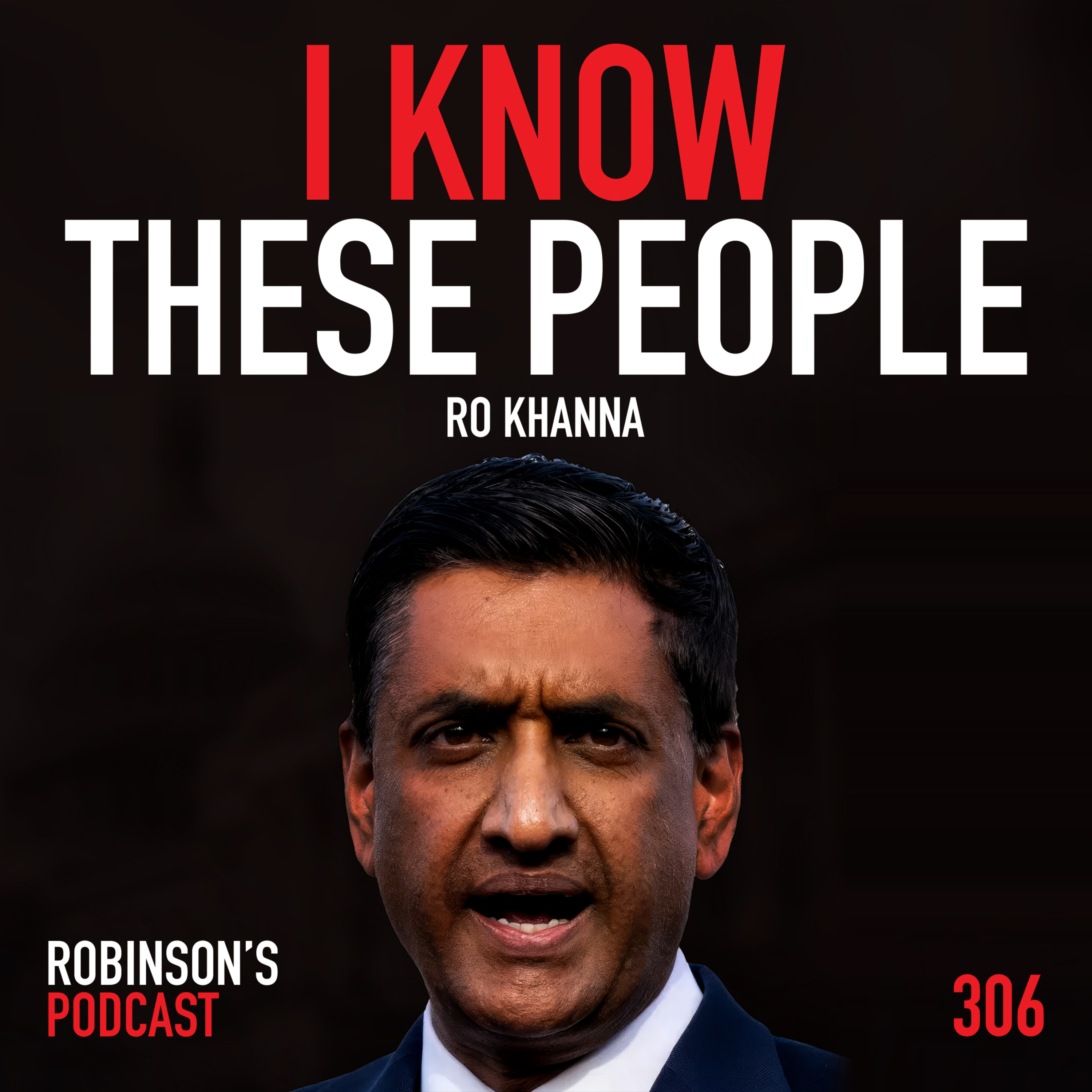
 Robinson's Podcast
19 Nov 2026 · 50m

 Add vo to ChatGPT or Claude to ask about everything you hear
vo listened to this episode to put together the overview and transcript, so there may be the odd mistake.
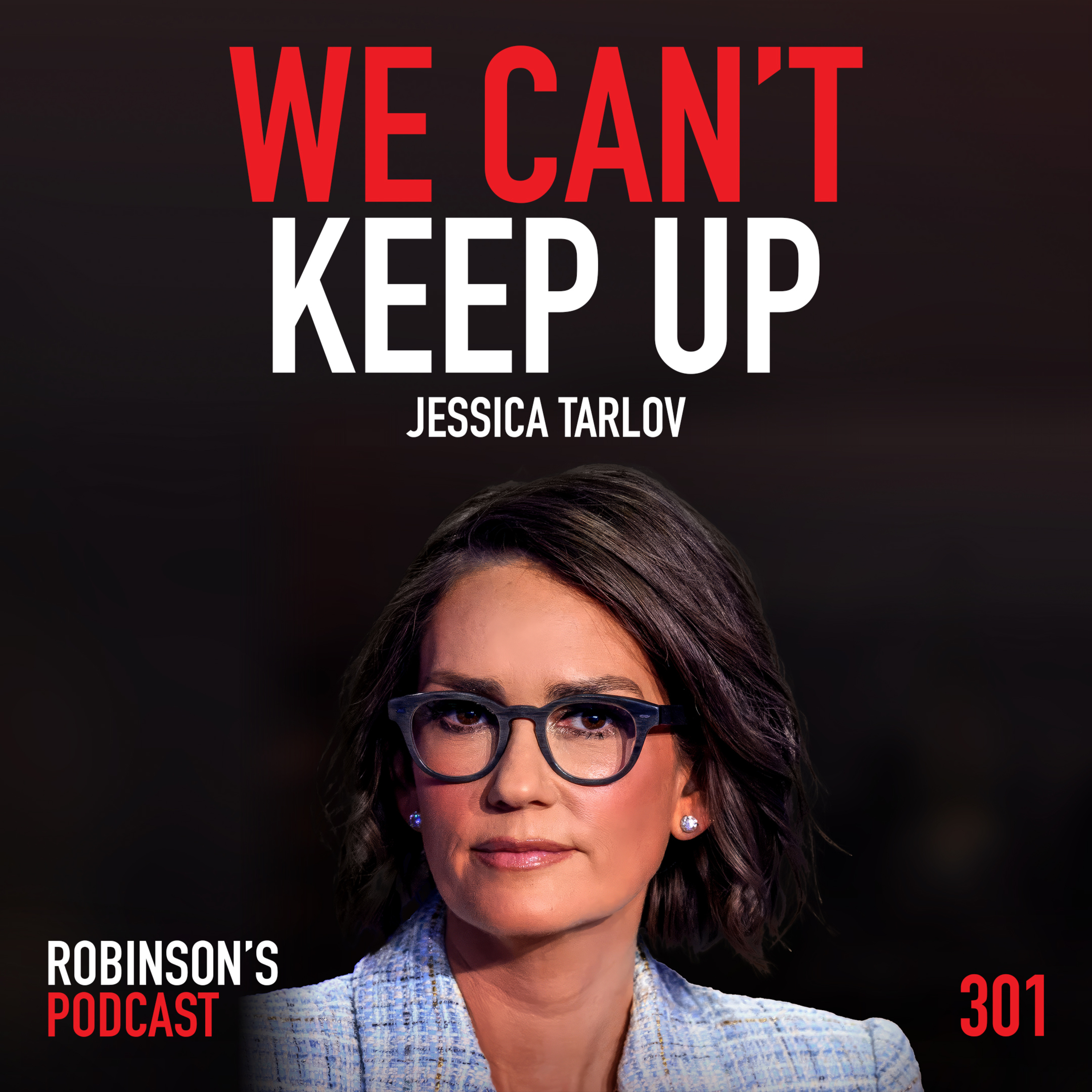
Ro Khanna argues Democrats face “corruption” as participation in a system that blocks policies on Palestine and Medicare for All, and he warns AI tech billionaires can’t be trusted to protect jobs or safety. He also discusses AI regulation, jobs, cybersecurity, and existential risk, emphasizing state-level action (especially California) over an unlikely federal response.
Ro Khanna is a Democratic U.S. congressman for California’s 17th district (Silicon Valley). Before Congress he taught economics at Stanford. He has worked on releasing the Epstein files and on pushing back against billionaires.
Donor/AIPAC pressure makes politicians avoid saying “genocide,” leading to blacklisting and smear campaigns. AI leaders (Sam Altman, Dario Amodei, Musk) are socially disconnected, profit-driven, and treat existential risk as abstraction. Federal AI regulation will be uphill; California can lead with independent auditors and bans on recursive self-improving AI.
Khanna cites joining Rashida Tlaib’s Genocide Act as triggering ads and donor blacklisting; he says a California billionaire-wealth tax effort was defeated by Newsom and billionaires; he references his 60% win despite $2M billionaire spending.
0:00I know these tech billionaires. I have been in rooms with these tech billionaires. And let me tell you, you can't trust them to keep us safe or protect our jobs. When I joined Rashida Tlaib's Genocide Act, that is when they hit the nuclear button. That is when people started running ads against me, when they started blacklisting me. If you're not willing to say genocide, what that says is you're not willing to offend the donor class in this country. Hello, this is Robinson Earhart here with a cat's leg and an introduction to a conversation with Ro Khanna. Ro is a Democratic congressman representing California's 17th district in Silicon Valley.
0:42And before entering Congress, among other things, he actually taught economics here at Stanford. And in government, he's recently been very active with his work on releasing the Epstein files and then pushing for attacks on billionaires. This was my first time interviewing a politician, and hopefully there will be more down the line, whether that's Republicans, I would love, heads of state, candidates, who knows. But it was a novel and neat experience and felt very different from talking with academics, which is what I'm used to. And I'll be back with some thoughts, reflections in the out-production.
1:18But until then, I hope you enjoy this conversation with Ro Khanna.
1:32Most of my left-leaning friends, to put it lightly, they're really ecstatic about the midterm results, but they're still very concerned about the Democratic Party's internal politics. And to the extent that the outcome of these elections was a referendum on the state of democracy in the United States. What do you see as the biggest challenges that Democrats face regarding corruption within their own ranks? The influence of AIPAC. We need to clearly reject aid to Israel. We need to call out the genocide. We need to stop weapons going to Israel. We need to recognize a Palestinian state. And there's still a lot of Democrats who are reluctant to go there.
2:22And that's not just because of APEC. It's because of all of the APEC and affiliated donor class. We need to be for Medicare for All, but there are a lot of people who are afraid of upsetting the hospital lobby, the private insurance lobby, the pharmaceutical lobby. We need to be for taxing billionaire wealth and have a wealth tax. I don't understand how this is a hard issue. In California, by the way, it would have passed. It was 51 or 49, I think, by the end of it, if the Gavin Newsom and the billionaires had not conspired to defeat it. And yet there's still a minority, I would say, in the House Democratic Party who are for a tax on billionaire wealth.
3:05So, you know, there's corruption in the quid pro quo sense, like Trump is corrupt because he's making money for his own family from cryptocurrency or from pay-to-play politics. I don't believe the vast, vast, vast majority of Democrats are corrupt in that narrow sense. But then there's the more general corruption, which is participating in a corrupt system that is blocking the right policy on Palestine, blocking Medicare for All, blocking, taxing billionaires. And there, I believe there is a corruption in the Democratic Party and that we need to have a politics that's uncompromised. In what shapes and forms as a representative do you encounter pressure from Israel and AIPAC?
3:56Is it just donations or where else do you see it? Well, the line, and this is important for your viewers to know, the line for all of these groups is genocide. So we could at Stanford, in a philosophy class, have a philosophical debate about whether it's a genocide or not and whether it meets all the prongs of genocide. Obviously, the U.N. Commission has found it is. Navi Pallé won the Nobel Prize for this, for her work. But you could argue in an academic law class, is it genocide? Is it war crimes? That's not what's going on in the political context. And this is important to know. When I went on Delia Ramirez's Drop the Bombs Act, APEC was upset, but whatever.
4:43They weren't ever going to support me, but they kind of shrugged. When I said I'm for zeroing out aid with Massey, they kind of shrugged. When I joined Rashida Tlaib's Genocide Act, that is when they hit the nuclear button. That is when people started running ads against me, when they started blacklisting me with donors, because there may be donors who were supporting me who cared about climate or cared about other things. But they suddenly started getting emails and texts that Roe is an anti-Semite, Roe is anti-Israel. It is genocide. And this is why. This is why so many politicians on our side are afraid to say genocide.
5:25They will say, oh, we'll wait to see what the ICC does. We will look to the legal experts. If you're not willing to say genocide, what that says is you're not willing to offend the donor class in this country. You're not willing to take on APEC and its affiliated organizations. So it's less about the truth of the matter. And we can argue why I think it is a genocide based on the number of children killed and the wanton killing of civilians. But it's also about whether you have the actual courage to take on the system. And if you don't have the courage to take on the system in a campaign, you're certainly not going to do it when you get to Congress or the Senate or the presidency.
6:05So it sounds like just based on what you said, the the two main issues a politician faces are pressure from donors regarding Israel and then being blacklisted in various forms by the media. Is there anything that I that I missed? Very concise. Yeah. Pressure from donors being blacklisted, labeled an anti-Semitic, labeled fringe, not serious about foreign policy, not someone who you should appoint to chair a committee in Congress, appoint to be in a high ranking position in the government. And it's sort of the path that leaves resistance is not to upset these groups because these groups will basically try to smear your reputation.
6:48So it's not just the money. It's the it's it's it's taking on these groups wrath. The United States in various ways is. We use our intelligence agencies to sort of influence media throughout the world, politics throughout the world. That's that's kind of it's not really a secret. Is there any pressure, do you think, in the United States on politicians from Israeli intelligence that also influences elections and politicians? I haven't seen it at the congressional level. What I don't know is what role was played on Trump. I mean, the idea of Netanyahu sitting in the situation room was absolutely absurd.
7:37And there needs to be a clear assessment of the role Netanyahu or any of the Israeli government played in advocating or pushing for the war in Iran and how they tried to influence Donald Trump and the administration. And there has to be a real report and assessment of that for the American public. One thing that I wanted to make sure that I spoke with you in depth about in this conversation is AI and Silicon Valley. And I wanted to know how you weigh your duty to Silicon Valley and the immense wealth that you represent here against your duty to the people of the United States more broadly, especially where those interests conflict.
8:32My campaign was that Silicon Valley shouldn't ask what America can do for it, but it should be thinking about what it can do for America. So my interests are clearly with the people I grew up with in Pennsylvania, with my constituents or the working class in my own district. This is why I took on tax on billionaires, even though I have more billionaires in my district and the surrounding areas than anywhere. We've got$25 trillion in our district and the surrounding 50-mile radius. It's one-third of the nation's wealth. And the billionaires put in$2 million against me, and I won. I got 60-some percent of the vote.
9:14The candidate against me got 6 percent, showing that even in Silicon Valley, the interests of constituents are not the interests of the tech billionaires. There were a lot of people in my district who were teachers and firefighters and police. So clearly my values are how do we get the AI and technology revolution working for ordinary people? But I believe having a technology and economic understanding of the modern economy gives me the confidence to stand up to these tech billionaires and a substantive roadmap for how we can have a new deal for our time. You have especially close interactions with the tech billionaires.
9:53Are you speaking to people regularly like Sam Altman or Dario Amadei about their technologies and how they expect to impact both your district and the country at large? I know them. I've spoken to them. I wouldn't say speaking to them regularly, probably speak to them once or twice a year. But certainly I speak to a lot of people at OpenAI and at Thropic and NVIDIA and Google and Meta, even if it's not the person right on top. And what I say is I know these tech billionaires. I have been in rooms with these tech billionaires. And let me tell you, you can't trust them to keep us safe or protect our jobs.
10:36We need to have politicians who understand it enough to be able to ask the right questions, but then to appoint people from Meter or Medi or Palisades or the groups at the Constellation on AI safety to keep us safe with an AI safety agency or at Stanford or MIT or Carnegie Mellon. professors who are going to help make decisions that aren't profit motivated. It's interesting that you say that you can't trust them because that's something that I would just assume to begin with, but you've actually met them and spoken with them. Why is it that you feel that you just can't trust these people? Is it because they're, I mean, empirically, they've already demonstrated that they can't really be trusted with the cybersecurity issues, for instance, but is it also their personalities or just how deeply involved with money they are?
11:32These tech billionaires lack a normal connection to society. Many of them grew up at a young age with their own device locked in their room. Someone was telling me about Larry Page, and they said that Larry Page was in a conversation with a few people, and suddenly he just leaves. And this person asked Larry Page, you can't just leave. Why did you do that? Did they say something that offended you? He said, no, I just thought that the utility of my own thoughts had a higher value than the utility of that conversation. That's just not normal. People don't do that. So one, they lack a social empathy gene.
12:11Second, they are consumed by a profit maximization of outdoing each other. Dario and Sam, they want their companies to be the leading on the scoreboard and to be the leading in AI. And third, they kind of view these things as abstractions. Oh, Pidu, isn't it interesting that what we're doing could have a 10 percent chance of having human extinction? And it's kind of an abstraction as opposed to a mom who worries every time she drops her kids off about their safety. So it's not even that some of them are inherently bad people. They are just divorced from the social contract in America, from a social contract in society.
12:57And the problem is that right now they're calling the shots not democracy. And that's why I have been very much on the democratic accountability for AI. When you talk to them, does it really feel like they view a P-Doom of 10 % as just an abstraction and a distraction? They're not really emotionally invested in it? Yeah, it's like a professor who's kind of thinking through, wow, isn't it interesting that human beings may have their own extinction. I mean, it's an intellectual thought experiment, but it's not striking at the emotional core. And the risk-taking shouldn't be the risk-taking of a Sam Altman or a Elon Musk.
13:48The risk-taking tolerance for a society needs to be the tolerance that a democratic society would want. And by definition, these people are much bigger risk takers, right? They wouldn't be entrepreneurs and founders if they weren't. But that doesn't mean that they get to transpose that level of risk on society. And so there is a social disconnection. There is a level of abstraction in which they view these things. There is a level of arrogance where they somehow feel like they're carrying civilization on their backs. They're carrying America on their backs, as opposed to the reality, which is that the steelworker and the teacher and the nurse and the firefighter and the good neighbor and the church leader and the mosque leader and the temple leader, synagogue leader, they're the ones who are actually the glue of American society.
14:37Our soldiers are people who have fought for freedom, are activists. So they have a disconnected view of their own importance and a lack of connectedness to society. And this is, I think, what makes them even more challenging than the Rockefellers and the Carnegies and the Morgans and the Vanderbilts of the previous Gilded Age. Three times the wealth concentration, by the way, of the previous Gilded Age. But these folks aren't building universities or hospitals by and large in communities. They're doing things like, let's go further in space. Let's further isolate ourselves from daily human existence.
15:21And so there is less of a connectivity to the country, to a local community, and even to humanity at large with many of this rich new capital class. At any given time, I mean, the president of the United States is obviously going to be the most influential figure in the country when it comes to AI regulation. But over the next two years in particular, not looking past and into 2028 or beyond 2028, who are the key figures in government for regulating AI in this two-year period? California legislature, because we can put in California legislation that could pass, that Javier Becerra could sign, that would put independent auditors into these frontier labs so that we actually have some sense of what's going on.
16:15We could ban recursive self-improving AI. I mean, all these labs are in California. So California has unique ability to have significant impact on AI safety. The other fact is that we should look for people in the administration, if there are any, who are sounding the alarm to try to work on a federal solution. But I'm not optimistic, given that Donald Trump has taken basically a total acceleration is posed to AI. He wants the stock market to go up. He sees these companies having huge stock gains. And that's the lens in which he's viewing everything, not through the lens of safety or jobs. So I believe that really it's going to have to be the laboratories of the state and the federal government.
17:00We should be pushing for an AI treaty with China. That's what my committee on the China committee will do for safeguards and guardrails. But that is an uphill battle with the Trump administration. Is it fair to say that you're optimistic about regulation within California over the next two years, but outside federally, it's going to be an uphill battle? Federally, it's going to be an uphill battle, but we at least need to, through crack-true diplomacy and our diplomatic needs, put pressure on Trump to do something with China. At least they raised it in his meeting with Xi Jinping. And the foreign policy and our relationship on AI safety at an international level or in a bilateral level with China, that's not something that can be done by California.
17:45But in terms of domestic legislation, while I have a comprehensive bill, the Human Control Over AI Act, where Bernie has a very comprehensive bill, I really believe that the states, in California in particular, need to show the lead. We will fight. We will continue to put forth the agenda. But the possibility is that we get an agenda that is implemented by the next president. And that is too late in terms of we can't wait two years. And I'm just curious about you personally. I've been, and this doesn't make me special, but I've been so much more worried about AI over the last couple of months than I ever have been before.
18:23And I think I can put these worries into three buckets. They're just general economic worries, they're cybersecurity worries, and then there are the existential threat worries. And I'm wondering how you personally think about them. Do they keep you up at night? Do some in particular influence your direction in policy more than others? I have for some time now been aware of the jobs challenge with AI. And you're seeing this now when you talk particularly to young people. You must know a lot of young people who are 24, 25, 27 and still living with their parents because they can't get a good job, because they can't afford rent or housing.
19:09I believe that AI has exacerbated that significantly. The data may not be showing up yet, though there was a Stanford paper that showed it was having an impact on entry-level jobs. But anecdotally, when you talk to young people, they're saying AI has made the job market much, much harder. I underestimated the safety risk. I did not, I sort of a few years ago thought, okay, these are kind of terminator scenarios. And some of these tech folks are inclined to believe the worst of science fiction. But I now really believe that the risks are real, that they're existential, that they're urgent. And that thinking of mine has changed over the last six months.
19:52And one of the reasons I say that is people who underestimated it should feel comfortable coming out and say, yeah, I underestimated it. I now see it's seriousness without any judgment, because we need more people to feel that way for there to be significant legislation. To what extent do you feel that people like Donald Trump and Pete Hegseth recognize the cybersecurity and existential threats, and they just aren't open about them? Because I forget what it's called. This is probably something I should have written down, but maybe the fortress protocol that the CIA or sorry, the Pentagon released recently that involved making all of our military bases independent for 90 days.
20:40How do you how do you think about them, these people? I believe they understand some risk and they basically are diminishing it or dismissing it. Part of it is temperament, right? I mean, if you have the risk tolerance to go to war in Iran, where people are dying, in my view, for a strategic blunder, You obviously have an appetite for a fair amount of risk, and they just have an appetite in some ways for risk. So they may look at it saying, well, yeah, but it's building all this wealth. We're creating all this competitive advantage over China. Yeah, there's some risk that bad things will happen.
21:22So what? And the problem I have is that that's not where most Americans are. So there is a disconnect between the governing class, the capital class, these tech billionaires, and what someone who just wants to take their kids to a soccer game on the weekend and take them to a movie and help them do their homework, what they want the risk to be about. They don't want all of these AI risks for the marginal value that it's providing the stock market. What you just said is really fascinating, and I hadn't thought about it before, but how the differential in risk incentives really explains a lot. And it also helps explain to me why people like Elon Musk would be invested in giving shares of SpaceX to every child in the country, because if he could align the general population's risk incentives to his own, then you might find a lot more support for data centers.
22:26Yeah, I mean, and data centers there, of course, it's not just the existential risk. It's the fact that these are right next to people's homes. And who wants to have a data center right next to their home? Elon doesn't, I'm sure. I mean, with the noise and the impact on water and sound. But look, this is an age old problem for humanity, right? I mean, kings used to want to conquer other lands. They had a huge appetite for risk for their own glory and people would die. And that's why our Constitution said, no, we don't want the president to decide on war and peace. We want Congress to decide. And so the general population that just wants to lead their lives, have a family, have some decent living, enjoy each other's companies, don't have grandiose visions of conquering other parts of the world or of building trillion dollar companies.
23:17Now, to some extent, you want ambition, but you want the extraordinary. It can lead to advances in medicine, advances in science, entrepreneurship. But the problem I have is it's out of whack, where the only people who seem to be making decisions right now on AI are those who have the highest risk tolerance for the negative consequences. And those who are unions or workers or AI safety experts are saying, slow down. they don't have a voice in this. And that's why we're in this situation. We only have a few minutes left since we've been talking a little bit about Elon. I had a conversation recently, I'm not sure who with, but the person said, well, isn't it such a strategic mistake of Elon to be donating so much money to Republican causes this election cycle when they're probably going to lose.
24:13And my gut response was no, because talking about risk, sure, there's like a there's a lot of risk that's unlikely the Republicans were going to win. But if they lose, Elon Musk still is worth billions and billions of dollars. And he can then just shift his donation to Democrats and they're going to take it. What went through your head when you returned donations from Palantir? And are you at all confident that when Elon Musk inevitably switches sides, as will other billionaires, that other politicians are going to do the same? Well, I won't take any money from Elon Musk. I've known Elon for years.
24:57I know he blurred my first book, which I wrote on manufacturing in 2010, because back then he was an actor who was focused on bringing manufacturing here with Tesla. We had a major disagreement when he got the Obama loan that made Tesla possible. I thought it should have been conditioned with labor neutrality and that they should have allowed for unionization, and he didn't. But we stayed in touch, and I fundamentally believed in the electric vehicle revolution. The problem is that when he came to Doge, you and I put out an op-ed saying, OK, if he's going to go after the Pentagon budget, I'm open to that.
25:37I mean, why not? We've got a bloated Pentagon budget. If he's going to go after actual waste and Medicare Advantage, fine. But he came in there. He didn't listen to anyone. He didn't obey the Constitution. He took food and medicine away from the world's poorest. He fired hundreds of thousands of qualified civilians, and he's gone on a rant against people who are trans and people who are immigrants. And so at this point, you know, he should have no place in a Democratic party unless he renounces all of these ugly views. And if he has some repentance or, you know, I don't believe that anyone is fundamentally irredeemable.
26:19irredeemable. But the Elon Musk today, we certainly shouldn't just take his money. Yeah. Did did you see You Can See Everything? No, no. The Elizabeth Holmes documentary. Yes. I mean, I've heard of it, but I haven't seen it. Yeah. I'm sure you're too busy to see three hour movies these days. But I'm just amazed by the ability of people to convincingly lie when it is self-serving. And I don't know how anybody could possibly trust Elon Musk, even if he did genuinely switch sides. I don't know what he could do that would make anybody really trust him. But I agree with that. Well, he certainly should be taking his money, right?
27:02I mean, I'm for banning all of these super PACs in Democratic primaries and in general. And it's appalling that any individual has that kind of wealth and that kind of influence. Ro, thank you for being the first politician to dare coming on on this program. I really enjoyed this. I appreciated your time so much. I look forward to doing it again sometime. Well, I hope it won't be the last and I hope it met your expectations, but I appreciate your bringing civil and thoughtful conversation to the world. I mean, ideally, that was what podcasts and the Internet and social media should be about, as opposed to just kind of the sensationalism that often passes for conversation on X.
27:49All right. I hope you enjoyed that. I am here with what I believe is now my third introduction. And I've groped my way toward a format that is feeling comfortable and manageable, which is three reflections or so, responding to a couple of comments. I've got one lined up this time from the previous episode, and then dispatching with any janitorial duties that require my attention. Sam Harris always refers to this task as housekeeping, and I didn't want to steal that from him. So I had a couple that I liked, janitorial duties, ministerial tasks, and I decided to go with janitorial duties. But after this interview, what I found myself thinking about most, and it's kind of funny that this is where my mind went after my first interview with a politician was another epistemic question, and this time about trust.
28:50So how much should you trust what someone tells you when you know they have a personal stake in what you come to believe? And in Ro's case, of course, he was talking to me, but he knew that anyone watching our conversation would also hear his answer. And this kind of links nicely with the Jiang episodes that I just released, the three of them, because trust wasn't really an issue there, since in the most important instances, I already had good independent reasons to disbelieve some of his assertions, such as that Sam Altman is an occultist. But I will come back to Jiang, I think, a little bit later in this introduction.
29:37So the first thing that stuck out at me or struck me, I always end up saying struck me, stuck out at me, confusing them, saying them both at the same time. But the first thing that struck me about today's interview was the stark difference between interviewing politicians and then interviewing academics, which I mentioned in the introduction. So Noam Chomsky's career, for instance. It hardly depends on whether I agree with him about linguistics, but Ro Khanna's entire career depends on the support of a large group of people. And there are some questions, often the ones that I most want a direct answer to, where I can't expect a straight answer in a public interview.
30:25And maybe nobody can. Take my question about whether Israeli intelligence puts pressure on American politicians. Blackmail was the main possibility I had in mind. And what Roe said was, I haven't seen it at the congressional level. And in this case, I could not reasonably expect Roe Khanna to say, even if the answer were to be yes, yes. Because among other things, if he were to have said, oh, yes, the Mossad leaves threatening messages at my door every couple of weeks. It's really a nuisance. It would probably make breaking news. There would be investigations and questioning and so on. And yet, given the immense interest that foreign and other non-governmental powers have in U.S.
31:16policy, it is totally within the realm of possibility that such blackmail occurs. So maybe it's not surprising that his interests that this interests me so much since my job is asking questions and getting answers. But all of this raises the question for me, which is given that I want to interview politicians, what am I supposed to ask them when what I most want to know is precisely what they have every reason to keep from me? So take the blackmail question. If I'd expect the same answer from Roe, whether he'd seen blackmail firsthand or not, then what can I expect to learn by asking? And is there even a point of asking?
32:06And what should I ask instead? But the funny thing is that a few minutes later, when Roe told me I couldn't trust the tech billionaires, my first reaction was, well, sure. I mean, I even told him that was something I'd have assumed to begin with. But I would be so curious to interview Elon Musk or Sam Altman or Mark Zuckerberg. And I think a lot of it just has to do with things that are beneath the surface. I want to see their micro expressions or hear their tone or just listen very closely to the way that they convey the information that I might have already anticipated. And interestingly, maybe this will come up again in my reflections today, but that's one reason why it's worth paying a lot of money to do in-person interviews with high production values.
33:03But that's another issue. Okay, reflection number two. Speaking of the tech CEOs and people's interests, in our conversation, I mentioned giving stock to children. And I've since looked that up. And among others, Elon promised every child in America one SpaceX share, which was worth about$146 when he announced it. And then Dario and Daniela Amadei pledged 80 % of their own Anthropic shares to philanthropy. And Anthropic separately put 5 % of the company into its public benefit fund. And I think Michael Dell and like I mentioned, some others have done similar things. But personal anecdote, when I was a child, my grandfather gave me a few shares of stock in Procter & Gamble.
33:59And even though I hardly understood what that meant from that point on, I only wanted to use Old Spice deodorant and Crest toothpaste because I felt like I was on Team Procter and Gamble. Now, if an entire generation of children, not to mention their parents or current voters, believe that their future is tied to the finances of SpaceX or other AI companies in some material way, then that could end up terribly for the planet. I'm not saying it will or would, but it certainly could. And leaving the existential threat aside, I wouldn't be surprised if many voters don't realize that while their kids$146 share quintupling or quadrupling or, I don't know, 10-tupling in value might buy them a new phone, The advances in AI that might drive up the share price could also just threaten their livelihoods by swiftening the displacement of human labor.
35:06It could be a very dangerous thing in a democracy to have the majority's financial interests even appear to be aligned with those of the tech companies for that reason. But on the other hand, even if they give away everything they've pledged, the Elons and the Amadeus of the world will remain extremely wealthy. And so depending on the impact, the alignment, so the impact policy wise, that the alignment of voters financial interests with theirs has on those companies share prices, it could even be a lucrative investment for Elon Musk to be donating a share of SpaceX to so many children. Okay. I would like to reiterate that, or maybe I didn't iterate this in the first place.
35:56I was so grateful to talk to Roe. I would be so grateful to talk to any tech billionaires who want to come on the show as well, for that matter. So this wasn't like personal about them, because my interests also don't align with theirs often, and they don't align with the listeners. And it would be so unfair not to point out that my interests aren't always aligned with the guests or yours. So what's most problematic, though, or the way in which the conflict is most relevant to what I've just been discussing, are the ways in which the conflict between my interest and yours might make me untrustworthy.
36:41And that's a serious issue to consider. And I'll list some ways in which that comes to mind. So in line with my comment about Roe, someone like a corporation, a powerful person, a government, they could attempt to blackmail or bribe me into lying, propagandizing, etc. And I might be motivated to misrepresent myself because it's in my best interest for your viewers to like and trust me. Or I could even exploit guests to further my own interests. For instance, if I really wanted people to believe that Sam Altman was not an occultist, I might interview Jiang Shuiqin and then manipulate the footage in such a way as to make him seem less convincing and thus discredit that position.
37:38But this takes us back to the question of how can we trust anyone, myself included, when they likely have interests you are or are not aware of that conflict with your own. And I don't have a simple answer to that, but at least for my part, I would say that because I'm very much aware of this, the strategy I'm employing is transparency, maybe for lack of a better word. so to respond to the examples that I just gave if somebody were actually blackmailing me I'd presumably sit here and tell you they weren't so you've got exactly the same problem I had when I asked Roe but the fact that I make it a point or I try to make it a point to charitably explore both sides of issues would make it seem less likely that there's foul play involved so very contentious issues like Israel and Palestine.
38:38I have interviewed people on both sides. I've interviewed more pro-Palestine than pro-Israel people. But one thing that listeners don't realize or viewers don't realize is that I only interview a small fraction of the people I invite to be on the podcast. So for instance, I've tried to interview Benjamin Netanyahu because I would love to interview him about Israel and Palestine. And he's as pro-Israel as they get, but he doesn't respond. And Norman Finkelstein likes me a lot. So I get to talk to Norman Finkelstein a lot. So that's kind of how it works. But then with the misrepresentation, for instance, I could have been lying when I said I had a legitimate interest in speaking with Jiang Shuiqin beyond drawing in viewers.
39:31Because if all I cared about was the views, I'd still have every reason to tell you I found him interesting. But I can tell you what I actually got out of talking to him, and all you can do is make a judgment about whether that explanation makes sense to you, which I guess is what I did in the last few episodes. Then finally, as to the exploitation of guests, the fact that they can all see the episodes and publicly repudiate me or clarify their views is another safeguard against that exploitation. But okay, anyway, these are just some thoughts because there are plenty of media figures and outlets I don't believe to be trustworthy at all, and I really do not want to become one of them.
40:24So hopefully when there are conflicts of interest, I can disclose and defend them when it's relevant. Unfortunately, I'm not the best liar or actor, though that is just what I would tell you, right? All right, on to an interesting comment. My hands are all cat hairy from the podcat in my lap. But okay, the comment that I pulled up is very small. Okay, this is on the most recent episode with Jiang Shuiqin. Can the host let us know if he changed any of his prior beliefs after this entire prolonged interview. Then we'd know if any normal person could possibly consider adjusting their mind after listening to academic and well-structured arguments.
41:21This was, I should have said who commented this, LLSS 3923.
41:33So I don't think I changed my mind about anything after the third Jiang interview. But as I mentioned in the last episode, it was quite thought-provoking in various ways. My biggest takeaway came from Jiang pointing out that while I do believe one should be skeptical of news reporting, I believed the reporting on the Hugging Face incident implicitly. And when he asked me why, I could not tell him what evidence it was based on. Of course, as I mentioned in the last introduction, I looked into it afterward, and I'm now convinced it happened. So what Jian got me thinking about was whether I had good enough reason to be as confident as I was when he asked me.
42:26And again, I talked about this at length at the end of the last episode, so I won't belabor that point. But I will address the more general question of whether I can change my mind in an interview. And maybe this is a turnoff, but I'm not sure I have ever changed my mind at all about anything significant in the course of actually recording a podcast. Changing one's mind about a substantial issue probably shouldn't happen lightly. And I'd be skeptical of myself if I believed that my mind had changed about a deeply held belief after a single conversation. Now, whether I learned something new and eye-opening or came to understand a different perspective is another question entirely.
43:15So there are plenty of times when I've learned something fascinating or my perspective has changed. And some examples that come to mind are before talking with Harvard psychologist Robert Stickgold, I'd been unfamiliar with hypnagogic dreams, which are the dreams that occur right as you're falling asleep, where your brain just starts to put together seemingly random sequences of events and objects. So I'm assuming this happens to you, but I'll be like lying in bed and then I'll catch myself thinking about a clock on a tricycle, getting a pint of ice cream. And then I'll be like, how did I come to start thinking about this?
43:56But he explained how you can harness these dreams to fall asleep faster. And I ended up finding that quite helpful. But that was something that I learned that was totally new. So there was this, I don't know about profound, but a real change in my brain after that conversation or in the course of it. Then another one, while I'd of course encountered the idea of machines taking over the planet in science fiction, it wasn't until speaking with Eliezer Yudkowsky that I came to see it as a legitimate problem worth discussing, whereas so many people, myself included, would have dismissed it before really digging into the arguments.
44:39There's also a difference between changing my mind while I'm sitting across from a guest and changing it in the course of preparation or reflection. So before I interviewed Brian lighter of UChicago, I'd more or less written Marx off because I'd never really gone beyond. And this is this is a confession, I think, but I'd never really gone beyond the popular descriptions of him as a kook, I guess, just because of his portrayal in the popular media and because I'm not an economist or interested in continental philosophy. But then in prepping for the interview and reading some chapters from a book that Brian had written, I realized that there was so much rich thought provoking material there.
45:30just as one example, I mean, Marx's concept of ideology, which of course I am far from an expert in or on, I don't know what preposition I should be using there, but whether that's politics, religion, or what have you, as a force that serves the ruling class and helps keep them in power, even if nobody deliberately devised it for that purpose, I mean, it's so powerful, so cool. And that came from my preparation. But one case where my views changed afterward was my conversation with Robert Sapolsky about free will. And I'd been pretty convinced by philosophers like Daniel Dennett that we do, in fact, have free will, despite the well-known arguments from determinism and the companion argument that even if there's genuine randomness, randomness alone wouldn't give us free will either.
46:24but so much of the debate about a concept like free will depends on how we define it and i guess what it comes down to is that i would just reject the idea that there is one true or accurate concept of what free will is but sapolsky's determined in part because he isn't tainted by too much philosophy made me realize that the idea of free will he's arguing against is closer to what most people mean by free will. And they mean that in precisely the same circumstances they genuinely could have chosen otherwise. That's what I think people mean by free will. And I found his arguments against that kind of free will to be totally convincing.
47:15And whether we have something else that's worthwhile, whether we should call it free will, whether there's genuine moral responsibility or room for treating people as though they're morally responsible, are other, albeit related questions. But if you'd asked me before I talked to Sapolsky whether we have free will, I'd probably have said yes, but it doesn't mean what you think it means. Now, if you asked me, I'd want to know what you meant because on the most common understanding of the question, my answer is no, we don't have it. Okay. I'm not going to crack my knuckles, but all right. Finally, we come to my janitorial duties.
48:02And all I have to say today, I think, is that I see lots of comments, particularly on YouTube, about there being too many ads. And I have a few things to say about that. So first, I haven't actively tried to inundate people with ads. I just always click the let Google decide button or let Spotify decide button. And then I assume that if people don't like ads, they'll get the premium option or whatever. I have YouTube premium for that reason. But this show is expensive to run, and I want it to be even more expensive to run because I want it to be even better. So I don't see ads going anywhere anytime soon.
48:52That being said, though, I'm going to work on ways of getting different sorts of sponsorship, of maybe doing skippable host-read ads. of trying to change the placement and frequency manually on YouTube and Spotify so that there's less of them because I want to make the viewing experience better. After all, I mean, while, of course, I would love to be almost Elon Musk, filthy rich, I genuinely want people to enjoy the show because my earlier comments aside our interests are at least aligned that much okay all right until next time geeslings it is time for me to sleep
Support the Show: https://www.youtube.com/channel/UCsxwneBx6apV1mQ7CbWKfXQ/join
Ro Khanna is a United States congressman representing California’s 17th District in Silicon Valley. In this episode, Ro and Robinson discuss corruption in the Democratic Party, AIPAC’s influence, Israel, Gaza, and the Iran war. They also talk about Sam Altman, Dario Amodei, Elon Musk, and the power of Silicon Valley. They consider the risks artificial intelligence poses to jobs and human safety, and what governments can do to hold technology companies accountable. Other topics include billionaire political donations, super PACs, and Ro’s changing views on AI safety. His most recent book is Progressive Capitalism: How to Make Tech Work for All of Us (2023).
Ro’s Website: https://khanna.house.gov/
Progressive Capitalism: https://www.simonandschuster.com/books/Progressive-Capitalism/Ro-Khanna/9781982163358
OUTLINE
00:00 Introduction
01:32 Corruption Among the Democrats
03:47 Pressure on the Government from Israel
06:54 Does Israeli Intelligence Pressure U.S. Politicians?
08:05 Silicon Valley vs. The United States
09:47 Talking with Tech Billionaires
11:02 Why Ro Doesn’t Trust AI Executives
13:07 Who Gets to Decide How Much AI Risk Is Acceptable?
15:33 How to Regulate AI
18:12 Does AI Keep Ro Up at Night?
20:10 What Does Trump Think of AI?
21:56 Aligning Risk Incentives
23:52 Keeping Money Out of Politics
27:49 Outro
28:34 Can You Get a Straight Answer from a Politician?
33:07 Who Would Benefit from Giving Children SpaceX Shares?
35:50 What Makes a Podcast Trustworthy?
40:43 What Changed After the Jiang Xueqin Interview?
44:39 Rethinking Marx and Free Will
47:57 Why Are There So Many Ads on the Podcast?
Robinson’s Website: https://robinsonerhardt.com/
Robinson Erhardt researches symbolic logic and the foundations of mathematics at Stanford University, where he is also a JD candidate in the Law School.
Disclaimer: Robinson’s Podcast is a forum for open discussion. Guests’ views are their own and do not necessarily reflect Robinson's. Hosting a guest does not imply that he endorses the views or opinions they express.
Scan the code with your iPhone camera
Listen in the app.