
 Ask ChatGPT



Written by AI. May contain mistakes.

Get the gist, explore an idea or ask about something said.
 Claude
On Rosebud with Gyles Brandreth, what are the key points of this episode?
Searching your listeningAutomatic transcript. May contain errors.
0:00It's a beautiful day and I've got a beautiful guest. Cue the music and welcome to Rosebud No, I've got that in the wrong order It should be welcome to Rosebud And now, cue the music
0:32It's been quite a week for royals in the news. It's been quite a week for royal brothers in the news. And, well, it's Friday, this is Rosebud, and I'm bringing you a royal brother. A royal younger brother, too. Yes, it's the younger brother of the late Dinah, Princess of Wales. My special guest this week is Charles Edward Morris Spencer, 9th Earl Spencer, who was indeed the younger brother of Diana, Princess of Wales. And of course, memorably, Charles Spencer gave the eulogy at her funeral which shocked people at the time, brought forth, well, cheers and applause from the congregation gathered outside Westminster Abbey and then eventually applause within the Abbey.
1:20It was very controversial. And Charles, who I've known for, I'd say, 40 or so years, is a remarkable fellow. he is a wonderful writer i have to tell you he's written some really good serious history books he's also written a memoir which i found quite searing so this is going to be a very interesting and revealing episode i think you will find yes there are royal elements to it but he is there's much more to him and his family story than that as you'll discover in this week's very special Rosebud. Cue the music. I think fanfares are in order, don't you?
2:13Charles Edward Morris Spencer, 9th Earl Spencer, born on May the 20th, 1964. I want to know, Charles, what is your very first memory? Well, my very first memory is when I was around two, and I was sitting in the middle of a very swirly green carpet in the nursery at Park House in Sandringham, where I grew up. I can also remember my father, who was a very keen photographer, taking loads of photographs of me in one of those sort of bulletproof prams that nannies used to enjoy and I remember I was chewing on the side and I was chewing on the side of the pram not of my father and and I think what happened was from the very early age I was familiar also with the photographs so I think they buttressed the memory but I do remember movement in those episodes which point me towards them being real memories as opposed to photographs that have been printed themselves on my mind and what age would you be roughly two two that's quite small it is well So you've given us your father and you've given us Sandringham, which I always think of as being a royal estate.
3:24Were you on a royal estate? Yes. So we were in the, it was an extension built by Edward VII for shooting guests and senior members of his household. In fact, three people were born in that house ever. My mother and my brother, who died before I was born, and Diana. And otherwise, it was very much a sort of utilitarian, lovely house. It's home to me, Giles, even though I haven't lived there since I was 11. And even though, you know, my parents' marriage didn't survive, my mother left that home, that is home to such an extent that actually my eldest sister, who's 70, can't ever go back there. It was too perfect.
4:04It was a sort of rosebud connection with perfection in simpler childhood. So who owns the home now? The king owns it, yes. It was, after we left, it became a care home, a Leonard Cheshire home. But I remember it so clearly. It's not in great shape at the moment. It's between uses, I think. Perfection. And how come your family were living there? Who was your father? Tell us a bit about him. Well, actually, to go slightly sideways on your question, the reason we lived there was through my mother's family. Yes. so my mother's father was Morris that's where I get the third name from for Moy who was a very charming Irish American who loved England he died 70 years ago age 70 so he would have been a very old grandfather I never met him but classic east coast wasp really went to Harvard and then joined the American infantry in World War I came over fell in love with England and ended up becoming the local MP in Norfolk for Kingsland and was very close friends with George VI.
5:16And he taught the late Queen how to skate on Sandringham Lake. As we all know, George VI had many qualities, but he was quite shy. And having a quite gregarious Irish-American who was quite amusing, I believe, next door was quite a thing. And they played tennis together and shot together. And then my grandmother, his much younger wife, Ruth, became a confidant to the royal family and the Queen Mother's lady-in-waiting. So Morris Fomoy, friend of the Duke of York. Absolutely right. When young, still friend of the King when he becomes George VI, he is able to rent this house on the estate. Yes. And that's really where your family is brought up.
6:00His wife is Ruth. That's right. known in the press as Ruth, Lady Fomoy. Correct. That's it. She is your grandmother. Yes. And she has a daughter. Yes. Who marries Earl Spencer, your father. That's right. And who is your mother then? Tell me about your mother. Frances. She was very dynamic as a young lady. My father was engaged to Anne Glen Connor, actually, as she revealed in her book. Yes. But there was no date fixed, so I think my mother thought it was fair game. And she moved in. And who was she? What was her name? Frances Roach was the family name of the Fomois. And she married my father when he was 30 and she was just 18.
6:45She had seen him working at Sandringham. He was a courtier to, first of all, Georgia VI and then the late Queen. And she rather fancied him, I think. He was rather dashing. In those days, a very dashing young army officer who had done okay in the war sort of thing. and they got married very you know one of the many weddings of the year of 1954 you know that's what they were called in those days everyone tried to make them into something and they lived a life in Norfolk where it was quite a quiet life I think five children I was the fifth two girls a boy a girl and a boy and I actually think that probably the death of my brother soon after birth sunk the marriage actually I don't think it went very well nobody really knew what to do and there were lots of resentments on both sides and then my mother fell in love with a absolutely charming man called Peter Shandkidd and she decamped to Australia and then and then the west coast of Scotland I met her in Edinburgh she was utterly charming yes she was a huge fan yeah and describe her though as you remember her from your childhood when you were a little boy what are your memories as a small boy of your mother?
7:56She was very dazzling actually. She had this incredible energy, great sense of humour, quite a shocking sense of humour. She was very naughty, funny and she hadn't got much time for convention. We had such fun, you know, as children we went to stay with her on the west coast of Scotland and it was a very outdoorsy life. In the summer, lobster potting, macro fishing, that sort of thing, helping on their farm. They had a cattle farm there. But as a mother, she was tremendous fun I'm not sure maternity was her first calling but she was enormous fun but you went through it five times she did she was a very yeah I mean she I was by the way I was the fifth child and she was 28 so she had she packed in um the breeding schedule quite early but what I would say is she was terrific fun and people really adored she lit up a room can you remember a game that you played with her or a moment with her reading a book with her what what comes into your head she taught me bridge we started with honeymoon bridge which is for two people and she was fanatical we all we all got taught that by her i love the west coast of scotland but it does rain a lot so there's plenty of time for cards and so that was the main connection in terms of playing my father was more of a reader my father was a absolutely lovely old-fashioned English gentleman.
9:16And I think he really struggled with being, he was the prime parent. He won custody, which was quite unusual. Were you conscious of the divorce when it happened? No, you were too small. I can remember one moment. It's the only moment I can remember my parents together ever. And I was three or so. And I remember both parents thinking, well, he won't know what's going on but children do and I was in my mother's bedroom in her rented flat in London playing with a train set in the corner while my mother was sitting on the bed head in hand sobbing and my father was looking at me trying to look reassuringly but devastated and I reckon he was trying to persuade her to come back or something and it was never going to happen But that's my only memory of my parents together in childhood.
10:13How would you describe him? Again, I met him, and while my recollection of your mother is of being fun and flirtatious, it must be said, my recollection of him is of somebody very solid, very decent, a little bit hard to know beyond the obvious English gentleman's way of speaking. Yes. But what was he like? he was an incredibly loving gentle father um i mean i think i only saw him lose his temper with any of his children twice he probably should have done more so we were quite wild children i think i believe listening to nannies we had a lot of nannies who came through everyone loved him on you know on the estate when he inherited you know people still talk very highly of him and he's he died 33 years ago very charming very sweet nice gentle sense of humour.
11:05I think was brought up in an era which is very hard to understand now. So he'd read to me every evening. The books we read together were Just So Stories, Dr. Doolittle, the Narnia tales, that sort of very conventional stuff. But he taught us manners and things. He was very, very keen. Christmas Day, you know, if we hadn't got all our thank you letters done by the end of Boxing Day, well, we did. There were rules. And you did things in a certain way. He was very reverential of the royal family, as in, you know, very old fashioned. He was a soldier courtier. He was actually, he was much brighter than his position would have allowed.
11:46And I feel it was quite unfortunate that he was, came out of the war, became an inquiry to the royal family, but before that to the Governor General of Australia. And it was all a bit, it didn't light up his mind. I've seen things he wrote, and they were really well written whether it's um he did very well in world war ii and i i read a dispatch he wrote there and it was so cleverly written about liberating he he and eight men liberated a couple of communes in normandy and he he was a brave soldier and i think he could have done more with his life if somebody had thought you know what forget the baggage of whatever title whatever because it was all a bit meaningless by then anyway.
12:31You should do something. And I wish he had. But then I think he was waiting to inherit, actually. And when did he inherit? When did your grandfather die? 1975, by which stage my father was 51. And you hadn't yet moved. You didn't move to the big house until then. You were still at Sandringham. Yeah, and that was heartbreaking for us children because absolutely no question that we were going to move to, it can be pronounced all Thorpe or all Trubes, both. but we didn't want to go at all and actually I have to say for the younger children that's Diana and I it was devastating because we were still at school and left behind friends we'd been at school with in Norfolk to go to obviously a very privileged setting but my goodness it was lonely no local children were going to touch us and quite a complicated relationship with my stepmother etc So we were removed from a very happy part of North Norfolk and taken to an absolute goliath of a house in the middle of the Midlands.
13:35And we had no connection with it at all. Before we leave North Norfolk, tell us about your brothers and sisters there. Yes. So the first brother dies. What was his name? John. John. So he was born in January 1960, and my mother had been given some medicine akin to the thalidomide drug. And he was born with all sorts of issues and died within a day. But it was all very complicated. The doctor thought it would be bad for her to see him. You do see. Very difficult. Out of good intention, but of course completely wrong. So she never saw him? She never saw him. And I think she never got over that. and my father who was you know wouldn't have he was obeying doctor's orders you know this is what we do when when children are born like this and then I have still got two wonderful sisters Sarah who's nearly a decade older than me who is always in trouble she's quite punchy I remember she was having a disagreement with my father and it was very difficult to think of a suitable protest so she just rode her horse into the hall and sat on it in there and it was a very brilliant gesture because what are you going to do with that my goodness and she was yeah i think she was kicked out of school she was drinking and smoking and all that sort of thing but really fun and she's actually settled down since no no no no absolutely not no in fact she's just been um she's still riding and she had a very bad fall last month and has been in hospital for a long time and I think was quite a handful as a patient because the lead doctor said to my brother-in-law she's quite a character isn't she which I think is code can you take her home and then I have another sister Jane who's absolutely lovely completely opposite very gentle very sweet really funny the tragedy for my sisters is that they're from that generation they were sent to school as a sort of holding operation rather than education Jane was definitely Oxbridge material, but went to a place called West Heath, which was a Calder School in Kent, and got a B and an E and A levels, and that was considered very, very gifted, because nobody taught her.
15:50And yeah, we were quite a close trio, actually, even though the age gap, so Jane's seven and a half years old, I'm very much the youngest, but frankly, at 61, it doesn't really mean anything. And how much older than you was Diana? Two and a half years. So really, what happened was Sarah and Jane grew up together because there was sort of two and a half years between each child and with John dying in the middle there was a gap and so it was two and two really growing up. And at home life with the nannies who were is there a nanny you particularly remember and what was the routine? Yeah I can remember a lot of nannies.
16:27Again you know this makes my father sound completely inconsiderate the worst thing about the nanny situation was he took a view that it was too upsetting to say goodbye to a nanny so sometimes we go to school in the morning and then come back and the nanny was gone and he thought saying goodbye was too upsetting but it wasn't it would have been a bit of what we call closure but that my favorite who's still alive was called sally and she was absolutely lovely she was from peterborough very warm very fun very affectionate and um but very early on we had some horrors they're safely dead so I can because I had to research that for something I wrote Mrs.
17:07Richardson and Nanny Forster and they were really unpleasant you know what sort of thing do they do? well if Diana and I if we one of those two when Diana and I did something wrong together she would really bang our heads together and if it was just one of us who had done something which she thought was beyond the pale it would be smashing your head into the wall and really painful. I can still remember it. Very dizzying, you know. But what were you doing that was wrong? Childhood stuff. I think it was sort of apple pie beds and things like that. Oh, yes. Well, that's... Yeah. Nothing vicious, but just endless, I think.
17:45Probably quite exhausting. My childhood nickname at this stage was Buzz. I've recently, I mean, like half the world, I've been diagnosed with ADHD, but I think I always had it. And Buzz was my mother's nickname for me because I was like a busy bee and I never really settled. And I think that was probably quite hard work for other people. And you and Diana were friends from a small age and remained friends. Were you all? Yeah, it was hard. It was hard, really. So she was a girl a bit older than me. When it mattered, she was really good. So first day at primary school, she had been there for two or three years.
18:26and Miss Lowe, the formidable but absolutely wonderful Edwardian head teacher, told me when she was about 90-odd, I went to visit her. And she said, you know, your first day, Diana was in my class and she wouldn't settle at all. And so I said, go on, go and see him. And then Diana went to have a look to see how I was doing and then came back and went, he's fine. So things like that were really good. And we had actually the drudgery of being the children of divorce with parents who don't get on at all. Once a month, we'd get on the train from Kingsland in Norfolk and go the two and a half hours to Liverpool Street to spend a night once a month with my mother.
19:07And that was, you know, especially as children, a long train journey as hell. So we endured those together. Yeah, talk about drudgery rather than being trauma. It was just annoying. Bore, yeah. And also embarrassing because we had to leave class early. Oh, and everyone knew why you were doing that. And actually, I mean, you have to remember, so in late 1960s, Norfolk, there weren't many divorced people. I mean, I was struggling to remember. I don't think anyone else had divorced parents at that stage. So it was all a bit much. And were you embarrassed by it? Were you concerned for your father more than your mother?
19:41She just disappeared from your life. When you were three or four, she just vanished. she vanished for six months we didn't see her at all she went to live in australia and even she was advised this would not be good in a custody case but she was madly in love and she she went there and so when she came back she did try to get custody of us but the judge well my father had a lot of people saying he's doing a really good job and he probably was wasn't he by his own lights yeah and it my my mother's mother supported him so that's a bit of a knockout yeah and they that meant my mother and her mother didn't speak for a decade but I think I've seen the correspondence actually my grandmother was not taking sides she was just saying the children are doing very well and do you think it was the right in retrospect was the right decision means you haven't had a mother yeah and no doubt many a therapist would say they've been on a lot of your story is to do with not having had a mother attachment yes no I I think I look with my father did really well, given the background he came from.
20:50But I think not having a mother's when there is one available is probably not a good thing. And I think it was actually I was always quite sort of forthright. And I remember, for instance, Jane, my second sister, was very sweet and meek and never say boo to a goose. And I remember her being really miserable one holiday because technically we were meant to do 50 percent of each school holiday. with either parent. And I said to her, I was five or something. I said, why are you so unhappy? She said, I just want to be at mummy's house. So I just marched into my father's study and said, Jane must go to mummy, as we called her.
21:30And my father went, what? And I said, well, she's unhappy here. And he went, oh, okay. And that afternoon she went off. So I did my sort of shop steward bit on behalf of the family then. But I think it was quite tough. So my father wasn't involved. He didn't do the school run.
21:50We really only saw him in the evenings at bedtime. And the rest was school, house staff. It all sounds very, very bizarre, but that's how it was. What's your best memory of him, the best time that comes into your head? It would be, I know you're asking for specific, but I'm going to say how unbelievably kind he was to all my school friends. Yeah, and they still revere his memory because unlike a lot of people from our background, he really cared about people. And my friends would come and stay. Every year I'd have four nights of my friends staying for a series of annual cricket matches. And they were amazed that when they came back, he remembered what they were about to do and all that.
22:37So that was quite touching, actually. And your best recollection of your mother? Well, usually it's sort of a fag in her mouth, a glass of wine in a speedboat, going to check on the lobsters off the coast of Scotland to see if we caught any in the lobster parts. You know, she was fun. And when we stayed there, she had some great friends, you know, who would come and light up. My father's friends tended to be slightly duller, I think, it's fair enough. And so if they came to stay, you'd just sort of evaporate. but my mother had a sort of raucous crowd of like-minded folk and how quickly did your father remarry after the divorce oh not for a while so my parents got divorced they split in 66 or so and he married rain in 76 and but they'd been together for a year or two before that yeah we you know that was really problematic i feel i genuinely now you know rain's been dead for a while.
23:34I feel very sorry for her. This sounds very rude. She was Barbara Cartland's daughter, and I don't think that's an easy slot in life. I sat next to Barbara Cartland at lunch once at her home, just before my first wife was about to give birth to our first child. And Barbara Cartland said the most revealing thing. She said, I hope you're not cursed with a daughter. And you think, well, what chance did Rain have if that's your attitude as a mother? quite tough. She was formidable, Barbara Carpenter, wasn't she? She was. The love of her life, whenever I met her, she was always talking about Lord Mountbatten.
24:09That was the one. That and trying to sell you the properties of bee pollen as a sort of vitamin supplement. She gave you, whenever you came, she produced a handbag and from it came. She was extraordinary. I interviewed her once for the radio and just as the interview was about to begin, she leant to the floor and pressed a button and she was suffused suddenly in pink light. And I said, I'm so sorry, Miss Gartland, this is actually just for the radio. Oh, but it's a performance just the same. Well, I once went, bizarrely, a very long time, 30, 40 years ago, I used to work for one of the American networks and they didn't know anything about my connection to Barbara Cotton.
24:44And she had just written her, I think it was her 650th novel or something. They said, could you go and just do a four-minute thing for her for the news? And I turned up and she went, oh my God, what are you doing here? And it was like a skit from Little Britain because I was taken into where she dictated and there was a chaise longue and a secretary, a rather
25:05unglamorous secretary sitting there with a typewriter and Barbara Cartland said in front of the secretary I have to have a screen because she's so plain and she said you're very plain aren't you and she went yes Miss Cartland and it was just awful she was extraordinary and the reason she didn't want to see the so-called plain secretary she said because I have to think beautiful thoughts She gave me a record, you may have it, an LP of her love songs. I'm afraid I have heard a nightingale sings in Parkley Square. That's the opening track. Nobody's ever heard beyond the opening track. That is enough.
25:39You can't unhear it, as they say, can you? It's a bit of a warble. But she seduced me by saying that she'd named one of her heroes, Giles with a Y, so I liked her for that. That's pretty good. But her daughter, Rain, who I also knew a bit, I can never forget or indeed forgive her, we were at a tourism awards ceremony when I was getting a prize and she was something big in British tourism and as I was being announced she was telling me one of her stories and I kept saying I've actually, I'm so sorry I'm so sorry contest I've actually got to go to the stage she wanted to finish her story and there was a prize being given to me so I missed my moment so she was a strong taste as well an achieving person as a politician etc but was she a nightmare as a stepmother?
26:24She was quite hardcore I think really for Rain her life was one of rich snobbery and actually Julian Fellows has the standout quote on Rain I saw he was interviewed and he was asked was Rain Spencer a snob and Julian replied well I think to have married two earls in a count has to be more than coincidence and that's it so she married my father probably not for love but he was in love with her was he? I think so do you know actually he had had a couple of girlfriends who we met so they must have been quite serious before and that didn't come to anything so there was a decade before the marriage and I think he was depressed as in medically depressed and I think Rain told him he was magnificent and that she was going to make life wonderful and a sort of trade was done really and then sadly for him it wasn't a particularly happy marriage in the early days because I've seen them the letters were really awful you know just one of those things that wasn't going to work out and then he had a stroke and very early on in the marriage he was 54 he'd been married for two years I think everything just got on top of him he got hugely overweight etc and after that it was he was different so in my first 14 years of life I remember him as being this very sweet slightly uptight chap and then he nearly died and hats off to Rain she did get a drug that helped him to survive and all of that but he was very different afterwards he was sweet and charming but had sort of abdicated all responsibilities to Rain and that was quite tricky for not just his children but for people who worked for him etc she was punchy would be a polite way to put it and didn't really want us around I mean it's very difficult I've been a step parent it's an incredibly difficult slot and she she she didn't really excel at it I don't think.
28:32Going back to your early childhood who was your first friend outside of the family beyond Diana and your other sisters? He still is a great friend of mine he's called he's called giles but with an eye disappointingly um and he is a great friend i saw him last week yeah we went to primary school together um i he's now married to a lovely gentleman and i i never knew he was gay but the clues were there from age four uh he's always trying to get me to go my tree house and said why don't we run around naked and i thought why not you know and also i got this wonderful photograph of the two of us at my eighth birthday two best friends standing together and I'm looking ridiculously like a sort of North Norfolk young hooray Henry and he's wearing camouflage top with camouflage tie and camouflage trousers all not military camouflage sort of you know more peacocky and I said how amazing you were wearing camouflage I said this recently to him how amazing you're wearing all camouflage he said it's not camouflage it's glamourflage and he's remained my best friend and he's just fantastic he's the only man I've had lunch with last year he said mustache got to buy some new espadrilles and you think that that's a friend if you can share that you mentioned primary school because yes famously you went to a prep school this is before your primary primary school first which was a local primary yeah lovely place in Kingsland which was a sort of market town in Norfolk full of farmer sons, you know, asparagus growers sort of thing, and lovely people.
30:10And I'm still friends with quite a lot of them, actually. And that was a normal school. Very, very normal. As a little boy, you went there. Yeah. But being from the class you came from, of course, you were sent, as I was, to a prep school. Yes. Which was the prep school you were sent to? It was called Maidwell Hall in Northamptonshire. Look, I've got great friends from there, but it was a really problematic school, because it was run by again dead your lawyers can relax but a a paedophile sadist what does that mean well he had two strands to him one was molesting little boys and but his stock in trade was canings with blood everywhere and i talked to um people who were there with me who still had scars on their buttocks from 40 years before good grief yeah and did your father not check this school out it wasn't the school he'd been to wasn't the prep school he'd been to no that that had gone under that wasst peter's court in kent which is a lot of the royal family used to go there sort of thing and so it was thought to be wonderful but it went under and um how did you find this school well it was near to altrupp and uh the land agent who worked for my grandfather had his children there and said it's marvelous so you went so at what age Eight.
31:29And you shared a dormitory? Yes. And when did you first discover that it was a terrific place? I mean... Well, I do know, it's interesting, because I've spoken to a lot of people about it. Yeah. We didn't know. We knew it was awful in itself, but we didn't know it was awful to the outside world, because if you're a little boy of eight to 13, you don't have any context. Also, none of us spoke to our families. I mean, I have been at conversations where men in their late 50s have told their mother that they were sexually abused while they were there and the mother's breaking down in tears because they had no idea.
32:08Interestingly, several of the mothers of the boys who were there with me had an inkling something was wrong. They just didn't know what it was. And the headmaster was very good at seeing them off. So a cousin of mine was there and he was about to go and every time he had to go back to school, he had run away and had to be locked in the car. And on one of these occasions, an Australian relation was there and said, what on earth is going on? This is not normal. And his mother, who had always thought it wasn't normal, but had been told to shut up by the husband, telephoned the headmaster and said, look, I just need to know why my son is absolutely frantic about coming back there.
32:48And he was ready for it. He said, I gather you're about to get divorced. and she said to me, she wasn't going to tell the headmaster that she was being beaten up. There's very good reasons for the divorce. And she got off the telephone as quickly as she could because he said, you're going to destroy that boy. He played the religious card, you know, the Christian card and said, you're making a sin and I'm not prepared to talk about your son's upbringing with you. And he saw people off. Was he ever, did he ever have his come up and said, Deidre, headmaster? well he he he was got rid of at 52 and never had a job again and i so the governor's eventually and were you a victim of any of this are you a survivor of any of this personally i was uh sexually molested at the school by a member of staff but not by him and has that had an impact on your life do you think very much so yes so i was 11 and it was a female member of staff.
33:49Now, if I'd been 17, that would have been vaguely interesting. But at 11, it was just very abusive. And it happened because there was a kind of license within this school. I mean, it was fundamentally a corrupt place. The people within it understood that, but nobody actually voiced it. Yes, that's absolutely right. And so what I think the real problem was, we had almost no communication with the outside world. We had a letter home on a Sunday, probably similar to you, a letter home on a Sunday under supervision. I remember that. No landline. Sunday morning, sitting at the desks. Try and get over the page.
34:26No landline, no couldn't make phone calls. No landline that we had access to. And our parents weren't really that interested, actually. One of my friends who I've reconnected with recently, remember this is in Northamptonshire, sort of bang in the middle of England. His parents lived in furthest Cornwall, and they only saw him at school holidays. And so when it was exeat time or half term, he would go and stay with one of the more problematic masters who wanted to have him to stay. And actually it was so bad, Giles, that a friend of mine, one of my closest friends from the school, had a younger brother who was very able, very interesting, and he had a terrible, wasting disease.
35:10And he left in his living will that when the doctors had determined he was in the last two weeks of his life, his parents mustn't be allowed to see him, even though he loved them, because he didn't blame them for sending him to this school, but he did blame them for not taking him away. So it tells you it was a very deep-rooted problem. And really what happened was the headmaster was very clever. He kept a very, very sparse number of teachers there. and there were three who were in on it with him and the rest were never going to blow the whistle on this situation because there wasn't a cultural whistleblowing in the early 70s anyway.
35:51And so everything was kept under wraps. And the woman who molested you or interfered with you, she was, I assume, one of the matrons? Yes. And she was quite young? Yes. And what happened and why has it affected you? um it awakened me sexually at a very early age I was 11 um I've written about it but um age 12 I saved up my pocket money to go to a prostitute because I already do see what I mean it was uh it had got into me introduced you to something when you were completely the wrong age that's right at the time though were you did you think in your head I'm in love with her yes yeah and she said she was in love with you yeah it was a very clever what do you call it sort of seduction really so it started with sweets and secrets and she would laugh at the other members of staff in a very very frightening place with no female attention it was very attractive to be a chosen one of this person and then it became sexual as much as it can with an 11 year old and um she was emotionally very dangerous too because so it's psyche psychologically dangerous so she had three or four of us in her trap oh simultaneously yeah but she would play us off against each other and it was devastating because you'd be cast out and um she pretended she had to leave the school she was going to have to leave the school early and I don't believe that was ever the case and then she was going to stay and we were triumphant so I tell you the deep impact of this is extraordinary because I wrote a book about all this and the most astonishing coincidence happened I sent I pressed send to send it to my publishers you know that wonderful moment but I felt so absolutely done in by writing about all that stuff that I thought right I was at home I thought I'm going to do something completely different and I knew that the curator was cleaning out an attic room for the first time all these books there and I'm tall and I was helping with some books off the top shelf and the first one I pulled out which hadn't been seen for decades was the prayer book my father gave me my first day at Maidwell and it had you know very sweet his looping handwriting you know darling Charles wishing you all success in your school life whatever and then there's this little tiny book next to it and it was a sort of schoolboy diary from 1975 and I didn't even remember having it and I opened it and the front page was she had written me as in me her and then her address and telephone number and it knocked me off my feet the coincidence that happening then and then seeing her handwriting and all that it was very it was it was like a punch in the guts when did you see ever the last time?
38:51How did it end?
38:55After she left. She left the school while you were still a pupil? Yes. After she left, there was an expedition, a school expedition somewhere and she was there. I mean, when I was 12. And yeah, I mean, she's still around. And she's being, I'm obviously not going to name her, but she is being, she's on bail. Oh my goodness. This was, it went on. Yes. And eventually she was caught and tried and... Well, no, it's because of what I, what happened was I wrote about it without naming her because I didn't feel the need to name her and I didn't know if she was alive or whatever. And then one of the tabloids said, who is she?
39:40And I said, well, I'm just not going to say. And they said, well, we'll find out. And I said, well, if you do, you do, but I'm not going to help you. And I have to say selfishly too, I just thought, well, what if she does something to herself? or something you know and um then the police came to see me and said we need you to tell us who it is and i said what's the point she's in her 70s and she's a woman or whatever and they said because she'll still be doing it and i said well don't be ridiculous you know and they said no it's no different um she'll have leveraged what was a pretty good job in a good school to still be in contact with children.
40:18Then the tabloid came and said, well, we know who she is. And they had pictures of her in a position of trust with children. Gosh. So then I did give the police her name. So it's been brought to an end after literally 50 years. Yeah, but I, you know, somebody... You didn't do it for revenge. You did it because it happened. You told your story. I did it. I wouldn't have done it. I wouldn't have given the name unless I thought she could still potentially still be added. Do you see? I do see totally. If they said, and of course you won't be doing it anymore, I wouldn't have shared the name because I wasn't looking for revenge at all.
40:55Because there isn't a revenge to be had at this distance. Do you feel now having told the story, was there catharsis? Yes. I've changed completely since telling the story, which is the most extraordinary thing. I wasn't looking for that. It started, when I started writing about those prep school years really. It was just something I doodled and had a file on my computer and then one day I read it and I thought, God, there's really a lot here. And then I came across this chap, really sweet guy who I remember who's a year younger than me. I hadn't thought about him really, but I do remember him being really sweet.
41:33And he was mending something at Altra. I didn't know anything about his background, didn't recognize his name his wife came as well and said to my wife my husband was at school with yours and she went oh eat and thinking you know that's quite likely and said no made well um my wife said oh my god that was an awful place and she said i gather it was but he won't talk about it and so i just wrote to him i said when you come back with the thing you've mended i'd love to talk to you about it and i sat with him and he told me how he had been raped there you know as a nine-year-old and stuff. And I took ten pages of notes, and I just said to him, you know, I can't write this.
42:17And he said, well, someone has to. So that's when it became a book rather than a sort of self-centred series of jottings. It's an appalling story, isn't it? Yeah. And the beatings that went with it, were you ever beaten? I was beaten with a slipper. I was never whipped. The headmaster had clearly boys he enjoyed inflicting serious pain on. You know, we all had showers together and you could see what had happened to boys. And the livid marks. One of my best friends remembers he just couldn't get his pants off at night because of the blood. And the matron knew about this and he had to go and sit in the bath in water for it to all come undone, as it were.
43:01And it was really extraordinary. What is interesting to me there about this is I had lunch with somebody two days ago who I hadn't seen since 1976 and he was a very unusual person for the school he came his father was a car dealer most of us were very tweedy landowner types and we didn't really know what to make of him he was very brash and he had different clothes and all that and he ended up he said he had 40 years of drug addiction and it wasn't just to do with what happened at the school. It was to do with the fact that when he actually told his mother about it, she said, oh, don't be such a drip.
43:39And that, he said, he found really difficult. And so the impact goes on and on. And the best thing about writing this book has been reconnecting with some very nice people who've had a bit of a rough ride of it. And your rough ride, you mentioned going to a prostitute aged 12. Yes. I mean, how does one do that? Well, it wasn't fun. But how does he have the courage where would you know to go i was in florence with my mother and stepfather on a holiday and um on the way back from dinner one night my stepfather said to my mother una prostituta and i thought oh and she was in a in the courtyard outside our hotel later under a light and i went over with my savings as it were my pocket money and that was a very joyless that's how i lost my virginity at age 12 because the other things I'd done with the assistant matron were less than that but very serious um so I I think what had happened was a sort of flame had been lit and I needed to conclude that and then post that do you attribute any of your other travails in life your relationships with girls your marriages to I mean have you sought help I have sought a lot of help and I would say definitely, definitely there is a connection with that I don't, I'm not I think like you Jars, I don't look to blame people or things I think it's very difficult to know where sort of cause and catharsis meet and all of that but definitely it severely messed me up that experience because it went on for a long, it went on for many months and I think if that's your first sexual emotional sort of experience.
45:27It's very confusing. And I remember sitting there in almost disbelief right at the end of my time at this school. The headmaster gave us the facts of life. And I was looking around the room thinking, well, three of us know them quite well. It was one of those sort of things, you know.
45:45And I think it made things much more complicated, yes. We'll go back to your school days in a moment, but just to conclude this part of our conversation, are you in a good place now do you think in terms of love and relationships i am i mean if i say i'm in the best place i've ever been that sounds rather like a sort of romantic clutching at straws but lots has changed in my life um i i've been a teetotaler for a while and i found that very helpful um i i drank too much and just decided to stop one day and it's been very helpful and actually i think that was to do i'm sorry to go back to the book i think it was the cathartic process i realized that a lot of my drinking had been uh masking um a willful look for a a sort of anesthetic i don't feel the need for that anymore i've had an enormous amount of therapy which of course is very dull for anyone listening but i tell you the thing that really helped me was a process which i undertook about two or three years ago i've been in residential care actually for post-traumatic stuff and I I was in a very good unit if I'm allowed to I I respect everyone's mental health problems we have to see humor in some things and I was in this very um well-respected place for mental trauma I suppose uh and then there was a woman there who was one of the counselors and I the others were so professional and she struck me as less professional and we're sitting in a room there's a dozen of us there and she's sort of trying to be quite aggressive getting to the nub of our issues and she has a white board up and she says each of you you know she said the one thing I want you to understand is the word should is the enemy you should never you should never think of should as a thing and then she went around the room and we all had to give the thing that we've been left with through unfortunate childhood experiences and one of my colleagues in this place said they've been left with a chip on their shoulder and she wrote that and she went there's even should in shoulder and I checked myself out that afternoon because I thought I can't do this anymore it's even should in shoulder oh amazing And it was one of those, it's like something from The Office, you know, it's just so absurd.
48:10But up until that point, I did do all the things that a lot of people in England would laugh about, you know, sound and drumming and all that sort of thing. But, and all of it was helpful. But it's very difficult for people of my generation and your generation younger, because we were brought up in such a different way. We didn't talk about these things. No, I honestly, I, there's so many of my friends, I can't talk about this stuff to. And actually, it's very personal. so I was going to say the one thing that really helped which I tried two years ago is called EMDR and I'm afraid I can't quite remember that but it's eye movement something something it connects the emotional and the logical processing parts of your brain so we literally have as I'm sure many people know and I don't I'm not a scientist but the brain is in two halves and there's the emotional half and the processing half and quite often the theory is that when you have a traumatic image or event that keeps coming up, it's because it's locked in the emotional part and hasn't been processed.
49:10EMDR connects the two parts of your brain. It could be holding your two hands on your chest and patting one side of your ribs and the other, but it's connecting the two sides of your brain to things happening in your body. It could be following a wand with your eyes but it's it's being led through a process where you connect the two together all I can say is I remember very very clearly and it was a traumatic image that would resurface being told by the daily cleaner at Park House in Norfolk that my mother may be away now but she'll be back soon and this is when she had left the house and I knew from her tone that that was a lie you know a child knows when they're being lied to.
49:57And that whole little sequence had stuck in my mind in Technicolor. And the very first image I had to deal with in EMDR was that. And I went back the next week and the doctor said, so what do you think of last week? And I said, I just can't even remember what you're talking about. And then the doctor gently prodded me towards what we had. And I went, oh my goodness. and it appeared in my mind, not in Technicolor, but in grey, like an Etch-a-Sketch, and it was gone. And it sounds like magic, but it's not. It's science, and it certainly helped me. So I dealt with that and sort of eight or nine things from that school, and it's been very helpful.
50:47You leave Madewell just because your time is up. Yes. The headmaster has left by then, or he's still there? He leaves a year later. that under a slight question mark very good yes so there's a school still exist no it just closed yes and you go to eaton yes because that's where your father went yes and does that become a totally different story yes the one thing i would say you know these boarding schools called prep schools and frankly if you can survive a prep school like that i mean eaton was a walk in the park and i really liked the very first day as a new boy well first thing i remember was I was in a queue of 250 of us to sign up to the book in Eaton's school office.
51:24And I was standing with a friend of mine who wasn't very academically gifted, but came from a family that was not going to be turned down by Eaton, come what may. And he said to me, he pointed at someone ahead of us, and he said, thank God I'm not the stupidest boy in the school. And he was pointing at Boris Johnson, who was a few places ahead, who actually turned out to be one of the brightest. But I love that image of Boris looking less intelligent than he was. And then I said that that evening, we went to be spoken to by the headmaster, a sort of terrifying figure called Michael McCrum. But he taught me a lesson for life that first day.
52:03He said, there's a lot of you, there's such a big school, there's a lot of you I won't see again till five years when you leave. And he said, but each one of you will come with a piece of paper saying what you've done at this school. And he said, the saddest time for me as a headmaster is when there's nothing on it. He said, so go and fill that piece of paper. And I thought that was wonderful advice. He said, I don't care if you're an expert in collecting butterflies or you're good at kicking a rugby ball. Just be good at something. And how did you fill the piece of paper in your time? I was very busy.
52:33I was a fag to... My house captain was also the leading boy in the school just by chance. And being a fag means like being a servant. That's right, if there are any American listeners. Yes, it was a boy servant. pretty much unpaid. I think I got two pounds a term. It could be anything from making the bed of a senior boy or making toast or running errands. It was very, very basic. It got finished when I was there. But anyway, I was to this incredibly senior boy. He's the only boy who was, he was basically the head boy of the school. And he was president of POP, which was a self-electing group of prefects with huge prestige in a tiny place like that.
53:11And waistcoats. and waistcoats exactly and I remember thinking he's got a very nice life so I wanted to be like him and most people who got to that sort of position were very good at sport and I wasn't but I was sort of in the school play I was editor of the school magazine that we had instead of chapel we had this alternative service with creative things and I was very much one of the people leading that. And so I did. I did the conventional things, house captain and in pop and all of that. But I kept very, very busy.
53:58And were you still at school when Diana became engaged to then Prince Charles? Yes, I was 16. I had a couple of years to go and I remember it very well I was in I knew when the announcement was going to be February day or something and I was in my history class and I remember the history master it was a man called John Peake and the next time I went back he said did you know your sister was getting engaged while I was teaching you the last lesson and I said yes sir he said well why didn't you tell us all and he couldn't get his head around it But because I was just a schoolboy, I had no concept of what was going on, really.
54:40I was, you know, I was more interested in learning my lines for a play or something. But you were accustomed to being around the royal family because of the Sandringham childhood and because of your father being not a full-time McQuarrie. He was part-time, wasn't he? Helping out. Yeah, he was full-time when he was younger. But yeah, when they were at Sandringham... You saw them. We saw them. give us a happy memory of that to give people a flavour of what the relationship was like we would be invited to if one of the children so Prince Edward's exact contemporary of mine I'd imagine Prince Andrew's pretty much exact contemporary of Diana's sort of thing so if one of them was having a birthday party we'd go to that I remember seeing the film Chitty Chitty Bang Bang on a projector there that sort of thing I wouldn't say we were all close friends but every now and then we were thrown together we were sort of at ease with them to a certain extent but I remember the crisis after church one day in Sandringham Princess Anne dropped by without any announcement and my parents didn't drink and she asked for a drink, fair enough and so my father had to open something he had won in a tombola.
55:59Is it avocat? A sort of yellow poison. So she had to tolerate that. Because, I mean, he didn't really drink. So, yeah. But they... Did you see it coming in the Diana Charles thing? Well, my eldest sister Sarah had been with him as a girlfriend a little bit before. 1977, I remember, yeah. So that, and I was only very young then. And then, and Diana did call me around to her flat before the engagement was announced in that little flat she had with her school friends in Colhorn Court in Fulham. And she said, Oh, by the way, I am getting married. And I just saw her, she just looked so happy. And I thought, well, that's lovely.
56:41And I remember the wedding day. My father had a straight by that stage and I was in reserve to escort Diana up the aisle if he couldn't do it. But he was determined and he did it. He was heroic. Yes. I remember that. Yes. And I sat next to her at lunch, or the breakfast, they call it the wedding breakfast at Buckingham Palace after that. And, you know, I remember a bit of it, but I also remember going back to my mother's flat after the wedding and all that sort of palaver and thinking, well, we'll all go back to normal now because nobody knew what she was going to become. You know, I just thought, well, they got married.
57:18That's nice. I mean, what do you think of that? Has it affected your life? Well, yes. I mean, but I'm not, it's been a very, I mean, I obviously, leaving the tragedy of 28 years aside, it was an extraordinary thing for my family. I had a career off the back of it if I'm honest of 10 years working at NBC as a correspondent because I got a job in the record industry and this American who ran it said I think you should consider a career in journalism Prince Andrew and Fergie were getting married in 86 I was just about to leave Oxford and he said well I've spoken to NBC and CBS and they're looking for a commentator for the wedding.
58:10And I hadn't got anything planned. And so I took a month's job doing some reports for NBC. The other two networks, ABC and CBS, cut commercials because they'd run out of things to say. And I was still wittering on about God knows what, when they came out on the balcony to kiss. And the executive producer said, oh my God. He said, I'm going to give you a job. And that morphed into 10-year career. Well you managed the balancing act extremely well if I may say so Thank you of being a journalist and a writer and talking freely about it without actually betraying any secrets or being unkind to anybody because most people know that life isn't easy Yes, that's right Absolutely and there's no I'm too old now there's no baddies and goodies you know, just get on with it And also people I think like where we are now with the King and Queen Camilla actually people when they get the coronation people are actually rather good there's this blended family it seems to be working so well I to be you know I'm not evading the question or avoiding it or anything I don't really think about it you know I just I want to I want everyone to be happy really but you do think about your sister still do you yes a lot yes particularly anniversaries you know and I mean birthdays first July is a big thing my father was very big on our birthdays so they were a thing not not just a little thing they were a big thing so whenever I got a diary as a child the first thing that went in were my parents and siblings birthdays and so that's a big uh reminder you have uh at allthrope yes so on a little island yes um 31st of august is a big day as well.
1:00:03I get fundamentally unhappy on the 31st of August, which is the anniversary of her dying. And you go and visit the... I do, yes. On your own? Yes, I do. Or with any of my children who are there. And we cut flowers and take them on to her grave there. And, you know, that's still a thing. And I try, I find I try and be really busy on the 31st of August because it's just terribly be sad really i tell you what i do find quite difficult and this it probably sounds ungracious but um occasionally total strangers come up and feel they must tell me where they were when they heard that she died sort of thing and i'm sure that's helpful to them it's not entirely helpful to everyone else uh and i had actually this year i had i mean it's comic really i had a lady from south dakota who clutched me to her ample bosom and said that i may have thought i grew up with diana but actually she did oh bless in south dakota so you just have to smile it doesn't matter it's a curious thing i have a neighbor in my part of south london who's got a shrine to her yes that is in his home which he has kept yes since 1997 yes with candles and flowers and photographs of her this is a successful businessman it's extraordinary isn't it it is have you analyzed what it is yes i think to i think it's different things to different people and I think particularly to women of a similar age, they really invested their lives in hers.
1:01:34So they ran, maybe they had an unhappy marriage, maybe they battled an eating disorder. There was plenty of Diana to look into and take your bit out of, almost like a horoscope, you know. You can make it make sense for you. Julian Fellows, if I may quote him a second time, he's a close friend of mine And he said, I think part of her appeal, of course, you know, she married into the royal family. She was beautiful and, you know, very charismatic. But he also said, like the great film stars, there was something unhappy in there that really triggered an emotional response. What do you have in you that she had?
1:02:16What did you share? sense of humor is the same it's quite irreverent and and all of that i i that would be an innate thing but i think in terms of upbringing we were brought up very carefully by my father i mean she she again she would do all her thank you letters on christmas day even at the end so i i think she learned from my father and i hope i did a little bit um how important individuals are and how you must connect with them an unsnobbishness I hope an unsnobbishness I'd hope would be one of them I know you've already said not today but you have said it before that the the famous speech homily tribute to your sister at the funeral the the fears you had then have not been realized did you think do you think now you you got it right that day it must have I mean, how did you write that?
1:03:13Did you just read what you'd written? I wrote something very different. I was living in South Africa. I flew back from Cape Town overnight. Very, very sweet stewardess helping me because I was in bits. And I'm sure everyone listening to this has had to deal with very profoundly emotional moments. I like to keep busy. and I had in those days I had a big thick address book and I thought my father died quite recently I want to find someone who's going to make the speech fair and I got to Zed and I hadn't found anyone got off the plane in Heathrow called my mother and one of the things I said to her was I said I can't think who's going to give the eulogy and I got an awful feeling it's going to have to be me and she said well it is going to be you your sisters and I have decided it I didn't think anything more of it and then so Diana died I think on a Saturday Saturday at a weekend and was being the funeral was the next Saturday and I on the Tuesday night I jotted a few things down very traditional um eulogy almost you know she was very good at this as a child and all that and then I thought well this is ridiculous that's not who she was and then overnight I must have been chuntering away and I realized that my job actually wasn't to do that but it was almost to speak for her and I knew I'd been left at that stage it had no legal standing but I knew she'd left me as guardian of her sons obviously the other parent being alive that meant nothing but it meant something to me um that sort of uh duty i think and then i wrote it in an hour and a half and yeah that was it really i did take one bit out actually because i did give a rather unnecessary name check to rupert murdoch and uh and i thought why bother why give him the publicity i don't think he needed it it would have been pathetic yeah absolutely pathetic and And in the moment when there was that extraordinary applause, what did you feel, or did you feel anything?
1:05:31No, I didn't hear it at the time. You didn't hear it. Because it came into the cathedral. Yeah. The abbey. I was very worried about my mother. My mother had lost a child already, and she'd lost another one. And by this stage, she was struggling a bit, and she was battling a few demons, and she had taken some sleeping pill-type things. and I was really worried that she was going to sort of not make it. And I remember sitting down after doing it. I was absolutely wrung out. I do remember I found it almost impossible to say the last few lines. And my mother sticking an arm out to sort of comfort me and it felt very robotic and I just thought, oh my God, she's not going to make it.
1:06:17So I was worried about, you know what it's like when, I mean, people look from the outside, they see one thing, but when you're in it, you see something completely different. And I didn't know. I do remember leaving the Abbey and this woman running out the crowd and saying something. And I thought, what the hell is she talking about? And it was about the eulogy. And that's when I knew something had happened. And then I got back home and this policeman came up to me and he went, I'm not sure if I'm a monarchist, but I know I'm a Spencerist. And that was very sweet. And that was it, really. Did you feel the next day maybe bad about the Queen or the Duke of Edinburgh or even the Prince of Wales in some of what you said, the way it was reported at the time?
1:07:06Well, that's the difference. What I said and what was reported. If you look at the script, there's nothing against anyone in it apart from the press, I think. And, of course, the press being the press. They spun, rather than let anyone look at that, do you know the Sunday Telegraph actually took out the paragraph I said about the press when they covered it the next day. And I think the press whipped up the perceived anti-royal family bit as a distraction because point at anything anti-royal family. I even said I fully respect the royal tradition and all that. I'm not saying there wasn't a perception, but the reality when I wrote it wasn't an attack.
1:07:48And you walked behind the coffin. I remember I talked about it with the Duke of Edinburgh because I wrote his biography. And he was brilliant. Well, that's the impression I got. He took charge. He took charge. I was very anti it, as I've been on record as saying. I thought it was terrible. But he took charge of it. And it was still the wrong decision. I think it wasn't his decision to do it. But actually on the day, he was a calming presence. he was a very good grandfather and did his best in impossible circumstances. I got the impression from him because it's misreported I think sometimes that Prince Harry felt obliged to do it but the impression I got from the Duke of Edinburgh was that it was Prince William who was reluctant and Duke of Edinburgh simply said we're doing this and I think you'll regret it in years to come if you haven't done it so this is what we're doing we'll just do it.
1:08:39well obviously I wasn't part of that I just I have to say as an uncle I didn't think it should happen because I just thought it was too young but I was told by Buckingham Palace that it was happening so you went along with it yeah but I do Prince Philip you knew him very well I knew him a tiny bit but that was his even people who knew him very well knew him a tiny bit yes I love the funniest thing that you've ever written of the many things is when you reported, you said to him about his father, was it the sauntering down to the south of France or something? Floating down to the south of France.
1:09:18His father floated down to the south of France. And Prince Philip said he never floated anywhere, which is so brilliant. It sums up that. I have got a Prince Philip story. Oh, tell me. This is not one I've troubled my therapist with, but it is a resentment of such tininess. I am not a fisherman. I was staying at Balmoral with my sister Jane. And after a week of just messing everything up and getting flies caught all over the place, I caught a salmon, very rare event at Balmoral. And I was walking, luckily, a friend has a photograph of me with this fish walking down one of the tracks there. And a Range Rover shot by at 80 miles an hour in a cloud of dust, stopped and reversed.
1:10:00And it was Prince Philip. He said, what do you got there, Charles? And I said, it's my first ever salmon, sir. He said, good, put it in the back, we'll have it tonight. And gone. But it was his salmon. Well done, Ian. But no, he was always charming to me, actually. And no complaints. And just to finish on the sort of association with the royals, has it been, well, you can't change your life. It is the life you've led. And one of your sisters, Jane, also married the late Queen's private secretary. Yes. So totally wrapped up in that world. and yet whenever I've met you and I think I first met you a long time ago you've always seemed quite normal thank you were you conscious of that?
1:10:47how have you? my mother to be to slightly circle back my mother wasn't a huge presence in my life in terms of time but she was very good influence on a certain part of me she left my father for various reasons being in love with someone else etc but one of her things was losing respect for him because he wasn't doing enough and she was a doer and she told me from my being a little boy she said you are not going to just wait to inherit you're going to get on with life and so first of all when we lived with her in a house in scotland it was very normal you know i mean we were making our own beds etc as you would hope but when we were my father that wasn't the case and secondly was this always saying well what are you going to do you know what I was working in the record industry because she was saying well what was I going to do if I had nothing to do in Scotland she had a gift shop in Oban town and I would if I hadn't got a plan together I was I'd work there or I'd work on the farm and so the I've always been very busy you know I've written loads of books I've had various careers and things.
1:12:03But it's always the voice of my mother saying, well, what are you going to do? And have you broken the habit of serial falling in love? Yes. You've discovered the nature of love that works for you? Well, that's a very good question. So I'm old enough now not to be, old enough and battered enough not to be a victim of romantic love at its worst. Sorry, at its most dangerous. It's a family trait. that's what happened to your mother and I would also say I would say there's a definite echo of my mother in my three wives dazzling in a certain way not perhaps as giving of love they have wonderful qualities I have wonderful children but it was always me trying to win the love from women who weren't necessarily as connected and that sounds critical and it's not it's a criticism of myself being codependent I think and I'm no longer codependent so that's quite a liberation so the relationship I'm in now with Kat Kat is somebody I worked with you know I've seen her as a work colleague first and then it developed in something sort of much more solid and meaningful.
1:13:31And it's very funny. I enjoy humour. It's very nice to be with someone who laughs a lot. And you know what it's like when you get older, Charles. The most important thing is to be with someone who's kind, who makes you laugh, isn't it? What more can we ask? That's right. On to the end, a moment of joy in your life. It comes into your head, particularly from your younger years. When I say joy, what do you think of? Catching a lobster. It's very hard to catch a lobster on the west coast of Scotland and so we'd have 12 lobsters and probably the happiest moment of my boyhood in terms of minor achievements as it were and joy was pulling one up and it had three lobsters in it because there was a very little often you go lobster-less but the joy Is there no skill to it?
1:14:12I thought it was just dropping a lobster pot in the right place There's no skill but you can still have joy Very good Yes No, that's fine Three lobsters in one pot A trio of lobsters You're a three lobster man Yes That's it Three wives, three lobsters Who could ask for anything more? And then a moment of sadness. I think working out my mother wasn't coming home, even though I had no capacity or understanding of why not, but knowing she wasn't coming home was devastating. That is a rosebud moment in that your world is over, but you don't know why, and you don't know how to ask why. and you wouldn't know that you could ask why.
1:15:00I'm so happy to find you in such a good place at the moment. So we end with, what's your life lesson? What have you learnt? Give it a go. That's my life lesson. Every time I've thought, well, should I or shouldn't I? For better or worse, I've thought, well, I'll be dead for a very long time and I don't want to be lying on my deathbed thinking I should have done that. I'm glad you did this. Thank you, Charles. Charles Spencer, thank you so much. Well, I enjoyed it thoroughly. Thank you. Well, that was a remarkable conversation. One of those that bits of it will go viral. But the joy of listening, I think, the joy of Rosebud, I hope, is that you can listen to people over an hour and you get a whole, you don't just hear the soundbite, you actually hear what moves them, the experiences they've had.
1:15:50Anyway, I found that completely fascinating. And if you did too, do feel free to give us a review because that helps spread the word about Rosebud and indeed to send us an email. It's simply hello at rosebudpodcast.com And oh, and we've probably got an email on something quite different that I can share with you today. We've had an evocative email from someone called Karen Frith. She writes, As a child, I lived in Hull. My mum ran her own hairdressing salon. My sister and I often went to the salon with her. She had a back room where we played and rested. I have happy memories of sitting on the knees of my mum's customers while they were under the hairdryers I remember one lady trying to teach me to knit another woman gave me a sixpence which I put in my mouth and swallowed by accident I vividly remember all the fuss when I did this I suppose I was about three or four years old obviously trauma sticks in the mind I will never forget the day when my mum and dad separated and the horrible breakfast when my parents broke the news to us.
1:16:56I remember my mum crying and spilling the cornflakes in the sink. I was ten then. I have happy memories too of wonderful childhood holidays pre my parents' divorce. Kind regards, Karen. Well, it's true, isn't it, Karen? A childhood lasts a lifetime. And really, I suppose that's what Rosebud is all about. so thanks so much karen for emailing in if you want to share any of your stories have points you want to make questions you want to ask suggestions for guests you'd like to have on rosebud you know where to get a hold of us it's simply hello at rosebudpodcast.com hello at rosebudpodcast.com and if you want to check out the website where we do have in alphabetical order the list of all the guests we've had so you can find out who we've had in the past and the details of the diary episodes and other bits and pieces and there'll soon be a picture gallery that's going up quite soon all you do is go to www.rosebudpodcast.co.uk and there's a facebook page that we were started simply by people who enjoy listening to rosebud and if you go to facebook and look up rosebud reflections there you'll be able to meet a lot of fellow Rosebud enthusiasts.
1:18:17Thanks for being part of the Rosebud family. This is me, Charles Branworth, with my producer, Harriet Jane, saying thank you so much for listening. Stay with us. Without you, it would just be two people in a room, but at least it's a room in Park Lane, and the biscuits are beautiful. I'll have another. Who cares about the calories? Look, I'm on statins. I told you, Harriet, I'm on statins. Pass the biscuits.
1:18:47Thank you.
1:19:27Rosebud is a Plain Jane production produced by Harriet Jane, hosted by me, Giles Brandreth, with music by Phil Leppard, and recorded this week at the JW Marriott Grosvenor House in London's Park Lane. Room service.
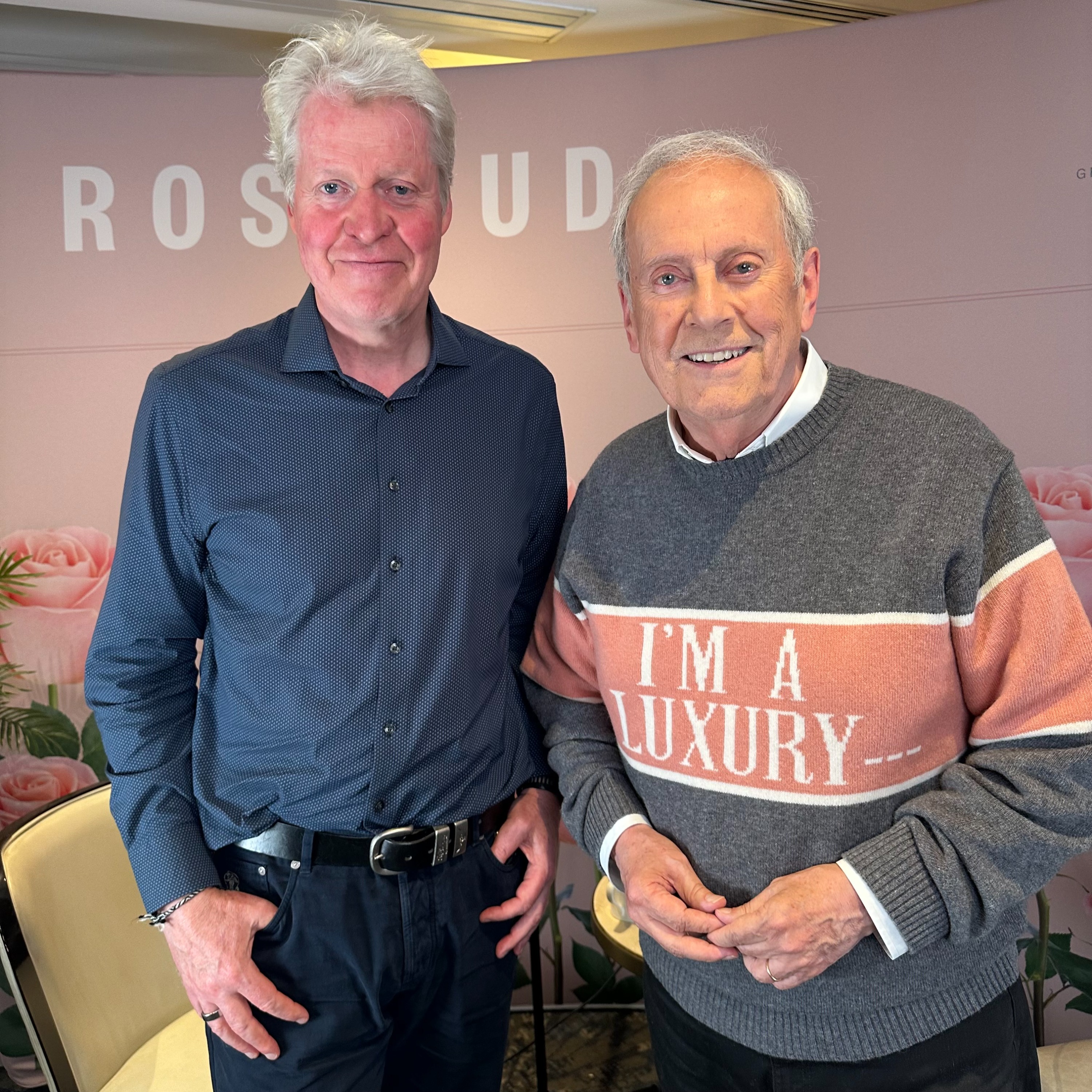
This week's guest is Charles Spencer: the writer, broadcaster, and heir to the Spencer family title and estate at Althorp, where his sister, Diana, is buried. In this unmissable conversation, Charles talks to Gyles about his childhood, the breakdown of his parents' marriage, and his mother's sudden and shocking departure from the family home. He talks about his three sisters, and his close relationship with Diana. He talks about his schooldays, and in particular his harrowing experience at Maidwell Hall prep school - this episode does include Charles's account of the corporal punishment that took place there and his own experience of serious sexual abuse by a staff member. He talks about his happier time at Eton. And finally, he talks about the eulogy he gave at Diana's funeral and the extraordinary effect it had. This is a fascinating, unflinching, and deeply moving conversation. Many thanks to Earl Spencer for being our guest on Rosebud.
Charles Spencer's book, A Very Private School, is available here
Hosted on Acast. See acast.com/privacy for more information.


