
 Ask ChatGPT



Dame Maggie Aderin (Rosebud) discusses her unlikely life journey from a difficult, divided childhood to becoming a leading space scientist and science educator, linking her memoir Star Child to her lifelong drive to study space.
Dame Doctor Maggie Aderin is a UK space scientist and long-time presenter of The Sky at Night (succeeding Patrick Moore). She received an MBE for science education, honorary degrees, served as president of the British Science Association, became chancellor of the University of Leicester in 2023, and was awarded a damehood for services to science, education, and diversity. In 2023 Mattel made a Barbie based on her.
Her parents’ separation and custody battles shaped her emotional sensitivity, adaptability, and difficulty keeping friends. She credits dyslexia/ADHD with logical strengths and hyperfocus on education. Space represents emotional escape and transcendence beyond earthly barriers.
She recounts being moved between parents across 13 schools, running away with her sister to live with her father, and making her own telescope at 14 after being inspired by Patrick Moore. She describes her “moon for mindfulness” calm, and her later career path via an instrument-building project for a major Chile telescope, leading to Sky at Night and a Zoom encounter with Queen Elizabeth II.
Written by AI. May contain mistakes.
Maggie Aderin's remarkable career and recognition in science.
“And unusually, my guest today on Rosebud is a scientist.”
Maggie shares her first memories of family and childhood experiences.
“Maggie, I'm calling you Maggie so boldly, partly because your whole name, I'm not sure I'm going to pronounce any of it right.”
Maggie discusses her mother's adventurous life and upbringing in Nigeria.
“Now look, Yuri Gagarin was born on the 9th of March.”
Insights into Maggie's father's life, their meeting, and family challenges.
“And she, I don't know if it was sort of for the same, 1961, but she met Yuri Gagarin because he came over, probably for the Trooping the Colour, actually.”
Maggie explains the cultural and class dynamics between her parents.
“And so my mother used to play this to me.”
Maggie reflects on her parents' separation and its effects on her childhood.
“Oh, 1940s, I think, because my mother's 30 years older than me.”
Maggie discusses her father's sacrifices and her feelings about gender roles.
“I think my father was teaching my mother possibly an evening class.”
Exploration of the father's focus on family over personal ambition.
“So, your father, who has become a doctor, has he?”
Maggie discusses her childhood decisions shaped by her father's expectations.
“When he left your mother, or when they parted, forgive me, he didn't leave your mother, when they split up, did he eventually find a new partner?”
Maggie's painful choices during her parents' custody disputes.
“involved because there is a dispute your parents can't amicably agree because what my father wants is to keep all four daughters together.”
Maggie reflects on her father's emphasis on education amidst family turmoil.
“And so much so, in fact, that my two elder sisters used to tell my father off because they said that I was his favourite.”
Maggie analyzes her childhood experiences and their impact on her adaptability and relationships.
“And your mother had by then a boyfriend who became a kind of stepfather to you.”
Maggie's lifelong fascination with space and the influences that sparked it.
“but their marriage starts to fall apart.”
Maggie shares how children's television like The Clangers fueled her passion for space.
“all my life I've dreamed about getting into space it's been the driving force of my I can't remember a time I didn't want to get into space.”
Explore how early inspirations shaped a desire to explore space.
“I don't remember them, but I was caught up in that buzz of excitement.”
Discuss the feeling of not belonging and the allure of space as escape.
“and wanting to be with the Clangers because you wanted to get away from this world because it was a bit of a nightmare?”
Uncover the journey of focusing on education and science despite challenges.
“And I didn't watch television for two years because I thought this is my focus.”
Discover how looking at the stars brings calm amidst personal challenges.
“which I loved because the moon was his friend, especially when he was traveling across Nigeria.”
Explore the transition to adulthood during university and travels.
“Yeah, actually, and even today, just you saying that, I can feel the calm coming over me.”
Maggie reflects on her youthful friendship and adventures with Gideon.
“This is interesting because he clearly was a really good chap.”
Maggie discusses her move to London and the emotional challenges with her father.
“So we were interrailing, and it's lovely.”
A conversation about Maggie's estrangement from her father and their eventual reconciliation.
“And so I was living in London effectively on my own and was very lonely.”
Maggie shares her journey into the world of astronomy and science communication.
“What got you into, you went to work in Chile?”
Discussion about Maggie's marriage, stability, and the impact of her past on her present.
“I think most space scientists will say, yes, there's definitely life out there because our local star is the sun, eight planets going around the sun.”
Maggie reflects on her identity, adaptability, and the duality of her personality.
“So my father, sort of friends, other people.”
Dame Maggie Aderin discusses her multifaceted identity and feelings about being a role model.
“But because I'm used to trying to fit in, I'm a chameleon.”
Gyles Brandreth thanks Dame Maggie Aderin for her insights and contributions.
“But meanwhile, I'm so glad you stopped off here for a while.”

Get the gist, explore an idea or ask about something said.
 Claude
On Rosebud with Gyles Brandreth, what are the key points of this episode?
Searching your listeningAutomatic transcript. May contain errors.
0:00Dame Maggie Aderin: Quick question, when was the last time a display ad changed your mind? Now think about the last time a friend told you about something they loved. Different feeling, right? That's how podcast advertising works. A host who's built real trust with their audience talks about your brand in their own words, in their own voice. It doesn't interrupt the experience. It's part of it. With Acast, you can access the world's largest podcast marketplace. Choose the right shows, the right audiences, the right format. Then watch the data tell you it worked. You're not buying impressions. You're buying influence.
0:33Dame Maggie Aderin: Learn more by visiting ACAST.com slash advertise.
0:40Hello, I'm Giles Brandreth, and I'm wearing a sweater today that was once worn by Diana, Princess of Wales. Yes, I designed a sweater that Diana bought in Kensington in the 1980s. On the front, it carries the words, I'm a luxury. And on the back, it says, few can afford. I like to think that rosebud is a luxury we can all afford. Welcome to it. Cue the music.
1:25Welcome to Rosebud. And unusually, my guest today on Rosebud is a scientist. I don't think we've had enough of them, but I think you will feel at the end of this one we can't get enough of this one because she is extraordinary. She is Dame Maggie Adairin and if you've come across her before it may be like me because you enjoyed the programme The Sky at Night. She's been a presenter of that for the last 10 years or so. She's succeeded Patrick Moore in that role and she's well known as a space scientist recognised as such getting an MBE for services to science education and she's had honorary degrees, awards all over the place She served as president of the British Science Association.
2:06She became chancellor of the University of Leicester in 2023 and was awarded a damehood for services to science, education and diversity. I think she tells an amusing story in this conversation about her encounter with Queen Elizabeth II. She's unusual too, because I think she's our first guest, who is also a Barbie doll. Yes, Mattel made a Barbie out of Maggie Adair in 2023 because it was unveiled as part of International Women's Day because she is a remarkable role model. But the reason I'm really interested to be talking to her today is that I have read her childhood memoir, Star Child. And really, it's her childhood that explains everything.
2:55If you're interested in what makes a human being human and how you can survive and thrive in a very challenging childhood, you will want to listen to Maggie Adairin's story. Okay, so this is Maggie Adairin on Rosebud. Enjoy and cue the music.
3:27Maggie, I'm calling you Maggie so boldly, partly because your whole name, I'm not sure I'm going to pronounce any of it right. What is your full name?
3:38Dame Maggie Aderin: Full name, full name of title is Dane Doctor Maggie Adairin. Very good. And you've got a middle name as well? Yes, Ebuluwa. Ebuluwa. And what is Ebuluwa? Where does that come from? It's Nigerian and it means, very generously, I think for my father, a gift from God. Quite right too. And Adairin? Adairin. This is the Yoruba tribe. And Adairin is a Yoruba name. Very good. And I have a question to ask you. You were born, I hope I've got this right, on the 9th of March 1968? That's correct, yes. Good. So we're virtually twins. I was born on the 8th of March, about 20 years before you. A mere 20 years.
4:14A mere 20 years. And appearances are deceptive, aren't they? Because we almost look the same age. We look as if we're both in our late 30s.
4:21Dame Maggie Aderin: No. We're both doing very well, I can just say. That is the right thing to say. Now look, Yuri Gagarin was born on the 9th of March. So I am the first person in space. Yuri Gagarin. I was thinking about Yuri Gagarin recently because I was a commentator for the Trooping the Colour. Oh, yes. Okay, which is an event that celebrates the Sovereign's birthday. And I remember the first Trooping the Colour that I attended, which was in 1961. And to my amazement, my father took me to this event. It was being broadcast to the Soviet Union. And in the commentary box was, wait for it, Yuri Gagarin. He was the commentator on Trooping the Colour in 1961.
5:06Oh my goodness. The first man in space came to London and I saw him. Woo! Yay! So you're in the presence of somebody who saw Yuri Gagarin in the flesh. Yes.
5:17Dame Maggie Aderin: I'm going to tell a bougie tale as well. Okay. because during COVID, during lockdown, I had a Zoom call with the Queen. And she, I don't know if it was sort of for the same, 1961, but she met Yuri Gagarin because he came over, probably for the Trooping the Colour, actually. And she was saying, and I said, so what was he like? And she said, Russian. Everybody just messed up laughing. She was very sharp, the Queen, wasn't she? I think that tells us everything we need to know about Yuri Gagarin. He was Russian. I know. Very good. Very much so. Well, I'm going to be dropping a few names during our conversation.
5:57Perfect. But it is going to be all about you, Maggie. And we're going to begin, as we always do, by me asking you what, Maggie Adairin, is your very first memory?
6:07Dame Maggie Aderin: My main first memory is me at about four years old. And it's just before my sister, my youngest sister was born and I remember sort of running my hair has been very excited that there was a new baby and everybody referred to it as the baby and I was excited to meet the baby and then when my sister was born at home and when she was born I ran into the living room and there she was and she was being washed in this big yellow tub and this was one of my first memories and they kept on calling her Gracie and I thought who's Gracie I don't want Gracie I want the baby and so that was one of my first memories but then i remember seeing her she wasn't very well she was born at home and was sent to hospital and seeing her as a little squirmy thing in an incubator so that was my first formative memories but in writing my memoir i had this i heard a piece of music um and it's scarlet ribbons uh sang by harry bellafontaine i think how does it go um scarlet ribbons scarlet ribbons scarlet ribbons for her hair and um and i remember that i'm hearing this as a child.
7:12Dame Maggie Aderin: So I must have been about two and a half, three years old, because it's before my sister Gracie was born. And my mother used to play it to me because I'm a total insomniac. And I can see why now I have dyslexia and ADHD. So sleep is not my friend. And so my mother used to play this to me. And I remember her being all dressed up. And I remember the smell of her perfume and just lying in bed, all sort of quiet and comfortable. And I didn't want to go to sleep because I knew if I went to sleep, she'd go away. And so I'm trying to sort of stay awake, listening to this beautiful music and I drifted off.
7:44I love that as a proper first memory it's beautiful. Tell me all about your mother what what is her name and where'd she come from what's her story and who was she when you were born?
7:54Dame Maggie Aderin: So my mother is a Carol a sort of a Carol Bissy way but was her maiden name and she had an adventurous life so she was born in Nigeria and I think her parents were quite affluent. I don't really know. I never met my grandfather on either side, actually. When would this have been? In the 1940s or late 1930s? Oh, 1940s, I think, because my mother's 30 years older than me. So 1938 should have been born. Yes, 1938. That's great. And so I think she was sort of, I think she told me she had a British governess. And so I think she was brought up with clipped accents, but in a sort of a fairly affluent.
8:34Dame Maggie Aderin: Although I don't know if it was a warm family. From what I've heard from her, they were all a little distant. But I think she met my father, I fell in love. What was his name? Oh, Justice. Justice Bayard-Adarin. Justice, as in justice? Justice. My gosh, no wonder he regarded you as a gift from God. And he was the man who didn't just administer justice. He was justice. And was he, because of that, quite a formidable figure? Oh, no, no. He was warm and wonderful. Oh, yes. Unfortunately, he passed just over 20 years ago. So how did they meet and what age were they when they met? So I think my mother was quite young.
9:16Dame Maggie Aderin: My father was a little older. I think my father was teaching my mother possibly an evening class. And I think there might have been some disapproval when they met. But I think they met and sort of ran away together. Why would there have been disapproval? Well, I think for my mother's family, a fairly affluent family, my father's uh my father's father my grandfather uh was a vicar uh in nigeria and religion is steeped in my family so my uh my grandfather was effectively a vicar uh my uh uncle became an archbishop in nigeria and i lived in a vicarage for a number of years as a child give me an archbishop is a big deal yes the uncle archbishop do you remember him oh yes he was the The main thing I remember about him is he looked just like my father.
10:02Dame Maggie Aderin: And so when I missed my father, I used to see him and he was, yes, and also a very kind and jolly man. So your grandfather was a vicar? Yes. And your father was what? Oh, so teacher. He was a teacher, which is, of course, an excellent profession, but she came from a well-to-do family and they were anxious that it might be, she might be marrying beneath her. I think so. Was there a tribal element to this? Because as we know, Nigeria, the tribal issue is important. Yes, and I don't think so. I think they both hail from the Yoruba tribe, so I don't think there were any issues there. They were both Yoruba, but they were as a class difference.
10:35Dame Maggie Aderin: I believe so, yes. So did they ever give you any indication of why? Because they ran off together. They didn't have a formal wedding. What happened? Yes, that was my understanding. And I don't know. You see, my parents split up when I was four. And so they never really spoke about their early lives and things like that. My father did say that when he first came to the UK, it was horribly cold. because he came by boat to the UK. Why did they come? Were they married by the time they came? Well, I had a younger sister. So technically, well, I'm not sure they were married. Don't think the grandpa, the vicar, would necessarily have approved.
11:13Dame Maggie Aderin: I think he was quite laid back as well, but I don't know how laid back. So your parents came over. Yes. Either separately or together. Separately, I know. Because my father came to the UK first, leaving my younger sister and my mother behind. So my oldest sister and my mother behind. So that was Sue, who was born in Nigeria. But me and my two other sisters were born in the UK. Gracie. Yeah, Gracie and Hal. So there's Sue, Hal, then me, then Gracie. So mum and Sue stay in Nigeria. Yes. Dad, Justice, comes to the UK to do what? To teach, to improve himself? To study medicine. Yes, that was his goal.
11:52Dame Maggie Aderin: He was quite a scientist. I'd like to see, if he lived in the Victorian era, he would have been a gentleman scientist because he was so inquisitive about everything. And he decided that he wanted to come to the UK and study medicine and make a name for himself that way. Have you any recollections at all of them together, of you being with them together? And what would that recollection be? So not many, because they split up when I was about, actually, Gracie was quite young. She was only about sort of, I think she was about six months to a year old when they split up. And do you know why they split up?
12:28Was it the challenge of after Gracie was born, with her not being very well, did that create tension? Did you ever talk about it with your mother?
12:36Dame Maggie Aderin: No, and I don't think it was that. I think she wanted to expand her horizons. But it was fairly, at the time, it was amicable, because my father helped set my mother up in a sweet shop in East London. I think my mother found someone else, maybe. often when people say maybe it means that's what happened but i'm good you are to be discreet about it yes and also that's not my story that's hers indeed it is her story so let's take let's get take you back your mother comes over she follows your father yes they live and you're for a while is it in islington where you are yes i'm born born at home in isling you're born home in islington and so for the first four years you're living with your parents you can't really remember the detail of that.
13:21No. You do remember Grace's arrival and you know that soon after your parents split up. Yes. We're not entirely sure why but there may have been a man in the case. Maybe. Yes. A vicar, I think. Sort of more religion. These vicars. Honestly, you can't keep a good vicar down. Grandpa the vicar approved of them running off and having children out of wedlock and then she runs off with another vicar. Oh my goodness. while uncle is the archbishop. It's a rip-roaring tale, let's put it that way. Were you brought up on the Carry On films by any chance?
14:00Dame Maggie Aderin: No, Betty, no. Actually, no, that's Frank Spencer. I don't know if I can see it. We've got the idea of it anyway. So, your father, who has become a doctor, has he? No. Oh, what happened to him? That was one of his laments in life, that he never got... So he came to the UK. My mother and elder sister came soon after. And I think because he was focused on maintaining a family. So he had another three children after my mother and sister came over. And so, yes, he was mainly working to support a family rather than studying medicine. Well done him. Yes, yes. He sacrificed his own life and career. Yes.
14:40To be a good father and homemaker.
14:42Dame Maggie Aderin: Yes. And also I think he was of the era where I think he wanted a son. And this is quite formative for me because I always decided that I was going to be the son that he never had. I was going to be as good as any boy. And so this sort of set some goals in my life. So he had four girls. Yes. When he left your mother, or when they parted, forgive me, he didn't leave your mother, when they split up, did he eventually find a new partner? No, he never did. Fine. So he never had a son as far as we know. No, no. So you had these four girls, including this very special Maggie, who one day becomes Dame Maggie and is having Zoom calls with the Queen, chatting about Yuri Gagarin.
15:21It's a weird world. I hope most of this is true. Because we have had occasionally guests. We had Harry Hill come onto this show and he invented up his whole life. Yours is sounding a little bit improbable, but I'm going along with this Vicar line that you're taking.
15:36Dame Maggie Aderin: Well, it's quite interesting because in my autobiography, I make up a piece of scientific equipment. and it's called the Retrospectroscape. And also it looks at sort of something called the multiverse. So this is the idea that every decision we make in life leads to an alternative universe. And because, as you say, I'm day Maggie, I do the sky at night and things like that. I try and look at all the decisions that led me to that possibility because it is a very, very, very unlikely journey from where I started to be where I am. And so I keep on thinking that there must be many other Maggies out there living very different lives but i'm really glad to be this one because i'm loving this one going back now to you aged four the time your parents do split up yes what is your memory of being aware that your mother and your father are no longer together that your family is not a family unit like so many others yes it's your first recollection of that so it's actually trying speaking to um official workers and saying so where who do you want to stay with your mother your father and one of the things is I was uh I still am I call myself an empath I think it's the neurodiversity but um one I recount uh one occasion where I cried because I had bread instead of toast so I'm a pretty sensitive child and so trying to choose between parents you know you're hurting someone and that was very painful but one of the decisions I made is I wanted to live with my mum because she had uh she had the sweet shop and she had access to lemon sherbets I I love lemon sherbets because it was quite a prolonged custody battle wasn't it well it went on until i was probably 15 and and but as a result i racked up many schools because sometimes i was my mom sometimes i ran away from home twice well just take this step by step the social workers are involved because there is a dispute your parents can't amicably agree because what my father wants is to keep all four daughters together.
17:38Dame Maggie Aderin: And my mother says that she wants the two elder sisters to go with my father, and she will keep myself and my younger sister. And he disputes that. Yes. And the dispute goes on and on. And my relationship with my father was very, very close. Because he said he wanted a boy. So he said, I'll be the boy. And then also people often said I looked like him. And this made me so proud. I remember actually going up and shaving my hair to try and look more like him once. Because to me, he was, I don't know, the epitome of, I don't know, knowledge and fun. And I don't know. He seemed to have a good moral compass.
18:19Dame Maggie Aderin: If I followed his advice, I'm on the right direction. So did you say to the social workers, maybe dad, who did you live with first? First, I lived with my mum. And I think as a four-year-old, I think the sweet child did play a role in that. because my mum was set up in the sweet shop. I liked Sherbet lemons and so, yes, I think that had a slight swaying to my decision. And how long were you with her? Not long because I think my father wanted this ongoing battle and I think he actually encouraged me to run away from my mother to go and live with him. And so I have one of my earliest memories is also being about four and a half years old, holding onto my younger sister's hand.
19:01Dame Maggie Aderin: This is Gracie. Gracie. And my father sort of arranging it so we sort of leave the house. I've got my Womble slippers on and I'm in my pyjamas and I'm outside hiding behind a bush. And then my father and my two elder sisters are talking to my mum. And we get, oops, we go into the car with my dad and he takes us over to his place. He was very determined to keep us all together. And you stayed then for a while with him. Yes. But your mother succeeded in having you brought back to her. Yes. And so that was quite a few years later. So you stayed with him for quite a while. Yes. So here you are with your father.
19:37Are you feeling more at ease with your dad than your mum as you're moving between the two?
19:41Dame Maggie Aderin: Yes. I think when I wasn't with my father, I missed him horribly. And I did miss my mum. And I got to know my mum a bit better. But my father was, I don't, it's like the relationship I have with my daughter. We were very, very close. And so much so, in fact, that my two elder sisters used to tell my father off because they said that I was his favourite. and they didn't like that so so my yes and so my father was the natural place for me to be because he inspired me in so he used to teach me how to think and we'd watch tv or something like that and he'd say so why are they doing that or what's behind that and so just set scenarios where he'd ask questions and i'm a very curious person as well in fact i think my father was probably dyslexic or neurodiverse anyway and so we were kindred spirits in that way but he taught me how to think and I can't think of a better gift.
20:31Yes, he's clearly the hero in your life story. But tell me about the sweetest recollection you have of your mother. What's the nicest time you can remember having with her?
20:40Dame Maggie Aderin: I remember, yes, her in the sweet shop. Because she was like a conductor. There's a wonderful author, Joanne Harris. Joanne. Yes. We have her in common as well, of course. So I've met her a few times and she wrote the wonderful book Chocola. Of course. Yes. And the woman in that, she reminded me very much of my mother. sort of a free spirit and in the sweet shop my mother would conjure up you know some images you know in the shop window sort of displays really to entice people in and i remember so she could create magic in all sorts of different ways in your head have you worked out ever what it was that made each of your parents so determined to continue this battle over the custody of the children for so many years no it's funny because now i i'm a mother myself i have a 16 year old daughter and so no I don't think I fully understand it uh and seeing my father's wish to keep the four girls together and also I think when my father came to the UK he saw the UK as quite a hostile place because this was sort of late 50s early 60s and there were signs so no blacks no dogs no Irish and I think he felt that he was bringing out four daughters and how are they going to survive and maybe even thrive?
21:57Dame Maggie Aderin: And I think he saw education as the key. And to a certain extent, I think one of the reasons he wanted to keep us together was we could help each other, but also he wanted to make sure we got a good education. And so this was drummed into me. When I was, I don't know, five, six years old, my father would say, so what Oxbridge College are you going to go to? So right from the get-go, education was everything. And I think it's many immigrants, but especially many Nigerians, they see education as the key to success. And your mother had by then a boyfriend who became a kind of stepfather to you. Yes.
22:30Dame Maggie Aderin: And so the vicar, which I think she ran off for, a lovely guy called Barry, he was, they had moved into a vicarage in Hastings. And the problem is my father, my father's health was deteriorating because the concert, so he was sort of three kids, three daughters in boarding schools. and then my my younger sister when she came back from Nigeria she was staying I suppose with a foster family uh in um in Chinna in uh Oxfordshire and so he was just trying to support us all but um uh I had a conversation with my elder sisters and they were saying you know dad this is hard on dad and and he was suffering mentally and physically as well uh so I think physically he was surviving but you could tell he'd come home and thinks I loved his company so much and sometimes i'd go and sort of he'd lie on the sofa and i'll go and lie next to him i could hear his heartbeat and that was my happy place that's where i felt okay i i'm content here this is where i want to be but then my sisters pointed out that you know he was working hard he was coming home he needed his rest he didn't need little maggie sort of snuggling up to him so i stopped doing that after a while you went to how many schools but during this yes moving yes You're like a ping pong between your parents.
23:45Dame Maggie Aderin: So I've backed up 13 in the end. 13. I didn't realise. So analysing it, what do you think the effect on you now has been of this strange childhood between two parents, warring parents, 13 schools, different beds? Yes. What's the effect been on you? So looking on the positive side, the glass half full, I think it makes me very adaptable. Some of the boarding schools, some of the schools I went to were the local comprehensive, but some of the boarding schools I went to were sort of top class. You did an interview with India Hicks. She was at one of my boarding schools, Lord Mount Button's granddaughter.
24:30Dame Maggie Aderin: And so, yes, there was a wide variety of, and so it makes me feel that I can fit in anywhere. I feel at home in any situation. So I love that. but it also makes me very transitory and also I'm not good at making and keeping friends I'm an intense burst of energy but then I don't know how to maintain that and that makes me very sad because I meet lovely people and I don't really know how to keep in contact with them and also maybe you're frightened to establish a relationship in case it suddenly disappears as it's taken away from you. I think that is definitely the case. And so there's a few people in my life who are critically important to me, but everybody else, yes, I think it is a fearful, a fearful extending that.
25:19So it's all resolved though, one way or another, by the time you're 14 or 15?
25:24Dame Maggie Aderin: Yes. And how is it resolved? What happens? So I'm living in the vicarage with my mum and my younger sister and Barry, the vicar, but their marriage starts to fall apart. and and so I think for I suppose the two two and a half years that we were living in the Vicarage I think that would be the closest that I was to a normal childhood I did manage to rack up two schools while I was there one school just closed I didn't touch it but it just closed down which helped boost my numbers but yeah well I was living a sort of fairly normal life living at home with my mum and Barry and and Gracie but then their marriage started to implode literally and it was getting worse and worse and so my mother was going to leave the vicarage and she was going to leave and move out to the countryside I was just coming up to my GCSEs and in the back of my mind there was always oh you should be working harder because education is the key to you know social mobility everything and so living in this environment I felt that my education wasn't going to thrive also my younger sister Gracie her education wasn't thriving and my father gave us the opportunity to go and live with him and so as my mother's marriage was imploding we ran away again and so 14 now sort of very much cognizant of what I was doing but I left my mother and went and lived with my father and again the hurt I caused my mother by doing that still lives with me today yes you feel you deserted her in a time of need yes I do and um but then uh but see for me this was an opportunity and I always say that um yeah I try and grab opportunities with both hands because by the time I got so this was my final school my 13th school I got there and this was a school in sort of Camden in London but they had no record of me at all because well I've been so many different schools they didn't have anything and so they said oh Maggie um what stream should you be in your top stream middle stream lower stream now all my life with the dyslexia which I didn't know I had and sort of being a black kid I was always at the back of the class and so but I thought this is my chance you know if I was going to get an education this was it so I said I should be in the top stream and so they put me in the top stream and as with ADHD and dyslexia you know sometimes get hyper fixations and so education became my hyper fixation all my life I've dreamed about getting into space it's been the driving force of my I can't remember a time I didn't want to get into space.
27:54You can't remember a time, so you're not going to be able to answer the question when was the first time you thought about space because it's always been there.
28:00Dame Maggie Aderin: Yes, I can see the influences. So going back, I was born in 1968. 1969, the moon landings happened. I don't remember them, but I was caught up in that buzz of excitement. And later on I heard about people like Yurik Agarin going out there into space and it's like, whoa! And then The Clangers. I used to watch The Clangers. The television series? Yes. So little mousy creatures. I remember them. I can picture them with pointy noses with pointy noses living out on a planet out there Peter Furman Oliver Postgate I knew them both did you? of course I did of course I did out of all the people you've mentioned they're real heroes for you yes because the Clangers were just so beautiful and just so sweet and so I used to watch them oh they live in space I want to go into space so the moon landings the Clangers and it's funny I always say the Clangers are a gateway drug because you start watching Clangers and before you know it you're watching Star Trek again.
29:21We're Acast, and we put them right in front of you. Browse thousands of the world's leading podcasts, book host reads or run your own ads, and track every conversion in real time. Same skills you already have, brand new results. Acast. Acast.com slash advertise.
29:43And were you looking out into space and wanting to be with the Clangers because you wanted to get away from this world because it was a bit of a nightmare? And is, I mean, I... Yeah, I think that's...
29:55Dame Maggie Aderin: Because to me, space represented something that transcended. Earth seems like a troublesome place, especially for an emotional child. And so space, what I loved is that space, growing up I didn't feel I belonged anywhere um I would um speak to my relatives that came from Nigeria and I said Maggie you're a lost Nigerian you don't speak the language you're quite British really you're not really a Nigerian you've never been there and so I felt oh I don't belong that into that camp but this is the 1970s growing up and so um sometimes I'd go to school and people say why don't you go back home so I didn't belong in that camp but when you're in space you transcend all of that you just see our planet you don't see countries you don't see barriers you just see our glorious planet that appealed were you conscious of happiness and unhappiness as a child or you're just living through this and there was unhappiness there because i missed my sisters but i think sometimes maybe the retrospective scope needs finer tuning because sometimes i gloss over the unhappiness and that's one of the things writing the memoir suddenly there were emotions which have been buried for a long time and they came to the four and they overwhelmed me for a while it was quite quite terrifying age 13 or 14 is that when you had your first crush um i suppose there were crushes um but nothing came nothing much came of them and i had a a very big fear of boys um boys were more likely to call me names in the playground how interesting yes and so boys sort of i i steered well clear of them i mean racist epithets or misogynist.
31:38A combination.
31:40Dame Maggie Aderin: Charming, yes. Mix and match. Young men at their best, both racist and misogynist. Choose your slug. Dearly me. And this wasn't for all boys. And also from the age of, I suppose, about seven, when I went to my first boarding school, it was mainly girls' schools. And it's quite interesting because girls do better at science in girls' schools than in mixed schools. So I think that might be partly why I became a scientist or, yes, went in that direction. But yes. Now, I asked about the crushes of this period only because all the domestic problems at your home, the moon is out there, but at least a beautiful boy or girl across the classroom you can focus on.
32:21But that wasn't the case with you.
32:23Dame Maggie Aderin: No, and also I think partly, I heard a wonderful story about Ada Lovelace. So Ada Lovelace was the first computer scientist. Yes, a wonderful woman. Famously the daughter of somebody interesting. Lord Byron. And she was steered into logical pursuits by her mother because she wanted her to be very, very different from Lord Byron. And I think it might be the same with my father. He almost wanted to shut down anything because I think my mother had run off with a vicar. I think he wanted to shut down anything like that. And that wasn't almost godly. So your focus was entirely on your work and your dream was out there in the great beyond.
33:05Yes. And how does that turn into a reality?
33:08Dame Maggie Aderin: Ooh. So I think the reality started with going to this school, my 13th school. I make the decision that I want to be in the top stream because if I'm going to try and get into space, this is the opportunity. And so I take that opportunity. And I didn't watch television for two years because I thought this is my focus. And yeah, I do get hyperfixations and education became my hyperfixation. and so rest assured you are now my new hyperfixation i am definitely weird fascinating weird but wonderful keep going thank you and so yes and so i focus on education especially the sciences because i knew it's science that got people into space and also as i was undiagnosed with dyslexia but dyslexia gives me all sorts of skills so yes reading and writing especially when you first get to school those are the things you find really hard as a dyslexic i didn't know i was dyslexic I just thought I was dumb but as a dyslexic I'm very logical I'm really curious and all these things make me a better scientist so going and sort of studying science which would lead me to space made a lot of sense no logic of it at the time but that's where I pursued.
34:18Did you tell any of your teachers this was your ambition?
34:20Dame Maggie Aderin: I did mention to a teacher when I was much younger when I was about seven years old at one of the boarding schools one day I want to go into space I'd love to be a space scientist or something like that. I don't think I knew what a space scientist was, but yeah, I went to study space. And the teacher said, oh, Maggie, that's a lovely idea, but why don't you go into nursing? That's quite scientific. And the thing is, it can crush someone's dreams. But I'm the sort that I'm stubborn. So when someone says that to me, I think, oh, well, why can't I be a space scientist? And did you have a telescope by that stage of your own?
34:48Dame Maggie Aderin: So a telescope, when I was actually 14, 15, this is where I started to make my own telescope and inspired by Sir Patrick Moore. Who was then presenting The Sky at Night and had done from the beginning. Yes, so he did it for 57 years. Wonderful. I'm not going to make that. I don't see why not. Amazing advances in medical science will be needed. But I used to watch The Sky at Night and got permission to stay up and watch it because he would tell us the wonders of what was out there. And he'd also say, of course, with a telescope, you can see this. Oh, a telescope. I'd love to get a telescope. and I'm living in inner city London it's not the best place for a telescope but I sort of bought one and I think from Argos they do much better ones now it was a little plastic telescope we were living in a cancel flat at the time my father was losing his sight I think because of the pressures and so when because of the pressures or depression?
35:44Dame Maggie Aderin: oh no well the pressures of working yes and keeping four kids in and so he started losing he got glaucoma and so he was losing his sight so I sort of became the carer so it was my father Gracie and I living in this council flat and so we couldn't afford very much because we were living on of his benefits uh but yeah I bought this telescope and it had plastic lenses and it just it wasn't a very good telescope but I was flicking through a magazine and I saw something that said a telescope making class with telescope making class you can make a telescope and so I went along to the class and my recollection was coming into the class and looking around and I thought the average age of everybody in there because everybody was white male and I thought the average age was 50.
36:29Dame Maggie Aderin: This was from a 14 year old perspective. I think they were probably in their early 30s. To me they were all grandparents. So I went in and I found out recently that I had to get special permission to join this adult education class because it's an adult education class and I was still in school and I was 14 and I was unaccompanied because my father couldn't join me because of his site. I had to get special permission from the school and also from my father so I could join this telescope making class. But I went and I sort of ground and polished my own telescope mirror. And then you looked up at the sky.
37:01Dame Maggie Aderin: It took a few years. But yes. So I was, my father described himself as a self-certified lunatic, which I loved because the moon was his friend, especially when he was traveling across Nigeria. Because he was cycling across Nigeria, the streets were unmetalled and no streetlights. And so when the moon was up, it was his friend. And also growing up in London, you don't see many stars, but you can see the moon. So you have this first telescope. You're looking up at the stars. You have this complicated family, but you're doing well at school. By now, yes. And so I went to my final school just as we were starting GCSEs.
37:40Dame Maggie Aderin: So I had the two years of GCSEs and I focused on nothing else. no tv no fun a bit of telescope making it side but it was education and you get good a levels um a levels yes i got bougie and i got a bit sort of yeah cocky and i did four a levels so i did physics chemistry biology and maths which is a bit of a mouthful and i got a d in a level physics but um but physics was the subject i loved the most because physics is the study of everything in the universe from the tiniest particles to the whole of the cosmos and everything in between so I wanted to do physics and so I applied to Imperial College and I got a D but they let me in I snuck in the back door so my education was doing fine but the dyslexia I think was playing its part and so I was finding things hard but because I didn't know I was dyslexic I used to beat myself up you know everybody else can do it you should be working harder obviously you're not trying hard enough.
38:32Were you as a teenager the delightful person you are now but a teenager or were you a bit of an oddity?
38:40Dame Maggie Aderin: I think I was definitely an oddity. And looking at my background, so I was living at home. For the first two years of university, I was living at home. With dad still? With dad, yes, because he had lost his sight by then. So I was effectively the carer. But living at home and I saw university as an opportunity and I spent the first two years living at home. But by the third year, I decided if I don't, I'm going to continue being an oddity. And the oddity will continue into my later life if I don't get out into the world. Did you have friends in a normal way? Yes. Did they think you were a bit strange?
39:17Dame Maggie Aderin: I just chose strange friends. I was a fellow nerds, I guess. People who were, I suppose, into education. And so we were like-minded creatures. and um and i suppose uh with the still in a very strong religious environment at home saying prayers every night things like that and so yes uh but yeah my third year in university i think i decided that it's time to grow up really yes because the manic energy that you have now you have managed to make it a social asset you are an enchantment an adornment to the world and you are the public intellectual and we all love that. But I'm thinking that as a teenager, it's a much more intense thing.
40:05Dame Maggie Aderin: Yes. There is this caring for your father. There's the guilt over your mother. There is absolute determination to fulfil this educational goal. Also, you've got these personal challenges. And so is there the laughter and the gaiety that we see now? Probably not. I remember, actually, when you say that, I remember my biology teacher. I think at A-level. And I don't know what happened, but he said, even Maggie's, or even Margaret, because they used to call me Margaret, it's called, even Margaret's laughing. I was like, what does that mean? So I think I was, I was, so it's focused, determined, probably very weird.
40:44And did you feel when you looked up at the stars, an ease, a peace, this is my world?
40:51Dame Maggie Aderin: Yeah, actually, and even today, just you saying that, I can feel the calm coming over me. Because there is something. And yes, as you say, I have a manic energy. Let's put it that way. But when I look up, it just calms me down. I use the moon for mindfulness. Because when I look at the moon, it just, oh, yeah, it's all okay. We had a conversation on Rosebud with the astronomer Royal. Oh, yes. And it was clear that he was at his happiest alone looking up. Oh, yes. I can understand that. And that's when you found your peace. Yes. but you were determined to keep going when did you become do you think grown up what made you become grown up was it when you were imperial college or later so i think it started when i was at imperial and i was living at home for the first two years and because that's the good old days where you got a full because i'm living a cancer fact you got a full grant and sort of living expenses on top but because my father was in london and i went to imperial i had to stay at home for the first two years but I decided a third year and it started because I went on an interrailing trip yeah alone or with a friend with a friend oh a lovely friend Gideon a boyfriend oh no a male friend a male friend no but I meant a boy who was a friend yes Gideon I've kept his book in my side drawer for years oh no it's me in my Gideon bible exactly I love that idea but yes Gideon was a friend he was my lab partner and the thing is I didn't know I still don't but know how to approach boys or interact with boys but Gideon was my lab partner and he was a lovely lovely chap sorry we came up with this crazy idea we wanted to see the world we came up with this crazy idea that we would set up an adventure where we'd go to the Amazon and would do sort of experiments because and we could get funding for that and so we started putting a group together and we realized that we were the least qualified people to go to the Amazon because we're physicists biologies students go to the Amazon but and so we slowly got surely moved out of our own So as a downside, we went intervailing and we sort of travelled through Europe together and sort of lived off biscuits.
42:59Is Gideon still a friend of yours?
43:01Dame Maggie Aderin: No, because I'm not very good at that. This is interesting because he clearly was a really good chap. He really is. I'm sure he still is. I'm sure he still is. But he was your proper partner. He was. He enjoyed working with you and he enjoyed travelling with you and you shared interests. Yes, even though my weirdities, yes. Yes, and he coped with your weirdities. There was never any complication. No. No, you never put a hand on your knee. No. No. Well, no, we did go out for a while. Oh. So, briefly, the Bunsen burner that was Gideon dropped into life. What happened? You went out, but you didn't stay in, did you?
43:36Dame Maggie Aderin: So we went interrailing together as good friends. There we are. And there was some funny challenge. I jumped off a moving train. For what reason? So we were interrailing, and it's lovely. We were definitely in a deck class. the low with the low and I was on a moving train coming back from Spain heading home actually and I was disappointed because I'd loved being the freedom of being out there and we're heading home and I managed to tuck my passport in between two seats and then I thought I'll go and just nip to the loo so I just had my money belt around my waist went down to the loo and this train was coming from Spain and I went to the first loo I mean you couldn't breathe so I shut the door and move further down the train.
44:16Dame Maggie Aderin: And then I realised that for some reason I'd gone too far down. And I thought, what I'll do is I'll just nip off the train at the next station, run up the platform, hop back on, bish, bash, bosh. So as the train slowed down, I thought, I was surrounded by a few people who were looking at my money belt a little suspiciously. So I thought, I'll just leap off now. Train was moving faster than I realised. So I leapt off, sort of rolled a bit, cloud of dust, picked myself up and saw the train disappear. Didn't stop. and you know that moment of no this is no my dad's gonna kill me that was the main thought so anyway the train went off i had a number of adventures but was able to eventually to join him in paris but all this time we weren't actually going out and it wasn't until when i got back from that the independence just felt wonderful and so i decided i was going to move out of home and sorry it's still quite emotional um that estranged me from my father he didn't oh you were abandoning him now yes having let your mother down by now just to do the hat trick if i may say so your poor blind papa i'm sorry the carer yes he is the hero of our story he's He's given you everything.
45:33He's given you your focus, your love of learning. He's explained to you what thinking is all about. And now you're not just looking at the stars. You're reaching out for the stars and saying, well, sorry, Dad.
45:44Dame Maggie Aderin: But the thing is, I was living in London. Of course. And by then you're nearly 20, aren't you? Yes. It's time to grow up. You had to leave him. Don't feel bad about it. You had to leave him. And then you moved into the arms of Gideon, did you? Well, yes. So I happened to move into a flat, because I didn't know anyone really. So I happened to move in a flat where Gideon was living, sort of below. And so I moved in there and then we became a couple. So how long did Gideon last? So probably about two years. Oh, it was a problem. It was, yes. But the problem is, so we finished our degrees, but then he did his PhD up in Leeds.
46:20Dame Maggie Aderin: And I was still in London because I stayed for my degree and PhD at Imperial. So I was at Imperial seven years. And so he went up to Leeds. And so it was a long distance relationship. And fundamentally, when I left my father's house, I was so lonely because he was my linchpin. And not only was he not happy that I left, he sort of, you know, don't darken my doorstep again. Very sort of Nigerian sort of drama. And so I was living in London effectively on my own and was very lonely. How long after were you and your father reconciled? How long did that take for you to get together with him again? Probably two or three years of total disengagement and then slowly but surely.
47:03Although the problem was it was never quite the same. Really, even to the end? Yes. Even to when he died?
47:10Dame Maggie Aderin: Yes. Well, I suppose he was such an important person in my life. And the fact that I could be told, don't darken my doorstep again, it put up barriers. and so of course he was my lovely wonderful father although his health was degrading and maybe his mind he was getting very paranoid about things and so he was finding life hard as well yeah no he was the most important person in your life from sitting here yes and of course his challenge that's why he had the problems with your mother he was a very much you know it's either there or there my way or the highway exactly yes and i've seen that with my two elder sisters because slowly but surely they got estranged for him.
47:54Dame Maggie Aderin: And it's funny because you see it happening and you think, oh, well, Sue must have done something wrong or Hal must have done something wrong. But when it happens to you, you think, oh, oh, okay. And it makes you think of those things in a different light. Well, really, this conversation is about what made you the person you are and we're discovering that beautifully. So we can't really touch on your career. But just give us a couple of tastes of it. What got you into, you went to work in Chile? Oh, yes. That was exciting. That's the sort of step that takes you from academia in Britain to being just in a nutshell, I'll give you that.
48:25Dame Maggie Aderin: When I left university, I wanted to, space and astronomy was where it's at, space science especially. But my first job, I didn't even apply to space jobs because I had no experience. And so I was working for the MAD and various other things. But then I got an opportunity to work on a project at UCL, so in London, but it was building an instrument for a big telescope in Chile. And Patrick helped. So Patrick Moore, because I'd made my... So Patrick Moore, you made in touch with him by then? No, no, I'd never met him. But the fact that I'd made my own telescope, oh, OK, you did that when you were 14.
48:57Dame Maggie Aderin: So it was a good link to get into astronomy and space because I was that way inclined. And so I got the opportunity to make an instrument that went on a telescope in Chile, managing a team of about 17 people, all working together to make this instrument. And then I got to ship it out to Chile and work on one of the largest telescopes in the world, which was glorious. And how then did you find yourself doing Sky at Night? So I appeared on the Sky at Night a few times, but I'd never met Patrick. Chris Lintock, my co-presenter on Sky at Night, a lovely chap, met him a number of times, but never met Patrick.
49:29Dame Maggie Aderin: And then when Patrick Moore passed away, there was talk at the BBC of getting rid of the Sky at Night. And I was told that they never had as many letters of complaints. You can't get rid of our Sky at Night, which was wonderful. And I put my name forward. I said I'm working in science communication by this time I'd done some children's television I was working in science communication done a little tv mainly news programs and so I thought this might be a wonderful opportunity I love the sky at night so it would be a be a true honor to if it was going to continue I'd love to be part of it and I heard nothing so I thought okay you know some crazy dreams my father always said always used to say this or something better will come along and I didn't hear anything and then one day I was filming for the children's program I did and they phoned down and said yeah would you still be interested to write but it was terrifying at the same time because he was so iconic and you sort of you know it's obviously Patrick Moore and then hello it's me I used to think he was eccentric but now I've met you ah yes a chip off the old block you look up at the heavens you see amazing things up there is it all science for you or is there romance and magic and dreams are there people out there oh so it's definitely romance and magic and dreams uh and i think it's but the science just augments that because i i see it and it looks beautiful and it makes my heart sing to see it but then i can understand what's behind it and that's what i love to share with people look at it it's amazing this is glorious we are part of this and let me explain you some of the things that are happening we know so little but i can explain some of it so yes the magic is definitely there and it just makes my heart sing to see it is there a potential of life yes possibly we might know it yes and to me i love the history of astronomy and so there is a study called archaeoastronomy and it's looking at the different cultures of the world and everybody has looked up at the night sky and wondered and but we have a lot of hubris we thought you know we're the center of the universe you know oh no the sun is oh no our sun is one of 300 billion stars in our galaxy.
51:35Dame Maggie Aderin: And to me, it's a numbers game. I think most space scientists will say, yes, there's definitely life out there because our local star is the sun, eight planets going around the sun. The stars we see in the night sky have planets going around them too. And we're able to detect them using sort of wily methods. But now that's just our galaxy, the Milky Way, 300 billion stars. In the whole of the universe, the Hubble Space Telescope taught us there are maybe two, three, 400 billion galaxies. Why would life just occur here? Again, it's human hubris. We're the centre of everything. So I definitely think there's life out there.
52:08Dame Maggie Aderin: But the distances in space are vast. And so going from one star to the next door neighbour star, our next door neighbour star is Proxima Centauri, 40 trillion kilometres away. Using current technology will take 76 ,000 years to get there. But I don't care, I'm going. When did you become a normal person? No, because... I'm working on it. No, this unusual childhood, this focus on your work, this achievement all of that i can see the different challenges with your two parents but you're clearly a very normal person is your husband part and parcel of that when did you meet him and how did you meet him oh so i met him at university so both studying for our phd what's he called martin we recently broke up unfortunately oh that's still part of the story we've been married we were married 23 years that's not bad but yes it's very good going and you've got a beautiful daughter.
53:00Dame Maggie Aderin: She's the light of my life. Yes. What did you get from your husband though? Stability, I think. Because, yes, too much was child. And it's funny because I sort of pushed, I'm revisiting that now. I pushed it all to one side. I didn't talk about my childhood. I didn't talk about any of that. Nobody who knew me or was a friend of mine from university onwards knew anything about this. I don't know if I was embarrassed by it. I don't think so. It was just a part of me that was in the past. And that's why it's been interesting revisiting it. But, yes, I suppose to me... Are you quite enjoying being on your own again?
53:37Are you on your own now?
53:38Dame Maggie Aderin: Yeah, with Laurie, with my daughter. Yeah. But, yes, I think there's an independence again. Which you're liking. I am.
53:58Dame Maggie Aderin: When she said I don't dance now, I make money moves. That was a mission statement for a whole new generation. Respect, but that's not the Mount Rushmore. Listen, cash rules everything around me. When that line dropped, it changed the whole hustle. The greatest tracks are never finished. They're just debated forever. Introducing the Sprite Living Trackless, 50 tracks that shaped the culture from six decades of hip hop. Scan the QR code on a Sprite or Sprite Zero Sugar to see the full breakdown. Now obey your thirst. Sprite. Here's a tip for you. There's a podcast out there with fans waiting to be your next customer.
54:33They tune in every week. They trust the host. And that host wants to talk about brands like yours in their own words to their audience. The problem is you just haven't been introduced yet. We're Acast, where that introduction happens. As the world's largest podcast marketplace, we let you browse shows, see who's listening, and book host-read sponsorships or run your own ads all from one platform. Transparent pricing, real-time data, complete control. Start advertising on podcasts by visiting acast.com slash advertise.
55:10But you did also for those 23 years, you liked the stability of a normal family life.
55:18Dame Maggie Aderin: Yes. That you never had as a girl. Yes. And suddenly with this good man. Yes. father of your daughter you had some very good years we did and some enjoyable years and some travel and an adventure but it's again people sort of sometimes grow gradually i think i grow in leaps and and i think also i think one of the things you asked me earlier about um the influence of my tumultuous childhood, I think I adapt to other people what they need. So my father, sort of friends, other people. And I think one of the reasons my friendships are transitory is because I can't maintain that. That's not me. But because I'm used to trying to fit in, I'm a chameleon.
56:06Dame Maggie Aderin: But sometimes I don't know my true colours, if you see what I mean. And I can do it for a while and I can be the person they almost need me to be. but when I it's like a rubber band snapping what is the true you if we were we're meeting for the first time I said who are you Maggie just in a nutshell in a sentence or two describe yourself to me so there's the facade Maggie which is the comic and I'm always having a laugh and I just want things to be jolly and happy I want everybody to be happy I also I think I need I like everybody to like me so i adapt for that but the inner maggie i think it's more thoughtful probably quieter uh a little less manic uh but but i suppose head in the clouds um a dreamer a dreamer who believes in magic which is odd for a scientist but you also like the company of intellectual people you want to be with clever people?
57:05Dame Maggie Aderin: I like stimming. Actually, I like being with people, but in a confined, I love, this has been brilliant for me, speaking to you, thinking. It just fires up all the neurons. I love that. And so I like that. But I always feel that after a while, people will get bored of the real Maggie. And so, or bored of the facade Maggie as well. Yeah, yeah. And so it's lovely. And we have this moment, and then I move on. Well, one of the things that's exciting about me meeting you is you're the first since i met barbie and ken the people actually knew i have met the original barbie and ken oh my goodness uh you are the first barbie i have met since meeting the original barbie because there is a barbie doll of you isn't there maggie there is a scientist yes when did that happen it's rather lovely it was actually it was very um timely because it was 2023, the year of the Barbie movie.
58:02Dame Maggie Aderin: And every year, Mattel, the people who make the Barbie doll, will choose six women from around the world who they see as role models and make them into Barbie dolls. And it's funny because role model is a bit of a double-edged sword for me because I know I'm like, I'm often late for things. I'm incredibly untidy. So in my mind, I feel I can't be a role model. But now I'm realising that actually being untidy and going into a school with jam down my front and makes me more accessible they think oh she can do it then maybe so can I and so and so they made they made a Barbie doll of me and I must admit I was a bit terrified because my daughter took photographs of me we sent them out to Mattel in California and they made the doll and then they were going to do the big reveal show me my Barbie and I was thinking and the cameras and things like that I said what if I don't like it you know what it doesn't look like me I was quite apprehensive about it but they whipped the blanket off and And there was my Barbie doll.
58:56Dame Maggie Aderin: And I thought, it does look like me, but it looks like me on a really good day. Yay. And I think that's how a Barbie doll should look. I feel I've caught you on a really good day. I think you're brilliant. People who haven't read your childhood memories. That's what it's called, isn't it? Childhood memories. Star Child. Star Child, it's called. Yes. Star Child. That was Albert. That, yes. We have a publisher in common as well. I mean, we are virtually related. We are. Yeah. All right. We're getting to the end now. A moment of joy from those earlier years. A moment of joy, sheer joy. Yes. Looking back, my sister Gracie, we used to have fun because we used to do plays.
59:39Dame Maggie Aderin: And she'd be Princess Gracie and I'd be everybody else. And so I just loved doing the different characters. And so we just had made up adventures because we're often sitting in the back of a car. We were stuck in a flat in London where five of us were living in a bedsit. But we'd make up adventures which would take us away from things. And so I love that. And I miss it to a certain extent. And a moment of sadness. When my father passed away, he didn't have any plans. He didn't have any money. And so I went into project manager mode. And I had to work out that Gracie could stay in the cancer flat they were in.
1:00:19Dame Maggie Aderin: I had to work out the funeral because my father was a little estranged with my sisters I felt that I should take this on so I took it all on and found a burial site and things like that and I did all of that and then and then Gracie got ill and was having some challenges so she went to hospital so I was tackling that as well but then about a year later I remember waking up one morning and howling I mean gut-wrenching howls at the loss of my father because while I was focused on project management mode and yes okay Gracie you're flat I've got to go it was lovely because of those it's not like looking after Gracie it's a distraction from the reality but then when I realized I just howled for I don't know a day at the loss of my father because he as I say was my linchpin he he gave me the aspiration to think big and think crazy and he was gone and I and towards the end of his life I don't think he was very happy and I wish I'd done more to make him happy in that period so I think there was partly loss that way but yes and I hadn't realized how built up it was but there was that with release professionally you can be very proud of your achievements in terms of the public engagement and particularly the young people introducing them to science and space and particularly young women which is fantastic personally what is your proudest moment ah see it's hard for a moment the thing i'm proudest of in my life is my daughter and it sounds a bit cliched but i find her amazing and this is my life I do, I hyper focus on people.
1:02:05Dame Maggie Aderin: And she brings a smile to my face. And what I've loved, sorry, it's not a moment at all, but it's her life because at each stage she's been different. She evolves. My prime example is when she had her 13th birthday to celebrate, she was really into Hello Kitty. She has hyperfixations too. And so we went down to the Hello Kitty cafe in Brighton and yet she had little cakes and we had a lovely time by her 14th birthday she was into South Park and this is the other cartoon where everybody swears and things like that so this shift of perspective but I loved that journey and with that journey I sort of I follow her so yes South Park I don't like South Park oh actually it's quite interesting and so she gives me a different perspective on my life a similar way to my to what my father did so yes one of the things I've learned from our conversation is that the things that you talk about like adhd dyslexia uh hyper hyper fixations are things that may be challenges but also have been part of your success very much so and and it's funny because i didn't i i often think i'm weird i call them maggie isms because other people don't do this but i do but i think you can use them to your advantage and they don't have to be negative and there is negatives with the adhd and the dyslexia but i don't think they have to be the end of the story so many positive things and what i've learned is to know myself um there are some things that i'm good at there are some things i am foul out but then work out that and get support in those or work in teams where someone else is really good at that and it's taken me nearly 60 years to get here but now i'm realizing that yes work your strengths and know your weaknesses and then thrive we see your strengths in front of us so the last question is quite simply this what have you learned what has life taught you this extraordinary life that you've achieved i think that one of the things we do in our lives is we self-limit we have big crazy dreams think oh no i can't do that i say blow that i am literally reaching for the stars, metaphorically, but physically as well.
1:04:21Dame Maggie Aderin: And the stars are like a star 40 trillion kilometres away. I still want to get there. It's crazy. I don't know how I'm going to do it, but I have that dream. And by having that dream, I may never get there. It's a retirement plan. I may never get there, but just by having the dream has enabled me to do things I would have never thought possible. So I say think big and think crazy. I think you may well get there. But meanwhile, I'm so glad you stopped off here for a while. You're absolutely brilliant. Dame Maggie Adairin, thank you for joining us on Rosebud. Thank you so much.
1:04:55Well, I found that completely fascinating. My thanks to Dame Maggie. It's wonderful to have a scientist on Rosebud. We don't have enough. I do remember we had the Astronomer Royal a year or so ago, but we need more scientists on Rosebud. I think the problem is it's not something I know a great deal about, but I love to meet a brilliant scientist like them, Maggie, because I learn a great deal, and it makes you look at life in a different way. So if there are scientists you feel we should be inviting to be guests on Rosebud, do get in touch. You know where we are. It's quite simply hello at rosebudpodcast.com.
1:05:36That's where you will find us, and that's where people send us emails. In fact, Harriet Jane, our producer, has found this email that she wants me to share with you. It's from Carrie Lawrenson, who is one of our listeners, I think it's fair to say, of riper years now. And I'm going to read the email, though it seems a bit unseasonal, because we're still, as far as I'm concerned, in summer. But this is a recollection of Christmases, Christmases past. Carrie writes, most of our Christmases when I was a child were spent with my grandparents in Colchester. They were cousins, aunts and uncles, so it was always a jolly affair.
1:06:18One of my aunts, Aunty Peggy, was very religious, although even as a child we knew it was because she had a thing for George, the unmarried vicar. Every now and then George would come to tea with his thick-lensed spectacles and food-spattered jacket. We would hide behind the curtains listening for something outrageous without knowing what it would be. I was about ten and my sister was seven, so it was 1952. Aunt Peggy's main preoccupation in life was to do good deeds. She'd endlessly knit socks for children who had no socks, bring pregnant young women to the house. A blind man, injured in the First World War, who sold matches, brought to the house for a good meal.
1:07:04And once, a couple of giggling young boys, she'd found teasing another war veteran whose twisted leg left him with a visibly debilitating walk. Well, this Christmas, Aunt Peggy brought home two young women, explaining they'd come to Colchester, a gallowson town, to meet friends who hadn't turned up. They were now lost with nowhere to go. I was completely entranced by them. I'd never seen such exotic women with their bright red lipstick. Very blonde hair, semi-transparent blouse on one, much shorter skirts than I'd ever seen, plus tottery high heels. This was 1951, 1952. All was well until they were taken into the drawing room, where my father, grandfather and two uncles were sitting.
1:07:59Like a tableau vivant, the whole scene remained with me for years. Total silence. Narrow-eyed men mesmerised by wide-eyed women. My grandfather rising slowly from his chair, and without a word being said, the women whipped round and scurried out. Probably a little exaggerated over the years, but the essentials of the story are all correct. Words I didn't understand. I pestered the adults. What is a Protestant? Protestant. Exasperated, someone eventually said, oh, for goodness sake, they were ladies of the night. That's a wonderful story. Oh, what is a Protestant? I love it. That is a wonderful story, Carrie.
1:08:49Thank you for sharing it with us. Completely charming. And Harriet, the producer, was right. We couldn't wait till Christmas to hear that one. Well, if you want to write to us, you know the address. Do keep in touch. We love hearing from you. And there will be people who would like to get behind the scenes and become a little bit closer to the team well we have the rosebud family and you can join that it costs i think you know the price of a cup of coffee a month to join the rosebud club all you do is go to patreon.com forward slash rosebud and there's a welcome page that tells you what to do and we have a kind of special sunday supplement every Sunday afternoon.
1:09:27It drops. It takes you behind the scenes. It, well, gives you extra episodes where we go down memory lane and we reveal some of our family's secrets. That's for members of the Rosebud family. Do feel free to join. So that's it for this episode of Rosebud. There'll be another one next Friday. Next Tuesday, what will it be? Well, it could be me and Harriet meeting somebody interesting, or it could be me and Harriet dipping into my diaries. whatever it is we very much hope you will join us my thanks again to Dame Maggie to my producer Harriet Jane to Alec Cadell who edits these for YouTube and most of all to you for listening it's wonderful to have the Rosebud family there thanks for being with us cue the music
1:10:27Thank you.
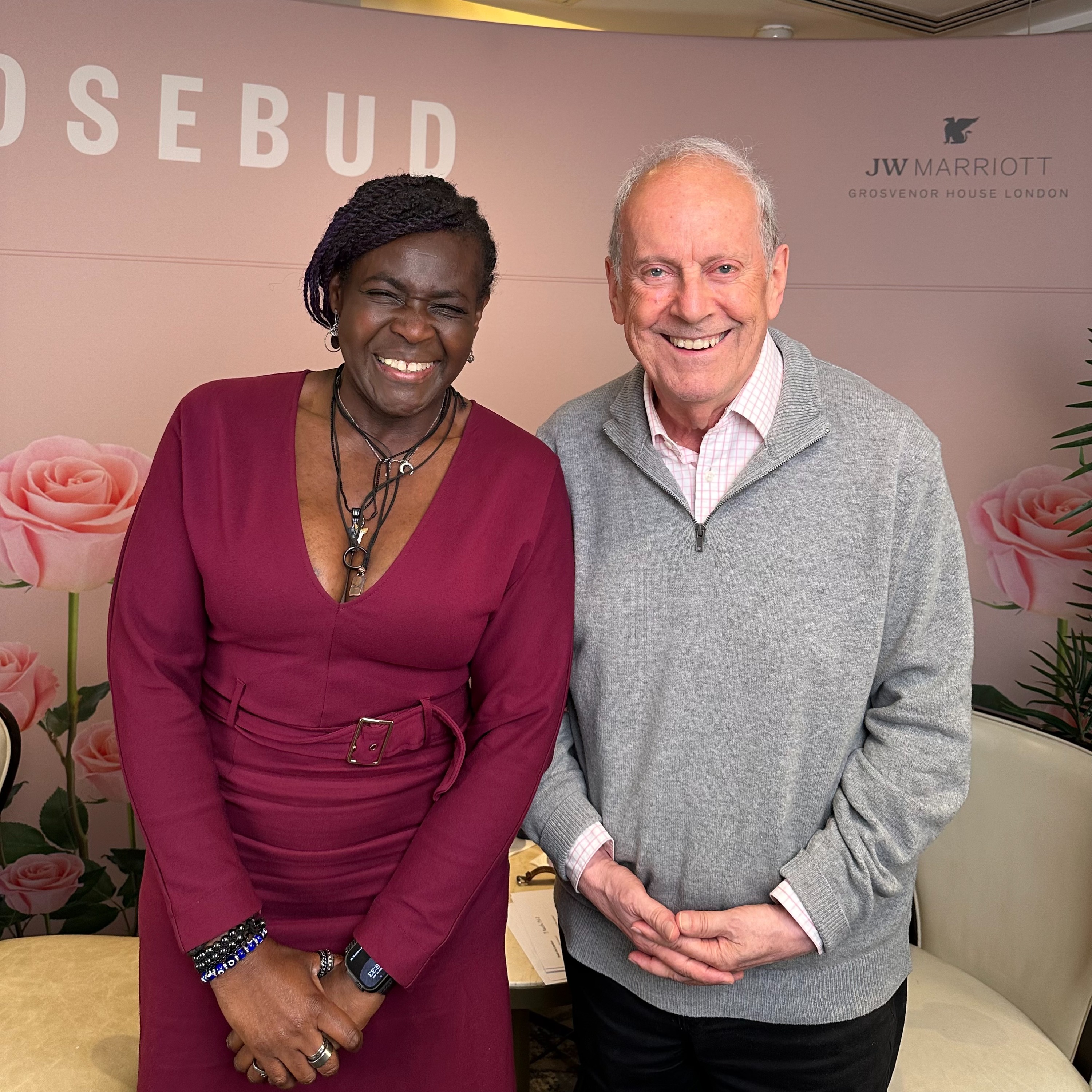
1:11:01Rosebud is a Plain Jane production produced by Harriet Jane, hosted by me, Giles Brandreth, with music by Phil Leppard, and recorded this week at the JW Marriott Grosvenor House in London's Park Lane. Room service.
1:11:24you're fishing in the same pond as everyone else. Podcast listeners are a different audience entirely, more engaged, harder to reach through traditional channels, and ready to act when someone they trust makes a recommendation. We're Acast, and we put them right in front of you. Browse thousands of the world's leading podcasts, book host reads or run your own ads, and track every conversion in real time. Same skills you already have, brand new results. Acast. Acast.com slash advertise.
Our guest today is the scientist, broadcaster and presented of The Sky At Night, Dame Maggie Aderin. In this moving conversation, Dame Maggie tells Gyles about her childhood - and her parents' long custody battle, which often led to upheaval for Maggie and her sisters. She talks about her early interest in space, and joining a telescope-making club as a teenager. She talks about thinking big and not taking no for an answer. She talks about "Maggie-isms" and being unusual.
This is a fabulous edition of Rosebud with one of our foremost science communicators and educators. Dame Maggie's book, Starchild, My LIfe Under the NIght Sky, is out now and available here.
Hosted on Acast. See acast.com/privacy for more information.


