
 Ask ChatGPT



An interview with Dame Zandra Rhodes about her life and career, from childhood in Chatham during WWII to becoming an iconic fashion designer with a “rainbow” pink-haired brand, and later surviving a serious bile-duct cancer scare during early COVID.
Zandra Rhodes (born 19 Sept 1940) is a British fashion designer and founder of the Fashion and Textile Museum in London (founded 2003). She studied printed textiles at art college in Medway/Chatham and won a scholarship to the Royal College of Art. She worked daily in her company and runs a studio/print room in her London penthouse above the museum.
Her mother’s ambition and exotic style shaped her; she “doesn’t do regrets”; her pink hair began after a trip to China around age 40; she sustained her career by staying an artist and “ducking and diving” through fashion cycles; she survived a 13cm bile-duct growth/cancer diagnosis with planning (will, Sandro’s Foundation).
Dressed celebrities including Diana (ordered six dresses; pregnancy announcement in a pink pearl dress), Freddie Mercury (1973 top/pleated cape), Elton John (jumpers), and worked with figures like Deanna Vreeland (American Vogue). Childhood memories include being born during an air raid and later VE Day on her father’s shoulders.
Written by AI. May contain mistakes.
Zandra describes her penthouse and its significance.
“If you felt stuck trying to lose weight, you're not alone.”
Zandra describes her penthouse and its significance.
“This is my rainbow penthouse, which is on the top of the Fashion and Textile Museum here near the Shard in Burmesee.”
Zandra shares the story behind her name and her first memories.
“And this is Rosebud, and we always begin with the same initial question.”
Zandra discusses her parents, their personalities, and relationship.
“because our first question is always precisely, what is your first memory in your head?”
Zandra reflects on her father's character and experiences during the war.
“And as a child, I used to feel, you know, when she came to a school open day, I thought she was probably far younger than all the other mothers.”
Zandra elaborates on her parents' relationship and its impact on her.
“Oh my gosh, so they were wanting to be married in the 1930s?”
The guest shares memories of family, including the impact of her mother's death and her father's emotional distance.
“You did your best to do that, did you, you and your sister?”
The guest reminisces about her childhood experiences during WWII, family dynamics, and her sister's marriage.
“you know Britain's darkest hour do you have any recollections really of the war?”
A discussion about the complexities of her parents' relationship and its impact on her perspective of her father.
“I think it was mainly hidden from us as such.”
The guest discusses her school experiences, including challenges and influential teachers.
“I can vaguely remember being pulled by a toboggan.”
The guest reflects on her teenage years and the guidance from her mother regarding relationships.
“And who is the teacher there that makes the difference to you?”
Dame Zandra Rhodes discusses her relationships and views on marriage.
“And I was going to a country club with the parents.”
Zandra shares her artistic journey during the vibrant 1960s.
“have they been like in your head, like marriages?”
Zandra recounts her early career steps and gaining recognition.
“Mary Court, yes, short skirts and false eyelashes and everything.”
Zandra talks about her transition to America and connections with Vogue.
“Because you were conscious of your own worth.”
Learn about Zandra Rhodes' early experiences in fashion and her rise to fame.
“go to America there'll be someone there to back you.”
Discover the evolution of Zandra's punk collection and its initial market response.
“I suppose it creeps up on you gradually when suddenly Brit Eklund came round for a dress and David Bailey ordered me to do a dress to take to Paloma Picasso in Paris.”
Explore how working with celebrities like Diana and Freddie Mercury impacted Zandra's career.
“So instead of what the chiffon dresses were moved to the basement for that month or week, and we put in the punk dresses and it opened with a splash and a whole week went by and we didn't sell a thing.”
Hear Zandra's memorable experiences dressing iconic figures like Diana and Zsa Zsa Gabor.
“And he and Brian phoned up and I said, Brian May.”
Hear Zandra's memorable experiences dressing iconic figures like Diana and Zsa Zsa Gabor.
“It's designed to support you in reaching your goals.”
Discover Zandra's thoughts on confidence, fashion sustainability, and her creative process.
“I mean, you, you know, you don't say, you know, you have to go with the flow.”
Zandra Rhodes shares her experience with a life-threatening illness and its impact on her perspective.
“But like everything in fashion, things go up and down, and one minute you're in and one minute you're not.”
Zandra reflects on significant moments of joy and sadness in her life, including her mother's passing.
“And a wonderful sister who, you know, has been...”
Zandra discusses what life has taught her, her views on work, and the importance of relationships.
“I don't mean that because I didn't think, what am I going to do in six months?”

Get the gist, explore an idea or ask about something said.
 Claude
On Rosebud with Gyles Brandreth, what are the key points of this episode?
Searching your listeningAutomatic transcript. May contain errors.
0:00If you felt stuck trying to lose weight, you're not alone. Enter Weight Loss by HERS. It's designed to support you in reaching your goals. And HERS now offers access to an affordable range of FDA-approved GLP-1 medications, including the WeGovi pill and the WeGovi pen. Even better, with a range of affordable GLP-1 options, HERS makes it simple to find an approach that fits your needs and your budget, if eligible. You'll get a treatment plan personalized to you and unlimited dosage changes as needed. It's weight loss designed to work with your life. Ready to reach your goals? Visit 4HERS.com slash eligible to get personalized, affordable care that gets you.
0:37That's F-O-R-H-E-R-S dot com slash eligible. 4HERS.com slash eligible. Weight loss by HERS is not available in all 50 states. Wegovi is the registered trademark of Novo Nordisk AS. To get started and learn more, including important safety information, Wegovi clinical study information and restrictions, visit ForHers.com. Hello. Put the rest of the world on hold. Forget all the horror, forget the bad news, forget everything, and just welcome, for an hour or so, to the world of Rosebud. It's wonderful that you're here. Thanks for being here. I'm Giles Brandreuth, and here's another very special episode.
1:21Cue the music.
1:43Hello, this is Giles Brandreth, and it's time for another episode of Rosebud. I'm talking to somebody I've known quite a while. I admire her hugely. She is, I think we can say this fairly reasonably, it's a word I hate using because it's so overused, but I think she is an iconic figure. When I tell you that she is a fashion designer and she has pink hair, you'll know, oh, it's going to be Zandra Rhodes. And it is. It's Dame Zandra Rhodes. She has just celebrated her 86th birthday, but, well, to me, she feels younger than springtime. She's known everybody, dressed everybody, I mean, literally, Everybody from Diana Princess of Wales to Freddie Mercury.
2:24And she's somebody whose own story is remarkable, unusual, her beginnings. Her life in the 50s, 60s, 70s, the names she's got to drop are amazing. I went to meet her at her incredible penthouse flat, which is above the Fashion and Textile Museum in London that she founded back in 2003. Her home is extraordinary. Her taste is both outrageous and yet it works. So, for an episode that's full of ambition, vision, determination and pink hair, I give you Dame Sandra Rhodes on Rosebud. Cue the music.
3:18Zandra, before we begin, we're in this wonderful room. What is this room? Where are we? This is my rainbow penthouse, which is on the top of the Fashion and Textile Museum here near the Shard in Burmesee. In London? In London. Have you always been a London person? I moved to London when I got into the Royal College in 1960, and I've lived in London ever since. No, you could have been in New York or Rio or Paris. Yes, I could have been, but I'm here in London. And do you live here as well? This is actually my penthouse, which I use for having dinners around the round table or for meetings like we are now.
4:05And then two floors below is my studio and my print room. Gosh. My company, which I'm still in every day. Well, and I love having your company now. And this is Rosebud, and we always begin with the same initial question. And that is, let me show you I've got the right person, Zandra Lindsay Rhodes? That's correct. Born 19 September 1940? That's it, yes. Zandra, is that the baptismal name, the original name? Yes, my mother was going to call me Zandra with an X. And my grandmother said, well, no one will know how to pronounce it. So that's how I got to be Zandra. And where did you get the name from?
4:45I don't know. Maybe it was Alexander the Great. It could be. But it was definitely a wonderful, unusual name. And when I was at school, it was always embarrassing because the teacher would make you stand up alphabetically and say your name. And I'd go, Sandra Rhodes. And she'd already written Sandra. And then you'd say with a Z. And she'd have to either rub it out because they didn't have white out in those days. You know the Latin tag, nomen est omen? No, I don't. The name is all. The name is everything. Oh, well, I like that. I remember that. But also, often people like you, who are unusual, have been blessed with having an unusual name.
5:24So were you from the get-go, conscious, I'm Zandra, that's special? I suppose it, yeah, I suppose subconsciously. I mean, it was pointed out once I stood up at school and then they always got it wrong, you know, when they did the register at the beginning of the year. And the Lindsay? I don't know where she chose that from You had a name all your life You have no idea You're not some auntie A granny No I didn't have a family name My grandmother was called Actually what was my grandmother My mother's name was Beatrice Which was wonderful I'm trying to think what my grandmother's name was It wasn't Beatrice No it shows you what my memory's like now Well this bodes a bit It's a bit worrying, given we're going on a trip down memory lane.
6:12Exactly. But let me take you back to your first memory, because our first question is always precisely, what is your first memory in your head? Not from a picture you've seen, but in your mind's eye. I think being in a pram when it had been raining and smashing on the water that would gather in the plastic bit. And where would this pram have been? We lived in Chatham, Kent. And in fact, I was born during an air raid and my father had to go down the hill to the hospital and she lost one of her shoes on the way. And it was pouring with rain and there were probably doodlebugs going over the top. So she raced down with your father, they raced down together to the hospital.
7:02To the hospital. Doodlebugs over, shoe being lost. That's it. We've got to get there. The rain is sleeting down. That's it. Very glamorous, isn't it? She gets in and you were born. I was born, that's it. Are you the firstborn of their children? Yes, I'm the firstborn of the two of us. Who are your parents? Give me your mother first. Beatrice Ellen Twig. That was her original name, Twig with two Gs. And my father was Albert James Rhodes. Very good. Good names, strong names. Strong, yes. What was your mother like? extremely exotic. And as a child, I used to feel, you know, when she came to a school open day, I thought she was probably far younger than all the other mothers.
7:51She'd have high heel green lizard shoes on and beautiful makeup with red lips and her hair cut in a swirl that she sprayed silver and looked very exotic. And I say, please, mummy, don't come in looking so different from all the other mothers. But she did. But she did and she looked wonderful. And how did she meet your father and who was he? She met my father when in ballroom dancing. And he was very handsome. He looked like Errol Flynn. And they were at one point Kent champions. And of course my mother could make wonderful dresses, ball gowns with lots of sequins, which in those days she would have sewn on all by herself.
8:33so she was a very exotic, wonderful woman I think that my father just fell in love with her like that But he was good looking so if he looked like Errol Flynn did he behave like Errol Flynn? Well, they had a very strange relationship in the sense that probably apart from the fact he looked and he danced well of course when he proposed to my mother My grandfather wouldn't let her marry then because he thought she was sort of below, because he was in fact, he was a lorry driver. And her father felt that wasn't good enough. Her father felt that wasn't right and she didn't marry till after he died.
9:21Oh my gosh, so they were wanting to be married in the 1930s? They were probably, yes, wanting to be married in the 1930s. and I'm not sure of the actual date, but they probably got married in the late 30s. Well, you were born in September 1940. They could well be married a year before. That's often what happened. So I see them on the dance floor, she with her sequined skirt, him looking extremely dashing. Did he have the Errol Flynn moustache? Yes, he had an Errol Flynn moustache. He did look very handsome. And did he do war service? Oh yes, he was in Egypt during the war, just as an ordinary...
10:00As a soldier? Yes. Well, don't dismiss him as an ordinary soldier. We're jolly grateful that he was there doing his thing for us. So, what were they like together? What was their marriage like, do you think, from where you were? Oh, they were totally unsuitable, really and truly. But it was that period of the war, in that period of time, when people would have stayed together anyway. way so in fact your grandfather was probably right to say but on the other hand it's formed me so I think one just has to look at it in that context and when you say they weren't right for each other why weren't they right for each other well my mother was an extremely exotic woman that he he in a way looked up to and then she could she could do all these exotic things which whilst he felt proud of her he wasn't really able to step out of that level in a way if you want to picture it really our family was a bit like elf garnett in the in the comedy shows yes i remember that where he's talking with his mouth full and and children children are horrible snobs i think they are anyway and i think probably i was you know you my father what would look all right if they were going to something but we came from a home where people didn't they weren't invited back to dinner like we would these days so your mother felt that she was a cut above or she was different she was different i don't mean she felt she was a cut above but she was obviously the money earner yeah not a lot but she taught in the art college and she sat and made wedding dresses at home which if my sister and I were good, we could sit and watch her do the fitting if we didn't quarrel with each other.
11:57And he continued. I mean, he looked very elegant on the dance floor, but by day, he was a lorry driver. Yes, and he'd cycle to the dockyard and he'd be there all day. And then he was always, it was very funny because, you know, in a way, I can see how he really had his balls cut off, as you'd say, because, you know, I'd come home, my mother would be teaching and he'd come home from work and I'd walk back to home with my girlfriend Jillian and I'd say, can Jillian come to tea? And she'd go, no, she can't. She came last week. You know, and we could answer and say, well, mummy pays for it, which is very...
12:34You did answer like that, did you? Yes, I've got a backhander for saying that, but... Well, maybe you deserved it. So what's your best memory of him, of your dad? Did you call him dad? Daddy. Daddy. Called him Daddy. Oh, well, I mean, we used to have nice drives into the country, and he also loved cycling. He'd go cycling and doing hill climbs and things, and belonged to a cycling club. So we'd go out in our little Morris 8 or whatever, and see him driving, doing that in the hill, and then we'd be collecting blackberries. So it was very nice sort of countryside, semi-countryside in Chatham in those days.
13:20Can you remember an intimate personal conversation with him ever? No. No. I mean, when I think about it now, particularly having done a book where I've been questioned about it, because I think I shut it out all my life. whereas my sister who's three years younger and has four children they had a grandfather so they would go and you know what I mean they'd go and see him because of the children whereas I went to college and wasn't really associated that much and my and um and then my mother died before she knew about what had happened with my career so she you you lost your father in a sense yes i vaguely see him yes probably because i didn't have children so there was no no reason no reason for a link you were getting on with your career yes and he wasn't a very communicative or emotionally aware person no when he remarried a bit later having met his very nice sweet wife um and about four years after my mother died he went back to ballroom dancing classes and they'd come to my dress shows so they saw my dress shows so what age was your mother when she died 19 1969 was my first trip to America so my mother would have died in 1968 and left me 500 pounds and you were only 28 then I would have been 28 yes by the time she died did you feel you knew her well oh I knew my mother very well yes and um I'd go try and go down there with because it was during the last two years of her life because she was a chain smoker and she then got myself down with my sister and stood in front of us and said I I've I've got lung cancer and I've been given six months to live and I want you to make this the most wonderful sixth science of my life.
15:27So it was quite wonderful. And you really did. You did your best to do that, did you, you and your sister? I think we did our best, yes. And my sister, towards the end of her life, she moved to my sister and her husband's in Amersham where they looked after her. And my father would just come and visit because she was really in bed the whole time. And did she remain an exotic personality throughout her life? Yes, she was always exotic. I mean, she, you know, she always wore makeup and always looked lovely, yes. Yeah. So, really, the essence of what you are, you got from her, do you think? Oh, completely, yeah.
16:03I'm probably the result of my mother's ambition. But I don't mean I felt that. You know, once when I said to my mother, if I'd have wanted to leave school at 16, you know, you'd have let me. She said, no, I wouldn't. But she guided me. I think she guided me towards going to the art college where she taught for Saturday morning art classes. Unlike my sister who worked in different factories, because she wanted to, I was never made to work. In the holidays, I'd go out sketching every day. She never said, you should go out and earn any money. You were born at the beginning of the Second World War, 1940.
16:47you know Britain's darkest hour do you have any recollections really of the war? Only being held up to the sky and being told they were doodlebugs going over to London Did it frighten you? I don't think you know fear as a child as such and then there was an air raid shelter in the garden and I can remember drawing chalk butterflies on it in the garden but that's all I really remember. I don't remember. Oh, and I can remember sitting on the front gate and we were on the main A2 road by a bus stop and all the tanks going by as they were coming back from the coast because Chatham's only, what, 20 miles from Dover.
17:40Do you remember the end of the war, the sense of...? I remember sitting on my father's shoulders going down for VE Day with all the crowds out. I can remember that bit. And when your sister came along, did that please you? Did you get on with her? I've really only become really close to my sister in the last ten years, more than anything. But she married her childhood sweetheart at the age of... I think she must have been about 19 before she then came up to college. They both came up to college and he studied to be a doctor and she was studying at a teaching college. And that worked out? Oh, perfect.
18:23They were wonderful and they put up with me. And as a little girl, what were the games you played? Hopscotch, chalking on the ground. Although my father once caught us playing in the street and we weren't allowed to do that, which was good, but we played in the garden and sort of knocked balls around. and probably it was wonderful semi-country. We had a very steep garden and there was a bit of wild land with stinging nettles and wild flowers. So I was brought up on the fabulous Flower Fairy books by Mary Cicely Barker, which are wonderful and I still love those. Beautiful illustrations. Yes. Did you have dolls?
19:05I had a doll in, I had a doll Jacqueline who I've still got. She looks a bit threadbare now, but I suppose I like making clothes for her, but I actually didn't really play with dolls. I think I was always really more painting and drawing. Even from a small age? Even from a small age. Can you remember the first time of feeling good in what you were wearing? Was that a party frock? Oh, well, my sister and I were always the child stars of the dress show because my mother taught at the local art college. so they'd make these very pretty dresses, little off-shoulder scallop dresses that the students would make and we'd model in the dress show and then have them afterwards with little bonnets and everything and I used to dress up to go to my grandmother's in them but when I went through the park, the kids would throw stones at me.
19:59I'd be running through the park so they didn't see me. Mocking you? Probably, yes. Teasing you? But it didn't stop me from wearing the dress. And why did you feel special in it? I mean, I can see your mother was a seamstress. She made clothes. She loved doing the ballroom dresses. But what made you feel special? I suppose I like dressing up. Maybe it was my mother made me feel special too. What is special about dressing up? Why do people like it? And why do some people find it difficult? I think you're presenting yourself to the world like I knew I was going to do this interview and I'd dress up for the interview.
20:38I wouldn't want you to see that I'm in a crappy old pair of trousers and things would paint all over them. And have you found over the years, dressing people, that you have made a difference to their lives as well as making their lives more colourful and making them look interesting? Oh, I suppose it does. I mean, I've got a wonderful press cutting that someone sent me that one of the main shoplifters, when she died, Harrod sent a wreath specially and she got buried in one of my dresses that she'd shoplifted. But this is hilarious. Harrod's their regular shoplifter. They sent a wreath to the shoplifter's funeral.
21:19Well, she wasn't going to shoplift anyway, was she? She wasn't going to anymore. This was their last gesture. And she chose to be buried. Have you had other interesting people have chose to be buried? Oh, one of my favourites. She didn't actually wear my dress for it, but I had a wonderful customer called Mickey Easterling who lived in New Orleans. And when she got married, it was on CNN, and she had herself totally embalmed, sitting cross-legged on a chair with a cigarette in one hand and a glass of champagne, surrounded by flowers. And the whole world, it was on CNN, but were walking by to see her.
21:57That's the way to go. I mean, I think, you know, if you've got to go, you might as well celebrate it. Have you got plans yourself? I haven't thought about that. Yeah, I'd better get on with that too. So, here you are as a little girl, enjoying dressing up, being happy. You have a happy childhood. I'd say it was a... Oh, yes, I'd say it was a very happy childhood. Were you conscious of the tension between your parents as a little girl? I think it was mainly hidden from us as such. I was a bit more conscious when I was a bit older, but just the fact that you had this funny man, you couldn't really bring people back home easily and everything.
22:37They were mismatched. They were mismatched, but because of the... And we didn't realise once we went on a very long holiday where she in fact left him, but he kept coming around. You know what I mean? But that was all semi-hidden from us. He wasn't a ledgers man, although he looked like a little bit. No, no, no. He obviously really cared for my mother. This exotic lady who wasn't... But he'd had a horrible childhood. Yes, that was the whole point. His father was in the army and went to war and his mother took in borders and she had an affair with one border and then another one and the first one cut her head off.
23:28It was a big scandal and in somewhere small, like Chatham, it was in all the newspapers. I'm not surprised. Newspapers around the world. Forgive me. Who is this in relation to your father? This is my father's mother. Your father's mother... Got murdered. Got murdered and was decapitated... Yes. ...by a former lover who murdered her. Yes. Or someone in the same house. But this is truly traumatic. And this was in the newspaper and he revealed this to my mother and my mother felt compelled knowing the secret that she should marry, you know what I mean, marry him. Because he had shared this terrible secret.
24:05She felt an obligation. Yes, so it was told to me secretly by my mother much later. I probably would have been in my small, you know, very young teenager. Did it make you have been more sympathetic to your father? a little but I mean I feel much softer towards my father now do you know what I mean when it's probably too late but I suppose regrets go through the skies when this terrible thing happened to your grandmother the decapitated lady the murdered lady was your grandmother yes how old was your father then I'm not quite sure I think he was really have been a boy and then had grown up with it but my mother had heard of the scandal you know what i mean because it was in chatham it was a big this does mean doesn't it we have to forgive everything you know that's what i mean but at the time i didn't know till i was a teenager do you know what i mean and he had this poor man inside him all his life wow so you go to school what's the first school you remember i oh i could be taken in the snow on a toboggan down to a nursery school.
25:19I can vaguely remember being pulled by a toboggan. So you were taken on the toboggan down to the school. Do you have any recollections of that school? No, not of that one. Then I went to a sort of little school and then I failed my 11 plus, which, because I was slow, and then went to the secondary modern, which I hated, and then I worked very hard and passed the 13 plus. Did you make your appearance exotic even then? No, no, no. I was extremely, I didn't mind wearing school uniform. Mark you, I wore the same tie for the whole of my time, just slid up and down. I don't think it ever went to a dry cleaners or anything.
26:04So I wore the same tie and thing and I didn't mind wearing uniform. I'd say, like the other girls who wanted, I said, well, I'm at school. I don't care. I'm not trying to impress everyone else.
26:41Even better, with a range of affordable GLP-1 options, HERS makes it simple to find an approach that fits your needs and your budget. If eligible, you'll get a treatment plan personalized to you and unlimited dosage changes as needed. It's weight loss designed to work with your life. Ready to reach your goals? Visit ForHERS.com slash eligible to get personalized, affordable care that gets you. That's F-O-R-H-E-R-S dot com slash eligible. ForHERS.com slash eligible. Weight loss by HERS is not available in all 50 states. Wegovi is the registered trademark of Novo Nordisk AS. To get started and learn more, including important safety information, Wegovi clinical study information, and restrictions, visit ForHERS.com.
27:28So age 13, you go to this new school. I go to the new school. And who is the teacher there that makes the difference to you? Is there one? I suppose the art teachers would make most of the difference but I also liked there was a teacher called Miss Ryan who taught history loved history I liked the English but a wonderful teacher called Miss Peacock who wore socks over her Lyle stockings and she'd go we've got reproduction today when miss peacock taught you the facts of life in reproduction yes were you shocked interested excited we didn't get further than frogs with big thumbs the rest of the time we were dealing with photosynthesis who did teach you the facts of life the birds and the bees i think they just come gradually i don't i never had a lesson from my parents or anything my mother was wonderful she I'd say, when I had my first boyfriend, how old would I have been?
28:34About 16. And I was going to a country club with the parents. And I said to my mother, is that all right? She said, if you can't do anything in front of me, you know it's wrong. And who was this 16-year-old boy? Was he at the same school? Was it a code school? No, no, he went... Oh, the other thing was that being the fact that one was conscious that my mother had, my mother married so-called below her. I wouldn't have wasted time if it was a boy working in the garage around the corner. I'd go out with boys from the local public school or people that have passed their examinations. Well, you admitted earlier you might have been a bit of a snob.
29:29And clearly you were. And was this boy good-looking? What did he have to offer, the first boyfriend? Yes, he was quite good-looking, and he played the organ at the public school. Oh, I mean, you picked a good one there. Have you overall been good with men? Or because of your father, has it been difficult to form...? No, no, I hadn't realised it was difficult to form relationships, so I had very nice boyfriends. Yeah. You didn't get married, though, did you? Had a long-term partner? Never got married. I've had several long-term relationships. Yeah. That's good. Can I ask why you didn't get married?
30:13Did you consciously? I'm only asking that because of your parents. There was once someone who I was in love with a bit later in life. Let me see, how old would I have been? I probably would have been then in my early 30s and then he revealed he was gay. But it was actually, it did me a good turn really because at the time I went out my way to buy my first house and thinking I could have children there. But it never happened, but I wouldn't have got together a house. So everything happens with a good reason. But when you've had long-term relationships, have they been like in your head, like marriages?
31:00Or have you felt, actually, I have my life, I have my work, I have my home, all of which I've built myself. And while I'm loving having this long-term relationship with you, we are not married. And therefore, that does give me a freedom and an independence. I didn't think of it that way. Most of the time, I wouldn't consider going out with someone unless I admired their work. I have to admire what they do with their lives. I don't mean I have to be part of it, you know. My first long-term real relationship was with a guy called Alex, and we set up business together, and he's a brilliant interpreter of ancient fabrics for Rothschilds and things.
31:50He's at top in what he does. So I had to admire what they do for their lives. So fancying them is not enough. We need something more than that. They have to have other things going for them. Because your last long-term partner was very much involved in the business again, wasn't he? Oh, well, he was a self-made. He started from nothing in Egypt, landed on Ellis Island in 1943. In New York. in New York, and they said, well, you either go back to Egypt or you become an American citizen on the spot. He became an American citizen and then was sent to Germany for three years. And then he came back and started as an usher in a cinema and he ended up as a president.
32:44Of the cinemas? Oh, yes, he was the president of Warner Brothers at the end, but he was president of several other cinemas. But it's pretty good going. What a story, of course you admired him. Oh, and he was a workaholic. Oh, fabulous. And that was quite useful because you're a workaholic. He didn't. Oh, he'd just say, do you mind if I'm working? When he'd say, we'll go out to dinner tonight, this is when we first met each other. So I might be at work and I'd take my change of clothes and then he'd phone up and say, I'm terribly sorry, I'm still in board meeting. So I'd just get back to work again until I could go there.
33:22And how long were you with him? About 21 years. Oh, a long time. What was his name? Salah Hassanin. Good name. And it was a short name because he was really Salahadine. Oh, very good. Hassanin. Yes. Well done. Well, and he died not that long ago. He died in 2019. Yeah. And then I lived partly at that time in California with him and partly here, but it was really him who conceived the idea of how I could achieve having the museum. So, I mean, I owe him an awful lot. But you like a high flyer who's an achiever, who's a workaholic, because you are all those things. But I can admire what they do. So, we're getting a flavour of who you're becoming, but you're still at school and what are you in your head thinking you're going to do with your life as a teenager?
34:23Gradually I loved drawing and I thought when I decided to go to art college rather than be a teacher and believe me I couldn't bear teaching when I actually did it but I went to art college and I thought I'd be an illustrator you know, a book illustrator and then I went to art college and in my first year they give you different things like you can do pottery and you can do a bit of sculpture and a bit of this and I fell in love with doing printed textiles with the most fantastic teacher Barbara Brown and I fell in love with that and I did that specialized in that for my original in my original art college in Medway Kent Chatham Kent and then got a scholarship to the Royal College of Art.
35:12But this means that you are in at the beginning of the Swinging Sixties. Yes, Swinging Sixties. This is the London of that. Mary Court, yes, short skirts and false eyelashes and everything. And were you getting into all that in terms of your appearance as a teenager? I did when I went out. My mother could make me exotic, flowing blouses and I could look lovely. but when I was at work I was still in the old jeans and painted shifts covered in paint and always had my hands covered in dye and everything. It didn't pass you by but it passed me by. I was there in the swinging 60s and even though I lived in Baker Street near where the Beatles had their Apple shop and I went down Carnaby Street and I knew all these things were happening, I can't pretend I really got involved and a lot of people didn't.
36:04But did you? And describe to us, particularly to people who weren't there, what it meant. Because it became a huge international thing, the idea of the swing 60s. People made movies. I was aware of the movies and having, when I went out, the Beatles were just right at the beginning, the Beatles and the Rolling Stones were really starting to make their name and we'd go down, we'd go to someone's flat and do the twist and everything like that. But I wasn't in with the in crowd. So I was really just a workaholic at college. And then when I left college, together with Alex, we set up a funny old studio by Royal Oak Tube Station and set up a little print room and a design room.
36:58and that's where I sort of started to print and do designs for other people. Can you remember the first amount of money you received, the first cheque that came your way, how much it was for and what you'd done? What I remember was when I, at the end of college, I got a little scholarship, I think it was about£300 for travelling with, but I managed to get my prints accepted by two fabulous girls in Carnaby Street called Marion Fole and Sally Tuffin. And so I was doing prints for them. So instead of going on the trip, I did that for my... I managed to get my work in there. So that was really my first footsteps into the business.
37:46And how do you break out? How does... How did it happen? How did it happen? Well, first of all, I did the prints for Sally and Marion, and I insisted my name going in the publicity. So if it showed a picture of their trouser suit with stars all over it, it would say print by Zandra Rose. So my name sort of was creeping there. Because you were conscious of your own worth. Well, I suppose so. Speaking of which, the House of Worth was part of... Was where my mother had worked. She'd been a seamstress there or... No, she was a pattern maker. Pattern maker. And she was a brilliant woman. And the thing she said was, when she went for the job in Paris, even though she didn't know what she had to do, she'd say, now I'm not sure if my method will be right.
38:34Will you show me your method of how you want it done so that I don't do it wrong? And she kept the job, so she must have been all right. Oh, she's a shrewd cookie. I mean, in a sense, you've got what you are, where you are, because of her. I'm the result of my mother's ambition, yes. And you were fulfilling it for her. So here you are, we're into the 60s, things are beginning to happen, and we have a breakout, don't we? The name's beginning to get known. What is this breakout? Well, first of all, I had a little partnership with Sylvia Aiton. It was Sylvia Aiton's under roads, and we made lovely flowing trousers, and trendy people would come along.
39:15Vanessa Redgrave had been introduced to me, and she put some money in, and we had our first shot. but it only lasted a year, but it was opened. You know, we had a wonderful pop concert with pop artists singing for the opening, so it was quite trendy. This would be at the same time as Ozzy was really big too, and this was in the... Ozzy? Ozzy Clark. Very good. In the... We weren't in the King's Road, we were in the Fulham Road, so it was the less trendy. So the shop only stayed open for a year. But we had Joan Cocker opening it. Well, also, Vanessa Redgrave then, she'd done Blow Up. She'd done Blow Up, yes.
39:57Which was a seminal 1960s film. Exactly, yes. Which she appeared topless. You wouldn't recall that, but I do. Oh, I don't recall that bit. Isn't that interesting? I remember it and you don't. But her sister, Lynn, appeared in a film called Georgie Girl, which was very much a swinging 60s film. And you're beginning to know these people. How on earth did you meet Vanessa? I met her through a lovely girl called Alex Green, who was also at the Royal College, who had been photographer on the set. I'll blow up. And she wanted to do also interested in the shop. So it was really because of all those things coming together.
40:33And did you feel that you were part of this group or still an outsider? I was probably an outsider since I was extremely boring and working. You know, most of the time was working and I taught two days a week to make the money to live. And I hated teaching, so I'd go... Why did you hate teaching? Were you no good at it? No, everyone I taught said I was good. I bet you were good too. I mean, really, I wanted to do my own work. Yeah, that was it. And so I'd go to work at five o 'clock in the morning and set the work for my machinist, and then I'd go teaching and then come back in the evening, you know.
41:10And how distinctive were these prints that you were making? Oh, I mean, the prints really were very, very dramatic, and I've still got pictures of them because we've been trying to put a book together of all those things. So you were getting more dramatic, you were exotic, you were on the fringes of swinging London, and then we have the breakout. The shop is called what? The shop then was called the Fulham Road Clothes Shop, but that got publicity but then closed. And Sylvia Rayton, who I was working with, she got a job at Wallis Shops and she was their top designer for the rest of her life there.
41:49and I was then without a job but I had a studio and my mother had died and left me 500 pounds and I'd met these mad Ukrainian American girls who love wearing my chiffon caftans and floating down the King's Road and they said to me Sandra you're going to make your fortune you've got to go to America there'll be someone there to back you. I had one other American friend called Richard Holly who later became the top decorator in Houston and he said I'm going over to America come with me and you can stay in my flat that's over there and I then was work had I published in English Vogue through a wonderful woman called Marit Allen.
42:42And Marit organised for me to have a letter of introduction to Deanna Vreeland in New York. And who was she then? Deanna Vreeland was the editor of American Vogue. So I used to have red lipstick curls drawn on my face, heavy eye makeup. up my hair was still brown and I used to wear all these flowing scarves and white high white beaver boots with chiffon trousers tucked in and flowing chiffon tops and I had my letter of introduction and I went to New York she saw me and she raved about the clothes and she she was so amazing all i can remember is this wonderful hook nose and this face which was all shaded red around the edge and and she said they're wonderful we were photographed them on natalie wood oh and she called in natalie wood i mean i didn't know what whether what whether i was walking on the ground and um so she photographed the clothes and immediately picked up the phone and phoned the top boutique in 57th Street, Henry Bendell, and they ordered the clothes.
44:07And she phoned two other top society women, Mika Ertegun, whose husband ran Atlantic Records, and Chessie Rayner, and they floated around in my capdans, which they ordered. And then I didn't find anyone to back me, but I came back to London and in my little workroom made the clothes and delivered them. And that was the start of my business. And when did you become famous? I suppose it creeps up on you gradually when suddenly Brit Eklund came round for a dress and David Bailey ordered me to do a dress to take to Paloma Picasso in Paris. and so it's all little tiny things somewhere around the same time which was also very interesting I was chosen a whole lot of my prints were used for a huge campaign in Australia where I became a household name because it was tied in with Women's Weekly and so I did I did and that was the first time that I learned to do TV interviews and all sorts of complicated things like that.
45:22And is it, because some of what you do is extreme, there's a sort of punk element, sort of crazy over the top. Well, that was a bit later. That we're talking about in the 70s. Yes. But do you need to be extreme in order, because only a few people are going to wear the extreme clothes, how does one make money? I don't think, you see, I don't think a lot of my things are extreme. I think people think they're extreme because they look, ah pink hair heavy makeup um how i might wear them but remember the people that order them might order a printed dress and it was in but it would be printed in black and gray and an edge with white pearls instead of being in turquoise and red so that it would be toned down and in a different way it's just i don't usually wear black i mentioned punk because you're associated with that and that was you excited by it or getting on the bandwagon how does that something happen i had a wonderful friend dougie field whose paintings you see on the wall of the headless ladies yes and over there with the with the landscape yeah and he was a close friend and everything was happening in london at nightclubs and i'd been doing my prints looking very exotic and I'd got a shop in London off of Bond Street by that time.
46:47And every half season we had to think of concepts and we thought, oh, why don't I do a punk collection? So I had an amazing Lady Anne Knight who used to run Harrods and then became my manager in my shop. And she said, well, if you're going to do these very extreme things, which, by the way, were really influenced more by Dali and Schiaparelli, where Schiaparelli used the print with the tears. And I thought, instead of the print, I'll do holes and put beaded safety pins on it and everything. So she said, well, if you're going to do that, we should really make a statement with the Zander Road shop.
47:31So instead of what the chiffon dresses were moved to the basement for that month or week, and we put in the punk dresses and it opened with a splash and a whole week went by and we didn't sell a thing. The chiffon dresses had to go back. They might have made all that publicity and they're collector's items now but they weren't seller's items. Oh, interesting. You know, the public weren't ready on my level to do them. it helps of course when you have famous people wearing your clothes i know this because i began designing knitwear jumpers in the 1980s with a man called george hosler right who was the head of design at leicester polytechnic fabulous yes and great guy and we had a couple that were bought by diana later diana princess of wales right and how wearing those jumpers made all the difference they still sell i mean that jump one of the jumpers i did for her is still one of the highest selling isn't that nice um exactly luxury sweater yes in the world because of diana now you had quite a few i mean you did things for diana did you she had six of my dresses ordered by her by chance did she come to the shop or how did it happen she came by chance before she married Prince Charles, she came in with, actually, with Sarah Ferguson.
49:05And she bought a dress for Sarah. But then much later, when she got married, and when she announced she was pregnant, it was my little pink dress with pearls all around the edge that she announced her pregnancy when she was in Japan. And was she a nice customer? She was very shy and quite wonderful. She'd come into the shop. I wasn't in the shop, I was in the workroom. But then I'd go to the palace and fit her. And she was easy, wasn't she? Very, very shy and lovely, actually. And who others have helped you in the sense of... Did you start from Freddie Mercury? I did a top for Freddie Mercury in 73, before they really were a huge band.
49:52And he and Brian phoned up and I said, Brian May. Yeah I'm with you. And I said well you'll have to come in the evening because I hadn't got a changing room or anything in those days. I was in my rickety old three-story building and when I put the phone down I'd made the appointment I had to ask the girls what they played because I mean believe it or not you have pink hair but that doesn't mean you know what they're doing and i also created jumpers for elton john oh wonder that's a good one as well it's a good one but i'm saying these names because i know what the difference that made to my little jumper business yes so what it must have done to you was considerable oh well the freddie mercury is the one that they always remember with the pleated cape and it was wonderful he came up to my rickety old studio and i said try this on and then go in front of the mirror and see how you are and he sort of, it was a wedding top in fact but he sort of like he brought it to life with how he communicated to himself in front of the mirror which was wonderful.
51:01Have you ever had a bad experience with a gland? Yes, Jar Jar Gabor Oh no, I'm sorry to hear that It was towards the end of her life and she was making a film with Ned Sherin and I was so, it was the first film star I'd ever dressed and I went along with my things and we'd put them on and she'd want this done and that done and everything. And then she was like a little kitten when he was in the room. And then when he went out of the room, she'd go, I hate this dress. I hate this dress. Well, anyway, years later, I meet her at a cocktail party in Los Angeles. And I said, oh, did you give all the dresses to your daughter?
51:41She said, oh, no, darling, I loved them. But she didn't say she loved them at that time.
52:00If you felt stuck trying to lose weight, you're not alone. Enter Weight Loss by HERS. It's designed to support you in reaching your goals. And HERS now offers access to an affordable range of FDA-approved GLP-1 medications, including the WeGovi pill and the WeGovi pen. Even better, with a range of affordable GLP-1 options, HERS makes it simple to find an approach that fits your needs and your budget. If eligible, you'll get a treatment plan personalized to you and unlimited dosage changes as needed. It's weight loss designed to work with your life. Ready to reach your goals? Visit 4hers.com slash eligible to get personalized, affordable care that gets you.
52:38That's F-O-R-H-E-R-S dot com slash eligible. 4hers.com slash eligible. Weight loss by HERS is not available in all 50 states. WeGovi is the registered trademark of Novo Nordisk AS. To get started and learn more, including important safety information, WeGovi clinical study information, and restrictions, visit 4hers.com.
53:03And are you good? Were you good at handling the clients? Yes. What do people look like? A customer is always right. Yes. You don't, do you know what I mean? I mean, you, you know, you don't say, you know, you have to go with the flow. But you have to make sure that you're also going to be proud of what they've got on. I wouldn't let them buy something and it look terrible. What's the trick of looking good? Half the time I think it's confidence. Confidence, extra jewellery, feeling good for a girl makeup. You wouldn't see me without my makeup. When did the pink hair come in? 1980. Oh, gosh. I went to China on a visit.
53:49You were 40. Maybe it was that. I'm 40, can do something about this. And I went to China and everything. It was wonderful. What a privilege to go to China. They were only in army uniform and navy. Oh, no one wore makeup. These were the days of Chairman Mao, of course. The most jewellery would be a wedding ring and the tiniest bracelet. tiniest wristwatch and everyone stared we were in it was in a there was one woman librarian on this trip as well there were only a little coach load of about 20 of us and she said i don't know how you bear it because of course we get out the the bus and the people in the street would just stop and stare as you walked along because you might as well have been a gorilla you know they it was the most wonderful experience when I look back.
54:43But I came back and said, Red China and dyed my hair pink. And you've kept it there. And I've kept it pink. It's part of the trademark. It's part of the brand that is Zandra Rhodes. How have you sustained it? Born 1940, 2026 is a long time and you're still at it. It's still here. The workshop's downstairs. You're still working. Is that how you've sustained it? I like working. And I like, if I go on holiday, I go on holiday with, for example, with a wonderful friend, Andrew Logan, who makes the jewellery that I wear. And we do a drawing a day. So we decide what we're going to draw. After we've drawn, we probably go to the museum, sightseeing and shopping.
55:28So that's our idea of a holiday. Well, he dresses pretty eccentrically too, doesn't he? Exactly. Some things in mind. He's got a little skull cap on his head. He's got a skull cap on everything. It's marvellous, what a double act you are. But what's interesting about your design work, which I've been looking through, is that, curiously, it hasn't dated. Some of the stuff from the 60s and 70s looks quite dated now, but you've managed to keep yourself... I think it's... I'm very lucky, and really I'm a sort of artist working, so they don't totally follow the pattern of everything. But like everything in fashion, things go up and down, and one minute you're in and one minute you're not.
56:09With our lives, I think it's a case of, you know, you survive by ducking and diving. When I say to you, regret, do you have a regret of any kind in your head? No, I don't think I do. No professional regrets? No, I mean, I had a shop and that closed and I worked slightly more hand to mouth, but I'm very lucky. I'm in a building that, you know, I own everything. And so I've been able to now keep going and pick and choose my jobs. Personal regrets? No, I don't think so, because I ended up with a partner that was wonderful, Salah. And I think things just happen for a reason. If you go around regretting, you can't get on with the rest of your life.
57:00Now, you've had a brush with death. We thought you were going to die. And you didn't. Right at the beginning of COVID, in fact, Andrew Logan gave a yoga class in here, and London was about to shut down. And we were all lying on the floor, class of about 10 of us, and we're breathing deeply. And my stomach was full and I hadn't eaten all day. And this was six o 'clock in the evening. Why, I would think then, my stomach's full. What would make me think? I wasn't in pain. that I phoned up my doctor, wonderful doctor, Michael Harding, and I said, he arranged for me to have an x-ray and then called a meeting and he found out a specialist and they said, oh, you've got a 13 centimetre growth in your bile duct.
57:54Good grief. It's the one that goes towards your liver. I've forgotten. It's got a carciolangus, really amazing name. Complicated name. and it's quite one that people don't discover in time but they then had a meeting and my sister came to the meeting and her husband and the doctor, Dr. Kahn said well we think you've probably got six months now this was at the beginning of Covid I said well don't tell anyone or no one will give me any work and I then called a meeting and made sure I had my will and put the Sandro's Foundation in place. Hold on, were you distressed? Did you go home and cry? How did you cope with the news?
58:44I don't understand why. None of it, all it made me say was I've got to pull my life together and make sure everything's in order so that everything I've built goes somewhere and doesn't destroy itself. So on the day when you heard the news, I imagine you hugged your sister or she hugged you. Well, my sister was in tears. Yeah. My sister was in tears and I was saying, don't cry. You know, and my doctor, Dr. Harding said, he was on the phone in a visual thing. And he said, well, there's one question you haven't asked, Sandra. And I said, well, I can't think of it. And he said, well, you haven't asked if you'll lose your hair.
59:24And I said, oh, I'll wear a wig. I've got plenty of wigs hanging around this place, so I just wear a wig. So I can't understand why, and I did have two or three friends that were dying of cancer and have since died, who I could speak to when I was having treatment. But this is seven years ago, and when you were given six months to live. This is seven years ago, and then I only told a few close friends and pulled all of that. And then since then, the Zander Rose Foundation, which is run by a wonderful guy called Piers Atkinson, we've been putting, I found that I had squirreled away over 8 ,000 garments in this building.
1:00:10And various bits and everything. So I've had to work out where it's going. We pick key museums and everything across the world. So apart from my work, it gives me something to do. But it's marvellous too because you're told you're dying and it doesn't distress you because you know that all that lives must die, passing through nature to eternity, to quote Hamlet. And so you accept it and it's all right because you've got, in a sense, your children, which is your work, here. And a wonderful sister who, you know, has been... Now phones me up every day on... What's the one? When you look at each other.
1:00:51FaceTime. FaceTime. And I always go, why do you always use FaceTime? She said, because you're a liar and you wouldn't tell me if you weren't well. Oh. And you probably wouldn't because you're just getting on with it. So, you know. How has it changed you? Thinking, I'm going to die, you had the busyness of getting on with sorting everything out, the foundation, all these 8 ,000 outfits that I'm going to leave. I'm going to put my house in order. That's good. I made my will. I'm going to leave something to Andrew. I'm going to look after my sister. it's all sorted did you think of your parents dying what what what was in your head i just thought of the things i had to do and i keep going by what is i don't know what i'd do if i wasn't working i mean i've got lots of friends but i mean you you know can you imagine not working you're phoning someone up and they're busy working and you you're just going around i mean What's your state of health now?
1:01:49Oh, I can't... I get out of breath and can't walk perfectly that marvellously, but I'm still here. Yeah. Well done you. What do you do to relax, to unwind? Do you drink? Do you play music? No, no. I try and have a dinner party for at least ten every weekend. And I go out to... That's quite hard work. I mean, this week's been very busy. I've been out every night this week. That's a bit much. It's a bit tough, yes. Very good. A moment of joy from your life, particularly your early life. A moment of joy, what comes instantly into your head? A moment of joy. I mean, seeing the sunshine and looking at my terrace with all the plants coming up, I love.
1:02:39That's a moment of joy. I think that's, yes. love the garden love visiting gardens the Isabella plantation in in the Richmond Park you know so I mean being with friends very important now a moment of sadness a moment of sadness it probably is maybe when your mother died eventually that was I mean that was awful seeing her you know seeing her go because she was a chain smoker and she had you know she was racked with lung cancer um have you had pets in your life no i wouldn't be able to i can only just look after myself pets don't come along and do you look after yourself are you quite good at that i mean you make yourself breakfast lunch and tea well before i was diagnosed um they've then said said to me after that that I should always have three meals a day because I think probably I'd just go without and eat just in the evening.
1:03:50But I have proper, I have a Weetabix breakfast and everything boring like that. You've been a working machine all these years. But I have a telephone and friends so What more do you need? And you've got work to go on with. What has life taught you? This is the last question. What has life taught Zandra Rhodes? Oh my gosh.
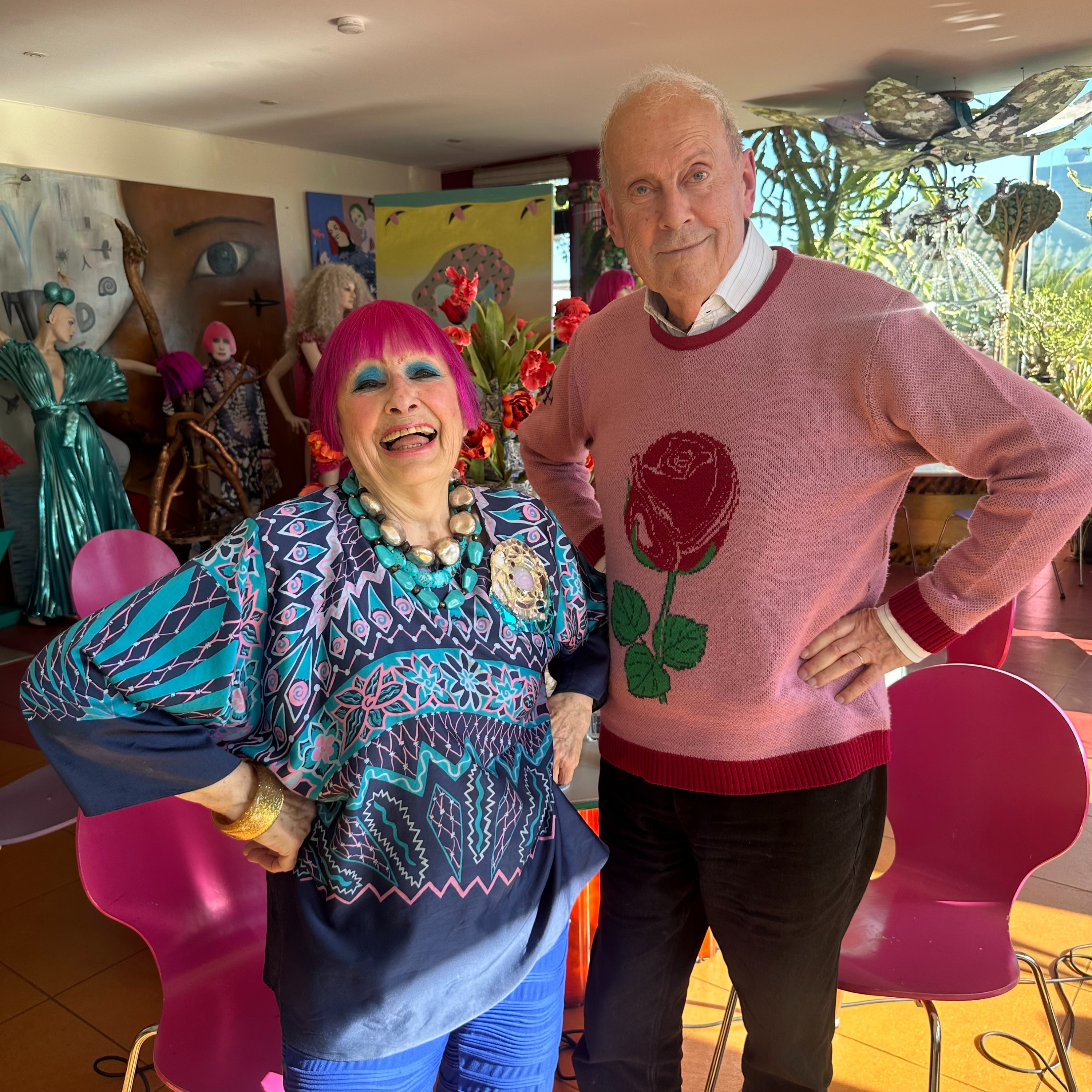
1:04:15that work will get you everywhere. It's got you here. And it's got me here too. If it wasn't for the work you've done, the pink hair you've got, I wouldn't be here. I'm glad you're famous because I think you're fabulous. Oh, well, so are you. But I've had lovely... I have lovely things I get invited to. I've seen you at lots of fabulous things. We are very lucky, you and I. We get invited to things. We get invited. And I think, well, we dress up for the occasion. You and your woolly. And do you know what we do? we turn up we go don't we yes like you turned up today and you looked the business you turned up in your nice woolly with the rose the least I could do we're sort of coordinated you know but I mean but I you know I mean I like I definitely like people I mean I'm lucky I can bury myself in work so but will you be sad to go will you feel I haven't done that when the last moment comes because you must have rehearsed this thinking you were going to do it six and a half years ago no I haven't I suppose I don't oh no because I maybe I didn't believe it.
1:05:12I don't mean that because I didn't think, what am I going to do in six months? I spoke to friends who were dying, but I didn't think about it. Maybe it wasn't really there and maybe someone, maybe God or someone said, you're not going to really die, so you make the best of it. Make sure your work's remembered. Make sure you fill in all and you don't waste any time. yeah well my time with you has not been a waste of time i love you oh good thank you i think you're brilliant sandra roads i'm very excited to know you we'll now go down and maybe swap clothes or something downstairs dress up as thank you for coming it's been wonderful it's been wonderful being with you sandra thank you thank you
1:06:00thank you sandra roads 86 looking good sounding good being extraordinary it's wonderful to be unique, isn't it? That's what I think Rosebud is about, meeting unique people and discovering that some aspects of them makes them just like us, but they also, most of them, seem to have that little bit extra. And Zandra Rhodes has certainly got more than a little bit extra. She is, well, she's unique, iconic. Oh, I feel so lucky meeting people like her. And I feel so lucky that Rosebud has such an amazing following across the world. Here's a letter that comes, it begins, hello from the heat and wildfires of Texas.
1:06:40So somebody's written to us from Texas. He's called Robert Gordon, and he says, I'm an expat and listen to all that Rosebud has to offer. Imagine my surprise when Harriet, that's Harriet Jane, our producer, mentioned the small Devon village of Crapston. I was born in a place called Dousland, which is quite amusing when I hear Texans try to pronounce it. Dousland. I had the joy of growing up with Dartmoor as my playground, cycling around Barataw Reservoir and exploring the moors, something I don't think I fully appreciated at the time. Born in 1958, one of my earliest memories is of my mother putting me on the dining room table to change my nappy.
1:07:20From there, I could reach the Johnson & Johnson baby powder and inevitably knock it over. I also remember glancing up at the old wireless on the mantel above the Rayburn and hearing Mrs. Dale's diary. Funny how passing mention of a tiny Devon village can bring all that flooding back. Oh, and some of that comes flooding back to me. I sadly remember the Johnson & Johnson when I was changing the nappies with our children. And in those days, they were real, terribly nappies, that after you take them off, you put them in a bucket filled with something called nappy sand, which was supposed to clean them.
1:07:58And also, we used safety pins, and you had to put the nappy on in a particular way so that your hand went against the baby's tummy and you never stuck the pin into the baby. I remember all of that rather well. And I also remember, in fact, she's mentioned in my diaries, I don't know if that episode has gone out yet, meeting Jonquil Antony, the lady who for many years wrote the scripts for Mrs. Dale's diary. Well, there you are. Funny how a passing letter coming into Rosebud brings back all sorts of other memories flooding back. Oh, and he ends up, Robert, thank you both, that's me and Harriet, for the splendid and thoroughly entertaining adventure that is Rosebud, and for all the memories, stories, and unexpected little journeys it brings with it.
1:08:42Warm regards, Robert. Well, my thanks to Robert, to everybody else who listens, and to everybody who writes to us. Our address is simply hello at rosebudpodcast.com. And as your day proceeds, what about thinking about your very first memory? Just think about it. What was it? I met somebody the other day who is now regularly at dinner parties. Well, I say dinner parties. They actually said when we have friends over for supper in the kitchen, they always begin by actually saying, what is your very first memory? And they begin the meal by, and the guy said to me, we now have the same friends back and we change our first memories.
1:09:25So the idea of this is to really think about what your very, very first memory was. My thanks, anyway, to Zandra Rhodes for sharing her memories with us today. And my real thanks to you for listening. And of course, to Harriet Jane, our producer, and Alec Goodell, who edits these special episodes for us. Until next time, this is Giles Brandreth saying, see you soon. Well, actually, I do see you. If you watch us on YouTube, which some people do, they see us. All the big episodes are now on YouTube. And from next year, everything we do is going to be on YouTube, which is why I am on a diet. Yeah, yeah.
1:10:04Anyway, follow us also on Instagram and you can catch up with us on Facebook. Rosebud Reflections is where you find us there. And if you want to join our club, we call it the Rosebud Family. We'd love to have you there. We do an extra episode for you every Sunday afternoon. And to join that, you simply go to patreon.com forward slash rosebud. But never mind all that. We just love having you with us every Tuesday, every Friday. in the world of Rosebud. Cue the music.
1:11:19That was another episode of Rosebud, produced by Harriet Jane for Plain Jane Media, presented by me, Giles Brandreis, edited by Alec Cadell, and recorded at Grosvenor House in Mayfair, London. United Kingdom. Western Europe. The world. When I was a little boy, I loved saying all of that.
1:11:45ACAST powers the world's best podcasts. Here's a show we recommend. On the eve of your 30s, you will look for a man you've never known. We think that you might be our biological father. The search will take you across coasts and into the veiled landscapes of love, family, and memory. Just because you're happy doesn't mean you get to erase your whole past. I'm Sarah Quevedo, and this is Reaching Out. Literally, when should I apologize? In the past? Before I said it? An audio memoir from Futudo and KCRW. Out now, wherever you listen.
1:12:26podcast.com
Dame Zandra Rhodes, the iconic British fashion and textiles designer, is our guest today. In this brilliant conversation, recorded at Zandra's beautiful penthouse apartment in Bermondsey, Zandra tells Gyles about her childhood, which was hugely influenced by her "exotic" and extremely stylish mother, who was always well dressed and was ambitious for her daughter. She talks about her father, who was a lorry driver who adored his wife but whose childhood was marred by tragedy. Zandra talks about her early love of dressing up, and about her memories of the war, and of going out blackberrying in the Kent countryside. She talks about starting out, about her fierce work ethic and the people who gave her breaks early on in the Swinging Sixties. Zandra tells Gyles about meeting Diana Vreeland in New York, about dressing Diana and Freddy Mercury.
This is a charming hour with one of the most distinctive visionaries of British style. Our huge thanks to Zandra for having us at her place that day, and for her warmth, talent and wonderful stories.
Hosted on Acast. See acast.com/privacy for more information.


