
 Ask ChatGPT



Geoffrey Rush’s life and career, from Australian childhood and theatre training to international film success, personal relationships, mental health, and a later defamation case.
Geoffrey Rush, Australian actor with an Oscar (Shine), primetime Emmy, and Tony. Raised in Toowoomba and Brisbane; parents separated when he was four. He trained in physical theatre at Jacques Lecoq in Paris, then worked with Australia’s early Queensland Theatre Company.
He describes a “bifurcation” from his separated parents, operating on different emotional levels. He credits Lecoq with teaching him to “discover what that is” rather than mimic. He says his early-90s career “brick wall” involved panic attacks during touring, treated with transcendental meditation and Xanax. He frames his Oscar as boosting an indie film record and enabling later major roles.
Shine; Elizabeth (Francis Walsingham); Shakespeare in Love; Quills; Pirates of the Caribbean; The King’s Speech (Lionel Logue); The Life and Death of Peter Sellers (meeting Sellers); The Importance of Being Earnest (panic onset); defamation case involving a tabloid newspaper; later film/TV projects including a 2023 thriller.
Written by AI. May contain mistakes.
Gyles discusses Geoffrey Rush's remarkable career and notable roles.
“It's an actor, again, as my guest today, and he's a unique actor, unique in the fact that he's won the Triple Crown.”
Gyles reveals his guest's identity as Geoffrey Rush and begins the conversation.
Geoffrey shares vivid memories of his childhood, including hospital experiences.
“Born, if I've got this right, on the 6th of July, 1951?”
Geoffrey describes his hometown Toowoomba and its beautiful carnival of flowers.
“and I remember screaming for about four seconds and going under.”
Geoffrey explores his family history, including the story of his convict ancestor.
“And every year they had the most superb in September, carnival of flowers.”
Geoffrey discusses his father's struggles with alcoholism and its impact on his life.
“So you've given me this wonderfully colourful picture of your recollection of the 1950s Australia.”
Geoffrey shares insights about his mother's life and the challenges of their family.
“who wanted him to be on the land and I think Roy wanted to run a neat little sports shop.”
Geoffrey reflects on the social stigma his mother faced as a single parent.
“a single mother might be rather looked down on?”
Explore Geoffrey Rush's lively memories of his early years and family dynamics.
“modesty and propriety of that image they were breakaway groups back in the day, you know what I mean and how would you describe your mother?”
Geoffrey discusses the impact of dance and early performance experiences in his life.
“We got close later when I had kids 30 years later.”
Geoffrey shares his experiences transitioning to a new school in Brisbane and the challenges he faced.
“Certainly I can remember that for 57, 58, 59.”
Discussing Geoffrey's early romantic experiences and reflections at a school reunion.
“You leave the small town to Womba and you're now in Brisbane, you go to a new school.”
Geoffrey reflects on his father, family relationships, and their musical background.
“Did you feel when you were a little boy, actually, I am quite special, these girls do like me?”
Geoffrey discusses the effects of coming from a broken home and his academic journey.
“In the long run, how do you think coming from a broken home has affected you?”
Discover Geoffrey Rush's initial struggles and pivotal experiences at university leading to his theatrical journey.
“And I said, that would be really wonderful.”
Learn about the origins of the Queensland Theatre Company and Rush's involvement in its early productions.
“and auditioned for Porsche's Manservant in The Merchant of Venice.”
Explore Rush's innovative approach to theatre, including his role in 'A Spring Awakening'.
“So it's a very new, young thing, and you're part of that.”
Geoffrey Rush shares his transformative experience studying physical theatre with Lecoq in Paris.
“it's about this time, isn't it after you leave Europe?”
Discuss Rush's early career in acting in Australia, including both highs and lows.
“And the reason, and then when I graduated, I got a message from him saying, we're going to do a production with Warren Mitchell.”
Rush reflects on significant moments in his career, highlighting a pivotal adaptation of Gogol's work.
“So the big thing, the highlight, Les Envants du Paradis, very difficult anyway.”
Learn about Rush's relationship with Jane, including their initial challenges and eventual partnership.
“The keynote that Neil gave, I said, how do I do that?”
Rush discusses his transition from theatre to becoming a well-known film actor.
“15 years ago and some of the actors had died and we all went up a rung.”
Learn about Geoffrey Rush's struggles with panic attacks and challenges in his acting career.
“That, look, it was sort of at a halfway point.”
Discover how Geoffrey Rush transitioned from theater to becoming an acclaimed film star through his role in Shine.
“We have the collapse during The Importance of Being Earnest.”
Explore Geoffrey Rush's significance in winning the Emmy, Tony, and Oscar and how it has shaped his career.
“I think if you want to be really pedantic, you say a primetime Emmy.”
Geoffrey Rush shares insights on his personal life, family, and experiences with IVF.
“Mum's sizes vary by location and exclude Alaska and Hawaii.”
Geoffrey Rush discusses his children's aspirations and careers in the arts.
“My children are very strong-minders, I think.”
Learn about Geoffrey Rush's family dynamics and their creative pursuits.
“It was a rough journey, but we were pleased that we survived it.”
Delve into Geoffrey Rush's feelings about being Australian and his honors.
“And I think you think you're quite easy in your head now, aren't you?”
Geoffrey discusses poignant moments in his life including loss and joy.
“And you talked about a bifurcation and being two people.”
Geoffrey shares profound insights gained from his career and personal experiences.
“Two very interesting films coming up for him.”
Explore the lasting influence of iconic hip-hop tracks on culture.
“When she said I don't dance now, I make money moves, that was a mission statement for a whole new generation.”

Get the gist, explore an idea or ask about something said.
 Claude
On Rosebud with Gyles Brandreth, what are the key points of this episode?
Searching your listeningAutomatic transcript. May contain errors.
0:01Cha-ching! That's the sound of Lowe's Labor Day Savings. Get up to 45 % off select major appliances and save up to an additional$100 on select laundry pairs. Plus, get three bags of Miracle-Gro.75 cubic foot garden soil for just$10. Labor Day deals are on now at Lowe's. In-store and online. Valid through 9-9, while supplies last. Selection varies by location. See Lowe's.com for more details. Soil offer excludes Alaska and Hawaii. Roses are red, varlets are blue. I'm feeling mellow. How about you? Cue the music. It's Rosebud.
1:01Hello, I'm Giles Brandreth, and this is another episode of Rosebud. It's an actor, again, as my guest today, and he's a unique actor, unique in the fact that he's won the Triple Crown. He's an Oscar-winning actor. He's also won an Emmy, a primetime Emmy for television work, and a Tony Award for an appearance on Broadway. He's a wonderful actor. I first saw him in a film called Shine many years ago. Lots of people saw him playing Francis Walsingham in the film Elizabeth. He then played Philip Henslow in that wonderful Shakespeare in Love. The Marquis de Sade in Quills. I think his wife was in that too, playing the Marquis de Sade's wife.
1:46I think he told me once that he and his wife, when they went out to dinner, they were invited as the de Sades. I loved him, of course, in the Pirates of the Caribbean films. Maybe he's best known in this country, perhaps, for being in The King's Speech, playing the speech therapist Lionel Logue. One of his films that I've seen several times is The Life and Death of Peter Sellers, in which he was fascinating. Peter Sellers, a complicated, multifaceted individual, and I think this actor you're going to meet today is a complicated, multifaceted fellow. You will by now, I hope, have guessed that the actor I'm referring to is Geoffrey Rush.
2:27Our conversation, well, it begins with his Australian roots, his childhood with parents who separated when he was quite young. He came to Europe for the first time to go to Paris, and then he had his breakout moments, being in Shine, meeting his wife, Jane, and then more recently what he described to me as seven years of banishment. He'll touch on that as well in the course of our conversation. So an unusual life, a remarkable life, with some highs and some deep lows. This is a very special episode of Rosebud with a most distinguished Australian actor, Geoffrey Rush. Cue the music.
3:21Geoffrey Rush. Born, if I've got this right, on the 6th of July, 1951? Correct. So far, so good? Yeah, all good. I need to ask you, Geoffrey, what is your very first memory? I've got a fairly visceral and vivid recall of a lot of my childhood for different reasons. I can detail the time down to probably 1954, maybe late 1953 So I was three-ish Because I had two minor hernia ops, my mum told me So I don't have any recall But just of that anecdote being something from my childhood But I do remember, you know, in the early 50s probably like Britain, everyone around that age had their tonsils whipped out.
4:18You kind of got lured into it by being told you'd eat ice cream for a week, which is what they did. And I remember going from the bed in the hospital very clearly through a screen door that slammed a little bit like the door on my grandparents' farm in Toowoomba on the Darling Downs and they brought what looked like a mesh sieve from the kitchen but it was round with the mesh wire and laid a cloth on it and they must have sprinkled a bit of chloroform. and I remember screaming for about four seconds and going under. Gosh. Yeah. That's a vivid first memory. Well, it's starting with a bang, not a whimper.
5:18Now, quite a bit to unpack there. The grandparents, Toowoomba is the place you mentioned? Yes. And your mother. The whole set of grandparents. Okay, give us the whole set of grandparents. Give us this place where you are. Tell us, for people who don't know, that part of Australia. Toowoomba has now become a little bit more hip because 20, 30 years ago they opened a university and all of that. But it was a kind of, on the Darling Downs, it was the biggest city outside of Brisbane.
5:53And the thing I remember most, I left there when I was eight, was it had the most beautiful garden. It was a garden city. And every year they had the most superb in September, carnival of flowers. All of the local guilds, the unions, the foundry workers would enter afloat. And to me, my memory of it was seeing these phantasmagorical galleons that were covered in, they were low-lying tractors, I think they used, covered with chicken wire and individually twirled crepe paper flowers. And they would have a giant Botticelli shell and some saucy 17-year-old carnival queen who would be there with ribbons and six giant tropical fish pulling her, as it were, and they glided down Rutherford Street.
7:06People probably thought Australia was a bit of a cultural backwater in the 50s. You know, we sort of had some Peter Finch films from around that time, but there was no industry. from it stopped in the 30s and then kind of revitalized in the 70s. So things were a bit sluggish, but I remember he was in a wonderful film called The Shira Lee. This is Peter Finch. Yeah. Famous Australian actor, very good looking. Noted for possibly, was it an affair with, if I imagined this, with Vivian Lee? Yes. I've not imagined that. He was picked up by them in 48. they came out and did Laurence Olivier, Vivian Leigh went to Australia, famous tour School for Scandal, Oedipus Rex all of that, Richard III and they encountered Peter Finch took him home took him home, and gave him a job gave him a job and a place to rest his head and the rest of him yeah, giddy times, and it made a big impact it was a thank you to the Anzacs We are sending you our equivalent of the National Theatre, the Old Vic Company, led by the great Sir Alonso Olivier, Vivian Leigh's star of Gone with the Wind.
8:26They're coming to Australia. They are. So you've given me this wonderfully colourful picture of your recollection of the 1950s Australia. Flowers, carnival, a taste of theatre brought to you from the glamour of the West End. Now give me who these grandparents of yours are, the two sets. My paternal grandparents were from Ireland, and the other side, my maternal grandparents, were from Germany. And I investigated that because I went on, Who Do You Think You Are? and it went back to John Charles Rush 1790-95? He came out in the famine in the 1840s to Australia and became a farmer. That was the mythology that we'd all grown up with.
9:28But, of course, when I went on, who do you think you are? A convict. He got a seven-year for pig jobbing. Stealing pigs. I think he stole pigs and then flogged them off for a percentage because they'd be, I think the pig sales would move all around Ireland and the locals, you'd kind of do, a bit like the paleo in Italy, You just trade cash and money. And he got caught doing that. So on your father's side, you're descended from convict. Yeah. And your father was who? What was his name, your dad? Roy. Who was he? What did you do for a living? What was he like? He was a bit of a lone wolf. the descendant of the Irish convict I think he wanted to be he was an alcoholic at a very young age Your father?
10:33Yeah And why was he an alcoholic? I think it was a conflict with his dad who wanted him to be on the land and I think Roy wanted to run a neat little sports shop. He was close to being on the Queensland soccer team. One of my early memories is him and my mum being there on a Saturday afternoon in the front of one of those 50s cars that didn't really have a back seat, terrible curve at the front, you know, whatever the seat was. mum would be banging around the horn going, come on, Roy, you know. And then he kind of pretty much at that point disappeared from my life. Age of four. Yeah, I remember waiting up for him to come back.
11:26He'd gone to join the Air Force as an accountant and that was probably a way of getting himself together, I think. so he became a kind of a distant uncle figure to me but I got the women on both sides of my family the grandmothers were huge in my childhood life almost like a probably gave me a little bit of a split personality because on Roy's side they were more middle class and on my mum's side they were hard-working people of the land. So we have Roy, whose father wanted him to be on the land to farm as he had done, who wanted something different, something better for himself as he saw it, who couldn't get that, who drank for consolation, who escaped by joining the Air Force and disappears basically from your life from the age of four.
12:25We'll come back to him a little bit later. Your mother is who? What is her name and who are her parents? My mum is Merle. Merle? Yeah. As in Oberon. Yeah. She was Merle Bischoff, so there was the ancestry of that side of the family. And I knew my great-grandmother when I was a teenager. We were living, we moved to Brisbane when I was eight, probably for economic reasons, to live in with my mum's parents and my uncle. My uncle and I shared a room. We shared the same double bed. It was a little bit... It was actually the Housing Commission rental office that my grandfather... So your mother's brother and you shared a room when you were in prison.
13:14Both families, with my sister Roseanne and I, were both taking very good care of us as children of a single mum. In the 50s was pretty tough going, I think. There were no government support schemes or anything like that. And possibly, in 1950s Australia, a single mother might be rather looked down on? Was there... Possibly, yes. ..social stigma attached to it? It ended up being a divorce. Her side of the... My mum's side of the family were Lutherans, and the other side were Presbyterians. so they were both kind of for the modesty and propriety of that image they were breakaway groups back in the day, you know what I mean and how would you describe your mother?
14:11picture, give us a picture of what she looked like her manner in one word she was a jiver a jiver she loved to dance and she would She loved sneaking out as a teenager to go to dances at Cloudland. What a name, and what a ballroom. She had two very good friends who were dance partners. They were a gay couple. No one knew that. No one referred to it? No, it wasn't. No, well, one was called Henry and one was called Les, and they were like great buddies to me because Les was an artist. I think he was a hairdresser by trade. And Henry was a very straight-looking man. And he would take moral dancing as a beard, as a front, you know.
15:05And they were... I remember we had a Stromberg Carlson gramophone in the front room of a very small cottage in Toowoomba. You know, I remember so vividly, we'd have cracker night, fireworks. November the 5th, in the middle of the heat of summer. They had to ban that eventually. But cracker night was, again, one of the rituals, like the carnival of flowers, where you went, this is the best day of the year, and you'd have flower pots and you'd make a guy and that would be put in there so he looks like he's pissing and you'd have Roman candles coming out of his ears and all that sort of stuff. and on the gramophone the boys would be playing Little Richard, Rip It Up and I just went, these are my people it was powerful so your life, what were you like as a little boy because what you're remembering are the colourful moments what were you like as a little boy, Geoffrey?
16:10quite shy I think but because it all worked, there was a lot of sharing between my mum's parents were down in Brisbane by now so my dad's mum, May, they had a farm out in the Darling Downs and I used to spend a lot of holidays with them all the way through even once I'd moved to Brisbane. And you had a sister as well? My sister, yeah, Roseanne. And older or younger? Two years older. And you were close to her? Not really as offspring. We did spend a lot of time together. We got close later when I had kids 30 years later. She was invaluable in my life. And your first school? It was called South Girls and Infants.
17:06so it was a big beautiful late high victorian probably built in the 1880s big educational place in toowoomba and i remember my grandmother my father's mother would pick me up after school or i was a latchkey kid there was a lot of times where i would go home or i'd go around to my grandmother's house because it was quite close to the school and then she'd walk me home later and I remember her one day on that walk teaching me, well I said we learnt to polka today at school, it was so Anglo, you know in a way, there was, they'd play the Durham reel and we'd dance in the schoolyard and do all that sort of stuff, which I loved, but I remember she was going, that's right, you go right, left, right, right, left, right, left, right, left.
18:03So once you've done that when you're six, it instilled in me a sense of weight transference and balance that was just like water off a duck's back, where some kids were going, I can't now put my weight over. So when I learned tap dancing later, it was easy because you have to go up, da-da-da-da, ba-ba-ba-ba. And were you performing at all at that stage? No. I was going home as a latchkey kid and in a kind of pathetic way, cutting out little proscenium arches from shoe bosses and using the toys that had been left when I had my tonsils removed. There was a little Nelson kind of James Cook figure with a tricorn, some.
18:59But I used to use them as little figures, so I was very self-amusing and would go, I think, into some kind of weird meditational state where I could fill in two or three hours before Merle came home. So when did the performing instinct set in? Was it when you moved to Brisbane, your next school? No, no, no. More seminal than the carnival of flowers. annually, and I was able to follow through on this many years later, which was very fulfilling for me. There was set up in the 30s a travelling variety vaudeville tent theatre. They would travel, and that was the other great event of the year. Certainly I can remember that for 57, 58, 59.
19:51Maybe I saw another one. And I know I saw a Cinderella, a Mother Goose and Jack and the Beanstalk because the tent could hold up to 2 ,000 people. We're talking borderline Drury Lane dimensions. And it was on the grass, but the tent was fantastic. It had a canvas proscenium arch. All the curtains were hollandy blind because there's no fly tower. But they had backdrops. And when Jack climbed the beanstalk, it was very much the British model of a panto. But we had a heritage in Australia probably since the late 19th century. Vaudeville and Variety was huge.
20:45So it was an Australian version of that British model. And in your head, I mean, you're painting a very clear picture of what your childhood was, falling in love with this vaudeville, the colour of the flowers, the fireworks and all. I can see that, the loving grandparents. You then go to Brisbane and that must change slightly. You leave the small town to Womba and you're now in Brisbane, you go to a new school. Well, I remember weeping and kissing the boys' school on the side of the building as I left. Wow. Because I loved school and I loved learning the alphabet and letters and words. Terrible at maths.
21:31Nothing that worked there for me at all. Being in a new class, I struck gold because Miss Hammond, welcomed me with open arms. I was, I think, reserved, but always excited every day to go to school. When did you first perform? At this school, you did? We did sketches, and she would encourage... I remember I had a colleague there who liked to... He'd say, I've written a sketch for us. Another boy at school. Yeah. There was no drama teacher or there was no mention of the word improv. But he said, I've written a sketch. It was only about a half a page long called Judge Collins' Bad Tooth. And it was about going to the dentist that he was going to play and he would say to me, I'm going to pull the tooth, the whole tooth, nothing but the tooth and the kids would all go you're funny I think we might have even put powder in our hair to look like old men it was weird but she was very encouraging of all that but I remember Mr Mole in grade 6 he'd go alright tomorrow he used to have a news weather commercial he'd go you do the news you do the weather rush you do the commercial and then you need to go home and you'd do an impression of louis the fly or something and the news person would have to look in the newspaper and deliver the thing the weather would be given and of course getting the commercial you just kids would love it because it was early days of tv which only arrived in 1960 Gosh, TV arrived in Australia in 1960.
23:38Yeah, yeah. Gosh, so... 56 in Sydney. But where you were, Brisbane, 1960. There wasn't a lot going on. When did you discover girls? 1960s, when was your first crush? It was at primary school, I gather. I like girls and girls like me, and they tended to be the brighter end of the spectrum, maybe, at the school. there was one Joanne McDermott and another girl called Jill Press. And then I knew them all the way through high school. And then maybe in 1998, I was in Brisbane doing a play, having won the Oscar and everything. And we all had our 30th school reunion. And we recreated our photograph. What did they think of you?
24:32Did they say, we always thought you were like that, Geoffrey? Yeah. They did, did they? Some did. And did you believe them? Did you feel when you were a little boy, actually, I am quite special, these girls do like me?
24:47No, I didn't. But you were at ease with them, weren't you? Yes. I think you were being amusing with them. Yeah. You were being funny and fun. Yeah. I've always enjoyed female company a lot. This is the 1960s in Australia. Well, was there sex, drugs and rock and roll? Was it like swinging London? Was there a bit of that going on? A little bit, yeah. Did you get into any of that? No, I was still at high school. So really what happened is I bombed badly. I ran the school drama club in year 12. I went and had a holiday with Roy down on the couch. Oh, you were still in touch. This is your father. Yeah.
25:28And how was he after all these years? Was he drinking? he'd been to Vietnam and I had him with the Australian Air Force yeah yeah well brave man pretty rugged time but I think he still might have been battling that and regrets I don't know were you easy with him or did he seem like a stranger to you yeah I remember we used to meet up and he'd say this was in the early 60s I remember a few times of meeting he'd go have you heard Return to Sendy yet and he'd always we'd go to visit his brother up in to Darling Downs in Pittsburgh he had a pharmacy shop there and there was a great jukebox and he'd feed that and say what do you think of this song so we liked communicating on those kinds of things
26:55We'll be right back. Labor Day deals are on now at Lowe's. In-store and online. Valid through 9-9. While supplies last. Selection varies by location. See Lowe's.com for more details. The soil offer excludes Alaska and Hawaii.
27:11In the long run, how do you think coming from a broken home has affected you? Being more unusual in Australia in those days. A father who left when you were four. And you only saw occasionally. How do you think it's affected you now? I think there was a split, a bifurcation, two sets of grandparents that were quite different. And I sort of learnt to operate on different levels because my grandmother, my dad's mother, was very musical. She could play the fiddle and the piano and they used to play in homes when I was at university. They were lively. And the university you went to was the University of Queensland?
27:57Queensland. So I had that Christmas with Roy, and he said, I'm going to help you go to university. And I said, that would be really wonderful. And suddenly Keith, his brother, took someone from my high school year and myself and gave us an introduction to the campus. And you went, oh, my God, this is really... There are faculties of geology and whatever. And it's quite a notable university now.
28:30So in the first year, I was very crestfallen and homesick, but I loved those university review life that I'd go and see. And I got invited into through the guy that had been the director of my school's, you know, nondescript theatrical company. He said, there's a group on campus called the College Players. They specialise in Shakespeare and Gilbert and Sullivan. And they invited me. He got me an audition and I went round to this big old grand house in one of the poshest suburbs of Brisbane and auditioned for Porsche's Manservant in The Merchant of Venice. And I remember it being very amusing because the guy was wonderful and he was directing it.
29:29And I said, what, just read? He said, yes, just call me madam, he went. I thought, oh, Irving Berlin, I knew that by then. You know, anyway, I did that and I went on tour with all these extraordinary people who were in their third or fourth years of degrees, older. So I'm 18 and they're 22. And they're touring parts of Australia? That production is so embedded in my mind, watching them. They were really good. There was no professional theatre company yet. It started in 1969, the QTC, and it looked as though it would be the director of that company, Brian Mason, would and should take over but it was they imported a wonderful Englishman and an Irishman from the National Institute in Sydney Alan Edwards who he had a this is very intriguing to somebody like me for whom theatre is embedded in this country sure centuries and what you're now telling me it was Queensland Theatre Company was basically founded when you were a junior member of it in the 1960s that's So it's a very new, young thing, and you're part of that.
30:43And it was a repertory company because I did three years there, so it was probably about 20 plays. And you realised that once I'm at home, this is what I've got to do. I finished my, well, I had a good time on campus. We did a production of Frank Vadekin's... Lulu. No, no, the other one. Something with a flower. There's a flower in the tub. A Spring Awakening. That's the one. No one had done it. Not even the royal court, but this friend of mine had said, we're going to do this play. It's quite a risky play. It's a tough play about masturbation and teenagers and suicide. And I played the head of the faculty, and I played him as a vulture.
31:30I had huge shoulders. and by now I was getting into nose putty and the Leischner make-up chart. And I was pretty good at it. And the rest is history in a way. Had you been to Europe at that stage? No. So when you come to Europe the first time, it's about this time, isn't it after you leave Europe? So you go to the famous, is it Lecoq? Yeah. Who in Paris has this movement. Yeah. Over the years we met a number of people who went to train with Lecoq. Was he himself there? Oh, yeah. Physical theatre. We were absolutely in the right place at the right time. And why did you think of going to Paris to train for Lecoq?
32:09Well, while at university and while at the early days of the Queensland Theatre Company, I did a workshop with an ex-student of Lecoq's, Marc Furnow, his name was. I didn't think his clown was particularly interesting. But he said, you have a... In the improvisational exercises, He said, you have a very strong sense of your body and you don't illustrate and you don't emphasize and you don't control. You just present, you know. And he said, you should go to this school. And what is the essence of what you learned? In a sentence, what did Lecoq give you? Make it your very own. And you learn to discover what that is, that you're not mimicking something else.
33:08And it was a great, it was a two-year course. The culling from year one was from 120 people to 30. So it was, he was very serious about one-on-one
33:25pedagogical engagement. But you were settled in your head that I'm going to be an actor now. I'm going to be my... Oh, yeah. Yeah, that's what you're going to do. And you go back to Australia and you become a successful... Well, what happened was that in the last year of Lecox, Alan Edwards wrote to me and said, how are your finances? He said, I've had a talk to the board. We'll help you with your second year fees. This is in 1976. If you come back and work on contract with the company by 1980. Gosh. And I went, 1980? That's Orwellian. Yeah. And so I took up that offer. And the reason, and then when I graduated, I got a message from him saying, we're going to do a production with Warren Mitchell.
34:16And I said, I've met Warren through my best friend at school. His father knew Warren from wartime or something. and I'd seen Warren do his Alf Garnett one-man show in the clubs in Sydney and I thought, this guy's a real actor and then I went and saw him at the ICA in a fantastic Pam Gems play called Franz into April which was about Fritz Perls, the Gestalt lunchtime play and I went, this guy's a real actor, you know and I went and met him in the Nosh Bar opposite the windmill and he said, you know, he said, stay here, work with Berkhoff, you've just been in Paris, you know, but he said, if you're a bit homesick and you want to go home, I'm coming out there to do Lear.
35:12They wanted me to do The Merchant of Venice. He said, I don't want to play Shylock. If I go to the colonies, that's what you could tell he was thinking. I'm giving a Lear. and he was pretty amazing. So in your years, before we get to your breakout moment, in your years as an actor in Australia, what for you is the high point? What is the one you think, yeah, I did it? And also, what was the low point? What was the worst thing you did in your years as an actor touring Australia with the Greens and Theatre Company before we have you becoming an international star and the best? the worst thing was that we did a we were nurturing a young female director at the Belvoir Theatre but we did one production there Les Enfants du Paradis with six people with a smart young Czech woman who kind of, she couldn't grab that piece and I remember saying to Jane I really hope I get hit by a car on my world of rehearsals today because what we're doing is not very good.
36:27So the big thing, the highlight, Les Envants du Paradis, very difficult anyway. The big highlight was doing, because of Les Envants du Paradis, a wonderful British writer who sadly died only a few years ago, David Holman, he wrote a lot here for TIE. He was a serious Trotskyite in his days. He wrote some extraordinary politicised plays aimed at children and he came out to work in Australia and he said, I've written an adaptation of Nikolai Gogol's Diary of a Madman with you in mind because I know you had such a terrible slump last year doing Les Affontes parody. And he was on a sort of university sabbatical up in Newcastle in New South Wales.
37:17And I said, hmm, okay, I'd love to do it. And we did it. And Neil said, David, do you mind, can we improvise around this? I want to get it down to just two actors and two musicians. I don't want three actors because I don't think it works to have an externally orbiting figure that's not intrinsic enough. we had we went from an initial read through when Neil fell asleep while I was it's pretty much a monologue and it kind of we just unleashed something we got Gogol there's something about Gogol and the breadth of Russia and the size of Australia and the conformity of having this crazy figure who goes, it's a tragic comedy, and when it's funny, it's through-the-roof funny.
38:17And when it's tragic, I mean, the play ends with him in an asylum believing he's King Ferdinand VIII, screaming for his mother, riding a Troika across Russia to her back to his childhood. The keynote that Neil gave, I said, how do I do that? I mean, I don't want to seem bombastic or corny. He said, just make the journey back tomorrow. And I went, okay. And it had to become, he's just screaming at the end, please save me, my mother, from my terrible life. Gosh. I know. Anyway, we did that, and then 20-odd years later, we took it again, went to the Brooklyn Academy with it. Two breakout moments in your life.
39:09One is meeting Jane. Who is Jane? How did you meet her? How has it lasted? It's 40 years ago we met. 22nd of August, 1986. I remember all of that. We didn't get on at all. Oh. Oh, no, no. She was from Central here. Central School of Speech and Drama. Yeah, yeah. And a notable graduate. I mean, but she... Why didn't you get on? What was... I'm not sure. I'm not sure. It was a strange... I think she resented my popular image in Adelaide or something. Because you were by then quite well known. Yes. You'd become a leading actor. Yeah, maybe. And then what changed it? How did they... We just sat and had a drink one night and said, why are we not getting on?
40:02And why is there this thing? And it just skyrocketed from then. And within 18 months, we planned marriage. We joined up with the Melbournes Theatre Company where she had worked when she came back. She did a lot of television and stuff. She was a really serious classical actress. And you've been settled ever since, and she's been there. Yeah, and we spent a lot of time together. I mean, we did a lot of Shakespeare together, but she was always, in Winter's Tale, she was Hermione, Armatolycus, we don't meet. You know, we did Troilus and Cressida. She's Cressida, I'm Thercytes, the cockroach in the Greek army.
40:57and then we did The Importance of Being Earnest together and she was Gwendolyn and I was Jack. Oh. And we had our honeymoon on that production touring Australia for four or five months maybe and then we revived it late, just only 10 years ago, 15 years ago and some of the actors had died and we all went up a rung. And you didn't play a slow-edge actor, did you? Well done. No. You gave us your Canon Chasuble. No. I gave my Bracknell. Of course you did. Of course you gave your... I remember this because it's one of the things that we have in common. There's a bus stop there of me as Lady Bracknell.
41:38That's me as Lady Bracknell. You are the great Australian Lady Bracknell. There's only been one and it's you. I had forgotten. You went up a rung but down a few lines because actually it's a shorter part. Oh, yeah. So how do you have your, I mean, you're a serious now classical actor, well-known in Australia. How do you become a movie star? How does that happen? That, look, it was sort of at a halfway point. I think this year it's a 54-year career. There's been a big chunk out since I had a stoush with a big tabloid newspaper, which lost me a bit of time. but it was a victorious case on many levels, but not on all.
42:31I hit a brick wall in the early 90s when I turned 40 and thought I was treading water and I didn't know...
42:48I always had great stamina and great kind of oomph. And suddenly that went and I got very panicked. And it happened on stage during the importance of it being earnest on that tour. And I don't know whether it was fatigue or panic about we wanted to start a family and I thought I've got no money. You know, I mean, wages in a state theatre company, you didn't accumulate anything. And it happened during the early part of Lady Bracknell's first entrance and Jack's there. I'm standing behind Jane as Gwendolyn and I said, I feel really weird, really, really weird. I've got to go off. And I just went off and I was sort of down on all fours in the wings having a massive panic attack.
43:43And then it started recurring, and it would be, you know, and you met so many more other people who said, I know the feeling. It was one of those things no one really spoke about. And I dealt with that with transcendental meditation and inevitably pharmacological solutions. Xanax was the first thing that was, this will get you back on stage and level you out. And it took a long period, over about four or five years, but I was determined to keep working. And I was finding that I gravitated towards plays by Beaumarchais or plays by Johnson or plays by Ionesco. I thought, don't try and be... you're not the centre, you're not the heroic centre of anything.
44:37You're an orbiting comet, you know. So take me to this breakout moment. We have the collapse during The Importance of Being Earnest. We have a different range of work. But how do you become a film star? I'd worked in Adelaide a lot, and Scott Hicks, who directed Shine, was casting. He'd been working for three or four years talking to this character called David Elfcott and developing a script. And he said to Liz Mulliner, who was one of our great casting agents, she said, no, Geoffrey's the person to get. And then we started doing it. The script was a bit complicated at the beginning. They started off with another layer to it where I'm making a trip back to meet up the people who helped me get my life back up because he studied at the Royal College of Music.
45:39So I did get to shoot a scene with John Gielgud, which was wonderful. And I keep saying to Scott, well, we just celebrated the 30th anniversary with a festival screening of a 4K restoration. It's in pretty good nick. And musically, it's really crisp. but then I read somewhere Sir John had said, I don't remember, I remember the Shine experience. It was wonderful. But I don't remember Mr Rush at all. I don't remember Mr Rush. No. I'm trying to be delightful. I don't remember him at all. No, he was great. And the thing is, I came home from that phase in London, which was 94, going, oh, this film, we should call it shite.
46:26because I was being atrocious because the film made no sense. It was trying to put another Chinese box on the biographical form. They just edited all that. Scott was, he said, we're not doing that. And so we went back to where I started work with Len Redgrave and we'd shot the wedding they were in and we just played. and I went, ah, you just be with a camera. You don't really, you know. There was a lot to learn. And after I'd done that, I went and spent six months doing a 12-part television thing because I knew I had to learn a lot more about it. And then you were nominated for an Oscar quite quickly?
47:11Yeah. And then did they make you work to get that Oscar? I mean, was that all ridiculous? Or did you enter into the spirit of that? Well, no, there was a vibe at the time. it was a year where Secrets and Lies, Mike Lee, English Patient, there was no studio films. It was an indie boom. And by the next year, it was almost indie became a genre. Do you know what I mean? And it was exciting to be around that. Very exciting. Congratulations. We're not going to talk about your extraordinary career. Well, no. I mean, you are, correct me if I'm wrong, Am I right that you are the only Australian ever to win the triple crown of an Emmy, a Tony and an Oscar?
47:59Yes. Well, that's nice. I think if you want to be really pedantic, you say a primetime Emmy. You don't want it to be a daytime. Well done. The real thing. I think that is true. Because of the Oscar that you win for Shine, that leads to everything else. That leads to Elizabeth. that re-leads to Shakespeare in Love, that leads to all the other parts of the Caribbean, all the big commercial things, which is fantastic. What I liked about the Triple Crown thing, it kind of, it just sort of felt, it made me feel numb, but I went, I'm really pleased that the Oscar was for an Australian film and I think it still holds a record for the seven nominations and it being of an indie status.
48:54You know, I think Fury Road and films like that have kind of gazumped it. And the Emmy was for our Belvoir Malthouse theatre production of Ionesco's hardly known play that it took Broadway by storm and we played a kind of weird existential tragicomedy burlesque farce because I knew the vaudeville of it.
49:39Labor Day deals are looking good at Lowe's. Save$10 on one-gallon cans and$50 on five-gallon pails of select interior paint via rebate. Plus, get two 2.5-quart or 3-quart mums for just$8. A fresh look and savings? Even better. Labor Day deals are on now at Lowe's. In-store and online. Valid through 9-9. While supplies last. Mum's sizes vary by location and exclude Alaska and Hawaii. See store at lowes.com for more details.
50:12What sort of, are you an unusual person? The only film of yours that I want to really talk about at all is The Life and Death of Peter Sellers, only because I met him and he was a most unusual human being. both genius and oddity. Yeah. And are you, I mean, in your head, are you genius and oddity or are you just working actor? What are you? What do you see yourself as?
50:40I veer towards extremities. Mm-hmm.
50:49But I don't know. It's trusting the ability to just play and only play and have the truth of your playing being honest and also to put excitement into it. I want it to be like a little Richard record. in three minutes, you know. It all goes back to all that, those fireworks on Cracker Day and those amazing flowers. You want to give us all of that. And you still also want to go back to Merle. Very intriguing. Just you touched on, you brought it up there, the trauma, as I imagine it was, ten years ago of that issue that ended in defamation and a legal case. For people who don't know about it, in a sentence describe it and also tell us what it was like for you, that experience, just in a nutshell.
51:54A newspaper run by a very famous Australian tabloid newspaper owner, they decided in the wake of some post-Harvey Weinstein articles, they wanted something like that for their output. and a couple emerged of stories, but they were like minor TV people or things. It's an issue that should have been dealt with through the HR of the theatre company involved and I was stymied, snooped by that. I phoned them up and said, what's going on? I'm being accused of something tomorrow. It's going out in the newspaper. And they said, you don't work for us anymore, so you're not under our jurisdiction. And then the media pushed it into a case about harassment rather than I was suing a newspaper.
52:57So it was, to use the puns at the time, a Me Too moment. Yeah. But it got out of hand because a newspaper ran it as a story. You had to, to save your career, take action against the newspaper, and ultimately you were successful. I was. To the extent of, I think, millions of dollars of Australian dollars. It was financially successful, but emotionally and creatively very crushing. I think for everybody involved in it, really. And now, it's ten years ago, isn't it? Yeah, late, well, nine. Nine years ago. And have you come through it professionally? I mean, did it damage your work prospects for a while?
53:43It did, but it made me... I've got two things about to come out, and in 23 I met up with a New Zealand director that just felt like a soulmate artistically, doing a wonderful, bizarre, horror, psychological thriller about people in an aged care facility. at which I am now the right age to play those sorts of characters. And it was very fulfilling. Yeah. I'm so sad that I haven't seen your King Lear. Are you going to do it again? Was it filmed? I had, no, no, it wasn't. I don't think it was very good. Oh, really? Because sitting here, you seem to me born to play King Lear. No, well, see, I went for, you know, when we shot the poster, I said to Neil, the Anglo tradition seems to be hardcore, black and white, chunky photography of beard and white and autocrat and patriarch.
54:55I said, my way in is going to be through what if Gogol had written King Lear and I'm going into Act 4 where he's bedecked with flowers and absolutely lost touch with reality. I can see you're doing that perfectly. But for some reason, we never... It was just... I don't think we cracked it. Well, you've got time. You've got plenty of time. We're coming towards the end now. Are you easy to live with? You're fun to be with. Are you easy to live with? We might be a last train. My children are very strong-minders, I think. my daughter is so special to me how many children do you have two she was an ivf baby and that was a journey in itself we had a wonderful ivf team uh in melbourne back in the early 90s uh the mathematics of it the science of it the invade you know the commitment of what the parents and more so the mother has to go through.
56:03It was a rough journey, but we were pleased that we survived it. And the doctor did suggest at the end, go for a quick cesarean, you've been through hell, the labour has not been the best. when this young newborn was held up in front of us. We felt we'd known her for an eternity and that was just something else. And she's still got that pluck. She's now enjoying a very interesting career as a theatre designer. And your son? He's a burgeoning filmmaker. He applies to... I brought him once here at the Serpentine to a Stanley Kubrick exhibition and he realised Kubrick was a photographer and he is turning, he's a wonderful photographer and he's made some very good short films and he applies to these laboratories that happen and he's worked with, I may not get the names right, Apichatipong Wiris Thachel who's a Thai director that millennials, you know, ovate.
57:21And then there's Andrei Zvezhintsev who made Loveless and some tough Russian films, Leviathan. He went and did a workshop with him and the short films he made, again, he was thrown into it saying where they said, you find the film. It's got to be you. And I think that's a terribly important thing, to not just be an interpreter, but to be an inventor. I think maybe you are reasonably easy to live with. You certainly think you are. And I think you think you're quite easy in your head now, aren't you? You're in a good place at the moment? Yeah. Which is great. One or two Negronis, and I'm a really normal, happy-go-lucky fellow.
58:06Do you feel Australian today? Are you an Australian? Well, you have the Order of Australia, which is the highest accolade that can be given for an Australian, isn't it? Yes. You are a member of the Order of Australia. I think it's the... I can never remember it. No, it's a companion of the Order. Forgive me, that's a higher rank. I think that that is the highest rank. Yes. We've had others. I kept saying it's the Commodore. No, it's not. No, you are a companion of the Order of Australia. That's numero uno. Yes. Well done, Geoffrey. Do you feel... What is it like to be Australian? What does it mean, being Australian?
58:38today? I feel very Australian because of things I've talked about today that's the soil that we come out of and when I was given that honour I said you know it's like the arts, you have to realise it's like a lot of people don't think we do it I go no they're like spiders they're there, there's always two or three in a room a metre away from you but most Australians are ready to roll up a newspaper and just bash the shit out of you where will you be buried? have you decided? jeez I didn't think that was I thought we were going to have lunch it's rather a good question we'll discuss it maybe over lunch that's for future reference it's quite a nice question where would you be buried?
59:33have you thought about that? I think I would probably choose Toowoomba. Yeah, of course you would. Yeah. Three quick final questions. When I say to you a moment of sadness, what comes into your head? We love dogs and we've had members of our family that have been very important to us. Jane had a big family history of pugs and we continued that. We had a beautiful pug called Sweep and a beautiful pug called Eloise. We had a big greyhound called Henslow after my... Very successful Shakespeare. Their deaths, two of them had to be... Henslow had to be put down because he developed terrible kind of sarcomas and things.
1:00:30and the sense of loss for all of us was enormous. And how long ago did Merle and Roy die? In 22. Oh, not long ago. 2022, yeah. She had a good life up until 94. And were you quite close to the end? Yeah. Yes. Yeah, but I had, you know, when I went to Europe, I knew that life in Australia wasn't everything to me, you know. And it was to her. And I liked forging my own path. And Roy, what happened to him? Roy would have died, I can't think when. I think he went into a little bit of dementia and had married a number of times.
1:01:28No, he kind of evaporated away. Have you become one person? Because you talked earlier about the effect of having these separated parents and clearly you lost Roy eventually. And you talked about a bifurcation and being two people. Are you one person now? Do you think you've come together? Or do you still have different compartments? Are you still different people on different days? You know, because of my Lecoq explorations, I like my clown element. I also like my bouffant, dark, dangerous, radical, you know abrasive confrontational thing this is why you're so good at these things like the UNESCO exit the king get the go go because it's a bit of you isn't it I suppose yeah moment of joy a moment of joy what comes into your head all of a sudden it was definitely and Jane and I've shared this moment over and over it was when Angelica was held aloft that we just went, you know, I don't know what happens.
1:02:49You just... It's an overwhelming... Many people will think of you simply in terms of the films. They've seen that you are an Australian film star. We now see that you are that, but also so much of your life has been in the theatre. You are this curious mix of a clown and also a really quite serious intellectual person who loves reading deeply. You're a fascinating mixture, if I may say so. And you've had highs, huge highs. I mean, my gosh, no Australian has won in the theatre and cinema as many awards as you have. Well done. And you've had lows. I mean, you were cancelled for a while. So you've had that and you've had that.
1:03:35You've got Jane, you've got these children. What has life taught you, Geoffrey Rush? What have you learnt as we finish here? it's you know the great lines of the readiness is all and ripeness is all for edgar they're two great discoveries and that's all for me i they went that's what i'm trying to do at least struggle with that be ready and get ripe well you're certainly ripe and i think you're ready and And I'll give a quotation of Shakespeare's now from Hamlet. The rest is silence. Thank you so much, Geoffrey. You're so neat. Wonderful.
1:04:23My thanks there to Geoffrey Rush. Two very interesting films coming up for him. I'm looking forward to seeing them. I very much enjoyed talking to him and very much enjoyed meeting his wife, Jane, as well. Actually, do you know Harriet Jane, my producer and I We are so lucky that really interesting people make their way to our door Geoffrey Rush based in Australia, but he was in Italy until yesterday He flew in from Pisa, 16 hour flight, everything went wrong But he still turned up and, well, was as fascinating as I hope you found him So our thanks to him And funnily enough, he then said, oh, I'm going on and he said he's a regular listener to Rosebud, which I think I suppose is why he did it.
1:05:08He said, I'm going on to see Ralph Fiennes in a play. I'll say hello to him from you. And then later in the week, I'm going to see Felicity Kendall in High Society, the musical. I'll say hello to her from you. We're very lucky that we have these extraordinary guests on Rosebud. So I do thank them and I thank you for listening. And if, by the way, there are people you think, oh, why haven't they yet had so-and-so? Drop us a line and we'll see if we can get hold of them. Sometimes I say to them genuinely, The reason I'm writing to you is that this week somebody wrote in and said, would you please invite so-and-so to be the guest?
1:05:40So do write. The address is very simple. It's hello at rosebudpodcast.com. Hello at rosebudpodcast.com. Harriet sees most of the emails. She tries to reply to as many as she can personally. But we now have a colleague called Marie who is helping in that department as well, which is fantastic. And we also, of course, have another colleague in Alec Cadel, my wife's godson who is helping us edit some of the shows including I think this one with Geoffrey Rush so though Harriet Jane is the producer and I'm still asking the questions we've got a little team now we need a little team, we've got a big audience we love you, thank you very much and thank you for writing in, somebody's written here Dear Harriet and Giles I still find that slightly irritating it's alphabetical, G-H Dear Giles and Harriet you've written Dear Harriet and Giles because that's how you see us.
1:06:31Okay, let's read the letter now. Dear Harrington Giles, listening to more Rosebud last week, Giles, you mentioned going to Stratford-on-Avon by train and bewailed the lack of a proper train service. It reminded me of a break my husband and I took there back in the day when British Rail did package holidays. Rail travel plus accommodation. Probably the 1980s, we booked travel from our local but small station. We turned up to catch the train on our holiday schedule sent by British Rail, only to be told by the stationmaster that the said train didn't stop at that station. After showing him our itinerary and some discussion, he phoned somewhere and arranged for the train to stop for us.
1:07:16Excellent service, we felt. Really special. But it did confuse a number of people already on the train, some of whom thought they were at their destination until they saw the name of the station, and others waiting for the train after ours who were not sure if they should get on or not. We had a great journey via Reading, and I do remember being surprised when the train for Stratford turned up and it was just two carriages. Our journey home at the end of our stay was quite ordinary and boring. Thank you for Rosebud. It's so interesting to hear all of your guests and your memories. The episodes often remind me of things from my life.
1:07:52I was born four years after you, Giles, so have lived through the same time period, more or less. I look forward to future episodes. With all good wishes, Sue. Well, we look forward to more episodes too. And we like to feel, when I'm reading my diaries to Harriet, I like to feel I'm introducing the younger generation to what life was like back in the day. So, from our correspondent Sue, that's Sue Weekly. Well, we're here weekly, Sue Weekly. Thank you for being with us this week. It's been another fun episode with an international film star. That's always exciting. I don't know who we've got next Friday, but I hope it will be somebody you will enjoy meeting too.
1:08:37Thank you for your company today. This has been Rosebud. Cue the music.
1:08:51Thank you.
1:09:28Rosebud is a Plain Jane production produced by Harriet Jane, hosted by me, Giles Brandreth, with music by Phil Leppard, and recorded this week at the JW Marriott Grosvenor House in London's Park Lane. Room service.
1:09:51send off select major appliances and save up to an additional$100 on select laundry pairs. Plus, get three bags of Miracle-Gro.75 cubic foot garden soil for just$10. Labor Day deals are on now at Lowe's, in-store and online. Valid through 9-9, while supplies last. Selection varies by location. See Lowe's.com for more details. Soil offer excludes Alaska and Hawaii. When she said I don't dance now, I make money moves, that was a mission statement for a whole new generation. Respect, but that's not the Mount Rushmore. Listen, Cash rules everything around me. When that line dropped, it changed the whole hustle.
1:10:29The greatest tracks are never finished. They're just debated forever. Introducing the Sprite Living Tracklist. 50 tracks that shape the culture from six decades of hip-hop. Scan the QR code on a Sprite or Sprite Zero Sugar to see the full breakdown. Obey your thirst. Sprite.
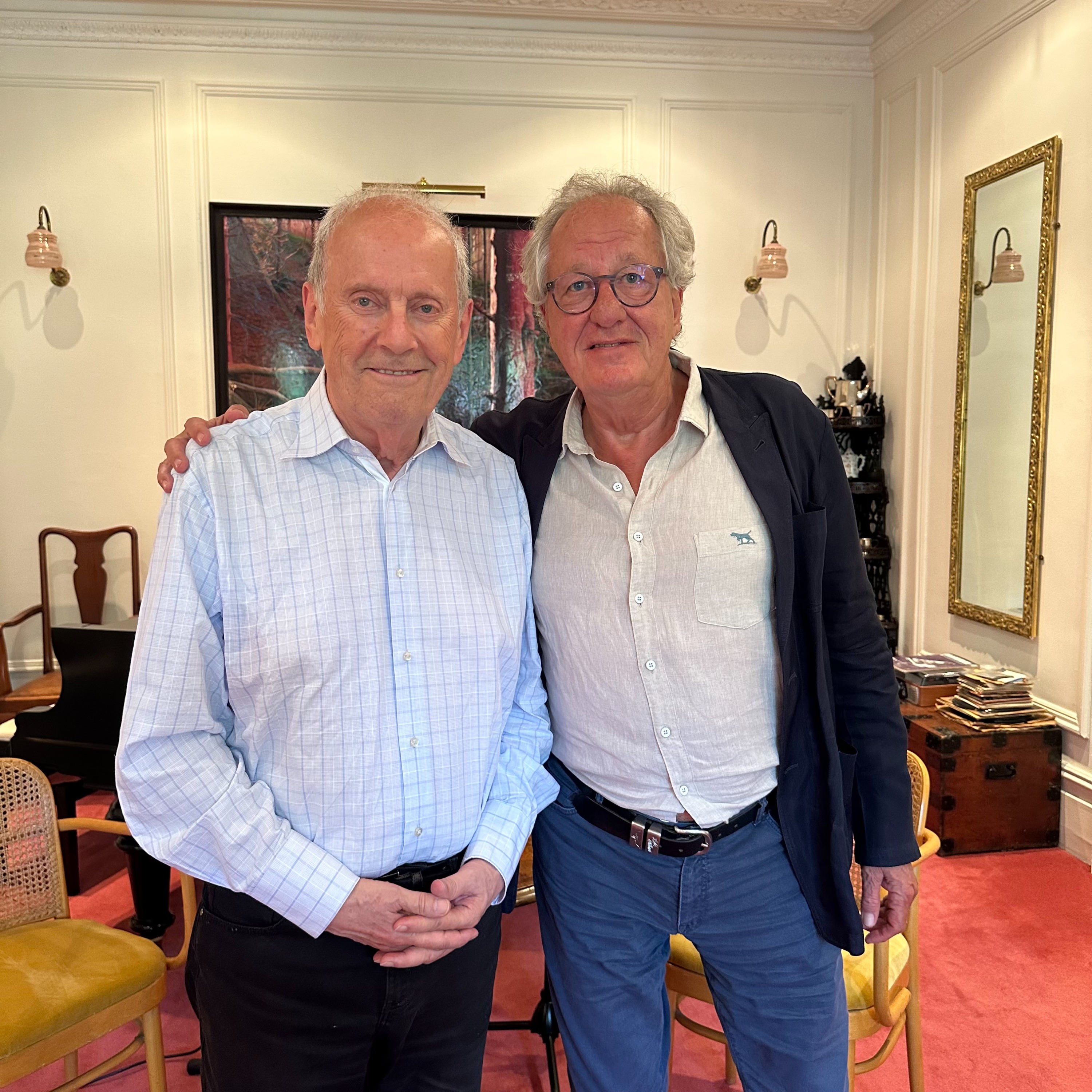
Geoffrey Rush: the only Australian actor to win a Tony, a Primetime Emmy and an Oscar, is our Rosebud guest today. Geoffrey tells Gyles about his childhood growing up in Toowoomba, Queensland, the son of a broken marriage, brought up by his mum and grandparents. He talks about his early memories of rural Australia - of gardens, flower festivals and fireworks - and then he tells Gyles about moving to Brisbane, and discovering his talent for performance. He talks about his work with the Queensland Theatre Company, about meeting his wife, Jane, about Shakespeare and training with Lecoq in Paris. He then tells Gyles about his big break in the Oscar-winning Shine, about winning the Oscar, and about Shakespeare in Love. He discusses his case against the Sydney Daily Telegraph, from whom he won damages in 2020.
Our heartfelt thanks to Geoffrey Rush for this fascinating conversation.
Don't forget to subscribe to our YouTube here. Join The Rosebud Family here. And visit our website here.
Hosted on Acast. See acast.com/privacy for more information.


