
 Ask ChatGPT



Written by AI. May contain mistakes.

Get the gist, explore an idea or ask about something said.
 Claude
On Rosebud with Gyles Brandreth, what are the key points of this episode?
Searching your listeningAutomatic transcript. May contain errors.
0:21Welcome to More Rosebud. More rosebud means, well, more of me, Charles Brandreuth, more of my diaries this week because every other week we give you bits from my diaries from my teenage years and more and this is a bit that people love more of my producer and friend harriet jane harriet have you brought in the teenage diaries and love letters from your yesteryear that you promised not yet it's coming it is it is because i'm moving house so then i'll i'll find it you're moving house that's oh gosh i have i'm gonna have to be a caring colleague while you're moving house because there will be the distractions of moving house there'll be the nightmare of are you having the new house done up a bit yeah oh good luck the builders they're never on schedule they're never on budget just i tell you this however much you think they will be however much uh you know well I don't think they will be they never have been in the history of the world I know I mean ours are really they work really hard they're not the ones that turn up three hours late and roll their eyes when you ask no they're really efficient good you also as well as editing the shows and doing everything that I'm not doing you look after our emails our correspondence and we're very grateful for emails also we love people putting on recommendations and telling their friends about us.
1:48Yeah. That helps us grow. Reviews, that helps us grow. I've actually just logged into a whole new bit of Spotify or something. And I can see things people have written about individual episodes. And there are quite a lot of comments after some of the episodes, almost all really positive, saying how much they love them. So I need to reply to some of those. It is funny. Positive things people never remember. The one negative thing that we'll see in there. will haunt you and me for weeks, won't it? That's so true. Yes. Yeah, that must be really true for you, is it? As a well-known person, if you get negative.
2:27Totally. Yeah. Absolutely. I mean, it's true when I was a member of parliament. You know, you've got so many people saying lovely things and nice, positive letters and feedback. But the one thing saying you didn't do this, you haven't done that, that's all that gnaws at you. And I've got a lot of friends who are actors and directors, work in theatre, entertainment, radio, television, films. Anything you see in the review that's negative, that's what you brood about. We're all the same, aren't we? And sometimes constructive criticism is good. Every now and then someone's pointed out something about Rosebud, usually in a nice way, but something they think could be improved.
3:02For example, when we very first started, someone commented that the jingles that announced the ad breaks came in really loud and they deafened them on their headphones. and I thought oh gosh that's a really good bit of advice and I've ever since adjusted the levels of the jingle so that they come in gradually and never get really loud. Thank you for doing that the attention to detail is terribly important. But that was a good bit of constructive advice. Yeah absolutely because we are I don't know there's something programmed in us to focus on the negative. I remember the first time I went to perform at the Edinburgh Fringe at the time I was with john bishop and he was saying how's it going i said it's going okay and we're mostly sold out he said yes he said i'm mostly sold out too he said but last night there was just one empty seat and you then become obsessed with that one empty seat why no i mean that's why is there one empty seat you really begin and that's what i'm like or he said if there's one person who isn't laughing you then find you you throw away almost the rest of the audience to determine to make this one person laugh.
4:09So when you're on stage, you're really looking at individual people in the audience, are you? Because I never know if people are or not. Well, what is interesting is often you cannot see the audience, depending on what the lights are like. But sometimes you can see the front of the stalls and your eye is drawn because it's a sea of faces. Your eye is drawn to that lone, empty seat. And then you're distracted by that. You think, oh, what's happened? Is somebody late? You know, what's going on here? Why haven't we sold? We said we were sold out. Why is that seat empty? You begin to brood about it.
4:44But they probably just didn't feel well, Giles. Quite possibly. It was sold out and they just couldn't make it. Yeah, exactly. Or you see someone who is, it quite amuses me, this does happen, people nod off. Oh, yes. And I have done that thing of getting the whole audience to go quiet. And I've said, there's somebody in the third row seems to have nodded off. Let's all on the count of three go boo. And we've done, everyone's gone quiet. On the count of three, one, two, three, boo! Oh, that's brilliant. And we get them jumping to them. You could give someone a heart attack doing that in one of your shows, John.
5:18I don't know. Thank you. Now, I want you to know that my audience is of varied ages. Yes, that's true. I often get very young people aged, and sometimes it makes me a bit anxious. It says on the programme, 11 plus. Yes. But that doesn't mean age 11 plus. It means that you ought to have got to be sufficiently intelligent to have passed the 11 plus. It's an intelligence requirement that I'm expecting. But my show is generally a family show. But I do get some young people. And they're mostly people who have just a minute on the radio fans. Young people aged 12, 13, 14, girls and boys love just a minute.
5:57Yeah, because we used to listen to it in the car. And sometimes there are young, actually boys and girls, who come who clearly quite like me. The boys are often wearing rather smart blazers and little bow ties. Yeah, I can imagine. You've seen the cartoon in the loo here, haven't you? Which has got a geeky looking boy wearing a jumper, a funny jumper with a rabbit on the front. And the parents are saying, what is one parent saying to the other? Oh yes, some kids want to be James Dean. Oh, Kevin wants to be Giles Brandreth. Well, there you are. Some people won't know who James Dean is. This cartoon was put out many years ago.
6:37Do you remember the name James Dean? Oh, yeah. I think people know who James Dean is. I don't think I've ever seen a James Dean movie, but I absolutely know what he looks like and even what he was wearing, the white T-shirt, the jeans, the quiff. Yeah, he's... Alec Guinness, Sir Alec Guinness, who would have been a great rosebud guest if we weren't doing it then. We've been lucky to have so many of the great theatricals of our time. But Alec Guinness told me that he saw James Dean. He was out in Hollywood filming something. He saw James Dean on a particular night. He hadn't really met before. James Dean showed him his beautiful car.
7:17And Alec Guinness had a strange feeling and said to James Dean, please don't get into that car. Please don't get into that car. and James Dean did, and that was the car in which James Dean died. No. He had a premonition. Have you ever had a premonition? No, not like that. That's... Quite deary. Gosh, that's rude. And he died that... I think that very night. Wow. That's amazing. Was James Dean a good actor? I don't know. Right. I don't know. I've not seen enough of his films. But he obviously had something extra. Yeah. He was a great star. Have you ever had a premonition?
8:03I don't know that I have No, I don't think I have I've had psychic experiences Oh, one week Oh, this is a treat for future listeners I will play to you Have you got a record player? Yeah, I've got a record player We may have a record player here as well I will play you the voice that I recorded of Winston Churchill after his death How? He is speaking to us from the other side. It's a quotation from, I think, Land of Hope and Glory. He's simply saying, Make thee mightier yet. Make thee mightier yet. This was an experiment that I took part in, oh, 50 years ago, where we sat in a Faraday cage through which you cannot get, you know, signals cannot be sent, with blank tapes provided by a newspaper that was monitoring this experiment.
8:59And with a man called Konstantin Raudiva, who was the kind of medium, we sat there and recorded conversations from the other side. And one of the people who came through was Winston Churchill. I will play you the voice of Winston Churchill beyond the grave. But were you convinced? A Rosebud special. you'll hear it does sound quite like Winston Churchill but all he's saying is make thee mightier yet wasn't much was it no but it had to come a long way from the other side well I mean is that all Winston Churchill's doing over there just sending messages rousing bits of the oratory to wherever the cabin was in Gerrard's Cross where we were making this recording now look enough of this badinage and nonsense Have we had any interesting emails?
9:52Any communications from people? From the other side? No, not from the other side. From this side. From this side. So, Suzanne Williams has emailed us to ask a simple question. Why was POBS called POBS? POBS, for people who are new to... I can't believe I've never asked you this. More rules, but I think you have actually asked me this. POBS was a girl who was at school with me and who was completely delightful, who I liked a huge amount, and who was great fun to be with. If she's listening or if a friend of hers says, God, he's banging on about you, do feel free to get in touch and we can meet again.
10:30You were younger than me then. You'll still be younger than me now. I can arrange for a restraining order. Absolutely. And there will be chaperones provided. Chaperones provided. Pops, I'm sure it was called Pops because of her toes. Oh. The bobble who had no toes had once as many as we. When they said, someday you may lose them all, He replied, fish-tittle-dee-dee. For his aunt Trubisca made him drink leavened water tinched with pink. Do you know this verse by... Edward Lear? Edward Lear, yes. And I think Bob's must have had something funny with her toes. Hmm. Yeah. And how did people at B-Dales know about her toes?
11:06Oh, I guess it was a boarding school, so you saw people's feet. Yeah, we saw people's feet. Anyway, Bob's and I were quite friends, so I might have seen her feet anyway. Yes, probably. Who knows? So she had funny little toes. Sorry, Pobs. I'm sure your toes are absolutely lovely. She was totally charming. Yes. Totally. She was not tall, but she was delightful. And, yeah, of course at school you know what people's feet look like. Yes, yeah, you do. Yeah, your gym and all that. Yeah, you see people's feet all the time. Showers and you see people's feet. Yeah, yeah, yeah. Did everyone have a nickname at your school then?
11:41Oh, I suppose most people did. It was an era. They were much bigger in those days, I think. Yes. What was yours? Did you have a nickname at school? no i mean people call me if someone calls me hazerbaijan which is quite funny because it's short harriet yeah hazer azerbaijan i mean it's it's quite an obscure nickname i'm sorry to tell you what was yours i was sometimes called by a group of people supercilious simpson oh you told me that i think i did oh poor you i didn't mind when it was abbreviated to super uh but supercilious That doesn't sound. But that, I'm afraid, that maybe tells you something.
12:19You see, I wasn't liked by everybody. And I think hearing my voice now, my voice is quite normal now. It may seem plummy to you, but compared with what it was in the 1960s. Oh, really? Yes. Oh, has it become? Much more. It's virtually estuary now by the standards of what it was then. Well, I mean, everybody's voice was posher then. But that must have been posh, Giles, because I think most people would think you're pretty well-spoken now. Which is interesting because, as you know, I did well in these speech competitions. Poetry, speaking poetry out loud, making public speeches, all that sort of thing.
12:52Well, your voice has a lovely timbre, if you don't mind my saying. I love you saying nice things. But it really does. And lots of people say how gorgeous it is. And can I say lots of people say how wonderful your voice is. I don't want this to turn into a mutual appreciation society. Well, okay. So, yes, you won the poetry competition. So what I'm saying is I would have thought that my voice was a kind of acceptable received pronunciation voice. Yeah, it probably was back then. Yeah, maybe it was more. But the very fact that I was called supercilious, I think, well, maybe was I looking down on the world?
13:21Was I seen as a, did I see myself as, I don't know. Oh, I'm sorry. Yeah. You asked the question, I gave you the answer. Yeah. I'm not brooding about it. so that leads on to the next question which is that in the last set of entries and in this set that we're about to read you're saying goodbye to b dales yeah i'm 18 you are i'm going to leave school and you've done your a level i'm ready to move on i have one more term to go because i'm going to be taking oxford university entrance papers and that gives you in those days you've got an extra term, a kind of seventh term in the sixth form. So I've got one more term to go, but I'm 18 and I'm ready to leave school.
14:02I'm ready for the real world. I'm eager, hungry. And actually, I've always been pretty good at moving on. Oh, interesting. You know, I think, I think so. I mean, I remember, for example, when I lost my seat as an MP in 1997. I thought, that's it. Fine. Good. You know, fresh fields, pastures new, ready to move on. Because you're quite a, I would say you're relatively sentimental. You cry. I'm the same. And I find goodbyes are my worst thing. I mean, I actually dread them and I would do anything almost to avoid them because i i start welling up even thinking about saying goodbye to someone if it's a proper parting no but i forgive me we're parting today and i thought we were seeing each other on sunday but we're not so we won't meet again till monday i'll be blubbing in the street that is a bit much just because that's two days i mean i know i know we see each other a lot I'm slightly exaggerating, but to make the point, I'm with you totally.
15:11But you know, if I say goodbye to someone, for example, at the end of school, or if they were moving abroad, or... You will see in the diary here, I think there's certainly one teacher that he and I avoided saying goodbye to each other. Yes, that's what can you... Because we would have found it too emotional. That's what you can end up doing, which is a shame, because you should... Ask not for whom the bell tolls, Harriet, it tolls for us. it's telling us it's time to record this next episode of my B. Dale's Diaries. Yeah, great. So Harriet, we've got to 1966. I'm now 18 years of age. This has been my last proper term.
15:50I've done my A-levels. But I'm coming back in the autumn term because I'm doing Oxford entrance. But this is the end of my school year. We're beginning, I think, on the 31st of July. I'm at home in London because it's the school holidays. Yeah. At the end of term, I do remember this, at the end of term, there was a festival organized under the auspices of UNESCO, the Confederation of Internationally Minded Schools. It was a festival with 120 young people, aged 16, 17, 18, from six different countries who came to our school, B-Dales. I remember our French teacher, George Smith, the senior French master.
16:27He was the honorary secretary of this organization. And we had this festival. It was quite important. And I think that's mentioned right at the beginning. Oh, and somebody else who's mentioned right at the beginning, who was then quite famous, was a man called Anthony Hopkins. Not the actor. He was a composer, a conductor. He was a broadcaster. He had a long-running BBC radio series called Talking About Music. It's the kind of thing you would have loved, because you're very into music. Yes, I am, yes. Anyway, so let me take a sip of water and take you back to 1966, Sunday, the 31st of July, 1966.
17:04The sun is shining, though none of it reaches my room. I don't mind. I'm very happy here. It is the 31st of July, 1966. Sally's birthday. I love her, and she loves me. She understands me too, which is very nice. This evening, I'm going over to Putney to her house for a birthday supper. It will be charming. Meanwhile, I'm here at my desk, having just completed my 5 ,000-word diary of the CIS Arts Festival. I'm editing the souvenir magazine. Of course I am. And now, all the contributions are in, it's clear that the star of the show was Mr Anthony Hopkins, who conducted the orchestra and swept in and out of the school grounds in one or other of his E-type Jaguars.
17:54One has the number plate AH600, the other 1 C-A-H-I-C Anthony Hopkins. How could you miss him? Some thought him vulgar and unnecessarily noisy. Others were bowled over. It ain't easy being a star. Highlights of the festival for me, apart from my French ham in the trilingual production of Noah, were discovering the poetry of Robert Frost and meeting Mr and Mrs Cecil Day-Lewis. that's the poet Cecil Day-Lewis and his wife was the actress Jill Balkan and they then sent their children Tamsin and Daniel Day-Lewis to Beedles they gave a wonderful poetry reading and were delightful indeed a very nice letter from Jill Day-Lewis has arrived this morning I got back from the festival yesterday morning yesterday afternoon I joined the rest of the nation if not the world in front of the TV to watch the football World Cup England v Germany.
18:57We won 4-2. It was the first football match I've ever watched from start to finish. And I admit, it was quite exciting. The stars of the day, Alph Ramsey, the wonderfully dry team manager, Bobby Moore, the captain, Martin Peters, who put England ahead with his goal, and Geoff Hurst, who scored the other three. I like to think it was the fact that I was watching that helped us to win. Oh, Giles, yes. We wouldn't have won if you hadn't been. I don't know. I have to say, every time I have watched a football match, England has won. I've unfortunately not watched many in the subsequent 60 years. How many have you watched since then?
19:38But I think I'm right in saying that Geoff Hurst is still alive. Now, Sir Geoff Hurst. Yes. And I met him not that long ago. Would he be an interesting guest for Rosebud? We loved Sir Viv Richards. I mean, absolutely. He was at one of the most memorable moments of British... Yeah, I mean, the word iconic is overused, but it applies there. So how many, just out of interest, how many football matches do you think you've watched since 1966? I watched one when we got to the semifinals and we won that. I was not available for the finals and we lost that. Oh dear. So I've only watched one women's football match ever.
20:17And you won. And we won that. Giles! So you're essentially the mascot of the English team, but they haven't made sure that you've been present often enough. Yes, yes. Interesting. From my point of view, back to the diary, from my point of view, it was a memorable day for a different reason. In the evening, I went with Ma to see Noel Coward in his double bill at the Queen's Theatre in Shaftesbury Avenue. The plays are not his best, but his presence is amazing. His speed of speech extraordinary, his panache unbeatable, his style unique. He's 66 and by all accounts not well. Last night was the last night.
20:59It was Noel Coward's farewell to the stage. And yes, ladies and gentlemen, I was there.
21:14Saturday, 6th August 1966. This is hell, and I am hating it. I'm in Kent at something called the St Mary's Bay Camp, organised by Lady Astor and the Children's Country Holiday Fund. It is a worthy cause, giving deprived children a seaside holiday. But the children are ghastly, really ghastly, and the place is grim, grim, grim. The huts are horrible. Torn lino on the floors, no curtains, cold water, disgusting lavatories. The food is uneatable, quite revolting. The organisation utterly hopeless. I am a volunteer helper. And I deeply regret letting Ma push me into this. I blame her wretched black bombers.
22:04She's on manic overdrive. This is my mother. I'd been prescribed really quite strong antidepressants that came in the form of large black capsules. Ah, and that was making her full of schemes, was it? Full of schemes, exactly. I don't know. I mean, I'm now supposedly a, this morning, menopause ambassador. And I'm supposed to be understanding people. Is it possible, I don't know what age my mother would have been then, that this was, that she was on some, was this? Oh, interesting. I mean, I don't know. Yes, she was menopausal. I don't know. I'm just suddenly, in retrospect, just a second, I'm thinking that.
22:42Absolutely could be the case because the menopause does make people feel a bit all over the place. And maybe she needed HRT rather than black bombers. Exactly, because she would have been about 50 then, you see. And I was 18. And she'd just come out of the fat farm. Exactly, the fat farm where she was losing weight. She was put on these black bombers, as we called them. I'm sure my father called them the black bombers. It's a funny name for them, isn't it? They were huge. Were they? Huge. Gosh, poor her. Black capsules. She popped them in and then she was full of energy. And, you know, she told me, I'm doing this, you know, we've got to come, Children's Country Holiday Fund, we're taking these four children to the countryside for a seaside.
23:20You'll come, you'll help the activities. I loathed it. And I was the same sort of age, or not much older than the children. Yes, I did something, I think I told you, I did something similar at your prep school once, yeah. But so she was on, basically, she'd been put on antidepressants, hadn't she? Yes. And they'd made her a bit too much the other way. Yes. Yes. Well, here we go. In fact, they weren't my age. I think they were much smaller. They were sort of eight to ten. Sunday, the 7th of August, 1966. I'm on the five o 'clock from Folkestone going home. I did the two and a half hour walk to Romney Marsh this morning and then pleaded sick.
24:02I know this is feeble, but I could not stand it any longer. I'm returning to London, my natural habitat, and I'm going to see Sal. Do not reproach me, dear reader. If you had a choice between spending time in a squalid holiday camp with a bunch of lawless eight-year-olds or falling into the gentle arms of a beautiful blonde with breasts like pomegranates, which would you choose? I rest my case, my lad.
24:35Oh, child. All right, you may be laughing. the line about, in my defence, I now realise the line, the breasts like pomegranates, is a quotation. It's not in inverted commas here, but it is a quotation from a passage to India. I think it's how one of the characters describes... That is fine then, Giles. Well, there you go. The point is, this is me writing aged 18. Yeah. And Sally was beautiful. And you're being honest. Well, I'm writing it in the diary. Yeah. Yes, yes. Monday the 8th of August, 1966. It is clear that I was meant to come home. I arrived to find a wonderful letter from Sal waiting for me.
25:24She sent it on the 6th when we thought we weren't going to meet up again until she gets back from France. I love the way it begins. My dearest, first and foremost, how empty and unexciting it all is without you. I miss you already, and six weeks of it seems unbearable. Almost unbearable. Two things help. One, I know you like to be missed. And two, you always seem to love me better when I'm not there. I love it all, in fact. I love her, in fact. Today I'm resting, playing Scrabble with my sister Virginia, working on my theatre programme scrapbooks, polishing off the material for the festival magazine before I send it to the printer.
26:12Tomorrow, at 11am, Sally will be here. Thursday, the 11th of August 1966. Cabinet reshuffle. George Brown becomes Foreign Secretary. He switches places with Michael Stewart, who now goes to the Department of Economic Affairs. This is Wilsonian manoeuvring to reward Brown for staying on board when he threatened to quit over the wages freeze last month. But the volatile Mr Brown, 51, is famously pro-Europe, so it may be good news for the nation. That's the view of me, GDB. The Times thinks otherwise. Also on the front page today, Mr Heath was turned away from a reception in honour of the Deputy Prime Minister of South Vietnam at the Dorchester Hotel last night because the security men thought his invitation might be a fake.
27:04The US have conducted an underground nuclear test in Nevada and a lunar orbiter has been launched from Cape Kennedy to take photographs of the moon's surface. The Monopolies Commission says that Unilever Ltd and Procter & Gamble Ltd should reduce the selling price of household detergents by 20 % and foot and mouth disease is spreading across the countryside, which is why I'm living in Bake Street. Sal will be here at 4.30pm. Monday, 15th August 1966. Refreshed by my beautiful girlfriend and boosted by my A-level results just in, straight A's for the A's and a 1 and a 2 for S-level. I've returned to the horrors of St Mary's Bay Camp to do my duty.
27:53Tomorrow at dawn, we take a coach to Dover and walk back. It's 21 miles and I will have four snivelling and unruly urchins in my care. It can and it will be done. Well done in your A-levels, by the way, Giles. Thank you. It's very good because you didn't think you'd done well. Do you remember? Yes. Well, I think, do you always think that, maybe after an exam? I think I really did think I did badly. Also, I think you think you did badly, say it to yourself, so that if you didn't do badly, it's a great boost. Yes. And I'm glad you didn't go into primary school teaching because you obviously don't like looking after little kids.
28:33I'm a very good one-day teacher. I think later in the diaries, I do go, I do teach at a school, but I may even go back to my prep school. Oh, yes. But, oh, gosh, that holiday was terrible. The truth is I wanted to be in London going to the theatre and seeing Sally. Yeah. Ah, then there's a quotation I put in the diary from Eric Bentley. When we get up tomorrow morning, we may well be able to do without our tragic awareness for an hour or two, but we shall desperately need our sense of a comic. I had read a book called The Life of the Drama by Eric Bentley. That's where the quotation comes from.
29:07And it really rang bells with me. The world is full of tragedy, but put that to one side and keep your sense of humour. Friday the 19th of August 1966 Suddenly, just now, I thought of Bettsanger and singing Nightingales The day thou gavest, Lord, is ended It has been a long, long day It began at the camp, the buses left in convoy for the long journey back to Ladbroke Grove I didn't enjoy one minute of it but I'm glad I didn't chicken out entirely and tonight I had my reward. I joined Gin and boyfriend, he's not yet popped the question, for dinner at Beauty's and I had my favourite, a very tasty Soule Meniere and for my next treat, the Whitehall Theatre on Wednesday to see the beautiful Mr Danny LaRue and the delightful Miss Barbara Windsor in Come Spy With Me.
30:10Now that's my idea of a fun night out. Sunday, 11th September, 1966. I'm sitting with a cup of tea in the Festival Club, 54 George Street, Edinburgh. This has been my base all week, where I've written up my notes, etc. My weekly club membership, 15 shillings, expires today, and I'm on the 12 o 'clock train home, reaching King's Cross at 7.54pm. It has been a satisfying week, though a bit lonely, which is odd since I've been busy, busy, busy all the time. I've been to 12 shows, see separate notebook for my reviews, and seen some of our great actresses giving their all. Notably, Gwen Frankson-Davies and Wendy Hiller, and Flora Robson as Hecuba.
30:55Jane Asher was Cassandra, and also a perfect perdita in Winter's Tale. She could be the new love of my life, but she appears to be committed elsewhere. She was famously the girlfriend then of one of the Beatles, Paul McCartney. Yes, I remember. I also went to the ABC cinema and saw Dr Zhivago and fell in love with Julie Christie. She is so beautiful. And back in the real world, I made a lovely new friend who made me feel less lonely. Honey Blake. I love her name. We had supper here on Friday and I took her out for a Chinese last night. I wonder if I will see her again. Probably not. Wednesday, 28th September, 1966 This is my last term at B-Dales Eight weeks from now, I'll be taking my Oxford entrance exams This time next year, I shall be starting at university If not Oxford, then somewhere else Cambridge, Bristol, York, Sussex, Reading I have the interviews coming up shortly And then what?
32:03Strange to say, I don't believe that I'm going to be an actor after all I think I realised that for the first time in my life today, this very afternoon, when I was walking with Simon, that's Simon Goodell, through the orchard on our way down to Petersfield for tea at the donkey cart. Simon knows he's going to be an actor. It's his destiny. It's what he lives for. That's why he's alive. Laurence Olivier says that if you want to be an actor, don't be. If you need to be an actor, then be one. I want to be a whole variety of things, but suddenly I'm thinking an actor, Tukur, probably isn't one of them.
32:46Secret truth. I'm not sure that I'm quite good enough to be a great actor. And if you can't be that, what's the point? Later, we talked about great acting and star quality. We talked about David Warner's Hamlet. It's all the rage. Hamlet, the contemporary student, Prince, in his college scarf, etc. And it's a fine performance in an interesting production, Peter Hall. But despite the brouhaha, do we reckon it's one of the all-time greats? No. David Warner is a wonderful actor, but does he have that little bit extra? As per the story of Dame Edith Evans and the young director who'd spent day after day of rehearsal telling her where to stand, when to sit, how to say this line and that.
33:32Eventually, Dame Edith turned to him. Young man, when are you going to give me a moment to do that little extra something the audience has come for? On Saturday, the school film was all about Eve. George Sanders has that little bit extra. If I could be as good as George Sanders, I'd be an actor. Oh, and he was a medallion. Simon and I are planning some sketches for the next merry evening including one about us set 40 years from now in which Simon has become a great star and I've become a down-on-his-luck waiter and I'm serving him a drink and he doesn't recognise me funny we hope and poignant 1st October 1966 Trouble Serious trouble and I'm in part responsible.
34:30One of the girls in my year is having a relationship with AB and I've been helping her. Their affair is illegal because she's a pupil and he's a teacher. But they are in love and I have assisted them by acting as a decoy, being seen going over to his room arm in arm with her, apparently to do French revision, and then leaving her in his room alone while I've sat KV outside the door. Anyway, it seems that she is now pregnant. He's going to have to leave, and I don't know what's going to happen to her. She's got exams, etc. I think she'll leave to have the baby and then come back to take the exams.
35:11They're going to get married. It's quite funny. Whenever outsiders ask about B-dells, they always want to know if we're all sleeping with one another. I say no. It's the staff we're sleeping with. Well, Giles, this is one of the most serious things that has happened in Beedales, because a few things have happened, haven't they? Well, it's a major thing that should never have happened. The teacher was, I think he was a full teacher. He was very young. He was young, yeah. Early 20s, you know, and people in my year would have been 18. Yeah. But it should never have happened. I mean, it's just not on.
35:49And do you think that, because you've obviously mentioned lots of times in the diaries, B-Dale's liberal ethos, which obviously extended to things like tolerating quite a lot of relationships between students and it being written in the book and, you know, a bit more of a relaxed atmosphere you might find at other boarding schools. Do you think this was problematic or do you think it was a good way to run a school? This has been over the years controversial. And there have been former pupils at B-Dales who didn't like their time there and didn't like the, in quotes, liberal nature of it and have written about it very critically.
36:30Because I knew the founder, John Baddeley, who founded the school in the 1890s with his wife, knew him to be a Christian socialist, somebody of high moral value, somebody of integrity, but also liberal and wanting the work of each for the wheel of all, a community of equals, staff and teachers, equal in their way, some more experienced than others, but he would never have tolerated this. I say that, but at the same time, we all knew at the school that the deputy headmaster, a man called Mr King, Cyril King, who was a sweet elderly gentleman when I knew him in his 60s or even 70s, he had famously, in the 1920s, married the head girl.
37:15and he was the deputy headmaster and she was teaching at the school so we knew and she was a senior English teacher as an adult they'd married and then she'd become a teacher they had children but they were now in their 60s and 70s so there was a history of staff people I'm not suggesting I think she probably I don't know that she had left the school when they got married and it is an issue of course it should never have happened, it's inexcusable and the teacher in this instance was dismissed immediately. It was a big thing. But they did want to get married. In fact, I know they got married and they were happy and they had other children.
37:55But I think what's interesting about a diary is that it's a record of a period. Yeah. And, of course, there are things that are right and wrong. And that was wrong, I would have thought, by anybody's standards at any time. Well, you say then, trouble, serious trouble. Yeah, and I knew it was trouble. Anyway, it happened. And what I'm really saying about the diaries is that they are interesting. I know when you see a television programme now from this period, they often say beforehand, you know, this reflects the values of the time. Yeah. And I think, well, fine, it's good to be told that. And so it does.
38:35And that's what's interesting about it. Yes, of course. So this happened. I was hugely happy at the school. Some people found that if you were motivated like me and you were a self-starter and a hard worker, it was great. I think there were some people who weren't and who were more pushed the way of the wind for whom maybe it wasn't so good. Yes, I was going to ask you that. Were there people that weren't happy and didn't thrive? There must have been. Because you said, for example, to me, that your friend Simon wasn't happy there. No, he wasn't happy at all. He ran away. And his parents got a cottage, rented a cottage near the school ground so they could be there at weekends to see him.
39:12He didn't like it. It didn't work for some people. Relationships, girlfriend, boyfriend, were allowed, encouraged. But you see, different values, different ages. This was an era where, for example, homosexuality would be against the law. And so would our view of two boys at school holding hands, now, if you read about it in the diaries, what would your view be now from then? Values change. but I think it is not on in any circumstance for a person in authority, i.e. a teacher, I was young, to engage in a relationship with one of the students. And in fact there weren't flirtatious relationships.
39:54I had a very good relationship with the teachers and as you can see from the diaries, really close relationships with the teachers but they were always teacher pupil relationships. Oh of course that wasn't true at my prep school where there indeed was somebody who should have been arrested, but was moved on to another school. Yeah. These things happen, and it's part of the record. Yeah.
40:24Okay, on we go. Saturday, 5th November 1966. I love that. We just had the fireworks, haven't we? And now we've got to Saturday, 5th November 1966. The highlight of half term, the highlight of the year, of the decade possibly, was 8.30pm last night at the Golders Green Hippodrome. Simon and I went to see Miss Marlena Dietrich and she was indeed sensational. We knew that she would be, of course, but the reality exceeded our expectations. the delayed start the sense of anticipation the prolonged overture the rustling of the curtains the completely manufactured but nonetheless real anxiety will she, won't she be appearing and suddenly she does we find her in a spotlight in that dress in that outrageous floor-length fur with those eyes and that teasing smile and we roar we stand and we cheer and she laughs at us and takes it as her due.
41:34Formidable in every sense of the word. Every element of the evening was impeccable. Her appearance, her face, her hair, her arched eyebrows, her voice, her banter, her timing, her repertoire, her arrangements take a bow, Mr. Bacharach. I want my life arranged by you. But Bacharach was there. He'd done the arrangements. He was conducting the orchestra. Yeah, yeah. In the program, there is a note about Marlena Dietrich by Ernest Hemingway. He says, I think she knows more about love than anyone. I know that every time I have seen Marlena Dietrich ever, she has done something to my heart and made me happy.
42:15If this makes her mysterious, then it is a fine mystery. The mystery to me is how the magic is contrived. From start to finish, there are tingles up your spine. She is extraordinary. Never mind love. I think she knows more about theatre than anyone. When it was over, the moment it was over, Simon said, follow me. We raced into the street and round to the stage door. A crowd was already gathering and a car was waiting. Simon said, that'll be the decoy car. Let's wait in the front. So we did. And we were duly rewarded. After about half an hour, another limousine appeared and drew up in the street in front of us.
42:54A policeman appeared and then another. There was a flurry of movement around the theatre doors and suddenly she was there before us within touching distance. She was small and looked so gentle and she smiled at us. As she walked towards the car from around the building a crowd came surging, men and women young and old. And just as I thought she was about to be trampled underfoot, I realised that two men, her driver and one of the policemen, were lifting her bodily onto the roof of the limousine. They held her as she struggled to her feet. She was wearing a sort of leather miniskirt, and on spindly high heels she then began to teeter about the roof of the car, her arms outstretched to maintain her balance.
43:37She looked down at us, laughing as we began to cheer. As she mouthed the words, I love you, her driver held up a sheaf of photographs for her, already signed, and she took them, and wobbling to and fro on the roof began to distribute them to the adoring fans. When the pictures were all gone, she revolved slowly, surveying the scene one final time before lowering herself onto her bottom and edging herself towards the side of the car and me. This was Golders Green at midnight and Marlena Dietrich was coming off the roof of her limousine into my arms. Her legs were thrust towards me. as the policeman helped her to the ground for a never to be forgotten moment in my hands I held Marlena Dietrich's left thigh.
44:27Well, there you are. It's a pity my whole life peaked on the 5th of November 1966 but it did at least peak at some point. You know what I mean by Marlena Dietrich, do you? Yes, I do, of course. Yeah, I mean, she was extraordinary and she appeared in those famous films in the 20s and 30s and then became an internet and lots of films going on after the war as well and then became a huge international cabaret star i was thinking that in a way now we have i think what replaced people like this because i was thinking who's marlene dietrich to us you know and i was thinking it's really been replaced by pop stars or rock stars people like madonna yeah would have been Yeah.
45:10Britney Spears. What you were saying about, what Hemingway was saying about she is love, you know, it made me think, I used to be really into this guy called Prince. I think I've told you before. And I've seen him, I saw him lots and lots of times in concert. And he did something like that. You know, he sort of embodied something. But yeah, I think that's what you were saying. If you want a good Prince story, people, Was it Christine Scott Thomas who began with her Prince story? Yeah, she worked with him. Who was it? What did Linda LaPlante have a funny story? Freddie Mercury. Freddie Mercury.
45:47Not to be confused one with the other. Well, quite similar. Short, quite eccentric and extremely gifted and talented. With this, which I think is what you're describing that Marlene Dietrich had, she has incredible stage presence and ability to connect. And when she was an ordinary person, Kenneth Tynan told me this, he was a theatre critic who knew her, you know, she came for supper, she'd be the first one on with the marigolds at the kitchen sink. Oh, really? She was, you know. But John Gielgud, the great Sir John Gielgud told me, when he was in New York, he went over to her place for drinks or something, Marley and Dietrich, and she said, you must listen to my new record.
46:27and she put on an LP, not an EP, an LP. The first side, one side of it. No, there were two sides for it. Were there an equisit to both sides? Yeah, two sides. Side one was simply people applauding her. And they sat there and listened to it. Brilliant. I can't believe she got on top of the car. And there are photographs of her doing this. She obviously was part of what she did and it was part of the routine. And, you know, the driver had their photographs ready. I mean... It's amazing. I mean, now there's no way, you know, the kind of the risks involved of being exposed like that and on top of a car in a pair of high heels.
47:02I mean, it's absolutely mad. And you saw that. Well, I mean, I genuinely held Marlena's left thigh. Wow, says Giles. Yeah, yeah. I have lived. You really have? Yeah. It's been downhill really all the way until I met you a couple of years ago. Oh, thanks. Yeah, well, if you're lucky, I'll get on the top of the Ford Mondeo later. Oh, please. I think we'll take a photograph for behind the scenes Rosebud. Okay. That would go viral on TikTok. I'm not getting on top of a car, Giles. I've ruined my car. For me? No. Get on top of my car. No, I'm not denting the top of my car. You were boasting to me how slim you were last week.
47:38For some Rosebud social media content. I think you should. Are they committed or not? She was committed. That's why we're talking about her. Yeah. Years after her death. It's true. Will they be talking about you, Harriet Jane? I don't mind if they're not. I do. They will be. Okay. Monday, 28th November, 1966. I've just emerged from three hours of General Paper 1 of what is described as the examination of the men's colleges of the University of Oxford for admission and entrance awards. We were faced with a six-page essay on authoritarianism by Hannah Arendt. I answered the question, what sort of evidence do you find for or against the view that we are in fact confronted with a simultaneous recession of both freedom and authority in the modern world.
48:30I have no idea what I said or why. Oh, golly. Wednesday 30th November 1966, I came out of this morning's OK-ish English literature examination and was summoned to Mr Slack's study at 1245. He was their master. He was beaming and hopping from foot to foot the way he does. He asked if I'd like to be head boy. I said, yes, of course, thank you very much. He said, you don't seem very pleased. It's only for a few weeks until the end of term. I said, no, I'm delighted, thank you. He said, we didn't ask you before because we thought you were so busy with all your activities, with the things you do for block two and so on.
49:11That's fine, I said. but I could see that he was surprised that I wasn't as pleased as he expected me to be. And you didn't need to be head boy to get into university, he went on. I said thank you again and we shook hands. I didn't realise it was important to you, he said. That's what I think is interesting. He didn't realise that it would matter to me. Of course I wanted to be head boy and now I am. It's too late and it doesn't mean a hill of beans. Isn't that interesting Wow You had your nose put out of joint Well obviously I felt it was my due to be made head boy Well I think you did deserve it by the way Well you're very sweet I did everything There was nothing I did not do I did it at the school magazine I starred in the school place I even ran the 220 You were doing the cycling proficiency classes I was doing everything Yeah Running the bookshop But they I'm sure thought well he's busy enough and also kind enough to make the point and you didn't need to be head boy to get into university.
50:16They might have thought there's a marginal candidate and we'll help them. Yes. Brandreth doesn't need it. That's true. And then they thought at the end, well, you know, obviously he's going to like to leave as head boy, wouldn't he? Let's make him head boy. Yeah, interesting. And do you think you'd been feeling bitter about it? No. Before this day or do you think it just... Funnily enough, it's interesting, I don't think I mentioned it at all in the diaries. so I don't think I was thinking about it. I don't think I was. No. No. I don't think I was brooding about it. Yeah. But anyway. Monday, 5th December 1966.
50:55This morning, Petersfield 8.30, Guildford 9.24, Reading 10.13. Interview with someone from the English department at Reading University. He was youngish, bespectacled and bearded. He had a tiny room, not much bigger than a coffin. A desk piled high with papers, a small window, and on the back of his door, a huge poster of W.H. Auden. We talked about the lines on Auden's face, so many of them crisscrossing his features like tram lines. Can you picture, Harriet, W.H. Auden? I don't know if I can. Oh, you know what I mean, the poet. Oh, no, I know who W.H. Auden is. Stop all the clocks. Exactly. He's crisscrossed with lines, so many lines across his face.
51:38and Noel Coward said, seeing this famous photograph of Auden with all these lines across his face, look at his face, now imagine his testicles. Well, I didn't try telling that joke at the interview. Probably didn't know it in those days. Oh, they'd have loved that. I don't know. I don't know. I don't think they would have loved Noel Coward. Anyway, it was not an interesting or promising encounter. I know they won't offer me a place and I can't say I'm sorry. I came back on the 2.34 and got to Petersfield at 4.30. I'm now in the library, the one place here that I'll really miss. I love it in here.
52:17The beams, the smell of beeswax, the absolute silence, the copy of Hilary Spurgeon's tome on Shakespeare's imagery that no one else seems to know about. I'm upstairs in the gallery looking down. At one end, I see the giant globe. but the other, the library calendar. I'll miss the calendar. Yes, for their sustaining philosophy, some turn to the Bible, some to the Koran, I go to the library calendar. Here is my latest batch of wisdom, my favourites from November. 5 November. Idleness leads to languor and languor to disgust. Amiel's journal. 7 November. Always laugh when you can. It is cheap medicine.
53:02Merriment is a philosophy not well understood. It is the sunny side of existence. Lord Byron 13 November If I were ambitious, I would desire no finer epitaph than that it should be said of me he has added a little to the sweetness of the world and a little to its light. Havelock Ellis 21 November Perhaps the most valuable result of all education is the ability to make yourself do the thing you have to do when it ought to be done, whether you like it or not. T. H. Huxley Friday, 16th December, 1966. I'm on the train back from Oxford. I'll write it up properly later. Dreaming spires, etc. For now, this is the essence.
53:52It didn't go wonderfully well. The disaster was the big interview with three senior New College dons. It was led by Mr Quinton. Well built, beaming, genial, very much the man running the show. He thought to put me at my ease by starting off with some questions about my much vaunted interest in prisons. I burbled rather boastfully for a minute or two when I heard him ask, Mr Brownworth, what is a star prisoner? I didn't know. It's a term quite commonly used in the English prison service, he said pleasantly. It means a first-time prisoner. Oh, I said, I didn't know. From then on, I was completely thrown.
54:37Damn and blast. Reading, here we come. Sunday, 17 December 1966. I've been doing the rounds, saying my goodbyes. Gonda, the librarian. Rachel, the drama teacher. the chief that was the old headmaster founder of the school H101 I will miss our games of Scrabble he says he will too I shall miss Scrabble and tea with Mr and Mrs Cox as well I'm trying to see everyone because when it's over it's over I shall not come back I must add this I've been getting letters and notes from the block two people
55:19There'll be going to be some... Oh, better take a sip of tea. There'll be some sentimental bits coming up. Oh, Giles. It's sad leaving places. It is, isn't it? Awful, even 60 years later.
55:35I must add this. I've been getting letters and notes from the Block 2 people. Lovely letters and notes. Lots of them. So many, I think, it must have been coordinated. they're all going into the archive
55:52may I thank
55:56how do you know you can't read it Harriet why don't you, seriously because you know how labile I am my mother was very labile my father kept saying oh she's so labile means you cry a lot I know you cry a lot too But you won't cry at this because it's me and not you. So since it's pretty sentimental, I think, to the end of this, because it's the end of my school years, why don't you read for me? Go from I must add this, just the last two entries of my school diary. OK, I hope I don't cry. I must add this. I've been getting letters and notes from the Block 2 people. Lovely letters and notes, lots of them.
56:43So many, I think it must have been coordinated. They're all going into the archive. May I thank you for being so kind and generous to me. The school shan't be the same when you leave. In fact, it will be much quieter. Yours faithfully, James. Here's another one. Thank you very much for letting me be on your supper table. I've enjoyed it very much. Well, goodbye, Giles. Lots of love, Biddy. Or Bridget, if you prefer, etc. I'm off to the dance now, MC and cabaret. I'm doing a soft shoe shuffle with the headmaster. I'm imitating him and he is imitating me. Tuesday 19th December 1966. This telegram came today, sent from Oxford at 3.40pm.
57:34All in capitals. Awarded scholarship, new college, congratulations, Quinton. Thursday 22nd December 1966 I'm meeting Sal at Tottenham Court Road, Tube at 4 We're going to Foils to buy Christmas books and then having tea at Lyons with toasted tea cakes, I hope The Post has brought this letter from Hegg Harold Gardner, my English teacher and the best of men Ridge Cottage, Steep, Petersfield, Hampshire 20th December 1966 My dear Giles what an extraordinary thing that at the last moment neither of us oh dear
58:20sorry you're making me cry giles okay my dear giles what an extraordinary thing that at the last moment neither of us felt capable of facing the other and so the congratulations are by the more formal medium of a letter. They are nonetheless heartfelt and of the warmest. You have deserved every grain of success for the way you have done everything one could have hoped for and then still found the time and the drive to do more. I don't think a swelled head is a serious risk and so I can say how much more pleased I am for your success than for any other pupils whom I have ever taught
59:10or whom I am ever likely to teach. I, Harold. Giles, that's so sweet. I can't believe we're both crying. And if I can find a photograph, we'll show a picture of this man. He was, I suppose, late middle age, in his 50s or 60s. He was so bald. He was almost like a caricature of what an English teacher would look like. Quite thin. He wore a jacket with leather patches. And he had a lovely wife. And funnily enough, one of his daughters got in touch. She was at school too, a little bit younger than me, a year or two ago. And came here to this room where we were recording this. And we talked about him.
59:58Been dead long gone. But, you know, what a good teacher. But he obviously really, really loved teaching you and got a lot of satisfaction out of it. Yeah. That's lovely, Giles. Sorry, everyone listening. No. That I, Giles asked me to read that because he thought I wouldn't cry. But what you probably know if you listen to this podcast a lot is actually Giles and I set each other off. So Giles was crying listening and then I burst into tears reading it. But it was a lovely letter and I hope you managed to get the gist of what it said. Well, next time, two weeks from now, we'll move on to 1967, the beginning of my gap year.
1:00:41More adventures. What happens to Sally while I'm away in America? Oh. Let's discover that. Oh, dear. Yeah, exactly. But interestingly enough, I didn't go back to the school for many years, I don't think. I was going to ask you. And I don't think I saw any of the teachers again. I don't think Mr Gardner and I ever met again after that. Gosh, that's interesting. No, I don't think we did. So I was very keen to move on. I know that's what you've got to do. And obviously, you know, like any school, there are good teachers and not so good teachers. But I had a wonderful time there. And for me, it was a very, very good school.
1:01:22And it allowed me to do all sorts of interesting things. and do you think you would be the Giles you are today and have been and that we know and love without having been to be Giles yes I think so I mean I may have moved in a different I was glad to be at a co-ed school I think that was good I now think, I didn't think it at the time at all but I now think my parents may have thought of the co-ed school because of the male teacher at my earlier school, the predatory male teacher. And I think they thought, well, let's go. They were alarmed by that. Maybe they were. We never talked about it. And I don't know, I don't know if they ever knew about it.
1:02:10And there's a hunch in retrospect. But were you happy at your school? Yes. I was someone that liked school. But I didn't have an experience like you. I went to three different secondary schools because of things that happened at home I moved around a bit so I was the new girl a few times and so I put on a happy face because that's the sort of person I am and I got on well with everyone and I did my work and I did well but I wasn't sort of fully ensconced in it and they were just secondary schools so it's not quite the same sort of community but I did go to boarding school in the sixth form and I really enjoyed that and you're going to bring us a bit of your diary.
1:02:52You've dug in for next time, maybe. Yeah. Oh, look, the bell's going again. Oh, it's not from the bell tolls. It tolls for us. It means this episode of Diaries in Rosebud is over. More Diaries in two weeks' time. Yeah. Next week, more Rosebud will be again different. Yeah. Who knows? We've got some fabulous guests coming up. We've had some fabulous guests. We've got some... We've got coming up some amazing guests, literally Oscar-winning, world-class movie stars and TikTok sensations, the like of which, I mean, we've really come ring the camera. We're going to have our first 21-year-old guest, I think.
1:03:29Yeah. And we've got some people in their mid-80s as well. The whole, this is the podcast of our times, reflecting our times. We've given you the 60s today, but we like to feel that Rosebud is a podcast that's as modern as tomorrow with a lot of time for yesterday. Oh, but before we go, I think we've got some special music to play us out today, haven't we? We do. What is it? So in the last Diaries episode, we read an email from someone called Angela Horner. I remember. People may remember. And she was talking in that about her mum who could play the piano, even though she had dementia, she could still play all these tunes.
1:04:08The reason she wrote in was she said, our theme tune, the piano one, the more rosebud one, reminds her of the All Creatures Great and Small theme tune. and that led her to talking to us about her mum, Dorothy, who loved the All Creatures Great and Small theme tune and also she could play other things like Amazing Grace, which is what she's going to be playing here. And even when she had dementia and had it for 10 years or so, she was still able to sit at the piano and play this amazing music. Because music is the last thing to go, isn't it? You know when people can't remember anything and they can't even necessarily talk anymore really, they can still, music still resonates with them.
1:04:47So we're going to hear now Dorothy, the mum, actually playing for us on Rosebud. Well, this was recorded, I think a couple of years ago, to play at Angela's father's funeral. Oh, how touching. And it's her mother playing Amazing Grace on the keyboard at the nursing home where she lived. Well, with real feeling, I'm going to say, and actually little tears in the corner of my eyes, cue the music.
1:05:19Amen.
1:05:48That was more Rosebud with music by Phil Leppard, production by Harriet Jane, and in the chair, me, Charles Brandreth. Thank you for listening.
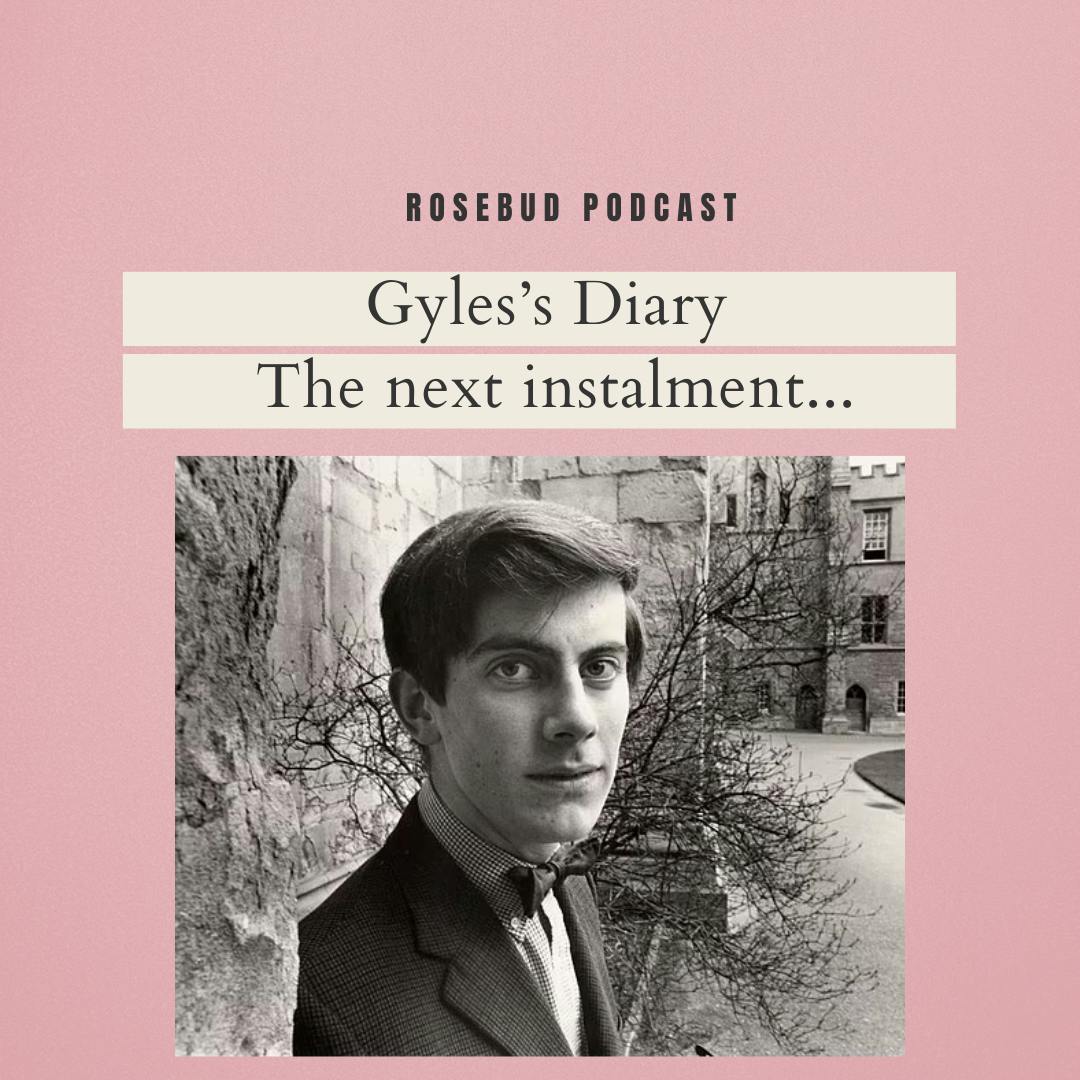
The second half of 1966 - Marlene Dietrich, university interviews, and the final goodbyes.
This is a roller-coaster episode of Gyles's diaries, which is full of incident. Encouraged by his mother, Gyles goes on a charitable summer camp to Kent and doesn't enjoy it; there is a scandal at school while he is preparing for his Oxford entrance exam; he and Simon Cadell see Marlene Dietrich live in Golders Green and, in a moving finale, he leaves Bedales for good and gets goodbye letters from some old friends. Plus Gyles and Harriet chat. NB in this episode there is some discussion of some sensitive issues around teacher/pupil relationships. As Gyles reflects, these diaries present what happened to Gyles back in the 1960s - times have changed.
Learn more about your ad choices. Visit podcastchoices.com/adchoices
Hosted on Acast. See acast.com/privacy for more information.


