
 Ask ChatGPT



Host: Gyles Brandreth
Harriet Jaine
Exploration of first memories and experiences with humor and nostalgia.
@therosebudpod
Written by AI. May contain mistakes.

Get the gist, explore an idea or ask about something said.
 Claude
On Rosebud with Gyles Brandreth, what are the key points of this episode?
Searching your listeningAutomatic transcript. May contain errors.
0:20Welcome to More Rosebud with me, Charles Brandreth and my friend and producer Harriet Jane. Harriet, what do you think is your passion in life? I ask for a reason. Oh, that's a difficult question. And I have not given you a forewarning of it. This is rather like I do a radio show called Just a Minute, where they give you a subject to talk about for 60 seconds without hesitation, deviation or repetition, and you genuinely don't know what it's going to be until they give it to you. I know. So, I'm asking you, and I'm not telling you... Well, I'm going to tell you why I've asked it in a moment. But what do you think is your passion?
1:00Oh, gosh, I really don't know. Cake. That's a good answer. And eating things like that as often as possible. Sometimes for breakfast. Really? Yeah. I have a chocolate biscuit for breakfast or a cake, yeah. I mean, I've got a really sweet tooth. I've already had two chocolate sort of large chocolate biscuits today Wow The reason I ask the question is I've been reflecting on wisdom given to me many years ago by the great psychologist Dr Anthony Clare who said that to be happy in the long term in life you need to cultivate a passion have something in your life that sustains you when in your case it's cake and it does sustain you That's not going to keep me alive really keeps you going.
1:51And I often think and compare the late Margaret Thatcher, whose centenary is coming up later this year, with the late Queen Elizabeth II, whose centenary is coming up not long after that. And I know the late Queen Elizabeth II, her passion in life was her dogs and her horses, and they kept her going to the very end. And Mrs Thatcher, her only passion was politics. And when that was taken away from her, She had nothing to sustain her. And I was brooding about it, thinking, is one of the reasons that I work all the time because I'm frightened that I don't have anything else to fall back on, any other passion apart from my work?
2:33You've got lots of interest. I do think I do. And I'm probably the same. I have a passion for Shakespeare. I have a passion for words and for language. So, yes, I do have a passion. If everything else was taken away from me, I could still read books. I could go to the theatre. So yes, I do have a passion. And you could still eat cake. Yeah. Do you bake cake? Sometimes, not as much as I eat it. I like Mr. Kipling cakes that you just buy in the shop. Oh, look, we are awash with sponsors, but we are ready for more. And I have to say, you would move right to the front of the queue if you were Mr. Kipling getting in touch with Rosebud.
3:11I love the little, like the French fancies. Oh, yeah. Those French fancies. Oh. Which colour? do you like? Well, I'm afraid I quite like the pink. Because I like the yellow, because I think they taste of lemon. Yes, they do. Oh, let's have a Mr Kipling party, you and I. That would be my idea of heaven. I mean, the truth is, and I think our listeners have worked this out, we are going back to our childhoods with this podcast. We often liken ourselves to teenagers in the sixth form common room, getting together and plotting the school magazine. What are we going to have next week oh we've got who have we got an interview with it wasn't this exciting and i remember in my sixth form com room we had a toaster and we could make toast yes and i loved the toast and the butter and the honey and sometimes we mix marmite and honey and occasionally mr kipling's cakes existed in those days oh really yeah i think mr kipling and people would bring in those french fancies are fantastic i love i love those exceedingly good cakes indeed mr kipling wrote exceedingly good poetry as well.
4:14But Mr. Kipling makes exceedingly good cakes. I love that. So, Mr. Kipling, feel free to send us some samples of your new ranges or your own ranges. Yes. And feel free to sponsor us. Absolutely. We'd do such a good advert for you, wouldn't we? We would. Funnily enough, I enjoy the ads. Do you? You've shown me the device where you can actually press and move forward 20 seconds. So you don't need to listen to all the ads. Well, yeah. So I sometimes, but I do listen. No, ads are fun. I used to love, when I was a child, I remember loving the ads. They were so fun, weren't they? Oh, and do you remember, was it the last episode of the Diaries?
4:50I was offered a job by a big advertising agency when I was working during my gap year in the United States of America. Of course you were, yeah. Actually, it's a good time for me to say to people, listeners, that the ads can be possibly sometimes be a bit annoying, but that's how we pay for me for things we do on the podcast so listen enjoy and don't fast forward just think please don't just think oh i'm i'm buying harriet a cup of coffee yeah exactly they're a necessary i shouldn't even say they're a necessary evil they're not they're good they're very very good and i have to say harriet comes on the underground always to our recordings I occasionally do take a taxi but I do not charge it No I don't charge the taxi because I feel I've got freedom pass I could go on the underground for free We're quite I think we're quite careful with money aren't we We don't spend money much But we would love to have some Mr Kipling cakes Oh we would yeah So it's diary day Is it diary day today?
5:59Do you want to do a letter before we get round to the diaries? I thought I'd just read an email just because it was a really lovely email and I thought everyone would love to hear it. And it relates to what we were talking about at the beginning of the last Diaries episode, which hopefully everyone's heard, where we were talking about childhood bereavement, which I think struck a chord with a lot of people. So as a result of that, someone called Alex Porter emailed in this lovely letter. Hello to you both, Alex says. I wanted to write to you to say, I love listening to your podcast. It cheers me up on long commutes, makes me laugh and cry, and generally gives me the opportunity to switch off from hectic family life, which is what we're here for.
6:45I want to share one of my first memories, which is very dear to me. I was four, and it was a warm July day in 1984. My brother and I were picked up from school by my dear dad. He stood waiting for us with a huge wide grin on his face. We ran into his arms, and as he gave us a big squeeze he said you've got a new baby sister his complete joy at the birth of his third child radiated from him we spent a very excitable car journey to kingston hospital and when we got there my mum and new baby sister were still in the delivery room such a happy day these memories are particularly close to my heart because we lost my dad very tragically nine years later when i was just 13 years old.
7:32Harriet's words on the last episode of Diaries rang very true. When you lose your parent as a child, there's something left hanging over you that you can never quite solve or get over. You are indeed stuck in some ways as that heartbroken child, always craving that parent that you lost and forever missing them in every stage of your life going forwards. Me and my siblings were very lucky to have an amazing mother who picked up the pieces and became both mother and father from then on. She's the rock of our family to this day and now a magical grandma. My dad's name was Darcy Lodl. What a lovely name.
8:12And he was just 50 when he died. He was the most wonderful father and human being and I treasure the years we were with him and the love he gave us. He was a very positive person and I like to think he instilled that in me. I'm now a parent to a seven-year-old boy, Leo, and my daughter Izzy, who's ten. I often talk to them about Grandad Darcy as I want him to be in their lives, even if he's not physically here. I recently picked up my daughter Izzy from school and she handed me a piece of paper with a poem written on it. and although she's not aware of your podcast she coincidentally had chosen to name it Rosebud.
8:52Rosebud by Isabella Porter. So this is a poem that Alex's daughter, 10 year old daughter Isabella wrote called Rosebud. In the horizon deep through the earth lay down a rosebud distant of its worth flowing like a flower through the turquoise sky farmers harvesting in a meadow nearby. Cherry blossoms blooming, petals in the air. Sometimes I wish I could be a rose out there. That's all I wanted to say. Thank you, Harriet and Giles, for your brilliant show. Bye for now. Alex Porter. That's a very touching letter, isn't it? My goodness. And what a lovely poem as well. Yeah, well, Isabella Porter, my gosh.
9:40Look out for that name. We've had a few poets on the podcast. We've had Michael Rosen and we had the Poet Laureate as well. So they're two good episodes. And now we've had Isabella Porter. Exactly. So please, Alex, introduce Isabella. Not every episode is suitable for her. She's got to wait a few years before she can listen to Rupert Everett or Charles Dance. Or Rachel Sterling. Indeed. But there are other episodes that she will find particularly intriguing. So start with maybe Michael Rosen. That could be a good one to start with. Lovely. Well, thank you. and please keep those letters coming to us.
10:14It's simply, isn't it, hello at rosebudpodcast.com. So it's more diaries. Back in 1967, I have a gap between leaving my school and going to my university. And I've taken advantage of that gap by going to the United States of America, where I'm a bit short of cash. I'm a bit homesick. I'm teaching at a school in Baltimore, visiting family who I have on my mother's side. up in Brooklyn in New York and well having an interesting time and you're like a sort of teen a British teen heartthrob on the Baltimore well there's a bit of that because I'm young I'm 18 and the Beatles have made Britain world famous oh this is the swinging 60s anybody with an English accent they think is British, you know.
11:09Oh, my God, the Beatles are coming. Oh, my God. Giles. Yeah, exactly. They love the accent. Wow. So, and indeed, because I was desperate for money, I made a feature of reading. I came up with this idea of reading poetry. And it's not rock and roll, is it, Giles? I mean, this is so Giles Brando. The Beatles are the Beatles from Liverpool. They're huge. And then Giles comes along and starts reciting poetry. I agree, it's ridiculous. But in Baltimore, there was a sort of women's society or women's club. Very, very hunky, Giles. And they invited me to go along and read some poetry. So I put together a programme of beautiful English poetry, which I read and proved quite popular.
11:57And I ended up, and you'll discover this in the diary, travelling around the United States of America, performing my poetry. Oh, Giles, of course. That's brilliant. And I did it at schools, at colleges, all over the place. That's wonderful. And indeed, as you'll discover, so successful was it that the following Christmas, I flew back to America. Yes, to give more lectures talking about life in Britain. To do a stadium tour. You supporting Elvis Presley. You are still alive. Can you, I just want to, before we start, what was your look at this time? Were you John Lennon, Paul McCartney, Elvis? It really depended on the day of the week because I did have glasses.
12:43If I was wearing the glasses and had my hair cut, I looked a bit geeky. But if my hair hadn't been cut and I wasn't wearing the glasses, I looked a bit like a mophead beetle. I had the advantage of being 18. So from the vantage point of today, if I showed you pictures of me then, You think, oh my, he's relatively attractive. Yeah. I did not feel in the least bit attractive. Oh, Gile. But I don't think I was anxious about that. Right. But I think I probably thought, well, I've got to accentuate the personality because the looks aren't really there. You've said this before. You obviously had a bit of a low...
13:19A low self-esteem in terms of appearance. Low self-esteem in terms of your look. Yeah. I think that all began when at school, I don't know if this featured in the diaries, maybe it was too painful to write down. we did a production of Pride and Prejudice as a school play. Yeah. And I went to the auditions expecting to be cast as Mr. Darcy. And I came away having been cast as the Reverend Collins. Mr. Collins, I think you have meant, I remember talking about this because I remember saying to you, I think you do a good job of that. Thank you. It's a great part. Mr. Collins, he's a terrible person, but a great character to get into.
13:57Oh, that's disappointing. Yeah. I mean, were you, because we're going to get more of your diaries in due course, were you conscious of being attractive as a girl or did you feel that you weren't very attractive? So I, probably a bit like you, I wasn't, I knew I wasn't one of the pretty girl, the gorgeous girls. You know, there's a type of girl, isn't there, that everyone wants to be. They've usually got blonde hair. They usually look a bit like a doll. And, you know, they've been putting on lipstick since they were 12, that sort of person. and they play netball and I wasn't that. I've got red hair, my teeth were a mess until I had braces put on and I was skinny and a bit angular and made silly jokes a lot and stuff.
14:45But I knew I was fun and funny and that appealed to some people. I knew who I appealed to, I could tell, so that was fine. Because if you are very beautiful, maybe you don't need to be funny because there was a girl at my school, did I write about her, called Sappho Durrell? Oh, yeah. She was the daughter of Laurence Durrell. But she was troubled. She was troubled. I don't think we knew it when we were at school together. Yeah. But she was very beautiful. She had dark hair. And she had a perfect sort of porcelain-type face. So there was a doll-like element. But she was very self-contained. So that's because she was troubled.
15:21Yeah. Well, or maybe she felt she was so beautiful which you need to do the larky stuff with the personality. Yeah. Anyway, speaking of personality. We've really gone off on a tangent there. We have. There's some deep stuff we could be exploring. Deep, deep, deep, deep. Feel free to share your deep thoughts with us. Were you good looking at school or not? Were you good? Did it matter? Yes. I mean, it is really, when you first start at secondary school, I think it's very important. It's how people define themselves, isn't it? There's sort of pecking order. You think there's a pecking order in every school.
15:54and really the good-looking people are at the top, aren't they? Are they? I think they are. The other thing that can help you is clever or sporty. But if you're a bit more geeky, unusual-looking and getting by on your wits, then you've got to jostle it out a bit more. So you're saying that the order is looker, sport, cleverness and then let's be funny. And you can be low down if you're clever, because you can be really frowned upon. Clever can be right at the bottom. Yes, you're right. The spoddy kind of squares. Yeah. So look accounts for a lot. And then do you self-analyze and do you say, in the looking stakes, I'm number seven, and so only aim for number sevens?
16:41Oh, I don't think girls do that as much as boys, because boys are having to make the move. So I think maybe you're having to do that a bit more. Is that still the case? Maybe it's strange. Well, I don't know, but when I was young, it was. Yeah. No, I wasn't putting myself in a packing order like that. I used to do a calculation. Of course you did. I did a calculation that you'd get different points for different things. Oh, yes. So that you'd be, you know, you could be 10 out of 10 for looks. Yeah. But where are you on humour? Wow. Where are you on, you know, energy and all the other things? So what was the total possible score?
17:11The total possible score would be 100. Oh, there were 10 categories. And what were you getting out of 100? I was scoring quite high. because it was your own score no but i would then do the other person oh oh my this is a bit creepy josh no it's not were you writing this down no but no because it would have been in the diary only going for people that were on well a similar score to you yes oh so the point is if somebody was very beautiful they might not have so there's called 10 out of 10 for that but they might not have had some of the other characteristics so you don't need to put yourself down.
17:45So I might have been over-ambitious, possibly, in terms of approaching people who are very beautiful, knowing that I was not very beautiful, but thinking maybe I had other things to offer, such as ready quips. And Shakespeare quotations. Yes, exactly, at the ready. And theatrical anecdotes. And projects that they could become involved with. Oh, what a thrill, yeah. A school magazine to edit. Yeah, and speaking of which, Sally, Sally Henry, My girlfriend, when I go to America, she and I, before, as you may remember, we had promised to stay faithful to one another. Let's see how that panned out.
18:24Oh, cliffhanger. I hope you're not going to tell us something bad happened. With these diaries, I have not re-read them. So they're coming to me fresh across the years, as they're coming to you and hitting your ears right now. So this is Giles Brandreth's diary on more Rosebud. Enjoy. Saturday, 15th April, 1967. I have before me the final edition of today's Baltimore Evening Sun. The headline, NY peace marchers hear King call for halt in Viet bombing. The story, thousands of peace marchers jammed into United Nations Plaza today to hear Dr. Martin Luther King repeatedly call on the United States to honour its word and stop the bombing of North Vietnam.
19:14I was one of them. At 7am, with a small party from Park School, I climbed aboard one of the six buses taking the Baltimore protesters to New York for the day. It was a memorable and moving experience. We walked in our thousands along the avenues of Manhattan with a sense of purpose. We felt we were doing something worthwhile and important. The war is wrong. I saw Dr. King way, way in the distance. The loudspeakers destroyed the power of his auditory, but it didn't matter. It just felt good to be part of such a huge crowd and to know that we had right on our side. I'm spending most of my time, of course, with the faculty members at Park, liberal, Jewish, intellectual.
20:01We all admire Dr. King. Others feel differently. In the last presidential primary here in Maryland, George Wallace, the pro-segregationist white supremacist whose wife is now governor of Alabama, secured 42 % of the vote. Friday, 21st April 1967. Yesterday, I went to the Maryland State Penitentiary, a disheartening experience. Had I hoped to find ideas for reform and progress, Baltimore is not the place. The food was good, they gave me lunch with the men But that was all The overcrowding is terrifying With two men in cells for one in almost every instance Except for sex offenders, those in the punishment block And those on death row One of the most alarming aspects Is the way that all the prisoners are thrown together From teenage first offenders to old lags Murderers, rapists, the lot The attitude prevails that a man should pull himself up He doesn't get to have a different job or get parole or take classes or play sports if he doesn't get himself up and do it.
21:10This means that those really in least need of help progress the fastest while the incapables sink further and further down. Seeing how the death penalty is administered certainly confirms my view that execution is obscene. They use a gas chamber here. It looks like a small space capsule The prison officer showing me round pulled open the door pointed to the metal chair within and said Try it for size I was quite frightened When they have executions up to 15 witnesses are required to watch Apparently members of the public apply in droves What's almost worse than the legalised slaughter itself is the way they operate death row a series of isolated cells on a corridor leading to the gas chamber.
22:03One of the men I met has been on death row, alone in the same cell and completely idle for more than 10 years. This is terrible, Giles. It is terrible. Oh, it's so chilling to hear about it. It is. It is. Very, very chilling indeed. And very shocking. and I'd forgotten this, but I do remember there was a glass window in the gas chamber so that when the door was closed, the prisoner could see out and you could see in. And I do remember too when they told me that droves applied. I mean, they're literally talking about hundreds of people wanting to come and witness the execution. Oh dear. Anyway, it's April.
22:52On to jollier things, I write. On to jollier things. Today is my last day at Park. And, oh joy, oh rapture, the school has given me a check. That's how they spell it, C-H-E-C-K. For$150. And I have another check for$8 from the Valley School, where I've been doing the odd morning teaching French. This morning, the ninth graders, aged 14 to 15, gave me a surprise cookies and Coke party. And tonight, there's to be a dinner in my honour with the outgoing principal, the incoming principal, Uncle Tom Bolts and all. The new head has kindly asked me to stay on for the rest of the year and told me there's a job for me here whenever I want it.
23:34I don't think it's for me. I'm okay as a one-off novelty. I can hold a class for 50 minutes, but to be a real teacher, you need staying power. Conrad Udner has died. I noted that in my diary. Do you know who he was, Harriet? No, never heard of him. He was the first Chancellor of the Federal Republic of Germany from 1949 to 1963. Big figure in my childhood. And, of course, this was when there was West Germany and East Germany. So he was the West German Chancellor. Tuesday, the 25th of April, 1967. Busy, busy. Dumbarton Oaks with Hugh Wills. I think he was a boy I was at school with. What's all this about?
24:19Dumbarton Oaks with Hugh Wills. the Smithsonian Institution with David Shukat. He was an interesting man. He'd been at the school himself. He was an older man. And tonight I'm just in. Oh, this is interesting. And tonight I'm just in from a very plush four-hour candlelit dinner at 1786. That was the name of a very swanky restaurant. My hostess was Miss Emily Brown, a lovely lady, a lonely lady, born 1906. At Beedales, that was my old school, in the early 20s, at the British Embassy here since 1949. I was very flirtatious. I put in brackets, Felix Krull. This was my confidence trickster hero who appeared in the novel, The Confessions of Felix Krull by Thomas Mann.
25:11I was very flirtatious, Felix Krull. She is very lonely, and I agreed to see her again. she began by telling me that her years at Bdell's were the worst of her life and ended by giving me 150 pounds for the Bdell's development campaign am i feeling guilty just a touch she drank six martinis i drank wine delicious wine good night oh charles yeah you're you're flirting with with an older woman an older woman and making her drunk on six martinis well no no i think she she chose the six martinis she was only 61 just to extort money and i was raising money for the bdl's development fund knowing that i was going to be paid a little bit of money myself so i was earning money at the same time and i think we will see but i seem to recall that i had quite a few dinners with this lady because it was fine dining.
26:11She went to the best places and treated me to wonderful meals. Well, she took you out. Always. Well, I was 18. Yeah. And she was, I mean, if you were taking out, I mean, I know you are not 61 or anything like, but you are a grown up with teenage children. If you took a teenager out, you would expect to pay. Oh, I would pay. Yeah, yeah, yeah. But then you were trying to get money out of her. Yes. Very good, Charles.
26:43Sunday, 30th April 1967. I took the Greyhound bus, leaving Washington, D.C. at 5.15 p.m. I reached Toronto at 9.10 a.m. Never again. I shall not be crossing America by bus. I shall be going by air. Half price, student standby. Uncle Jack was waiting for me. I was visiting my mother's brother's family in Toronto. I was going there to attend a family wedding. My grandmother, that's my mother's mother, had taken her two children, Jack and Alice, that's my mother, from India to Canada back in the early 1930s. And while my mother came to England to go to university, my uncle had stayed in Canada, where he worked for the Bank of Nova Scotia.
27:32Oh, right. So that's who Uncle Jack is. So it's a proper uncle. It's a proper uncle. He put me on the local bus for Etobico, where Aunt Ede was waiting too. Hair redder than ever, a little dumpier than I remember, all of four feet off the ground, wearing her white gangster raincoat and dark glasses. She started talking the moment I arrived. That's an extraordinary portrait you've painted there. A four-foot tall red-headed woman wearing a gangster raincoat and dark glasses? Yes, and she did not stop talking. She sounds like me. 72 hours later she hasn't stopped it's been fine in its own extraordinary way an alcohol-fueled weekend during which i imagine i'm the only one in the entire household to have drawn an even vaguely sober breath they drink from dawn to dusk and through the night uncle jack had a flask with him for the wedding rehearsal he is droll around the house he wears nothing but a kimono and does nothing but sit in front of the boob tube glass and bottle in hand watching the hockey and occasionally shouting shut it woman when aunt eid in the kitchen gets too voluble the wedding was fine uncle jack traveled with a bottle and a glass in the bridal car the ushers wore tuxedos the bridesmaids were in yellow the bride's outfit was simple and effective the supper was dry wait So was this Uncle Jack's daughter getting married?
29:01This was Uncle Jack's son. And the girl that Uncle Jack's son was marrying, Johnny, the son's called Johnny, the girl came from a teetotal family. So it was going to be a dry wedding. And when you say the supper was dry, you didn't mean... No, it meant there was no alcohol. That's why Uncle Jack travelled with a bottle and a glass in the bridal car. Because he knew he was going somewhere where there'd be no alcohol. fair enough yeah exactly at a wedding yeah so the supper was dry tough and served at six there was a fizzy rosé for the toasts cries of where's the hard stuff gone but the moment the speeches were done mercifully few and brief the dancing and the serious boozing began you have never seen anything like it the music was rolling stones and similar the bar was open and free i did my oh fun of this is not what i remember this is very interesting this is the diary account when i tell the story now i say the wedding was dry and that uncle jack brought his own booze and served it outside the wedding in the car park but clearly i've got it wrong this is interesting isn't memory plays such tricks with you yeah this was written at the time so this we can trust okay so maybe when i said the supper was dry tough and served at six it meant it was dry tough and served at six and there was a fizzy rosé which surprises me for the toasts but the moment the speeches were done the dancing and the serious boozing began you have never seen anything like it the music was rolling stones and similar the bar was open and free i did my jigging and poking to entertain the crowd, and each time Jack or Ede stumbled past, they cried, Just wait till your parents hear about this, Higg!
30:53Eventually, we got home, and that's when the real drinking started, and it did not stop until 5am. Let's be fair, 4am, summertime began last night. Giggling, gurgling, tippling, tumbling, belching, burping, I have never, ever seen anything like it. And this morning, when I emerged, they were already at it. The ladies in curlers with cold cream covering their faces, tossing pancakes while tossing back Bloody Marys. The men in kimonos watching the hockey. There is always hockey on TV in Toronto every hour of every day, each clutching his own bottle to his chest. Johnny, much improved since our European tour together.
31:41Oh, it's that guy. Yes. You didn't say that. Cousin Johnny. The one you hate. The one I hated. The one I travelled around Europe with. Ten countries in ten days. Me sitting in the seat beside him, behind him, because I couldn't bear to sit next to him. That Johnny. Beating him at cards. Beating him at cards. At Scrabble. At Scrabble, word games, beating him all the way. Him only wanting to find Hitler's bunker. Him going to the red light district in Marseille, honking his horn to try and get the possuits out of bed. I can't believe he invited you to his wedding. Well. If I was Johnny, I'd have been, I'm not having that boring old Giles come to my wedding.
32:16I was representing the British side of the family. He was my first cousin. Jack was my uncle. Ede was my Aunt Ede. I was in North America, so I went up to Toronto for it. Okay. Johnny, much improved since our European tour, proposed that I join him ground hawk hunting. And I'm glad he did. We escaped the House of Booze and drove into some fresh and lovely countryside and spent the whole afternoon wandering through the woods. It was really quite magical. Streams, glades, spring flowers, horses running free. Nothing to shoot, however. At four, Johnny set up some old tin cans and did a bit of target practice.
32:58I took a few pot shots and at least managed to hit the right hillside. Wednesday, 3rd of May, 1967. The Vietnam War can take a back seat Elvis Presley has married Priscilla Beaulieu Last night I dined beautifully with Dr Edward Murphy and his wife He is an old bedellian and the son of J.T. Murphy the British communist leader in the 1920s Dr Murphy, who is taking me today to visit the Toronto Sick Children's Hospital where he works showed me a photograph of himself on his father's shoulders in 1926. In the photo, the little boy is holding hands with a familiar-looking figure. Yes, I can now say that I have shaken the hand that shook the hand of Joseph Stalin.
33:54It's impressive, isn't it? A letter has come from Sloan Wilson. Listen, this was the celebrated American author who was married to one of my cousins on my mother's side. Yeah. I'd asked him what lessons life has taught him. He said he'd think about it. He has. And here they are. One, liquid shoe polish doesn't work. Two, a man who wants time to read and write must let the grass grow long. 3. Beware of people who are always well-dressed 4. The hardest part of raising children is teaching them to ride bicycles A father can run beside the bicycle or stand yelling directions while the child falls A shaky child on a bicycle for the first time needs both support and freedom The realization that this is what the child will always need can hit hard 5.
34:53Children go away and live their own lives, starting when they are about 18. Parents who accept this as a natural part of the order of things will see their grown children surprisingly often. 6. Friends are fun, but they are more dangerous than strangers. Strangers ask for a quarter for a cup of coffee, while friends ask for a thousand dollars, no questions asked. Some friends also have a roving eye for your wife and daughters. 7. Despite all the advice about how to achieve connubial bliss, a happy marriage is usually an unearned miracle. The reasons why some people get on so well together are as mysterious as the reasons why other people fight.
35:388. When things break around the house, call a handyman. No intelligent man is capable of fixing anything unless he has made home repair his business. this is incredible advice and wonderful that this guy sent it to me i mean sloan wilson has just gone straight to the top of the charts for me i love the one number two a man who wants time to read and write must let the grass grow long and i can see where i'm going wrong because i'm rushing around all weekend doing things like mowing the lawn and putting up shelves I never have time to read. You can't do it all. His novels are really worth reading, Stonewurst.
36:21Look him up. A couple of them, I think, were made into movies. He was a big figure in the 50s and 60s. No longer alive, sadly. Anyway, I think he comes up a little bit later in the story, too. Saturday, the 20th of May, 1967. Do not come to the greyest capital in the Western world, for there is nothing to see, except grey civil servants in grey suits making their way to grey offices in tall grey buildings. The place is so dead it has a morbid fascination. Where am I? Ottawa, of course, where the good souls are all tucked in bed by ten and up eating porridge well before 7am. For nightlife you go to neighbouring Hull.
37:09For shopping you go to Montreal. To sleep you stay at home. I am with the Wises, lovely people. He is the son of Mrs Cox from Steep. She is a keen Christian scientist. The liveliest part of my visit to date has been a Christian science meeting. I've also been to the National Gallery. I recommend Simon of Wies, the fortune teller, circa 1620, on the second floor. And in the half-empty Capital Cinema, I caught the Bristol Old Vic on tour. with a poor Romeo and Juliet and a fun measure for measure which I could just about hear above the coughing, chatting, tittering and rustling of sweet papers around me.
37:51I don't think they appreciate Shakespeare here. He wasn't Canadian and in this centennial year that's really all that counts. This is because the birth of modern Canada dates from 1867 when British imperial rule ended and the 1867 Constitution Act brought about a new confederation creating one dominion under the name of Canada on the 1st of July, 1867. I looked that up later. A lovely letter today from Sal, her 28th. We are numbering them so we know where we are. I miss her. I would like to be playing with her tonight. Oh my. That means there must be at least 28 letters in that box in the basement which I've never opened.
38:35Are we going to open it together? Or maybe not, I don't know. We'll decide that some other time, Harriet. Tuesday, 23rd May, 1967. Last night, at the end of the Victoria Day holiday, Dr Wise drove me downtown to Parliament Hill to witness the symbolic giving of centennial medallions to Canada's youth. Today, in Montreal, just now, minutes ago, I was in the youth pavilion at Expo 67, where the exhibits celebrate the young as the great idealists and world builders of the future. This fawning on us young is rather nauseating. I contrasted the huge romanticised photographs of youth in action with the real thing all around me.
39:21Bored, pimply and nose picking. To my surprise, Expo 67 is a messy success. See, separate journal for my Pavilion by Pavilion account. For the record here, yes, you see, I was keeping sub-diaries. I was reviewing, Harriet, all the plays I saw. Everything had a sort of separate diary. I can't wait for the episode on the Pavilion by Pavilion review of Expo 67. I ought to tell you, Expo 67 was a global phenomenon. All over the world, people were talking about it. And any Canadian, you know, it's like... It was like the Great Exhibition. Yes, or the Paris Exhibition when the Eiffel Tower was opened in Paris.
40:07When was that, 1951? Oh, the Great Exhibition, which was an echo of Prince Albert's Great Exhibition for 100 years before, 1851. So yes, it was a major, major event. There are certain things from it I still remember. I particularly remember the Karsh of Ottawa. Have you heard of Karsh of Ottawa? He was a photographer. He took famous photographs. For example, there is probably the most famous photograph of Winston Churchill, the wartime leader, was taken by Karsh of Ottawa. Famously, Churchill, he was due to have this photograph taken. He came down the stairs to have his photograph taken. And Karsh of Ottawa was waiting with his camera at the bottom of the stairs, Downing Street.
40:45And Karsh of Ottawa simply plucked the cigar out of Churchill's mouth. Churchill growled at him. He took the photograph. Oh, that's that picture. So famous for wonderful black and white photographs. I can still picture, for example, from then, two photographs I loved at that exhibition. In fact, there was one of Picasso that's in my head now. Again, it'll be a famous one. And one of Laurence Olivier and one of Vivien Leigh. I remember those. But there'll be full details. What I say, actually, in the diary, for the record here, it is an amazing experience. And only$2.50 for the day. In the French, Canadian and Russian pavilions, there's simply too much to absorb.
41:28Thailand, Israel, India, Egypt each tell a simple story well, without any politics. The Cuban pavilion is all propaganda, with a giant picture of a stout lady looking very like Mrs Khrushchev in a black bathing suit, illustrating Cubans at play. The British pavilion is best. It really is. You begin standing on a conveyor belt, being taken on a journey through time, and end up in Britain today. Illustrated by film clips, moving models, records, puppets, etc. I felt quite proud and homesick. When Expo is over, it should be transported to London, brick by brick. The food in here is outrageously expensive.
42:14I knew it would be. mrs wise has kindly equipped me with cheese sandwiches and an apple carried in the blue duffel bag i won at bingo in broadstairs all those years ago i'm sitting on the grass by an artificial stream reflecting on the genius of kash of ottawa look i didn't realize i was going to read this now it really stuck in my head yeah every one of his photographs churchill kennedy Picasso Olivier backs a punch they're the best thing by far in the Canada pavilion Thursday 8th of June 1967 I think I've gone from Canada back to New York okay war rages this Harriet is 1967 the Middle East six-day war which broke out on the 5th of June when Israel launched preemptive strikes against arab forces destroying 374 planes and on the 10th of june the fighting ended when israel having gained considerable territory agreed to observe the united nations ceasefire that was back in 1967 very pertinent yeah war rages and while it rages life goes on that's the message from my new friend richard leacock old bedalien documentary filmmaker and pioneer of direct films films that show us life as it is in new york in the past 24 hours while i've been following the news and feeling almost involved because the united nations is here life has indeed been going on i've seen three films blow up fahrenheit 451 and deadlier than the male.
44:01And a play, Black Comedy, at the Barrymore Theatre on West 47th. And now I'm on the train coming back from a memorable day with a raft of long-lost relations. I have been upstate to Ossining, to the hometown, to the home, in fact, of the last Brandreth to make any serious money. And the first one, too. Dr. Benjamin Brandreth, pioneer of Brandreth's pills. Dr. B the medical qualification was self-awarded set off from Liverpool in 1835 determined to make his fortune he succeeded when he died in 1880 the New York Times credited him with a stack of real estate including a mansion on 5th Avenue and cash in excess of a million dollars he achieved it all with a simple laxative an unremarkable patent medicine that when marketed by Dr.
44:56Brandreth became a powerful cure-all. Each packet of pills, I now have several, as fresh as they were a hundred years ago, came with a promise. The Brandreth pills in all future time are warranted to possess and contain those purgative, those cleansing and innocent qualities which they have always heretofore possessed in so eminent a degree. Whatever your problem, pleurisy, inflammation, fever, heart complaint, the big C, Brandreth pills, would help not hinder. The great advantage of using Brandreth pills in sickness is that they never make any mistakes, often prolonging, never shortening life.
45:41To prove the point, the great man published a book, packed with hundreds of testimonials from satisfied patients and their awestruck physicians. Fox Brandreth Connor, who runs the family business now has kindly presented me with a copy. We must get a proper family tree done. Dr B had two wives and 14 children and working out who is descended from whom is not exactly easy. Obviously I know I'm descended from Henry Brandreth who was sent back to Liverpool to run the European end of the business and as we know ran it into the ground but where all the rest have ended up I'm not entirely sure. Eleanor B., who lives in one of the family houses and served me sherry and slivers of cheese before I left, appears to have inherited handsomely, so I'm not quite sure why we haven't.
46:33The pills still sell, mainly to the Arabs, pronounced Arabs, but the business has diversified and Fox Brandreth Connor now does best out of the Brandreth-have-a-heart traps. humane animal traps catch any creature from a mouse to a moose without causing it harm what you do with a creature once it's trapped is not specified oh child so this is the brandreth family fortune the brandreth family fortune and it was a very very considerable family fortune many years later in fact not only a few years ago when i wrote a childhood memoir called Odd Boy Out, I explored more about this remarkable man, Dr.
47:20Brandreth, and his pills and how he marketed them and how he was one of the pioneers of advertising. He, for his pills, had the first billboard on Times Square and he really invented the concept of the bigger billboard. He did a lot of newspaper advertising. He was much admired by P.T. Barnum, the Barnum and Bailey circus man. Well, because it's, forgive me, but it seems from what I'm reading here that these pills were 95 % marketing and 5 % medical science. I think 5 % laxative. Yes. 5 % laxative, 95 % marketing. So, I mean, are we saying that Benjamin Brandreth is a sort of snake oil salesman?
48:05No. He's giving you something that is healthy and the promise of something that's healthy. what was interesting is when pt barnum pt barnum loved taking the pills you've heard of barnum haven't you yeah of course barnum loved taking the book you've seen the showman have you seen the greatest showman it's about barnum uh he loved taking the pills and he thought they were brilliant and somewhere he was on tour with the circus somewhere and he saw that brandreth was in the same city so he went to find him and he arrived and he said to dr brandreth your pills are great you're a genius and brandreth said oh show me the pills you've been taking because we don't actually sell them in this particular part of america and they were pills that were being marketed as brandwood spills but they weren't oh and pt barnum said okay it's not the real thing but i took it as if it were the real thing and it had the desired effect so what barnum was saying is that the idea basically a placebo the idea of being cured by brandwood spill is sufficient this is very interesting so what you're saying essentially and what pt barnum saying is that if you put enough marketing behind something to give enough people the idea that you're selling them good health immortality whatever you're giving them the elixir of life then you make the pills more effective because you've convinced yes people enough and it's not only how some kind of medicine can work but it's also how politics works you're selling people hope yes the shining castle on top of the hill yeah camelot is there for you and if they believe it you've given them hope yeah they vote for it and if you can keep the charisma going you know if you are ronald reagan you can persuade people that you're delivering on it of course yeah and it's how religion works too um the difference between well of course people who believe would counter that and say religion works because something's going on but medical scientists might counter what you're saying and say something works because it actually is doing exactly and i would i that's why i'm taking the statins because i believe it is exactly to reduce my my hypothesis is actually brandreth's pills were probably they weren't doing everything that he and and i think he knows that listen to this the great advantage of using brandreth pills in sickness is that they never make any mistakes often prolonging never shortening life so all he's saying there is they won't kill you they were little vegetable pills yeah they were all it was entirely a vegetarian recipe um and i think they did have some laxative element to them so they could help you clean out your system yeah and feel a bit better but this book that i've got that i must put a photograph to go with this episode out there online um he's got people saying you know i i had cancer uh we wanted a baby we couldn't have a baby who took a brand of the pill months later a baby appeared somebody else saying we couldn't afford to have a baby i took a brand of the pill and the baby didn't come yeah so whatever you wanted yeah what we do know is it made him a millionaire it made him one of the richest people in america and consequently one of the richest people in the world he had lots of children i come from the unsuccessful end of the family he had a lot of daughters and they all because he was so rich they all married well and we may in this diary i don't know if we come across somebody I met in America who was another of my cousins who had one of his daughters had married somebody who was got into the oil business and became and founded Teneco Oil which subsequently became Texaco and was America's first billionaire exactly and none of us came down none of not any of it trickled down I mean it trickled down to my great-grandfather and my grandfather had something But by the time of the Second World War, all the money had run out.
52:15And by the time I was making this visit in the 1960s, the company wasn't doing as well as it had done. The pills were less popular. They were being sold still in the Middle East to the Arabs, as I put it there. But they diversified into these Havahat traps, which were humane animal traps. Yeah. Okay, on we go. So interesting, Giles. Well, it's fun always discovering who one's family is, isn't it? Yeah. And he did wonderful things. He had a huge park called Brandreth Park, which I think is still, in fact, I know is still the largest privately owned park in America. Wow. I mean, it's tens of thousands of acres.
52:54Amazing. And only descendants of Dr. Brandreth can have access to it. Really? Well, it's just sitting there. Well, there's a huge lake in the middle of it called Lake Brandreth. They all have houses around the lake. my son has been back to try and claim his because we're the only people I think my son and his sons are the only Brandreth directly descended from Dr. Brandreth who still have the name Brandreth because a lot of girls who married people and changed their names oh yeah oh yes but don't knock and when you're next deal I've still got some of these pills when you're next deal they're very old but I'll give you one you can pop one of my pills Oh, right.
53:35I'll try it out. You're next getting queasy. Has it ever made you feel better? Do you take one sometimes? Well, I have taken them, and I'm still here. Yeah, but I think that's the bare minimum you can ask of medication. I mean, this is what I'm saying. Have we talked about another of my relatives? It didn't kill me. That's not enough. George R. Sims. Have we talked about him yet? George R. Sims wrote a famous poem called It Was Christmas Day in the Workhouse. and he was a remark, he was the highest paid journalist of his day and he's a cousin on my father's side of the family and he created a hair restorer.
54:13He was hugely famous. I mean, he was like the Piers Morgan of his day. He was a columnist and a sort of popular personality. Well, I say popular personality. Yes, he was popular. And he had lots of wives and lots of horses. I think no children. anyway he had a patented hair restorer um and i have got some of that patented you know 100 years ago look at my head it doesn't work but things do run they they stop being effective it's probably he should have put a best before end on it don't you think okay and now this nonsense when we get around to reading your day i just want to hear about your family okay um later i'm still new york later.
54:57I bought the Daily News 8 cents. The banner headline, Israeli Victory. Stories on pages 3, 4, 5, 6, 7. But below the massive headline, an unexpected picture filling two-thirds of the front page. A very frosty-looking Queen Elizabeth II meeting the Duke and Duchess of Windsor at the unveiling of a memorial to the late Queen Mary. 30 years later, royalty accepts the woman I love, Wally is given the royal nod. The Duchess of Windsor, slender and appearing much younger than her 70 years, wore a deep blue shantung coat with blue pillbox hat. They are fascinated by Wallace Simpson over here. We don't forget, she hails from Baltimore.
55:45Do you remember I was teaching at a school in Baltimore, and Wallace Simpson, who became the Duchess of Windsor when she married Edward VIII, who abdicated, She came from Baltimore, so it was a big story in America.
56:05Saturday, the 1st of July, 1967. Count your blessings, Mr. Brandreth. Ten good things that have happened this week. One, dinner with Susie Blaustein. She is truly beautiful. And her grandfather is the richest Jew in America. He gave one million dollars to Israel this week. Two. Dinner with Emily Brown. We dined very grandly at the carriage house. Succulent steaks, cream spinach, European wines. Tomorrow, we are going Chinese. Nanking on P Street. Three. A swim in the Washington Hilton pool. Well, it was good at the time. How was I to know I'd get a heat rash? The itching. Oh, Lord, the itching.
56:55The heat here is horrendous. Four. The reception given to my talk on progressive education in the Summerhill tradition. This was for Mrs. Bloom, who had already given me$50 for my hour-long poetry reading to her group of enthusiasts. More, please. Five. Reading Scoop by Evelyn Waugh. 6. Good work on the proofs of the badly memorial magazine. Corrected, cut, pasted, returned. Posted at 2am at the DC Post Office, followed by coffee at the all-night Georgetown Cafe. This is what I like doing best, completing a project. 7. Arranging my meeting with James V. Bennett, long-serving director of the Federal Bureau of Prisons.
57:45The man who really knows. 8. Taking tea and then cocktails with Betty Ducat vaudevillian friend of Pa's friend Wee Georgie Wood Miss Ducat has a dance school and created a dance troupe The Fabulous Ducats 4 girls and a boy who were a complete sensation on The Ed Sullivan Show 9. Lunching with Dr. Ackerman at the Cosmos Club at 2121 Massachusetts Avenue It's a club for gentlemen and explorers. They don't allow black people in the place, except to wait at table. Incredible, but true. Dr. A is so civilized, cool, calm, courteous. At the end of the meal, in his pocket diary, he made a note of my interests and what I'd eaten.
58:36He does that every time he meets someone. Helps place them, he explained. And next time we meet, they're pleased with the details I appear to have remembered. Ten. Getting my haircut in the barber shop at the United States Senate. Oh, yes. And meeting Robert Kennedy in the lift. I didn't know it was an elevator for senators only. I truly didn't. I think this week sums up all that I like best in life. A performance that goes well, fine food, interesting people, top people, theatre people, prisons, politics, projects, and a good book. scoop is a very good book now i'm off to meet david shookett at dupont circle we're going to take a beer and a burger and observe the cooks and hippies who congregate there should be interesting i think we're going to stop there aren't we today because i'm about to embark i think on a journey across america before i head back for england a road trip a road trip it's funny isn't it the kooks and the hippies.
59:43We looked at them, I looked at them as though they were sort of creatures from another planet. Yes, I know. Well, you weren't a kook or a hippie, were you? No, I wasn't. You were wearing a bow tie and a waistcoat. I wasn't quite that bad, but I was. I was a funny English geeky type, I suppose, a little bit. I don't know. I grew up among kooks and hippies. Oh, seriously? Yes, because I'm from somewhere called Totnes in Devon, which is the second most alternative town in England after Glastonbury. Is that what they say? Yeah, I mean, I read that in the paper once. Yeah, there were lots of hippies where I grew up.
1:00:19So in the 60s, people like your parents were being 60ish, were they? Yeah, I mean, my parents weren't really, my husband's parents were, yeah, they're vegetarian, they were, they followed a guru, they all lived kind of communally. Yes, That was all going on then, wasn't it? Yeah. And this is when the Beatles went off and found their Maharishi in India. Yeah, they went on the magic bus to Afghanistan and Pakistan. You know, there was a bus called the Magic Bus. No, I didn't know about that. People went on and it drove all around the world. Do you know, I miss the magic bus. Yes, you weren't at the stop at the right time, John.
1:00:58The idea of a magic bus is where Sooty and Sweep are. And Sooty's saying, Izzy, Izzy, let's get busy. The bus is about to depart. What did you think of hippies, say? Were you at all tempted? Or would you just have thought, oh no? I wasn't remotely tempted. I've never actually been tempted. Also things like drugs, the idea of not being in control. I think I was an observer. I think I was probably a bit of an outsider looking at the scene, very fact of writing it all down. In my head I had my projects, etc. I suppose my weakness, if I had a weakness, was falling in love with the different girls that I met along the way.
1:01:42But I never smoked a cigarette, never mind a joint. I don't think I'd, well, I did drink a little bit of alcohol at that time, but not very much. And when I drank more than one or two, I began to go woozy. Oh, really? So I think I was conventional. I've been conservative always with a small C. Yeah. I like to think of myself, of course, as a radical person. Well, I think you are in some ways, because you're not conventional in the enjoyment and joie de vivre. I think you have unusual levels of ebullience, which is a good thing, I think. I know. So maybe you just don't need the drink and the drugs.
1:02:22No, exactly. I'm high on whatever it is. You're not a stodgy old... No, thank you. You're the opposite of that. Well, what did you describe in your diary as yourself having? What was that expression? Zest. You have unusual levels of zest, Giles. But you talked about zestfulness, I think. Zestfulness, yeah. I loved the idea of you being zestful. And I think zestfulness is an important ingredient. And maybe if you've got zest, you don't need drinking drugs. No. We got zest. Yeah. Rosebud, zest. Maybe we should be selling a drink. Oh, do you know what? Brandreth's Pills, we should do a... I mean, because you obviously come from, you know, that's in your heritage, the snake oil salesman.
1:03:05We could market a sort of rosebud zest. This will give you zest. A rosebud zest drink? Yeah. Do you think? Or a herb? An elixir or some pills? An elixir, that's the word. Yeah. The rosebud elixir. Yes. Zestfulness guaranteed. It won't kill you. Don't worry. It'll give you zest. That's good. Yeah. Look, Harriet, our fortune could be made. But listeners, rest assured, even when our fortune is made, we shall still be bringing you more rosebud every week, with diaries every other week, and in between, interesting people and unusual ways of looking at things. I won't be. I'll be lying in my feather bed.
1:03:45I mean, I'm not going to be making rosebud. When my fortune is made from the rosebud elixir, that's it. You're joking. I'm clocking off. I'm going to have, I don't know, be in a hot tub eating chocolates or something. If you want to come to the hot tub with the recording equipment, okay, maybe I might do something. I was so charmed by Jojo Siwa that her most, when I say, you know, what's your moment of joy, it was being in the hot tub with Chris two nights before the end of Celebrity Big Brother. I mean, I couldn't bear the idea of being in a hot tub. Oh, really? A hot tub, you share it with other people and you don't know who's been in there before you.
1:04:24Oh, gross. I mean, maybe with the love of one's life, a solo hot tub, that's a possibility. But a sort of team hot tub is not for me. That's why I never played those team sports. I've seen blokes after games of rugby and football. They all dive into some bath together. Can you imagine? Do girls do that after sporting fixtures? We're meant to be finishing this episode. This is a whole new avenue of conversation, Giles. We'll have to have it next time. Join us in the hot tub. We'll just leave you with that thought. yes indeed giles not in a hot tub because he doesn't like them no i won't be the hot tub yeah but who knows where harriet will be i don't want you in the hot tub not sharing with other people we're not hot tub people we are rosebud people coming soon rosebud the elixir that guarantees zestfulness meanwhile another episode with a real rosebud star on friday thanks for your company bye
1:05:32Thank you.
1:06:04That was more Rosebud with music by Phil Leppard, production by Harriet Jane, and in the chair, me, Charles Brandreth. Thank you for listening.
Another bumper episode of Gyles's diaries, featuring lots of chat, more diaries, and a gorgeous listener email and poem from Alex and Isabella Porter. Gyles continues his travels around the USA - he finishes his teaching job in Baltimore, and begins travelling around the US, going to Washington DC, New York City and Canada - where he visits Expo '67. Gyles tells Harriet about his wealthy ancestor, the great Dr. Benjamin Brandreth, inventor of "Brandreth's Pills" and creator of the family fortune. This leads Gyles and Harriet to come up with their own invention... stay tuned to find out what it is! Enjoy this episode, have a lovely sunny day wherever you are - and please email us at [email protected] if you want to tell us about your younger days. Or about anything else, for that matter!
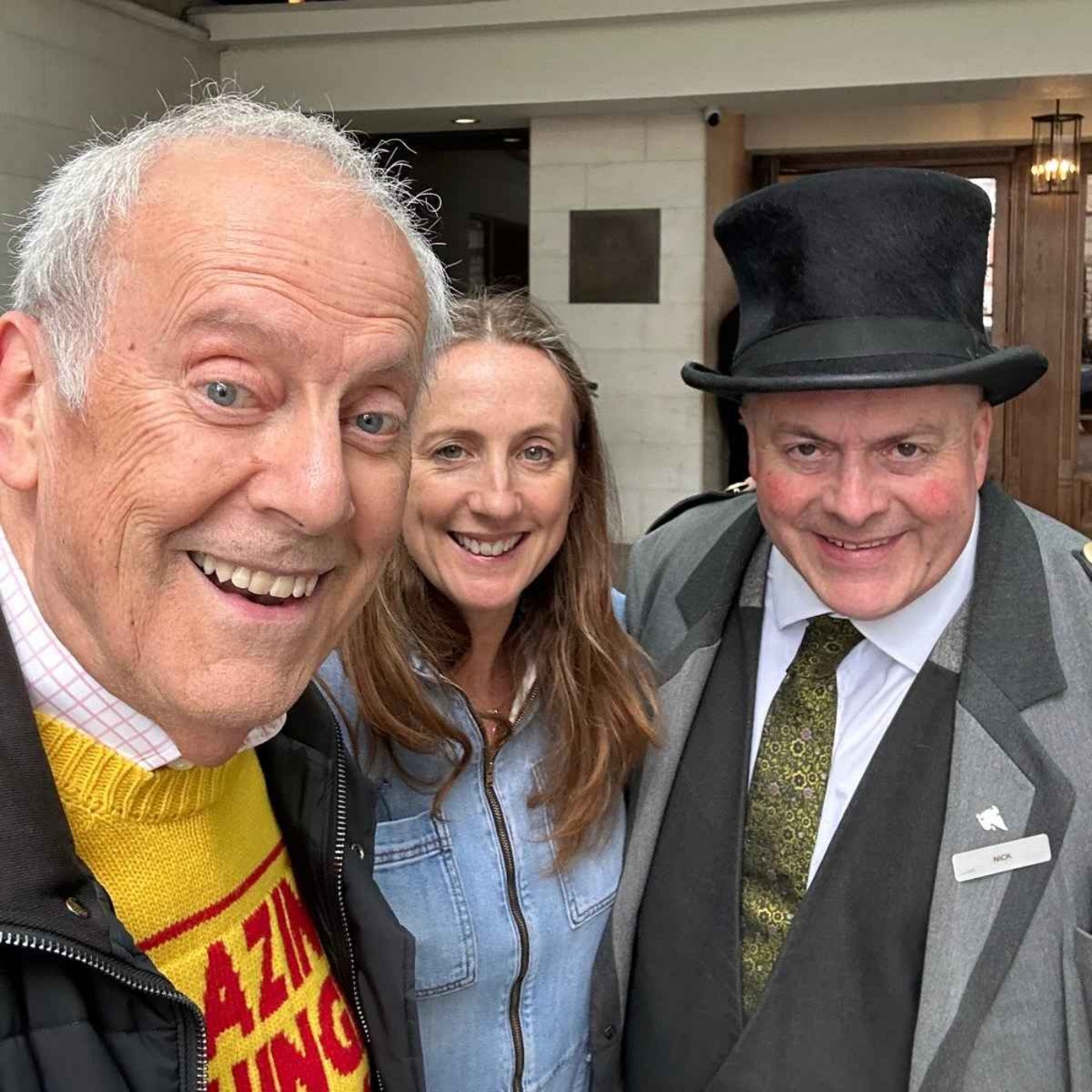
Recorded at the JW Marriott Grosvenor House on Park Lane in London.
Hosted on Acast. See acast.com/privacy for more information.


