
 Ask ChatGPT



In this episode of "Rosebud" hosted by Gyles Brandreth, comedian Harry Hill shares his unique life story, which includes growing up in a circus run by his father. The conversation explores Harry's early memories, his unusual childhood experiences, and insights into his career in comedy.
Written by AI. May contain mistakes.

Get the gist, explore an idea or ask about something said.
 Claude
On Rosebud with Gyles Brandreth, what are the key points of this episode?
Searching your listeningAutomatic transcript. May contain errors.
0:00It's Tuesday, the best day of the week, because it's more rosebud. Oh, wait a minute. Perhaps the best day of the week is Friday, because that's Rosebud. Tuesday, more Rosebud. Friday, Rosebud. Tuesday, Friday. Now, I can't decide which is the best day of the week. Maybe they're all good. Yes, you can actually listen to Rosebud any day you like. There's a whole back catalogue of episodes. So whenever you want Rosebud, 24-7, we are here with the interesting memories of remarkable people. Please stick with us, spread the word. We love having you here. Welcome to more Rosebud. Welcome to Rosebud.
0:40Welcome to the, oh, the whole rollicking, riotous Rosebud world. Enjoy. And now, cue the music.
1:06Welcome to More Rosebud. I'm Giles Branroth and because this is a Tuesday, we always put them out on a Tuesday, More Rosebuds, at the beginning of a new month. I always have with me on a Tuesday, my producer, which is always there anyway, but we let her speak on a Tuesday. It's Harriet Jane. Hello. Good to speak with you, Harriet. Thanks for letting me speak. And do you have a middle name? Anne, with an E. Oh. Actually, that reminds me of ever decreasing circles. And Richard Bryars and Penelope Wilton. She was called Anne. I used to love that programme. We've had Penelope Wilton on Roosevelt, haven't we?
1:43Brilliant. One of my heroes. And I was lucky enough to know Richard Bryars, who was a very funny and delightful man. I would love to have met him. He seemed so... Was he as lovely as he seemed in The Good Life? He was certainly as lovely as that. Very amusing. Could be a bit cantankerous, I suppose. Look, enough of this banter. We've got, I'm very excited about this week's guest because he's a comedian. Who is your favourite comedian, alive or dead? Oh, that is difficult. I loved Victoria Wood. Oh, I loved Victoria Wood. Funnily enough, on YouTube this week, Michelle and I were watching an audience with Victoria Wood recorded in the 1980s or 90s at London Weekend Television.
2:32Oh, I was lucky enough to know her. And her husband, the great Soprendo, who I employed, or rather I persuaded her to come to the Oxford Playhouse when I was doing things there in the early 1970s. So I knew her for a long while. Gosh, she was gifted. She was so gifted. She was a great fan, you know, of Max Miller. Have you heard of Max Miller? Yeah. English musical comedian. And I liken him in many ways to the great Sir Noel Coward. Very different. He was a playwright, but she was a playwright too. but he was a performer, entertainer. He wrote these brilliantly witty songs, which she did. And the playing and the singing and just the warmth.
3:08And there was something, she was a brilliant observer of Englishness, I think, and she sort of captured that. So it was so good, so good. And Julie Walters as the double act. Oh my goodness, I'd love to have Julie Walters on. And then I love someone that you might not have heard of because he's a young comedian. Oh, thank you. Yeah, James Acaster. I know him. Do you? I know him personally. Are you on shows with him all the time? Yes. Oh, he's so funny, I think. He is funny. Funny and charming. You've got to remember also, I go to the Edinburgh Fringe where I perform. And so I meet a lot of these people.
3:44And also I do do these shows like QI, Would I Like You, etc. Well, he's really good on Would I Like You, as are you. And you meet these people at these things. So, yeah. So I met them all. I still think the funniest person I've ever seen live in a theatre is Ken Dodd. Oh, I never saw him live. And I did, oh, I must bring you in pictures. I'd forgotten. I did a series with him called The Railway Carriage Game. Oh, yes, yeah. So I worked with Ken Dodd in pictures of me. Did he tickle you with his tickling stick? He gave me a tickling stick, which I then gave away for a charity. And they're now probably worth a great deal.
4:20Yeah. But he was, to see him live, he was exhausting because he did go on. Was it three hours? It was at least three hours. But it was worth it. He was just, he was a clown and a bundle of joy, just so warm, so funny, and it stands the test of time. Again, on YouTube, I'm watching him. So. Brilliant. And we've got one of my. We can ramble on, can't we, Charles? We mustn't ramble on. Because we don't, people, not to hear our special guest today. Yes. And he is a special guest. He's on tour. But we've persuaded him to come in today. And he's one of my favourite entertainers. Because like Ken Dodd, he's a family entertainer.
5:02He's funny whatever the age. Children love him. Like children loved Ken Dodd and the Diddy Men. He is Harry Hill. Do you know what, Giles? He is so funny. Did you ever watch his show, TV Burp? Of course. Harry Hill's TV Burp? I think that's one of the best shows that's been on the TV for years. It was brilliant. You know, he used to make people have fights. He'd say, which is better, Giles Brandreth or Sooty? Anyway, let's have a fight. People are thinking, oh, Harry Hill, he is the fellow with the white shirt and the big collars. And amusingly, he comes in looking quite normal. And I don't think Harry Hill is his real name.
5:40I'm not sure we're going to discover that when we get into the podcast. Harry Hill's a persona, isn't it? A persona, a character that he plays. And he changes into Harry Hill. So he puts on the shirt with the big collars and he's got these dark rimmed glasses. What we did not know much about before we invited him to be our guest today was really his childhood. And it was unusual, to say the least. So we're going to find out more about his days with the family circus, travelling around North Kent, when his only friend, when he was small, was a chimpanzee called Narduli. Isn't that lovely? It's amazing, isn't it?
6:14We've never had a guest on, because you often ask people, a first friend outside the family, it's never been an animal before. No, I think maybe it has. People had dogs that they were very fond of. Anyway, this is going to be a special guest for today, Harry Hill. So cue the more Rosebud music and then welcome Mr. Harry Hill.
6:44Harry Hill, it's very exciting to have you here. We're going to begin as we always begin with Rosebud. I'm simply going to ask you to cast your mind back and tell me what is your very first memory? My first memory? Oh, well. What very first? It's probably a smell, Giles. You know how smells can be so evocative. And even now when I smell it, it's... sorry, I'm getting a bit emotional, is, you know, grease paints still. Grease paint and sawdust, basically, the two very evocative things, because, you know, I mean, I don't, I'll be honest with you, I don't really talk about my childhood, because it is, it was quite unusual, and it seems, some of it seems a bit far-fetched and a bit extreme, I'll be honest.
7:38Well, what sort of age would this be? So I was perhaps three. You know, my parents were circus folk. You know, my dad was, he ran a circus. Was it a well-known circus, like Jerry Cottle or Billy Smart? It was called Keith's Circus. So it was very big in North Kent. If you go and see anyone who's in their 80s, late 80s, they'll remember Keith's Circus. They used to say Keefs. circus. The TH was... What kind of circus was it? Did he have animals? Was it just... The act... Well, there were animals. Some of the acts he had was like he had Ray Bolton. Do you remember him? You do. I do. Do you know...
8:26Funny enough... Have you heard of Keefs? Well, it's ringing a bell because I was brought up and used to go on holiday to Broadstairs. Ah, well, yes. It would have been... Broadstairs, Margaret, Ransford, out of Thanet. But you're more... He never got down as far as Broadstairs. That was his, his cut off would have been Ramsgate, probably just the outskirts of Ramsgate as far as he would, they'd turn up and pitch the tent there. And so, well, Ray Bolton, so what he used to do was catch an anvil. Catch an anvil? Yeah, it's a brilliant act. I mean, mainly it was the build up to catching the anvil.
9:02That's so often the case. So he would, they would then, he'd go up, it goes. And they would winch it up. and he'd position himself underneath it. And then there would be a drum roll, and it would be released, and he would catch it. It was... Fantastic. It was amazing, yeah. But your dad, what was your dad's name? Keith. Oh, Keith? Yeah. Yeah, of course. Keith Hill. Keith Hill, yeah. And he employed Ray Bolton and a whole series of other acts. Barry, the... Don't get away from it. I want to hear more about Keith. What sort of man was he? How do you remember him when you were a little boy? I don't remember him.
9:37I mean, I don't remember. The thing is, you know, these days, you know, your parents, I mean, with my children, your parents were like your friends, aren't they? Oh, Dad, let's go. It wasn't like that when I grew up in the 70s, the 60s. You know, your parents were very much, were distant. They were parents, you know. They were sort of older and they looked older. You know, he would go off to work. So you didn't live on a caravan on the side? I didn't. No, he did, but I didn't. So you live with your mum? I live with my mum. She was on benzodiazepines, Valium, awaiting hysterectomy for most of the 70s.
10:18I shouldn't laugh. I am laughing. Do you mind? It's a bit much. It is a bit much. That was the trend back then, you know, that you would be waiting for a hysterectomy. And she always saw the same GP. This is what people forget. Now, but in the 70s, you always saw the same GP, even though, you know, we knew of at least three people that the GP had killed by accident, you know, because he'd got the... So you're living in North Kent with your mum. What's her name? Her name is Jan. Jan. Yeah. So are Jan and Keith there together? I mean, your dad comes back at weekends, or does he come back on a Sunday?
10:57I mean, or is he performing the circus five days a week? We would see him occasionally. You know, we would see him, because he was so involved with the circus. because he was himself one of the acts. Ah, was he the ringmaster? No. He was, and it seems an old-fashioned idea now, but there was a part of the circus, and I don't like the word freak, but it was sort of a freak show. So there would be a bearded lady, and there was this lady, Lois, who had three legs. And I can remember sitting on her knees and her telling me bedtime stories. and um i mean people don't remember this i mean this is normal i mean in victorian times that was what was at the core well this is in victoria i know we are now going on 50 60 70 years to the 60s and 70s and your dad was having kind of throwback to that kind of entertainment yes there was a certain amount of nostalgia and so he was billed as keith the amphibian man because he by an accident of birth and I have it as well is uh webbed feet ah some webbing he was different to me in that he had an extra vestigial pair they were only uh tiny an extra pair of ears so he had four ears which looked like the way that they lit it looked like gills so Keith the amphibian So he would take, you know, you sell the tickets and make sure everyone was in place, and then he would get into this bowl.
12:37It was like a bowl. Oh, like a tank, like a fish tank, so full of water. Well, it wasn't full because he couldn't swim. It was only half full, and he was, because he was built as an amphibian. Correct. Yeah. Different time, Giles, you know. And so the sawdust and the makeup that you remember. The clowns and the... One of the things I've learned, because I've known quite a lot of circus families over the years. Have you? Yeah. But Aled, do you know what I mean by Aled Jones? Aled Jones. Yeah, you know Aled. Of course they do. Walking in the air, there's snowmen. He's a lovely guy, and I've known him since he was a boy.
13:11Well, I think we've all known him since he was a boy. Yeah, that's true. That is true. And he's got a lovely wife called Claire. He still looks like a big boy. He does look like a big boy. He's got a lovely wife called Claire, Claire Zippo, and she comes from a circus family. What, Martin Burton's family? Is that? Zippo. Zippo, is that the real name? That's his name, Martin. Because she says she's got, her name isn't really Zippo, it's something else. It's not really Zippo. It's a real circus family name, that she comes from a real circus family. And she was a trapeze artist. And they have got in their home, and I've been to their home, a reinforced trapeze in the sitting room.
13:46Yeah. So she can actually swing. After supper, they do this. She just swings in the trapeze, which is fantastic. But she has good men. I still have one in a 60s semi. Yeah. Is that where you were with your mum? Yeah, with the height. That was the problem, really, practicing the trapeze, because they did have an interest in that for a while. But the point I'm making is that she and other people I've known in circuses, they have good memories. I mean, I knew Jerry Cottle. It's a good world. Well, we support each other, you know. Actually, Zippo told me a story. Zippo from Zippo Circus, whose real name is Martin.
14:23It's a very interesting bloke. He was telling me about training ducks, right? You should get him on this because he's great. He's great. And he told me that it takes about a week to train a duck. And he said as a joke, what he did was he was living in this sort of caravan thing on the circus. And if he had a friend around, he trained this duck so that he'd open the door and the duck would walk in and get in the oven.
14:52That's brilliant. It's a brilliant act. I can see that going well. So I'm picturing the scene. Here we are in the 60s. Your dad is Keith. He runs the circus, which is very popular within its niche area. Has a variety of acts, including Ray Bolton. Yes. It has some trapeze artists. What sort of animals does it have? Well, they had, there were ponies. Yeah. I'm not sure. The ponies just used to sort of run around. Snakes. It was made. So this was post the era of having elephants. Because in the 1950s, I remember seeing them as far. They did have an elephant. Oh, they did have an elephant. Yeah, but their problem was, I don't know if you know, but the clown, they found out that the clown had been abusing the elephant.
15:39And this is a problem, apparently, because clowns identify slightly with elephants because they've got big feet. This is true. I know it sounds far-fetched, but that elephant, Sarah, who I'm still in touch with, she's in the sanctuary now, she's very nervous around clowns or anyone who's wearing a lot of makeup. So she can't, for instance, watch anything with Gemma Collins on TV or RuPaul's Drag Race. That's the question. so um yeah that was unfortunate and i think there was a little bit of that went on in the circus and you know it was the 70s it was a very different um well you know i'm picturing the scene your dad's running the circus and your mom is living in the yeah but she's waiting for the doctors i don't know why i'm laughing about that because obviously it's heartbreaking in some ways is there a brother and sister involved she had to but But that wasn't all that mum did.
16:45I'm sort of exaggerating that, perhaps slightly. Because once a week she had to go and change the filter in the bowl. So they were together, even though they spent much of the week apart. Yeah, that would be a good way of looking at it. Together but apart. And were they brothers or sisters? For you? My mum and my dad. No, they weren't. Did you have any brothers or sisters? Did your mum, your parents have other children? I was an only child. But in a way I had a sibling. And that was Narduli, the monkey. So we had a... And was this in the circus? Narduli was one of the circus performers. Yeah, but he would come home with me every day.
17:32Narduli, lovely name. Yeah. Yeah, I don't know where that comes from. Perhaps he's Italian. I don't know if he was Italian. and we were like brothers really, I suppose. Was he your best friend? Was he your first close friend, would you say, Narduli? I think probably yes. Yeah, yeah. I mean, everyone else was, you know, everyone got on pretty much okay, although there's a lot of politics in a circus. Explain. As you can imagine. Well, between the acts, you know, they're competing. Can you remember your first friend outside of your family and outside of the circus? your first boyhood friend, apart from Narduli?
18:17I was a shy boy, and so I was quite lonely as a child. So I wouldn't say I had like a best friend. What about going to school then? When do you go to school? When I was homeschooled. Ah, by your mother. Or, yeah? Yeah, I was homeschooled for a long time, but it wasn't like conventional lessons. It was just that stuff that she knew. So it would be stuff, you know, like a lot of learning, you know, rote learning of instruction manuals. You know, I remember the, there's an Ikea flat pack. I think it was the Hableck. Do you know that? It was like a bedside table. And that was, I remember, if I can remember the opening.
19:13You know, like there are some famous opening sentences in books. Oh, yes. You probably know some, don't you? I dreamt I went back to whatever it was. Yes, Mandalay. So this was, I remember, was place side A next to side B, move toggle C to side flap 12, and tighten using the Allen key. and straight away I was hooked. It's a really unusual childhood. I think it explains everything about what you do now. Well, but see, you know, so then I knew that I wanted to escape from the circus and, you know, become a doctor. Ah. You know, a lot of the times it's the other way around, isn't it? People want to run away.
19:58It used to be that thing of running away to the circus. I wanted to run away from the circus. Yeah. Were you aware at the time, though, that this was an unusual childhood? No, it was what I knew. You only know what you know at the time. So eventually the circus closes, is that right? I seem to have read that somewhere. It was forced to close. Partly there was this scandal, which I really don't want to go into. And that was closed, and then we got into a more conventional way of life. And I did start going to school, the senior school there. I went to the Joan of Arc school just outside Hawkehurst, and until that, well, it burnt down.
20:43And that was the nuns, you know, who used to hit us. No. Yeah. Yeah, one of them, Sister... Sorry, I'm getting quite emotional. Sister Alan used to hit us with a rolled up newspaper. And so I would always listen first thing in the morning to Radio 4, praying that it was a slow news day so that the newspaper would be a thinner one. Because, you know, if there was a lot of news... Were you a naughty boy, though? I mean, were you getting into trouble? I don't think so. Fine.
21:28what did you shine at at your secondary school um
21:36well i was great in the uh the coconut shy because obviously i'd learned those skills of course it was flexible and had good eye to hand yeah coordination coordination you were shy and there'd been coconuts at the circus. Yeah. I'm getting it. Yeah. And tell me now about your first girlfriend. In fact, your first kiss. My first kiss, that was Prue Leaf. You know her? Do I know her? I've known her for a long time. Yeah, she did a school visit and she grabbed, I don't know, it didn't seem appropriate at the time. and then one of the nuns rushed him with some pepper spray, wrangled her to the floor.
22:27I think you're exaggerating here. But Prue, that's marvellous. She's great, Prue, isn't she? Yes. Can you remember your first experience of pure joy, a moment of ecstasy in your young life? Oh, probably when Pret-a-Manger opened. Do you remember that? because prior to that you couldn't get decent sandwiches, could you? You couldn't really get them anywhere. If you think back to the 70s, it was sort of ham or cheese. And now you've got this huge range of, you know, there's a baguette or an avocado and chicken baguette. There's the small ham roll with the butter and...
23:16your pret order is just arriving there what about your first recollection of fear of being frightened yes fear well i was used to in extreme conditions so perhaps that's not something i mean i was sort of in a constant state of fear for a for a large amount of you know in the 70s particularly you know in the car we would um you know no one used to wear a seat belt in the car did they i mean you know i used to sit on my nan's lap in the front and uh you know there'd be three or four people on the back seat and one loose in the boot all of us smoking you know it was um you know and people didn't obey their the speed limit you know well actually you know my dad taught me the way to work out how fast you could go this is you know in the 70s was he said that you because there were no speed cameras there was more of a level playing field he said that what you do is you take the national speed limit and you add 10 so like 30 would be meant you could go 40 you know 70 meant you could go 80 unless he said unless you've been drinking in which case you took 10 off out of respect for the local community and you'd go the back routes home as far as possible And then he said that if you got, if you did get stopped by the police, the chances were that they'd been drinking too back then.
24:45Or you'd say, sorry officer, I think I may have got the amount you'd have to drink when you're driving mixed up with the amount you'd have to take through customs. And are your parents still with us? Are they still alive? As far as I know, yes. I haven't checked this morning, Charles. But are you still in touch with them? Yes, of course. And what did they do in return? What did your father do once he'd given up the circus? Nothing. Ah. Yeah, no. All his joints had gone. Water damage. And so he did as very much, as little as possible.
25:21And your mum? My mum, well, you know, she's a little bit confused now. In fact, she phoned me the other day and said that she'd got her hair caught in the knitting. and ended up knitting herself a balaclava she can't take off. Oh, that's lovely. Yeah. This is a wonderful childhood. It's a unique childhood. And do you think this childhood, well, I'm sure it must have done, has contributed to what you do now? No. No? Not really, no. No, I think, if anything, I've sort of kicked against that. You know, and I've tried to, you know, I think my act is very sort of straightforward and observational about real-life things that are happening to people every day.
26:07When you were growing up, who were the outside of your family? Who were the big inferences? Who were the entertainers you admired? Well, they were the TV shows I used to like to watch. You'll know these in the 70s. Opportunity Harassment, that was good. Do you remember that with, I can't remember his name. No, the one I liked was The Brothers. Do you remember The Brothers? Was that a sort of afternoon soap opera? It was a Sunday evening thing. And it was a fascinating insight into a family-run haulage business. Yeah, I do remember this. Yeah. So that had a very powerful effect on me as I watched them organising the different deliveries and articulated lorries, you know, I really started to appreciate planning and what was possible.
27:02Well, look, Harry, you have brought so much happiness to the world. I want really to end with three things. One, I want to ask you about your happiest moment, the happiest moment in your life, but perhaps particularly from your childhood, but at any stage in your life. And then I think I've got to ask you about the most traumatic moment in your life. But let's have the high first before we have the low. The happiest moment? Well, I suppose, you know, probably going out on stage and getting my first laugh, you know. When's that going to happen?
27:39I'm so cruel. So cruel. No, you're brilliant. When did you realise that you were funny? In the sense that, was it in the circus? or was it maybe you know going with your mum to the hospital helping her when she was having the hysterectomy or trying to get I wasn't involved in that you were you didn't you not support her then in those days you didn't go with her to try and no no no it was very much you know uh kept under wraps everything would be sort of you know we wouldn't even refer to it as such you know um what was the question happiest is you going on to the stage yes my first joke you know I remember telling my first joke, why did the cucumber cross the road?
28:22Why did the cucumber cross the road? Well, it hasn't crossed the road. It wasn't crossing the road, basically. It had fallen out of the shopping bag, and what you've done is added the narrative yourself. That's nice. There you go. Okay, and your most traumatising moment in your life. I don't know why we're laughing. Well, the school burning down. Yeah. Because that was an accident. I maintain to this day. Oh, I know. Well, because there's a lot in the cuttings, there's a lot about that, and the coincidence of it being the Joan of Arc School. It seemed almost too obvious. Yeah, yeah. Almost too obvious.
28:59Yeah, almost too obvious. You're joking. You're laughing. But my sister, I don't dare tell this story, because last time I told a true story about Rod Hull and my involvement with his sad demise. Ended up in the newspapers. This is another true story. You pushed him off. It wasn't that you pushed him off. No, but you encouraged him to... I encouraged him, as did others, to sort out his problem with his aerial. And it was a dark and stormy night, and he sadly climbed up the ladder and fell off the roof. Okay, that is sad. My sister, when she was a nurse at a hospital in Tooting... George's, St George's?
29:39Yes. Obviously, that's where I trained. Well, then you may know this story. She and a girlfriend of hers, they were nurses, and they used to, smoking wasn't allowed, it was banned during that time, which they didn't think much of, so they would smoke in the, not in the sluice, but in the room where they keep all the laundry, the laundry room. Yes. Anyway, my sister's friend, unfortunately, burnt down the hospital. Wow, yeah. So, you know, here we are laughing about some Joan of Arc school being burnt down. Here's the whole hospital in Tooting being burnt down. Yes. So we've got that in common.
30:14We have, sort of. we want to end please with your message what have you learned over your life well i mean it's like the old song says if you you know if you can't be with the one you love love the one you live with
30:35now the best advice i was ever given is if it's going badly get off and if it's going well get off. I'm going to have to call it there, Giles, because I've got, I've just noticed that I know that today, on April the 1st, I've got a very important meeting, so I'm going to have to, I'm going to have to go. Well, thank you for sharing your story with us. Yeah. No, it's been, it's been interesting, you know, I've never really, as I say, I've never really told that story, and it's been interesting listening to it as one sort of thing, if you like, It all just does sound like a remarkable life. And I think it explains everything.
31:20Thank you.
32:07That was more Rosebud with music by Phil Leppard Production by Harriet Jane And in the chair, me, Charles Brandreth Thank you for listening
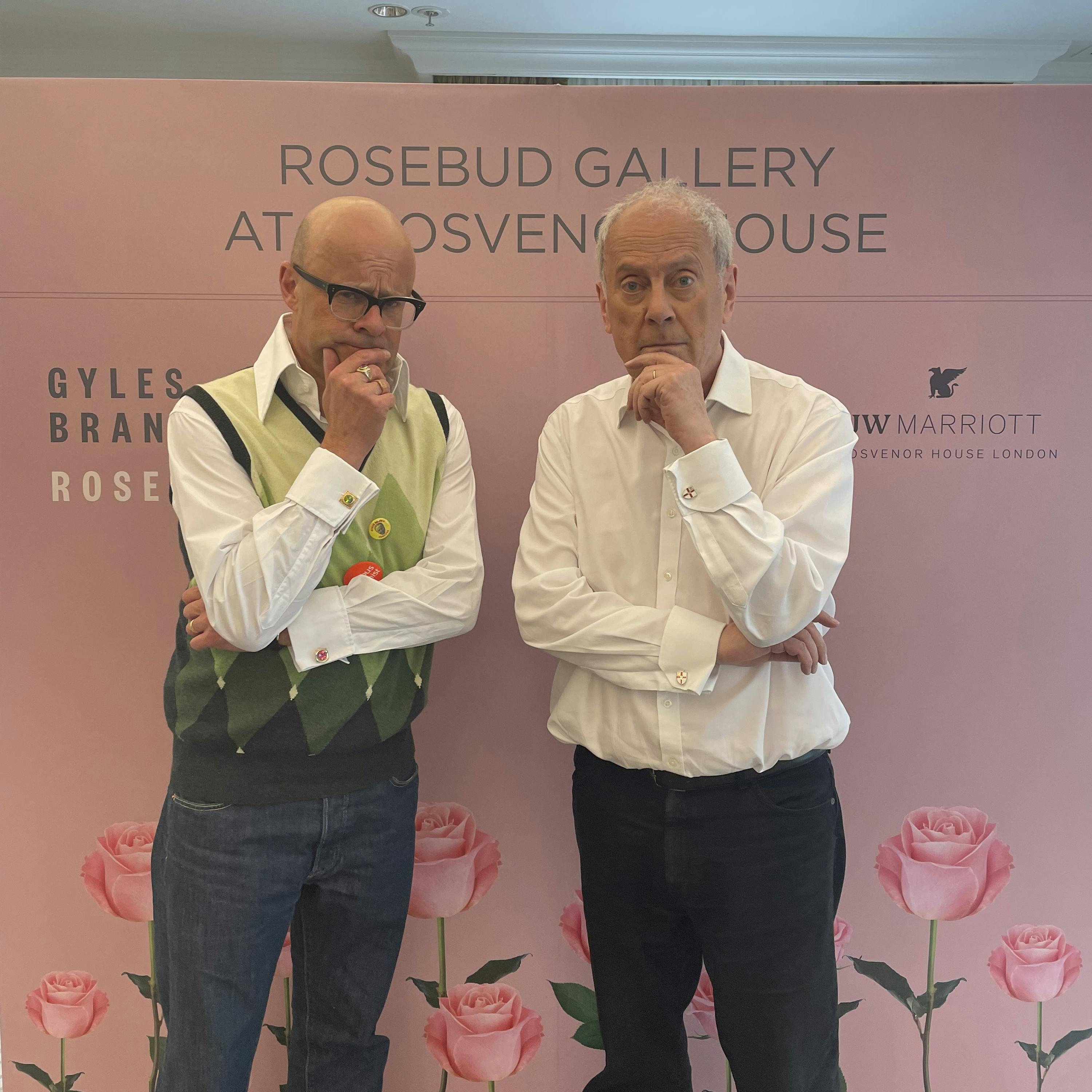
Today's More Rosebud is an unexpected April treat from the great comedian Harry Hill. You'll know Harry from his brilliant TV shows like TV Burp and Alien Fun Capsule or his podcast Are We There Yet? but you won't know about his incredible life. In this episode Harry tells Gyles his scarcely believable story - and what a story. Growing up in his dad's circus in North Kent, Harry tells a tale of dodgy doctors, depressed elephants, nefarious clowns and men with gills. We've all been there. Enjoy this special episode of More Rosebud with Harry Hill.
Harry Hill is on a nationwide tour now, tickets available here.
Learn more about your ad choices. Visit podcastchoices.com/adchoices
Hosted on Acast. See acast.com/privacy for more information.


