
 Ask ChatGPT



Host: Gyles Brandreth
Jimmy Carr
December 12, 2025
The episode focuses on the first memories, experiences, and reflections of comedian Jimmy Carr, offering insights into his life and career.
Written by AI. May contain mistakes.

Get the gist, explore an idea or ask about something said.
 Claude
On Rosebud with Gyles Brandreth, what are the key points of this episode?
Searching your listeningAutomatic transcript. May contain errors.
0:00Wherever you are in the world, whatever mood you got up in, however you're feeling right now, Well, you can take an hour or so off from harsh reality and tune in to somebody else's story. Welcome to another episode of Rosebud.
0:35Well, today's guest is a bit of a catch. I'm excited about this. I've known him since, well, since he was a very young man. And I've been wanting to have him on Rosebud for a while. And I said to him, this is the day you've got to do it. He said, I can't do it. My movie is opening today. I said, well, that is the day to do it. I said, what's the movie called? He said, it's called Facom Hall. I said, that sounds funny. He says, it is a funny movie. And it is a funny movie. He wrote it with his brother. It's a spoof, I suppose, of Downton Abbey. And that makes me think, Downton Abbey, maybe we could get Julian Fellows.
1:08That would be rather good, wouldn't it? Well, anyway, forget Julian Fellows. Let's move on to the writer of this film, Thackham Hall, which literally is being launched today. You can see it this weekend. The person who co-wrote it is Jimmy Carr. I've known Jimmy Carr a long while. He makes me laugh. We've appeared on television shows together. I like what he does. I'm going to see his tour, too. He's doing an arena tour at the moment. I'll give you the dates at the end of our conversation but if you like a funny man who's going to teach you quite a lot I think you'll enjoy my conversation this Rosebud with Jimmy Carr yeah, on the day his movie opens he's found time to be with me that's the Rosebud effect cue the music
2:08Jimmy Carr, born on the 15th of September, 1972. Ah, correct. Good. That's a good start. Wait a second. Is this a quiz? What have you won? It is a quiz. Do you want to bank that? No. Why don't you bank that? You're 100 % right so far. Well, look, the answers are in your gift. Well, yes, I was born in 1972, but a lot of this is new. What we're looking at? Even my iPhone says, come on, put the code in. it's my face is like trigger's broom it's a very good face and i want to explore your appearance issues later please do but i want to start by asking you because this is rosebud what is your very first memory jimmy uh well the first thing i remember is i think i was three i'm pretty sure i was three and i had a spinal tap i had meningitis when i was three uh we were in ireland at the time I proudly carry an Irish passport.
3:01My family are all Irish. We were there on holiday and I got sick. I think initially with the bumps. And then I had bacterial meningitis. I got a spinal tap. What is a spinal tap? I thought it was a band. Yeah, it is a band. It's when they have to drain fluids from your spine. And I remember it was very painful. I can't remember why there wasn't an anesthetic and maybe they were in a hurry or something. But there was no anesthetic. and it was a painful thing. You knew that obviously in retrospect. There was no anaesthetic at the time. You were not aware. At the time, I was not calling for anaesthetic, but I did say at the time, which became something of sort of family law, the doctor said, I'm really sorry.
3:41This is going to hurt, as doctors do. And I said, age three, you've got to be cruel to be kind. Wow. And the doctor went, what? Okay. This is your first recorded one-liner? Yes. Well, not even a one-liner, just like trying to make the guy feel a bit better about it. But yeah, that's the first memory, which is, and I suppose it's instilled in me that idea of going, well, there's a counterfactual. We never really think about the counterfactuals, the idea that, well, it could have gone another way. Some people don't make it through that. Some people don't leave the hospital. And I left and was unaffected.
4:18But some people don't get meningitis. So, you know, a lot of people, most people don't get meningitis. to do though we need to this is this is my uh motto for life uh look at the donut don't look at the hole very good let's look at what we got very good yeah so that's the first memory kind of a dark memory but you know well not that dark yeah because you come through we've had worse yeah so who are your parents where was this happening explain the irish background oh so irish background parents from limerick both parents both parents from limerick and moved to slough so some something about there's a touch of a limerick when you mentioned slough yeah there was a young man from slough i'm sure there's many yeah and there's certainly a young woman from limerick uh yeah uh and who were they who were these parents uh and what was their heritage well my mother was um she was a nurse uh my father was in uh accounts and yeah i mean it was really i was very close to my mother before we get on to that i want a little more detail on both your parents let's start with your father who was was he also a jimmy car what's his name he was a i'm not sure what his the name is on his passport but uh yeah i think so yeah i think he was known certainly as jim car jim car i i don't have a lot to do with my father and haven't for many many years so it's which is again it's like i try and see the positive in these things but he was there at your conception He was, I believe, there at my conception.
5:46We give him that. He made a contribution. Yeah. He made a contribution and he was an accountant, basically, was he? I think so, yeah. Yeah. But clearly, very much a person in your life is your mother. What was her name? Her name was Nora. And you say she was a nurse. What kind of a nurse was she? I think she was in, like, the operating theatre for about two weeks and just said, this is all a bit too gory, and then took to the wards and was great. I mean, she kind of described those years as being the best of her life because it was the most, it was the most work she'd ever done. She had this, you know, we'll get onto her narcolepsy, I'm sure later.
6:23But she said it was from that period, an ability to sleep that was like, if you had like, it was like being in the military. If you had like two minutes off, you had a cup of tea. If you had five minutes off, you had a nap. Have you got pictures of her in the nurse's uniform? I've got, yeah, I've got lots of pictures of my mother. And thanks to the wonders of AI now, I have pictures like a couple of birthdays ago, my other half did me photos of my mother with my kids. Obviously, my mother never got to meet my kids. My mother died many years ago in my mid-20s. But she photoshopped or got someone to photoshop my kids with her.
6:57And it just absolutely broke me. It's how we judge gifts in our house. It's like not necessarily the material value of the gift, but the emotional effect it has on one. If you can make the other person cry with a really thoughtful gift, then it's, you nailed it. It's a lovely idea, but it almost also emphasizes, underlines the fact that your mother never saw your children. No, but, you know, I think that thing of going, it was maybe about 15 years after my mother's death. Remember, someone said to me, do you still talk to her? And I went, what? And I hadn't thought to. I hadn't thought to say, well, I kind of know what she would say on any given topic.
7:35I, you know, knew her very well. just because you're not hearing anything back doesn't mean you don't still have that person in your life. And I kind of view, uh, I don't believe I don't have a religious faith. I lost that in my mid twenties as well. Um, so I don't believe in, uh, uh, an afterlife, but I kind of believe in a next life and it's the children. It's the idea. I had a lunch with a friend recently. He said something that really, um, touched me. He saw, I was talking about how much I'm loving being a father and he said uh he said you will die and you will be reborn as someone new and you will love them so well that's it that's that's everything that's reincarnation explained that's purpose that's that's it's such a wonderful thing explain to me about the special relationship you had with your mother why she is so important to you uh well i think the any talent that i have You know, I mean, I think there's a weird thing where people tend to take all the, they say, well, all the negatives were from my parents and all the positives were, well, I just did that myself.
8:37It's like, it's a lot of it's heritable. My mother had a great sense of humor and she had an incredible laugh. I mean, I've got kind of a weird laugh. I laugh on an in, not an out. So kind of a weird innie laugh rather than a ha ha out breath. It's an in breath. She was a ha ha go. No. Oh. She had a narcoleptic laugh. So she had a sleep disorder, narcolepsy. Yes. um where we keep falling asleep that's yes it's a link to that so she had a thing where when she would laugh she would not make any noise at all but she would melt just sort of lose muscular control and melt into the like like a witch in the wizard of oz so we were obviously massively uh encouraged to make her laugh because of this incredible result you got and she had a great sense of humor so i spent my childhood with her driving around trying to say something funny enough so that she would lose all muscular control you'd have to take the wheel and again how many of them were you were there brothers and sisters yeah there's an older brother and a younger brother yeah so your father stayed around long enough yeah we believe he is the father of all three of you yes i've got an older brother colin and a younger brother patrick my younger brother is much younger is like 14 years younger oh he stayed around a long time this man we we are not talking about yeah well you have to have some recollections of him come back to that Tell us about the brothers.
9:52The older brother, what was he like? Was he a good older brother? Yeah, he was all right. And what, did he cope with you when you arrived? We weren't particularly close. I think I'm probably closer to my younger brother, but yeah, I mean, they're both, you know, good guys. They're okay. Yeah. And the younger brother, 14 years later, he's quite a bit younger than you. Yeah. And does he, what's your relationship with, what was it and what is it? Well, it's good. I mean, we just wrote a film together. We actually wrote a film with some other guys called the Dawson brothers. And it's really fun. It was a really fun thing to do as well.
10:23It's fun to kind of collaborate and, you know, mess around together and share that sensation. This is your Downton Abbey spoof. Yeah. I mean, I'm being... No, no, that's exactly... ...journistically clichéd. That is exactly what it is. We just did movie maths. We said, what did the British do well? We do period drama very well. We do comedy well. What if we did an airplane, Mel Brooks meets Downton Abbey, Gosford Park? I think it works. Oh, I can't wait to see it. It's fun. And it's, I think it's that thing of, I don't like being a grifter. I don't like selling anything I wouldn't buy. And I would watch this.
10:54It's often me and Caroline will be sort of flicking through, looking for something to watch that we both like. Yeah, that we both want to watch. So it was a really fun thing to do together. Let's get your father out of the way for good. The reason that you blocked him, I assume, is that he left your mother, did he? No. Oh. No, no, we had a falling out. I had a great childhood. I'm not complaining about anything. I don't get on with my father. that's a there are problems and there are predicaments problems are there to be fixed and then there are predicaments and they are things that we must live with and when did this begin for you that was i haven't seen him in 25 years 26 years something like that it's a long time ago so but you were grown up by then yeah i was a grown man and did you falling out with him or deciding actually we don't need each other anymore did that begin when your mother died or what triggered that?
11:45That was the catalyst, I think, for it. Although I would say in a more kind of, maybe a more reflective tone, I think there are two, we talk a lot about the teenage transition and those teenage years that we go through in puberty. I think there's something else that happens that we don't really talk about. And I think we will be talking about it more, which is around the age of 24 for women, 25 for men. There is a thing where the frontal lobe completes. There's something that happens physically. and I think there's something that happens where you kind of just become yourself um and uh I think maybe around that age was when everything changed for me my um belief in God went so it's kind of everything changed around those years and part of that was I yeah we we had a falling out and uh and and kind of that's fine so you grew up in a sense you turned that age things were changing in your life your mother died I think it was the first time I made a decision I've spoken about this before but I think before then it was like you took the best option but it wasn't really a decision like I went to school no one really made a decision to stay on and do A levels just that's what everyone did it was mimetic so it was just that thing of like we are creatures that say oh everyone's staying on okay right everyone's going to go to university which one should we go to well we'll go to the best one we can I mean I went to Cambridge and you know as is often said the only the only value in a Cambridge degree is if you have one, you never need to feel intimidated by anyone with a Cambridge degree.
13:14Tell me about the sweetest moment in your childhood with your mother. I think probably buying records. Music was a huge part of my life growing up. And my mother was very into music as well. And we used to go to the Slough Record Centre. And we would buy singles, and then take them home and put them on and dance around. And that was the that was like the norm in our house was to buy records. You'd have things you liked, things you didn't like. But like Top of the Pops was a huge thing in our house of like going right, seven o 'clock Thursday. Okay, we're watching this. And it was fantastic. It was kind of a shared culture.
13:49What was your mother's favorite record? What did she enjoy listening to most? I don't know. It would have been kind of pop. I would have thought. We put together a list a couple of years ago of all the stuff that she really liked. And now, even now, I will hear stuff and go, she would have liked them. She would have liked that. That would have been her thing. So it was, yeah, she was, probably the last thing she loved was Jeff Buckley. And when did she die? She died in 2001. So, yeah, 25, 26 years ago. Yeah, just before 9-11, to the point that I think, I think the day we buried her, there was an international day of mourning, which I think she would have liked.
14:24And she obviously was ill with something quite serious. Yeah, it tends to happen, doesn't it? Well, no. Those things can be linked. Well, no, some people live, I have friends who lived into their 90s and simply went to bed one night and didn't wake up. I mean, obviously they died of something, but maybe what she died of. She had pancreatitis, not a good way to go. Oh. Yeah, not great. There's a lot of false storms with pancreatitis. A lot of people kind of feeling a little bit better and then, yeah. And what have you got from her? What of Nora is in the Jimmy Carr we see today? I think a sense of, she's very charismatic.
15:02woman, she could kind of light up a room. And I think I've got good, if it's not arrogant to say so, I've got good, I work on charisma. And I think it's often the way of like charisma and charm are often conflated. I have zero charm, but I have charisma. You have to know what you're working with. We think the best example of that is like Donald Trump for all of his ills is charisma based. it's you come to me obama is charm i come to you you think about his body language the rhythm of your speech everything angelina jolie is charisma she's up on a plinth um jennifer aniston is charm she's your friend literally and metaphorically it's like they're different um different kind of approaches so she had and it's what you are so she had a wonderful way of just everything kind of was lit up when she walked in.
15:55Very funny, told great stories. She was friends with my friends to the point that I would come back from university, kind of walk in the door and my friend Giles or Gerard would be just sat having tea. What? What did you know? No, I was just seeing your mum, just hanging out. She was very friendly, kind of lovely, affable, got on with everyone. Great. Who was your first friend outside of the family, outside of your two brothers and your mum? I've been very lucky with friends. I still see most of them now. So maybe Toby McCullough would have been a very good friend of mine that lived down the road.
16:31A guy called Matt Thicke, who I was just texting with on the way in. Matt? Thicke. Oh, great name. Great guy. Great guy. Pete Maxman. Lots of kind of guys that I was just very close to at school. And lots of girlfriends that were just fantastic as well. And the house you lived in in Slough, what was it? Was it a house? Was it a flat? What was it? We lived in a house on the Farnham Road, just in the shadow of the Mars factory. So, which is, you know, sounds kind of working class, but equally the world's melt of chocolate, so not so bad. And the first school was what? First school would have been, I think, Farnham Common Juniors, like a nice little school.
17:10I mean, I was very bad at school initially, very bad. Quite dyslexic, couldn't read or write with any proficiency until I was about 10 or 11. And did this worry your mother? But no, no one seemed to, I wasn't like kept behind. No one really seemed to care that much. It was like, I couldn't spell anything and wasn't that great. And I think people just went, oh, he's a dumb dumb. Don't worry about it. And did you worry about it? Were you worrying about it? I was very worried about it. I think that's the reason you, the only reason to kind of, you know, get a degree from a fancy university is to kind of, well, I'll show them kind of thing.
17:45And basically just show yourself. Yes. To try and feel like, well, I'm not intimidated by this. So you go into it. So I remember very clearly I couldn't read in class because it was just, it was baffling to me that anyone could read out loud. Because I read very, I read very slowly now as well. I have to really put time in. And then somehow I've made that my living, reading autocue. Which is, I don't know what perverse incentives were driving me, but I just thought, oh yeah, I'll do that. So at school, what did you do? How did you, I mean, you had a group of friends. Clearly you were likable. What did you give your friends?
18:20Were you amusing? Yeah, but everyone was funny. I mean, I think there's that great adage, we don't stop playing because we grow up. We grow up because we stop playing. And I never grew up. Well, maybe briefly in my kind of early 20s, had a couple of rough years of like being a grownup and I didn't like it. And I went back to playing. But as a little, were you doing this as a little boy? Naturally, you were doing this. What, making people laugh? Yes. Well, I made my mother laugh. I was the, I suppose, I was quite a good sort of barometer on, like I'd come in a room and I'd be able to change the temperature in the room.
18:55I was very good at making things all right. I remember really clearly as a child being in the kitchen with my mother, kind of Christmas or like, maybe it was Christmassy, but like she was prepping stuff in the kitchen. And I went, I might go and watch this thing. She went, whoa, whoa, whoa, whoa, don't go. And I went, I'm not doing anything. She went, you're here for vibes. I was very much there for vibes. Did you feel you needed to make things all right Because subliminally you felt things weren't quite right at home. Yes, my mother suffered with depression. And obviously you don't see that when you're a child because you just think it is what it is.
19:27I thought it was perfectly normal that my mother would be, you know, you get home from school and she'd still be in a dressing gown and hadn't got herself together. And I thought that was kind of the normal state of affairs. I don't think that is the normal state of affairs. So yeah, being able to make her happy. I think that's the question for comedians. Like which of your parents were sick? that's the only question for comedians most every comedian you believe has got one or other parent who is sick yeah and they had to make it okay
20:03so do you sport in your primary school football i didn't do any sport growing up like none none at all terrible really so you were buying buying records with your mom you were dancing you enjoyed moving about a bit uh and you enjoyed making people feel good and you enjoyed watching telly lots of tv i mean uh heroic amounts of television yeah it was wonderful and what what were the the formative shows when you were very small um well it probably would have been i mean for every one of my generation it would have been um the young ones um filthy rich and Catflap, Ben Elton's other, I think, underrated, hilarious sitcom, you know, The Black Adders.
20:43And then it would have been, Vic and Bob would have been the first thing that really felt like punk rock, that felt like kind of new wave. And your secondary school, which is that? What is your secondary school? Secondary school, I went to a place called Burnham Grammar, which is on the Britwell estate, which is the biggest estate in the UK, huge estate, where they cleared the slums of the East End to Slough. So a lot of my friends were kind of cockney guys, but it was a grammar school. It's a pretty good grammar school. And I managed to get in there, um, which I, I don't, I'm, I'm sure my mother had a hand in it, went in and said something to them because I'm academically, I wasn't great.
21:16Was the 11 plus still, I think. Yeah. The, I think it was the 12 plus where we were. Anyway, so past that, scraped through that somehow and went to this grammar school and was kind of okay. I mean, I just messed around and didn't do great. Were you conscious of class did you feel you belong i mean is one as a child conscious of what class one belongs to yeah i think so and what class did you feel you belong to and to the other was it just a boy's school or boys and girls boys and girls but i felt a little bit different to the other kids in that i knew that i had this irish heritage and i was very aware of that i was very aware of you know because it was kind of the heyday of the ira and stuff so you'd be kind of aware of people maybe hearing your mum's accent and being a bit...
21:57Oh, she spoke with a... Yeah, she had an Irish accent, yeah. But you never did? No. Well, maybe you would have, like, the phrasing. Sometimes the phrasing would come back. Like, if you spent six weeks in... We used to go to Kilkei every summer, where the whole of Limerick decamped to this little seaside town, which is lovely, on the west coast of Ireland. And you'd come back from that, sort of, with a little bit of a lilt or a weird phrase that would sort of stand out a little bit when you went back to school. And was that quite strange, almost living in two different worlds. No, I think, I think everyone's got a sense of that.
22:27Like, even when you first go to school, I think everyone code switches and you code switch between your friends and family and grownups and other kids. And everyone has that kind of going on. I think that's quite a normal thing, but I really felt like, um, being a little bit outside gave you a bit of perspective and really comedy is all about perspective. And were they Catholic or Protestant? Catholic. That's the God I don't believe in. And was that important to both of them? Were they my mother was uh yeah a real a real believer um and she kept her faith to the end yeah oh yeah like it got stronger at the end i think and that was a great comfort to her and i think the the cognitive dissonance of um of faith you know well if i'm right then everyone else is wrong kind of it didn't break for me for a long time and i think that was partly out of i didn't want to break her heart i didn't want her to feel like i'd uh left that but it wasn't like we didn't go to church all the time.
23:21We were like, you know, we were fairly... Does it distress you now to think that she was fooling herself given you don't believe in it? No. Given you... Not at least. Because you do believe she was fooling herself. Well, yeah, but I sort of... It's fine. Fine by me. I don't... I sort of think religion is... There was comfort and consolation in it for her. Yeah. Well, that's purpose enough, isn't it? I mean, absolutely. It depends where you find wonder. I always think like, you know, science and religion, they're both looking for the truth. They're just looking in different places. There's something about it that just works for people and it's necessary.
23:51As a boy, did you say prayers? Did you? But I still think prayers work in a weird way. I think prayers work in the same way that wishing wells work because they tell you what you want. You throw your penny in, you say, well, this is what I want and it's the aiming up that's the thing. So it works. It has like a purpose beyond the metaphysical. Now, how does this boy who is relaxed, fairly easy enjoying life at home i don't know if i was relaxed ah and why weren't you relaxed i think if i think i've got like a little bit of um and this isn't a negative way i think we over pathologize normal uh human emotion but i was a bit of a worrier i think you would now say uh suffered with the anxiety but uh and what were you worrying about what were you i was like worry about like exams i would worry about how well i was going to do would i get into that college whatever, I was always worried about something.
24:50And I think it's that thing of like, I like to think of depression and anxiety as sadness and worry, because I think those terms are just, normalizes it, right? Everyone suffers with that. And depression is about the past. I've not really had any great bouts of depression, a couple maybe in my life, but been pretty lucky. I've got a bit of anxiety, that's more about the future. And really, if you can be, if your head can be where your feet are two or three times a day, you're fine. You say depression is about the past but your mother who was depressed was depressed in the present she was unhappy you can only be depressed in the present but yeah but you're saying it's about the past yeah i think it's about it's it's regret a lot of the time so you are slightly anxious as a boy you've got this slight feeling of being outside but the anxiety the the sorry just to close that circle but that the flip side of anxiety is everything i've ever done creatively is the same worrying mind applied to jokes so great but i felt that there was going to be a change in you about the age of 16 that you were quite when i went relaxed you were not too worried about your work but clearly you were worried oh no i didn't i didn't do i didn't do a stitch of work and just messed around and hadn't given life any thought at all but something then something changed well something changed i moved schools ah i don't think you can beat your environment and did you choose to change schools.
26:08Yeah. So I wanted to change schools. And my friend Toby, who I'd known since I was three or four, was at this other school called RGS, Royal Grammar School up in High Wickham. And it was a much better school. Everyone knew it was like, well, it was a really good school. It already sounds it, doesn't it? And so I applied. And I remember I went to see a guy called Mr. File. Mr. File. First name, not pedo, but a very nice man. And he literally said in the interview, he was quite a fun bloke. He said, well, we looked at your GCSEs and they're not terribly good, but you know, you might have to cut your hair, really long hair at the time.
26:40And, uh, he said, we might, we might, uh, yeah, I think, well, as long as you haven't raped the matron, we'll let you in. What? He actually said that? Yeah. He said that in the interview and I went, this guy seems great. And then he, so it was a guy called Mr. Farm and a guy called, um, uh, Mr. Clayton. They sort of sat us down after a couple of weeks or whatever. Mr. Clayton was like, he went, uh, Mr. Clay rather, Mr. Clay. Um, And he said, he said, you seem, you seem quite bright. You should apply yourself a bit more. Like someone really taking an interest. I remember him inviting us over to Mr.
27:13Clay to his, to his flat and giving us drinks and chatting to us. And he kind of gave me like, he went, yeah, you should probably go to Cambridge. And had this even crossed your mind before? Well, I didn't know what he was talking about. And then I fell in with the right crowd. You know, so I was friends with this guy, Jarl. I remember in history, I was writing like D grade essays. and I was sat next to this guy, Pete Maxman, who was like head boy of the school and captain of the rugby team, just a great guy. And he went, just read mine, just write them like that. I just read his and kind of went, oh, I can work out how to do this.
27:46It was the friends, it was the peer group that helped you. So had the dyslexia fallen by the wayside? No, no, still horribly dyslexic. Just took me longer to do it. But you did do it. Yeah, but you just, what do you want? That's the first question. What are you prepared to sacrifice to get it? what are you willing to do to be someone that you admire i had to work so hard to do it it's kind of pathetic you had no time for other things you weren't in the school plays or in the choir no i did that when i was little but not when i was when i was at school i just you wanted i wanted to work and did you have any aspirations for yourself age 16 17 18 did you think beyond now the possibility of going to cambridge did you think beyond that what your no not really i mean I mean, I really like music.
28:26I really like, I could like play chords on the guitar and stuff. And I loved all of that. But I could sing a little bit, but I just didn't have any, had no ability, really. And I think that thing of like life advice, you kind of go, well, don't follow your dreams. Follow your talents. All the names you've mentioned so far, and we've got you up to, about to go to university, are boys. Yeah. Did you have any friendships with girls at this stage? So many, yeah. I had really close girlfriends all the way kind of through school growing up. And what was the nature of your, you say close, implying a kind of intellectual intimacy?
29:04Yeah, a lot of great friendships. And then, you know, romantic kind of things when you're a kid, kissing and messing around. But nothing serious, really. Nothing serious till much later. But lots of close friendships, which was kind of great, you know. And you applied to a college at Cambridge, because that's the way it works. you have to apply to one college or a group of colleges you apply to one college so i think the kid at our school had got in a couple of years before and they so they said oh listen we got another guy he seems good so we applied i took like a year off after my a levels to apply because i i couldn't get in on the um a lot of people that apply the year before yeah and it's like what your predicted grades went my predicted grades went up to it but then i i did okay in the exam so then applied you were going to read english history no no um social and political science is that a subject not really no it's like it's like doing sort of uh the general knowledge round in a pub quiz as a degree at cambridge yeah it's great university it's sort of ppe oh that's okay not really oh no it's mickey mouse but it's i know i know enough to survive on qi about an awful lot of subjects and nothing properly in depth but you got in and what was great what was the when you got in i remember when i first got i remember my first ever like sat down opposite marissa who kind of let me in for the first ever kind of thing and she went and this is like 1993 and she just went i'll tell you why afghanistan's the center of the world oh 10 years later we went oh right yeah oh you were right about everything great so kind of uh i don't i mean i thought cambridge was great but it's it's that weird thing where you go So I think I've done most of my reading since.
30:46I think the idea, a lot of people get their degree and that's the last sort of academic thing they ever read. I always think that's a great shame because all of those books are just available. What did Cambridge give you and what did you give Cambridge? I don't think I contributed an awful lot. I mean, I didn't join in on the, like the footlights kind of thing, slightly passed me by. I wasn't really interested in that. I was interested in my friends and hanging around and having a good time. So I wasn't particularly, I had no aspirations to perform. So what did you do at Cambridge? Drank. Oh. Drank heavily, hung around, had fun.
31:22Party animal. Yeah, we had fun. We had a really great time, yeah. Had lots of great, made lots of great lifelong friendships, which I, you know, you can't argue with that. No, you can't argue with that. When's your first serious girlfriend come along? I don't know, like, sort of dated. Much later than that. Later, yeah, kind of dated few people at college, but nothing really because i read somewhere you don't lose your virginity till you're 26 yeah but i think that's i think if bill clinton was arguing this he would say well but lots of other stuff happened so fine good luck yeah good luck well you said you had fun yeah and when do you begin to go through an unhappy period because the moment though you're anxious everything is going reasonably well you've got friends post-university like everything had just been you do the next thing and then it was like everyone suddenly was getting jobs and had careers in mind.
32:06And I was going, well, I don't know what I'm going to do. I had no idea. And then I kind of, I liked music a lot, but there was nothing to do. I didn't have any sort of real talent. And then I kind of liked the idea of like film, obsessed by film. And, uh, I just didn't know how you would even begin to get involved in that. So I remember sort of thinking, well, maybe advertising, that seems like an industry that might be hiring and then ended up kind of falling ass backwards into marketing. And it was really, it wasn't until my mid twenties that I made my first decision, which was really fuck this.
32:40I'm, I'm, you know, and it was, it was very much kind of, um, I didn't leave to do this. I didn't leave to be a guy on TV and touring the world and playing arenas. I didn't leave for any of that or making movies, whatever. I left going yo ho ho a pirate's life for me. I'm going to do little gigs above a pub and tell silly jokes. Great. And I fell in immediately with this. It was kind of the comedians. It's like all the broken toys come together. And I fell in immediately with this group. And you sort of never forget those people that you come up with. I remember first going to Edinburgh and thinking, why did no one tell me about this?
33:15I want to discover how you make that leap from an ordinary job to finding yourself at Edinburgh. Before I do, tell me about who was advising you, who you were chatting to. Did you talk to your tutors about it? I get the impression you probably didn't talk to your mother about it because you are more the carer than she is No, no, she she I remember her saying to me remember her like watching I think she was watching johnny vaughan. He's a friend on like the big breakfast or something I remember her going you should do this. You'd be good at that I'm thinking yeah great. I'll do that then shall I how does that happen?
33:49And just no no idea. She was right so the first time you earned your living before you become a comedian is what what how do you what's your can you remember your first paycheck first first kind of proper job post-university was working for a small advertising company just like being an account manager answering the phone kind of doing whatever needed doing you weren't really writing copy or creating ads no i wasn't a creative the creatives were like another department and i remember thinking well how how did they get that and they'd all been to art school so they were allowed to be creatives and we weren't allowed to be creatives i want to be one of them they're having much more fun so this is a period where there's a bit of a low and this is we're coming up to this change of life time yeah and how do you cope with the low are you still living at home have you after university do you move out i think i clung i moved back home and live with my mother and it turned out actually that moving back after university i lived with her for the last couple of years of her life so really looking back very special time i'll never get that again and obviously your younger brother was there and he was just a boy he was 12 he'd gone away to school oh he got to boarding school so he was around but not as not as much as you would like but yeah he was around so it's you and your mum yeah and in retrospect these are two lovely years yeah you didn't know they were going to be her last two years but it turns out they were yeah but also you are beginning to feel a bit lower not only anxious but low because you don't quite know you know this isn't quite right what you're doing with your working life.
35:15Yes. So how does this manifest itself? I was feeling blue, I guess, depressed, whatever you want to say. I started going to see comedy. I'd seen a little bit at university. You didn't go to see a therapist? No. You didn't say you were going to see the GP and get some pills to make it feel a bit brighter? It wasn't even... On your horizon? It didn't even... It wouldn't have occurred to me. Fine. I didn't... You know, I have a huge regret about not recommending something like that to my mother, but I just wasn't exposed to that. So I ended up working for a company called Shell Oil. Oh, big guy. So I worked for Shell in their marketing department.
35:48Now, Shell has got like a budget for training. Now, obviously, the budget is meant to be for guys working upstream. The guys on the oil rigs need to do the safety training to make sure that they get everything right and no one gets hurt. Great. But everyone gets the training budget. so with the marketing department we were off doing like training days doing like cbt cognitive behavioral therapy and neurolinguistic programming and all this kind of stuff so we had like a trainer guy and the idea was it would make you more efficient and better at your working practice and let's get your aims and ambitions for the next five years and what you want to do with your career and i did it and went oh this why has no one told me about this stuff i love it so that kind of really resonated with me.
36:29I loved it. I still love CBT. I think for me, I thought therapy was sitting down and doing Freudian analysis and saying, it's all your mother. Well, I know that. What are we going to do? I'm very interested in what are we going to do? Well, what does that change? I don't need to know why. I need to know what are we going to do? And CBT is very focused on that and very fast and effective. So you practice it for yourself. Yeah. So I did, I did loads of that. For those who don't know, what is the nut, nutshell version of CBT? Well, CBT is cognitive behavioral therapy and it would talk about patterns of thought so if you have like recurring thoughts or if you have if you're um catastrophizing or if you're um indulging in magical thinking it's different thought processes which you can just google them and it helps you break those yeah because you kind of look at it and go oh i am doing magical thinking if that then that well if i don't do this then what happens so it's really it's it's a very practical way of getting into stoicism.
37:23Because you said, well, you can't change what happens to you. But you can change how you react, and how you want to be in the world, and who you want to be in the world. And you changed how you are in the world, because you left. Yes, I don't think this was, this was not Shell Oil's thing. Well, Shell Oil also had this thing where they were, they were trying to get rid of some staff. So they offered voluntary redundancy. So I did a couple of these courses and went, well, I don't like who I am now. You know, I remember going out with my friend, And I think it was Rufus and Henry. And we went out to a bar and we were trying to chat up some girls.
37:52And I was boring. I was really boring. And I was very conscious of it. Like, I've got a boring, like, I've got no good stories. I've just, I'm working for an art company. This is, no, this isn't for me. And then thinking, well, I need to do, I need to take responsibility for that. Gosh. So, in fact, your career in comedy is because you were searching for a better chat-up line, essentially. Yeah. The more interesting. I tell you, I was, a life less ordinary was the thing. What were you after? That was kind of the motto. That was the idea. Like, I'd like a life less ordinary. And how does - I didn't like the idea of like, I remember commuting into the Strand and just thinking every day is kind of the same.
38:29Yes. And I didn't like the routine of it. Because there's the experiencing self. It's not a pleasant experience. I mean, the routine's kind of fine, but the experience is kind of okay. But in the remembered self, you could look back on a month of that and you don't have any memory of it because every day is kind of the same. But so many people feel this way. So, I mean, that really resonates with everybody almost at that moment. I want to service the remembering self. Maybe subconsciously. I don't think I had the right terms for it then. But I basically switched resume points for eulogy points.
39:07So I had a very good CV. Yeah. Right? And mid-20s, I went, right, not interested in that. I don't care about the CV. So in practical terms, what did you do? How did you make this transition? Obviously, you didn't think of it in these clear terms you're expressing it now, because you're looking back on it. But this was coming into your head that I must move from resume, the everyday things I'm now doing, feeling bored and let down when I drive into London. Is there more? There must be more. How do you get to these? What happens? What did you do? I read a couple of books. I read a thing called What Color Is Your Parachute, which is quite good.
39:45And Zen and the Art of Making a Living. And they're both good because they're workbooks. Self-authoring by Jordan Peterson would probably be the modern equivalent where you write your life story. You write kind of everything you've done up to now. And you write what you're doing now. And you write what your ambitions are. And it takes ages. It's a really long process, like sort of seeing a therapist. And you just sort of decide who you want to be. It's jumping out of a plane. You don't quite know what's going to happen. But you go, right, I'm not, I don't want to do that. So I'm not going to do that.
40:13And you know what the future is sometimes when you look at your boss or your boss's boss. You see, I remember there was a very nice guy in Shell Oil called Mike Harl. Beautiful man, really lovely guy. And I remember him saying to me, cause I was like at Shell and, you know, it was kind of in the transition period. I remember saying, oh yeah, I might go and work for like Boston Consulting. I got an interview with Boston Consulting. We're like, you know, it's like a better version of the same thing. I said, I'm thinking about applying to this thing. Like he sort of took me into his office and I thought he was going to be like cross on me and going, you can't tell me that because I'm your boss, whatever.
40:48And he just went, I don't see it. I don't see it. Go and do something more fun. You're at the edge of the airplane. On the airplane is the past. Yeah. Your mother is now, has now died or is dying. Your father, we're leaving on the airplane. This job, we're leaving on the airplane. there's this fellow who's ready to push you out of the airplane and you're going to jump but what are you jumping towards and how practically what happens well when i think it's okay not knowing i think it's okay like you you you leave and you don't have a clear plan i left certainty for yeah like uh joining the fair yeah so slightly you're jumping off and you're saying cry freedom not quite knowing where you land but you do land somewhere well i think how does that happen i I think that thing about, not to be overly philosophical, but I think the loss of faith is very important.
41:40Because if you think about God is the future, right? All self-help is the future. All self-help says, prioritize later. Which I agree with. And God is, well, work hard in this life for the next life. I will argue with that. And then suddenly, heaven is the future, God is the present. Because God guides you every day, if you're a believer. Yes, but that idea of going, the heaven is the, is the aim. It is. Okay. So that, that future that you're working for is the aim. So you're prioritized later. And that was like, I was a man in a hurry. I remember when I was like, I started doing comedy. I must've been about 25, 26, maybe 25.
42:16And just before my mother died, so it would have been around the year 2000. And just thinking, I better take this seriously. I gave up drinking for, I think 12 years. I didn't touch a drop because I just went, this is more fun and this is going to be the thing. You know, booze is a proxy for the joy that I wasn't feeling in my life. And I want to enjoy this. And I want to be fresh for this. And I want my mind to be fresh. And I suddenly didn't want to be out of my head. I wanted to be in my head. Did your mother ever see you on stage performing or on television performing? Well, then I hope there is a heaven.
42:51So she's seen in retrospect. I think, will it be? I sort of feel like, you know, I feel like you're still there, even though you're not there. I feel like she's a huge part of me. Yeah.
43:11So, in practical terms, what happens? What's the first gig you get? First gig is in a little place. I went there, I remember, three Sundays in a row to this place called the Tutton Shive in Islington, and I watched. You went three times to watch, and then five minutes, and you wrote it out beforehand? Yeah, I wrote it out. I remember thinking, yeah, that's kind of an idea for a joke. And was it like it is now? Were these gags in the sense they were one-liners? I mean, a joke that actually has a payoff, a line that leads to a laugh. Yes, it wasn't. And I really aspired to being a storyteller. I really wanted to be like a Billy Connolly and tell long, interesting stories.
43:46I had no ability for that. But I found that I had this other thing. I think your sense of humour chooses you. It's very, as a performer, like your performance style, it's who you are. and I think it's very revealing. I also think like sense of humour generally, like if you're just a consumer of comedy. It's very much like food and sex. You don't get to decide what you like. It's part of you. So some people like it spicy. Some people like spicy food and they like BDSM and they like edgy comedy and some people like mild stuff and that's fine too. And were you edgy from the beginning? No, I was like, I was not as edgy at the beginning.
44:27And I think I became more myself on stage and became more, again, I never want to be a grifter. I never want to do a show that I wouldn't pay that money to go and see. So I want it to be those laughs that are, like, I want the laugh followed by the sharp intake of breath. I want it to have that lovely cognitive dissonance where you go, oh my God, that's so funny. And I should not be laughing at that. Is there any joke that isn't acceptable? There's jokes that aren't funny enough. Yeah, exactly. But if it gets a laugh, is any joke acceptable? Yeah. I think if you can, the magic of humour is you're taking something, it's Peter McGraw's theory, benign violations.
45:10You're taking violations. Things aren't how they're supposed to be. And you're making them okay by laughing about it. And I think comedy at its best, it broadens the Overton window. So there's the Overton window? Well, there's the Overton window in politics, which is what's the most left-wing, what's the most right-wing thing you could say in polite society, in common discourse, that is acceptable. It's called the Overton window, and it shifts over time. You'll notice it's gone to the left and to the right at the moment. It's much broader than it was in the 90s. It was much smaller. Liberal democracy was kind of there, and that's all you could say.
45:41Now it's gone way to the left, way to the right. It's a much broader conversation. The centre is there for the taking. I think there's a conversational Overton window that is broadened by comedy. So you think about what the conversation could be in the buttoned up sort of early 80s. And then as comedy gets bigger, the conversation about sex and politics and life and mental health becomes much broader. I would argue that comedians talking about mental health, musicians talking about mental health has broadened the Overton window of our conversation. I think comedy does it uniquely well. Would you like to have charm as well as charisma?
46:16You can't have everything, where do I put it? But now I'm asking, would you like to have? Do you sometimes, when your head hits the billow, think, I really have conquered this. I can have 10 ,000 people. I come on. They're looking at me. I really have. I can hold it as long as I want. They will laugh. I take them to the edge and I push that a little bit further. I have delivered this. But when they go home, they admire me. They quite like what they've seen. But do they feel warm about me? Do they feel about me like they feel? Well, it's that great line, isn't it? The good comedians get laughs, great comedians get love.
46:49Yeah. Yeah. I'm a good comedian. It's okay. Do you sometimes think, though, Eric Morkham was loved? He was a good comedian as well, but he was loved. Do you sometimes think, well, I'm doing, actually, I'm filling a bigger space than Morkham and Wise ever filled? No. But you are. Yeah, but you can't be, I think that way madness lies. Can I suggest something to you? Sure. Totally, probably totally wrong, but I'm just going to suggest it because it's in my head. I was a friend of Bob Munkhouse. I loved him. I met him once and it meant the world to me. He was brilliant. He was a brilliant comic. And I knew him over many years, over perhaps 40 years.
47:26And in the early days, he was, like you were, the ultimate professional. I mean, nobody could command a room quite like he could. But as the years went by, he became lovable. He became likeable. And I think you've locked into your head that what you do is charisma. you've got rules about life you've got these catch races that come out all of which have truth in them no i'll i'll you know but you take charm if i'm much softer than i was five years ago i think in the in covid we all kind of sat around that was our sabbatical right so we all took a sabbatical a government imposed and sat around and i wrote a book and i opened up a little bit more about myself and now i kind of have a side hustle of like you know come on a podcast and you you may be slightly more open about life and you talk about things and there's a bit more of that in the performance now.
48:12So you find yourself chatting about, um, love and life and philosophy, uh, sort of more openly. And I think as long as there's, you know, I'm in the service industry, right. And I am a drug dealer. Ultimately I'm, I'm serving dopamine and serotonin. I, people never remember what I say. They remember how I made them feel. And that is changing over time. I can feel that changing over time, but that's about having great role models in life. and great figures. So Bob Monkhouse would be one of them, great gag writer. And lastly, yeah, I think he did open up towards the end. But also like, I remember seeing my friend Neil Brennan's special, Three Mikes, and thinking, wow, he's really open about stuff in a way that I could never be.
48:58And then you slightly go, well, I can't do exactly that, but I can do my version of that. So it's often I'll let myself, and I think the kind of the truth leaks out in comedy shows. And you will change as the years go by, because you're relatively young. You've got many years to go. Yeah, but I'm Benjamin Buttoning this thing. I'm trying to look younger. Tell me about the appearance. Tell me, since you brought it up. Because actually you're looking very normal today, but I've seen you over the years in various make-up rooms and at parties and things, and sometimes your teeth have been so white and your hair's been so black and your skin has been so perfect.
49:30I mean, I've envied, I've always envied your figure. I've envied your... Well, I have something of like, I don't think I have an eating disorder, but I certainly have a strange relationship with the food. My mother was, didn't look after herself, was maybe a little bit overweight and that led to, you know, she was unhealthy and then she got sick and then she died. And I don't think that's, that's not lost on me in terms of going, I'm very particular about trying to keep myself sort of trim. And do you exercise a lot? Yeah, and probably not as much as I could. I mean, I'd like to do more, but it's finding the time.
50:08But the sort of taking care of yourself is often that thing of like, you know, the golden rule. You know, the golden rule. I don't know the golden rule. Well, you know the golden rule. You treat other people as you would want to be treated. But there is a platinum rule, which is you treat yourself as you would treat other people. How much of our mental health crisis, how much of that software problem is a hardware problem? Often think about this. If you talk to someone and they are depressed, you go, well, how much sleep did you get? how much exercise did you take did you eat clean did you eat good food and it's almost always i'm not doing any of those right i'm not sleeping i'm not exercising i'm not eating right and it's it's exactly it's a you know it's a spiral you get into with these things so i think kind of taking care of yourself is incredibly important but i do have a bit of an issue with it like i'm and certainly and looks wise or whatever i wanted to get my teeth done i was very self-conscious about that um they're more normal now than they were a few years ago no they're about the same i think you've calmed down a bit i may have just seen you the day after the treatment i don't know okay yeah uh teeth and then you know i've had lots of botox and i had a hair transplant and and and i suppose it's that thing of you know they say you can't polish a turd but you can roll it in glitter you do the best with what you've got you feel better i mean i have to say and this has been a revelation to be this conversation because i'm both charmed by you and I'm convinced by you.
51:31I'm thinking I may be having some work done on my own face now. I don't, I mean... You're very kind, but I... No, I was going to say that. There's only so much medical science can do. Maybe if AI gets involved, we could do something. But this is... What do you think? Huh? Too late? Too late? No, never too late. Never too late. Never too late. And is there more work to be done on yours? Oh, this is like the fourth bridge. Oh, what? We get to one end. Yeah, we start again. This is like the fourth face. But you mean, when we get to one end of the bridge, we start again. Yeah, I think that thing about going, it's all right.
52:00I mean, I think there's a certain amount of vanity in being on TV or being on stage. Yeah. Where you go, well, I'm aware, especially now with social media, you're looking back at yourself constantly. So, you know, checking clips and okaying stuff, and you kind of, you get very self-conscious about it. It's strange. But I'm sort of, I lean into it. I quite like it. Yeah, clearly you like it. Has it become a habit in the sense that you constantly think, I need a little tweak here, a little tweak there? Yes, I think it's quite sort of a... A bit addictive. Yeah, a little bit. Yeah. A little bit. I'm not sure whether it's the...
52:32Yeah. Although, I don't think there's anything the matter with it. I don't think it's... And the money thing. You work so hard. You make millions. And yet, after a certain amount, one doesn't need more. What do you do with it? It's like it's a... I mean, it's a... No, what are your hobbies and enthusiasm? Some people... Ken Dodd buried it under the bed. Yes. Other people... Well, Ken Dodd, very much an inspiration. not just comedically but also in tax planning yes but then he had that great line about he said uh i didn't think i had to give anything to the inland revenue because i lived by the sea yeah oh he was he was brilliant he was tried by a jury of his peers in liverpool they were never getting a conviction if i'm not guilty oh i loved him he is he is my comedic hero because he was a wonderful clown but what i think some people do that with it other people buy i worked for um many years ago for Bernard Manning.
53:25He loved his Rolls Royces. So people do use their, I'm asking you, how do you use your wealth? I'm not really interested in stuff. I'm very, well, I mean, you know, a little bit. I mean, I wear nice suits. You do wear nice suits. I wear nice suits really because I get on very well with my tailor. Yeah. So I'm always in there. Tom Sweeney. I just like hanging out with my tailor. So we're always building something. Why not? And I don't know. I sort of think experiences are much more valuable than things. Tell me about a couple of remarkable people you've met. Stephen Hawking springs to mind. Yeah, a good friend.
54:02A good friend? That's quite a claim. Yeah, we're friends. We met at college. I met him when I was at Cambridge. He was in Caius. I was in Caius. Gone for the Caius up in Cambridge. And I kind of knew him to sort of, you know, he was there at the kind of formal dinners and things. And you would sort of say hello. but it would be, obviously, if you have a friend who's tetraplegic, you're on send, not receive. And then I met him at the, again, I think it was in this hotel. It was the Pride of Britain Awards, which is a fantastic event. And Stephen was there and I was at the same table as Stephen.
54:34I hadn't seen him since college. And I got chatting to him and I told him a couple of jokes. Is it easy to chat? Was it easy to chat with him? No, it's difficult. Well, it's not difficult, but it's that thing where you go, look, he's just going to be typing. So I'll just, and his nursing staff was so great. I could just tell him jokes and things. And they went, oh yeah, no, he's, he likes that. And or yeah, no, tell him more. Sit down, please. He likes you. Um, so they would be very good at kind of, um, facilitating the conversation. So I said, I've got a couple of jokes about you in my show. Um, do you want to hear him?
55:06Cause I've always had that thing of like going, if you can't tell a joke in front of the person the joke's about. Don't tell the joke. Don't tell the joke. What was the joke? Can you remember one of them? I think it was like, um, Stephen Hawking, half man, uh, half computer. I bet when he dies, it's a virus. Uh, yeah, he's got, uh, he's got health insurance and, um, uh, Norton antivirus, whatever, something like that. It was the gist of it. And I remember like telling him that and he kind of went, all right, you know, he still had like one good eye at the time and kind of, you could tell when he was smiling.
55:36Um, and then we just sort of struck up a little weird friendship. He sort of came to see me live in Cambridge and we sort of hung around and watched films, went to see Booker Mormon together. He sort of came over to mine for curry. I don't know, he was a remarkable person to know, but I knew him as a guy as opposed to a physicist. I didn't have any questions about physics because everything he knew is above my pay grade. So we just chatted about life. You're very funny and very charming. Is this how you wooed Caroline? Just Caroline? Yeah. How did you meet her? What age were you? I met her at an audition.
56:09No, this is sexual harassment in the workplace that went well. So she was auditioning me for a part, and I knew straight away that I liked her. How long ago was this? This was 25 years. So you were in your... This was mid-20s. I'd just started doing comedy. This is all the same. I was maybe about 18 months into comedy. But this is all this mid-20s change of life thing. Met her, just kind of knew straight away, and she took longer to kind of... It was a bit of attrition there. She was like, I guess we could go out for dinner. And what was she doing at the time? She was working for a TV company, trying to devise panel shows.
56:48So she had to write notes on me the first time we met. And so she said, he's a one-note comedian with the eyes of a rapist. Which, I mean, she's not wrong, but don't say it. And then we've ended up with a very, very happy life. Very good. Did she come with you on the touring? No, with the kids now, it's more difficult. But we used to do, I mean, we've been everywhere. We've travelled the world on tour. I mean, that was, again, that was another amazing discovery about maybe, I don't know, 10, 15 years ago. I started to go, well, I could probably gig around the world, couldn't I? I could probably go to other places.
57:26And it's now 48 countries I gig in. Unbelievable. Congratulations. See the world. And between you, what do you do together? what as a yeah as a couple what happens i laugh you laugh yeah we have we we make each other laugh i think that's the that's the it's that great i think it's victor borg said it laughed is the shortest distance between two people it's a real connector so it's that thing if you you build up that thing of like it doesn't matter what's going on you're having fun doing it and how are you managing to be a better father than your father was or different father from the way your father was i think it's different i think it's like uh i it's partly just being involved being present i think it's that thing where you go uh it's not so much about not giving kids screens it's about not having them yourself it's about being present when you're there with them and have you succeeded with that no i mean it's a battle for everyone i think it's a it's a real battle but uh jonathan heights work i think is changing the way that uh i think we ran an experiment for the last 15 years on our children where we said why don't we have no freedom in real life and infinite freedom online and see what happens and i don't think we've seen great results and i think we're going to backtrack on that now and the screens are going to be less a part of kids lives which i think be a very good thing you spent a lot of time thinking about life and reading about life do you read fiction do you read escapist stuff haven't read any fiction at all since i was 26 and it's it's totally do with like i think i read and i used to read voraciously um and also i read because i was slightly dyslexic so i felt very um i suppose less than because if i hadn't read everything on the booker list.
59:19So I really thought it was kind of a flex. And then as soon as I started doing creative things, I was like, I'm not interested in that. I went to kind of biography and history and very interested in kind of politics and just the world. And curious. So we're nearly at the end now. I want you to tell me what comes into your head when I say a moment of joy.
59:44I've just been thinking about it. I've been dancing around to The Obvious Child by Paul Simon with my mum in the living room when I was a kid. Joyful. Of course. This has been really a conversation about your mother. Tell me about, which is lovely, which is lovely because it reminds me of, we had a conversation here with Sir John Major, the former Prime Minister, and who is 82 and he talked about his parents. And he tapped his head and I found it very touching. He said, if I want to, I can tune into them any time. and I do, even though they died more than six years ago and he sort of tapped his finger and in a way, though you say you don't talk to your mother your mother is there, your mother has been with us now so when I say a moment of sadness I assume it will be the death of your mother or maybe not yeah, no, I think, and I think that's with me I think that thing of, my thoughts on grief are it's cumulative so it's not that it kind of comes in waves It's like every time a new death comes along, it's, what do they call the, there's a lovely Muslim term for death, the certainty.
1:00:57And you go, well, it's partly about mourning the ones that we lose. And sometimes now you could lose a pet and it all comes flooding back. And you think about your own mortality and saying goodbye. But then, again, I try and see the doughnut, not the hole. I try and see we've, isn't it fabulous? You know, a random collection of atoms coalesced into this form that could contemplate its own consciousness for 4 ,000 weeks. Will that not do? What's the longest time you've been on stage or would dare be on stage without getting a laugh? It's longer now because I've been inspired by some people that are braver than me.
1:01:46You know, working with Chappelle really helps with that. Just because you go, wow, he's really pushing this. It's amazing. And then when he does get one, he knows. He's the confidence. But I think it's maybe, at the moment, maybe three, four minutes, I would say, something serious. You've got a lot longer than that. You're going to be fine. Can I say, the next stage, no, I'm just predicting. Ten years' time, we'll come back and have this chat again. when you will be combining both the charisma and the charm. Well, you're very kind. But I believe it. I really do. So we end up, please, with me asking you what you think you've learned, what your life lesson has been, one you might share with your children.
1:02:29Is it a boy? You have one child, two children? Two? Boy, girl? Too soon to say. We're having a gender reveal, but we'll wait until they're 21. We want to be sure. Wait until they're 26. Right. That is the key age. I've learned that. I've learned a lot today. Yes. Well, what have I learned? I've got a couple of things I could... I really like this guy called Alex Hormosey. Do you know Alex? No. He's a brilliant guy. Runs gyms in America, but he's kind of a public intellectual. Very straight-talking, great guy. And he had this line that just blew the top of my head off. I just thought it was so great.
1:03:04He said, self-confidence doesn't come from shouting affirmations in the mirror. it comes from giving the world irrefutable proof you are who you say you are i love that i love that and in lessons in life i mean i wrote a book but you don't need to read it prioritize later that's all self-help summed up in one easy bite-sized chunk prioritize later we all need to be of service be of service to yourself in the future what could you do today that you will be grateful that you did tomorrow. Oh, you mean prioritise later. Look, prioritise... The future. Prioritise the future now. Yes, so you can give yourself gifts in the future.
1:03:47You can give yourself a million dollars and a six-pack, but you need to invest now, and you need to do some sit-ups now, and you need to eat right. You can give yourself gifts in the future, but you need to give them to yourself. And for your future, and I don't want you now to quote any guru that you have read. Right. Or any clip or line from the great minds. I've got nothing. I've got nothing. Public intellectuals, exactly. Why do you think, I mean, I love it. I love the curiosity and all this stuff that you've picked up. I've enjoyed it hugely. But is part of it, I'm just asking out loud since we're chatting, I see you looking so good in that wonderful sharp suit with your lovely appearance, and you are brilliant, clearly.
1:04:30Are you falling back on these people or quoting these people? to reassure yourself because you feel inadequate or simply because they're interesting and you've learned something from them? Well, I suppose a conversation like this is you get to see a little bit of the texture inside my mind. This is what I'm interested in. This is what I think about. This is kind of where I'm at. So it's just there. They're front of mind. They're with me. I think also quotes for me are what remains. I love them because you kind of go, I love them too. But there's something sticky about that. And I like it, and it sums something up.
1:05:10Well, you've been around for a long time now, even though you still look so boyish, and you'll be around for a long time next. What is the future you're prioritizing, personally, for you personally? It's just I want to be of service. I want to be a fun, involved father. I want to be a great partner. And I want to give people value for money. They buy a ticket to a show. I want to deliver. I want them to I always think my shows are adverts when I do a show it's an advert you're seeing a two hour advert for my next show well I've loved this show certainly be an advert for the next one come back maybe sooner than 10 years well thank you very much I really enjoyed actually I knew I was coming on the show I've always liked you you've always been very kind to me and I listened to a bunch of these like back to back what a treat It's been really lovely.
1:06:04This has been a great treat for us. Jimmy Carr, thank you so much. Jimmy Carr, very interesting. Very interesting. Actually, very enjoyable. I feel so blessed in the guests that we get. So I'm going to see Fackham Hall this weekend. And if you want to see him in action, he is very funny, dangerous at times. But I think, actually, changing slightly, I think as well as charisma, there is charm. there's certainly a load of laughs and in fact the show is called laughs funny because he does laugh kind of funny and uh doing uk arenas at the end of this global joy it's been all over the world 13th of december leeds 16th december manchester 17th december the o2 in london 18th of december swansea where my wife michelle was born 19th december wembley so there are pre-christmas streets with Jimmy Carr.
1:06:58And you can always listen to these episodes again. If you didn't catch everything he said, it's out there on repeat. And we've got lots of other comedians too. Go back to right at the beginning. This has been going for more than two years. And Harriet is doing wind-up signals saying, yeah, this is what is known as the outro to Jimmy Carr. It does not need to go on for two years. Giles, shut up. I will shut up if you give me an email. Have you got one? Oh, you have. We've heard from Margaret Mort. Hello. I had to write and say how much I'm enjoying rosebud. I'm in my 80s and new to podcasts. With my new phone and hearing aids, I can listen to rosebud as I walk my dog.
1:07:34We're walking further so I can listen to the end. It has made my walks much more interesting. Thank you, Margaret. Now, can I say something serious? I've been doing a big book tour and I've been meeting lots of people who listen to rosebud. and I met a lot of younger people or middle-aged people who say I'm trying to get my parents into rosebud and they just don't know what a podcast is so if you are a younger person and have an older person in your life who doesn't know about podcasts do introduce them but don't just say oh you must listen to rosebud actually show them how it can be done and show them how if they have hearing aids of any kind the modern ones you can actually tune it to the radio or the tv or to a podcast.
1:08:20And I think the special nature of podcasting is it's much more intimate than normal broadcasting. So listening to it through, you know, hearing aids seems quite special. So thank you, Margaret, for that reminder. Good to hear from you. That's it for Rosebud for today, produced by Harriet Jane, presented by me, Giles Brandreth, but most of all, listened to by you. Thank you very much for staying to the very, very end. Some people don't. But this is the end. It really is. It's over now. Yeah, you can go to the next episode or to the last one. And I promise you, it really is over. You're still waiting, aren't you?
1:08:59When is it over? That's what I felt about that quite complicated relationship in the early 1970s. When was it over? Is it actually over? If I could find it, maybe we could get as a guest in a future a week and we could discover whether it isn't still over for her. Because I met somebody the other day and clearly there was unfinished business between us. Anyway, that's as it should be. I'm going to ghost you now. Yes, it means I'm going to stop talking and I won't be there. I really won't be there. Are you still there? I'm still here. Are you really still there? I'm going. Oh, Hally is dragging me away.
1:09:36She's dragging me away now. I wanted to stay with you. I really did want to stay with you. Oh, do you know what we must do? We must do some post-Rosebud sleep exercises. Because I know there are a lot of people who listen to this in bed, because lovely people come up to me in the street and they say, oh, you know, I was sleeping with you last night. And I think, oh, and it turns out they were listening to Rosebud. We'll do some, I was going to say, some heavy breathing, some deep breathing. Yes, this is goodbye. Goodbye.
1:10:10Thank you.
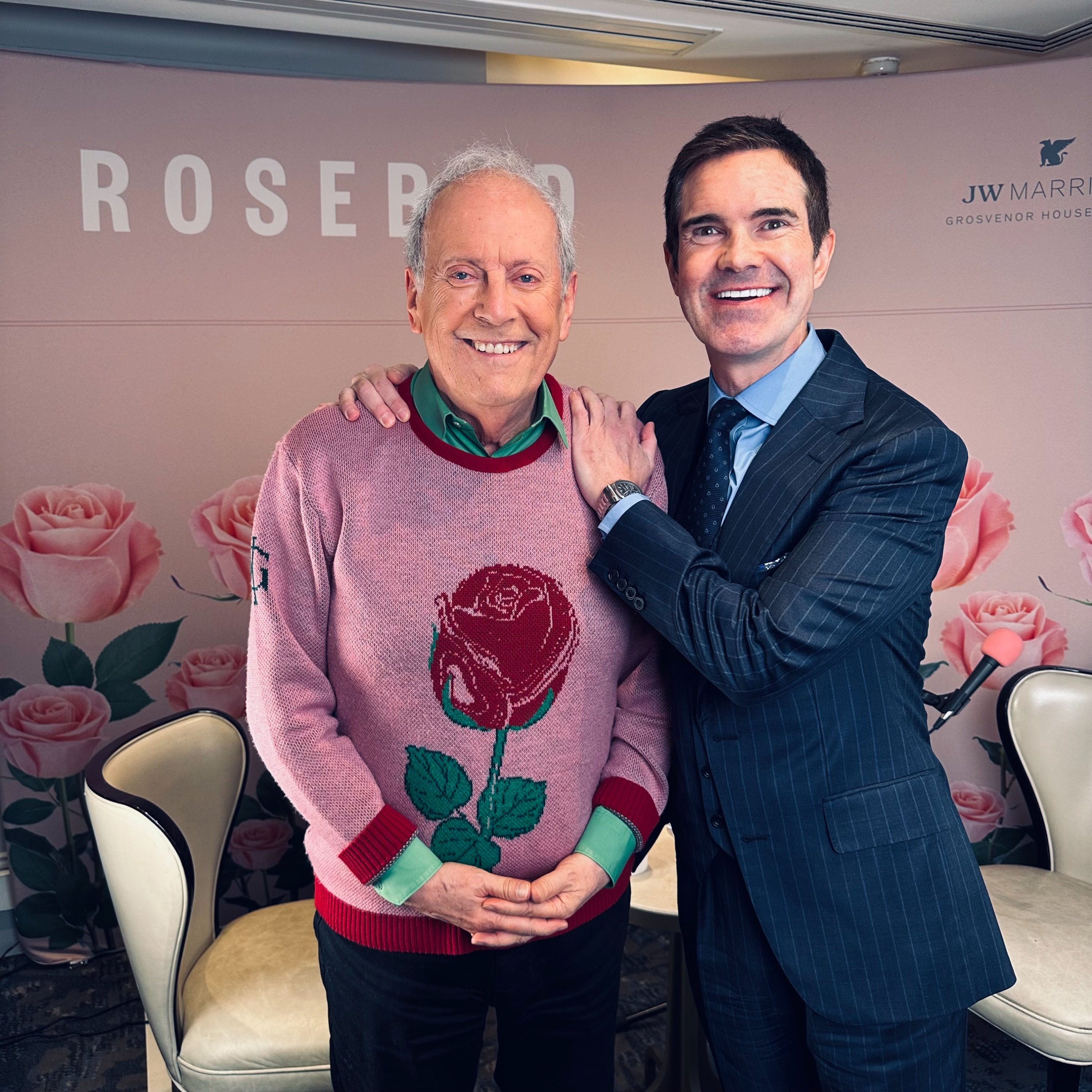
1:10:47Rosebud is a Plain Jane production produced by Harriet Jane, hosted by me, Giles Brandreth, with music by Phil Leppard, and recorded this week at the J.W. Marriott Grosvenor House in London's Park Lane.
A man who needs no introduction: comedian, writer and TV host Jimmy Carr. In this conversation we find out what makes Jimmy tick and hear about his origin story: he tells Gyles about his childhood in Slough, and his close relationship with his charismatic mother. We hear about his dyslexia, and how teachers at school encouraged him to apply to Cambridge. We hear about what, if anything, is off-limits in comedy, and the importance of being present for your children. Gyles and Jimmy also discuss the distinction between charm and charisma. Plus we hear about Jimmy's new movie, Fackham Hall, out in the UK on December 12 2025 (today!)
This is a revealing, wise and yes, charming, conversation with one of the most well-known comedians in the UK.
In January 2026 Rosebud will be launching their subscribers' club: The Rosebud Family. We'll be giving you more info about this throughout December, so keep listening! Cue the music!
Hosted on Acast. See acast.com/privacy for more information.


