
 Ask ChatGPT



Written by AI. May contain mistakes.

Get the gist, explore an idea or ask about something said.
 Claude
On Rosebud with Gyles Brandreth, what are the key points of this episode?
Searching your listeningAutomatic transcript. May contain errors.
0:00Welcome to Rosebud, presented by Giles Brandreuth, produced by Harriet Jane, and listened to you. Why, you? Yes, you! Cue the music.
0:31This week's guest on Rosebud is another very special person. It's Yung Chang. You'll know the name because you probably have got her book. She is the author of the multi-million best-selling historical memoir, Wild Swan's Three Daughters of China. Yung and her family, they are truly remarkable, as you're going to discover if you don't know it already. They survived a period of intense political upheaval and repression in China, and then Yung managed to get out of China and come to the UK. She was one of the first ever Chinese students to be allowed to come and study in the West and has been really incredibly brave in telling her story and shining a light on the horrors of the Cultural Revolution.
1:14Some of the stories she's going to tell you in this episode will certainly shock you. And Jung has paid a price for this. It's no longer safer to return to China and to be at her mother's side as she's dying. as she explains to me and indeed in her new book Fly Wild Swans My Mother Myself and China. We're blessed on Rosebud to hear from some of the most fascinating and impressive people in the world and Jung is certainly one of the most impressive. I think you're going to enjoy this. It's a special episode. This is the week of the 80th United Nations General Assembly meeting in New York, which is why at the end I'm introducing a special question about hope.
2:00I think I'm going to want to listen to this from beginning to end. This is the remarkable story of a remarkable individual, Yung Chang. Enjoy.
2:22Yung Chang, you were born in Yibin in the Sichuan province in China on the 25th of March 1952. I don't want you to cast your mind back that far because I don't think you will remember 1952. But I do want to ask you, Jung, what is your very first memory? Well, I can't say which memory is my very first. And there were some childhood memories when I was very young. I wasn't in Yibin then because my family moved to Chengdu, the capital of Sichuan province, when I was one year old. One childhood memory was raising silkworms, because Chengdu was a major silk-producing center in China, and therefore in the world, and it produces the softest silk.
3:21Marco Polo wrote about it in his travels. But where would you have seen a silkworm? Why were you close to a silkworm? Well, raising silkworms was a way of life in the old days. So even as a child, I remember gathering mulberry leaves to feed the hungry silkworms. But I think I'm not going to talk about that experience. I want to talk about something which was the earliest emotional memory of mine. And that was when I was very young. You know, we live in China under strict rations. Everything was rationed. So one year, my grandma pulled the whole family's ration coupons together and made two dresses of pink flowers.
4:20One for my sister, who's one year older, one for me. I mean, after making those two dresses and after making a pocket for my sister's dress, she'd run out of fabric. So she couldn't make a pocket for me. And I remember really being heartbroken. I cried bitterly. So my grandma cut up a handkerchief, a white handkerchief, and made a white pocket for me. But it wasn't the same. So I cried even more bitterly. Later on, particularly this time when I was writing Fly Wild Swans, I asked myself why I had such emotional outbursts, which produced such sort of deep impression on me. I mean, even today I could see that dress with a white pocket.
5:19And then I realized it must be that I had this emotional attachment to my grandma because my grandma had brought us up. My mother was busy working and we, the children, grew up with my grandma. And I had particularly a strong bond with my grandma because I had witnessed how much pain and she had been through because she had her feet bound. Tell us her story. What was her name? When was she born? And explain, yes, the tradition of binding her feet. Why did all that happen? She is your mother's mother. Did you have another grandmother? Yes, we had my father's mother, but I didn't know her because my family moved away from Yibing to Chengdu and she remained in Yibing.
6:14Tell me all about your grandmother as you think of her, your mother's mother. When was she born? What sort of family did she come from? Give us a flavor of her life. My grandma was born in 1909 when China was still under emperor and in a sort of relatively small town in Manchuria in northeast China. When she was two years old, her feet were bound, crushed and bound. I saw her feet when I was a child. The four toes were not normal. Only the big toe remained normal. The bones were crushed under a big stone, and the binding would stop the broken bones from recovering. What was the origin of this tradition?
7:02Why was this done? Well, it was about a thousand years and more. This custom, this tradition started. and so half of China's population, the women, were subjected to this cruel torture and lived in pain throughout their lives. What was the justification for it? In the heads of those who were doing it, why were they doing it? Well, you know, people said it made men feel sexy to see women torturing on this one toe. and also it was a way of controlling women. They couldn't go anywhere. They couldn't, you know, leave home. And this happened to millions of women. I somehow got the impression it was more well-to-do families that did this.
7:54Not everybody did it. But you're saying it was universal, was it? Well, I mean, anyone who wanted to get anywhere and also anyone who in fact wanted their baby girls to have a good marriage because without these crushed feet, which were called three-inch golden lilies, they couldn't find a decent husband. Big feet, which meant normal feet. You know, so the women couldn't find a husband. So your grandmother, when she was a small child, had her feet crushed and bound, and they were kept like that forever. Yes. And did she find a good husband as a consequence of this? Did it work? Yes, she was then given by a warlord general to be his concubine by her father.
8:53Her father, meaning well. Well, I don't know about meaning well, meaning that she would have lots of jewellery, lots of money, servants and all that, and the whole family. His family would also benefit. When you talk about a warlord, what would a warlord be at this time? It was in the 1920s, and my grandfather was the police chief of the Beijing government. And so he was a big chief, and he had many concubines dotted around China. So your grandmother became his concubine, one of several women in his life and household. Yes. And he had official wives as well as concubines. Yes. So she was a second class wife.
9:39She was almost like a third class because there was the proper wife and there were other concubines living with him. and she lived in Manchuria while my grandfather lived south of the Great War, so to speak, in China proper. Did you ever meet him, your grandfather? No. In fact, this is one of the things, even my mother never remembered him because when my mother was one year old, the warlord was dying and ordered my grandma to go and visit him. traveling long distance from Manchuria. As soon as my grandma arrived, her daughter, my mother, was taken away from her and was made to call the proper wife mother and told not to call my grandmother.
10:34So my grandmother realized that she would lose her daughter forever if she lived in the mansion of the warlord general. so she escaped she kidnapped my mother and this baby and she then fled one night um how old was she at the time your grandmother my grandmother um my grandmother was uh was in her twenties yeah and then in her twenties either 23 or 24 and had he shown your grandfather any interest in your mother in his child i imagine he had lots of children by various concubines Well, actually, that's not the case. He didn't have many children. And so my mother was important to him. But my grandma was not concerned about how important her daughter was to her husband.
11:28She was concerned about how important the daughter was to her. So she fled. Actually, when I was writing Wild Swans, I did research for the book. And I went to the mansion in North China. And then I realized how incredibly difficult the journey must have been because the road was strewn with rocks and spiky stones. And for my grandma, who had crushed and bound feet, it must have been hell to make the journey back to Manchuria. So literally on her, she left the mansion one night, taking this one-year-old child, her daughter, with her. She escaped from the warlord's mansion. And literally overnight, she just went on her own?
12:21She had her sister with her. And also she, at some stage, she rented a cart. But still, you know, it was an incredible journey. She couldn't ride the cart all the way back to Manchuria. How many miles are we talking? Hundreds of miles. Hundreds of miles. And that's how she began a new life. I mean, it showed her character and bravery, a character which my mother inherited, and which I hope I have inherited a little. What was your mother's name? My mother is called Xia De Hong. My grandma was called Yang Yufang. My mother was given a different surname because my grandma, after the warlord general died, fell in love with a Manchu doctor.
13:11And so that doctor was called Xia, Dr. Xia. So my mother took his name. And I seem to remember, having read the book, admittedly a long time ago, that he was a good man. He was basically a decent person. He was a very good man, very decent person. And an older man. He was much older than my grandma. And he was in his 60s when he fell in love with my grandma, who was in her 20s. He wanted to marry my grandma and marry her as a proper wife. But he's a whole big family, extended family, with lots of children and grandchildren. and they were against his marriage to my grandma because they said a former concubine would bring shame to the Shah family.
14:04And to try to persuade him, his eldest son shot himself in protest. Shot himself to kill himself? No, not to kill himself. I mean, he chose a fleshy part of the body. He wanted to stop his father from going ahead with this marriage. But there was an infection, and so he died. This was a son that he had by another, before he met your grandmother. Oh, yes, yes, way back. Because he was in his 60s. He was a widower. He was a widower. And he wanted to make your grandmother a proper wife. Yes. Not a concubine, a real wife. Yes. And he loved her, and she loved him. Yes. And yet the whole family objected to this.
14:47Yes. The son wounds himself, dies as a consequence. It's a terrible trauma for your mother and for the doctor. For everybody, yes. And Dr. Shah then had to leave his family because it was impossible to live together. My mother, in her formative years, was ferociously bullied and was once pushed down a dry well and nearly died. She was bullied because she was the daughter of a concubine. and my grandma also suffered tremendously. All this left tremendous drama in the heart of these two women as well as Dr. Xia. So Dr. Xia then left his family. He divided his property between his sons and left almost penniless to another city, Jinzhou, which was a big city in Manchuria, to start life from zero.
15:51He had no money, so they lived in a slum, which I went to see in 1989 when I was researching wild swans. And I was shocked by the sight because that slum was lower than the bank of the river, at the foot of the high bank of a river. So they lived forever in fear of a flood, which happened particularly in spring when the ice thawed. So what kind of childhood did your mother have living there? Well, then my mother felt very happy in that slum. It was the happiest time in her early life because she didn't live among this hostility and tension and bullying. And she was surrounded by love from her mother and from Dr.
16:47Xia. In fact, also for my grandma, she was also very happy compared to when she had been a concubine of the warlord general, when she had the big house, lots of servants, loads of jewelry. And she always said to my mother, if you have love, even plain cold water is sweet. So that was the happiest time in their early life. I assume Dr. Chia, because he was much older, died when your grandmother was still quite young. He died in 1952. Just after, a few days after. he was in his 80s. What time you were born? When I was born yes actually he gave me my name Arhong which means the second wild swan because he had changed my mother's name to wild swan.
17:45Hong the word conjures up the image of this big strong and beautiful bird that fly over great mountains and the rivers. And in fact, I saw the letters that my father wrote to my mother after they met. My father always addressed my mother as my beloved Wild Swang. And when I was born, Dr. Xia heard that I was born. He said, ah, a second Wild Swang is born. So I was given the named the second world swan. And then he died, it must have been a heart attack or stroke. He was in his 80s. So he was in his 80s. Your grandmother was still relatively young, bringing up your mother. This, of course, coincides, all this story, with the extraordinary changes in China.
18:39Yes. We've had the long march. We've had the arrival of communist China. No, no. Before the communists came. Well, they lived under the Japanese until 1945 when Japan surrendered. So my mother... And was that easy? Was that grim? It wasn't easy. My mother saw Japanese atrocities. And after the Japanese surrender, Chiang Kai-shek's nationalists came. And at first, my mother was very happy. They're living under a Chinese government. But she was soon disappointed because the nationalists were corrupt and incompetent. And also their intelligence were brutal towards students who were left-leaning. So she was turned against nationalists together with her left-wing students, fellow students.
19:42And my mother then left home and enrolled herself to a teacher training college, which took women. And then it was in that teacher training college that she was drawn to the communists. The communists and nationalists were at that point, after Japanese surrender, fighting a civil war for control of China. so she joined the communist underground and became a student leader against the Chiang Kai-shek by the age of 17. Goodness.
20:28How did your mother meet your father? I mean who was your father and how did they two get together. So my mother joined the communist underground when she was 17. And in 1948, the communists seized Jinzhou, the city where she lived. And then my mother met my father, who was a communist officer in the siege of Jinzhou. And my father had heard of my mother, this extraordinary 17-year-old girl who was giving orders to all the men and who was, you know, a firebrand, basically. China's Joan of Arc. The thing is, she was a feisty girl. And my father admired my mother, but imagined my mother to be the Chinese female tiger.
21:30But when he met my mother after the communists seized the city, my father discovered that my mother was this very slender, gentle, pretty, soft-spoken woman. So he fell in love with her because my mother never raised her voice. I mean, she issued command with the softest voice and always very gentle. And so my father was a delight, a pleasant surprise. He fell in love with my mother. He was 10 years older. Oh, he was 10 years older. 10 years older than my mother. And my mother fell in love with my father because she could see that my father was a decent man, was a moral man, even though he was shorter than my mother.
22:21But my mother felt he was like a poet. He's got wistful, big, wistful eyes. What was his name? My father is called Chang, which is my surname, Shou Yu. In fact, Shou Yu means to keep being the man people consider foolish. Because he is loved, admired, worshipped these qualities that in the ordinary, normal, traditional Chinese society were considered foolish. I mean, this could be seen from the names he gave to my brothers. I have three brothers. He named one zhi, which means upright, and pu, my second brother, which means true to yourself, and fang, the third brother, incorruptible. How many children were there in all that they had?
23:22We have five. There were five of us. Three boys and two girls. Girls, yes. And were your parents happy together? They were very happy together, but the remaining, of course, clashes. What sort of clashes? Clashes. Well, my mother, when the communists entered her city, and of course she found her love of her life, my father, but she also discovered the communists weren't as she had imagined. I mean, they did abolish the concubine system, but the women's association bosses, which were in charge of this job, actually despised my grandma and wouldn't sit with my grandma at the wedding of my mother to my father.
24:15So my mother was hugely disappointed. And also, soon after their marriage, they had to leave Jinzhou in Manchuria to Yibin, which was my father's birthplace and my birthplace. And the journey was 1 ,000 miles long. And my father was an officer, so he was entitled to a jeep or horse, whichever was available. and my mother was new to the revolution so she had to walk i mean so her idea of this equality among the communists was shattered so she walked a thousand miles well and not halfway halfway he wouldn't give her lift because it would be regarded as a nepotism and the form of corruption which the communists had said they would get rid of.
25:09And my mother desperately wanted to lift because actually she was pregnant with her first child. But she didn't know, of course. I mean, my father didn't know, others didn't know. And she was just feeling totally wiped out and nauseous and just, you know, wanted to collapse any time. and one night they were sleeping, everybody in that team unit slept together on the ground of a temple and my father was next to my mother and my mother burst into tears. My father turned to her and covered her mouth and said, you know, don't cry. If people see you cry, you will be criticized And to be criticized was not as light as the word seemed to be.
26:09It was berated, denounced, subject to humiliation publicly. The next day, the team leader berated my mother and said she was like a precious lady of exploiting class. And so my mother then suffered a miscarriage and not only lost her first child, she nearly died because she had a hemorrhage. And after that, she didn't walk the rest of the way. But of course, then she was totally disappointed by this new organization. She had just joined and she wanted to leave. She wanted to go and study medicine. Were they wearing a uniform at that time? Yes, they were wearing the communist uniforms. So she would have been wearing it, your father would have been wearing it.
27:03Did the children have to wear it? No, at that time, I mean, very few communists had children because you have to qualify. There was a qualification. To get permission to have children. Permission. No, to get permission to get married. You have to be aged 28 and above. You have to be a certain rank. Where do they settle? And why did you say at the beginning that your grandmother really brought you up? Because you now have, when you're born, you have a mother and a father and who are happy as a couple. So they arrived in Yibin, my father's birthplace, immediately after the communists seized China in 1949.
27:50and my father was the governor of the region and i was born there and lived there until one year old when you then moved because you don't remember when you were one when you then moved what is what was your daily childhood like give us a flavor of your life in the mid-1950s where you're living the house you're living in how much you see of your parents i think my My grandma joined us in Sichuan, first in Yibing and then in Chengdu. When I was a child, she was the one who held the family together. I mean, she created the atmosphere of love. I mean, for example, I think that the family dinner table, and my grandmother had many these sort of rules.
28:37And she said, you know, to my parents, no berating your children when they are eating, because that would affect their digestion. They wouldn't grow up properly. So it was that kind of care she took of us. My family also was in a very privileged position because my father was a senior official and we lived in the compound where there were drivers, cooks, gardeners. And so I lived among privilege. I grew up so much taking hierarchy and privileges for granted. And when I first arrived in Britain, I thought Britain was wonderfully classless. My views have been modified over the years. Your father was a very principled man.
29:33At one stage, didn't he take on Chairman Mao himself? My father was very determined to hold on to his principles. I mean, as we could see from the names he gave to his three sons. When my mother was giving birth to me, doctors said that it was going to be a dangerous birth. And my mother should be transferred to another place where they have specialists. And my father, who is the governor of the region, he vetoed the suggestion because he said his wife should not be treated in a privileged way and it should be like everybody else. And my mother was furious, of course, with my father and held this against my father.
30:25And this was a constant source of friction between their relationship. And of course, my mother only became happy when I came out of her body, you know, weighed nine pounds and safe. And she was safe, so she was happy. But my father's bending over backwards, not to be seen to be giving favors to his family. It was a constant source of conflict between him and his family. Soon after my birth, my father gave away the family big house because he said, you know, this big house only lived in by three people, his mother, his unmarried sister, and a brother. who is disabled. But then he gave away this family house.
31:25The family was furious and said my father was unfair because he said this was a big house. It was a huge house. He gave to a school for the teacher's accommodation. And it's still... What's your best personal memory of him, this principled man who was your father? you and he together. What's your best memory of him?
31:57Well, I have many, many memories of my father. I think when I went to stay with him, went to visit him and stay with him in a camp, which was a quasi-labor camp, but has a sort of euphemistic name as a sort of school. But in fact, he was in the deep mountains, and my father was sent there to do back-breaking hard labor. Forgive me. A moment ago, he was the governor of the province. How was he suddenly doing back-breaking labor? What went wrong? Many things happened. Okay, let me, perhaps I should... Is this because his principles, as I seem to recall, I may have got this story wrong, led to him sending a report and a letter to Mao Zedong himself, questioning some of the decisions that Mao was making, he made problems for himself.
32:53Is that in a nutshell right? Yes, absolutely right. What happened was my father's sort of sense of principles made it impossible for him to live with his family, whose interests he was constantly sabotaging, his own family, his mother, his brothers and sisters, like demoting one person and not to give fair treatment to another. And in terms of promotion, when the civil service ranking system was introduced in the early 50s, my mother was deemed to be two grades higher than she ended up to be. And my father vetoed it. He said people proposed my mother's promotion because my mother was the governor's wife, and my mother didn't deserve this promotion.
33:49And so he demoted my mother. So for decades, for the following decades, my mother couldn't even take the train with what they call soft seat, the equivalent of first class, because the first class was reserved to people of higher ranking. This created strain between them, tension between the pair of them. Constant strain. Were you conscious of that at the time? No, I was too young to be conscious of that. And a lot of those only manifested later. But my mother, in spite of all these strains in their marriage, she never stopped admiring my father. After all, she was a sort of communist as well.
34:34I mean, she sort of understood that, you know, my father as a good man who was committed to root out corruption in China. But he ceased to be the governor. He fell from grace. How did that happen? What was the result? So my family then left Yibing to Chengdu, the capital of Sichuan province, when I was one year old. And the reason was one of my father's colleagues, a woman, fancied my father and wanted to seduce him. He turned her down, but he knew that this woman was a vindictive character. And he was afraid she might harm my mother who worked under her. And so she then fled to Chengdu and asked for another job.
35:27And that's why my family ended up in Chengdu. And this vindictive woman, years later, was promoted by Mao. And this woman and her husband became the bosses of Sichuan, my province, which then had a population of 70 million and was the size of France. And these couple then persecuted my father ruthlessly, which was one reason why my father suffered so much. So he was sent away to this labor camp which was called a college. Forgive me, go on. Okay, sorry. But before that in Chengdu and of course there were a lot of things my parents were unhappy about what their party was doing but they always found excuses for their party.
36:25And one reason for that was once you joined the Communist Party, you were not allowed to leave. To leave would be deemed to desert and would be dealt with accordingly. So stuck in this situation, they had to think the best of their party. And this stopped, changed during the Great Famine between 1958 and 1961. roughly about 40 million people died of starvation. 40? 40. This was a big blow to my parents. I remember as a child, my father said to me, one day out of the blue with very agitated face and voice, and he said, you know, why we made revolution? We made revolution because people were starving.
37:21so he that was the one reason why he joined the communists when he was a teenager age 17 also and he's he knew and my mother knew the famine was not a bad weather it was man-made and their party was responsible and so did the famine touch your family yes we were all affected Of course, we didn't die of starvation, but both my parents and my grandma suffered a kind of illness from malnutrition. But we didn't suffer nearly as much as most of the population because of their privileges. But I could see famine. And one day, I was on the way to school. I was munching a bum. And when the child dashed towards me, I snatched the kind of Chinese bread and started to wolf it down.
38:27And I told my father, my parents, and my father, remember, this was one of my childhood memories, actually. And my father stroked my head and said, you know, you are lucky. And most other children are starving. so my father then wanted to speak up he wrote to Mao because that was the only way to influence policy but the governor Officer Chuan who was a friend persuaded him to withdraw the letter because the governor asked him to think about his young family and what disaster would fall on them. And so my father did. He didn't speak up during the famine. But this weighed on him for years until the Cultural Revolution, which took place in 1966, when I was 14 in my second year in school.
39:35And then the remaining violence and atrocities across China. and that was the last straw for my father.
39:51Give me an example of how these atrocities, this violence, touched you personally and your family. I was in a school and my school is the oldest public school in China and founded in 141 BC. So the school was also Confucius Temple, and it was full of gorgeous antiques and huge stone tablets recording Confucius teachings, a grand temple for worship of Confucius. And all those things were destroyed in the summer of 1966. And I saw boys walking around with iron rods and sticks to knock down the statues, the little statues that decorated those dainty sandstone bridges over a little canal that went through the campus of my school.
40:56And I saw so much destruction. But I also saw violence and atrocities against the teachers and pupils. I saw my teachers being forced to stand on the platform in a sports field. Their arms were twisted to the back. Their heads were pushed down. They were kicked and beaten simply by sort of being good teachers. And who was doing this to them? Well, the Red Guards were formed in August 1966. Mao called on for them to destroy the olds, including old culture, which is why all these old things were destroyed in my school. And also Mao also called on them to be violent. Those were Mao's words. And so their objects, the object of their violence were largely teachers.
42:06I saw my teacher being beaten up on one occasion because I was told to go to this particular classroom to see this teacher, particular teacher being set upon by pupils from my class because she had been dismissive to them who were, you know, unruly and not disciplined in her class. And what were they doing to her? Well, they were kicking her around. I was so, I can't tell you how terrified I was and because they said they wanted me to watch it because I was her favourite. And, I mean, they made her beg for mercy. I mean, you know, her hair were skewed, you know, face. Just absolutely incredible.
42:54What were you thinking in your head at that time? Well, I was just terrified. And of course, I didn't link all that with Mao. At the age of 14, I was not able to analyze, to make these connections, and to realize it was Mao's responsibility. because I had been brought up, like all my urban contemporaries, to regard Mao as our god. He was unquestionable, unsayable. He was like the air, the food, you know, a part of the thing we took for granted. And when we wanted to say what I say is absolutely true, we would say, I swear to Chairman Mao. So he was that kind of thing to us. And I hated all the violence and atrocities.
43:49You know, pupils also, we were divided by the Red Gods as the Red and the Black. The Reds were children from desirable family backgrounds. The blacks were the children from what deemed as the bad, undesirable family background. And the reds were licensed to torment the blacks. So I saw, you know, children being their heads shaved grotesquely and made to pull grass in the school. By the way, Mao also turned against the horticulture and said cultivating flowers and the grass were bourgeois habits. So whenever we had minutes, we were ordered to put grass from the school lawn. What were your parents thinking about this privately at home?
44:43Well, my father, it was at this point, he decided to speak up. So he wrote to Mao to protest the Cultural Revolution. basically asked Mao to stop all the violence and atrocities. He wrote a second letter some months later. And so he was deemed to be an anti-Mao criminal. He was beaten up ferociously. His legs, his ribs were broken and one eye was blinded. And he really went through a lot. And because those violence and atrocities soon were not restricted to schools, they happened all over China, in public. I mean, it was a country where violence and atrocities, not war, but, you know, people being set up, you know, on the stage, most publicly displayed violence and atrocities.
45:53You go home at the end of the school day to your mother, your grandmother, your brothers and your sister. Do you talk about this at home? Well, no. Well, the thing is this. And when the Cultural Revolution started in August, we were all, we the children, were told to stay in a school, to take part in the Cultural Revolution. And you had to stay overnight? So we had to stay in, you know, there was dormitories. There were dormitories, the classrooms were turned into sleeping places. But I hated all that. So I found all sorts of excuses to go home. and then at my last, the last time I left school to go home was the end of August when I saw a girl trying to commit suicide in the distance by jumping from upstairs a classroom window because she had been designated a black and was abused by the reds in her class.
46:55And I was, I went home. You were technically still a red yourself, were you? Sorry? Were you still a red family? I was, yes. I mean, you know, in China in those days, we had to fill in these endless forms. And every form after, you know, sex, date of birth, there is an inevitable column, class background. I mean, you have to, everybody had a class background. Mine, before my father was designated an anti-Mao criminal, was called the Revolutionary Cater. And so I was from a red family at that time. You can't believe what relief every time I filled those forms, aged 14, and how much pity and sadness I felt for people who had to feeling capitalist capitalist or landlord or a rightist.
47:59Those were deemed the bad background. In the midst of all this horror, were there any good things? Were there meals at home that were happy? Were you able to listen to music? Had you discovered books by then? Did you learn anything at school? Was there sport? Was there another side to this story? There was absolutely zero. You know, books were banned, at first burned, and then completely disappeared in China for more than 10 years. And Mao actually criticized Stalin for allowing European classics to exist in Russia. And he said Stalin made a big mistake. He was very thorough. There were no books.
48:43I mean, my father had a huge library, and all these books were cut off by the Red Guards who raided our flat, and they couldn't cut off all of the books, and they then asked my father to burn the rest. One day I came home and saw a bonfire had been lit in our cement sink in which I washed our mobs. and my father was forced to hurl these books into the fire. And he was sobbing and he hit his head on the wall. And I think that was the beginning of his mental breakdown, which was just absolutely a nightmare. And, you know, for 10 years of the Cultural Revolution, there were the music, all music was banned.
49:39The only music were these militant, aggressive music singing the praise of Mao and reciting the quotations of Mao. Theatres and cinemas and sports stadiums were turned into quasi-prisons. and my mother was imprisoned in the biggest local theater in Chengdu for a very long time. And it was just, I can't tell you what the hell China was in those years. You are telling me. What I'm finding extraordinary is how you survived all this. In your head, when your father was suffering like this, obviously having a breakdown, so understandable, Your mother was being as good as imprisoned. Your grandmother is still looking after you when you do go home from school.
50:40She's not at school every night. Are you close to your grandmother? Do you talk about these things? Does she hold you? What is there that gives you hope at that time, that makes you as a teenage girl go on? Well, I think actually the love of the family really bound us together. I mean, I stopped going to school. And at home, nobody dared to talk about these things. I mean, parents, I dare say few parents in the whole of China dared to tell their children anything different from the party line. Because what was the point of telling their children those things which might make them dissidents when they grow up?
51:30and that would only bring disasters to your children. I mean, you know, you constantly saw these notices in the streets of people being executed for being counter-revolutionaries. I mean, no parents would wish this fate on their children. And also children might blab, in which case it would bring disaster to the whole family. So I think people never talked. I didn't talk to my parents at all about these things. And I imagine then it wasn't possible at school to have a friend you could trust? Not at that stage. I mean, I was 14 at that stage. At the beginning. I mean, at the beginning. Later on, still, you know, you couldn't.
52:16You couldn't. I think only very, very much later. I think about Mao, never. I never talked to any friends because it just simply was too dangerous. Your mother and grandmother first had boyfriends 14, 15, 16, 17. Did you have a boyfriend at this time? Was it just not possible? Well, that was possible. I mean, I had boyfriends, yes, but we never talked about this. Only very much later, near the end of the Cultural Revolution, I think I talked to friends about these things. But we're talking about 1976, 1975. Well, 1975 is the year your father dies, doesn't he? So tell us the end of your father's story.
53:16Well, after my father was subjected to all the denunciation meetings and beaten up and so on, he and also my mother were exiled to these quasi-labor camps. I say quasi-labor camps because, in general, people in those camps had the treatments slightly better than the labor camps, the gulag-style labour camps. But still, my parents were there as the so-called class enemies or criminals. So they did all the back-breaking labour. For example, my mother, after half a day's work, she wasn't allowed to sit down at lunch break. The other people, the inmates, would always have an object to hate. Never forget hate.
54:09I mean, you know, this all, I was reading 1984. I mean, this was one of the expressions in 1984. George Orwell was not really young. And your father? My father was, you know, at the end of the day, when he was in the labor camp, he was subjected to denunciation meetings, which was several times a week. And it was so terrible. I mean, in his camp, there were many suicides and inmates who were designated enemies jumping into a river that flew across the camp. And the river was called the Anning, the river of tranquility. But the roaring of the river at night sounded like people sobbing, masses of people sobbing.
55:04When I heard about this in Chengdu, which was a four-day journey by truck to my father's camp, I had this urge to go and stay with my father because I was so afraid he might kill himself. I sort of gate-crashed the camp, sort of just went there. I mean, the camp authorities, it was difficult for them to throw me out because it was in the middle of great mountains. no hotels, no villages, only wolves. There were many wolves. So when I was in the camp, my father told me that if it were not for the love of his family, he would have committed suicide. How did he die, in fact? He died of a heart attack.
55:56But this was the result of years of abuse. And only three years after his death, you managed to escape. And your life then changes. Quickly, how did you manage to escape? Well, because Mao died. He died a year after my father in 1976. And China began to change. And in 1977, Deng Xiaoping started to roll back the Cultural Revolution. and in 1978, for the first time, scholarships for going abroad were awarded on an academic basis and I sat for a national exam. I did well, so I became one of the first to leave China. And did you leave your family behind or did you bring them with you? Oh, no, no, no.
56:49There was no question your family could come with you. It was only I had a scholarship. for a group of 14 people. And we were the first to come to Britain in 1978. I was one of the 14 people. And at that time, we were still wearing the Mao suits. Goodness. And we were quite a sight in the London streets because we were not allowed to go out on our own. We had to move in a group. Tell me, because we're coming to the end now, tell me about your mother, what happened to her. Finish her story. My mother was the one who helped me to become this one of 14, to go abroad. Yes. And in the subsequent years, I mean, she did all sorts of things for me, which ultimately gave me the freedom to write, freedom to write and freedom to be myself, freedom to live.
57:54So I'm forever grateful to my mother. And she is still alive. She's at 94. My goodness. She's still in Chengdu. And do you see her? No, that's a sad thing. Why can't you? You can't see her? I can't see her. Explain why you can't now. Well, I can't see her, I think, ultimately, because I wrote this biography of Mao. in addition to writing Wild Swans. I mean, my books don't toe a party line and were deemed subversive to the regime. Even today? Especially today, because currently under the present leadership, under Chairman Xi, Mao was deified more than any other time after his death. And Mr. Xi, in 2018, after he made himself the permanent ruler, supreme ruler of China for life, one of the first orders he gave was to make it a crime to insult our revolutionary leaders.
59:15I mean, of course, me as a biographer of Mao who had documented Mao's misrule of China. It goes without saying, if I set foot on China, I would be arrested. Goodness. Well, look, I have good news for your publishers. People who've heard you will be rushing out. They've already got Wild Swans. Most people have, one of the best-selling books of our time. I've got a copy. But they will go out and buy Fly Wild Swans because really it is the story of your mother, yourself and China. and you've in a sense well opened a door to the most extraordinary life story I think I've ever heard. Why do you think you're now so sane and look happy and beautiful?
59:58So sane? Yeah. Well, the thing is yes, I think I have optimism in my genes. I think my mother was an optimist and it was because she was optimistic that she always fought When did you last see her? Well, in person, 2018. At the time, just when I was in China, when I learned about the Xi's order. Are you able to make phone calls, FaceTime with her? Yes, well, thank goodness for these video calls so I could talk to my mother on the smartphone. Good. But, of course, it's not the same. I long to be at her bedside, you know, to hold her hand and hug her. And I can't. I guess, you know, that's the price we pay.
1:00:56I always finish by asking my guests three questions, and I've got four very quick ones for you. A moment, well, I don't really need to ask this. I imagine a moment of sadness in your life would be the death of your grandmother, who was such a strong person. When did she die? 1969, at the height of the Cultural Revolution. Do you remember her dying? Do you remember that moment in your life? Well, it's sort of very sad because my grandmother suffered in the last period of her life. She suffered tremendous pain. In her nuciation, she thought the pain was brought on by her being subjected to those ghastly denunciation meetings.
1:01:44But in fact, there had been no denunciation meetings against my grandma. But she had fainted when she heard how my mother was being abused, paraded in the streets, you know, so on. And she fell, I mean, in front of me, she fell like a plank of wood and her head hit a hardwood floor. And I think she may well have had brain damage. And I was helpless when I was with her, trying to soothe her from the pain, but, you know, couldn't. And I had to leave for various reasons. And I said to my grandma, I would be back soon. but I was delayed by one thing after another. So when I came back, my grandma had died and so I could only see the empty bed and I heard my siblings telling me
1:02:51about my grandma's last days.
1:03:00and well I think I very rarely talked about my grandma and every time I somehow become sort of uncontrollably emotional but the thing is I think the worst was my mother was detained quite close to home but she was not allowed to come home to be with her mother. And then until two days before my grandma died. She was allowed home briefly. And my grandma wouldn't die until she saw my mother. And her eyes were open. You know, sort of. Anyway, I just I felt
1:03:53Well, we all wanted to take a sip of water with you right now. Just as I said, what a story this is. But let me ask you, because I do ask everybody, and see if you can come. I want something to come straight into your head. Don't try and think about it. This extraordinary story, the tragedy, the trauma, the sadness, but also the love of the family, the love within the family. bring for me from your early years your time in China a moment of joy if I ask you just a moment of joy with your family maybe what would come into your head? In my childhood there were many moments of joy in fact my family my upbringing was full of love when I was a child I took all that for granted.
1:04:49And I took loving parents, and my parents never scolded me. I mean, even their occasional criticisms were coached in very gentle language, as though I were an adult who might be hurt. And so I took that for granted. And I think that might also have contributed to my intense love for my parents and my family. Because I think those extreme times had brought out an almost abnormal intensity of my feelings for them. Well, I've got one last question, and then I'm going to release you so that I can straight away start reading Fly Wild Swans. I've read Wild Swans. I now can't wait to read the sequel.
1:05:47This week, the world leaders are meeting in New York for I think it's the 80th United Nations General Assembly. And our podcast is joining other podcasts to think about hope. given the story you have told and given your natural optimism, you've spoken about how China has changed from the imperial collapse to being a global power now and you've told us about the challenge of actually meeting your mother again. I want to ask you, given all your experiences, where do you find hope for the future in the world in 2025?
1:06:31Well, I mean, to talk about hope, I must first of all mention despair and what makes me despair. And what makes me despair is that the current leader of China, in spite of knowing and perhaps even living through the atrocities of Mao's rule, still worship him and still wanted to return to some extent to the bad old Mao era. And that's the thing that makes me despair as particularly China is becoming, or some say, seem to be becoming the dominant power of the world. And I shall have no place to hide, to flee, and all the rest of the world who don't share that ghastly nightmare. So therefore, my hope must come from the resistance of the Chinese population and the world against China, to China going in that direction.
1:07:51And I think there has already been a lot of resistance in China and in the world. And my hope comes in more people making that ghastly scenario impossible. Yung Chang, My Kind of Wild Swan, thank you so much. What a story.
1:08:26Thank you.
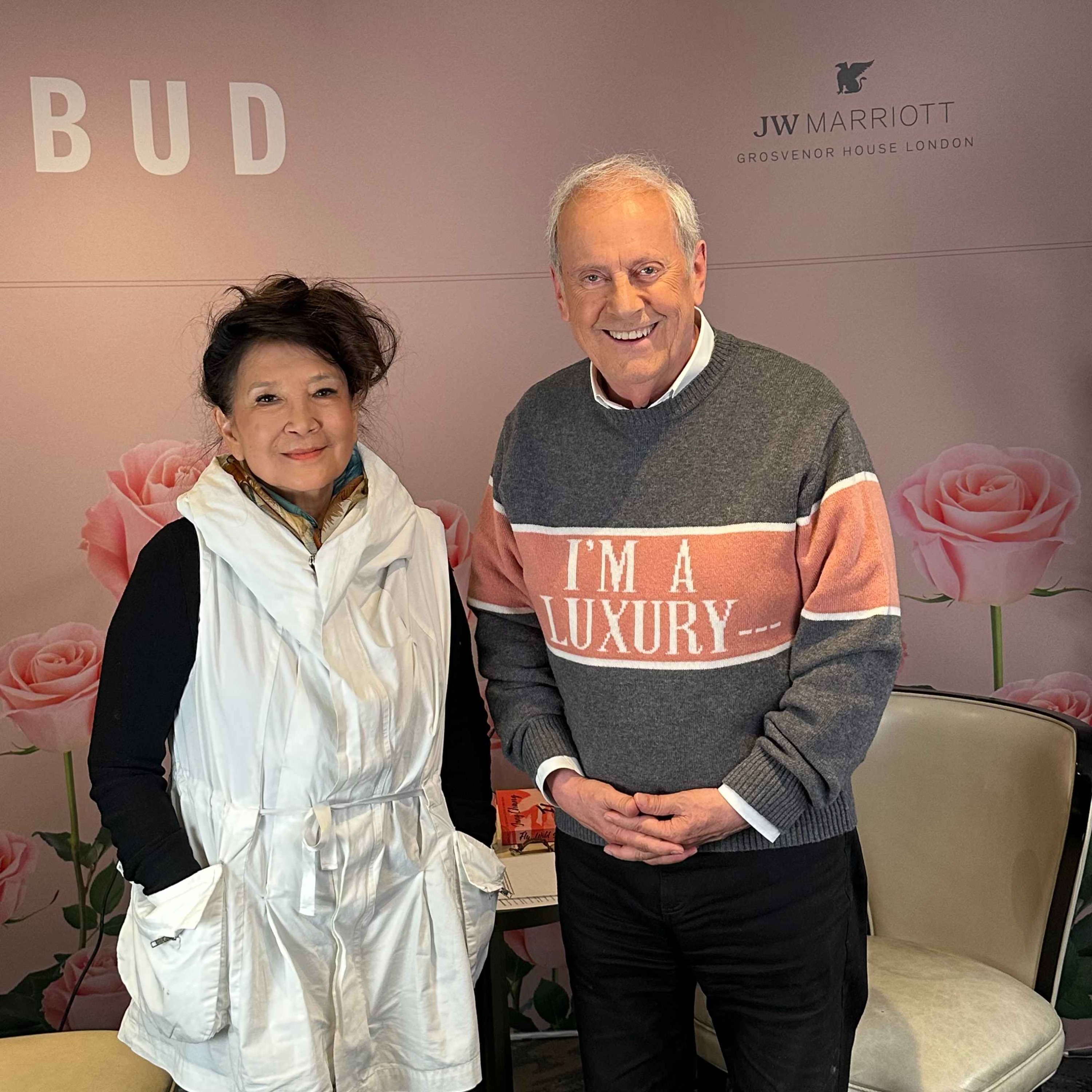
1:09:02Rosebud is a Plain Jane production produced by Harriet Jane, hosted by me, Giles Brandreth, with music by Phil Leppard, and recorded this week at the JW Marriott Grosvenor House in London's Park Lane. Room service.
We're honoured to have Jung Chang, the celebrated author of the international bestseller Wild Swans, as our Rosebud guest today - and her story will astonish you. In this remarkable episode, Jung tells Gyles the story of her family - and through that, the story of China over the past 100 years. This episode takes us from the tale of her grandmother, who grew up in pre-Communist China and was subjected to the cruel custom of foot binding, to her mother and father, who were committed Communists but who were eventually denounced and imprisoned by the Party, and eventually to Jung's own story, her move to the UK, and her fears for the future - which she tells brilliantly in her new book 'Fly Wild Swans: My Mother, Myself and China'.
Jung's latest book is out now and available now from here. It is riveting, and highly recommended.
For this week only, Rosebud are collaborating with Project Everyone as part of the "Be Hope" movement - and we've asked Jung a special question about hope at the end of the episode. And you'll definitely want to listen to to the end of this one! Cue the music.
Hosted on Acast. See acast.com/privacy for more information.


