
 Ask ChatGPT



Written by AI. May contain mistakes.

Get the gist, explore an idea or ask about something said.
 Claude
On Rosebud with Gyles Brandreth, what are the key points of this episode?
Searching your listeningAutomatic transcript. May contain errors.
0:00Hello, I'm Giles Brandreth and I'm here to offer you a respite from everyday life. You can forget the cares of the world, turn off the news, stop working for a minute, don't check your mobile during this, just prepare to immerse yourself in a world of memory. Yes, we're looking forward to looking back. Welcome to Rosebud. Cue the music.
0:47Hello, and welcome to another episode of Rosebud. I'm on the road. In fact, I'm in Hampstead, in North London. It's a beautiful sunny day. I've walked down the hill from the underground station, and I'm thinking, yes, this is very much the part of the world where rather interesting artists to live. It's beautiful. We have actually passed shops that are selling things like cheese. A butcher shop that delivers to your door. People have been offering us flowers to buy and they'll deliver them every week. It's that kind of part of the world. But I'm going to meet somebody, a remarkable man, who's now, I think, about 85.
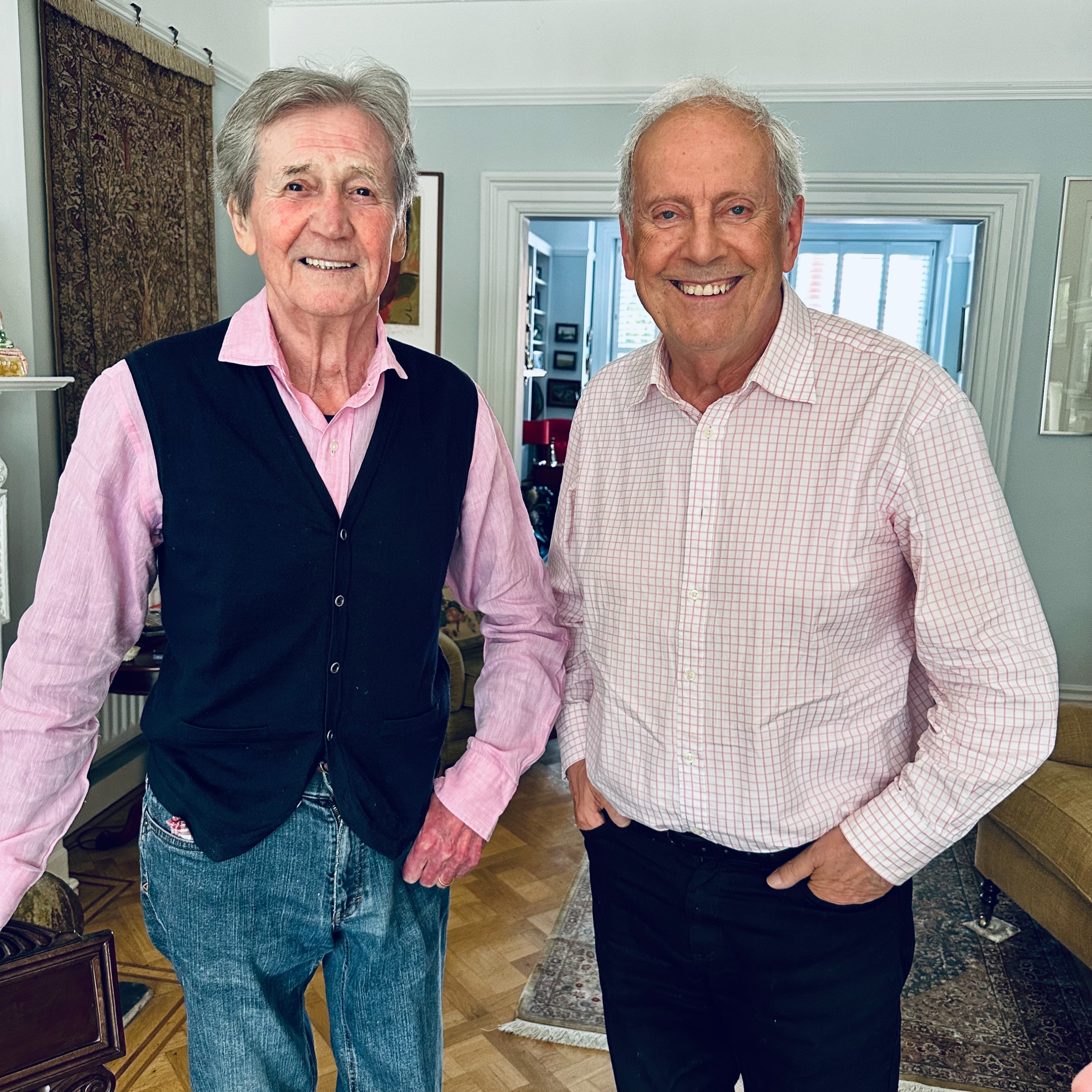
1:25I've been lucky enough to know him off and on for half a century. He's a polymath. He's a novelist. He's a broadcaster. he's a great champion of the arts a filmmaker he's also a member of the House of Lords and his story well it's all rooted as I think we're going to discover when we get to meet him in his childhood in Cumbria it's a story of well of triumph and tragedy there has been tragedy in his life and trauma I imagine he'll share some of that with us but he's also an enthusiast a lover of literature and the arts and somebody, well, I think he's rather brilliant. I hope you will enjoy this very special edition of Rosebud coming to you from Hampstead in England with Melvin Bragg.
2:15Cue the music.
2:29Melvin Bragg Melvin Bragg, born the 6th of October 1939 Melvin, what is your very first memory? Well, you set me a hard task because I have a muddle of memories when I was very, very small but I don't know whether I was three or five or two or whatever. But I was in a very busy household. It was called Council House in Council House Yard. And it was a big house. And the reason it was called Council House, because the council had bought it. And it housed two families, one of which is mine, two lodgers and occasional people who came and stayed so it's quite a big house with a big big cobbled yard in front of it and it had the fire station in it which was you've no idea how exciting that was every time they went you rushed out to see the men on their bicycles swerving around the corner jumping off their bike putting their hats on going out on the on the fire for everything that was just wonderful they had a library in it and it had the man who swept the gutters in the town in it.
3:40My goodness, it wasn't just the council house, it was the whole civic community was there. That's right, but they called it council house and council house yard. That's wonderful. So some people are born in a house called Dunroaming or Rose Cottage. You were actually born in a council house called Council House. That's right. So why were you born there? Who were your parents? Well, my father was one of a family of nine, the oldest. He passed a scholarship to go to Wiccan Grammar School, but then they couldn't afford it. So he left school at 14. This is your father? Yeah. And he worked as a boots boy in a big house.
4:15This is near Wigton? This is very near Wigton, yes. Which is in Cumbria? Cumbria, yes, in Cumbria. Carlisle might be a good reference for you. Fine. Just at the top of the Lake District. So here's this clever boy who gets these opportunities but somehow money can't be found. No, that's right. So a scholarship didn't come with scholarship money, it came with a small amount of money. Small amount of money. But it had to be topped up by his... But also it was the eldest boy, so he was completely expected to go out and work. And out he went. And a boot boy, meaning in service. In service, yes. And then he moved to doing farm work.
4:49And who was your mother? My mother was illegitimate, which I didn't dare say until I was in my 30s or 40s. She was born in Wickton. I still don't know her father. her mother was a housekeeper she had two illegitimate children and my mother was worn and was this in the edwardian times but what period would this have been this is my mother would be about 1920s 1920 just before the 19th and it was completely taboo you didn't talk about it no you didn't mention it you don't mention it and how so how And oddly enough, these two sisters, these sisters, look like twins. And they saw each other, and they looked alike, they talked alike, they did the same things.
5:36But nobody ever said they were sisters, or related, or illegitimous. Not until I was in my teens or something. Did they know they were sisters? They knew, yes, but they kept it quiet. Gosh. So who brought them up? Well, Mrs Gilbertson brought up my mother. She had her own family. And then she adopted two people, one of which was my mother. So your mother was adopted because she was an illegitimate child. Yes, that's right. Mrs Gilbertson adopted two illegitimate children, yes. So how did this, being the daughter of somebody who was illegitimate, how did this affect your mother? Did it affect her?
6:13I think she was remarkable because she did not let it affect her one bit. One bit. She got on with her life. It was a, you know, she made a living in all... She cleaned people's houses. in council house, you had around the corner was the gents, the ladies and gents. She cleaned the ladies out regularly, which meant got a reduction in the rent. Later, she got a job early on the, doing the early round on the post office. So she nearly always had two jobs. And she just got on with it. She was in the cycling club. She was very attractive. She was a good dancer. And how did she and your father meet?
6:53They didn't like to talk about them. their past very well how did they meet well he came to live in wickham he was from west cumberland and she was very attractive and i think the fact that he hadn't been brought up in wickham was a great attraction for my mother he knew nothing about her i think that was an attraction he was also a very dashing chap i mean he got on with things he went a clever man so he was an intelligent mysterious stranger who didn't know her dark secret no because he came from outside that's right and he liked the look of her what age were they when they got together oh quite young i mean we're talking about a young young young ladies on a young marriage and steadfast for then on and they were very good together very good can you picture them together actually as a couple yes what what can you remember of them they're good dancers they like dancing to go and when the wireless was on in the in in one of the rooms i just stand up and start dancing yeah it was great and how many children did they have?
7:52Me. Just you? Well, I got born and then the war started and I think by the time the war was finished they'd set on a different form of life and they didn't have any more children, no. I wondered myself, but you know, I never asked them why they didn't have any more children. What a stupid thing not to do. Well, no, I think it's quite, it's a bit personal, isn't it? One doesn't like to think of one's own conception, never mind. Why did you never think of having more children? I thought, I'd never occur to me to ask them. I don't know why. But it didn't seem to worry her. No. She was, I mean, she was stoic.
8:27So not a great deal worried her. Worryed her if people behaved badly. She wouldn't have that. She was quite fierce. There was a boy next to her called Tom Watson. Sorry, Tom. He was a real bully. I mean, a first class, 10 out of 10 bully. He was about three or four years older than me, bigger than me. And I sort of idolised him because he was good at throwing stones and he was good at all that walking along a thin wall and all that sort of stuff. But then he started to bully me. And I lived just around the corner. My mother got to know. And my mother sought him out. This is a little town of 5 ,000 people on the main street.
9:09Sort him out. And deliberately in front of people, she's fierce. I put it in the book. She put him in the book. She said, if you touch that boy again, you'll have me to answer to. and a little crowd had developed by then and they all applauded and did that put a stop to him absolutely so she he avoided her from then on and so you're born 1939 does your father go away for the war does he yeah well he was he was on a reserved occupation he was a man who mended airplanes there near near us was kirkbride which is on the solway way out of reach of the germans So they set up big hangars and the planes hedge-hopped from the south-east to come to Kirkbride, where they were quickly put back in order and flew back into battle.
9:55And he was one of those. And then after about a year or so, I just felt, I must not join up, I can't do this anymore. So he joined up. Well done. And he went into the Air Force and slogged away. Well done him. Yeah. They were wonderful, our parents, in that respect. They were very good parents. they were quite strict uh so with with great fireworks of generosity um give me an example well a little example we were in a pub by then a tenanting pub tenanting the worst pub in the town which he turned into a very nice pub slightly out of town anyway he came up nobody wanted he worked in pubs as a as his second job so he put in for it and he got it and what you got with the pub you got to carry the beer up and do that and learn to pull a pint and all that which I enjoyed very much but you got to put a poster up about the films of the week and for that you got two free tickets so I went to see every film that God made and one night on Friday night we went to see something called Snow White and the Seven Dwarfs I had never seen anything like it in my life next morning they put it on on the matinee because they went to all the matinees so I saw it a second time Mr Cusack who knew a good thing when he saw it had a second matinee in the afternoon so I saw it for a second time in the afternoon so I saw it three times by then and in the evening, Saturday evening I was desperate to see it again and I went round asking people if they could lend me this and Dad says, I'll take you so that a sudden burst of generosity the first time I'd been to the second house and to see Snow White again by which time I sat next to him on the front seats because all the rest were taking wooden seats the four corners and whispering the songs to him as though I remember that he was chuffed to bits but he did things like that and at Christmas he would he would I might recall Harry Moore had a garage just opposite in our street.
12:07He went up a ramp in his garage and he turned it into a big shop, toy shop, I suppose. And what he would do on Christmas, I mean, sort of forgotten. I said, come on. And I said, what do you want? There we were. He was a great person of generosity. What did you call him, Dad? Yeah. And you called your mum, Mum? Yeah. During the war, do you remember, I mean, you were small, you were naught when it began and only six when it ended. Do you remember the war years at all? I do. I don't remember those war years. I remember things like the blackout. We kept the blackout seriously. I remember events to raise money for the war.
12:48Pee and pie supper, bring your own knife and fork. Genuinely. It was a fundraiser, was it? Yeah, a fundraiser. To send treats to the troops. That's right. That's the kind of thing. That's right. And your mum would create the pie and the peas. Yeah. And people would come around and give her a shilling. With her own knife and fork. Knife and fork. and the money would go to the good cause. That's lovely. That's right. Did people sing songs at these? Yes, they did. They did it in the bottom of, underneath the congregational church. There was a nice room. That's where I learned to dance as well. Oh, fantastic.
13:17St. Bernard's was the first thing I learned to dance. Dum, dum, dum, dum, dum, dum. Dum, dum, dum, dum, dum, dum, dum, dum. Twirl. That's a dance, isn't it? It's called St. Bernard's. Da, da, da, da, da, da, da, da, da, da, da, da, da. That's it. so at home when you were a small boy what did you do what were your hobbies enthusiasms well we just there was plenty to do you just went out i mean there was a feeling that being out was good i'm not romanticizing it i mean my mother would say what you're doing inside on a day like this and you would scoot out and meet somebody and play and you just play meant running around out for each other chasing each other it was a little labyrinth of a town so it was wonderful to play games in, chessy games, chasing each other, tag games, finding each other, hide and seek.
14:08So there's always something different. Well, somebody had a ball and you played a bit of football or marbles, so you played in the gutters, you played balmers in the gutter. There was always plenty to do. And there was a park. My grandfather, who'd been in the pits, the mines, and he'd gone with five of his brothers right through the First World War, a little church with all their names on it. They all came back. and he was in a terrible pit disaster which scarred his face badly so he couldn't mind anymore. Anyway, he got a job as a park keeper in Wigton which was, you know, wonderful because it meant I could get on things for nothing.
14:45It meant that they had Park House where my grandmother and he lived with their children. I love it. Park House, Council House. That's right. It's all named after... That's right. It says in the tin. Because you were an only child were you sometimes you think better with grown-ups than with other children oh i never thought about things like that i don't think i noticed grown-ups very much so who was your first friend outside of home william ismay oh comes straight to mind yes who was william ismay william ismay his father ran a milk business well delivered milk and so i used to help them deliver milk on saturday mornings just to be with william we went around the town two bottles there took the empty bottles back and that sort of thing.
15:26Then went and saw all the bottles on this big machine being filled with milk and capped. So William Ismay was my best friend. And stayed my best friend until he died. And I still miss him a lot. What did he have? Why was he your best friend? I was just a nice... We just got on. We got on from the age of about four or five. They had a little cafe which was adjunct to the milk business. The cafe was called The Spotted Cow. So this was a town which loved nicknames, so he was thereafter, always called Spotted. A Spotted being in, have you seen Spotted? It's true. And so we just knocked around together.
16:07He couldn't sing, but I sort of wangled him into the choir. Oh, you were in the choir, were you? Yeah, yeah. From quite an early age? Yes, yes. I had uncles in the choir, and they just there was a call went out for trebles, and one of the uncles, more or less figuratively, got me by the scruff of the neck said come on and took me up to church and I was a treble In a cassock with a ruff? Oh yeah, not a ruff with a surplus a cassock and a surplus, no ruffs no I loved being in a choir I think you could disappear I think that's what I liked about it it was a good choir and we had Mr Mitchinson whose father played the organ and he ran the choir and he was very strict and make you do things again and again.
16:53Oh, it was scraping in the choir. Had all sorts of advantages because you had access to the church and so you could slip in the church but actually what you were going for is these flat hassocks about the size of that book where you knelt on. We played it being in the war and got the hassocks and skimmed them across at each other when the vicar wasn't there. Wow. It was terrific. Did you sing solos ever? Yeah, I did sing a solo. I was recording a song, yes. Oh, well done. Three kings from Persian lands afar. Da-da-da-da-da-da-da. And a follower guiding star. And this, that's right, I sang that.
17:32And the choir sang behind me a different tune. So your friend was nearly spotted. Did you have a nickname? I had a nickname, and I have, this is a first, because I've kept it to myself. People in Wickton know. Wickton was full of nicknames. There was Spotted. There was Nasha. There was all sorts of nicknames. And I was having an argument with a friend of mine called Lionel Temple. And I said something about Lionel Temple or something. And he said, Bragg. He said, Faggy Bragg. Faggy Bragg. Faggy Bragg. Faggy meaning cigarettes. I became, my nickname was Faggy. Very good. And you were smoking at the time, were you?
18:10No, I wasn't really. No, I wasn't interested. I didn't like smoking much. Was there a library in Wigton? Yeah, library in Council House Yard. Oh, fantastic. In the corner, in that far corner, there was a library run by the town clerk. And he told you what to read. Mr. Carrick, he wrote a book himself, The History of Wigton. This is wonderful because it was a world in itself. What you're giving me is that Wigton is a world. Within that world, there's a town that is called Council House Square. Yeah. Where you are living. Yeah. Did your parents have books in the house? or did you always borrow them from the library?
18:48Well, one or two, but not really. They were borrowed from the library. Can you remember the first book that is still in your head? I was terrifically taken with Robin Hood and I kept borrowing it again and again. Mr Carrick was very indulgent about that. I'd take it back and have it again, please. What was it about Robin Hood that appealed to you? Oh, it was fantastic. Living in the woods, bow and arrow, little John meeting Will Scarlet. Come on, what's not to like? I was particularly hot on Maid Marian. Ah, well, there you are. So you were an advanced person. I can't even remember anything about her.
19:21You don't remember Maid Malian? I remember her, but you were to have no consequence. Oh, interesting. You were more adventurous. I don't think I was more adventurous. Yes, you were. You were there with your bow and arrow doing Daring Do. We made our own bows and arrows, which is wonderful. Went along the river. There's a lovely river going through Wiccan called the river Wiza, W-I-Z-A. wends through, we can go into the sea and lovely trees there where you could make a good bow of them then get some twine at Stoddart's the ironmongers their son came to school so you'd get it either cheap or for nothing at all and you can make a good bow and arrow there and then make the arrows, it was great This is an idyllic childhood Looking back it was, I mean there were things that I suppose I must have been unhappy, I can't remember being unhappy Can you remember any dark cloud at all from those early years?
20:11I mean, not really. I was surrounded by good people. They were hardworking. Was there a policeman in Wigdon? Yeah, there was a little police station just down behind our house down the road. I remember once, I used to lie about scoring. My dad was big on football. So I would come back on Fridays and say, Hi, we got on very well. I scored two today, I said. and anyway he said let's go for a walk so we went down Station Road and on the left was the police station he said do you know what's in there he said there's a prison in there and if people tell lies they're sent to prison and they have to stay there and I was because I knew he meant me he didn't mean they he meant me so I didn't score any goals anymore from there on that's a wonderful so they were quite quite firm on discipline.
21:07Oh, yeah, and on morality. I mean, they wouldn't have fibs and they wouldn't have... No, they were very, very good people, but they helped other people. Were they happy together the rest of their lives? I think they were. You never know, but they... Dad always wanted to be his own boss, and so when this pub came up, he got a tenancy. Now, he said, they can't throw me out unless I break the law and I'm not going to break the law. It's cleared at 10 o 'clock. I never served drinks. And he never did. He never broke the law. And so he went down and lived in the pub. That was a bit of a strange one, because she was a teetotaler.
21:47And she had to live in the pub with him. They lived above the pub. Oh, yes. And she remained a teetotaler throughout the time at the pub. And she served behind the bar. Was he a heavy drinker? Oh, no. And he didn't, oh, another thing was he didn't drink in his own pub. Oh, is that a rule? Well, he made it a rule. It's a good rule, actually. What he did, though, after time, when time is called, 10 o 'clock or 10.30, depending on the day, the people who'd helped him, he had three people who helped him to serve in the different rooms, and they'd all go to the kitchen, and he could give them free drinks.
22:18That was allowed. So it wasn't, so that was OK.
22:29you went to school i assume is that a school in wickton that you went to a primary school yeah i went to primary school i went to the primary school then i went to the national school then i went to the grammar school what is the national school as opposed to a primary school well those three schools is the child school up to about the age of eight or nine my mother had been to that. Mr. Scott was the headmaster. He was also a person that went to church. And he remembered my mother. He gave me a book. And when I arrived there, I said, I remember your mother. Go see that cupboard over there. You can go in there.
22:58Just pick any book you want. So I picked something called Alice in Wonderland, which I'd never heard about. I did. And then you went from there when you were about eight or nine to the National School, which was Charles Dickens Grimm. Oh, really? Well, it was a grim building and 30 or 35 people in a car. But they kept very good order and they were good teachers. And Miss Tate, who taught the grammar school entrance group, she wanted to get everybody in the form into the grammar school. Everybody. And as it served three towns, that was more or less fewer grammar school. We were very disciplined.
23:35I mean, it was a disciplined time. People marched. People obeyed orders. People had been in the army. People knew how to behave in that sense. There were also, it was a rough area in some ways. There was fights from some pubs, quite regularly on Saturday nights. But not from your dad's pub, I imagine. They just, no, they chucked them out and never let them, barred them. Any trouble, you're not coming back in here. That's right. And so that would be on Saturday night. And on Sunday at about 10 to 12, there'll be a little line of people saying, sorry, Stan, I didn't mean it, I'll never do it again, I promise.
24:08Because they wanted to come back. Yeah. we'd give them one more chance and then we'd bar them and it was a bit dangerous bar because some of these were hefty lads and they liked to drink and they liked being down there because we had a good pianist there Jack Atkinson one of these people who could play by ear quite a few Irishmen came there they were working in there and they were good singers it was a hearty pub and it was well run and the beer was my father cleaned the pumps every day so they wanted to be back in the pub so they said they'd never do it again. And when you were working there because you served behind the bar and you helped out in the pub were you conscious that you were observing these people or you just took it as a...
24:48No, I was just helping out and sometimes Dad would let me pull a pint and serve in one of the rooms there were four rooms the bar, the darts room, the singing room and the kitchen. The singing room? You went in to sing. Wonderful. Yeah, it was great. You're picturing a wonderful world I must say. It was a wonderful world and I loved it. When you went to the grammar school obviously you went there because you were clever you passed the 11 plus yes were you conscious at that stage i'm now entering a new world i'm a different person from my family and from others around me not really because a lot of us in miss tate's class got into the grammar school i wasn't conscious of much really telling the truth i just got on with it i got on with it yeah and what were you like at the grammar school what sort of boy were you were sitting at the front of the class the back of the class i had to start to sit the front of the class because i discovered i had very bad eyesight oh and so i went to my my eyes tested and they said, you've got to have specs.
25:39This was a traumatic moment because I had to have specs. I was okay. I mean, I wasn't, the top of the class was a woman called Kathleen Hale and second was a woman called Pauline Bell. My goodness. And I was... These were in the same school as you? Yeah, much school. It was a mixed school. Yeah. The grammar school. Yeah. Kathleen Hale. My goodness. Well, she was a bit older than you. No, Kathleen Hale was my contemporary. Yeah, I'm thinking of Dorothy Hale, her sister. Oh, well, there you are. Thank you. They're good. Okay, so in the school, what do you do? What makes you stand out from the crowd of anything?
26:12I didn't stand out from the crowd. If you stood out from the crowd, you were good at sport. And I was okay at sport. I wasn't good at sport. I just remember teachers being firm, sometimes a bit mean. I remember Mr. Perdom, who'd served on a battleship, and one day he used to beat you. Oh. And one day he said, oh, God, this is broken. You know why this, Mr. Stoddard says, here, it's one and six, go and get me a new cane, please. This is in the day. Oh, my goodness. So I went down the street to Stoddard and said, Mr. Purdom says I can buy a new cane. He said, oh, yes, here, I want this. So I passed it to me.
26:53And I trotted back with it, feeling, oh, I've done a good job there. And he said to the class, shall we try it out on him first? No. Yes, he did. Bugger it in. I'll never forgive him. Mr. Purdom. Mr. Purdom. He doesn't need to be forgiven. My goodness. My goodness. Was there a lot of corporal punishment? No. No, not so much, but it was there. It was there. Yeah. And at the grammar school as well? Yes, I remember when I was a sixth former, even. In the lower six, I got a beating from the headmaster because I was very keen on this particular girl. And the way I expressed my affection for her, especially when it was snowing, was to make a lot of snowballs, which of course the more you kept them and hardened them they got icy and at lunchtime wait for the girls to come out of a girl's entrance and throw it at them you know we thought that was really a sign of deep endearment anyway so i was i wasn't a very good shot but this time i was a very good shot and he hit the domestic scientist she was smacking the face oh god well she wasn't having any so she marched me up to the headmaster's study mr stowe and he gave me six of the best.
28:02So there you are. Well, I think you deserved it. I did, I did. And at that stage, you're a teenager at the grammar school. Have you any idea what your future will hold? Not in the slightest. If anybody had said, I would say, I don't know, or a teacher. Yeah. Because if you said a teacher, that'd shut them up. Yeah. It covered all eventualities. Absolutely. And you probably thought you might be a teacher because you weren't going to run a pub, were you? I'm trying to be as truthful as I can and I say I'm being truthful. I didn't think about the future. I didn't think what I was going to be. It never occurred to me that I'd go to university.
28:34I thought I'd do what every other boy in my class did, was leave school at 15 and go and work in their father's shops, go and work on the farm with a lot of farm workers, go and work down the factory in the accounting offices and such. I didn't think it was the teacher who came and told my father, I think he's worth keeping on. So I stayed on. Well done, that teacher. Who was that teacher? Mr James, very good teacher. And then when I was going to leave at the end of the two years in the grammar school, he said, no, stay on. I'd like you to go in for these scholarships. If you pass, you get a scholarship from the university.
29:12You also get a scholarship from the county. And it'll pay your way. So you won't have to pay. So I stayed on and I got a scholarship. Because it wouldn't have been possible for your parents, just as your father hadn't been able to go to the schools. I think if they thought there was a big demand on my part to go, I think he would have tried his best. He'd have found a way. But I wasn't claiming, I didn't say, oh, I must go to Oxford or I must go to university. Mr James said, why don't you have a go for these exams? That's how he came about it. And you did. I did. In those days, you had to go for an interview at Oxford, didn't you?
29:46Yeah, you did. You took exams. You went down to a stay at Oxford a couple of days. Now, just describe that, because the boyhood you have now described in Wigton has a lovely, idyllic, old-world feel to it. And your parents, we clearly picture them. But you turning up for an interview in Oxford, had you ever been to the city of Oxford before? The only city I'd been to was Carlisle. And you applied for Wadham College. Yeah, well, Mr. James applied. He chose that. He'd been at Wadham College. Of course, yes. He'd been to Wadham College before and after the war. so he put me in for Wardham College.
30:25I think Wardham had very much, they wanted to encourage working class grammar school boys. Was this before the time of Maurice Bower? Maurice was our warden. Maurice Bower, for people who don't know, is one of the great characters in the history of Oxford. Yes. Quite an amusing character, drawn outside of it. What was he like? He was the head of the college. He was absolutely wonderful. He was, I mean, he was a great help. He was a bachelor he was uh he and Isaiah Berlin were great friends it was said that the only way they could speak to each other is if they sat back to back
31:02he made it his business to know all of us oh yes Albert Moff who came from Argentina was in the first year too and uh Albert said to Bauer have you any criteria about who you let into the college? He said, yes, I want clever boys, pretty boys, no shits. Well, there we are. So you fitted into the first two categories nicely. I hope so. That is why you were chosen. There's no question about that. I've seen photographs of you at that stage. Well done. So what did you do in Oxford? What was the subject you were reading? History. Because that's what Mr. James recommended. That's what Mr. James had done.
31:44Very good. And what are the other things? What were the pursuits you followed? I kept with two things I'd done at home, which was in rugby and in the choir. I went to the union, Oxford Union, thinking that that's where he went, because I'd done a lot of speaking, school debates and that sort of thing. But they were just too grand. They were just far too grand. They had white ties and they dressed each other as if they were going to rule Nigeria and that sort of thing. So I think I only went twice and never went there again. So what did I do? and knocked around with my friends. And then the big discovery was the cinema.
32:22Michael Wolfers, he said, I'll get you a job on Chowell as a film critic. Very good. Chowell's the university newspaper. Yeah. He was a fixer, Michael. So he got me a job on Chowell as a sort of sub-sub going to movies. Then I took to it. Then I was at the time of all these great Bergman above all, but Visconti, Fellini, they're all there. And I'm seeing these films and then writing about them and particularly Bergman with whom I had an association for the next, well in the sense that I first personally interviewed him in English and I went to Munich to do it and we spent a long time talking to each other and then I wrote a book about him and then I saw him again and we did something else together again.
33:13But what is so intriguing to me is we're going to come on to this extraordinary career that you then have as this person who is a major figure in the world of arts and sharing the arts with others, all of that. But at Oxford, were you really quite a tentative and shy person? Because during your teenage years, you had a traumatic experience, didn't you? What was that about and how did that affect you further on? Well, that affected me for quite a long time. You'd seen something when you were 13 or 14? Well, yes, also I was... It still affects me now and then. It's... What was it? What was the source of this?
33:50The source of it was that I felt that myself had gone out of myself. It's the easiest way. I'd been lying in bed. I had a little bedroom to myself above the pub. And then I would see a light, it's ridiculous, isn't it, but in the corner of the room, you know a light and not a switch like a light a light yeah like a light yeah uh this is a bit good and and i think i i actually thought well that's me and then there's this thing this carcass lying on the bed which was the rest of it and i could and i thought i i'm simplifying you now because it was terrifying i thought i've got to get that back inside me somehow or other and was Was there a specific experience that triggered that?
34:36I don't know. Do you have any idea what the origin of it was? I really don't know, and I've thought about it a lot. And it became very difficult for me to be alone. It became very difficult for me to walk up the street because a lot of the shops had big windows, and you'd see yourself in the thing, and then it wouldn't be you. You'd have to go and leave yourself. It became very complicated, and it was a burden. Did you share it with your parents? No. Do you share it with anyone? No, absolutely not. And did they notice that there was something odd about you? If they did, they didn't say so, no.
35:17So you just lived with it? Yes. And then it went away again? Yeah. The people who really noticed were the teachers, because I used to be in the top six or something like that. And then I suddenly sunk. And Mr. Swales, the headmaster, called me into his office and said, what's all this about? and I didn't know what he was talking about. He said, well, if it goes on like this, you're going to have to go to the secondary modern school. But first of all, I'm going to send you to 2L. It should have been called 2Hell. And that was where all the lads and lasses actually went who really deeply did not want to be at school.
35:54And one or two of them were bullies. And that was really not easy. And I just got worse. I couldn't remember things. And were you rescued by Mr. James from that? No. How did you get back out of 2L, back into 3A and 4A? Well, I got in by a dubious route. I was in the choir, and also in the choir was the headmaster, Mrs. Wales' daughter. She was a very good singer, and she noticed that I was in a bit of a bad way. anyway got back to the headmaster that I that I was and he um talked to me and I don't know how but next thing I knew I was back in 3A again and not in 2L again a very subdued person by that time but still on the on the old track which was hard work for good teachers so that but it did it had a huge effect on my life and it does come back sometimes this flash of us even later life even now I watch out for it and is it the same phenomenon of light not always but nearly always it's a phenomenon of being divided it's a phenomenon of there's this thing here with fingers and hands and sort of what's it doing there and then there's something somewhere else that is not connected and should be connected.
37:27And have you ever sought help? No. My goodness. I mean, here you are, this brilliant person who knows everybody. No, no, no, no. It's true, you do know everybody. Why did you choose not to seek help? Because it happened again in your 20s, didn't it? Yeah, I just didn't want to. You just thought, I'll get on with this. I just didn't know what to say to them. What would I say? I couldn't talk to my parents. I mean, look, I see this thing in the corner. couldn't talk to my friend. What are you going to say? I mean, he's buddy of talking to you. He knows so much and he's so sympathetic. But Tuckington, well, I mean, how is it?
38:02Did you ever think this could be a religious experience? Did it ever occur to you? No, all I wanted to do was I wanted to get it over with. No, no. I didn't think of it in grand terms. I thought of it in a physical experience that I had to somehow get through. Well, it's interesting. It's a disconnect, isn't it? Yes. Between your body and this light. Yeah. And while it's happening, you're desperate to get the light back inside and become normal again. That's right. And there is this awful garbage body, like sort of carcass here that is there that is useless. You've got it, yeah. I don't want to catch it.
38:48I've got the picture. I've got the point. But I'm sorry for you that it's gone on over the years. It comes back now and then, and it's not nice. Out of interest, and then we'll move on. Is it a known condition? I mean, have you read about it, and do other people have it? I've read about it, yes. And do other people have it, yes? Well, curiously enough, there were some of the things I've read about it by Indian writers, and they said, you're so lucky. This is what we aim for. well that's it you're one of these gurus on top of a mountain they come there and there's this light shining above because I've seen the cartoons of them with crossed legs these little thin old wizened gentlemen I didn't cross my legs there is the carcass or the beaming light something like that they thought I'd achieved something exactly I thought I wanted to get the hell out of it brag the new Buddha that's fantastic
39:43so at Oxford you work and you're enjoying the cinema and you're now beginning to think what am I going to do this is probably where you hear about the BBC traineeships yes I do because that was the era in which these things existed well it was the BBC traineeships that set me on the path because I didn't know what I wanted to do yeah anyway whatever I went to this place where they said and I applied for all sorts of things including concert iron and steel works didn't get that what a relief and anyway then the chap said well you might as well apply for this because everybody else is having the BBC thing and again it was a lot of fluke I um at that stage it was very difficult for me to travel anywhere without a book in my pocket a paperback stuffed somewhere well the day I went for this final interview from Oxford I forgot so I bought a copy of the Times on Oxford station and got there went for the interview, the man who's conducting the interview was a man called Sir Kenneth Lamb.
40:46As soon as I walked in the door, I thought, I've had it. One look at each other, we thought, hmm, that's that. And he was supposed to ask the cocker, and the cocker was, well, what's your view on Albania? But I'd read the article in the Times that morning on Albania. what a fluke set and matched for brag what a fluke wonderful a complete fluke and of course I was a spite of the 18 year old with a good memory and he was getting he was a lazy question and I knew more about Albanian needed because I'd read this he didn't like that at all and I came out thinking well I buggered that up so that's it and then I got the thing a week or two later let's say I was in the canteen at the BBC and Martin came up and I can see him now I'm sitting humming something in the canteen and he's standing there and he and he's with a big merry smile on his face and he said uh enjoying it i said oh yes he said they didn't want you you know
41:53wow yes as the years went by occasionally they showed that well done want you to know they didn't want you you know but becoming a bbc trainee didn't just change your life in many ways it made your life yes yeah before we get on to just one or two highlights of your life, because we can't talk about the 65 years without taking 65 years to do so. Looking back on your young years before you leave Oxford, and I say to you the word joy, what comes into your head? Joy from those young years, a moment of joy to give me. Oh, that's with William and friends going along the wires looking for a deep pool to swim in.
42:31Oh, that's perfect. And if I say to you a moment of sadness from those early years. Anybody that I knew dying, I hated people dying. An aunt of mine I was very fond of, she died. I still do, as to the people I most miss. It's ridiculous, isn't it? It's unbearable, really, isn't it? And what do you think this working-class culture of your childhood has given your whole life? I think it gave it an awful lot. An awful lot. people were on the whole very kind to each other very loyal to each other unpretentious they judged you by what you were and what you made and what you were going to make and all that sort of thing I feel very stabilised with it sometimes I feel sad that I've edged away from it or been edged away from it but then it's not too difficult to meet up with everybody again I feel it was a very rich life I mean when you look at the things I've talked about in this discussion with you I mean I sang in a very good choir I went to a very good school there were very good teachers I had excellent parents, I had good friends I mean what else do you want?
43:45It was wonderful Well done, it's fantastic We just do a little bit now about your first love Can you remember your first love? Oh yes, she just died about a month ago I'm so sorry Yes, no, it was very sad. Can you remember seeing her across the crowded room? Yes, I can. I saw her at school. She was at the same school. Joan, she's gone now. And we were together. We shouldn't have split up. She came to Oxford once and twice to see me. And she couldn't take Oxford. And she thought she'd have to live a life that was being lived by people at Oxford. And she did not want that. She was a farmer's daughter.
44:24she was very bright but wouldn't stay at school after her o-levels so uh we split up and i think looking back that was both of us wish we hadn't but that was yes that was very important went on for two years three years oh quite a long time yeah quite a long time and your second girlfriend was your first wife yes yeah and she is the mother of your mario sir who i have met yeah who is a vicar. Very reverent, thank you very much. Very reverent now. That means she's moved up the pegging order. She's moved up the pegging order. She's also at this moment going around Europe lecturing about the connection between mysticism and Christianity.
45:04I think she can explain these bright lights to you. I think you may find you're a more special person than you realise. No, she's a special person. She is a special person. I've seen her in action. I've heard her preach. I think she's remarkable. She is. And she is the daughter by your first marriage. Your first wife took her own life. Yes. which you've written about. Yes. Which I imagine writing about, well, living it must be bad enough, writing about it is difficult. Why did you write about it? Well, I don't quite know. I just kept writing about it. And I showed it to my Elsa. By that time I thought, I just don't want it to go as if you never existed.
45:51I think that was it. I don't paint myself in a good light at all, but I do her a reason of my justice, I think. You do her justice. You do yourself down in it. Yes, I do. That's the way it was. Having read it at the time, it was riddled, I felt, with guilt. Not that you were laying guilt with a trowel, but clearly that was part of it. Yeah, it was, and I thought, I just wanted to write something about her. Yeah. That was it. And your daughter? She wasn't too keen but didn't object. Well, she doesn't object. She loves you. I know that because I met your second wife, who I liked very much indeed, and your third wife, who I also met, who I like.
46:33I like all your wives, probably. So if there's a fourth in the wings, rest assured, I would like her too. No, I'm very happy with... No, Lisa took her own life. Kate died of basically massive cancer. She would not stop smoking. I mean, it was really massive. And she knew that herself. And we couldn't get her to stop smoking. She was a very serious smoker. In those days, a very serious smoker. I wish, I mean, I miss her an awful lot. An awful lot. But the lovely part of it is that your daughter, I think, am I right that your wedding to your present wife, she conducted it and your two children by Kate were there?
47:17Oh, yes. So the family all came together and supported you. Yes, very much so. Oh, yes. And all your interesting, I mean, this is impossible to say, but you may have an answer that you like to give or that you haven't given before, you think will give now. Of all the years, from Visconti through to today, interesting encounters. Is there one that comes back regularly as your head hits the pillow and you're thinking about your working life? You think, oh, I'm particularly glad I did that. um let me think working life my favorite television interview that you're doing is with francis bacon yes because you're clearly both i think you look as if you're wobbling about a bit oh very much a big wobble well it was um i i tried to interview i'd i'd known francis on and off for a while and asked to interview him tentatively because nothing had come of it and i met him coming out of a church that church he met me coming out of a funeral in Trafalgar Square.
48:18It's a Martin and the Eagles. Yeah. I said, I'm a bit fed up, actually, Francis. I've just seen a film that's been made about you by an American, and it is really crap. It's rubbish. It's a terrible film, and it does you no favours. I can't see why I want that sort of thing to go out, and not something that we'd do. Oh. So, what do you want, then? I said, I just want to sit down, do a long interview, and we'll fill in the rest. okay darling so that was fine so then we had about it anyway so i didn't drink at the start and we went to the restaurant when it was empty set the whole thing up so it was clear did little basic shots and all the rest of it and then um people started to fill in and we asked more and more and we started to drink and then we kept drinking and uh and it got to be very serious drinking, I'm afraid.
49:18But it did include things like, I went to Paris when I went to Paris and I saw these things along the Seine. They'd got these prints of people who'd been injured, Francis. Oh, yeah, and all their mouths were crimson. And I said, well, all your mouths are black, Francis. He said, oh, God, I can't do it. and he just got better and better and so and he got more outrageous really we went on to a gambling club after that and uh i saw the rushes after about two days i rang him up said francis we're both very drunk it doesn't matter about me but you are really drunk but actually you say things that i've never heard you say before which are really i think good and they're good about yourself, the good about the way you do things, and this is more like you than anything I can remember what do you think I should do, oh do what you like darling do what you like, do what you like, do what you want so we did what we wanted which was to show most of it raw, and it was terrific it was terrific well we're going to come to the end in a moment, are there things you haven't said before that you feel you should be saying now is there anything looking back, I mean you've been very lucky in many ways, I have and I know because I've had conversations with you before you hate compliments and you push them away but you've done good work in encouraging people to be interested in other things which is a good thing to do because you have curiosity what do you think is your greatest gift?
50:53I think you said it, curiosity I've always been interested in knowing more stuff and learning more stuff, always. Of all these people you've encountered, who have you learnt most from? Oh. Sometimes people do, I mean, I remember spending a day with Archbishop Desmond Tutu. Yeah. And I didn't learn specific things from him, but I learnt from the experience of being with him that I would answer that question like that. Is there anybody who just being with them, You felt you came away either wiser, warmer, better, less? It's quite difficult, that one. I was totting up the other day, I was in the next room, the number of people I'd interviewed.
51:43Oh, yeah, still. And it was 1 ,460. I interviewed for being on television. That's great. It's a lot, isn't it? It's a lot. Did you begin with Paul McCartney? Yes, I did. That was your very first interview. Yeah, and it was... I wanted to change things. I'd come to think of it. I'd wanted always to do a broad programme, rather like based... A bit like Hugh's Monitor. Yeah. A bit more than that, yeah. But also I was fed up with the arts programmes always being about the same things. And I just thought, well, actually, I'm seeing plays in the West End which aren't as good as the plays on television.
52:25The common culture is way ahead in many ways, in many ways. So I'm going to do that, see how far I get. Well, I got McCartney down. A big mistake I made was just do half a programme on him because I had to touch the other half. But anyway, what I did was enough to get it going, and he was very good. He's a wonderful talker and wonderful about himself. And we got this magnificent review in the Telegraph, which really rocked ITV. He said, we're very pleased that Bragg's doing this ice programme, but we draw the line at Paul McCartney. Oh. Isn't it wonderful? But there was an extraordinary snobbery, wasn't there?
53:06Oh, absolutely. But we draw the line at Paul McCartney. Now they've paid golden duck. Oh, amazing. What did your parents make of all this? How old were you when they died? Did they see all this happening to you? My mother did, but she took it very in her stride. I remember when I went to the Lords to be made a Lord. My dad was dead by that. She came along, and she's on that side of the table, next to Barbara Castle. And Margaret Che, who's sitting there, was the leader of the house, actually. Margaret said, you shouldn't have done that. Not put her next to Barbara Castle. I mean, she'll never get a word in.
53:52I looked across, Barbara Castle didn't get a word in. Oh, wonderful. It was great. And then she came up and congratulated me and my mother. And when I got this thing, I saw her looking up, and the first thing she said when I came out, she said, it's a wonderful ceiling, isn't it? Well, actually, it is a wonderful ceiling. It is a wonderful ceiling. So she looked at it with outsider's eyes. but do you ever pinch yourself and think how strange this is we began our conversation there you are in Council House in Council House Square and now you're Baron Bragg of Wigton well very few people say that and get away with it but it's what it is it does sound like being the Mayor of Trumpington but nonetheless it's a fine title and you just take it this is what happened this is your story so there we are yes that's it it's turned out like that and do you attribute it to anything in particular?
54:49What you were saying about curiosity, and I just liked doing the next thing, and I was helped. I mean, I was really helped. I mean, you couldn't have better parents, and they were going through difficulties. I mean, my mother, being illegitimate in that town in the 30s and 40s, and also having an illegitimate sister who looked like you, I've got a photo where they're like twins and not being able to talk about it and she was in everything a cycling club she taught the Morris dancers there weren't sticks and that there were girls dressed in lovely white dresses they danced the town band played the Hundred Pipers and they went down the street and they kind of she trained the Morris dancers and so she joined in everything she wasn't going to be left out she was going to do what she wanted, which she did.
55:45So I had that, and then I was very lucky with the teachers. I mean, there's that thing, Shelley, isn't it? The poets are the unacknowledged legislators of the world. They're not. Teachers are. Teachers are. I think it's such an interesting conversation because in many ways, the world you painted from your childhood was a better world, and yet you remind me that when you became a member of the House of Lords, your mother was able to sit there and you were a member of the House of Lords and she was there and accepted and you reminded me of how when you were a boy homosexuality wasn't spoken of and how it changed.
56:23So in many ways the world is definitely better now than it was and yet in some ways the world was better than it is. Yes it was. The world we were more comfortable with ourselves we weren't as demanding there wasn't a money culture I mean people didn't earn a lot even people who earned quite a bit didn't earn a lot. But it was a very comfortable culture, I think. Now I think it's a bit uncomfortable. Money counts more than it did before. I don't know, I'm making this up, actually. I mean, I just get on with it, really. Yeah, you do. And you seem happy enough. Are you happy enough? I'm happy enough.
57:02I mean, there's days and days. Of course. And who knows, next week they may be that bright light shining outside your carcass. I don't want that to come back. I hope it doesn't. and I pray for you that it doesn't. Anyway, you've got a lovely family. I think you're a lovely person. What have you learned? In your 85 years, this is what we end on, what have you learned that you would share with the people listening?
57:24Well, it's old-fashioned, but if you believe in something, don't give in. That's about it. That's about it from Melvin Bragg. Baron Bragg of Wickton. born, brought up in that council house, and now, well, now in Hampstead. You're brilliant. Thank you, Mel. Thank you very much. Oh, I think that was wonderful. My thanks there to Melvin Bragg from In Our Time to In Our Time. Great to have him here on Rosebud. Until next time, thank you for your company. Wherever you are, some people are jogging, some people are getting to sleep. I met the other day, well I'll tell you that another time that's it for now, bye
58:46Rosebud is produced by Harriet Jane, artwork by Freya Betts, and music by Phil Leppard.
Hosted on Acast. See acast.com/privacy for more information.


