
 Ask ChatGPT



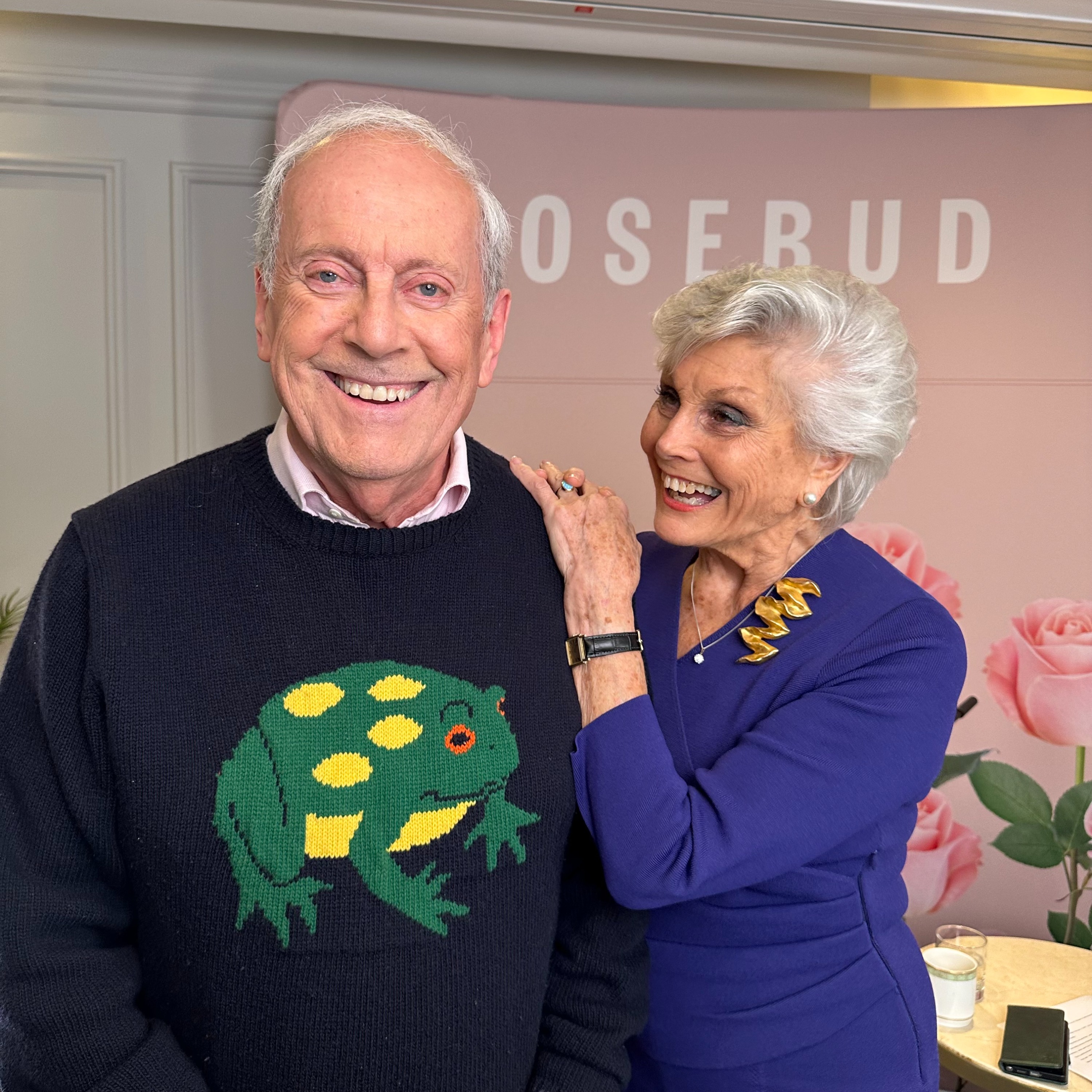
Host: Gyles Brandreth
Angela Rippon
Angela Rippon reflects on her early memories and a remarkable career spanning over 60 years in journalism and broadcasting. The conversation touches on her childhood, family, professional milestones, and personal anecdotes.
Written by AI. May contain mistakes.

Get the gist, explore an idea or ask about something said.
 Claude
On Rosebud with Gyles Brandreth, what are the key points of this episode?
Searching your listeningAutomatic transcript. May contain errors.
0:22Welcome to More Rosebud. Harriet is here. This is Harriet Jane and she's doing jazz hands. Jazz hands. That's very good. When jazz said welcome, I did jazz hat. Do you know now, my daughter Scythrid, who's been visiting us from Bali, has explained to me how young people now, so they're not oppressed by the sound of applause at concerts, just wave little fingers in the air to show their appreciation. Oh, yes, I have heard that. Little fingers being waved in the air. Yeah, because I guess clapping could make you a bit anxious. We don't want to trigger anybody. No. We just want happy... We're not going to burst into a round of applause.
0:55No, we are not. Nor are we going to say to the young people, Nut up. Get a life. Nut up? What is that? Go for the claws. This is the expression my son uses. Meaning, just get on with it. Do you know what my daughter says? Tell me. Pattern up. Pattern up? Yeah, if she thinks she needs to buck up, she'll go, pattern up. Oh, that's nice. I know, I love that. That's very good. Yeah. Pattern up. Pattern up. In fact, she did work experience with me last year. She and her friend did it, and I got them to record a podcast. I gave them recording equipment. they recorded and it was called Pattern Up with Belle and Lila, their podcast.
1:31Don't you think that's a fun idea for a show? Yeah. Very good. And they just went through saying the things they thought needed to pattern up. Well, we might next year, because there's going to be lots of innovations for Rosebud in 2026. We might do the occasional additional episode because people are asking for them. And we might do Pattern Up with Belle and Lila as, you know, a little bonus episode. Who knows? I might have to listen to it first. Yes, I don't know if it's suitable. Exactly, not suitable. But today is very suitable and very apt to you. Do you remember a few weeks ago when we were talking about who we would be married to if we couldn't be married to, who we were married to?
2:11I chose Elizabeth I. And I didn't know who you'd chosen, and you didn't know who I'd chosen, and you chose... Sir Francis Drake. In part because he comes from Plymouth. Yes. Which is your part of the world. It certainly is. Devon, yeah, I'm from South Devon. and that's where our guest today is from, isn't it, Charles? Before we tell you who our guest is, why is Plymouth special to you? Why should people around the world listen to Rosebud? Yeah, when we next go to Britain, we'll go to that place called Plymouth. Well, Plymouth is a naval centre. It used to have a huge docks there, Devonport Dockyard, where they made lots and lots of naval, big naval ships.
2:52It's where the Mayflower sailed from, the ship that first took the first pilgrims to America. And it's still got a ho, which I think is where Sir Francis Drake was playing bowls. I'm probably saying a load of made-up things on the day that the Spanish Armada came. But that's one of the great myths. I love it. I don't think that's true, but yes. But it's built up over the years. I know. I'm sure he was. I'm sure he was. Yeah. I love a game of bowls. Is that why people say Westwood Ho? No, I think it means go west, doesn't it, Westwood Ho? Westwood Ho is near Western Supermare, isn't it? Is it a place called Westford?
3:26Yeah, it's a place. Oh, I thought it was just a message. Go to the West. Westford, ho. Well, it is. Westford, ho. Yeah. Where does Santa Claus go at Christmas? Westford, ho, ho, ho. I improvised that. I love that. Did you just make that up? Yeah. And years ago, I used to write Christmas cracker mottos. Of course you did. I did, for Tom Smith Crackers. It's about 50 years ago. Can you think of any? One of my first jobs. Yes. What does the king do when he burps? I don't know. What does the king do when he burps? He issues a royal pardon. So you say our special guest today comes from Plymouth. I know it is.
4:00She is a remarkable figure. Oh, she has got a remarkable figure. And I think we're allowed to say that because she has worked on that figure by keeping herself super fit throughout her 80 years. She's celebrated for being, I think, the first full-time BBC newsreader who happened to be female. Yes. It's Angela Rippon, who first became, well, she's part of the Christmas season. We're coming towards Christmas because famously, was it back in 1976, she danced on the Mockham and Wise Christmas special, which I think at the time was the most watched television programme ever seen at Christmas. I think it's still the most watched TV entertainment show ever.
4:4726 million people watched Angela Rippon doing the high kicks. Yeah. She got the moves, hasn't she, Charles? I think she's still got them. She can still do the high kicks because last year she was in Strictly Come Dancing and we saw those high kicks. But I think she's interesting. I first worked with her, it would be nearly 50 years ago, or it may even be more than 50 years ago, when she was, well, we're obviously going to chat about it. So I've known her a long time. I think she's a remarkable person with an interesting tale to tell. And it's worth remembering that when she started out in television, for women it really wasn't what it is now it was a much it really was a much more difficult world yeah even when you began was it have you noticed a change in your time or not really well i mean there's so many more women working in tv and much less of the sort of macho attitude that i actually think angela does talk about in this episode a bit doesn't she yeah this is an intriguing episode of rosebud it's more rosebud it's tuesday i'm charles brandreth that's harriet jane now here is Angela Rippon.
5:52Cue the music.
6:04Angela, we always begin with the same question. It's a simple question. What is your very, very first memory? It's interesting you ask me that, Giles, because sometimes you know how people have false memory and you think you remember something. I think I remember actually being barely a year old. I certainly have a memory of being in a cot and my father looking over at me. Now, I don't know if it's a memory I've invented or not, but it is certainly one of those things that's sort of there and I'm convinced it is real. What I know was definitely real and is definitely one of my very earliest memories.
6:52I think I was about three or four years old and I was out walking with my mum and I had my teddy bear who was quite large under my arm and I tripped on a pavement, fell over and hit my nose on the curb and smashed my nose and was taken to, I remember being taken to hospital and they said no no no it's all fine and I remember it distinctly because when I was in my very early 20s and discovered that I wasn't breathing properly I was taken to hospital and had to have major surgery on my nose because I had in fact smashed the nose and closed over one side of it. My goodness so when people say has Andrea Riven had a nose job the answer is yes.
7:35I've had three subsequently because that was the first time they had to rebuild it because one side of my nose was not operating at all. It was completely blocked. And subsequently, when I started riding, when I was in my late 30s, early 40s, had a wonderful, wonderful thoroughbred mare called Extra Time, but she was Katie to everybody in the family. And she was stunning. And I used to do a lot of competitive riding. And on two occasions, for odd reasons, once I was standing in front of her when we were in the judging ring and she brought her head up and caught my nose and two days later I had to go to hospital and have it all rebuilt because she'd smashed it all are you happy with your nose now oh goodness yes I mean that doesn't bother me at all it works that's the most important thing I can breathe through it it's a charming nose it works and I have to say I'm going to come back to this because I think you are a bit of a thoroughbred and I want to discover why well yes Yes, and it may be to do with the breeding.
8:34You mentioned your father and your mum and the teddy bear. In short order, I want to know the names of each of them and a description of them at that time. Describe your father to me at the time you were born, which, if you don't mind me sharing this with everybody, was the 12th of October, 1944. That's right, yes. I didn't, apart from this very odd memory that I have of my dad, as I say, when I was about one, I'm convinced it might be real because I didn't actually meet my father properly till I was almost three years old because being born in 1944 towards the end of the war my father was a Royal Marine and he was part of the team that manned the 16-inch guns on battleships and he was on a battleship called the Rodney which was very famously involved in helping to sink the Bismarck um he told me just once his memory of it and he said he remembered that they were somewhere in the north atlantic when they were sent down to where the bismarck was going to be and they sort of got there with a lot of the other ships including the admiral of the fleet ship and the bismarck of course had these very very big guns and it was trying to sink the admiral's ship which meant that my father's my father always said they had the most wonderful captain who decided that he would take the ship under the guns and so they tacked the the this little pocket battleship that my dad was on started firing their guns and went underneath the guns as the bismarck was trying to shoot the admiral of the fleet under the guns and strafed all along the side of the bismarck and they hit the the armory where where they had all the all their every bit of ammunition they needed for the ship.
10:16And that was what actually blew the ship up. And that's why it broke in the middle and sank. And at the end of the war in Europe, his ship was one, I think, of maybe two or three that the British Navy lent to the Americans in Japan. So he went to Japan, but was there when the bombs went off in Nagasaki and Hiroshima. And he was present when the Japanese surrendered to the Americans, to the American Fifth Fleet. But, sorry, long story to tell you, that as a result of that, at the end of the war, which was then, what, very late in 1945, going into 1946, their ships, instead of coming home, were sent the long way round and went via Australia, New Zealand, the Pacific, the west coast of America, and they were gone for at least another year and um at the time daddy said that it was because so many service men were coming back that the british government and and i suppose what would have been what the war office at that time decided that it would be quite difficult to have too many soldiers sailors airmen women men and women in the services all coming back together so they sent them the long way around and I was I think two getting on for three years old when I actually saw him for the very first time.
11:38Do you remember that moment? I don't but I do remember growing up with my dad then always saying because he never saw me growing up he would open his wallet and there was a photograph of me when I was eight months old and he kept that in his wallet all his life and I used to say daddy don't you want some more modern pictures of me and he would say no he said I never saw you when you were that age. And I can see, I just turned on the telly. I can see what you look like now. But he came back. And we do have a famous photograph in the family that was taken by the Daily Mirror at the time because it was quite famous that the ship had come back and all these sailors and Royal Marines had not seen their children for two, getting on for three years.
12:19And there are all the sailors with these young children in their arms, all looking happy. And because I had been at that point brought up by my mother, my aunts and my grandmother, I had no idea who this man in uniform was. And I have a face like a prune. I mean, I'm looking, I'm in my father's arms and he's looking so proud in his uniform. And I'm going kind of, not sure about this. And it's one of my favorite photographs because I developed the most wonderful relationship with my dad because I, sadly my mother could never have more children after me. And I think my father, being the kind of man that he was would have loved to have had a son but he had me instead and he instilled in me all of those values that I think he would have wanted to pass on to a son of self-reliance being being prepared to work for what you want having a kindness and a humanity to other people all of my father's values that he would have wanted to pass on to a son he passed onto me without ever knowing that I was, you know, as I grew, I was going to end up in what at the time when I started, what, 59 years ago in broadcasting, that I was entering into a very male-dominated profession.
13:36Do you think he was disappointed? I ask that because my older sister, Jennifer, was very conscious that my father had wanted a boy. That was everything. And I think she was conscious of that. She adored my father and he adored her, but all her life she felt she'd been a bit of a disappointment? I don't think I was. My mother worked all my life, which meant that my mother was not always at home during the day. I mean, I was what in the 50s, late 50s and 60s were referred to as latchkey children. I would come home from school and neither my mother nor my father would be at home until five or six at night.
14:13So I would get home at four, four thirty after school. Did you have a string inside the letterbox? We had a string at home. No. Inside Saturday night, you pulled the string out and the key was on the end of it. No, you carried the key with me. Oh, you were trusted with the key. I wasn't trusted with the key. Trusted with the key. And at weekends, my mother was still working. She would still work on a Saturday. So I spent a lot of my free time at weekends with my father. And I think I grew up being very much a tomboy. So I never had the feeling that my father ever was disappointed in me. In fact, I think he was delighted that I grew up to be a little girl, but that I was prepared to do a lot of the daft things that he would have expected of a son.
14:51Tell us about your mother now. My mother was called Edna. She was trained as a tailoress. So she taught me to sew very early, which is why when I was, gosh, well into my 20s, I used to make most of my own clothes still because she allowed me to use the machine and taught me how to use it properly. But mummy worked all her life. It was just one of those things. She assumed that that's what women did. and I grew up assuming that that's what women did. How did they get on together? Extremely well. My father adored my mother. They both died in their very late 80s. They were married for more than 60 years.
15:28They were joined at the hip and my father absolutely adored my mother. How did that show itself at home? Oh, I mean, they always walked hand in hand everywhere. My father would put his arms around my mum whenever he was. My father was very tactile. It was just happiness. And also, my dad always let my mum have her own way, I think. It's another way in which it was. But my mum was quite a tough cookie as well. And she did work all her life. Because, I mean, we were never rich. We were always living. I learnt the value of my money very, very young. Because if ever we... I remember my first pocket money was sixpence.
16:07But you had a teddy bear. But I had a teddy bear. What was your teddy bear called? Teddy. Of course. What else? And he was a gift to me from one of my mother's friends. It had been her teddy bear when she was little. Ooh, an old teddy bear. And he was a stife bear. Yeah, the famous stife. They're the ones that are so valuable now. He's stuffed with wood shavings. Mm. Very old. The growl stopped working a long time. But if you shake him, you can still hear it. You've still got him. Oh, yes. I gave him a haircut when I was a little girl because I didn't know any better. and so there are bits where he's quite bald.
16:46We had at one point a German Shepherd puppy. She ripped off his ears and I've lost his ears. He's gone through the wars, his teddy. But my mother said to me one time, we were moving house. They were throwing out things and said, you know, we can't take everything because we're moving. And the teddy bear was going, I said, no, you can't get rid of him. And my mum said, well, why not? And I said, you can't get rid of teddy. He knows all my secrets. And he still does, Giles. Oh. What was your... Can you remember your first bedroom and your first home? Yes, I do. We lived in a little street called East Street in Stonehouse in Plymouth.
17:28We lived with my grandparents. They lived in the bottom of the house, and we lived on the next floor up. We had an outdoor toilet. My grandfather had chickens in the garden at the back. my parents had a bed sofa and the sofa would come out every night for my parents to sleep in the sitting room and I had the little room on the side which was my bedroom and one of the very first things that my father did was put a bookshelf up for me because I have had books in my life since I was little and could read and in fact there was a point where I I sort of started when I was about eight or nine I started a library for the children in the street because they didn't have books and I used to lend my books to them and I had a little I put a little tag inside them Angela Rippon's lending library which they had to give back to me yes well done you but I do remember that and I had a little single bed in the corner and the window which looked out onto the street and what were the first books you remember enjoying I know I was reading Enid Blyton for some reason I remember a book about someone called Presta John and I don't know why but that name has stuck in my memory.
18:40But I had books about ballet because I was going to ballet classes. I was sent to ballet when I was about five years old. And why did that happen? Was your mother keen on ballet? No, it was because I had knocked knees. Oh. I think perhaps a lot of women or children of my generation might have done. Again, it's a reflection on the times. You know, we had rationing. We didn't have a lot of food. I was brought up at the end of the Second World War. So it's to do with nutrition, is it? And it would have been to do with nutrition. Like rickets and things. Kind of, yes. proper diet. Yeah, and so I had no niece, and my mum took me to the family doctor, who was a wonderful Scotsman, and he said apparently to my mother, well we can either get her built-up shoes, or you can send her to a dance class.
19:20Well my mum, thank goodness, sent me to a dance class, and it was like duck to water. And what was the dance class called? It was called Miss Delver's School of Dance, and it was in a very large Nissen hut at the bottom of the hill near Plymouth railway station and there was somebody playing the piano and we were all little girls in little blue tabards I remember. I took to dance and loved it and managed to progress in Miss Delvers School to being sent to the Geraldine Lamb School of Dance which was the school of dance in Plymouth. It's where Wayne Sleep started dancing. So I've been dancing ever since.
19:58And can you remember why it pleased you? it must have been because of the music because it's inherent in all of us to be able to move to music even if it's only tapping your feet if you're listening to something there is something in the human psyche in the human brain in our makeup as human beings that reacts to music and that, just that in its most sort of primal form has stayed with me
20:35who was your first friend outside of home my dog i suspect um did you have a dog that you felt was yours oh yes i had a dog that was called rufina oh rufina rufina did you think of the name um well it was originally called rufus because we it was a boy and then the vet told us it was a girl so we couldn't change we changed it to Rufina and it was a little mongrel um and I think um my my first friend was probably somebody from from primary school or in the street where I lived I don't really remember having proper friends until I went then to primary school when we moved out of Stonehouse and moved into our first proper home away from my grandparents we we went into a prefab in a place in one of the suburbs called Honicknoyle.
21:22And what is a prefab? Prefabricated building and there were thousands of them built at the end of the second world war as a quick way of housing and there are. Were they made of wood? They were made, some of them were made of wood, I think ours was made of metal. They were perfect little houses and we lived in one that was in a little cul-de-sac and there were five little prefabs in the cul-de-sac. We all had a front garden and a back garden where we could grow our own vegetables and a shed and these little prefabs came with a sitting room two bedrooms a built-in bathroom and a fitted kitchen it came as a unit it just arrived just literally well that was presumably how it was built and they were insulated and they were that quick fix to this need for housing and i went to the local primary school and at the local primary school Gillian Derbyshire became my closest friend.
22:20Jeanette Radmore. And they remained friends even when I then went to grammar school because they lived in the same area. And at the grammar school, then I had... Kay Saunders was a friend. Trying to think of the other girl. Oh, Linda, Linda, Linda Salisbury. And what were you offering them as a person? Why did they... Oh, I don't know. Were you funny? Were you active? Were you physically, you were dancing? I don't think I was ever funny. I think I danced. They didn't dance. We were just friends at school. Was there a teacher who was special to you? There was a teacher who was quite dominant in my life who was called Miss Adams because she was a complete tyrant.
23:05So I do remember her in the primary school. She was quite difficult. And I was not a favourite of Miss Adams. Why weren't you a favourite? I think
23:19I don't know I just wasn't I suppose I didn't suck up to her like everybody else did I don't know I don't really know Giles but you're making me wonder if perhaps as I was growing up I was already very selective and very discerning about the people with whom I mixed and it's why people that have become I mean, my oldest, oldest close friend, Thelma, I've known since I was 17. My next oldest friend, Wendy, I've known since I was 20. And they are, we have remained such close friends. We're like Chekhov's three sisters. And our families have grown up in that way. I think being an only child, I have never sought lots of friends.
24:08I would much rather have a few friends that I liked and could really depend on. And with someone like Thelma, who you've known since you were 17, does she know all your secrets? Or are you just comfortable together? In the sense, you've known each other for so long, you don't actually need to share anything very much. You're just easy together. Or are you quite intimate in the sense of, actually, when they're bad days, you've shared them with her in a way that you wouldn't with other people? I think yes to both. I think she knows all my secrets. I think I know all of hers. and we are like sisters but sisters who like each other not sisters who are and similarly with Wendy um the three of us have grown up from early late teens early 20s and their children have grown up in the same way so Thelma's son Ian my godson has grown up with Wendy's two daughters Claire and Deborah and we have become and they and they've been very supportive of each other so the kids have grown up together and I think that's probably an indication of of the friendships that I've made and have kept that they're people with whom I feel comfortable who feel comfortable with me and when we make a friendship it becomes a lasting friendship.
25:27I'm going to come to your career in a moment but given we've been talking about the parallel lives of you Thelma and Wendy the three sisters and well done because I had three sisters two of whom didn't get on at all so it's perhaps better to do it your way actually picking your sisters uh watching your the parallel lives they have the children which you didn't have and you are godmother maybe to more than one of their children I am that's it's my family that is your family yes and has that been for you means that you don't have in quotes sadness you mentioned your mother's sadness or not at having more children.
26:00Not that she was deeply sad, but it was a sadness, and then she moved on because she had her work, which was true for her. Is that story true of you, in a sense? I think it's absolutely parallel. I discovered fairly early on that I couldn't have children. And fortunately, at the time, that was not a problem for my husband, Christopher. We were married for, I think, nearly 30 years in total. But I don't think it was ever a sadness for him either. it wasn't a sadness for me I think this is because I took a pragmatic view of it I had a wonderful family around me a wonderful group of very very close friends I was in a profession which became more and more important to me for all sorts of reasons and in which I was working harder and in which I was totally enveloped and it has given me great satisfaction and I think by the time I realized that neither of us were going to go in for IVF that neither of us felt we needed to go that way we did at one point suggest the possibility of of thinking about adopting children and I know that perhaps for some people this will sound selfish it wasn't selfishness that it was just finding i could cope without that i had children growing up around me babies that were growing up around me ian claire and deborah i had them growing up around me um so you're sort of and they've been they've been my family grandmother I mean, it's where you have the satisfaction.
27:45Well, no, I'm actually Auntie Ange. That's what they call you. I'm Auntie Ange to all of them. Going back to when you were a teenage girl at school, first meeting Thelma, what was your ambition then? What in your head did you think you were going to be? Oh, I wanted to be a photojournalist. Oh, yes. I mean, how does one know about being a photojournalist down in the West Country, age 16, 17? Go back to when I was a little girl with my dad. Yes. My father carried a box brownie camera with him all through the Second World War. And we have photographs that he took. And the photographs are only this big.
28:24And they're almost sepia. But he put them all in an album. And when I was five or six, I'm very young, my dad bought me my first camera. Because I was fascinated by the pictures he had taken. I wanted to take photographs. And I would take pictures with my little box brownie. at school I used to take it with me everywhere that we went and growing the grammar school that I went to in those days any kind of advice that you were given on careers certainly in a girls grammar school which is what I went to they wanted you first of all to go to university what you did after that didn't matter if you didn't go to university you went to teach training if you didn't go to teach training you would join the civil service if you didn't join the civil service you went into the bank and if you didn't do any of that you joined the forces so you went into the army the navy or the air force i was never keen on really being a teacher i had this thing i'm actually it's not what i want to take pictures and i was in my last year about to take three a levels and i saw an advertisement in the local newspaper to work in the photographic department of the western morning news and evening herald and i applied for it in my school holiday before I went back to take my A-levels.
29:42And I got the job and I went. You took it? I took it. Without taking your A-levels? Without ever taking my A-levels. Wow. And my name was mud at school. But I went and joined the newspaper. Without any regrets? None at all. What did your father think? My dad always said, you should follow your dreams. You should do what you want. My parents, both of them, But my dad in particular was always incredibly supportive of everything that I did. You know, they were my cheerleaders. It was great. You know, my dad taught me to dance when I was a little girl. Lots of fathers do it now, I think, with their daughters.
30:22If we went to a family gathering anyway when I was tiddly, you know, he would dance. My father adored dancing. I would stand on his feet and so he would dance with me. And daddy was really very supportive. And he just said, are you sure about this? and I said, yes, I really want to do this, Daddy. So I went and I did it and I started earning a wage. I mean, you know, I was not going to go off to university. I started earning a wage. You lived at home. I lived at home and... Did you contribute something to the... Oh, gosh, yes. Oh, yeah. Good. And I would go and make a nuisance of myself in the newsroom and I kept asking the editor, would he please give me a job as a journalist on the paper?
30:58And he used to say, no, no, no, we haven't got any vacancies, but go and write me a couple of diaries. And so I started writing... While I was in the photographic department, I was writing diary pieces for the paper. And then I would take a few pictures and they would use them. And finally he said, look, go and do your apprenticeship because that's what you had to do. You didn't go to university to do media studies then. And it was wonderful because I was in the building and every afternoon when they started, the press is rolling. A klaxon would sound in the building. And it was that moment when you knew the press has literally started very slow and built and built and built and then rattling like this.
31:39And the newspapers flying off. It was so exciting. And I just loved it. And I knew that this is what I wanted to do. I wanted to take photographs and be a photojournalist. And I did my three-year apprenticeship. I got my degrees in or the equivalent degrees in law and politics. I had to learn shorthand and typing. I still type faster than anybody else in my office because I can touch type. I've forgotten all the shorthand. Did you allow yourself any distractions? Did you go to the cinema? Did you go dancing? Did you have a boyfriend? Oh, yes, all of that. Can you remember your very first boyfriend?
32:19I remember having crushes on boys. I do remember that one of my girlfriends, Linda, was a very, very pretty girl. And I remember whenever we went out anywhere, boys would always use me as the conduit to get to her. I was plain, I had spots. I mean, I've never been a great beauty, but she was. So I had lots of friends who were boys, who were not boyfriends. So I didn't really have a proper boyfriend until I was, well, well into my teens, I think, yes. None of them particularly memorable. sorry moving on poor them i hope they're not listening the other so well there you go it was the spots that put us off we were only after linda anyway exactly they were they were so how do you get into broadcasting from journalism um i had a phone call and it was from the editor who was running BBC Southwest who said he'd been reading my articles and seen my byline and seen some of my photographs um would I like to go and see them because they would be interested in talking to me about possibly doing some work for them so I went to see them and at the end of it they said well how would you feel about coming to work for us I said well I'm not really you know I was, how old would I have been?
33:47I was in my very early 20s, working in the West Country, in the 60s. Television still was this thing that happened in London. Never occurred to me that that was something that I would do for a living. And when they said, would you like to come and work for us? I said, well, I'm still working for the newspaper and I'm indentured until the end of the year. And they said, would you have any days off? I said, well, I do actually have Wednesdays off because we worked on a Sunday. So Wednesday was my day off. and they said well would you make a film for us do a film for us I said yes all right what would you like me oh well come up next Wednesday and we'll find you something to do so I did I went to Seymour Road which is where the BBC is still there and they said look there's this story about someone wants to restart the oyster beds in the River Tamer which is the border between Cornwall and Devon and we think there's a story there so will you so I went off and did the story and I came back and they said well you're going to do it on spotlight tonight which was the program so I sat in the studio did it went home said to my parents how was that and my dad said oh it was all right he said but you look like a rabbit caught the headlights and I said but daddy you know I work even though I've got a byline and a tiny picture on some of the things I'm doing in the paper I work anonymously it's great you know nobody knows who I am and suddenly I'm looking at the camera and I'm talking to a couple of million people and my father bearing in mind he was an engineer by then he was in civilians he was working for an American engineering company knew nothing about broadcasting my dad said well the next time you go in the studio when you look at the camera talk to me tell me the story and I've now spent nearly 60 years talking to my father and so without realizing it my father gave me the key I worked there at the BBC for three years doing all sorts of stuff for them um doing a couple of of documentaries and then I went I was I was headhunted by Westwood Television as they were at the time as editor of children's programs women's programs um and producer of a thing that was called Westwood Report, which was a news and current affairs programme on a Friday night.
36:04And so suddenly I was doing all sorts of production as well as presenting and directing. This is where I'm speaking of you as a thoroughbred. Why? Because we met when you were 26 and I was 22. And you came to Westwood. I came to Westwood to be in your show. Yes. Open house. Open house. And there you were, 26, which is quite young. and I am 22 and you were formidable. You were in command. Well, I mean, you and I were the youngest people in the room. On the floor, probably, yes. I mean, we really were in the building. But you were in charge. You were the editor of the programme. You seemed to be the director of the programme.
36:45I know you weren't, but I do remember you talking to the director and I was the callow youth. And I have to say, you were wonderful to me. You may have forgotten this, that in those days it was made on film yes and it was live was it it was live this couldn't have been live this couldn't have been live because i fluffed oh and we did oh so we must have done a pre-record then we did a pre-record we did a pre-record and we had to do the whole you had to do the whole introduction everything yes because we only had a limited amount of film we couldn't start again and you were extremely nice to me so i remember that but i also remember thinking, my God, this is partly because, of course, this was a world where you didn't see women and you were clearly in charge of it.
37:26Were the men overall in your time decent to you? I mean, have you been well treated by men in your career? 90 % yes. And certainly at Westwood. Did you rub your contemporaries up the wrong way? I mean, I can't exaggerate to you how in command of that situation you were. I write about it in my diary, so I know I have not invented this. You were strong, stylish, on top of it, very nice to me as the new boy. But I'm now wondering, there was nothing on the day that made me think this, I'm now wondering, can they have liked her? Well, could they have liked me? Let's put it this way. I think I grew up at the BBC with wonderful people who helped me with do my job when I went to Westwood Television I was put in a position of authority and I was only 26 and at the time you have to remember unions were very strong the ACTT was incredibly strong at that time and there were all sorts of hurdles that one had to overcome to be accepted just to do certain things and did they like me all I can tell you is that Wendy was my PA at the time which is how we became great friends and have stayed so the cameraman my absolute wonderful wonderful cameraman Jerry Ewans and his family became the closest of friends.
39:04I made good friends. I also made people, and I, yes, I was, I was strong. And I think this is because, as I say, my father always wanted me to, to be strong. And I found that I was working with people who were not used to having a woman in the position that I was. I was the only executive producer at 26 in the building. Imagine in the country. Possibly. they were all men directors. Some of them, John Bartlett, one of them, stunning, stunning director. The director that I had for that particular program, let's just say I called him Buggerlugs. He was, as I have discovered happens sometimes in our industry, actually not particularly good at what he did, but had somehow managed to get to a position where he survived and got by.
40:01and at 26 I had not learnt the skills, I had learnt my journalistic skills, I had learnt my photographic skills. I admit I had not learnt my diplomatic skills and I found it at 26 in a position of authority being responsible for the content of three weekly programmes. I was up the sharp end and it was my responsibility and I hope that subsequently I've learnt how to deal with people who are difficult people who can be complicated and who can have agendas but at 26 I'd been so busy learning my craft and my profession which I think I was reasonably good at and knew I could do I had not learned how to be tolerant of those who clearly could not do their jobs.
40:52I'm being as honest as I possibly can. I was not tolerant of those that were all mouth and trousers, let's put it that way. I was not. And I had not learned how to handle them. I was at 26 still wanting to prove I could do the job. And I didn't want people to get in my way to prevent me from doing that, if I'm honest. Of course I didn't. And I didn't have to worry about it for 90 % of the people with whom I worked, but for that odd 10 % who made life difficult. It was an incredible, it was a great learning curve. It was a great arena in which to learn that part of what I have needed subsequently to survive for now what is just about 60 years in television which is that you have to work as a team and I suppose in those early days because I'd never worked in television you know I'd come out of newspapers I was learning that there are there were at that time people in television who really shouldn't have been there who were who were people who were not particularly good at their job or were pretty arrogant about what they did do did they behave well in the sense of were you the victim of because there'd been inquiries about the the moral standards of television in the 60s and 70s were you ever the victim of any unpleasantness and did you how did you handle it if you were I think because I had learned a lot about how to deal with people um I don't I don't think I'm a prickly or difficult person at the best of times but I you know I had to be tough I did I had to build a carapace if you like i had to build a shell that meant that i could do that and the fact that at 81 i'm still working i think is i hope because people enjoy working with me um it's because you are good at what you do because you are good at what you do but they also like working with me i think they don't you know the the the industry as you know jazz is is very crowded and you can be good at what you do and and horrible to people so they won't employ you and that's how it is now um so I hope that yes, I am still tough.
43:05I am tough on myself. But I think I've become more tolerant of those people that I recognize are not very good at their jobs. And so I'd rather support them than be cross with them. This is about the genesis. And I do want to touch on two highs and one low of your later career. Famously, you are, and though there were a number of people reading the news you became the person who first on a regular basis read the national news for the BBC as a woman as a woman as a woman can you remember the first time that you were doing it and what did you feel um I was I always refer to myself as the first woman journalist who read the news um nationally because um nan winton had read it i think for about six months six weeks rather very very short period of time and she was taken off air because the then program controller at the bbc decided that women did not he felt did not have the authority and the gravitas to be newsreaders which was a load of old nonsense and there were there were all men newsreaders then at itn at the news at 10 and the bbc for the news at nine but because i was still i think the only at that point the only woman reporter on the team I think um they said and they knew I could work in the studio because I was doing the political program they said um Richard's going on holiday would you mind sitting in for him I mean it was as casual as that and I and it didn't bother me because yes of course I can do it I mean I've done it in the regions I've been doing live television forever so of course I knew how to do it didn't strike me as being particularly difficult sitting in a studio reading an autocue.
44:46It wasn't. And so I did it. And the reaction, as you know, was extraordinary. And within weeks, News at Ten had decided, oh, they'd better have a woman, so they got Anna Ford to come and read the news. Literally within weeks. And your father was hugely proud. My dad was, well, my parents were incredibly proud, of course. And was Christopher resentful? No. No, he took it in his stride as well. He did take it in his stride. He was never, Christopher was never, Christopher being my husband, was never resentful. But he did get fed up, I think, with, he got fed up mostly with the attention from mainly the tabloid press.
45:29I think it got to him after a while. Was there a lot of that? Oh God, yes. Unpleasant stuff or just sort of endless? Just intrusive. Endless. Endless, yes. Endless. Can you remember the worst of it? I remember the telephone ringing at two o 'clock three o 'clock in the morning and it was on my side of the bed and I and I thought what the heck hello and it was the Daily Mirror a Daily Mirror reporter saying hello Angela we just want to know is it true that you and Christopher are getting divorced god um no you know go away um and it was that and and i think eventually he just got fed up with it and i i i know that i think i mean i have i can i can talk about him because we're still great friends you know um he lives in spain now he's very happy in spain um with judy and you got married again did you go find a new partner well they they live together now and have done now for over 20 years, I think.
46:34And, you know, we talk regularly on the telephone and we're great mates still. But I think he just, it was when I had, when I went to America, it was after the debacle at TVAM and I had to go to him and I went to America to get work. And I was away for a year and he came over a couple of times, but I was away. And I think it was at that time that Chris probably just got fed up with that whole thing. Yes.
47:06You mentioned TVM, and we must touch on it briefly, because it's mid-career rather than early days, so we'll just do it very briefly. But that's the one car crash, in a sense. And I remember it because I was part of the team that was brought in to replace the original Famous Five. And for those who don't know this, this was pioneering the first breakfast television programme on ITV, led by David Frost, Michael Parkinson, Robert Key, yourself and Anna Ford? Is that the, that's the five of them? I mean, you couldn't have bigger people and that was the problem. It was an all-star, high-powered, night-time line-up at six in the morning and it clearly didn't work.
47:45It might have worked, funnily enough, with just two of you. Say, even you and David might have worked or you and Parkinson. No, it would have worked with me and Parkey because on the occasion when Parkey and I did it together, all the tabloids were saying, TVAM have found their golden couple. And we worked brilliantly. We just sparked off each other. I don't talk about it in public. I may one day get round, if I ever have the time, to write my biography, when I will tell the whole story of everything that happened. Many stories have been written about it. None of them are true. They're all various people's versions.
48:22I think Anna and I have never spoken publicly about it. but we found ourselves dealing with people who themselves were new to breakfast television arrogant beyond description in saying what they thought would work and it was a real clash of personalities and unfortunately it was the people with the money who finally made the final decisions and it was a car crash and Anna and I left Did you think of giving up television for a while? Did you think I'd do something else? No, I didn't but the circumstance meant that for a year I didn't work Charles, you have to remember that at that time it was impossible for you to work for ITV and for the BBC You could not do that and one of the executives at the BBC at the time when all of this car crash was happening and Anna and I were jettisoned, he actually said publicly, Angela Rippon will never work for the BBC again.
49:34Oh, I remember this. If you remember, because... Because this was newspaper headlines every day during this. It's coming back to me now. A nightmare. What was happening behind the scenes was even worse. I mean, it was like an earthquake it was not just a car crash it was an earthquake nobody would employ me the BBC I would have friends at the BBC ringing up saying um and we want to come on particularly and I would say yes of course I'm very happy to come on as a panelist or an interviewee or whatever but I think you'll find that you won't be allowed to have me no no it's all right no no and they would ring like about three days later and say and I'm awfully sorry but I'm afraid I can't have you on the program it happened about half a dozen times my agent at the time was Mark McCormick Famous.
50:20Sports agent. Famously, yes. And Mark rang me and said, Angela, how'd you like to go and work in America? I don't know. And he said, CBS Channel 7 in Boston are looking for an arts and entertainment correspondent. I think you would fit the bill. After a year of having done no television in Britain. I had a wonderful year in America. It was terrific because the Americans at that time, we're talking about 1984 here. ratings were everything and so i i suppose it was a wonderful opportunity for me to break out of what in a way had been a kind of bbc corset you know everything is very uptight in america it was all completely different you are a thoroughbred it is outside of i think probably david attenborough the longest career in broadcasting do you know next september the 6th it will be 60 years yeah it's extraordinary but i asked various people i said you were going to be the guest on rosebud and everyone mentioned just two things you'll know what they will be yes what will they be what will the two things be one will be more um and walker and wise yes and the other will be strictly they will be yes well done walker and wise yes and strictly come dancing yes which is phenomenal uh and you are phenomenal and it's it's very recently so you were extraordinary the oldest person to be on it 79 i was 70 i mean absurd and kai of course who was my partner who and is still my dear friend i mean you know we really just did click it's 51 years younger than me he was 28 when we did it and i was 79 but we just we just clicked and we made we've remained very good friends what what should i learn from that experience which one well well in a sense Morgan Wise and being on the street, they're a bit similar because you both saw your fantastic pins in both.
52:16And you were dancing and moving in both. Is that, I mean, to be serious, because there will be lots of people like me listening. Yeah. Who have not spent a lifetime since they were five loving dance and being engaged with dance. What is the secret? I mean, it is because when I did Strictly, because of my age, a lot of people were very generous and kind and flattering and said, you're inspirational. You've inspired us to want to dance. Because of all the research I've done over the years, I know that this one statement is true. That dance is the one exercise that is perfect for the health and the well-being of your mind as well as your body.
52:58And it is. I made a series called How to Stay Young with Chris Van Tullicum when I went to Germany and saw a research program they were doing there in one of the universities where they had 30 people of 60 to 90 dancing and 30 people of 60 to 90 in the gym and they both had to exercise to the same music and at the end of six months the dancers were the fitter in every respect and also with dance you you have that wonderful thing you're never isolated and lonely you make friends it's the the communal thing about it it's the socializing side of it and I I ran Chris Whitty who's because I'd heard him on radio saying we've all got to take more more responsibility for our for our health not just for our health but for the health of the National Health Service because it will reduce the budget and I said look if I can if I can get a national movement going where I can get more people to dance for fitness would you back me and he said yes and he has done ever since so that's what we're working on with let's dance and it all came out of me doing strictly come dancing yes congratulations you are an inspiration as well as a thoroughbred quickly now we race to the finish with three quick questions oh and you've got to give me what exactly what comes into your head right okay a moment from your life maybe particularly your early years but anytime in your life when i say a moment of joy two years ago i went to thailand and i met with elephants and there was a moment when there were lots of moments when they put their trunks around me when one of the baby elephants was holding my hand but there was a moment when there was a whole line of them mature elephants all in a row and I sat in front of them and did a piece of camera and one of the elephants came out of line and walked behind me literally here I can I can feel it now he walked behind it she walked behind me to hear and I sort of looked at her and said you do realize you're photobombing my camera there and she just walked away and it was being in close proximity to something so magnificent something so gentle and something so wonderful that was pure joy and it was on camera which I think because your career has in many ways been your life now a moment and I can predict what it will be, a moment of sadness.
55:35The day I learnt my father died. Of course.
55:40I was at LBC. I was doing... I had my own programme at LBC. I was doing the breakfast show. And I came off there and there were all these messages. And one of them was just my mother saying, Angela, you must ring me. And I thought, oh God, what's happened? and I picked up the phone and said hi mum and I literally just come off air hi mum what's going on and she said Angela you've got to be very brave your father's dead and I was in the newsroom I won't do it in your microphone but I went
56:22and the whole newsroom came to a standstill because I had literally screamed out loud
56:32and I said what had happened and she told me and I was just completely in shock I'd spoken to him the day before as I'd spoken to both of them the day before as I always did every week on a Sunday when I was in London and I'd had a conversation with them and there was no no hint at all and he died thank goodness of a heart attack that took him like that very very quickly when he'd come back from shopping having bought a lawn row which is what we'd been talking about the day before and that is still the worst day of my life and how did your mother do afterwards was she okay no no no as i said they'd been joined at the hip they've been married for 60 plus years and she started to have a series of is it TIAs and those very quick um like mini strokes um I I mean I I just said to everyone at LBC I have to go I have to go and went got in the car and I'm I just spent the rest of that week looking after to my mum, organising the funeral, getting everything done, to do honour to my father's life, to the man that I loved dearly because he had been my strength all my life.
58:00Well, he's been with us throughout this conversation. What is the lesson of life? What would you share with your God children's children? What have you learnt? Oh, gosh, lots of things. But I suppose one of the most important things is we only have one go at this life. We don't have two goes at it. Working in television, I suppose I can use a broadcasting analogy. There's no pause button. There's no rewind. You can't say, don't like this. Let's go back and do that again. You can't. You only get one go at it. So I suppose to make the most of what you've got while you've got it, learn from the mistakes you've made in the past and look to the future as being the next big adventure I think you've made a very good go of it Angela, thank you so much Thank you, Giles
59:39The End More Rosebud with me, Giles Brandreth, and my friend and producer, Harriet Jane. It's produced by Harriet, and I turn up too.
Hosted on Acast. See acast.com/privacy for more information.


