
 Ask ChatGPT



In this episode of "Rosebud," Gyles Brandreth hosts a unique conversation with the legendary composer Ludwig van Beethoven, portrayed by actor and performer Tama Matheson. They explore Beethoven's early memories, his challenging childhood, and the complexities of genius, particularly in light of the struggles he faced with deafness. The conversation unfolds as a dramatic and insightful journey into Beethoven's life, revealing how his experiences shaped his music.
Written by AI. May contain mistakes.

Get the gist, explore an idea or ask about something said.
 Claude
On Rosebud with Gyles Brandreth, what are the key points of this episode?
Searching your listeningAutomatic transcript. May contain errors.
0:22Welcome to More Rosebud. This is the special Rosebud that comes out on a Tuesday, though we don't mind when you listen to it, in which I'm here, I'm Giles Brandreth, and I'm with my friend and producer who is called Harriet Jane. I'm still called Harriet Jane. And in a moment we're going to be introducing a very special guest to you in the form of Beethoven, the composer Beethoven. Before we explain all about that, when you were, you're into classical music, aren't you? Serious music. Beethoven, Bach, Brahms. These names, Bruckner, I'm thinking of all the B's. Oh, yes. These people mean something to you?
1:04Yes, well, because I sing in the choir and we sing classical music. And my daughter plays the violin. But, I mean, I'm not a world expert, but I do love music. And do you listen to it? I probably listen more to Radio 2, actually. Radio 2? Yeah, pop music. How interesting. I love pop music. I love soul music. And do you tune into it, or do you have a machine? I have it on in the car. So it's actually tuned to Radio 2, and you press Radio 2. I mean, I've gone off it a bit since Ken Bruce left. Well, if you want Ken Bruce, you have to come to Rosebud. I loved Ken Bruce. I mean, I know this makes me sound really middle-aged, but I loved Ken Bruce.
1:47You did? and that's why he was one of our first guests. Yeah, and I liked Steve Wright. Yeah, I mean, this is extraordinary. When we began, Rosebud, I was saying now, well, we're going to begin with Dame Judi Dench and then I think we might have, I don't know, another dame and then we'll have a knight and then, oh yes, the poet laureate would be rather good and the astronomer royal. And you kept saying, oh, what about Steve Wright? What about... A bit lowbrow, isn't it, child? Well, middle brow. Middle brow. But wasn't he good? Well, that's the thing. You know, they've got the touch. They can speak to people.
2:25Yeah. Yeah. But so we're going to discover Beethoven today. I have to say classical music, I went to a school where that classical music was a big thing. And it really has passed me by. I'm never saying, Alexa, play me Beethoven. Well, I don't think you've got, I'm going to possibly be a bit insulting here. I don't think you've got a musical ear, Giles. you once said to me about our theme tune you know we've got two theme tunes i do know that the main one on a friday which is kind of orchestral and the piano one and you once said to me it doesn't sound anything like the tuesday one doesn't sound anything like the friday one but it's the same tune but you can't i've got maybe you can't tell my problem is i've got no sense of rhythm this is one of the reasons i've said no to don't say that no don't say that on a first date no they'll find out by date seven oh gosh thank you very much right no this is why i've said no to strictly come dancing time and time again because i remember appearing in pantomime years ago with bonnie langford this is 1980s who's a brilliant and beautiful dancer she's definitely got a sense of rhythm.
3:39My gosh. And she, when we did a dance routine together and at the end of it, I could never, I was never facing it the same way. She was facing out front of the audience. Yeah. And I was, I had my back to the audience. Yeah, when you told me this before, that is, that's really difficult, Charles, dance routines. I couldn't do that. Oh, really? That's hard. No. Anyway. But I can tap along. Yeah, I've got a good sense of rhythm, yeah. I think we did talk the other day about getting in touch with the other side and communicating with the other world and how, uh i'd got a recording of winston churchill which we're gonna play one day i've also been to a medium and i was really rather excited that the first two people to come through were diana princess of wales oh and joan of arc oh that is kind of them lovely i'm glad they weren't busy because i would have thought diana's very busy over the other side don't you think because everyone wants to talk to her well i think all the french people all the francophones want to talk to joan of arc i'm sure but what was marvelous is that she's fluent English?
4:40No, but with a French accent. Was she, I imagine she was rather a serious, sort of a bit of a downer, Joan of Arc. I don't know. You know I've always had this thing, this Joan of Arc thing. Everyone knows now. You go on about it all the time. I never had a Diana thing. I did meet Diana. It was quite interesting. I had a conversation with Diana and I don't know why we're talking about boyfriends and things. And she said, there are a lot of people who believe they've had an affair with me. They actually believe it. Isn't that interesting? It's quite troubling to her. People were so vivid to them in their heads, they thought it had actually happened.
5:16What? Yeah. They were inventing actual kisses and stuff. A relationship. A relationship. Oh, right. So that's a bit weird, isn't it? So I'm hoping I don't have a weird relationship with Joan of Arc. I think you do. Yeah. 14th century. I mean, it's safe. She's safe. because it is 800 years ago. And I shouldn't really even smile about Joan of Arc when you think of the horror of her at the end of her life. I know, exactly. Being burnt alive. That's why I think she might be a bit... If you chatted to her now, it might... Well, I hope time... She's got PTSD, let's face it. Oh, no, you can't make jokes about Joan of Arc.
5:56No. But she did come through. Hello. Hello, Jules. This is Joan speaking. No, I'm not in hoa. I am in heaven I do not mind that you have no rhythm I still would love to meet you for copy let us come back from sexy Genovac to the modern day did people had an extraordinary response to our lost coat episode I was on my tour the other day I forget where but somebody came up to me and said oh so sorry the coat wasn't oh I shouldn't give a spoiler in case we haven't heard it yet the coat maybe wasn't the coat of who we thought it was the coat of and that gave well we thought of the idea of an object that is a rosebud yeah your rosebud object and a treasure possession particularly significant and somebody called deborah johnson has sent us an email do you want to share it yeah we had a few emails actually and i just thought i'd read one of them out because i i know i say this a lot but i'm genuinely quite behind with emails because We seem to have had a real flurry of emails in the last couple of weeks.
7:02We're going slightly viral. We're going viral, everyone. Yeah, we're up in the charts. We're very pleased. It's quite a long email. So if you hear a noise in the background, it's because I have dipped my lovely biscuit. What's it, shortbread? Oh, they're really good biscuits here. Sugar-covered shortbread. The Grosvenor House Hotel. We're at the Grosvenor House Hotel on Park Lane. And I've dipped it into my cup of tea. And while Harriet reads the email, I may very quietly eat my biscuit. yes so there are a few people who I haven't yet replied to and I really really am planning to so don't despair I'll get back to you and I will have read your email I really really love all the emails that we get but Deborah wrote in in relation to what is your rosebud object and she wrote to say this I was listening to the lost coat episode this morning and I loved the idea of listeners telling you about their personal rosebuds.
7:55The trouble is I seem to have rather a lot. We eat lunch every day off two plates that belong to my grandparents and I first ate from them nearly 70 years ago. They bring back so many happy memories of a grandmother I adored. I always helped with the washing up and I would have her in giggles very easily with my antics as I wrapped the cutlery up in drying up cloths and pretended I was holding a baby. I now have that very cutlery and use it every day. I also have a black toy dog she gave me for my sixth birthday. She sits with an assortment of bears that date back to my childhood. There's also a little mouse called Hunkamunker, that's another Beatrix Potter character I think, that my other grandfather gave me when I was just five years old when he visited us in London.
8:44I still remember being tucked up in my bed and the pleasure at seeing him and receiving the gift. I have a little elephant that a great friend, now deceased, gave me for my 21st. He was working at Harrods at the time and I fear he probably stole it. I've loved it for over 50 years and still remember the giver with much affection. There's also a frog that my boyfriend gave me on Christmas Eve 1971. I named him Zacharias. Said boyfriend and I parted but we remain friends to this day and Zach evokes many happy memories. There's a koala bear that I made at primary school for my father. He kept it always and when he moved in with me when he was diagnosed with Alzheimer's koala came too.
9:30I remember making him. I was very happy at that school in Kensington. Good memories of my father also who walked on water as far as I was concerned. I still have his wigs as he was a judge. I was so proud of him. I could go on and on to be honest. I have so many things that I treasure from years gone by that remind me of very happy times and people I love. Oh. I'm going to post the years. Oh Giles honestly. I am ridiculous aren't I? You're ridiculous. Well except I'm thinking of my father's wig. My father was a barrister. Of course. And I as a child, in fact I've got a picture of me wearing that wig.
10:10I've seen. You've seen pictures of my grandfather wearing the wig, my father wearing the wig and my son wearing the wig because I have a son who's a barrister. But I as a little boy, my father would let me wear his wig, his barrister's wig. And I've got rather a sweet photograph of me aged seven or eight wearing this wig. So my son doesn't wear the wig in court because it's a little small. My son's got quite a big head. It's a little small for him. And I think he thinks if he wore it in court, it might fall off, which would sort of the dignity of the thing. Yeah, would undermine his case. But he keeps, he's got the wig in an old battered wig tin.
10:47And my father, I remember my father with the wig tin. Is that a thing then, a wig tin? Yes. Oh, I've never heard of that. Ah, forgive me. Picture a barrister wearing a wig. When you take it off, there's a tin shaped the size of a sort of head, a metal tin, to keep the wig in with your bands that you would wear around your neck, sort of your kit that you leave it. And my father bought a new one, had his name on it, but because he became a barrister when he was a little, he'd been a solicitor first, he became a barrister after the war, he'd been a solicitor before the war, so he was older. And he didn't want to, he wanted to look as if he'd had this for a while.
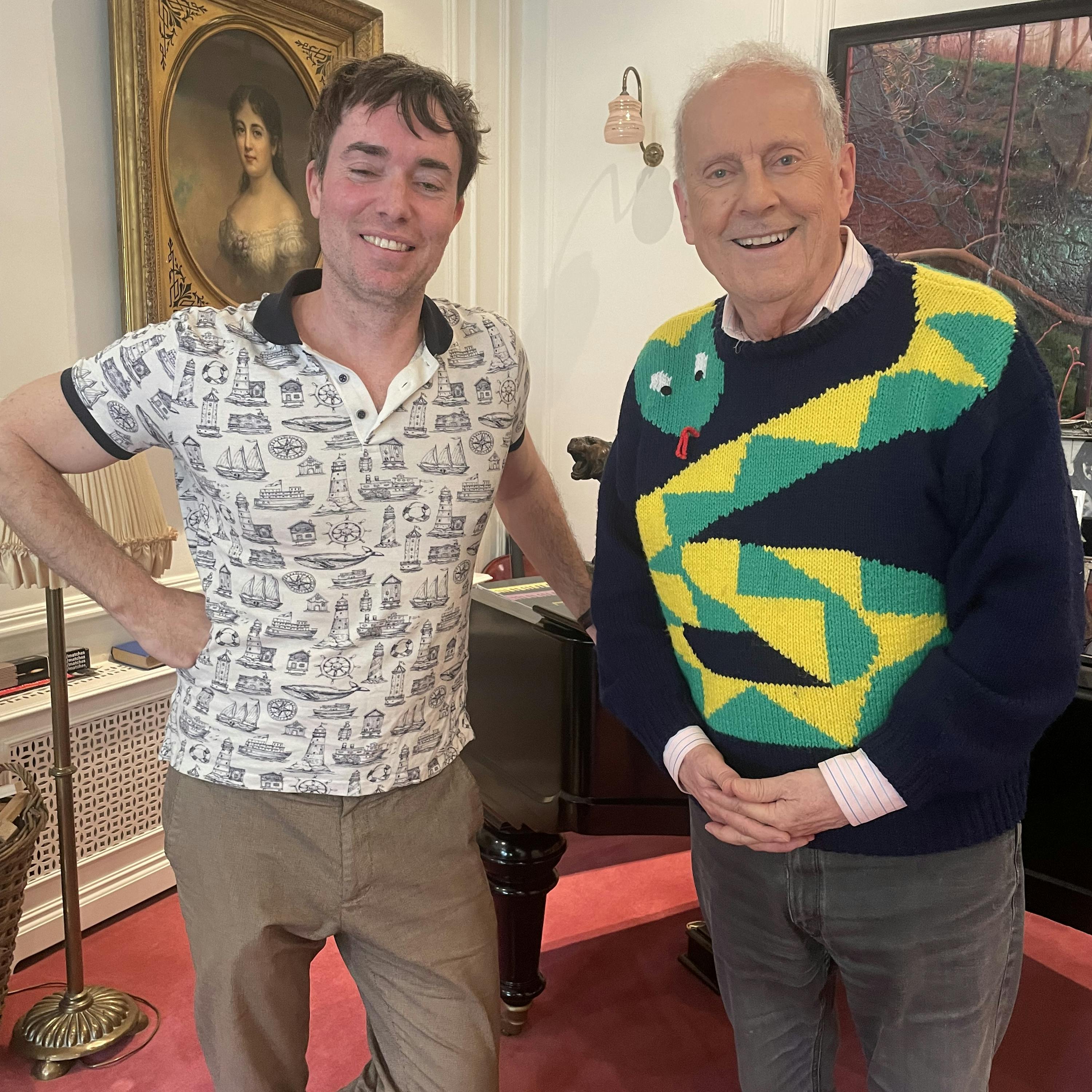
11:30So he kicked the tin around to make it look more bashed and older. So we used to have this. Anyway, I've given it to my son now. So that's what was making me feel a bit weepy. Now, Beethoven. Yes. This is something a little bit different. I went to see an actor called Tama Matheson, who was appearing at a theatre near where I live in southwest London, giving a show about Johann Sebastian Bach. One person show. It wasn't quite one person. there was a guy at the piano and the show began in German. I thought, oh, is it going to be Bach speaking in German? I'll cope if I can. Then he broke into English and spoke in a normal English accent with a slight Australian twang.
12:12But I watched the show, lasted maybe 90 minutes, two hours. And I thought, this is the most fascinating thing I've ever seen about Bach. Then I discovered that this same actor had done several other shows about interesting people, particularly composers. and I met him. I liked him very much and chatting to him, I thought this is one of the most intelligent people I've ever met and he's done a show about Beethoven but what I realised talking to him is that he has so absorbed everything there is to know about Beethoven that he could be Beethoven and I said to him, do you think we can have a go at an experimental rosebud where I interview you as Beethoven not as a joke, not you putting on a German accent or inventing things, but actually sharing with us in the first person what you know about Beethoven.
13:07I will simply interview in the way I would interview a normal Rosebud guest and we'll see how it works out. And you recorded it and how did you feel it worked out? It's really interesting, but also funny, moving, inspiring. It's excellent. So, this is a Rosebud special with Beethoven. We're here recording this introduction at Grosvenor House, but actually we invited Tama to my home and we recorded our conversation with Beethoven there. Here he is. Giles and Tama in southwest London and Harriet is pressing the button to start recording now.
13:59This is rather a different episode of Rosebud, because in it, I'm going to be meeting Beethoven. Yes, the composer Beethoven. How is that possible? Well, I think it is possible, because I've met a most unusual young man. He's called Tama Matheson. He comes... Well, tell us a little bit about yourself, Tama. First of all, what year were you born in? I was born in 1978. 1978. And where were you born? London. And who are your parents? My mother was an opera singer called Maggie Findlay, and my father was a conductor, John Matheson. He worked at Covent Garden and English National Opera. We worked with Callas and Pavarotti and Margot Fonteyn.
14:42Why are we talking to you when we could be talking to your dad? Alas, he's gone. He's no longer available. He's no longer with us. And indeed, we're going to go one better, even than your father, because we're going to go to Beethoven. And the reason I think that may be possible is I have seen a couple of your one-person shows. You are essentially an actor. You do these extraordinary, and they are extraordinary. I do recommend to people, we're going to give them details at the end of how they can see you. You do these extraordinary shows in which you evoke different people, bring them to life.
15:12I think the first one I saw was about Lord Byron. More recently, I've seen one about Johann Sebastian Bach. Give me a flavor of the range of people. What was the first one you did and why do you do them? I do them because I, first of all, I love classical music and the first ones I did were with classical music. Anyway, I worked with an orchestra who said, could you do something about Benjamin Britten? Oh, Benjamin Britten. That's very good. Yes, that's as close as I get. Ben. Ben, did you know him? As he was called. So little that I really can't boast that I did. Well, they said, what should we do?
15:50is you read some letters and things and I say oh I hate those concerts where you just read some letters and sit down why don't I write a little play and I'll do it as though I'm Britain talking about my life towards the end of through the entire life and can I give a sense of Britain's life in 90 minutes with music interspersed so the music is woven in and it works so well how do you do the research how do you find out about the lives of these people because when you're doing it as we'll discover in a moment with Beethoven you become that person not as a caricature but you try to be real that's right and you go to authentic material as much as I can I read every biography I possibly can all the letters that I can find all diary entries I just get as much as I can pile it all together go through it for you know months and before we begin our conversation with you as Beethoven.
16:41Just remind me, when was Beethoven? What years are we talking about? 1770, he was born and died in 1827. So his death anniversary is coming up in two years' time. And his full name is Ludwig van Beethoven. That's how we think of him in this country. Ludovicus van Beethoven is on the birth certificate, so he's Latinised. Ludovicus. Yeah, and it's van, so it's Dutch. His grandfather was Dutch and not van. Now, I want to have a conversation with you, you as Beethoven. I want to be respectful. I imagine, was it an era where people, were there journalists? Did people give interviews? No such thing as interviews, to my knowledge.
17:21Fine. So what would a respectful, maybe, student coming to meet the great man, but not obviously a mature student in my case, what would he have called him? Master? Maestro? Meister, probably. Meister. Meister, which means that's what people would, yes. because even today, conductors I know like to be called maestro. They like to be called maestro. They italianize it. Probably back then it would have been maestro. But maestro, that is what I would do. Good. And when you do the show as Beethoven, and you're going to be doing it soon, I think in London at Holland Park? The 6th and 8th of August is the show.
17:52It's called I Shall Hear in Heaven. It's at Holland Park, and it's the entire life of Beethoven. I Shall Hear in Heaven. This, of course, because famously, Beethoven began to lose his hearing in his 30s. Just before. It seems it was about 26 or 27 that he started to hear buzzing and humming. And how would he have made a conversation with somebody like me? Well, it changed through his life. At first, people would start to shout. Then they needed to shout very, very loud. He then got ear trumpets, which were designed by a man called Meltzel, who also invented the metronome, incidentally. And then eventually he had to put the ear trumpets down and he was stone deaf.
18:31And he would have spoken always in German? Always in German, yeah. He's from Bonn, so he's straight-up German. Because you're so brilliant, I know that you could actually speak totally in German now to me. But meine Deutsch ist schrecklich. Ah, this is wonderful. Yeah. Excellent. And our international audience mostly listens in English. So this is going to be Tama in his normal voice, but replying to my questions in the role of, the guise of the great Beethoven. And we're now to try to unravel the genius of Beethoven. And Meister, my first question for you, it's always the same first question.
19:11It's simply this. What, Meister, is your very first memory? Well, my first memory, alas, is one of grief and sadness. It is not a happy early life. The first memory I have was of the death of my grandfather, also called Ludwig van Beethoven. He was the first Ludwig van Beethoven. He was a musician like me, and I have always a feeling of immense warmth when I think about him, and gentleness and kindness. He was, I fear, rather disappointed with my father, Johann, who was also a musician, a tenor at the court of Bonn, but a bad one and a drunkard. And he would call him Johann der Leufer, Johann the Runaway, because he ran away from all his duties and responsibilities.
20:05But he had a great influence on me. And although I was only three when he died, I cherished his memory all my life and kept a picture, a portrait of him forever over my desk. This is your grandfather, you get the portrait? My grandfather. As tutelary spirit to my work, I would keep a portrait of him over my desk. And who was your mother? My mother was Magdalena and she had married my father. Unfortunately, under some duress, my grandfather wasn't very happy about the match, but nonetheless it happened. I think this was part of the disquiet of the household. We all live together. When my grandfather died, my father, as a head of the family, was something of a slovenly character.
20:49He drank too much. He got in trouble with the Bonn Court for being a drunkard and he decided at some point that I should be another Mozart to which end he would come home at night drunk from the inn haul me out of bed and force me to play the piano. So these were people who earned their living as court musicians. Court musicians. So you come from a family of court musicians. A family of musicians. And was your mother musical as well or she? No she wasn't. She was basically a housewife. She was a housewife And were there brothers and sisters? Yes, I had two brothers who lived, a younger sister who died, another younger sister who died, and my elder brother, who preceded me in the world by a year and preceded me out of it a short week later, his name was Ludwig van Beethoven, and I often think he was the first Ludwig of the children.
21:39And I often wonder whether his was not the better fortune. I wonder if the states sometimes look at certain souls and say... Gosh, he lived a week. He lived a week. I wonder if the fates look at certain souls and say, we shall not punish this one with a life. But they punished me. Well, we shall explore that, why you feel you were punished. So, as a small boy, you have this bit of a waster of a father who drinks too much. A loving mother? Very loving mother. And I adored her. But she was, unfortunately, a valetudinarian. What does that mean? She was riddled with consumption. Oh, my. And he was an alcoholic.
22:17So this was the first punishment the fates flung on me. He would come home at night and make me practice the piano, sometimes bring friends to watch me practice. And if I played a wrong note, he would strike me. And he would strike me sometimes on the ear. And I've often wondered whether those buffets on the ear of childhood struck a weakness into the ear of adulthood. And were you aware of who Mozart was? Mozart, very much. And how much before your time was Mozart? Well, he was essentially contemporary with me. He was about 16 years old. He was 1756. But he was clearly, Mozart was famous as a prodigy across Europe.
22:51That's right. So that in the court at Bonn, everyone knew about Mozart. Who was at which court? A different court. He was at Vienna, but poor Mozart was never given a proper post. And did you, as Beethoven, did you know Mozart? I met him once. Oh. I met him once, and I had been sent by my teacher, Christian Nefer, to Vienna to meet him. He'd set up a meeting with him, and I played for him. and I remember thinking what would such a genius be like would be gentle kind erudite and he was just irritated irritated with him because he I they'd sent him another prodigy so why do they always send me prodigies I think because I was one that I should forever be interested in them and anyways never mind him come play me something so I and I said if you provide me a theme her Mozart I will improvise upon it and he played me a theme on the clavier and then I improvised like mad.
23:44And then he said, watch out for that young boy. One day he will give the world something to talk about. Because this is a big thing with you composers of this period. I mean, I remember my writing thing that one of the things that Bach used to do, almost as a party piece, people would give him just a few notes, tiny theme, and he had to turn it into a fugue. Yes, this was the thing everyone was expected to be able to do, to improvise on a theme, and especially improvise a fugue, which is a very difficult musical form. It's the same as a canon, but there are many different voices so you have a theme which harmonizes with itself and we would have piano competitions to see who could improvise the best I had two very famous competitions with a fellow called Daniel Steibelt who was supposed to be the greatest virtuoso in Europe and he came to Vienna and Prince Lishnowski set the two of us up for a piano duel and this fellow came in and he was incredibly smug.
24:40He came with a smug, condescending expression, all superior, thinking I was some rustic. And he played one of my themes. And this was like an insult to me. So I took one of his themes, turned it upside down on the music stand, and then tore into him with a torrent of music. And as I played, I said, is this your little theme, Steibelt? Look, I play it with one finger. And he was so insulted, he finally got up and left the room and he said, I'll never come back to Vienna while Beethoven is there. And how old were you at that time? I was in my 20s. I was 22, 23, something like that. Steibelt was older.
25:23And yeah, one has to cut these people down to size.
25:33Take me back to your early childhood. Here you are, this little boy in this difficult household with a loving mother, a father who drinks too much, who's determined that you're going to save the family's fortune by being a prodigy. Did you have friends? Did you have schooling when you were a little boy? I was put into school and then hauled out again when I was 12 so that I could take up a position at the Bonn Court as a musician. I became a viola player. I didn't have many friends, but one of the great refuges of my life was to go to the house of a lady called Helena von Bruyning. And there was a wonderful family of Bruynings.
26:11There was a brother and a sister, Eleonora, who I somewhat fell in love with. And Helena von Bruyning, the mother, took me under her wing. She gave me my first introduction to poetry. She showed me some verses by Schiller, one of which, an ode to joy, stuck in my mind for many many years and whenever my father was on the war path screaming and shouting and breaking things and fighting with my mother I would go to the Bruinings and how far away do they live quite nearby oh quite nearby yes yeah a walking distance and you would you they would be a refuge for you an absolute and she the mother helped educate you absolutely and it was one of her daughters you rather fell for I fell for her daughter Eleonora von Bruining and when I left for Vienna And finally, I made something of a faux pas.
26:57I made a lunge at her. And she was... I had misread the situation. She was very, very offended. Can I say it's easily done? Oh, yes, yes. If you'd been born 200 years later, you'd have been cancelled. Almost of all things your career had got going. So, I'm just trying to get the picture of you before you're sort of... When you're still five, six, seven years of age. Life at home is basically work. you're you're having and is it the piano is your main instrument piano was my instrument it was work i had to go and work to help support the family because my father descended further and further into dissipation so i would go and work and bring my money back to the family the work was going to play the piano or the organ so the piano the organ the viola in the bonn orchestra and then i would come home i had to take care of my two brothers and my mother who was ailing of course she became weaker and weaker and weaker there was one point in which my father was so drunk he was actually taken to prison and I had to go and take him out of prison and plead with the prison guard to release him he was roaring and screaming and singing in the street and um and then finally my mother died at what age was she and how old were you I was just 18 years old and then the responsibility of the family fell firmly on my shoulders and by that time your father was a washout he was an absolute washout yes yes so your mother dies at 18 you're you then you're holding the family together absolutely and what was your role at that stage age 18 had you yet composed anything or i had a performer i had been composing by that stage but nothing official my first official composition came sometime later when the emperor joseph died And Emperor Joseph was the greatest emperor that Germany and Austria had known.
28:45And so I was given the commission of writing a cantata for his funeral. And I thought, I shall write something that they've never seen before. And indeed, it was so difficult that the Bonn Orchestra read, this can't be played. And they objected to it. And I had a fight with one of the musicians. He said, yeah, this doesn't work on my violin. And I said, I'm sorry, I'm not thinking of your violin when I compose. I write only as my muse dictates. and he said to me well maybe your muse should take some violin lessons then she could write something we could play and i said if you cannot play it do not be concerned it is music for a later age but all my life i heard the same objection it's too difficult it's too taxing i thought well should i degrade my invention just so some half-witted musicians can play it no where did this confidence come from why were you so certain of yourself when so young?
29:35It is strange. When I was 12, I remember having the urge to write and feeling very frightened, thinking, what would real working musicians think of a 12-year-old's music? But my muse seemed to speak to me. And she said, you must write, Ludwig, you must write what is in your heart. And at that point, I knew that what was in my heart was the right thing. And it always was from that point on the the crucial thing for me was always to to dredge and delve and dig until i found exactly what i needed to say and i would throw away sketches i would throw away endings i wrote five or six endings for my fifth symphony they were not right i they had to be honed and carved and sculpted until it was precisely what i needed to say because i realized something crucial that if you speak incredibly honestly, then the audience will respond with honesty.
30:29Initially, I imagine your father was your teacher in the very early years. Yes. But then clearly he wasn't capable of it. Who was your principal teacher? To whom do you give thanks for the technical skill that you acquired as a boy? I give enormous thanks to my teacher, Christian Gottlob Nefer. Gottlob means praise God and praise God for such a man. He first taught me the real principles of keyboard playing. but he taught me much more than music because he was a votary of the new philosophy of liberty that would later burst into revolution in france and so he taught me about ethics and politics he taught me about kant and kant's moral theories and kant's theories on the moral purpose of art art must strive towards some sense of moral truth and shed the superficial stole of prettiness and diversion so the diversions of hayden and mozart the divertimenti that's never words i was going to write oh it was going to be real music that strove towards some moral purpose this explains to me as a layman why mozart is rather fun and you can seem rather heavy yeah maestro if you'll forgive me for saying that you know i think you're probably used to hearing that.
31:44So how long were you Naveh a student? I think it was about eight years. Quite a long time. But as well as giving you skills, he gave you a philosophical education. Deep philosophical education. And a moral education as well. Absolutely, yes. Was faith important to you? Faith was crucial. But faith to me was bound up and intertwisted with music. My God was a musical God. And he had given me music and the world music. And to understand God, I had to understand music because they were co-evil. They were born at the same time in my mind. And who, we know he's your great teacher, who were the musical influences on you?
32:31Who did you listen to? Whose music did you know? There was a great composer called Jan Dussek, a bohemian composer. He was very important. I took a lot from him. And how did you, because this is before recording, did orchestras travel around or did you just read the music? How did you get to know these people's work? Exactly that. We'd read the music. I would play the music with Nefer. Orchestras would play it. Dussek would come to visit. And then there were other influences, Gluck, the Bender Brothers. The Bender Brothers? The Bender Brothers. They sound like us. Uri and George Bender. A musical act.
33:04Yeah. They did tap dancing on the side. The Bender Brothers. Like acrobats or something. Who were they? Who were they? They were Bohemian musicians. Are they forgotten now? They're almost forgotten. I think some people play them still, but very good musicians. They would have known Bach. Then there was a very famous composer in Vienna called Salieri, who was a court composer. I don't know if you've ever heard of him. Well, I have, because I come from a different era from you. I have heard of Salieri. Competition with Mozart. All that I'm familiar with. And then, of course, Mozart and Haydn. Mozart was a guiding light to all of us.
33:37He was the one that we could see was the greatest of all the musicians. And why? What did he have? He had the ineffable spark of genius, which one cannot quantify and one cannot find. One either has it or one hasn't. And you can listen to another great genius like Haydn, who definitely has the spark of genius, but in a more desultory fashion, Mozart seems to have it in everything. Everything he wrote for the last great 10 years of his life is almost an unqualified masterpiece. And I can't say, I don't think anyone can say why. I get the impression that you, aged 18, feel already that you have a spark of genius.
34:15Is that right? I trusted my muse. And I came to realize later on that it was probably something like genius. But at this early stage, I just wanted to write what I had in my heart to say. Before we get to your breakout moment and how you become internationally famous, looking at your early years before you get to your 20s, when I say to you joy, can you think of a moment of joy from your childhood years? Given the troubled way you began, maybe you can't. Joy. A moment of ecstasy. Joy and ecstasy. these are difficult things to find in my life. The greatest joy I ever experienced was in the wilds of nature.
35:10I found enormous comfort in the woods and the trees and the mountains and the streams. When I went to the town of Heiligenstadt, that was my great refuge as I grew older, as my deafness advanced, I went there. and I found that the ecstatic joy which one looks for in life was available to me there more than anywhere except my music and I tried to bring the two together when I wrote my sixth symphony which is an evocation of the countryside as an attempt to conjure in the concert goers' minds the glorious feelings on first entering the country the beauty of a babbling forest stream the joy of peasants dancing in the fields or even the terror of a sudden thundersquall and the comfort of the twilight after storms.
35:57Such things were life within life to me. And if I ask about the same period and a moment of sadness, what springs to your mind?
36:11The greatest sadness of my life was perhaps the loss of the woman I wished to love. Her name was, I shan't tell you, she's my unsterpliche geliebte. What does that mean? My immortal beloved. Gosh. And she was a dream from which I woke too soon. But this is a real person. A real person. I didn't tell anyone about her in life. I didn't want to burst the ideal with a pinprick of reality. And where did you meet her? I can't tell any of this. Gosh. I never told anyone about her in life. And I shan't tell now. Wow. But her person was promised elsewhere, but her heart was mine. So I became a second verter.
37:02Devoted to her, I had to give away. And I wrote her a letter, which I never sent. because it was too difficult. But she was the great loss. I had had several abortive love affairs in my life from my first lunge at Eleonora. I'm sorry about that. There was a young girl called Giulietta Guicciardi for whom I wrote a piece which you now know as the Moonlight Sonata. Oh my gosh. It's one of the ones I can play. Or at least the big opening bit of it. Yes, the opening bit. You can play that. It gets more difficult after that. And who was the girl it was done for? Giulietta Guicciardi. Well, I'm such a romantic.
37:39I'm going to learn it again and think about her every time what was she like as a person? Well I fell in love with her but she rejected me she said she was thinking about her future and I said I've secured your future I've immured it for all posterity in this but it wasn't enough alas and then she was married to a man called Count Diamond who turned out to be a bounder and a cad but we never got together alas and there were a couple of other loves along the way but the great love was my immortal beloved. Did you eventually get married to anyone? No. So why do you think you did not succeed with these people?
38:16Did you stop yourself? I mean, obviously there are practical reasons. Somebody may not fancy you, maybe committed elsewhere. But also was there something in you, do you think, that prevented you delivering for them or making yourself? Yes, I suspect so. I was only concerned with music. I didn't care about my appearance or my cleanliness. Women, it seems, are more concerned with hygiene. This may have had something to do with it. I wasn't a handsome man. I was not born with the face of an Apollo. I was pockmarked, swarthy, simian and bullish, not a great enticement to a wife. I remember there was a young girl, I've forgotten her name now, And she said, oh, Beethoven, no, I could never marry him.
39:04He's so ugly and half mad too. And were you half mad? Probably. Yeah. I think I was always, I was so concerned with the music in my head that I didn't care about anything. My house was a mess. There were papers everywhere. There were uneaten sandwiches on the piano and all over the bed. There was food all down my clothes. I even had, if you can believe this, an unemptied chamber pot beneath the bed. And I suppose when you take a young girl home and show her that, she's less interested. You don't need to show it to her. Her nose twitches and she thinks this isn't for me. Yes, and I used to walk around the countryside with my hair disheveled and my clothes amiss, waving my arms and humming madly with the music in my head so people thought I was mad.
39:55So when did you have your first musical success beyond being a performer at the court? When was your first composition that was recognised? There were a few along the way. I was taken on a tour of Europe by Count Lyshnowski, and the first thing was that my improvisations began to be well-known. We didn't play music that was written down necessarily. We improvised, and I was very good at this. A curious thing happened, which I'd never seen happen before in music. people burst into sobs of wild emotion. This had never happened with music before. And I realized something crucial, if I may have a short disquisition, that the vital element of music was passion.
40:41Not elegance, not beauty, only passion. The audience is moved by passion only, and music somehow can evince it. And I wondered how. Why should these noises we musicians make reach into the breast and ring the heart? They're just sounds. Yet they do, and so eloquently. Sad music makes us weep. Triumphant music makes us giddy. Joyous music fills our hearts with glee. But how can this be when no circumstance has occurred to cause this feeling? How does music elicit them in our breasts uncaused? But I thought this. Suppose, suppose that music is not merely sound, but that it is actually made of emotion.
41:28That it doesn't simply incite feelings, but embodies them. If you think about it, sounds of all kinds move us. If you have thunderclaps or screams or rippling waters or a cat screaming, you have an emotion. Suppose then sound is an audible form of emotion. if that's the case then music is the carving of that emotion into meaning the carving of feeling into meaning and as such when a composer writes he's not just making sounds he's sculpting in the bedrock of emotion and when i realized this i knew how i needed to write my music from now on to dredge out the passion in me because passion will speak to passion because of the commonality of our condition all humans will feel the same thing i feel so if i am true to my passions it will transfer to other people this happened first with my improvisations and then i realized this is how i need to pursue my music and this is the moral function of music that kant was telling us about because it can teach us how to unify the head with the heart so i pursued this and the first great piece I would say of mine was the Sonata Pathétique in which I found a new way to declare the human soul this was vast and this is a sonata it's a piano sonata all my music came first through the piano that was my in a nutshell what is a sonata a sonata is a very very briefly a piece for piano a long performance piece for piano usually in three or four movements which usually fast slow fast so you have three or four different elements contrasting in which you say everything you want to say and you show the virtual so here you are you're sitting down you're going to write this piece yeah and you want to combine head and heart and emotion and create a passionate piece what are you thinking what is that piece supposed to give us it is supposed to give you an experience of what I am feeling.
43:34And I imagine that music is a language, but a language that speaks without words. And the extraordinary eloquence of music is that it can tell you exactly the passions that I want you to feel without me having to tell you what those passions are. I can just make you feel them. Yes. So your Moonlight Sonata was a love letter to this girl. Well, possibly. That was the idea. Or was it not? Possibly. Well, he wrote it for her. It's always hard to say exactly why one writes a piece of music. There might be something that sparks it off. There might be someone to whom you're dedicating, which helps to shape it.
44:13Perhaps it's something else. The Moonlight Sonata is one of the greatest and most mysterious poems I ever wrote in my life. I probably couldn't rein it into something as simple as love, possibly even as trivial as love as I see it, but something far more cosmic. but perhaps love was the grain, the seed from which it grew. It's very, very hard to say exactly in words, in logical sentences, what a piece of music means, but when you listen to it, you will feel what it means.
44:50So you're now in your 20s, you're a proper composer, you're getting recognised. Does this mean you're now beginning to make serious money? Alas, no. money and art hardly ever go together in my experience but eventually you have these great symphonies that are performed by major orchestras across europe does the composer not get a royalty a percentage of the takings from the concert very rarely would you take a percentage of the takings essentially one was just given a sum of money and then one composed i eventually became so well i could just dictate my money it was never a huge amount never as much as salieri there was a time when i was offered a job in westphalia by the brother of napoleon and i was about to take it when some of the aristocrats in vienna clubbed together and said we will guarantee a stipend for you as long as you remain in vienna and they said we don't want you to do anything for it just stay here don't go and that's why i stayed in vienna all my life but you were a famous person Did you enjoy being famous?
46:02Enjoying being famous? No, I'm afraid I found humanity an irritation. Oh, really? And more difficult, the deafer I became, the more difficult it became to talk to people. And so eventually I would hide myself away from company. I tried for a while to see if I could read lips, but this didn't work for me. What was the origin of the being hard of hearing? This began in your 20s, early 30s? Yes, about my 26th year. It's very hard to say. Did you go to a doctor? Were there doctors in anything? I went to the doctors, and doctors prescribed me various oils for the ears, all sorts of things. They prescribed the air of Heiligenstadt, which is when I first went to Heiligenstadt, but nothing helped.
46:43It got worse and worse and worse. I had had a bout of typhus before. I had had a cold when I went out walking. Perhaps that went in my ears, but I have always wondered whether those buffets on my ears as a child did something. So it got worse in your 30s. You lost your hearing altogether in your 40s, but you lived to be 56 years of age. How can one go on composing if you can't hear the music? Or you do hear it in your head. How does that work? Hear it in my head. I had to hear it in my head. I'd always heard it in my head in any case.
47:21I remember I wrote a letter in Heidegenstadt to my brothers which I never sent in which I told them that I had contemplated the idea of suicide when I realized that this ailment was lasting a lasting malady, it would not get better I thought perhaps the best thing I could do was put a pistol to my ear and blow the sense out that had betrayed me and my life and my ambitions. But I couldn't do that because I still had so much music to write. I could not leave the world until I had dredged all the music from my soul. And I thought to myself, if silence is my fate, my destiny is music. If fate will take away the world of sound, I will build a world of sound within myself.
48:22And I decided then that I would live on because I had music running in my mind. And I could use that music to live through. I could climb on the mountain of my frailty and I could look out further than anyone had seen before. Not only would I continue to be a musician, I would be the best of all musicians. And from the summit of that mountain, looking back, what are the pieces of which you are most proud and you hope will be your immortality my heroica symphony in which i changed the form of music entirely it was twice as long as any symphony that had come before and i decided i would change sonata form completely sonata form was all about repetition the whole idea of it is that you state a theme you do a short development and then you recapitulate the theme and everyone's delighted by this repetition but this was a world in which everything was changing we weren't just repeating we were developing in France at that time Robespierre and Danton were were revising everything about the world and I realized that the world doesn't advance by repetition but by development so I expanded the development section so I changed the music and changed the music and so that by the time we came to the recapitulation, it had evolved into something new.
49:53This was music for a revolutionary age. This was music that reflected the revolution that was happening in France. And after that music, I hoped, would never be the same again. It certainly wasn't for me. And were you a revolutionary yourself? What were your, did you have political views? Did you take an interest in the world outside of your head? I did. I had very profound revolutionary views, I beg your pardon. Indeed, after the revolution in france that the other monarchs of europe became very very fearful and there were sort of all sorts of secret police and i was furious at this i have used this curtailment of our freedoms and i would shout and scream at them fortunately literally shout and scream at them fortunately they thought i was mad otherwise i would have been carted away but i i hated the thought that some aristocrats for some for what because of their birth thought they were better than I was.
50:46These people with no talent whatsoever would dictate to me. They kept Mozart in a position of servitude. I was not going to be treated as a servant. So when I was invited to play by these aristocrats who wanted me to entertain their friends, I refused. There was one very important occasion when Prince Lichnowsky, who was a great friend of mine, had invited me to play at his estate in Gretz in 1806, just at the time Vienna was under siege by the French and he was entertaining French soldiers I couldn't believe it this fool of an aristocrat telling me just come play entertain my friends play a little ditty for my friends and I screamed at him prince what you are you are by accident of birth what I am I am through my own talents there have been and always will be thousands of princes there is only one beethoven i knew and and nefer had taught me this that we are all made of the same substance and it is a calumny on the whole human race to aver that princes are made of finer stuff than we merit alone decides man's eminence i could see that possibly some people found you difficult possibly What was your, is there a bad experience?
52:02What was your worst experience musically, either with an orchestra or during your career? What's the worst thing that happened? The worst thing that happened? Well, there are a couple of bad things. When I performed my fifth and sixth symphonies, I had only just finished the music on the morning of the concert, so nobody had fully rehearsed. I forgot that I'd said to the orchestra, let's not play this bit, but then I forgot that we had decided not to play that and during the concert they played on and I went to the bit that I'd cut so I stood up in the concert and I screamed you idiot you've forgotten the way it played and they say you cut this they're better and you cut this I had to apologize then I played my fifth and sixth symphonies and the the two young boys who were holding the candles over the music stood too close and I whacked the candle out of one of their hands and I smacked the other one in the head and the whole concert fell to pieces and this was quite frequent with my work but also I was getting deafer and I wouldn't relinquish performing I was determined to perform even though I couldn't hear the music and people would look askance and finally I realized my performing days were over I was playing a concert for the Archduke and I could hear nothing I made a terrible Gallimore free of the music and the audience laughed and laughed.
53:24I felt that fate was laughing at me through them. And through losing your hearing you became a lonelier person. I mean you were viewed by some as eccentric, by a few as mad. You were tolerated because the music was so great and people enjoyed listening to it. Yes. But how were you treated by society? Did you still have friends to the end of your days or were you more and more isolated? I always had friends. I had some friends that I corresponded with in Bonn, my dear friend Wiegler. A lot of people tried to help me, but I think I was slightly beyond help in those days. I was so consumed with music, I wouldn't think of anything else, and if anybody contradicted me in music, I became furious.
54:10I had to have coffee when I was composing made of 60 beans precisely, and if there were fewer or more, I would fly into a fury. Reese, get me two more coffee beans. I can't have coffee without 60 beans. I'm afraid I was more and more difficult. Prince Lishnofsky, I never spoke to him again. I lost a lot of friends along the way because of my temper. I sometimes regretted it. I couldn't even get on with my own brothers. My brothers, we constantly fought. Carl and Johan, they were, and we fought. and fought. Sometimes we even came to blows. There was one occasion when we came to fisticuffs in the street and were reported to the police.
54:55And we could not find Concord for some reason, which is curious, I suppose, considering my Ninth Symphony. Something of an irony. But what are any of us but ironies? You say your Ninth Symphony, which is? The Ode to Joy. Oh, that is the Ode to Joy. Yeah. Absolutely. That was the piece that Helena... And why is it known as the Ode to Joy? You called it that? Well, I called it just my Ninth Symphony, but The last piece enshrines Schiller's Ode to Joy, which Helena von Breuning had shown me all those years before when I was a young boy, 12 or something. And it's Schiller's great cry for the brotherhood of man, Ode an die Freude, that we can all be brothers and all of us can know joy and peace if we know a fellowship.
55:41This was the great idea of revolution, that somehow if we could get rid of the chains of hierarchy and the mind-forged manacles which had been clapped on us by old traditions, the old traditions of the Ancien regime, then we could become ennobled and we could throw away war. We could know peace. We could know brotherhood. We could know concord. And as an idea, I love this. But in real life, there was nothing I could do. I would fight with my own brothers. But I realized something about that peace. I was meditating on that prayer all my life. Alle Menschen werden Brüder. All men shall be brothers.
56:24And when I wrote that symphony, I finally realized what it meant. And it's not what you think. It's not a call to arms. It's not an adjuration to make a better world. For that is merely fiction. Humanity is not made for harmony. And all men never can be brothers. and yet the thought is very beautiful. The fantasy of that fills up our souls and therefore we must never relinquish it. The fictions we create are crucial to our survival. They beautify the squalor of reality. Our illusions are like planks in a stormy sea. We must lash ourselves to them or we drown. and so that symphony is not a call to arms it is a peon to divine delusion I do not implore you to make a better world I simply invite you for the duration of the music to believe in one in your 50s towards the end of your life are you still working are you still are you honored do you get honors and rewards yes honors and rewards I worked until the very very end in fact i could not stop working i would drive myself mad with work i would not care about anything else that was happening to me physically i would forget to eat sometimes this of course made me more and more sick as i grew older i had some terrible intestinal problems a sort of colitis i had rashes i had jaundice for a while i couldn't see so not only did i lose my hearing but my sight i had to sit in a darkened room with cloth over my eyes um but i would just keep working keep working when i could the the one thing that kept me alive was alcohol the great god bacchus oh had it not been for him i would well i'm interested because of your father yeah obviously drinking too much yes and actually my grandfather ran in the family ruining their lives yes you drank too much do you think yes yes and it spoiled the work towards the end or did I hope it never spoil the work but it kept you going it kept me going I believe it kept me going I might have been pickled by the end but it kept me going and I I what I wanted to do with music is never be satisfied one feels always with composers like Mozart and Bach that geniuses they were that they perfected what they already had I would strive always for something new.
59:03Throw away what I had just done and do something new. Then throw that away and do something new. So always moving forward, this idea of development, of evolving, evolution into something new, right up until the very end. But there was something else that drove that. The fact that I couldn't hear was very important. I couldn't then be influenced by all the sounds and the music around me i could only hear what was coming from my own soul and in the silence of my deafness i heard things that flew beyond the scope of mortal music mysteries of sonority where music is set free of harmony or structure of beauty or meaning and exists purely as an affective substance a pulse to shake the center of the soul and this is what I chased and at last I began to realize had I not been deaf I would never have heard these sounds in myself that was the reason for my ailment that was why providence made me deaf that I could hear those sounds at last I understood.
1:00:16It's interesting because you began by saying that your life had been one of hardship. You didn't have necessarily happy memories. And yet clearly at the conclusion the achievement is in part because of the difficulties and the suffering.
1:00:35We suffer that we may have art. We have art to ease our suffering. The misery is not what's important. It's what the misery gives rise to, what it germinates in the artist's brain. All of us have stories of misery and suffering choked with woe. But the artist can turn this misery into screeds of lasting beauty, beauty so dense with meaning that all the world can be consoled by it because they see themselves in it. The artist, for me, is like an oyster forming a lustrous pearl around the grit of tribulation. I love it. We're almost at the end. Looking back, who do you think is the friend or the person you knew who liked you most?
1:01:25And what do you think they saw in you that was so likable? I don't think anybody saw anything in me likable. No, do you mean that? Yes, I was something of a misanthrope. But that's only because the world is full of idiots. You may have noticed this yourself. I suppose my dear friend, de Vigela, who grew up with me in Bonn, remained my greatest friend and wrote a biography of me with my pupil, Ferdinand Rees, who also stayed loyal to me. Perhaps he remained my friend because he didn't have to spend much time with me. He remained always in Bonn and I was always in Vienna and our friendship was one of correspondence.
1:02:05But were there quirks about you that these people wrote about and thought about that they thought oh Beethoven is impossible but but the music that's it but the music had it not been for the music I would have just been an unbearable thug but then somehow inside was this spark of music I don't know if that excuses everything but once I am gone with all my frailties and foibles all that is left is the music and that is to give joy to humanity What is the worst thing you think you did in your life? The worst thing was when my brother Carl died. He left his son, also Carl, in the joint care of his mother Johanna and myself.
1:02:49But I had decided that the boy's mother, Johanna, was lewd and wicked. And so I contested her for guardianship in court. And in those days, it was not immediate that the mother would get the child. I threw all sorts of accusations at her and indeed the boy was her behavior was lewd you thought she was I exaggerated the accounts oh my god I said that she had had intimate relations with a lover directly after my brother's death I intimated that she had poisoned my brother I did everything I could finally the boy was remanded into my custody she to her credit never said anything against me for the rest of her life gosh but were you capable of looking after the boy Not really.
1:03:34And this was where the problem happened. This a bit, I began to teach him the keyboard. I decided he should be a musician like me. And suddenly, inheritance reared its ugly head. I fear I was my father's son in this. I had no patience for him. Gosh. And I would be as angry as my father was to me when he taught me music. And then by that time, you were probably drinking too much yourself. Drinking far too much. And finally, I drove him, in the end, to such extremities is that he climbed to the Rauenstein ruins, put a pistol against his forehead, his temple, and fired. Fortunately, he missed, but he asked afterwards to be taken to his mother and never to see me, his uncle's face again.
1:04:14Wow. I wanted him to be my son, and I wanted to make him a musician, and I tormented and tortured this boy who had no musical ability. For me, I was fortunate to have the musical ability, so when my father taught me, the music that he forced me to play became my refuge. But this boy didn't have anything musical, so I just destroyed his spirit. That's the worst thing I ever did. It's a terrible thing, to be honest. It's awful. What is the best thing that you think you did? Not necessarily in musical terms, because you mentioned the Eroica, maybe as your best achievement. As a person, a good thing that you think you've done?
1:04:51A good thing that I did as a person?
1:04:59it has to be in music what it's just in music no it's just creating a body of work which expresses so much the the torment and condition of human existence that everyone can take a comfort from it. After we finished our conversation, Harriet, my producer, will play some music of yours. What would you like her to choose to play? There would be two things. Either you can hear the Moonlight Sonata, in which you hear this strange poetic invocation of love, or whatever it is, or the end of the Ninth Symphony, which is a great outcry of joy at the the hope for joy in a world that can never fully experience it well we've got a piano here i may be asking you meister to give it a go in just a moment so that's a treat in store before we have that i always ask people what they've learned in their lives 56 years one of the greatest composers in all musical history what have you learned what's life taught you that you'd like to share?
1:06:21I think the most important thing is that whatever happens you must pursue what you were put on earth to do and if you have the will to do so you can fight against fate you can fight against impending oblivion there is no handicap except despair well if you're listening to this if you're listening to this i think that's as close to beethoven as you are going to get in your lifetime and i have to thank uh tama matheson for evoking beethoven for us completely fascinating to spend an hour with Beethoven because that's what it's been like if we want to see your show in which there will be music, remind us what's the show called?
1:07:17It's called I Shall Hear in Heaven. And is that a phrase that Beethoven used? Apparently he said it's probably apocryphal but it's one of the things he said I shall hear in heaven What I love about our conversation is none of that felt apocryphal so I'm glad you've kept the apocryphal bit for this sort of coda and where is that going to be? in London at Opera Holland Park wonderful on the 6th and 8th of August it's a big production we've got a piano quintet the extraordinary pianist Jason Gillum and the quartet Concret two fantastic actors Murren Gallen and Robert Maskell and you and me I play Beethoven and then the English Chamber Choir come and do a cameo so it's a big show what's the date again I mean I'm 6th and 8th of August and it's the entire life of Beethoven but the music is sown into it so at these emotional moments the music then comes soaring out and you'll be knocked off your chair.
1:08:10Well, I've been blown away. It'll be good. I know it'll be good, but it can't be better than actually sitting down with the maister himself in conversation. So, Tama, thank you so much for channeling Beethoven for us on Rosebud. Thank you. Well, what did you make of that, Harriet? Brilliant, yeah. He's extraordinary. Amazing. Tama, isn't he? and wasn't Beethoven's story extraordinary? Well, and I loved all of the really interesting, inspiring things he said about the power of music to move people and to express the soul. I mean, those were all new ideas that Beethoven was having. Absolutely. And everything that Tama told you was properly researched.
1:08:55It wasn't off the top of his head. This is somebody who has a deep understanding. He was channeling Beethoven. Channeling Beethoven. and if you think that worked do let us know and if you think it didn't work do let us know then we won't do it again but if you think it did work I mean Tama has spent an evening talking to me about the life of Lord Byron the great poet he could be a fascinating guest to have Byron on Rosebud who knows yeah great um I want to say something which is Rosebud is on Instagram just search Rosebud Podcast on Instagram and it's got better our Instagram feed hasn't it Giles because we're doing some good videos you and me well we're doing some behind the scenes I don't know if they're good but we're just doing them yeah I mean they're often seem to be about lunch don't they well that's the time we're meeting yeah sandwiches are involved so if you want to see some fun Giles and Harriet video content go to our Instagram feed and you can comment there and I'll try and reply and yeah it's fun and now we're going to play out with some Beethoven aren't we we are going to play what's the Beethoven we decided we were going to play out on the Moonlight Sonata we're going to play out on the bit of Beethoven that I when I was learning the piano could roughly play at least the opening moments of it the Moonlight Sonata and I gave you a go at home showing you how I could play it and you said no Giles people would like to recognise the Moonlight Sonata So we've got a brilliant pianist playing this who is the person that plays with Tama in his show.
1:10:31Oh, wonderful. Jason Gillum, he's called. Wonderful. Take it away, Jason. This is Beethoven at his best.
1:11:02Thank you.
1:11:31Thank you.
1:11:56Thank you.
1:12:28Thank you.
1:12:56Thank you.
1:13:29Thank you.
1:13:55Thank you.
1:14:30Thank you.
1:14:57Thank you.
1:15:26Thank you.
1:15:58Thank you.
1:16:26Thank you.
1:16:55I love you.
We've got something quite unique for you this week: an episode of More Rosebud, in which Gyles meets one of the greatest composers who ever lived : Ludwig Van Beethoven. In this fascinating conversation, Gyles will find out about Beethoven's first memory, his challenging childhood in which he was forced to play the piano by his drunken father, and his ascent to genius, both aided and hampered by his encroaching deafness.
In this conversation, Beethoven is brought to life by the writer and performer, Tama Matheson. What you are going to hear is a classic Rosebud interview, answered by Tama as if he were Beethoven himself.
Tama is a brilliiant performer who has written and conceived a series of shows based on the lives of great artists - composers and poets - in which he brings these geniuses to life through performance, music, and meticulous research.
Tama's amazing show about the life of Beethoven I Shall Hear In Heaven is at Opera Holland Park in London on the 6th and 8th August. Tickets are available here.
Tama's own website is here. The Moonlight Sonata at the end of the episode is played by Jason Gillham.
Learn more about your ad choices. Visit podcastchoices.com/adchoices
Hosted on Acast. See acast.com/privacy for more information.


