
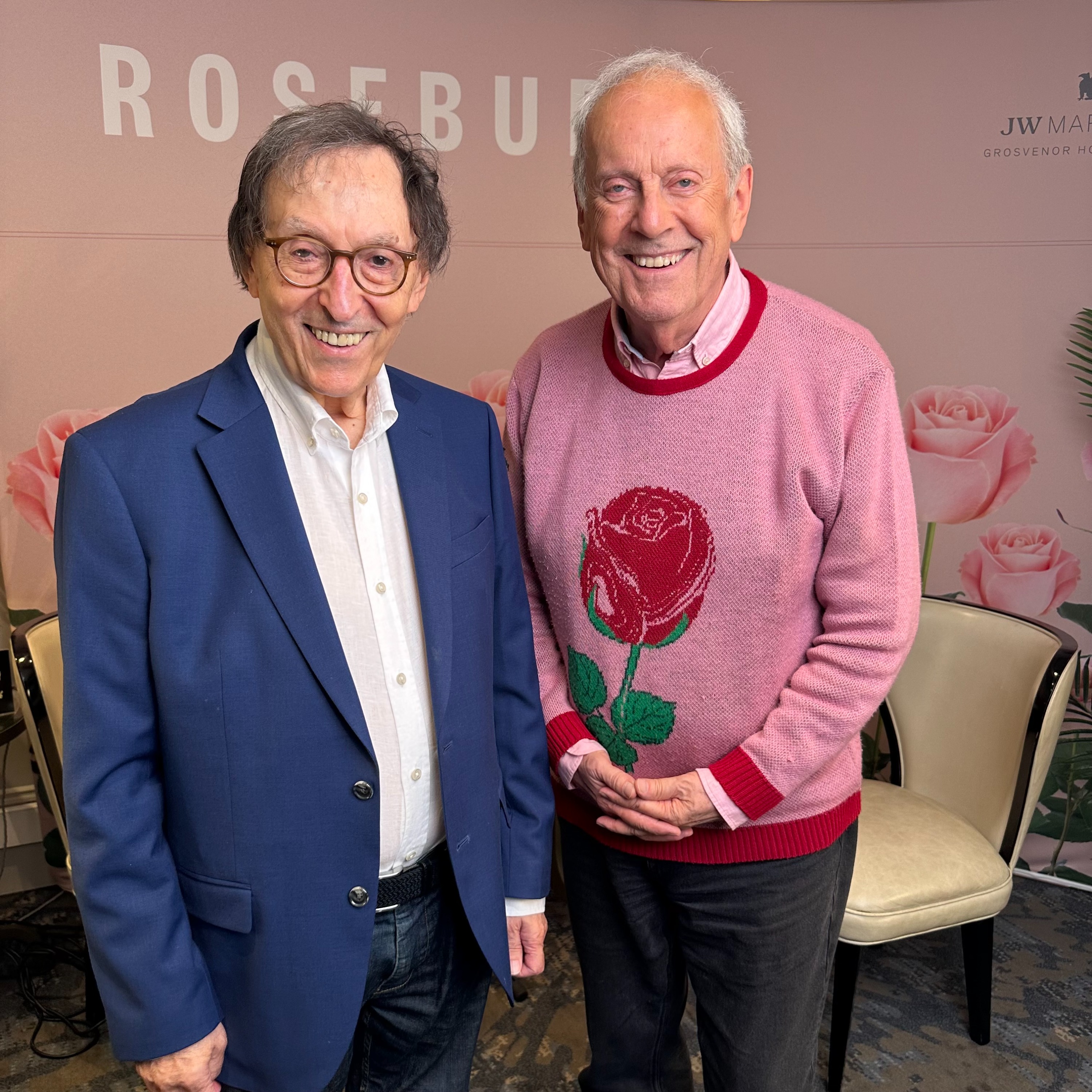
 Ask ChatGPT



Don Black, the songwriter/lyricist, reflects on his childhood in Jewish immigrant families in Hackney and Sunderland, the influence of his mother’s Russian songs, his close lifelong marriage to Shirley Berg, and how early London music publishing led to major career milestones including Matt Monro, James Bond themes, and Oscar-winning Born Free.
Don Black (born Donald Blackstone, 21 June 1938) is an Academy Award winner (Born Free), has two Tony Awards, multiple Ivor Novello awards, a Golden Globe, and wrote five Bond themes. He worked with major composers and performers including John Barry, Henry Mancini, Elmer Bernstein, and Michael Jackson.
His mother’s lullaby “Besame Mucho” shaped his early love of words/music; Denmark Street “Tin Pan Alley” taught him how songs become demos and get plugged to broadcasters; his marriage kept him grounded and he avoided heavy drinking/drugs.
Hackney Empire evenings; seeing The Jolson Story 32 times; writing “Walk Away” for Matt Monro; John Barry asking about “Thunderball”; “Born Free” winning the Oscar and being recorded by hundreds; writing Michael Jackson’s “Ben.”
Written by AI. May contain mistakes.
Don Black shares vivid memories of his childhood and family life.
“accounting firms trust Bill to handle BillPay processes.”
Don Black shares vivid memories of his childhood and family life.
“My first question, as you will know, is always the same question.”
Don Black recounts his experiences during World War II.
“And I was the one spoiled, rotten, complete.”
Explore Don Black's childhood memories and the humor of his brother Michael.
“And he turned into be the funniest man I've ever met.”
Don shares his fond memories of the Hackney Empire and its impact on his life.
“she would say, Eee, Donald, look at those chandeliers.”
Discussing the profound impact of The Jolson Story on Don Black's childhood.
“He was a Sammy Davis before Sammy Davis.”
Don recounts his school experiences and his love for snooker.
“So you've got this wonderful, happy home.”
Following Don's journey into the music industry through family connections.
“The thing I remember most about school was my English teacher, Mr King, because he used to use long words.”
Following Don's journey into the music industry through family connections.
“In your head, what's your life going to be at that stage as a teenager?”
Don reflects on his first crush and the significant people in his life, including his future wife.
“I'm thinking it's something to do with show business, something.”
Learn about Don Black's early relationship with his wife Shirley and its significance.
“Before I met Shirley, there was no really one.”
Explore how Don and Shirley's relationship blossomed into marriage.
“I always felt when I said, you know, I wouldn't be who I am, but she just wanted everything for me.”
Delve into Don Black's career beginnings and his partnership with Matt Monro.
“When I say lucky, I was writing songs then.”
Learn about Don Black's collaboration with John Barry on the song 'Thunderball'.
“Walk away, please go, before you throw your life away.”
Discover how Don Black transitioned from songwriting to composing for films.
“and he used to hang around Denmark Street as well.”
Understand the intricacies of lyric writing and its connection to comedy.
“The thing about it, I looked unbelievably young and I stole all the material from American comedians.”
Learn about Don Black's journey in songwriting and the emotional impact of his work.
“I hate leaving you, you hate leaving me but instead every time we say goodbye I die a little.”
Hear about Don Black's personal experiences and collaborations with iconic artists.
“How come you didn't stray, or maybe you did, over the years?”
Understand the process and creativity behind writing songs for films, including 'The Italian Job'.
“Now, Quincy Jones, who is a composer, a genius, not everyone will tell you that, he produced people like Ella Fitzgerald, Billie Holiday, Sarah Vaughan, Michael Jackson, the biggest people in the world.”
Learn about the process of songwriting and creativity in music.
“of hours i come back he plays two notes daddy on days not even like these and it was such a an unbelievable moment.”
Explore the stories behind personal encounters and their significance.
“And is that happening mostly in your head and then being written down?”
Discuss the enduring love and memories shared with a partner.
“because you're a powerhouse of positivity.”
Gain insights into the lessons learned through personal experiences.
“At that stage, did you know she was ill, that she was going to die?”
Gain insights into the lessons learned through personal experiences.
“When it comes to managing money, forget the hype and look at results.”

Get the gist, explore an idea or ask about something said.
 Claude
On Rosebud with Gyles Brandreth, what are the key points of this episode?
Searching your listeningAutomatic transcript. May contain errors.
0:0098 of the top 100 U.S. accounting firms trust Bill to handle BillPay processes. Why? Because our tools are built on over a trillion dollars of secure payments. We're not just moving money. We're powering financial workflows for half a million customers. That's a level of expertise you just can't fake. Ready to talk with an expert? Visit Bill.com slash proven to get started and grab a$150 gift card as a thank you. Terms and conditions apply. See offer page for details. Therapy's biggest impact doesn't show up in some dramatic breakthrough. It shows up in the smallest moments. You bite your tongue instead of escalating.
0:38You put your phone down instead of firing off that text. You say what you actually mean instead of what would hurt someone else the most. Nobody applauds those moments, but they quietly change your life. That's what growing feels like. And that's exactly what Grow Therapy is here for. Grow is therapy that works, covered by insurance. Sessions average$21 with insurance, and some pay as little as$0, depending on their plan. There are no subscriptions, no long-term commitments. You just pay per session. Grow connects you with thousands of high-quality, licensed therapists across the U.S., offering both virtual and in-person sessions, nights and weekends.
1:17You can search by what matters, like insurance, specialty, identity, or availability. And you can book a therapy session in minutes and begin in as little as two days, not the national 48-day average. See if you could pay as little as$0 for therapy in seconds at growtherapy.com slash ACAST. That's growtherapy.com slash ACAST. growtherapy.com slash ACAST. Availability and coverage vary by state and insurance plan.
2:10It's Tuesday. If you're listening to this on the day we drop it onto the world, it can be any time that you hear it. It's more Rosebud. And it's a special interview today. and I'm here with my friend, my colleague, my producer, Harriet Jane. Are you excited about today's guest? Oh, what a charming and lovely man. He's a very interesting human being as well as indeed being a very charming person and he's been a hero of mine for, well, really as long as I can remember. Do you know what one of my ambitions was when I was a little boy? No. It was to be a songwriter. a lyricist. Brilliant. You'd have been excellent at that.
2:53Well I don't think I would but I aspired to it because I fell in love with the work of Alan J. Lerner who wrote the lyrics for well for Camelot, for My Fair Lady, for lots of great musicals and when I first began to hear the lyrics of Don Black who is our guest today I thought this is my kind of guy because he's got away with words that is very special and he has been a huge success academy award winner for born free he well i mean he's got two tony awards for musicals done in the west end and on broadway six iva novella awards a golden globe he's had awards of plenty he wrote five bond themes yeah giles i mean that's big new it is diamonds are forever thunderball wow the story about the origins of Thunderball is one of my favorite stories but actually he is one of my favorite people because he is a happy person from an interesting childhood and he had the most remarkable marriage that because I've known him for a long time I was lucky to see he was married to his wife Shirley for nearly 60 years they were well they were very close they met I think when they were 17 they married when they were 20 i think that's the year he wrote one of his first hits when he was 20 years of age it's an extraordinary story he has worked with everybody literally from well you name it from andrew lloyd webber through to michael jackson i mean the name dropping in this episode is incredible but also the modesty and good humor of the individual yes and I think it's going to make you if you're listening to this just feel really lovely to listen to somebody as Giles says so modest so humble so happy so positive with such a lovely outlook and telling a really gorgeous story about a lifelong marriage and a really, really happy and satisfying life.
5:05And that's a great feeling to listen to someone talking like that, isn't it? It really is. And he's now, gosh, I think he must be 88. Yeah. He's a good age. But when I called him, you know, the day before the recording and said, you're coming, aren't you? Coming to our studio at Grosvenor House. He said, oh, yes. He said, I certainly am. Charles Aznavour, he said, famously said to me, a man will never grow old if he knows what he's doing tomorrow. And tomorrow, Giles, I'm doing Rosebud. So here is Don Black, the great lyricist, with his episode of Rosebud. Cue the music.
5:53Don Black, born on the 21st of June, 1938. My first question, as you will know, is always the same question. It's quite simply, what is your very first memory? Yeah, having seen this before, I knew you were going to ask me that. And I do remember being a baby-ish, you know, well, very, very young. But my most vivid memories of my mother singing me to sleep. Because it wasn't a normal lullaby. It was always besomé mucho. Ooh. Besomé, besomé mucho. You know the song? No, I don't know the song. we kiss, I hear music divine. It's a lovely gypsy thing. And anyway, coming from Russia, she knew all these kind of songs.
6:39And she always used to sing me to sleep with that. So it's very vivid. And we'll be talking about my mum and her singing. I want to talk all about your mum right now. So who was this mum? Why did she come from Russia? Where was this happening, this early memory? And I forgot to ask you, first of all, what is your actual name? What's your full name? Donald Blackstone. Donald Blackstone. And I changed it because when I wanted to be a stand-up comedian, I thought Bob Hope, yeah, it's a short, sharp, that's great. Don Black, yeah, that's good. So I changed it as the years went by. But answering your question, my mum came from Ukraine, from Mariupol.
7:24My father came from Kiev, also in Ukraine. And when did they come? They came around about 1900, I think. Oh, with their parents. They were tiny when they came. Yes, they were. And why did they have to come? What was going on? Well, they never talked much about it, but they always said that there was wars going on. Being Jewish, it was safer to get out of there. Anyway, they both ended up in Sunderland. of all places and they met in Sunderland and from Sunderland they moved to London to Hackney. Describe your mum what was her name what was she like? Well Betsy Blackstone she was full of love life and laughter she was the greatest mum and never stopped laughing she was very taken by celebrities and we lived in in Hackney and there were a few celebrities floating around there there was a boy called Danny Clapton who lived in the next block who was a very famous footballer played for Arsenal and my mum used to say Danny Clapton so you know she's very proud to know any and there was a singer called Steve Conway and if you look him up he had a number one hit with My Thanks to You it was called and he topped the bill at the Hackney Empire and my mother used to look out the window and she'd say things like Donald quick quick there's Steve Conway and he's wearing a camel coat she was always so taken by that kind of thing so betsy was full of life love and energy and music yes and your father was who my father was morris blackstone he was a wonderful man he was um he never lost his accent my mother had a sunderland accent but my father was he always we used to take the mickey out of him he used to lose the h's all the time he used to say um because he was in the arp you know the air raid war air raid protections during the war and it was wonderful because he thought this was the proudest thing to be and he used to say things as if he was field marshal montgomery he'd say things i'm going to headquarters without the aid and then he's going to acne wick for the dogs and this and he would say where's my daily herald because he read the daily he was a wonderful man and very strong he had chest expanders and no one could open them apart from him and my memory so vivid of him was he loved the radio and boxing so i learned names like bruce woodcock and freddie mills max smelling He knew all about boxing.
10:09He had a bit of a temper. He never used it, but he threatened me. He would always say, if you don't behave, I'll take the strap to you. I'll take the strap to you. He never did. And he loved any movie with Edward G. Robinson or James Cagney in it. A gangster movie. A gangster. Humphrey Bogart was his favourite. What did he do for anything? How did he earn money for the family? He was an underpresser. What does that mean? Exactly. It was a bit of a thing. Well, he used to press. He had a great big iron in the kitchen. And he was a very good presser. He did it at home. Yes, he did at home. This is a tailoring job of some kind.
10:48Yes, he had jobs to people with very good clothes. Used to go to Morris Blackstone, get him to press it. So that's what he earned a living. He made a living pressing clothes, yes. Pressing clothes for the gentry. Yes. How interesting. He did it from the kitchen at home. Yeah, the lounge. The lounge. That's how he earned his living. And did your mother have a job as well? No, look, she had five children. And I was the youngest. And I was the one spoiled, rotten, complete. I must say, it was lucky that I went to school because she never wanted to wake me. She used to say to the others, I don't like to wake Donald, he's having such a lovely sleep.
11:33it was that kind of really and i'm all my life i've been spoiled when she made chicken soup i was the one who got the egg and um so you know it was an incredible childhood do you remember the war at all i remember it well tell describe what you remember i remember the air raid shelters i remember them all singing songs in there there were lots of war songs like and when i think of bit that I hear them singing goodbye goodbye there's a silver lining in the sky and I can hear that I can hear the shouts of turn that light out up there and also seeing a flare it was a good thing it was exciting it wasn't there was no terror in it and you stayed in London throughout the war did you I was evacuated for a little while in Sunderland my mother had lots of sisters.
12:26I used to go to Darlington a lot because that was Auntie Annie's place. And Uncle Benny, who was a rabbi, became a very important rabbi. He became a chief rabbi of Cork. It was unusual. And were you conscious of your Jewishness as a little boy? Was that part and part of your life? Yeah, very much so. I went to Hebrew lessons and I was Bermitzvahed, obviously. and we were sort of orthodox we were orthodox we lit candles we were kosher food it all changed when i had my first chinese meal i think and i said lobster paws and all that stuff sweet and sour chicken that's another world another world opened beautiful and a sweet world that's sweet and was it when you were a little boy a problem being jewish was there anti-semitism no well there was there was obviously the black shirts but you know that was before you were born yeah it was really before my time yeah but you were not conscious as a little boy no no not school never came up at all no that's great and what were your parents like together when you were a small boy can you picture them together i can pitch them together they used to laugh and joke all the time it was it was bliss for them my mother would give us everything to all of us And my father would try to be strict, but he wasn't.
13:48He was trying to be a bit of James Cagney, you know, you dirty rat. He wasn't really like that. And the older siblings, if you're the fifth, how much older than you were they? Well, my brother, Michael, was 13 years older than me, which is quite a big thing. And he turned into be the funniest man I've ever met. Now, this isn't just my opinion. My brother Michael started out as a comedian compare. And everyone in show business used to say to me, your brother is the funniest man I've ever met who isn't on the stage. The people who said that, Bob Monkhouse, Dave Allen, Tommy Cooper. Good grief. Everybody said, and even today, your brother.
14:36He was hilarious. Give me an example. This is Michael Blackstone. Michael Black Michael, oh he called himself Black as well Yeah He turned into an agent And he used to say I'm a different kind of agent I get stars and make unknowns out of them Yeah he did a lot of that He would go into a bookshop Waterstones and say They'd say can I help you He said no love I've read them all He was just funny I remember going to a shop in Radlet And the man there said Michael I'm in terrible trouble terrible trouble I've had this shot for 30 years and they want to get rid of me my lease is up you don't know a good lawyer do you?
15:21know a good lawyer? he said my lawyer he said when he worked for me the judge got nine years he was hysterical he was great at exaggeration when he said I was with this fellow he's got a few quid you know I said has he? he said has he? he's got seven live-in trainers. You know, he just... And is he your hero when you're a little boy? He was. He was, and he got me started. He got me a job when I needed it, when I left school. Tell me then, before we get to there, the other brothers and sisters you have. How many, the five of them all? I had Nita, who was lovely. She used to tell strangers she was Don Black's sister.
16:04I mean that. I mean, she would say, you know, I'm Don Black's sister. And go to Brent Cross shopping, I used to say, Nita, don't do that. I said, you know, I used to tell you, Nita, do you know what I did today? I called myself Nita's brother. But she was so proud of me. When there were bad reviews, when I did something, the lyrics were awful. Nita immediately was like, oh, it could have been worse, could have been appalling. It was just I could do no wrong in any of their eyes. And the flat, it was a flat you lived in? It was a flat in a council flat. Did you share a room with your brothers? I did.
16:40I did share a room with my brother, Cyril. He used to do Frankie Lane impressions. We were all sort of influenced through show business in a way. And how were you into show business? Because there's nothing in being an underpressor. Well, my life really started, I think, in the Hackney Empire. And what age are you then? Well, it must be about 10, I suppose. But my mother used to love the Hackney Empire. she used to say to me, and it was so lovely, she used to say, when we sat down in the gods, she would say, Eee, Donald, look at those chandeliers. Look at those curtains, velvet curtains. Look at the manager's got a tuxedo on.
17:21You know, she was overwhelmed by this kind of stuff. She just loved it. She just loved it. And the Hackney Empire was a very famous music hall. Very famous. And a large building as well. It was a beautiful, yeah, Matcham building. Frank Matchman, the great theatre architect. But, you know, I saw everyone there. You know, who did I see? There were Gracie Fields, Ann Shelton, Max Miller, all those people. Max Miller? Yeah. And were you taken up by the magic of it? I was taken up by the magic of it, and just the spotlights and people singing. It was just a magical time, and it always followed in a fish and chip shop called Joe's, and we had chips and a wally.
18:06What's a wally? A wally, cucumber. Oh. Oh, yeah, it was a big treat. A wally? Why is it called a wally? I've got no idea, though. I don't know, but anyway, very good. So chips and a wally. Yeah. And a loving mum and just a wonderful evening of... Yes, it was a big thing. And, of course, there's one thing that wasn't a big thing in my life, the cinema. I saw the Jolson story 32 times. This is the original Jolson story, is it? Well, it's with Larry Parks. The Larry Parks version. The Larry Parks. Yeah. And we just... Forgive me, 32 times. 32 times. This is Al Jolson. Al Jolson. We went mad over Al Jolson.
18:49Because he was great. He was a Sammy Davis before Sammy Davis. And, you know, you laughed, you cried. because it was about a, you know, he was a son of a rabbi and he wanted to be a big star. And we could relate to it somehow because he was from an orthodox family, but he wanted to be a singer. One of my big disappointments in my life was many years later, I was at a party in Hollywood with Michael Jackson and Sophia Loren and Evelyn Keyes, who was an actress, Evelyn Keyes. She played Jolson's wife in the Jolson story, which I saw 32 times. So I was sitting next to her. I said, I can't believe I'm sitting next to you.
19:37I saw the Jolson story 32 times. And she said to me, I saw it the other night again on the late show. What a load of hogwash. I've never gotten over that. Yeah, terrible. But for you, it worked every time. Every time. Still does. So you've got this wonderful, happy home. You're not particularly wealthy, but there's a sense of community. Yes. And you're a lovely, close family. Yeah. You go to school. What's the first school you can remember? Well, the main school was Castle and Road School in Hackney. And, you know, lots of friends there. Do you remember your first friend outside of home? Yes, his name was Lionel Cohen, who changed his name to Lionel Conway.
20:23and he turned out to be a very successful music publisher. But he was also like me. He loved singing. In fact, we did a little double ad, Conway and Black, just for a little amateur thing. This is when you were teenagers? Yeah. What sort of songs did you do? Well, he used to do Eddie Fisher impressions. Not impressions, I did the impressions. He used to sing all those big songs that you won't remember because you're annoyingly young. But I used to do impressions of Sidney Greenstreet and Peter Lorre and people like that. No, don't ask me. I'm tempted to. What was your best? What was considered, your fail-safe impression?
21:04What was the one that you... Well, it was probably a bad Marlon Brando. You know, the one, I'm a contender. You know, that one on the waterfront. When an old film is on, I'm in my glory. So you were going to the cinema a lot. That was your hobby? What would you say was your hobby when you were a boy? My father used to take me to a snooker hall where all the people in the ARP, the British Legion, used to go. And he was pretty good. And I loved snooker. And snooker has always been my addiction all my life. And I've been playing snooker for years and years. And it's my hobby now. I belong to the RAC club.
21:46I've won trophies for it. I'm not any good, but I can give anyone a good game. But to me, it is better than therapy to have just the quiet click of the balls, the quiet excitement of how do I get that ball over there and keep that. And I still get a kick. As soon as I hold a cue in my hand, it's better than Valium. So you were a snooker-playing teenager. Yeah. in love with the movies, Hollywood movies, from this very warm, loving family. Are you academic at all at school? How are you doing at school? I was only... English was good. The thing I remember most about school was my English teacher, Mr King, because he used to use long words.
22:36And that's how I got interested in words. He would use words like culpable. I think, what's that mean? And I used to ask him, and then I used to go home and look them up, and I built quite a vocabulary up there, because it was just one of those things that stayed with me, and it helped me a great deal later on. When you work with people like Trevor Nunn, Sir Trevor Nunn, Sir Christopher Hampton, these are very well-educated people. So if they say that lyric, Don, is a bit too elliptical, you think oh god what i you feel an idiot if you can't say what's that trevor but you know what it is because mr king told you that's right mr king told so at school are you popular are you easy going are you i had a phalanx of friends oh that's a good word yes mr king introduced you to that i'll row them yes it's a phalanx i've got a phalanx mr king would be proud of me yeah um No, I was very popular at school.
23:37Why did you have a phalanx of friends? I think I was, I got no idea, probably because I was entertaining, lighthearted, coming from a family that was always laughing.
24:21shows up in the smallest moments. You bite your tongue instead of escalating. You put your phone down instead of firing off that text. You say what you actually mean instead of what would hurt someone else the most. Nobody applauds those moments, but they quietly change your life. That's what growing feels like, and that's exactly what Grow Therapy is here for. Grow is therapy that works, covered by insurance. Sessions average$21 with insurance, and some pay as little as$0 depending on their plan. There are no subscriptions, no long-term commitments. You just pay per session. Grow connects you with thousands of high-quality licensed therapists across the U.S., offering both virtual and in-person sessions nights and weekends.
25:05You can search by what matters, like insurance, specialty, identity, or availability. And you can book a therapy session in minutes and begin in as little as two days, not the national 48-day average. See if you could pay as little as$0 for therapy in seconds at growtherapy.com slash ACAST. That's growtherapy.com slash ACAST. growtherapy.com slash ACAST. Availability and coverage vary by state and insurance plan.
25:37Here you are at school. You're popular. You're liked. You've got a phalanx of friends. In your head, what's your life going to be at that stage as a teenager? I'm thinking it's something to do with show business, something. And my brother, Michael, got me a job at the Musical Express, the NME. He's the one who's 13 years old. Yes, as an office boy. And what age are you then? 15, 16, just left school. And that's when I met, my life changed then, because it's in Denmark Street, which was Tin Pan Alley, also known as 200 Yards of Hokum. and it was surrounded by songwriters and music publishers and I met so many of them.
26:21You won't know their names but I met Tommy Connor. He wrote South of the Border. I mean, you know, Jimmy Kennedy, Red Sails in the Sunset, Torchard Evans. What did he write? Now, what did Torchard write? Lady of Spain. But all these fantastic people. And as I got to know them, I noticed that old songwriters never lose their twinkle. They were old people. And I remember Tommy Conner, the south of the border, he said, I'm going to the park. He said, I've got to find an idea for a song. I thought, what a job that is, you know. And I started writing lyrics. But at that time, I met Matt Monroe. Before we get into Matt Monroe It's really fundamental to where you are now Which is an old songwriter Still with a twinkle Take me back to the first twinkle Of when you first saw a girl And fancied her and did something about it Your first crush Even your first kiss, Don Well, we belonged to a club in Clapton Called the Harmony Club And there was a girl who used to sing there Her name was Judith Hart Judy Hart.
27:41And she was very nice. That's all. And I found her very attractive. It wasn't... How old are you? I must have been about 16. And she was about a little bit older? About the same, I think. And I don't remember kissing her, but I remember cuddling and feeling very close to her. But there was... Before I met Shirley, there was no really one. There's not any one that stands out. Shirley is your wife for nearly 60 years. What age were you when you met her? 17. Oh, well. We have to bring her. She comes before Matt Monroe. Yes, very much so. Bring Shirley into the story. We can forget Judy Love. Well, we can forget Matt Monroe.
28:21We can forget everyone if we want to talk about Shirley. Okay. Where do you first see Shirley? Who is she? At the Harmony Club. Her name was Shirley Berg. And, well, I loved her right away, but that 17, what I loved about her is that she read a lot. She read books, which was unusual. And then when we started talking, and we went out somewhere and some records were playing, and I remember Tony Bennett's song, which was called How Insensitive, and she started to cry. She welled up a bit. And I thought, she cries in sad songs. And she was just irresistible. and what did she look like then when she was 17 when you were both 17 well she she was um very pretty she had blonde hair just irresistible how do you explain somebody like that it's uh just very attractive very warm as you look i looked at her and i felt she we belong and why did she like you do you think then um i made her laugh yeah and she made me laugh because she wasn't going to meet me that night and for years throughout our marriage she said things like i was going to wash my hair that night i wasn't going to come to the harmony club as the as we went on in our marriage if we ever had a row she would say i should have stayed in and washed my hair but um no she was the love of my life really is it's just i wouldn't i if it wasn't for her i'd still be selling ties in a men's way shop well you have to unpack that in a moment but how quickly did this your affection for each other develop into a proper love affair can you remember the first time you said i love you to her um i think it was it's a good word axiomatic self-explanatory so evident really it was just you don't remember the first time but it was we did go away i mean when after we'd been out a few times we went away for the day to like south end or something on the train yeah on the train can you picture that day what the weather was like what you did when you got to south end did you have winkles well i remember sitting in the deck chairs just having fun it was just lovely to spend a day with this beautiful girl what was she doing how was she earning her living she was um working for a solicitor she was a shorthand typist really she was because she was clever and she had a great education and was she jewish yes yeah would that have been a problem for your family if she hadn't been not really my mother had that attitude of as long as they're happy yeah and did your parents and the rest and your brothers and sisters they did they like her straight away?
31:25Very much so. Yeah. I always felt when I said, you know, I wouldn't be who I am, but she just wanted everything for me. And we wanted the same things. And also, she wasn't impressed. She wasn't impressed at all by show business. On her last birthday, her 80th birthday, her opening line in her speech was, I've met a lot of celebrities in my time, and I'm delighted to say none of them are here tonight.
32:01So she was funny as well. She was funny. How quickly did it become clear to both of you that this was going to be forever? Well, you don't think of it forever, even though I'm a songwriter, and they say forever, an instant it's just we're having a good time we were together we got engaged quite quickly yeah quite quickly and it was in those days when everyone said they're engaged you know it was a big thing yes yeah and then how old were you when you got married 20 young yeah and did you you got yourselves a flat how did you 20 we had a place in highbury oh it's not a good guy to highbury It was a lucky place because it was by a train station.
32:50When I say lucky, I was writing songs then. And I wrote one that did well. It was a song called Walk Away that Matt Monroe recorded and it made a top five. Well done. So at 20, you're getting married, living in Highbury. You've met Matt Monroe. You write a song that's a top five hit and you're 20 years of age. Right. Well done, Don. That's brilliant. and so just describe before we get on to Matt Munro this first flat that you had in Highbury what were the rooms like? did you have just a sitting room and a bedroom? well it was all fine until we had a baby yes we had my first son Grant there and the trains kept waking him up so it wasn't Shangri-La we were happy there when we were together we were happy it's not where you are it's who you're with so you are working for the new musical express you're working uh in tin pan alley yeah in soho and you're meeting songwriters you like the twinkle in their eye you think this this is going to be for me and you've already written a few songs how do you meet matt munro who was at that time huge well he wasn't huge he was skint at the beat when i met him oh he was a bus driver oh forgive me yeah yeah he was a bus you helped him become famous did you well yes i didn't do didn't do him any harm my gosh i assumed he was the star and he lifted you lifted him got it all the wrong way around right now he's a bus driver that's not the way he tells it and he kept winning he kept winning uh singing competitions in hong kong when he was in the army and stuff and then he came to denmark street and it was at the time when you had to demo a song and he was a demonstration singer he'd want you know because he was skinned absolutely skinned and I was in a position because I then went into music publishing a bit and I was in a position to hire him to sing songs that needed demonstrating.
34:52Explain in a nutshell if you can how the Denmark Street operation was. There are a series of businesses there that are creating songs and are getting those songs made into demo discs and they're then being sent to the broadcasters and if they, the pluggers would get them put on the air and if it works, everyone makes money. Is that the essence of it? But the whole street is populated by music publishers. So if anyone at that time went down the street like a Frankie Vaughan or a Dickie Valentine, all the publishers would rush to meet them, get him to get into the office and plug him with a song.
35:31But Matt and I got to know each other, just as you do in the local tea shop and stuff. And then we had a couple of ballads that came up, and I thought, I'm Matt Monroe. Anyway, I hired him, and I gave him a fiver. Now, he's never forgotten that. A fiver was a fortune to Matt, and I gave him quite a few fivers. And when he became successful, because it took him a long time, the first thing he said to me was, you're going to manage me, because I was his best friend, and he wanted me to do it. But anyway, but it was because of him, because he sang Walk Away. How does Walk Away go? Walk away, please go, before you throw your life away.
36:19A life that I could share for just a day. I could do the whole thing, but I need strings behind me. And you wrote the lyrics. Yeah, and it was an Austrian tune. Oh, that was available, that the music publisher had. That's right. That's how it would work. You'd get tunes from around the world. Yeah. You'd think this has got something. and then you would put words to it. And he'd an English lyric, yeah. So you wrote the English lyric to it. So I went round the world with that. 20 years I managed him. So this is you in your 20s and 30s managing Matt Munro, who became one of the world's most popular singers.
36:54Yeah, certainly the best singer ever to come out of this country. And Frank Sinatra loved him. Forgive me, the best singer to come out of the British Isles, in your view, was Matt Munro. No question. I mean, it's not just my opinion. Frank Sinatra wrote to him. Tony Bennett loved him. Sammy Davis loved him. He was really rated. And it was sad he passed. He was only 54 when we lost him. Gosh. Yeah. And you gave him his first hit. Yeah. And then you managed it for 20 years. But I'll tell you what happened in my life. That song happened to be John Barry's favourite song, Walk Away. and he used to hang around Denmark Street as well.
37:36Now, who is John Barry? John Barry is a famous composer now who wrote all the James Bond stuff and Out of Africa and Dances with Wars, he was a multi-Oscar winner. And he came up to me one day because he loved this song and he said to me in a Yorkshire accent, do you fancy having a gore at Thunderball? I said, what's that? He said, it's something, a Bond film or something. I said, yeah, cool, whatever it is. He just had Goldfinger. So it was more or less, that was the first one. With my friend Leslie Brickers writing today. Yes, Leslie and Tony Newley. Yeah. So anyway, I wrote Thunderball. And that was a hit and it got me into the world of movies.
38:24So how do you sit down and what happens? Has he written the tune first? Yeah, he's written the tune. and he said to me, it's got to be called Thunderball. So I looked it up in the dictionary and it isn't there. There's no such words as Thunderball in the dictionary. So I said, who's going to sing it? And he said, well, we want Tom Jones to sing it. I said, well, if Tom Jones, it's got to be a muscly, you know, it's a powerful song. And then I got the tune. So I thought, well, it came to me quite easily. He always runs while others walk. He acts while other men just talk. He looks at this world and wants it all, so he strikes like Thunderbolt.
39:06So it was because, you know, he's a different kind of man. We get it. How long did it take you to write those four lines? Well, people always write, you never know, it's a day or two or, you know, it never takes more than that. What's the lyric of yours that has made most money? Born Free, I suppose, because it won the Academy Award. After it won the Academy Award, it was recorded by 600 people. Johnny Mathis and Andy Williams. And you get a little tickled every time. Born Free. Are you getting something now if I just do that? Born Free. Well, not the way I sing. Only if you sing it all. And I'm prepared to listen.
39:51but um no it's uh it was it was a different time then because nowadays everyone writes their own songs so it's all different but that time was a golden time for me so you write thunderball with john barry yeah and your world changes yes because you've already become established with matt monroe yeah uh and you know music is going to be your life right as a lyricist when you mentioned earlier being a comedian yes like your brother had hopes to be yes when did that happen um when i just got married i think we have i thought i'd have a go i kept talking about it and i had a go and i played a few places like leeds and the met edgeway road collins music hall these are proper places yeah the met edgeway road was a big music hall very big collins musical big what were you building don black a living joke that was my bill matter that's rather good yeah Don Black, a living joke.
40:46And what was the material? What did you come on and do? Oh, terrible. The thing about it, I looked unbelievably young and I stole all the material from American comedians. So we've talked about my wife and mother-in-law. It was ludicrous, really. No, but it's helped me a lot in writing songs because there is a correlation between comedy and lyric writing. you can kill a joke if there's too many syllables and you know long winded and it's the same with a lyric writer it's all about eliminating the unnecessary is there a lyric you particularly admire not necessarily your own is there a lyric that for you is were you a great fan for example of Cole Porter of a great lyricist well he's my idol and yeah I mean he wrote everything all of them, Irving Berlin, Cole Porter, Frank Lesser I've studied them all and what is the line, give me an example of a great line and why it's a great line every time we say goodbye I die a little it's so much better than saying I hate leaving you and you leaving me what's wrong with that?
42:02I hate leaving you, you hate leaving me but instead every time we say goodbye I die a little. Wow. That's Cole Porter. Yeah. What's the next line? Can you remember? Every time I say goodbye, I wonder why a little. Why the gods above you who must be in the know. Why the gods above me who must be in the know. Think so little of me. They allow you to go. Oh, come on. It's priceless stuff. I'm surprised you didn't give up before you started. That's the competition. what's the first lyric of yours that you felt I can do it now, this is working as I kept going and I wrote some more and did Diamonds of Forever and I thought yeah well getting a bit of success and doing musicals that's what changed me John Barry after we had a bunch of James Bond songs together how many did you do in all?
43:01five you've written five James Bond songs But John Barry said to me one day, a great musical, he said, I think a great book is Billy Lyre. And he said it would make a great musical. This is Keith Walters and Willis Hall story. It's a wonderful story, Billy Lyre. And so we did Billy. It starred Michael Crawford. It ran at the Drury Lane Theatre for three years. And the producer, I always remember him saying, Peter Witt his name was from Vienna, And he said, you'll never be happier than today. You're all healthy and you've got a hit musical in London. And it's so true that it was a wonderful feeling to go to the theatre every night.
43:46And it proved to me I could write funny songs, not just catchy pop songs or title songs, because you can write any emotion in a musical. and the world, you know, it's a lyric writer's dream. Fantastic. And were you happy that day? Are you good at being happy in the moment? Did you enjoy that? Oh, very much, very much. When you have a show on Broadway and it's working, it's what every songwriter dreams of. They're not all hits, you know. I mean, I've written some... Oh, give us a flop or two. Reassure us. Well, Stephen Ward that I did with Andrew. Andrew Lloyd Webber. Yeah, and Christopher Hampton.
44:32And Christopher Hampton. I mean, these are Rolls-Royce writers. I mean, he's a Rolls-Royce writer. So then, you know, it got good reviews, but people didn't want to see it. This was the Profumo affair. That's right. This was the osteopath who took his own life when he was put on trial. It was a bit of a downer of a story. Christian Keeler and all that, yeah. Christian Keeler. But, I mean, you know, that... So that flopped. Yeah. I'm just hearing about this to be reassured.
45:23Thank you. to get started and grab a$150 gift card as a thank you. Terms and conditions apply. See offer page for details. Therapy's biggest impact doesn't show up in some dramatic breakthrough. It shows up in the smallest moments. You bite your tongue instead of escalating. You put your phone down instead of firing off that text. You say what you actually mean instead of what would hurt someone else the most. Nobody applauds those moments, but they quietly change your life. That's what growing feels like. And that's exactly what Grow Therapy is here for. Grow is therapy that works, covered by insurance.
45:59Sessions average$21 with insurance and some pay as little as$0, depending on their plan. There are no subscriptions, no long-term commitments. You just pay per session. Grow connects you with thousands of high-quality, licensed therapists across the U.S., offering both virtual and in-person sessions, nights and weekends. You can search by what matters, like insurance, specialty, identity, or availability. And you can book a therapy session in minutes and begin in as little as two days, not the national 48-day average. See if you could pay as little as$0 for therapy in seconds at growtherapy.com slash ACAST.
46:38That's growtherapy.com slash ACAST. growtherapy.com slash ACAST. Availability and coverage vary by state and insurance plan. Everyone talks about how challenging it is to raise kids, but what about protecting them? Outlet covers, kitchen cabinet locks, baby gates? Where do you even start? Well, protecting your home and auto is a great place to start. Progressive offers customized coverage options so you can be sure you have the right coverage. They're basically the baby gates of insurance. Get a quote at Progressive.com. Progressive Casualty Insurance Company affiliates and other insurers not available in all states.
47:23How come you didn't stray, or maybe you did, over the years? I mean, you don't seem to have got carried away. Did you drink too much? Did you ever take drugs? Did you stray from the path? No, because I have to be honest about this. Matt Monroe drank, John Barry drank, and I'm not a very good drinker. If I had two glasses of wine, I'd be in intensive care, I think. I'm just not very good at that. And, of course, I've had a stable life being married. Yes, because you've got to ask me, have I ever, have I ever, you know, because people expect you, well, you must have. No, I haven't, but it's funny because I thought you might ask me that and I was thinking, I wonder if he's going to ask me if I've ever.
48:14And I haven't ever, but I could have done with the two people I've loved in my life, apart from Shirley, and nothing ever happened. But I'm only mentioning them because you know them. One is Petula Clark. I've known Petula since I was 15 because she was always in Denmark Street. And I've loved her for years, but not in that way. But anyway, I love her. And the other one is Bernadette Peters, a great big Broadway star. Yes, of course. And she did my Tell Me On A Sunday in New York song and dance that I did with Andrew. And that's it, really. Shirley All The Way. Lovely. I suppose it's Born Free that makes you free, is it?
48:56The success of that Oscar. Did you go to collect the Oscar? Yes, I did. It was a night. You don't know you're going to win. I was sitting next to Hal David and Burt Bacharach. They were nominated for Alfie, which I thought, that must win it. Yeah, we would have thought so. Alfie. Yeah, exactly. Great song. But anyway, when this choir came on and sang Born Free, it seemed to be more of a social comment. There were black faces, Chinese faces, all singing Born Free. And anyway, Dean Martin came on and said, the winner is Don Blank and John Barry. And it was a wonderful, wonderful thing. And how did it change your life?
49:40It changed my life. Great composers asked me to write lyrics. So Henry Mancini, I worked with Henry and did Pink Panther, Strikes Again. Elmer Bernstein, who I love, and a great friend, did True Grit, John Wayne. I did lots of films. Working with composers is one thing. How are the artists, I mean, you mentioned Michael Jackson earlier. He obviously sang some of your songs. Did you work with him personally? Not with him, but I got to know him very well because I wrote the song Ben for him. And he got very... I was living in Los Angeles at the time with my two sons and Shirley. And he came over to my house and loved my family.
50:27He did a painting with Shirley together. He played Paul with Grant and Clive, my boys. And we saw so much of him. He used to phone every time he came to London. And then one day I got a call from his father, Joe, who said, Don, if you want to speak to Michael, you have to go through me in future. It was a horrible phone call. I said, OK. So he was a nasty man who took over his life. But Michael was 14, so innocent. So you knew him when he was a boy. He was a boy. But that was his first hit when he left the Jackson 5. So you wrote Michael Jackson's first hit. First single. Ben, and became a friend of his in a fatherly way.
51:11Yes, yes, yes. And your boys and he played pool together. That's correct. You knew him as a lad. That's right. And then the dad phones up and says, now look. Keep, yeah. Keep out, basically. Well, yeah, so come through me, yeah. But he was very, you know, dictatorial. Gosh. And the worst of these encounters. I asked you for the greats, and you gave me Stephen Sondheim. I mean I haven't got I mean I must say I've never you don't argue with your collaborators it's a funny thing because people say to me all the time what's it like working with Quincy Jones this one and you know I've worked with so many different people but they're all the same around a piano there's no difference between Quincy Jones and Andrew Lloyd Webber it just isn't because we're all looking for the melody and, you know, it's...
52:06So I've never had an eye boom with a collaborator. So, no, it's been all right. Your collaborators, you say you've got to get on with them, but John Barry had a reputation of occasionally being a bit difficult. Well, he did. I mean, you mentioned Leslie Brickers, because I went to an amazing party at Leslie Brickers' house. You won't believe when I mention who was there. You just won't believe it. You shouldn't believe it. because I went there. Danny Kaye was there. Edward G. Robinson was there. I played pool with Steve McQueen. That's the level of people. And John Barry's sitting there having a drink, as he does.
52:51And there's a guy at the couch next to him, and he's talking about Marla. Now, John Barry loved Marla. And he's listening to him talk. talking, loud, he's talking loud and John Barry suddenly put his drink down he took out all his dollars and he said I bet you this you can't own two bars of Marla and the guy looked at him and he said I think we should settle this outside and he was and he got up and he never stopped getting up he was about six foot nine he was john phillips of the mummers and poppers oh my gosh and he just and john was fearless i mean he he said right you know and uh he took us all burt baccarat henry mancini all those people to stop the fight but it was wonderful uh it was a wonderful moment he loved marla and in fact went in his house in oyster bay he used to swim every day to Marla.
54:01He had Marla going. It was very odd. Which proved that he's a very slow swimmer. You're a very funny man. What is interesting about you, Don, is you've covered so much over such a long period. I know. I didn't realise until I saw it again on TV that the Italian job, the movie, with Michael Caine and, of all people Noel Coward that's right and I think even a moment of Benny Hill yeah is it's one of my favorite movies but is is that your song um yeah your name flashed up at the end yes that was me there's two songs in it actually the self-preservation society where all the you know the prisoners sing but the main one is um the song that Matt Moreau sings over the titles and we were, the brief was to write a summary song.
54:55Now, Quincy Jones, who is a composer, a genius, not everyone will tell you that, he produced people like Ella Fitzgerald, Billie Holiday, Sarah Vaughan, Michael Jackson, the biggest people in the world. But he's not really a songwriter and we had to write this simple song, so I said to him, I gave him copies of Volare, Volare, just to give him a clue what I'm talking about. There's a summary Italian song. Anyway, I go to meet him in the marble arch in his apartment and he said, right, I can't see you tomorrow. He came back the next day, nothing, nothing at all. He said, I don't know, I don't know.
55:45man you know i don't know he was so cool and uh i said well shall i walk around the yeah walk around the park what came around so i said well i'll give you a title will it help you quincy said yeah okay i said on days like these yeah okay okay i can walk around again for a couple of hours i come back he plays two notes daddy on days not even like these and it was such a an unbelievable moment. So I said, well, what are we going to do? It needs more than that. We can't just do on dates. And it was so funny. And then he said, no, I'll work on it overnight. And he came up with the most beautiful tune.
56:33It was so hard for him because he wasn't, no matter how great he was, he wasn't a songwriter. He was an arranger, a producer and all that. but anyway and it was a lovely song what do you end up with give us the opening phrase on days like these when skies are blue and fields are green i look around and think about what might have been and then i hear sweet music float around my head as i recall the many things we left and It's on days like these that I remember Singing songs and drinking wine While your eyes played games with mine It goes on like that. You know what you're doing, don't you? And is that happening mostly in your head and then being written down?
57:25Or are you writing it down as you think of it? Or is there a lot of walking around the park? Well, I scribble it down and then can't read what I've written. I don't believe all these anecdotes. You get lots of anecdotes in these stories that people tell all the time. You know, I wrote it. You know, how did you do that and how did you do that? People ask me all the time that, and I explain to them, I say, you don't understand. It's not always an anecdote. It's imagination. Some of the greatest songs. Yip Harburg wrote Somewhere Over the Rainbow, but he's never been over a rainbow. And Bart Howard wrote Fly Me to the Moon, but he's never been higher than 35 ,000 feet.
58:07So, you know, people love to hear stories like that. We've known each other off and on quite a long time but I think you once had even an encounter with my mother. Well, that was a fantastic moment. We were, Shirley and I were in La Jolla, which is an unusual name, J-O-L-L-A. I had a show called Dracula. This is in Southern California. Yeah, Southern California. And, you know, I was there rehearsing. We just opened. It was a lovely part of the world. We stayed at this magnificent hotel called Valencia. And we used to go for a walk every day along this incredible beach. And one day we sat on the bench, and this woman turned around to us and said, I can hear by your accent you're from England.
58:56And we said, yes, that's right. And she said, what are you doing here? And I said, well, I'm involved in the theatre. She said, oh, my son's in the theatre. sort of and i said really she said yeah i don't know if you've ever come across him his name's giles brandreth i said i don't believe it giles brandreth i'm here in la jolla are you talking about giles brandreth i said what are you doing here she said i'm in a care home here what there she pointed to it behind me well it was a bucket and palace type situation it was unbelievable you think it's got to be zar zar gabor's going to come out of it or something and so she said would you like to see it and shirley said well but we would and she said come on in and she took us into this place and it was lovely but she was lovely and we sat down and we had a cup of tea with her and then shirley said to whisper to me she's absolutely lovely and then we had a game of Scrabble with her.
59:59Oh. We had a game of Scrabble with her. And another, and we said we'd come again. I got her, this was the funny part. I got her seats to see Dracula. Oh. Yeah, she came to see the show. And then we came back to see. What was good about it is she was very critical of the show. It wasn't. She liked a lot about it, but she spoke about it like a polymath. So I know where you get it from. because she knew about the lighting and the choreography. She had something to say about the whole thing. And then we played Scrabble. We had about half a dozen games of Scrabble over two or three weeks. An absolute lovely lady.
1:00:40It was such a surprise to hear your name out there on the same bench. But this illustrates you, if I may say so, Don, because you're a powerhouse of positivity. Every story you always tell is an upbeat story. You just spread happiness. Well done. Well, she was a lovely lady. You should be very proud of her. Well, thank you for remembering her. Well. So Shirley and you together, I mean, only until she died, whenever I saw you, which was quite a lot over the years, you were always there when we met in funny places. Yes, we did. You know, in odd places. But you were always there hand-in-hand with Shirley.
1:01:20Bill Kenwright used to call us the best double act since the Everly Brothers. That's nice. And you saw yourselves as a double act, did you? We were always together. You know, what I liked about Sheila, I don't know how she did it, because she came from similar beginnings. But if I said to her, we're going out tonight, we're going to have dinner with Julie Andrews and Henry Mancini, her first thing would be this was a catchphrase of hers can we get out of it she always would say can we get out of it and I would say no we can't ok she was lovely she went with everything but she was so down to earth and was your home life quite straight forward because obviously with the hits you've had there was lots of money pouring in did you have staff no No.
1:02:18Well, usual. Help. You had help. Yeah, help, yeah. People do the cleaning and a bit of that sort of thing. But you were not surrounded by butlers and cooks. No, no. No. I say this about my kids. You know, if it wasn't for them, I'd have homes all over the world. But you were never tempted by that. And describe... No, I don't. I don't know that kind of life. You know, I'm very happy with a normal existence. Why do you never get bored, you and Shirley together? Sixty years is a long time to spend with the same person, even when you're both funny, as you clearly, you are and she was. Yeah, because I think it's down to, you know, you want the same things.
1:03:01If you don't want the same things, it doesn't last. And, of course, she was such a family person. She wasn't just a wonderful wife. She was a fabulous daughter, fabulous grandmother, fabulous sister. She was just a one-off. And how are you coping now? How long has it been since she died? Seven and a half years. Oh, I didn't realise it was quite so long. How does one cope with being a widower? Well... In your case, given that you were totally wrapped up in each other. I remember when she died, soon after that, I was in an Uber. and there was an Afghan driver, a young boy, and he asked me about how you...
1:03:46I said, well, I've just lost my wife, you know. And he said, you haven't lost her. I said, what? He said, you haven't lost her. And you'd be married all that time? She'd be so unhappy to see you unhappy. And it registered with me, you know. I would never want to disappoint her. It just keeps me sane. Do you ever write a song about her? All of them. In my new show, there are quite a few songs about her. What are you calling the show? From the Heart. From the Heart. Lovely. And where's this playing? It's playing at the Garrick Theatre. It opens in October. And what are we going to get? It's about my love of New York cabaret.
1:04:36every time I went to New York I would go off Broadway and there's wonderful shows there with three girls and two boys and all the songs either make you laugh or cry and I said one day I'm going to write a show exactly like this we tried it out at the Fortune Theatre last year big success and we're doing it in a much bigger way and this time it's with my hits as well well done you we're coming to an end now what is I'm going to ask you three quick questions and I want from you the immediate answer that comes into your head a moment of joy a moment of joy was Shirley's last birthday her 80th birthday because everyone I loved was in that room and my brother Michael who was no longer with us my sister Nita no longer with us all of us were in that room for her 80th birthday and And it was her last moment where everyone I loved was in that room.
1:05:39So that would be that one. At that stage, did you know she was ill, that she was going to die? No, we didn't know. She was always asthmatic. And she went to Florida and came in and had a bad thing and it just got worse in hospital. She wasn't bad at all and suddenly sepsis came into her. It was such a shock. I was not expecting, not expecting it. And a moment of sadness. Well, of course, it's going to be losing Shirley, but when did you lose your parents? Well, some time ago. My mother died at 63, my father died at 78. 63 is young? Yeah. And did that throw you? Oh, very much so. Especially with the Oscar, because my mother did live that long.
1:06:31I mean, I won the Oscar in May, and she died in August. Yay! So she knew about that, yeah. You delivered for her. That's right. Yeah. And did your dad remarry? No. No. No, no, no. Oh, my father, which I didn't mention, smoked all his life. Terrible, terrible, terrible smoker. And, I mean, he smoked 100 a day. It was just ridiculous at the time. And they said to him they're going to take his legs off. doing an amputated leg unless he stops right and he said in that accent that he said take him off he said when your time's up it's up that's how he spoke and they did take him off oh lord they took his legs off and he was fine he was in a wheelchair smoking well he enjoyed himself he enjoyed himself that's fine what's your motto do you have a motto a maxim um I do and it's um it's I yeah Yeah, I thought about this.
1:07:31It's never too late to dream, and it's good for you. Ooh. It's never too late to dream, and it's good for you. And what's your dream right now? To stay well and enjoy what I have. Yeah. There's always tomorrow, isn't there? Yes. That's what Charles Aznaval said to me. What did he say? This is to you personally? Yes. This is Charles Aznaval, the great... The great French, everything. think you've got to have known him all he said a man will never grow old if he knows what he's doing tomorrow lovely well i know what i'll be doing tomorrow listening to this again and thinking how wonderful you are so i've reached the end of the road was that a song title i don't know end of the road this could be it could be give me one for my baby for the road hit the road don anyway as we reach the end of the road don black what has life taught you i'll tell you one thing I've learned in life, just to finish up, which I often say to my children, and it's a bit of advice to people in the business, there are a lot of very happy people in Hackney and a lot of unhappy people in Belgravia.
1:08:44So never be envious of people. It's my little bit of wisdom to pass on. It's a brilliant life lesson. You're a brilliant man. Don Black, thank you so much. Thank you, Charles.
1:08:59Thank you.
1:09:52When it comes to managing money, forget the hype and look at results. Bill has a trillion dollars of secure payments powering our BillPay tools. Instead of just moving money, Bill is powering the financial operations of nearly half a million customers. So stop the guesswork and start scaling with the proven choice. Ready to talk with an expert? Visit bill.com slash proven to get started and grab a$150 gift card as a thank you. Terms and conditions apply. See offer page for details.
Don Black, the legendary lyricist, brings his gorgeous and sunny energy onto Rosebud today. He and Gyles talk about Don's life and work, beginning with his extremely happy, but humble, childhood in Hackney, going with his starstruck mother to the Empire to watch Max Miller and other big names of the day. He talks about his father, who worked as an Underpresser, ironing clothes for the local elite. Don then takes Gyles to Denmark Street, or Tinpan Alley as it was known, the heart of London's music scene, where Don began to get work as a promoter and then as a lyricist. There he meets Matt Monro, and Don writes the song for Monro which changes his life, "Walk Away". Five James Bond themes, "Born Free", Michael Jackson's "Ben" and numerous other hits and hit musicals follow. Don is multi-award-winning and has met everyone from Quincy Jones to Henry Mancini, but remains delightfully modest, down to earth and funny. He says he was grounded by his long and extremely happy marriage to Shirley, who never let them get carried away with fame and fortune - and this episode contains many stories and lessons about love. This is a really charming conversation which will make you smile and remind you of what really matters in life.
Don's show From the Heart is on at the Garrick Theatre, London, from October 8. Tickets are available here.
Our thanks to Don Black for his delightful company.
Hosted on Acast. See acast.com/privacy for more information.


