
 Ask ChatGPT



In this episode, Gyles Brandreth revisits his diaries from late 1971 to early 1972, sharing humorous stories and intriguing insights about his personal life and career. Special guest Michele, Gyles's wife, joins him, offering a glimpse into their relationship as they discuss memories, milestones, and the evolution of their lives together.
Written by AI. May contain mistakes.

Get the gist, explore an idea or ask about something said.
 Claude
On Rosebud with Gyles Brandreth, what are the key points of this episode?
Searching your listeningAutomatic transcript. May contain errors.
0:22Magic moments When I was a boy, my mother, every Christmas, wanted either a record by Bing Crosby singing Christmas songs or a record by Perry Como. And he recorded Magic Moments. And we have a magic moment now in the Rosebud world because we can announce the winner of the Magic Faraway Tree competition. It is, imagine the drumroll, Helen Farrah. Congratulations. Come to the magic faraway tree tea here at Grosvenor House, Park Lane, London. Congratulations. Thanks for taking part in the competition.
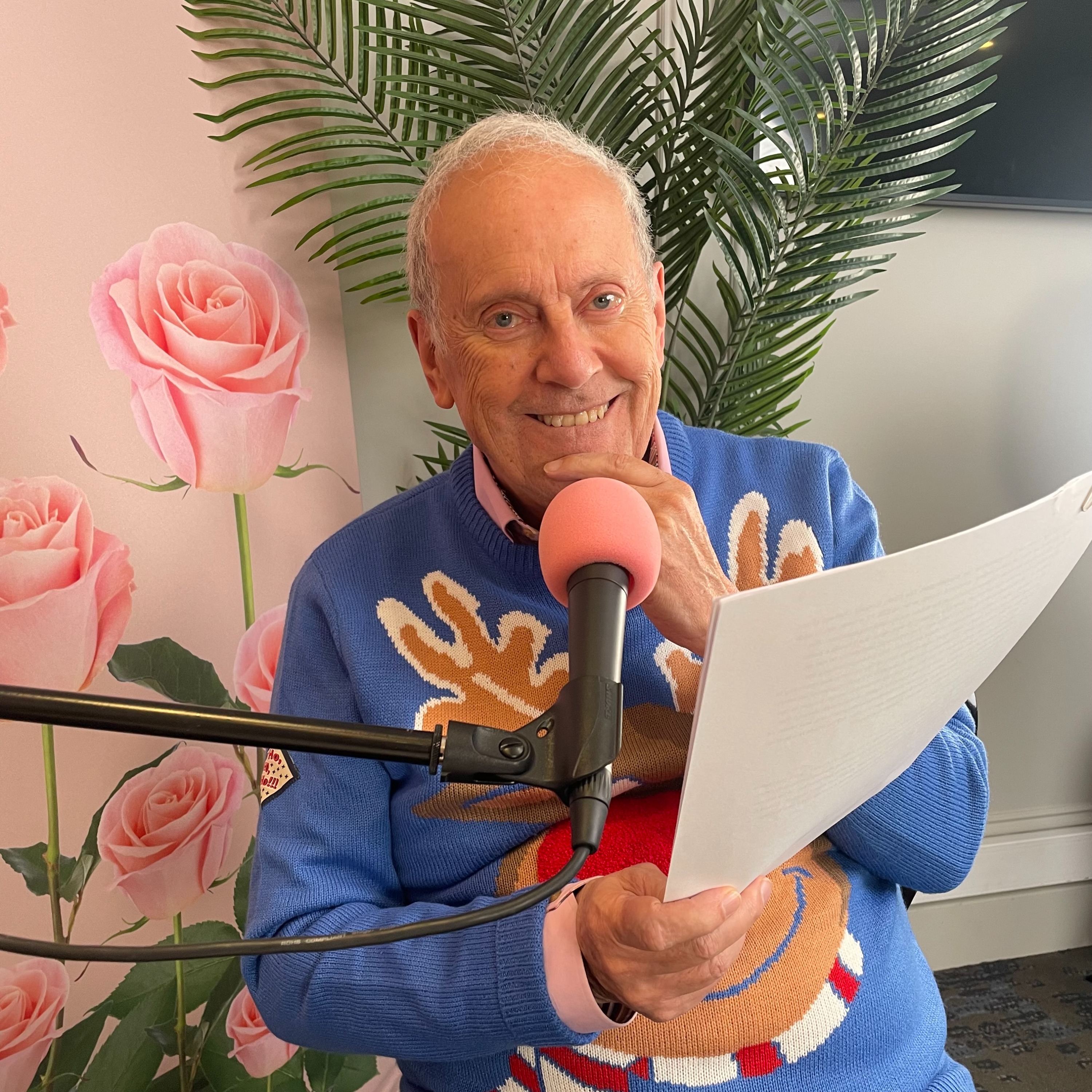
1:12Welcome to More Rosebud. It's a Tuesday and it's one of those Tuesdays when I'm going to read to you from my diaries. Oh, by the way, my name is Giles Brandreth, and I'm in our studio, the Rosebud studio, at Grosvenor House on Park Lane in London's West End. And wherever you are in the world listening to Rosebud, welcome. We love having you, and we think of ourselves as being the Rosebud family, because without you listening, we wouldn't be here. And in fact, I've got my family around me today. I have my lovely wife Michelle who is here today. Michelle thank you for being with us. Thank you Charles.
1:53Well it's the least we can do. We've been together now for 57 years. Oh my goodness me. And 2026 is a pause. It's time I had a facelift I think don't you? No. Curiously, I have to say, as far as I'm concerned, you are pretty unchanged. You look lovely, but you always have. Whereas I think you do think I could have a facelift, don't you? No, nothing could make you look more wonderful than you look at the moment, Giles. I have to tell you, listeners. Oh, that's nice. No, she says things on microphone she does not say when we're on the way home. Oh, yeah. Because I think she does think that a little face, a little nip and tuck here wouldn't come to her.
2:39Oh, you were saying you thought you might. I did. Only because we've had a lot of people. We've had quite a few comedians on the show over the last couple of years. And people have loved them. Whether it's been Rob Brydon, Lee Mack, whoever we've had. People have said more comedians. And one of the comedians people have most asked for is Jimmy Carr. And Michelle rather likes his face work. why did you say that well because you've told me in the past you think Jimmy Carr's made the best of what he's got and he's quite open about having had quite a lot of work done yeah Botox and a little nip and tuck there and you're saying well done so do you think I should, maybe I will I don't know whether you should but I think it would make you look better but whether or not that's important is up to you oh that's diplomatic isn't it Michelle I'm very impressed by that what do you think Harriet it i don't know i think i don't think i'm that bothered by what people look like and i think it's very difficult to have work that looks real real and i think you can very quickly tip over i mean i'm not an expert but from my observations you can very quickly tip over into that would you think of having any work done i'd be very careful about it because it can look terrible i think when When you get to that age, would you have your hair tinted or dyed?
4:04Oh, yeah, that sort of thing. I think that's fine. That's a girl thing, Giles. It's got nothing to do with what we're talking about. I think there's simple things you can do. Teeth whitening and straightening. Yes. I think it makes a huge difference. Hair, yeah. A bit of makeup or, you know, get your eyebrows. That's a huge... You know, women now all get their eyebrows shaped and dyed. I do. It makes a huge difference. I'm actually looking at Michelle. I think you do too. Yeah. No, I don't. Don't you? No. Oh, well. But your eyebrows do look good. Appearances are deserved. I'm amazed. I'm amazed.
4:36I have not touched them. I've neither taken them out nor swiped them in. Well, we're doing a Diaries episode, and you will remember, or people will remember, when I got to know Fanny Craddock. One of the first things she told us was how her eyebrows had been burnt off in a terrible fire. Oh, not by the oven. You know, opening the oven door too quickly. Sometimes that feels like it's going to happen. with what she does. Yeah. Yeah, no. And she therefore had eyebrows that were painted on. Yeah, well, people did in those days. But they were painted on sort of an inch above where the normal eyebrows were.
5:09So you could see an eyebrow line. Oh, gosh. And then above them was the makeup eyebrow. The surprised eyebrow. And then she also had on, instead of wearing lipstick, it was really lipstick and then lipstick around the lips. So kind of encircling the lips. Gosh. That's a thing with certain people, isn't it? Sounds a bit freaky. Yeah. Anyway, the point is, We're talking about the Rosebud family. My family is here in the shape of my lovely wife and my lovely niece, as I believe some of our listeners think of you. Well, in this email that we've got here, the emailer refers to me as like an attentive niece listening to my uncle telling stories.
5:48That's how he thinks of us, Giles. Uncle Giles. Since we've mentioned family... We're not actually technically related listeners. No, no. So before I read the email or before you read the email, I ought to mention, speaking of the Rosebud family, that from the new year, we're making an official family. We're going to start a Rosebud family because there have been people who've been saying, we love Rosebud, but sometimes we find the ads a bit too much. Are you going to be offering an ad-free version? And so we thought, well, why not? Everybody else seems to have an ad-free version. So there's going to be an ad-free version of Rosebud, which is starting in January.
6:25$4.99 a month. That's what they say you should do it at. Then we'll be giving extras as well? Yes. So the Rosebud family is our sort of Rosebud subscription subscriber club. We're calling it Rosebud family. And yes, so you'll get all the episodes of Rosebud ad free. You'll also get a bonus episode every month of you and me chatting, which you're calling Down Memory Lane. Because I want to take you to some places. I thought we'd go out on location occasionally and take you to places that I remember and then see what it prompts in you and indeed in our listeners. So actually place being a trigger for memories.
7:03And then we're also going to do two episodes a month of you reading Murder Mysteries. I'm into Victorian murder mysteries. You love a murder mystery, don't you, Michelle? Yes, I love a murder mystery. Yes, and I just like being taken away from reality and getting onto a really good book. So hurrah, thank you. Some people think the mystery is that Michelle hasn't murdered me over the last 50. I have tried. That could be the next instalment. It could be. So there's going to be murder mysteries. And there's going to be something you are calling Rosebud Retort. Yeah, that's the chat room. So if you're a subscriber, you get access to a Rosebud chat room.
7:43And access to first dibs at tickets for events and shows that we're thinking of doing next year. Yeah, and there might even be merchandise. That's another thing we can offer, apparently. Be careful with the merchandise. No, no, we can do it so that we don't have to do the mailing. Because I always thought we'd have to wrap it up and put the stamps on. But if we do it through this subscription thing, they will do all of that. But I only want quality merchandise. Oh, yeah, it would be quality. A tote bag saying cue the music. I mean, that would fly off the shelf, Giles. It would. Good, it's going to be a quality tote bag.
8:18It will be a quality tote bag. I don't want any of this tat. No. First division. No, 100 % cotton. Oh, good. Oh, excellent. Well, here we are. I want to read this. I mean, we haven't got the tote bags yet, everyone, so don't get too excited. And if people want to subscribe, what do they do? They have to go to, so it's£4.99 a month, which I think is a bargain for all the extra episodes they'll get. And they have to go to www.patreon.com forward slash rosebud. Very good. It's similar to that. And it starts at the beginning of January. Lovely. Well, starting right now is an email. And who is it from?
8:57What does it say? It's from a listener, another of our listeners who's in Australia, called Clive Mansi. And I thought I'd read this because it's got a few interesting questions for you, Giles. Dear Harriet and Giles, I'm such a fan of Rosebud, I just had to write. I love listening to all the guests, and in particular, Giles' diaries. I'm only a couple of years younger than Giles, so the diaries are a great reminder of my formative years in the 50s, 60s and early 70s. I enjoy the interaction from you, Harriet. You always say all the appropriate oohs and ahs as Giles reads his daily entries. In some ways, the rapport between you reminds me of an attentive niece listening to her dearest uncle talking about the old days.
9:45Oh, goodness. One thing that intrigues me, especially about the diaries, is the amount of information and detail that Giles managed to record, presumably in longhand. What was his regime? Did he allocate an hour every evening to writing his diary after collecting notes throughout the day? Is Giles still keeping a diary? And if so, presumably he uses an audio recorder. perhaps one day Giles can elaborate on the above as I'm sure it would interest other Rosebud fans we'll find out the answers at the end of this email as a Londoner who migrated to Sydney Australia in the early 70s Rosebud is a lovely reminder of the old dart all good memories if I was in London town I'd certainly make the effort to have a couple with you both I'm sure it'd be fun and I know who would do most of the talking best wishes Clive Mansi well it's a nice email the quick answer is I do still keep a diary I write it mostly in longhand in notebooks but I also do it on the computer on my laptop oh right and I merge the two audio is dangerous I was a friend of the late great Tony Benn Labour MP for many years and a great diarist he eventually began doing his diary on audio it became more and more verbose yeah whereas if you have the discipline of writing a few lines you concentrate your thoughts he also occasionally fell asleep while dictating the diary so did the audience thank you yes so i keep it on a regular basis and the complete diary we're going to do a bit of 1971 now but the complete diary has much more detail than i'm giving you it would amount to millions of words because i think i saw it as a record of our time as well as an account of my life.
11:34So I wanted to write down when something big news happened. I wrote that down as well. Well, even when you were 11, you were thinking like that. Well, we heard when I was 11. And I certainly did. I included, you know, the results of the general election. You did. Things that were going on in the outside world. And were you thinking then, oh, this might be read by millions? Or were you just thinking, oh, it's good for me, for myself? It's good for me, but I also had an eye on posterity, even from an early age, because what triggered writing the diary was having been given by my Auntie Edith and Grandpa Addison, my mother's aunt and father, a shorter Samuel Pepys for Christmas in about 1959.
12:15That's what made me think I'm going to keep a diary. So I'm disciplined. You require discipline. But I'm a writer, so I write every day anyway. So is this always at bedtime or are you doing this throughout the day? It's not at bedtime. Oh. Because by bedtime, I'm usually exhausted. Interesting. So at bedtime, our routine, Michelle can confirm this, is Michelle goes to the bathroom. And then when Michelle emerges from the bathroom, I go to the bathroom. When Michelle is in the bathroom, I'm usually still in the kitchen. And I'm finalizing the washing up, which I enjoy doing. And I do it just like my father used to do.
12:54I actually put the drying up cloth over my left shoulder, as he used to do. And I clear the surfaces, I wipe the surfaces, I check the back door, I check the front door, I take out the two glasses of water. I think we're getting too much information here. This is fascinating, I think, Michelle. Do you? Yeah. You must have a very dull life. So I take it all up to Michelle and Michelle then emerges from the bathroom and I then go into the bathroom. And Michelle is in bed. by the time I emerge. We've got one of these. Our daughter, was it, gave us Christmas or two ago a thing that heats up the bed.
13:35Electric blanket. But it's not a blanket, it's an undersheet. Oh, yeah. And we can have different temperatures on either side. So Michelle is already in bed, sometimes already asleep by the time I return. And we have to have the lights on at night because of the cat. Yes, the cat's the most important thing. The cat is what really manages the house. I used to think that cats could see in the dark but Michelle doesn't believe that no I don't think I do I've never asked one actually I'm not very good at actually speaking to cats but they understand you they understand me but they don't necessarily know what words I'm giving them so I have the light on but you Harriet have made it easier for me because you've told me think that you're on an aeroplane in the middle of the night and it's like seeing the light on quite exciting exactly so I actually go to bed thinking oh I'm flying somewhere exotic and then I fall asleep so I don't do the diary in the evening I do the diary during the day that was a long detour okay oh you do the diary during the day that's very interesting information and I I actually even do the diary while things are happening so if something interesting has happened for example the other weekend Michelle and I went to Paris because it was the 125th anniversary of the death of Oscar Wilde.
14:56And we went to Palachez Cemetery, where Oscar Wilde is buried, with the grandson of Oscar Wilde, our friend Merlin Holland, who's done an episode of Rosebud for us. And he had a key to the back of the tomb. Oh, gosh. And he was able to open a metal door in the back of the tomb. And I'd always assumed that the coffin of Oscar Wilde was inside the tomb. It isn't. The tomb is above ground. And below ground, we actually are able to see it, is where the coffin is. And on top of the coffin, in the top left-hand corner, is a small casket. And within that casket are the ashes of Robert Ross. Robert Ross was a great friend of Oscar Wilde's.
15:41Some say he was his first lover when he was just a boy aged 17 um and anyway he was a good friend of Oscar Wilde and after Oscar Wilde's death he did what he could to regain the copyrights of Oscar Wilde's work and try to get money for Oscar Wilde's sons and was an ally and friend a devotee of Oscar Wilde's and it was his fondest wish to be buried with Oscar Wilde so I was able to see this casket with the ashes and I thought I mustn't forget this. So we next found ourselves later that morning going for breakfast at the hotel where Oscar Wilde had died. And there was a gap between going for breakfast where Oscar Wilde died and going to the Irish embassy where the ambassador was unveiling a bust of Oscar Wilde.
16:28And I had 20 minutes to spare. And I got out of my diary and I wrote the notes there and then of having seen about Robbie Ross, about what Merlin Holland said, about being in the hotel where he had died, all the feelings that I had. There and then it's the immediacy that I think makes a diary interesting. So you carry it with you all the time, do you? Have you got it now? I've got the diary notebook and I might then transfer it. So it's a cumulative thing. How do you have the time for all this, Giles? Well, I have to say that Giles' mantra is, can't stop talking. And I think for those who have other things to do, it might be quite difficult to actually keep listening for the rest of the morning or wherever this is being heard.
17:17Anyway, I just throw it out to those people who might like to rearrange their arrangements for the day. I think Michelle is telling us, get on with it. I think that is, in shorter words, that is exactly it. But I do recommend to people, a new year is coming, keep a diary. It works at so many different levels. It makes, I think, you much more observant about what is happening. When somebody says something interesting, perceptive, amusing, I want to note it. And you think, oh, yes, I'll always remember that. But you don't. For example, the night before we went to Oscar Wilde's tomb, can you remember what we had for supper, Michel?
17:57We went to a lovely restaurant called La Mediterranée. with Merlin Holland and his wife, and with our friend, the artist, Anthony Palliser. What did you eat? I have no recommendation, not recommendation, no idea what I was eating. I was so busy talking to all our friends. You were, you were busy, and I was busy enjoying it. But when we got back to the hotel room, I actually wrote down that I had the, of mayonnaise, and how wonderfully French the mayonnaise was. and then I had the sole meniere, incredibly expensive. But I don't eat fish or meat. I know you don't. So that's one of the reasons why I wouldn't have been talking about food at that time.
18:41I probably didn't think about it at all. There you are. So you've forgotten what it was. But I remember the detail of the meal. The mashed potato, the pomme puree, it really was perfection. And Anthony, he had six oysters. he had been in the sole meniere as well none of us felt like a pudding we felt we'd feasted enough they had two bottles of chabri so all these details are put into the book and i thought well there are five of them do they need a third bottle no i think i'll pay the bill now so it's those kinds of details that go into a diary fantastic yeah there you go clive that's a bit of an answer we're going back now to friday the 3rd of september 1971 i've left university i'm earning my living really as a freelance radio person, television person and writer.
19:30Nothing's changed. And no, nothing has changed. I have been on a committee investigating pornography, the committee led by the Earl of Longford. One of the delights for me is that Cliff Richard, the young Cliff Richard, is also on the committee. Let's see what's happening now. Friday, 3 September 1971. There's clearly something in the air. I went to see Mary Kenny at the Evening Standard and found her wearing a see-through blouse with nothing underneath. Every time she moved in her swivel chair, her breasts wobbled. She moved a lot. It was quite disconcerting. Lunch with Peter Mayer was disconcerting too.
20:13I like him. He's a wood importer and translator of Fedo Farses. We're going to publish some of his translations in our playscript series and he keeps taking me to the Savile Club to discuss the finer details. I was working as a freelance editor for a publisher. He wines me and dines me and then, before we adjourn for coffee, he rests his hand on mine, just a little too long for comfort. Oh dear. I then mention Michelle. He then mentions his wife and we move through to the drawing room where invariably Robert Robinson is holding court. Did my ninth radio interview of the week tonight? The porn shadowbang outing has certainly proved profitable.
20:58This was Look Who's Talking, the Nicholas Barson's chat show for the BBC. And my fellow guest was the great Paul Raymond. He was a publisher. You probably haven't heard of him. I have. You have. He was a publisher of Men's... It was a Raymond's review bar. Exactly. promoter of sex shows and he had lots of property interests particularly in Soho. And my fellow guest was the great Paul Raymond. Roguish smile, tanned, leathery face, hair like silver candy floss. I liked him. He claims his business isn't pornography, it's erotic entertainment. After the recording he said, shall we have a glass of champagne?
21:40He drove me to the Whitehall theatre in his very comfortable Rolls Royce. My first ride in a Rolls Royce and I had Paul Raymond at the wheel. And there at the back of the stalls, champagne saucers in hand, we stood and watched the second half of his show, Pajama Tops. Look, he said proudly, pointing at the leading lady. Small titties, this is family entertainment. As I left, he gave me a copy of his magazine, men only. Michelle has been reading me Choice Extracts. This is Fiona Richmond's European report on one of her continental conquests. And as for his sword, terrificioso. Pale-coloured, pure Toledo steel.
22:30Maybe not the largest, but certainly the straightest I had ever seen. We won't be asking you, Michelle, if you recall reading that out loud to me because I hope you haven't recorded. On we go. No, I haven't recorded it. No, I'm quite right too. Thursday the 16th of September 1971. The out-of-town luncheon club Leicester. The ladies all wear hats and when I tell them that a hat really finishes off an outfit, I can actually hear them purring. This evening we went to the Kensington Odeon. Sunday, Bloody Sunday directed beautifully by John Schlesinger about a young man, Murray Head who has affairs with an older doctor, Peter Finch and a young woman, Glenda Jackson Interestingly, there was an uncomfortable feeling in the auditorium when the male kissing started I felt it too, and I've seen everything You can see things on your own and it's fine It's when you're seeing it with others that you feel embarrassed tonight at the salisbury arts theater i attended the world premiere of lewis carroll through the looking glass devised by me directed by me performed by cyril fletcher oh dear the idea is fine we meet charles dodgson in his rooms at christ church oxford he is an insomniac in act one he's pottering about his room, preparing for bed and trying to get to sleep.
24:03He tells us about his world as he does so. In Act Two, he's in bed, working at his nyctograph, the device he invented for writing in the dark, falling asleep and dreaming. In his dreams, he and we meet some of the amazing characters Lewis Carroll created. The set is fine. It looks like an Oxford room. The costume is fine, especially the wig. The problem, let's face it, is the performance. Or rather, the performer. Because I'd been in Bristol in the morning, I only got to the theatre in time to wish little luck and take my place at the back of the stalls. At 7.15, the theatre was full and expectant.
24:47The house lights dimmed and we all settled back, awaiting the strains of France Liszt that I'd chosen to ease us back to Oxford in the 1860s. Instead, we got the oom-pah-pah of the March of the Gladiators, Cyril's signature tune. And when the tabs should have gone up to reveal Lewis Carroll in his room at Christchurch, we got a furious rustling of the curtains, followed by the appearance of Mr. Fletcher, in dinner jacket and toupee, gurning gleefully, striding onto the stage, and launching into 20 minutes of his vaudeville routine. Essentially, he had lost his nerve. He said to me afterwards, I thought I ought to warm them up.
25:30In fact, he simply confused them. Eventually, he got round to the play. But it was a sorry affair. It was fairly obvious that he didn't believe in it. He kept winking at the audience. It was even more obvious that he didn't know any of the lines. All around the stage, onto assorted props and various bits of scenery, he had pasted, pinned up, half-hidden the entire script. Pretending not to, he read virtually every word. But Giles, didn't you direct this? What happened was that Siddle Fletcher had been very keen to do a one-person show. He'd seen other actors have a success. We thought, between us, that Lewis Carroll was a good person because he was known Siddle Fletcher for his odd odes.
26:17And Lewis Carroll wrote amusing poetry. His problem was that he had found difficulty learning the lines. We'd had some rehearsals. He said, it's all going to come right. I'm working on it. Have no fear. We'll do this triad in Salisbury. And that's what we did. And it didn't quite work.
26:38Friday, 1st October, 1971. Meeting with Douglas Muggeridge, Controller Radio 1 and 2 at Broadcasting House, to discuss my future. meeting with cyril fletcher to discuss his actually a good meeting cyril is going to learn the lines and make a fist of it in time for our proper opening at the arts theater that was a a tryout yeah he just wanted to put it on the stage okay fine meeting with philip hodson to discuss sex and so earnestly erectile dysfunction jazz we must talk about it more meeting with George Gale to discuss pieces for the spectator. He's now the editor and very friendly. He communicates by means of grunt and growl.
27:27He likes a liquid lunch. When I met him at 5.45pm in his office in Gower Street, he was just back from it. He went to sit down at his desk and, with some ceremony, sat down immediately alongside his empty chair. He collapsed straight onto the floor but didn't appear to notice that he'd done so. Patrick Cosgrave, deputy editor, carried on chatting as if nothing had happened. That was a real thing wasn't it? That people would totally go out at one and not come back to the office till five and they'd be quite drunk. And not just in journalism. I remember Michelle and me going to have lunch with our bank manager and there'd be sherry before the lunch and wine at the lunch.
28:08People gave, I mean that was just the way it was. People had a generous lunch. And in the journalism, television, radio, particularly the press, I mean, it was part of the course. Yeah. And do you think anyone could do any work after a lunch like that? Well, they would say it was all part and parcel of the work because they were creating an atmosphere of conviviality, that it was making, you know, it was a happy place to work because everyone was mellow. And maybe in Fleet Street, that's how you got stories. yes you know yeah it probably was that it was a different also they didn't just drink they smoked yeah so you went into an office mary kenny was i think the features editor of the evening standard the lady was there with the see-through blouse yeah she would have been smoking yeah she'd have had a liquid lunch yeah i mean it was a totally different world and were you joining in with all this i didn't smoke and i didn't drink oh when did you stop drinking well those lunches i didn't i was trying to be in control i was wanting to command the situation i did drink in those days i gave up drinking much later did i did i come to any of these things i don't think i did you were in television then yes i certainly wasn't into the sort of television that you're talking about friday the 22nd of october 1971 generous letter from frank longford at the pornography Every committee meetings, now the others look at me warily.
29:36But not Frank. He really does have a loving disposition. In Denmark, when there were no cameras present, he embraced one of the models we met, hugging her close to him, putting his arms right around her. She was stark naked, amply bosomed, and with an extraordinary amount of pubic hair. But Frank seemed truly not to notice. in his letter knowing of my deep interest in prisoners he promises to copy me in on his very moving and remarkable correspondence with ian brady it does not deal with pornography on which i fear he takes a view similar to that of john mortimer qc do you know what i mean by ian brady harriet of course i think everybody does yeah ian brady convicted with his lover amara hindley of a horrendous series of child murders committed on Saddleworth Moor, I think really in the mid-1960s.
30:37And Lord Longford, who was a prison visitor over many years, took a special interest in both those murderers. And did you read that correspondence? Yes, I did. I don't know if I made this clear. I'm earning quite a bit of my living at this stage by doing public speaking at ladies' luncheon clubs, that sort of thing. A sort of WI type thing? WI, a little bit grander than WI. Often there would be 200 women there, all wearing hats. Ladies who lunched. Lovely. And they took tea as well. Listen to this. After yesterday's triumph at the Washington Tea Club, County Durham, I'm doing three or four of these ladies' groups a month now at£26.77 a time.
31:18Net. It adds up. I travel down to Shipston-on-Steuer for a less successful engagement. For£30.60 net, I made my debut on any questions. I was okay, but I made a basic mistake. When I had nothing to say, I said so. The others all had plenty to say on everything. They seemed so certain of their opinions. My problem is that I see several sides to every issue. The most memorable part of the evening was returning to London in the chauffeur-driven limousine belonging to Vic Feather, General Secretary of the TUC. He sat in the back of the car with a rug across his knees, a cigar in one hand and a glass in the other and put the world to rights.
32:05I was much amused that the champion of the workers, no-nonsense Yorkshireman, shop steward and leader of Britain's trade union movement should travel in such style. All he needs is a peerage and then he'll be Lord Feather, a proper restoration fop. It was ever thus. Monday, the 20th of December, 1971. Godfrey Wynne was the highest paid journalist of his time. For more than a generation, he was the star columnist in Woman, Britain's best-selling women's magazine. Now he is gone. Who is to replace him? For months, the search has been on. Who is there possibly who can step into the shoes of this lamented Fleet Street legend?
32:52Could it be? Yes, it could. I had a meeting with the editor this morning and I have a feeling she's made up her mind. This could change my life. So I was ending the year thinking I was going to be the new Godfrey Wynn. As Michelle will say, nobody's heard of Godfrey Wynn now. you're right but he was the highest paid journalist of his time and he had this column in the best selling women's magazine in the world and I aged 22 23 was being you know looked at as his possible replacement and would it have been good money is that partly why you wanted to do it it was an achievement I don't think I was yet clear about what I wanted to do I was just doing what I'd been doing so I was turning up for radio programs like any questions because it was the big it was then much but it was like question time but on the radio we're still going and but of course it's clear I didn't have very much to say and I was being sized up for this column and I don't think I thought through how am I going to use this column yeah so I was being given these opportunities but was I really seizing them so I was making television making radio writing shows for the theatre, about to be this big new star in the magazine world.
34:19And I was just doing it because I was doing it. I think what I definitely enjoyed, even then, was doing the speaking. I think I enjoyed going to the ladies' luncheon clubs. Because you, Michelle, you for a while did some talking at the ladies' luncheon clubs. Do you remember that? Oh yes, I did. Yes. And it worked quite well, didn't it? I believe so. It's such a long time ago now, I can't remember. What would you have been talking about? Well, you were talking about, I think, you'd done a book. I mean, we're both, I mean, we're only now 20. I don't know how this quite happened. You did a book around that time called Restoring Old Junk.
34:51Yes, I did. It was very successful. It was successful. What was it about, essentially? It was about mending things that have got broken, but you don't want to throw them away. And Michelle. That sounds good, Michelle. Well, in a sense, Michelle was very well known, too. I mean, for example, we've still got a magazine, a girls' magazine called Judy. It's like a comic for girls. And I remember you were the pin-up girl on the back of Judy. Yeah, I was a pin-up girl. Wow. And so the pair of us, we were a little media couple, but we were only 22 and 23. Like Richard and Judy. We were. I hope not. We were a young Richard and Judy, weren't we?
35:26Yeah. Neither of us, I think, at the time, had really thought anything through. Things were changing a lot. You won't remember. You won't remember. But at that period of time, I mean, there was a huge change in the way in which people were dealt with, what they worked to do. You know, all those things were being looked at in a very different way. A lot of reasons because of television and so on. The world was changing. This is before you were born, Elliot. It's very much a changing world. And it's quite difficult, you know, because there are still a lot of old codgers, as we eventually became ourselves, who didn't really know how to handle it and didn't know whether they liked it or not.
36:07Two things happened. I think one definitely positive in that there was, because of women's lib, there was an affirmation of the role of women. Which was correct. It needed to be. Which was correct. And people like you were given opportunities that the generation before wouldn't have been given. But also there was this sexual liberation which manifested itself in a variety of ways. One, the advent of the pill made life very different in terms of sex relations. But also, women's lib included a phase, it didn't last very long, of people going topless. I did not do this. No, you did not do this. Nor did you.
36:45No, not did I. We went to the Old Vic Theatre one evening, and there were people who'd gone to the theatre topless. I don't recall that, Joss. People in the audience. I don't recall that at all. he often has these imaginations no it's not my imagination well I did not see a lady no you wouldn't necessarily have noticed but I definitely noticed of course I would have noticed and Mary Kenny was not alone in going to the office without a bra well there's nothing wrong with that this was part of women's lib at the time it didn't last long but this notion burn the bras and all that stuff but also freedom of expression but that's what was happening at that time it was a feature of the era I never saw somebody that that's up to you in a sense that's what the diary is about it's actually showing you what things were like that phrase didn't last and it's because of that sort of thing that was going on that Lord Longford formed his committee because he was anxious that this liberation was not liberation but there was an element of license and the liberation he welcomed he had daughters many daughters himself aspiring successful people but he didn't like the idea of licence and he was worried about that hence the pornography committee and because I wanted to be seen I suppose to be on the side of the liberals and on the new world that's why I fell out with him and my fellow committee members and dropped out of the committee Shall we go into the next year?
38:18Yes, so that was the end of 1971 Giles Yes
38:29Sunday, the 9th of January, 1972. It is 8am on Sunday, the 9th of January, 1972, the first Sunday after Epiphany. It is a cold morning and dark. I'm sitting at my desk in my study at 11 The Close, Muzzle Avenue, N10. To the left of my typewriter stand my framed portraits of Lenin and Noel Coward and my Mr. Punch Toby jug containing my pencils and pens and the large pair of scissors that belong to Granny Addison. To my right is a plate of Marmite toast and a mug of tea. Michelle is asleep in our bedroom next door. We had a late night made later by discovering a mouse scuttling across the bedroom floor.
39:20It took an hour to corner the creature and another half to catch it. where the Brandreth family have a heart animal traps when you need them. The pill company had diversified, and as well as manufacturing Brandreth's pills, we were producing have a heart traps, humane animal traps, that could catch everything from a gerbil to an elephant. And we were having difficulty catching this mouse. I bet you do remember this now. I do remember that, yes. Eventually, we secured the mouse between an upturned colander and a baking tray. And at around 3am, I padded down to the front garden to release it to the world.
40:01Perhaps the mouse was a sign. Perhaps it's time to move on. It is. And we are. That's the week's big news. On Monday, we secured our first mortgage. £12 ,900 from the Guardian Building Society to assist you in defraying the purchase price of 170 Clarence Gate Gardens London NW1. The loan will cost us£91.40 a month for the next 20 years. We exchange contracts on the flat on Wednesday morning. The deed is done. I'm excited. There was more news yesterday. I have been fired from Lord Longford's study group. My teasing, though accurate, my teasing, though accurate, account of our proceedings has appeared in the January issue of Nova magazine and given offence.
41:02The magazine's cover carries a photograph of a masked girl in suspenders, bullwhip in hand. The piece is illustrated with a sculpted model of Lord Longford with his head in the form of a phallus. It was a very unpleasant thing. I didn't get involved in that, did you? You did not get involved in that. My article is innocent enough, I reckon, but I can understand Lord Longford taking a different view. He has written in the tone I would have expected. I'm sorry that it should have ended in this way. I wish you all success and happiness in other fields. Yesterday's post brought a letter from Malcolm Muggeridge that was less obliging.
41:45The ethical implications of what you have done I leave to your conscience. May I add on a personal note that when you first came to see me as the editor of an undergraduate journal I formed a high opinion of your gifts and qualities. Indeed on the strength of this impression, I recommended you in various quarters. It therefore saddened me to see your undoubted talent put to so poor a purpose as this very trivial and, I fear, rather squalid Nova piece. Yeah, I agreed with him. I have replied to both letters, carefully, standing my ground on the content of the piece but apologising sincerely for any offence given.
42:27The truth is I'm glad to be free of the committee but i do have regrets i don't like upsetting people and i'll miss cliff this morning went off to saint marilyn parish church for the christening of jenny and alan's baby katherine emma first a bath and another slice of marmite toast oh so you got fired you wrote a scathing i got fired from the committee and a moment ago i said when i stepped down in my head i thought i'd resigned but clearly now reading the diary i was wanting the best of both worlds i was staying on the committee while disparaging them in this article yes and it wasn't good it wasn't good no it wasn't jiles the whole thing it was really a relief to me to be fired um and you can see i i felt because i'd loved i'd love meeting the people also i had access to these distinguished people lord longford was you know a knight of the garter he'd been a cabinet minister Malcolm Muggeridge was one of the leading personalities of the day, a famous journalist and broadcaster.
43:34Well, you would know that, obviously. So, well, you can see, I felt conflicted. But did you feel bad about having written that piece? Yes. I felt bad even as I was writing it. The truth is, if you're going to be a journalist, well, certainly a columnist, you are going to upset some people. Saturday the 22nd of January 1972. This is an historic day. The Prime Minister Edward Heath has signed the Treaty of Brussels. After a decade of difficult negotiations, Britain, Ireland, Denmark and Norway have now joined the European Economic Community, enlarging it from six nations to ten. The common market is now larger than the United States of America and accounts for more than 40 % of world trade.
44:29That is historic. The opposite of Brexit. That is interesting, isn't it? And for me, that was exciting. Elsewhere, things don't look so good. Ulster, that's Northern Ireland, Ulster is in turmoil. Bangladesh is in crisis. In Rhodesia, Ian Smith has arrested the former Prime Minister, Garfield Todd. And where am I on this momentous day? as it happens on the train to Cheltenham. I'm on my way to the Everyman Theatre to see Siddle Fletcher in Mother Goose. I think that tells us everything, doesn't it? Friday the 28th of January, 1972. Today we left 11 the Close and move to 170 Clarice Gate Gardens, London NW1.
45:18I love the address. I love the flat. where on the lower ground floor, the kitchen opens onto a backyard that leads to Siddons Lane, named after Mrs Siddons, who live nearby, the great actress. In the yard, we have our own shed, and from the shed... I don't think this is going to be terribly exciting for people. We've got a door, and we've got a tap. I'm sure we're all very excited about this. In the yard, we have our own shed, And from the shed, you can see the Abbey National Building, set on the site of 221B Baker Street. Yes, this is the place to be. Edgar Wallace lived around the corner. So did Frank Richards and George and Whedon Grossmith, authors of Pa's favourite book, The Diary of a Nobody.
46:08According to Mr Varian, the friendly Irish importer... Oh, he was so nice and so kind to us. T.S. Eliot lived in this block. I remember him actually saying that. Possibly in this very flat. Wow. Wow, full circle, Charles. It all bodes well and it all looks good. It's a Victorian block, so the ceilings are high and there's period cornice work, etc. The wooden parquet floor gleams. We have three big rooms at the front, our drawing room, bedroom and study, and on the other side of the long corridor a loo, bathroom, a bedroom, the dining room and kitchen. The kitchen is big enough to eat in. We're going to be happy here.
46:53Well, congratulations, your first home. Our first home. That you bought. And it was an enormous amount of money. And the difference with this flat from the flat we rented was this. At the flat we rented, the rules didn't allow us to have pets. And at Clarence Gate Gardens, we got our first cats. Lovely cats. So more about that next time. And that means you won't have any mice. You won't have a mouse. No problem. We won't have mouse problems. So that's the penultimate episode of My Dad is for 2025. Wow. Yeah. And I'm only 23. Oh, my goodness. Am I even 23? Yes, I think I am. And so there we go.
47:34Very good. You know, we promised people some of your diaries. I know, and I've just never... There's so much we've got to do in 2026. I've even got them all in a box, but it's just reading them and transcribing them. And I haven't yet taken you down into the basement to look at all those letters and all my memorabilia. I have promised you that. Michelle's having a coughing fit. This poor woman. Honestly, there's more in life than your bits and pieces. Oh, really? Maybe that's what we should call Tuesday's episodes. there's more in this life than your bits and pieces Giles I think all you're talking about Michelle we're doing a whole episode on Giles' gas bills aren't we she's teasing you Giles' bank statements full of interest people's bank statements are full of interest no that would be interesting they really are if you did that you should have a lot of different input not just you clutching something that you've found so that's it if people want to get in touch with us what do they do they email hello at rosebud podcast.com and if next year they want to find out more about how they can get ad free episodes and extra bits and pieces where do they go to www.patreon.com forward slash rosebud p-a-t-r-e-o-n.com lovely but there's lots more to come in 2035 before 2026 happens thank you for your company today wherever you are in the world that's me thanks i'm giles she's harriet and you're michelle cue the music
49:50That was more Rosebud with me, Giles Brandreth, and my friend and producer, Harriet Jane. The show is produced by Harriet Jane for Plain Jane Productions. And, oh, this week we had a treat. Michelle Brandreth dropped in. She calls herself Michelle Brandreth on good days. On other days, she calls herself Michelle Brown. That's her maiden name. Whether she reverts to that or sticks with Michelle Brandreth, we don't know. The Relate meetings are ongoing. We'll keep you posted.
Hosted on Acast. See acast.com/privacy for more information.


