
 Ask ChatGPT



“More Rosebud” Diaries Tuesday episode where Giles Brandreth and producer Harriet Jane discuss their Edinburgh Fringe run (pre-show routines, warm-ups, meet-and-greets), then Giles reads diary entries from 1979 about family life, work, politics, and celebrity encounters, including firing a live-in nanny and dealing with a damaging newspaper interview.
No guests appear in this episode. Harriet Jane is Giles’s producer; Giles Brandreth is the host/diarist.
Serval (ad) claims it automates IT ticket work (onboarding, password resets, app access) by building automations from plain English, guaranteeing 50% ticket automation in a free four-week pilot. In the diaries, Giles claims people “don’t change” fundamentally, only behavior patterns; he also claims his 1979 radio interview/paper coverage taught him to be careful because journalists can write verbatim.
chocolate biscuit mishap on Harriet’s jumpsuit; Celia Johnson’s quiet Pelmanism pre-performance ritual; 1979 nanny Nina deliberately breaking her glasses; a vile Paul Callan Daily Mirror spread; Giles passing his driving test first time; meeting Apollo 15 astronaut David Scott (moon stamps story); teasing a future lunch with BBC newsreader Anna Ford.
Written by AI. May contain mistakes.
Gyles discusses their time at the Edinburgh Fringe and performing daily.
“I'm Jake Stouck, co-founder and CEO of Serval.”
Gyles discusses their time at the Edinburgh Fringe and performing daily.
“because we are in our last week of presenting a show which we've been doing every day, well, since the beginning of August, and we've been so blessed.”
Harriet shares her physical struggles during the performances.
“I think your hip's going because you're doing this.”
Gyles and Harriet discuss their pre-show routines and funny incidents.
“And women will know that the perils and the nightmare, it's not fuzz, it's called frizz.”
Gyles learns about vocal warm-ups and musical timing from Harriet.
“and luckily it could hang down over them and I think I got away with it on stage.”
Gyles and Harriet discuss their feelings before going on stage and the atmosphere backstage.
“you're primping your hair, you go to the loo, you do a bit of an arpeggio, we then go and set our props on the stage, we do a sound check.”
Learn about the quiet preparation and sudden transformation of a performer before going on stage.
Discover the unexpected joy of engaging with audiences after performances.
“We built Serval to automate the IT work that slows companies down.”
Setting the stage for a dive into diaries starting from 1979.
“There was some sort of rumor that I was dating Connor, Whitney's husband.”
Explore Gyles's reflections on personal and professional life in 1979.
“Anything else to share with anybody before we go into the diaries?”
Listen to the challenges of managing a nanny and the decision to part ways.
“After the performance, Noel Coward sweeps into Vivian's dressing room, finger-wagging.”
Engage in a discussion on relationships, challenges, and the fixation on problems.
“They come to interview you, so you talk.”
Explore how shared challenges can strengthen relationships.
“She had many strengths, but she wasn't right for us.”
Discuss the challenges of dealing with journalists and media portrayals.
“There was some sort of rumor that I was dating Connor, Whitney's husband.”
Delve into the nature of personal change and growth through life experiences.
“And the mug you offer them the coffee in.”
Explore how behavior can change while core character traits remain consistent.
“But you can train yourself to change behaviour traits, patterns of behaviour.”
Listen to a fascinating recount of a dinner with a moonwalker and his unique story.
“I'm in Broadway in the Cotswolds in a beautiful room in a beautiful hotel having just come from a memorable dinner.”
Delve into the memories and admiration for newsreader Anna Ford from childhood to adulthood.
“Yeah, I think it was fine for him to do that.”
Anticipate the details and stories surrounding a lunch with the iconic Anna Ford.
“The very fact of me contriving it is shaming enough.”
Get excited about upcoming guests and political context in future episodes.
“You can Google her and see her lovely face.”
Get excited about upcoming guests and political context in future episodes.
“password resets, access to applications, my laptop stopped working.”

Get the gist, explore an idea or ask about something said.
 Claude
On Rosebud with Gyles Brandreth, what are the key points of this episode?
Searching your listeningAutomatic transcript. May contain errors.
0:00I'm Jake Stouck, co-founder and CEO of Serval. We built Serval to automate the IT work that slows companies down. Onboarding, password resets, access to applications, my laptop stopped working. While employees wait for help, their real work is put on hold. IT desperately wants to automate this work, and that's why they need Serval. You just tell Serval what you want to automate in plain English, and it's built. No drag-and-drop workflows, no expensive consultants. Employees get unblocked and IT teams go from drowning in tickets to building what actually matters. With Serval, IT becomes the AI engine powering the entire company.
0:39This is a new way to run IT. We guarantee you'll automate 50 % of all tickets and we'll prove it to you in a free four-week pilot. Go to serval.com slash tickets. That's S-E-R-V-A-L dot com slash tickets.
1:00The more you listen to your kids, the closer you'll be. So we asked kids, what do you want your parents to hear? I feel sometimes that I'm not listened to. I would just want you to listen to me more often and evaluate situations with me and lead me towards success. Listening is a form of love. Find resources to help you support your kids and their emotional well-being at SoundItOutTogether.org. That's soundedouttogether.org. Brought to you by the Ad Council and Pivotal.
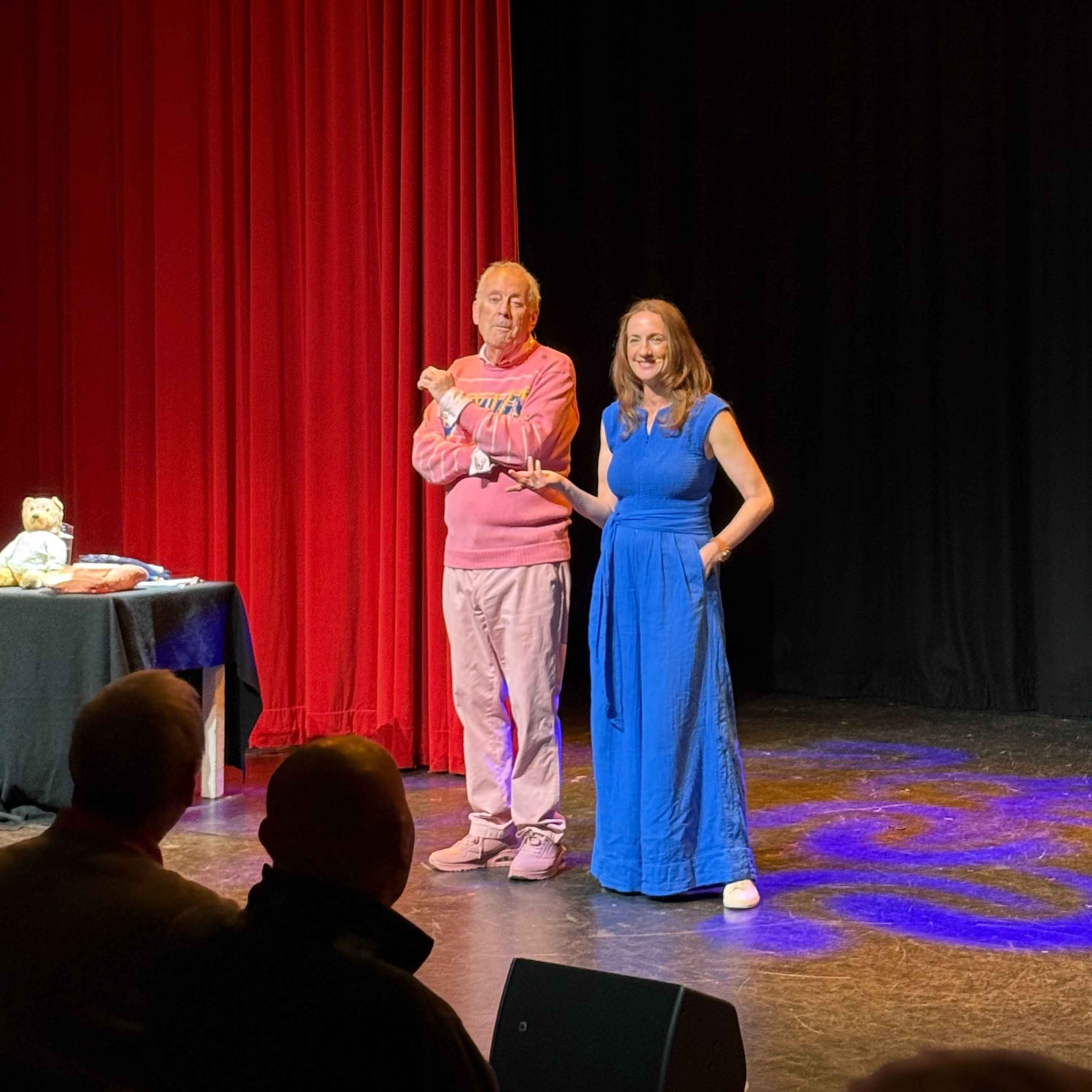
1:53Hello and welcome to an episode of More Roosevelt. I'm Giles Brandreth and I'm, as ever, with my producer, who always joins me on a Tuesday. She's Harriet Jane. How are you today, Harriet? I'm fine, thank you. We are still in Edinburgh because if you're listening to this in real time on the day it drops into the world, it is Tuesday, the 25th of August, 2026, which means we're in Edinburgh because we are in our last week of presenting a show which we've been doing every day, well, since the beginning of August, and we've been so blessed. We've been doing it at the Gordon Aikman Theatre in George Square.
2:31It's part of the Edinburgh Fringe. And Touchwood, so far, we have sold out every day. But that's because a lot of the tickets are bought on the day. So if you're in Edinburgh, come along, because we're only there until next Sunday. How are you bearing up? I've done the Fringe a lot of times, but this is your first Fringe as a performer, Harriet. How are you physically bearing up, do you think? Well, my right hip's giving me jip. I think I've probably got a cold sore. I've got a sore throat. And what else? I think your hip's going because you're doing this. The high kick. High kick. And someone said to me, well, do you warm up before you do the high kick?
3:11I said, no, of course I don't. I just pop out on stage and do a high kick. Whereas in the green room next door to our dressing room, we see young, fit young men every day who are doing a dance show in their underwear doing amazing warm-ups. They're stretching, they're doing Pilates. They're doing, aren't they? Yeah, they're doing Pilates, yeah. For about half an hour before every show. Yeah, I mean, I don't know what they're doing on stage because I haven't seen their show, but yeah, anyone sensible would be doing something. I mean, I have been going to the gym, so it's not as if I've been inactive.
3:44And you've been swimming as well, haven't you? Yeah, I mean, I think the swimming was responsible for some of the hip problems. But you've also been out whining and dining. I take a snooze every day for an hour before the show, and I'm leading quite a dull life on the whole, trying to go to bed reasonably early and having a supper and then having a proper breakfast, whereas you are leading a crazy social life. I don't think I am. But, I mean, I have had some people here, but not that many. So I can't have a snooze before the show because I have to do my makeup and my hair, which takes an hour.
4:19Goodness. So you can't just kind of roll out of bed and walk to the theatre, unfortunately, if you're a woman. You have to, I mean, I don't enjoy that sort of thing at all, but you have to spend some time around in the mirror. Your hair has to look as if it hasn't just been sort of dragged through a hedge backwards, which takes time. Yes, and you have the advantage of having hair and the disadvantage of having hair. Well, yeah, I mean, I'm not great at doing hair at all. I don't know what I'm doing, but I have this heated brush and I spend a bit of time faffing with it. and then you walk to the theatre and inevitably it's raining or drizzling and you're worrying about what that's doing to your hair and making it all fuzzy.
4:56And women will know that the perils and the nightmare, it's not fuzz, it's called frizz. And it's what happens when moisture interferes with your hair and it makes your hair look frizzy and it's not attractive. And if you're under lights and your hair's frizzy, which I'm sure mine is a lot because it often is, it doesn't look good. and what pre-show routine have you developed i've been in lots of shows over the last 50 or 60 years and i've seen lots of very different pre-show routines what what has evolved as your pre-appearing on stage we're doing it's like a daily matinee we're at four o 'clock which believe it or not in edinburgh is a very hot time to have a show a lot of the big shows are on at four o 'clock great time for a snooze and well indeed for the audience's point of view they You can come to Up and Down.
5:46Feel really comfortable. A little dosette with Harriet and Giles. Exactly. But what do you do once you've arrived at the theatre? What's evolved as your pre-show routine before you walk onto the stage? Oh, God, nothing elaborate. I mean, I get changed into my clothes, which is my stage clothes, which you sensibly said, do not wear these outside this theatre. We do actually wear them out on the street afterwards for a meet and greet. But I have followed your advice and I haven't eaten in them or been anywhere else in them. And I've washed them quite a few times during the run. Oh, I did make the mistake one day of eating a chocolate biscuit in the dressing room, which was so silly.
6:32But it was so delicious. Those those ringtone biscuits. Yeah. And as I was standing backstage before I went on, I looked down at myself. I had about five minutes before I had to go on stage. and I had two blobs of chocolate on the front of my outfit. And again, if you're under lights, all that's visible. So then I rushed up to the bathroom, dabbed the chocolate with water, which made it look much worse because then I had, they hadn't really got rid of the chocolate and I had a wet pack, two wet patches where I put the water on. Then I think, oh, well, there must be a dryer in here because then I can dry it with a hand dryer.
7:12No dryer. All there were were paper towels. So I then dab the wet patch and the chocolate with the paper towel, which obviously makes it look even worse. I then stand there thinking, I'm going on stage in three minutes, whatever it is. And I look like I've got two places. I've hack-handedly tried to remove some chocolate from my jumpsuit. Then I realised I had this tie around my waist, which is like a sort of sash that you knot and you can put it wherever you like. and I just put it rather cleverly over the two marks and luckily it could hang down over them and I think I got away with it on stage.
7:53I checked a couple of times while I was on stage what was going on and I took it home and washed it that evening. But that's the kind of pre-show drama I have. I mean, I've got no pre-show ritual. I get changed. I might do a five-minute vocal warm-up, which sometimes you do with me. Which you find on your phone. yeah it's an app is it called vocal warm-ups it's just in spotify i just search vocal warm-up and that's and we we sit there together and we do an arpeggio which means going up and going down yes an arpeggio is basically a scale but you're singing every other note i never knew that well that doesn't surprise me you don't know anything about music why would you know that i know nothing about music but actually but i'm ready to learn because one of the things that i have been doing I hope you've noticed you quite rightly we give each other notes well I encourage Harriet to give me notes and one of the very helpful ones right at the beginning was to try and listen to the music whereas well I was no no there's a difference I was listening to the rhythm of the words and I was trying to say the words roughly in time to the music alongside the music telling the story in the words but you said to me actually probably the words in the music were written to work together and maybe try and sing the words on the note that is expected you may find it works better and what this is the rough idea of singing but believe it or not i've reached the ripe old age i'm at and didn't really appreciate that nobody's ever stopped to explain that to me and i've been in you know pantomimes and half a dozen musicals over the years and nobody's actually told me that so i've just been coming at a line and thinking i'll speak it you You know, New York, New York, it's my kind of town.
9:40That's what I would do. However, I felt emotionally about it. Whereas, in fact, it works better if you hit the word and the note at the right moment. So I'm now conscious. In the early days, I was very conscious when you told me to do this. I'm actually doing that, of trying to hit it. So I'm enjoying doing the little warm-up with you. We basically hum. We go, mmm. That sort of thing. Exactly, yeah. But I never knew it was a half a time. In fact, it always in my head sounds as if we're doing the same note. Eight times, but actually it's going up. Yeah, you're going up and down. Without realising it.
10:12It's quite interesting that. Anyway, so you basically, you get changed, you're there, you're primping your hair, you go to the loo, you do a bit of an arpeggio, we then go and set our props on the stage, we do a sound check. Yes. Do you feel apprehensive? Do you then stand? I mean, I'm describing to people what happens. We have a time in the dressing room, we then go on to the stage, we do the sound check, and we have had a few issues. with the mics being either too close to our face or, you know, something can go wrong. But we're comfortable about that. We've been pretty lucky, haven't we? We haven't had a mic fail.
10:46No, we have had one performance where somebody had to come down onto the stage to adjust your mic. Yes, it was too loud. It was too loud. That was sorted. But then we go behind the scenes. The house is open and we wait as they arrive. We can actually watch them out of the window. So 500 people, we see them all lined up. We watch them coming in and then we wait. And what is going in the... It's been interesting for me observing you over three weeks so far. We are behind the main tabs, the main curtains. And Ariat at first was just sort of standing there. And now you do dance about a bit. Yeah. Yeah, sometimes dance around to the music that's playing while the audience come in.
11:30But yeah, I'm not feeling particularly nervous or anything. I'm just waiting to go on. Yeah, that's quite interesting. Yeah. I mean, the range of people I've worked with over the years goes from people... If you're in a musical, traditionally, it's been going on now for, let's say, about 30 years and it's still done, you have, before the show begins, a group hug and everybody in the cast gets together in a circle and you all hug one another and you think... And then chatty people do chat. Yeah. I don't think I want a big, long chat just before I go on. No, it's clear. I've absorbed that. Because the other day I was backstage and I was having a chat with Greta, the stage manager, and it was actually developing into a conversation, you know, about relationships.
12:11And I was thinking, I'm going on stage in three minutes. I don't think that's a good idea to have a proper conversation with someone. I think just burbling is fine. I mean, I'm a burbler, as you know. What some theatre people do, and I think I belong to that school, is after the group hug, whoever you're going on with at that moment, you stand at the wings, And you probably are chatting. But it is, as you say, burbling. It's inanities. You're saying, how do you think today? How's it tell me? Oh, God. Do you think, when we get to that first bit where it's left, I go left. I know I go left. We know we go left.
12:46We always go left. We've been in this show for two months. Why are we saying you go left? You're just actually saying it to fill the air with sound, to make yourself feel more easy. That's one way of doing it. The complete contrast of that, and this has always stuck in my mind. I may even have written about it in my diaries, which we're going to come to in a moment, because this is a Diaries Tuesday. I remember working with one of my favourite actresses. In fact, if not my favourite stage actress of that era, Celia Johnson. Became Dame Celia Johnson, best known for being in the film Brief Encounter in the mid-1940s.
13:22A film star, wonderful actress, with a great emotional presence, rather like Judi Dench. And I produced a play that she was in called The Dame of Sark, which was a very successful play that we opened in Oxford and then it played in the West End and around the world. And she, before the performance, would be in her dressing room until the very last minute. She would be in the dressing room and would be alone and would expect to be left alone. And she'd be sitting at her dressing table playing Pelmanism. And she would just have the cards all laid out. And she'd arrive, because the rule is we have to arrive by the half which is 35 minutes before the play begins she'd be there 35 minutes before she'd go into her dressing room people would say hello miss johnson and she'd go into her room she'd close the door she'd get herself ready make up frock etc she'd then sit down and lay out the cards and she'd stay there totally quietly until the moment came when she was called to the stage uh somebody would knock on the door in those days before tannoy's and say miss johnson your call please come to the stage and she'd go down to the stage no one would speak to her she'd stand completely quietly in the wings having just taken off her glasses left the cards where they were and then on whatever the queue was on stage she would walk on and in the wings you just see a late middle-aged lady standing there totally quietly as if nothing was happening the moment she hit the lights on the stage but not until the lights you could actually see if she was in darkness looking at the stage if any of the lights happened she suddenly was transformed so if she was the play where she was coming on laughing suddenly the laugh would come from nowhere or if it was emotionally charged it would be or if it was new whatever it was she just came on immediately did it and a tinkling laughing scene could end the first act laughter and applause out into the wings and let's say there'd been two men in the scene they'd go oh that went well today they'd nudge each other didn't we do well she would walk away immediately quiet again go upstairs back to the dressing room and either more pelmanism throughout the interval or the daily telegraph crossword that was her totally quiet and settled yeah that i can relate to that yeah yeah so different different styles yeah the big surprise of this whole experience for me has been apart from uh the the joy of working with you and watching you work and watching what you do develop the big surprise for me has been enjoying the meet and greet yeah because our producer wanted there to be a meet and greet afterwards yeah and there's a reason within the show a special reason for doing it which i won't give away in case people are still planning to come or if we have a life beyond edinburgh come to see us but we meet and greet people afterwards and i thought oh it's a bit of a duty we already done an hour-long show or more oh i'm exhausted but in fact we're quite high at the end of the show and so we run down the stairs get outside and it's been lovely hasn't it oh i've loved it yeah i love i love meeting people it's really fun yeah we've had some great groups yesterday we had a huge group from jersey and uh i mean there were about 13 of them or something they were in all 32 oh 32 they came as a party from jersey no 13 took part in that sort of photograph we did oh the husbands were there too yeah yeah it's really fun so um there's been we've met so many nice people some rosebud listeners some not um lots of people we've been able to say oh you must listen to rosebuds i think we've got quite a few new listeners from doing this show um and taking loads of photos it's been great i've even signed an autograph or two which is very 80s it's rather it's rather fun actually and i've got used to because i'm i mean i'm used to people going up and saying hello giles i've had to get used to people coming up and saying, oh, hello, Harriet.
17:10Hello, Harriet. Oh, Jars is here too. Yes. Yes, Jars, you can be in the selfie as well. But I've taken that. I mean, that's not true, by the way, everyone, but whatever. Yeah. It is occasionally true.
17:29I'm Jake Stouck, co-founder and CEO of Serval. We built Serval to automate the IT work that slows companies down. Onboarding, password resets, access to applications, my laptop stopped working. While employees wait for help, their real work is put on hold. IT desperately wants to automate this work, and that's why they need Serval. You just tell Serval what you want to automate in plain English, and it's built. No drag-and-drop workflows, no expensive consultants. Employees get unblocked, and IT teams go from drowning in tickets to building what actually matters. With Serval, IT becomes the AI engine powering the entire company.
18:08This is a new way to run IT. We guarantee you'll automate 50 % of all tickets and we'll prove it to you in a free four-week pilot. Go to serval.com slash tickets. That's S-E-R-V-A-L dot com slash tickets.
18:28The more you listen to your kids, the closer you'll be. So we asked kids, what do you want your parents to hear? I feel sometimes that I'm not listened to. I would just want you to listen to me more often and evaluate situations with me and lead me towards success. Listening is a form of love. Find resources to help you support your kids and their emotional well-being at SoundItOutTogether.org. That's SoundItOutTogether.org. Brought to you by the Ad Council and Pivotal. This week on Get Real. They were a messy, toxic mess. Oh my God. Chris Olsen. There was some sort of rumor that I was dating Connor, Whitney's husband.
19:07What is the vibe? Joey Camasa. He is thirsty. Thirsty. He is an F boy, but with a heart. Khloe Kardashian's new show. The girls. Very interested to see how that plays out. Who did people like more? She actually blocked me. Oh. Find and listen to Get Real wherever you get your podcasts and stream new episodes Thursdays on Hulu and Hulu on Disney+. Terms apply.
19:32Anything else to share with anybody before we go into the diaries? I don't think so. No. And we've reached the year 1979. It's my diary. And, well, I'm going to read it to you and see what we make of it. Monday the 1st of January 1979 So how old am I now? Have I reached 30? Am I already 30? Gosh I must be Yeah Anyway Yeah I'm 30 The flight back from Barbados was a nightmare Three weeks in heaven followed by 13 hours of hell The plane was packed and late and Nina the nanny sulked from Kingston to Heathrow deliberately breaking her glasses mid-flight so that we might focus on her and pity her the more.
20:17The day will come when we don't need a live-in nanny. I look forward to it. Not that we want to dance naked in the hallway, but it would be nice to feel that we could. We saw in the new year, stuffed in a taxi, travelling from the airport to Camden Hill. We got the children sorted and into bed. We collapsed and slept the sweetest sleep we've known in years, until the doorbell went at 7am, it was the car to take me to start the week. A New Year special, live from the Savoy Hotel. Michelle was appalled. Why? Why? Why did you say you'd do it? What do you make of that, Harriet? Things don't seem to have changed much to this since 1979.
21:03What an idiot I was, booking myself in for start the week on the radio, literally within hours of us getting back from our holiday. You're not commenting. Okay. No, no, I will comment. No, wry laughter from... Oh, poor Michelle Giles. What were you thinking? Who does that? I wasn't thinking. Who does that? But don't you agree I've changed remarkably in the intervening years? Yes, straight from Jamaica to start the week at 7am. I mean, you're unbelievable. But it was a very big show on the radio in those days. Yeah. It really was. I'll go on. Did Michelle have to go with you? No, she didn't go with me.
21:47Oh, that's okay then. She turned over in bed cursing. But nonetheless, the doorbell ringing, me getting up, getting into my clothes, going downstairs. She was then left. Of course, she had the nanny, but with the children. Yeah. Anyway. Why, why, why did you say you'd do it? because I thought it would be fun to start the new year at the Savoy Hotel on national radio with Richard Baker and co. And it was. It was fun. The usual crowd, Kenneth Robinson, Sheridan Morley, Esther Ranson, Mavis Nicholson, Lance Percival, with special guests, Bernard Miles, harrumphing like an old turnip, and Elaine Stritch, fizzing with energy and Noel Coward stories.
22:25Miss Stritch lives at the Savoy Hotel. Perhaps that's the way ahead. Coward attended the first night of Titus Andronicus at Stratford in 1955 with Laurence Olivier in the title role and Vivian Leigh as Lavinia At the climax of the play, Lavinia enters having been cruelly ravished her hands cut off and her tongue cut out so she cannot name her attackers She comes on holding a stick between her wrists to scrawl the names of her assailants in the sand Unfortunately, as she enters the stick slips and clatters noisily onto the stage. After the performance, Noel Coward sweeps into Vivian's dressing room, finger-wagging.
23:06Tut-tut, butter-stumps. Sunday, the 21st of January, 1979. Domestic news. We are going to have to send Tonka, Bennett's pony, to the home of rest. According to the vet, the radiographs show the presence of sidebone formation in both forefeet. Tonka's London days are over No more hard surfaces A little light hacking at best Hester is offering to find a replacement for her But we can't afford two burnies We can't really afford one Evening with our friend Noel Davis We picked him up at John Schlesinger's house Where he is now lodger and friend in residence There is no physical relationship John has a boyfriend Noel is simply there to keep an eye on the house when John is away and to be funny when he isn't.
23:57Besides, Noel claims to have the lowest libido in London. We had a white lady cocktail at the Royal Garden Hotel and then went to Nick's, Lord Avon's restaurant. His lordship was at the door to greet us, tall, willowy, handsome, charming and, according to Noel, queer as a coot. Noel was on song and told the story of the elderly queen in rep who was appalled to learn that there wasn't to be a part for him in the forthcoming production of King Lear. The young director tried to explain that there simply wasn't a role in the piece that would suit his style and temperament, his limp wrist and mincing gait.
24:33But there is, there is, screeched the old poof, flourishing his copy of the new Arden Shakespeare in front of the director triumphantly. Look, look at the list of characters. What does it say at the bottom? a camp near Dover. Those are the sort of stories, period stories you couldn't tell probably anymore, but Noel loved them and told them so well. Friday the 9th of February 1979. The country is grinding to a halt, but we are carrying on regardless. Things are truly terrible out there. In Liverpool, land of my forefathers, the municipal gravediggers have at last called off their strike. The dead can again be buried, but the streets are still piled high with uncollected rubbish.
25:14The strikes, and even more so, the working to rule and other forms of industrial action are affecting everything. Schools, hospitals, prisons, petrol stations, supermarkets. They can't get the supplies to the shops. It's grim. But on Camden Hill, we're rising above it. We've just bought ourselves an Elizabethan four-poster bed. £3 ,000. Ridiculous, I know, but wonderful. And Harriet, all these years later, I'm still sleeping in it. So is Michelle, an Elizabethan bed. I should hope so. You're not going to send that to the dump. No, you are, but£3 ,000 seemed a stupid amount of money to pay in 1979.
25:54You'd probably buy a house. But the point is, 40 or more years later, we're still in the same bed. Yeah, well, good. I'm glad to hear it. My last bed cost about£124. Well, I hope you are still sleeping in it. I don't know if it's going to last. Happily, 40 or 50 years from now. This morning, Paul Callan from the Daily Mirror came to interview me. He looks like a junior version of Mr Toad, but he was amiable and I tried not to be too garrulous. It's difficult. They come to interview you, so you talk. You talk, so they say, you talk too much. You can't win. Anyway, I think we got on well. He has a child at Norland Place too, which helps.
26:37That was the school that our children were at. For our Collins VVIP diary, Anthony Burgess sent me an amusing thought for St. Valentine's Day. Laugh and the world laughs with you. Snore and you sleep alone. Ooh, I love that. Good line. Yeah. Anthony Burgess. I'm dropping the names there. I met Anthony Burgess on one of those Start the Week programmes. That's the fun of doing some of these shows. You get to meet people. Thursday the 22nd of February 1979. It was ridiculous and painful, but it's done. I have fired Nina the nanny. The relief is immense. I didn't fire her. I simply said, it isn't working anymore.
27:20And that's the truth. She is fine with one small baby to love. She was perfect with Scytherit. She adored her. She loved her to bits. She bought her a little coat from Harrods. She let her sleep in her bedroom. She spoiled her, but always in a loving way. She couldn't cope with the new baby. It was too much for her. And we had had enough. It was ridiculous. Michelle sat up the road, hiding in the car at the top of Camden Hill, while I went back to the house and found Nina in the kitchen and did the deed. We both burst into tears, and I hugged her, and she said she'd go at once. Michelle has taken the children to Hythe to her parents for the weekend.
28:00Anyway, it's done. The burden of Nina has gone. She had many strengths, but she wasn't right for us. And now she's gone, what on earth will we talk about? All we have done for months is discuss the problem of Nina. Oh, that's interesting, isn't it? Yeah, that can happen in couples. you develop a fixation which is actually often rather fun even though it's it's sometimes a problem yeah uh leon and i became like this during the lockdown the covid lockdown which we were convinced was an over uh not an overreaction but things were happening which we felt were not conducive for example the closure of schools oh things in the world yeah yeah the reaction to Yeah, we became sort of very engaged in this and talked about it a great deal together.
28:57And it was actually, while both of us were quite sort of furious about it, it was rather a fun and good time for us as a couple because we had this kind of mutual agreement on something, which we were both a bit cross about, which is also a rather bonding thing. And that can then, you could translate that to anything. you could have a problem with your neighbours or you could have yeah someone working for you that you can't really stand or a problem with one of your children I mean that's less I think that's less pleasurable actually usually a problem with children um but they're bonding things and then when the thing disappears I remember I remember at the end of Covid thinking to myself what are Leon and I going to talk about because we just moaned on about lockdown for years and then suddenly it goes and no one really wants to talk about it anymore.
29:48And yeah, so Nina, Nina the nanny. The same with Nina the nanny. Yeah.
30:01I'm Jake Stouck, co-founder and CEO of Serval. We built Serval to automate the IT work that slows companies down. Onboarding, password resets, access to applications, my laptop stopped working while employees wait for help, their real work is put on hold. IT desperately wants to automate this work and that's why they need Serval. You just tell Serval what you want to automate in plain English and it's built. No drag and drop workflows, no expensive consultants. Employees get unblocked and IT teams go from drowning in tickets to building what actually matters. With Serval, IT becomes the AI engine powering the entire company.
30:40This is a new way to run IT. We guarantee you'll automate 50 % of all tickets and we'll prove it to you in a free four-week pilot. Go to serval.com slash tickets. That's S-E-R-V-A-L dot com slash tickets.
31:12Listen to me more often and evaluate situations with me and lead me towards success. Listening is a form of love. Find resources to help you support your kids and their emotional well-being at SoundItOutTogether.org. That's SoundItOutTogether.org. Brought to you by the Ad Council and Pivotal. This week on Get Real. They were a messy, toxic mess. Oh my God. Chris Olson. There was some sort of rumor that I was dating Connor, Whitney's husband. What is the vibe? Joey Camasa. He is thirsty. He is an F boy, but with a heart. Khloe Kardashian's new show, The Girls. Very interested to see how that plays out.
31:49Who did people like more? Jeff blocked me. Oh. Find and listen to Get Real wherever you get your podcasts and stream new episodes Thursdays on Hulu and Hulu on Disney+. Terms apply.
32:04Friday, the 23rd of February, 1979. Horrible. The Paul Callan piece has appeared in the Daily Mirror. A full page, and it is vile. Paul Callan meets the wonder author, lecturer, and former Monopoly champion, the biggest head in town. That's Gentleman Giles of the Smug Squad. It's a horrible, horrible piece. I am very unhappy. The photograph is grotesque too. Later the same day. I had a call at about twelve noon from Paul Callan. My stomach churned as soon as I heard his voice. I stood up at the desk. I will stand up during difficult calls. He was very fruity. Hello, old chap. Sorry about the piece.
32:49You know how it is. We have to spice these things up a bit, make them readable. Anyway, I am calling to apologise. Keith Waterhouse is standing at my elbow. He suggested I call you because I told him I liked you, and he said, well, it doesn't sound like it from the piece, so give him a call now to explain. So that's what I'm doing. No hard feelings, eh? I mumbled something like, of course not. Let's have lunch, she said. We won't. Oh, that's not very nice, Giles. That, I think, was one of the worst mornings of my life. To open the newspaper, it was a full spread, huge, huge headline, ugly photograph.
33:34and also I mean obviously you fear that there's some truth in it but also I felt betrayed because I'd got on well with him you know there is a kind of bond between people who are parents at the same school isn't there but well done Keith Waterhouse because obviously he'd gone back Paul and said oh I like the fellow you know and then this piece appeared and Keith Waterhouse obviously stood at and said, you've got to phone this guy and apologise, which he did. Was Keith Waterhouse the editor? No, Keith Waterhouse was a very brilliant columnist. Yeah, I remember the name. Absolutely. And he wrote plays with a man called Willis Hall.
34:08They were a double act who wrote scripts, plays, TV. But he was, in his day, the funniest columnist of his day, the Craig Brown of the era. Yeah. So a noted name and a big name and a bigger name than Paul Callan. It's awful to say. And I don't know. Actually, I think I tried to be good. When Paul Callan died two or three years ago, I neutered it. And I deliberately in my head thought, feel neutral about this. Don't take any pleasure in this. Though that moment, that morning has stayed in my life ever since, has made me apprehensive about every newspaper interview I ever give. well it's horrible but it is a good lesson to learn because you have to be careful with journalists yeah so I've only once been in a paper the evening standard and I was shocked that what they did was verbatim type what I had said and I thought stupidly that they would put it into good sounding cogent sentences but they didn't they just I sounded like sort of like an idiot and I was kind of shocked by this and thought oh you really do need to be careful when you speak to journalists because they're taking notes and they will write down exactly what you say no matter how stupid it is anyway it's a good lesson to learn you have to be really really really careful.
35:44And part of that lesson is to remember that you're always being interviewed even when you think the interview is over. Yeah when you answer the door. Exactly. When And you make them a coffee. Yeah. Yeah. And the mug you offer them the coffee in. Exactly. Make sure it's the, you know, not with a chip in it, but not the best mug. You know, got to go so careful. I know. Get it right. I mean, I've never, ever been interviewed in that way. And I don't think I ever will be, thank goodness. But, I mean, is it just a bad idea to invite a journalist around to your house full stop? Should you just do it on neutral territory somewhere?
36:14Yeah, you probably should. I do let them come to my house now. In a sense, I become more carefree. But I always think about what you... You've given me this advice often. I mean, you gave it to me the run-up to our being in Edinburgh, doing interviews. You know, it doesn't mean to say you have to give them... Ask a question, answer it. Don't then do another paragraph, and then another paragraph, and then a whole chapter. Charles, you can occasionally stop talking and let the other person speak. Yes, I mean, it's striking a balance, isn't it, between getting across what you want the interview to do.
36:46You know, you want the interview usually to publicise something, so you need to do that, but not over-talking. Yeah. Monday, the 5th of March, 1979. Day at the desk. I completed Famous Last Words and the Z to A of Total Nonsense and sent them both off to the US publishers, Sterling. The latter I've had illustrated by Lucy, 18-year-old daughter of my Start the Week friend, Kenneth Robinson. he's obsessed with his girl completely she is the love of his life he thinks breathes talks only of lucy she finds it quite oppressive the poor girl yeah poor girl poor girl i think there'll be more of him later went tonight to the vaudeville theater to see margaret rawlings in her one-woman show about the empress eugenie most entertaining but inexplicably no mention of the brandreths the Deans, the Dauberneys, or even George R.
37:46Sims. This is because we had some family connection through George R. Sims with the Empress Eugenie, who was the wife of Napoleon III. Oh, I don't know who the Empress Eugenie was. What? No. The Empress Eugenie? No. The great Empress Eugenie, married to Napoleon III, Emperor of France. Oh my goodness. But she lived and died, of course, part of her life in England. My father actually, I think, went to see her once in her retirement in Dorking. What, she was still alive? Oh, she was alive in the 1920s. Yeah. He's a Victorian figure, Napoleon III. And we claim relationship with this interesting European family who are all buried in England.
38:26The most wonderful memorial stones and plaques to them. It really is in a monastery somewhere near Dorking. Anyway, that's by the by. It was near Chisahurst and Kent, I think, that they lived in the end. Let's get back to this. Performance only marred by Miss Rawlings. slightly shaky acquaintanceship with her lines. Now, I'm off to bed with spiritual thoughts in mind. Tomorrow, I start preparing 13 epilogues for Anglia TV. Thursday, 29th March, 1979. An historic 24 hours. Last night, at 10.20pm, the government fell. The first government to be brought down by a no-confidence motion in 50 years.
39:12The government was defeated by just one vote. Chaotic scenes in the Commons, apparently. Neil Kinnock and friends started singing the red flag. Mrs Thatcher, trembling with contained excitement, demanded a dissolution and got one. Mr Callaghan, the Prime Minister, now that the House has declared itself, we shall take our case to the country. The election is expected on the 3rd of May. I'm not standing. I don't have a seat. Does that matter? Not really. I have time on my side. And I have cause for celebration. At 2pm this afternoon in Mill Hill, I took my driving test. I cannot tell you how many lessons I have taken.
39:55Dozens. Scores. I confess it. But I can report that I passed first time. Oh, that's brilliant. Yes. The man testing me told me he had bought one of my books for his children. But he only told me when the test was over. Oh, congratulations, Giles. Yeah, eventually. That's a real achievement. Well, it's a real achievement. Passed first time. First time. But I was 30. Yeah, but that's not bad. I passed third time. No. Yeah. But you were much younger. No. Oh, really? Not really. I think I was 25. Oh. Yeah. Yeah, and it's easy to fail a driving test. It doesn't take much. But I think maybe in your day, it was tougher for young people.
40:34I think they failed young people a bit more often. I don't know. But anyway, I'm impressed. I was determined not to take the test. Because so averse to failure am I, I thought I'm going to take lessons and lessons and lessons until I'm told you really cannot fail now. Yeah. And so it proved. And clearly, possibly it did help that the test instructor had actually bought one of my books for his children. Anyway, and that day ends. I am now on the 450 train to Nottingham. Another day, another speech, another dollar. It's quite funny, Ariat. My life hasn't changed much, you know. after our show yesterday, I went somewhere in Edinburgh to make a speech.
41:16It's funny. Doing the same sort of thing. It went quite well, incidentally, the speech. And I'm interested that after I made the speech, I was in the taxi going to meet up with Michelle and Becky Cadell, who you know, who is married to my friend Simon Cadell, who is the mother of Alec, who edits some of our Rosebud episodes. And I thought to myself as I was going, oh yes, I'm so glad the speech went well. Isn't it funny? how much we are the same after all these years. Do you think you've changed much? Have I changed? Oh, I don't think so, no. I don't think you change at all, do you? Oh, I had hopes.
41:52Anyway, let's go on. I don't know. Does one change? Well, I spoke to the psychiatrist, Anthony Clare, about this. And he said fundamentally people don't change. Yeah. But you can train yourself to change behaviour traits, patterns of behaviour. you can you know you can change you can modify your behavior but the fundamentals don't change i think i've so i've there's certain things i have changed like i never used to exercise now i exercise that's good um i think i'm more sensible and less thoughtless than i used to be when I was young, and less irresponsible. Yeah. Yeah, so maybe. But no, I think, you know, that thing of even as a child, I think your character is largely formed, isn't it?
42:45It's very interesting. You can see it even in four-year-olds, three-year-olds, five-year-olds. It's fascinating. It is fascinating. You go to a children's party and you see these little people lined up, and often you know exactly what they're going to be like. Yeah. And also almost the sort of people they're going to marry, the kind of look they're going to have when they're middle age. You can see immediately in their faces and their bodies. I mean, how does that happen? I mean, even as a baby, I think you could see elements of my daughter's characters when they were babies. I mean, it is absolutely fascinating.
43:16People come out of the womb with this stuff imprinted. We often remind people to go back to one of our favourite episodes with the actor Charles Dance, with him lying, his first memory, lying in the cot or the pram, looking up at these adoring yummy mummies who are all looking down and loving the look of Charles Dance. Well, there you go. People don't change. Friday, the 6th of April, 1979. I'm in Broadway in the Cotswolds in a beautiful room in a beautiful hotel having just come from a memorable dinner. My hosts were the security company, Group 4. I spoke after dinner along with Jorgen Philip Sorensen, the chairman of the company, Swedish, cool, early 40s, frighteningly focused, Sir Eric St.
44:01John, police commissioner, and a strange American who sat on my right at dinner saying very little and drinking quite a lot. I chatted away while he drank steadily looking into the middle distance. Just before the speeches I said to him, why are you here? What's your claim to fame? He looked at me and raised an eyebrow. My claim to fame? Walking on the moon, I suppose. After we'd both spoken, we talked. He's called David Scott. He was the seventh person to walk on the moon and the first to drive there. He described himself as a disgraced astronaut, though I did nothing wrong. He told a complicated story of taking a cache of postage stamps with him on his lunar mission, and then, when he was up there, producing his John Bull printing set and franking them, the moon.
44:55The plan was to bring the stamps back, keep some, and sell some to benefit the families of the Apollo 15 cruise children. He was the mission commander. We weren't well paid as astronauts. I just got my U.S. Air Force basic. When the crew returned to Earth, the stamps were discovered by NASA and confiscated. Scott and his men, though they'd done nothing illegal, were put out to grass. He is full of resentment. He told me how he'd seen President Nixon presenting a piece of moon rock to the Pope, but that neither he nor any of his colleagues was allowed any souvenir of their lunar expeditions. How unfair!
45:36But isn't... I mean, you've not heard that story before, have you? I think it's true. In fact, I know it's true, because I do remember that there were 398 stamps in all and that one of the stamps was sold at auction. I remember reading about this and being amazed by it. It was sold at auction in 2008 for$18 ,000, a stamp franked on the moon. But anyway, an intriguing encounter. Yeah, I think it was fine for him to do that. Well, he didn't clear it with anybody. He took it up, a bit of free enterprise. Well, we thought America was the home of free enterprise. Yeah, he's just showing a bit of initiative.
46:15I think it's cool. No, it's cool. Poor him. I think he ended up, you know, as the boyfriend or partner, even the husband of Anna Ford, the beautiful and brilliant newsreader. She was tasty. She was. We'll come into the dowries to my lunch with Anna Ford. Have we been there already? Actually, to tell you, talking about how, you know, even young children, their characters are formed, my sister had a crush on Anna Ford the newsreader when she was about two my sister was a toddler and she would sit transfixed in front of the six o 'clock news when Anna Ford was on with this look that I can only describe as complete loving devotion like you would look at someone you'd fallen in love with yeah it was so odd and I don't know where this came from and I've never seen this look on a toddler's face before but she was completely transfixed by Anna Ford yeah who I think is one of the most beautiful people who was on TV at that point I think she's one of the most beautiful people she's ravishing she was ravishing mesmerizing yeah well my sister absolutely loved her that's a fascinating story yeah when she was so young yeah so what oh tell Tell us about your lunch with Anna Ford.
47:31Well, I think it probably features in the dowries. Oh, I think. If I haven't cut it out. Oh, you don't lunge at her, do you? Well, wait till the day comes. It's worse than that. Oh, oh. It's worse than that. Oh, I can't wait to hear this. My lunch with Anna Ford. The very fact of me contriving it is shaming enough. Well, no, I think that's forgivable, Giles. She's one of the most beautiful women in the world. Why wouldn't you want to lunch with her? Absolutely. Yeah. And I did. And you'll hear about it all here. Oh, I can't wait for that. Well, this is why people stay tuned. Shall we leave them with a cliffhanger?
48:05Does Giles lunge at Anna Ford during a lunch day at an undisclosed time and location? When does this thing happen? This thing happens. I'm not sure. How long have we got to wait? How many episodes? I don't know. We may have to have more Diaries episodes to get to it more quickly. It certainly happens. I mean, I'm now 30. It certainly happens during my 30s. and I can tell you the restaurant was in Baker Street. I can picture myself walking up to the restaurant. I can actually see myself in the street walking up to the restaurant. I can see myself going through the door. I can see the table where she is sitting.
48:42She's already arrived. And I am going to have lunch with then, I would say, the most beautiful person in the country in the view of many people, including your sister as a toddler. Age two. Age two. We should maybe explain who Anna Ford is for anyone listening who's living in another country or is too young to remember her. She was a BBC newsreader, wasn't she? She was. I'm just checking. You can Google her and see her lovely face. What does she look like, Giles? She had lovely, dark, lustrous hair. No frizz for Anna Ford. And beautiful lips like a rosebud. And yeah, let's look at a picture of her right now.
49:25Sorry, Anna Ford, if you're listening, I'm very sorry about this. Anna Ford is now 82, retired journalist, television presenter and newsreader. First worked as a researcher for Granada Television. Ford helped launch the breakfast television, TVAM, of course. And I worked at TVAM, but this was before then that I met her. and she'd become on BBC television really famous as this newsreader. I mean, she was just incredible. Anyway, she was... She had a great aura. That's the thing with people, isn't it? It's not just the beauty, it's the... She was very cool to look at, wasn't she? Yeah. It was a cool look.
50:06It's the aura, the energy. Yeah. Wow. Anyway, so, I mean... Crunk. Anna Ford. Really fantastic. Do you want to meet her again? Do you want to invite her to be on Rosebud? I don't know. After this episode, I think we need to be a bit careful. Please, after our lunch, she won't want to, but maybe it was so long ago that she has forgotten. Sorry, Anna Ford. Sorry. Well, yes. Yes and no. Anyway, that's something to look forward to. I think that's enough for today. The political situation, as you can see, in the UK is hotting up because this is 1979. You know, James Callaghan falls as Prime Minister.
50:39We're going to get Mrs Thatcher. Who knows what the future will hold. You'll discover on the next episode of More Rosebud, which features diaries. Yay! We've got something fantastic coming up this Friday. Have we? Which I do want to tease up, possibly. I don't know about that. Well, I'll just mention it. It's something very exciting, I think, coming up this Friday. We're an international podcast, and we've got one of the most famous and successful Australian actors of our time as our special guest on Friday, Geoffrey Rush. You watched him again on television the other night when you saw Shakespeare in Love, and you were pretty much bowled over, weren't you, Harriet?
51:16He's brilliant in that film. Yes, yeah. He's got a sort of wild energy to him, a bit like Michael Palin in some of those Monty Python movies. And, yeah, he's very, very fun to watch. And he was also wonderful in The King's Speech. I saw him appearing as Peter Sellers in a film about Peter Sellers. He's an extraordinary actor, and there is this wild streak to him, which we discovered when we met him, because he's back in movies. he's back in movies having been involved in a sort of a case that eventually came to court and was resolved he's now back making films he's going to be at the Venice Film Festival I think at the beginning of September so he thought this is a good time to meet and talk to a remarkable Australian actor whose story I think you will find totally fascinating so we have another international film star appearing on Rosebud this Friday Geoffrey Rush by the time we next speak to you on more Rosebud well we will be back in London but Rosebud goes everywhere and wherever you are listening to this thank you for your company this is me Charles Brandreth and my producer Harriet Jane saying together in unison cue the music
52:38Thank you.
53:06Thank you.
53:36password resets, access to applications, my laptop stopped working. While employees wait for help, their real work is put on hold. IT desperately wants to automate this work, and that's why they need Serval. You just tell Serval what you want to automate in plain English, and it's built. No drag and drop workflows, no expensive consultants. Employees get unblocked, and IT teams go from drowning in tickets to building what actually matters. With Serval, IT becomes the AI engine powering the entire company. This is a new way to run IT. We guarantee you'll automate 50 % of all tickets and we'll prove it to you in a free four-week pilot.
54:16Go to serval.com slash tickets. That's S-E-R-V-A-L dot com slash tickets.
54:27The more you listen to your kids, the closer you'll be. So we asked kids, what do you want your parents to hear? I feel sometimes that I'm not listened to. I would just want you to listen to me more often and evaluate situations with me and lead me towards success. Listening is a form of love. Find resources to help you support your kids and their emotional well-being at SoundItOutTogether.org. That's SoundItOutTogether.org. Brought to you by the Ad Council and Pivotal. There's a headline every 30 minutes for our show, I'm pretty sure. Welcome to Get Real. I'm your host, Amanda Hirsch. This is the show for the reality TV obsessed.
55:07You thought the show was crazy. Living it was crazy. I was drinking sweat before I even started. For the stars and fans of the Hulu reality verse. Do we think she's stirring the pot to secure a place on the show? Find and listen to Get Real wherever you get your podcasts. And stream new episodes Thursdays on Hulu and Hulu on Disney+. Terms apply.
It's another cracking episode of Gyles's diaries for you today, and Gyles is reading choice extracts from the year 1979. In which he: lets go of the family's live-in nanny and puts their pony, Tonka, out to grass; is mortified by a critical article in the Daily Mirror; and finally takes his driving test.
Enjoy this, diary-lovers!
Don't forget to subscribe to our YouTube here. Join The Rosebud Family here. And visit our website here.
Hosted on Acast. See acast.com/privacy for more information.


