
 Ask ChatGPT



Written by AI. May contain mistakes.

Get the gist, explore an idea or ask about something said.
 Claude
On Rosebud with Gyles Brandreth, what are the key points of this episode?
Searching your listeningAutomatic transcript. May contain errors.
0:00Give me an R, give me an O, give me an S, give me an E, give me a B, give me a U, give me a D, give me Rosebud. Cue the music.
0:34To celebrate the end of the second year of Rosebud and the beginning of the third year of Rosebud, we've had a string of dames on Rosebud. Dame Eileen Atkins, Dame Judi Dench, and I thought, well actually, let's not have a theatrical dame to launch our third year. Let's have perhaps the most brilliant dame in the world. Intellectually, there's no one quite like her. If you know anything about ancient Rome or ancient Greece, it could well be because you've read one of her books or seen one of her remarkable television programmes. I'm talking, of course, about Dame Mary Beard, English classicist, specialising in ancient Rome, trustee of the British Museum, fellow of Newnham College, Cambridge.
1:22She is, well, she's a brain box, but there's much more to her than that. So many things are fascinating about Mary Beard. One of the most fascinating, I think, is she's steeped in what the world was like 2 ,000 years ago, and yet she's so alive today. And what we're talking about is who Mary Beard is now. Enjoy this as we launch our third year. Welcome to Rosebud with Dame Mary Beard. Cue the music.
2:05OK, let us begin. Dame Mary Beard, born on the 1st of January, 1955. It's a great day on which to be born, isn't it? It's a wonderful day. It's always very easy to calculate, as you always had to do at school, how old are you in years and months? And if you've got a birthday on the 1st of January, that's a very easy calculation. And it's for real, because in some parts of the world where people didn't know what date they were born, they are given that as their date. No, mine is absolutely for real. And we're a kind of quite nice little club, people who were born on the 1st of January. Well, congratulations.
2:42Happy birthday for last 1st of January and next 1st of January. We're in the here and now. And what I want to ask you today is to cast your mind back and give me your very first memory. I can't do that exactly because they kind of merge. but we moved house when I was five so I know that all the memories I have of that first house were before I was five what order quite they come in I've never been certain but it was a school house attached to the village school my mum was a village school mistress and it was right in the middle of the Shropshire countryside. It was a bit like a Mary Webb novel almost, I think.
3:35And I have ever such strong memories of, well, first of all, we had an outside loo, not an inside loo. And in order to get there to the loo from the back door, you had to negotiate the dog. And I remember being absolutely terrified. I put off going to the loo because you had to get round this very barky dog. So that sticks in my mind from the house. But also it's the idea that, as I say, my mum was the village school mistress. It was a village school of about, you know, between 30 and 50 kids, I guess. And it was really the old days. And I remember, I've got no idea what summer it was, that the boys from the school constructed this most amazing den across the brook at the bottom of the garden with straw bales and all the kind of things that you can get in the country.
4:40There was a labyrinth of little rooms constructed over the stream. Now, as I look back to it, I think that was so dangerous. I mean, that was a health and safety disaster waiting to happen. and, you know, it would go up in flames, it would fall into the brook. But what I remember from the time is this idea of what you could do, you know, to create play space is what we were doing. I mean, it was very gendered. I mean, the girls sat on the bank and, you know, I must have been about three or four, just admiring these great big seven and eight-year-olds making this kind of great hut over this little brook.
5:24I remember thinking, wow, when I'm a bit older, I'll be able to do that too. Well done. Tell me then about your mum and the dog. What was the dog called? I have no idea. It wasn't a family dog. It was a dog, but I don't remember. It was your family dog. It was our family dog. I remember it being a very dark black mongrel. Gosh. But I can't remember. Was it called Dig the Dog? Perhaps it was called Dig the Dog. Dig the Dog. Well, that's a bit like the dog we had that thought it was called Down Boy. That's good. It's called Dig the Dog, I think. She was the school mistress and we lived in the Tide Cottage.
6:01What was her name? Her name was Sarah, although her real name was Joyce Emily. Because your real name is Winifred. My real name is Winifred, my first name. Why was she called? when she went to her first school um there were three joyces in the class and the teacher said to her um we're gonna have to use your second names we can't have three choices she thought that emily was the most embarrassing name that you could possibly have uh you know unlike now it's the terribly fashionable name so she said no i think i'll be called sarah and did Did you call her mum? Mummy? Sarah? I called her mum. That's good.
6:44And what does she look like, your mum, from those days? Can you picture her? Does she look a bit like you, do you think? She had teeth a bit like me. We've got good kind of buck teeth. And I remember her being so big. She had big skirts. You don't see it any longer, do you? Every couple of weeks, she would have a shampoo and set. Probably. And so her hair would be a kind of rather artificially coiffed. And where would she go to do that? Because you were out in the village. We were out in the sticks. She would go into Much Wenlock, the nearest village. Much Wenlock did have her hairdressers. And she enjoyed that.
7:30Was that a treat for her? I've got no idea. I get the feeling it was something that she did. She never talked about it as being, oh, I've got to go to the hairdressers. I'm going to have to go and have my hair done. Oh, I only ask that because my mother loved going to Josephine's The Hairdresser every two weeks on a Saturday morning at the same time. My father drove her and I went to, and we went to the local ABC, he and I, and we had a bath bun and a cup of tea while she had her hair done. And he always wanted it to go on longer than it did. Yes. No, I think she thought of it as a kind of obligation, actually.
8:03an obligation to look smart, to look like the schoolmistress. And how did she become a schoolmistress? What was her background? She came from Herefordshire and she went, as her sister did, to Hereford Girls High School. She was quite bright. But it was before grants. I mean, she was born in 1950. They didn't have money for university. And they said they could pay two years for her to go to teacher training college. They couldn't afford a three-year course. So she went to teacher training college and became a teacher. And that also was more the expectation of the time. A university would have been more for a woman?
8:49It was partly, but in her case it was cash.
8:55We now live in a post-grant age and that was the pre-grant age. You call her the headmistress, but she actually was, she taught everybody did she? There was an extra teacher for the little ones so there was two teachers Did you find that satisfying? Was it a good life for her being a village school mistress? I think in all kinds of ways. Yes, she was a toughie and she you know, she regretted not going to university and she was hugely pleased that I could and I was very relieved that she never kind of took it out on me because, you know, she might do. I think she was quite keen on having power, I'm pleased to say.
9:37And we lived in this village until I was five. We then moved into Muchwenlock out of the Tide Cottage. Muchwenlock is actually a large village, but it seemed like a cosmopolitan hub when I was five. But she then became head of a big junior school in Telford, Newtown. And kind of, you know, she wanted to run something more than a village school. So she was somebody of ambition and indeed achievement. And how did she meet your father and who was he? He was an architect. Oh. She met him during the war when she was evacuated with a load of Liverpool slum kits, where she was then teaching to North Wales.
10:26And she started climbing. He was a keen climber. He was splitting up with his first wife. Oh. And they got together. And what was his name? Roy. And what did he look like? Huge and bearded. Oh, so she was quite a big girl. Yes, quite big. An even bigger fellow. Yes. Bearded. Bearded. Bald and bearded. Bald and bearded. And what was his first wife? Did you know anything about her? She was called Nancy. They had a son. Oh, so you had a half-brother. I had a half-brother, and he's in his 80s. But I never met her. So that was all done and dusted by the time they met. Yes. Well, I'm not quite sure.
11:06Fine. I think there might have been a few loose ends. So was he a bit older than her? Yes. Yes. Not all that much. He'd been born in something like 1999. Yeah, so six years. He sort of, he kind of just about remembered, and I recall him talking about this, he just about remembered the world before the First World War. And I remember him saying that that world was just completely different, that things changed. people of that who do remember that era and very few of them left of course now none of them left now but i remember growing up they always talked about the first world was changing everything yeah that's certainly how he presented it that it was different what do you think attracted him to her and vice versa what what did they have together god only knows you know if you isn't that the most mysterious thing about one's parents you know why did they I mean, they enjoyed a pint.
12:07They were quite smart. And, I mean, it's something which I have to say is an idea of a nightmare to me. They like climbing up bits of rock with ropes around them. Well, that's something unusual to have in common. They bonded over... You know, mountain climbing. I mean, and they sort of tried to get me interested in it. And, you know, I thought, what on earth is this for? Can you picture them together? I mean, do you remember looking at the pair of them and thinking...
12:39Yes, but it's kind of slightly overcast by the fact that eventually when I was at university they got divorced and the last ten years of their marriage was... It was bickering. it was interspersed with good times I think bickering is never quite constant. In retrospect therefore it's difficult not to see them through the prism of how it ended. That's right that's right. And were you easier with your mum than your dad? You were the only child I was the only child I had different things in common I saw a lot with my dad and he was actually a historic buildings architect. Oh. Shropshire churches and that kind of stuff.
13:29And I remember I would go out with him on his rounds as he were to see his clients, many of whom were vicars. And the most petrifying thing about it was going into the belfry. He would take me into the belfry. And I think, you know, bats in the belfry, it was... I can still remember climbing up these ladders. He'd say, come on, Mary, come on. Up there, you're going to go and see the bells. and it was just this kind of dusty, really scary. And then it would come to be 12 o 'clock and the damn bells would strike 12 times. It was terrifying. But it was good fun. He was a very ecumenical architect and he worked for different denominations and he worked for the C of E but he also worked for the Catholics.
14:16And I remember it was rather different when he went to his Catholic clients than when he went to his C of E clients. the Catholic clients would be getting the alcohol out and feeding me kind of chips and whatever. It was rather more loose with the Catholics. Did he rather enjoy that? I mean, you described him somewhere as being a bit raffish. He was a bit raffish. You've been doing your reading, Giles. Yes, you know, I think, you know, there's nothing he loved more than sitting down, putting his feet up with a bottle of whiskey and the Catholic priest. Wonderful. This big guy, bald and bearded.
14:54That's right. But clearly bright. Yeah, clever and... And it was quite fun being with him. Was he ever alarming? Did you ever find him... Well, I thought, when my parents rowed. Each one gave as good as they got, I have to say. It was not... But you think... Were you in the room or in another room? You were in your bedroom hearing it, weren't you? You hear it, don't you? You hear it. And do you try to intervene? you try to help i what i remember is not kind of intervening but playing the kind of faux naive you know you'd come down to breakfast and a glacial silence was in the room and so i remember knowing uh exactly what had gone on but i would rightly say why is nobody talking you know and i think that's what kids do isn't it they try i mean and they have different ways of doing it.
15:50You tried to make it work. You hoped it would. You hoped it would. Who was your first friend outside of home? I think it was when we moved into much Wenlock, you know, the cosmopolitan centre of my life at that point. And I became great friends with the daughter of the local doctor who lived about 50 yards down the street called Rachel. You know, happy childhood. And you kind of wonder whether you're being romantically nostalgic and in part you must be being wasn't you but I remember summer days and much when look before beaching had been connected to the railway network and I remember seeing the last train steam train go out of much lock station my god that was a moment but it left this deserted rail track and rachel and i used to go off and we'd walk down the rail track and there'd be these deserted railway huts and we would go off for the whole day in the summer we'd be have a picnic and couldn't get lost because you're on the railway line.
17:03There's a kind of freedom to that, which I never gave my own kids. We don't now. Not saying, oh, come back when you're ready. We didn't have a mobile phone. I mean, we just turned up again. Why do you think we don't? Because I talk about my childhood in London being on my tricycle on the pavements, going off to the museums. and it's inconceivable now. What has changed that makes that impossible? You know what the standard answer would be is it's more dangerous. I don't think it is, actually. I think that that sense of... The sense of the care we're supposed to give our kids has changed. Not, I think, for the best, but...
17:55It's interesting because having these conversations, people of our generation often talk about this freedom that they had and it wasn't that long ago it's after the second world war it's the 1950s even early 60s and people and i think to myself is this just a kind of nostalgia rose tinted we want to feel um that we had this freedom or did we have it you ask yourself i mean you can't help but say am i seeing all this as a kind of nostalgic projection. I don't think so. I can remember going out, going down the railway, having the picnic. I can't remember saying we'll be back at three. I can't remember that, but we turned up.
18:40I have no idea if my mum sat there thinking, I hope they're alright. I just, you know, you don't see it from the parental point of view. It's very difficult. Do you remember, I'm sure you do, a historian called Richard Cobb, who was one of my teachers. and he used to say history is so difficult because real history is real people and how do we know? We know what wars took place and what the leaders were doing because there's material but we don't know what the people were doing in the villages and yet that is the real history. So where do we find? How are we going to know what, a hundred years from now, how will they know what the 1950s was like?
19:15I suppose through novels, maybe? I guess so. And diaries, if people kept them. So this is your accurate picture. I think I'm remembering right, but you always think... It's gone through... Inevitably, it's gone through kind of different prisms, and inevitably, there is a bit of this which is saying, I think we're too risk-averse now, which I do. On the other hand, you don't fancy not being risk-averse. just describe the house in much winlock it was a late 18th century stone long cottage number 25 shington street it was and it had a very very long garden um which my parents were completely useless at looking after you know they would have um occasional moments when they decided to um indulge in gardening but it never lasted more than the week or so and so there was this awful kind of straggly lawn.
20:20Did this dog come with you to much renlock? I think the dog must have died. I think it must have died. I'm pleased to hear it really. I only remember the dog outside the outside loo, right? Maybe it never went anywhere else.
20:40Can you remember the first books you enjoyed in your bedroom? I can remember Beatrix Potter. The kind of, the less common ones, I remember the tale of the fierce bad rabbit, where something very nasty happens. He gets his tail shot off by Mr. McGregor or somebody. I remember that. And I remember my mum saying that when I had it read to me, I'd always say, no, no, no, don't read that page. Don't read that page because it's so terrible. then what I remember I mean I think people look at people like me and they kind of imagine that I must have been a real bookish kid and you know delving into middle march at the age of six well no way darling I remember loving fact books I mean I remember having a Pears encyclopedia and the idea of that knowledge was just the way that you could look at all this and you could discover the population of France, the exports of La Havre, you know, all these kind of totally useless but utterly entrancing bits of stuff.
21:56And I used to love the Guinness Book of Records. I think that does still exist in books. It does. I think it does. I'm afraid Bear's Cyclopaedia, I think, is gone, by the way. I think it's gone. Yeah. And the first school you went to? Well, I first went to my mum's school. Oh, oh, was that a bit strange? It was a bit strange. And... And was she different in the classroom than she had? Yes, yeah, and she saw this, I mean, look, it was fine. And I went at a bit of a young age, because it saved on the childcare, isn't it? So I went into the infants at three, and she didn't exactly teach the infant class.
22:31But as soon as I got to be seven, when I was kind of coming up to be being actually taught by her, they thought that I should go to a different school. And so I went to school in Shrewsbury. I'd go with Rachel, who went to the same school. We'd go on the bus, and it took about an hour to get from much when locked the bus. I remember it cost a shilling and a hapenny. Seems quite a lot, actually. Doesn't seem quite a lot, doesn't it? Perhaps that was a return. but I remember shilling in a haitany because that's what you needed in order to buy the ticket and that school was what it was the girls high school it was the junior department of the girls high school which was kind of semi-independent and were you conscious that's shrewsbury I would think of we say shrewsbury when it's the boys public school that is there and the locals always tell me it's actually shrewsbury no I always say shrewsbury fine we'll stick with shrewsbury but that makes me think were you conscious of class as a girl?
23:31Did you feel that you belonged to a certain group of people? I think that is something I've reflected on quite a lot because I ended up going to this fee-paying school it's a direct grant school actually but they don't exist any longer that kind of I think that it's partly because the hierarchies certainly at the village level were so completely different from how they are now. I remember when we were living in the schoolhouse, I had a nanny until I was about three or four and went to school. And we had a gardener because my parents were hopeless at gardening. But we didn't have an inside loo.
24:13And I remember my mum did not go to hairdressers on Saturday because what she used to do was to take the bucket from underneath the loo seat and bury it in the nearby field. And you kind of think why class didn't impinge is because in modern terms, kind of 21st century terms, it was so mixed up. You know, if you say I had a nanny and a gardener, you think, of course, blimey, that's posh. But if you say and every Saturday we used to take the stuff from underneath the loose seat and bury it in the nearby field, you think that's not posh. I also think that in terms of how I thought about women's role was importantly different because we're in the countryside.
25:02You know, I didn't think that the farmer's wife, even if I might call her the farmer's wife, I didn't think she didn't do a job. That farmers were run by... Yes, it was a role, wasn't it? It was a role. The farmer's wife actually did something. Did something. So it wasn't as if we were dealing with women who didn't work. All the women in that village, as far as I knew, worked. And then lots of confusing elements. We can't put you in a box because I can picture your father when you say, oh, he's an architect, I have a view. And then you say to me, he's a large man with a beard and a bald head with this pint that he enjoys.
25:38I then have a different picture. So it's quite an interesting... And we like to put people in boxes, don't we? And it's not going to be possible with you. I think so, and I think that's a mixture of that I'm old, you know. This we're talking about 60 years ago plus, but we're also talking about a rural world that I suspect doesn't any look like this. Yeah, and was valued in a way that it isn't now. Yeah, and I'm sure that when I was a kid I didn't see the difficulties. you know my mum was uh pretty radical and before i was born she'd been she'd stood against the lord of a man of the manor for the county council the lord of the manor never having previously been um contested for the county council seat and she beat him right that's interesting because when you said earlier she wanted power i thought you meant she wanted agency to use the modern phrase but she actually wanted power as well yes i think she wanted she wanted to be there to be somebody Yes, I think she did.
26:42Well done her. Well done her, you know. But I think when you try to see through this idyll, right, I remember my mum saying, there's no such thing as a poor farmer. They're poor farm labourers. There's no such thing as a poor farmer. And I think, right, OK, she was negotiating the inequity of rural life, the inequity that I didn't see, actually. At that stage, she was a political animal in the way that you weren't then. Were they people of faith? Did you go to church? My dad, obviously, had kind of affinity with Belfrit because he used to ring the bells at the local church. My mum very occasionally went in order to, because it was sort of a good thing to do.
27:27I was christened. Christened Winifred. When did the Mary bit start happening? Almost immediately. Straight away. So you've always been Mary. Yes. And that was just a... Was there a relative who was called Winifred? My godmother. Ah, very nice. But not so good for poor Winifred. She's no longer with us, I imagine. No, she's no longer with us. She didn't take it personally. No, she didn't take it personally. And it was always said, but this was probably a white lie to excuse everything, that when I was learning to speak, I couldn't say Winifred. I could say Mary, but I couldn't say that. Oh, that's the nice line to give to her.
28:04Yes. Oh, Winifred, yes. Mary we have to call her that because she can't say Winifred it's too complicated for her exactly and so I think it was all smooth the trouble is that for an awful lot of my life it was fine you just said I'm called Mary I've noticed in like the last 20 years there are so many more occasions where your full name is demanded of you what is your full name so now I live this kind of I have a shadow existence which is Winifred Was beard ever a difficult name to have? It's a funny name. It is a funny name. I didn't particularly like it. At school, what sort of little picture?
28:48You now, you're at the junior school of the high school. And what sort of girl are you? Quite obedient, really. Good. I like that. I'm a kind of, I'm a keeney. You sit in the front row? I sort of sit in the front row. By this stage, I'm beginning to kind of develop kind of mad intellectual ambitions. I remember we were reading Jane Eyre at school, but I remember, I thought, I'm going to learn this novel by heart from start to finish. I have to say I didn't succeed. What a shame, because it made an extraordinary one-woman show. I could have lived out on it forever. You could. Did you give it a go?
29:34Did you learn a bit of the first chapter? I learnt a good half of the first chapter. Well, congratulations. I couldn't remember a thing, no. What do you think inspired you to do that? I mean, of course, it's a great romantic novel, and you are now 10 or 11, I assume. Yeah, but... So you're beginning to get to your big romantic phase. I think it's about intellectual control. I think it's the idea of the pleasure of knowing stuff. and to some ways if I think about that bit of my psychopathology I guess that the Guinness Book of Records is part of that and Pears Encyclopedia I think I took a huge pleasure in knowing things and no one would be able to take it away from you I mean if you knew it if you had learnt it then it was yours Did you share your knowledge with friends and did they like what you were giving them?
30:32Were you popular? I was quite popular. But it was relatively small classes. It wasn't rough. It was all girls, not rough. And a very high premium was put on being friendly and looking after each other. Oh, what a nice school it sounds. It was, you know. We're now in the mid-60s, so this is swinging England. Was it swinging? Mark Dwenlock wasn't swinging very much. Maybe Shrewsbury was. Shrewsbury was... Were you aware of the Beatles and all of that? Was that going on for you? Yes, just a little. Did you buy records? We didn't have a record player. Oh. Soon enough, when I was about 11 or so, we really did move into cosmopolitan, really cosmopolitan Shrewsbury, and that did change things.
31:26Otherwise it was all a bit filtered. And you moved because of your mother getting this new job rather than your father.
31:36I don't know why we moved. I think it was my father being a bit bloody minded actually. Did he ever have financial worries? I expect he must have done. But you weren't conscious of them. But it was not. No. It wasn't something that impinged. We didn't live in luxury. Did you feel a loner because you were an only child? No. I don't remember ever feeling lonely. But that's partly because of the kind of school it was, the kind of village it was. It just seemed to be how it was. Nice. It's terrible. As I sit here and say this, Giles, I think, God, was I so untroubled? Was I so kind of confident? Didn't I actually have terrible anxieties?
32:23Now, I must have done, but I made a great effort not to remember them. Did a frightening thing ever happen to you during those years? What was the most unpleasant experience of your childhood? Oh, I think hospital, actually. I had a kind of utterly undangerous but quite complicated internal nose problem. the septum of the middle of my nose was growing over one nostril so it closed off one nostril and it was relatively easy to fix but it was complicated at the same time and i remember spending several occasions in hospital actually in wolverhampton because they wouldn't do it in troseberry and that was quite um anxious making it was on an adult ward i remember spending christmas in the hospital oh now of course that's much worse for the mum and dad than it is for the kid i mean it's a bit of adventure for the kid is it well and also they brought your sack of my goodness me you talk about you get special visits from father christmas you get absolutely everything.
33:38I mean, it must have been much worse for mum and dad driving over to visit me in Wolverhampton. Were you conscious of your appearance? Did it make you feel, did your nose look funny for a while? No. It was so internal that nothing was visible. And were you a pretty girl? Did you feel you were a pretty girl? No, I felt a bit of a tomboy. But that's quite fun, isn't it? That was fine. And did you dress a bit as a tomboy? Yeah, yeah. And had very short hair. Can you remember your first crush? I assume when you were a teenager you had a first crush, either a girl at school or one of the teachers or a boy?
34:14Oh, yes, I had a crush on the French teacher in the senior school. And who was she? She was actually pregnant. I remember her being, she left to have a baby. And I remember thinking that this was maturity. It wasn't a desperate crush, but I remember so wanting to please her. You know, I really worked hard at French. But it was, by the time I was in the senior school, the teachers seemed quite elderly. And they were quite austere. But you knew they were on your side. You can take toughness, as long as you know the person who's been tough is doing it for you. And I remember Miss Monroe, the history teacher, Mrs Lewis, my Latin and Greek teacher.
35:07They were scary. But you felt they'd never let you down. I found it quite moofy. You know, as I'm telling this, I keep thinking, come on, Mary, what was not so nice? Well, I was hopeless. Miss Gammy, the PE teacher, I remember playing hockey, you know, and I realised that if you put on a tracksuit, you didn't actually have to get undressed. You could just put a tracksuit on and you didn't have to get cold. But I was, you know, it didn't last for long. It's moving hearing about these splendid women. Were you conscious? This is 1960s. So this is a time where Betty Friedan, the feminine mystique, Germaine Greer, the female unit.
35:52These are books that are being published then. You're a teenage girl. Do you read them? I was just about beginning to. and I certainly read The Female Unic and I read Simone de Beauvoir's Second Sex they made much more of an impact theoretically than they did in practice partly because I was in a girls school with these terribly impressive female school teachers and I thought that kind of discrimination against women was a kind of theoretical issue it wasn't until I got to university that I saw it had practical consequences for me but I do remember thinking that you needed to think about what I would now call the politics of gender but I thought of it very much in theoretical terms just like I mean roughly at the same time I remember when I was about 15 or 16 I became very interested in the black power movement in the US and used to go to the rather stuffy bookshop called Adnit Norton and would order and it took about months to come you know soul on ice you know and things like the works of Eldridge Cleaver and this kind of thing I became very interested in Angela Davis the Black Power female Black Power leader who was then in prison exactly this must be early 70s in California and And I persuaded my mum and dad, it didn't take much persuasion, I was allowed to have put in the kitchen a poster.
37:28I remember that poster of her with that extraordinary hair. Amazing hair. And the logo underneath, I can still remember, which said, the real criminals in society are not those in the prisons, but those who have stolen the wealth of the world from the people. Wow. Blimey, and I got this up and I felt... A home in the kitchen, yes. I'm home and I can't show you, right? It was truly amazing. And I kind of got involved a little. I've got no idea whether the people who sent me the leaflets knew how young I was. But I went round Shrewsbury putting leaflets, Free Angela Davis leaflets, through the letterboxes of the Burgers of Shrewsbury.
38:13I think very little practical political effect. But somehow, you know, I can see that I was hugely interested in at least the theory of the exploitation of women, black people and whatever. Recently, I thought I'd really like to find that poster of Angela Davis. And I Googled it. And eventually, in fact, there it was. And it was a bit of a shock to discover it was in a museum. But there was my poster. And what in your head was your ambition for yourself as a teenager? I got very interested in Latin and Greek. Oh, who? Because I had a great teacher at school and I was good at it. Simple as that, yeah.
39:01And who was the teacher? Mrs Lewis. Let's give her credit. Yes, she was brilliant. And I also did archaeology at that stage. If you're a keen teenager, you could still go on a dig. And that was probably the most important thing for me. I remember digging in these rather sort of unimpressive Roman villas in Shropshire, but it was still so exciting, picking up this piece of absolute rubbish pottery but thinking, a Roman touched this. That's where the spark came from. I enjoyed Latin and Greek because partly it's back to Jane Eyre and learning the whole thing and knowing it. There was something very, very satisfying about knowing, knowing these languages, which you didn't have to speak.
39:45So what A-levels did you take? Latin, Greek and ancient history. Very good. What else? Started with me to go on. And then they put you up for university. How did that work in those days? How was it decided where you should apply for? You know, I was a clever little thing, and I came top of the class. and I was very much encouraged to think of Oxford and Cambridge. In retrospect, I can see that my head teacher was extremely anxious that my, at that stage, rather aggressive left-wing politics might be a disadvantage, because I did some practice paper to get into Cambridge and I wrote a great black power tract.
40:27Quite right. and I remember Miss Crane she was called she summoned me to her room to say that if I wrote like that I would not get into Cambridge now actually I think she's completely wrong yes I think I think that it would have been a dead cert um but she said you know cut it out for the Oxbridge exam and you followed her advice I'm afraid I did no no didn't do any harm didn't do any harm You had to apply to a college. What college did you choose? I applied to Newnham, where I went. Now, why did I think that you'd first thought of going to King's? I did think of going to King's, because it was about the first year, or the second year...
41:08Where they take women. Where they take women. And you thought that would be kind of interesting. I'd be a pioneer. That would be great, wouldn't it? I'll break this glass ceiling, yes. Yes. My school were very against this. They said, you'll find there is discrimination when you get there. Mrs Lewis had been to Newnham she took us to Newnham I'm actually really pleased because because would there have been discrimination in your time at Kings Hill? there would have been I think I went up in 1973 and about 10 % of the students were women and that was actually when even at Newnham which was fantastic women's college putting iron in one's soul it was the first time I saw kind of practical sexism.
41:55Give me an example of that. I have a very good friend and I won't name him because he's still a friend. He came into my room one day. He was also Jane Classics. And my room was a bit messy. One of my essays, you know, back then, handwritten, was on the floor with all the comments of my supervisor and he picked this up. And it said in the end something like, this is a very good piece of work, this would get a first. And this male friend of mine said, you get a first. And I thought, the only reason you're saying that is because I'm female. You've got no idea what my work's like. You just don't think that, you know, I don't look, I don't fit the bill.
42:47and it was still a time when you know as I got a bit older I became a graduate student was sometimes invited to high table at colleges with a load of blokes you know and you would sit down and people would say do you know I think women shouldn't be in this college
43:10in the end it I think it it put more iron in my soul because I instead of just feeling angry or embarrassed or I soon learned to say I'm afraid I disagree and of course what you discovered is as soon as you fought back they really liked it and you've got a really good discussion going
43:39You used the phrase a moment ago about thinking. What does thinking in that sense mean? How do you think? Oh, it's really hard. People listening to this who think, well, I would like to think a bit more. I'd like to be one of those people in life who can get a first. What does thinking involve? I mean, I think it's one of the most difficult things to understand. And one of the things that I really pleased that I got out of doing classics at university and to be taught by people who would not give an inch was that it made me confront things that were really difficult. You know, I thought, I don't understand this.
44:31and I'd cry you know it was so hard to think about what let's say the Greek historian Thucydides was trying to say here that you you you couldn't stop the tears you couldn't literally literally it was you know I cried I cried because I thought I couldn't think hard enough because if I could think hard enough, I'd understand it. Is it a matter of concentration and focus? Partly. It's also partly a matter of saying, put it down for five minutes and come back to it. But it's the idea of making your head do more than you could ever possibly imagine it being able to do will i ever be able to understand this and i i feel so grateful that the women at newham who taught me joyce reynolds and patty stilling are great classicists would never ever let you stop before you'd got there you had to go on working and and I was terrified particularly of Joyce Reynolds I was terrified of her because she was so fierce come on Miss Beard sometimes when they were crossed with you
46:02and you know I think now if a teacher taught with that severity they'd get told off I mean it was absolutely unbendingly severe but it felt all right because you knew that they were doing it for you you know this wasn't sadism they were wanting you to do something that was more interesting and more difficult than you ever possibly imagined that you could and ultimately exhilarating when you've got there. Fantastically. Supervisions in Cambridge are standardly supposed to be an hour. I remember with Joyce Reynolds they'd sometimes last two or three hours because she wouldn't let you go until you'd got there.
46:55And you knew that the sheer time that she was investing in you, even though it was painful and tearful and you'd come out of the room and you'd go out and she'd write sometimes at the bottom, this was quite good, but you could still do better. And part of it got quite angry at that point. You thought, look, if I could do better, I would. You know, I wasn't holding back, but it was constantly saying, you've got to go the extra mile, you've got to go the extra mile. And the first that one aspires to is that all of that, plus that little bit extra. I think so. That little bit of magic that makes an actor have star quality as opposed to being extremely competent.
47:39You know, it's hard to know, isn't it? It's very hard to know how much is, what the mix between star quality and graft is. Also, I think possibly being ready to go extra and be a little dangerous. Well, to take risks. I mean, we said before, look, I feel very opposed to fantastic risk-averse culture. what you need to do when you're starting to learn to think you've got to take risks you've sometimes got to write rubbish because you've got to push the boundaries you've got to say i'm going to see if i can follow this lead it may end nowhere but you've got to do it you've got to fail you've got to have bad ideas in order to have good ideas you've got to have bad ideas having talked about the intellectual life it seems pathetic to talk about men but when did Did boys come into your life?
48:35They were all very academic. So it was quite an overlap. Did you have a boyfriend when you were a teenager? Did you have a... Who was your first... I had what you might euphemistically call a boyfriend. He was a bit older than boy. Oh, you had a grown-up boyfriend. I had a grown-up boyfriend. And why was this? Well, I fancied him, didn't I? That's very good. And he fancied you. Who wouldn't? what's the answer to that? no but it's a bit unusual the point is most teenagers their first boyfriend will be another teenage boy and there's a bit of holding hands and snogging but you this is an older man possibly even dare I say it not a married man oh dear maybe I shouldn't have said that separated fine well we don't need to go there we don't need to go there but what is it in you not telling us that story but what is it in you that drew you to an older man you can answer that in two ways you can say what did it feel like what did it feel like I've had to do it you then if a student said that to me I'd say maybe you could analyse that a little bit more carefully and he was an academic and this is when you were at Cambridge before?
49:57teenager I think that the line that one would now normally play is that I was being exploited. Oh. I can, you know, that's, that I was the victim in this in some ways. And, you know, I can see why people think that. The guy I'm thinking about just opened my, I mean, it was not just, I fancied him, he opened my eyes to different sorts of reading you could do. I was in Shrewsbury and it was good and I had supportive parents and I had lots of intellectual excitement. But the idea of going around with a guy who would go into the local newsagent and would buy a copy of the Times Literary Supplement and the New Statesman and come home and be really keen to read that.
50:46It was an opening to a kind of version of literary culture that I was really sucking up. so to some extent I was um I was learning how to be a different kind of thinker you got something out of it and obviously he got something out of it do you still do you now think you were exploited or do you in fact think it was to your mutual benefit um well it was still your mutual benefit in part. If someone were to say to me, you were exploited, all I could say in reply is, that is not how it feels. I couldn't say no, I wasn't. I can say that is not how it feels. And you don't seem to regret it. Not at all.
51:35And did that become a pattern in your life until you met your husband? It was a bit of a pattern. I met my husband and we've been married for 40 years. Congratulations. Was he an older person? Yes. I'm 70 and he's 80-something. Oh, my gosh, he was quite a bit older. So these men are not two or three years older. These are, as it were, grown-ups compared with you. And it's because you wanted to be in a grown-up world. I don't know. You know, the amateur psychoanalysis would say, you know, what was your relationship with your dad like then, Mary? Yeah, they would. And they would. And forgive me, we could go up that beltway.
52:11We're climbing the ladder. There are bats in the belfry. It's both frightening and exhilarating at the same time. And he's having arguments with your mother at home. And you know something's going on. He's going to eventually leave. It's a hugely plausible reconstruction. But what I would come back to is saying, that's fine, but it's not how it feels to me. Maybe my whole life has been not looking at that whole aspect. Maybe I have chosen not to. Maybe I have. Maybe I have chosen not to. But actually I'm fine with that. This is interesting to me because we are of a similar generation. I'm a few years older.
52:54But many of the things that happened to me or that I did would not be happening. And I wouldn't want them to happen to my children or grandchildren. And yet they are the things that I think were thrilling at the time, from which I learnt a lot, which I don't have regrets about. That's right. So it's quite complicated, isn't it? It is, and I think that it's very hard to get across to, well, students, if you ever talked in general terms like this, to say that you perhaps wouldn't want this. You know, you would not want this. You wouldn't recommend this. And you think that, you know, within universities, the abuse of power by men and female students is something that you fundamentally deplore, etc.
53:37You know, and I say that sincerely. I just don't want my experience taken away from me. But you have had bad experience. I read in somewhere in the cuttings that you've been raped. Yes, but not by an older man. It was a... It was an odd story. um i was a graduate student and i was going to rome for three months with my thesis um and you know we you didn't fly back then you went yeah i was changing trains in milan right and i got all my stuff for three months with me and i got my thesis right and i sat down in a cafe milan waiting to get on the train from Milan to Rome. And I'm very keen to practice my Italian.
54:28Oh, how sodding naive. Right? And so I think it'd be good to talk to people. You initiate a conversation? I initiate a conversation. And then this guy says, what are you doing? And I said, I'm going to Rome. And he said, have you got a, what kind of seat have you got? I just can't remember. I will go and get you a better seat. and what does he get he gets it back on lay of course you know and you have no I've got I can't abandon my thesis right all my possessions I'm stuck and do I fight? no but am I forced to have sex with him? yes and it's and I don't remember huge details about it but I do remember that he was he was an architect he was designing a biscuit factory near Naples so you remember these bizarre details and I also remember he would so he was on this train he was going on to Naples I was getting out at Rome and when we get near Rome he says I should have a cup of coffee and the kind of the custodian of the wagon comes by and brings me coffee and I still remember his face I don't remember the face of this guy at all I remember the face of the wagon lead attendant who had seen all this many times before it was a kind of he knew what was going on was he going to help me?
56:08not at all and so I get off in Rome. What do you think about men now and have they changed since Roman and Greek times? They've got better. Oh, good. Thank God. One thing that's good about working on the Greeks and Romans is that basically we've got better. Overall we've got better. Everybody's better. Overall we've got better. Oh, this is a relief. So there is a kind of bit of optimism here. And your husband now, you've been together a long time since 1985, so it's an anniversary we're celebrating. Yeah. We lived together for a bit. We got married when I was pregnant. So we'd been together for 40 years.
56:43Can you remember first meeting him, seeing him across a crowded room? Oh, yes. What happened? Yes, I can. It wasn't across a room. It was in an excavation in Turkey at a city called Aphrodisias. You couldn't make it up, could you? He couldn't make it up. He was there working on the Byzantine art of the city. I didn't see him again for about 10 years, I suppose. Oh. And then when you met again, you thought, yes. Yes. Yes. And what is it do you have, what do you give each other, do you think? Why has it lasted so long? We've still got things to talk about. And he's an art historian. And I think that...
57:30I mean, one pleasure I have in life is going round an art gallery with him. He will still show me things. he can open my eyes. And has having the children been a success? They are successful. You've got two of them, haven't you? I've got two, boy and a girl. I mean, a man and a woman. Do you have grandchildren yet? Yes, three. Well done. It's, you know, you wouldn't have missed it for the world. Just wouldn't have missed it. And you don't worry about the world they are in. I mean, I'm interested in your perspective of the distant past. makes you more optimistic about the present but a lot of people i know are very unhappy about the world they now live in i i can do that i mean and i see that and i am you know i don't don't i spent the last um most of the last year in washington dc and it was terrifying in some ways i've got a friend who um works in ukraine i mean of course you know the uh undiluted over optimism would be appalling I mean uh and unthought out I still go back though to thinking that okay this is largely a western basically privileged view but my mum was born before women had the vote in this country and just she would be amazed at the opportunities I've had she's been dead for quite a long time now but she would not recognize my opportunities now you've got to be realistic that not everybody has my opportunities but but that they exist is important is there a downside to being what you are which is an interesting thing you are a public intellectual through your newspaper columns then your books and then your television series that's what you are is there a downside to it um misquotation as it happens all the time no no it's not misquotation i think that um people will take what you say decontextualize it and oversimplify it and then hang you with it yeah yeah that's yeah and it's and in the social media age it's all done in clips yes so they just take a phrase and then absolutely yes and does that is that water for ducks back are you or have you ever been upset by any of this oh you i suppose i get less upset than i used to i find myself wanting to say to people please read what i said please read it and i you know i think back to um my own experience particularly at university being made to read very carefully you know that's What did I learn to do?
1:00:20I learnt to read when I was in college. I learnt to take words seriously and as complicated things and as dangerous things. And I think that the oversimplification of political debate is absolutely dreadful. And, you know, I want to, you know, if academics have got one important role to play, a single important role, never mind whether we still go on learning Latin and Greek or not, it's to make sure that people understand that world's complicated. It's very difficult. Everybody wants something simple. We all want a soundbite, which is why I'm going to ask you, what is your favourite food? Do you have one?
1:01:02Is there a meal that is going to be your last supper? Oh, you know, we're in the condemned cell. I think I'd quite like a nice spaghetti carbonara served with proper guanciale as the meat, the pastry. That would be good. Coming towards the end now, so more seriously, what's your recollection from your younger years of a moment of joy? When I say joy, or indeed actually your whole life, a moment of joy, what instantly comes into your head? Well, it's... Whether it's a moment or not, I'm not sure. I think learning that I could speak and being able to speak to an audience that was not just 50 Cambridge undergraduates.
1:01:53The realisation that I could interest people. And is there a trick to that? How did you do that? Or did you just discover it one day, it's working? Well, it started with a written academic article and I wanted to get some comments and I showed it to a senior colleague bloke. When he'd read it, we went out to have lunch at Pizza Express opposite the British Museum and we had quite a lot to drink. And at the end of the meal, we got to talk about this article that I'd written and he said it was fine, it was right. He said, the trouble is, Mary, it's a bit boring. You know, what a kind of... I feel now so grateful to this guy.
1:02:41What a thing to say to somebody. But brilliant. But it was, and he was right. It was boring. And I thought, once I'd kind of dusted myself down, and I thought, he's on my side, actually. He's on my side. I thought, one thing I don't want to be is boring. And it took me quite a while after that to discover how not to be. but when I kind of gradually realised that I could get up and I could say things to people about the ancient world largely that they would say thank you that was so interesting that's the joy and it's a deferred pleasure and for me it's got a trajectory from you know this put down but it was a put down that I'm so glad was delivered And a moment of sadness.
1:03:36I think it is my parents' marriage not working out, really. Because it's clear that they had been happy. And it's difficult to understand what it is, that boundary line between being happy and it just being untenable. you know and I think that they both sort of regretted it they're both deeply proud and I remember my dad died first I remember mum wouldn't come to the funeral and I thought god that's raw you know that's really raw did she find another partner? no and it's not easy being alone no she had loads of friends she was terribly gregarious there was a kind of a certain sort of bizarre and ludicrous quality to this because my father divorced her and she assumed that the whole thing had gone through, he got the decree and she assumed he'd then got the decree absolute you wanted to marry somebody else?
1:04:46No, he just didn't want to be married to my mum, but I remember her saying that she walked through Shrewsbury, it's a you know, big town, but it's got small community. And she bumped in, sort of the day after he died, to his solicitor, who she knew quite well because they drank in the same pub and things. And he said, Sarah, I've got good news for you. You're a widow. Because he'd never applied for the decree absolute. Oh. So they weren't actually divorced at all. They weren't actually divorced at all. and I both think that's very funny I also think god the only thing that mattered to him was that was making that gesture he couldn't give a toss whether they were divorced or not just wanted to say I've done it and he didn't he didn't follow it through and this solicitor didn't remind him so mum got a widow's pension and you think that's that is both hilarious but the kind of sadness and twistedness.
1:05:54And you weren't ever able to talk to him about that sort of thing? To either of them, you really didn't talk about personal things in a way. I've got one last question, but before I get to it, you're so not boring, you're fabulous, and I'm very excited because you're here because we're welcoming you full-time, big-time, to the podcast community. Because you've just launched Instant Classics. Yes, with Charlotte Higgins from The Guardian. We're having a weekly podcast, which, in a friendly, messy, engaging, and not very reverential way, but serious, looks at different aspects of the classical world, kind of then and now, and also has an attached book club.
1:06:43Now, this is something for you, Giles, because we're going to be reading The Odyssey together for the next probably about a year. Wonderful. And everybody's welcome to come to the Instant Classics Book Club and find a copy of The Odyssey and we'll kind of discuss it and debate it and take you through the difficult bits. What could be nicer? I shall join you on this Odyssey and I'm so grateful for you coming here Let us go on the odyssey of your life. What have you learnt? You've been around. We know that you must be 55. We're in 25. You're 70. You've had your three score year and ten. The biblical span.
1:07:30What have you learnt? Not always to take things too seriously. You know. I've learnt to choose the battles that I need to fight and sometimes to think that laughing is as good as outrage. I know, sometimes. Laughing is as good as outrage. Great line to finish on. Mary Bitt, Professor. Are you still Professor? Yes. And Dame, that was nice. That was nice. That was very nice. Who did it when the day came? Prince William. Oh, you... Prince William. Well, if he's into the older woman, as you used to be into the older man, who knows what this may lead to? Who knows what will happen next? Yes, because we need to start a bit of an ex-storm Insta sort of following to get instant classics.
1:08:22Yeah, really moving. We'll have the Prince of Wales. Yeah, Prince of Wales and Mary Beard. Whoever thought it. Well, you heard it first here on Rosebud. I shall be tuned in to instant classics. Mary Beard, thank you so much. Thank you, Jess. Well, there you are, Dame Mary Beard. I think she's now my favourite intellectual dame. I do love a dame. So I'm very grateful to Dame Mary. And look, by interesting chance, our first email of our third year also comes from a dame. Dame Kate Detheridge, very distinguished educator, part of the team that works for the Secretary of State for Education. she's been a director at the department for education for some years i imagine that's why she has her dbe anyway she sends this intriguing email dear giles and harriet last night my husband and i went out for supper and as avid listeners to rosebud we got onto the subject of some of the interviews we liked the most and the responses that various of your celebrities had given to some of the regular questions you ask them, i.e.
1:09:30earliest memories, moments of joy, moments of sadness, life's lessons, etc. This led us to rosebud each other, if indeed that can be a verb, and ask each other some of the same questions. Who knew that after 44 years together, we met in my first year at university, and 39 years of marriage, there were still things to learn about each other. The exercise was revelatory And both great fun and poignant in equal measure I've since rosebudded my brother And will no doubt repeat the exercise with my sons when I next see them I would encourage fellow listeners to try the same With some of their friends or family I'm sure they'll find it an equally absorbing exercise Oh, this is rather sweet She adds, I can't say my conversations were carried out with Giles's aplomb I'm sure they were more so.
1:10:25But nevertheless, she writes, they provided precious insight that I would not otherwise have of those most dear to me. Well, thank you, Dame Kate, for that. I think it's a brilliant idea. Play the Rosebud game. Rosebud, friends and family. Ask them. And the trick there, when it comes to moments of joy or sadness, is to remind them it's got to be the instant answer. You don't want people, often I see people, particularly people who are, you know, nervous in the public eye or used to being in the public eye and want to protect themselves. They, you can actually see them editing what they're going to say.
1:11:01You want instant answers, moment of joy, moment of sadness. Anyway, thank you, Dame Kate. And can I assure you that you don't have to have a DBE or KBE to be on Rosebud. We have quite ordinary people like Melvin Bragg. Of course, he's in the House of Rules, isn't he? Well, I don't know. We have quite ordinary people like he was prime minister wasn't he look we're going to find some ordinary people to appear on rosebud in the coming year not many of them actually the list we've got coming up is simply extraordinary i do believe our third year is going to be our best yet and if you stick with us it will be because frankly the success of rosebud is down to well my producer harriet jane but um she's made it really all happen, but really to our wonderful guests who come along and share their stories, and particularly to you who are listening, because without you out there, there'd be no rosebud.
1:12:01So thank you for being there. We need you. We'd be lost without you. We'd be...
1:12:09That's my little joke, you see. I threw that in a little extra. Anyway, cue the farewell music.
1:12:17And I'm making myself laugh.
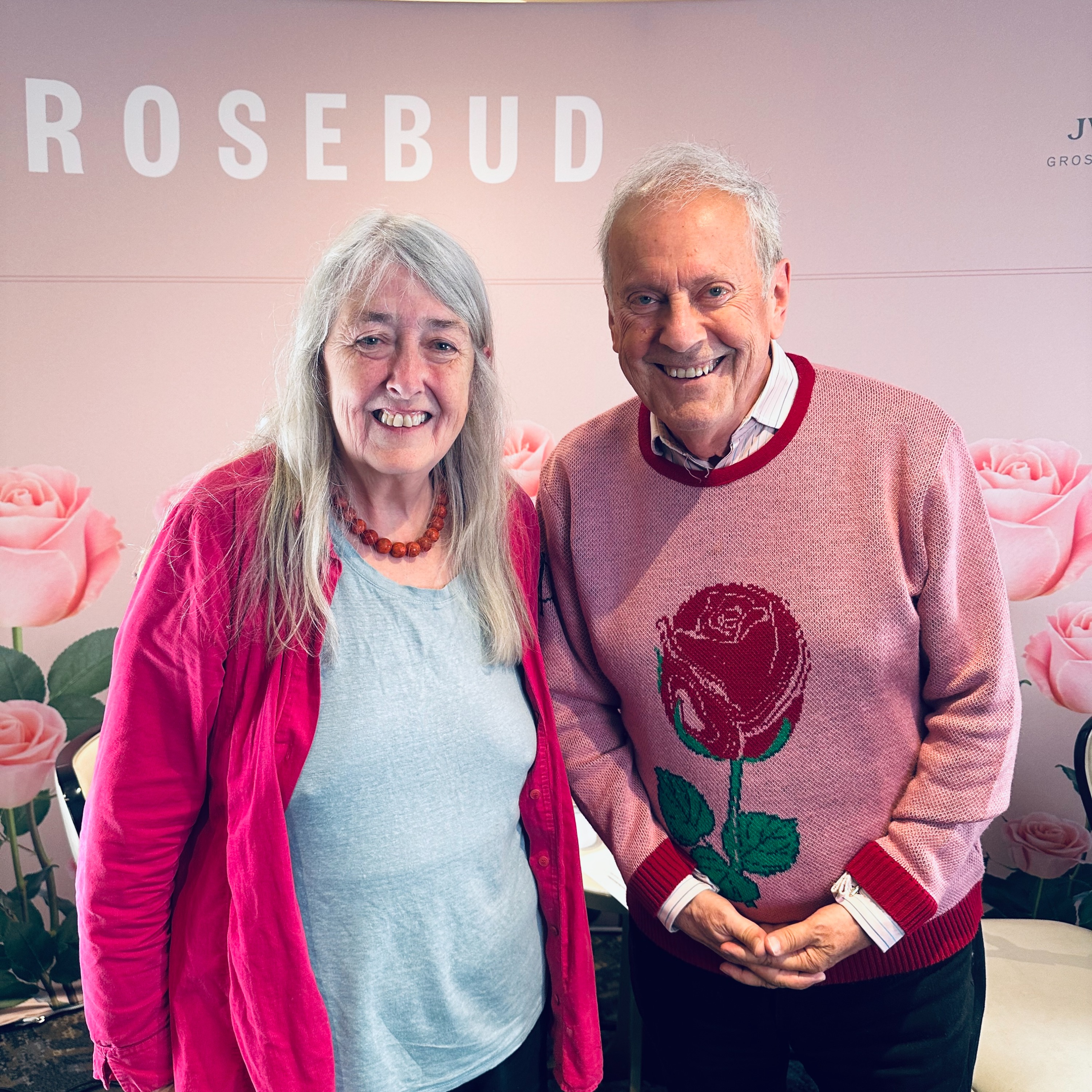
1:13:05Rosebud is a Plain Jane production produced by Harriet Jane hosted by me, Giles Brandreth with music by Phil Leppard and recorded this week at the JW Marriott Grosvenor House in London's Park Lane. Room service.
Our guest today is one of the UK's best known and best loved public intellectuals, the classicist and expert on Roman history Professor Dame Mary Beard. Mary tells Gyles about her country childhood in Shropshire, playing on a disused railway track and trying to memorise Jane Eyre by heart. She talks about her interesting parents - a headmistress and a "raffish" historical buildings architect, and about the alarming visits up ladders into church belfries she made with her dad. She talks about Cambridge, sexism, and discusses interesting questions such as 'how to think' with Gyles. She talks about her early relationships with men and she describes the chain of events which led to her being raped in Italy as a student. She talks about the challenges of being a public intellectual, and about her aversion to risk aversion!
As you can tell, this is a wide-ranging and fascinating discussion. Enjoy this.
NB this episode contains some discussion of a rape, which is not graphic, but you may want to be mindful of this if listening with children.
Hosted on Acast. See acast.com/privacy for more information.


