
 Ask ChatGPT



Host: Gyles Brandreth
Richard Osman
Richard Osman, a renowned writer, presenter, and producer, shares his early memories and experiences with Gyles Brandreth. The conversation touches on Osman’s childhood, family dynamics, and his journey in the entertainment industry.
Written by AI. May contain mistakes.

Get the gist, explore an idea or ask about something said.
 Claude
On Rosebud with Gyles Brandreth, what are the key points of this episode?
Searching your listeningAutomatic transcript. May contain errors.
0:20Hello and welcome to Rosebud. On Rosebud, over the last couple of years, we've had an extraordinary range of guests. Prime Ministers, poets, Oscar winners, Booker Prize winners, scientists, sports stars, TV presenters, authors, billionaires. Today's guest is certainly a millionaire. He's also a crime writer and a TV presenter. Today, our special guest is Richard Osman. In the UK, you'll probably know him from Pointless, the TV quiz show that he both devised and co-presented, and also from Richard Osman's House of Games, on which he met his wife, actress and comedian Ingrid Oliver. Internationally, he's known as one of the most successful crime writers in the world, truly a mega number one bestseller.
1:12It began only five years ago with the Thursday Murder Club, Since then, there have been sequels to that and he's begun a new series. There's even a movie now out of the Thursday Murder Club. His height has been a challenge for him in life. He's six foot seven inches tall. His eyesight has been a challenge too. And aspects of his childhood have been a challenge. A challenge that really, I think, has informed the rest of his life. This is a conversation with an interesting personality, a remarkable individual. and it's about pain and about addiction and love and how life isn't easy for any of us.
1:51It's full of wit and wisdom and I think some important takeaways. This for me is one of the most interesting episodes of Rosebud we've ever had and that's saying something. So, welcome to Rosebud with Richard Osman. Enjoy. Cue the music.
2:22Richard Thomas Osmond, born on 28th November 1970 in Billericke in Essex. I want to ask you, what is your very first memory? My first memory would be in Billericke in Essex, funnily enough. So I know it's very, very early, because we were only there for a couple of years. And it was... We lived on a cul-de-sac called The Chase. which then, you know, years later became my chief rival. We lived on this little cul-de-sac, and I was on a little trike and fell off it and hit my chin on the pavement. But I was very, very, very young, and I've questioned myself over the years as to whether that was a real memory or not.
3:00But there's no pictures of it. It's not something I've ever really talked to my mum about. And a couple of years ago, I had a meeting with the boxing and snooker impresario, Barry Hearn. And Barry's office is in a big mansion house in Brentwood, which is just up the road from Bitteriki. so I thought about a couple of hours before the meeting I thought I'm going to take myself to Bitteriki and I'm going to go to the chase I've never been back since and see if it looks like it did in my memory and I went to the exact bit where I fell off the trike and it was exactly as I'd remembered it exactly as I'd recalled it you know this is what 50 years later so I think it was real but I must have been two or something like that but listen trauma what are you going to do well a lot of people's first memories is a physical trauma of one kind or another oh it's a big fall.
3:44A big, well, not a very big fall because you're only on a trike. Yes, it was a very small fall. And you had a brother at that stage who was older than you? Yes, my brother Matt, who is three years older than me. He was three years older than me then and remains three years older now. Just two of you? Just the two of us, yeah. And why were you living in Bitterwicky? Your parents were there? My parents were there. It's such a good question, Charles, as to why they were there. I don't know because they've been in Stevenage when they had my brother. They're in Bitterwicky when they had me and then we moved down to Sussex which is the only bit of my life really I can remember apart from the terrible trike incident they moved around my mum was a teacher but at that stage she wouldn't have been a teacher because um she was looking after us I'm never a million percent sure what my dad did for a living it's never been quite made clear to me all sorts of interesting things but there'd have been a reason he was in the heart of Essex I'm sure of that and so who are your parents tell us about your mother first what was her name what she looked like my mother my mother's name was and still is brenda brenda osmond who was born to a big working class brighton family during the war so my grandfather was off at the war and she didn't meet until she was three or four and she first person in her family to do higher education went to teacher training college it's super super bright my mum but from a generation where quite hard for a woman to to find her way in the world and she doesn't have the personality type where she would push herself forward.
5:07And what was that maiden name? Wright. So my family are the Wrights. So there's two halves of my family. The Wrights, which is my mum, my nan and granddad, my auntie Jan, and a big family. My granddad was one of 11 siblings. So even now there's a lot of the Wrights in and around Brighton. And the other half of my family was the Osmonds, which is my dad's side of the family, who we lost contact with. My dad left when I was quite young. So that side of the family are sort of a mystery to me. but the Wrights who were born and bred in the heart of Sussex, all of them, that's my sort of, when I think of family, that's what I think of them.
5:39That's their, their family. Yeah, yeah, yeah. And did she have a secure childhood herself? She, my grandfather was a police officer. Oh. So they were always moving, always moving to different places. And my mum was very, very bright, but the family didn't have money. So she was always going to new schools, but she never had the right school clothes. So that's, which you can still see with my mum now. it's absolutely her formative thing is being brought up and feeling slightly ashamed so they were moving from one school to another and they couldn't quite afford to keep up with the uniform so she was still wearing probably the wrong skirt but with the right blazer I remember I had like a boys shirt that had been cut off at the back and just things like that and then she got into the grammar school which in some ways was the making of her my grandfather was a huge, huge believer in education because he had to leave school at 14 and he was a very bright man and so she went to the grammar school and as I say got into teacher training college.
6:34But your grandfather, can you picture him in uniform as a police officer? Less so because he was on the beat for you know probably the 50s and 60s so by the time I came along he was an inspector, a detective inspector down in Worthing towards the end of his career and then went into trading standards right after that like a lot of ex-police do which was a cool job so he would take us up to Brighton races and you know he'd be going around the stallholders having chats with various interesting people. So there's loads and loads of photos of him, firstly in police uniform and, of course, in army uniform as well.
7:06So, yeah, he has that very sort of authority figure look, but very, very, very left-wing, very, very, very funny, very, very, very ambitious, but very, very, very bolshy, all of which I admire. And was he straight? Was he a man of integrity? He was a man of integrity. He certainly wasn't strict, but, you know, he was a police officer. straight in the sense of was he an honest person i asked that because i knew a man called sir robert mark who was the medical police commissioner brought in used to do the adverts indeed avoided the adverts he was our top policeman and he was a friend of my father's and he said unfortunately there are two types of policemen the ones who are straight and the ones sadly who aren't yeah and you know this was an issue at the time and it's that generation of your grandfather My grandfather certainly didn't believe in following rules that you could get away with not following.
7:58Certainly. He always spot the angle. If you can get away with something that doesn't harm anyone and is not going to harm you, do it. Don't obey a rule that is unnecessary. He, in the 1970s, I think he would have got further in the police. But, for example, he wouldn't go and police the miners' strike in the 70s. He said, of course I'm not going to go and police that. That's a man's living. That's not my business. I'm not going to go up there with a baton and, you know, beat the hell out of a minor. I'm not going to do it. And so he was morally very, very straight in that way. But he would, you know, if there was any sort of way you could bend a rule or make your life a little bit easier, anything like that.
8:33Yeah, he was always full of good advice on how to make your life a bit easier. So he's an interesting character. Oh, he was great. And your mother's character as a young woman. What do you think she was like? I think she was very, very shy. Very, very shy. she told me a story once about how um she was playing in a cricket pavilion in some one of the villages where my grandfather was the local bobby and she got locked in and she said i was so shy that i couldn't shout help or i couldn't shout i'm locked in here she said i had to i was there for like four hours until people come to because i was too shy to say i was there and that would have been her personality but yeah very very bright born out of time definitely but i think fortunate to have two parents who understood that she was bright and were able to push her in certain directions but yeah she she was yeah if she was born a different human being she would have done extremely interesting things and in the end she did you know she's a primary school teacher for many many years and you know I go back down to Haywards Heath now and she's a huge celebrity you know they love her down there and you know everyone says oh it's Mrs.
9:35Osmond hello Mrs. Osmond how are you Mrs. Osmond I did a book festival down in Cookfield which is a little village next to Hayworth Heath and I did it because it's the closest to where my mum lives and she had not been to a book festival and she was in the audience that she had more selfies than me at the end she was slightly yeah they she she were she she loved it but um so she's come out of her shell over the years oh I mean for sure and some yeah and then some you know I once I did a show called child genius on channel four and I really liked it I loved dealing with the kids and you could have a real laugh with them but it was so noisy the thing I really remember of it is at the end of the day, you're virtually deaf because you've got all these kids and they're just so loud.
10:14And I said to my mum, how did you deal with the fact that you've got all these kids and it's so loud? She went, oh, if I didn't want there to be a sound, there wouldn't have been a sound. And you're like, oh, okay. Oh, she had authority. Yeah, yeah, yeah, exactly. You need a huge energy to be a teacher, I think, also, day after day. People like you and me can be good one-day teachers. We can go in, seduce them for the day, come away as heroes. Yeah, we'd be like, oh yeah, just give me a half an hour. Oh my god, the kids love me. They just thought it was the best lesson they've ever had. You think, yeah, But like now it's break and, you know, now I have to go back in with them.
10:42Now I could see it. And towards the end of her career, you could see the energy had gone. And I could see at the end she's counting down the days to retirement. But, you know, she was much loved as a teacher. Did she wear glasses? Yes. Yes. She has the same eye condition as me, as do a number of people in my family. So, yeah, which is called nystagmus. And so, yeah, she's always had that. She can't see anything. I can't see anything. So I imagine that was a challenge when she was younger, contributed possibly to her shyness. Yeah. and made her not feel as pretty. Every young person in my eyes is beautiful.
11:14So I'm sure she was pretty, but being the glasses, shy, slightly self-conscious. Yeah, I think the shyness is the thing. I think, you know, I can only speak of my own experience of the eyesight thing is no one really understands it. So you're wearing glasses so people think you can see and if you have nystagmus, you still can't. I mean, it's better than if you didn't wear glasses, but you still can't see anything. So she's at school where everything's written on the board and she is not going to put her hand up to say, I can't read this, I can't see this. And so there was a point at her school where they just said, look, Brenda's not going to make it.
11:45She's failing everything. And so there's no point even putting her in for the 11 plus. And my granddad said, I don't buy this because I see who this girl is at home. I know what she does. So he started tutoring her and he's entirely self-made. My granddad, let's say, left school at 14, but he would tutor my mum and a couple of the other kids from the village. And in the end, she got the highest mark, Highest 11 plus in Sussex. Hey. Oh, it's brilliant achievement. But at school, she couldn't see anything. And how did she meet your father? She met at teacher training college. They have, I'm a great believer in names, place names, people's names, things like that.
12:21You wouldn't be, given you're descended from the Wrights. Yes, oh, there you go, exactly. Yeah, my grandmother, who was a Reed, so they were Reed and Wright. And she met her, Mr. Wright, who was my grandfather. Yes, but my parents met in Bognor and married in Goring. You think that's, which is where Woodhouse would have people meeting and marrying, I suspect. And what was he at the time, your dad? He trained to be a teacher as well. He came from a slightly more well-to-do family in Southampton, so south coast again. But yeah, he trained to be a teacher. He, I think, didn't have my mum's ability to control a classroom, I would say.
12:59So he didn't stick at that for very, very long. But yeah, they met there, you know, fell in love, married fairly soon afterwards. And yeah, that die was cast at a teacher training college in lovely Bognor Regis. What is the best of him? I know he leaves the family when you're about nine. But what is the best of him? Do you remember the early years? I don't remember a huge amount, is the truth. He wasn't around an awful lot. You know, he would sort of get home after we went to bed and he would leave before we got up. so I was really, really bought up by my mum. But, you know, having met him in later years, I liked him.
13:36He was a funny, very pleasant man, not designed to have children in any way, not designed to be in any sort of relationship in any way. You know, he had Victorian parents. His mum was born in 1899. So, you know. But he was the same age as your mother. Yes. So he was a late child. What was his first name? David. David Osman. Yeah. And they were happy for a few years. I mean, who knows? But certainly they were together for a few years. I think my mum was definitely happy. And my mum felt that, again, from a generation where the opportunities were not open to her that might have been now, she felt, oh, I've got my role here.
14:15I know how to do this. I'm going to bring up these kids. I like kids anyway. I've got a husband who's off doing various bits and bobs, and I can be supportive to him. And we lived in a little estate down in Habersheath. and there's lots of young families there at the same time, all of whom had kids who were my age and my brother's age. So that's sort of a slightly idyllic kind of late 70s suburban lifestyle, which must have been enormous fun for somebody who didn't come from that. Lots of families there came from the working class and were making their way up. And when I think about the holidays, we used to go on, all of us.
14:45I remember that group of people so well when I think about the story of Britain and who we are and where we come from and where we're going. That group and the aspirations they all had and the joy they took in these new lives that they were finding. Give me the best of those holidays when the family is still together, the four of you. We would go on holiday with lots of people from our street. So we'd all book a campsite down in the south of France, and we'd set off in a convoy. The convoys usually broke up somewhere near Rouen. We had my friend Tony and Simon and their parents, the Dears. They were the Powers.
15:17It's all good names. The Dears, the Powers, keep going. I use all of these in my work. And so, yeah, we would all take three days driving down to a campsite in the south of France, and we'd pitch tents all next to each other and just play games all summer long. I'm assuming that the parents were then drinking all evening with each other and having an absolute ball. We had a ball, the kids. That's definitely the case. That sense of people on the same journey I always found very interesting. And your best Christmas before the family broke up? My best Christmas was almost always after the family grew up, because it was always with my grandparents.
15:52We'd always go down to Sussex and we'd play games. There'd be presents all morning. It was, you know, my granddad got to the point later in life where he'd always say, he'd say, Ricky, I've got, he said, I've got an army pension. I've got an old age pension. I've got a police pension. I've got a trading standards pension. So I've never been richer in my whole life. And so there was a sense that, you know, there was more alcohol than there would have been a few years before. There were more presents than there would have been a few years before. But no, there's a super, super happy times. And your favourite childhood present before you're 10?
16:23When I remember once, like, you know, when a present happens, you're like, I literally can't believe this has happened. I remember getting, like, a little box and it opened up. And in it, this would have been 78, maybe 79, so whatever, it would have been, you know, eight or nine. And I got a digital watch. A digital, I lost my mind. I couldn't believe what I was saying. And I was sort of looking around me, just going, I thought I was being pranked because I assumed that digital watches must have cost thousands of pounds. I couldn't believe that this thing existed in my life. And to this day, I remember that thing of just opening it up and just being, because I didn't know it was happening.
17:05I didn't know it was coming. I sort of didn't even know I wanted it until I looked at it. I just thought, okay, well, welcome to the future. Did you realize that something wasn't quite right within the home before you heard from your father that he wanted to leave? Never did. You had no sense that? Absolutely zero sense whatsoever, which, you know, adds to the trauma, I suppose. But, I mean, how would I have a sense? I'm, you know, eight, nine years old. It's the 1970s. No one's talking about anything in the 1970s, let alone to their kids. So, yeah, absolute bolt from the blue when we were sort of called in and said that...
17:37You say called in? We were, yeah. It was a family meeting, was there? What happened? Yes, I was sort of heading upstairs, and my mum said, oh, no, can you come down? We need to talk to you. And my nan was there, but she never was. and I thought, oh, that's strange, but okay. I had a little glass of orange squash with me, but I came down and I said, oh, no, your father's in love with somebody else and he's going to live with her. Is this in the sitting room, the kitchen? What room was this in? That would have been in our living room, yeah. And you all sat down, I say you all, your brother and you, your nan, your mother, and your father, was he there?
18:04He was there, yeah, he was there. And did he break the news or did your mother have to do that for him as well? Gosh, that's a good question. I think, and this will not surprise anybody of any gender, I think it was my mum who was tasked with revealing that news to us whereas when my dad could just sit and nod slightly shamefacedly and my nan who was never quiet was completely quiet which to me was the worst thing of all and how did your mother explain this? what did she say? she said your father has fallen in love with somebody else and so he's going to go and live with her I was like but when?
18:38and they go well he's going to go now he's like okay he had to go and pick up some shoes straight afterwards so we were allowed to go to the shoe shop with him when he picked up his shoes. But yeah, it was explained that way, really. And I mean, I know when you're a kid, it's obviously traumatic in one way, and in another way, there's always something happening when you're a kid that's out of your control. And so I don't remember a kind of a sense of the bottom falling out of my world, particularly. Did you walk with him to the shoe shop, though? He drove. But the two boys got in the back of the car?
19:10Yes. And did you chat to him about it? Did he say anything more? not really i'm sorry boys these things happen he was a massive talker my dad in a funny kind of way he tried to later in life but but he never quite got the knack of it i do remember thinking then because because my mum's eyesight is like mine she can't drive i remember then in that car thinking i'll bet this will be the last time you ever go in a car so remember it you must remember being in a car because you because i don't see an option for you going in a car again after this so i remember that uh but it's uh yeah it's it's it's it's a trauma that i didn't deal with for many many years and of course the second you do start dealing with it it's sort of easy you know you start talking to people about it and they go but and i met up with him again and you realize oh he's just a man and these things absolutely happen to everyone but it was it was at a time and in a family where it wasn't really spoken about and that was the that's the only issue i think about it all it would have created financial strain because he'll have had a second eventually wife I assume did he marry her did he marry her I think he did marry I mean did they have children do you know no he he listen he had not fallen in love with this other woman he I think he felt which I understand in 1979 you cannot walk into a room and say I just want to leave you I want to leave you I want to leave my children and I want a different life I don't think you do that whereas you can say something has happened to me which is i've fallen in love i'm powerless against this that's a narrative that he could tell himself that would make it acceptable for him to leave his family how interesting you're now looking at life like a novelist well that's interesting you're describing some that i'm fascinated by this yeah but don't you think i don't i don't see a way in which he could have just just even in and of himself he's thinking well how would i even say that to somebody how could i do that whereas men i think sometimes like the world to have happened to them.
21:01If they want to get their own way, instead of saying, this is the thing I want, they'll go, oh, this thing has happened and therefore this is the thing I must have. But he had, as it were, was having an affair with his lady. Absolutely. And he moved in with her. Did you meet her? Yes, I did meet her. For about six months after he left, there was contact. My brother, not at all. My brother completely cut off contact. Because he was angry. Your brother was angry and he decided to go with your mother and to show total solidarity. Yeah, I think so. and that's very much his personality. Oh, so he was older, wasn't he?
21:31Personality, yeah, exactly. And he was then the oldest man in the family. Yeah, I think he had spotted that something was going on and I hadn't, and so I think he felt something was brewing in a way that I didn't. So yeah, I met her and I remember once my dad, we were driving back to wherever he was living, up in Crawley, which is not a million miles away from Hayworth Heath, and him saying, would you buy Ruth some flowers on the way, buy some flowers and you say they're from you. and I was only like nine I was like actually I know I'm not going to do that because I even at the time I thought that doesn't seem that doesn't seem right that's not something you can force on a nine-year-old I think he didn't have the emotional literateness to to handle the situation that he was put in was he hurt that your older brother sided completely with your mum and wouldn't communicate whereas you at least tried you were trying to keep everyone together oh yeah jolly and happy yeah no of course um was he hurt i didn't listen if if he was he didn't say it out loud that's for sure and when i saw my dad again after about 15 years so when i had kids i went to see my dad and my brother still didn't and actually when my dad was dying my brother's wife said i think you should go with ricky and see see your dad which we both did and no there were there were no sort of I wish I'd done that I wish I'd done this he just wanted the conversation you know like he would have with anybody and I get it our weird behaviors are always to do with pain right and whatever pain he was in he didn't have the language to say sorry or to say I was hurt or to say I wish things had been different you know it just it just it didn't exist within him so for the six months you did your best and then he moved away did he that was the reason that you then didn't see him for a while yeah yeah he moved away they moved up to rugby or something like that i went once i went once and i had to get on a coach up to banbury because there's about halfway between he wouldn't come down and pick me up i had to get a coach like i was 10 uh and he would come and pick me up at banbury and drive me up uh there's no fun for me you know that was it was there was nothing in it for me so i think i probably even manufactured an argument where i didn't have to again because i'm a boy and i can't just say i don't want to see him i had to go oh no we've had this row and so I can't see him and yes I didn't see him from that moment onwards and neither of them my mum or my dad my mum understand me my dad less so made a great deal of effort to change that but you know myself and my brother are quite a quite strong-minded and strong-willed so once we've made our mind up it's probably quite hard to but you then did decide a few years later to get in touch again yeah made an act what motivated that well having kids and understanding how flawed I was a human being and understanding how just being a human being makes you flawed so I just thought yeah listen I'll go and see you and chat to you and do you take your children no not the first time although I did later on I just wanted to make sure they met him and you know he'd met them and again there was there was no there was there was no great connection I'll say that but I think the first thing he said to me was oh you you you must be interested in what I've been up to since I left I thought no do you know what I think the first thing is I want you to be interested in what I've been up to since you left I think might be the thing I'm interested in but he was listen he was a perfectly nice guy a perfectly nice guy but anyone who's you know we all live in blended families and anyone who has a birth parent and a adoptive parent or a step parent they know which one is the best parent and it's all it's nothing to do with the blood or not blood it's always you you can either do it or you can't do it and you either love and are able to love or you can't do it and he just he didn't have it in him and when did he die he died i want to say five or six years ago something like that and we went to the funeral you say we me and the kids and my brother and his wife it was very very for me an unemotional time for his current wife of course i listen it was very very emotional but i can only speak from my experience of it the speeches were all my um my cousin steve who i knew a bit said oh i've i found a piece of writing on your dad's computer about his life and i'm going to read it out at the funeral i'm like oh no here we go and i thought finally this actually might be the bit where he says and then of course in 1979 i left brenda and i felt one of the things about this i regret having done it this way or you know but actually it was literally it was wikipedia it was you know i was born in 1942 in 1947 I went to this school so there was zero emotion in it whatsoever did he stay with Ruth to the end was she no god very very much not that was that was very short-lived and there were others yeah it was it was a very unemotional I was I was I was very moved by how unemotional I was and we drove back with my brother and we both said that felt so it just it just didn't hit us and I I know enough about the human mind to think no but be careful in the next few days that this feeling might be replaced by, you know, like a pain or something more visceral.
26:41And it never has been from that day on. I'm always open to it coming in and I've always been looking out for it. And it never has. And I find that fascinating just about family and what it means and how much of it is cultural. And that actually I was brought up in a family that adored me and loved me and who I love and who I adore and I will always look after. So I have that. and this man could have been part of it wasn't but there's there's there is nothing beyond the cultural thing of you should care here and and the truth is I didn't particularly what good thing has that experience given you well forgiving him was good trying not to be judgmental towards people you know not judging people always by the worst thing they ever did or the thing they did under the most stress.
27:32And so it gave me that. But it also gave me a perspective on who's important to me and what love means. And that if people love you, they put themselves out for you. So it's given me those sorts of perspectives. But mainly not judging people. And especially in these days, that's a harder and harder trick.
27:59Did you? We're not going to talk about your first marriage because I know you don't talk about it and why should you? But do you think? I wasn't married either so but. Oh you weren't your first? Yes. You weren't married the first time around? No. Oh forgive me. That's okay. I read the notes wrong. I see it all the time it says I was but I wasn't. Oh fine. Because then the question is irrelevant i was going to ask whether your father's behavior had given you permission to move on from the mother of your children it's certainly it made it a million times worse because i thought i can't believe i'm doing this and we often repeat the sins of our fathers don't we i mean it's it's such a cliche um and obviously i thought the same thing would happen to me and my children which hasn't but so it was awful it was awful it's the worst part of my it was much much much worse than being left by my father a million times worse the worst thing i've ever done the thing I'm most ashamed of in my whole life for sure um but it's you know we we we tend to we tend to make the same mistakes that our parents do because we react against them and of course I'm thinking I won't do what you do I'm going to have a family young I'm going to make sure that it's you know it's it's perfect and all that and you can't you can't manufacture it how do your children now they are 26 and 24 good will they be coming to your funeral and enjoying it well Not enjoying it, but will they be coming with an easy heart full of the right kind of tears?
29:16I certainly said to my daughter that there'll be better speeches at my funeral, I promise. Yeah, I mean, they both came to my wedding. They walked me down the aisle, the two of them, which was great. We came down the aisle to an Eminem song, and it was me and the two of them either side. It was a day of great joy and smiles and happiness. So that was lovely. And funnily enough, in my speech, I spoke about them. I said and you know it's interesting because I said how proud I was that I was walked down the aisle by the two of them and I said because I never got to go to any of my dad's weddings I said so maybe it's a nice new family tradition that we've we've created go back to your mum how did she survive being on her own gosh I mean you know when you look back with an enormous with enormous pain enormous pain I mean you know the thing that she had wanted the thing that she had worked for and strived for the thing that she felt she had built collapsed you know completely and she would have had more warning than i did but it collapsed and you know you know i could hear her crying at night you know that she wouldn't sleep and all of that stuff um she had no money i mean no money at all so we used to every night she would get in piecework from the local magazine distributors and she would be packing magazines and things and heat sealing them and you know you'd do 200 of them get you know 0.1 p for each one or whatever it was so every night would be that we'd have a little trestle table set up and me and matt would do some of them so she had no money coming in.
30:36But yeah, for a couple of years, it absolutely completely derailed her. Did she eventually find another partner? She didn't. She never showed much interest in that, I would say. She'd had a fill of men by then. Well, listen, I get it. I really get it. And she had two boys who she was bringing up, so she had plenty to do. She had a full-time job. There was nothing where there was any new father figure on the horizon. I think she just felt, again, we run away from pain, do we not? so I think she felt I can live a life without that which is not the fullest life it could be but at least I'm not going to have the lows that I've experienced before and I understand that entirely.
31:16What have you got in you now that she particularly gave to you? She is I mean my mum is a a brilliant woman she's incredibly open-minded she would always my myself and my brother are both um You can't really tell us anything. Either of us were both self-starters. And she never, ever made us do anything. She absolutely understood that, you know, I watched TV all the time when I was a kid. And she never told me to stop because she could see I was engaged. She could see I wasn't sitting, you know, slack-jawed. She could see I was interesting. She'd say afterwards, you know, I'd ask questions about it.
31:49I'd find out things about it. So, you know, she gave us that permission to not be like all her friends' kids and to not have to go and do French lessons and piano lessons or whatever people had to do. She gave us the permission with my brother to sit up in his bedroom and play a bass guitar. She gave me the permission to sit and watch TV. But yeah, she is somebody who could have, if she had an ounce of the sort of confidence that I see in some of my contemporaries, she could have achieved easily as much as me and my brother did. So one of my great joys is that she is able to share in our success, and she feels she knows she's part of it.
32:33You know, she gets that. It's rather curious. The passion of your childhood seems to have been watching TV. I loved it. Were you doing that because you were not wanting to be in the world? Yes. Ah, you think that is it? Oh, definitively. I've always, because of the eyesight, and I know it's a funny one, because you can't really explain this to people, but it's like you see the whole world through a heavy fog, right? So that's the closest I could get if you wanted a version of what it is. If you're on a motorway and suddenly you can't see the signs and the lights are incredibly fuzzy and you don't see the car in front until you're right next to it.
33:05It's that. And I've always had it. So you can't drive as well as your mother not being in front. Yeah, none of that stuff. So, yeah, I've always been slightly outside of the world, always very scared of the world. You know, if I go somewhere new, I'm always like, but yeah, but how do I get home? Enjoy places when I go to them. But anything that's new or different, I've always found hard. television to me gave me firstly I could see the world because I could go three inches away from it so I could see birds and trees or you know I could see a cricket ball on a cricket bitch things I can't see in real life in any possible way so I could have that and I could hear stories you know and I love to me it's like magic you know you're going around the whole world I don't I don't want to go around the world but I really I'd like to see it and I'd like to see different people I'd like to hear different stories so yeah for me television was and is just this incredible window which means i don't have to go and do all these things because i can i can watch other people do well in the 1950s for me it was the cisco kid circus boy the lone ranger and from homegrown product billy bunter of gray fryer school and wacko yeah there you go give me five from the 1970s for you gosh so the stuff that i absolutely loved starsky and hutch i would say the a-team still you know was uh one of the greatest shows ever dukes of hazard which i look back on the politics of that now and it it doesn't stand up but my god i love dukes of hazard um and then things like grange hill of course um was one of the uh the all-time greats but you know we still on saturday mornings there'd still be the champion the wonder horses and all of those things they still exist that was still i love champion the wonder horse with it rearing up and all that the first joke i ever remember writing the first funny it's not a joke it's a pun was um when someone had heard of this place called Western Supermare.
34:51And I said, well, Western Supermare, that's just Champion the Wonder Horse because it's a super mare from a Western. And I thought, oh, there you go. So anyway. No, it's good material. That's a sidebar. I wouldn't open with it. But it's something. But I loved all that. The worlds you could see. And at school, your first school was what? My first school was Harland's, which is a primary school just up the road from us, which is great so i could walk to you know i had like a three minute walk to school and then everyone in our area went to there's two comprehensive oak hall and warden park i went to warden park which is like 1500 kids big comprehensive school great i loved it yeah a lot of people loads of people to hang out with loads of people did you stand out from the crowd were you getting tall already what what when did your height begin yeah i was probably pretty tall probably not like crazily tall at that stage maybe maybe 15 16 is what is is when i was like properly kind of shot up even more but yeah i was always one of the tall is that connected with the eyesight in any way no not at all just chance yeah it's just any of your family as tall as you are my my granddad as i say is one of 11 and there's a picture of all of them in the evening august when they all went off to war and they were all six footers which in 1940 was was tall yeah was tall my my yeah my dad six two i want to say my my dad was you're six seven aren't you six seven yeah and my brother is 6 '5".
36:12And is that a bore? Yes. Yeah. And was it as a child annoying? Yeah, certainly as you get older because I'm always thinking, look, I already can't see and now you're giving me this as well because all you want to do is fit in, really. And so that was a bore but, you know, I wanted to fit in but also I didn't want to fit in like everyone. In one of the Thursday Murder Club books, Bogdan, who's the Polish handyman, he says, everyone wants to feel special but nobody wants to feel different. And I think it's that, you know, we all want to think we've got something to give but also we just we don't want to stand out you know we don't want to kind of be notable or noticeable so what was different was your eyesight and your height what made you special as a teenager um i think that i always wanted to be part of the conversation i was wrote i always wanted to write i always wanted when i looked at tv i would think of tv show ideas um i would write journalism i would you know magazines i liked i would write articles for them there was a a program on radio sussex called turn it up which was on every Sunday and it was open access so you could just turn up and the second I heard that I just thought well I well I would like to do that I mean I was super shy and super self-conscious but there was a bit of me that was always going oh no but you go and do that though quite where that comes from I absolutely have no idea it doesn't come from my mom it doesn't come from my grandparents but myself and my brother both had it do you do a levels uh yes what subjects my poor mom I think that you know they my brother is the bright one in the family okay that's the thing you need to know but like he's like properly and he's a great achiever too yes he's an over achiever what in what area uh music so he's in a band called suede who've sold kind of millions of records and now he writes novels and it's he's a polymath my brother in a way that i'm not i'm sort of a a monomath or perhaps a duomath at best and so he he was super bright and i came along and they were saying oh perhaps you do maths at a level so i can't really do maths and they go okay which science would you like to do i said i'm i can't do science and they go how about a language and i can't i've never been able to do language as i said so i ended up doing history politics and sociology which was i mean it's it's as easy as you could have got back then and it was me writing essays and again writing is something i i can but it's a good school that lets you do all those oh well they didn't want to i mean they really didn't want to and that they said no you have to do thing exit you can't do those three as i've done throughout my entire life i was i was like okay but i that is what that is what i would like to do though and i ground them down eventually this is a touch of your bullshit grandfather coming out of course but of course it is well again not taking no for an answer sometimes people are telling you have to do things a certain way and often they are right and but sometimes they're not right and it's it's the skill in life is is working out when they're right and when they're not right was there any sport no i love sport i'm sport obsessed but again because of the eyesight and funnily enough because of the height and lack of coordination i'm terrible at all sports apart from darts and pool which i'm not bad at you know where i'm up close to things but i love sport is i love it i loved it then i love it now live sport sport on telly anything it's it's an obsession and it's it's got the right brain left brain thing of there's a million stats i can look at and world rankings and things but it's also it's just about people it's about people winning and people losing and it's about redemption so it had everything i liked in one go and you don't know what's going to happen you never know when people say why do you like sport and you go well you watch soap operas it's the same it's the same thing except in one of these art forms we don't know that we don't know what's happening and in the other one we do so i absolutely sometimes i sit down i think i am so lucky that i like sport because my life would be so much emptier without it gosh what about girls do you remember your first first time you held hands first kiss yes i'm i i do remember that listen i won't go into details for sure but um she knows who she is and yeah i've i was always i always sort of did okay in the air again i was quite shy but shy can be attractive can't it yes it can be and and i was always funny and you know people like that but i always felt i looked awful i always thought you know my self-image was terrible and of course you look back at pictures of yourself and you just go oh my god you look great you look so good and but at the time you're like you're just thinking this is awful you were young yeah that's always that's all you need i know it's all you need can you remember how you felt the first time you were seen naked or were the lights off because you're self-conscious gosh that's a good question yeah i mean that's awful for everyone isn't it well i don't know i'm wanting to can i remember it we don't know how stories end so i know how this one's beginning i'm putting you in a room with the girl and well i'm just thinking the first time is also because you're so tall so you're you are unusual yes and you must have been conscious that you're unusual tall doesn't look bad naked i'll say that you know it looks unusual on the tube but uh you know in a room where it's just you know in context it's it kind of it's it all seems to fit together this is the title of your memoir tall doesn't look bad naked i've at least given you something today thank you that's very good so you go to university but not just any university you go to cambridge university which at the time and indeed still is one of the top universities in the world and it has something about it too yeah an aura yes uh and you come from biderickey yes are you conscious of that when you apply to cambridge do your teachers discourage you have lots of boys from your school and girls yes no one had really and and and um funnily if they a couple of people in my year but before yeah there was there was no history of it from the school people going to Cambridge or Oxford so anyway I put it on the list of places to go and applied to King's to do sociology and politics so it fitted in well with what I was doing what I was interested in and I went up for an interview at King's and it's so badly because I was out of my depth I'm entirely out of my depth I knew I could get through an A level I got it I understood what I was being asked to do I understood what the essays were and I go to there and then I was actually talking to actually clever people and they were asking me interesting clever questions i did not have the training to do that and i also that didn't have the mind that could work out i didn't have the training you hadn't had conversations like that before no was there no teacher at school who had a because usually one has one or two teachers i had i'd great i had a great sociology teacher called mr langley but but mr langley knew that i was a grifter you know he knew it he knew that i i had a ceiling that my head was going to bump up against he knew him and so he was very encouraging when he when he knew I was applying but he did say you're going to have to go into a different gear and he was absolutely right but I didn't have a different gear at that point and so I did that interview failed it I thought okay that's that's okay but it was I went up there for the interview and you're supposed to wear a suit I didn't know that I didn't have a suit I didn't have smart shoes anything like that I was walking around the quad just thinking okay this I could handle this you know I didn't know this existed and I'm interested and other people seem to have access to it i think i should probably have access to it too but anyway i failed and then i get a phone call they said oh you've been put in the pool so the pool is a thing where you know kings had filled up their their so you know policies and sociology thing but some of the other colleges hadn't they've interviewed people and they hadn't come up with enough people and this is oh this this pool and they would like you to come up i was like oh okay and i went to four different colleges and i went to one which is called trinity which which it turns out i didn't know anything it's like the posh it's beautiful and it's honestly it's like breathtakingly beautiful uh and i was like well that's interesting so i went for that interview and i was interviewed by a guy called dr chandavaka who's a lovely sri lanka man he's no longer with us uh and um dr chandavaka again this is how you know just thinking back to my granddad and just you know taking advantage of angles he said oh i'm looking in your thing and i see that you like cricket so i used to go watch sussex all the time i said yeah yeah i really like cricket uh and he said oh we have we have a great cricket team here said um what position do you play and I thought well I don't I'm terrible at cricket but I like it just oh I'm a fast bowler and you know I'm six seven so I'm pretty good and we spoke for I want to say 40 minutes about cricket and nothing else absolutely nothing else and at the end he said do you have any other questions for me and I said no I think I think that's I think that's it I got back home and they sent me a three c offer wow I was like okay and did you have to play cricket for trinity no because of course I was never going to remember.
44:31Again, I got in because I'm a good speaker and I'm a good writer, but I wasn't smart enough to be there. And some of the people I know from there are the smartest people I know. But did you consequently not have a good time? I did have a good time. Did you struggle a bit? Did you feel a fish out of water initially? I struggled academically. Socially, I found my people. And some of my oldest friends now are people that I met there. But it makes me think a lot about intelligence and about who runs the country and stuff like that. because I met people there who went into academia who are so much cleverer than me, but I'm the one who can go on TV and give my opinions about something because I've got speed of thought.
45:08That's all I've got. Whereas they've got depth of thought. And I've always, always, whenever you see any politician, you think, what have you got? Have you got speed of thought or depth of thought? And they've almost always these days got speed of thought. And it's very, very hard to be a public figure and have depth of thought these days rather than speed of thought. You have speed of thought, I think, but you have something behind that, don't you? I hope so. Yeah. But I don't know if I was, was I taught it or did I have it already? But your natural, like the first thing you say in any situation, is it usually the best thing you're going to say?
45:40Is that true? But don't you think? Wow. Because for a lot of people, it's not. For a lot of my academic friends, they will have to go away for three days if you ask them a question. They will come back with incredible stuff. Whereas if you ask me or if you ask you or plenty of people in our culture, we will give you like an offhand thing that sounds smart, that's sort of witty. But maybe glib. Maybe glib, exactly. But it's easier for everyone, don't you think? Is your generation at Cambridge, do you think, now running the world? No, I don't think so. No one I was at Cambridge with has gone on into a position of power in any way, which is probably good for everybody.
46:18You know, there's a few of them who went into the city and made plenty of money, but I don't think anyone new from that generation went into politics or anything like that. You know, plenty of, you know, funny people. Zonda Armstrong was at the same college as me at the same time. So show business and things like that. But no, I think no one I know is running the world, and I'm very glad of it. Except we do need good people running the world. Yes, I think most of my friends would be bad at running the world. Yeah. By the way, I would be very bad at running the world, so that's not a slight of my friends.
46:48We'll be the judges of that. No. At Cambridge, what were your highlights? What did you do that informed the rest of your life? um i think my eyes were open to a different way of living my eyes were open to um uh a confidence you know people's parents would come up and take them to dinner at restaurants and i was like huh that's that's weird what like your parents come up and take you to a dinner at a restaurant i've never been to a restaurant you know we used to go to a carvery with my my nan's birthday but Just that idea that you could live in this sort of very sort of loose bohemian way that was utterly, utterly alien to me.
47:34I found that extraordinary. I just liked hanging out with a whole bunch of people. I liked being with a whole group of friends a lot of the time and not having anything to do because my degree was not taxing. It was taxing if you took it seriously, but I didn't because I couldn't. I just didn't have the ability. So I really had three years of just being able to sit around in rooms and have a laugh. And having a laugh is my favorite thing. Were you earning any money at that stage already? Yes. Yeah, I was. I used to write for the NME, the music magazine. So, yeah, I used to write gig reviews for the NME.
48:08And then I used to write for Golf Monthly as well. I did a column in Golf Monthly. So I was doing that through my teenage years. And you wrote off to these magazines offering your services. Yes, so I wrote reviews for them and said, what do you think? And they took them and then they asked you to do things. They got in touch and, yeah, exactly, asked me to do more, which is why I always say creative industries weirdly are slightly easier to break into than most industries because you can show people what you can do. So, yeah, I did that, you know, rather than working at a bar or anything like that.
48:36I managed to make all my money through journalism, which is crazy. And also I had a full scholarship. I had a full fees paid maintenance grant. It was the last generation. I think it was a very, very last year. So you weren't thinking about money all the time? No, I didn't have to worry about money. Can you remember taking a girl to a proper posh meal for the first time? No. I remember once when I was already working in TV, and someone said, oh, we're all meeting at the Holland Park Hotel. We're having a breakfast at the Holland Park Hotel. And so I turned up at the Holland Park Hotel, and I didn't understand the restaurants that you would meet for breakfast.
49:09They had like a breakfast room where you'd meet for breakfast. I was like, oh, they must have hired a room, and they're going to have some breakfast. and they were going, well, we don't have that name and there's no one booked into this hotel. And then I realized that there was a restaurant at the hotel and they were having breakfast there. And from that moment, I've always remember when people say they're having breakfast at a hotel, there's just a breakfast bit where you can go and have a meeting and people do that. And so I didn't know any of that stuff. I didn't know any of the codes. I didn't know any of the what people did.
49:36And I've tried in everything I do to, and that thing of not being involved in life, but being a spectator, I try and learn as quickly as I can. what the thing to do is. Can you give me another example of that? Almost a rite of passage of discovering the world, an awkward moment. Because it's quite interesting, you were an outsider, and clearly you found something, maybe, I think maybe you still find some things a bit daunting, do you? Oh yeah, almost everything. But I've got so many workarounds now. I mean, for example, I give you a good example of me. I became a member of parliament. Yes, I remember.
50:14And I was elected. What a weird life you've had, Giles. A very weird life. But I realised when I first arrived at the House of Commons, I've never been into this building before. Yeah. And I was, by then, almost a middle-aged person. Yeah. And it was terrifying. I felt I was back at school in the most vulnerable sense. And I thought, I sat there on the first day, and I thought, I'm going to burst into tears. I do not know where to look, what to say this is an alien world and all the older boys know what's going on everybody else seems to know but you don't know yeah I think that I learn an awful lot from reading and I learn an awful lot from watching television so I think I'm pretty good at compiling a file in my head of how one behaves if one goes to certain situations I couldn't believe it the first time I went to a posh restaurant that you got restaurants that were so posh you didn't have to dress up that was like sorry when as a kid you know if you went to if you had lunch at the british home stores canteen you didn't have to dress up because of course you didn't but if you went out to the carvery you'd be in all of your best clothes and suddenly you think you go to a restaurant and everyone else was like just in jeans and t-shirts and i was like huh i'm gonna say there's there's a level beyond posh and so that sort of thing blows my mind fascinating
51:46who has taught you most in life have you ever sought help have you gone has they been over stage with your problems your eyes your height your emotional life you've sought help from other people absolutely i have an amazing therapist called bruce lloyd and he's absolutely brilliant i love it i love how long ago to this begin and why why did you decide to go to him um again it was towards the end of of my relationship with the mother of my kids and i just i just felt i wasn't where i wanted to be in life and so i felt i should go and talk to bruce and you know i i remember the whole first session i would say no but this is why i do this and this is why i do this and you know i do this for a reason and i do this uh and you know i think it's okay because i you know and at the end he just went well how's that working out for you and I said oh yeah it's working out really really badly for me because I've got I've been given so many wonderful things in my life and become so I've had so much luck and given so many um weird brain gifts and yet I'm throwing them all away and I'm not happy and you know he was the first step on the journey to going no you can you can you can find a way to to be a real boy in this world which is what I really needed I needed to find a way to to become myself I still use all of those skills I used to use.
52:58What is the way? The way is to try and get rid of shame, you know, is to try and however self-conscious or shame-filled you feel about yourself or who you are and the fact that you don't fit or the fact you don't belong to forgive yourself, to not be judgmental of yourself. And once you start with that, once you really kind of throw the light on it you still feel it at times but at least you know you're feeling it so if your first reaction to something if someone's a drinker or someone has anger issues it's not the drink it's not the anger it is you confronted them in some way and they do not want to go to the place that you want to go to and so they have to have a barrier to that whether it's i'm going to drink i'm going to be angry whatever it is and we've all we all have that in lots and lots of different ways you can see it in lots of politicians the ways that they behave you think oh that's interesting even sort of being the sort of you know overly jolly and familiar you just think that you're you're avoiding the you're avoiding the thing that someone is asking you here the second you are aware that you are doing that it becomes much harder to do understand that it is you are reacting that way because you're you're running from something you're hiding from from something and that's the key with anything i've spoken before about having food addiction issues and i say the first thing to deal with is so embarrassing to people and the first thing is saying I have zero shame about this I can't it's like drink it's like alcohol it's like anything we're all addicted to something we're human beings it's really hard to be a human being none of us asked for this right we're in a really really weird place with a brain that's not quite up to it so we're all going to find unusual ways of dealing with it and some of them will end up being harmful so you cannot be ashamed of it you mustn't be ashamed of it it's hard but don't be ashamed understand it's the human condition and the second you do that it becomes much easier because you understand what it is that you are doing so the source of your binge eating which you went through phases of yeah was the shame the problem wasn't the binge eating the problem with you was a sense i'm using the word because i picked it up from you saying it was it shame was that your problem I think so.
55:09And what were you ashamed of? But anyone will tell you that. Here's the thing about any addiction, really, is it becomes a cycle, which is you're running away from pain in some way, so you start behaving in an unusual way. I don't want to think about what happened with my dad. This is a very, very basic version of it. So I'm going to sit down and have a six-pack of crisps. Okay? Done. And I'm not thinking about it while I do that. then afterwards I look at what I've done and it's ridiculous it doesn't make any logical sense in the same way that going to the off-license buying a bottle of vodka drinking the whole thing it doesn't make any logical sense it makes absolute sense in the moment because you need to shut something up in your head but afterwards it makes no logical sense whatsoever okay so you start feeling shame about that behavior so whatever shame or pain you're trying to run from the first time first place which makes you drink the vodka is sort of lost because you immediately go oh no now I feel ashamed that I drink or that I eat too much or that I take drugs that I shouldn't take and so the shame is a spiral it just end it just goes round and round and round and it has no tail so you're never ever ever going to get out of it the one that you have to at some point just nail down the shame and just go no listen I did it because I was in pain I'm ashamed of the way I deal with things and that's where i am and you're out of it now uh i don't think i'd ever be out of it out of it for sure um but certainly yeah i'm i'm i'm comfortable with everything at the moment but i know i know it'll come back it's never not you know i talk to bruce about it all the time and he says well you're always going to be an addict you can't because you started when you were nine you're not suddenly going to not not be one that's how your brain and body understands things he said but it's in your power to do something about it he said but and again because you mustn't if you ever go back to it again you mustn't feel shame that you must go oh my god i thought i got rid of this because you're not going to get rid of it it's it's but again i think all of it comes down to it's really really really hard to be a human being don't you think i do i also think you've been a very successful human being certainly in the public world because you got into television and they were a backroom boy and you invented or helped devise and punch up some of the great shows of our time.
57:30Yeah, all sorts of things. All sorts of things. Any favourites? Gosh, that's a good question. I mean, you know, Deal or No Deal I love just because it shouldn't work. It sounds so ridiculous and it's so compelling. So I love something like that. But we used to do this show called The Games, which I loved, which was celebrities playing games, which is before they'd done Strictly or anything like that. And that was a show. There's loads of shows that were not hits that I absolutely love. And so when you do have a show that's a hit, you have to grab it with both hands. And when you became public, because you were doing all this privately and you were a great success, and suddenly it was on Pointless that you were...
58:04That was my first on-screen thing, yeah. And did that change you? Has that changed you? Certainly it surprised me. It's not something I'd ever sought in any way and shows you what life can throw at you. I learned very, very early on, and I think you are very good at this. There's no point being on television if you're not being yourself. You can't do it. You cannot act apart because it takes too much of you. And I thought, well, I will be myself. And if it works, great. And if it doesn't work, that's also great. Also, there's something you do, which I didn't do right at the beginning. You like television.
58:34Love it, yeah. And you rather respect it. And I think when I started, I didn't really like it very much. Yeah. And I didn't respect it. I think it's our greatest medium. I think we won't look back on this era as the era of rock and roll or the era of film. We'll look upon it as the era of TV. And it's so close to our eyes. but you don't even spot it. It's an unbelievable thing, television, and what it's done for people. It's just, it showed me everything. And you get some presenters now who don't watch TV and yet they're taking the money to present shows. And that to me, my union boss side comes out of that.
59:07And I don't think you should be allowed to be on TV if you don't watch it. And when you lie in bed at night, do you sometimes think how bizarre this is? I'm now one of the most successful authors in the world. I mean, you know, after J.K. Rowling, we thought, well, it can't be done again. And the lady who wrote Fifteen Shades of Grey... Fifteen Shades of Grey. For what? Fifteen Shades of Grey. How many did I make it? No, you said 15. I think it's 50. Oh, it's Fifty Shades of Grey. Maybe I gave up after a few chapters. Or some of them weren't grey enough for me. Honestly, the sixteenth shade was too much for me.
59:43I had to put it down. Fifty Shades of Grey. And I look forward to welcoming her all the way from Australia where the success began. But the point is, you are a huge mega success. Do you sometimes pinch yourself, though, thinking, this is bizarre? Why me? What do I think about it? I think that I've never, ever done anything different my whole career. I've always tried to make something that I would like to watch or I'd like to read. You know, I've written since I was a kid. You know, you put me down with a blank piece of paper and a pen. That's where I'm happiest. And I do things that I would like to consume.
1:00:18When I started Thirsty Murder Club, when I started writing it, I didn't tell anyone I was doing it. I didn't go to a publisher or anything like that. I just tried to write a book that I couldn't see out there that I would like to read. But I wanted to write something that was smart and was about characters. That's the thing that I wanted to write. Well, you do it supremely well and you give great fun. Almost at the end, when I say to you the word joy, what comes into your head? Joy, a moment in your life that brings you joy as you think of it. joy laughter to me is always joy friends and laughter you're laughing with the kids laughing with Ingrid just you know evenings with friends having a few drinks and just you know laughing so much you cry I think laughter has been the the big common factor in my life it's the thing that I like inducing on other people more than anything and it's the thing I admire most in other people so I to me comedy and laughter and it's is that's joy how has Ingrid changed your life what is different from why you were well how long i didn't meet her that long ago did you yeah four years ago five years ago um so you're already a middle-aged person yeah how has her presence in your life changed your life it's just it's what i've been waiting for forever and i knew i was and you know i knew that funny enough bruce always said you you need to be in relationship you work better in relationship because because i have a lot of love to give but also i want you know it's it's I need I need it too so I was always looking for the person and she is the perfect person and you know so just absolute sort of absolute kind of safety and passion at the same time if that makes sense and just two people we can like I said I literally I said to her yesterday I said have you ever been with someone before where you just want to be with them all the time and she was like no I said it's so weird but it's so weird that's good because you do say that a lot in the first two years of a relationship.
1:02:08I'm pleased to hear you saying it after four or five years. It's most unusual. It's definitively not going to stop because, yeah, it's wonderful. And also she brings me out of myself and, you know, I will go to lots more places. You know, I go around the world doing book tours now and they always know that I'll always say that if Ingrid's working, which she is most of the time, I say I won't do it because if I have to go to Australia and Ingrid's not there, I just, I don't have a good time. You know, whereas if I do and she's there, because everyone loves her, you know, the first time they always say will richard come out to germany to do a tour and okay okay then they go or richard and uh ingrid going to come back to germany to do a tour and i go yeah and then they go are ingrid and richard are going to come back to germany it's been every territory it's always she she charms all of them it's it's just a sort of lovely joyful thing whereas whereas it didn't used to be and sadness a moment of sadness that comes straight into your head yeah as quickly as possible in the sense don't think too hard about it goodness a moment of sadness sadness i mean i've spoken about my dad too much i think but you know that that would have been the the moment of great sadness i think but um you know i i'll feel i mean i cry all the time you know watching anything but in in my life that would be the sadness no i'm i'm i'm gonna go back and go there there are times and again to anyone who does struggle with any sort of addictive issues there are times where I've seen my behaviors and I felt you know like physically like I'm going to be like I've eaten so much I'm sort of fit to bursting and I'm going to eat something else and and and the the depth of that sadness is is something that will stay with me forever and ever and ever and and to anyone who who experiences that and has experienced it recently it can go away you can that that is something you can deal with that is something you can make that bit of it easier but that's those those have been the moments of great sadness in my life is just me alone thinking what on earth are you doing i don't think you talk too much about your dad i think what you said is very helpful okay good i'm gonna start crying now but i do cry i do and i've got we've got to feel less embarrassed about crying i think i don't know i mean i i i often cry at the end of these conversations because it's quite nice to sit with somebody talking about things well i'd enjoy someone on the thursday murder club books he says you know if if you don't cry sometimes you'll cry all the time you know and you know crying is just your pain laughing uh and i think it's true you know it's it's it's your pain just going okay give i give me a moment so in your life you've had pain you had laughter you've had you've known quite hard times with your family financially and you've known huge international success and a great deal of money.
1:04:55What have you learned in life? What's the lesson you would share now with your children in their 20s and with anyone listening? What is the lesson life has taught you? A couple of things which are similar, which is always judge people by their motives, not their opinions. Always. You know, there's many people in this world who I disagree with a great deal, who care a great deal about the world in the same way that I do. They just happen to disagree with me. And in terms of interpersonal relationships, always judge people by their actions, not their words. Always, because words are very easy and actions are not.
1:05:30Words come easily to you. I'm grateful for your words. I'm even more grateful there for, to the action you took by actually turning up today. Oh, such a pleasure. So thank you very much, Richard. I've said to you before, no one says no to Giles. Oh, well, we've been very lucky so far. And one of our luckiest days has been the day you said yes. Thank you, Richard. Thank you. My thanks to Richard Osman there, A remarkable conversation, I think. Frank and fascinating. So, thank you, Richard. I first met Richard, I think, when I was taking part in the show that he devised, Pointless, a few years ago now.
1:06:06And I think, actually, I won it once or twice or even three times. I lost it as well. And I think when he stepped down from being on the regular Pointless, I was one of the people who took his place for a few episodes. Anyway, I got to know him then. I liked him a lot. I feel I know him a lot better now. I very much enjoyed that. It's a great privilege for me every week to meet these remarkable people and have these very candid and fascinating conversations. So, thank you very much, Richard Osman. Oh, before we go, have I got time for an email or two? We do have listeners around the world. I wonder where this week's emails are coming from.
1:06:47We've heard from Alan Worrell. Hello, Giles and Harriet. It's a Friday. And on a Friday, Harriet is here, but she doesn't speak. I keep her in the corner of the room in a box. If you want to hear Harriet, you have to tune in on a Tuesday. Hello, Giles and Harriet. I'm saying that because more and more letters are beginning, Hello, Harriet, brackets, and Giles, which I'm not so sure about. You know, it is actually called Rosebud with Giles Brandreth. on Tuesday it's Rosebud with Giles Brandreth but Harriet Jane and Harriet Jane that's a joke hello Giles and Harriet in the late 1940s when I was perhaps eight or nine I used to read illustrated comics one of them, I think the Beano but it may have been the Dandy used to publish very short, very silly verses across the top of certain pages two of them have stuck with me for almost 80 years And I wondered if they might fall into the category of short poems which you mentioned in a recent episode of Rosebud.
1:07:53Here they are. Man fat, down sat. Top hat, squashed flat. I like it. And the other one is downhill, no brakes, steamroller, pancakes. Oh, I like it. Downhill, no brakes, steamroller, pancakes. It tells a little story in very few words. Occasionally, I've tried to write similar verses, but I've never achieved the same sense of surreal brevity. Best wishes, Alan Worrell. I love those verses, Alan. I was brought up on the ruthless rhymes of Harry Graham. I don't know if you remember them. Aunt Eliza was one of my favourites. In the drinking well, which the plumber built her, Aunt Eliza fell. We must buy a filter.
1:08:39It's quite nice, isn't it? Here's another one for you. Of baby, I was very fond. She'd won her father's heart. So when she fell into the pond, it gave me quite a start. Necessity is one of the most notorious of Harry Graham's ruthless rhymes. Late last night, I slew my wife, laid her on the parquet flooring. I was loath to take her life, but I had to stop her snoring. You couldn't make it up. You don't have to. They're the ruthless rhymes of Harry Graham. Auntie, did you feel no pain falling from that apple tree? Will you do it please again? Because my friend here didn't see So lessons for life, fine poetry there of a short kind If you've got short poems, do feel free to share them with us It's simply hello at rosebudpodcast.com So that's it, that's it for today's episode of Rosebud I'll be back with Harriet next Tuesday Before I say cue the music, did I tell you about Uncle Joe?
1:09:37An angel bore dear Uncle Joe to rest beyond the stars. I miss him. Oh, I miss him so. He had such good cigars. Those are the days when your uncle, he tipped you a fiver and gave you one of his cigars. It was a different world a hundred years ago. Was it better? I'm not sure. It was before my time. Just. Oh, Harriet's pulling the plug.
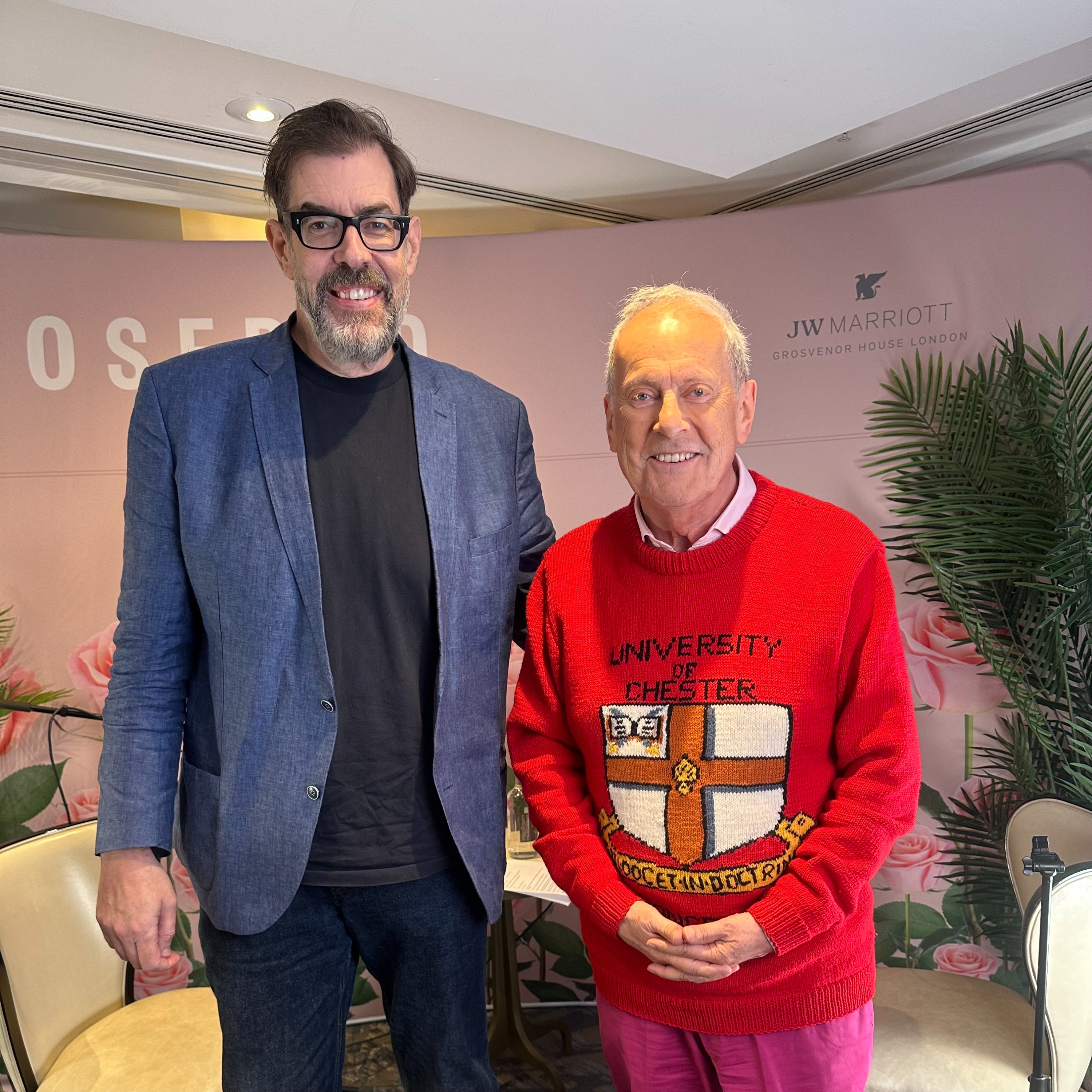
1:10:39Rosebud is a place to live in the world. Jane Jane production produced by Harriet Jane, hosted by me, Giles Brandreth, with music by Phil Leppard, and recorded this week at the JW Marriott Grosvenor House in London's Park Lane. Room service.
Richard Osman: writer, presenter, producer, creator and podcaster. From Pointless, to House of Games, to Thursday Murder Club and The Rest is Entertainment - the range, volume and success of Osman's work is impressive. So how did this shy boy who liked to stand outside things, observe and who has "weird brain gifts" become such an on and off-screen talent? Richard talks to Gyles about his early years - how his happy childhood spent holidaying with families from the street was disrupted by his father leaving the family when Richard was only nine. He talks about his struggles with his eyesight, and how that and his height made him feel separate, and different. He talks about his amazing mum, and how she coped as a single parent. Richard talks about how much he loves TV, and about how much he loves his wife, Ingrid Oliver. And he tells Gyles about seeking help for his food addiction.
This is a fascinating episode full of wisdom and honesty.
It was recorded at the JW Marriott Grosvenor House in London.
Hosted on Acast. See acast.com/privacy for more information.


