
 Ask ChatGPT



Host: Gyles Brandreth
"Rosebud" features conversations with intriguing guests about their first memories and experiences, with a focus on nostalgia and storytelling.
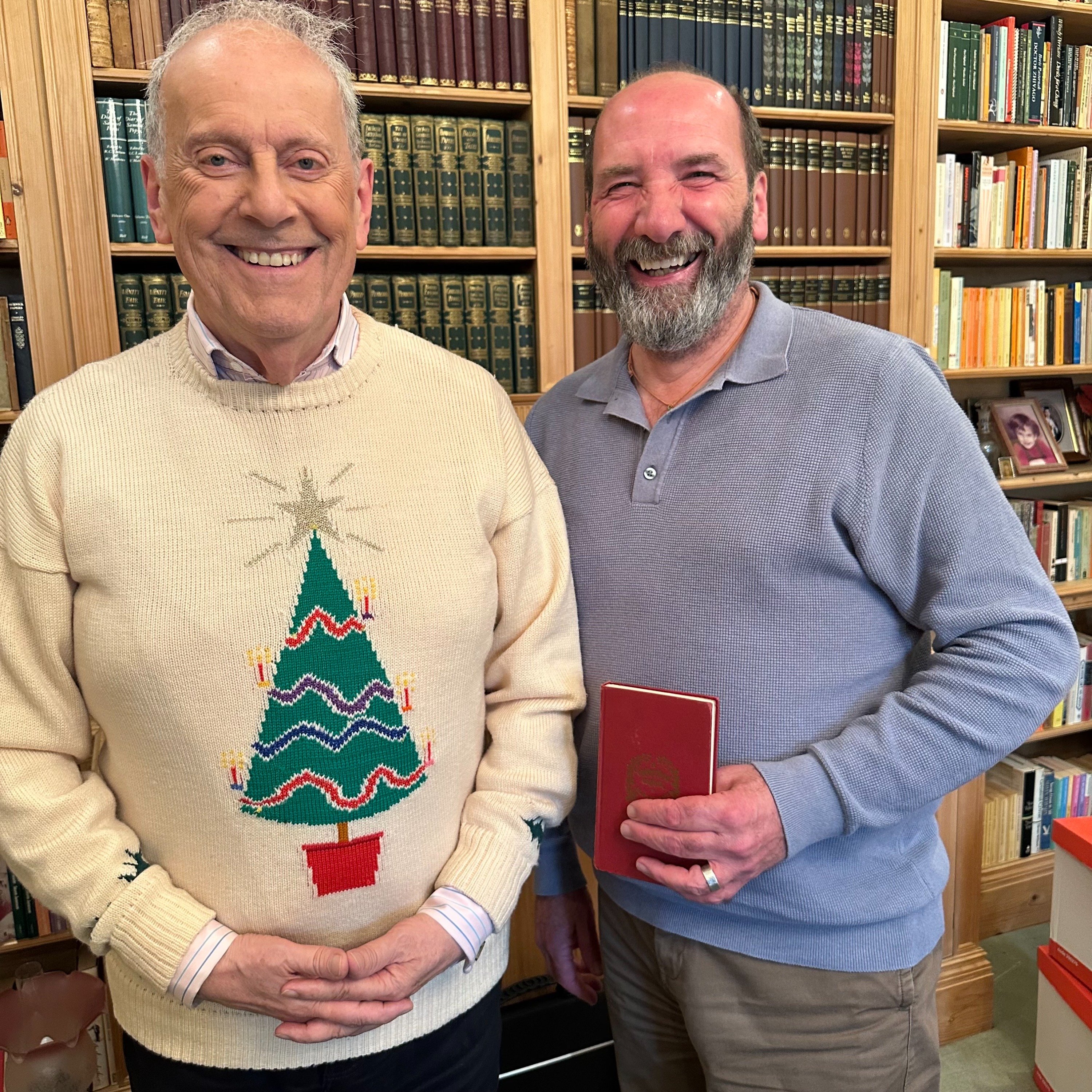
In this Christmas-themed episode, Gyles Brandreth engages in a captivating dialogue with Gerald Dickens, the great-great-grandson of Charles Dickens. They explore the life and legacy of Charles Dickens, emphasizing his childhood experiences, literary successes, personal struggles, and his profound connection to Christmas narratives.
Written by AI. May contain mistakes.

Get the gist, explore an idea or ask about something said.
 Claude
On Rosebud with Gyles Brandreth, what are the key points of this episode?
Searching your listeningAutomatic transcript. May contain errors.
0:00This is Rosebud. It's the start of the Christmas season. Harriet, cue the festive music.
0:30Marley was dead, to begin with. There is no doubt whatever about that. The register of his burial was signed by the clergyman, the clerk, the undertaker, and the chief mourner. Scrooge signed it. And Scrooge's name was good, upon change, for anything he chose to put his hand to. Old Marley was dead as a doornail. Since my father first read the opening of A Christmas Carol to me I have loved the work of Charles Dickens This is the beginning of the rosebud Christmas season And we have a very special guest for you We're going to celebrate the author Charles Dickens So associated with Christmas We're going to do so in the company of Gerald Dickens Charles Dickens' great-great-grandson Cue the music
1:36Christmas is upon us. And when I think of Christmas, inevitably I think of Charles Dickens. Remarkable author. Many regard him as our greatest author in the British Isles after Shakespeare. Many regard him as our greatest novelist. and his most popular novel is, I'm sure, undoubtedly, A Christmas Carol. So we wanted a special Christmas guest and I'm lucky enough to know some of the descendants of Charles Dickens. In fact, one of them is with me here now, Gerald Dickens. Gerald, it's good to see you again. Wonderful to be here, wonderful to see you, thank you. We've met over the years quite a few times because you are an actor and you do a show.
2:18What is the show you do? Oh, well, it's a variety of different programs. They're all based on Dickens' work and life. A Christmas Carol is always a central part of it. I tour every year with a one-man dramatisation of A Christmas Carol. And you do this all over the world? Yes, I do, yes. Particularly in America. America, I tour a great deal of America. A Christmas Carol in America is extraordinary. It really is a central part of the American Christmas celebration. It's a bit like performing a pantomime in Britain in that people will come back every year to the same performance just out of tradition.
2:51And they'll bring their children and then a generation later you'll find the people that were children and are bringing their children. How many children did Dickens have? Dickens himself had ten. Ten children. And did they all have descendants? No, actually, not at all. Nine survived to adulthood. One little daughter died in infancy. Actually, only two had a line that continues. Gosh, so all the Dickenses I've met are descended from just two Dickenses? Well, actually, I think all the Dickens you've met are from one. No. From Henry Fielding Dickens. He was number eight, Henry VIII. The other line came down through his elder son, Charlie.
3:30And that line still exists, but without the name Dickens anymore. That became the female line. So the Dickenses I have met, I mean, I think I've only met about 15 of them. But there seem to be hundreds. Is that right? It's a big family. um back in 2012 which was the bicentenary of dickens's birth we had a great big celebration in london we all went to westminster abbey to the to the graveside and then met for lunch afterwards and i think there were 200 and something there and there were many other celebrations going on around the world as well so yes so you gerald you're a direct descendant you are the great great great great grandson no no two greats at all you're making me doubly great than I am.
4:09Great, great grandson. So this is quite exciting. I'm in the presence of the blood, great, great grandson. And then very few authors have done what he has done, is give their name to the language. When you say something's Dickensian, already you've got a feeling for it. It's extraordinary, isn't it? It's been very interesting listening to this podcast and many, many guests you've had, the amount of times Dickens is referenced by people. It's absolutely extraordinary. Either people saying, I had a hard upbringing and it was positively Dickensian the way we were brought up or I think it was one the other day Ben Elton he was saying that his first theatrical performance was in Oliver and other people reference characters that have appeared in their life as being like Dickensian characters he he just is everywhere his influence still in 2025 is still incredibly powerful.
4:58Now in his lifetime did he give many interviews and was he a good interviewee? I don't believe he did he spoke through his own his own channels he he edited his own magazines Aldi around and Household Words that was his connection to his readers quite apart from his novels what have you been a good interviewee well I'm not entirely sure um I think he probably would rather taken control of the whole of the whole interview well let's see how he behaves during the next hour or so because we're going to play a game now it's a kind of a Christmas carol of our own we're going to summon you as the, not the ghost of Christmas past, but the ghost of your great, great grandfather.
5:42You have played Charles Dickens. We want you now to be Charles Dickens. And I'm going to have a conversation with you. And you're going to please answer in the guise of Charles Dickens. And I, you've spent so much time absorbing his story. His, literally his blood is coursing through your veins and let's see how it goes it will be my great honor well for us it certainly is a remarkable honor to actually be speaking to the great charles dickens himself so mr dickens charles dickens born on the 7th of february 1812 my first question is always the same question it's this. What is your very first memory?
6:24I believe one of my first memories is in a boarding house in Sheerness, a funny little town on the river Medway. I couldn't have been more than five, maybe, or six. And the lodging house abutted onto a theatre. And every night in my bed, when the theatrical performance ended I could hear rousing singing of Rue Britannia through the wall and I could hear people stamping and clapping and I could hear my father in the room below and he would be standing and singing along with the audience in the theatre and that was remarkable to hear all of these people together as one and that made a big big impression and this would I mean, I suppose, 1817.
7:14So just after the end of the triumphant end of the Napoleonic Wars. And you have exactly made the point. I was born in Portsmouth because my father worked for the Royal Navy in the pay office at the dockyards at Portsmouth. And because of the Napoleonic Wars, it was quite literally all hands on deck. My father worked until the hostilities, the war came to an end. And then we were moved back to London. He lived in London for a short while until he was again posted to Sheerness. And tell us a little bit about your father. What sort of personality was he? What kind of man was he? What was his name?
7:52John. John Dickens. I am somewhat conflicted in my memory of him and speaking of him. He could be a wonderful man, an entertaining man, a joyful man. He was not a businessman. He could never budget. He could never save the money he earned. He always wished to be a little grander than he really was. He wanted to impress. And over and over and over throughout my childhood, my father fell deeper into debt. And this went on and on and on and affected our entire childhood. Who was your mother? My mother was Elizabeth Dickens. She loved words. She loved books. She read to me. She taught me to read. I had little education, but my mother read to me.
8:50She taught me Latin. At one point in her life, she tried to open a school, Mrs. Dickens Academy, or Mrs. Dickens Establishment, or some such name, and nobody ever came to it except me. I was the only pupil. How many children did they have between them? There were six of us. And where were you in the begging order? I was number two. My eldest sister, Fanny, we were very close. My father's debts affected us, I think, very greatly. You see, in London, he was eventually taken into the Marshalsea debtors' prison for unpaid debts. And my mother couldn't cope with the family in the end. So she moved with the youngest children into the Marshalsea with my father.
9:36So this was a system, because it doesn't exist any longer, where people who owed money could be arrested by other citizens. The people that they owed money to could get somebody to go and arrest them and put them in prison until the debt had been paid off. That's exactly right. So it wasn't a criminal charge. No, no, no. You will be imprisoned until you can fund this debt. The establishment was purely for the imprisonment of debtors. And you're absolutely right. And you could take your family in there because it was like being, I mean, a lodging house, was it? Or was it like a prison? No, you're right.
10:11It was comfortable enough. And my father and my mother and brothers and sisters were there at the Marshallshire Prison in Southwark. And how old were you when this happened? 11, 10, 11. Gosh. I was left to earn the money. Aged 11? Aged 11, 12. to clear the debt so that my father and the family might be released from the Marshallsey prison. What can you remember of your time before that? Was there a good time in your childhood? Joyful. Joyful. Happy times. In Chatham, again from the Sheerness Dockyard, where I listened to the theatre through the wall, my father was moved to the Royal Dockyard at Chatham, and that was an exciting place.
10:57It was bustling and the ships came in and they smelt of tea and spices and the sailors were exciting. And I learned a great deal about language at the dockyard. And I would just be able to explore. I could walk everywhere and look at the ships and I could walk into the countryside around the River Medway. It was the happiest time of my life. And I used to walk with my father. I walked through the countryside. And we would cross the wonderful bridge, Rochester Bridge, and there we would start to climb a long green hill. And at the summit of the hill was a house. And that is what this walk was all about.
11:42That is what I loved because it was the most beautiful house for a six-year-old to lay eyes on. Built a red brick. It had a little white tower on the top with a bell on it. And the proportions of the house were perfect. It was beautiful. And it stood on the top of the hill on the main road from Dover to London. And the hill was called Gad's Hill. And I wanted to know why I couldn't live in a house like that. That is the house the Dickens family should be living in. And I told my father so. I said, why can't we live in this house? Why do we have to live in our small house by the dockyards? Why can't we live here?
12:24And my father was wise because he said something that affected my entire life, my entire outlook. He said, Charles, if you were to be very persevering, if you were to work very hard, then one day you may come to live in a house like that. And I never forgot it. I believe my child mind suggested that I would live in that house. My father had told me so. I just had to be persevering and work hard, and I could live in that house. And I did. In that house? In that very house. Many, many years later, I came back to Rochester to revisit the scenes of my childhood and the scenes of many of my novels, and I discovered that Gad's Hill Place had been put up for sale.
13:18It was meant to be, and I purchased it. I lived there. It was my family home. Extraordinary. Were you aware of how well your parents got on together? Did they get on well? Was it a good marriage? Yes. They seemed to be happy people? I believe so. I believe my mother was very frustrated with my father for his difficulties, as Mrs. McCorber put it. And they were financial difficulties? Were they made worse by, was he a too heavy a drinker? No. Just living above his means. Just, and a little bit above your means is terrible. Yes. Because every year it gets worse. It gets a little worse. And Mr. McCorber and David Copperfield, there is my father.
13:58Annual income, 20 pounds. Annual expenditure, 19, 19 and 6, result happiness. Annual income, 20 pounds. Annual expenditure, 20, 8 and 6, result misery. Yes. And there, in a sentence, is John Dickens. And a universal truth. Yes. Because that's a lesson for life. Did you have, still under the age of 11, Did you have any friends, close friends, that you remember from those days? The Aunt Fanny? I had friends. I remember at the time I was sent to work in the blacking warehouse in London to raise funds for my family. This is when you were in London and your parents were both living in... At the Marshalls.
14:41At the Marshalls Sea debtors prison. Debtors prison. What is a blacking warehouse? Oh, the manufacture of shoe blacking for making boots shine. for the respectable. Oh, like shoe polishing? Yes. Or it might be for the hearths of higher places, just for blacking. But I had a friend there, and he was in the same circumstance as me, and we worked together, and we worked hard. We spurred each other on, because I couldn't let him be better at his job than I was, because if that were the case, then I was not being persevering, I was not working hard, I wouldn't own my house. His name was Bob, and I named a character after him many many years later in in honor of our our time his his name was bob fagan oh i don't know what he made of of the character i named in his honor but how interesting yes the most villainous character in oliver twist and he was your good friend yes he was did he ever know about this well he would have read the book i suppose he read the book we only knew each other during our time at the Blacking Project.
15:46So from the age of 11 you are in a sense homeless. Yes. I mean. I stayed in a lodging house kept by an elderly lady who lodged children like me. I hated being there. I didn't want to be there. So I spent as little time as possible at the lodging house. I walked. I explored. I investigated London. I watched day and night. I made my way through the Rooker Easter terrible slums of London. I saw how impoverished people could be. I saw destitution. I saw crime. I saw hatred. I saw fear. I saw wealth. I saw excess. Were you writing notes? Were you recording any of this? No, just in this in your head.
16:33All in my head. And you were paid in the blacking factory, I assume, a small amount of which you had to pay some to the landlady of the lodgings we lived. Yes, yes. I was paid six shillings a week. You know, so much of what came later was formed at that time. And now you're a teenager. Do you visit your parents in the Marshallsea? Fanny and I, we walked every Sunday from the centre of London across the river to the Marshallsea prison. And we spent time, and it was happy times. It was good times. How eventually did your parents get out of the Marjalsy? Well, my mother's father died and left her a small legacy.
17:14And that cleared the debt, and my father was released with the rest of the family. However, I remained in the Blacking warehouse. They decided that I should continue to work there for a year. the original warehouse was on the banks of the Thames at Hungerford Stairs and then it moved to a new position a little a little away from the river Chandos Street originally I had worked in a basement a rat infested basement by the time the blacking warehouse moved I was placed in the front window overlooking the street so people could see how the work was performed with Bob Fagan. And I was working in the sunlight, in the daylight, and I saw my father walk past outside, strutting along as if he had not a care in the world.
18:16And he saw me. He looked at me and turned and carried on his way. No. He eventually remonstrated with the owner of the factory and said that this was not seemly, that I should be put on show in this manner. And he took me out of the Blacking Warehouse and I thought I was free at that point. But there ensued a great argument between him and the owners of the factory and my mother intervened And she was warm to me going back. She wanted me to go back and work. It was heartbreaking for me. Heartbreaking. And the extraordinary thing is that my father and mother never mentioned it to me afterwards.
19:04They never spoke of it. It was as if that had never happened. And were you eventually reunited with your family? Yes, yes, yes. And what age were you when you were reunited? 13 or 14. So you went back home. And where were they then living after they'd been released from the... We were in Camden Town. But we were always moving. There was always a debt to be paid. There was always a lodging house where we could not remain. My father was always on the move. And after the blacking factory, you didn't go back to education? I did, briefly. I went to a school called the Wellington Academy. It wasn't a good school, but it returned me to childhood.
19:49It made me a boy again. I didn't have the responsibility of working to earn the money. so that was a good thing my first salaried job was at a lawyer's office i was a clerk and i enjoyed time with the other clerks and we we played i i remember i i used to throw cherry stones out of the window at passers-by and see if i could hit their hats yes we did that and you were 16 then yes my father one of the finest bits of education at that time was my father taught me shorthand oh very useful and i began working first of all as a reporter just just taking notes of the proceedings at court but from there into into parliament so you're still a teenager yeah and you go along and you sit in the what would we now call the press gallery a reporter's gallery sometimes all night sometimes i'd sleep there and with shorthand writing down what the different you had to recognize who the members of parliament were exactly and and and i was making notes on on paper.
20:55And if I did not have enough paper, I would start writing on my collars, on my cuff. And I believe I earned a reputation for being accurate and speedy. So that was my introduction into writing, if you like. What I found difficult at that time was I was listening to all of these debates. I was watching all of these highly privileged gentlemen debating. And in my memory were those streets of my childhood, of the poor, of the impoverished, of the destitute, of the squalor. And somehow what I was witnessing here in Parliament did not reflect what I had seen there as a boy. And that was very important to me.
21:38That made a very big impression.
21:48so here you are first as a court reporter then as a parliamentary reporter earning reasonable money yes um giving some of it to your parents and eventually deciding you're going to have a place of your own what is your own home your first home on your own it was furnables inn i believe Which is in the city near the law courts. Yes, yes, yes. At that time, fully engaged in the proceedings in Parliament, of course there were times of the year where there were long recesses. But during those long recesses, I had nothing to do. And boredom is something that I couldn't abide. So I kept writing. And what would I write?
22:27I decided to write about what I saw around me. I wrote about what was happening in the streets. I wrote about strange characters who lived in houses who nobody seemed to know. I just wrote and I wrote. And a friend came to visit me at my lodgings, and he happened to pick up one such manuscript and read it. And he said, these are remarkable, these are wonderful. You should have these published, they're witty, they're funny. And I'd never thought of such a thing. So I took one, I took one of these little pieces. It was called A Dinner at Poplar Walk. and I very carefully bound it in paper and I stole out under the cover of darkness and walked through London until I arrived at the offices of a magazine I knew well called the Monthly Magazine who published short stories.
23:16I didn't have my name on the page, it just said to dinner at Poplar Walk, anonymous. And I stood outside the editor's box and I didn't know whether to post it through the box or to run away. And in the end, I let it go. It went into the box and I could do nothing else. I waited for three weeks, I believe. And I walked down to the Strand, very near to the spot where the original blacking warehouse had been. And I saw a bookseller at a book stand and he was selling copies of the monthly magazine. And I stood and I watched and gentlemen came and paid for the magazine and started to read and they were reading my work they were reading my words at dinner at poplar walk and they were laughing and that was one of the most remarkable memories of my life is seeing that and the gentleman who was selling the magazines at the newsstand his name was William Hall and I remembered him I pictured every moment of that scene I wanted to capture it forever and I remembered him and that would become important later so that's how it started gosh and do they write back they paid you for this piece no no I wasn't paid but they didn't know who I was oh you literally were anonymous I was quite anonymous you just dropped it in I dropped it in and I kept on doing that for a few months and they published them.
24:47Pieces were appearing without you personally getting any credit or any money. Exactly, at first. Eventually I decided to put a name on it but not my own. I didn't want to be Charles Dickens because I didn't want to be a laughing stock within Parliament. And I chose the name Boz. B-O-Z. B-O-Z. And Boz was a family nickname for my youngest brother Augustus. Augustus was quite a bit younger than the rest of us. And as a childhood nickname, we called him Moses after the character in Goldsmiths, Vicar of Wakefield. But being very young, his pronunciation was not wonderful. And he couldn't quite say Moses.
25:33He'd say Bo-sies. It came through his nose. Bo-sies. And that was where I took my pen name. Boz was from Bo's, was from Bo's, was from Moses, was from Augustus. So then I started writing under the name of Boz. And other magazines approached me, other editors approached me by this time and said we would like to publish more of your works. And what was your first novel? Sketches came first? Sketches came first. The sketches were popular. And people were talking about them throughout London. And I was approached by a gentleman from a small publishing house. And his name was William Hall. No. The same gentleman who had sold my first copy of the monthly magazine in the Strand.
26:20And he had no idea that you were there watching him? No, no. And he was in partnership with another gentleman, Mr Chapman. The company was Chapman and Hall. Now, they approached me asking me to provide witty captions to a series of sporting prints that were being produced by an artist by the name of Robert Seymour, who was very well known in London, very popular. And he had come upon an idea that if he provided a series of prints about a sporting club based in London, of which the members were wholly incapable of undertaking any sports, they'd be too fat to go skating and they'd fall through the ice.
26:56Or if they were going on country walks, they had to be pushed in wheelbarrows. And he had approached Chapman and Hall asking them to find a young author who would provide captions, letterpress to these illustrations. and I thought about the idea and I said to Mr Hall I was rather hoping that there might be a little more involved than just writing a few captions and could I offer a counter idea and that would be that we would take the idea of a club and I would write a whole series of adventures of the members of the club and we would do this every month so the readers could buy a manuscript for a few pennies and then the story would go on and on and on and on and I told him I didn't like the idea of the sporting club that didn't work at all for me so he came upon the idea of a corresponding society where the members of the club would travel around the country and would send back to their headquarters in London at the Georgian Vulture Chop House in the heart of the city accounts of their adventures.
27:57And these adventures would be collected by an editor, me, Boz, and then put into the public, so the public could read and enjoy them. And the idea was taken back to Mr. Seymour. He was told that his idea of a sporting club was not really going to work, and also this was not going to be merely a book of pictures, this was going to be the start of a novel. And and he agreed and so we started to work together and the name of the club of course was the Pickwick Club the posthumous papers of the Pickwick Club and that is how it began it was a difficult start I rather took control of of the whole idea and I regret I regret deeply I was short with Mr.
28:51Seymour about one of his illustrations and the whole book was being sold because it was Seymour and I had the temerity to tell him that a character in a certain illustration the dying clown was too grotesque was too vulgar and hadn't captured what I had written enough I tried to calm him down a little by telling him that he had captured the uh the perspective of the table in the foreground of the scene perfectly but he didn't seem to didn't seem to react to that well because in the immediate aftermath he returned home, he took a shotgun, he tied the trigger to a door and he shot himself. No. He...
29:39As a direct result of this rejection by you of his illustration. I hope not only. Is that one of your weaknesses? Speaking your mind, do you think? Yes. But I hope his strength. I hope his strength also. But on that occasion, yes. Since we've touched on this, what are the weaknesses of Charles Dickens? Oh.
30:10Well, speaking mind, but also being very self-centred. everything had to be perfect for me and and that stayed with me all through my life through my marriage and the subsequent collapse of my marriage i can be a very difficult person to live with you mentioned your wife tell me now who was your first girlfriend who's the first a girl you noticed and why and what happened? It was a young girl called Mariah Bedenal. I fell completely in love with her. She was beautiful. She was pretty. She was funny. And how did you meet her? How old was she? How old were you? I must have been 19, 18 or 19. But her parents, her father was a banker and he didn't approve of me at all.
31:06He thought I had no prospects. He thought I was frivolous. I like to wear colorful bright waistcoats and my hair was long and out of control and wavy he didn't approve of me at all and he removed Mariah he sent her abroad to be educated to take her away and when she returned to England she had no interest I remember I invited the Biednall family to my 21st birthday celebrations and she referred to me as a boy that was terrible and many years later 25 years later maybe she wrote to me by which time I was a popular author and had some great notoriety and she wrote to me and wished to meet me and suddenly all of those childhood delights came flooding back and we agreed to meet without our respective spouses Oh.
32:08In secret. In secret? Well. Well, yes, a private meeting. Yes, a private meeting. You left them. She left her husband, you left your wife at home, and you thought, let's see if we can rekindle the magic. And to me, she was going to be, as she always had been, she was going to be pretty and fun and vivacious. And she wrote to me. She said, I'm not that girl anymore. I'm an older woman. I have become fat. Well, of course, I wasn't going to believe that. But she had been telling the truth. She was sad and flighty and, oh dear. It was a rather disappointing meeting. She became Flora Finching. As a rather frivolous, silly lady.
32:59And were there many more before you met your wife? Well, I met Catherine shortly afterwards. And who was she? Catherine Hogarth. her father was the editor of one of the newspapers for whom I was reporting and he invited me to to the house and there was Catherine and again I lost lost my heart we we we engaged quickly and we married quickly my my Catherine but that is rather your style isn't it yes I mean you meet them you like them you love them let's get married yes and so what sort of wedding was it your parents come? Her parents came? It was a proper wedding in the church? A proper wedding.
33:41And we honeymooned in chalk on the Kentish marches, very near Chatham, where I had my happiest times in my childhood. We honeymooned in the blacksmith's forge there. It was lovely. And what did you love about her and what do you think she loved about you in the early days, these good days? She was measured. She was intelligent. She was clever. Unfortunately, maybe we weren't perfectly united. We weren't absolutely together. We were close together. But this was the time that my writing career was beginning. And soon I was meeting fine people and theatre people and literary people. And I began to soar into a society I had never imagined.
34:33And Catherine remained. looking back that is how i see it so you became this great literary lion following the success of the bigwick papers and the other novels you become hugely famous as you say you move up in the world but she remains the domestic creature at home and of course having babies how many children did you have in all well we had 10 children now she herself came from a large family Do they all survive? Little Dora died in a month or so of being born. But the other nine survived into adulthood, yes. Just for a moment on Little Dora, of course it's not unusual in the era, your era, for children to die in infancy.
35:18But did it rock the marriage for a while? Did it affect Catherine? Did it affect you? Where was Dora in your list of 10? She suffered great depression. Great depression. She was away when it happened. Dora was ill and Catherine was suffering greatly. And I sent her away to the countryside to give her rest and ease. And I had to write to her with the news that Dora had died. and it was a terrible time for all of us, of course. Of course. And so why did the marriage end? Because it did actually end and eventually you did send her away permanently, didn't you? Yes, yes.
36:11she
36:15she couldn't keep up with me and our family another regretful part of my life I wrote a statement to the newspapers I asked many of my friends who are editors and journalists to post a statement in which I announced that she was a bad mother. You actually used that term? A bad mother and had not been a successful housekeeper. Initially, we shared the same house, but I caused our bedroom to be separated by a partition, a door. And then she left the house and the children stayed with me. We hardly saw each other again. We hardly corresponded again. There was one time we corresponded. In 1865, I was fortunate to survive in a railway accident.
37:16Very fortunate. And one of the first letters I received in the days after the accident was from Catherine, and one of the first letters I wrote was back to Catherine, telling her how I felt and what had happened. And there was that moment where we shared a companionship again. But this was a notorious accident where people, some people may even have been killed. A lot of people were injured. Ten people were killed. Yeah, there's a major accident. And is this the accident where we later discover, I don't know if it was known at the time, that you were not alone in the train? I'm interested about you writing to your wife immediately afterwards.
37:54Maybe in your conscious speaking as well, I don't know. But you were with your then-girlfriend, unwrap that if you don't mind Nellie Ellen Turnen a number of years before in 57 I believe I was staging a play in London it was called The Frozen Deep written by Wilkie Collins and it had been received very very successfully I performed it at my home at Tavistock Square I had a theatre built in the dining room. It held 90 people, many of whom couldn't see. They came to watch the play, and it was received with great, great delight. And Her Majesty Queen Victoria invited us to perform for her at Buckingham Palace.
38:44Goodness. I couldn't do that. I couldn't perform. So I told her it would not be possible. But soon this production took on a life of its own, and people wanted to see it in a bigger venue. And I was invited to perform in Manchester, the Free Trade Hall in Manchester, a huge venue. So I needed professional actors to take the role. And in that case, I discovered a family of actresses, the Turnen family, Mrs. Turnen and her three daughters. And I engaged them to perform in the play. The youngest was Ellen. She was 17 at that time. And I think you were 45. 45. The date you've given us. 45. and they performed and we had a wonderful time.
39:31The camaraderie of a theatrical company producing something wonderful. I took to Ellen, not in a romantic way at first, but soon it became a little more involved. I remember Wilkie Collins and myself, we travelled to Doncaster, supposedly to research a series of stories we were going to write, but actually that is where Ellen was performing. We watched her in the theatre and took her out to dinner afterwards, and we became closer and closer and closer. And because of your fame, because of the success of the novels from an early stage, after Big Big Papers, all the others come, the ones that we're so familiar with, David Copperfield, Oliver Twist, you name it, you become famous, so famous that somebody like Queen Victoria thinks you can come and bring a show to Buckingham Palace.
40:26So were you anxious? Well, you obviously were anxious about your image. The very fact that you told friends in the press to publish a statement disassociating yourself with your wife and putting it all on her, saying she's a bad mother, she's a poor housekeeper, this is why we're having to do this, please understand. You also, I imagine, very anxious that people should not know about your relationship with Ellen Turner. Nobody knew about Ellen. Nobody during your lifetime. Your friends knew, I imagine. Well, my closest associates, yes. But I believe there was a rumour rife in London that I was seeing another woman, which was the cause of the separation from Catherine.
41:08And at the time of the separation, Catherine's sister, Georgina Hogarth, came into my house to keep house, to look after the house. and there there the rumours started everybody jumped to the conclusion that it was Georgina and I was so far from the truth I couldn't bear that again I put out another statement in the press saying that all of these rumours are unfounded but all of the time Ellen was there now we began talking about this because of the Staplehurst railway accident Ellen and her mother had been staying in France for a number of months. And I had been traveling to and from France to visit them and look after them and make sure everything was right.
42:01And in June of 1865, they decided they wished to return to London. So I traveled to France to travel back with them. and we travelled from Paris on the train to Boulogne and from there on the Victoria Steamer to Folkestone and from Folkestone we boarded what is called the Tidal Train which would whisk us into the heart of London with great rapidity, 50 miles an hour the Tidal service was the blue ribboned service for the Southeastern Railway Company so as soon as the luggage and the passengers were loaded the train left and it skimmed across the countryside of Kent. And on that day we settled ourselves into our carriage.
42:46There was Mrs. Turnham and Ellen on one side and I was sitting opposite. I was deep in thought. I was still working on our mutual friend. I had the latest manuscript. I was going to deliver it to the publishers in London. And we came rushing through a small town, Headcorn. and shortly after I remember there were two violent blows on the train whistle and then shortly afterwards we felt the train lurching as if we were forced to a stop and then suddenly everything tipped we were thrown into the corner of of the carriage as we were dragged along the track I described it later as being like like in a basket of a of a balloon being dragged along the ground.
43:35Soon everything stopped and I realized there was no more danger. We were upside down in the corner of the carriage and Ellen was crying. She'd hurt her arm. And then I heard the screams from outside, the cries. So I opened a window and I saw some workers who had apparently been working on the stretch of line. And I called to them, do you recognize me? Do you know who I am? And they said, of course, Mr. Dickens, of course we recognize you. Well, bring me a ladder, bring me a ladder. I wish to clamber from this carriage and help. And I climbed down into the riverbank and there was death and destruction.
44:19The first man I came upon, I held him in my arms. I tried to cool him with water from the riverbank. I gave him some brandy from my hip flask, but he died in my arms. I remember he had a moon-shaped gash all across the top of his head. There was a beautiful young lady in a white dress. The dress was unmarked. It was not dirty. It was not stained. And I comforted her. I sat by her. I lent her against a tree in a little copse of trees. And I left and when I came back, she too had died. I remember a man running wildly alongside the wreckage saying that he had lost his wife and we found her and she was also dead.
45:03I spent three hours tending the wounded and the dead in the wreckage at Staplehurst. but in the meantime I had managed to ensure that Ellen and her mother had got away discreetly got away got away unseen the news of the accident was popular and when the passengers returned to Charing Cross on other trains that had been laid on to take them into London the members of the press were taking every name, every occupation every background story they could but the name of Turner never appeared in those lists. It was my own folly that brought her involvement into public knowledge. She had lost some jewellery in the crash.
45:58It's been engraved with her name. And she said she wished to have it back. And I wrote to the stationmaster at Charing Cross saying if this should come to light could you please return it to me, to Charles Dickens. There we are. Oh. But even then, we kept our relationship quiet as far as we could. I had a house for her in Peckham. Which you paid for? Which I paid for, and she lived and kept, and I visited often. Peckham was wonderful because there were so many different railway stations nearby. I didn't have to do the same journey every day, which would have alerted people's... It was almost like theatre.
46:39We lived under an assumed name. We were Mr. and Mrs. Tringham there. Yes. But the wear and tear of leading a double life while working so hard because... And you mentioned it earlier. You have a reputation. You have an image of a fine family man gathering round the fire at Christmas. The Cratchit family. Many, many other families throughout my works. And here I was. Leaving a deceiving life.
47:19Finish the story, if you would, about Catherine. Because in the early days, you go on your first trip to America as an author. By then you've written a lot of your best-known work. And you do a tour. Are you already giving the readings that you... No, no. It's just an author tour. 1842, I had great success with the Pickwick Papers, followed up immediately by Oliver Twist, and then Nicholas Nickleby and then Barnaby Rudd and then the old curiosity show. Well done. It was one after another and each more successful than the last. I was at the height of my success, so I thought. I was interested in America.
47:55I was fascinated by America. I wanted to know how a new country was coping with all of the things the old country were getting wrong. I called it the republic of my imagination. nation. I wanted to discover this new, new country. So we traveled on board the Britannia steamer through the worst, worst storms you can imagine in the Atlantic. Oh, goodness gracious. I remember I took a collection from all of the other passengers and we bought a silver platter for the captain for taking us there safely because we didn't think we would arrive. And at first, it was a wonderful trip. I arrived in Boston and they gave me banquets.
48:38They feted me. They threw what they called boz balls in my honour. And all the menus would have quotes from my books and little illustrations. And it was splendid. Everything was perfect. And then at a speech in Boston, I decided to raise the issue of international copyright. Now, here was an issue that was blighting many, many authors, both American and English. if I published a novel in England there was nothing to stop a publisher in America taking the manuscript and republishing it for himself and selling it at a great profit to him but nothing to me wow and the same was true of American authors with English publishers so I thought this bore mentioning and I made a speech and I made my point plainly and clearly and I I think fairly.
49:32And indeed, the members of the dinner who were there that night applauded warmly and I found nothing awry until the newspapers were published. And the press did not take kindly because the press, more than anyone else in America, were responsible for taking my works and publishing them, making my works so popular in America. When I was writing the old Curiosity shop, I came to the death of Little Nell, which hurt me. And I found it so difficult to write. Now, the old curiosity shop in England was in weekly installments. So I gently introduced into some of the preceding episodes that Little Nell was suffering.
50:13She was coughing. She was becoming reflective. I placed her in churches and in churchyards and people began to realize what I was going to do and sure enough the story took its toll and little Nell died but in America they were only getting the installments in monthly so when they started to read of little Nell suffering and coughing and lying in churchyards they couldn't believe it they had to wait and they had to wait until the following month when the steamer came across and and docked at New York and people went down to the dockyards they couldn't wait and they called out to the steamship The captain, is little Nell dead?
50:50And he cried back, yes. He had no romance. Oh, no. So my works were so popular in America. Oh, it's a dreadful spoiler from the captain. I was receiving nothing from them. So they attacked me. The press attacked me. They told me how dare I come across to America and be so ungrateful. I am being given banquets in my honor. I am being fitted. I am being idolized. And all I can do is stand up and say, you are not paying me for my works. and I did not like that I was still young I was still brash I was still arrogant so I attacked back I I told them exactly what I thought of their country and I I became more and more critical as the tour went on that's the battle between the press and myself raged and America took against me took against me badly I returned to England and I began writing my next novel which was martin chuzzlewit and it didn't sell it didn't repeat the successes of all of the early ones and i was terrified i thought if i can include some some criticism of america that will appeal to my english audience so i started writing some american chapters into it had no place in the plot at all two characters are lifted from the plot and they sail to america and they have a terrible time there and they both almost die in swamps as i remember yes yes and then they come back to England and they tell all their friends what an awful place America is and that made myself even more angered uh by the Americans and ah it was terrible it was terrible I in many ways loved the country I loved the people an educated American is the finest of friends I wrote but oh dear yes that that that that didn't didn't seal my reputation years later you go back so that first trip uh katherine comes with you katherine comes with me and we don't take the children we have a charming little watercolor portrait of all of them which we take with us everywhere but katherine comes with me and and she she is is popular at these events people like her people enjoy her and then again you go to america a few years later many years later by which time you and katherine have parted yes her sister has become your housekeeper to look after the children the younger children and you love the sister in a brotherly way and she obviously is sympathetic to you rather than to our own sister it caused a great separation in the hogarth family yes in fact mrs hogarth insisted that that georgina be medically examined to ensure that she was not my lover.
53:32Oh, that she was indeed Virgo intacta, as they would have said at the time. Quite right. Wow. And yes. Who was Mary Hogarth? Why does that name ring a bell to me? Ah, that is another very sad story. We'll take us right back to the beginning. When Catherine and I first married and had our first son, Charlie, Charles, we moved from Furnival's Inn to um to Doughty Street a new house elegant house a gated street with with gentlemen in livery at either end I had had great success with the Pickwick Papers I was in the middle of writing Oliver Twist and I was also writing Nicholas Nickleby and Mary was Catherine's sister she was only 17 and she lived with us and she was looking after little Charlie for us and one evening the three of us had gone out to the theatre it was a wonderful evening and we returned to the house at Doughty Street and we sat and we talked by the fire and and then late into the night we decided it was time to go to our beds and Mary left the room and made her way upstairs when suddenly we heard a cry and I rushed up the stairs and she had been taken badly badly ill I held her in my arms I caught her and we took her to her room and lay her on a bed and I stayed with her and I held her until the next day when she died in my arms her last words were of me I don't know how long I held her after she had died she had been alive I had given her a little drink of brandy and she had stirred and looked at me and And at some point she flew away to heaven and died in my arms.
55:20She was an angel. She was perfect. She was beautiful. I slipped a ring that she wore on her finger and put it on mine and wear it. Always. and from that day if you know my work you will see in many many of my novels if not all of them there is a perfect a beautiful an angelic 17 year old who can do no wrong and that was Dear Mary Towards the end of our conversations on Rosebud I always ask people for a moment of joy and a moment of sadness is the death of Mary the greatest moment of sadness of your life do you think? I believe so I believe so it stayed with me forever. Did Catherine die during your lifetime?
56:15No. So Catherine and Ellen both survive you and at the end of your time because you you die young by today's standards, everyone says, because you gave so much energy to your work. But I mean, now, having had this conversation, I can see that A, you were driven to achieve, B, you were leading a double life, which takes its emotional toll, but also, I imagine, a financial toll. So you worked and worked and worked, and you went on doing these performances, both because you loved them. Why did you go on performing right to the end? Almost the last 10 years, I was a performer. I was not a writer. Oh, you stopped writing, did you virtually?
57:00Almost. Our mutual friend was the last completed novel. So for the last five years, there were no new novels written. I was performing. I was a performer. I loved having the immediacy of seeing my audience. You can feel the energy of what you are doing coming back to you, and you feel the applause and you hear it. And there was my childhood memory of listening to the applause through the wall of the lodging house at Sheerness. I performed a Christmas carol. I performed the trial from the Pickwick Papers. And then there were characters like Mrs. Gamp, the wonderful drunken night nurse from Chuzzlewit.
57:41And my mind was always working on how to achieve more, how to write more, how to introduce more into my repertoire. And at the very end, in the very last year of my performing, I decided to introduce a new piece which was completely unlike anything that I had ever done, that anybody had ever done. And that was a passage from Oliver Twist. And it was the scene where Bill Sykes murders Nancy. A brutal scene. And I carefully created the script. I made it so that the tension of the scene built and built and built and built until the moment that Bill Sykes batters Nancy to death, smashing her head apart and the room is filled with blood.
58:31And I described the dead eyes looking at the reflection of the gore quivering on the ceiling in the sunlight. I asked a number of friends, should I perform this? And they all told me no, but I knew I had to. I knew I had to perform it. and when I introduced it the response was remarkable and after one performance just outside Bristol I remember writing home to my family at Gadsill Place and I wrote to them and said last night in Clifton we had a contagion of fainting between 15 and 20 women were carried out of the theatre quite stiff. But the emotion and the energy and the toll that performance took on me, as well as my second trip to America, which had been purely performing, when I became very ill in the harsh winter of America.
59:27I took a terrible chill. I never quite recovered. But performing Sykes and Nancy so often, because everybody wanted to see it, I collapsed myself on many an occasion. I was laid on a sofa in the dressing room of a theatre until I was well enough to be taken back to my hotel. I was also travelling from city to city on the train and ever since Staplehurst I was terrified by rail travel. I couldn't relax, I held onto the seat, I sweated, I trembled and eventually I was due to perform in Preston, Lancashire and my doctor came up from London. He had heard that I had been suffering and he insisted that I brought the reading careers to a close.
1:00:14I was told not to go on that night. I had a fully booked audience. So the readings hastened, hastened my ill health. But then of course I returned to writing and that's when I started the mystery novel, The Mystery of Edwin Drood. Oh and that of course is where we bring the story to a close because it is in 1870, age 58, that you die. We've heard a moment of sadness. Give us a moment of joy from your life. What comes into your head when I say joy? Joy is on stage. Joy is applause. Joy is laughter. Joy is everybody listening, laughing. That's my joy. That is my joy, on stage. Yeah, child stick in centre stage.
1:01:08Well, look, an extraordinary life, a legacy that is beyond belief. So many great novels still being read. A Christmas Carol, which is a Christmas staple every year. What, finally, do you think you learnt from life? What did life teach you? We've had ups and we've had downs. We've had laughter and we've had tears. what's life taught you Charles Dickens? I hope I learnt to be more generous with people to be less selfish I failed a great deal on that at different times in my life especially with Catherine of course I have deep regrets so I hope that if I have learnt anything it may be that Do you have a favourite novel and do you have a favourite line, Charles Dickens, from the works of Charles Dickens, that you can share finally with us?
1:02:09Whenever I published a new novel, it was always my favourite. Because that's how you sell books. But the truth is, it is always David Copperfield. Because David Copperfield allowed me to tell my story. Nobody knew. Nobody knew about the Marshal C. Detters prison. Nobody knew about the blacking warehouse. I never told anybody. Not my family, not Catherine. Eventually I told John Forster, for he was going to write my life story on my behalf. But nobody knew. So in David Copperfield, I could tell it. I could release it from within me. I could exorcise those memories by sending little David to the factory of Mudstone and Grimsby where he worked and Mr.
1:02:59McCorber was always in debt and struggling and the books were sold and the furniture was sold and the crockery was sold. That was my story. I even gave the main character my own initials. David Copperfield, Charles Dickens just reversed. So yes, David Copperfield was always the favourite of my children if I may mention the novels in that way. favorite line goodness I'm not sure I can come up with one there are so many
1:03:34Christmas Carol has been wonderful to me and has the success of the book but the success of the reading of it has gone on and on and on and on so let me say I shall honor Christmas in my heart and try to keep it all the year. There. That's all we can take from A Christmas Carol. Charles Dickens, thank you so much.
1:04:05Hello, I'm Giles and you're? Harriet. I thought you were Harriet. You look familiar. We are in a state of high excitement because we've got some rather exciting news, which is that in January 2026, any day now, we are launching something new and special. we are inviting you to join the Rosebud family. What's this actually going to mean, Harriet? Well, it means that people that love Rosebud, which I'm sure lots of you do, can join a subscription service. So it's going to be£4.99 a month. And they get lots of benefits for joining. One of the benefits I know is that they can listen to Rosebud ad-free.
1:04:47I quite like the ads, to be honest. I love ads. ads. I work for ITV. I like ads. But some people find it a distraction and want an ad-free option. So we're giving people an ad-free option. But as well as that, if you join the Rosebud family, you get extras. I'm wanting to take you down memory lane. And I'm wanting you and me every month to go on an expedition. Sometimes it can be just in our minds. Other times, I actually want to take you to places that have been important in my life and maybe places that have been important in your life and we'll explore why they're important and I think they may trigger in other members of the family recollections because we're all about memory and the value and importance of memory so we'll be going on trips down memory lane as part of life with the rosebud family that'll be once a month and something that we're going to try out and see if it works I love a murder mystery and I think you do too don't you I do and I have written a series of Victorian murder mysteries and I thought it might be quite fun to share these Victorian murder mysteries.
1:05:54They feature Arthur Conan Doyle, the creator of Sherlock Holmes, Bram Stoker, the creator of Dracula, Oscar Wilde, my great hero, as my detectives. They're quite fun. Intriguing. I hope they are intriguing. So that'll be a little fortnightly bonus, a little bit of fiction comes to the world of Rosebud. But I think almost the most important element is what you've called the Rosebud retort. What's that? That is a chat room, which will be for subscribers only. And it's a chance for you to get together, discuss Rosebud and other things. You can make friends on there with like-minded people. Well, and also, this is a family.
1:06:34And we know that some families are very close and stay close. And it's wonderful. There are other families. Well, I've mentioned before, I've known my two sisters who didn't speak for 30 years. Have you ever had anything like that in your family? Yeah, I mean, all families have a bit of that, don't they? But hopefully not the Rosebud family. No, we hope not the Rosebud family. No. Though this isn't a family that anybody can join. It's not free to join. No. We're charging people, what is it, the price of a very expensive cup of coffee a month? That sort of thing? Yes,£4.99. £4.99 a month, essentially for ad-free listening to Rosebud and lots of extra bonus episodes.
1:07:14Yeah. And when does this start? January the 1st. And what do people do if they want to join the family? They need to go to www.patreon.com. Oh, this is a new name. Patreon, how do we spell that? P-A-T-R-E-O-N.com. Yes. Forward slash Rosebud. So www.patreon.com forward slash Rosebud. And that's how they will be able to join the Rosebud family. Yes. Gosh, that's quite exciting. I know. Family fun in 2026. Do join us.
1:07:51Thank you.
1:08:19Thank you.
Today we get to meet and know an author who is synonymous with Christmas - Charles Dickens - brought to life in this episode by his great-great grandson, Gerald Dickens. Yes, that's right - you're going to hear an interview with one of our greatest ever writers, who has been dead for over 150 years. Only on Rosebud.
In this fascinating conversation, Dickens tells Gyles about his childhood, growing up in the towns and villages of the Thames estuary in Kent, and how his father's debts led him to be imprisoned in the Marshalsea. The young Charles suddenly found himself put to work, a formative experience which influenced much of his later writing. We hear about his marriage to Catherine Hogarth, and about his mistress, Ellen Ternan. We hear about the terrible Staplehurst train crash, about Charles Dickens's travels in the USA, and about his latter-day success as a performer.
This is a fabulous way to immerse yourself in the story of our greatest novelist, at this most Dickensian time of the year.
With thanks to Gerald Dickens.
Hosted on Acast. See acast.com/privacy for more information.


