
 Ask ChatGPT


 Rosebud with Gyles Brandreth
23 May 2025 · 1h 12m
Written by AI. May contain mistakes.

Get the gist, explore an idea or ask about something said.
 Claude
On Rosebud with Gyles Brandreth, what are the key points of this episode?
Searching your listeningAutomatic transcript. May contain errors.
0:00It's May, and if you're in the UK, you'll know this is the week of the Chelsea Flower Show. and this podcast is called Rosebud because we love flowers. So we thought we should do a special episode celebrating gardeners and a special garden and some special gardeners in particular. Let's get mulching. Cue the music.
0:46Welcome to Rosebud. This is an episode coming to you from one of the most beautiful and famous gardens in the world. We're at Sissinghurst Castle in Kent. The garden at Sissinghurst was created a long time ago, a century ago really, by Vita Sackville-West, the poet and writer, and her husband, the diplomat, the diarist, the Member of Parliament, Harold Nicholson. Actually, they'd be extraordinary guests on Rosebud because Vita Sackville-West famously had affairs with many women in her time, including, I think, Virginia Woolf. And Harold Nicholson had affairs with men in his time. Their son, Nigel Nicholson, who I was lucky enough to know, wrote a remarkable book about his parents called Portrait of a Marriage.
1:33Their grandson, the writer Adam Nicholson, and his wife, the great plantswoman, gardener, and entrepreneur Sarah Raven. They're our guests. So we're going to hear about the fascinating history of Sissinghurst, how it was created, and about the, well, eccentric, bohemian, unusual family that's lived here. But we're also going to hear about Sarah Raven's family and how, inspired by her father, she became interested in plants when she was a very young girl. This, I think, is a very special episode full of stories held together by a common thread, the magical thread of plants and gardens. So, welcome to Rosebud from Sissinghurst Castle in Kent.
2:29Sarah, Adam, before we begin, Adam, this has been your family home. Tell us where we are exactly. OK, we're in Sissinghurst Castle, it's called. Not really a castle, only called a castle because French prisoners thought it was a chateau in the 18th century. but it's a ruined Elizabethan manor house around which my grandparents, that's Vita Sackville-West and her husband, Harold Nicholson, made a garden starting in the 1930s and where we were brought up as children. My father became their heir and is now a great, famous place belonging to the National Trust. And the room we're in is what? Where are we?
3:11This is our kitchen. We have a little bit of the house where I and my sisters, Juliet and Rebecca, and our children, all of our children, and now grandchildren, we all use it like a kind of family Airbnb. And when I came here to visit your father, I felt when I came to this room that there was something familiar about it. Would he have lived in this part of the house? Yes, yes, this was. This, in fact, was his study. He worked here, some of the time anyway. This is where his telly was, black and white telly over there on legs. But this table we're sitting at was in his kitchen. It's just exactly the width of a copy of The Times, the old Times.
3:52And so The Times would exactly fit where you're sitting now, Giles. And I remember him kind of pouring over it with his head in his hands as the world went to hell. Well, I want to talk more about him because I knew him and loved knowing him and liked him hugely. but the first question has to be to both you Adam and your wife Sarah how long have you two been together I have no idea 32 or 32 years congratulations thank you so much the man who can't quite remember how long you've been together so the first question to each of you is quite simply this uh adam nicholson what is your very first memory well i have a very early memory of driving around the garden here at systeenhurst in my go-kart which was great fun it could never quite take the corners properly and so used to crush the exquisite anemone pulsatillas and tulipa saxatolis rodentsiae but did I care no and so I could drive my uh it's a pedal go-kart not an engine go-kart all the way down through this garden and just have well in the most lovely time and my little sister Rebecca I remember about the same time she had a trike and she used to drive her trike down from the entrance arch down to the tower and famously one day as she was careering down that path there were some nuns coming up the path towards her and as she hurtled towards them she said mind out angels mind out no wonder that's gone into the family legend so there were three of you three children yes my eldest sister she's older than you elder sister and rebecca my younger sister very good and who were your parents my parents my father was nigel Nicholson.
5:50He was all sorts of things. He'd fought in the war. He'd become a publisher with George Weidenfeld, had become a Tory MP in the early 50s, which was a failure, that career, that political career. And he crashed out over the Suez crisis. He disagreed with his constituency, which was Bournemouth East, maybe the most right-wing constituency in the country. Did he feel it was a failure for him yes he certainly felt it was failure but he also ended up hating the Tory party I mean he made a terrible mistake he he voted against the government over Suez he voted in favor of the legalization of homosexuality he voted against the continuation of hanging and he published Lolita all in one year so he was exactly designed to appeal to the voters of Christchurch and Bournemouth East.
6:45Gosh. No. I'm proud of him. You should be. He's like that. He was a wonderful writer and a wonderful columnist. I loved his weekly column in the Sunday Telegraph. I thought he just sort of looked at the world nostalgically, but with a bit of edge. And he famously wrote the book Portrait of a Marriage about your grandparents, and particularly your grandmother, Vita Sackville West's, relationship with Virginia Woolf that became... Mainly with Violet Refuses. Oh, of course. Yes. And that became a huge story. When I was still at school, it was serialised and everyone talked about it as though, but I imagine within the family it was an open secret, whatever it was.
7:27Or not? Yes. I mean, he famously, after his mother died, found in her room in the tower here a Gladstone bag, which we still have. and in it was this journal, diary, stories very, very lightly fictionalised of a radiantly intense and ferocious love affair with Violet Trefusis with whom she ran away to France and famously Violet's husband, the awful Dennis it's so good they're so dead now it doesn't matter the awful sort of colonel with a mustachio to Dennis and Harold, Vita's husband, they both very kind of, heroically really, chartered an aeroplane and flew it to Amiens, I think, to go and drag their women back to England.
8:19And so my father called the book, which is really portrait of massively destructive love, called it portrait of a marriage because he dressed it in clothes that seem to say one can make these terrible mistakes when one is young, but actually what matters in the end is a kind of good, secure marriage. And as a result, for the rest of his life and still now, is very widely disparaged by the lesbian community for degrading the love between Violet and Vita. It's a very interesting document in itself for what he wanted to see their marriage as the great, powerful thing. But really, the book says there's something much more than marriage, which is this, you know, the destructive power of love.
9:13Gosh, well, I'm going to reread it. I've got it. I mean, I remember reading it at the time. And reading it, I'm afraid, as kind of highbrow gossip, which is how it was serialised and why people talked about it. We ate our dinners and lunches out of that book for decades. I wouldn't have been educated without that gossip. But also your grandfather kept these diaries. He did. As an MP myself, I loved reading. Yeah, they're marvellous. He was a marvellous writer. He has rather fallen into the shadow of Vita. Vita is this great, glamorous, beautiful. And he is always portrayed as a slightly humdrum figure.
9:53But actually, he's a wonderful writer, very funny, incredibly humane, civilised man. And as you say, these diaries, he was a junior minister and not much liked by Churchill, but a junior minister for a while in his government. And he is just looking very hard at the world around him all through the war. I mean, the war diaries are the great momentary. These are your parental grandparents. Who are your maternal grandparents? Okay, my mother, she also totally disappears from this story, was called Philippa Tennyson Danecourt. Great name. Yeah, well, was that her name or her address? Her father was called Sir Jervis Tennyson Danecourt Bart, and that's honestly like somewhere in Wiltshire.
10:41As in Sir Gervais. Sir Gervais, yes. Oh, how wonderful. So her father, he was a stockbroker, and his father had been a naval architect and had designed battleships in the First World War and had designed the first tank in 1915. So he was a great man. But they were extremely conventional. And so the alliance between, or the marriage between my mother and father, was really a marrying of two very different culture provinces, It's very Tory, very heterosexual, against the whole scandalous Nicholson-Sackville-West shenanigan. Where there was more ambivalence. There was a great deal of more ambivalence.
11:25Well, I mean, Vita was an amazing seducer of women. I mean, I think she seduced 50 women in her life, probably. Well, we'll come back to all of that, the effect it has had on you. It's a matter of about gardening. Let's get to Sarah now. What is your very first memory? Well, I think it is. Looking out of my bedroom window, I'm a twin with my twin sister. And out over the garden where our barn that we played in was on total fire. And just like the whole sky was completely orange and with sort of incredible sparks rising from this thatched barn that was on fire. Had you set fire to it? No, but someone else had.
12:09Gosh. Yeah. and it was huge it was like this massive barn which has now got a housing estate on it it was that big i mean it was like a really big part and how old you have been at the time i think maybe five or six so i know that isn't very early is it but it isn't um i know but it's so vivid it's so vivid other memories and um and how near was the barn to you where you were oh it was exciting we were longing to go out but we weren't allowed you were kept in the house yeah who was in your family do you have brothers and sisters yes i have i'm one of five and did the fire brigade arrive quickly quite quickly but i mean it was gone by and then by the morning it was a pile of ash but i mean like you know it was it was a big big barn so it was quite dramatic it wasn't like a potting shed it was like this massive barn the great part of london yeah at home it felt like it when you're little yes and i just remember it being thrilling but also alarming and of the five Where are you in the...
13:06So I'm number four or five, but I'm a twin, as I said. So we are the youngest. Very good. Yeah. And how much older are the others? My older sister, Anna, is seven years older. And then I had a brother. In fact, he died in his 40s. And then I have another brother, Hugh, who's 18 months, two years older than us. And who are your parents? My father was an academic at Cambridge called John Raven. He was a pacifist in the war and had his sort of academic life disrupted by the war, but then went to King's and was there until we were born, actually. He retired. He was 50 when I was born, and he retired.
13:47I mean, King's College Cambridge is quite the real deal. I mean, he was clearly a clever person. He was a clever person. What did he teach? Classics. Oh. So pre-Socratic philosophers. You can talk to Adam because he's better on that than I am. He was so much the real deal. He was a great scholar, lovely. I never knew him, but I've read his books. Oh, and what is the most accessible of his books? None of them are accessible. But that simply doesn't matter. What a crazy question to all of us. My bedside is piling up with both of your books, but also your father's books, your grandfather's diaries.
14:21I just wanted to know whether John Raven's books had to go there as well. Okay, I'll keep them on the shelf. I'm proud to have them, but won't pretend to have read them. He was a very good teacher, I think. And I still get letters quite often, funnily enough, from customers, sweetly saying your dad was my inspiration and was kind of the best teacher of my life. I mean, quite often, like, you know, maybe one or two a month. Very sweet. But you won't remember his parents then if he was 50 when you were born. They'd already gone. Yeah. His mother died when he was quite young, and that was very traumatic.
14:53I mean, he was in his teens or early 20s. Traumatic? No, oh, for him, because he was really close to her. He was the only boy in his family and they were very close. And I think it left him with unresolved sadnesses. And his father was very successful. Can you just for a moment explain what an unresolved sadness is? He internalised a lot of his anxiety. So famously at King's he was a very popular lecturer but he did find after a little swig of whisky he felt a little better about the nerves because he was very nervous. And that became a bit of a pattern, which when I was growing up, he was not drinking.
15:36So he was in AA and very reformed. And he was never a horrid drunk, but he did drink whiskey. It was very sad because he was an incredibly capable man, a very beautiful man, actually. And didn't he have a lovely long affair with Margot Fontaine? Well, we don't really know. No, he was. I thought he was engaged to be married. Well, I think that's unverified, I would say. Okay, in my mind, he was. Yes. That's good enough. Now, in my mind, too. I mean, frankly, if Margot Fontaine is up for it, we're all up for it. Are you quite? He was doing the right thing. He was. Also, people thought, because King's was very gay at the time.
16:17Yes, of course. It's E.M. Foster and all that crowd. Yeah. I mean, he was... Dady Rydens. Exactly. Dady was one of his closest friends. And Dady was a friend of your Vita's, I imagine. Dady Gore everywhere. I met Dady. I imagine you met Dady too. Yeah, Sarah knew Dady really well. We should explain this. Dady Rylance, George Rylance, a great Shakespeare authority, taught at King's for many, many years, as a boy was part of the Bloomsbury group, as a kind of handboy there. He was a sort of lad there, wasn't he? But when I met him, he was in his 90s, still wearing leather. Yes. Still wearing leather.
16:51Leather trousers. Leather, do you remember all that? yeah exactly tight fitting leather jeans in his 90s yeah he was a very good companion to my mum after my father died she was safe with him yes and he used to do this wonderful thing with another man called John Saltmarsh and take us up onto the roofs of kings once or twice a year so Dadie and John would take us up and we were just allowed to run all over the chapel well can't quite with the lead flat roofs over the chapel I suppose You can do that. I did it once over the roof at Notre Dame. Oh, did you? So it is possible, about the same sort of time as that was going on.
17:30And your mother's parents, who were they? So they were Rutland, sort of hunting, shooting, fishing kind of gentry, I guess. But he was a very successful wharfinger, and in fact ran Hayes Wharf, which when you go over, which bridge is it? A wharf. Black friars. A wharf. A wharfinger. Do you like that? I love it. But what exactly is a wharfinger? I thought from him it was an exotic bird, but it's a wharfinger. Yes. I mean, I think it's a sort of dock owner. It's a man who runs a wharf. He had his own wharf. So he was a wharfinger. He owned a wharf. He owned a wharf. I'm sure you own a wharf. Well, if only.
18:13I mean, I've heard of the purple of commerce, but this is taking it to extremes. Wharfinger. Yes. Absolutely. Hayes wharf. Hayes wharf. Well, it's pretty good going. Yes, but they sold it before it got planning permission because they had a complicated relationship with social conscience and they didn't want to make all the people who worked there redundant. So they sold it to then somebody who immediately sold it with planning permission. So you come from this family where there was a pacifist on one side. Was that your father or grandfather? Yes, both. Both were pacifists. That's complicated in British society at the time.
18:48And then you have this on the other side of your family, People are giving away the family fortune because they feel a bit guilty to have it. Well, yes. But also my parents are very different ages. So they were 25 years apart. So that's why your father was 50 when you were born. Yeah. I mean, your mother was literally 25 years of age. Yeah, 30 when, yeah. 30 about then. When we were born, yeah. Wow. Yeah. So what is your recollection of them together, of your parents together? Remind me of their first names. So John and Faith. John and Faith. Picture your earliest memory of them as a couple. hmm so my father was six foot four and by the time that i really remember him he was seven and a half stone um because he had had six foot four and seven and a half stone yeah so he was skeletal basically and basically he had a duodenal ulcer before medical intervention happened so before drugs solved them so he had a half his gut taken out but unfortunately they forgot to take the stitches out so somehow he had to have even more of his gut out after that and so he basically couldn't really digest anything very much and also he had been a very heavy smoker and quite a heavy drinker as we discussed and my mum has got incredible uh highland cow colored hair was you know like me quite well built i would say and um so they were a funny pair they were thinner for and fatter for my mother's not fat and certainly not now but um you know they They were quite a funny looking pair.
20:22And they had all these children and this lovely time looking after a lot of undergraduates at Cambridge. So the house was always completely full of people. Often people who were finding life a struggle because my father was kind. And so we often had people who were sort of semi thinking of dropping out or having breakdowns or whatever. So our childhood was full of a lot of that. So lots of sort of big, rumbustious sort of meals. but then also my father quite depressive and sort of retiring to his bedroom quite early and my mother holding the fort really. And has she spent her life holding the fort?
20:56She is, she's still, by the way you talk about her, she's still alive. She is, she's about to be 95, yeah. Congratulations to her. She's managed to keep the whole show on the road. Yeah, I mean, so. Because he will have died quite a few years ago now. Yeah, he died in, so I was 17. Gosh. So in 1980, yeah. What is your sweetest memory of him? Oh gosh, I've got so many. He taught me everything I know about nature and botany. So I started botanising with him when I was maybe six or seven, maybe even less. And also, I'm incredibly bad at languages, but my father taught me the Latin names of everything from then.
21:34So I'm kind of bilingual in Latin names of plants, which thank goodness I am, because I'm very bad at learning languages. But they're there in a very profound way. And why was this an interest of his? He just loved nature, did he? Yeah. And so his father had been an academic slash naturalist and they had their nicest times together on family holidays in Southern Ireland. And in the days where you did collect butterflies with a butterfly net and moths and eggs, bird eggs and blow them, they would spend all their summers collecting nature stuff, including flowers. and when my father or grandfather saw a plant that they hadn't seen which by the time that they were older was almost none they would have to paint it.
22:22So if it was very rare they'd have to take their paints into the field and paint it. If it was less rare there was a rule of one in a hundred so if they could see a hundred they could pick one to take it home to paint in the evening. And when my father died when I was 17 he left me 18 volumes of these amazing watercolours. What a wonderful collection. Yes, of every single plant that grows in the British Isles. Oh, but this is a miracle. And you have this at home, do you? Yes. How lovely. And have you got children that you can pass this on to? Yes. They don't care about nature. Not yet. Oh, how frustrating.
22:58But can people see these sometimes? You sometimes share them with other people? Well, I really want to do a book one day on them. Oh, how wonderful. I mean, literally everything in the British Isles, every bit of flora in the rich isles is in these books subspecies every local variant i mean it's an amazing thing and this is your father and grandfather's lifetimes achievement yes and have you added to it were there any that they missed out when new things come along do you now add to it no do you know i don't but unfortunately they don't come along they go you know but that's what's interesting about the the record um is that of course there'll be lots of things in there and And that's sort of what I rather doom and gloom book.
23:36But that would be quite an interesting book, I think, of the paintings. Take me back to you as a little girl, age six, with your dad. Are you, what are you wearing? Where are you going? Do you hold hands? Do you have a notebook? Just picture for me the little scene. Yes, I would. He had a Morris Minor, which was quite sweet. A convertible Morris Minor. And so off we would tootle on a Saturday morning. and it would be the time that he and I would have on our own. He would have time also. He did birds with my brother, Huey, and he did butterflies with my twin sister, Jane. So my father had this incredible antennae, which, I mean, Adam does a little bit, which is he would know the geology, the soil type, the latitude, all those things.
24:24So he would immediately know, because he was often sent by Q or whatever somewhere to look for something rare. and so he would sort of sniff it out so he would have a look at the map the night before and think okay well I think it's quite likely to be here and and he looked like a sort of croquet hoop because he was so tall and thin so when he was botanizing he was bent double and then as his emphysema got worse I became his lungs basically so then he would coach me from quite early on to go up mountains or to walk across a bog in Scotland. And he would say, I think it's going to be kind of in here on a map.
25:03And off I would go. And to start with, he would be able to come with me. But as he got iller, he would less and less. Isn't he a loved picture? She was like his drone. I was like, so I'm angry. Wow. This little girl. It's teetering off across the bog. I can see this. There is the grass of Parnassus. And what were you wearing? What clothes did you wear? Skirts, beautiful dresses? My mother rather brilliantly got into Bieber when it first opened. And so Jane and my mother and I, we would all go off and have a little bit of a shopping spree. Anna would come sometimes. This is the big Bieber in Kensington High Street?
25:42Well, it was the one before. Oh, pre-Bieber. I think it was in Mayfair. It was the first one. Was it in Carnaby Street? Yeah, maybe it was in Carnaby. Was it the original Bieber in Carnaby Street? I think so. and it was really quite often we were in matching clothes my sister and I but different colors so she would be in a green stripe and I would be in a blue stripe in a kind of absolute pinstripe suit trouser suit when we were eight or kind of mary quant black and white big splotches black on white with sort of ruffled neck so faith had a had a good eye for an outfit but that wouldn't be what I would botanise in.
26:18I would be in cord trousers and a t-shirt. And you call it botanising and in fact it is the reason you are who you are. It's the reason we are talking to you because of that upbringing. And was that always your, from that childhood onwards, was that your plan for life? Did you think, when he died, did you think I'm going to go on doing this? No, not at all. Not at all. I loved biology because I love plants so I loved chopping them up and doing those brilliant drawings of stigmas and anthers and filaments and all that stuff and then I did a history degree but then I suddenly realized as I finished that when I was 22 I wanted to do medicine so I went back to school and I had to do my science A-levels and I did medicine then for 10 years and then only when I met Adam to be honest really did I realize that well well like we had babies so medicine and babies don't match uh i was on a one in three rota so i was away from the family which is exhausting so i when i got pregnant with our second child i took time out to think about it all and went to work at great dixter as a volunteer just over the summer and it was then well i remember saying to adam i'm going to do another degree i'm going to do a degree in horticulture he said i think you've got enough degrees actually i think i would just get into the garden and do some work and he was completely right because my mother was a bit of an internal student and I was in danger of having three degrees which would have been absurd so I just cracked on and discovered I loved gardening very much because I am at most at ease and happiest in nature even more than in gardens if I'm honest so botanizing is without doubt the sort of life juice that i need to tap into quite regularly is botanizing part of your life juice adam what is your first recollection of nature of course it has been how could i say no but was it when you were a little boy what's your first garden experience my first garden experience well i hardly had one you know i don't think i had one what i used to love when i was a boy here was escaping the garden, escaping everything that goes on here.
28:28Very highly organised, lots of gardeners into the fields and the woods and the streams out there because there's an absolutely magical 500 acres around here of wielding woods and they used to make treehouses and dams and freedom.
28:55What kind of a garden did Vita want? When she was here, when they acquired the castle, what did she envision and what did she succeed in creating? I think that she had been the only child of her parents at Knoll, a great 16th and 17th century house in Kent. And she was absolutely in love with Knoll as a kind of, almost like a machine for romance, you know, this huge time depth and all connected. She was a very high Tory person. And so all her sense of the past and everything was embedded in and stemming from Noel. And she, as a girl, could not inherit Noel. And so someone called Uncle Charlie inherited Noel.
29:48and so when her father died she was living outside Sevenoaks but on the lookout for something that might possibly fill that role in her life and she was having an affair at the time with Dorothy Wellesley the poet as you do as one so often has and the Dorothy Wellesley heard of this place for sale And the thing that was for sale was a large and very ugly Victorian farmhouse up there. And on about page seven of the particulars, after describing the rhododendrons and the gravel drive and the flush toilet, page seven it said, ruins in grounds. And so they swept past the farmhouse and down to the frontier and found this totally decrepit ruin of a great Elizabethan house, which had also been, you know, a courtyarded house with a great sense of its own kind of renaissance grandeur, but in ruins, as her expectations of Noel also were.
31:04And so I think from the absolute beginning, she thought she could somehow make a kind of, what's the word, simulacrum of Noel, but as a garden, with all the kind of poignancy and poetry of that, you know. And did she have money to do this? She's stacked. Oh, well done. No, no, tell that story. Her mother had a love affair with the person who owned the mother, who had many love affairs with Gordon Selfridge and various Astors and all the rest of it. Anyway, one of her love affairs was with the guy who owned the Wallace Collection. So you know the Wallace Collection. Of course we do. Well, what you see of the Wallace Collection is only half.
31:59She got the other half. And there was a fantastic court case in London where all the Ollis Collection owners' relations sort of denigrated Vita's mother in the courts and saying she's the most awful manipulative person, which she certainly was. It was a famous moment in the court case where she points over to them and said, now, if you had a fortune to leave, would you leave it to any of them? like that so anyway her mother was absolutely rich and left her a lot of a lot of lot of money as an aside because i want you to continue with how the garden has developed money and gardens have a very interesting between you you have three children yes five children between you how have you ensured that they have not well either enhanced their lives or ruined their lives by non-stop affairs given this is so deeply ingrained in your forebear's blood.
32:56Yeah, because they're terribly destructive. They are, I mean... Their affairs are really destructive. My observation of it, if you're reading your family memoirs, suggests that they are. Have you actually addressed your... Only 80 years' experience has led us to this understanding. Also, I think modern young people are much more sort of straightforward. They are not. Yes, I think I'm afraid the word is moral. They take it quite seriously. I mean, I know one of my grandchildren at school, I was at B-Dales, as I've mentioned before on the podcast, and there, well, we had boyfriends or girlfriends of any age, but my grandson would think it absolutely wrong at school to go out with a girl who was maybe a year, certainly two years younger.
33:45That would just be, see, unseemly. Has that been, I mean, did you ever think about this, Sarah? No, not really. No. I haven't had to give our children moral talks at all. Something very, very like it happened in the 1820s and 30s. There'd been a totally lush moment in English culture all through the 1790s. Everyone had been drinking and quite suddenly in the era of young Tennyson, young Gladstone, all those suddenly felt that a certain propriety was the right way to be. They pulled themselves together. Well, they became Victorians, actually. Yeah, well, Queen Victoria was famous. You know, and so I think in a funny way, there might be something like that.
34:31My generation has led a life of almost total self-indulgence. And their generation thinks... Thanks a bunch. Yeah, yeah, the boomers. We've ruined it. The boomers have attended to ourselves. We've trashed the economy. We've trashed the housing market. We've trashed nature. we've had a cracking time. So we go back. We go back to your grandmother. Sorry. Was able to work on the garden because she was well supplied with loot. She was married to your father. Grandfather. Grandfather. That was a proper marriage. I mean, they got married with a hope of having children and having a family. Because he also was not having daddies on the side.
35:11Well, he was bisexual. But really, he was gay, I think. And he had lots of affairs with lovely young men. Yeah, that all worked right. but the garden, she wanted it to be an Elizabethan garden. Well, they had this very good kind of fusion of things, quite traditional in a way, that he planned it and drew it out on graph paper. And she effectively planted and colourised it in a way. And so the garden itself, this is a very traditional description of Sissinghurst, is a place of great classical order. There are long axes across the garden. There are kind of rangs points where the axes cross. There are classical statues at the ends of these long views all the way across the garden.
36:00But then you move along those directed lines and you find yourself in very particularly enriched corners. You find yourself in an orange and red. Like a tapestry. Like a tapestry garden. Or you find yourself in the white garden, famously. And so you have a combination of a kind of rigour and a romance, a kind of fullness and thickness. And Vita always used to say that the main technique in gardening was cram, cram, cram, every nook and cranny. We all used to say every nook, crook and granny for that. But so that you have a kind of, well, grand talk, you have a kind of Apollonian strictness. and a Dionysiac.
36:48Oh, blimey. Largeness. Come along. No, I've got the picture. But he's an incredibly educated man. Dude, as are our listeners. They are, aren't they? They are. Am I allowed to say that? No. Absolutely. I'll leave now. Absolutely. Well, you've lost me. Oh, Tosh. You know exactly what we're talking about. Yes. So, your parents, though. It's actually untrue. Saying that picture isn't what it was. No, he was very vulgar, my grandfather. and wanted busts of all his friends along the tops of all the walls and a great Versailles-style fountain in one of the places. And did he get that? Did he get that?
37:24No, and she said, no, no, we'll keep it plain. So all the walls are extremely untarted up. So is it still Vita's garden? It's both of their gardens. It's both of their gardens. It definitely is a joint enterprise. And is that like their marriage in the form of a garden? And when your parents took over, They took over because your grandfather died? Yes, so Vita died in 1962. She had spent money like crazy. You know, they were living in this wreck of a place, but they had a lovely Rolls Royce and a chauffeur and many indoor staff and many outdoor staff. So she churned through the cash. And by the time she died, there was none left with very large death duties to pay.
38:14so my father had thought to give it to the national trust noel the her other house or the house she'd been born in had been given to the trust in the late 40s and so he went to her one evening and said oh i'm thinking you know the national trust might be the thing and she in her diary that evening wrote never never never never oh grand jamais never they've got my noel they will never have my sissing cast i will not allow that hard little metal plate at the door and so about a week after she died i think my father got in touch with the trust and said what do you think you know don't you and uh there are great stories about him trying to persuade the national trust the director general whatever he was called then came down and they'd sweated absolute blood for weeks trying to get it in in perfect order and he looked around and as he left he said do you know do you know what i really love more than anything else when i come to somewhere that you know no one's really made an effort for you anyway they said no they said no oh they said this is a garden of some dead poet you know who's going to care anyway uh how can you maintain the spirit of a garden which is so entirely dependent on the character of the person or people who made it and so they said no and he was i remember him another holding head in hands moment thinking how on earth am i going to do this because he had no money had this huge tax bill to pay and so he started publishing all the family secrets including her all about all her love that's how it came about yes and so he generated this huge audience for sitting us and five years later took five years the national trust finally after he'd pumped up the profile you could say now they took it they took sitting us he was really pleased and relieved and have you in your time i mean is the garden now managed entirely by the national trust or do you have input no it is entirely managed by the trust it belongs to them and they employ everyone here and they it is entirely their place and we are here only because one of the conditions my father made was that he and his descendants however remote is the expression which we always laughed at because he was so remote from so many of us could continue to live here and so Sarah and I we did try to live here and it's not easy being the kind of you know slightly unnecessary bauble on the perfectly satisfactory cake you speak of him being slightly remote to his children and I've heard some of this from your sisters but I remember him as being a person of great personal charm that's what we couldn't stand amusing that was the really annoying thing uh so how was there these two personalities well because he was a great performer he would have loved you i'm sure did love you did he love you i to be honest i think he did yes actually he genuinely said he did because i think he liked i mean i so was fascinated by him and his stories yeah and we got on famously but he loved telling stories anecdotes i mean he was a complete charmer and He was very good with my wife as well.
41:53I mean, we really loved coming here with him. And I had no idea until one of your sisters told me, oh, he can be quite, he actually is a bit depressive. Yes. And I had no idea of that. He was very polarised. Well, I don't think unique in that, that he was, you know, when you were asking Sarah about her with her father, I scarcely remember that kind of connectedness with him at all. he was very upright he's unlike john raven who was bent and there's croquet hoop my father was a sort of complete grenadier subaltern you know like this well you can't see on on the radio shoulders back chest out i remember we were in rome once and a car right next to us backfired enormously we all crouched and sort of oh my god and he did not break step just like that and so there was a kind of self-preservative distance in him and um and the charm show is theatrical but he kept it for other people how was he with your mother it was not a good marriage what a shame he were you conscious of that when he had been gay when he was very young and And had had gay affairs and I was very sexually uncertain.
43:18And he was a Tory MP and his constituency agent came to him when he was about 37, I think, and said, you know, you're not married and people do know about your parents and people in Bournemouth East and Christchurch are starting to talk and then maybe it might be a good idea to get married. and so he said okay I understand politically and so could you arrange the next three constituency drinks parties to introduce me to a few nice girls and one of them was my mother and he chose her and she was she wasn't in any way like him you know she was she'd left school at 15 she loved ponies she had some lovely glamorous friends in London this sort of odd austere Sissinghurst-y world was absolutely alien to her.
44:14Anyway, so he proposed and this is the most shocking fact of his life really. He proposed to her without having said anything to her beforehand or having kissed her. He proposed to her in front of her father. Oh my. Yeah. She felt obliged to say yes, did she? How old was she, poor girl? She was really young. I mean, I think she was about 12 years younger than him, so she would have been 24 or something. Oh, bless her. Too young, and very young at 24. A young 24. Yeah, very pretty and, yeah. What's your best memory of her, you and her together? I remember her here, actually, cooking. She was a great cook.
44:59Her father had sent her to work in the kitchens of the Dorchester, and so she'd learnt to cook in the Dorchester. It was very good. So she made delicious things. And I remember being with her in the kitchen and her cooking and a kind of, you know, fog of homeliness around her from the delicious cooking. What did she give you that you have now? What have you got that is new now, Adam Nicholson? It's this really interesting question and almost impossible to answer. I don't know. I don't know her at all. I think that I absorbed... What age was she left home? So she left. The marriage was really quite unsatisfactory.
45:37She left home when I was about 11, I think. And she got married to a man who I didn't get on with at all, who was a, we called him a builder Bob. He was called Sir Robin McAlpine. He ran a large building company. We've heard of him. We've seen his name on hoardings. And he, I think, really kind of loved her and start with. And he also had a very glamorous life, unlike my father's life which was quite austere certainly and so you know McAlpine had wonderful houses in the Bahamas and racehorses and private airplanes and Doveal and all the rest of it and so we were and did you live with her when you when she left age 11 you went with her I went with her and but knowing that I should somehow be here and so I do remember one awful Christmas with my father here, just me and him alone together.
46:35And the heating wasn't on in the house, of course. There was heating in this room, actually, which was the TV room, and also in his work room. But those were the only two rooms that had any heating on. And for lunch, we had chipolatas and a side of smoked salmon someone had given him for Christmas. And he just got it and cut it in two. And he had one half and I had the other. And it was terrible. What have you got from him? I've got lots and lots from him. You have, including appearance. Including appearance, increasingly, yeah, disturbingly. I look and I dream of him all the time. I mean, you literally dream of him at night.
47:19Yes, yes, a lot, often. Very, very often, yes. Often in a perfectly nice way. looking after him actually. I mean has this house and the gardens in particular have they overwhelmed your life? No that's a really good question. We when he died or when he was actually ill and dying last year's life we came to live here to be with him and stayed on after he died and Sarah and I both thought we had lovely ideas for what might happen here and for ages I mean about how long was it six or seven years maybe tried to steer sitting house more in the direction that we felt it should go which was more connected to the country uh to the to the land outside it a kind of much looser more romantic less horticulturally expertise orientated kind of precision gardening you know in other words to see it as a kind of poem really uh and we utterly failed in that and had a terrible difficult time because people would say you know why should we really listen to you what do you know about any of this and so uh sarah one day we were coming back from a friend in devon coming back here and as as we were coming back she said shall we not go back the house was absolutely full and tomatoes in the fridge and everything and we had lived in a small farm in Sussex about 10, 15 miles away which had been let out and the tenants had just left, some students and so instead of turning left to Sissinghouse we turned right to Parch Hill and went and lived and there was no electricity, we cooked on the fires and everything it was just a moment of utter liberation and a feeling of, oh good, now we can entirely live our lives and not in the shadow of inheritance.
49:23Inheritance can be a very, very toxic thing and is best shed, I reckon. You are saying the right thing because I have to say, I see your family, knowing your sisters, knowing you are very little, I see you through the prism of Sissinghurst. that is i'm not going to answer today i'm not going to of your home that where you now share you've now got this home what is the story there what is the poem you've managed to create out of your place well um adam look we have a 90 acre farm so it's really small and we we adam kind of does the buildings and the architecture and i do the gardens i mean we're very similar in a way to his grandparents yeah and adam has a brilliant eye and a brilliant sense of space and design and i absolutely don't i am a botanist down to my last cell so i look at detail and i look at my feet so the combination of the two of us works quite well but we didn't have the doshers to do it quickly so it's taken 32 years and we still have one building that is about to collapse so maybe in 35 years we'll have completed the project do you know why it's worked so well because i have to say mentioning your name to a number of people they've gone wild with enthusiasm for you what is it that she has as a botanist horticulturalist garden person that is so magical she has a very rare combination i think of qualities which is that she is a scientist really she's an evidence gatherer and evidence analyst and a list maker and a sort of grid maker incredible precision testing of things and so there's an absolutely secure unfluffy under structure but that amazingly i think i'm sure rarely is combined with an incredible color sense and just a kind of really effortless ability to make something beautiful with the ingredients she has in front of her.
51:27And so that is powerful.
51:37Can you remember the first moment that you saw him? Can you remember the room you were in? Adam? Yeah. Yeah, here actually. So I was a great friend of Rebecca, Adam's younger sister. and the garden used to shut on Bank Holiday Monday. It doesn't anymore. And the Nicholsons used to take it over and have a big family party. Adam and his family were there with the boys. I was married before. And I didn't clock him in a... I just remember him being here and seeing... No, particularly since his wife and children were there. I didn't say, ah, yes, this is the one for me. Here I am. No, you paced yourself a little bit, but you noticed him.
52:17That's a very good expression. no i i didn't she might be quietly on the market a great friend of ours said to me oh god adam nicholson he's so arrogant isn't he and i hadn't met this person anyway she loves adam now but she didn't love him then and it was quite funny so um no uh anyway then we went on a skiing holiday with rebecca and we that's where we it happened what is the secret from your point of view 32 two years together is a long time why do you think it works i'm my i do think that i think the sort of great corrosive in a marriage is contempt or despising or boredom oh i can hack boredom Well, I find one kind.
53:17What about you? What do you think is the secret? I think, yeah, I'm always surprised by Adam, and I admire his value system, which he's had to evolve for himself in quite a kind of cerebral rather than emotional way, because we both come from very complicated. hinterlands and I really admire that he's a very good sort of path to follow and he's very funny he's very clever which I don't mind because I'm not an academic in any shape or form but I think because of my dad being such a profound influence on me that combination of a love of the natural world with a very cerebral life and one of withdrawal, it creates a tolerance for somebody who you know, so it's about that as well isn't it?
54:15We rub along well. On this path, are there any weeds that you need to pull out? Yes. Sometimes I can work too hard and Adam can isolate too much. So we have to be a bit careful about that. A writer's life as you well know is hellishly removed and it has to be a conscious act to de-remove it's very difficult for me and sarah's major failing if that's what we're getting on to here is in just total work work work work work work i wake up very early in the morning as did my dad and actually as it turns out does my brother so i think it might be genetic so i work at at often four quarter past four and then i'm pretty knackered by the evening so i'm not very good company yes but this could be the reason it's such a success yeah exactly okay we're almost at the end of the road i want to eat from each of you i'm going to say the word joy joy a moment of joy from your lives adam joy i really love have loved sailing oh and moment where everything is perfect in the boat and the thing is just really cracking along in a wonderful bit of coastal sea off the west coast of Ireland or something that I think of as joy with the seabirds beside you and the mangs shearwaters just cruising like that.
55:51I'm with you there. Sarah? Joy! Joy, a jug of tulipus saxatilus on who sorry that's the Apollonian a very rare tulip in the Cretan Hills in a place called Spilly where Adam and I had this is like a floral arrangement so finding it sorry finding a big jug of this incredible I thought you were going to drink like a mink tulip a jug of this so no this is some tulips that have been cut and placed in a jug so it's a picture we're getting here well finding them was a moment of great joy in my life. Lovely. And where was this? In Crete, in the middle of Crete. The reason it's such a joyful moment for me is it tied together my dad, who is a great lover of my life, with my husband, who is a great lover of my life, because Adam had very sweetly found an article by my father about finding the difference between tulip saxatolis and tulip abakari.
56:48This is all means of wooing her. Come on. And he had to follow this map into the White Mountains to find a quarry that my father had written about 50 years before where three tulips were on the top of a boulder. We didn't indeed find the three tulips on top of the boulder, but they'd gone over. We found them. Adam found them. I was there. I found them. But in the film, you're both for there, rest assured. You'll have the finding moment, but you will be. But anyway, they'd gone over. No, you've got to listen to the end of the story. There's more. I'm so sorry. I was picturing the tulips and Adam finding them, but go on.
57:20They'd gone over. They'd gone over. They were over. That means it's their season's gone. The petals have gone. So we then drove very, very disheartened up to find somewhere to stay for the night before returning from Heraklion Airport and walked into the taverna and on the bar was a great jug of these tulips. These amazingly rare tulips. So we could say, where are they? And then dawn the next morning, up we went and found them all over other boulders. That's a beautiful story. Well worth the eight minutes. Good. I'm joking. It's a beautiful, beautiful story. Okay. We aren't in it there. It's all in the edit.
57:55No, no. Now this needs to be edited. It's beautiful. Sadness. When I say the word sadness, a sad moment from your early years, really.
58:09Well, wow. I was incredibly sad. I'll tell you, the saddest thing. Oh, it's too sad to tell. Don't. No, I won't. Oh, do. No, then do. Okay, it's incredibly sad. When my first marriage came to an end, I felt really sad about my three sons. And I had gone for a long walk across Crete, actually, and climbed a very big mountain in the middle of Crete, Mount Ida, Sileriti. And I had a dream that I was sitting on the top of Sileriti in this stony desert desolate place and feeling i had absolutely let every aspect of my life down i don't want to cry this story and as i sat there up over the edge of the kind of summit there's just a up over that horizon on the top of this mountain came my three sons in my dream and I said, oh, you're here, you're here.
59:18And they, instead of being kind of weary and sort of broken and reproachful, just ran towards me and hugged me. Well, it's a sad moment, but it's rather like the tulips. You first see them and they've all fallen over, but actually they then go around the mountain and they all come to life again. The only thing is the real sadness is like that. The real sadness has a kind of little seed of redemption in the middle. It certainly does. And did it all work out all right for your first wife in the end? Yes, she married again. Oh, good. Very, very admirable man. Good. A surgeon. And when I say sadness to you, Sarah?
1:00:01Yeah, without doubt, my father dying. Of course. Because I realised he had been very ill, But I realised that that part of my life was gone, which of course, as we've said about the Colonel in sadness, he hadn't gone. But it took me a long time to realise that he hadn't gone. And it was a muddle at the end, my father dying, which I still feel sad about, which is I was young. So I was 17 and I couldn't go places under my own steam. I couldn't drive. I was just literally one month into being 17. And it wasn't thought to be a good idea for me to go and sit by his bed while he died. And I feel that's a mistake.
1:00:50And it would have been very good for me to do that. But I wasn't somebody who was independent at that point. So I then saw him in the morgue, sort of covered in makeup. And that felt very like he'd really gone to a different. so yeah that was terribly sad and was the falling apart of my family really we call our podcast rosebud because of the orson welles film do you remember the moment in the orson welles film citizen kane he the william randolph hearst figure citizen kane remembers his childhood and a sledge a sled which had the maker's name rosebud. Do you have an object? Could be a flower could be a piece of furniture, could be a letter from someone that for you is a kind of a rosebud something in your life I do.
1:01:51Yes. Shall I go first to give him time? Yes. No, turquoise bowl a beautiful partly inspired by vita and sizzlinghurst actually that she has an amazing collection of beautiful persian ceramics from isfahan of this incredibly vivid uh lively well that's the same word but and what i find as a person who loves color it goes with every other color so it goes with white it goes with pink like your jersey it goes with anything and um yeah that for me a big bowl is that what giles means i this is isn't it something from the past that completely summons the memory of yes i didn't mean that but i'm if i may say so i love the answer you've given whatever you say has validity oh i didn't listen to the question i never was very good at school not the intellectual when somebody says lively and vivid are the same word and I think to myself yes vivid as in life vivid and lively life is like they are the same word you're a very clever person Sarah don't worry about that it's true it is true you're very lucky you know that I sure do now you give me the rosebud in your life well I there are one or two things which belonged to my grandparents and to my father which we now have and there is one I think it's a very kind of noble object that's a very unused word but it's an object of huge dignity and it's an extraordinary thing that when Harold and Vita were in Persia in the 1920s they bought and it is a large alabaster urn which is roman it's a funerary urn and it's about what two foot high and wide like that and always here it sat on the table in there with a light bulb dangled inside it and so this whole object just kind of glows warm You know, if more of life could be more like that object, I feel it's like a kind of lantern of dignity.
1:04:15Well, that's a good answer. Last question, and then we really finished. Sarah, you've lived 32 years with this man. You've lived 62 years by your own admission. What have you learnt? What have you learnt in your life? What would you share with your children, with us, that you've learned?
1:04:36Go for a walk in nature. And if you live in a city, get on the train and go for a walk. And do that as often as you can possibly do. But make a point to do it at least once a month. And pinpoint certain things at certain seasons. so you have milestones like the fritilleries in Magdalen Meadow. The who? The snake said fritilleries in Magdalen Meadow in April. Well, you know them. Is this a garden podcast? Yes. Fritilleries. Fritilleria meleagris. They're famous, aren't they, the ones in Magdalen? Very, very famous. You know that. I know Magdalen well. I thought I did. You've never seen them. And then go and put a date in your diary.
1:05:22He's fibbing to you. I'm looking for a date in my diary with you. we'll go together absolutely um anyway that's what i would say and that's what um and also attend sorry i'm allowed another one yeah attend to the little so for me as somebody who works very hard propagating sowing things from seed pricking them out potting them on so attending to the little detailed things is also a very good reminder that however many wars we have and however difficult life can be it's full of optimism very good and you adam what have you well i remember saying i remember it went having a row with my dad in in his 20s so the the trouble with your life is that you treat your books the books you're working on in the way that most people treat their children incredible care making sure everything is absolutely right about them just making sure that they can go out into the world in the most perfect condition you can imagine.
1:06:23And you treat your children in the way most people treat books, occasionally taking them down from the shelf, having a quick flick through a page or two and putting them back. And that is the definition of wickedness. And so, you know, one says these things in Rouse. And my tendency would be to be like him, kind of congenitally, and so my learnt thing is to be the opposite. Well, I've learnt a lot from the two of you, so Sarah Raven, Adam Nicholson, thank you so much. We'd better take a walk around Sissinghurst. Thanks so much. Oh, that was brilliant. Remarkable people, remarkable stories, and by the way, if you enjoyed today's episode, as I hope you did, because it's been fascinating for me to be at Sissinghurst and meet Adam and Sarah, you will want to read Adam's latest book which is called Bird School and you will want to visit Sarah's website which truly is a treasure trove of plants and ideas of any keen gardener that's www.sarahraven.com and if you want to get in touch with us to tell us well how much you enjoyed the garden or to share some of your garden memories well this is our address hello at rosebudpodcast.com we've heard this week from paul andrews in queensland australia we do get people listening in the uk it's just we get people listening literally all over the world and harriet jane my friend and producer she simply chooses what emails she feels the fun to share we can't share all of them but thank you very much for being in touch paul writes paul andrews i'm loving rosebud and more rosebud, and I'm pleased to hear people talking about it down here in Australia.
1:08:16So, a global popularity now, it seems. In my first memory, I'm still being pushed in a pushchair. My mother had pushed me to the bus stand at Chessington Zoo. Nowadays, a world of adventures. In those days, a home to many adventurous animals. My mother took me from the pushchair and stood me on the back platform of a Rootmaster bus. As she turned to fold up my buggy, the bus moved off, leaving me standing alone at the back of the bus as it headed towards the main road. Luckily, her screams were heard by the conductor, who alerted the driver with a rapid bell-pulling until the bus stopped and I was rescued.
1:08:56Fast forward a few years, and I remember the first book I purchased myself with my hard-earned pocket money. It's titled The Beaver Book of Magic by one Giles Brandreth. a book that was to change my life. By the time I was 18, I was a professional magician. I went on to perform around the world, produce magic shows for television, and meet a wide range of amazing people. Thank you both for a stellar podcast, which is truly globally successful. All the best, Paul Andrews. And my goodness, you could actually look him up, because he's got a website, magicpaulandrews.com.au that's australia i'm going to look him up i'm just so excited that my little book of magic produced in the 1980s i think um i don't think it'll be called the beaver book of magic now but that it had such a an impact on him oh i'm thrilled well done well done Paul I love magic I wish I'd had what you had the persistence to actually go on do it really well I'm so pleased thank you for a lovely email and if in any way I've touched your life feel free to write to us I remember those route master buses I love them as a child I deliberately didn't get on the bus till the last minute so I could hop on and it would move off straight away and I always jumped off the bus while it was still moving it's a fun thing to do and Harriet told me that she was like that as well.
1:10:30I know we have to mollycoddle people now and safety requires and all that sort of thing, but we survived. All I'm saying is that Harriet and I enjoyed jumping on and jumping off the Rootmaster bus. Nothing more than that. Okay, hold it tight, please. Bing, bing. Plenty of room up top.
1:11:25Rosebud is produced by Harriet Jane, Artwork by Freya Betts And music by Phil Leppard
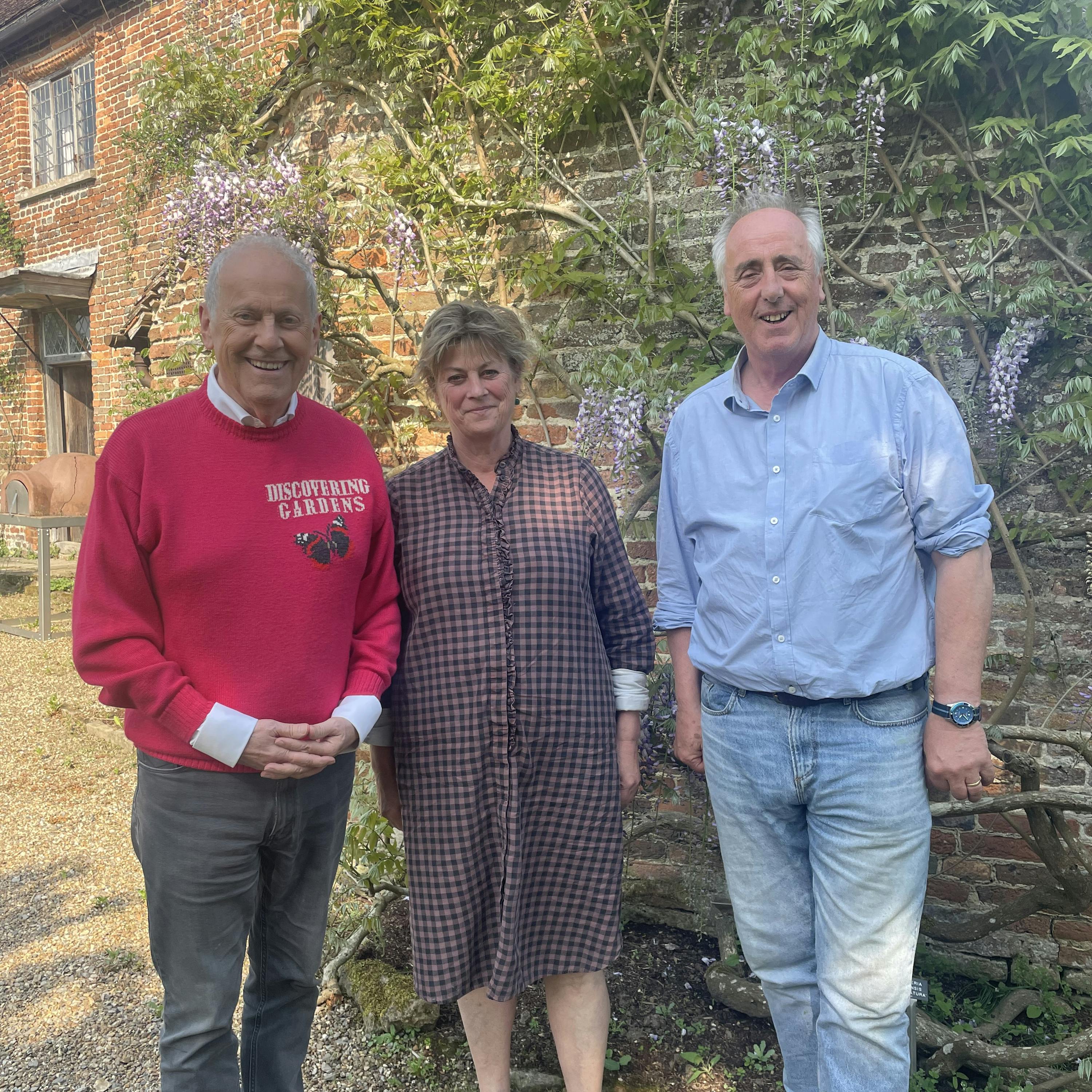
It's Chelsea Flower Show in London this week, and at Rosebud we're celebrating - with this special episode recorded at one of the most beautiful gardens in the world: Sissinghurst Castle in Kent. At Sissinghurst Gyles meets the writer Adam Nicolson, grandson of Vita Sackville-West and Harold Nicolson (who famously conceived and designed the garden there) and his wife Sarah Raven, the plantswoman and entrepreneur, who is one of the most influential people in gardening today. Sarah's garden at Perch Hill in Sussex, and the business she runs from there, have been instrumental in introducing a new abundant, naturalistic and colourful style in gardening, and her story is fascinating.
This is a brilliant conversation about the history of Sissinghurst and the Nicolson family, and about Sarah's childhood 'botanising' with her father, John Raven. It's also about finding wild tulips, the meaning of the word 'wharfinger' and the burden of inheritance.
Adam Nicolson's latest book, which is brilliant, is called Bird School and is available here. Sarah Raven's website is inspirational for any gardener and is here. Her book, A Year Full of Pots, is also highly recommended.
Learn more about your ad choices. Visit podcastchoices.com/adchoices
Hosted on Acast. See acast.com/privacy for more information.


