
 Ask ChatGPT



Christine Baranski’s formative years and how her Polish-American upbringing in Buffalo, family losses, and training shaped her acting career; includes her path to Juilliard, early stage work, and later TV/theater recognition, plus her upcoming London role.
Christine Baranski (born May 2, 1952) is an American actress known for TV and stage work. She grew up in Buffalo in a bilingual Polish-American household; her father, Lucian Baranski, edited a Polish newspaper and later did fundraising for schools/churches; her grandmother “Nana” Janina Baranski was a Polish theater performer and radio personality. Her father died at 8 (aortic aneurysm). She later studied at Juilliard after addressing a sibilant “S” speech issue.
Work and performance helped her process grief; she credits Nana for theatricality and her mother for work ethic and stoicism; she became an “achiever” to earn approval.
Nana’s Polish radio comedy; ballet lessons and a recital; Polish theater group Mazowsze; Juilliard acceptance after “S” drills with Elizabeth Smith and John Houseman; early career at Stratford (understudy in Romeo and Juliet); breakout via The Real Thing; marriage to Matthew Cowles (met through Ghosts).
Written by AI. May contain mistakes.
Gyles shares his thrill of recording in NYC and introduces Christine Baranski.
“and if you sense a little excitement in my voice and manner, It's because I am excited.”
Discover how to effectively advertise your podcast and track conversions.
“Most people probably introduced to her through the sitcom, where Sybil, where she played the character Marianne.”
Gyles shares his thrill of recording in NYC and introduces Christine Baranski.
Christine discusses her earliest memory and her upbringing in Buffalo, NY.
“Christine Baranski, we're very excited that you're here on Rosebud.”
Christine reflects on the impact her grandmother had on her life and career.
“Now, who were these parents and why were they in Buffalo?”
Christine explores the relationship between her mother and grandmother, and family tensions.
“We had twin beds and Nana was to the left of me, and she was a huge influence on my life.”
Christine Baranski shares poignant memories of her childhood and family dynamics.
“She thought Nana was a bit of a diva, and she probably was.”
Baranski discusses coping with her father's death and her mother's strength.
“While every other channel is fighting for your customer's attention, podcasts are where they've already given it.”
Exploring the impact of family tragedies on Christine Baranski's life.
“As I grew older, I grew to love her, and she and I had, well, there's another part of the story, which is my brother took care of my mother, was an utterly devoted son.”
Christine discusses the qualities she inherited from her parents.
“What do you think you've got in you now that you got from each of your parents?”
Christine reflects on her shyness and her journey to becoming a leader.
“and you've just, it all has to do with your ability to shift your weight and handle it and how you get through it.”
Christine recounts her early experiences and love for theater in high school.
“But I think my way of getting attention or getting approval was to be an achiever.”
Christine shares transformative moments that shaped her acting career.
“And had you been seeing live performances, people coming to Buffalo on stage of note?”
Christine reflects on her teenage years and perceptions of relationships.
“And suddenly, I was in this workshop, and I would take a bus to the University of Buffalo, where we did this theater workshop.”
Christine details her audition struggles and acceptance journey to Juilliard.
“I went to, I went to Juilliard at the age of 18.”
Christine discusses her speech impediment and efforts to overcome it.
“Oh, well, when I auditioned for Juilliard, I flew there and I did, they asked what I was going to do for my audition, and I said viola from Twelfth Night, and I heard from the dark theater viola.”
Learn about Christine Baranski's audition experience and acceptance into Juilliard.
“and I auditioned for NYU's theater program and Boston University.”
Explore Christine Baranski's rise in theater and her significant roles.
“probably my most important acting teacher, Michael Kahn, gave me my first job out of school.”
Christine shares the romantic story of how she met her husband.
“Can you remember the moment of seeing him across a crowded room?”
Christine shares her journey through theater and television, reflecting on roles and recognition.
“I have a gay following from the time I did Sybil.”
Christine discusses poignant moments from her life, including joy and profound sadness.
“Three quick questions and you've got to give the instant answer.”
Christine emphasizes the value of being present in the moment and its impact on performance.
“Well, I should thank Julian for, now I want to be a friend.”
Gyles wraps up the conversation and shares details about upcoming performances and gratitude for Christine's presence.
“And then the other two Sundays, I'm reading one of my murder mysteries.”
Gyles wraps up the conversation and shares details about upcoming performances and gratitude for Christine's presence.

Get the gist, explore an idea or ask about something said.
 Claude
On Rosebud with Gyles Brandreth, what are the key points of this episode?
Searching your listeningAutomatic transcript. May contain errors.
0:00Hi, this is Becca Moore of For the Girls Podcast. All right, a quick shout out to our presenting sponsor, Apple Cash. Summer is here, which means the group chats are already spiraling with festival and summer plans. And we all know the worst part of being the one who fronts the money for the passes or housing. That's why this year we're only using Apple Cash. It's a super easy way to settle up because you can do it right in messages. Just tap the plus sign to get started. And the best part is you can spend the money you get right away anywhere Apple Pay is accepted. Every payment is secure and protected by Face ID, Touch ID, or passcode.
0:27and your transactions are never shared on a public feed. Set up your Apple Cash today in the Wallet app. Apple Cash services are provided by Green.Bank, member FDIC. Terms apply. A BetterHelp ad. Hold on. One second. I just need to...
0:50What if you had a room where no one interrupts? No notifications. No expectations. Just space to talk. With BetterHelp, therapy happens in a space that's yours. Visit betterhelp.com slash randompodcast for 10 % off your first month of online therapy. Welcome to Rosebud, presented by Giles Brandreuth, produced by Harriet Jane, and listened to by you. Yes, you. Cue the music. It's just for you.
1:45Hello, this is Charles Brandreth, this is Rosebud, and if you sense a little excitement in my voice and manner, It's because I am excited. I'm excited, first of all, because I'm in New York City. This is where today we happen to be recording an episode of Rosebud. But it's a special episode of Rosebud. It's with a great American actress. People often say, Charles, we love Rosebud, and we love the range of guests you get. And you seem to guest people that other people can't get. How do you do it? Well, all sorts of ways. But one of the ways we do it is I chat to people who've been on Rosebud and seem to have enjoyed it and say to them, who do you think would be good on this?
2:35Who do you think would like doing this? Because there's no point inviting on somebody who actually doesn't want to talk about their past, their childhood, doesn't want to remember things. And I was talking with Julian Fellows, the creator of Downton Abbey, scriptwriter, actor, and a very old friend of mine. And I told him, I said, I'm going over to New York. Who should I get? And he said, do you watch The Gilded Age, my TV series? I said, I do watch The Gilded Age. I love it. You know, you're doing for America in the 1890s what you did for Downton at the turn of the 20th century. He said, exactly.
3:09He said, it's huge. He said, do you want someone who's constantly being nominated for Emmys because of it? I said, I do. And he said, well, do you want somebody who is funny and revealing and rather touching and fascinating. I said, please, please, please. Who is it? And he said, it's Christine Baranski. I said, well, she's your leading lady. He said, yeah. But if I introduce you, she might do it. She hates doing podcasts. She says no to podcasts. But if I affect the introduction, you might hit lucky. And we have hit lucky. Christine Baranski is an actress. And well, she's going to be in the West End coming up shortly.
3:46this fall, because she's going to be in a wonderful play, Hay Fever, by Noel Coward. But I don't think I realized that she was really a classical actress. A lot of Shakespeare, Ibsen, the great works. She then became, of course, a television star. Most people probably introduced to her through the sitcom, where Sybil, where she played the character Marianne. People loved her in Mamma Mia. oh mama mia so christine baransky is our guest and do watch this on youtube as well as listening to her because she comes looking like a star she is a star she's glamorous so intelligent so perceptive you can't help listening and enjoying our special guest today christine baransky Cue the music.
4:43This is the Gilded Age of Rosebud.
5:00Christine Baranski, we're very excited that you're here on Rosebud. Julian Fellows, creator of the Gilded Age, said, oh, you're going to be in New York. If you are lucky, you may get a chance to encounter Christine Baranski. Julian, as you know, is one of my oldest friends, has been on Rosebud. You were with him this week? I was with him, and I had dinner with him two nights in a row. How lucky was I? And I sat to his right, and yes, both times I sat to his right and had the pleasure of his company. Marvelous man. I'm in love with him. Good. Well, I'm already in love with you. Love is in the air.
5:42And we have the example of Julian, of course, who I think proposed to his wife on the day of their first encounter. Yes, a half hour into their meeting, he knew he was going to marry her. But when you see them, and when you see, of course, when you see Emma, you think, well, of course. What a marvelous woman. Well, I'm so grateful to Julian for the introduction and grateful to you. And I'm going to take you right back, Christine Baranski. Am I pronouncing the name correctly? Yes. Good. Born May the 2nd, 1952. I have to ask you this to begin with. What, Christine, is your very first memory? My very first memory was standing in a crib in my home, in my childhood home in Buffalo, New York.
6:31My crib was in my parents' room, and I just have a distinct memory. I was tiny, I mean, to have still been in a crib. Clearly, I wasn't walking yet, but I do remember the texture of what's called the bumper that goes around the crib to make sure the baby doesn't hit her head on one of the wooden slats in the crib. So I have a sensual memory of this bumper. I think it was pink. And I remember standing, standing up and being aware of being a human being. That's it. No other deep thoughts on the subject, but that goes way back. And we can picture you there standing, maybe holding the side of the slats to keep yourself upright.
7:20You're there. That's you. Now, who were these parents and why were they in Buffalo? What was your father's name? What was your mother's name? My father's name was Lucian Baranski. My mother's name was Virginia Mazurowski Baranski. My father was the editor of a Polish newspaper in Buffalo. My mother and father wanted to marry except World War II intervened. and my father then fought in the war as a lieutenant in the army. He fought in the Philippines and was in Nagasaki when they liberated the camps. Why were they in Buffalo? They were in Buffalo because grandparents and great-grandparents were Polish and migrated to what was a very active, large Polish-American community, which still exists in Buffalo.
8:20Why did they come over? Were there many people coming over from Poland at the time they came over? What were they escaping from? Well, my grandfather, my paternal grandfather, actually did come over when World War I broke out, and he was an artist. and he came over. And I think on my mother's side, they also came over. I don't think they were refugees. They were not Jewish. But there was a vast immigration happening, and I think they were from Warsaw. But the wonderful thing about my upbringing, which I love to talk about actually, is that the Polish-American community, I was raised in a bilingual house, and I felt the effects of Polish culture.
9:12My paternal grandmother, Janina Baranski, and my paternal grandfather were actors in the Polish theater community in Buffalo. And my grandfather looked rather like Rudolf Valentino. He was so handsome. I did not know him. He died before I was born. but my grandmother, Janina, lived with us in Buffalo. When I transferred out of that crib, I made my way to another bedroom that I shared with Nana. She didn't act on the stage anymore, but she had a radio show that she wrote with her friend, and they wrote a comedy show on Buffalo Polish radio. So I grew up with an actress. We had twin beds and Nana was to the left of me, and she was a huge influence on my life.
10:07But I have very fond memories, and to this day, I treasure my Polish-American upbringing. Before we leave your grandmother, who you shared the room with, enormous influence to share a room as a little girl with an older woman who is your grandmother. And who was such a vivid personality. Clearly, because she was an actress. And what kind of an actress was she? Well, she performed, she was also a singer. She sang in the Countess Maritza and the Merry Widow. And I don't know what kind of plays. You see, I didn't see her on the stage, but she certainly in her life behaved like an actress. I always say she was my auntie maim.
10:51She had a flamboyant, utterly gracious personality. She wore vivid, colorful clothes. She claimed she knew Mae West, and she had some clothes that one was a feather fan that she said belonged to Mae West. How she might have known Mae West, I don't know. But she was beloved by all her friends because she was warm and gracious, and she was very loving to me, very physically, demonstrative and just, you know, just tender. And when I'd wake up in the middle of the night and be afraid, she would come into my bed and she had lovely long fingernails and she played the piano. So she had beautiful, delicate fingers, but she would scratch my back.
11:38And I'd always say, Nana, scratch my back. And she would, just with these lovely, soft fingernails and fingers, She would just coax me back to sleep. And so she was that kind of loving personality, which my mother was not. My mother was not physically demonstrative. My mother was raised by a woman who was not terribly warm in that way or demonstrative. How was she raised by a woman who was not, given that she is the daughter of her? No, no, no. That was my father's mother. Nana is your father's mother. Yes. Now, why is she living in the house with you? Well, because she actually, it was her house, and she lived upstairs for a long time.
12:24So Nana lived upstairs, and we had the downstairs, and it was Nana's house. And then they decided to rent out the upstairs, probably to get money, to earn some money. So we had people living up there who were renters, And then they built another bedroom as part of the house in the back. And so Nana and I shared that bedroom and my brother Michael was next door. So it was a three bedroom house. And I had really the good fortune of having a roommate with such an extraordinarily gentle, beautiful and vivacious woman. Her friends loved her. She spoke beautiful Polish, and she was known to being a wonderful public speaker in Polish.
13:09And she had a very wealthy friend who would take Nana on trips to Europe because, for the pleasure of her company, she would take Nana all over. And Nana would come home with, you know, souvenirs and things from Warsaw, from Paris, for London. and she had stamps on her luggage back in the days when travel was glamorous and Pan Am and something. Oh, wow, you traveled Pan Am. And how did your mother, your actual mother, get on with her mother-in-law, Nana, your grandmother? There was quite a bit of tension there. Nana, my mother always claimed that Nana would be ill during the day on a day when she was entertaining her friends, but suddenly she came alive when the guests arrived, and then she'd be up till two in the morning having a grand old time.
14:03She thought Nana was a bit of a diva, and she probably was. But my mother was raised in Buffalo, in the Depression, walked to school with newspapers in her shoes, ate jelly sandwiches for all the years of the Depression. And as I said, she didn't marry my father till after the war. And then there's more story to follow. Once I turned eight years old, my life changed dramatically. But my mother did live with, had to live with her mother-in-law, which I think is tough under any circumstances. Before your world changes, age to date, describe your father. He was a big, well-built man, also very gentle, very sweet.
14:55I just have such a strong memory of Sunday mornings. We would have something called the Sunday Morning Club, and he'd get my brother and I in bed and read us the comics before my mother would drag us off to Mass. But he'd wrestle with us on the floor, and he loved dance, and he loved ballet, and so he insisted that I study ballet. And I remember my mother having to take me to Lily Shuvalski's ballet classes. Lily Shuvalski was very Polish, and I remember my first dance recital. After I did my number, whatever it was, I went and ran into my father's arms. He was in the audience, and he just adored me, and I had a wonderful relationship with him.
15:41And I often tell this story, so if any of your listeners have heard this, I'm sorry. But my fondest memory of my father was when he took me to see a Polish singing and dancing group. They're called Mazowsze, and they actually still perform. My father took me, and I was, what was I, maybe seven, maybe eight. it was a date with Tatush. I called him Tatush, which means father. Tatush took me to the ballet and I was sitting on the aisle and my father was sitting next to me and he was, as I said, very tall, well-built man. And the dancing, there's a lot of Polish singing and Polish dancing. And at the curtain call, remember the performers waved their beautiful scarves up and down at the audience.
16:38And I suddenly heard this shouting coming from my father as he shouted, bravo, bravo. And I was stunned that he was being so vociferous. And I thought it was embarrassing. And I looked up and there were tears rolling down his face as he shouted, bravo. and at the time I was so embarrassed that this big man was acting like that and now I think back maybe all these years of being a performer maybe it's for that man shouting bravo What did he do to earn his living at that stage? He was, as I said, an editor of a Polish newspaper then it went bankrupt and he had to get another job so he worked fundraising for building schools and churches in and around the Buffalo area and it meant that he often had to travel and leave us because he was on the road and I don't know how long that lasted but it didn't last very long because he was going off to work one morning and made his way back to the house.
17:57I was already in school, but he banged on the door and told my mother he was having difficulty breathing and he was taken to the hospital by his brother, Matt. And I got back from school and my nana told me that Tatush was in the hospital, that he was taken to the hospital. And nana told my brother and I that. We had just come back from school, so we didn't really know what was happening. My mother was gone. And then I went to bed that night, and I was awakened by the sound of people, especially my nana, who was rather swooning and a lot of crying going on. And my mother walked into my bedroom and told me that my father had died.
18:50And I was eight. How old was he? 49. Oh, my. It was an aortic aneurysm. Oh, my. Sudden death. So we continued to live there for maybe a year, and there was enormous tension between my mother and grandmother. And then my maternal grandparents bought a house near them in another part of Buffalo. It cost all of$10 ,000 at the time. And we moved away from Nana's house. So I was suddenly separated from... Leaving Nana where she was. Yes. And then Nana lived there for a while. God knows how painful it was for Nana. and it was a tremendous loss for me to lose this woman. How had your parents got on as far as you remember?
19:44I mean, you were only eight when he died, so you may have no recollection at all. But did they seem to you to be happy? Yes, I think so. In fact, my mother wanted, you know, he came back from the war, and he didn't talk much about the war. but I remember that my mother often spoke once my father passed away. She said, I wanted nothing more than to be a stay-at-home mother. Because I remember coming back from school, she was a wonderful cook and a wonderful baker. You know, there'd be donuts or there'd be homemade cakes. She wanted that life. And I remember the first eight years of my life being happy and secure.
20:25And then suddenly this changed. Oh, when I had to change schools and get new friends and a new neighborhood. And it was, looking back, I think it was quite traumatic. Did people talk to you about it? I mean, the way people now deal with children grieving is so different. No, no, they did not. My mother, I have no memory of my mother ever discussing my father's death with me, like, how do you feel? In fact, this is rather extraordinary. I was already in my 30s, sitting at the kitchen table with a girlfriend, and my mother was there, and we were talking, I don't know about what, probably about life in Buffalo, whatever.
21:09And my mother actually said to my friend, mind you, I'm a grown woman, she said, well, Chris doesn't, didn't remember her father's death. She had no feelings about it. She was too young to have feelings about it. And I remember saying to her, of course I had feelings about it. I just had to suppress them all because Nana was gone. I couldn't really talk to Nana. Nana was devastated by the death of her son, but then we moved away. And my mother, as I said, was not a demonstrative woman. So no memory of ever sitting on her lap or of her embracing me. I remember one lady, shortly after my father died, was staying with us for a while.
21:59And I remember she said to me, how are you feeling? Are you okay? But otherwise, I had to internalize it. Fortunately, I had been raised very much daily mass and going to church. And I had a relationship with God, and I did a lot of praying. I prayed, enormously helpful. I prayed that, of course, my mother wouldn't die, otherwise I'd be a total orphan, and I prayed for my mother, and then suddenly money became an enormous issue, because my mother didn't, you know, she was prepared to be a housewife. She didn't even know how to drive. So, most of the rest of my youth was spent with a woman raised in the Depression, whose mantra was, we can't afford it, we can't afford it.
22:47And she raped, but she did manage to raise two actually wonderful kids. It was a success, and my brother was a successful, he wound up working in the theater in Buffalo, and she did get a job working, ordering parts or something. So she had a skill set that she was then able to get a job at a place called Huday. She worked at Huday during the war and then worked at the Buffalo Forge Company. She had a mathematical mind and she worked for years until she retired at the age of 70 ordering parts for air conditioners. Can you imagine how dreary that job was? and she had a terribly mean female boss she'd complained bitterly about.
23:38But she did actually have a good enough job to support us.
23:52Hi, this is Becca Moore for the Girls Podcast. All right, a quick shout out to our presenting sponsor, Apple Cash. Summer is here, which means the group chats are already spiraling with festival and summer plans. And we all know the worst part of being the one who fronts the money for the passes or housing. That's why this year we're only using Apple Cash. It's a super easy way to settle up because you can do it right in messages. Just tap the plus sign to get started. And the best part is you can spend the money you get right away anywhere Apple Pay is accepted. Every payment is secure and protected by Face ID, Touch ID, or Passcode, and your transactions are never shared on a public feed.
24:22Set up your Apple Cash today in the Wallet app. Apple Cash services are provided by Green.Bank, member FDIC. Terms apply. While every other channel is fighting for your customer's attention, podcasts are where they've already given it. No one accidentally listens to a podcast for 45 minutes. They choose to be here. They trust the voice in their ears. And when that voice talks about your brand, it doesn't sound like advertising. It sounds like a recommendation from a friend. Acast gives you that trust at scale. Digital precision, post-read authenticity, and performance data that proves it worked.
24:56Don't fight for attention. Buy it with Acast. Learn more by visiting acast.com slash advertise.
25:07Did she remarry? No, we told her we didn't want another tattoo. She said he was irreplaceable and she never even dated. It was awful. Do you feel guilty about that now? No, no, I'm not sure she would have. I'm not sure what the market was for one thing. we said we didn't want another father because our father was so special but looking back she was in her early 40s when he died so she was a beautiful woman she she could have but back then you know what did we know about like a woman in her 40s we we didn't think she was young we thought she you know so there you have it so the rest of her life was much of a muchness she kept working until she was 70.
25:56She did her duty by her children. I admire my mother so much. She was, in fact, if you, when people ask me about Aunt Agnes, I say I'm playing my mother. A survivor, someone who played the hand she was dealt. Tough, but when it came to her family, to taking care of things, She took care of her own mother got cancer. She took care of her mother. She took care of her father. She took care of us. She worked overtime. She put me through Juilliard. I got a scholarship, but she had to throw in lots of money. She supported me. And then the rest of the story goes, she retires at 70 to enjoy her grandchildren.
26:43I had two daughters, and she was hit with the first of three cancers. So her first cancer was lymphoma, stage three. She went through chemo and went into remission. Years later, a lump in her breast. She had breast cancer, had the breast removed, had radiation, went into remission, then lung cancer. She suffered three different forms of cancer. The end of her life came at 85, a recurrence of the lymphoma. And I think what actually took her out was she was one treatment away from finishing chemo. She got pneumonia, which if you smoked most of your life, which she had, pneumonia is going to take you out because you just don't have the lungs.
27:35But my mother was extraordinary. The doctors thought she was something of a medical miracle to have withstood that many treatments for all of those cancers. So she was a tough old broad. She had a great sense of humor, devoted mother, but she was not Nana. And thank God I had Nana for eight years. You say you admired her, and obviously you didn't love her in the way that you loved your father. Not in the same way. But did you love her? Yes. As I grew older, I grew to love her, and she and I had, well, there's another part of the story, which is my brother took care of my mother, was an utterly devoted son.
28:19He married but didn't have children. Utterly devoted, loving son. I became very close to my brother later in life. He dropped dead of an aortic aneurysm at the same age as my father. at the same age and for the same reason. And that nearly broke my mother. Understandably. To lose her beloved son. In exactly the same way she'd lost her beloved husband. And, you know, my brother, at that time, he took her to every single doctor's appointment. I mean, if she needed to have her nails done, every single, but he wouldn't go to a doctor himself. And because of my father's, you know, dying of an aortic aneurysm, he could have had a CAT scan.
29:10He was predisposed. Anyway, that almost broke her. That was the greatest tragedy, my brother's death. And then my mother came to Connecticut, and I took care of my mother until she passed away at age 85. That's a long life. It's a long life. What did you get? It's clear what you got from Nana. your very theatricality. So we see what you got from Nana. What do you think you've got in you now that you got from each of your parents? What are the qualities in you? Well, I think my father was a gentle, loving soul, and so I think I got that from my father's side of the family. But my mother, because I lived with this really strong, female woman who often bitterly complained that she was doing the same job and didn't get the same paycheck as her male colleagues, which is exactly right.
30:14She worked so hard. I think my work ethic and my ability to withstand the ups and downs of life I got from my mother. I married a man who was a juvenile diabetic who then had health problems his whole life, and I had to take him through his last days because he died in 2014. He was 69 years old. That's a long time to live with diabetes. But living through my brother's death and you learn from people close to you how to deal with tragedy. So she had a lot. She had a lot of tough things to deal with, but I admired. She was stoic, you know. She played the hand she was dealt, and I love that expression because, you know, you don't know what life is going to throw at you, and you've just, it all has to do with your ability to shift your weight and handle it and how you get through it.
31:16And that was the sound of it. When you were eight, you just played the hand you were dealt with. You were a little girl, but you were at school. Nobody was giving you any particular comfort. just go back to school, just get on with it, Chris. I know. Did you call me Chris? Well, only because I got earlier the feeling that when you were a child, people did call you Chris. I love it. Very few people call me Chris. When I got to New York, it became Christine. But everybody called me Chris or Krisha. Krisha means little Christine. And my father called me Krisha. In fact, when I was born, my father called everybody and said, But Krisha has arrived because he had a son, but then he wanted a little girl.
31:57And so I was called Krisha. But thank you for calling me Chris. It just takes me right back to my childhood. Yeah, Chris, you know, I was shy, very shy when I was a little girl. And when I got to school, I had to change schools. I was very nervous. I bit my fingernails to the bone. I just didn't feel comfortable for quite a few years. But I think one of the reasons I'm sitting here as someone who's achieved something in her life was because the way to survive was by being a good student. And I became good at that. I was a good student, and I was a very hard worker. And from the time I was in sixth or seventh grade, I was voted president of my class all the way through high school.
32:52I was always voted president of the class. I became comfortable with public speaking in front of my classmates and giving the valedictory address and all that. But I think my way of getting attention or getting approval was to be an achiever. Now, I don't know if my father had lived. My mother often said, your father would not have approved of you going on the stage. He would not have approved of you going to New York to study acting. I thought, how odd, because he loved performers. He wanted me to study ballet. But she thought he would have been very wary of sending me off. But my mother did.
33:29I got a scholarship to Juilliard, and I left Buffalo. But she may have also been wrong about your father. Yes, you're right. Because Nana was, he loved his mother. Yes. And she had that style, and she had loved him. And, you know, once he saw me in plays in high school, whatever, he would have seen, oh, come on, you know, this girl's got talent. He might have been apprehensive because it's such a difficult thing to do. So you, as a schoolgirl, you are successful, you are confident. People are saying you've got leadership qualities. Are you already showing an interest in performing yourself as a teenage schoolgirl?
34:03I think in my imaginative life, I was always in front of an audience. But I remember getting to high school, and in my freshman year of high school, watching backstage. I worked backstage helping with costumes and all. I remember sitting backstage and watching the girls who were performing, thinking, oh my God, how are they doing that? Anyway, the following year, I think I auditioned for a play, and we had this wonderful drama teacher in high school. and her name was Miranda Curry, and she was a former opera singer and ballet dancer. Miranda Curry. She had a marvelous accent. I didn't realize she was Australian.
34:46She certainly sounded English. She had flaming red hair. She was rather, think Maggie Smith, because she had this aquiline nose. She had rather impeccable manners, and she saw something in me, and suddenly I was doing the leads and plays from my junior year and then my senior year. Of course, I was cast as Mame in Mame, and I was the lead in the senior class play, and, well, the rest is history, because by the time I was a junior or senior in high school, I read about the Juilliard School having opened up a drama division, and I read that in the Buffalo Evening News, cut out the article, taped it onto my wall and said, that's where I want to go.
35:38And had you been seeing live performances, people coming to Buffalo on stage of note? What was the theatre? What was your first? It was the Buffalo Studio Arena and they actually had, that was a marvellous regional theatre back then. And they premiered plays by Edward Albee. And they did Beckett plays. I remember seeing several productions there. But what really, the thing that I think was a turning point for me was in Buffalo, you could take a train up to the Stratford Festival in Stratford, Ontario. And as a sophomore or a freshman or sophomore in high school, I remember taking the train up and sitting in the audience.
36:25I was up high, like in a balcony, watching Romeo and Juliet, these marvelous Canadian actors, one of whom was William Hutt, who was really quite a well-known Canadian actor. Romeo and Juliet and Measure for Measure. And I remember it was like, you know, when Cupid strikes you with an arrow and you fall in love, something happened to me up in Stratford. And the other thing that was transformative for me is there was an advertisement in the Buffalo Evening News of a theater workshop that they were doing at the State University of Buffalo. And it would be improvisational theater and theater arts.
37:11And they had auditions for it. And I got in. And suddenly, I went from being a girl who just her whole life was the Polish-American community, and everyone had an S-K-I at the end of her name, or so many vowels that you couldn't find, so many consonants you couldn't find a vowel in the name. That was my world. And suddenly, I was in this workshop, and I would take a bus to the University of Buffalo, where we did this theater workshop. We did African dancing. We did drumming. We did improvisational theater. Anyway, we wound up performing on the streets of Buffalo. We did street theater. And the Buffalo Theater Workshop was connected to the New York Theater Workshop.
37:59And we actually took a trip to New York and performed street theater in Bedford-Stuyvesant with the New York Theater Workshop. You know, I mean, it was just magic. And how old were you at this time? I was 16, 17. There were boys as part of this as well. There were boys. And what did you make of the boys? There were boys. Well, you could imagine. I often joke that when you're raised by nuns who tell you that if a boy touches you anywhere from the neck down, he turns into a wild animal, and if you get pregnant, it's your fault for not controlling him. Well, there's something in that. There is something in that, but you can imagine how alluring sex becomes, because you have to think, if it's so bad, it must be so good.
38:52So, yes, I think the... Did you toy with any of that, or did you just think about it? Oh, yes, I had very sexy boyfriends. I mean, it was so titillating. You know, when it's so forbidden, I'll tell you a funny story. We had a Catholic newspaper called the Catholic Union and Echo. And they would rate the movies that were okay for the family. They were somewhat objectionable, partly objectionable. And then there were movies that were condemned. Actually, condemned, that was the word. Condemned. Well, I would sit and look at the titles of those condemned movies, and my imagination would go rampant.
39:31You can imagine. I can imagine. Like these words, why was it condemned? and what, so yeah, the Catholic schoolgirls are very sexy. We'd have to have our uniforms, if we knelt down, the uniform had to touch the ground, and we had black loafers in these dreary navy blue uniforms, and we couldn't wear makeup at school, but you would see as these girls left the school, as soon as they turned a corner, the skirts got lifted up to a mini skirt, you tuck the skirt in your belt, you put on your lipstick and, you know, I swear it bred more sluts because we were told it was so bad that we just were just desperate.
40:19But there was no, no, no. I went to, I went to Juilliard at the age of 18. I was a virgin. Well, I'm pleased to hear it, but not entirely surprised Couldn't wait to get rid of it. But, you know, we're talking the 60s, where it was love the one you're with and all of that. So it was a very libertine time. I call it Dionysian era, where, you know, I mean, my God, sex, drugs, and rock and roll. But I came to New York as this, you know, Polish Catholic virgin, and I lived with a family in exchange for room and board. I babysat their little child while the mother went off to work in a hospital. So the first year and a half, I lived with a family, but Juilliard was within walking distance.
41:14My mother couldn't afford an apartment for me, certainly not. But yeah, the dream to be an actor was born in Buffalo and a number of very strong influences. This is my teacher, Miranda Curry, hugely influential. But was that a particular challenge because of a speech impediment? Oh, well, when I auditioned for Juilliard, I flew there and I did, they asked what I was going to do for my audition, and I said viola from Twelfth Night, and I heard from the dark theater viola. It's pronounced viola. And what did I do? I did Nina from the Seagull. Anyway, it was time for me to be hearing about where I'd be accepted, and I auditioned for NYU's theater program and Boston University.
42:06I was rejected at NYU, accepted at Boston U, but I still hadn't heard from Juilliard, and I made a phone call. And I was told that I was on a waiting list, but that the reason they're having difficulty with me was because I had sibilant S. The sibilant S didn't make for a lisp, you know, like I didn't have a heavy lisp, but it whistled slightly, or they thought it was a sound that would be very difficult to correct. So during the summer, I went to a speech therapist, and then my mother took me to New York where I then went to John Hausman's office. Oh, the great actor, director. Yes, John Hausman ran the program.
42:59He was the head of the, yes, he was the first head of the drama division. Wow. The august, intimidating John Hausman sat behind his desk. I was handed a page like the one sitting on your lap. It was a page filled with nothing but S words. And I had to say this. Sister Susie sits upon her, that sort of thing. But it went on for an entire page. And then I remember so vividly the voice and speech teacher had her back to me, and she was looking out the window as she was listening to me. And I finished. And her name was Elizabeth Smith. and everyone, she was very intimidating as well. But she was going to make the decision, and John Hausman said, well, Elizabeth?
43:49And all I remember is her nodding. And then John Hausman said, well, congratulations, you've been accepted at Juilliard. And my mother was waiting for me downstairs in what was then Avery Fisher Hall, which, no, it was actually called Philharmonic Hall, where the New York Philharmonic Play, she waited on a bench. And I remember that moment being so special, telling my mother, it still makes me cry, that I got into Juilliard. And we went and had two Southern Comfort Manhattans at the Algonquin Hotel, because the Algonquin Hotel was where Mame, it's referenced in Mame. And then, of course, it's the famous Algonquin.
44:36It's the only time I got drunk with my mother. We waddled home. We waddled back to our cheap room in Times Square. And then that night, would you believe what we saw? Private Lives with Tammy Grimes and Brian Bedford. Wonderful.
45:05Hi, this is Becca Moore for The Girls Podcast. All right, a quick shout out to our presenting sponsor, Apple Cash. Summer is here, which means the group chats are already spiraling with festival and summer plans. And we all know the worst part of being the one who fronts the money for the passes or housing. That's why this year we're only using Apple Cash. It's a super easy way to settle up because you can do it right in messages. Just tap the plus sign to get started. And the best part is you can spend the money you get right away anywhere Apple Pay is accepted. Every payment is secure and protected by Face ID, Touch ID, or passcode, and your transactions are never shared on a public feed.
45:36Set up your Apple Cash today in the Wallet app. Apple Cash services are provided by Green.Bank, member FDIC. Terms apply. The future of furniture is here. Why buy ordinary furniture when you can come home to King? Save up to 50 % on selected designs at the King Living Mid-Year Sale. Shop online or visit your nearest King showroom today. Quick question. When was the last time a display ad changed your mind? Now think about the last time a friend told you about something they loved. Different feeling, right? That's how podcast advertising works. A host who's built real trust with their audience talks about your brand in their own words, in their own voice.
46:17It doesn't interrupt the experience. It's part of it. With Acast, you can access the world's largest podcast marketplace. Choose the right shows, the right audiences, the right format. Then watch the data tell you it worked. You're not buying impressions. You're buying influence. Learn more by visiting acast.com slash advertise.
47:02probably my most important acting teacher, Michael Kahn, gave me my first job out of school. In fact, I didn't collect my diploma because I was already a working actress because Stratford started rehearsing early. So Stratford, Connecticut. Connecticut. And I was hired to be an understudy, A Lady-in-Waiting in Romeo and Juliet, and I understudied Elizabeth Ashley in Cat on a Hot Tin Roof. And then, because that was my first job, and because my senior class play at Juilliard, I played the lead in Tis Pity She's a Whore with an actor named Franklin Seals. So right out of school, I had done already a season at Stratford, and then I'd had several credits to my name.
47:58And so Michael Kahn was hugely important in my acting, early acting career. During those Juilliard years in New York, what sort of a person were you? Were you a wild thing, losing your virginity as soon as possible, and going partying, sex, drugs, and rock and roll? No, no, actually, no, I wasn't that girl. No, I lived in that era, but drugs had no appeal to me. I was probably the hardest working student. I was at Juilliard before it opened. I would go to Juilliard and warm up my voice and be doing exercises and all before classes started. And I was the last one to leave. I was always working.
48:41They were happy years for me. I'm surprised I wasn't hit by a car because I had my head in the clouds going to school and then working. We were always working on some role or another. We were always in a production. I was so happy as a student. It was very competitive. It was hard. But you see, I'd been raised by these nuns who were also so tough that I was used to the rigors of that. And after the first year at Juilliard, they awarded a scholarship to the hardest working, most economically needy student. It was the Jack Landau Scholarship. And I won it. And it was$1 ,000 scholarship. And, of course, I was supposed to use it to live on the following year.
49:28But I took it. And I was at the passport office the next day. and I went to Europe for two months on$1 ,000 and went all these great European cities. That's a lot of money. It was a lot of money in those days, and travel was cheap. I'm talking 1971. That also was a hugely important trip in my life because it just opened up my world. And my mother forbade me to go. She said, you cannot go alone to Europe. She was adamant that I not do it, And I said, well, I'm going to do it. And I'll never forget one. And this is before cell phones, before texting. Even a long distance phone call would have cost a fortune.
50:10So I didn't talk to my mother for eight weeks. I was alone in Europe. And I'll never forget when I arrived home at the airport, I called my mother. And she said, I'm so proud of you. Well done. Yeah. I first saw you on stage in The Real Thing. Oh. But when would that have been? 83, 84. Oh, so that's a few years later. Many, yes. But by that time, was that your breakout moment? It was in that it was a solid gold hit. By that time, when I left Juilliard, as I said, I did Stratford, and then I did quite a few years, like English actors do, of going to regional theatres and playing wonderful roles for four weeks rehearsal, four weeks of playing, stay in inexpensive accommodations, but I did Moliere, I did Shaw, I did Shakespeare, I did Tom Stoppard, I did Billy Dawn in Born Yesterday, I did Cherry Orchard.
51:12I loved, I got to do, I got to utilize my Juilliard training, and it was wonderful. I had no great desire to commodify my youth and like, oh, I have to get on a television show or I want to be a movie star. I didn't think those thoughts at all. In fact, I didn't really want a television career, and I didn't think a movie career was available to me. I didn't think I was that kind of, had those looks to be a movie star. But I spent years doing the regional theater and then made my way by my late 20s to New York, did some off-Broadway, off-off-Broadway, and then Mike Nichols saw me. I did a production of Midsummer Night's Dream in the park, and it was quite successful for me.
52:01I played Helena. It remains probably my favorite stage performance. It was directed by James Lapine, who was about to do a workshop of Sunday in the Park with George. Nobody knew anything about Sunday in the Park with George. Sondheim only had one act written. And anyway, because Sondheim had seen me in Midsommar, I auditioned for Sondheim. I don't know what I sang, but I got a role in Sunday, playing the woman in the center of the painting. And I had a wonderful scene with Bernadette. Anyway, Mike Nichols saw that production, and he wanted me to do the real thing. And then the rest, as they say, is history, because the real thing was a solid gold hit.
52:50and then I had the pleasure of working with Tom Stoppard, Mike Nichols, and Stephen Sondheim in one year. Yeah. Who gets that? Yeah, well, you do. That was 84, and I also got married and got pregnant within that 12-month span. I've never been able to top that one. This is your golden year. How did you meet your husband? Can you remember the moment of seeing him across a crowded room? No, he was Oswald to my Regina in Ghosts, Oh. And he was this eccentric man. That's an exhausting play. Oh. Ibsen play. Utterly dreary. Well, it's not utterly dreary, but it's the one where the sun has inherited the disease.
53:28Venereal disease. And, of course, I was the pert maid. I played what I call those soubrette roles. But there was this eccentric actor. I remember he had wire glasses that he wore when he was motorcycling, and they dangled from his ear. he had this long blonde hair and he talked sort of like he was Irish or something. But I remember him smoking these unfiltered cigarettes and he drove a motorcycle. And one night, we became kind of friendly. I thought he was terribly exotic, but sexy. And he asked if I wanted to ride home on his motorcycle. And I don't even like driving in cars. I don't like high-speed driving because my brother had a terrible car accident.
54:13And after the age of 16, cars made me nervous. But can you imagine, I got on the back of this motorcycle and he named all his motorcycles. And this one's name was Lucifer. Oh my God. Okay. So I'm on the back of Lucifer with my arms around this big leather jacket going over across the Williamsburg Bridge with this sexy guy with the blonde hair. And we get to the Lower East Side where we went and had drinks and we stayed late talking in this little restaurant in Chinatown. And it was clear that this man was really interesting and passionate and intellectual and also very devout Roman Catholic. So we began just talking wide and deep very quickly.
55:03Anyway, we were married. I think the whole thing took a year. We fell in love and got married. And he drove me away from the church on my wedding day. I was side saddle on the back of the motorcycle. Can you remember what the wedding day motorcycle was called? I think it was Lucifer. Again. We're mostly supposed to be talking about your formative years. But what has been interesting about you is your formative years have gone on and on. I know. I'm still being formed, I'm afraid. But you are very blessed in that. I know. Because when I say your name to different people, they say different things.
55:41I know. Isn't that wonderful? You say Sybil. Some people. I know. I suppose it's because each generation, you've been lucky enough to. But you know, now because of YouTube and because everything's available to everyone all the time. I'm intergenerational. I have young, young girls who are obsessed with Tanya in Mamma Mia. I have a gay following from the time I did Sybil. There are people who, like you, will reference the real thing or will reference earlier theater work that they've seen me in the Manhattan Theater Club. I never know what people are going to bring up. If I went to Beijing, China, and I put my hair in hair clips, I would be recognized for the Big Bang Theory, which I didn't even have a recur, I had a recurring role, but I was rarely on it.
56:32I could count maybe 12 times I was on that show, because I was Leonard's mother. I was the leading man's mother. And she was such a unique character that the Big Bang Theory takes me around the globe as well. What would you like to be recognized for? I don't know. When you get to heaven, and you will, because those Catholic nuns have guaranteed that for you, you know? You will get to heaven, and you have to declare. I haven't cashed in on the slutty thing yet, though. I haven't cashed in on that. No, but there's time. I explained that the formative years are just beginning, and you're on your way to London where that sort of thing is available, and what happens in London stays in London.
57:15So you need to have no fear. And your leading man in London is going to be Richard E. Grant. I know. Isn't that marvelous? We talked to him recently and, though tragically widowed. I know. And feeling it still. Oh, he loved his wife. He loved his wife. How does one cope with loneliness and grief? Well, you know, I'm very lucky because Matthew passed away and I was back at work a few months later on The Good Wife, and that was my family. Juliana was there. The crew was there. I was close friends with the producer. Work is salvation. Work is absolutely grounding, and now I have my Gilded Age family.
57:59I love it. I love all the actors on The Gilded Age. So, you know, I'm going to take so much baggage up to heaven. I have just bags full of ground. And I don't have any one favorite thing, but I do remember being flouncing around as Helena in a big wide hat. And I was falling in love with Matthew then. He drove me on the motorcycle from Garden City, Long Island, where I was doing Ghosts. And then he'd take me to rehearsal to the public theater. And I was in love with this very extraordinary guy. I was so alive then that maybe, and that feeling of life and love infused my performance. So Midsummer Night's Dream was very special.
58:48I think you can still access it on YouTube, but it was magical. And I was outside in the park performing Shakespeare. And of course, Helena has those marvelous plaintive monologues. She suffers so, and she's so in love. and I do think it's really one of my favorite performances. Good. Well, I'm going to find it on YouTube. I'm looking forward to it. We're going to come to the end now. Does that mean I have to start talking about my death? No. Inevitable. You're going to have to talk about what life has taught you. You're going to London. You're going to be in Hay Fever. Yeah. A wonderful play by Noel Coward.
59:27Of course, Maggie Smith, who you've referenced, who in many ways. Well, I revered Maggie Smith. I thought she could do anything. She could do anything, except I don't think she could sing. And I think if Maggie Smith had been able to sing, can you imagine her, Mrs. Lovett? Can you imagine her doing Phyllis in Follies? Leave you, leave you, how could I leave you? I mean, she would have been the ultimate sometime. She didn't believe she could sing. She does sing in two movies. In Oh, What a Lovely War, she sings wonderfully. Oh, there you go. I've seen a scene in Travels with My Aunt where she sings with Robert Stevens, and every time I see it, it brings tears to my eyes.
1:00:09You know, Judi Dench sang Send in the Clouds. She did a little night music. Oh, Maggie Smith should have sung Sondheim. But Maggie Smith did play the girl, the daughter, in Hay Fever, directed by Noel Card. She played Myra Arundel. Yeah, of course she did. You're right. And I still watch that. And Richard E. Grant, we talk about that scene between Richard and Myra where the dialogue is just rapid fire and then they wind up kissing and falling in each other. I mean, it's consummate act, consummate light comedic acting. Okay, we are coming to the end. Three quick questions and you've got to give the instant answer.
1:00:52Oh, really? You can't think about it. I want from your life a moment of joy. Christmas in Buffalo with my whole family when my father was still alive. And we sang Christmas carols in English and in Polish. And we had a traditional Polish Christmas Eve called Wigilia. Lovely. Now, and I know what the answer is going to be, but I'm still going to ask the question. A moment of sadness that comes straight into your head. The day I had to choose a coffin for my brother. Oh. I've never known a deeper sadness. And I assumed it would be your father. Well, I was young then. You were only eight, weren't you?
1:01:35I was eight, and that's the moment of profound sadness. But if you're talking adult... No, you're right, because also you explained you weren't allowed to have feelings because the show was moving on. It's infinite sadness when my mother put her head on my chest and said, you don't have a father anymore, of course. but in my adulthood to lose my brother. What did he mean to you? Well, we lived through my father's death. We grew up together. We fought like hell when we were little, but then we became very close, and he was a wonderful uncle to my daughters. Like my father, he had a heart of gold, and he was utterly devoted to me and to my mother.
1:02:14So his loss, his death, was met with the same tragic sense as my father's because he was really well loved by people. So it was like losing somebody who was a beautiful human being. What has life taught you, Chris?
1:02:37The value of presence, the value of being totally present in every given moment. And I'll tell you why I say that, because I had to give a speech. I was given an honorary doctorate at Juilliard, and of course I had to speak to the students. And I thought, oh my God, how am I going to address a class full of performing artists who are going out in the world, and I don't want to use cliches and use the word dreams or journey or hard work or any of those hackneyed phrases. And so I gave it a lot of thought in the depths of me. what is the best advice. And what I said to them, which is now what I will say to you is, show up.
1:03:23I said, you've got to show up. When you're a performing artist, your job is to bring your best physical, vocal, emotional, psychic, spiritual self onto a stage. If you're a musician, if you're a dancer, if you're an actor, if it's stage, if it's screen, you have to be present. And in an age where we're so distracted with these damn telephones and everything, it's getting harder for people to really be present. But the value of presence means that you are living in the moment, and so you're available to everything that's happening. And it's a great gift. You're aware of other people when they're very present.
1:04:09you're attracted to those people because they're there. Simone Weil, the great Catholic mystic, was quoted as saying the greatest gift you can give another human being is your total attention. Like what I'm giving you right now and you're giving me. And it's what I give my grandsons. When I'm with them, my greatest gift is to just be with them. Like my nana was with me. She was totally present with me. Well, you have commanded my total attention. I'm so grateful to you for showing up. Oh. You are just the best. I've loved it. Well, I should thank Julian for, now I want to be a friend. Yeah. Can I see you in London?
1:04:54You're definitely going to see me. Can you give my regards to the king and say he was a lesson in grace and authenticity and generosity? And we Americans felt blessed to have that on our soil. We are badly in need of that. Please tell him that. I'll tell him all that. And I'll tell you now, I feel blessed to have had you here today on Rosebud. Can I have one of those, darling? Can one of your Rosebud sweaters? I'm going to work on that for you. Of course you can. It's been a real pleasure, Giles. It's been a great pleasure. Thank you. Thank you so much. Thank you.
1:05:32That was Christine Baratsky. and I'd have given her a Tony Award conversation with me just now. She's won, actually, Tony Awards. Whenever I say to my producer, Harriet Jane, oh, you know, they're Tony-nominated, Emmy-nominated, Oscar-nominated, she said, nomination is one thing. You've got to have won it for it to count. That's Harriet's view. And I can tell you, and I know this won't be edited out by our brilliant producer, Harriet, Baranski has won two Tony Awards and one of them actually was for the thing i saw in back in 1984 uh tom stoppard's the real thing as i mentioned earlier she's going to be in the west end this autumn i called it fall earlier and just a few days in new york and already you're adopting the language she's going to be i think it's at wyndham's theater uh with richard e grant they're going to be appearing together in nolcard's brilliant play hay fever and i'm definitely going to go to that and in fact we've agreed um that we are going to go and see that and afterwards Julian Fellows and his wife Emma and me and my wife Michelle we're going to take Christine Baranski or Chris as I call her out for supper so you may spot us at some nice West End diner you're right I do live a charmed life I'm conscious of it and very grateful to our guests for coming along so that was Christine Baranski hope you enjoyed the show, do go and see her on stage, and maybe come and see me on stage, because in August, I will be at the Edinburgh Fringe for a month, the whole of August.
1:07:11It's a matinee, every afternoon at four o 'clock. Harriet Jane, my producer and friend, shall be on stage with me. It's not really Rosebud. There'll be a twist of Rosebud in it. It's a show that I'm calling up memory lane. So it's me telling some of my stories, dropping a few names. Harriet has promised to give me a sort of bonus every time I drop the name of someone who is actually still alive, which, well, it's going to be quite a challenge. I don't think I'm going to be getting much bonus money. But anyway, if you enjoy Rosebud, and particularly you enjoy the episodes where Harriet pops up on a Tuesday, or if you're a member of the Rosebud family and you hear the a show that we do on a Sunday, because every month we have a couple of special rosebuds where Harriet and I are, you know, chatting together.
1:07:59And then the other two Sundays, I'm reading one of my murder mysteries. That's what you get if you belong to the rosebud family, where you can also get ad free listening, if that's your bag. And you do to do that, you simply go to patreon.com p-a-t-r-e-o-n dot com forward slash rosebud and that tells you what to do but we're here free for you every friday and every tuesday we have more rosebud do keep joining us we love having you without you there wouldn't be rosebud and without guests like christine baransky well my life would be much much emptier i'm really grateful to her and to julian for suggesting her so my thanks to them and especially to you and of course to harriet jane my producer and to alec caddell who puts all these conversations that we're recording now onto youtube so you can see us there and do take a look at miss baransky because my goodness if you want to see old world glamour in a very modern person well that's what you'll find on youtube you just go to youtube find rose bud with giles brandreth and there we are for this week for this friday goodbye until next time that's giles brandreth that's rosebud cue the music
1:10:09Hi, this is Becca Moore. for the girls podcast. All right, a quick shout out to our presenting sponsor, Apple Cash. Summer is here, which means the group chats are already spiraling with festival and summer plans. And we all know the worst part of being the one who fronts the money for the passes or housing. That's why this year we're only using Apple Cash. It's a super easy way to settle up because you can do it right in messages. Just tap the plus sign to get started. And the best part is you can spend the money you get right away anywhere Apple Pay is accepted. Every payment is secure and protected by Face ID, Touch ID, or passcode, and your transactions are never shared on a public feed.
1:10:40Set up your Apple Cash today in the Wallet app. Apple Cash services are provided by Green.Bank, member FDIC. Terms apply.
1:11:10front of you. Browse thousands of the world's leading podcasts, book host reads or run your own ads, and track every conversion in real time. Same skills you already have, brand new results. Acast. Acast.com slash advertise.
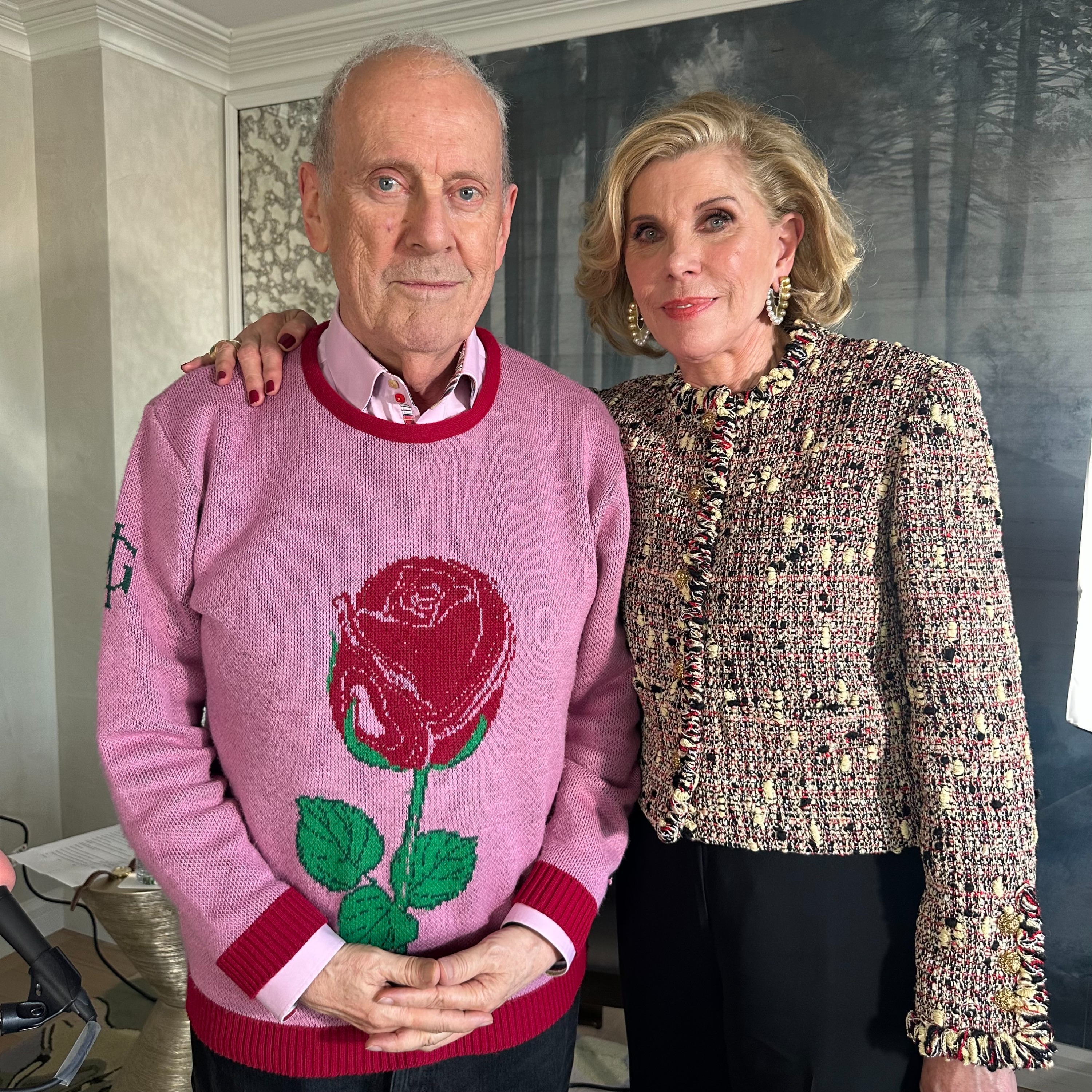
We're in New York City, so we need glamour, class, poise, elegance, talent and wit; and we're pleased to say we've got them all... because our guest today is Christine Baranski. Star of The Gilded Age, The Good Wife, Sybil, Mama Mia and guest star in Big Bang Theory, Christine Baranski is a gifted actress with an impressive body of work across stage, television and film. In this brilliant and in-depth conversation with Gyles, she talks about her childhood in a close Polish family in Buffalo, New York, where she shared a bedroom with her theatrical and flamboyant grandmother, a formative influence. She talks about the death of her father when she was only nine years old, and the ways in which life changed following that devastating event. She talks about being a sexy Catholic schoolgirl. She talks about getting a place at the prestigious Juillard in New York, and about her early work in theatre.
This is a fascinating, honest, moving and elegant conversation with a great star of the old school. We felt privileged to spend time with Christine Baranski, and we hope you will feel the same!
Christine is in Hay Fever with Richard E Grant in London from September 2026. Tickets are available here.
Enjoy this.
Hosted on Acast. See acast.com/privacy for more information.


