
 Ask ChatGPT


 Rosebud with Gyles Brandreth
17 Aug 2026 · 30m · 16 chapters
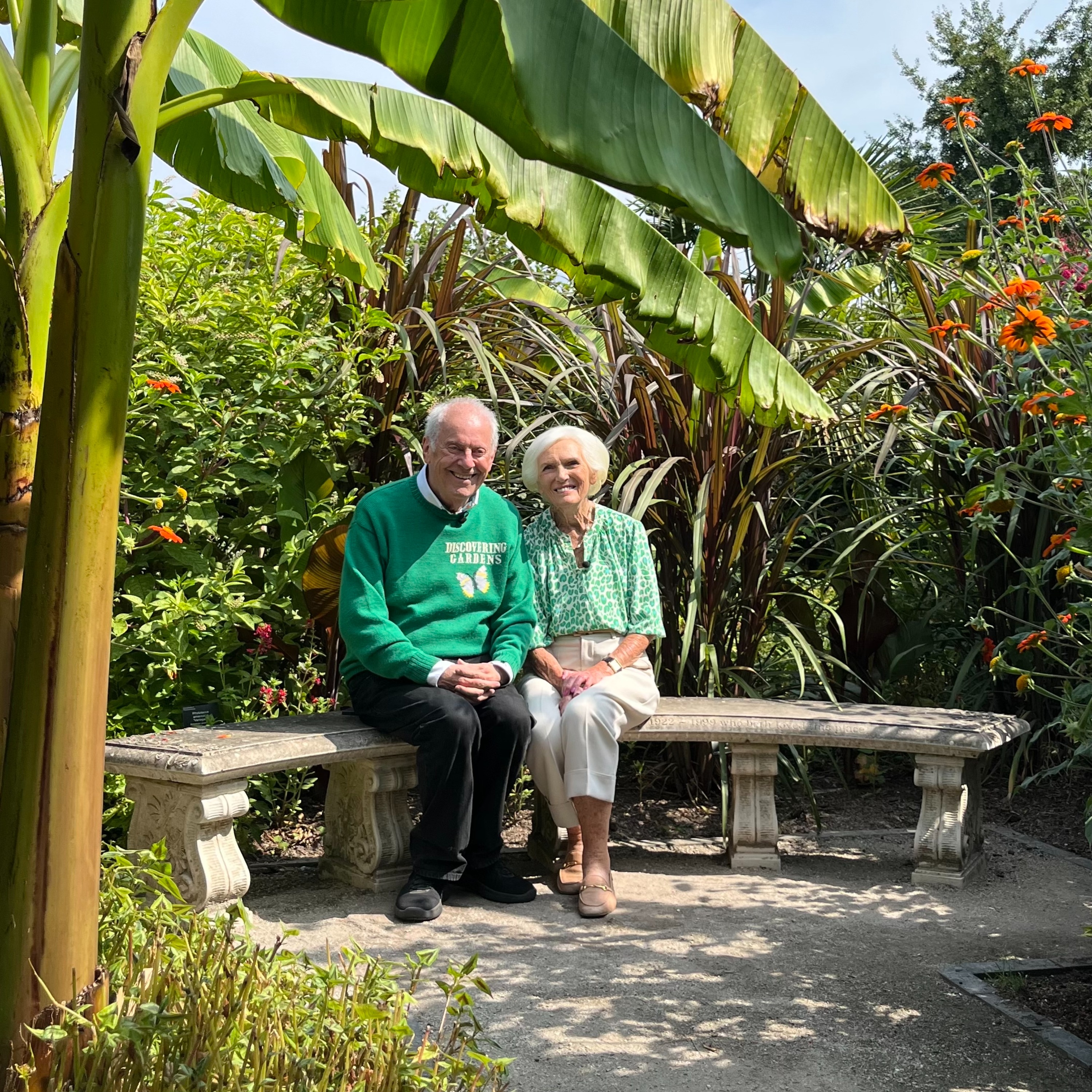
A special Rosebud episode recorded at RHS Garden Wisley (Royal Horticultural Society) exploring why gardens and gardening improve mental and physical health, and how biodiversity supports humans.
research shows green spaces can lower blood pressure and stress hormones within minutes; NHS doctors prescribe green space; “50 shades of green” matters because humans can distinguish more green shades; plant scents (e.g., lavender) can reduce anxiety; biodiversity acts as an “early warning system” for environmental problems affecting food, medicines, and air.
Wisley’s dry garden with grey-foliage plants; Wisley’s 25,000 species; experiments comparing natural green views vs color-manipulated screens; advice to improve biodiversity via many flowering species and less mowing.
Dame Mary Berry (celebrated cook/baker; long-time gardener; RHS ambassador) and James Wong (ethnobotanist; author/TV/radio; studies human use of plants; RHS ambassador).
Written by AI. May contain mistakes.
Gyles Brandreth discusses the enchanting qualities of gardens and their restorative effects.
“It is a little bit different this rosebud.”
Dame Mary Berry shares her first garden memories and how they shaped her life.
“So, welcome to this, I think, unique episode of Rosebud.”
Mary Berry reflects on her gardening mistakes and the importance of knowledge and patience.
“Can you remember the first time you, Mary, discovered a garden?”
Discussion about favorite plants, gardening preferences, and color choices.
“Just as in cooking, you know, you have to follow a recipe and you do get a meal in a day.”
Mary Berry explains her role as an RHS ambassador and promotes the benefits of gardening.
“We have a huge bed of Chandos Beauty, which has brilliant foliage, lovely scent.”
Gyles Brandreth expresses excitement about RHS Wisley and its exotic garden features.
“And also all the year round, because as long as you dress for it, it's lovely, and you feel so good in the winter when the snow's on the ground.”
Meet ethnobotanist James Wong and his background.
“She's one of my favorite people on the planet.”
Discover the mental and physical health benefits of green spaces.
“and from that series you did years ago, which tempted me into it because it was called Grow Your Own Drugs.”
Learn how the color green impacts our health and well-being.
“So, you know, on one hand, it's aesthetic, it's beautiful, it takes your breath away.”
Understand what biodiversity means and its significance for the environment.
“because when you played the manipulated views of the same scene, they didn't work as well.”
Explore how biodiversity serves as an indicator of environmental health.
“Oh, yeah, you've used the word biodiversity.”
Tips for enhancing biodiversity in your own garden or space.
“So what you're saying is that the more butterflies, the more bees, the more different things we see, the better it is for us.”
James shares his childhood memory that sparked his passion for plants.
“So James, I want to know your very first memory of nature, of a garden, given it's been your life.”
Discussing favorite plants and the joys of gardening while enjoying cake.
“when I was a little kid, I've just become obsessed with wanting to grow them and like experiment with them and learn new things about them.”
Learn about the benefits of gardening and connecting with nature.
“Grow is actually the name of their app as well.”
Learn about the benefits of gardening and connecting with nature.
“Remember enjoying Saturday morning cartoons and savoring the sugary milk at the bottom of your cereal bowl?”

Get the gist, explore an idea or ask about something said.
 Claude
On Rosebud with Gyles Brandreth, what are the key points of this episode?
Searching your listeningAutomatic transcript. May contain errors.
0:00There's a headline every 30 minutes for our show, I'm pretty sure. Welcome to Get Real. I'm your host, Amanda Hirsch. This is the show for the reality TV obsessed. You thought the show was crazy. Living it was crazier. I was dripping sweat before I even started. For the stars and stands of the Hulu reality verse. Do we think she's stirring the pot to secure a place on the show? Find and listen to Get Real wherever you get your podcasts. And stream new episodes Thursdays on Hulu and Hulu on Disney+. Terms apply.
0:32Hello, I'm Giles Brandreth and if I sound a bit different it's because A I'm excited and B I'm out of doors. This is a very special episode of Rosebud. It's coming to you from the RHS garden Wisley. It is a little bit different this rosebud. It's brought to you by the Royal Horticultural Society, the UK's gardening charity helping people and plants to grow. Oh yes, this is a special one. Cue the music.
1:21Hello. I'm really in a very happy frame of mind, and for a reason. I'm at one of my favourite gardens in all the world. It's the RHS Garden, Wisley. Have you ever noticed that the moment you step into a beautiful garden, everything seems to slow down? All those endless to-do lists, the emails, the general hustle and bustle of life, they manage to melt into the background. There's something magical about it. For me, every garden is an enchanted place. And this garden, where I am today, is truly an enchanted place. So I've escaped here to explore, well, why gardens are so special. Why do gardens and gardening itself have such an extraordinary effect on us?
2:11Is it the array of colours? I do love colour. If you know my jumpers, you'll know that. Is it the scent, the fragrances? Yeah. Smell is so important. Is it birdsong? I adore birdsong. Or perhaps the simple satisfaction of getting your hands in the soil and watching something grow. In my case, it doesn't always grow as I'd hoped. But there, that's the idea. Whatever it is, there seems to be something restorative about it all. And joining me on today's very special episode, we've got two wonderful RHS ambassadors. as a friend of mine, a real friend of mine, also a friend of rosebud, Dame Mary Berry, and James Wong.
2:53They're going to explore the joy of gardening with me. They're going to look at the power of nature and why the RHS believes helping people and plants to grow can make us all happier and healthier. And there's research that shows that gardens do make us happier and healthier. It's not just a claim, it's a fact. So, welcome to this, I think, unique episode of Rosebud. We're called Rosebud for a reason. We love roses. We love flowers. We love plants. We love nature. We love the joy of gardens. This is one of the best.
3:41Look who I have discovered at RHS Wisley. It is none other than one of my favourite human beings, Dame Mary Berry. It's lovely to see you here, Mary. Well, I love coming to Wisley. It's such a treat. I always try and go sort of early in the morning or a bit later in the afternoon because it's more peaceful. But the moment you come through the gates, there's so much to explore. Can you remember your first visit here? I can remember my first visit here when we first got married, and that's 60 years ago. Oh, wow. And it was like a breath of fresh air. And I was full of questions because I had a very small, shady garden.
4:28And I was looking at where they were growing shady plants with a notebook. No, I don't have a notebook, but I love to... I learn so much. Can you remember the first time you, Mary, discovered a garden? Not necessarily this one, before this one. Your first garden moment in your life, your first garden memory? It was in the war. We had a big back garden at South Lawn in Bath. and dad wasn't that keen on gardening but you you would used to dig for britain and he grew potatoes raspberries which i love picking um he grew celery and i remember him uh like you bank up potatoes he would wrap the celery in a newspaper and then bank it up and it's amazing how all that sticks and I used to follow him around like a dog really and to chat and talk and pick and he grew sweet peas for mum.
5:30Mum didn't garden but she loved flowers in the house and I must say when I come back from a holiday the first thing I do is pick some flowers and put them in the house. Doing that with your father you know creating food, digging for victory, do you think that actually influenced the rest of your life, you becoming known as a cook, the baking, etc. Does that play into the rest of your story? Well, it's funny, I can remember vividly the garden and the plants. And then there was a gap when we had three children and so much to do. And the garden, it was a football for rugger, for cricket. And I didn't take too much interest in the garden then because the children were more important.
6:11And then, of course, gradually, as they needed us less, then I became interested in gardening. because there was a gap in my life. And I remembered so much of my very early life with Dad and it helped me, but I made so many mistakes. You know, I realised that we have to know our soil and you can have that analysed here. And you've got to know where the sun is at midday. You know, some things want full sun, some things want shade. and so you've got to obey the rules. Just as in cooking, you know, you have to follow a recipe and you do get a meal in a day. You've got to be more patient with gardening.
6:57What I love about these gardens is, having lived all my life in London, there was a time I didn't have a garden. I simply lived in flats and the most you had was a window box. And then, well, that's when you need to be able to get onto the bus, onto the train, onto a car and come to somewhere like RHS Wisley. if you don't have a garden here is a garden for you exactly that is important but we lived in a house in notting hill and we had just a yard but we had hanging baskets and i can remember in those days you had milk delivered and so i used to put the milk bottle out full of water put it in my hanging basket which was a routine and they did really well and the same with the window boxes.
7:38It was because I was taking my milk bottles out with water because things do want water, regularly watering, and then you get success. Do you have a favourite flower or plant? Oh, definitely. I have roses I like. This is a rosebud. We have a huge bed of Chandos Beauty, which has brilliant foliage, lovely scent. What more can I want? Lovely. I'm for roses too, but I'm very fond of pansies and peonies. Are you? Yeah, that's my great idea. I love pianists too, but they don't last a long time. And again, I can remember coming here and asking whether I kind of cut them down as soon as they're done so it doesn't get untidy, and I was told, no, you leave the foliage on until the end of the season.
8:24You see, you can have so much advice with a smile, and you're not meant to feel stupid. And you know, they've now got their own app. Everyone's got an app. It's called Grow. And, I mean, you just go on the app, and then you can actually just show your phone a plant, and the RHS tells you immediately what it is. That's terribly clever. Oh, the world is, I mean... I must try that. Oh, good. Well done, you. That's what I love about you. You're still trying new things. Whereas, I mean, I can't cope with some of the new things, you know. I can't. When I go to the supermarket, unidentified object in bagging area, I want to kick the machine.
9:00At home, do you design your borders? Do you actually think it through? or is it more random? It's mostly at random and I make mistakes but it is important to have low at the front and higher at the back and I always over plant so there's no room for any weeds. I like that. I like that. Over plant. Now I think we have a difference of opinion about bright colours. Yes. I love bright colours. I love, forgive me, a municipal garden that's full of, you know, plants that are bright red or bright orange. You are not into orange, are you? I'm not very clean on orange and I think that yellow is very much a spring when you have the lovely all different kinds of narcissus And then I love them.
9:44I love the way you say Narcissi. Do you know all the Latin names? Daffodils. Yeah, I know. Daffs. And I'd say Narcissus is, but Narcissi is the correct thing. So do you actually know the Latin names? I don't know. I failed Latin. I don't know if... No, I didn't do Latin at school. And I don't use any Latin names because I've no idea what they are. We found this little room here. I love it that there are all these little pockets of space where we're sitting on a bench, a stone bench that was put here in memory of someone who used to come here and love it. In 1924, I think they departed because I read it.
10:22Do you know how long the garden has been here before it became RHS Wesley? I have no idea. I must find out. We've an awful lot to find out, haven't we? Do you know? But actually, that's what makes life interesting, learning new things as the years go by. Yes. And I was thinking, actually, about climate change. So has the garden here taken on board the changes that come with climate change? It certainly has. There are sections of the garden that are dry gardens and a lot of grey plants, some gravel and things that will take the heat without water. A grey plant? What's a grey plant? Most of the plants in a dry garden have foliage of grey.
11:06They don't seem to need so much water and a lot of grasses and things like that. How do you, Mary Berry, know so much about gardens and gardening? I thought you were a cook and a baker. How do you know all this? Because this has just been a passion for you, a hobby. It hasn't ever been. You've ever earned your living in gardening, have you? No, I certainly haven't, and I don't know any latter names, and I make so many mistakes. I do know about cooking, but for me, I love to grow all my own vegetables that we eat. The Royal Horticultural Society is very proud, they told me this, to have you as an RHS ambassador.
11:44but they didn't actually say what that means. What is your ambassadorial role? What do you do? I try to encourage people to come to their gardens and tell them what great value it is to be a member because it's not only for people who have got big gardens. You can see an awful lot of houseplants and get advice about houseplants. Not everybody's got a big garden or a little garden, just window boxes and hanging baskets. It is for everybody. who wants to know the benefit of being outdoors. And if you're a member, you can go to any one of the five gardens around the UK? You can indeed, and each membership, it's for two people.
12:26And so you can go take a friend, you know, someone who's feeling a bit sad, take them out for the day, they'll feel a lot better in the great outdoors. And also all the year round, because as long as you dress for it, it's lovely, and you feel so good in the winter when the snow's on the ground. You know, there's so much you can learn. Oh, when you said dress for it, I thought, oh, you have to wear a hat as a garden party. No, no, no, but keep warm. But what I like, because as I get older, I want to travel less. I want to go abroad less because of the hassle of the airports and all of that. And being here in this exotic garden at RHS Wisley, look, there's a banana plant there.
13:02Isn't that a banana plant? It is. No bananas, but banana plant. Nonetheless, it gives you the flavour. And some of these, look at those look like, what are they? I think they look like variegated nettles, but you can say it because it looks a bit complicated for me. Titonia... Oh, randifolia! Rotantifolia! Titonia rotantifolia! Anyway, we are... It sounds as though you knew about it, you don't! I've got no idea, but what I do know is this is an exotic garden. So the point is, you don't need to go abroad, you don't need to go to the airport. All you need to do is get to RHS, Wisley or one or the other, well they've got five gardens in all, and the world of plants is there for you.
13:43I think you're the best, Mary. Shall we go and find ourselves some tea and some cake, if you've brought it, and picnics are allowed?
14:05Oh, I just love Mary Berry. She's one of my favorite people on the planet. I've left her to go off for a cup of coffee and a piece of cake. I'm climbing the hill up to the Lavender Hill. Right at the top is Lavender Hill. And standing in front of the Lavender is, well, I think he's going to be my new best friend. I've seen him on television. I've heard him on the radio. And I know he's an ethnobotanist. I'm going to find out what that means. It is the great James Wong. James, I know you from radio, from television, from your newspaper columns, from your books, and from that series you did years ago, which tempted me into it because it was called Grow Your Own Drugs.
14:43Yeah, exactly. You know that right? Exactly, yes. They turned out to be health-giving drugs. But when I looked you up, it said that you are an ethnobotanist. Yes. What is an ethnobotanist? Okay, so it's essentially a really fancy word for a scientist that studies human use of plants, whether that's like food or medicine or horticulture, ornamental horticulture. I've been looking at today. So what to you is the main value of a place like RHS Wisley? To a human, what is the main value of it? I think, you know, to a lot of people, like a space like this is pretty and it's ornamental and they have trouble seeing beyond that.
15:22Because, you know, it is so beautiful that that's the first thing that kind of really excites your brain and your mind and you're looking at things. But what we are beginning to realise now is the measurable impacts that walking around a space like this can have a mental and physical health. Can you give me one or two examples? Yeah, well we now know, thanks to quite a lot of research, that it can pretty much instantly lower your blood pressure and your stress hormones within a few minutes of being in the space. Literally five minutes of being out in the garden. Exactly. You calm down. Yeah, and considering the mental health epidemic that we're faced these days, physically being in the space, even simulated green environments, you don't even have to do the exercise.
15:57If you have a disability, for example, and you're a wheelchair user, simply moving through the space, seeing these green colours, can have this enormous impact. And this is measured and measurable. Absolutely. There's really good data, for example, on hospital healing times increased by simply a view of a green space. So, you know, on one hand, it's aesthetic, it's beautiful, it takes your breath away. On the other hand, we now have excellent data, like doctors on the NHS are now prescribing spending time in green space. And what does it do to you? What is it physically doing to me coming out to a garden like this for a morning?
16:31So there are lots of different things at play. We're still trying to figure out exactly the mechanisms why spending time in green space works, but we know it's various things. So one of it is literally just seeing new things, like having new exposure to new environments. Another one may be the color. Another one is the fresh air. Tell me about the color. Oh, the color green. So human eyes can see more shades of green than any other color. And it comes from being around plants for so long. We can see dramatically more colors of green. And we now know this yeah 50 shades of green is much more important than 50 shades of grey Even even to me This is your next book.
17:10It is a global bestseller. It's bizarre James Wong we were trying to figure out why we can see so many shades of green Well essentially if you're wandering around the savanna in our deep evolutionary past You need to be able to detect the differences between plants So you can really tell the difference between things that are toxic and things that are tasty if you're a rubbish botanist and you can't tell the difference between plants you're very very likely not to feed yourself but in fact poison yourself so what is the benefit to me of coming out and being exposed to a wonderful array of greens here yes and as well as the lavender we've just been looking at what is the value to me of these colors on my health we don't know the exact mechanism behind how that works but we do know that being in a green space is beneficial and one of them is the color and the reason why we know this is through an experiment where they put a bunch of blokes on treadmills, we knew that when you exercise in green space, like we, one of the things is physically the exercise, but when you exercise in green space, you burn more calories and yet it feels easier.
18:08And so they took these views on screens of natural environments and then they played them and then they manipulated the colors. So there was a black and white version, there was a red version and there was the natural green version. And it definitely is part of that color because when you played the manipulated views of the same scene, they didn't work as well. So we don't really know the mechanism, but we know that colour is one of the factors. Okay, so fresh air, colour, what else? Exercise. Exercise, yes. We also know that plants give off different volatile organic compounds. They're part of the scents.
18:45So like when you walk past lavender, the smell you get. I love lavender smell. So lavender has been demonstrated consistently in studies to help reduce anxiety. And when you have the essential oil... I'm so sorry. It's been lovely seeing you. I'm going to go straight back to the lavender. That's amazing. It's the only reason I can string sentences together at the moment. I'm taking my producer with me. We both have anxiety issues. We're going to be doing rosebud in future from the lavender hill. And this is true. This is fact. Measurable. That's actually been demonstrated for a long time, particularly with the essential oil.
19:16Obviously, this is quite early days in this research. Because you're telling me you know the results because you see them and can measure them. Yeah, we don't know quite how all this is caused. That's the thing. There are so many different factors that it's really difficult to isolate And that's what you do. Yes living and you do it with the RHS you you're an ambassador What's your work with them involved? Oh, so I do lots of different things. I help them explain things about the importance of Biodiversity in gardens like this stop. Oh, yeah. Oh, yeah, you've used the word biodiversity. Yes since I've arrived here Everyone's saying biodiversity What does it actually mean?
19:47What is the meaning of biodiversity and then why is it important? Okay, so biodiversity is essentially a way in which we assess whether an environment is good for nature. And one of the key measures for that is literally how many different species are found in a particular location. So ecologists would come to a location like this and you'd count the number of plants, you'd count the number of butterflies, you'd count the number of bees you see, you add them all together. And then the list you essentially create, the length of that list, is not a perfect measure of how good a space is for nature, but it's a pretty good, it's the primary one we use.
20:21Well here at Wisley, 25 ,000 species. Yes. Any butterflies? I, it's like a manga film here. They've been everywhere except now, but they're all over the place. And when you go up to the Lavender Place, when that place was first installed in a flower, I came here and I thought they had like, you know those hidden speakers you get in fancy hotels? I thought they were playing bee sounds. I was like, guys, this is a bit over the top. It was actual bees, but there's so many of them. It just sounds fake. Why? I mean, I know they're beautiful. I love a butterfly. and I love the buzz of a bee. But why are they important?
20:51Why is biodiversity important? Biodiversity is important for a whole number of reasons. But let's just take the simplest one, the canary in the coal mine. We know how well our environment is functioning. Remind us, the canary in the coal mine, and your family, part of them come from South Wales, as my wife's family did, coal mining. They took a canary down into the depths of the... And if a canary died or fainted, they knew the atmosphere was dangerous. Exactly. It was an early warning signal. I think that a lot of the toxic gases were quite low on the ground. So if they had a canary in a cage low on the ground, they could basically detect things like carbon monoxide before it would affect people.
21:30So you are saying, explain now what you mean. So measuring biodiversity is a really important indicator, an early warning system to know if there is a catastrophe happening in the environment. And this is, let's say, you don't care about anything environment. You just care about human beings. Even if that was the case, it's an early warning system about things that will affect us. You know, our food is directly affected by our environment. A lot of our medicines, up to 50 % of the medicines that we take every day, and I'm not talking herbal medicine, the kind of stuff you'd get in a pharmacy or the NHS, still come from natural sources.
22:06The air we breathe is largely from plants. You know, a lot of it's from algae in the ocean, but an awful lot of it is from trees and grasses. All of these things... There's a butterfly. Oh, aye! Finally got that one ticked off! Add it to the list! So what you're saying is that the more butterflies, the more bees, the more different things we see, the better it is for us. It's essentially a measure of how good the environment is at supporting all life, and we are just one of those species. And how good is the... here at RHS-Whisley, how good is the biodiversity here? Has having these 25 ,000 species made a difference?
22:40It's absolutely astonishing. I mean, like let's, I think in the UK there's 1 ,500 native plant species off the top of my head. So having this space, it's probably one of the most biodiverse spaces in the whole of Britain. Yeah, I'm feeling better already. And that's the case for gardens, you know. How then, you're a professional, you know about this, they're all professionals here, they're amazing. In my garden, or even in my window box, I live in London, so it's a small garden. How do I make biodiversity happen in my life? Okay. The most important thing about improving biodiversity in your garden is you don't have to be David Attenborough.
23:15Literally just by trying to make a pretty garden, you're already doing it. Because almost everything you want to do as a gardener improves biodiversity. So if you imagine that you've got a small garden, you want to see the maximum number of flowering plants. And you want to see them for the longest period. The way you do that is by introducing loads and loads of different species. And all of those things that you're doing is essentially what bees and butterflies are after. They want the maximum number of flowers for the longest period of time. The other thing is just not to bother as much. So don't bother, like, mowing your lawn.
23:50I like the sound of this. Actually, what that means is better food and better shelter for wildlife. You essentially have pets that you don't have to feed. I get, you know, foxes, badgers, all kinds of things in my mum's tiny garden in Croydon. And it's literally there by just being less tidy with things. So diversity of things and not being too neat. There's only two things you need to do. I love these secrets. On Rosebud, we always ask people about their very first memory. So James, I want to know your very first memory of nature, of a garden, given it's been your life. What's your very first memory?
24:25I weirdly actually have a photograph of this. And I can never remember if I just remember it because I saw the photograph when I was a kid. but I have a very real feeling of a memory of Filling little pots with mud and planting seeds in them. I think I was like three four and it's like it's a hazy memory But my grandma in Wales used to send me packets of seed in Singapore and I remember trying to grow them and it was things like snapdragons things like sweet peas and there's this thing on the packet where it says estimated germination time and and you know it'll say something like maybe 10 days two weeks if you try and sow sweet peas in tropical rainforest conditions it's like 10 hours like 14 hours not 10 days 14 days and I remember reading it and like my mum reading out to me I just thought oh my gosh I'm a genius I'm a prodigy like all of this stuff is growing so quickly and then what happens in that extremely high heat and humidity is they all get fungal and bacterial diseases and then just they they'd just fall apart and I would cry.
25:28And I think that part of my obsession with plants is there's that kind of formula, isn't there? Desire plus frustration equals obsession. So because I wasn't able to grow them the way I wanted when I was a little kid, I've just become obsessed with wanting to grow them and like experiment with them and learn new things about them. Do you have a favorite, this is to finish off. Do you have a favorite flower, plant, herb, tree? Do you know, I think I have a favorite every week. It's always changing. At the moment, I'm trying to grow the world's largest water lily, Victoria Amazonica Outdoors in my mum's garden in Croydon.
26:05And each lily pad is like... How will it be bigger than me? Well, if I had a huge heated glass house, each leaf can be like the size of a double bed. Wow. Like a mate of mine, Alberto, has actually stood on the top. Wow. And he's like probably 70 kilos, 80 kilos. So I couldn't. but he can. I'm trying to grow that, but in a bonsai style, in a much smaller pot, less fertilizer, less temperature, less humidity going outdoors here. But I think I might, in this warm summer, I might be able to get it to plant. A lily pad? Yes, they're enormous. Amazonian things. Trying to grow them in Croydon? Not so easy.
26:42What a wonderful challenge. And do you have a favorite cake? I asked for a reason. Oh, favorite? A favorite cake that you'd like to eat? Because We're gonna sit on the bench watching your lily pad grow with a piece of cake. What's the kind of cake? The way you said it, it sounds like you have you wander around with a like Mary Berry in the back of your pocket and she can just produce cakes at any point. As chance would have it, I do have a hotline to Mary Berry. I think between now and us getting to the table, she'll rustle something else. Okay, okay. Victoria sponge, old school. No, nothing fancy.
27:09Love it. Victoria sponge, old school from Mary Berry. This is heaven. This is what RHS Weasley can give you. Wow. Hurry up, Mary.
27:29This is the end of this very special episode of Rosebud, and I've come here at RHS Wisley to the Butterfly Pavilion, and there are indeed butterflies flying by, and they're lovely. It's been a really uplifting day. So my real thanks to Dame Mary Berry, she's so wonderful, and James Wong, from whom I have learnt so much. So thanks to them for sharing their stories, their wisdom, and principally their love of gardens and gardening. And of course, to the RHS, which is the UK's gardening charity, helping people and plants to grow. Grow is actually the name of their app as well. So thanks to them for inviting us to spend time here at the beautiful RHS Garden, Wisley.
28:15it's one of five very special gardens across the country and i have to say they're fantastic i've been to all but one of them i haven't been to the one in bridgewater which i stupidly thought was in wiltshire it turns out that it's in manchester i must go to the new alternate capital of the country if today's conversations have inspired you perhaps it's a reminder that you don't need to be an expert to enjoy the benefits of gardening or simply spending time surrounded by wonderful displays of nature. Whether it's a visit to one of the five beautiful RHS gardens across the UK, a few pots on your windowsill, or planting something to support wildlife where you live, every little step connects us more closely with the natural world.
28:59And if you want more information about the benefits of becoming an RHS member and visiting the lovely RHS gardens, simply visit rhs.org.uk That's me, Giles Brandreth. I really loved my day at RHS Wisley. Yay! I'm going to do less in my garden and be more biodiverse. Oh, look! I planted a seed.
30:01This special episode of Rosebud was brought to you in association with the Royal Horticultural Society and recorded on location at RHS Wisley. It was produced by Harriet Jane, hosted by me, Giles Brandreth, and starred our very special guests, Dame Mary Berry and James Wong. Thanks for listening and see you in the garden. There's a headline every 30 minutes for our show, I'm pretty sure. Welcome to Get Real. I'm your host, Amanda Hirsch. This is the show for the reality TV obsessed. You thought the show was crazy. Living it was crazy. here. I was dripping sweat before I even started. For the stars and stands of the Hulu reality verse.
30:42Do we think she's stirring the pot to secure a place on the show? Find and listen to Get Real wherever you get your podcasts and stream new episodes Thursdays on Hulu and Hulu on Disney Plus. Terms apply. Remember enjoying Saturday morning cartoons and savoring the sugary milk at the bottom of your cereal bowl? Well, Cachava's new cinnamon French toast all in one nutrition shake gives you all the nostalgic feels and benefits. Made with real cinnamon bark for rich, authentic flavor, just two scoops provide the complete nutrition your body craves. Take a sip of nostalgia. Go to cachava.com and use code fitness for 15 % off your first order.
31:20That's cachava, K-A-C-H-A-V-A dot com code fitness.
We have a treat for you today: an exclusive one-off edition of Rosebud recorded at RHS Wisley, brought to you in association with the Royal Horticultural Society, and starring special guests RHS Ambassadors Dame Mary Berry and James Wong. In this episode, Gyles, Mary and James enjoy walking round the beautiful gardens at Wisley, and discuss the joys and benefits of getting out into gardens of all shapes and sizes. You'll find out about Dame Mary's first memory of gardening, about her love of roses, and about her long relationship with Wisley. You'll find out about James Wong's tips for making your garden more nature-friendly, and about his current pet project: growing a giant waterlily. But most of all we hope this episode will inspire you to get out into your own outside space, and - better still - to visit on the RHS's five flagship gardens somewhere in the UK.
You can visit the RHS website here.
With our heartfelt thanks to Dame Mary Berry, James Wong and the RHS for this special edition of Rosebud.
Hosted on Acast. See acast.com/privacy for more information.


