
 Ask ChatGPT


 Rosebud with Gyles Brandreth
7 Oct 2026 · 1h 19m · 25 chapters
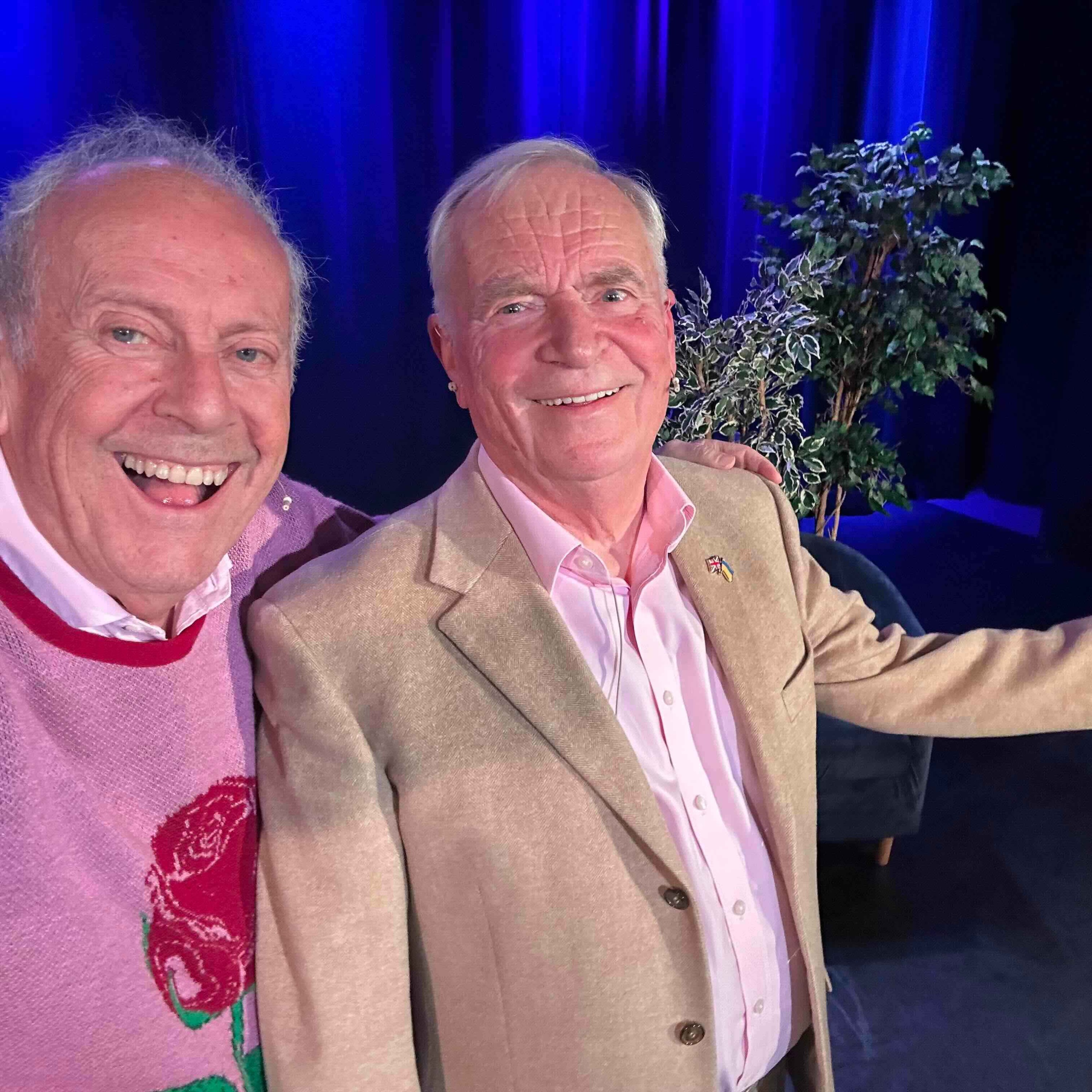
A Rosebud special honoring the late novelist Geoffrey Archer (Lord Archer of Western-Super-Mare) after his death in October 2026, featuring his final novel Adam and Eve and a wide-ranging conversation with host Giles Brandreth. The episode is framed as a celebration rather than a critical biography, explicitly avoiding discussion of Archer’s politics and libel trial.
Geoffrey Archer, bestselling novelist and public figure; born 15 April 1940, died 5 October 2026. Giles Brandreth, host and interviewer.
Archer says Adam and Eve’s success is driven by word of mouth more than publicity. He describes the novel’s premise as Hitler changing his mind twice, with two children (Adam and Eve) born on the same day to reverse outcomes. He argues there’s no shortcut to writing or professionalism, citing multiple drafts and “best possible” revisions.
Archer recites Shakespeare’s Puck farewell (“If we shadows have offended…”). He recounts 18 drafts changing a scene (draft 17 vs 18: Victoria realizes she’s a widow). He tells stories about raising money with the Beatles (Oxfam), Frank Sinatra’s professionalism, and Mother Teresa leaving a message for him that led to her planning dispute being resolved.
Written by AI. May contain mistakes.
Gyles shares memories of Geoffrey Archer and the context of their last show together.
“Have you been putting off that annual doctor's appointment because you don't want to make the call?”
Gyles shares memories of Geoffrey Archer and the context of their last show together.
“except it's a bit different from our usual episodes.”
Gyles reflects on Geoffrey's passing and the impact of his last performance.
“Because Geoffrey did this show on Sunday.”
Gyles introduces Geoffrey's last novel, discussing its significance and themes.
Geoffrey discusses the inspiration and writing process behind his new book.
“But is it true that somebody who is a friend of both of us recently said in public that she had been caught on the underground crying?”
Learn about Jeffrey Archer's meticulous writing process and the significance of multiple drafts.
“You're terribly clever and you're so much younger.”
Discover Jeffrey Archer's childhood, family influences, and how they shaped his writing career.
“But actually, this is the definition of kind of genius because I remember being told about George Gershwin writing It's Lovely and then realising what he wanted to say was It's still lovely.”
Hear about the strong women who influenced Jeffrey Archer, including his mother and wife.
“of your childhood and western super mayor with your grandmother and your parents your best memory It's the saddest.”
Explore Archer's early aspirations, particularly in athletics and his experiences at school.
“I had a lovely name or it was over the teacups.”
Learn about Jeffrey Archer's formative years, his teaching experiences, and the influence of sports on his confidence.
“During what we now call a gap year, after you'd left school and before you ended up at Oxford, where you did a kind of teacher training and all of that, you tried out various things.”
Explore Archer's ambitious attempts to involve famous personalities like the Beatles in charity events.
“And they said, oh, yes, yes, join us on the line.”
Hear captivating stories of working with Frank Sinatra and the professionalism required in the entertainment industry.
“and he was surrounded by giants, you know, three admirals, and he said, and I want to put on a show that will make a million in one night.”
Learn about the importance of timing and preparation in performance from Jeffrey Archer's experiences.
“But I had watched him practice that to a split second.”
Discover Jeffrey Archer's transition from politics to becoming a successful author after experiencing failure.
“APPLAUSE Because this brings us round...”
Explore the journey of Jeffrey Archer's third book, Cain and Abel, and its massive success.
“And not only did I clear the debt, Mary and I were able to buy a house.”
Jeffrey Archer reflects on a poignant farewell with a friend and shares a memorable encounter with Mother Teresa.
“and I didn't realize it until afterwards, and this must have happened with you.”
Archer recounts his experiences with Mother Teresa and her charismatic presence.
“I've never heard his Mother Teresa story before.”
A discussion about historical figures Archer would like to meet, including Thomas Jefferson and Joan of Arc.
“To answer the first part of that, it's a two-part question.”
Archer discusses characters from his books and influential figures in literature he admires.
“I saw the film, I think it was called The President.”
A conversation about Alexandre Dumas and the impact of his characters on literature.
“I talked to Bonington about it, and I said, did he reach the top?”
Archer ponders the plausibility of events in his life and how they might translate to fiction.
“And I rushed to my publishers in America and I said, I want that on every book.”
Discover a lighthearted discussion about improbable coincidences and humorous rumors involving Geoffrey Archer and Mother Teresa.
“like you and Mother Teresa being seen...”
Learn about Geoffrey Archer's experiences in the film industry and his insights into adapting stories for screen.
“and you haven't oh Roger has asked and this is a very quickie there was talk of a film adaptation of Paths of Glory with Ewan McGregor as George Mallory is this still happening, if so when?”
Hear Archer's reflections on ambition and the importance of resilience when pursuing goals.
“You're looking good Because I talk to 16 year olds In schools and I say, one of the things I say to them, there's nothing wrong with ambition.”
Explore Geoffrey Archer's gratitude for his career and his reflections on the impact of storytelling.
“Is there anything you would like to say to all of us?”

Get the gist, explore an idea or ask about something said.
 Claude
On Rosebud with Gyles Brandreth, what are the key points of this episode?
Searching your listeningAutomatic transcript. May contain errors.
0:00This ad is sponsored by ZocDoc. Hi, it's Danny Pellegrino from Everything Iconic. Have you been putting off that annual doctor's appointment because you don't want to make the call? Or maybe you've been meaning to find a new dentist, but you have no idea where to start? I find that's especially true when you move. It's hard to find your people. I've been there, which is why I use ZocDoc. Now, as a busy podcaster, parent, and someone who's always juggling a million things, I love anything that makes life easier. and ZocDoc lets you search and compare local in-network doctors with over 250 ,000 providers across more than 200 specialties.
0:33You can read reviews from real patients, find a provider who feels like the right fit, see actual appointment openings, and book instantly. I recently had a last-minute health issue pop up and needed to see someone fast. Instead of calling around or sitting on hold, I found a doctor on ZocDoc and booked an appointment in just a few minutes. It made the whole process so much less stressful. Now, taking care of your health just got easier. Download the ZocDoc app today. That's ZocDoc, Z-O-C-D-O-C, and book that appointment on your to-do list. Wherever you are in the world, whatever you're doing, whoever you are, I really hope you enjoy this episode of Rosebud.
1:16I'm Giles Brandreth, and here we are. Cue the music.
1:41Hello, I'm Giles Brandreth and this is the Rosebud Podcast, except it's a bit different from our usual episodes. This is an extra episode, a special episode featuring a friend of mine who died this week, Geoffrey Archer, Lord Archer of Western Supermare. Geoffrey Archer, one of the most successful novelists of our time, whose own life story sometimes seemed stranger than fiction. Born on the 15th of April, 1940, he died on the 5th of October, 2026. That's Monday of this week. On Sunday of this week, Geoffrey and I were on stage together at the Leicester Square Theatre in London, celebrating his 50th book and his final novel, Adam and Eve, and talking about his remarkable life.
2:34We had a good time together. It was a fun show. And after it, in the dressing room, my wife said to Geoffrey, You've never been better. And I think Geoffrey rather agreed. It went so well, and it felt a bit different. We'd had onstage chats before, but this time Geoffrey seemed a bit more relaxed, more at ease with himself, more amusingly self-deprecating. And he told stories I'd never heard him tell before. Wait till you get to Geoffrey Archer and Mother Teresa. And before we began, Geoffrey said this to me. He said, I'd like to do something a bit different at the end of the show. when we are finished, he said, I want to get up on my own and in the middle of the stage, I want to say thank you to the audience, to thank them for keeping me going, buying all my books over the last 50 years.
3:29And then he said, I want to recite a bit of Shakespeare. I said, oh, Geoffrey, a bit of Shakespeare. He said, yes, I want to recite a little bit from A Midsummer Night's Dream, the end of the play, where Puck gives a speech that begins, if we shadows have offended, think but this and all is mended. And he recited the whole speech to me. And he said, what do you think? I want to do that. And I just want to leave the stage on my own. Is that okay? I said, of course it's okay. And that's what he did. And Puck's farewell turned out to be Geoffrey's Farewell, and you can listen to it now or watch it on YouTube at the Rosebud podcast channel.
4:14Geoffrey did a regular Rosebud a while ago, you know, the normal one that begins what is your very first memory and took him right through his childhood. It was an interesting episode because he talked about both his parents. He never liked talking about his father. He was in denial about his father. But anyway, that's available on the Rosebud Archive if you want to listen to that. That's the full traditional Rosebud. And his wife of 60 years, Dr. Dame Mary Archer, we've had her as a Rosebud guest as well. And that's equally fascinating in a quite different way. She is a fascinating and remarkable woman.
4:52And I think that is an episode of Rosebud but you really will find intriguing. So this, what you're about to see and hear, isn't a traditional episode of Rosebud, and nor is it a critical review of Geoffrey's life. Certainly it's not about his life in politics or about the libel trial that he won on the basis of a lie that eventually landed him in prison. And incidentally led to three of his best books, in my view, his prison diaries. Now, this is a celebration of Geoffrey's latest novel, his last novel, of course, Adam and Eve, and it's really simply two old friends in conversation. After the show, in the dressing room, Geoffrey and I, we hugged, and he went off to sign some books for fans, and I went home.
5:40And that was Sunday night, Sunday night of this week. By Monday afternoon, Geoffrey was dead. He'd taken a nap after a morning of writing, and he didn't wake up. And I suppose if you have got to die, and we all have to die, perhaps there couldn't be a better way to go, you know, in your sleep, after 86 years of a life lived to the full, on the very eve of the publication of your latest and last bestseller. Because Geoffrey did this show on Sunday. He died on Monday and on Tuesday. His last book, Adam and Eve, was published and it's now destined to become a number one bestseller. I don't know if he had any premonition on Sunday night that that would be his last performance, but when you hear him recite that Shakespeare speech at the end of the show, so good night unto you all.
6:39Give me your hands if we be friends and Robin shall restore amends. I think you will wonder. Anyway, you can read plenty about the worst of Geoffrey in the papers this week. I was looking through some of them today, and they are certainly retelling all the stories of the ups and downs of his incredible career. But this Rosebud special is simply giving you the best of him, and I very much hope you enjoy it. So here is Geoffrey Archer at the Leicester Square Theatre this Sunday. Cue the music.
7:24I want to talk a little bit about Adam and Eve first, and then I want to take your story right back to the beginning and just, I want to discover why you are where you are now by going right back to the beginning and hearing about the journey and the roots of Geoffrey Archer. But is it true that somebody who is a friend of both of us recently said in public that she had been caught on the underground crying? And she was asked why, and she said, well, what did she say? Yes, she was on, Ayesha Hazakari was on an underground reading Adam and Eve, And a lady came up and said, is anything wrong? She said, yes.
8:15It's brought me to tears. And she rang me again this morning to say she'd finished. And she very kindly said, and she's saying it on air this morning, in her opinion it's a masterpiece and the best thing I've ever done. Well done you! No, you know, it's funny you say that. But in the end, it's the people who decide. You can have two weeks of the most amazing publicity. You can have great people saying it's a masterpiece. But if you survive for 50 years, it's because the word of mouth. That is far more important than any advertisement, than any publicity. it's real people telling other real people.
9:09Why is this, do you think, as good as anything you've ever done? Why is this book important to you? I got the idea six years ago, or at least I got half of the idea six years ago. I was reading a history book by the great Leo McKinsky, and he had written that on September the 15th, 1940, Hitler changed his mind three times. So I went home and thought, what would have happened if he changed his mind twice and he had invaded the British Isles? And I put that up in one corner because I couldn't see what to do with it. And then I had the idea that an earl desperate to have a son so he could inherit the estate and, more important, the title, and a shepherd on the same estate desperate to have a daughter because he feared any son would end up going to war.
10:26and the exact opposite happens. The Earl has a daughter and the shepherd has a son, Adam and Eve. And how do I... That's the problem. I've now got two problems. How do I get Adam and Eve to be responsible for Hitler changing his mind the third time.
11:03Now, I'm very aware that if it's, oh God, I could see that a mile off, Jeff. Yeah, plonked it right in the middle, didn't you? You have to write it so that the reader goes along with it. And people say at the end, could it possibly have happened? Before you write the first word You know what the destination will be But do you know the route of the journey? No I'm lucky if I know the next page I know there are these two kids Going to be born on the same day If I may I know these two children Are going to be born on the same day So I'll just read you That that. He was dreaming when there was a knock on the door.
11:55Bill Turner turned over and hurried, sorry, I haven't got my glasses, and buried his head in the pillow. Have I got glasses on me? I don't need glasses.
12:13Read the first paragraph.
12:20The 11th of November, 1918. It's a significant date as well. The last day of the First World War. He was dreaming when there was a knock on the door. Bill Turner turned over and buried his head in the pillow, still hoping it was a dream. But the knocking ignored his wishes. If anything, it was louder and more persistent. He reluctantly opened his eyes and blinked at the bedside clock. Eleven minutes past four. One of the perils of being a family doctor, he rested for a moment, but when he looked again, the clock had moved on to 4.12, as if in agreement with whoever was knocking. The doctor slowly pushed himself up, pulled back the covers, and placed his feet gingerly on the carpet.
13:04He put on his dressing gown and slippers, padded across to the window, and looked down to see the Earl's butler staring up at him. You can leave now, because we're enjoying this. who's done the audiobook why didn't you ask me this time i remember martin jarvis used to do a lot of your books have you done the audiobook for this you see what you say the answer to the to your question is that so i've now got the doctor yeah i've now got him rushing off yes for the birth of the daughter. He then comes home and he's called out a second time that morning for the birth of the son. So you've got the two children born on the same day.
13:50But I want to answer your question. I didn't know why I was going after that. Oh, my gosh. No, the pen then goes on. Is it a pen or is it? A felt-tip pen. Yeah, yeah. Do you still write on those big yellow? You're terribly clever and you're so much younger. My eyesight certainly is. But you've always written with a bend. I can't turn on a computer, let alone use it. So I always handwrite everything. And then it's given back to me, typed, triple spaced. And I work with a pencil then. And this draft of the book is the 18th. Wow. I wish there was a shortcut. I genuinely wish, though, after 50 years, I wish there was a shortcut.
14:41But I tell young people when they come to see me, I'm not a ballet dancer. I do not play the violin. I'm not a countertenor. My gift is a simple one that I can tell a story. But you've still got to work damned hard. And one lady said to me, I wish it was a young lady, said to me, you did 18 drafts on this book. I said, yes. She said, give me an example of what happens between draft 17 and draft 18. Oh, good. Very good question. Good question. And what's the answer? And the answer was, well, there is a scene where the Earl is pushed down the stairs of his wine cellar and the man who's killed him disappears, gets out of the house and his wife, Victoria, comes looking for him and she's walking down the stairs and I had written the sentence.
15:44Long before she reached the bottom step, Victoria realised her husband was dead. Draft 17. Draft 18. Victoria walked down the steps and long before she reached the bottom step she realised she was a widow. Oh, oh, oh, well done. Oh, you are good. You are. That is very interesting. You see, that's 17 to 18 and it's worth doing because I want to be able to say at the end If you don't like it, it's not my fault. I've done the best I can. I would hate to say I agree with you. I got lazy and handed it in on the fourth or fifth draft. No, I agree. So that was the difference between... But actually, this is the definition of kind of genius because I remember being told about George Gershwin writing It's Lovely and then realising what he wanted to say was It's still lovely.
16:47Yes. And then he got to It's delicious. Yeah. And it's just these little things that make all the difference. Let's go right back to the beginning. Well, you say that. It's very interesting. Matt in the Daily Telegraph, who we all love. This is a cartoonist? The great cartoonist. Pocket cartoonist.
17:07His grandfather... Is this V.S. Pritchett? Is that his grandfather? Yes, V.S. The great man. Famous novelist. The great man. I was only in my 30s when I saw the great man standing in a corner. He was our poet laureate and a very great man. And I went up to him and said, I wonder if you could spare me two minutes, sir. I'm sorry to bother you. and so vivian said of course and so we went behind a pillar and i said i am sorry to bother you sir but either i'm a complete idiot or not very good but i've just done 16 drafts of my new book and i'm not don't feel i've finished he said only 16 and that taught me that if a man as great as that That was his response.
17:53That was good enough. Keep going. Let's go back, if we may, to the very beginning, because I want to discover why you are like you are and how you've managed to do this so consistently for so long. Let's begin with your childhood, your parents, your initial role models. When were you born? Where were you born? Who were your parents? I particularly want to talk about your mother, because I think she is still part of these books. Oh, yeah, sure. Quite right. So when and where were you born? I was born in City Road, London. And Winston Churchill gave orders that all people under the age of, I think it was 10, should go if they could.
18:32And I was taken to my grandmother's home in Western Supermair. This is because of the war. 1940. So you're born in 1940. What is the day? What is the month? 15th of April, 1940. Cards are always gratefully received. 15th of April, 1940, you were born, but evacuation has been ordered. Ordered by the Prime Minister. So off I go to my grandmother in Western Supermare with my mother and father. And so my whole upbringing is in the West Country. Which is why you are Lord Archer of Western Supermare. And who was this grandmother? My mother, you know, I guess all of you in this room can say this. This won't come as a shock because I've been surrounded by strong women all my wife, all my life.
19:18That is the ultimate slip of the what's it. I've been surrounded by strong women all of my wife. Oh, my gosh, Jeffrey. And the first was my mother, who became a local councillor at Western Supermair and chaired the arts committee. Second was my beloved wife, Mary, who, as you all know, was the first woman ever to chair a national gallery, the Science Museum. And the third, of course, Margaret Thatcher for 11 years. In the case of my mother, she falls into the category, and you may well say this about your grandparents. If Mary had been born 50 years earlier, she'd have been a housewife. she would not have been the first chairman of the science museum the new generation of women have so much more that they can do and i believe in strong women so you everybody tells me when they read the book your women are so strong of course they are so what is your sweetest memory of your childhood and western super mayor with your grandmother and your parents your best memory It's the saddest.
20:32And this book reminded me of it. You're just too young, and I mean that. You're just too young, so you missed it. In my youth, I saw lots of people with one arm, one leg, blind, who'd served their country. And that stuck in my mind. So I had the nought to five was the last five years of the war. And then afterwards, recovering, when we had ration books to go and get food. Oh, yes, I remember that period very well indeed. Give me a flavor, though, of you at home as a little boy. You and your mum and your granny. What did you call your grandmother? Granny. Granny, and she was your mother's mother, I take it.
21:21My mother's mother. My mother was Lola and my grandmother was Nell, a very wicked woman. Oh. When my grandfather died and he was quite successful, he left£20 ,000, which in those days... A lot of money. It was a lot of money. And my aunt Eileen, who was a schoolteacher in Leeds, and my mother thought, this is great. In time we'll get£10 ,000 each. No. my grandmother decided it was time to visit Australia and see her relations in a rather nice ship called the Queen Mary. So she then took the ship to South Africa to see her other relations. She died in debt for 504 pounds.
22:10Give me a flavour of your mother and father when you were a little boy. Well, my father tragically died young. He had been in the war and he tragically died young. So I was a one parent family from about the age of nine, ten. But my mother was a remarkable woman. She was truly an example. I didn't realize, of course, at that age, you don't, that she was doing a job during the day. She was on the council. She was earning everything she could. And she was making sure I got tutored by a man called Mr. Baker. so I won a scholarship to the school I went to because of Mr Baker. She'd arranged all that and I didn't, of course I didn't realise it until years later when she used to come up to London and this was after Cain and Abel.
23:01She'd stay at the Savoy Hotel in the Riverside Suite and have a driver take her from Paddington to the Savoy and from the Savoy to Paddington. She would then go to Harrods and have a heyday and then she would go home and Mary said, and that's your way of saying thank you. Which is lovely. Right, God bless her. And she lived to the great age of 87 and I owe her so much. She also wanted to be a novelist. She worked on the local newspaper. She had a column, didn't she? A weekly column. She had a column on the local. Which had a lovely name. I had a lovely name or it was over the teacups. That's it.
23:42That's what it was called. Over the teacups. And I was Tuppence. Oh, she wrote about family life. So you were Tuppence, your little character in her weekly column. So she was a writer, but she would love to have written a novel. She told me again and again. I'm happy to say she lived to see Cain and Abel, so she saw. And as a little boy, before you go to, you know, before you're a teenager, what sort of little boy are you? What are the games you like playing? What kind of friends do you have? I wanted to run most of all. I was a runner at a very young age. I wanted to captain the England cricket team, but unfortunately I couldn't bat, bowl or field, which my headmaster explained was a minor disadvantage.
24:29But I could run, so a lot of my youth was spent enjoying, genuinely enjoying running. And like all little boys, more interested in sport than little girls. and it kind of took over my life when I was chosen to run for England schools. And when was this? So you're at school, you're 15, 16? No, 17. I'm sorry, I've skipped too far, yeah. 17. And it was irony for those, again, you'd know this because of the life, the early life you had. I was at a little school called Wellington in Somerset and next door was Millfield. Oh, yes. So our first match of the season was against Millfield, and I thought I was a god.
25:18So I go along to Millfield, do the 100 yards, and there's four of us on the line, the two from Wellington and the two from Millfield, and I came third. Oh. And I went back home and thought, I've been kidding myself that I was any good. England schools final, I came third. And the two boys in front of me were the two boys from Millfield. That's good. Yeah. So what I'm wanting to get at is when you in your head begin to see that you are, do you think you're special? Obviously you do think you're special because you are a god and you can run very fast. What do you think has led to this? Is it you're now an only child, your mother dotes on you?
26:05What has brought this sense in you? What do you think is the origins of you feeling I can do something special? Well, I think that came much later, to be honest. That didn't come until much, much later. So academically, how did you do at school? Well, I won a scholarship to Wellington, thanks again to my mother getting a tutor, which she must have paid for. Otherwise, she couldn't have afforded. Did you do O levels? Yes. Yes, or O and A and so on. And you got those? Yeah, that was fine. But by then I wanted to run for Britain. But that was what was driving you. I'm going to be a runner. Driving me.
26:45Yeah. Yes. And you do run for your country. Yeah, but let's get this straight. I was never good enough. I always tell the story when I was at Oxford, when the phone went and I went to answer it and they said, we need you in Birmingham tomorrow for the 4x100 relay England, Ireland, Scotland and Wales. And I said yes of course I'll be there. So I get my ticket to Birmingham and I get up to Birmingham and I'm determined to show this woman I'm madly in love with that I've run for my country. So I go there, the relay, we win, we beat Ireland, Scotland and Wales and I've been in the team and I come back and I show her the programme and the programme says, The England team, Radford, Watson, Davis and A.N.
27:39Other. Oh, no. Because the man who was meant to run had fallen out and I had taken his place. The reason I'm trying to get at why you think you were like you were is this. We first... I think I may be the person who's known Geoffrey, in a way, longer than any other person alive. And I say this for a reason. During what we now call a gap year, after you'd left school and before you ended up at Oxford, where you did a kind of teacher training and all of that, you tried out various things. And one of the places you ended up was a school called Dover College. Correct. Where you were teaching as a young teacher and doing athletics.
28:19Correct. I was at a prep school nearby called Betsanger, where there was a really splendid headmaster, a man called Ivor Burton. And I remember the day we were told by Mr. Burton, I found a new running coach for you, a new athletics coach. He's at Dover College. He's coming over here on Wednesday afternoons or whenever to teach you boys how to run. And this young man is the most remarkable coach I've come across in my lifetime in education. and that is how I was introduced to Geoffrey Archer who would have been about 18 at the time. Now, what I'm wanting to know is what was there in you that made Mr Burton introduce you, an 18-year-old, a 19-year-old, to us boys as being this phenomenon?
29:08Why did you... And you were a phenomenon because as an instructor, he did rather bark at you. Would I? But what made you, at 18, this sort of person that had that impact on people? What was there about it? Where did it come from? That's what I'm trying to get. I think sport does that for you. Ah, explain. I think sport, whether it's football, whether it's cricket, whether it's athletics, if you get to run for your country, you do feel supremely confident. And it's funny you should say that because I think it was my downfall. I think all of it came far too young, because I then went on to enter the House of Commons at the age of 29.
29:49I was far too young. I say to people nowadays when they come to see me about wanting to be a politician, for God's sake, don't go in the House until you're 40. Do something. Achieve something. So that when you get up to speak, people want to listen. I'd achieve nothing. What age did you enter the House? 40. What? Forty. Only because I'd listen to you.
30:28This ad is sponsored by ZocDoc. Hi, it's Danny Pellegrino from Everything Iconic. Have you been putting off that annual doctor's appointment because you don't want to make the call? Or maybe you've been meaning to find a new dentist, but you have no idea where to start. I find that's especially true when you move. It's hard to find your people. I've been there, which is why I use ZocDoc. Now, as a busy podcaster parent and someone who's always juggling a million things, I love anything that makes life easier. And ZocDoc lets you search and compare local in-network doctors with over 250 ,000 providers across more than 200 specialties.
31:01You can read reviews from real patients, find a provider who feels like the right fit, see actual appointment openings and book instantly. I recently had a last-minute health issue pop up and needed to see someone fast. Instead of calling around or sitting on hold, I found a doctor on ZocDoc and booked an appointment in just a few minutes. It made the whole process so much less stressful. Now, taking care of your health just got easier. Download the ZocDoc app today. That's ZocDoc, Z-O-C-D-O-C, and book that appointment on your to-do list.
31:35but just to go back so you you do the teaching at dover college you then go to oxford in your head then you are already an achiever because you've learned to run fast who at that stage are your role models who are your heroes when you're a young man it's interesting you say that because i think when you're that young if you achieve that you do believe that my role models well it'll be interesting to see how many people in the audience have ever heard of my hero there was a man in the olympic games at that time when i was a child who won the 5 000 meters the 10 000 meters gold at the olympics gold at the olympics and went to the organizers you can't do this today you've got to have every form filled in he went to the organizers and said i've never run a marathon, but can I enter?
32:29And they said, oh, yes, yes, join us on the line. He won. He got the gold in the 5 ,000, the 10 ,000, and the marathon. The great Emil Zatopek, who for me is a god. So when I was chosen to run for Great Britain against Hungary, I shared a room with my closest friend, Adrian Metcalf, who was in a different class to me. And we discovered that Colonel Colonel Zatapak had been sacked by the communists and was now working as a gardener in one of the local parks. This is the man, the great Emil Zatapak. The great man. It was called Colonel Zatapak. He was working as a gardener. And Adrian and I went to the park and fell on our knees in front of him.
33:12We wish to acknowledge that we thought he was the greatest. He's certainly, in almost everybody's eyes, one of the greatest. And you had this extraordinary... The other was. The other was. Yes. Because you've never asked me this question before. The other was, there was a man who won the discus three golds in a row. Can you believe it? That's 12 years. And he entered the American Championships. And the American Championships are always the only ones in the world where if you get in the first three, you go to the Olympics. If you don't get in the first three, It doesn't matter if you've won everything else.
33:54If you don't do that on the day, you don't go. He came third. And the people went to him and said, we don't want you to go to the Olympics. Why, he said, because three goals is just a bit special. and we want that just a bit special to remain for the rest of your life. He said, no, I'm going. I'm going. And off he goes to the Olympics. And after, there are six rounds, three rounds to get through to the last ten, and he just got through to the last ten. He was ninth or tenth. And then on his final throw, on the sixth throw, you couldn't make it up, could you? He throws a new world record. Yay! Yes.
34:46And gets the fourth gold. And Jay Sylvester, a truly great discus thrower, came second. And they went up to him and said, how do you feel about that? He said, when he comes in on a stretcher, it's going to be close. And that just sums up, really, how great the man was. But it's interesting. You tell them stories, and they are extraordinary stories. Yes, yes. But this ambition that you clearly, you love these achievers who keep going, who keep achieving, and you have this confidence that you say maybe came to you too early. It gave you the confidence. This is what I find interesting about you. All of us think of doing remarkable things, but very few of us actually follow through.
35:35And right from the beginning, you followed through. Tell us about, I think you're in your early 20s, approaching, for example, the Beatles. The Beatles, who are then, You know, the biggest band in the world. You're in your early 20s. And people would think it was a fun idea to do, to get the Beatles involved in something. But how do you begin? How do you make it happen? Well, I was at Oxford last year and supporting Oxfam's attempt to raise a million for the first time. And I read in the press that their manager, the manager of the Beatles, Mr Epstein, I got in touch with him. I then, you're quite right, when you're young, you do such stupid things and such.
36:18I mean, I wrote to the Prime Minister and said, if I got the Beatles, would you cut? And he said, yes, go ahead. And the Prime Minister was Harold Wilson or someone like that, was it? No, this was Harold Macmillan. Harold Macmillan, of course, this is a long time ago. I'm 86, Giles. Good grief. Not a child like you. So I got in touch with Mr Epstein, and of course nowadays I wouldn't get in touch with Mr Epstein because I know he'd say no. I would waste my breath. You don't know when you're that age that people will say no. And he said, come up to Liverpool. So I went up to Liverpool. I met the Beatles and they agreed to come down to Oxford and we raised the million.
37:01Thanks to the Daily Mail and David English and thanks to the Beatles. They came to Oxford to perform in Oxford. They came to Oxford, yeah. It is a remarkable story. It is. It is a remarkable story. What were they like? Did you like them? There's a very amusing photograph, if you've not seen this picture, of Jeffrey holding, I think, an Oxfam tin, grinning with the Beatles looking, who is this guy? But, I mean, they did turn up. They performed for them. Oh, yes. They turned up. What were they like? They're four very individual people. And, of course, we only spent a few hours together. so I never really got to know them.
37:41I liked Paul McCartney. I liked George, but he was very quiet. Ringo was, I didn't have a word to say, John was the most vocal and he didn't really approve of, I'm not sure he approved of Oxford. Whenever I meet somebody who says, you know, I slept with one of the Beatles and they won't tell me who it is, I know it was Ringo. Just saying. May I ask what the hell that's got to do with Adam, I mean? But you've always been, I think, drawn to star personalities. Still at that period, because that's the time when you get to know, and you do get to know him, El Mambat and Aburma, and there becomes that big charity event again, where involving stars from whom I think you learn things.
38:30You have a wonderful Frank Sinatra story, and I think it relates to that period. Again, that's again, you were just approaching people and saying, will you do this? Actually, to be fair, because I was so outrageous in those days, Elman Batten approached me and said, would you come to tea? So I went to tea at his lovely home in Chelsea, and he was surrounded by giants, you know, three admirals, and he said, and I want to put on a show that will make a million in one night. Who would you invite? So he said, I said, well, the biggest star in the world at the moment is Frank Sinatra. So I'd invite Frank Sinatra, and then I'd have Bob Hope doing the first half, the comedy bit, and I'd have Noel Coward introducing them.
39:22I know all three of them, he said. But I loved it. He taught me something. He taught me what the power of, I suppose you could say royalty or whatever, but he picked up the phone and he phoned the head of MGM. And the next sentence is something that remained in my mind for the rest of my life. He knew exactly what he was doing. He picked up the phone and they put him through and he said, Lieutenant, he'd been a lieutenant in the head of MGM, had been a lieutenant in the Navy in the war. And he replied, yes, Admiral, I want Sinatra. There was a terrible silence the other end, and the man got Sinatra.
40:05Sinatra came to London. He did two shows, one in front of Princess Anne, one in front of Prince Charles. They raised the million. And I'll tell you about professionalism, if I may. I went to see the rehearsals. Who wouldn't? I went to see the rehearsals of Sinatra. And three days before the show was due, Norcard went into hospital. So Mountbatten rings again and says, who do you want? And I said, well, it's impossible for a man to take Norcard's place. We'll need it to be a woman. I'd like Grace Kelly. Oh, no. I know her well, she said. She's been told never to perform again since her marriage.
40:51Never, never, never. I said, but it's for a charity, sir. All right, I'll try. So he rang. the prince in Monaco, and talked him into it. And Grace Kelly came over, and I want to tell you about the professionalism.
41:10Sinatra would have done 20 drafts.
41:16The whole orchestra are playing Sinatra-type songs, and Grace Kelly does the introduction of her friend Bob Hope and her friend, Frank Sinatra. She then goes and sits in the royal box. And I'm sitting on the end of about the fifth row watching very carefully. And the orchestra, the Royal Philharmonic, and at the back he appears. No one sees him. He doesn't march out on the stage the way you and I did. And he comes through the orchestra and starts talking to a violinist, cello player, an oboe, and then someone sees him and starts clapping and then someone else sees him and starts clapping and then someone starts cheering and then he comes up to the microphone and he picks up the microphone and he walks over to the Royal Box and he waits, he's got the timing so beautifully that as he reaches the Royal Box he looks up at Grace Kelly and it's gone silent and he says, you make me feel so young and the place, oh, the whole place just erupted.
42:27But I had watched him practice that to a split second. So everyone in the audience thought how natural, how wonderful. He was the ultimate pro. And what he taught me there and then, that's what you have to do if you're going to be the ultimate pro. There is no shortcut. But you have also spent your life observing these scenes and they are what colour your books because you see an incident as a story and you've told it there so beautifully. So here you are in your 20s, raising money, doing different things, trying out different things, but ultimately you've decided you're going to be a Member of Parliament.
43:02You now say too soon, but you apply and you get a seat straight away, do you? Far too soon. I went to an interview for Louth in Lincolnshire assuming I had no, genuinely assuming I had no hope. It's a lovely part of the world, but... You would assume that you had, you'd rather hope you had no hope if you were, you know. I've seen no hope. I mean, none of us, has any of us here ever been to Louth? Oh, it's lovely, I know that. Anyway, go on. You went, assuming you had no hope. Well, Douglas Hurd had rung me, the former foreign secretary, but then he was very young and very junior, but he was head of the private office at Number 10, and he said, Geoffrey, we want someone young at Number 10 who will tell us what the young are thinking and what's going on.
43:50I said, well, what an honor. And I went to dinner with Ted Heath and Douglas Hurd. And they said, I said, well, I've got one problem, but I don't think it is a problem. I'm being interviewed for Louth. And I said, when that's out of the way and I failed, I'd be happy to join you. I won it. So I had to say to the prime minister, I'm not available. And I found myself in the House of Commons at the age of 29, far too young. And I'll tell you another thing, too, because people do say to me regularly, do you think those people in the House were more classy, more able than they are today? All I can tell you is I sat on the back of the back of the back benches in the house and looked down at the labor benches.
44:40And I looked at Harold Wilson, Roy Jenkins, Dennis Healy, Shirley Williams, Crossman, Crossland. They were class. It was a privilege. And I thought that was the norm. Absolutely the norm. And they were on our front bench as well. And so, yes, I look back on those days when I learnt a lot. What you also learnt is because disaster struck, that in fact disaster can lead to success because you coming out of the House of Commons, which you had to do, we'll explain that in a moment, is what actually leads us to you being here today. Yes. Otherwise, you would have continued a career in the House of Commons and you would now not be here.
45:19You'd be at the Conservative Party conference in Birmingham. As a former Secretary of State for Transport. Yeah. Yeah. Actually, very likely. Very, very likely. But that didn't happen. Something went wrong, and you had to step, you decided, you chose to step down. I made a complete bloody fool of myself. I thought everything I touched turned to gold. I thought I was a genius. I thought I was going to be prime minister. And I'd made a little money. I'd been quite successful. And a banker at the Royal, sorry, not the Royal, the Bank of Boston, not the Royal Bank of Boston, the Bank of Boston, a vice president.
45:59I didn't realize that the word vice president didn't mean a damn thing. There are hundreds of vice presidents. And he told me to invest in this company that couldn't lose. The irony is, if he did that today, they would have had to clear me. They wouldn't in those days. So I invested everything I got, and I borrowed money to invest even more. Are we talking of tens of thousands? We're talking about 200 ,000. Which is a vast amount of money in those days. A vast amount of money. 55 years ago. And I lost every penny, every single penny. The irony is, as I said, if it was today, one would go to the bank and say, this is going to be on every front page, and they'd have cleared it.
46:40No. Just dealt with it. But you couldn't go on as an MP because an MP is not able to be bankrupt. So you thought I could have stepped in. No, so I waited till the election, which luckily was only three months away, and quietly disappeared. And then I thought, wait a minute, I've had all my money stolen. I'd like to write about that. So I invented the theme for Not a Penny More, Not a Penny Less, of four young men who have lost their fortune, don't know each other, meet each other, and decide they're going to steal it back from Mr. Big, Not a Penny More, Not a Penny Less. and they mustn't go over the top because that would be stealing.
47:23That was the first book. And I got very, very lucky. Again, does this happen now in politics? David Owen was the Labour Foreign Secretary. Yes. And his wife, Debbie, was a well-known agent. And so I went to David and gave him the book. Just before we got the finished book, this is the first book you have written. Yes. So you hadn't written art, you weren't known as a journalist. Correct. Though your mother had created tuppence in her lovely over-the-teacups column, this was your first experience of writing a book. So you wrote it in longhand? Yes. The head of my college at Oxford, Sir Noel Hall, principal of Brasenose, gave me two rooms in his marvellous building, and I sat and wrote there for 12 weeks and came back with it, and I gave it to David Owen and said, look, David, I don't want to bother you because being Foreign Secretary is quite a big job.
48:25If your wife would be kind enough to read it. She read it and believed in it. And indeed, if I may say so, 50 years later, the book is dedicated to Debbie Owen, who made it all possible. That, I think, is a lovely moment for us to take our break. We have to have a break. APPLAUSE Because this brings us round... Well, I want to say one more thing. Yeah, I want to say one more thing about where it is in the bestseller list now, this Not A Penny More, Not A Penny Less. Published first time all those years ago. The first 14 publishers turned it down. Yes. The 15th publisher gave me an advance of£3 ,000.
49:07A reasonable amount, actually. Which doesn't make a very big dent in£200 ,000. That's true. and Mary said, my wife said, perhaps it's time you got a real job and I went on and everything changed with Cain and Abel.
49:36I've got almost all your books and the one I think, am I right in thinking, and you've inscribed them all to me, is Cain and Abel. I've got a first edition Cain and Abel inscribed by you. Would that be the most valuable? Would that be the one that would fetch me? No. Oh, oh. No, because what happened, if I could give a little intro on this with Cain and Abel, is that you'll remember that there were only 3 ,000 copies of Not a Penny More, Not a Penny Less. So they are the far more. Ah. Ah, but that changed all my life. It was very strange. I finished the book and handed it in to Debbie. And Debbie said, we're not going to sell this book.
50:22We're going to auction it. Oh. And I said, what does that mean? She said, I will give it to the 14 great houses of the United States. They will read it. They will have one week to read it. and then they will start bidding and they will have three days to bid. So that happened and I said, what happens if nobody bids? She said, it won't be published. So she sent it to the 14 grade houses and they took a week and they asked for an extra day, the last two asked for an extra day. And the bidding finished at just after two o 'clock in the morning on the Sunday when Simon & Schuster bid$3 million for the rights for Cain and Abel.
51:12Those of you who have been paying attention will remember that I was in debt for$200 ,000. And so I bought a totally new meaning to the words nouveau riche. How wonderful. The$3 million advance for Cain and Abel. And was this your second or third book? Third book. It was your third book. And it paid, because people love the details. You know them and understand them. It was paid a third on signing, a third on hardback, a third on softback. That's fairly common. So I was given a million straight away. And not only did I clear the debt, Mary and I were able to buy a house. Amazing thing. One or two of you may say, wait a moment, Geoffrey, that sounds to me like five years before you got to there.
52:03but in between, Mary became the first woman ever to teach at Trinity Cambridge, and they gave her a beautiful flat. So we had a flat, she had an income, and I was scribbling away. And how did you met Mary, and why on earth did she agree to marry you? Actually, I don't think that's funny. I think it's very fair. I think that's very fair. I fell in love with her on site. Well, as you might. Absolutely. At a party given by Nick Lloyd, who you made at Oxford. And she did not fall in love. Nick Lloyd became the editor of the Daily Express. Indeed. Indeed. Sir Nicholas. And she didn't fall in love with me at first sight.
52:50I had to work very hard indeed. But the shock was at the, just before our wedding, We had to, she had to go to face the examiners. And of course, it's now well known, of course, everybody. She got a double first. So I was not only marrying the most beautiful woman, I was marrying the cleverest woman. And I didn't know at the time because she's so modest and so quiet about her achievements that you would, well, you know her well. You would never know. You've always been drawn to high-achieving and remarkable people. I mean, I remember back in the day I used to give wonderful lunches when you got your, not the present apartment you live in, but you had another apartment in the house that you have overlooking the river.
53:40And you used to give lunches on, I think, a Wednesday for ten people, which I was lucky enough to come to. And you collected all sorts of people, politicians, sports people, best-selling writers. You're drawn to achievement, aren't you? I do find, before I answer that question, that people in another world who meet someone they would not expect to meet find that fascinating. You and I had the honour of having Barry Humphreys as a friend. And I once had a dear friend too. I'll tell you two stories on that. He agreed to open... My wife was also, before she became chairman of the Science Museum, she was chairman of Cambridge University's Hospital, Addenbrookes.
54:28And he agreed to open the fete for her as Dame Edna. And I thought, how can we possibly thank him properly? So I thought, he's so clever, and I'm not exaggerating. One of the cleverest men I've ever met, and one of the best red men I've ever met in my life. So I thought, I'll tell you what, I'll get, we had a dinner for him the night before with two Nobel Prize winners, three heads of colleges, two ambassadors. I mean, and of course, they loved him. And he held his own with them. I was on the way down in the car. I drove him down to Cambridge. And he said, who's coming to dinner, Geoffrey? So I said, well, there's the Astronomer Royal.
55:19there's the head of Trinity College
55:26and he's sitting on your right then on your left and he loved that he loved the challenge of a fine brain and wow he was good company people ask me how long the journey is from London to Cambridge in a car the answer is an hour and 20 minutes with Barry Humphreys, it's five minutes. Because you just, it's such a privilege. That could be. I would like to tell my second story. So the saddest moment in my life, and I didn't realize it until afterwards, and this must have happened with you. He came to see me just before going to Australia. And I didn't realize he'd come to say goodbye. I didn't realize because he wouldn't tell me.
56:16and he came and said, I'm off to Australia and we were looking at the picture. God, he knew his art backwards. He just made you feel you knew nothing. He didn't do it purposely, he just made you feel you knew nothing. And he's looking at this picture and Mary walked in and he turned and looked at Mary and said, Mary, I have a word that sums you up. I have a word that encapsulates you. And he then put his arm round me, looked directly at Mary and said, tolerant.
56:55One of the questions here, and I can see if I can find it again, is about who you would like most to walk into the room now that you have met before, that you most like to see again. Met before? Yes. And then there's also one of who you haven't met but would have loved to in history. Which order would you like? The order in which I've asked them. So you've got... Someone's going to come into the room now that you've met before you would most like to meet again. I mean, Barry Humphries is not a bad choice, but I think you'll choose someone else. Mother Teresa. Oh. Oh, that's a good answer. I've never heard his Mother Teresa story before.
57:35This is a new one on me. When Margaret Thatcher was Prime Minister, she rang to ask to speak to me and left a number, and I rang the Indian High Commissioner. Mother Teresa left a message on the answer phone. Hello, this is Mother Teresa. Is that a Jeffrey? I love not a penny more, not a penny less. All the sisters of Little Mercy have been enjoying it as well. Could you call me back? I mean, she left a message for you. Mother Teresa left... I mean, I've heard of some good stories, but this... He's such a ham, isn't he? So I rang the Indian High Commissioner, because don't forget, Margaret was Prime Minister and I was bad carrier.
58:27So I rang the High Commissioner. I said, I'm sorry to bother you, sir, but I've had a call from Mother Teresa asking to see me, and I thought I'd take your advice before I go to see her. and he said, Geoffrey, she will have something she wants done. That is her nature and she's chosen you, poor man. My advice is just say yes and do it. So off I go to the East End of London where she's got one of her homes and I come into the house, they take me to her. Someone is washing her feet. So I sit opposite her and she's desperate to get hold of this house and she's having problems with the planning people and the council.
59:14And I explained to her that I couldn't do anything and I also explained to her that asking the prime minister to do something would be pointless. So I said, I'll ask the local member of parliament because he will know the councillor. he will know the area and it it was the liberal member of parliament uh at that time um gosh trying to come back to my mind and i left her i heard i rang him and he was on a train coming down to london so i went to the station met him explained the whole thing took him back to her and he dealt with it and she got what she wanted and why was she special why is she somebody you'd say to us, I mean, we'd be excited to see her, of course, but why is she the person that you would most like to meet again?
1:00:07To answer the first part of that, it's a two-part question. Why was she so special? Yeah. Can you name the person who took her place? No. Is the answer to that question. I was, she had a charisma, she had a presence, she had something that is rare, rare, and it hits you between the eyes. Oh, yes, she was very... In a different way, I found that with Desmond Tutu. Oh, of course. What a lovely man. Because what a lovely man. He was like being with a ball of sunshine. There was a warmth about him. And a very brave man, too. Stood up against the authorities. The other part of that question was, who would you most like...
1:00:54This is the old question of having them to dinner, having a drink with. Who would you like to have a drink with that you have not met? A figure from history. Dinner, not a drink. Oh. I'd like to have dinner with Thomas Jefferson. Remind us, this is the 250th anniversary of American independence, who in that context is Thomas Jefferson? Thomas Jefferson, third president of the United States, intellectual giant. John Kennedy once said of him when dining at the White House with eight Nobel Prize winners Kennedy said this is the greatest gathering of intellect in this room since Jefferson dined alone.
1:01:40So yes I'd love to. And I love American politics. I'm fascinated by it. But he... I'd love to have met him in person. I'd love to have met Joan of Arc. But that's by the by my personal fantasies are neither here nor there. Though that is one of the other questions. Who from history would you like to have married if you couldn't have married Mary?
1:02:05It actually doesn't say from history. It just simply says who. If you say who have I fallen in love with at a long distance, I saw the film, I think it was called The President. I fell in love with Annette Bening. Oh, yeah. And the reason I fell in love with her is because she had, not only was she beautiful, but she had that intelligence that I admire so much in Mary. She had that, and I could see why the president fell for her. Damn good actress as well. Yeah. I once had a very close encounter with Raquel Welsh. To be honest, I don't really mind if she... I must say that's more your style. Yeah.
1:02:42And whether she was intelligent or not, as far as I'm concerned, is neither here nor there.
1:02:50Of all, this is from Justin Ashby. Are you here, Justin? He's sent in a question, but he's quite shy. If he's here, this is your... You're here, Justin. Of all the memorable characters in your books, which are the ones you consider to most closely resemble yourself? Oh, oh. What kind of character? I mean, do you write yourself in the source? Well, I'm certainly more able than Cain. I'm certainly a striver ambitious man I had no I didn't start with any wealth or any any start that some children have so I would say that but this will shock you in Adam and Eve I think I'm more like Eve and I think Mary is more like Adam because Adam is the intellectual who has to fight, and Eve is a doer.
1:03:50And so, yes. Nicky Collinson wants to know, what's your favourite character that you have created? And I think I know the answer to the second part of Nicky's... Are you here, Nicky? Oh, thank you, Nicky. Thank you for being here. The favourite character you've written, and then the favourite character that another author has written, and I think I know where we're going to go with that. Oh. So give me the first one. My favourite character, and he wasn't a character, he was real, is Mallory. Ah. I think I wrote a book called, what did I call it? I wrote... It's about climbing the mountain, isn't it?
1:04:34Is it called Up and At It? Paths of Glory, thank you. What? Paths of Glory? Paths of Glory. I was fascinated by this man who wanted to be the first person to conquer Everest in 1924. If you think Chariots of Fire, that was the era he was in. Indeed, he was a friend of Harold Abraham's. So he wanted, and they didn't know what Everest was. Nobody, you all know what Everest was. They didn't. And he'd studied it and studied it, and he made three attempts, and his body was found 700 feet from the top. And we don't know if he was going up or he was going down. I've just found that so fascinating. And I thought, what strength of character he had.
1:05:25I talked to Bonington about it, and I said, did he reach the top? and Bonington said, I don't think so, but who cares? He was the greatest climber that ever lived. And I thought, what a wonderful summing up. And I saw Bear Grylls and I said, I'm at 700 feet from the top, Bear. Take me to the top. And he talked me through the last 700 feet of reaching the top and coming back down, which he said was far harder, far more difficult coming back down. So that when you read the book, it's what Bear Grylls, I've written it, but it's what Bear Grylls described to me. And that's, again, we've talked often about the privilege of knowing people.
1:06:21Mickey Grylls and I were on the Greater London Council together. This is Michael Grylls, the father of Bear Grylls, who was a member of Parliament. And so when Bear Grylls, I knew Bear Grylls when he was in a pram. When he was a cub. Yes. Yeah.
1:06:40Don't encourage him. So what about a favourite character created by other people? Because you enjoy reading other people's work, do you? Oh, yes. My favourite character would be in Vanity Fair. Oh. I think she's the wickedest woman. Oh, Becky Sharp. I think Becky Sharp's the wickedest woman I've ever come across. Because I thought it was... I'd have lasted about a week with her. I don't know about you. Oh. You'd have lasted more than a week. We wouldn't have got past first base, Jeffrey. Let's be realistic. I thought we were going to say one of the Dumas creations. Ah, well, time for one bit of showing off.
1:07:25Yeah. I was very, I'll tell you a story about that. The Washington Post wrote, Britain has found the new Alexander Dumas. So I wrote on the back of Britain has found the new Alexander Dumas. And I rushed to my publishers in America and I said, I want that on every book. Britain has found the new Alexander Dumas. Put it on the latest book, please, please. They said, no, no, we're not going to do that, no. We're going with another winner, Larry King.
1:08:00Well, exactly. Who's heard of Alexander Juma? Because there was a father and a son, Juma, and the one you're liking is Alexander who created what? The Three Musketeers. Unbelievably, nobody believes it today. He wrote, in the same year, the Count of Monte Cristo and the Three Musketeers in the same year. Of course, no television in those days, no distractions. He just wrote, and he was always penniless, joined the club. He was always penniless, so he was writing to make money. But he wrote two masterpieces in one year. I've always loved the character of Serrano de Bergerac. because I'm a bit of a romantic.
1:08:46You're a romantic too, aren't you? Yes, I'm a total romantic, and Serrano is... There he is in love with this woman, but he's an ugly thing. Well, there we are. Moving on. David... David Timmis, am I saying the name correctly? David, are you here? Is it Timmis or...? Timmis is good. Timmis is good. Thank you. Good. Geoffrey, if you were writing your own life as a Geoffrey Archer novel, which episode would your editor tell you was simply too implausible to be believed? And would you change the ending in any of your stories from your real life if they were fiction? Well, first, to answer the first question, I'd become prime minister.
1:09:28Of course. In fact, I'm available now. The second answer is you can't do that, Charles. We all make mistakes. We all do things that are wrong. We all turn the wrong corner at some time in our life, and you can't just wish it away. Put it behind you, stand up, fight on, but don't be stupid enough to say, if only I'd done that, oh, it would have all been all right. It's not good enough. What David is asking is if there's something totally implausible that we find hard to believe, like you and Mother Teresa being seen... LAUGHTER ..holding hands over dinner at the Caprice. I mean, people would find that hard to believe.
1:10:12But I now think it's quite possible. You and Mother Teresa, oh yes. She said, call me Terry.
1:10:24Can we all run with this rumour? Can we all put it out there on social media this evening? We were at this event this afternoon, and Geoffrey Archer came clean about his, in quotes, affair with Mother Teresa. Nothing actually happened, but absolutely. It was indeed an immaculate conception. Okay, let me not get too carried away. What he's looking for is something implausible, something that we think would find hard to believe. What, in the book? In any of your... Is it in your life something so ridiculous that you've done? I think sometimes coincidences are hard to believe. You put them in a book and people say it could never have happened, Jeffrey.
1:11:12Whereas, in fact, in real life, coincidences are far more common than we realize. And so this is a pathetic one, but it goes to show I was in Hong Kong, pressed the lift button, opened the doors open, and there was Adrian Metcalf, my best man, in Hong Kong. It's a coincidence you couldn't put in a book because the editor would say, sorry, Geoffrey, that's not possible. By all means, have him... You know he's in Hong Kong and you meet him, but don't. And so coincidence is much rarer, is much less rare than people realise. OK, we're running out of time. Why? Well, because you've talked so much. and you haven't
1:12:11oh Roger has asked and this is a very quickie there was talk of a film adaptation of Paths of Glory with Ewan McGregor as George Mallory is this still happening, if so when? well do you know I want to tell you about the film world and you know it better than I do I have at the moment seven films in development, where they have purchased the rights. I got very lucky as a young man. Michael Grade came to see me when Cain and Abel was just hitting the world. And he came to me and said, the BBC want to make Cain and Abel. And that was wonderful. And he said, how much, Geoffrey, how much do you want?
1:12:58And I said, one pound. And Michael said, what are you talking about? I said, I want one pound, Michael, but I want you, you, Michael Grade, to say it'll have the biggest build-up, the biggest everything you've ever known. And I'll do it. And he kept his word. But I say to young people today, when they made Cain and Abel on television, there was only BBC One, BBC Two and ITV. There were only three programs. So surprise, surprise, 17 million people watched Cain and Abel. If it came out today with Netflix and a hundred other outlets, nowadays, if you, I mean, 7 million is considered unbelievable.
1:13:473 million is thought to be very, very good. And a million you don't complain at. But there were only three programs. and in a way though it's wonderful to be on television and film and it sells more copies these are stories these are books and one of the things that i have learned through the queen's reading room which is a charity that you have supported this is queen camilla's campaign for encouraging the joy of reading they've done research that shows close friend to queen camilla only five minutes of reading fiction a day makes you feel better you know reduces your stress levels it's reading the original story you can't beat that two more quick questions one from a friend of mine who's here clive siddle clive is a brilliant person uh and i'm are you here clive we've just sent in lots of questions oh he's not over there clive are you here he's here oh good his his carer is speaking for him um he i i do know he's embarrassed by admitting he knows you You win that one He asks What advice would you give Your 16 year old self Because you said you were 86 now Looking pretty good actually Do you have a personal trainer?
1:15:06You're looking good
1:15:15Because I talk to 16 year olds In schools and I say, one of the things I say to them, there's nothing wrong with ambition. Just don't be surprised if you fall over on the way. Oh. That's a very, very good question, Clive. And a very interesting answer. This is the end of our conversation, Geoffrey. Is there anything you would like to say to all of us? I'd like to say thank you. I've been very privileged in my life to have been given a single talent that demands that you spend seven, eight hours in my company again and again, for which I will always be eternally grateful.
1:16:11If we shadows have offended, think but this and all is mended, that you have but slumbered here while this vision did appear, and this weak and idle theme no more yielding but a dream. Gentles, do not reprehend, for if you pardon I will mend, else the pucker liar calls so. Good night unto you all. Give me your hands if we be friends. and Robin will restore amends. Geoffrey Archer. Bravo! Bravo!
1:17:05Well,
1:17:11there you are. The last words from Geoffrey Archer and the conversation that we had and enjoyed last Sunday at the Leicester Square Theatre in the West End of London. So our thanks to the Leicester Square Theatre, my special thanks too to Liz Dawson, who's been looking after Geoffrey as his publicist for HarperCollins and who's made us being able to share this with you possible. So my thanks to her, to Liz Dawson and to the whole team at HarperCollins. and I very much encourage you to read Geoffrey's book. I've got a lot of Geoffrey Archer books on my shelves, all signed by Geoffrey, I'm proud to say.
1:17:51And Geoffrey was so excited about this one. He felt this was in the Cain and Abel League and he said, you haven't read it yet. And I said, no, I haven't read it. He said, you must begin reading it. And I did begin reading it on Sunday night and I read more last night. And I have to say, I'm still turning the pages. you will be turning the pages to. It's called Adam and Eve. And would you believe it's going to be a number one bestseller again? So well done, Geoffrey Archer. Thank you very much for sharing your time with us here on Rosebud. As I mentioned earlier, you can hear traditional Rosebud episodes with both Geoffrey Archer and Dame Mary Archer in the Rosebud archive.
1:18:33And gosh, it's been a week on Rosebud for Remarkable Writers. on Tuesday on More Rosebud we featured the great Don Black the lyricist with an episode that some people if you look at the comments it's lovely when we get nice comments on YouTube some people have said that this has been their favourite with Don Black their favourite episode of Rosebud yet they've liked him more than anybody and other people said I had no idea who Don Black was I think he's the guy who wrote the lyrics for five of the James Bond themes he wrote Born Free I mean he's been a lyricist of real note for a long time. He's won Oscars, Tony's, you know, you name it, he's won it.
1:19:10Anyway, his story is fascinating, but the way he tells it is very charming and his account of his marriage is moving. So that is there. That was more Rosebud on Tuesday and I think later in the week, on Friday, who have we got? Oh, another best-selling novelist. Yes, it's Writer's Week here. Well, it's the year of reading, so why not have a Writer's Week on Rosebud? It's the great Ian Rankin, great Scottish crime writer. Oh, he's got a remarkable story to tell, too. We're very lucky, aren't we, on Rosebud, to meet all these amazing people. Anyway, thank you for your company. My thanks, as I say, to Liz Dawson and the team for making this particular episode possible for us.
1:19:51Do enjoy Geoffrey's last novel. And I hope you enjoyed the show that we put together for you this past Sunday. With thoughts to Mary Archer and to James and William, the two Archer boys, the rest of their family, and to Geoffrey's many friends. This has been a special episode of Rosebud. Business as normal on Friday. Goodbye and cue the music.
1:20:38Thank you.
Last Sunday - the day before he died - Jeffrey Archer was on stage at the Leicester Square Theatre in London celebrating the publication of his fiftieth book - his final novel, Adam and Eve - and talking with Gyles about his remarkable roller-coaster life. Jeffrey was in great form, telling stories even Gyles hadn’t heard before. This isn’t a regular Rosebud, but it was such a fun show, we wanted to share it with you. It’s poignant, too, because, as you will hear (and can see if you watch our interview episodes on the Rosebud Podcast channel on YouTube), at the end of the performance Jeffrey recites Puck’s farewell speech from A Midsummer Night’s Dream: ’So goodnight unto you all …'
Jeffrey Archer, Lord Archer of Weston-super-Mare. Born 15 April 1940. Died 5 October 2026. Author, politician, MP, member of the House of Lords, served two years in prison for perjury, 2001-2003. Married to Mary Archer since 1966. Both Jeffrey Archer and Dame Mary Archer have featured in regular episodes of Rosebud, now available in the Rosebud archive.
The recording of this special episode has been made possible by Harper-Collins, publishers of Jeffrey Archer’s final novel, Adam and Eve, which was published yesterday. Our thanks to Elizabeth Dawson and the Harper-Collins team for all their help. Our thanks, too, to the Leicester Square Theatre where the recording was made on Sunday 4 October 2026.
Hosted on Acast. See acast.com/privacy for more information.


