
 Ask ChatGPT



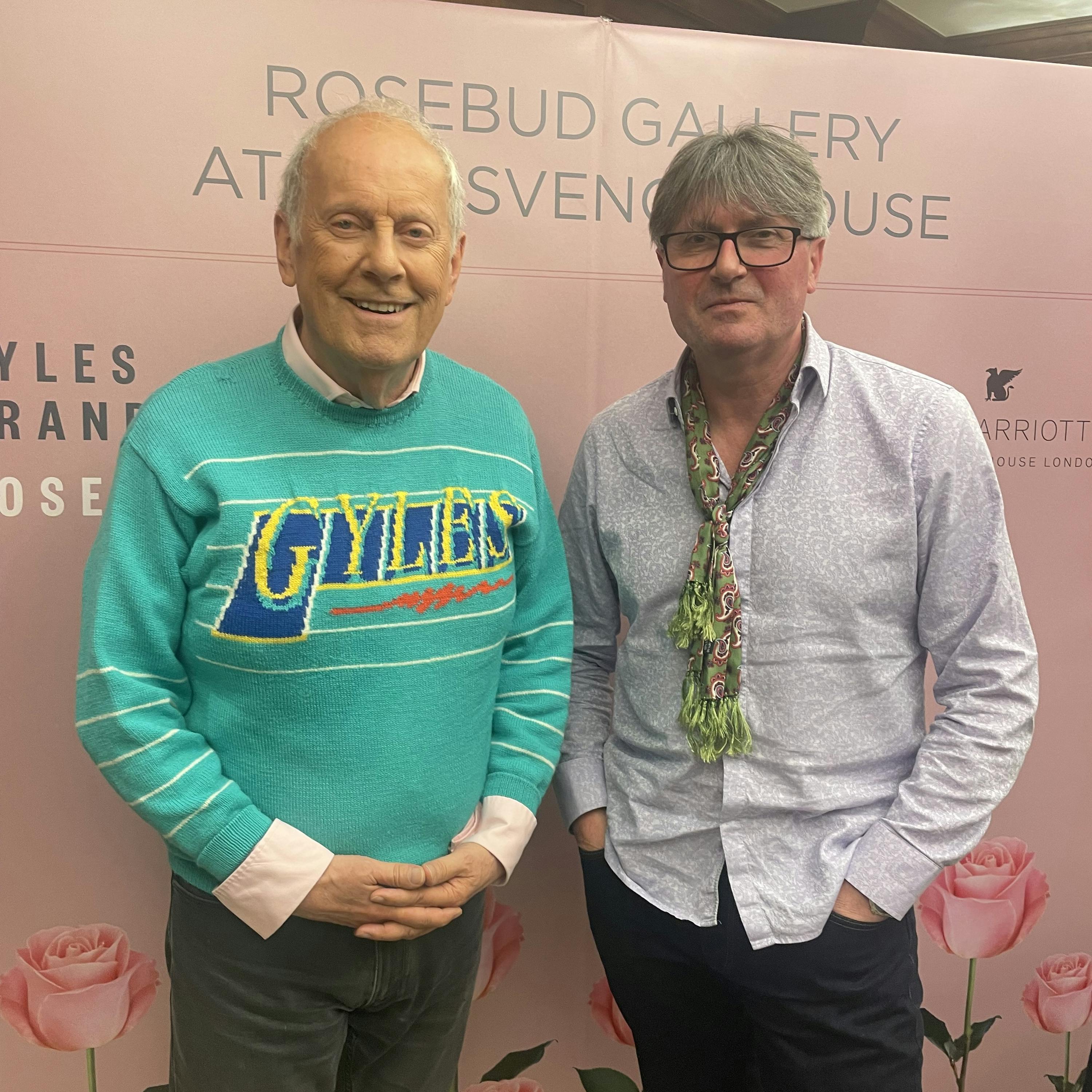
In this episode, Gyles Brandreth celebrates William Shakespeare's birthday week with a special guest, Simon Armitage, the current Poet Laureate of the UK since 2019. The conversation explores Simon's childhood, early experiences with poetry, and his journey to becoming an acclaimed poet.
Written by AI. May contain mistakes.

Get the gist, explore an idea or ask about something said.
 Claude
On Rosebud with Gyles Brandreth, what are the key points of this episode?
Searching your listeningAutomatic transcript. May contain errors.
0:00Welcome to Rosebud. You'll be pleased to know this is a tariff free zone. Yes, there's no extra cost for listening to this week's Rosebud. Wherever you are in the world, even our Chinese listeners. are welcome to Rosebud. You don't have to pay anything more to enjoy this. Yes, this is Rosebud tariff free. We're not even charging VAT. Cue the music.
0:43Shall I compare thee to a summer's day? Thou art more lovely and more temperate. Rough winds do shake the darling buds of May, and summer's lease hath all too short a date. Sometime too hot the eye of heaven shines, and often is his gold complexion dimmed. And every fair from fair sometime declines, by chance on nature's changing course untrimmed. But thy eternal summer shall not fade, nor lose possession of that fair thou owest, nor shall death brag thou wanderest in his shade, when in eternal lines to time thou growest. So long as men can breathe, or eyes can see, so long lives this, and this gives life to thee.
1:39That's the sonnet, of course, by the great William Shakespeare, our national poet. We believe he was born on the 23rd of April, 1564. We don't know that. We know that he was baptised on the 26th, so we just guess that that's when he was born. That's when we celebrate his birthday. We do know that he died on the 23rd of April, 1616. Well, we can't bring you Shakespeare, our national poet, even though this week is his birthday week. I thought, what's the next best thing? If we can't bring them Shakespeare, who can we bring them? Well, I thought, well, we do have a poet laureate. And we've had a laureateship dating back to 1616, which was the year that Shakespeare died.
2:25That's when a pension was provided to Ben Johnson, a poet and playwright who knew Shakespeare, was a friend of Shakespeare. The first official poet laureate was John Dryden, who was appointed in 1668 by King Charles II. Well, the first man to be poet laureate in the reign of King Charles III has been Simon Armitage. Simon's a poet. He's published more than 20 collections of poetry, starting with one I think called Zoom back in 1989. he's professor of poetry at the university of leeds and well i think he's remarkable i've known him off and on for a few years now and i like him i'm fascinated by him i hope you'll be fascinated too welcome to rosebud with the poet laureate simon armadish
3:29Simon, you are the Poet Laureate. Somebody said to me this morning, what does that mean? What does it mean, being the Poet Laureate? Well, I've been doing it for five years now, so I'm about halfway through, and what I've learnt is that the greater part of the job is answering the question, what does the Poet Laureate do? It's a very meta role. I mean, it's a long-standing role. Goes back hundreds of years, doesn't it? Yeah, hundreds of years, back to John Dryden. It was a lifetime appointment up until Ted Hughes died, so there have been periods of history where poets have literally sat on their laurels for a long time and not done a great deal.
4:11And then when Ted died, it became a 10-year appointment, and I think it's evolved into something of a working role, or at least a role where there are opportunities to do things. I would feel as if I'd wasted this decade if I didn't try and get some initiatives off the ground, given that it gets you into rooms with people and gives you a chance to try and organise projects. So, for example, I'm trying to develop a National Poetry Centre in Leeds. We don't have a National Poetry Centre. And I do a big tour of libraries every spring in support of a very beleaguered library system. And they're things that I just wouldn't have been able to accomplish without this title.
4:54Fantastic. And it's a royal appointment. I say that because I think this is the first time I've met you not in the presence of royalty. We only meet in palaces. So I feel it's a bit of a letdown being at Grosvenor House, even though Grosvenor House is so wonderful. Well, it's good to be meeting without having to wear our ties. Yeah, it is a royal appointment. And technically, I am a member of the royal household. so the approval process as far as I understand it is that a name goes up to 10 Downing Street and then that name goes up to the palace and if it's approved then it comes back down to 10 Downing Street and the prime minister rings you up in my case Theresa May one of her happier duties I think during her tenure and does it cause jealousy amongst other poets Possibly.
5:49I imagine it's one of those positions that everybody says they don't want until they don't get offered it. I certainly wanted to be Poet Laureate. People tell me that even when I was at college doing my geography degree, I'd expressed an interest in the role. Well, that's partly because you knew Ted Hughes. I didn't know him back then. Yeah, he was from the Next Valley. north and I think there was probably something in me that always thought well if he can do that coming from Halifax I can certainly do it coming from Huddersfield you know reading Hughes when I was 16 17 I mean that was just a light bulb moment for me I was really uninterested in the world I I didn't realise that you could recreate it with these little packages of language on a two-dimensional surface.
6:46I still find it astonishing that there are only 26 letters in the English alphabet. But if you put them in the right order, you can make astonishing things happen in somebody else's head in complete silence and across thousands of years and across thousands of miles. And that's what Hughes's poetry did for me. It really woke me up and alerted me to this idea that maybe there was something for me in life. I don't think I knew that I wanted to write then, but I certainly knew that I wanted to read. And poetry felt to me alternative, it felt other, it felt like a refuge, it felt secret. So right from those moments it was my thing.
7:29Well, my thing is one of your poems. and before we go, I'm going to share it with you and ask you to read it, if you don't mind. But let's begin by going right back to the beginning and me asking you, Simon, what is your very first memory? I think my first memory has become confused with a photograph. So I seem to remember sitting on what would have been the sort of posh dining table, i.e. the table that we never used in a very small house in the village of Marsden in West Yorkshire in front of a big picture window that overlooked the village. This is before my mum and dad had their conservatory built.
8:14And I was sitting in front of my sister who's 18 months older than me, my sister Hilary, and she had her arms around me. and she is obviously wearing pink and I am obviously wearing blue but I'm not quite toddler age and I feel as if I remember that. I also have a memory of standing at the bottom of the stairs where there was what we called the front door but was actually the back door and there was a keyhole in that door and at certain moments during the day and presumably at certain moments during the year direct sunlight came straight through the keyhole and shone a light onto this spot on the on the stairs and I remember putting my hand in front of it it's like a sort of projected beam of sunlight into the house.
9:10Who were your parents then your mum and dad are they still alive? My dad died three years ago. So he was a huge character in the family. You know, definitely the centre of the solar system. What was he called? He was called Peter. I am Simon, son of Peter. Yes, so... What does he look like? Was he big? He's a big personality. I guess because my final memories of him are as in when he'd become smaller. I remember him as being slightly smaller than me and I remember trying on some of his jackets after he died and thinking that they were a bit tight because in more distant memory he'd been this huge character he had a series of quite scrappy jobs really when I was little at one point he was driving a van around the countryside taking tyres that are usually used for holding tarpaulins on top of haystacks and bales to stop everything blowing away.
10:19And he took them into a factory where they were remouldered to be sold on and to go on lorries and vans. He was somebody who kind of made do. I think he trained as a plumber when he was younger. And then he had a lightbulb moment. He was reading the paper one day and he saw an advert for people who'd never been to university from the probation service asking if anybody was interested in working with people, if they had people skills, which he definitely had. So he gave up whatever it was he was doing at the time. And he worked nights in a valve factory for a couple of years so he could read the books at university and get himself through university.
11:01And how old was he when he was doing this? It's interesting that you asked me that question because I've wondered about that sometimes. And I don't, I mean, I could find out, but I'm guessing that he would be in his early 40s at that time. It's a massive jump for him. Anyway, yeah, just to come back to him as a character. Did he get the degree? He got the degree, became qualified. Became a qualified probation officer. And was he a good probation officer, do you think? He was excellent. He was very old school. You know, he wouldn't be the kind of probation officer which the probation service would allow in their ranks anymore.
11:35I don't know how I came across this, but I saw his application to the university, and this must have been at the time when universities could still ask for a photograph of you when you applied to university. And he was a bit of a thespian, and he was in lots of local shows and amateur dramatics and everything. And so instead of sending his mug shot, which is what they meant, he sent a kind of theatrical shot of him in Annie Get Your Gun. Oh, brilliant. With a rifle broken over his knee. That's what kind of probation officer he was. That's what we need, absolutely. You say the amateur theatricals, that was big for him.
12:13Did you discover that when he was quite young though? That was the passion of his life. Yeah, I think he would have loved to have been an actor. Can you remember him on stage? Oh, yeah. He had a presence. Yeah, loads of things. He was Fagin in one show from Oliver. Yeah, scared the hell out of me. He was Bill Sykes in another version of Oliver, scared the living daylights out of me. I can't remember what Bill Sykes' dogs called. He acquired a dog for the role, and this dog came to live with us. There's a bit of method acting going on. He was a really mean dog as well. Oh, so he lived with the dog for a while?
12:50The dog lived with, yeah. To get into the part? Yeah, yeah. And so it got to sort of know him and trust him on stage. This is in the local village hall. It was in a barber shop singing group as well called the Victorians. And they used to rehearse at our house on a Sunday morning. So I'd been in bed and I could hear all these harmonies, you know, drifting up the stairs. And they used to wear these very fancy waistcoats and go off and sing in hotels on Friday and Saturday nights. So, yeah, I think that was his dream, really. and he produced and he directed locally. He wrote a pantomime every year, as well as sort of playing cricket as well for the village.
13:29He was never at home. But he sounds like a fulfilled and consequently happy man. Yeah, he was. Yeah, I think that's absolutely true. He wore his heart on his sleeve. I remember thinking when he died, you know, we hadn't left anything. You know, we'd said everything to each other. We knew all about each other. But, yeah, it was a big loss. And even three years on, we're still rearranging the configuration of the family. Within the family. You and your sister. And any others apart from you and your sister? No, my sister. And is your mother still alive? She is, yeah. So it's quite a challenge for her.
14:04She's coping with widowhood. Yeah. And also coming out from under his shadow a little bit as well. Because he was the big figure. Yeah, he really was. But yeah, she's... Has she blossomed a bit? I think that's fair to say, yeah. And also, I mean, it's coincided with some big and slightly mysterious improvement in her health. I think she had a sort of regime change with her medicines, and suddenly she's walking places again, and she just looks a lot better than she did three or four years ago. Well, of course, she may have been literally in his shadow, and the shadow is now gone, and so she's now more in the sunshine.
14:42Yeah, maybe, but no, she's... But how did they get on together? Were they a loving couple? Did they enjoy each other's company? I think they absolutely did, especially at the end. I mean, they could play the part of a niggly, Yorkshire, long-married couple sometimes. My dad, at their 60th wedding anniversary, stood up to give a speech and said, I'll tell you what the secret of a good marriage is, tolerance. I was watching my mum's face at that point. What do you think you've got from them? What did they give you? what is in you now that is directly a result of them?
15:23Permission to show off a little bit and not necessarily to stay within the mainstream, even though they were, to all intent and purposes, a very kind of regular and conventional family. You know, my dad lived this sort of other life, I think curiosity. We weren't a bookish family at all. I could probably list on two hands the number of books in the house when I was growing up, but there were encyclopedias and there were atlases. There were books of knowledge. There was a great relish of language in the house, especially from my dad. He was a big storyteller. He loved a mucky joke. I was probably the quiet one when I was growing up.
16:14They were all quite gobby. And, you know, I've sometimes wondered whether I started writing because I would have been the butt of the joke maybe at tea time and somebody would have been making fun of me, probably my dad. And so I'd flounced out and gone upstairs. And then ten years later I've come back down with a poem. You know, ha-ha, here's my rejoinder. When he died, did you write a poem about him? Have you written about him since his death? well that's been interesting for me as well because when he was alive I wrote a lot about my dad and nearly all of the poems I wrote about him were very elegiac and commemorative I'm not sure why whether it's some kind of preparation I don't know what he made of these poems because he was very much alive and kicking when I wrote them so when he died and it was a big shock you he hadn't been ill or anything.
17:07I assumed that there would be more of these poems, and there weren't. But then about, I don't know, maybe a year after he died, I was watching telly one night, and there was that programme, The Repair Shop. I'd seen it a couple of times, but my dad used to watch it all the time, mum and my dad, and he was always ringing up and saying, did you watch The Repair Shop last night? And this, this, and this. So I purposefully watched it one night, and I could suddenly see why he liked it. I mean, you know what they do on that show? They get objects which are in disrepair. And because they're often heirlooms, they repair them.
17:46And it's like being reunited with somebody. I think that's the alchemy of that show. And so, yeah, I wrote a poem called The Repair Shop, which is about sort of putting my dad back together. And there have been a few more since.
18:11Who was your first friend outside of the family? I had a little gang of friends. See, this house where we lived, I've said before, I had sort of one foot on the pavement and one foot in the pig pen. I mean, we didn't have a pig pen or a pavement, actually, but it was right on the edge of the moor. It was the sort of last terrace before you got up onto the moors. and there were two or three lads who lived in the same area and they all became, well, we all became a little gang, really. Were you a happy gang? You got on well, you played games? Yeah. It was all about the bikes. Oh. Yeah. I loved those summers.
18:51And also the, you know, this territory that I'm describing. So the village of Marsden's the last village in the Cone Valley before you get up onto the Pennines You've got the Peak District, you've got Saddleworth Moor, and they were just an amazing playground. And Marsden as well, it's like a cistern. It's a sort of water-collecting village. There were 11 reservoirs, spillways, canals, catchwaters. I mean, it felt Aztec sometimes, you know, the scale of the industrial architecture. so yeah you could turn one way and you could go down into the village or you could go off into Huddersfield on the bus or you could get on the train and go into Leeds or Manchester but it was more exciting just to walk up the hill where the road eventually petered out.
19:42So you were going outside you weren't sitting at home watching the television. Well I like telly as well and I've always been sceptical about people who've you know pooed pooed telly because I didn't read books when I was a kid. Wasn't interested at all. I watched telly and read comics and that was quite enough for my imagination. What sort of comics were you reading? I read Tiger and Scorcher, Desperate Dan, you know, thumping people into the middle of next week. Great national hero, actually, Desperate Dan. Minnie the Minks, Alf Tupper, Tuffer the Track. I think courtesy of one of my friend's sisters, She used to get all those Scottish annuals, the Broons.
20:29Oh, yes. And Oor Willy. Indeed. And they used to end up at our house during the summer. From DC Thompson. That's right. The same people who gave us Dandy and the Beano and all that. I used to read them. I loved them. I didn't quite understand them, but... So, the primary school's okay. The secondary school, I get the impression, not so happy for you. No. No, I really didn't like school, no. No, why not? It was too big. There were 1 ,800 kids at our school. What was the school called? What was the school? It was Cone Valley High School. And that didn't include the sixth form either. Mind you, there were only about five people in the sixth form.
21:07Got that far. Yeah, it was just a tough place to be. There was an anti-work ethic. Not that I wanted to work especially, but you would be singled out for harassment if you were caught learning. If you were seen doing any homework in school, people would stand around in a semicircle and sing, hey, Jude, you're a Judas. Gosh. Betraying the ethos of the school by actually doing something. Betraying the ethos of the students, really. I mean, the teachers, I think, were good, and they were doing their best to get as many people through what was just like a big system, really, with the least amount of trouble.
21:49but it catered for an extraordinary range of people uh you know so there were people there who were academic and wanted to to learn i wasn't particularly one of them but there were also a lot of farmers kids there as well people just wanted to go into industry i mean i've written about this in the past but the two big things at our school if you weren't going to go on to further education and most people weren't, you either went to work at David Brown Tractors or you went to work at David Brown Gears. David Brown Gears made the gears for Aston Martin, which is why the Aston Martin is the DB6. Of course.
22:27And what was your subject? What were you good at? What was the lesson you looked forward to in the day? I guess English. I had a big crush on my geography teacher in the sixth form, which is why I went on to study geography. And who was she? She was called Mrs Towler. Actually, what's weird about this, we were terrible in the city. I think we made her life a bit of a misery, but she invited us to her wedding. I think she got married at Manchester Airport. This is all sounding very strange. She clearly wanted a quick guess away. When did you start writing yourself? What was the first poem you read?
23:04How did you discover poetry? It's a funny thing to be interested in. I think in earnest. You know, I was talking about reading Hughes at school. I remember reading a poem of his called Bairn at Charge. I mean, Hughes was obsessed with the First World War. His dad fought at Gallipoli. So it's a poem of his about a soldier in the trenches coming out to go over the top and into the flack and the barbed wire. And there's a line in that poem which is, in what cold clockwork of the stars and nations was he the hand pointing that second? In what cold clockwork of the stars and nations was he the hand pointing that second?
23:51I couldn't really give you an adequate paraphrase even now, but it was something about consciousness, I think. And it coincided or it prompted a realisation of consciousness in me. and the fact that a poem could do that, I think that's partly what triggered my interest. My first written poem, as far as I remember, we were at junior school and we had a supply teacher whose name, I remembered it a few years ago, he was called Mr. Krizwicky. Great name, Mr. Krizwicky? Krizwicky, yeah. It's a Polish name, I presume. And he'd said to us, so I think I would have been about 10 or something he said to us I want you to go on Christmas holiday and write a poem about Christmas I don't think I really knew what a poem was I knew it was short so that was quite appealing I think I'd put quite a lot into it because I brought it back into school and he'd said that he was going to put the best six up on the wall and he didn't choose my poem and then about a week later he came up to me and he said, oh Simon I just thought to tell you that that poem of yours was really good and I just thought, well why don't you put it on the wall then and I have wondered actually since then whether I've just been pursuing a career of revenge and bitterness, because I can be a bit like that, so every time I finish a poem I'm thinking, stick that on your wall Chris Wicky Well done I've recently been reading the poems of Afra Ben.
25:30And I came across a marvellous poem about the value of billet doux, little love notes, and the virtue of not saying things, but writing them down, because it becomes permanent. And you've got to fix the thought on the page. Did you write love poetry? Did you write billet doux when you were a young teenager? I don't think I did. I'm not sure that I would have been confident enough in my abilities at the time, or whether I wanted people to know what I was doing. I mean, I remember reading that somebody had once asked John Berryman, the American poet, why he wrote poetry, and he'd said, to get X into bed.
26:18I don't think I used it with the same motivation at that time. I have written love poems. What was the first love poem you wrote? I can't decide whether I've forgotten or I'm not telling you. It's probably the latter. But then can you remember, though, your first kiss, your first... Don't need the details, but can you remember it? Is it vivid to you? I seem to remember having a snog with somebody under the stage at the parochial hall. That'll do. That'll do. Has that got me through that section? I think it's got you through that section. And I think, too, that is more of a limerick than a poem.
26:59But that'll be fine. That's OK. We don't mind that. My dad used to tell a great limerick. I think I might have told you this one. Share it again. Well, it was just because you were talking about him and his relish of language. And if the subject of limericks came up, he would always say this. So it was, There once was a man from Rill who swallowed an atomic pill. They found his balls at Niagara Falls and his arse up a tree in Brazil.
27:28And when he got to that last line, he would just collapse with laughter. I'm not surprised. It's great. It's fantastic. So at school, you're emerging. You're interested in Ted Hughes. You're beginning to write a little bit. You're a bit of a loner, are you? Because you do do a bit of work. You don't feel comfortable with most of the boys around you. They're girls as well at the school. So what in your head are you thinking you're going to make of your life? I have no idea. I mean, I had no idea, even after I'd finished my degree, I didn't know what I wanted to do. I was just drifting, Giles. I mean, I haven't studied English since sixth form.
28:08I went on to do a geography degree, partly because it was telling me I think I was besotted with my teacher. But I think I had this vague notion that I was interested in maps and I might become a cartographer or a town planner or something like that. Were you interesting as a person, do you think? No. No. So you were at the centre of attention. In the way that your dad was this great personality, naturally with star quality, you were the quiet one in the family. I think it was the introspective one. I think I had more of my mum about me. You couldn't have had two people like my dad in the same room.
28:46It would have been like a collision between Jupiter and Mars. So what happens? What do you do then? You emerge. Which address did you go to? I went to Portsmouth Poly. I was going to say that I messed up my A-levels. I don't think I did. I got exactly the results that I deserved in terms of the amount of effort that I put in. I went into something called clearing. I don't know whether that still happens. I remember my dad being on the phone, ringing around, trying to find me a place somewhere. He clearly wanted me out from under their feet. and I sort of got told really that I was going to Portsmouth Poly to do geography.
29:27It was about as far away as you could possibly think and I was okay with it because my girlfriend at the time was going off to Southampton University, which is just 20 miles away. So I thought, well, this is going to work out. She was the girl you were at school with. Yeah, I think I was madly in love with her and so, you know, trailed off to Portsmouth Poly and she went off to Southampton University to do biology, dot, dot, dot. And, yeah, so I think she left me after about three weeks. So I was kind of abandoned on the south coast. And this is me painting my picture of it anyway. And I was going to pack it in.
30:08I was going to go home. And I remember... Yeah, because you were quite lonely. I was really lonely. I was homesick. and when you were homesick did you express your feelings given your you become a poet eventually a full-time poet did you were you writing were you keeping a diary were you writing i was writing poetry you were writing poetry and i was writing poetry about home and i was reading ted hughes and tom gunn and elizabeth jennings and elizabeth bishop and sylvia plath and philip larkin and i was reading all that poetry because we'd looked at it at school and i was homesick and i was trying and remember being back at home, I think.
30:45So what happens? You don't go home. You go through it. You get your degree. Yeah, I sort of bodged along in that. I found Portsmouth quite a strange place. I mean, I was from a little village in West Yorkshire, completely landlocked, and then suddenly I was in this sort of quite schizophrenic city that I think had lost quite a lot of its identity with the decline of the Navy and so we were living in a bed and breakfast accommodation that wasn't being used by tourists in the summer and that had a strangeness to it as well. I was in Portsmouth when the fleet went out to the Falklands, watched the aircraft carriers going past the end of the street.
31:33But as time went by, I was really into music then. That was everything for me. Pop music? Yeah, kind of punk, post-punk, indie stuff, dancing. And you went dancing? Went to discos. On your own? I had a big group of friends who were all into the same music. We'd go to gigs. We used to go up to London. And some of the people that I knew then, well, one person particularly, probably became one of my best friends. And we still listen to all that music, still go and see those bands and talk about them. You were ordinary. to the exterior, were you ordinary inside your head? No. You felt special in your head?
32:15Yeah. And so what was that doing? What were you beginning to think, there's something in here going on. How did you take that forward? Well, it came out eventually in the poems, you know, the self-awareness and wanting to express myself and tell people what the world looked like to me. And the first poem to be published? The first poem to be published was a poem called Without Photographs, which was a memory of me and that little gang of mates I was telling you about, messing around under the mill in the village, and we found all this equipment, it was like a a brazier and kindling and pans and bowls and eventually we worked out that some other gang had been there and they'd been smelting lead so they would nick lead from the mill windows or off the church roof and then you could melt it just in a saucepan and they used to pour it into what they call the frog of a brick you know into the well of the brick and the brick would have the maker's name in it as well and you you could make these ingots and then turn them out and these beautifully shiny silver heavy um trophies of of work and industry and manufacturing and you know we were only 12 or 13 it was dangerous as well we got burnt a lot and we did that all one summer in fact we found a brick at one point the brick maker's name was Armitage and so I cast a lead ingot with my name I don't know where it's gone but yeah I wrote a poem about that called Without Photographs and after sending various poems out to various magazines finally got that one placed in a magazine and I think the magazine was called Other Poetry and it was published in Leicester you know pamphlet small circulation and they sent me a check for uh two pounds 50 which i never cashed and i've still got great because it you know my take on this is that it never gets any better than that if you are moment well if you are unpublished and then you are published that change it's not just exponential it's it's beyond measure you you can't quantify that mathematically so any other progression you can quantify but that that changed from being unpublished to published and seeing your work in in print you know fixed in type and and in a circulated magazine and being able to sort of pop that down on the kitchen table and say i did that i did that but You wanted to be heard.
35:13And when your dad and your mum saw it, did that change their view of you? Not at that point. I think they still thought it was just something on the side. I think it was a trainee probation officer by that time. Because you realise, I've got to do a job. I've got to do something. And this is what your dad had done. Yeah, family business. Yeah, I mean, after college I went back up north, really out of complacency. and I didn't really know where else to go, what else to do. Started volunteering in ex-offenders, hostels, working in day centres, then eventually got on a course at Manchester University to qualify as a probation officer, stayed on, did an MA, got really into the work.
36:00I mean, by that time, I was quite academic. You know, all that stuff had come too early for me before. But suddenly I was really interested in writing. Because you went on to do another degree after the poly. Yeah, so my first degree was in geography. Even then, I just sort of drifted through it. But by the time I went back, I went to Manchester University to do the probation training and then stayed on to do a dissertation in an MA. And the dissertation was on an interesting subject, wasn't it? The effect of violence on television on teenagers, that sort of thing? Yeah, what we used to call video nasties.
36:36So I was trying to detect whether people who had violent tendencies were people who had watched video nesties and whether they'd become more violent through that. In a nutshell, had they? I think in a nutshell, no. I think my recollection of the findings was that most of these lads were predisposed to violence anyway, and that's why they were choosing to watch that material. And what they were acquiring more than the impulse towards violence was technique and methodology. So an example would be, do you remember Kung Fu, the David Carradine TV series? Actual incidents of violence didn't go up at that time, but the number of people being Kung Fu kicked and chopped did.
37:30So it was a sort of methodology rather than a... Well, it's rather like advertising. Advertisers said that we don't make you buy more butter, but by advertising our product you will choose our butter rather than the other butter. So you're not increasing the amount of violence by showing this. You're giving people ideas of how to do it effectively at the moment. Yeah. So you ended up as a probation officer. And where were you working and how did you make out as a probation officer? I was working in Greater Manchester. I worked in Rochdale to begin with and then I worked in Oldham for three or four years.
38:02I did placement in Wakefield Prison. I worked in the courts and I think I did most of those Why didn't you stick with it? Philip Larkin enjoyed being the librarian up in Hull It kept him rooted while he was doing the poetry Why did you not stay? Why not the head of the probation service instead of being the poet laureate Sounds a bit of Wimwam, poet laureate I think you've answered your own question Whereas the head of the probation service really could make a difference to the lives of young people across the country What good have your poems ever done anybody? You're asking me the same question that my dad asked me when I told him that I was packing in.
38:39I think he was always a bit miffed, actually, that I'd retired from the probation service before he did. I think that was the point when they were a bit worried about me because I'd trained very hard for two or three years. I got this qualification. It was a profession. This was at a time when there weren't many jobs. It was probably going to be a job for life with a pension at the end of it. and I was chucking it all in for this thing called poetry and at that time I think I'd only published one book. I mean, I'm absolutely certain that even if it wasn't for the poetry I would not still be a probation officer now.
39:17Weren't you any good at it? I'm not sure that I was any good at it, no. Well, I mean, I don't know how to measure it and that was one of the other things that I found very frustrating. There was no product. I think I'd always wanted to make things and to be able to point to things that I'd made and it was very difficult to point at examples of success in probation whereas with a poem it was something that you could finish it was like your ingot yeah exactly it's an object, you are fashioned and there it is it's a made thing I think somewhere in the back of my mind growing up I'd always wanted to make things but I hadn't been any good with my hands I was never going to be a carpenter or a painter or anything like that.
40:00But this material that I found I could manipulate was language. Did you meet any interesting prisoners along the way? They were all interesting in their own way. I mean, there had been a massive heroin explosion in Manchester at the time, so a lot of it was drug work. I mean, it was impossible. And that was part of the exhaustion, especially working with people who've got a heroin habit you can make so little difference in their lives your input compared with the hold that that drug has over them I'll give you an example I was working with one guy and he'd gone down to this area of Oldham to score his drugs one day and he didn't have any money so he'd snatched the little bag of heroin and they chased him down the street and they'd stabbed him in his side with a little ceremonial sword.
41:01Despite which, instead of going to the hospital, he went home and took the drugs and next day was down there again trying to buy more with this open wound at his side with God knows what coming out. And I just thought, I don't think there's anything I can say to that man that's going to make a difference at this point in his life. Yeah, I think I was maybe a bit of a bleeding heart back then. I'd gone into it because it was a sort of soft science. It was quite a radical job. It was about keeping people out of prisons because prison's a terrible place and it doesn't do anybody any good. Did you encounter any celebrity prisoners?
41:43Well, I did when I worked in Wakefield Prison because that's category A prison. I did a placement there. Dennis Nielsen was there. People that you'd seen on the telly when you were kids, monsters in your head, and there you were having a chat with them on the landing or going into their cell. There was a prisoner there at the time. You know how every now and again the tabloids will say this is Britain's most dangerous prisoner? and there was a guy called Robert Maudsley. They took me down into the sort of dungeons to show me Robert Maudsley. I think that's the right, I think that's what they were doing.
42:25They were showing him to me. And it was a sort of Hannibal Lecter moment. He was in a glass case with a telly outside of the wall so he couldn't touch it. And I think as well as he'd killed his father, but he's also killed a couple of prison warders while he'd been in prison. and so he was notorious, but, you know, a more pathetic sight you've never seen. So that would have been about 1991, maybe, a bit earlier, 1990. And then about 25 years later, I was driving along one day, and there was an item on the radio about Wakefield Prison. They started talking about Robert Maudsley, and they said he was in this glass casing.
43:10And I was thinking, God, in all that time and all that life that I've lived, he's still in that sort of goldfish bowl. Have you written about that? I have written about that, yeah. I wrote a poem called Solitary. It's a villanelle because that form is very... What is a villanelle? It's very repetitive and quite a claustrophobic form. So certain lines are repeated in a certain order. It keeps coming back on itself. in a sense I'm glad that you've written about that what are the experiences that you do write are there things that we think of Ted Hughes and we think of nature with you what should we think of and what do you think of in your head when a day comes do you write something every day I do write every day I don't know whether it's poetry I've got a notebook with me at all times and I get very panicky if I don't know where it is is kind of companionship as much as anything else.
44:10I do a lot of commissioned work these days as laureate, so people get in touch and say, you know, could you write about this or would you be interested in coming and doing a project here? And I've been writing more and more nature poetry. I said when I became laureate that I wanted to put the environment front and centre with what I was doing and that poetry's had its monies worth out of nature and nature can't speak for itself and it's in crisis. So, for example, my last couple of books, I wrote a book called Blossomize for the National Trust, which is a big celebration of blossom. Well, not just a celebration, an exploration of its meaning in our life and its transitory as well.
45:03Tell me about your, you've got daughters, haven't you? I've met your wife and I think two daughters. One daughter. One daughter. That's your family, a wife and a daughter. Do you communicate well with them, given that you're writing your most powerful thoughts in your notebook and clearly a lot goes on in your head? How are you as a husband and father? Yeah, all channels of communication are very open. Good. Yeah, our daughter's very talkative, very communicative, you know, tells us everything. And your wife's called Susan? Sue, yeah. And how long have you been with her? It will be our 25th wedding anniversary this year.
45:39Congratulations. Thank you very much. Well, what do you think you give her and what does she give you? I think one of the reasons it works is that we are in a similar line of work, but not the same. Oh, what does she do? So she works for the BBC and she is in charge of arts and culture output for BBC Radio for the North. Very good. So we do have a crossover. And you choose still to live in the north, though a lot of your time you're travelling. Where else is there? Well, exactly. I have family come from Lancashire and from Yorkshire and from Cheshire. I don't know what I'm doing in London either, except I feel very metropolitan.
46:19But I do feel I love your poetry, I have to say, and I've got a poem of yours. I did a collection of poetry to learn by heart a year or two ago, and I almost open the collection with a poem of yours called The Catch. You know this poem? Do you like this poem? It's an old poem, but yeah, I am quite fond of it. The reason that I put it in this book, I think, it's I wanted to show people how the presentation of the poem could tell the story. It's about a catch and a cricket match. It is, yeah. And the way you lay out the lines, actually you visualise as a result of it what is going on. Would you mind reading it?
46:59I mean, just to say, on that subject, you know, the physical presentation of a poem on the page is a huge part of the attraction for me, how it's laid out. I mean, we own the page. Prose writers don't. They give their work over to somebody called a typesetter. But we, you know, poetry sort of occupies... Is this part of you making this thing? Yeah, it stakes out... there's something architectural I've said before I think we've got more in common with photographers and sculptors and visual artists than we have with prose writers I think so it's interesting and satisfying to hear you say that about the layout of this poem, the catch Forget the long smouldering afternoon it is this moment when the ball scoots off the edge of the bat, upwards, backwards, falling seemingly beyond him, yet he reaches and picks it out of its loop like an apple from a branch, the first of the season.
48:15Great. I love it too because it catches a moment and you're clearly very good at that, encapsulating a moment. Before we go, just a few quickies. Your recollection of joy, if I say to you joy, ecstasy, happiness, what's the first thing that comes into your head? Music, dancing. Are you still into that? You and Sue do a bit of dancing? We go away at New Year with a load of friends. It used to be like a three or four day rave really. It's become slightly more about cooking and walking and chatting and playing games. But still most nights there's a playlist goes on. I kind of reach experiences of sort of ecstasy through physical movement and listening to music that I don't get from anything else.
49:08I'm sure music's given me more pleasure than literature in my life. And sadness, your first recollection of sadness. My first recollection of sadness, I think that would be being left at nursery by my mum. That is an early memory actually that I'd forgotten and now I've remembered it. You've sort of broken that memory for me. Yeah, there was a sort of preschool nursery in the village and I remember her taking me along there and leaving me. So, yeah, that sense of abandonment. it was probably more panic than sadness. That'll do. And you must have met some extraordinary people. Well, obviously, you met Dennis Nielsen, but you met some extraordinary people as poet laureate, beginning, I suppose, with the late Queen, because when, if you say you were appointed in Theresa May's time, that was when Elizabeth II was still alive, and it was part and parcel, but you get a moment when you actually are inducted, is that like a kissing of hands of Prime Minister?
50:15So you go with a poem or something to say, hello, I've got the job. I don't know if you know who I am, but I'm the New Poet Laureate. Yeah, there was a bit of that. I went to the palace for two reasons on that occasion. I'd been awarded the Queen's Gold Medal for Poetry, and I was the new laureate. And so I went along there with Caroline Duffy, who was the outgoing laureate. I said to the Queen something like, so it's a double do. And she said something like, well, you might put it like that. Well, she must have gone back to John Maysfield, must have been her first Perth laureate. He was one of the ones who never gave up because he was Perth laureate for almost Edward VII, George V, George VI, Edward VIII.
51:05He never went away. Yeah, she'd seen off quite a few. I think it must be like prime ministers. Not quite the same revolving door. Easy cam, easy go. I took David Constantine onto the Palace one year. He'd been awarded the Queen's Gold Medal. And as we were on our way there, I got a call saying, it was during COVID or just sort of post-COVID, that she was staying at Windsor, wasn't sort of risking coming to Buckingham Palace that day. And we were almost there. So I said, oh, is it cancelled then? And he said, no, you're going to have an audience with a virtual audience. So you bow into a TV. And because it's the palace, it's not a new flat screen.
51:51It's some old grumbig with a vertical hold problem. So he had the audience. So you're bowing to this flickering figure. Yeah. And at the end of the interview, as a way of closing things down, I think, she said to me and David, well I do think it's marvellous what you do seeing things and writing them down and I went out thinking yeah that is what I do actually that is actually the essence of it what you see you write down brilliant, very good anyone else that rings a bell in your head that you think my gosh are there great poets that you've encountered? well that generation that I was talking about I think you never really get over those people that have made such a bold impression.
52:39So I met Ted several times, spent a little bit of time at his house. I spent more time probably with Seamus Heaney. Do you feel obliged when great poets get together to talk poetry? Do you feel that it's sort of part and parcel? You're with Seamus Heaney, I better say, drop a few, you know, talk about a villanelle again, throw that into show, I know what I'm talking about. I think the thing with Ted and with Seamus, they lived and breathed poetry they were the embodiment of poetry so it was just a natural part of the conversation and when you see their letters you realise that it just flows through them continually and I wanted them to talk about poetry I wanted to listen to these magic men these magi talking about their work and the work of others.
53:36They were just sort of endlessly fascinating on that subject. I'm not sure it's the same with my generation. I don't know why I was thinking about this on the way here, but I don't really hang around with any writers. I mean, I know lots of writers and spend time with them when we're doing projects and readings and festivals, etc., etc., but I don't really socialise with anybody. but I'm not really sure that I want to be a writer. I just want to write. And you do write, and you write very well. On my bedside, I have The Rattlebag, which is the Seamus Heaney-Ted Hughes anthology, which is fantastic.
54:19Which of your books, somebody listening to this for the first time, thinking, oh, he sounds interesting, might get one of his. Which would you recommend people start with? Well, there's a book called Paper Aeroplane, which is, I guess, you know, a selected poem by another name. I'd probably suggest that. That's good. And also it's an object that you've made, a paper aeroplane. I can see it whizzing through the air. That's the idea, is it? Yeah. Or my translation of Sir Gawain and the Green Knight. Oh, that sounds fun. And Sir Gawain and the Green Knight, that's an ancient text, like Beowulf or something, is it?
54:59It's later than Beowulf. It's medieval, middle English rather than old English. And you've rewritten it? Yeah, I translated it. Wow. Yeah, I mean, in the States, if I'm known for anything, that's what I'm known for. I think here and over there, it's sold about a quarter of a million copies now. Congratulations. Yeah, thank you very much. You're a poet who's actually made some money, which marks you out from the rest of them. Yeah, I'll be able to get back to Yorkshire tonight. The final thought is, what have you learnt? in all your years? What has life taught you?
55:36I think, don't panic. Let's carry on.
55:46There isn't a sort of road map to here. It's just the consequence of experience and doing things that I enjoy. Other people say I am fanatically determined. I think that's probably true, but I don't think I'm ambitious. I'm just determined to keep making good work. And when there's something wrong with it, I'm absolutely prepared to go back and change that and to try and make it different next time. and all those endless adjustments through life and through the writing. And I see a lot of younger people now, and I think it's because it's dangled in front of them, who I think expect that they can get the thing they want very quickly and that there is a shortcut to it.
56:45I'm not even sure there's a long, straight road to it. I think most people I know who are satisfied with themselves and comfortable and happy in their work and have achieved things have just got there, not necessarily by accident, but just by, you know, keeping going. So, yeah, keep going. Keep going. Well, don't panic. Please keep going, Simon. I think you're marvellous. Thank you very much for joining us on Rosebud. It's a pleasure. So there you are in Shakespeare's birthday week, our poet laureate Simon Armitage. I think he's marvellous. I love Simon's poetry. In fact, I've included some of it in my anthology of poetry to learn by heart, which is called Dancing by the Light of the Moon.
57:38I really enjoyed hearing today about Simon's life and times. and I do encourage you to take a look at his recent book, Blossomize, Blossomize. It is beautifully illustrated. It's published by Faber. Get it if you can. All right, that's enough poetry for now. Let's move on to one of your emails before we go. We've heard from Jen Gaskin this week and this is Jen's memory. My first detailed memory that I know is mine Not retold to me or from a photo Is my first school assembly when I was five We went down to the large grass field Everyone was sitting cross-legged in rows on the grass With our classes in the sunshine Then the principal went to the front Said hello to everybody And then very seriously said Please refrain from eating the grass I'd never heard a direction like that before the word refrain struck me.
58:38But also, I clearly remember thinking, why does he need to tell us this? Why have my parents left me with these strange children to eat grass? And then I remember asking myself, maybe it's tasty. Should I try it too? I have no further memories of grass eating, but it was definitely a memorable start to school. Thank you for the podcast. Jen Gaskin. Wow, have I ever eaten grass? Well, I think I remember sucking on grass and liking that and I think too I remember almost grazing my tongue with the side of a blade of grass. So something interesting clearly was going on there. Anyway, Jen, thank you for that memory.
59:28If you have other memories, do share them with us. Our address is quite simply hello at rosebudpodcast.com. And that's it for another Rosebud. We appear every Tuesday with more Rosebud, and then every Friday with a new and special guest here to share their very first memories with me, with my producer Harriet, and most of all, with you. Thank you for listening. Until next time, goodbye.
1:00:26Rosebud is a Plain Jane production produced by Harriet Jane, hosted by me, Giles Brandreth, with music by Phil Leppard and recorded this week at the JW Marriott Grosvenor House in London's Park Lane. Room service.
It's the week of William Shakespeare's birthday, so Gyles has poetry on his mind... and we thought we'd celebrate with a special conversation recorded with Simon Armitage, who has been Poet Laureate since 2019. Gyles finds out about Simon's childhood and early days, when he played out on the moors with his friends, watched TV and read comics... long before he became turned on to poetry by reading Ted Hughes. Gyles hears about Simon's parents, his love of indy music, and his first career as a probation officer. Gyles and Simon talk about poetry, about Ted Hughes and Seamus Heaney. We hope you enjoy this episode, and that it inspires you to read some poetry today - Simon's most recent book, Blossomise, it out now - it's a celebration of blossom and is well worth reading this springtime.
Learn more about your ad choices. Visit podcastchoices.com/adchoices
Hosted on Acast. See acast.com/privacy for more information.


