
 Ask ChatGPT



This episode is an interview with actor/writer Simon Callow about how his family history and early obsessions shaped his life and work. Callow discusses his earliest memory of his grandmother Vera Agnes Gies in Streatham, London, emphasizing her deep contralto voice and optimism. He contrasts this with his mother Yvonne, a hardworking but “emotionally remote” Catholic secretary whom he describes as difficult and focused on making him an academic. He recounts his father Neil Callow’s disappearance after living in Africa (including racist attitudes Callow later recalls), his death in Zambia from cirrhosis, and how Callow later felt he “played” his father through roles like Toby Belch. He also covers his teenage self as energetic and “plump,” his early reading, and his coming to terms with being gay via books (DJ West; Brian McGee’s One in 20). Key examples include his first reading breakthrough at age five, Africa’s lions and alligators, and his formative encounter with Michael McLiamore.
Simon Callow is the main guest; the host is Rosebud’s Simon (the interviewer) and the episode also includes unrelated ad voices.
Written by AI. May contain mistakes.
Gyles Brandreth introduces Simon Callow, discussing their shared interests.
“This week we've got an actor on Rosebud, one of my favourite actors.”
Simon shares his first memory and discusses his grandmother's influence.
“That is worth saying, only because I think when in the 1980s he became one of the first high-profile British actors to come out as gay, he described it as his biggest act of activism.”
Simon reflects on his grandmother's life and her remarkable voice.
“running towards my grandmother, who was the sort of salvation of my life.”
Simon describes his family's dynamics, focusing on his mother and uncle.
“It was immense and very, very, very deep.”
Simon recounts the unconventional courtship and marriage of his parents.
“And she was a good woman, and she was a woman who worked incredibly hard.”
Exploring the tumultuous relationships in Simon Callow's family, including his parents' marriage and his father's abandonment.
“felt she'd lost her virginity and therefore felt obliged to follow it through with matrimony even though this was a man who she would leave the room rather than be with.”
Discussing Simon's education, his mother's job, and the impact of significant figures in his early life.
“My mother got a job then when I was five years old.”
Delving into the expectations Simon's mother had for him and the emotional distance in their relationship.
“Once I could read, I would read everything.”
Narrating the surprising return of Simon's father and the complications that arose from it during their time in Africa.
“and through you, if it could have happened.”
Explore Simon Callow's complex relationship with his father and their last meeting.
“So it seems that what he was trying to do was to get her to desert him.”
Delve into the impact of his father's death on Simon's life and career.
“And then the next, and he would write me occasionally letters.”
Understand Simon's experiences and interests during his teenage years.
“Are you still, describe yourself as the fat boy from Streatham?”
Examine Simon's understanding of his sexual identity and influential literature.
“Had had many, many boyfriends, but was scornful of them all.”
Discuss Simon's university choices and the impact of Oscar Wilde on his life.
“So you go to Queen's University of Belfast because you don't get into Trinity.”
Learn about the fascinating connection between Michael McCleomore and Oscar Wilde.
“And you discovered Oscar Wilde because of this whole interest in that.”
Discover the memorable meeting between the host and the legendary Michael McCleomore.
“where you could get gramophone records to borrow.”
Explore the host's aspiration to connect with legendary theatre figures like Olivier.
“though he was not Irish at all, and you then sought out a heroic figure from world theatre in writing to Laurence Olivier.”
Explore the significance of working in the National Theatre and Laurence Olivier's influence.
“of creating a National Theatre and all that.”
Simon Callow shares his journey from box office worker to aspiring actor.
“And I thought, well, he's Laurence Olivier.”
The importance of drama school and Callow's decision to pursue acting education.
“And did you then go to drama school after university?”
Callow reflects on his varied career, including acting, directing, and storytelling.
“But I look at your career, and you are the golden thread that links this world that you evoke so beautifully, the Michael McLiamore world, born 1899, the L 'Anse Olivier world, born 1907, with 2025.”
The significance of storytelling in theatre and the connection with the audience.
“And I know that there's a lot of brilliant conceptual theatre around in our lives, but whether it tells a story is the crucial matter for me.”
Explore Simon Callow's complex relationship with his mother and her views on his career.
“And we had to kind of make the best fist out of that that we could.”
Simon Callow shares insights about his past and current relationships, highlighting his happiness.
“I've met Sebastian, your partner, now husband.”
Simon discusses what life has taught him, emphasizing the importance of embracing it all.
“That was just two volumes, Charles Lawton?”

Get the gist, explore an idea or ask about something said.
 Claude
On Rosebud with Gyles Brandreth, what are the key points of this episode?
Searching your listeningAutomatic transcript. May contain errors.
0:00At QVC, shopping is more than just checking out. It's discovering something new every day. Start with today's special value. Then explore exciting finds across the brands and categories you love. From beauty and fashion to home, culinary and outdoor living. Shop now at QVC.com.
0:30ACAST powers the world's best podcasts. New school year, new podcast obsession. Hit play on this. What is a cyberdeck and how can it blend makeup and Neuromancer? Why do we name birds, beetles, telescopes, and principals after people? How does Omdahl's Law explain when sometimes, 10 times faster, when it's not that fast? I'm Dr. Nikki Ackermans, a scientist. And I'm Huynh Twet-Dow, an engineer. And we're here to spill the tea on questions just like this at the intersection of science and technology. And we'll also add in quite a bit of nerdiness and fun. As well as a healthy pour of our experiences as women in STEM on our podcast, Technical Tea.
1:10Subscribe to Technical Tea wherever podcasts are found. We drop episodes every month. Acast helps creators launch, grow, and monetize their podcasts. Class is always in session at acast.com. Gather ye rosebuds while ye may. There's a new guest waiting with quite a lot to say. So I'm going to shut up and say welcome to another episode of Rosebud. We do indeed have a very special guest for you. Cue the music. They're ready.
2:03This week we've got an actor on Rosebud, one of my favourite actors. He's also one of my favourite writers and one of my favourite people. I've known him for quite a while, not that well, but we have a number of interests in common. Chiefly, I suppose, Oscar Wilde. I'm president of the Oscar Wilde Society, and he has played Oscar Wilde on stage. I think we were most recently together when we were in Paris last year at the Père Lachaise Cemetery, where Oscar Wilde is buried, and we were together, me with my wife, Michelle, he with his husband, Sebastian, there at the tomb of Oscar Wilde, 125 years to the day, In fact, to the hour since the death of Oscar Wilde.
2:53So Oscar Wilde very much informed his youth. He is gay. That is worth saying, only because I think when in the 1980s he became one of the first high-profile British actors to come out as gay, he described it as his biggest act of activism. But I think of him principally as a writer because he's written some wonderful books. Being an Actor, which was an exploration of the craft of acting, he wrote when he was very young. But I have his biographies of Orson Welles, of Charles Lawton, both of which I have devoured. Orson Welles is three volumes so far, there's more to come. He's written about Wagner.
3:42I have that book. I've not opened it. I'll confess that because music is enormously to him, not so big to me. But Dickens and Shakespeare, he's written about them because he's played Dickens, he's played Shakespeare. Have you guessed who he is yet? In the theatre, his breakout moment was when he appeared as Mozart in Amadeus at the National Theatre at the end of the 1970s. Famous, of course, for a number of film roles, A Room with a View, Four Weddings in a funeral with that wonderful reading of the Auden poem, Stop All the Clocks. Shakespeare in Love, which I saw again just before Christmas, and he's brilliant in that.
4:24Howard Zinn, Morris, all those great Merchant Ivory films, and of course, on theatre, television. Have you guessed who he is by now? It's Simon Callow. And we're really going to talk today, I hope, not about the stuff we all know about, you know, the stage and movie career, but about his origins, what made him the person he is. I particularly want to hear about an actor called Michael McLiamore. If you don't know who he is, well, you're going to discover more. He was an extraordinary character, and extraordinary characters are part and parcel of the story of Simon Callow. So enough from me, let's cue that music and introduce you to Simon Callow author, actor, director commander of the Order of the British Empire and a very interesting human being cue the music
5:29Simon Philip Hugh Callow Born, I hope I've got this right, 15th of June, 1949. Indeed. The question is, what, Simon, is your very first memory? Well, I think my very first memory, and I'm sort of suspicious of memory generally, but anyway, I think my very first memory is me tottering down the hall of my grandmother's house in a shantung shirt, running towards my grandmother, who was the sort of salvation of my life. And just the joy of going into her room to see her. That's it. And there's no real kind of punchline to the memory at all. It's just that there she was, this extraordinary, copiously built woman who I utterly understood and understood me utterly and who I see more and more and more is the foundation for the basic optimism and joie de vivre, which I still flickeringly maintain in my dotage.
6:52So where was this and who was this lady? What was her full name? who was she the mother of and why did she come to be the central figure it was in streatham in london where i was born in a nursing home somewhere up the road from my grandmother's house um and of course uh it it was a semi-detached house of of no great distinction or size but to me it was a magical castle and her name was Vera Agnes Gies. Gies was, my grandfather Gies was Danish and an inventor and an engineer and a thoroughly ill-humoured man who dropped dead at the age of 41. So he was long in the past. I never met him at all.
7:48She, my grandmother, had been a singer. In fact, a rather remarkable voice. She possessed a rather remarkable voice. She had one of those contralto profundo voices, like Marian Anderson or something, that you very rarely hear now. Marilyn Horne had some of those notes in her voice. And she did sing. she told me and my grandmother's historical imagination was considerable so we mustn't take this as a fact but she said that she said she changed her name to Vera Melbourne as a tribute to Dame Nellie Melba and she sang at the Albert Hall on Armistice Day in 1919 and And it is said that she managed to shatter the acoustical arrangements, which was the size of her voice.
8:43It was immense and very, very, very deep. And she would sing at parties, didn't take much encouragement. And her absolute star turn was to sing Softly Awakes My Heart from Samson and Delilah by Saint-Saëns. And she would work the room. That I remember vividly. She would go from, especially she'd go from man to man, locking eyes with him and pouring this golden tone at him.
9:19She loved life. And she gave birth to your mother? Gave birth to my mother. And the others? Were there uncles and aunts? My mother, my aunt and my uncle. My uncle died in the last year of the war, saving somebody else. One of his, he was a captain, I think, one of his men's lives. And that's the sort of story families tell each other, but I've seen all the letters. I've seen the letter from the padre. I've seen the letter from the colonel of his battalion. And he is the absolute mystery figure in my life because everybody adored this man. He was quite short, not exactly strikingly good-looking, but the photographs show an extraordinary personality and a charm, a gracefulness about him.
10:16Everybody adored him, Tony his name was. And in fact, my grandmother frequently, absentmindedly called me Tony rather than Simon. Explain why your grandmother, though, is this central figure, given that you had a mother. Ah, I did have a mother. My mother and I were very temperamentally at odds with each other, really all the way through her very, very long life. She was 98 when she died. And she was a good woman, and she was a woman who worked incredibly hard. What was her name? Her name was Yvonne. And she worked extraordinarily hard as a secretary all her life, but she rose to great heights.
10:58She was the secretary to managing directors and people of that sort. And she was known to be, by everybody, a difficult woman. Even as a girl, she was a difficult girl. She was a bit of a tease to the men, but very scornful of them. and she was, my grandmother typically would tell me everything really about everything but she said that my mother as a child had had a rather curious interest in, there was a medical student staying in the house, there was always a lodger and this was a medical student and he had a skeleton in his room And my mother loved this skeleton and, in fact, couldn't get to sleep without the skull on her pillow.
12:02This is a story told by my grandmother. Now, it's very possible that there's some embellishment going on here. But she certainly was a slightly odd woman, my mother. Very independent and very quite easily scornful of people, you know. And when did you feel first that you were at odds with her, and so warmed more to her mother than to your own mother? I think it was fairly apparent from the beginning. We had quite an interesting life, my mother and I, because to try to cover this elaborate story as quickly as I can,
12:46she married her brother's best friend. Tony's best friend was my father, Neil. Neil Callow. Neil Callow. Neil Callow, who was the life and soul of the party. He was the man who reliably laughed at everybody's jokes and then went off and bought another crate of beer. He was a jolly, happy-go-lucky, lively man. And my mother took an instant dislike to him. She was my uncle's best friend, but she took an instant dislike to him. He became, that probably excited him more, and he started to pursue her heavily. And when she would walk into a room, and if he was in it, she'd walk out again immediately.
13:36And eventually, there was a bomb raid, and they all went down to the cellar. And somehow or another, they all piled on top of each other. and my father did something to my mother which must have stirred her deeply physically and she, being somewhat naive, thought that this was, that she'd lost her virginity. So she felt she'd succumbed in this stumble and tussle, felt she'd lost her virginity and therefore felt obliged to follow it through with matrimony even though this was a man who she would leave the room rather than be with. Precisely. So she married him. And she had not lost her virginity, as far as we know.
14:21She had not lost her virginity, not at all, no. It was just a fumble in the air, Sheldon. Yeah, exactly.
14:29However, the unexpected happened, which is they got married, and it turned out that he was a wonderful lover, and she fell in love with him deeply. Oh. Well, that's a good twist, isn't it? That's a terrifically good twist, but there are more to come. So she joined him. This was, I think, 44 or something like that. And he was in Africa, fighting in Africa. And by 44, I think you could be joined by your spouse because the war was over in that arena. Anyway, she was there in Africa. And once the war was over, they stayed in Africa, living the life of Riley, as colonials did, you know. In Lagos they were eventually.
15:11And then finally, I was conceived, this was in 48, and late autumn of 48 and then in due course they came back to England both of them and they decided they'd try to make a go of it in England they lived in a bed sitting room me and the two of them and it became intolerable my father went back to his former job which was an insurance salesman which he detested having known the glorious life of the colonials. And so he said he would go back to Africa and he would send money, which he did. And then at the end of 18 months, he was due for a sort of vacation or whatever, and he never showed up. And that was it.
16:05He never showed up. He never showed up. And then eventually she got through. There was a large party thrown for him to welcome him back. and he just never showed up. I mean, literally, the day was set when he was going to be there. Yes, and everybody was invited to the party. The wine and the beer was there. All the family were gathered. You, the little boy, aged two or three by then. No, 18 months. 18 months, waiting for Daddy to return from Africa and nobody came. They all came, but he didn't come back. And he was still in Africa. He just hadn't caught on the boat. Booked a call to Africa for the next day.
16:44Obviously, in those days, you couldn't call straight away. And she said, I'd like to speak to Mr. Callow. And they said, oh, Mr. Callow left for Paris with Mrs. Callow 10 days ago. And so my father eventually sort of crawled back to London and begged my mother for a divorce, saying, I'm sorry, it's all over. I loved you, but I don't anymore. And I found a new person I love and I want to marry her. Well, I don't know whether he said that or not because that didn't materialize. There was no second Mrs. Callow. No, I think it was just somebody that he'd gone to Paris with. And my mother, being a very strict Catholic, Catholicism was absolutely at the centre of her being in a way that it wasn't for anybody else in my family.
17:35I mean, they were all Catholics, but very much in a, you know, eat, drink and be married for tomorrow, we confess kind of a way. And anyway, the alimony was always very fitful. My mother got a job then when I was five years old. Forgive me, when did you first realize, you as a boy, that there wasn't a father in your life? Not until much later, and I'll tell you how that came about. But anyway, what happened in the sequence, which was quite enough to distract me from being fatherless, was that my mother went to work in a boarding school in Goring-on-Thames as the school secretary. And my education, such as it was at the age of five, was thrown in as part of her salary.
18:21And it was a boarding school run by a man rejoicing, I mean, for a schoolmaster in the name of Roland Birch. And he was a great enthusiast of corporal punishment. Nominist omen indeed. Exactly. He was a linguist. He spoke Spanish fluently. and indeed he'd fought in the Spanish Civil War on the other side, on the Franco side. So we're in a sort of evil in war situation here. Not that I, of course, knew any of this until I was later told by my mother. But I wasn't, I was too young really to be part of the school as such. But I was taught how to read by another sort of angel in my life, which was Roland Birch's mother.
19:18who was an elderly Cockney woman, her suit, and with a Mrs. Gamp-like sort of tincture of sherry and gin on her breath at all times, which I liked very much. It was a lovely, warm sort of thing to be around. And she taught me how to read. So this is Mrs. Bertram, mother of Roland. And I had a breakthrough. It took me some while, so I was a little bit late to learn to read. And she said, all right, now you go and tell your mama that you can read. So I went off and found my mother, and I said to my mother, I can read. And she said, you now have in your hands a key with which to unlock the riches of the world.
20:07That's my mother for you. But how right she was. She was absolutely right. And then there was no stopping me. Once I could read, I would read everything. Unpick for a moment a little bit more of this incompatibility with your mother. Yes. Because that line you've quoted just now of her makes, draws me to her. Oh, yes. She had many, many virtues, but she wasn't fun. She wasn't particularly warm. and I was, I mean, I'm putting all the burden on her. I mean, I was a sort of uncontrollable child. Oh, in what way? Well, just energy, just absolutely insatiable energy and romping around and showing off and doing voices and all of this kind of thing, which of course delighted my grandmother, but on the other hand, my grandmother didn't have to live with me all the time.
21:05You must have had another grandmother, your father's mother. I did, I certainly did. Was she part of your life? Yes, very much so. and I loved her very deeply too. But she was as great a contrast to the woman I called Mater. Everybody called that grandmother Mater. My father's mother was French from Lyon and she was exactly what we all think of a French housewife to be, incredibly busy around the house all the time, scrubbing and cleaning and spotting dust somewhere like this, you know, an eagle eye for it, and in other people's houses too. Also, interestingly, she came to England when she was, I think, 19.
21:51She married my grandfather, Charles Callow, who was a silk salesman who had ended up in Lyon, where there's a considerable trade in silk. and there he met my grandmother whose name was Marie-Elisabeth Eugénie Leonard, Callow eventually, but born Harvey because her father was a Scotsman and my grandmother, I don't think had come to England until she married Charles and then was here from her being 20 years old and she still spoke English with an Inspector Clouseau accent to the day she died. My darling, don't stand front, my light take out. All of this. And she was a very smart woman. She read voraciously in English.
22:49She read Dickens from cover to cover. She adored Dickens. But she was essentially just that thing, a French housewife. So these two grandmothers are the influential figures in your mind as you see it now. And your mother is a distant figure. Distant isn't quite right. No, not distant. Emotionally remote. Not even that, because she was perfectly capable of losing her temper. But odd. My mother was a little odd. And therefore you could never be totally comfortable with her. Yes. But with the grandmothers, you could be comfortable. She was also tremendously conscious of, as I said before, which I sympathize with her for, my uncontrollable energy.
23:36was problematic. She was trying to contain me and to focus me on proper academic work because the only thing that mattered to her for me was that I should become an academic. That's what she wanted more than anything else. And of course I realized, even then I think I realized, that it was herself that she was thinking of. She wanted to be an academic. She had this vision of me, she used to say, walking across a quadrangle in Oxford with my academic gown flowing behind me and students racing to keep up with me to note down the words of wisdom that are coming out of my mouth. And I realised it's her.
24:18It's a lovely ambition, though, for herself and through you, if it could have happened. If it could have happened. Given that she was a Catholic, obviously she always felt she was married to the end of her days. Absolutely. Did she and your father ever attempt a reconciliation? She never saw him again. Oh, really? Never saw him again. Oh, my. Yeah. And did you see him again? Yes, because there's a bit I've left out, which was that... Well, which actually contradicts what I've just said. What happened was that we were... I was nine, and by now, obviously, she'd left Elmcroft, which was the school where she was the school secretary.
25:01she had taken six months leave of absence of me to go to Spain where she'd always wanted to go and she worked as a sort of whatever you call it now a governess for a Spanish family and learned Spanish which was amazingly enterprising of her and then I and I'd gone to various boarding schools in England unhappily mostly and suddenly really completely out of the blue when I was nine arrived one of those blue aerograms and it was a letter from my father saying it's been a terrible mistake we must get back together again and he was living in Zambia by then and so my mother said to me very simply he is still my husband we will be going and so So I remember taking all the precautionary drugs, you know.
25:56Malaria and the rest, yeah. All of that. And we took the three-day flight to Nairobi. My father drove us down, all the way down the African continent, more or less. This was the first time you'd properly seen him? Yeah, since... Since his departure, so since you were tiny. I had seen him on my own once or twice. There are photographs of... Through your grandmother. Well, through Dojo the Grandfather. Precisely, who was mortified by the way he had behaved. Mortified and felt guilt-ridden by him. So you knew him in that sense? In that sense, I did. I've met him once or twice. There are pictures of him, bearded, very bearded, looking like a sort of an explorer or something like that.
26:41He was working for Shell or whatever. I can't remember. and then he went to so he drove us down down to South Africa stopping at overnight at you know the Luangua Valley and things like that I mean I was a child from Streatham it was a really shocking experience shocking I mean exciting of course but truly I mean like otherworldly and seeing the logs on the side of the river suddenly slip into the water. Because they were alligators. Alligators and the lions. We'd stay in our little randavals at night and there'd be a fire outside and if you happened to see them at four o 'clock in the morning when the fire would really die down, the lionesses would come towards the fire with their cubs and so on.
27:36I mean, this is absolutely extraordinary. But for the most part, we lived in Africa for three years. my mother and I but when she came when we got to the house it was immediately apparent that his idea that we were resuming the marriage was not really going to work because they were in separate bedrooms first of all and very soon after we arrived he started locking off all the other rooms like the front room and the lounge and so on and then eventually the servants the servant, the houseboy, was told not to take any instructions from her. So it seems that what he was trying to do was to get her to desert him.
28:23Therefore, he could have claimed that as a grounds for divorce. Anyway, it nearly drove my mother insane, as you can imagine. And your father was a drinker by then, a heavy drinker? My father was always a heavy drinker. And, I mean, that just got worse and worse and worse and worse. Can you remember the last time you set eyes on him? Yes. He came to England on a visit. He asked me to arrange a hire car for him. And because nobody drove in my family at all. He was a racing driver. I've got pictures of him with lots of cups on the hood of his car.
29:13and he asked me to arrange a hire car for him. And I did. I was immensely proud of it because I had no experience of cars at all. I somehow got in touch with whoever it was and that day Hertz or whatever it was. And there he arrived, my father. A shocking sight really to me. He was still wearing sort of bush shorts and he'd lost a kneecap in the war and so he sort of lurched and was extremely bronzed and sweaty and so on and he'd spoken grunts mostly and we got into the car that I'd so carefully arranged and the conversation sort of just faltered very, very quickly particularly when he started denouncing the black population of Africa in terms which are just stomach-churning to me then and even now, a hundred times worse now.
30:15Because this was, yes, 69. So that is really the last time I saw him. And then the next, and he would write me occasionally letters. very often there was this pretense that he'd sent me a postal order but which never materialised. Somehow they'd always got lost. Where did he die? Well, when he died, I was working in Edinburgh in the Young Lyceum Company in the Edinburgh Festival of that year. And so I arrived off the train at Waverley went to the stage door and the director of the theatre not the director of the play but the director of the theatre was there and said to me would you, Simon welcome, would you like to come for a short drive and I said yeah sure, I thought this is rather nice on your first day in a new company the director takes you out for a drive and we talked of this and that and then eventually said I don't know if you know this he said I think your father may be not well I mean very very ill I mean I think he might be and I said dead?
31:38you mean dead? and he said yeah I didn't want to be the person to tell you this and I said oh it's alright I know you better than I knew him how's the season going? and that's all the effect it had on me and then we went to the police station and then I gathered what had happened, which is basically that he died of cirrhosis of the liver. And where was he when he died? Still in Zambia. And was that the end of it for you? Was that the end of it of him in your life? Mm-hmm. Is there what, if I ask you now, do you have in you today that you got from him? Is there anything? I looked like him.
32:18I don't know. Well, and also when you played Toby Belch, you decided Toby Belch is my father and did you play him like that were you conscious when you played Toby Belch I was and that's probably the closest I've got to my father for a long time because he was also very sentimental he cried and I when we did in our production and we sang Feste sang you know Youth for Stuff Will Not Endure and all of that I find myself weeping as I know he would have done in his cups, you know the loss, nothing having really come of his life at all anyway, so that was that so I came back to England in yeah, 62 62 when I was 13 having missed the 11 plus and all of that so you were going to go to a secondary school but it was going to be an independent school was it?
33:17No, it was actually the grammar school. It was the London Oratory Grammar School in Chelsea.
33:47exciting finds across the brands and categories you love from beauty and fashion to home culinary and outdoor living shop now at qvc.com
34:03a cast powers the world's best podcasts new school year new podcast obsession hit play on this hey this is kim holderness and this is pen holderness and we have a podcast called Laugh Lines. You know, we're all getting older and sometimes it's fun just to laugh about it. We've laughed about insane 90s song lyrics, unhinged summer jobs, and designing the perfect Gen X retirement home. We also have some meaningful conversations about fighting Alzheimer's, understanding ADHD, marriage, parenting, empty nesting. If this sounds like you, welcome home. You're safe here. So we called our show Laugh Lines for, you know, the lines that show up on our face because we're getting old and we're laughing, but also because we have a literal laugh line.
34:46It's a place you can call in and very true to us. It's a landline. You can leave a voicemail on the laugh line. We actually love hearing your voices and we feel so lucky that our audience is growing older with us. So what are you waiting for? Go check out Laugh Lines. It's available in all the usual podcast places and also on YouTube. Yes, I have to wear a bra and hard pants when recording this show because we put it on YouTube. The sacrifices we make for our listeners, honey. Seriously. We hope you join us soon. Acast helps creators launch, grow, and monetize their podcasts. Class is always in session at acast.com.
35:26So describe the teenage Simon Callow. You've arrived at the school age 13. Are you still large? Are you still, describe yourself as the fat boy from Streatham? Plump, definitely. You're plump? Yes, yes. And still full of energy? Oh, uncontrolled. And how are you using this energy? Not for sport, I guess. Certainly not. No. Indeed, no. No, for just racing around like a lunatic and... Running things within the school? I did become... I did co-found the Literary and Dramatic Society. Good. Red Place. Oh, and because I was passionate about classical music, because my grandmother had, I think I said, this vast collection of shellac recordings.
36:09And they were the open sesame for me to a world of music which probably means more to me than anything, any other element of my life, socially and artistically. I just adore music and I listen to it constantly. I'm very knowledgeable about it. I'm not a performer of any kind. I did ask my mother if I could have piano lessons, and she said probably quite rightly, no, because you've manifested no talent whatsoever up till now. And if you start now, it'll only take time away from your proper studies because, you know, this big idea for her was me to get to Oxford or Cambridge, become a don, you know.
36:54So why did you go to Queen's University Belfast? My plan was to go to Trilogy College Dublin, mostly because of Oscar Wilde because by then, you know, I was aware that I was gay or whatever one called it in those days. I don't think gay had quite caught on yet. From a very early age. Oh. A very, very early age. Pre-13. Oh, yes. Pre-adolescence. I knew that I was very attracted to not only other boys but men. Gosh. Because there was an absence of men in the family, you see, because obviously my grandfather had died, both my grandfathers had died, leaving behind just women. And my mother was separated from her husband.
37:42My aunt, who was an absolutely extraordinary woman of remarkable brilliance, but harsh and combative and hard drinking and hard swearing. But I thought she was a wonderful person, just a magnificent, extraordinary woman who had her hair done up like the evil queen in her snow. Oh, yes. And her fingernails painted like that. Had had many, many boyfriends, but was scornful of them all. They'd all let her down one way or another. Men were a very threatened species in my family. They were like, hang on to them. And the local priest was a regular visitor, you know, for drinks, just to get male energy into the house.
38:33So I shared this excitement about the otherness of men, you know, of grown-up men. And so I was very, because I was, you know, a big reader and so on, I knew pretty well what I was and what I wanted. And you were comfortable with that? well it didn't trouble me uh it was a little hard in my in my school to sort of there didn't seem to be anybody who was gay there at all or if they were they were so extreme and flamboyant and all the rest of it i thought oh god i really don't want to do that and then i read a book by um D.J. West, his name was. He was a government... This is a famous book. I remember the book.
39:25It was a penguin. I can see the cover. Blue bottom half, and there's some orange and red in the top half. Just called Homosexuality. It is. I remember this book. And it's a very depressing book, and it paints a picture of the life of gay men, particularly as being utterly bleak and disconsolate. And I've always, it really, it did cast a shadow over me for quite a period. And then I read a wonderful book, an absolutely extraordinary book by Brian McGee. You remember who I'm talking about? I knew Brian McGee, an academic. I knew Brian very, very well by the end. We were very, very close friends.
40:13Brian McGee. And he became quite well known through television. He was very famous in his documentary. Public intellectual. He was an MP, all kinds of things. He wrote a book called One in 20, which came from one of his documentaries, which was about the condition of gay people in England. And he basically said, the law as it stands is absolutely preposterous, unjust, stupid, makes people's lives miserable, people who would otherwise be perfectly happy and contribute to society. And I thought, yes! And threw the DJ West out of the window and put the Brian McGee up in its place. And after that, I felt not exactly militant, but I never concealed.
40:50This is a very curious thing, is that when I was at school, I was very candid about, you know, they'd say things like, who do you fancy, you know, who do you really fancy? And I'd say, Cliff Richard. And I did too. He was very dishy in those days. And they didn't seem to faze anybody at all. Good. I mean, can you remember your first crush that was reciprocated? I never had a crush that was reciprocated at last. I did have big crushes, and the objects of my desire sort of probably knew that that was behind it, but nothing was ever said, and it was all very nice. But no, it wasn't until I got out of school and all of that that I was able to finally meet somebody.
41:43And then it all went extremely. So you go to Queen's University of Belfast because you don't get into Trinity. Yeah. I mean, that's it. You fail to get into Trinity. No, no. It was because the British government ceased to give grants. Ah, because it was Ireland as opposed to Northern Ireland. Exactly, yeah. So I thought, oh, I'll go to Belfast. It'll be much the same. It really wasn't at all the same. But wonderful. I love Belfast. And you discovered Oscar Wilde because of this whole interest in that. Totally. And he becomes, he's the heroic figure. Totally. Absolutely. Absolutely, yes. And when do you meet the great Michael McCleomore?
42:14That's in Belfast. Good. Explain to people who Michael McCleomore is, for those that don't know. Yeah. Michael McCleomore was an absolutely unique phenomenon. He was a boy actor. Of some reclame, if you consider, he played Oliver Twist to Beerbohm Tree's Fagin. He was a big boy star on the West End stage. What was his name at that stage? His name was Alfred Wilmore. And so then came the war, and he grew out of being a boy actor. He appeared in a play with Noel Coward. They were both boy actors. Whenever Coward used to meet him, he'd say, and you're still three months older than I am.
43:10And Michael then, like many, he went to school, he went to the Slade School as an art student, thinking he might be a theatre designer. And there, how exactly, I'm not absolutely sure, But there he met someone who introduced him to the Irish movement, the Gaelic movement. And so he started to learn Irish, which is the most extraordinary thing for a young boy from Wilsdon, you know, at art school, to have done. His cousin, and he toured Europe, she had TB. and they went from one watering hole to another and eventually ended up in Ireland where she somehow had Irish connections. Michael had no drop of Irish blood in him at all and he went to a touring company there and suddenly the idea of being an actor again came to him but he had meanwhile learned Irish so well that he was speaking Irish fluently.
44:18He'd adopted an Irish accent, and he'd invented this name, Michael MacLearmore, which is an unprecedented name in Irish. I don't think anybody else has ever been called MacLearmore, but anyway, there he was. Called Michael MacLearmore, and he wrote one of the first modern plays in Irish, Diarmid O 'Groña, and was clearly a very good actor, a rather wonderful actor, And he met the sort of partner of his life, Michael Hilton Edwards, and they together decided to form a company which became the Gate Theatre in Dublin. Now bring yourself into this story, because he is one of the figures, I think, knowing you, who is a formative figure.
45:03Totally. And how did you meet him, and why was he formative? I knew who Michael McClemore was because of my obsession with Wilde. I'd read everything about Wilde. I came across this in the public library where you could get gramophone records to borrow. I came across this thing called The Importance of Being Oscar, which was on two albums, two 12-inch vinyl albums. And it was the most extraordinary. I was enchanted by what I heard. Because McClellan, and this is just the voice of McClellan, or simply plunged you into the life of Oscar Wilde and had filleted the life so brilliantly that you understood really, I think, the essence of Oscar Wilde and what had happened to him and what he was as both a man and an artist.
46:04And so I knew these albums, these records, had listened to them again and again and again. and there was something called the Irish University Drama Association and this year it was held, there was an annual competition and at the university, I was part of the Drama Society of course which was responsible for our involvement in the competition they said we've asked Michael McClemore to adjudicate it and I said well then I'm going down to Dublin with a tape recorder to interview him for the student newspaper And I rang the bell and I was ushered in. And then suddenly, McLare Moore appeared wearing a dressing gown and wearing heavy street makeup.
46:52I mean, extraordinary. With a toupee, a palpable toupee. And then just erupted into this phenomenally brilliant conversation. I'd never heard anybody speak of that. And he is 70 and you are 20. Sort of. I suppose he was 17, yes. Yeah, exactly. And the whole phenomenon, and he was very, he didn't treat me as if I was 17 at all. He treated me as if I was his oldest friend. And he said, you know, I said, there were all these Beardsleys on the wall. Aubrey Beardsleys. Aubrey Beardsleys. Wonderful, wonderful Beardsleys. Everyone's seen them reproduced, and here were the originals. and I said Salome is one of them he said that idiot woman Brigid Brophy says that as she holds her fingers up in the air it's a phallus he said well I've never seen a phallus like it and I've seen a few I can tell you we were into suddenly an intimacy of, it was like being in some fabulous club or something.
48:10It was just absolutely amazing. And I had this ancient tape recorder with me, huge, great big box-like thing, which I'd lugged all the way down. And it was jittering through, and I said, I'm sure it'll be all right. So I got back to London, completely intoxicated by his personality, and discovered that I hadn't, I'd only half recorded or whatever. So I then basically made the interview up, you know, and published it, and it gets great prominence in gown and the paper gown. And then Michael sent me a letter saying, many congratulations on your marvellously accurate interview with me. I've never been so accurately quoted in my life.
49:00From beginning to end, more or less. and then when he actually came up I said and now I must be his amanuensis because he had cataracts at that time and they were growing out as they used to say and so he couldn't really even see his own handwriting so I went round with him to every event we sat there and I wrote the you know I wrote down his judgments you know he dictated them to me But he used to sit in his hotel room with this kind of terrible, cheap plastic wig. And he said, ah, yes, he said, my wonderful black tresses. All my own, every one of them. So he was a cornucopia of anecdote and naughtiness.
49:57It was a lovely combination. and there was a great seriousness about him too. He and Hilton had made this theatre together but one of the duties I had was to take Michael around to lunches and so on. So how long were you with him, working for him? Just a week. Just a week. And Tom Stoppard was there, the very young Tom Stoppard. He'd just had a success with Rosencrantz and Guildenstern and Michael said to him, oh Tom he said in Rosencrantz in Guildenstern he said how did you do it I understand how you found the comedy but the pity and the terror I don't know I felt as if I was next to Henry Irving or something it was just absolutely astonishing and of course I was looking after him in his dressing room and that was a fascinating experience because all he did was he wore a rather 1890s smoking jacket really and a white shirt and patent shoes but they had to be impeccable and I was taught by him how to iron it and how to pack it and all of that and he was full of bonhomie and wonderful wonderful stories and naughtiness
51:21to begin with And then as the clock ticked, he began to get nervous and more nervous. And then the story stopped and then he stopped talking altogether. And then because of his cataract, I had to take him down the little corridor and he asked me to push him onto the stage. Push him actually onto the stage. And as we went down that corridor, he took me by the hand and dug his fingernails into my hand while crossing himself, Jesus, Mary and Joseph, Jesus, Jesus, Mary and Joseph, Jesus, spare me, spare me. And then he'd literally, I'd push him up the stairs and he'd say, look, there goes that bloody fool Oscar Wilde, the gentleman said to his companion.
52:13And Oscar Wilde turned around and he said, it's extraordinary how quickly one becomes known in London. And he was in it absolutely. And I slipped around the front and watched him beguiling this audience of sort of Ulster people, like literally farmers and people whom he made feel sophisticated. They became sophisticated. They laughed. They understood all these wonderful jokes of Wilde through the medium of Michael. Michael had sort of somehow made it all live for them. It was an extraordinary lesson.
53:16different names for colors in the dictionary? Or that leprechauns were once called shoemakers? Those are the kinds of things I love talking about on the Grammar Girl podcast. I'm Mignon Fogarty, and I've been hosting Grammar Girl for 20 years now. Can you believe it? On Tuesdays, I share quick tips to clean up your writing, and stories about language you'll want to text to a friend, like the word recipe first referred to a list of medications you'd get from a doctor. And on Thursdays, I sit down with authors, freelancers, and the people who actually make the dictionaries and style books we all argue about.
53:52Find Grammar Girl on Apple Podcasts, Spotify, or wherever you listen, and give it a follow so you don't miss an episode. Acast helps creators launch, grow, and monetize their podcasts. Class is always in session at acast.com.
54:12So you sought out this heroic figure from the Irish theatre, though he was not Irish at all, and you then sought out a heroic figure from world theatre in writing to Laurence Olivier. Is this right? That's absolutely right, yeah. And why had you written to Laurence Olivier? Well, because I left school not having the remotest idea of what to do. I'd entertained these ideas, perhaps we all do, one hand being a diplomat, I thought, but then I realised that it was just the canapes and the champagne that I always wanted to be a diplomat for. There'd be a lawyer perhaps, but I realised it was just standing in court in my wig and gown and saying, I submit, my lad, and so on.
54:58And so I really, honestly, I just had no real idea about what to do. And I was, meanwhile, passionately in love with the theatre. I read every play that I could get my hands on. I took myself into the West End to see plays. Above all, I took myself to the National Theatre at the Old Vic. We even went there with the school those were the days. And you saw Robert Stevens and Roll Hunter the Sun, all those. All those people, Maggie and Much Ado About Nothing and so on and so on. All these wonderful ones. And it was glamorous. The National Theatre at that period was unbelievably glamorous in a way that no other theatre in London, that Binky's day had sort of started to fade in the West End.
55:40Binky Bear, what, 1950s, all that glamour had gone. All of that had sort of gone, faded away anyway. But the National Theatre was this strutting group of fantastic actors, many of them young, some of them among the greatest actors of our time, Edith Evans, Michael Redgrave and so on, and Olivier himself at the centre of it all. And it was a dream, a centuries-old dream of creating a National Theatre and all that. So I went there very often, and one day I just had this sort of revelation. I thought, well, this is extraordinary because what is wonderful about this building is that everybody who works there knows how extraordinary what's going on on the stage is and is there to serve that.
56:21It sort of inspires them. They're all... And it was the first time that ushers in the West End had worn uniforms and all that kind of thing. and I just thought, God, what a wonderful phenomenon. That's all I thought. And so I sat down because then my great dream was to be a writer and I'd sold all my records and had my little typewriter and so on. And you sold your records in order to be able to afford to buy your typewriter. Yeah, yeah, exactly. And what were you going to write? Well, what else would I write about but me? Of course. And even I realised how tedious that was after a while. But anyway, I went to the old Victor and saw this.
57:01And so I went home and typed out a three-fool-scat-page letter to Laurence Olivier explaining to him what a wonderful theatre he had. And I think I might have ended with the phrase such as, it makes one feel proud to be British, which is a perfectly wonderful thing to say to Laurence Olivier, who was a deeply patriotic man. And by return of post, then was the days, I got a letter back saying, well, if you like it so much, why don't you come work here in the box office? From Olivier? Yeah. Signed by Olivier? Uh-huh. And I was working in a bookshop then, and I said, I have a letter from Laurence Olivier, and one of the women's secretaries said, show it to me.
57:38I used to work for him. I'll tell you if it's his own signature. She said, that's it. That's Larry's signature, definitely. And so I got a job in the box office, which is a great place to work, to learn about the theatre from the ground floor upwards, because there are no illusions in the box office. You know what succeeds and what fails. You know what the public's saying about even the individual actors. People were very chatty at the box office when they were in those days. And Olivier functioned very much as the actor-manager of the company. He was a very paternalistic figure. He looked after his company.
58:17And it was remarkable. He seemed to know everybody's name. And I thought, well, he's Laurence Olivier. He's got the best memory in the business, but I discovered later, on the contrary, that he had photographs of everybody, and Joan Plowright used to test him on it. He'd hold up a photograph, and he'd say, Tony, Tony, no, again, starts with an S, Simon Callow, is that boy in the box office? He'd know everybody's name. Good grief. Absolutely remarkable. Then he'd also decided that there should be a canteen in the Old Vic. He'd knocked down two storerooms, hired a very good chef and laid on food at rock-bottom prices.
59:00So everybody was there in the canteen, everybody, the whole company, because the food was so good and so cheap. And so you would find yourself sitting next to Joan Plowright or the Chief Sparks or the designer of the set or that, and suddenly I was in this extraordinary world. And then the best of all for me was that Monday nights were dark in the theatre so as they could rehearse on the stage. And I therefore could sneak in at the back of the stalls and watch Peter Brook rehearse Oedipus with John Gielgud and Irene Eworth. Laurence Olivier rehearsed The Three Sisters. The staff producer re-rehearsed A Flea in Her Ear, which was running at the time.
59:45And I discovered that, contrary to my imagination, actors don't stand around in dressing gowns smoking cigarettes out of cigarette holders and uttering witticisms. They try to get the scene right. And there was just a lot of this kind of, well, I don't know how to do this. It doesn't make any sense. How can I do this and do that? And then somebody would say, well, why don't you try coming on left instead of right? And they say, well, I'll try it. I'll try it. Actually, that helps. That's wonderful. I thought, what a fabulous way to make a living, solving these problems of how you release these plays, how you liberate them.
1:00:30So then I thought, well, I suppose I'd better see if I can act because there was no school drama in my school. No school drama at all. So I had no idea whether I could act. Honestly, no idea at all. I thought well I could go to amateur theatre I suppose but I sort of felt I instinctively knew that wasn't quite what I needed or I could go as various young actors of the time like Ian McKellen and so on had gone to university and learned to act there or I could go to drama school and I thought I think probably drama school is the right thing to do but anyway I couldn't figure that one out for myself Instead, I went to university thinking, well, at least I can join the drama society or something.
1:01:17And did you then go to drama school after university? I did. Because I left, I realised that I, because I played Trigorian and the Seagull and realised that I was absolutely hopeless and that I'd have to, if I really was going to find out if I could act, I'd have to go to drama school. So I left Queen's University and I then went back into box office, I went to the Mermaid Theatre, which is an education in itself. Bernard Miles. Bernard Miles. That was a real revelation, actually. That theatre, which is dead now, and long dead and gone, tragically, was an astonishing organisation. The range of the repertory was absolutely unique.
1:02:03Way ahead of the RSC and the National Theatre, but with no money, you know. But they were doing extraordinary, extraordinary things. So I learnt a lot from that, and I worked and met Bernard Miles and all the rest of it. It was a really, it was a wonderful place to be, and then the RSC in the time of Judi Dench and, you know, all those astonishing productions like The Twelfth Night and Troilus and Cressida, Barton's Masterpiece, and so on and so on and so on. But all the while I was planning to go to drama school, and I hopped off one afternoon and went and auditioned for this place called the Drama Centre, which I've read the prospectus of all the drama schools, and they all looked like holiday camps, except for the drama centre, which looked like a concentration camp.
1:02:48And I thought, that's the one for me. I was already feeling very old when I was 23 or something like that by the time I went to drama school. And so I left, and one of those lovely cleaning ladies at the Aldrich they just said to me what are you doing what are you doing at the moment I said well I'm going to drama school she said oh she said that's quite right you look like one you know you look like an actor so I said I felt maybe she was right anyway so I went to drama school In you I see and we can't go through your whole career because we would be here for a whole series an extraordinary and wonderful career a breakout moment I suppose in the public consciousness of when you were in Amadeus at the National with Paul Schofield playing Mozart, and then the Merchant Ivory films and all of that.
1:03:45But I look at your career, and you are the golden thread that links this world that you evoke so beautifully, the Michael McLiamore world, born 1899, the L 'Anse Olivier world, born 1907, with 2025. and that has been a thread throughout your life and you've been a writer and you've written about these gigantic heroic figures. You've done things that your heroes did. You've played Oscar Wilde in, I think, McGlemore's version. Exactly. You've done Charles Dickens. Since you have been a Shakespearean actor, you've done a show about Shakespeare and that's the one-man show tradition, as in Michael McGlemore, but also as actually in Bernard Miles.
1:04:29He used to do one-man shows as well. Absolutely. Has this life that you've led, do you feel you're a modern person, an old person? Has the golden thread that has enchanted me all the time I've seen you and read your books and loved your work, do you think it's been a disadvantage? No, I don't think so. I have no complaints about my career. It's been a bit erratic, but that's sort of kept me on my toes. I've liked that I've done I think that's my greed you see again I wanted to do as much of as many different things as I could possibly do and I've done quite a lot of the things I thought I might be able or be allowed to do like I've directed operas musicals plays I've directed film I've just finished directing my second film I've done, especially I'm very excited by the one man format which I've done about four or five well actually ten one person plays which is not just megalomania, it's a very particular relationship with the audience because if there's anything, any one word that would sum up for me the quintessence of the theatre, its storytelling.
1:05:59I believe passionately in stories. And I know that there's a lot of brilliant conceptual theatre around in our lives, but whether it tells a story is the crucial matter for me. And often I find the more brilliant the concept, the less clear the story. And I, like any actor will tell you, long for and wait for that moment in the theatre. The thing we're not longing for is laughter or applause. The thing we're longing for is that silence where people are just focused totally on what you're telling them and they just must know how this story ends. what is it, and the more, and the one person shows, I've been able to kind of hold on to them from the first word to the last, then I feel that consummation has occurred.
1:07:02It's been a really that's that's. It's not just that it takes people out of themselves, it takes them into themselves. It focuses them in a wonderful way. and there's nothing I think for me more gratifying than a story well told either on the page on the screen or on the stage itself and for me as an actor it's not about it can be of course and that may be part of the story too about splendid effects wonderful stagecraft and all the rest of it that's a wonderful thing in itself But unless I'm engaged by the people on the stage and connected, united with them, so that I'm absolutely, that we're in time present, totally.
1:08:00When that happens, I think, then I've spent my life well. You know, that's as much as I ever aimed for, and that's what I hope has happened, you know. You've certainly told your story magnificently. You are fascinated by great men who are complicated, I think. Yeah. You've written about Charles Lawton, great actor, complex figure. Written about Orson Welles, great man, complicated figure. Hey, come on. We are called Rosebud because of the Orson Welles film. Yes. Are we right to call ourselves a roast butt? I mean, I saw a clip of him, of Orson Welles, rather dismissing it, saying it's become a cliché.
1:08:44I rather regret it. Yeah, well, he always said, whenever he wanted to dissociate himself from something, he claimed that it wasn't him who did it. He said that it was Herman Mankiewicz who had that idea. He called it dollar book Freud. It's just a MacGuffin. It's a kind of a hook. although I think the early scenes in Citizen Kane the little boy who somehow separated from his family and inherits great wealth is not Wells' actual story but there is because he lost both his parents and felt weirdly guilty about the death of both of them there's something very there's something resonant there something resonant.
1:09:35You lost both your parents in a sense, one through literally your father disappearing and the other through your mother being the odd person you describe her as being does that bother you? No Well it's just literally and it can happen in families can't it? It's just literally we're two people that would not normally have been together but because she was my mother and I was her son, then we were. And we had to kind of make the best fist out of that that we could. And, you know, I feel very strongly now how incredibly hard she worked, sacrificed a great deal to enable me to be properly educated.
1:10:25That was her big obsession. And it really, I mean, it was a... It was very sad. When I wrote my first book, it was called Being an Actor, I dedicated it to her, and I sent her the manuscript. I heard nothing from her at all. And I said to her, after a while, I said, did you get the manuscript? Yes, I got it. And I said, well, what do you think? And she said, it made me angry. She said, I thought, he can write, he's intelligent, and he wastes his life on being an actor. And it was kind of... I just thought, God, you really don't get it, do you, at all? I didn't feel angry. I didn't feel disappointed.
1:11:12I didn't. I just thought, no, this is an unbridgeable gulf. Because she just does regard the theatre as basically... The theatre, acting, etc., as basically being shallow and easy and cheap and had I been the head of a college at Cambridge then she would have thought I was the master of maudlin I think she would have died happy she had Alzheimer's so badly that I don't have any idea how she was but she did say something to me which is probably one of the most sort of heartbreaking things my entire life was one day there was a sort of lucid interlude in her Alzheimer's and she sort of woke up and she saw me, I was there and she said oh, oh, oh, hello and she said where have you been and I said well I've been you know working I've been in America a little bit and I've been in France and I've been in Spain and she said oh Oh, yes.
1:12:25She said, you work very hard, don't you? And I said, well, you work very hard. And she said, did I? So I said, oh, yes, yes. You were a very hard worker, and everybody knew it and acknowledged it. I said, I've got letters from people, your ex-bosses, you know, saying tributes to you, saying how wonderfully helpful you were and how you organized everything so fantastically and how hard it was going to be to do without you and so on. And she said, almost like a little girl, she said, you mean I was of value? I mean, terrible thing to hear from somebody. But that's, of course, that was, in a way, her problem of her life.
1:13:12She didn't think that she'd been recognized or everything she'd done, although God knows I told her often enough. but terrible. Well, that can be your moment of sadness, a moment of joy. I've met Sebastian, your partner, now husband. Yeah, husband, indeed. Were you lucky in love before you met him? Oh, yes. Good. Very, very lucky in love. Have you overall been lucky in love? Serially lucky in love, yes, I suppose. Though, you know, otherwise the relationships would have endured, but they didn't. But they all had wonderful, wonderful aspects to them, and then less wonderful aspects. And with Seb, it's been so much more evenly about happiness and straightforward love and support and tenderness and all of this.
1:14:14I suppose you might say I was ready for it. and he was too so it's it's been just an unalloyed blessing really congratulations one last question I'm going to ask you back another day if you don't mind to talk about Orson Welles because you're on to your fourth volume or third, fourth volume fourth and final so when you want to promote Orson Welles and encourage people to buy all the books we might do a special rosebud on Orson Welles and maybe throw in a bit of Charles Lawton as well. That was just two volumes, Charles Lawton? That would be wonderful. Lawton, just one. Just one volume. We might just, as an amuse-bouche, a bit of Lawton and then a proper deep dive into Wells.
1:15:02Amazing life. Wonderful life. Wonderful storytelling. What has life taught you now? You're in your 70s now, aren't you? Gosh. 76, yes. Oh, trombones can be played. Very good. What has life taught me? I don't know. I don't know that life has really taught me anything except just to embrace it. I do try to embrace life as much as possible. I hear myself kind of saying things like, you know, that I don't want to do this anymore, I don't want to do that anymore. but the truth of the matter is that I'm a greedy creature and my appetite for everything is almost insatiable and I suppose it sort of keeps one going.
1:16:05And it's always, life has just been an unending series of surprises. some of them quite tedious but most of them really rather marvellous and I think that does come from my grandmother somewhere that feeling that her great joie de vivre was everything to her even when she was almost incapacitated and so on And if, you know, she'd take her bed for long, long periods of time. And then at the mention of the word party, she was up on her pins and at it, you know. That was what her daughters didn't like about her because they thought she was, inverted commas, just an actress. But in fact, she was in life.
1:17:04She was in life. She loved it deeply. and I do too Wonderful, we began with your grandmother it's good to end with her You will be back Simon, Simon Callaghan thank you so much Thank you
1:17:22Oh my thanks there to Simon Callaghan What a voice, actually what stories I really enjoyed that and I'm very much looking forward to inviting Simon back onto Rosebud at some point in the future to tell us all about Orson Welles. Well, without Orson Welles, there'd be no Rosebud. And so that will be a return visit from Simon Callow at a point in the future. Fantastic. Talking about the future, we are going to be giving the outcome of our postcards competition. I don't know if you remember this, but we invited people to send us postcards. When we read somewhere that the postcard was dead, dying all over for the postcard, we said, no, we still love postcards.
1:18:05if you've got a postcard you want to send us, do send it. And people have sent us postcards literally from all over the UK, but also from all over the world. From Svalbard to Auckland, we have received postcards, including some very saucy Donald McGill-style postcards. We haven't yet chosen the winners, but we will be choosing them soon, and they will be getting prizes, and that's going to be something to look forward to some Tuesday in the near future, because it's on Tuesdays that we do that kind of thing. And on Tuesdays too, we're going to be having to have the results of our poetry competition.
1:18:38Larry Lamb, telling his story in poetry, has proved incredibly popular, a really popular episode. This weekend, Larry will be appearing in person at Chatsworth House in Derbyshire as part of the Queen's Reading Room Literary Festival. And he and I are going to be in conversation there and he's going to be performing some of his poems. But people have been sending poems into us, and we've been enjoying reading them. And the best of them, in our view, will be sharing with you at some point in the near future, some upcoming Tuesday. Meanwhile, shall I share a limerick with you? It's from Steve Simmons from Worcester Park in Surrey.
1:19:19This is Steve's limerick. So Rosebud, a podcast with Giles, he digs into memory files. A lovable host who name drops the most. Some tears, but then plenty of smiles. Thank you, Steve, for your limerick. Appreciate it and enjoyed. And thank you very much indeed, Simon Callow, for being with us today. We've got more exciting guests to come next Friday. Well, I won't tell you, but I will want you to listen. And next Tuesday, surprises too. And if you want to join us on a Sunday, you always can. You simply join the Rosebud family. To do that, you go to patreon.com forward slash rosebud and find out all about it.
1:19:57But for today, I just want to leave you with that marvellous message from Simon Gallo about, well, the lesson he has learnt. Simply this, embrace life. Yeah, embrace life. Thank you for making Rosebud part of your life. Cue the music.
1:20:29Thank you.
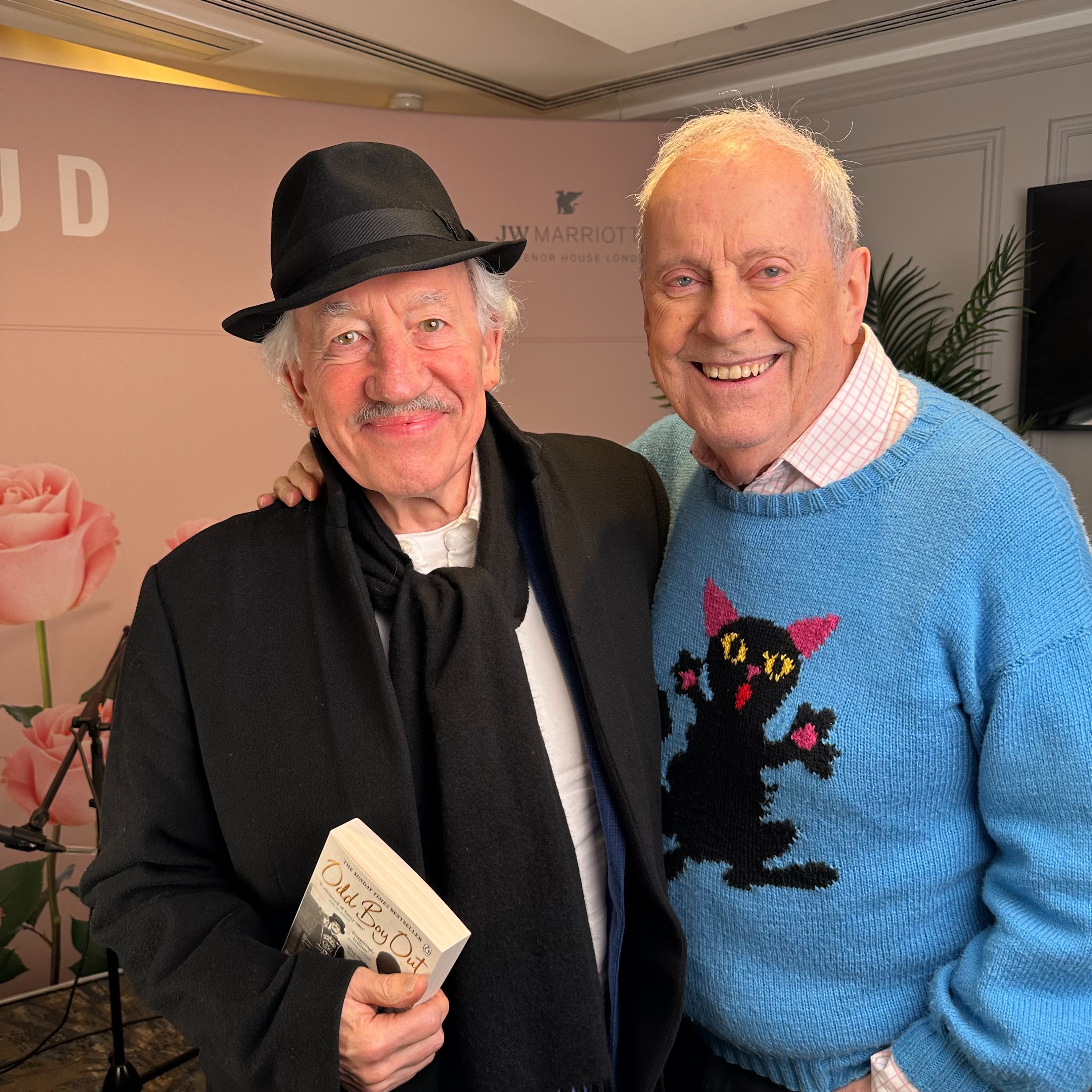
1:21:00Rosebud is a Plain Jane production produced by Harriet Jane, hosted by me, Giles Brandreth, with music by Phil Leppard, and recorded this week at the J.W. Marriott Grosvenor House in London's Park Lane. Room service.
1:21:27Do you like cats? Do you like dangerous subterranean games put on by ultra-wealthy alien corporations? If so, then Fantasy Fanfellas is the podcast for you. What is Fantasy Fanfellas, you ask? Well, it's a bookish podcast where me, Stephen, will be guiding my buddy Hayden through his first time reading Matt Deniman's smash hit, Dungeon Crawler Carl. So if you are a first-time Dungeon Crawler Carl reader, or you've already finished it and want to see Hayden struggle to guess what's next, then you'll be right at home. Episode 1, covering spoilers for chapters 1 through 11, goes live on Wednesday, September 9th.
1:22:01We hope to see you there. Bye!
One of Britain's best-loved and most talented actors for you today: Simon Callow. In this gem of a conversation, Gyles hears about Simon's childhood in Streatham, where he was dazzled by his theatrical grandmother but had a more complicated relationship with his "odd" mother. His father left when he was small. Gyles hears about formative teachers, an early love of theatre and literature, and music. Simon also talks about university in Belfast, Michael Mac Liammoir, drama school and how writing to Laurence Olivier landed him a job at the National Theatre.
This is a fabulous episode, one of the best. We know you'll enjoy it - and our deep gratitude to Simon Callow for taking the time and trouble to record with us.
Hosted on Acast. See acast.com/privacy for more information.


