
 Ask ChatGPT



Written by AI. May contain mistakes.

Get the gist, explore an idea or ask about something said.
 Claude
On Rosebud with Gyles Brandreth, what are the key points of this episode?
Searching your listeningAutomatic transcript. May contain errors.
0:00This is Rosebud, brought to you from Grosvenor House in London's Park Lane. Wherever you are in the world, I hope you enjoy this very special episode of what's become a multi-million. download podcast. We're very proud of that. I hope you enjoy the show. Cue the music.
0:38My Rosebud guest today is a playwright, a prolific playwright, a famous playwright, a hugely successful and admired playwright. It's Sir David Hare. We're putting this out in the week that marks the anniversary of the birth of Oscar Wilde, born on the 16th of October, 1854. I think I know David Hare because of Oscar Wilde. We have, David and I, a friend in common, a mutual friend, in Merlin Holland, who is the grandson of Oscar Wilde and is in London this week at the British Library, where something quite extraordinary is happening, the British Library cancelled his grandfather's ticket to the reading room.
1:22And today, or this week, the British Library are going to restore Oscar Wilde's reading room ticket to his grandson. Anyway, that's Merlin Holland, who's written a fascinating book about his grandfather and the legacy of Oscar Wilde. David Hare, of course, wrote a remarkable play about the relationship between Oscar Wilde and Alfred Douglas called The Judas Kiss, recently revived with Rupert Everett. Rupert Everett has been a guest on Rosebud. Merton Holland has been a guest on Rosebud. Do check out their episodes. Very different, but equally fascinating. And of course, I think one of the plays of David Hares that I've enjoyed most was a play called Amy's View, which I was lucky enough to see on Broadway with Judi Dench, another Rosebud graduate.
2:12Anyway, we're talking to David Hare about his life as a playwright. He's written so much. He's currently one of the first plays of his that I saw is being revived. That's Teeth and Smiles. I think the first play of his I saw was called Knuckle. He wrote plenty. He's written so many plays. Skylight. I mean, he is prolific and brilliant, as you'll discover. His latest play to be opening in the West End, new play, it's a play about the relationship between Sir Henry Irving, the great Victorian actor-manager, and Ellen Terry, the most famous actress of that era. Wish we'd been around a hundred years ago.
2:52We might have had them as guests on Rosebud. Well, we have got Sir David Hare. This I think you're going to enjoy. It's exceptional. He's exceptional. Please welcome to Rosebud with Sir David Hare. Cue that music.
3:18I'm really excited that our guest today is Sir David Hare because I'm a great admirer of his work and because we have a friend in common and we have an interest in common in Oscar Wilde. You wrote a wonderful play about Oscar Wilde. The Judas Kiss. The Judas Kiss, which I saw in a revival with Rupert Everett. a couple of years ago and loved. Why did you get into, what was the Judas Kiss and why did you get into it? I suppose because Oscar Wilde is the first person to interest me in literature. And I was thought by my grandparents, particularly by my grandmother, to be a particularly stupid boy.
3:56And they were completely amazed when at the age of seven or eight or nine, my prep school headmaster started saying that I was scholarship material, which mystified them, my whole family, who had seen no indication of it at all. And the first sign of it was that I started copying out Oscar Wilde's Canterville Ghost into the school magazine because I wanted to make it a weekly serial in the school magazine. And I was sort of enraptured by Wilde's tone, which I am to this day. In other words, I find that mixture of the lighthearted and the serious absolutely irresistible. And so I always loved his work and I always took it very, very seriously.
4:38I thought he was a very serious writer. And when I was at Cambridge University, where the Puritan moralists of East Anglia ruled, I was told that I could not take Oscar Wilde as my special subject because I would be a laughingstock. And I was told this by Terry Eagleton, who himself later wrote a play about Oscar Wilde, and a very good play about Oscar Wilde too. And Terry did not agree with that point of view, but he said, I just have to warn you, no one will take you seriously if you treat Oscar Wilde as a serious writer. And indeed, I think he wrote the best play written in English in the 19th century.
5:20I don't think there's any question about that. It's what comes near. Certainly not Tennyson. No. born in 16th October 1854 died 1900 in November 30th curiously his grandson is still alive and is our age which is bizarre isn't it yeah I think it's completely wonderful Vivian Oscar Wilde's son had Merlin very late in life by Thelma and Merlin has I think I think he is the best literary widow in the business. I think that the way he has safeguarded his grandfather's reputation is absolutely extraordinary. And the rise in Wilde's reputation over the whole of the 20th century and into the 21st century is in good part due to the custodianship of Merlin, who is a wonderful person who dedicates his life in some way to his grandfather without ever becoming pious or adversarial or difficult or contrary about it.
6:21Well this is Merlin Holland we recommend his new book which is called After Oscar which is about the legacy of Oscar Wilde. Yes it's about how Oscar Wilde still goes on making trouble from the grave and how the mere fact of dying has not stopped Wilde from being as provocative as ever. I can see why you are fascinated by Oscar Wilde because he meant so much to you when you were young the first writer you got into. What is your fascination with late 19th century theatre because your new play opening in the West End in the spring is about Henry Irving and Ellen Terry and I think Henry Irving is almost the only person who slightly alarmed Oscar Wilde.
7:02I've read around this, know quite a lot about Oscar Wilde and I think it was only in the presence of Henry Irving that Oscar Wilde felt slightly abashed. yes I think that everybody was frightened of Henry Irving except Ellen Terry and Ellen Terry you know from the very beginning in my play her sister says to her don't you aren't you frightened of Henry Irving to which she replied for some reason I never have been and people were frightened of Irving both because of his talent and because of his social awkwardness he wasn't an easy person to be in a room with the only way he could be comfortable was by leading he was very happy leading a company.
7:40But people felt very both scared of him and incredibly warm to him, often with a kind of warmth which they could not express. That's what your play is about? No, no. My play is about Ellen Terry. When I wrote the play, it's no secret, I wrote to Judi Dench and said, I've written a play for you. Unfortunately, you're now 50 years too old to play it because there is nobody who commands the public's affection in the 21st century in the way that ellen terry did in the 19th and 20th she was loved not just as an actress but she was loved for herself because she was taken to be such an extraordinary person and she and irving sir henry irving the first actor to be knighted and i think his knighthood was announced on the day by coincidence that Oscar Wilde was found guilty.
8:29That's right. He, the great actor manager, she, his leading lady, were they, obviously they were fond of each other, they worked together, were they in a relationship? Well, look, there is an argument about this. What I mean is that Edward Gordon Craig, who was one of Ellen Terry's illegitimate children, says, of course, they didn't have a relationship. Edith, Ellen's daughter, says, of course, they did have a relationship to which Gordon Craig said yes but Edith's wrong about everything but I actually I you know I do know a little bit about proximity in the theatre I have some experience of it and I would have thought the chances are that a racing bet would be yes I mean read his letters to her he loves her so much he adores her it's absolutely impossible to believe that that love didn't become physical.
9:22And by the way, it is an unproven fact, but it would make total sense that Henry Irving was one of the few people to greet Oscar Wilde when he came out of jail and to meet him with a letter. That is believed. Merlin says it's not proved, but it's believed that Irving went with a letter when he came out of jail. Good man. Very good man. How many plays have you actually written? Stage plays? 40. 40. So you have some experience. And this often crops up on this podcast because we talk to a lot of actors and theatre people and playwrights. And sometimes my producer raises an eyebrow and says, oh, this is one of your obsessions.
10:02and I try to explain to her and to others, having produced plays myself and appeared in them, that every production is a bit like a love affair. People being together for a period of weeks, three or four weeks in rehearsal, the intimacy, that it is in many ways like a love affair. Is it? In your experience? I'm not one of those people who needs family. In other words, there are a number of my very good friends who love it because they think it's like having a temporary family with the huge advantage that after a couple of months, they just say goodbye to that family. And they feel that they've been very close to these people.
10:38I don't feel that. But what I do feel is intense comfort in the rehearsal room. You know, I've been rehearsing for nearly 60 years. And so it is a place where I'm most comfortable. I'm quite awkward as a person, particularly with people I don't know. I'm not socially adept in life. But in the rehearsal room, I'm totally in the groove because I'm part of a process that I really do understand and that I think I have some gift for. And when you're dealing with great actors, I was lucky when I was young, I knew Michael Redgrave. Yeah. And he told me that when, in the 1930s, he appeared with Edith Evans in As You Like It, it was the first time he felt true freedom on stage.
11:24Just being with her, looking into her eyes, we flew he said that we just flew and there was an intimacy there they may well have had enough in fact they did have an affair as well but before the affair he felt a freedom that he had never felt anywhere else he claimed in the world i i feel i feel that and i watch actors physically transform themselves you i watch rave finds who i know extremely well you know i've worked with rave 10 times and he's playing henry irving and the person who comes onto the stage i simply don't know them as Ralph Fiennes. I know them as this actor who's giving this performance of transformation as Henry Irving.
12:02And there's a sort of physical transformation that happens in the very great ones. It particularly happened when Tony Hopkins played Lambert LaRue in a play I wrote with Howard Brenton called Pravda, which was the first, I'm happy to say, satire about Rupert Murdoch, the founding satire, if you might say. There have been many sibs, but no Rupert Murdoch I've ever seen has touched Tony Hopkins and in Tony Hopkins there was a sort of physical transformation whereby he both was Tony but was also just this completely other creature and how they do that and how they achieve that kind of intensity on stage whereby they transform themselves it's that's that's what we love and that's what's so mysterious it is mysterious and they can do it instantly after we recorded a conversation with Gary Oldman uh we had lunch with Gary and at one point he became Laurence Olivier yeah I mean completely but I mean it was Laurence Olivier and a little bit later over pudding he gave us Winston Churchill and it was Winston Churchill having the pudding it's no reach for them and it's just it's physicalization I think more than anything more than vocalization I think that um you know there are particular gestures that actors have made in my play.
13:22There was a line Judi Dench used to have in Amy's View, which was a play about an actress. And she said, I play like comedy, was the line. And then she said, but you know, with layers, with layers underneath was the line. And doing that, she'd make a sort of physical gesture, rather like sort of patting a non-existent dog that was underneath her. And the audience just roared with laughter at this gesture. And yet the line is not apparently a particularly funny line. But when Judy embodied what it meant as an actor to have layers beneath what you did on the surface, the whole audience just erupted laughing and no other actor could possibly do it.
14:03And I remember when the next actor took over the role, I remember them saying, do you want me to do that bit about layers where Judy used to do that? And I said, it's a complete waste of time trying to do that gesture. That is Judy Dench. She is the only person in the world who can do that gesture and make it something that the whole audience fall about. Now, what is that? It's so mysterious. And yet they understand it and we don't. And so when you're directing, personally, all I'm trying to do is give the actor the freedom to feel confident enough to find that stuff and to sift it a little for them and say, that's one of the most glorious things I've ever seen and hold on to it.
14:47Well, now I want to hold on to you and I want to discover all about you, David Hare. And we're going to go right back to the beginning. David, you were born on the 5th of June, 1947. I'm sure you can't remember that, but can you recall what is actually your very first memory? It's very easy because we moved to Bexhill from St. Leonard's when I was four and a half. so everything that I remember of St. Leonard's is um must be before I was four and a half so I can remember the flat we lived in because it was what I think is called a cold water flat it was very very basic in St. Leonard's and my mother had struggled with one child already in a pram up the hill, my sister, in that terrible cold winter of 1947, and said it was just horrendous to be pregnant and, you know, on ice pushing up that pram.
15:50And I'm afraid to say the thing I first remember. It's a terrible memory that makes me sound so damaged, which I don't think I am. But I do remember my father, who was a sailor, and very rarely came back. He only came back for four weeks a year. But because those four weeks coincided with his holidays, I remember them going off on my father's Vespa to go to France on the morning of my birthday. And I could not believe it. I was four. And I just thought, how can you do this to me? On the morning of my birthday, go on your holiday? And they sort of apologized and said terribly sad. But it was true that my father was almost totally uninterested in me.
16:34and uninterested in my sister. And it probably didn't occur to him. It would have occurred to my mother, but it wouldn't have occurred to my father that it was a cruel thing to do to a little boy. Tell us a bit more about him. What was his name? What generation? Clifford. Clifford Hare. He'd run away. He came from a family of bank managers. He'd run away at the age of 17, 18 to be a cornet on a ship with P &O to go off to. What's a cornet? A cornet is the person who blows Ravalli when you wake up in the morning, the cornet blows the trumpet. So this is a kind of boy's job. Yeah, that's the lowest job you can get if you don't complete your education or if you're 15 or 16 or whatever.
17:14So you're given that job on the ship. By the end, he was the ship's purser, but he spent his whole life on ships and not with us. With Cunard? No, with Piano. Piano. And how did you meet your mother? And who was she? She was from Paisley. And so she was in the Wrens in Scotland in Grinwick and they went to a dance in Grinwick. They met during the war? During the war and my father was back because at that time the Merchant Navy was commandeered by the Royal Navy to be in convoys taking goods and personnel to war and they had one of those wartime instant romances whereby they were married within probably I think three weeks of meeting each other.
17:58So she married a man she didn't really know. And then when he came back, they had their first child. They had their first child, and then they had their second child. On the next sort of leave, a year later. And that's exactly what it was. And they moved my mother, who was brought up in a terrifying working-class town, Paisley, which had made her really scared, scared of men and scared of life, because it was a tough old town, and still is. It's not the most attractive. Well, apologies to the people of Paisley, but nobody could say that it's the most attractive town in Scotland. It's a suburb of Glasgow, very, very rough, and on a Saturday night, incredibly rough.
18:39And that's what made her wary of men. Did she have bad experiences? She was wary of men and she was wary of life. She was scared of life. And so she moved to Bexhill, which is the place with the oldest average age in the country, but she still regarded it as a potentially very dangerous place. Oh, bless her. You know, and I was forbidden to go. For instance, you know, there was a cafe nearby called the Cozy Cafe. I wasn't allowed to go in there because it was full of working class people and therefore dangerous. And so that terror of life, I've tried. I know I've inherited it and I've done my very best to suppress it and to never let my fear get the better of me.
19:18But it's been a conscious effort. But it was like, she was like a single parent in a way. Yeah, she was a single parent. She was bringing up my sister and me alone, and the only reward for it was one month a year with my father. And were there aunties and grandmother, aunties, uncles? There was a forbidding grandmother called Euphemia who lived... It's a good Victorian name. She lived in Whitehall Drive in Paisley and disapproved of absolutely everything, including she'd forbidden my mother to go to university because my mother was quite bright, said women don't go to university, your job is to find a man and get married.
19:54she was rude to my mother saying constantly you've never found a man you're a failure because my mother was about 27 28 before she met my father and she had a very low opinion of well everything really the world and in the month and the year when they were together your parents were they happy together that's an impenetrable question I don't know the answer well except you're somebody who believes you can understand Henry Irving and Ellen Terry and their relationship and you never met either of them you at least knew these people i think that one of the um reasons i'm a playwright is because um things are deeply mysterious to me and maybe people do understand much better than i do i'm very sensitive and that i think is a quality in a playwright i detect unhappiness and um you know various people have said to me that at any party i will tend to head for the unhappiest person in the room as if attracted by the radar of unhappiness and this is true an awful lot of people unload unhappiness to me um but it i i i don't believe i was in a happy home no i don't i i i don't i don't see how my parents relationship can have been fulfilling but he behaved well when he came back for apart from neglecting you because he wasn't interested they went off on a holiday together they he was not a faithful husband uh because he was a sailor around the world sailor around the world yes and on occasions we were introduced to mysterious women uh i remember at one point going to the dorchester and meeting someone who uh was in wholesale fruit and veg in common garden market and she was you know we were just all going what why are we at the dorchester which was so out of our social circle and the world we were in and why are we meeting this woman and I think it was probably a tentative introduction to something that never happened i.e a change of um parental care but it never happened never materialized yeah did you find in full in the fullness of time you had half brothers or half sisters around the world no nothing like that nothing like that so there they were you were your relationship then was with your mother my relationship was my mother you called her mum mummy mum mum and describe her she was tall she was thin she was very 30s looking she had what is called 30s good looks and she had thick lustrous black hair when I when I remember her when she was young she had a Scottish accent and in the 30s she had enjoyed being the stage manager and small part player for an amateur theatre group in Paisley.
22:31And financially she supported herself how? We were lower middle class, we lived in a semi-detached, my father turned up with rolls of five pound notes which he dispersed and then we lived on mince and potatoes until he came back again. And did she work, did she go out to work? No. She just looked after you? No and in fact But, you know, when I divorced at the age of 32 or 3, she said to me, well, but how on earth will you look after yourself? And I said, well, I'll do everything myself, you know. And she was completely mystified by this. She said, but you can't look after yourself. You need a woman to look after you.
23:10Who are you going to have to look after you? Because that had been her whole life. And if that wasn't a job, then what had she been doing her whole life? which I'm afraid towards the end she did feel. What have I been doing my whole life? What did she give you? When did she die? How old were you when she died? She was 90 and she had Alzheimer's so the last 10 years were extremely rough. But she'd seen your success. Yes. She knew you when you got your knighthood? Do you know, I don't think she had her mind when I got my knighthood. Because that would have pleased her hugely, wouldn't it? Yes. Not as much as the only time that I've ever felt really sad for the absence of my mother was that I was asked to give the eulogy in Westminster Abbey when John Gielgud was admitted to Poets Corner.
24:05And I gave the eulogy. And when I was driving there, I thought this is probably the only thing I've ever done in my life that my mother would just be completely knocked out by. because she worshipped John Gielgud and thought he was the greatest actor she'd ever seen and adored him. But this is interesting because she's obviously a highly intelligent and rather sophisticated person. Totally. Despite this lower middle class, penurious life. And there was a funny little drama school in Bexhill called the Thalia School of Drama. And it was for tots. It was for kids, you know, to elocution. And it was run by two women, Christine Porch and Isabel Overton.
24:41and some of your listeners will remember it. It's chiefly distinguished for the fact that Julie Christie, in the couple of years that she lived in Bexhill, was very much the leading lady of that little kids' theatre. I can remember her very, very clearly as anyone who saw her would. As anyone with any sense would. Nobody would ever forget her. And my mother, in fact, in a Moliere play, opened the door for her to come through. So your mother went on doing amateur theatrics? Yes, yes, she did amateur theatrics. She had satisfaction in her life. She taught Scottish accents. If anybody needed a Scottish accent, then my mother taught it because she had done a course in phonetics and elocution.
25:21So that was my introduction to the theatre. What, if anything, did your father give you that you have now?
25:32Golly, that is such a good question.
25:38well I suppose emotional blankness probably I mean you know he he just avoided every possible difficult situation he was sort of emotional coward he could always sail away so it's not something I'm proud of but I have a temptation to sail away when confronted and I have to again resist it. But if I honestly say what, you know, my sister, when my father died, he didn't leave or mention us at all in his will. And my sister, I said to my sister, were you surprised? And my sister said, well, he wasn't interested in us when we were alive. Why should he be interested in us now? Now we're dead. So I just lived with that as a fact of my life.
26:27My father wasn't very interested whereas my mother came to my first play which was called slag and which had a lot of extremely fruity and ripe language and some comings and goings in it and of course you know she had to find a way of um dealing with it and the most elegant way she found of saying what she thought was she said i enjoyed it very much but your father having been in the navy understood rather more of it than i did how nicely put well done her what of her is in you today I think she was incredibly sensitive to everything that happened around her she felt people's she was hypersensitive to people's feelings and knew and for me that's a qualification of the job you know everyone says of playwrights oh they're incredibly touchy and they get upset by criticism and you know if they get a bad review you know they're so bad tempered but the very sensitivity that is meant to be such a failing in us is actually the thing that makes us rather suited to the job.
27:30We're aware of what's going on in a room, and we react to it. And it's not self-pity at all. It's an awareness of what people are undergoing and a sort of freshness of reaction to suffering, I suppose, is what I think is there in any serious playwright. Your friendship with your sister, I sense you were allies from the start, were you? No, we were oppositional. Ah, but you're not any longer. No, we're very good friends now. Yeah, I feel that. But she was older and she was a woman who wanted to be a scientist. And whereas I got a series of scholarships which removed me to private education, she was never allowed such a thing.
28:16She went to Bexhill Grammar because, of course, you don't educate a girl. You simply, you know, she had to do domestic science. Well, this is someone who went on to get an MSc at London University. And then eventually, when she went into a British industry, where she went to work in, she had to become a secretary in order to be promoted. In other words, when she was doing a job where she used her science, she was never going to get promoted. So she became a secretary in order to advance through the system. uh i hope those days have gone but that's how it was who's your first friend outside the family i suppose christopher hudson at school um christopher was um somebody i just teamed up with at school instinctively uh at prep school as i say i got scholarships i started gaining scholarships to everything and so i got a quality of education i would never have got without those scholarships.
29:16The first one was to this prep school? To a prep school. That was the first scholarship. And was it an okay prep school? No. But there were no... Bexhill was full of prep schools, most of which were run either by people who were psychologically severely traumatised by the Second World War or people who were unsavoury characters, either pederasts or voyeurs or, you know, sadists, all the usual collection. And mustn't juggle too much because people write in to complain. I know. Well, if you really want to know, there is an absolutely horrible thread, which you can go to, about Bexhill prep schools in the 50s.
29:51And it is absolutely traumatising. My mother actually removed me from one prep school because she sensed that the headmaster was a pederast. And she got it. That's what I'm saying. She knew what was going on. But you had no bad experience yourself? No. I mean, violence, yes. Beatings, yes. But not sexual abuse, no. And the beatings, do they still prey on you? No, it was part and parcel of what happened. No, but I can remember very clearly one boy who fought back. There was a boy called Larkin who came back down. We were all doing prep downstairs, and he'd fought the headmaster. He'd simply not accepted his right to beat him.
30:31And he came down with his shirt torn and blood all over his chest. And we all just, he immediately became our hero. And then the headmaster came in flecked with blood. and it had actually turned into a full-scale fight between the boy and the headmaster. It's a scene in one of your plays. I mean, my God, he turns on the headmaster. Yeah, and that was, I suppose, the beginning of radical stirrings in me. I began then to side instinctively with one side rather than another, which later became my politics. And I was anti-authoritarian. When you arrived... Because these schools were awful, really.
31:08But Lansing wasn't awful. Lansing wasn't awful. That was your public school. That you went to when you were 13. Yeah. Again, another scholarship. Scholarships. And interesting people there, a couple of whom I think we've had on the podcast. Was Tim Rice a contemporary of yours there? Tim Rice was a contemporary and Christopher Hampton was a contemporary. Christopher Hampton, yeah. I went to see Slag with Christopher Hampton. Is that possible? If I misimagined that. Yeah, there were two productions, one at Hampstead and one at the Royal Court. Yeah. But the, you know, I was incredibly lucky, not just in, that there's this weird coincidence that the three of us who've made our lives in the theatre were all at the school together.
31:45But also there were a couple of absolutely classic, outstanding teachers, the kind of teachers that... You know, it is said they transform your lives, but what they really do is open you up and you've got to have the will to be transformed. How do they do that? Because people often express this gratitude to this particular teacher. What is happening? Can you give me an example? Harry Guest, who was a poet. What did he do for you? Who taught us French and German. I just could tell that he was part of a life that seemed to me incredibly glamorous. And I think glamour played part of it. And in other words, I remember him coming back from a party where he'd met Harold Pinter at the weekend.
32:27And of course, that just seemed to me astonishingly glamorous. And so I said to Harry, I'm very bored in Bexhill in the holidays. can you give me a reading list of books I should read he said I'm going to give you a list of the best books ever written and you can read them right and he gave me six eight every holidays and I read them and then when the Sunday Times when I was leaving Lansing published a list of the hundred best novels of the 20th century I'd read 42 of them which is a very high number and you know that I just did it because partly of course because Harry was saying if you read all this stuff your life will be enlarged but also I wanted to please Harry and feel grown up and sophisticated and I think glamour plays a part in in learning about literature it just seems a more glamorous life than others a boys school then I imagine they take girls probably now yeah were there girls around were there dances with the girls school did you meet girls Yeah, we danced with Rodine, or danced against Rodine, as they used to say.
33:37How wonderful. We were so terrified and so out of our depth. I can't, you know, there were boys who pretended that they'd had relationships with girls, but I didn't believe any of them. Do you remember your first crush? Was it with a girl or a boy or one of the teachers? First serious crush? Oh, I remember who it was. It was someone, what happened, I went to the United States. This is a gap year. In my gap year. And then when I went to New York, I was staying in a hostel, and there was a girl who really just, I could not speak in front of her. I just was so completely in awe of her. That's as far as it went, I should hasten to say.
34:16That was the first time I've experienced that thing of being just so awkward and hopeless and unable to deal with somebody's immense power. interesting I imagine that's quite a difficult scene to write and to play people being reduced to idiots you mean yes a girl comes into a room and the 18 year old boy is speechless yeah unable to do anything and yet all sorts of things are happening in your head I did write a play about last thing called South Downs and I wrote it about um it's a boy who because he's lower middle class doesn't really understand the rituals of middle class life that everybody else understands.
35:01And that was me, obviously. And I was played by the brilliant Alex Lawther in his first ever appearance. He's now an extremely well-known actor. And he just perfectly caught that sense of bewilderment of feeling that you are a part of an institution where everybody else understands the rules and I don't. And that, again, has been incredibly useful to me as a playwright. because I move like an anthropologist through middle-class society, going, obviously everybody else gets this, I don't get it. Am I right in thinking, you're mentioning this girl who overwhelmed you in New York, that this gap year was a kind of change of gear?
35:41Yeah. And how was that? What happened? I went with my friend Roger Dancy, and the two of us had a job where we were meant to paint the beach house of a primal scream therapist and to rearrange her filing cabinet, her filing system. It's another play. So we read all these unbelievable accounts of people reimagining their birth under drugs. You know, that's what she did. And so that was sort of the entrance into a completely different world. But we were fortunate enough to have a$99, 99-day ticket, which took us round in a sort of U-shape through the South America. Like a greyhound. Yeah, greyhound.
36:23Well, it was actually continental trailways, but it was the same. It was like a bus trip all the way around. And you could go anywhere. And then we drove into Birmingham, Alabama, just the two days after the riots in 1965. And you could not, and we were lucky enough to meet two Roosevelt radicals who had represented Rosa Parks, who sat in the back of the bus, Clifford Durr and Virginia Durr. And that was a life-changing encounter for me. In other words, when I began to understand racial politics in the South and met these wonderful old New Deal radicals, who to me were the most inspiring people I'd ever met in my life, and we stayed with them.
37:03And both Roger and I always say that completely opened our lives. But how were you introduced them? Who were you staying with? Because we were being handed on. In those days, not many young students went around America. And so you got handed on. You stayed with one lot of people, and then they'd recommend another lot of people saying, oh, well, if you're going to, you know, Georgia, be sure to look up so-and-so. So you'd come into Montgomery, and you'd have the name Virginia Durr. You'd have no idea who she was. I mean, books have been written about Virginia and about Clifford. When they started telling me about the Rosa Parks case, you know, my eyes were on stalks.
37:39And there was one wonderful evening when Roger and I were sitting having dinner with the Durs. and the phone went in the next room and Virginia said, oh, I better get this. And we suddenly heard her say from the other room, but Lyndon, how can you do this, right? Oh, no. You know, we were 17-year-old boys. This is Lyndon B. Johnson, the president. And she was talking to Johnson, who was her old friend. They'd been Texas schoolteachers together. So when later I heard Johnson say, I would never have got into Vietnam if people had warned me, I wanted to say well I was there when Virginia was warning you about Vietnam in 1965 which is quite early that to me if I still if I hear Martin Luther King's voice if I hear Robert Kennedy's voice if I hear John Kennedy's voice I well up because it's just to me the most inspiring period of progress in the time that I've lived in.
38:41Though here we are 60 years later, wondering if there's been that much progress after all. Yeah. But you have this wonderful nine months and then you come back to a place at Cambridge? To Cambridge. A scholarship there? Scholarships, scholarships. Of course. Always scholarships. Well done you, how nice. I know. And you arrive which college? Jesus. Nice rooms? Do you remember all that? Yes, Cambridge wasn't the most important experience of my life. In other words, I thought the teaching, the one-to-one teaching in school was much better than the teaching at Cambridge. Really? Because you had a tutorial once a week?
39:18I had very famous people teaching me. Raymond Williams eventually agreed to teach me. I'd gone to Jesus in order to study with Raymond Williams, who people may remember was part of a great radical movement with Richard Hoggett and Lisa Jardine later, who began to examine culture from the working class point of view. And Raymond's basic point was that culture came up from below, that it wasn't cooked up in drawing rooms, but that it came from the people and it expressed what was going on among the people. I agreed with this so wholeheartedly. I wanted to go and study with him. But unfortunately, by then, he was more concerned with stirring up revolution in Britain than he was in teaching students.
39:59And so for two years, he sort of refused to teach. is too busy oh dear but he did eventually he did eventually and for you then cambridge was was just three years no cambridge was great for me because i ran the film society and that was incredibly important to me and you know film was as much a passion as theater became in fact i only really went into the theater because film sort of didn't exist at the end of the 60s when I left university there was a very limited British film industry indeed there always has been and so um you know we had the Cambridge Film Society to which Alfred Hitchcock came uh much to everybody's surprise at your invitation at the invitation of Dick Arnold was the president I was the secretary were you impressed were you impressed by him oh deeply deeply and i don't accept any of the um malign portrayals of him now as somebody creepy or unsavory you know i just had four hours he arrived at one o 'clock and he wasn't going to speak till five so he spent four hours with about three of us four of us round a lunch table a very, very, very long lunch in which he talked about film in the most inspiring and fascinating and riveting way, which I can still remember long sections of.
41:25What did you learn most from him then? He said this thing, which I have always believed to be true. He said, you can't disguise who the actor is. He said, people like Grace Kelly because Grace Kelly is indeed a wonderful person. He said, I tried to make them like Tippi Hedren they didn't like Tippi Hedren because they could smell that she wasn't a very nice person and then he said there is only one actor in the world who is so great that he could make you think he's a nice person when he isn't and he said who do you think it is and I said oh please don't say it's Cary Grant and he said yes it's Cary Grant oh no oh no he said Cary Grant is such a great actor that he will charm the socks off you but he actually isn't really very nice but that I I later felt, and I felt it particularly with Gielgud and Richardson and the Judy Dench, obviously, I was drawn to these actors because who they were, Paul Schofield, who they were, is exciting to Ellen Terry, indeed, I now write about.
42:30Whereas Laurence Olivier, yes, I can see, you know, it's all technically very brilliant. And of course, he's a great actor. but I don't warm to Laurence Olivier in the same way because, you know, frankly, Laurence Olivier, on his own admission, wasn't perhaps the nicest man in the world. Are you a nice person since you brought it up?
42:52I couldn't judge. Do you hope you are? I felt more like a nice person since I married Nicol Fari and I think Nicol Fari and my second wife is so clearly a wonderful person and is so universally accepted to be a wonderful person that I don't believe she would have married me unless she saw good in me. Yeah, I understand that totally. I trade off the integrity of my wife and have done for half a century. Well, there's a great Cyril Connolly remark where he says the health of your wife is a mark of the man's character. Yeah. And my wife is very, very, very healthy. And I am very pleased with any way in which I've been able to make her happy.
43:37And I'm very proud of any way in which I've been able to make her happy. Basically, I motored on self-hatred through the first 44 years of my life, feeling myself to be a horrible person. I didn't like myself at all. Why was that? I thought I was shallow and ambitious and nasty. And you were ambitious? Were you ambitious from an early age? By the time you were at Cambridge, you think I'm going to be a writer? What do you think you're going to be at Cambridge? No, I wanted to be a filmmaker. And then I thought I was going to be a director. I ran a little theatre group, so it never occurred to me I was going to be a writer.
44:12But writing is very good for ambition in the sense that you are totally a prisoner of your imagination. There's nothing you could do by will. If your imagination gives it to you, coughs it up, great. If it doesn't, it's... And so probably it's been the redemption of my character has been that it couldn't be achieved by will. Whereas if I went into a nasty profession like, I don't know, politics or the law or journalism, then ambition probably would have been my downfall. It would have been quite unpleasant. What made you feel you were nasty? I just didn't like myself. And what didn't you like about yourself?
44:54I thought I was probably morally unscrupulous. And were you? Yeah. You took advantage of friends or girlfriends? Yeah. I mean, do you remember early girlfriends with... Do you remember your first girlfriend, in a way, you want to talk about? Don't worry if you don't. First long relationship, yes. Yeah, proper girlfriend. Yes. I don't think I took advantage of her, but on the other hand, I don't think I was totally honest with her. And so that always, you know, that sense that I was never going to settle and that I was never going to be 100 % honest with another person. I think that, you know, in fact, a very interesting thing.
45:33I wrote a book called The Blue Touch Paper, which was my memoir. And there was a review by a Murdoch journalist in which he said, this is a literary pose. No one can hate themselves as much as David Hare claims to have hated himself in the first half of his life. And it becomes extremely tiresome in this book that he pretends that he hated himself. And, you know, I said to the person who told me, I said, well, if you haven't known self-hatred, then you're very lucky. And good for him that he hasn't known it, this reviewer. But on the other hand, maybe if you work for Rupert Murdoch, perhaps a little bit of self-hatred might help you see your own state rather more clearly than perhaps you do.
46:12How did it manifest itself in you? I mean, what was it doing to every day, this sense of self-hatred? Depression, very bad depression. I suffered horribly from depression, again, in the first half of my life. I've suffered much less from depression since. Did you take pills and things? No, never. I'm superstitious about... I don't trust either psychiatry. I've never been to a psychoanalyst because I don't want to know the sources of my creativity and I don't want to understand them. I like the way they are totally mysterious to me. But you might want to know the sources of your unhappiness. Yeah.
46:48Yeah. I thought I knew pretty well what the problem of my unhappiness was. And what was it? That I wasn't trustworthy and couldn't commit to another person. In the way that your father was, who couldn't commit to one person. I probably would see it like that. No. And I can see that various people in my life have been, would-be father figures to me. Yeah. And I think that clearly I wanted Raymond Williams to be my father. I wanted Harry Guest to be my father. I certainly wanted Joe Papp to be my father when I went to work with Joe Papp. The fellow who ran the theatre in New York? Yes, and he ran the best non-profit theatre there's ever been in America, which was the public theatre.
47:33And he traded in being a father to everyone. And I loved that. I was very happy to be his rebellious son. And the people, your heroes, people like John Gielgud and Ralph Richardson, they are older men. there is a kind they also were decent men they were decent men and so you looked up they were your kind of hero yeah and they were my kind of people Schofield you know I was lucky enough at the age of 23 to be thrown completely without experience into a rehearsal room in a play I'd adapted which very badly which was what was the play? The Rules of the Game by Pirandella with Paul Schofield I'm sitting at the age of 23 you know rehearsing with Paul Schofield and Joan Plowright and Laurence Olivier is producing.
48:21And so I'm going, I was clever enough then to know that I was so out of my depth that I didn't make a fool of myself. So you get married and who do you marry? Margaret Matheson. And is she a nice person? She's a wonderful person, completely wonderful person. But she loved you. She loves me too. But that was good. That should have made you feel better about yourself. It should have made me feel better. You're absolutely right. Did you have any children together? Three. Oh, my goodness. Yeah. Oh, well, so you've kept in touch. So we hope you then became friends after the marriage was over. We are friends.
48:56We totally are friends. But it's not been without bruises along the way. Wow, three children. So how long were you with her? Until you were 44? No, 10 years. I was with her and I left her when my children, two of my children were very, very young. And so I did something unforgivable, which is leave home when two of my children, twins, were only six months. So it's made me in life extremely unjudgmental. I was unjudgmental anyway. I don't judge people's private lives and I don't like people who do because I don't think anybody understands why people do things, you know, as Renoir famously says, the heart has its reasons.
49:39and in those circumstances how can you begin to understand so when people leave people and they say oh it's disgraceful so and so so you know you go well they probably had a little option in my own case i had little option but to do what i had to do however cruel it was and it was very very cruel so you know when you ask a source of self-hatred leaving a wife with two six-month-old children that's pretty cruel yeah i remember discussing this once with michael frayne and he described it it was about him leaving his wife as being in the sea and standing you think you're in the shallows but actually the waves overwhelm you and so what you know whatever it may look like from the shore you are standing there and you are overwhelmed by these waves and he couldn't described in any other way is that i was in a situation in which i felt if i continue this marriage i will be so unhappy i will not survive and so at one level you can say well that's a fantastically selfish thing to think at another level you can think uh well uh if i'm not going to survive like this i can't put my children through this and it's actually kinder to separate and I certainly, when it comes to judgment, I certainly believe ending an unhappy marriage, if it is truly unhappy, is much kinder to children than continuing in an unhappy marriage and again, I speak from personal experience.
51:09And is there a happy ending to this in the sense that your relationship with your children is not good? My relationship with my children is absolutely great. I hope. I certainly, it is from my side. Have they ever asked you about it, about what happened? They don't really want to know. I don't think they really want to know. Do you ever brood about it? Is one of the things you brood about? No, but it's been a fantastic source of drama to me. I mean, you know, I'm not, what is it, you know, what is it? You know, obviously that experience, those years, which were really the late 70s, early 80s, the time of my maximum misery and sort of maximum desolation.
51:45I mean, it's just been a gold mine in terms of my work. and my ex-wife will occasionally say have you shared some of the royalties with her now you're admitting my ex-wife will occasionally say oh my god here I am again you know popping up as not as a character it's not that it's not like that but certainly the kind of emotional dynamic of
52:12unlivability and betrayal and unworthiness I know a huge amount about and I've written a lot about it of course I have And are these things that one lives with or that one can or should try to do something about? Well, look, I always say, and I'm sorry this is such a useless answer to most people, but I've found that writing a memoir about what I regarded as my worst behaviour made me feel much better. It may not have made anyone else much better. But by the time I'd written it all down and sort of said, which I think is what the Sunday Times reviewer was objecting to, I was kind of saying if you want to make the case against me this is the case against me and I make it a lot better than you can right and here it is and so having done that I feel I've discharged it and I've been I actually haven't had the major depressions from which I suffered until I wrote that book and I wrote it at a time about 10 years ago when I'd had a couple of bad collaborations in the theatre and that really shook my confidence.
53:14I'd worked with a couple of people who I didn't get on with and that to me was horrible because I'd always got on with everyone in the theatre. I'd never had these really bad relationships and I had two in a row, one with a director and then another with someone whose book I was adapting and they shook me and I thought maybe my collaborative gene is frayed and having spent my whole life wanting to collaborate, maybe I don't want to collaborate anymore. And that's why I went off and wrote a memoir, which I enjoyed doing by myself, and to work this out of me. And now I enjoy collaboration very much again.
53:59Tell us about your collaboration with Nicole. Can you remember the moment, literally the moment your eyes first saw Nicole Fowry? It's photographic. What happened was I wrote a play called Murmuring Judges, which was the middle of a trilogy of plays about England or about Britain. A state of the nation. A state of the nation, so-called. I resisted that title, but they did. And when the dress rehearsal came, I said to my beloved designer, I said, the leading lady, Alphonsia Emanuel, is not very well dressed. And Bob said, don't worry, don't worry. I'm seeing Nicol Fari tomorrow and I kind of went Nicol Fari I think I've heard that name but I sort of not terribly fashion conscious and and then Bob said next day Alphonsia looked stunning I said oh my god these clothes are completely wonderful who on earth designed them and Bob said Nicol Fari but you'll meet her because we've given her tickets for the first night Nicole wasn't going to come and And she was watching television the night before, and I was talking about the play on television, and she saw me on television.
55:16She went, oh, perhaps I will go after all, right? Oh. Yeah. A friend rang her. She was asleep and said, why don't you turn on the television? That writer whose play you've been invited to is on the television. I think you'll be interested. And Nicole said, I watched him, and I thought, he's talking to me. He's talking to me. this mysterious thing. And similarly, at the party. So she went to the play, and there was a party afterwards, and I walked into the party. I didn't know she was Nicol Fari. I just saw this woman. I went, oh, my God. That's someone I wish to know. So it's absolutely a sort of life-changing moment.
55:53So I believe in that. Was she unattached at the time? That was a question I asked very soon. Oh, well done. Despite the answer, you carried on. well and so quite quickly you were together you were very very quickly i mean what i mean is we had a date and then we went out and then i moved into her house at the weekend and i've been in her house ever since 1991 and what's after the initial excitement what is it that's sustaining this i think the way we see the world in the same way and yet her experience is so completely different from mine you know she comes from a turkish jewish french family whose parents her father and mother hid for a year in a barn in france from the nazis and she was brought up you know in a jewish family in nice um but like me escaped from the small town wanting to go to the big city wanting to go to Paris um and then you know I just think we totally understand each other and understand how how we both see the world in exactly the same way actually I have very similar reactions to things it's very rare we disagree if we go to a movie it's it's very unusual for Nicole to like it and me not like it or vice versa and uh or if afterwards if we've been at an event together we will interpret it in the same way did you see what was going on at that table did you see how that woman doesn't like that man did you see the thing we'll we'll have seen it we'll have picked up on exactly the same thing so she validates you in that sense totally and is that the reason that you've been able to be happier and less self-loving.
57:43Yeah, but also, as I say, I think both things, that she's made me incredibly happy, but I had not believed myself capable of making another person happy. I'd associated love with suffering. In other words, it seemed to me that passion brought torment because passion always had brought torment to me. But the idea that passion could be benign, that you could have a relationship which was just as passionate and just as overturning if you like but that it could actually be for the good for both of you this was a total revelation to me because you know Tristan and Isolde Romeo and Juliet you know the great love stories are usually portrayed as tragic but there are great love stories which are very very far from tragic and such is mine and Nicole's.
58:39And were you quite excited too that she had about her glamour and a name and achievement of her own? No, I was fascinated by the world that she introduced me to. What was great was she introduced me to business people and I didn't, you know, writers in those days, things have changed now because of private sponsorship, but in those days the arts and business didn't mix at all. and so to begin to meet the people who ran retailing in england produced skylight you know skylight which is sort of my best known play um which is about a man who's a businessman who has a relationship with a young woman who has worked for him and has now gone into the public sector and it's about the difference between the private sector mentality and the public sector mentality a subject which I learned means a lot to an awful lot of people.
59:33I only knew about business and the private sector through meeting people in Nicole's world. The world as it now is, is obviously a rather depressing place for many people. Is your next work going to be about the modern world? I cannot tell you how happy I am that the job of national playwright has been handed over to James Graham. and I said you know I think James is wonderful and I just I the obligation every single time anything happened in the newspapers people used to ring me and say are you going to write about this right and I did enjoy being the national playwright in that sense you know that I wrote about the church and I wrote about the law and I wrote about politics and I wrote about um the invasion of Iraq and I wrote about Israel and Gaza and I wrote about all these public subjects and I loved doing it but I strongly resisted and I had to fight to resist going on any questions going on question time writing journalism and being turned into a kind of a commentator really which is what journalism wants to reduce playwrights to.
1:00:47I didn't enjoy the obligation of being the person who was expected to diagnose the state of the nation. And, you know, whenever they call me now, I say, do you have James Graham's phone number? Please call them. Or Jack Thorne. Call Jack Thorne. You were involved in the management of the National Theatre too, weren't you? Yeah. Well, I was associate director. Yes. I mean, do you like the way these big institutions are now? No, they're ridiculously overstaffed, and I've made no secret about this. You know, I just read that the Royal Shakespeare Company is trying to halve its staff. It's long overdue, and I don't understand, you know, if a theatre has 800 people, as both the RSC and the National Theatre do, on their books, how can they make sense of the importance of producing plays?
1:01:39they're just organizations that of which plays are a by-product and when we first moved into the building at the national theater there were too many offices there were you know we did far more work than they do now but if you wanted an office they'd say yes they take one that they're physically far too many offices now they have dozens of outbuildings and they have 800 people working there and yet the amount of work they produce is much less so something is deeply wrong in these big institutions. And, you know, they're going to have to get rid of people. The Royal Academy is the same. They've just got rid of 25 % of their staff.
1:02:18It's going to happen everywhere. It's going to happen at the V &A. It's going to happen at the British Museum. It's going to happen in... It's going to happen because these places are top-heavy in the relationship between what's going on in the stage and the number of people needed to back it up. Coming towards the end, I sense you're quite happy at the moment. Very. in a good place yeah and to what do we attribute that um my family um do you have grandchildren now i have seven grandchildren oh well done i have and nicole's daughter i regard you know i've i've helped bring her up i'm not her father but i am as close to her as i am to my own children so i have effectively four that are very very dear to me and whom i love and admire very much And I also feel free.
1:03:04I feel that it's too late for them to get me now. And I feel retrospectively incredibly lucky that the culture was so rich in the theatre that there is this extraordinary phenomenon of a generation of playwrights who've been able to do it for 50 or 60 years. Howard Brenton has, Carol Churchill has, Tom Stoppard has. Michael Frayne has. There's lots of us who've been nourished by this tradition and it's very rare in history. You know you have to go back to the Elizabethans till you see a generation of playwrights who've been able to do it from their early 20s right into their late 70s and 80s. God I was lucky to be around when theatre culture was that rich.
1:03:55Well we've been lucky to be able to see the plays and watch the movies. Thank you. So we thank you. Before you go three quick questions. from your early years when I say a moment of joy what comes into your head early years probably the most joyful moment was teeth and smiles at the royal court theater and the rock band just pulsing through the walls with Helen Mirren as a rock star and I was sitting on the steps outside and two people said, they said to me, we can't get into Teeth and Smiles, it's sold out. Do you think we can go to Hampstead and see Fan Shen? And I didn't tell them that was another play of mine, but I did say, I'm afraid that's sold out too.
1:04:40And that was, you know, I was 27. That was a deeply satisfying moment. A moment of shame or regret that comes into your head? Oh my God, so many. I wouldn't know where to begin. Oh, God. I think losing my temper, it's always to do with losing your temper, isn't it? Afterwards, or gaining a victory by losing your temper. I think it's utterly humiliating. I once had a row when Christopher Moraghan was head of drama at the BBC and I stormed into his office and shouted and screamed like a child. And I think it's so shaming. And the next day I did send flowers to the secretary because she'd been so frightened.
1:05:27And I don't think there's any excuse for that kind of behaviour. And a moment of sadness. I think it's the friends I've lost. There are certain deaths that are okay, selfishly, in the sense that you feel that the person's life has run their course. Like your mother also. My mother, totally. Peggy Ramsey, who was the most important person in my life. She was the director, wasn't she? The agent, the famous agent. But by the time she died, she really had lived this extraordinary life and it was over. But lately, there have been friends. I lost Anna Massey, the actress, too soon. She was too young.
1:06:12Howard Davis, who was one of the directors of my work. Losing Howard was horrendous because none of us felt he'd finished his work. And a great friend of mine called Ridge Gadney, who was one of my closest friends and whom I adored. And he was a painter and writer. And he died way before he should have died. And these people who leave you before they should have done, they haunt me and I can't put them out of my mind. Where does their energy go? Have you been with somebody when they died? If you have, you'll know that the energy literally seems to leave them. Yeah. There was energy and it's gone.
1:06:49Yeah. And I often wonder, where does that energy go on to? I mean, do you have a faith? Do you believe in anything beyond us? I can see why people do, and I can see those people who have experienced, I've heard those people who have experienced both things. They've experienced light, or they've experienced nothing, and they come back having experienced nothing. My dreams are horrible, and my subconscious is vile, and so I'm not looking forward to going down there. we won't join you on that journey but we loved having you on this finally what have you learned in your life oh to believe the best of people really i think that uh i i my occasionally nicole will say to me that i'm credulous but i think that i have made a principle of if you can believe the best of people's behavior you should i would wish to be interpreted kindly in my actions so i would wish to interpret others in there and i didn't do that when i was young i i went into easy opposition with everything and i fought everything and i resisted everything and i i don't anymore i i think the best of people do you have a line of poetry in your head that comes back to your line that you've written or that somebody else has written is there a line that rattles around your head?
1:08:14And that which should accompany old age as honour, love, obedience, troops of friends we must not look to have. Instead, curses, not loud but deep, mouth honour. David Hare, thank you so much. That one just won't go away. Wasn't that fascinating? Aren't we lucky to spend time with people like that? his way with words. Extraordinary. The power with which he expresses himself and, well, the rawness of some of this and the way he's unsparing about himself and indeed other people. Remarkable. Well, I'm now definitely going to go out and find a copy of the Blue Touch Paper. That's his memoir that he mentioned.
1:08:59I think he said the paperback is in print, but if it isn't, you know, I've got a library in the street where I live and I'm always banging on about how we need our libraries and yet how often do I visit mine? Not that often. This is shaming. If you don't use it, you will lose it. That is true of your library. So can I say I'm going to go into the library and see if I can get the Blue Touch Paper by David Hare. Yeah, I'm sure they'll get it for me. Oh, don't forget, I ought to mention this. I've got a new book out. While we're plugging books, we plugged my friend Merlin Holland's book after Oscar.
1:09:34Have you yet bought your copy of my biography of A.A. Milne, Christopher Robin and Winnie the Pooh, Somewhere A Boy and a Bear, published by Penguin Michael Joseph? I hope you'll buy it, and I hope you'll enjoy it. Don't worry. If you hear this, it's because Harriet didn't cut it out, which is very sweet of her. But when it gets to Christmas, we shall also be plugging her choir's carol concert. So it's a two-way street, this, just to let you know that. Now, Harriet's waving something at me. She's drawn a face on a piece of paper. She's holding up a copy of my autobiography, my memoir, Odd Boy Out.
1:10:13Why has she got a piece of paper with a face on it and is holding a book? Oh, Facebook. Have we got a Facebook page for you? We have. It's called Rosebud Reflections. All you do is you go on to Facebook, you find Rosebud Reflections, and you can join in the conversation. Harriet is joining in the conversation. Some intriguing people who are listening to Rosebud are meeting up at Rosebud Reflections. This is me giggling on Facebook. It's been a long day. Let me calm down as I share with you not a Rosebud Reflection. That's what you find on our Facebook page. But instead, one of the emails you've sent in.
1:10:56Pass me the email, Harriet. We've heard from Stephen Newham. Good morning. I'm a truck driver travelling around the UK and Europe I just want to say that this show is brilliant and always look forward to listening while I'm on my long journeys many thanks to you both Stephen Newham how wonderful to think there is a truck driver at the moment you know, trundling across Europe when there's a huge heavy vehicle and they pull in at the side and they go to sleep in those trucks overnight amazing, I've always wondered what they were listening to and now we know. Fantastic. Thank you very much, Stephen.
1:11:32Well done. Truckies everywhere. Rosebud salutes you. And whatever you're driving, whether it's a huge Pantechnican or you're just one of our younger listeners on your tricycle, getting used to grown-up conversation, thank you for being part of the Rosebud family. Till next time. Bye.
1:11:59Thank you.
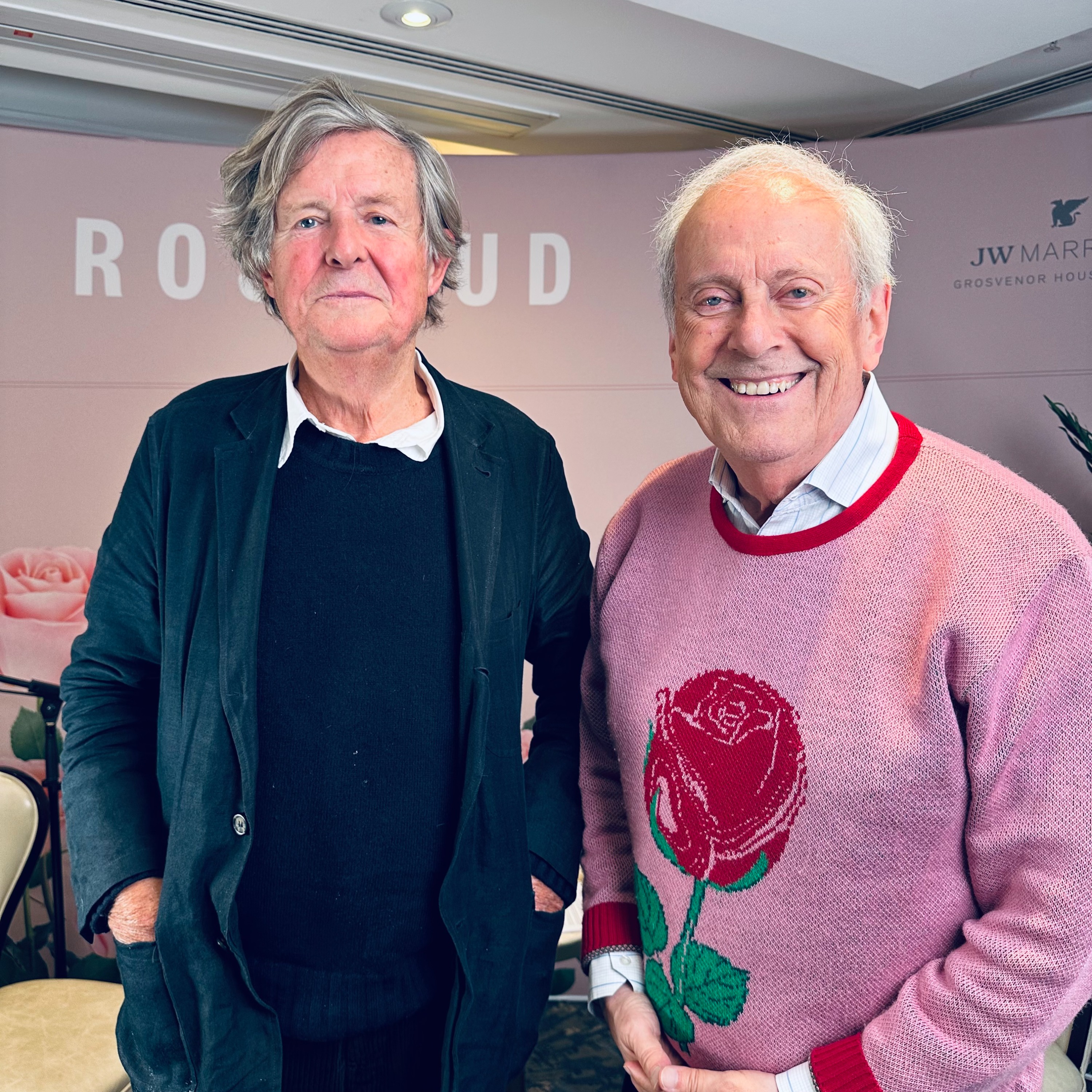
1:12:33Rosebud is a Plain Jane production produced by Harriet Jane hosted by me, Giles Brandreth with music by Phil Leppard and recorded this week at the JW Marriott Grosvenor House in London's Park Lane. Room service.
Sir David Hare is one of the UK's most prolific and successful playwrights, and in this episode he talks to Gyles first about theatre, about great actors, and about the sensitivity necessary to writing drama; he also talks about his unusual childhood - his father was in the merchant navy and was rarely at home, his mother was resourceful and talented but also fearful and anxious. He talks about the teachers who helped inspire him to read and broaden his horizons. He talks about his relationship with the fashion designer Nicole Farhi, and about his new play Grace Pervades, which is about the Victorian actor Sir Henry Irving and his relationship with the great actress Ellen Terry. This is a wide-ranging conversation, bristling with honesty and self-awareness. Thank you Sir David for your time, energy and brilliant stories - we really were honoured to speak to you on Rosebud.
Hosted on Acast. See acast.com/privacy for more information.


