
 Ask ChatGPT



Written by AI. May contain mistakes.
Gyles discusses Ed Davey's upcoming appearance and his life story.
“I know there are people who listen to Rosebud, which is wonderful.”
Ed shares details of his birth and his earliest memories, including a pet hamster.
“Have you always been called Ed as opposed to Edward?”
Ed recounts the profound impact of losing his father at a young age.
“This is Sutton, Ashfield, Nottingham Shire.”
Ed reflects on his family's struggles and dynamics following his father's death.
“He had Hodgkin's disease Which those It's not pretty curable but those days it was deadly He was diagnosed in November 69 And died on March 12th 1970 Age 38 Gosh When did you first hear that he was dead?”
Ed shares fond memories of his mother and their experiences during tough times.
“Did she, this lady, your paternal grandmother, did she blame your mother in some way for losing her son?”
Explore the fond recollections of a mother's love and discipline.
Understand the emotional landscape during a mother's battle with cancer.
“But the heavy caring started about halfway through.”
Discover the bond formed through caregiving during difficult times.
“And were you the principal one, or did you feel you were?”
Learn about the complexities of dealing with a loved one's death.
“Did you, obviously by the time it came close to her death you all knew she was going to die Yeah, yeah Did she plan ahead?”
Explore how childhood experiences shaped resilience and escapism.
“and the three children of the Doughty family were in the similar years to Charles Henry and myself and they came out with us trying to sort of have a bit of escapism.”
Discuss the emotional journey of becoming an orphan at a young age.
Detail the supportive family dynamics following the loss of parents.
“But, you know, automatically the love and the care of the family was around.”
Reflect on teenage experiences including friendships and parties.
Delve into early romantic experiences and their impact.
“The next door neighbours were a bit hard of hearing, fortunately.”
Analyze the effects of grief on mental health during adolescence.
“You had a succession of delightful girlfriends.”
Discuss how early losses contributed to personal growth and resilience.
“Well, they were remarkable because you seemed to have managed this balance between this caring role that you had for your mother as a very young boy and with being relatively normal.”
Explore the transformative power of travel during a gap year.
“I was much more angry when my granddad died relatively suddenly when I was 18.”
Reflect on the challenges faced during university studies.
“So I was pretty angry about that because I thought this is just not fair.”
Trace the development of political beliefs and identity.
“I think that was quite a restful moment.”
Detail the journey from university to a career in politics.
“And I had my one of two sleepless nights in my life, in that first term, thought I'd gone to the wrong university, was never going to succeed.”
Ed Davey shares his path to liberalism and political engagement.
“I think my mum would have been a Ted Heath conservative.”
Ed recounts the initial meeting and attraction to his wife, Emily.
“So it was not what I call a career move.”
Discussion of his son John's early development and diagnosis journey.
“But a year into his life, we're told that he might have cerebral palsy.”
Ed explains the approach to therapy for John and the family’s commitment.
“And then Emily would spend five or six hours a day with a program that she'd learned from these PETA.”
Ed discusses the future care for John and balancing family responsibilities.
“And do you think about the long term for him?”
Ed opens up about his wife Emily's battle with MS and its impact.
“Well, she's amazing, but unfortunately she has MS.”
Ed describes a dramatic incident where he saved a woman on the Underground.
“When we go with John, she gets treatment there too.”
Hear a gripping story about a life-saving decision made on a train platform.
Exploration of personal moments of joy and sadness in life.
“I have a great relationship with him and I'm so proud of him.”
Discussion on regrets and key life lessons learned through experiences.
“Obviously, there are regrets for things that happened, but any professional regrets?”
Insights into the vital role of family carers and their impact on society.
“and I won't give you all the policy geeky stuff in here but I really, really think it's the answer to a lot of things particularly healthcare.”

Get the gist, explore an idea or ask about something said.
 Claude
On Rosebud with Gyles Brandreth, what are the key points of this episode?
Searching your listeningAutomatic transcript. May contain errors.
0:00Welcome to Rosebud, presented by Giles Brandreth, produced by Harriet Jane, and listened to you.
0:34Hello, I'm Giles Brandreth and this is Rosebud. I love listening to Rosebud, usually in the bathroom while I'm getting ready to go to bed. When I get into bed, I then usually look at a book. I know there are people who listen to Rosebud, which is wonderful. Some people listen to Rosebud to get them to go to sleep. Others, because they can't sleep, they listen to Rosebud because, well, it's enjoyable, interesting to listen to. I hope, as one may be thinking of drifting off. But I normally read a book, and I've just finished reading David Baddiel's book about his family. If you haven't heard him on Rosebud yet, please do check it out.
1:12It's the most fascinating story about David and his remarkable parents and his mother's lover. So I finished that a couple of nights ago, and I then started on another book, which I'm looking at now. It's by a politician. And I don't, on the whole, enjoy the political memoirs of politicians. Having been one of sorts myself really isn't for me. But I'm looking at this book now. It's called Why I Care. And it's got a lovely photograph on the cover of the author of the book, who is a father, looking at his son, who he cares for, who has had challenges all his life. And the author of the book is Ed Davey, Sir Ed Davey, leader of the Liberal Democrats since 2020.
2:00Formerly, he'd been a cabinet minister. He was in the Cameron Clegg coalition government about 10 years ago or so. Anyway, and he's been a member of parliament off and on for Kingston and Serbiton since 1997, off and on. But it's not about politics that we're going to be talking. We're going to be talking today to Ed Davey about his life A life that's contained a lot of loss and a lot of needing to be a carer It's a remarkable story about losing a mother, losing a father, losing a grandfather And, well, the challenges continue But he tells the story, I think, with great humour, great heart I found it fascinating and moving and remarkable Whatever your politics, put politics aside, actually, and just listen to a human being telling a very human story.
2:57This is Rosebud with Sir Ed Davey.
3:12Edward Jonathan Davey, born, have I got this right, 25th of December 1965 yeah at 10 past 8 in the morning wow what a day Christmas day well it must be for my mum what a Christmas present I that wouldn't happen now somehow there I think they managed to avoid people having babies on Christmas day well I was born at home because I was a third of three boys actually and so I think my mum was used to giving birth by then and though they weren't expecting it I think it was supposed to be after Christmas very good well we have to begin as we always do with Rosebud, by asking you quite simply, may I call you Ed?
3:49Of course. Have you always been called Ed as opposed to Edward? No, my mum and my nana called me Edward, but Ed stuck, so there we are. Good. Ed, tell me, what is your very first memory? Well, I think it's probably of a hamster. Hammy, the hamster, because it's very original. Because I think as a young kid you remember these little things. Probably my more serious memory was of my dad when he was in the back of a car with a trench coat because he'd been diagnosed with cancer and couldn't drive the car when mum was driving and they picked me up from nursery. They're my two things I'd recall most.
4:31Let's just deal with the hamster first and then come to the serious matter of your father. Hand me the hamster. How old do you think he would be? I would have probably been about three, three and a half. And it was your personal pet? No, it was a family pet. But, you know, it was the first pet I can remember. And I remember sort of it going around his little wheel and the straw and that's the bit I remember. Okay, where is this? This is in Sutton, Ashfield, in a place called Bathwood House, which was a lovely house that my father had bought right next to the park with an orchard. It was really lovely.
5:07And this is Nottingham? This is Sutton, Ashfield, Nottingham Shire. Nottingham Shire. Yeah, because my father came from a family who were involved in mining, coal mining and building. He'd become a solicitor and had worked really hard and managed to have two practices. He was one of these guys, he could speak Nottingham to the miners, you know, or he could speak posh to the more middle class customers. What was his full name? John George Davey. And before you tell us about his early death and how you only fought at the time, tell us about him and your mother. How did they meet? Who was your mother?
5:47Yeah, well, my mother was Nina Jones Stambrook, and they met at a dance. He was doing national service. He was in the RAF, stationed near to her college, a teaching college called Wall College in Hertfordshire. They invited these people from the RAF camp to a dance because it was a women's college and they wanted a few men. and my dad apparently had been lying on his bunk and said, I don't really want to go, and his mate had forced him to come along. And then he'd seen my mum and had been quite attracted to her. But he danced with someone else first, so he could have a better look at my mum. And then he asked my mum to dance, and the rest is history, as they say.
6:28And the romance blossomed quite quickly? Were they married quite quickly? Pretty quickly, yeah. They were married in Hertfordshire, but he then went up to nottinghamshire where he was born and mum went with him and actually my mum's parents my nan and granddad moved to be uh near there as well so the whole sort of family went north so the whole family goes north he is a now solicitor she has given up work to be i think she started she kept teaching so she had been in teaching um and she taught on and off yeah but She has the children, three of you. So who are the two older ones? Charles, who's five years older than me, and Henry, who's three years older than me.
7:08Both lawyers, like my father. So your first real memory, other than the hamster, is your father in a trench coat. Yeah. Describe the trench coat. Describe the scene that you've got in your head. So I was in this little nursery, being picked up every day, normally just by mum. but dad had been in I think he'd been in hospital for some treatment and wanted just to see me as much as he could and was obviously not not well at all feeling the winter cold and was in this big sort of gray trench coat and as of you're four at the time yeah and do you realize as a four-year-old can you remember that did you know he was ill did you know something wasn't quite right Just that That's all I mean they obviously protected me I have a vague memory of spiritual healers Coming to the house Because you know they were trying everything They were desperate What age was he and what was the cancer he had He had Hodgkin's disease Which those It's not pretty curable but those days it was deadly He was diagnosed in November 69 And died on March 12th 1970 Age 38 Gosh When did you first hear that he was dead?
8:27Or wasn't coming back? Or how did they put it to you? You know, I'm not quite sure I mean, you can imagine My mother, the whole household was Completely traumatised And I have this memory of great sadness I have a memory of my mother crying Quite a few times I don't think I went to the funeral, actually I think I stayed with an aunt or a neighbour or something. But my two brothers went. So I think there was a degree of trying to shill me because I was so young. But, no, you couldn't escape the fact that there was loss and the whole house felt totally different. Can you remember the first time you vocalised that you didn't have a father when you were at school possibly?
9:16You actually said to somebody, I don't have a dad or my dad is dead or I don't think I can it's a really interesting question you're making my mind go back a rather long time uh and I you don't tend to think of those moments um I mean it's much more in my mind about when I lost my mum uh later on um and I could maybe come to that in a bit but um I mean what happened and this really did be the impact we had to move house because we had this big house in certain nashfield and we had to move to nottingham both for financial reasons and because my eldest brother charles had started at nottingham high school and uh that's a long way from from north nottinghamshire so we moved much closer to the school because he would have had a good middle class income as a solicitor yeah he yeah and that disappeared did were there partners who tripped him with some money not really i mean um he asked two of his mates one was an estate agent one was a builder uh pat holder morris brackenbury to be the executive of his will and you know he he basically said look make sure these boys are probably educated so there was enough money to privately educate the three of us so he thought about that in advance yeah i mean it's money had been put aside for the three of you to go to independent schools yeah if that was the decision yeah well charles was already there and the hope was henry and i would join him and you can imagine it you know this thing suddenly comes out of the blue you've got a few months to make preparations and he was obviously thinking deeply about us and how what what he was leaving what legacy could he leave uh for us and making sure there's financial provision for education was his gift his gift so the family moves to nottingham it's just your mum and the three boys is it yeah that's right yeah uh grannies aunties yeah well we had a quite difficult relationship with my uh father's parents uh my father's mother in particular who was quite nasty to my mother and would write her not very pleasant postcards one day she went to our school to try to get hold of my two brothers at the time who were there and take them back.
11:40What is the source of this? Did she, this lady, your paternal grandmother, did she blame your mother in some way for losing her son? I mean, it would have been very painful for her to lose her son when he was only 38. Yeah, I'm sure it was. I don't know, if I'm honest. All I would say is I'm not sure if her character was the warmest to anybody. I am told, folklore has it, that she was thrown out of six care homes. Oh, dear. A difficult lady. And she reported her other son, my uncle, to the tax man. So there might have been a common trait through her personality. I'm fortunate not to know her. But that was an added strain for your mother, the point.
12:23Yeah, very much so. She had these three little boys. She was slightly constrained with money. And you might have thought that her husband's mother would be helpful, but she was actively unhelpful. That's right. Conversely, my nan and granddad, my mum's parents, could not be more helpful. And we were very close. We'd go almost every weekend just to be with them and to feel their love and support. Tell me your sweetest memory of your mum. What do you remember best? She was brilliant at keeping us happy. She was determined that we would be happy despite the tragedy of losing our father. But in those first few years, before she became ill, she was relatively tight with the money.
13:09We didn't go on many expensive holidays or we didn't have some of the luxuries that some of my peers were having at school. She was careful. When she became ill... And what was her illness? Well, she originally had breast cancer. She had a double mastectomy. And we heard about that when I was nine. and then gradually i'm afraid it came back but went on to her bones so secondary breast cancer on her bones she's extraordinarily painful and when that was diagnosed when she was beginning to have real problems with her back pain and so on i think she took the decision that she wanted to create some really happy memories for us and she wanted to spend a bit more money and suddenly we had a color tv and a tv with a remote control and we went on holiday and this particular holiday which she was so farsighted to do this was to Jersey and we stayed in a hotel with a swimming pool it was very exciting lovely can you describe her to us what did she look like what sort of clothes did she wear what's the picture on your mind's eye she was a beautiful woman she turned heads oh and there's a wonderful picture of her on her wedding day and they'd I think hired a wedding dress from Elstree Studios so it was probably born by an actress in some Hollywood film and she looked like a Hollywood film star.
14:36So she was beautiful as well as warm and kind and on this holiday, I was mentioning Jersey, we used to sit every evening for dinner and we sit at this table in the corner of this restaurant and I think the head waiter took a shine to her so we got lots of attention and when my mother said she wanted to try four different sweets for her dessert she was given four different sweets every night they took a shine to mum did she cook at home oh yeah what sort of things what do you remember favorite food when you were a little boy oh yeah i mean it would be everything from stews with dumplings to you know roast chicken you know quite traditional fare the biggest problem was because three boys um and that's as you know is an odd number which means this dividing things up particularly when we would come back from shopping with a fresh baked white loaf of bread and we all like the crusts but there are two crusts so she had to literally to keep us happy cut the two uh crusts off and then cut them two-thirds a third and prove to us that we're each getting the same so she was very loving how did she maintain the discipline with three boys three strapping lads as as you will have become was she a disciplinarian or did or did you behave well do you think yeah i mean we were very good on our please and thank yous and table manners and she insisted on those certainly i i'm not saying i was a goody goody i wanted to please my mum and so i did what i was told really relatively easy i'm sure i was the odd naughty bit And I know she told me often.
16:15I mean, my father, when he was alive, had my middle brother had sworn he had taken some soap and a toothbrush to say you don't use those foul language. Oh. So there was a little bit disciplinary in there. Wash your mouth out. I mean, literally. Wash your mouth out. Toothbrush, soap on it, and literally wash your mouth out. No bad language. and then mum would very occasionally, I mean, no, occasionally, once or twice, would use a slipper if we'd been extremely mad, but it was like a feather, essentially. And we used to have this joke, you know, hit with a feather. It was kindness, but it was, you know, you've gone too far this time.
16:57When you were nine and she first had the breast cancer, was that discussed openly? Yeah, she told each of us separately. and I remember her telling me because we were in the bedroom at my nan and grander's house and she did it to me as a matter of fact not to worry and I wasn't I felt it was okay it's clearly a big thing because she was going to have an operation which didn't sound really terribly nice but I got the impression she thought it was all going to be okay so I don't think I was panicking or sense of alarm at all. And how quickly did it not become okay? How soon after the original? It took a little while, about, I mean, three years.
17:41So there were some normal years. Yeah, yeah. It was quite a few normal years. And, you know, we'd go to church. All of us sang in the local choir, St. John's Carrington Choir. We'd play in the youth club, cubs and air scouts, and played tennis at Mappley Park Tennis Club, and obviously school. So quite a full life. I have nothing but a happy childhood. And it's really important. I did. She made us enjoy life. And we did. And when you were 12 or 13, adolescence is beginning. Was that challenging for you? Oh, yeah. No. 12, she was diagnosed with the breast cancer gone to her bones. Ah. So, my gosh.
18:21So, it coincides with that. But the heavy caring started about halfway through. Yeah. So, she died when I was 15. the first year or two of 18 months of the diagnosis so she was gradually getting in more pain and was a more mobility problems but it wasn't heavy caring did you naturally respond optimistically or did you cry i mean how you had no rules about how to behave i didn't cry um we knew it was you know there was serious but we were going to fight it mum was a fighter she was determined she was going to beat this thing and she tried everything and when the nhs after a while um said that they couldn't do any more she tried uh naturopathy and we'd she'd go to this naturopath in manchester every four weeks and get all these pills and she was only her diet was uh carrot juice and apple juice and some cottage cheese and i would spend uh you know it was my job to chop up the carrots and chop up the apples and juice them and give her this horrible stuff that is her only diet.
19:29And she had to do coffee enemas, can you believe it? What does that mean? I mean, what an enema is. Well, you make the coffee. Very strong coffee. Yeah, you'd boil it up in a saucepan and then she'd administer the enema to herself. Gosh. It was a sort of crazy, quacky cure. She was trying, because she was trying everything. She was going to fight this. And she had spiritual healing. So she was trying everything. And what was your view of this? You say it was your job to cut up the vegetables like that. Who made it your job? Did you make it for yourself? How did this evolve? We were just part of the family.
20:05It just happened? Yeah, I mean, mum wanted me to do it, so I did it. And, you know, I just followed her lead, and I wanted her to be as comfortable as possible and as happy as possible. And I just thought, how awful it is that you're only allowed to eat this food. In your head, who were you, 12, 13, 14? Were you the boy at school? You were at a day school. Yeah, I was at Nottingham High School. I mean, school life was full on. Yeah. And, you know, I was doing lots of extricate activities. I was playing the cello. I was playing rugby. I was playing tennis and all sorts of stuff. And quite a normal in enjoying all that.
20:46Yeah. And it was only in the last 18 months when, you know, you really were looking more inward. but mum was determined for life to be as normal as possible so you didn't brood about it just came home and got on with looking after her well it became more i say more insular and more more broody if you like i didn't feel like that but that's that's i guess what it was like towards uh the last 80 months when she was in a lot of pain needed a lot more care and one was really worried about how she was and leaving home to go to school you would keep thinking of her and yeah Did she have somebody with her during the day?
21:25Did her mum come over or no? I mean, none and grand would come over a lot and we had a cleaner called Maureen who was amazing and one or two neighbours would come in, so we had some help but it was largely the family there was no, there wasn't lots of nurses coming in or or living care, anything like that. And were you the principal one, or did you feel you were? You had your two brothers. Well, both my brothers played a role at different stages. I think in the last 18 months, my eldest brother had a year off, a gap year, and then gone to university. So I think in the last 18 months, it was more Henry and me.
22:06And, yeah, we did what we needed to do. I mean, some of it was pretty personal stuff, you know, with commodes and and and uh painkillers so towards the end last i don't know nine months we had in our kitchen two bell jars one full of morphine and one full of a pink liquid that you mix with the morphine so it was drinkable and um i would mix this up and take it to her i don't think they'd allow that these days i'm not sure if it would pass the various tests but i would give her a morphine yeah and you knew that by doing this it did relieve the pain yeah i mean obviously morphine can knock you out of course i mean the other pain kid was a bit like a tens machine that women have when they're giving birth you know it gives you electric shocks to distract the the pain nerves and so on and um i'm sure there's more technical way of saying it and uh i would put the gel on these four black pads and put them where she wanted me to then she'd have this little thing which would turn up the the current i spent a lot of time after school laying on the bed with her and we'd talk and we'd use this small tv in a room with a remote control and watch rubbish tv and yeah i mean i was probably much closer to her than most teenage boys because i spent a lot more time with her yeah and you enjoyed the time yeah I was pretty close to her and we liked each other's company and you know I think at one stage she said she always was wondered what it was like if you know Charles and Henry had gone off and it had been me and her growing up and how close we would have been and there was one moment I'd been away on a trip to Germany with the school for about three days and the coach had pulled up in a car park and we got out and stretched our legs and there was some German girls and I got talking to this German girl and we had our photograph taken like you do with 14 year old kids and when i got them developed because you know old-fashioned it wasn't digital uh and i showed the picture of me and this german girl to mum she said um i wonder who you'll end up with so she was beginning to think about what life would be like the life she was not going to see so while there is of course great sadness in the story you're telling us there's also good times oh yeah definitely definitely i mean the thing about caring is you get really you have these really special relationships and while caring is you know uh when you're looking after someone you're very close and you love dearly um it does really impact on your life if it's sort of hands on care we were doing um the the love that you get and the memories you create are really special and of course there were some pretty tough memories you know I was by her bedside when she died and you know there are difficult memories
25:05Did you, obviously by the time it came close to her death you all knew she was going to die Yeah, yeah Did she plan ahead? Did she talk to you about what the plans were for you because you were 14 at the time well 15 by the time she died i mean it's interesting because she was such a fighter uh there'd been a conversation with my middle brother henry about what which was she going to die in the middle of his exams doing a levels and she didn't want that and so uh he wanted to go to cambridge and he did what was called fourth term entry i remember so you've done your first year six on the fourth term you could do an exam and he got in to Cambridge with an offer of two e's which he was always going to get and so the sense of relief from my mum knowing that Charles was already at Oxford my middle brother was going to Cambridge and although I was you know before my O levels but my exam marks were okay uh so I think she felt we had the momentum and um I think she then thought I can go now because she knew she wasn't going to be able to hang on so she she did actually die um June the 3rd 1981 a few weeks before my brother did his A-levels so it was very again she was an amazing woman planning ahead and picking her moments and did you say goodbye or did it just happen she let go yeah she let go so in the last two weeks almost all her illness she was at home looked after by her as helped by her nan and grandad and then the last two weeks she was in Nottingham General Hospital in a very old-fashioned Victorian ward and I would go in every day before school and sometimes after school obviously to see her as much as we could and the day she died I was gone to visit her in my school uniform and sitting next to her and then she turned her head and I knew that it was quite serious and so I was up So I got the nurse and the nurse asked me to leave the ward and just wait.
27:13And then they came and told me. And what did you do? How did you feel? What happened then? Well, immediately I felt my legs go underneath me and I was a bit upset. But then I went to see her and the pain had gone from her face. Her face had relaxed. And there was a sense of relief. and then they allowed us to use the phone in the nurse's room and we phoned my brothers and my brothers came and I can't really remember what happened then. I mean, I can remember the night before the funeral, we went to watch Tess of the D 'Urbervilles as a film with some family friends who we knew very well. The Doughties, they had three, they lived near us and the Mr.
27:58Mistata were amazing, helping us with lasagnas and food and stuff. and the three children of the Doughty family were in the similar years to Charles Henry and myself and they came out with us trying to sort of have a bit of escapism. Yeah, that's quite an emotionally exhausting film. Test the Dermotivist. It was what was on the screen. It was better than Carry On Matron. So I think probably the right choice was made. But did you in your head think, what happens now, I'm 15? Yeah, but I mean, the thing that's worth stressing is I was fortunate, right? First of all, we were okay for money. I mean, we weren't rich, but we weren't poor.
28:39There was stability. I had my brothers. I had my nan and granddad. I had friends. And although you did feel, right, this is a moment. And there were a few times in those first few months when it did feel difficult. I mean, for example, when I went into school the first time after mum died, I met the head teacher in the corridor and well he was a decent guy he clearly wasn't used to this situation he said Davy I'm sorry to hear about your mother we've never had orphans before and I'd never that word had never been mentioned and I thought oh right I'm an orphan am I I was 15 so I wasn't a young sort of Oliver Twist type orphan thing but I was an orphan and it was the first time it had been said to me and the sensitivity of some people at the school wasn't as good as it might have been other teachers were amazing uh some really brilliant teachers who were kind and sensitive although i don't think even they knew quite what to say is there a legal position that one is in if you're 15 and you have no parents do local authorities get involved or because you had living active grandparents or your mother's parents i don't know uh i don't think we We had to go to this local authority, all the social service department.
29:58But, you know, automatically the love and the care of the family was around. And I lived with my brother initially. So you just assumed we carried on. So you carried on with the house. Initially, yeah. So the mortgage had been paid. No, the mortgage hadn't been pretty paid, actually. But the provision was made. And I mentioned, didn't I, that we had executives of my father's will. Yes, the two friends. They were now becoming executives of my mother's will as well. and so they were looking after the money i mean it wasn't a lot of money but there was enough to pay the bills um so there wasn't that worry that other families would have had which is why i count myself fortunate but equally um then i had to move around a bit so i live with uh in our old house in mappie park bungalow with my brother henry when he was on his year off and he and i lived like kings really um that's a long story of you yeah and then i went to live with my nan and but hold on let's have this lively year well it was about four or five months but yeah well he was working he started off working marks and spencers as a lift attendant and all these people kept coming and kept telling him that he they felt his job had its ups and downs uh and uh but uh part of the the benefit of working for marks and spencers was you get the food cheap at the end of so he'd get bring back all his food a quarter the price and we we ate feasting yeah we feasted fantastic and we got you know the wonderful indian family across the road the malhotras will bring over these wonderful curries a family down the road of a husband a wife the frasers would make these wonderful homemade soups for us the doubt is rooming like the sanias so we were okay we were okay you two boys age sort of 15 16 17 yeah i was 15 16 he henry was 18 19.
31:44Gosh. And then there were the parties. Oh, no. Tell us. Yeah. Well, we were in the cul-de-sac at the end of the cul-de-sac. The next door neighbours were a bit hard of hearing, fortunately. And then there was no other house that near. And so Henry sort of started off with a few parties. They weren't wild, but at the time they felt a bit like different. So it was, you know, we'd have quite a few friends around. when did you have discover girls when was your first girlfriend well i mean my first sort of sort of real girlfriend was um uh pippa doughty who was one of his family but she was a year older than me and she preferred donny osmond which was a was a always left a scar frankly quite right i mean a questionable taste well i i'm glad you say so because i was i was not happy with donny osmond i mean i was the boys high school there was a girls high school across the road and i did tend to find lots of ways of mixing with the girls.
32:43Did you take girls home? Did your mother ever meet any of your girlfriends? No, no, she didn't actually.
32:51My first girlfriend, I guess this time, was a girl called Caroline. And, you know, everyone sings Sweet Caroline these days. I bought the whole album for my first girlfriend. Well done. Excellent. And she came to some of these parties. She must have done. I mean, you know, I had a few girlfriends, you know. You played the field. Well, no, forgive me. Serially monogamy. Very good. You had a succession of delightful girlfriends. Yeah, I was very lucky. Were you comfortable in yourself? I mean, given this very unusual, and one might have thought traumatising childhood, losing a father and then losing a mother over several years, you might expect it to have an effect on you, on your mental wellbeing.
33:38but the picture you're giving is of a boy who did what he did with his mother and loved doing it and felt closer to her as a consequence and almost privileged to be able to do this yeah i mean i i do generally feel that i because i'd had that love from my mother and i felt the love from my father um i had this sort of coat protecting me my father had written me a letter oh um a beautiful letter, very short. He wrote letters to all of us. You can imagine how hard that must have been for him, writing letters to his boys. How old were you when you read this letter for the first time to understand it?
34:19That's five or six, I guess. Oh my gosh. So it was written in simple terms? Very simple terms, yeah. And the essence of it was, I love you. Be good for mummy. Be clever. Work hard. Mummy will give you all my kisses. That sort of thing. It was tough. and you know it was when I became a father and you realise how much your children mean because all parents will know this you hold your first child in your arms and it's just like love you've never ever experienced and I can't imagine what it must have been like either for my nan and granddad to lose their only child my mother, I mean I could see how the pain they were in as they saw her die or for my father and mother to say goodbye to us at such early ages.
35:11Well, they were remarkable because you seemed to have managed this balance between this caring role that you had for your mother as a very young boy and with being relatively normal. That's quite you. No, but relatively normal in the sense of taking part in school activities, doing okay at school, and then when you get the chance with your brother, having fun parties you know leading a balanced life why is that why did you not have any what was when your later teenage years what was the effect of all this or maybe there was no effect maybe it's just yeah i mean uh i could probably do some pop psychology on myself i guess i mean i mean there were tears at different stages so i remember um the summer after mum died I went to visit my eldest brother Charles who was working on a campsite in France and I stayed with him in his tent for about three weeks and I remember one time by the river by myself just bursting out crying so of course there were tears and it was sad and there's no point pretending otherwise right but equally I did have my brothers I did have my nan and grandad and I had them in memories and mum had made us strong mum had prepared us I mean just to show you that Being prepared for something, particularly by the person who's suffering it, is the way I think I dealt with it.
36:33I was much more angry when my granddad died relatively suddenly when I was 18. So he had a heart attack out of the blue. And then we thought he was going to recover. And then he had another heart attack in hospital and died. So I was pretty angry about that because I thought this is just not fair. he just lost his um only child and i think you know i think he died of a broken heart and then he'd left my lovely nana who'd lost her only child and her husband in the space of three years and so i was pretty angry about that so how did the anger manifest itself did you go off the rails a bit no because you've got your a-levels you did well yeah um yeah i mean i took a year off and i think i mean i was always going to take a gap year my brothers had and i wanted to and I think looking back on it that was a really even more important for me because I went traveling I went to Spain and Spanish a bit very badly hitchhiked worked in France when cycling in Germany down the romantische Straße with my then girlfriend Ruth who was lovely and went inter-railing and did loads of different things worked in a pot pie factory did all the sorts of things you do and I I think that's slightly getting off the rat race of exams and being by myself a lot.
37:52I think that was quite a restful moment. And I think I could find some peace, I think. And university, you wanted to go to university, you assumed you would. Let's get you to Oxford, where you do philosophy, politics and economics, the famous PPE. What is the most outrageous or exciting thing that happened to you at Oxford? I certainly can't tell you. Yeah, we want to know. we want to know oh dear what was most outrageous thing at oxford um well the most memorable what springs into your mind as well let me i mean let me give on two uh two moments i mean the first moment was um in fresher's week when i met my best friend uh another ruth actually um we both had years off both gone to spain both like port and we just kept talking um so yeah ruth ruth quinn and i became best friends and you know meeting one of your best friends is always a moment isn't it um unusual to have a girl who is a best friend perhaps uh what other things i mean um in fresh this week again i uh looked all these different oxford sites the union so i decided i didn't want to join them oh um i'm sorry um but i did want to join uh what was called the student ecology group because by this time i was into the environment i'd read jonathan porrits uh seeing green which at the time was one of these classic work and it would really take me and i started reading other books in that area and so new undergraduate i said i must join the student ecology group very very worthy as i was and there were about four of us unfortunately i didn't think they were taking the message of what i'd taken from jonathan uh porrett seriously enough so i got us rechristened my first bit of political spin was to call us green action oh and we did some campaigning and i did a term card of debating on green economics and so yeah those sort of things and that's not really outrageous it isn't a green action sounds very worthy and worthwhile and i'm glad you did it i was looking for that outrageous dreadful well what was the worst thing that happened to you in three years did you well i tell you what in my first term i hadn't done my reading uh before going up on economics so uh i hadn't studied economics at a level hadn't done maths at a level and hadn't done my pre-reading despite having a year off go up to oxford and all these people had done economics A-level, maths and further maths, and they found it really easy, and I found it really difficult.
40:32And I had my one of two sleepless nights in my life, in that first term, thought I'd gone to the wrong university, was never going to succeed. And that Michael Miss holiday, I went back to my nana's, because I'd go back to her and stay with her. And she had this lovely black labrador called IMI. And I would sit at this table with all these books in economics, trying to work out what on earth this bizarre subject was and i'd wake up every morning with a pit in my stomach thinking the first time in my life i couldn't do this thing and i'd look at my grandmother's dog and i'd think i wish i was you yeah i really felt you know i'd uh found this thing i couldn't do um but i sort of spent a long time working at it sort of got my head around it did okay in the exams that you take called collections after the holiday and then i started looking up again and you know making more friends and having a good time and when did you think you were going to become a political animal when did that cross first cross your mind well i mean i mean interesting politics right um were either of your parents do you know ah well i had thought my father was a conservative because i was told by my mom he'd gone and played snooker at the conservative club.
41:48And my eldest brother had been chairman of Nottingham Young Conservatives. My first conservative event was a disco, aged 12. And I'm sorry, Jars, but it put me off. Shocking, isn't it? I think my mum would have been a Ted Heath conservative. And my grandad used to shout at Arthur Scargill when he came on the TV. So you can sense there was a... You come from a very good family in every respect. I'm liking them more and more. But I hadn't you know, pin my colours to a mask. I was very attracted to liberalism, you know, freedom of the individual, internationalism. And it was only after I'd left university and was applying for jobs that I sort of began to realise maybe the Liberals were the place I was going to go to.
42:33But I wasn't a member of the party. But I applied for a job with the party in the December of 1988. So I'd just graduated in the summer. I was applying for a whole series of jobs Applying for this job, not expecting to get it Was interviewed in the Social and Liberal Democrat Whip's office And I was very surprised to get the job And I started work as the Social and Liberal Democrats Parliamentary Economic Researcher On the 3rd of January 1989 Not being a member of the party But sharing their Sort of approach on the economy And then I heard Paddy Speak Paddy Ashdown and met him and thought, wow.
43:17And his clear explanation of liberalism, personal liberalism, political liberalism, economic liberalism, made me feel that that was the party for me. And I joined it when we were 4 % in the opinion polls. So it was not what I call a career move.
43:41just tell you when did you first meet your now wife how old were you then how old was she she says we met in 1995 on new mold and high street oh uh though i don't remember i then met her and really noticed her at a training event I was speaking at for Liberal Democrat women. And how did you notice her? Just tell me what she looked like. What was the moment that made you think, oh, oh. First of all, I was attracted to her. But also, she was asking the most intelligent questions, most insightful questions. But it was a whole room and I was coming and going, so I didn't really get to speak to her, which I was a bit disappointed at.
44:22But then, a year or so later, and this is quite sad to confess but I've confessed it before I was chairing a Liberal Democrat housing policy working group and she became a member of it because she was into social housing and housing policy she was a housing lawyer and I kept noticing her in this policy working group and I asked her out for dinner and the rest the rest is history well done and how quickly did you have your son? um so we got married in 2005 and we had our son in november 2007 and tell me the story about him because as it were his story is in the public domain it is because of your experience with him i mean yeah what i think is fascinating about you is one so often could criticize a politician like you whose life has been politics since he was young but your life experience is so rich that it would fall dead upon the lips if one's right to say you'd have no experience because few people have had as much experience of life as you have so tell us a little bit about your son and his story so uh john was born uh 28th of november 2007 uh we were just over the moon born in kingston hospital and uh just you're on cloud nine and then uh sort of three months in we just didn't think he was developing quite as fast but we weren't that worried um you know boys slow developers and all that sort of thing um and then we got to six months and he wasn't sitting up and wasn't quite engaging again people told us not to worry but then we eventually got appointment with the consultant pediatrician and they said yeah we think there could be an issue and then it also took off and there was a diagnosis very early diagnosis when he was just before he was one that they suspected he might have cerebral palsy.
46:18Now, he doesn't have cerebral palsy. He has no diagnosis. But a year into his life, we're told that he might have cerebral palsy. We were offered a bit of OT, but in 12 months' time. That's occupational therapy. Yeah, and some physio, but in six months' time, and some speech and language therapy in 12 months' time. And he's just one. And we're going, this doesn't work for us. We want something now. And we had an au pair who was from Hungary called susan and her father was a doctor back in hungary and susan told her dad about john's diagnosis and he said why don't you advise edward and emily to take john to the petto institute in budapest which has got an international reputation for an approach called conductive therapy uh which is quite holistic physiotherapy is the best way to describe it and because we weren't getting anything else we said let's give it a roll so uh in january 2009 so he's about 30 months emily and i find ourselves in budapest with john on my back ice on the ground and we go to the petto john's in pain for the first day or two because his muscles are beginning to attach to his bone and as they did their exercises on him he was in a bit of pain but and this is a crucial bit both emily and i found the way that these conductors these hungarian staff that they call conductors were handling john and the way they were talking to us about him we just felt hey these people care and so in those early days we would go to budapest uh paid for by my brother in law three times a year emily would write down every exercise and i would when it was my turn and write down every exercise that they were doing.
48:09And then Emily would spend five or six hours a day with a program that she'd learned from these PETA. Five or six hours a day. Just sort of think about that for a moment. It's a lot of hours, isn't it? Well, well done now. My wife is the most amazing person. She taught John to crawl. It took her two years. Holding his tummy and moving an arm and a leg. An arm and a leg. because the theory of the petto is you retrain the brain. So the brain's got damaged, you retrain it by repetition, often linked to music. And she, just like my mother fought for her boy, my wife fights for her boy. And how is the boy now, today?
48:56He's 18. Gosh. And the great thing is he's done way better than anyone thought. but he he can't speak very well at all he said daddy when he was nine for the first time and his speech is better than anyone had expected but it's still very limited and we have we normally do we talking jokes you know he likes to be a lion and a bear and um so he's there's a communication challenge his mobility is pretty limited he can hold his own weight which anyone knows anything about caring you can hold your own weight that's fantastic and that's a lot of work emily peto others have helped an operation we had on his legs because he would walk on tiptoe with bended legs and now he can walk on straight flat foot on straight legs which is fantastic um and he's got learning disability disabilities so he's severely disabled he always needs 24 7 care but the key thing the fight is for us maximizing his independence so he can feed himself we're aiming for toilet independence and we're quite close i mean he has got up from the table once or twice take himself to the toilet gone for a wee and come back out again now that's a red letter day in the david household so we're working the whole time to maximize his independence so he can be the best he can be.
50:23Excellent. And do you think about the long term for him? Does one do that? Or do you just take one day at a time? It's my room 101. Because at the moment, he has his mummy and his daddy. But there'll come a time, either when we're just too decrepit to do the care, and then, of course, he won't be here. And I find that difficult to think about because no one's going to love him like his mum and dad. But there are great carers out there, so we've got to think about where he'll be. And I don't want to put it all on my daughter because she's got to have her own life. How old is she now? She's 12 in February.
51:03What's her name? Ellie. And you manage, of course you do your best to manage the balancing act because the boy demands so much. You could give everything to the boy and clearly Emily has. And yet you have this wonderful daughter as well. Yeah, well, she's amazing. The truth was we weren't sure whether we'd have her because when we got used to what John was and the challenges was, because that took a little while. So Eddie didn't come along for a little while. But we said we're going to try again for a second. But then we said, well, you should get yourself tested genetically in case what John's got is genetic.
51:43a year and a half later Great Ormond Street doing fantastic tests they said we don't know if it's genetic or not Emily and I took probably a most difficult decision as parents and said are we going to roll the dice and have a go what happens if another child has John's condition and we decided to go for it and it was the best decision we've ever made and Ellie is a daily joy beyond measure. And she cares deeply for her brother, but I don't want her to feel that pressure on her. How is Emily now? Well, she's amazing, but unfortunately she has MS. And we thought she might have before we got married.
52:31So, you know... So that's been in both your heads all these years. But it only really struck. She had a first serious attack when her dad died. that triggered an attack and for a time she for about two or three days she was really badly affected but we were actually in in Budapest and the peto helped her and she improved quite rapidly but then we got it fully diagnosed in in London and it you couldn't notice it to be honest and I could because I noticed her well and her gait changed a bit and things but then during During the lockdown of COVID, she went down quite rapidly because she couldn't swim.
53:14She couldn't do the exercises. And it might have happened anyway. But it coincided. It coincided. So she now walks with a stick and her walking isn't great. But she's fighting that too. And actually, she gets treatment of the petto as well now. When we go with John, she gets treatment there too. Did the anger that you felt when your grandfather died return at all with John and with Emily with these two later blows? No. no they're there and they're wonderful and you know you just make the you just help them in whatever they can to be as independent as they can be and and we got a really different discussion with emily um and she you know she's fighting for herself because she wants to be as well for her children you know it's interesting the way you are accepting of these major events in your life what else can you do yes well at times you could once when you were younger you were angry yeah since then you have dealt with it yeah i mean um i need to be there for them don't i yeah and you manage how do you manage your diary how do you organize because here you are as the um leader of the liberal democrats uh i was watching you in parliament this week doing your stuff doing your thing got a busy constituency weekend but you did mention oh i'm doing some caring then you obviously keep the diary and there are times when you are a carer well we survive by very careful time management um support for my staff emily managing uh the most uh managing john's uh education and therapy um keeping an eye on what how ellie's doing at school and we have a living carer we could not cope without living carer and we have a care team who help us in different ways but that has to be organized it has to be paid for and we're very lucky for a friend and um a relative helping us with that care cost and i couldn't afford it for it it's way out of my budget but with because i'm supported in that i can do my job well and your job is as a politician and i've got three more quick questions for you and then i'm going to release you to go off to change the world to a better place which is what we want you to do uh and it's what you do as all good politicians aim to do.
55:33Three quick questions. One of them, you've got to tell me briefly, looking through the press cuttings, I saw this act of heroism from years ago where you seem to have saved somebody from certain death on the London Underground. Just describe that incident briefly. It was on the trains actually, Clapton Junction, late one night, and I was on Platform 11, and the fast train to Victoria came in at Platform 12. A woman got off, was shouting at her partner who was on the train. the partner got off pushed her down the platform they were having a real to-do he got back on the the train the train pulled out and she went to try to get back on the train and fell between the train and the platform and everyone sort of went quiet so i went over and looked and she was in one piece lying on the near rail and no one was doing anything so i took off my coat and i got onto the rail and uh decided to lift her up and i said stop the trains and then i saw the train if you don't clap and it comes around on the corner and i saw these two lights of the fast train coming towards me and i said stop the train and i picked her up and i worked out that if they didn't stop the train i might get her on the platform but i'd be um hit so i took the decision to walk over the lines checking there wasn't a train coming the other way uh and making sure i didn't hit the live rail and got her to the other platform and the train did stop but about three four meters from where we've been wow so yeah that was an unexpected um moment well it was extraordinary because it turns out that as well as being super son and super dad and super husband you are superman we actually took off the jacket yay no it's heroic okay we are almost there we always end with these three quickies i'm just going to say a phrase to you and you've got to tell me what immediately comes into your head a moment of joy in your life just now what comes into your head a moment birth of my son is just amazing lovely and you were there yeah yeah holding him in his hand and I've got the picture of him coming out Because it was a C-section And as was Ellie Just a joyous moment New life And a moment of sadness My mum Loss of my mum I mean I was interviewed by my vicar And he asked me What would I choose for John to have no disabilities or my mum not losing my mum and not losing my mum is just obvious.
58:10I mean, John is amazing. We have such fun and love. I have a great relationship with him and I'm so proud of him. But I would have loved to have my mum here. Any regrets in your life? Obviously, there are regrets for things that happened, but any professional regrets? Professional regrets? Not yet. Not yet. Yeah, I mean, in life, I guess, not meeting Emily earlier and starting a family earlier. Maybe we've had more children. And what have you learned? What have you learned in this extraordinary story you've shared with us? Well, I've written a book called Why I Care and Why Care Matters. Oh, I'm going to read this.
58:54Yeah, and it tells my story, but importantly, it tells the story of other carers. because the thing i feel i've learned and i want to be a voice for carers is how many people like millions of people have different caring experiences and but for those family carers our society our nhs would just collapse and i don't think the policy makers and politicians and society understands how important they are and if we did we would transform our society and I feel very passionately about this and I won't give you all the policy geeky stuff in here but I really, really think it's the answer to a lot of things particularly healthcare.
59:41I'm going to read your book. We shall promote it afterwards giving all the details so that we can buy it and I hope there'll be a paperback later in the year. Thank you very much. Thank you for a fascinating and moving conversation. Ed Davey, thank you so much.
59:55Well that was Ed Davey and what a remarkable and fascinating story We've not had many politicians on Rosebud We don't ever do politics as politics but we do, well we're fascinated by people and by human stories and I have to say we've got some very exciting ones coming up Next Tuesday, I think, on more Rosebud we've got one of the most extraordinary stories I have ever heard about the parents of our guest two most unusual people but this guest's first memory well it'll blow you away it will knock your socks off next Tuesday's what is your very first memory you'll think this answer can this be true.
1:00:45He describes the smell, the texture, the touch of somebody that he knew when he was a little boy, when he was three and a half years old. And the smell, the taste and touch is of one of the most famous people, I suppose, in history. Yeah, and that's on Rosebud on a Tuesday. Oh, oh, we spoil you. And when we're spoiled too, by the quality of our listeners, we had a wonderful letter in from Judith. Do you remember a couple of weeks ago, we had this wonderful episode with David Baddiel, when he was telling us about his bedroom that was, well, wall to wall with his parents' bedroom, and the noise of his parents having sex.
1:01:28If you haven't heard it, go back to it now. It really is extraordinary, completely extraordinary. It's a description of his father's ecstasy, sounding like a sort of walrus in his dying throes. Anyways, by the by, that was David Baddiel, but I think it's inspired this letter from Judith, who writes, Dear Giles and Harriet, I've just listened to the David Baddiel episode, and what a lovely man he seems. He is. You're asking, Giles, for parents having noisy sex stories. Well, these aren't my parents, but my husband's mum and stepdad, and I know he wouldn't mind me telling you this story. He's told me that his brother, sister, and himself used to share a bedroom, and on quite a few occasions when their mother and stepdad were making love, their mother would call out loudly her husband's name.
1:02:14My husband's younger brother would get so upset their sister used to sing Silent Night at the top of her voice until they'd finished. The thought of this never ceases to make me smile whenever it's time to sing Christmas carols. But I don't think I'm ever going to be able to go to a carol service again and hear Silent Night being sung without thinking of the the noise from the bedroom next door. Oh, Judith, thank you so much. You've made my day. Oh, thank you, all of you, for listening to Rosebud. It's such a privilege for us to be with you every week, twice a week. And if you want ad-free listening, it's always available to you.
1:02:53You simply go to patreon.com forward slash rosebud, and there you get ad-free listening to Rosebud, but also you go on trips down memory lane with me and Harriet. There's a diaries episode with me and Harriet once a month. I'm reading my murder mystery, The Candlelight Murders. So there's all that available for people who want to have that. You just go to patreon.com forward slash Rosebud. Oh, and this Sunday on The Rosebud Family, which is what you get when you go to the address I've just given you, The Rosebud Family, Harriet and I are going on a trip down memory lane visiting different London hotels with some quite intriguing stories to tell of hotel life in London.
1:03:34So, that's the Rosebud family. Hope you'd like to be part of it. But we just love having you here on Rosebud. If you like seeing us, well, actually, if you like seeing me, you can see me tonight on Would I Lie to You, which is one of my favourite programmes, and I'm a guest tonight. We've had the whole cast of that as guests on Rosebud. David Mitchell, Lee Mack, Rob Brydon, and me. Anyway, I'm on Would I Lie to You tonight. Oh, I was on QI on Tuesday, and we've had santi toksvig and alan davis seems everywhere i go i just pick up rosebud guests alan davis's episode if you haven't heard it is so powerful so moving and it's part of why recovered memories and sharing them is actually important for your well-being actually anyway so i think there's a purpose to rosebud actually if you want to see alan davis go to youtube all you do is find YouTube and then you go to Rosebud Podcast and there we are a whole array of them I'd start with Alan Davis actually but Michelle and I we watched two this week we watched Thelma Ruby the most remarkable centenarian and we also watched the Welsh actress Sian Phillips once married to Peter O'Toole that's quite a story but Michelle particularly enjoyed that because of course anything Welsh she loves because Michelle was born in Swansea.
1:05:03There's lovely. That's it from Rosebud. Cue the goodbye music.
1:05:52Rosebud is a Plain Jane production produced by Harriet Jane, hosted by me, Giles Brandreth, with music by Phil Leppard, and recorded this week at the JW Marriott Grosvenor House in London's Park Lane. Room service.
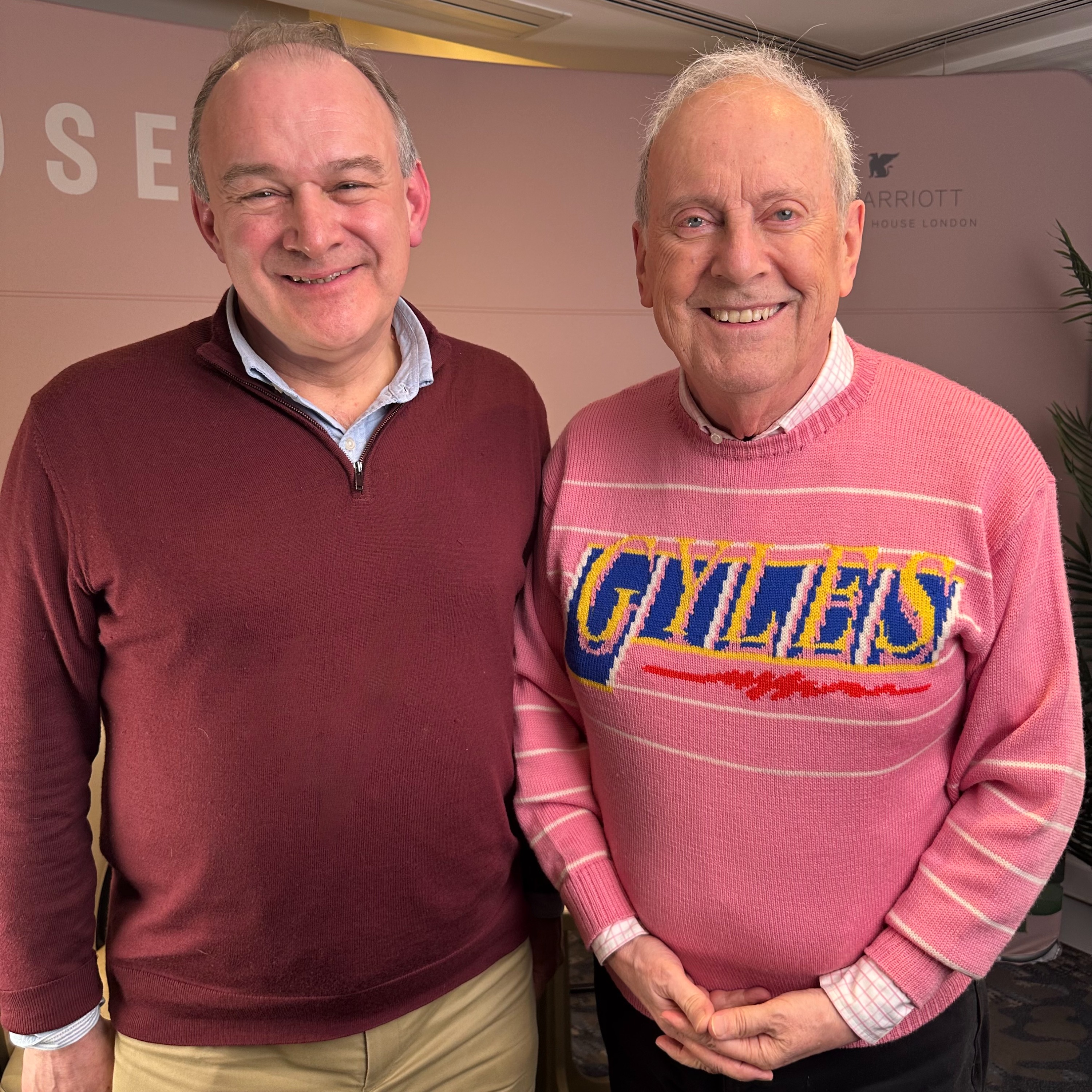
Joining Gyles on this episode of Rosebud is the Leader of the Liberal Democrats, Sir Ed Davey. But this isn't a conversation about politics, it's about Ed's life, his family, his experience of profound loss, and his involvement with caring for his closest relatives - his mother, who died of cancer when he was 15, and his son, John, who was born with neurological difficulties. This is a very moving episode, with some discussion of illness, death and bereavement.
Sir Ed talks to Gyles about his father and mother, both of whom died too young - his father when Ed was only 4 years old, and his mother 11 years later. He paints a vivid picture of them, and particularly of his mum - her beauty, her courage and her love. He also talks about the years after his mum's death, when he and his brother lived alone in the family bungalow and had some wild parties with their school friends. He then talks about the birth of his son John, and the amazing work done by the Peto Institute in Hungary to improve his mobility and strength, and the dedication and commitment of his wife, Emily. All of this has led Ed to write a book Why I Care, about his experience of caring and about the importance of supporting carers.
This is a very moving, inspiring conversation, full of hope and of love.
Ed's book is available here. Don't forget to subscribe to our YouTube here. Join The Rosebud Family here. And visit our website here.
Hosted on Acast. See acast.com/privacy for more information.


