
 Ask ChatGPT



Sir Geoff Hurst (Geoffrey Charles Hurst), last surviving 1966 World Cup final player, discusses his life and football career—childhood, West Ham development, England selection under Alf Ramsey, and the 1966 final vs West Germany where he scored a hat-trick.
Geoff Hurst, born 8 Dec 1941. Played for West Ham from age 15/16 to about 1972; later England World Cup winner. His father Charles was a sheet metal worker and footballer (Oldham/then Bristol Rovers). His brother died by suicide after jumping under a train at Chelmsford Station; sister Diane still lives in Chelmsford. Married Judith Helen; she supported him and was private during celebrations.
Ron Greenwood’s “near-post cross” training shaped his scoring. He was happy to be on the bench in 1966 and felt ready when called. Alf Ramsey’s discipline and player selection (“he will not let me down”) were decisive. In the final, after Germany equalized, Ramsey told them to beat the Germans again.
West Ham FA Cup 1964 and Cup Winners’ Cup 1965; Hurst’s 6-goal match vs Sunderland (Oct 1968, West Ham 8-0); quarterfinal goal vs Argentina from a Martin Peters left-foot cross; semi-final vs Portugal featuring Eusebio; final moments including the crowd roar from Wembley’s tunnel and the “beat them again” team talk.
Written by AI. May contain mistakes.
Geoff discusses his first memory and his grandparents' influence.
“Before we begin, just please note that there is a reference to suicide in the course of our conversation.”
Geoff shares insights into his family dynamics and the tragedy of his brother.
“Interesting question, and I've got a very good answer for that, which I remember as my first memory, was sitting in my father's parents, my grandparents' house, in Denton.”
Geoff reflects on his parents' relationship and his father's football career.
“I never really fully understand the circumstances of what happened.”
Geoff recounts his journey into football and the challenges he faced.
“Mainly she's got people who want to get an autograph.”
Learn about Geoff's transition from cricket to football and his experiences in early matches.
“I'm not sure I'm embarrassed to tell you this.”
Discover how coach Ron Greenwood shaped Hurst's football career and his unique coaching methods.
“we won nothing a guy called Tony Scott scored the only goal and from a standing start around this is 63 I played late 62 63 I played 27 games in a new position and score 14 goals.”
Explore Hurst's life as a young player, including friendships and his time living away from home.
“I don't think they necessarily needed to be too disciplined with me or too strict with me.”
Understand the leadership qualities of players like Bobby Moore and Hurst's perspective on natural leaders.
“I met him a couple of times, and even as an older person, he had a kind of leadership quality about him.”
Hear about Hurst's remarkable achievement of scoring six goals in a single match.
“the moment, not necessarily one that's famous, but one for you, the satisfaction, when you're still young but you're playing for West Ham.”
Geoff Hurst reflects on his 15-year career at West Ham and their triumphs.
“They're there in 56, 57 until 72, 15 years.”
Hurst discusses how he was selected for the England team and the differences in football culture.
“every single thing apart from the goalpost.”
Geoff Hurst shares insights about the strict discipline under manager Alf Ramsey during his time.
“Was they tell you you'll be paid this much for the match?”
Geoff Hurst recounts how he met his wife Judith and their early relationship.
“You tell it the way you want to tell it.”
Hurst describes the highs and lows leading to the 1966 World Cup final.
“Just take us through the moments that got you to the final.”
Geoff Hurst shares his experiences leading up to his debut in the World Cup.
“And he just told you this, that that's who he was choosing, and there was no arguing about it.”
Hurst reflects on critical matches against Argentina and Portugal during the World Cup.
“That night when you get into bed, it's still going round and round in your head, that moment, is it?”
Hurst recalls the events and emotions of the World Cup final against Germany.
“a bunch, not only of great players, I mentioned, but a bunch of top, hard-nosed professional players.”
Hurst discusses his feelings after the match, the legacy of the game, and the impact of dementia in sports.
“whether the hat-trick hadn't been scored, how big it was.”
Explore the personal and family aspects of Sir Geoff Hurst's life.
“I am booking for one by going to aonesportingspeakers.com or jeffhurst.com.”
Discuss the impact of losing a child and the enduring nature of grief.
“It's how a person sees you as opposed to how you feel about yourself.”
Geoff Hurst shares his belief in the importance of family over celebrity status.
“And were your daughters into football at all?”
Sir Geoff Hurst reflects on memorable moments of joy and sadness in his life.
“It can be on the cricket field, the football pitch, the World Cup.”
Discussing the lessons life and football have taught Sir Geoff Hurst.
“I mean, you look back with, apart from those two tragedies, your life has been good.”

Get the gist, explore an idea or ask about something said.
 Claude
On Rosebud with Gyles Brandreth, what are the key points of this episode?
Searching your listeningAutomatic transcript. May contain errors.
0:00This is Hannah Berner, the co-host of Giggly Squad. We could all just stay in bed scrolling through other people's vacations forever, but where is the fun in that? The best memories come from stepping outside of your little bubble and being open to the unexpected. And what better way to be open to the unexpected than finally booking that trip to Europe? You guys know I'm a Delta girly. Every time I go, I get my Delta headphones. And when I fly to Europe, Delta treats me like a queen and they'll treat you too. I was always a little nervous about navigating a foreign country, but then I realized it's so important to grow and see different cultures and to put yourself in different situations, and Delta held my hand the whole time.
0:42Being away just helps you put life into perspective, and your little worries are not so bad. Travel really is the best way to discover something new about yourself and grow from the experience. Step outside your comfort zone this summer, get some Delta headphones, and fly with Delta Airlines. They truly are the best way to get to Europe, and they just make the whole journey feel so comfortable and seamless. Go book your next chapter right now at Delta.com. Wherever you are in the world, whatever mood you got up in, however you're feeling right now, well, you can take an hour or so off from harsh reality and tune in to somebody else's story.
1:22Welcome to another episode of Rosebud.
1:45Hello, I'm Giles Bradrith. Welcome to another episode of Rosebud, the podcast where, well, we ask remarkable people to cast their minds back to their first memory and then to the best and sometimes the worst of their early memories. This weekend, if you're listening to this live, where we drop on a Friday with Rosebud, if you're an England supporter and you like football, it's, well, it's a slightly disappointing weekend because things didn't quite work out as we hoped in that semi-final on Wednesday, which means that, well, Saturday night, we'll be playing against France. People I know say, France is going to win that.
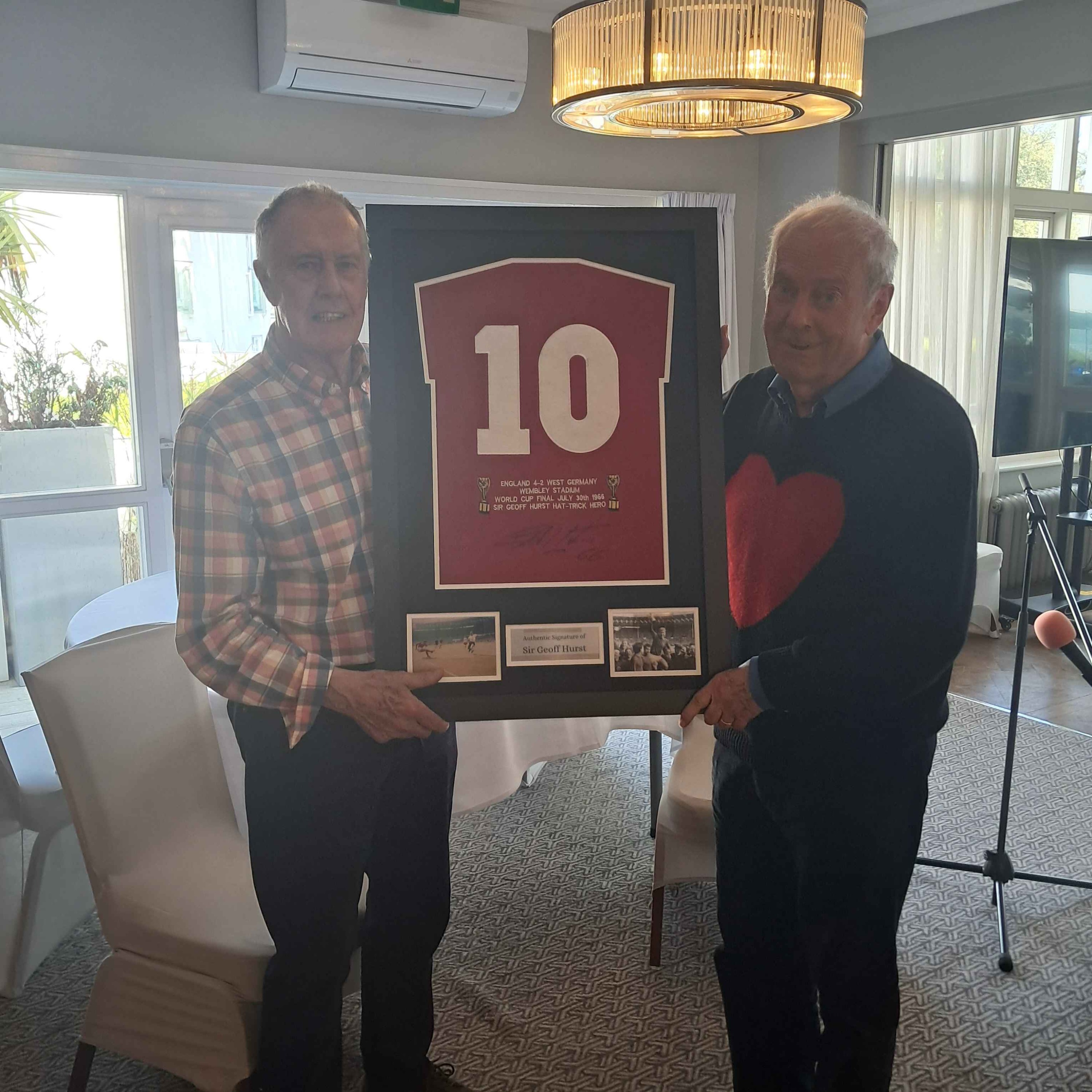
2:24We might come fourth. We could have come first. We might have come first. We might have won the World Cup in 2026, but we didn't. So we can't bring you on Rosebud, a victorious England 2026, but this is Rosebud. We have to bring you something special, and we're going to. We're going to bring you, yes, England, World Cup victors, 1966. I was there, well, I was watching, but also I'm pleased, proud, grateful to say that I'm going to be introducing in a moment to you somebody, the last person left alive actually, who was actually on the field, on the pitch on that day. The 30th of July 1966, the World Cup final, England four, West Germany two.
3:15The hat-trick hero of the day was Geoff Hurst, now Sir Geoff Hurst. He scored three of those goals. I met up with Geoff Hurst at the beautiful Harbour Hotel in Christchurch, and I think you'll find our conversation fascinating and revealing. This may be Geoff Hurst as you haven't heard him before. Hope you enjoy it. Before we begin, just please note that there is a reference to suicide in the course of our conversation. Cue the music.
3:59As the 2026 World Cup moves to its climax, I am in the presence of living history. I'm with somebody who has been a hero since 1966 and who's still with us and still looking pretty good. How, Geoff Hurst, are you feeling? I'm OK. Still standing, which is my normally response. Still standing. And looking good as you stand. Let's make sure I've got the name right. Geoffrey Charles Hurst? Correct. But do you like to be called Geoff on the whole? People often, when you're a knighted, people who approach you and the people you meet for the first time are always a little uncomfortable. How shall I address you, Geoff or Sir Geoff?
4:39My stock line is, you can call me Geoff. Only my children call me Sir Geoff. I will call you Jeff then, Jeff. Born on the 8th of December, 1941. That is correct. Good. What I want to find out from you to begin with is what, Jeff, is your very first memory of your life, the first memory in your head? Interesting question, and I've got a very good answer for that, which I remember as my first memory, was sitting in my father's parents, my grandparents' house, in Denton. Which is where? Near, in Lancashire, near Manchester. And sitting in the room with my grandparents, who were then obviously getting on a bit, and grandmother was sitting down, and grandfather was trying to cook breakfast.
5:31And it seemed like he was getting on a bit then. It doesn't seem like he'd done an awful lot of cooking, a bit like myself, really. And sort of making a bit of a mess of it. And that was my clear memory. in seven sandwiches a row. Not quite successfully making breakfast. Correct. I think it's a nice way of putting it. Yeah. Who was he and who was your grandma? What memories do you have of them? What were they like as people? A lovely, lovely couple. It was my fondest memories of them. Not for one second would I recount the time I spent with them that I would think of anything, but what an absolutely lovely, lovely couple they were.
6:06And your father was called Charles. Yes. And who was he? what was he like what was his job he also played football he um he was brought up in the north he played for oldham roxdale and then we moved south many many years later he then played for bristol rovers and what sort of man was he was he tall like you no he wasn't tall at all um he's joking say he was a center half but not very tall and apparently he used to tell me if he couldn't hit the ball he used to head the back of the tall center forward's head He was a tough, quite a tough individual, my dad. The great memories of him playing foot, watching him play.
6:50And I think he was a sheet metal worker, his work. Because in those days, was he, I mean, he was a professional footballer. Yes. But they weren't paid very much at all, were they? Not at all. Well, we weren't paid much in my time, let alone my father's time. In fact, the reason we moved from the north down to Chelmsford in Essex, and I was about seven within the family, it was partly he had a job in Chelmsford and also could still play part-time football for Chelmsford City. So who was your mother? Evelyn May, brought up in Gloucester, Gloucestershire. Evelyn May Hopkins was her maiden name. Were they well-matched, do you think?
7:29Did they get on together? They appeared to get on very well together in upbringing, but unfortunately, sadly, towards the end, they separated. So they didn't get on that well. But you weren't, when you were a boy, you were not aware of that at all? Not at all. Not at all the circumstances, which is good really, that you're not aware of the circumstances where your parents fall out. How many of you were there in the family? How many children did your mother have? I was the eldest. Yeah. Then my sister's two years younger than me, Diane, she's still around. My brother's four years younger than me.
8:01And sadly he committed suicide probably when he was in his late 20s. Gosh. And do you know the reason for that? Not really. I moved away then. I was at West Ham and away from the family. We used to pop over back once a month. I never really fully understand the circumstances of what happened. Never fully explained to me at all, except I do know what happened. He threw himself under a train at Chelmsford Station. And did you have any inkling of his depression? None whatsoever, none whatsoever. I think although we spent a lot of time together, I think because I moved out to West Ham when I was probably 15, 16, so I've gone then even as a teenager.
8:44But for your parents, I mean, this may be one of the keys to why they separated. Because on this show, Rosebud, we've had stories similar, different but similar, and sometimes a family crisis, like a death in the family, is very difficult for each of the parents to cope with. And that may, given that you tell us that when you were a boy you were not aware. Not aware of any issues between the parents whatsoever in the time I lived there. None whatsoever. So it may well be. I mean, I'm just speculating. Yes, I think we have to speculate that... The tragedy. A tragedy of one of their kids, what happened, possibly could have initiated the beginning of it.
9:24I wouldn't have thought it would, is my own limited knowledge. I think it's just something that sort of happens between a couple who eventually decide that it's a time for them not to be together. That's only a guess. I mean, I don't. I mean, when did, well, you were grown up by the time they separated? Yes, yeah. All right. So, going back to you, a brother who you know well. Does he play football with you? Are you friends, you and your brother? I think, yes, we got on together. He didn't play football much, really. I didn't see a lot of him. I was probably, I'd sort of gone by the time I was 15 or 16, as I said.
10:01So spending those years together, hard for me to assess the reasons why he would have did what he did. I never saw anything in his behaviour or acting, how he was different or unsettled. So that's something that's very difficult to answer. And I assume it affected your mother and father hugely for the rest of their lives. It must have been catastrophic. I'd imagine a child committing suicide. I just can't possibly think how that could have affected my parents. And your sister, who is still with us, happily. Yes. What's her name? Diane. She lives in Chelmsford still. We moved to Chelmsford and she is still there.
10:39Have you got on well with her? Yes, absolutely fine. We're in contact fairly regularly with Diane. Mainly she's got people who want to get an autograph.
10:52Which we joke about. I'm going to be collecting a few before this is over. But I don't want to leave your dad out of this because he was a footballer. and a successful footballer at his level. Yes, he was pretty good. Do you remember watching him? Do you remember watching him somewhere? Yes, I think towards the end, after he finished at Chelmsford, I think he played for a much smaller team in Suffolk and I can't think of the name of the place. But I watched him once and I finished up falling in the bath after the game. Oh, in the team bath? The team bath, yes. Hilarious. That was your first experience?
11:26My first experience. Of being with the lads. Yeah. And when you were watching him, was he a hero to you or was he your dad? I mean, is he... He was my dad. He was your dad. He was my dad. I wouldn't say he was a hero, and I'm not being negative about that. He was simply my father. I remember having a poster of Stanley Matthews, who was a big hero in the 1950s. Absolutely. And he was the great name when I was a little boy. He was. Him and Tom Finney were the big England wingers, the big names. One of my first memories of watching football was watching the Cup Finals, the Matthews Cup Final. Which would be what year?
12:04I would say late 50s, yeah, 53. 53, not late 50s. That was my first really good look at a football match. Not supporting anybody. It was a huge game with Matthews and so on, and Blackpool, and Mortensen was the centre forward. So it was a huge time. What's the greatest game of football you have watched as opposed to being part of? Repeat of the World Cup Final. is the right answer. But for personal satisfaction, sitting there and thinking, this is so good. I wasn't a big football watcher. I was too busy just playing and enjoying my sport. That's cricket and football. And you got into football first, or football in the winter, cricket in the summer?
12:46Simple as that. I wasn't an outstanding young footballer that scouts were looking at, a bit like the great Jimmy Greese. I'm sure every scout in the country was looking at Jimmy when he was leaving school to go do what he did. He was the genius, as described. Nobody was looking at me. And what happened was a friend of my father called Jot Redfern, he unbeknownst to me and my father, he wrote to school leaving age for a trial at West Ham or Arsenal. And West Ham replied first. Arsenal never replied. So my first job interview from leaving school from that letter was a trial at West Ham. When you were 15 years of age?
13:2715 years of age. And they saw something in me and took me on. And what position were you playing then as a little boy? I was at school, I was a centre-half, strangely enough. And in my early days at West Ham, I was a midfield player. So it's quite extraordinary getting to this part of it, that I was playing cricket and football, which is disastrous, really, to try and do the two. Cricket doesn't finish till September. Football start training in mid-July. So I was turning up at, and in 62, 63, I played for Essex cricket, and I won first class game. Yay! Yes. How did you do? How did I do? I'm not sure I'm embarrassed to tell you this.
14:10I got nought, and nought not out. So I come back finishing cricket. Now I'm back in September. I've missed all the pre-season training. Playing in the reserves on a Monday night at Chabble Heath, our training ground. Ron Greenberg came over. said we play Liverpool tonight I said well I understand that I want to try you up front in a new position I said okay so we played Liverpool I've come back September I'm in the reserves I'm not fit I've missed the training I played against Liverpool we won nothing a guy called Tony Scott scored the only goal and from a standing start around this is 63 I played late 62 63 I played 27 games in a new position and score 14 goals.
14:56And then cricket was immediately out the window. And it's probably the least sport I watch now. But in the early days, they were equally important to you. I get that impression. Oh, very much so. Absolutely. They were equally important because I didn't realise, I was never told how difficult it was to combine the two. But prior to my time, you had players like Dennis Compton and Willie Watson who actually played cricket for England and football for England, which is, you know, quite extraordinary. But I found in 62, 63, doing those two was absolute madness. But for some amazing reason, Ron Greenwood saw something in me to try me up front.
15:37And did you see anything in yourself? Were you just a happy-go-lucky lad enjoying his cricket, enjoying his soccer and thinking, well? Yeah, I was really. I think probably one of the reasons he looked at picking me up front is because I was very two-footed. My father did one thing he did when I was six or seven years of age. He taught me to kick with my left foot in our small back garden in Chelmsford. So I was very two-footed. And in the youth team at West Ham, we won a tournament in Amsterdam in the late 50s, under 17s. And we won the final 2-0. And I got both goals, playing from midfield, obviously with both feet.
16:16So here's this boy who leaves school at 15. Up till then, were you a tall academic? Did you remember the subjects you left at school? I wasn't too bad at school. English, maths, science and technical drawing. I think 4-0 levels I got. I wasn't bad. And you had no time for getting into trouble because you're at school all day. And when you're not at school, you're either playing cricket or football. So you're busy. Yes, busy. Playing, certainly in those early days, under 10s, under 11s, in our first house in Chelmsford. We played football in the road, across the streets. We lived in a cul-de-sac, which obviously not as many cars anyway in those days.
16:52And two or three other neighbours played two against two across the road in those early days. That was my teaching in football. Was your dad ambitious for you, do you think, as a footballer? I don't think so, no. I don't think he was that kind of parent that would lean on you or talk about football. I think he was that kind of parent that didn't push you too much or unnecessarily push you. Well, you were a good boy, though, basically. I was a good boy. I was a good boy. I think, by and large, I was fairly disciplined. I wasn't a wild lad anyway. I don't think they necessarily needed to be too disciplined with me or too strict with me.
17:32So here you are, 15, and Ron Greenwood sees you. Why does he see you? Why is he looking for you? I think... Tell people who he is, for those who don't remember. Ron Green was an absolutely brilliant coach years ahead of his time. He was a fantastic coach. And some of the stuff we did under him at West Ham, winning the Cup in 64, we hadn't been at Wembley since it was built 100 years ago. We win the FA Cup in 64, and then we win the Cup Winners' Cup in 65. That was only about the second time a club won a European trophy, predominantly with English players. So they were planning as a really tough German side, not Bayern Munich today, but a team called Munich 1860, winning that 2-0.
18:16So it was incredible. And then the next year, 66, we go to the World Cup and unbelievably, we provide three players, the captain and Bobby Moore and the two goal scorers from West Ham, Martin Peters and myself. Martin, my next-door neighbour for four years, just absolutely stunning. He was an absolutely brilliant coach. I don't think probably discipline wasn't quite as strict in those days. You hear about people drinking and it wasn't a discipline. I think we had one or two players that probably would pop out for a beer on maybe a Friday. I don't think he was – he was more a coach, not a boss in those terms.
18:58But he was – the work we did, the coaching we did, the goals we scored that we'd worked on, I look back, Just unbelievable, the work that he did. You started when you were 15. Did you go away? Did you live away at West Ham? Yes. What did they have? They have a dormant. What was the set up? I lived in Diggs. On your own, age 15? On my own, 15, 16. I mean... Mr and Mrs Foskett, about 200 or 300 yards from West Ham's entrance. Blessed them, and West Ham found them. These are people who regularly took boys in. They took boys in, yes. And you got breakfast from them? Cooked breakfast? Cooked breakfast.
19:34Mrs Foskett provided a cooked breakfast. fried egg maybe fried bread oh I can't remember the fried bread a bit too much I don't think there would have been fried bread yeah so those were the early days and they were clearly you remember them they were lovely people very smashing people at what time did the day begin sort of not you'd be there 9.30ish 10 o 'clock training at Chabwell Heath which is our training ground there and that would be the routine and you took it for granted this is my life now you never never thought oh am I doing the right thing not for one second not for one second that's a bit like my character as my wife who has known me for 60 plus years she says about me when things go a little askew or whatever don't go quite right she said I move on quite quickly and just get on and don't harp on and that's my character I think that was her character in those days I just did what I did not for one second did I think it's the wrong thing or I wasn't enjoying it am I doing the right thing am I not in the first team not for one second Did your parents go to church?
20:36No. So they were just straightforward people. You had a disciplined childhood, but a loving childhood. Yes. And you knew you were on this journey and you thought, yeah, this is fine. In your early days with West Ham, who were your best friends within the club? One or two. Martin, of course. Martin Peters. Martin Peters, he came about a year after me, so I became as close to him. And in the team then was, of course, Bobby Moore, or Moro, as I got to know him. His full name is Robert Frederick Chelsea Moore, just in case people don't know that. That's great. And Chelsea was not named after the club.
21:13I think for some other reason he was called Chelsea. Robert Frederick Chelsea Moore. I knew him, of course, as Moro. Moro was only eight months older than me, but he progressed through the academy and the West Ham team and the national side maybe four-ish years before me. So I looked upon him, although at the same age, as my senior player. Looked at how he acted, behaved, played, trained, and he was a great example to me. I met him a couple of times, and even as an older person, he had a kind of leadership quality about him. Absolutely right. What was there? Why was he, given that you were contemporaries, why was he the person you looked up to and the person who was a natural captain as opposed to you?
21:58These people in life become natural captains or natural leaders. not like politics where people get voted to be a you know the prime minister and so on he automatically automatically amongst a group of people suddenly becomes the thing they think the thing the person they should be the leader and one astounding thing many a few months ago the chap at West Ham produced a lot of calendars over the years from about Moro's time to when he left and a couple of the early calendars has a whole squad in it and the first year which is about the time he started he was in the picture but he wasn't in the main picture he was on on the right or the top or out of it the next year in a team photograph he's right in the middle in the captain's position with the trophy the next year which would be he'd be only 15 or 16 Even then, he was picked as the captain and the leader of a schoolboy team.
22:59That just shows you how he developed, easily developed to be the captain of West Ham. Just a natural leader. There are people in life, and I talk about this, and in business, where a group of people look around at people all around them and think, you know, I think this person, this man, I think should be the leader of our particular organisation. They don't get voted in to be. He was never voted. People never put their hand up and said, Moro should be the captain. Moro, he automatically progressed, even that young photograph as a teenager. He assumed it. He assumed it. A natural leader, not Aintel West Ham, of course, but he wasn't voted to be the captain of the national side.
23:41But he just becomes a natural leader and, of course, then became the captain of the national team. When you're 15, 16, this is a few years before 1966, when you're 15, 16, what is the thing that you remember learning most from Ron Greenwood? What's the single thing he taught you? So much. I think the biggest influence which had in my life career was what we call the near post cross. The cross. In the medieval days, as I joke, the Matthews and Finney area, you'd have a fullback and you'd have a winger, Matthews and Finney. And the objective was the winger, Matthews, to beat the fullback, and then cross the ball.
24:21What we started doing under Ron Greenwood was crossing the ball before we got to the full-back, past the full-back. That's one of the fundamental, and that provided goals, I can talk about the goals later, from the right and the left. And that's not the winger, it could be the right side of midfield, the right full-back, and we worked on that at West Ham for hours and hours and hours, crossing the ball accurately, past the full-back from left and right. Let's talk about your first golden goal for you, the moment, not necessarily one that's famous, but one for you, the satisfaction, when you're still young but you're playing for West Ham.
24:55What's the first goal? Well, I wasn't so much the first goal. I think probably the thing that people tend to forget or overlook that I'm probably the last person to score six in the game. And not many people know that. I didn't know that. In one game? In one game. What was the game? Even Harlan's not called six in a game yet. we played Sunderland in October 68 West Ham 8 Sunderland 0 Hurst 6 hat trick in both halves so that's got to stick out and nobody has done that 6 and as it was happening why not pick one goal why not pick 6 but are you when all this is happening are you as cool then as you are now is this one of the secrets of your success.
25:46Yes, yes. Never got carried away with that. But were you still quite... Yes. At those days, people didn't run around and grab each other, did they? Well, oh, no. I mean, you doing that now, the difference between the game then and the celebrations at the club level, international football, with what we see today is just absolutely bordering on the laughable where not just... If you look at when we scored a goal for England or West Ham, for example, you get one or two players come up and say, well done. And that's it. Well done. Well done, off you go. And we see the celebrations today, which, because I played in the medieval time, I find almost, I can understand people getting excited, but nothing like the celebrations, very little celebrations we had in my time.
26:32But also, I'm getting the flavour that your coolness is part of the secret of your success, because you weren't getting overexcited. I mean, can you remember, well, it's a long time ago, the moment you got to the second half, you done hat trick in the first half. Anyway, you were ahead, you didn't need to get any more, but you went on. Can you remember any of what was happening in your head? Not too excited about it, as I think you're assessing my character, really. Not, I never made much of a fuss of it over the years, you know, even up till today. So little fuss that many people, and when we do the shows and theatres, that a few people, West Ham fans know, but not many other people know, and I have to remind them that I'm the last person to score six in a game.
27:20And then they got carried away and went home and just did what I always did, went home and cleaned my car and cut the grass. I think there should be dancing in the streets of Cheltenham. I may organise people to come and make up for the way they didn't show all those years ago. OK, let me know when you're going to do it, please. Then you'll move elsewhere. You'll be somewhere else for the day.
27:46This is Hannah Berner, the co-host of Giggly Squad. We could all just stay in bed scrolling through other people's vacations forever, but where is the fun in that? The best memories come from stepping outside of your little bubble and being open to the unexpected. And what better way to be open to the unexpected than finally booking that trip to Europe? You guys know I'm a Delta girlie. Every time I go, I get my Delta headphones. and when I fly to Europe, Delta treats me like a queen and they'll treat you too. I was always a little nervous about navigating a foreign country, but then I realized it's so important to grow and see different cultures and to put yourself in different situations and Delta held my hand the whole time.
28:28Being away just helps you put life into perspective and your little worries are not so bad. Travel really is the best way to discover something new about yourself and grow from the experience. Step outside your comfort zone this summer, get some Delta headphones, and fly with Delta Airlines. They truly are the best way to get to Europe, and they just make the whole journey feel so comfortable and seamless. Go book your next chapter right now at delta.com.
28:56Okay, so here you are, and you do, I mean, how long are you at West Ham? About 15 years. They're there in 56, 57 until 72, 15 years. And before you get chosen for the World Cup team, what's your greatest moment? And then the Cup Winners' Cup, back-to-back, is at a time when we'd come from the second division, we'd been in the second division and only got back to the top flight only a few years before. So getting back into the Division I then and then going to win the FA Cup and the Cup Winners' Cup, a European trophy, when you look back, it's absolutely astonishing. And how were you as a team, as a group of human beings?
29:41Because you're very young men, aren't you? I mean, you're boys, really. I mean, you're literally a teenager. A teenager, a kid, really, yes. And how did you get on with one another? Was it easy? Who was the father figure who kept an eye on you all and made sure? I wouldn't think there's a father figure. I just got on with everybody. that was just the way you were brought up you play with the team there's nobody looking after us I think we had a great coach as I said that was just instrumental in the success I achieved but now they have so much pastoral care they have psychiatrists they do yes and psychologists team people are checking their mental well-being yes making sure they're hydrating properly you know and that the friendships you know are proper friendships so there are boundaries that we're in by I mean there was none of that no I'm laughing because when I talk about the medieval days, as I often joke, I look at the past not with any regret how different it was, how the money wasn't as good and so on.
30:38Every single thing I look about the past is just with great amusement. And I often say everything in football has changed, every single thing apart from the goalpost. It's still white, still the same shape and same size. Every single aspect of the game of football at every level has changed unbelievably different. Can you remember the first time a game of yours was reported and you were mentioned, or a television programme, where you were noticed? Not really. I look back at some of the cuttings I've sent, you know, when I finish playing, there's lots of cuttings. Did you keep them or do your parents keep them?
31:17My parents kept them, and I kept them, and then were handed over to me. So I've got quite a bit of paperwork at the home of various games I played in and the results and so on. Do you read them with pleasure or just took it for granted? I'd probably say I read them with amusement, you know, to look back and see the games at that time. It's interesting. Were you ever treated, I mean, I knew for a while quite well, George Best, who was extremely likeable and funny. And a brilliant player. And, of course, a genius player. A genius. But distracted by fame. Very much so. And that, in the end, ruined him as a person.
32:01And I first met him at a party. And it would be at a party. It was at a party. And he actually went off with the girl I was chatting with. Right, there's a shot. Yeah, I introduced them. And by the time the evening was over, he'd copped off with her. But now, maybe he was one of the first people. I think probably, just interrupting, I think the sad thing about Bestie is that because of his indiscerative lifestyle, he virtually finished about 27, which for most players is really about the peak of your football career. And now, as we can see, they can go on to 35. That's going to be pretty good.
32:36Yes, with the medical assistance they get today. So was there any of that for you? None at all. Prior to my time, the thing you would eat before a game would be steak. And then the medical people said that's probably the worst thing you can eat before a game because it's the least digestible. Because they thought it would build you up. The idea was steak will make a man of you. But of course, three hours before the game is probably the worst thing. So that started changing in the early 60s. Then it would be scrambled egg on toast. Your much more digestible foods had started in those early 60s.
33:15And how then do you come to be chosen to be playing for England? When does that happen and how does it happen? Well, I think it happens for two reasons. One is that the club has to be successful. I think when a club is successful, then the manager of England, a manager, the manager. And who was the manager in those days? Lalf Ramsey. Yeah. And then that was the first thing. So he would be looking at West Ham. We won the cup and the cup wins the cup. So we were very noticeable, of course. and I think the second thing is Alf Ramsey's style of play which was basically a 4-4-2 was similar to our West Ham so he picked the same style which was basically a 4-4-2 like he had a dipswich and I think that's part of it as well Did he pick you on paper?
34:07How did you know? You get a letter saying you've been picked I got a letter in late 65 in December saying I've been selected for the game against Germany in February 66. Simple as that. That was it. The letter came through the post. That's it. No forewarning. No. No meeting. No discussion of… No. No. No. And no. And no. What's wrong with it? And was there a contract? Was they tell you you'll be paid this much for the match? No. No. You just did it. We just did it. The money, I'm not sure what the money was. I think it may have been£60, possibly. And how much training was there then? Yeah, there are three days.
34:49You'd probably meet on a Sunday for a game on a Wednesday. So 11 lads, well, 11 men, and 20 in all, a squad of 20, and you don't know you're going to be chosen, but you hope you will be the way Alphamsey works. You think I'm in with a chance. You meet literally on a Sunday to play a game on a Wednesday. This is the first time these 20 people have actually got together to play football. Yes. And you're going to play for your country internationally. Against West Germany. It's bizarre, isn't it? It is, it is, like many things we talk about. I'm laughing again. I know, because these are medieval times, but it was 60 years ago.
35:21And did you assess what the German team was going to be like? Did you do any talking about that? No, not at all, none at all. Again, the gigantic difference you see of managers today and the press today and the talk. So there was none of that particularly. I think the advice I got from Ron Greenwood at that time, being the coach and manager he was, when I got selected, he said congratulations. And then he said something which always stuck with me. He said, when you get involved with England, prepare exactly the same way as you've been doing at West Ham in the last few years. Don't think of it as something different or special.
35:59No, just playing more football. Yeah, just prepare the same way. Sleep, eat, drink, training. And what was Alf Rams' secret? I think one of his big secrets was the discipline. It was again a different time when the discipline was very strict. Difficult of it off the field or on the field? I would say more off the field. I think there were players at that time that I felt, this has gone back a year or two later, that could have been in the squad or possibly the team. And I found out by the senior players that that particular player was a little indisciplined. And indiscipline in the medieval days would be something like maybe turning up late for a breakfast or a lunch or doing something silly.
36:46And I think that the discipline was absolutely unbelievably strict at that time anyway, but also under Ralph Ramsey's leadership. Very, very strict. Speaking of discipline, before we get into the great game, when did girls come into your life? Well, girls? Can we just settle for girl? Well, possibly. It's your story. You tell it the way you want to tell it. But you mentioned girls, though. Yeah. Girl. I knew my wife at school. Oh, my goodness. She thought I was a big head. A big head? Yes. Were you at the same school? Same school. She was in the girls' school at Reigns of Secondary Bond. She was aware of me.
37:27I wasn't aware of her there. But we bumped into each other not long after school. We used to go to a youth centre. And how old were you when you first encountered each other then? We'd be 17, 18. She's a couple years younger than me. One of our early togethernesses was I used to train on a Thursday night in my father's gym, and after the training on Thursday, I used to go to the Odeon Cinema in Chelmsford for a dance evening. And so I was with my wife. We would dance together most evenings. And what's her name? Judith. Judith. Do you remember the first time? Judith Helen. Do you remember the first time you saw Judith Helen?
38:06No. Don't tell her this. I won't tell her, but she'll be listening, because Rosebud's very popular with women of our generation. That was our togetherness. But I think that... Why did you get on so well right from the beginning? It's difficult to say. Relationships are so difficult to state whether they're together or they're not together. Very difficult. We just got on. I think she was slightly irritated when I danced with her all night, but then for a while I didn't take her home. I think she was, so we had a little altercation about that. And then I didn't take her. But then I got on the bus later on, a bit later, not expecting me.
38:50I got on the bus to make sure I took her home. That she was okay. That she was okay, yeah. Yeah, so that's, it's just a gradual thing. You get on together. And how long was it before you got married? So I married in October 64. So it had been two or three years, yeah. Yeah, so you were 22 or 23. Pretty true, yeah. Just a couple of years younger than me. First house we was in 1960, just after we married in Horn Church. Martin Peters was around the corner, my next-door neighbour. Was he your best man? My best man was a guy called Eddie Presland, who also played football at West Ham and cricket for Essex.
39:27He was my best man. And it's been going since then? I think so. I hope she's home when I get home. She's still there. My goodness gracious me. So we're fortunate in many respects health-wise. She's okay. Was she interested in football in the early days? Did she come and watch you? Oh, she came and watched, yeah. In the early days, I'm not sure necessarily interested, but naturally she supports me in everything I do and has come. She has a brilliant memory. You should interview her. If she were here, I would ask her, why did you call him a big head? What did she think about you made you a big head?
40:08I never asked her why she called me Big Ed. I don't think I was, I don't really think I was a Big Ed at school. I'm surprised that she called me Big Ed. I don't think necessarily my behaviour was outlandish at under-11s particularly or under-15s. And is she cool like you so that when you were chosen to play for England for the first time against Germany, she took it in her, you were married by then, she took it in her stride as well? Super cool, yeah. Not carried away at all. Again, in the medieval times, the wives were much more private. They're not so prominent than them on social media or kids we see today.
40:48Very much, she's the private face of the family. I mean, it's amazing. People don't know this, but our wives were not invited to the celebration of winning the World Cup. Oh. So, no wags in those days. There were no wags in those days. No, I'm sure. It never, no, none at all. Our wives sat in a room downstairs in the hotel while the celebrations went on at the top of the hotel, the Royal Garden Hotel. But it worked in its own way, didn't it? It certainly worked. It certainly worked. So, here we are, 1966. Just take us through the moments that got you to the final. What were the highs, what were the lows of the run-up to it, to getting to the final?
41:30Well, the big thing for me, of course, as many people know, I didn't start a tournament. There were no subs in our day. and in the four friendly games in Scandinavia and Poland, Roger got a couple of goals. Roger. Roger Hunt. Yeah. Got a couple of goals in those four games. Jimmy Greaves, the great Jimmy, got four against Norway, funnily enough. I didn't score a goal. So Al Fragge started off, what I was jokingly said, those two very average players, Jimmy Greaves and Roger Hunt, two greats from two great clubs. And he just told you this, that that's who he was choosing, and there was no arguing about it.
42:06You just accepted it. You sat there quietly. Simple as that. And did you call him Mr. Ramsey? Or was he by then Sir Alf? No, it wasn't Sir Alf then. Mr. Ramsey. Or possibly if we got away with it, maybe call him Alf. Or perhaps nothing at all. Just said yes. Just said yes, sir. Yes, sir. So I didn't start the tournament. And then three games in, the great Jimmy Greese, damaged his shin. A lot of people know this. Against France, funnily enough. So somewhat fortuitously, I made my debut in the World Cup against those kind, lovable, friendly players from Argentina at the quarterfinal stage. And we win 1-0.
42:44And the goal we scored, I've talked about the practice we did at West Ham, the goal we scored to win the game was honed on the training ground at West Ham. Martin Peters, my colleague, crossed a great ball with his left foot. He was predominantly right-footed. He wasn't two-footed. but he crossed the ball with his left foot and a cross has to be very accurate for a centre-forward scorer anywhere other than that you're not going to score it. Brilliant cross enabling me to glancing ahead or across the goalkeeper to score the goal and win the game. But I must tell you one thing at the start of the tournament when I didn't start the tournament Roger and Jimmy played I sat on the bench and I wasn't disappointed or felt left out or whatever term you want to use and I just I was actually happy to be there I was happy and thrilled to be part of an England World Cup squad that's hosting the World Cup in their own country that's how I felt so importantly when your time comes I was ready to participate and this is human nature you see people in business and in life where things go against them and then when their chance comes they're not ready mentally or physically not just in sport in any walk of life and I think that's I was just ready to take my opportunity because that's how I felt not being picked to start with.
44:04I was happy to be there and these 22 great players. So here we are with the quarterfinal. You scored against Argentina. That night when you get into bed, it's still going round and round in your head, that moment, is it? Or are you so calm and cool that you just get into bed and go to sleep? I'd probably just go to bed and go to sleep. Yeah. When you look back, it's fantastic. The goal we scored and beat a really tough... And who were the stars of Argentina in those days? Aratim was their chief star who didn't last the whole game. It was a very... Any game against Argentina, they were a very good side, a terrific side and a very tough side.
44:42That was, many of our players would say, one of the hardest games they played in. And the semi-final, how did that go? Semi-final against a very good Portuguese side and the great Eusebio was their main man as opposed to what the Argentina game was like. tough and rough the game against Portugal was against two teams who just wanted to play football and that was a very good Portuguese side I say with Eusebio was their main man an unbelievable player I've got a picture at home of Eusebio kissing my wife in my second bedroom we met somewhere years later and there's me there and he's kissing my wife on the cheek but anyway so we win Bobby Charlton gets two I contribute the game I make the second of his goals you know in Bobby Charlton you've got one of the greatest players that's ever played for England to remind people 106 odd caps for England 49 goals Man United and a nice guy and a nice guy my wife got to know him when we played golf many years later with the wives as well turning up and my wife as women are good at summing up the people they know lying about Bobby Charlton was he wouldn't put a foot wrong on the field and he didn't put a foot wrong off the field.
45:59That's how she described Bobby Charlton. So we get to the 30th of July, 1966, the great day. And are there special preparations? Do we have a special breakfast? A little bit extra scrambled eggs? No, no, no, no, no, no, no, no, no special, no special, same routine. Really? Exactly the same, exactly the same. Team talk first? A small team talk. There wasn't, again, the difference here, there weren't major team talks. A lot of it was, I think Alf Ramsey picked players who their position, the way they played was fitted into his team plan. He didn't need to tell me how I should play, things I should do, because he's picked me on the basis that the way I played at West Ham would fit in to the way the team played.
46:42The thing I remember about Alf Ramsey saying, more than anything, in the final when the Germans equalised, were off the pitch, waiting for Alf to come and talk to us about the last 30 minutes. A couple of players were sat down on the grass and the first thing Alf said when he came over to those lads, get up, get up, don't let the Germans see a tie, get up. And he simply said, as we went back onto the pitch, he said, the thing I remember more than anything, as we all do, he said, you beat the Germans once, go and beat them again. And that was it. That was the team talk. Simple as that. And I think it's very interesting.
47:18I come from a theatre background, film background. I've met many film directors and stage directors who say it's all in the casting. If you cast the right people, if you're confident you've got the right cast, let them get on with it. Exactly. You've chosen the right people in the right positions. Just let them get on with it. That is exactly summing up clearly. Yeah. Absolutely. You pick the right players to start with. You get the players out over the two or three years that we're not going to fit in behaviour-wise or any kind of football-wise. and he was left with, after three years, a bunch, not only of great players, I mentioned, but a bunch of top, hard-nosed professional players.
47:56And one of the things Alf Ramsey said when he picked players, when you sort of talked to him about this player or that player, he used the same phrase. He would also say, he will not let me down. And I think that was the quality of the side.
48:21This is Hannah Burner, the co-host of Giggly Squad. We could all just stay in bed scrolling through other people's vacations forever, but where is the fun in that? The best memories come from stepping outside of your little bubble and being open to the unexpected. And what better way to be open to the unexpected than finally booking that trip to Europe? You guys know I'm a Delta girly. Every time I go, I get my Delta headphones. and when I fly to Europe, Delta treats me like a queen and they'll treat you too. I was always a little nervous about navigating a foreign country but then I realized it's so important to grow and see different cultures and to put yourself in different situations and Delta held my hand the whole time.
49:03Being away just helps you put life into perspective and your little worries are not so bad. Travel really is the best way to discover something new about yourself and grow from the experience. Step outside your comfort zone this summer, get some Delta headphones and fly with Delta Airlines. They truly are the best way to get to Europe and they just make the whole journey feel so comfortable and seamless. Go book your next chapter right now at delta.com.
49:31Of that day for you, what are the moments of that game? I mean, running onto the pitch, is the roar incredible or you just don't even notice it? The roar was incredible. The story was in the old Wembley, you came out of the dressing room opposite the Germans. So the dressing rooms are five yards apart. They come out one side. We're now walking up the tunnel onto the pitch. The Germans on left, we're on the right. And as we get to the position where we're almost on the pitch, the crowd on the other corner could see us coming out of the tunnel and started to go nuts. And my feeling, my feeling, strong feeling, I remember today, it felt then that having heard that small roar coming in, it felt that the whole country was up there, not just that section of fans that saw us coming on the field.
50:22Strong memories of that day. How long did the game last in terms of minutes? A couple of hours. A couple of hours. It was an hour and a half normal and a half hour at a time, yeah. And during those two hours, what was the worst moment for you personally? Well, I think the worst moment is, well, two worst moments. One is German scoring first after about 12 minutes and then equalising, you know, at the end of a normal time. That's always a blow through arguably a foul that Jack Charlton said it wasn't a foul, which I probably agree with him, where they had the free key and then scored the goal. So the worst moment is when you think the game is nearly finished in any game and all of a sudden somebody pops up, as we've seen in the current World Cup.
51:00And with you, your hat trick again, another hat trick. When that began happening, I mean, what's the sensation going through you? You can't have been cool that day if you were. I mean, honestly. You don't, honestly, you might find it strange me answering these questions like this. But at the time, the most important aspect, and that's the same today, the most important aspect of that day was the team winning. My hat trick would have counted for absolutely nothing. had England got beat. I would not be sitting here talking to you had we lost. If you'd lost, you would not be sitting here talking to me.
51:38Absolutely. Categorically. Frankly, you'd have been cancelled. No, you wouldn't. So I think that's the most. The hat-trick, I wasn't aware at the time whether the hat-trick hadn't been scored, how big it was. Again, you just take things in your stride. And as the years have gone on, of course, it's quite amazing that we're sitting here 60 years on and England have not won a World Cup as a major country. That is very, very disappointing. Very disappointing. What is your abiding memory of the day, the overall recollection? I mean, when you go up at the end, you shake hands with the Queen and all that?
52:16So the two memorable things are, one, when the whistle is blown. And at that moment, as the ball went in, I wasn't sure whether the goal had counted because the referee was blown. But we realised not long after that goal did count. The first reaction is one of just relief, if you like, or sagging. You've been through a tough game against a great German side. There's one that you got through it as your first feeling. And the celebrations, you run around the pitch and that stuff, but you're just still sagging because of the tough game you're in. The second, you talked about meeting the Queen. my other recollection, things you stupidly remember, Bobby Moore was not only a great player, he was known as being very immaculate in his opponents, teammates, how he dressed, behaved on and off the field, immaculate, even from school, people remember him, somebody bumped into me a few months ago, who had been at school with Morrow, and she said about him then, at school, as immaculate, so we go to meet the Queen, he's up for arms, I'm second in line as you've seen the film, and he sees the Queen is wearing white gloves.
53:29So not to make sure he dirties the white gloves of the Queen, he then wipes his hands just in case there's any mud on them, on the rough, the cloth parapet, whatever that was, to make sure his hands were not dirty before he meets the Queen and shakes hands with her. The immaculate body, Ma. Who does that? That's astounding. The thing I said about somebody who went to school and saw him as immaculate as a schoolboy. Is there an unsung hero from that day? Somebody you feel actually hasn't been recognised as they should have been? No, I wouldn't have thought so. I think it was a team... I wouldn't think for one second everybody...
54:11Maybe from outside people, maybe from the media, maybe from people who didn't watch much of the game. Certainly from my angle, every single player on that field on the day were fantastic. And did you keep in touch with most of them? Yes, we played golf. I touched on, we played golf. We touched with a lot of them and the wives for many years after. Jack Charlton started us playing golf every year. So we played golf. The wives came along and went shopping. So the wives got to know the players, like the Bobby Charlton story. And that togetherness was so strong, it lasted for many, many years. It wasn't just the football togetherness and we all went in a separate ways.
54:48We were together annually, I'm guessing, for about 10 years afterwards. And then you went to many funerals, I imagine, over the years. Yes, one or two, sadly. Is it true, I mean, people of that generation, many of them through doing heading, research has been done to show that actually they had brain damage as a result? There is some research. There was a guy in Scotland, I think, I'm not sure his name, Willie Stewart, I think, who's done some research and would say that players who had head head ball were three and a half times more likely to suffer with dementia. But that is certainly not the whole issue.
55:22because as we know, there are many people who suffer with dementia, men and women, who have not been anywhere near football. And I do some work for Alzheimer's, and one of their straplines is that they're saying now that people are born today, one in three are likely to get dementia, which you look at that stat, that is astounding. And that's certainly not one in three people born today can be heading a football. We can't cover the rest of your career, and actually coming up to 1966, in the view of many people, nothing has happened since 1966. Well, it has in terms of winning it. Yes. But your life went on.
55:56You went on playing football and then you went into business. Yes. And now people want to hear more about you. There are these fantastic shows. I am booking for one by going to aonesportingspeakers.com or jeffhurst.com. At the end of the podcast, we'll give more details of that because this autumn, you're going to be in theatres and people can hear more of this and they can ask you questions. They probably won't be asking you questions about your family life, which has been, you've had a good life. You're a mellow person. I've only met you a couple of times, but you're a mellow person. You'd describe me as mellow, would you?
56:32I would. What does mellow seem like? You're an easy person. You're easy with yourself, I think. Am I right? You are easy with yourself. I don't know how I am with myself. Maybe I'm easy. It's how you see me. You're consistent. It's how a person sees you as opposed to how you feel about yourself. Is there a dark side to you? Are you difficult to tell? No. Are you difficult to live with? No. Don't ask my wife that. She stayed for more than 60 years. She's put up with me. She's the matriarch. She's the boss of the kids and the grandchildren. She's the matriarch. And you had three children and you lost one when she was, was it a girl, your daughter you lost?
57:11The eldest daughter, Claire. You had three daughters? Yes. The eldest daughter passed away with a brain tumour in 2010. Gosh, when she was only, I think, 45. 45. And that's with you in your head every day, I suppose, is it? It's there. Oh, yes. You never, ever, ever get over that ever. Ever. And you just have to go on. Is that it? It is, yeah. To endure is everything. You just have to get on. You'll always go back and talk about it. We've got a picture right in front as you walk in the door, so we see her there every day. What was her name? Claire. Yeah. Plus. And were your daughters into football at all?
57:49We're not a celebrity family. The answer is no. People don't. People look at the WAGs and the things today of the players and their wives and the kids that are all around. We are. We are. We were. And my wife, we are not a celebrity family. But I wish you were. Only because I think it would be a fascinating role model as a family if there were more celebrity families like yours. It might be a better world. We're coming to the end now. That's very good. Always three quick questions. And this has got to be what first comes into your head. And I know you find this a challenge. I'm firmly challenged before you even start.
58:23Because you're not Mr Memory, but your wife is not here. So we can't ask her. I want from your life a moment of joy. A specific moment. When you think, oh yeah. It can be on the cricket field, the football pitch, the World Cup. A moment of joy or with your children? Family is the most important thing. We talked about sport. Family is by far more the most important thing. You say that. That's an easy thing to say. Do you mean that? How has that happened in your life? I mean that because the most important thing of everything is, the big question is meeting my wife with her alongside me for 60-odd years and how she deals with everything.
59:11She is absolutely unbelievable. with the kids and family is by far the most important aspect of our lives. Whatever you've done in your business, your family, your kids and your grandchildren and your wife are by far the most important thing. When you got your knighthood, 1998, were your parents still around? No. Gosh, they didn't see the moment. Were they there in 66 though? Yes. Did they come to watch the game? Yes. They were there? Yes. And my wife's father, Jack, was also there. And were they overwhelmed or was it then the coolest family in Britain? I've no idea. We're not a celebrity family.
59:52We just take this in our stride. Probably. I can't, when we got back there a day or two later, I don't think they were going nuts. But it's the time, isn't it? You know, if that happened today, if a player went back to see his parents, who were either at the game or not, the parents were going absolutely bananas because you see every day, every game now, the reactions when somebody scores a goal in the stands, the family, and the players themselves come off the pitch. It is absolutely nothing short of nuts. But it wasn't that kind of attitude in the time we played. And a moment of sadness. Well, sadness is the obvious thing.
1:00:34It's a brother, what happened to a brother, and my eldest daughter Claire, you know, with the brain tumour, seeing her go through that for quite a number of years and how difficult that was, how absolutely heartbreaking it was to see your daughter, which is absolutely a beautiful girl, smashing personality, very sad. Yeah. Life is unfair or just life is life. Life is life, yes. It's good, bad and up and down. And mostly good for you. I mean, you look back with, apart from those two tragedies, your life has been good. Oh, fantastic. You know, my wife and I are still around, which, you know, is remarkable, really, 60-odd years together.
1:01:20And we had some terrible times with my oldest daughter passing and so on. But we're very fortunate. The good side is we've got five grandchildren and between 35 and nine years of age and two boys, three girls, and they are absolutely fantastic. Would you like to be playing football now? Yes, I would, because it would mean I'd be 24 years of age.
1:01:48Do you think you could make it work still? Easily. Easily today. In today's easy world, yes, easily. I'd probably score seven in the game if I was playing today. I believe you. I believe everything about you. Last question, what, Sir Geoff Hurst, my kind of hero, what has life taught you? I think, I guess, the first thing that comes to mind is behaviour. Behaviour with everybody. You meet your family and people in the street, you know. And I get a great tutor because when I go out to functions or go outside the house and I'm likely to bump into people, my wife leaves me with this message. be nice well thank you for being so nice to us on Rosebud today Sir Geoff Hurst, my kind of hero thank you thank you, pleasure
1:02:43what a very interesting and nice man Geoff Hurst is I really enjoyed my conversation there at the Harbour Hotel in Christchurch with Sir Geoff who very generously gave me two of his signed England shirts, which I am going to be handing on on his behalf to Fields in Trust, which is a marvellous charity that he has supported over many years, particularly when it was called the National Playing Fields Association. That's where he and I first met years ago. And it's a charity that protects playing fields, sports facilities for children, for young people, for people with disabilities all over the United Kingdom.
1:03:25So it's a good cause. And thank you, Sir Jeff, for donating these two shirts to it and for supporting people who are raising money, for making sure that there are places for young people to play football taking us into the future. If you enjoyed listening to Sir Jeff, you might want to go and catch one of his theatre shows. He's got a tour coming up this autumn. Tickets for that you can get from a1sportingspeakers.com. That's a1sportingspeakers.com. or I think simply by going to jeffhurst.com. That's how I got out of him, jeffhurst.com. And you can see one of his shows. Mixed feelings this weekend about football, as far as I'm concerned.
1:04:08I can't decide whether to watch or not. And of course, on Sunday night, will I be supporting Spain rather than Argentina? Or should I be rising above it all? Maybe. Do you know what I think I'm going to do on Sunday night? I'm going to re-watch 1966. Actually, that's what I'm going to do. it'll be in black and white but I'll love it and I'm also going to watch the bit at the end where the great Bobby Moore wipes his hands clean before shaking hands with the queen yeah that's my Sunday evening treat I don't really mind who wins or loses now have we had any emails oh yes we have had some emails I'll share one with you before we go um good morning Giles and Harriet this is clearly somebody who listens to us in the morning you can listen to us any time you like.
1:04:55A lot of people listen while driving, I'm told, or while walking the dogs. Some, somebody said to me, oh, I love listening to your podcast. I'm mostly asleep, but I do love it. This person says, it's Claire. Her name is Claire Tyres, and she writes, good morning, Giles and Harriet. Harriet is the producer of Rosebud. I'm just listening to you suggesting that the day of the postcard is over, and thought I'd share that I send a weekly postcard to my 90-year-old mum every week. This habit started as a daily postcard during COVID when she was living alone and I couldn't drive to visit her because of the restrictions.
1:05:34She has saved every single one of them. At some point after the COVID restrictions were lifted, we decided to change to weekly postcards. My mother still enjoys receiving them and I enjoy the focus needed to write them. Mindfulness. Long live the postcard. thank you for the hours of enjoyment you give both in the podcast and your touring shows see you in Edinburgh, the tickets are booked, Claire Tyres well several things to say there, thank you Claire for keeping the postcard alive our very best wishes to your mum, thank you so much for booking for Edinburgh I'm excited to tell you our show which is called Charles Brandreth Up Memory Lane with a twist of Rosebud and Harriet Jane is on at the Gordon Eggman Theatre from the 5th of August for the whole month of August every day at 4pm.
1:06:28You can get tickets by going to the Edinburgh Fringe website at Ed Fringe or something like that the Edinburgh Fringe website or going to Assembly Edinburgh because we're at Assembly George Square or simply going to my website gilesbrandreth.net or going to the Rosebud website, rosebudpodcast.co.uk. Book now, be sure to see us. And after every performance, particular Rosebud fans can come and say hello because there's going to be a meet and greet hosted by my wife, Michelle, after every show. We'll be around for half an hour or so. So you can say hello to Harriet and me. We're looking forward to that.
1:07:07Also, we're looking forward to getting postcards because we've issued a postcard challenge. And if you have got a postcard that you'd like to send to us, we'd love to receive it. It can simply be a postcard from Morecambe or the Mumbles or wherever you happen to be, Broadstairs or Bridlington, saying, wish you were here. You know, love whoever you are. Send it to me, Giles, or to Harriet, or to both of us, or to Rosebud at Grosvenor House, Park Lane, London, W1K7TN. and we're going to pick what we think is the either most attractive postcard or the funniest postcard, particularly if you can find some of those rude seaside postcards that are now so politically incorrect that we really will be embarrassed to receive them.
1:07:53Well, I'll chuckle and Harriet will reprimand me, smack me over the knuckles. She doesn't do that, actually. It's just one of my fantasies. This bit will be cut. On we go.
1:08:07Oh, really? She's saying she won't cut it. That's funny. We're in the same room recording this. It's too ridiculous. She keeps also having to get up to adjust the microphone because she says, you may boast that you've been broadcasting since 1966. You have no microphone technique of any kind, Giles. You keep moving about on your chair. You're wobbling to and fro, for goodness sake. So she has to come over and adjust the microphone for me. Well, that's the way it is. But if you've enjoyed today, I hope you have. If you'd like to watch it on YouTube, you can. For YouTube, it's edited by Michelle's godson, Alec Cadell.
1:08:44But Roosevelt, of course, is produced by Harriet Jane. Indeed, it's a plain Jane media production. I'm Giles Brandreth. Until next time, thanks for being with us. And well scored, Sir Geoff. Wow, my kind of hero. Cue the music.
1:09:02Thank you.
1:09:48This is Hannah Burner, the co-host of Giggly Squad. We could all just stay in bed scrolling through other people's vacations forever, but where is the fun in that? The best memories come from stepping outside of your little bubble and being open to the unexpected. And what better way to be open to the unexpected than finally booking that trip to Europe? You guys know I'm a Delta girly. Every time I go, I get my Delta headphones. And when I fly to Europe, Delta treats me like a queen and they'll treat you too. I was always a little nervous about navigating a foreign country, but then I realized it's so important to grow and see different cultures and to put yourself in different situations.
1:10:27and Delta held my hand the whole time. Being away just helps you put life into perspective and your little worries are not so bad. Travel really is the best way to discover something new about yourself and grow from the experience. Step outside your comfort zone this summer, get some Delta headphones and fly with Delta Airlines. They truly are the best way to get to Europe and they just make the whole journey feel so comfortable and seamless. Go book your next chapter right now at delta.com.
We can't bring you an England World Cup Final in 2026 - much to our regret - but we CAN bring you a trip down memory lane with the greatest goal-scorer of our victory 60 years ago in 1966: because our guest today is Sir Geoff Hurst. In this conversation, Sir Geoff tells Gyles about his childhood, when football and cricket competed for his affections, and his footballing father encouraged his love of the game. He talks about his apprenticeship at West Ham under Ron Greenwood, who spotted his attacking ability and encouraged him to play as a centre-forward. He talks about meeting and playing alongside Bobby Moore as a teenager, and looking up to the natural leadership of the future England captain. He talks about being selected to play for England - by letter - and the culture in the team. He talks about meeting and marrying his wife, and the loss of their daughter, Claire, who died of a brain tumour at only 45.
This is an unusually revealing conversation with one of the greats of the game and a fascinating reflection on the changing nature of football over the past 60 years.
Sir Geoff Hurst is touring the UK with his "Last Man Standing" theatre show this autumn. Tickets are available here.
Hosted on Acast. See acast.com/privacy for more information.


