
 Ask ChatGPT



Host: Gyles Brandreth
Sir Grayson Perry
(not specified in the transcript)
In this episode, Gyles Brandreth interviews the renowned artist, presenter, and thinker, Sir Grayson Perry. The conversation delves into Perry's unique life experiences, his childhood memories, and his journey as an artist and public figure. Reflecting on themes of creativity, identity, and emotional resilience, this episode is both insightful and engaging.
Written by AI. May contain mistakes.

Get the gist, explore an idea or ask about something said.
 Claude
On Rosebud with Gyles Brandreth, what are the key points of this episode?
Searching your listeningAutomatic transcript. May contain errors.
0:00This is Rosebud, brought to you from Grosvenor House in London's Park Lane. Wherever you are in the world, I hope you enjoy this special episode of what's become a multi-million-million-million-million-million-million-million-million.
0:40Hello and welcome to Rosebud. This is the podcast where we explore the first and the early memories of some very interesting people. My name is Giles Brandreth and today my guest is certainly very interesting indeed. I think I can fairly describe him as unique. I certainly don't know anybody else quite like him. Unique and fascinating. He is an artist. He is a potter. He is more than both of those things. He's a formidable figure. He is the great Sir Grayson Perry. Born in 1960, in fact, in this very week in 1960, so happy 65th birthday, Grayson. He grew up in Chelmsford, But home life for him was turbulent and often unhappy.
1:27Grayson's father left when Grayson was about four and his stepfather was violent and unpredictable. I'm going to let Grayson tell you all about that. Grayson then retreated into a fantasy world of which dressing up as a girl was an elaborate part. I'm certainly going to let Grayson tell you more about that. So the fact that Grayson is now an establishment figure, a Turner Prize-winning artist, and indeed a knight of the realm, certainly the only person I know to have sat down to dinner with King Charles III wearing a frock. It wasn't the king wearing the frock, it was Grayson wearing the frock.
2:04He is genuinely remarkable, and I'm going to let him tell you all about that too. This is going to be fun, a little bit unpredictable, quite moving at times, but certainly worth listening to. This is Rosebud with Grayson Perry. Cue the music. Oh, by the way, I should have mentioned, he's going to be on tour later this year, and I think the tour is something I am definitely going to be catching up with. So if you enjoy this, you can go and see him live and in person, and certainly in colour. As I was saying, cue the music.
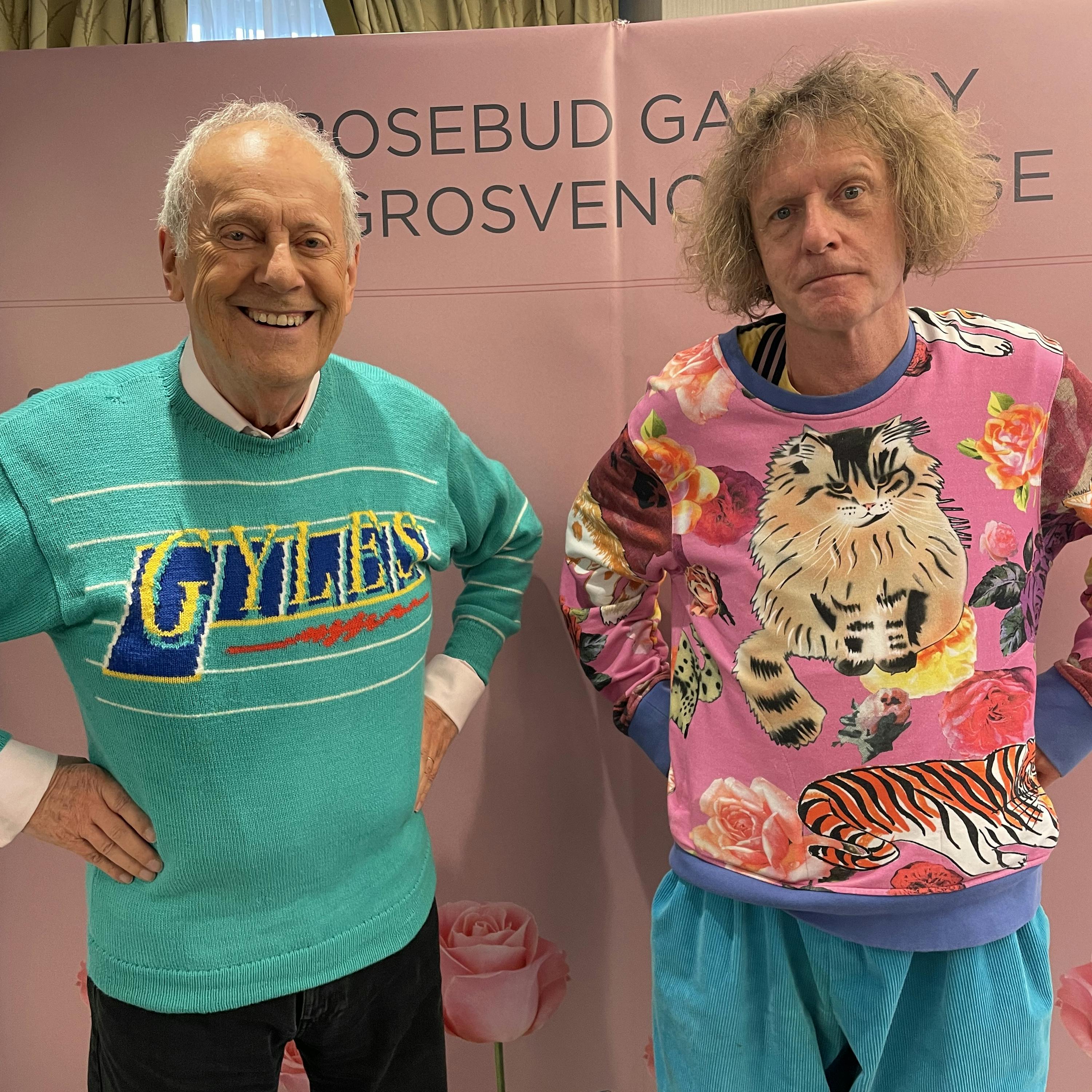
2:53Grayson, before we begin, you're looking so wonderful. Describe to our listeners your outfit, starting at your feet. These are some shoes I designed. They're kind of pink paint and sort of booties with orange ribbon laces and yellow sort of details. You had these made for you? Yes, I designed them, yeah. Is that very expensive? With the wonderful Natasha. Your own shoes made for you? No more expensive than the shoes just round the corner from this hotel, I'm sure. Fine. Okay. They look fantastic. Yes, they're one of my favourites. They're kind of like giant children's booties. Little grey socks?
3:27Warm socks, because I came on my bicycle. Very good. And I've got, again, I designed these corduroy, very baggy, bright blue corduroy trousers, and my friend Natalie, Nat the Cat, as she's known, designed the sweatshirt I've got on with lovely cats and roses on it. And amusing hair? Amusing, like, yeah, just got out of bed sort of hair, really. you're too young to remember somebody called Coco the clown
3:57do you know that you had you know the clown it inters when I get the students to design me outfits that's one of the kind of themes that I give them is that I do like a clown because that's part of the kind of anti-style I mean I was it was I was phrasing it in my mind this morning I really hate people who think being dull is sophisticated you know this kind of muted tastefulness that spreads over the super rich like a kind of creamy butter and i really hate that you know that kind of sheeny anonymity like you saw it in succession they pinned it very well but it's it's very pervasive and so you see whole streets of people in black puffer jackets black trousers black trainers thinking they're sophisticated and they're not they're just dull and they've given up their responsibility to make the world more interesting well yours your costume is playful isn't it your playfulness is very it's one of my big campaigns is that humor and playfulness you know is downgraded culturally you know the comedy never wins the oscar and so i'm very much for i'm against chromophobia and i'm against people who think it's sophisticated to be tasteful and restrained.
5:12Restraint is one of the great strangling forces on culture. There's nothing restrained about you because you wore a jacket when you arrived, which you've now slipped off, which was made of what? Pink latex, day-glow pink latex. Kind of acceptable street fetishism, I would call it. Very good. What is a fetish in a nutshell? A fetish is the kind of erotic fixation with something, you know, and it can be all sorts of things. I mean, you know, you could have a fetish for rubber, but you could also have a fetish for certain situations, you know, mental asylums or, you know, being dominated, feet, you know, these are all the common ones.
5:49But everybody has a fetish, you know, and some are more acceptable than others. I mean, you could have a preference for big breasts or muscly men. These are fetishes, you know. In a way, I've got a bit of a thing about chocolate mousse, and I sense there is almost an erotic charge. Oh, God. Well, they call them sploshers. Oh, they call sploshers, are they? Sploshers, yeah, people who like to get covered in mucky food. Yeah, no, they have parties. They all get covered in food, and they get turned on by that, and then they have an orgy all writhing around in the blancmange. I've learned... And jumpers, Giles, come on.
6:20There's a huge jumper fetish scene. Mohair, particularly, is massive. Just go on the internet. Google mohair fetish. See what comes up. I don't want to get arrested. You won't. Good. I will definitely do that. I've already learned so much from you, because I remember... I remember telling you, maybe when we last met, how I was writing a play about Lewis Carroll and Alice in Wonderland and how I'd also appeared in a show dressed as Dorothy from The Wizard of Oz. And you said you must try the Alice in Wonderland look because it is the crack cocaine of cross-dressing. Yeah, that little girl and the pinafore and everything, you know they are signifiers of something that is really ingrained into culture um and there's a whole kind of what you would call sort of sissy side to fetishism and cross-dressing which loves that look and we'll come on to that and you can explain to me why i love that look a little later let's begin though as we always have to begin with rosebud by asking you grayson what is your very first memory that's a difficult one to pin down and i'm interested in the nature of memory have you ever heard of that expression beating the bounds yes and what they used to do they used to march people around the parish border and young people who would carry on the knowledge in the medieval times when they didn't have maps and they would hit them when they came to a landmark so that they had a physical memory of that place so when they were walking the when they got to the boundary yeah that's exactly literally what they did they beat the young people at the boundary to show them where it was so they would have a bodily memory of that geographical location it was emotionally ingrained into them in a bodily way i suppose my first memory is it has a similar kind of resonance in that i remember my mother answering the door to the milkman and it blowing open in the very windy day and smacking me over quite violently the door as it swung open because of the wind which was a very kind of ominous moment i have to say uh considering later events oh we'll come to later events but first tell me who was this mother of yours and where were you when this happened my mother was quite a character i think i've inherited many of her traits she's very funny she was very open and emotionally intelligent and had a very good sharp intuition she was also but the trouble was i think she was thwarted she was very intelligent she never had anywhere for her intelligence really to go and so she tended to use it to be mean so she was world-class at being mean gosh quite tough to have to live with that yeah she could really kind of pin somebody and she knew just how to sort of get their backs up what was the source of that in her why was she like that do you think she was the ninth of nine children and i think she probably didn't get enough attention my wife sort of diagnosed her sort of casually as she doesn't like to do this but she said oh yeah she's a hysterical narcissist so she everything was a drama and everything was about her so she she read any situation as being about her somehow trying to get at her is she still alive no um when was she born roughly um i'd say mid-30s 36 oh not that not that long ago just before the second world war yeah and what kind of background was hers in terms of what was her very working class uh family came out from the east end to chumpsford grandfather had literally been a cockles and muscles seller alive alive oh i mean being the ninth child she was neglected she had to say i'm here look at me think about me Yeah, I think so.
10:09I think that was, because her aunties were lovely. Yeah, but my mother, she was trouble. And how does she meet your father? I'm not sure. I think somewhere like a youth club, I think, when she would have been about, I mean, quite young. I think they married when she was 21, I think. My father was a sort of, he'd just come out of the RAF. He would have been in conscription. And then he would have been a toolmaker at Marconi's, which was the major industry then in in chumpsford so he was a very skilled craftsperson he could make anything you know he could build a brick wall grow vegetables refurbish the radio set replumb the house you know build a chair strip a car engine and can you remember what they were like together in the early days when you were a little boy well they split up about the time i was four so i'm not really sure i think the trouble was is that my mother didn't find him glamorous or exciting enough i think they got married because in those days you did you did get married so she was 21 she liked him he proposed they got married yeah i think so were you the firstborn yes and the only one no i've got a sister from the same marriage so the pair of you and then they break up almost before you can remember anything yes what happened and why uh my mother had an affair with the milkman the said milkman that um was at the door when it blew open and knocked me down ah and uh he was a kind of i suppose he was a more glamorous figure you know he was he had basically he he started an affair with my mother got her pregnant fairly soon after he had three women pregnant at the same time gosh uh he drove an e-type jag my god and he was a milkman and he didn't just deliver the milk it's clear and he was like a kind of like my mother had a sort of bit of a thing for tom jones and he had that kind of dark swarthy kind of look you know yeah he wasn't good news necessarily so your father leaves because she's having this affair yeah do you remember any of the rows or any i mean this is you looking back on it i can remember The thing I remember was, and I think this is a real mistake they made, they never really said they were getting divorced.
12:31My father just sort of disappeared from the scene. I think they even said something like, oh, he's going on holiday. And that cowardice that my dad particularly had that cowardice. I'm really afraid of emotional confrontation. And one of the big problems of my father and the divorce was that he just couldn't stand the upset cause. So when he left, he never really visited again. And I never really saw him again for years and years and years. So you just disappeared from your life. And you and your sister were there with your mum, living in what sort of accommodation? We were still in the council house in Chelmsford.
13:09What was your bedroom like? I mean, compared to children's bedrooms now, it would be pretty stark, you know, and institutional looking. I can remember those sort of cream metal, almost sort of like hospital beds. you remember those you know and itchy blankets and i would have had a huge i had a cardboard box full of comics that my cousin had given me and i had this slightly rotting set of arthur mees children's encyclopedias i remember those yeah and that's sort of where i learned to read now being a precociously sort of child when i was young i kind of almost remember sort of half teaching myself to read you know i got the basics and then edged myself towards literacy and um i can remember reading those sort of after me particularly illustrations they really struck a chord with me all those hundreds of sort of old sepia photographs of sort of germany before the war and log jams in the canadian wilderness you know and all those sort of things did you have pictures on the wall i can't the only curiously i've got the exhibition at the moment the wallace collection that's just opening and of course the most famous picture in that is the laughing cavalier by france house and i think we had a kind of print that my mother got from like free with soap powder or something on the wall i think so that's one of the first pieces of art in retro you know looking back that i remember yeah quite strange life has come full circle yeah at home do you have any friends outside your sister and your mum uh yes i mean i became very friendly with the boy there was a little boy who was only slightly older than me next door called alan barford and we played a lot together you know because we before we went to primary school and i had measles when i was three i had this teddy that i'd had ever since i was born pretty much and he became kind of like very close to me so i named him alan after alan barford next door and measles after the fact that i had measles so alan measles was then and he became your best friend didn't he yeah he became very important in that kind of way of him representing quite a large subconscious part of myself i think what people do for survival is they invent imaginary worlds so that they're more in control of an imaginary world and then they also park parts of themselves that are unhelpful in the real world at that time so my kind of masculinity perhaps and my kind of power and my abilities i parked with alan measles so he became a kind metaphor for me in many ways so he was a kind of alter ego was he yeah did you chat to him did you say yeah i used to did you call him alan or did you call him mr measles or alan measles what did you call him i can't remember what i actually called him at the time but i had this whole imaginary world where i narrated it for an imaginary audience and he was part of that and he was an invincible character because he was so precious he was invincible so therefore he would never die so if he had numerous car crashes and airplane crashes because you know around the bedroom and everything but he would never perish and i had given myself the role of his bodyguard in my childhood games so i played that out and were you desperate if he wasn't there i mean if you left the house and you've forgotten him do you have to go back to get him no because he was in my head more than i still have the physical teddy you know 65 nearly years later um but he was in my head and still is to a certain extent you know so he was an ally best friend but also he was a benign dictator i always think of him as you know he was like confidence charisma all-knowing loving you know that's what he was because your mother was not those things My mother, you know, I never remember hugging my mother.
17:30She was funny. And I think she treated, in all of the kind of travails of her marriage and her first and second marriages, because, you know, the marriage to the Miltman was never that happy. Oh, she did marry the Miltman. She married the Miltman. He had a choice of three. He had two more children, two more boys. He seems there were three women pregnant at the same time. Yeah, he made an option. He had his first marriage, he'd had his wife pregnant. then he had this teacher in the local teacher i think he had pregnant as well and my mother and he opted to go with my mother and he obviously had something going for him i mean he would have had an animal chart you know i imagine and what did you make of him he moved into the home he was frightening he came to live in your council yes he was frightening you know he wasn't the most articulate person in the world and he he had prone to violence which came very much to the fore as the sort of time went on.
18:27And was that towards your mother or towards you? Both. Gosh. And even more so to my brothers, his own sons. They got the real thick end of it later on. Because how many children did you have with your mother? Two. So there was you and your sister, then his two boys, who you regard as brothers. Yeah, yeah, yeah, I still see them, yeah, yeah. And what were they called? Warren and Spencer. Warren and Spencer. And why are you called Grayson? I was called Grayson I think well the story is my mother met someone when she was pregnant on holiday who was called Grayson who was very nice and she liked the name and that's about it but I never met another Grayson until I was quite old so there's this fortunately that you've got Alan measles because otherwise you're not close to your mother you're frightened are you frightened of the milkman terrified yeah I mean literally try to avoid his company you'd disappear to your bedroom would you hide in there yeah i mean you know it was awkward because you know you're living in the same house and and you didn't want to poke the beast you know and set him off and mother would call him down like like if i did some infringement you know he would be cap called in to sort of deliver the punishment gosh and what was the punishment i mean it could depend you know like just being screamed at or kind of thrown against the wall or hit that's not very nice is it no oh gosh has it made you a better parent do you think well i swore that i'd never be any you know like him you know that was one of my big fears becoming a parent you know i had to kind of make sure that i'd somehow didn't repeat the pattern you know because it's very easy because when you have children one of the kind of subconscious processes is that when they're a certain age it reminds you of you when you were that age and so quite often people have sort of um you know relapses mental health trouble when their child is at the age when they themselves had a trauma when they were children and so when my daughter was i ended up in therapy you know around the time you know when i she was sort of four five six
20:32let's stick with this young you yes living in this council house nervous of your stepfather with a good reason not intimate with your mother okay with your sister oh fine yeah you got on well yeah yeah and you've got alan measles then you have these two other brothers that come along when you get to school are you a normal child at school i'm teacher's pet ah i was teacher's pet and they you know and i got some affection that way you know i think by sort of doing doing well it's when you were very small that you began thinking about dressing up too isn't it um well it kind of you know my fetishistic journey started fairly young i think there was a babysitter cousin who i can remember she she said that she'd found me with my pajamas tied in a noose around my neck to the bed post when i would have been seven or eight and what was this do you think what how in your head what was happening when god knows because you know you operate on an unconscious level you don't intellectualize it i mean you don't think oh in 50 years time i'm going to be talking to jars bandraff and pulling this thing apart you know you you do it with your body you do it with your unconscious emotion it does not register but you take the pajama cord level you take the pajama cord put it out of the pajamas no no my pajamas it would have been i would have had one leg around my neck and the other leg around there and was it It was a game, obviously.
21:59It was a fun thing. I would have rationalised it as that, but of course, you know, fetishism and stuff. You say fetishism, which you've explained to me, involves an erotic element. Yeah, well, you could... Anybody that's had a little boy would know that they're capable of getting aroused from very young. But when you're four or five or six or seven... Yeah, you wouldn't know what it was. I mean, I never knew what it was when I had my first orgasm. I thought I was bleeding to death. How old were you then? Twelve, eleven or twelve. So when did the dressing up begin? I loved Giles' face there.
22:43Well, I'm quite conventional. When did the actual dressing up, never mind the playing with the pyjamas and tying yourself to the bedpost? Well, I think I had a sort of, fantasy going around my head that I, you know, was in a, you know, because all my childhood games were set in World War II, you know, because that was my kind of, you know, I loved aeroplanes and soldiers and, you know, all that sort of stuff. Did you make Airfix models? Yes, huge numbers, and Lego, I loved all that. You know, so I had a whole imaginary world that was populated with Spitfires and stuff like this. I think I had a fantasy that I was in a prisoner of war camp, and as humiliation, the guards made us wear dresses.
23:28And I found this an amazingly stimulating thought. And so the next day I asked my sister if I could borrow one of her dresses to sort of see if it worked, which it did. But this is interesting because what you're doing is taking what would have been humiliation and turning it into triumph. That is not news to anybody in the fetish world. We don't have a pride flag, we have a shame flag. Oh, really? Explain that. Unpack that. because of this. Shame and humiliation are very, very powerful aphrodisiacs because they're to do with fear. And fear is an amazing aphrodisiac. You know, I'm also an adrenaline addict.
24:05You know, it's adrenalizing, isn't it? Adrenaline is a big part of, you know, risk-taking is a very erotic fuel. I mean, a lot of, you know, very bad male behavior is because that adrenaline is so... They know they're doing something wrong, but they'll do it because it's so exciting so you in your head i can picture because i remember there were in the 1950s and 60s lots of books about the second world war and about the horrors of the japanese prisoner of war camps yeah and accounts of kind of torture and humiliation and you would you'd come across that sort of story i mean where's it what is the source of this i I don't know.
24:49You'd have to ask my unconscious, you know, because it was, you know, it's a long time ago. But that was the true story of my first sort of forays into cross-dressing. And your sister was quite happy to oblige? Yeah, yeah, yeah. She pointed out a couple of her things she didn't wear so much. But she very quickly became, you know, she was smaller than I was. And I was growing fast at that point. So, yeah, so I had to move on to my mother's clothes. And what did your mother make of that? She didn't know. But your sister did. She was a kind of co-conspirator. I knew fairly on it wasn't something you bragged about to your parents or in the playground.
25:21I mean, did you feel more comfortable dressed in your sister's or mother's clothes? No, I felt more uncomfortable. That's why it's so exciting. Because, you know, most women's clothes are more uncomfortable, especially, you know, if you put on high heels and corsets and all of that. And years later, when you went into therapy, was this explored by you and the therapist? and did they help you understand or does it not bother you whether you do understand why you wanted to do this? Because most people don't. I can't remember it being a huge part of, you know, it wasn't one of the central themes.
26:01But so we have you as a little boy going to school, being the teacher's pet, doing rather well, but leading in a sense a double life, your own life in your head. Yes. where you and Alan are colleagues, allies, where you're doing the dressing up, which is both exciting and a bit risky. Yeah. And at the same time at school, you're a conventional child. Until I was about... It almost happened, I think as soon as puberty fully hit, and that coincided with my home life becoming more upsetting, then I went from top of the class practically to bottom almost overnight and why did it become more upsetting um I think as my kind of you know my parents marriage wasn't so great and you know there and I was just getting up you know I was probably pushing back a bit as I was getting older and realizing this you know and what for whatever reason I could you know adolescence is tricky at the best of times you know your brain turns into a soup and so you know I was going for all that.
27:05And was he still a milkman? No, he kind of moved on to being a kind of wholesale news agent, just a general ducker and diver. But they were still getting on, sort of? Yeah, I think, you know, they... And she clearly took his side all the way along the line to keep the peace... I don't know, because that was one of the problems, I think, is that my mother, and I think it's a fairly common dynamic, my mother used me as a confidant. ah is that exhausting well it's a bit much to load up a sort of 13 13 14 year old you know really she tell you everything i can remember overhearing them making love one night and particularly noisy and my mother was screaming because i think he was enthusiastic uh lover and i said to my mother this morning was he hurting you and my mother went oh yes
28:00well that's quite a good example of my mother yes well i can see where some of your enthusiasms come from how extraordinary what an amazing childhood it was did you sense it was a different childhood from those of your friends well that's a very good question because one of the things about dysfunctional families is they tend to you know unconsciously or otherwise isolate themselves from other families because then they don't have nothing to compare with they don't you not be compared to a happy family so i you know i remember as i got older we didn't have a lot of friends so much and i can remember going you know occasionally around a friend's house and thinking that's being nice this is where he's bringing us a cup of tea and some biscuits or whatever which was something my stepfather would never do in a million years so it came to an end though your mother and the stepfather no No, it never did.
28:54That was what was... Oh, he stayed the course. That was what was weird. Yeah, they almost got divorced. There was a point when I would have been about 20. You know, she was sort of saying, I'm going to divorce him, I've had enough. And then he got down on bended knee and begged her and they did this fateful thing. They did what people in Alcoholics Anonymous call a geographical, which is where you move to start a new life, start afresh. But of course, what you take with you is yourself and all your problems. and of course now they're exacerbated because you're isolated and in a new environment and so it makes them worse and that's what they did they bought a dairy farm in the west of wales and it was the well that's during a big time because a dairy farm i imagine the west of wales about that time was probably the worst time in the history of farming to buy a dairy farm why they could afford it because everyone else was getting out of dairy farm i mean i think foot and mouth and you know the other disease that affected cattle at the time yeah they had both those it wiped them out yeah completely but they continued until one of them died yeah my well yeah my mother i mean they did they they lived out there they i never saw either of them much after i think the last time i saw my mother when would it have been i think it was at my brother's wedding in about the mid-90s, a long time ago.
30:16Did you go to her funeral? No. Then you definitely didn't go to your stepfather's funeral. No. And does that worry you, not about your stepfather, about your mother? Would you have liked to, now in retrospect? My feelings when I've heard that my mother had died was, what a fucking waste. Oh.
30:41did your sister go? I expect she did she did and she reported back she said it was the most inappropriate occasion she'd ever been to was her words
30:52so you left home though when the marriage was still struggling on but you weren't happy I think when you were about 15 no no I didn't leave home till 19 I thought you went to live with your father at some stage I did yes and how old was it when that happened? that was I would have been 15 yeah so what what was that about well i hadn't seen my father since i was seven or eight yeah and you've got to remember this is an age for the internet and mobile phones you know people you how do you find people or whatever you know and it wasn't something that i necessarily thought but at the time i was very unhappy at home and a friend of mine at school said i think i'm dating your stepsister and i was like that's odd and so i re-established contact so I sort of rocked up at his house one day I didn't tell my mother where I was going I'd made some excuse and met him you know it's a pretty weird moment meeting him you know you have all this kind of build up and all this kind of mythic sort of idea it was like but you know I sort of hung around his house and they seemed more relaxed and he had this then second wife who seemed okay and then one night I forget how it came about but my mother was having one of her going off the deep ends and I somehow must have told her that I'd recontacted him and she flew off the handle flew off the handle at this point completely went into the red zone and said right that's it suppose you want to go and live with him now do you and I probably mumbled something in my sort of you know 15 year old inarticulacy and said something like well it'd be better than here she'd packed my all my belongs up in within an hour and was driving me to my father's and dumped me at the top of the road she didn't even go to the house dumped you in the suitcase at the top of the road yeah and i ended up on my father's doorstep with your stepmother who was nice enough to accept you in yeah and they had like my grandfather living there her daughter from a previous marriage and a lodger in a small council house so i was not welcome spatially for sure and um she turned out to be quite a you know firebrand as well what does this all this given you to be positive looking on the good backstory hey this will make a great musical but in terms of the way you we now know you you're here because you're a great artist and recognized as such what do you think those experiences as a child and as an adolescence have given you in your work and your creativity today if anything
33:54um self-sufficiency you are self-sufficiency is the big thing that's that is a very tender description of myself which my wife rails against sometimes because i'm you know but i am very self-sufficient yeah so here you are as a teenager all this is happening at home uh at school though you continue to do well or no because you began to go down having been okay you go down because all this is affecting your schoolwork yeah one thing i liked at school was the cadet force i was very keen because i'd always loved war films and all that so i loved the cadet force i was a very enthusiastic member of the cadet force and of course it was a very powerful recruiting arm of the of the army so i i was already thinking about joining the army at that point until i was 16 i was on and i was being interviewed by the person from sandhurst and I was going to go to Sandhurst.
34:47And were you right fit? I mean, you... I was super fit. Yeah. I'm really keen. Fucked up enough to be a soldier. Do you need to be, do you? No, I don't think so. I'm joking because I think that most people that join the armed forces, you know, get a hell of a lot out of it and it's a really benefit. But I was screwed up enough to sort of... But it also is like a family for them. One of the reasons that often ex-soldiers have problems is the army has been like a family for them. And when they leave the army, they don't have a family any longer. so yeah you you would have had a family and i got that i mean i used to go on attachment to regular regiments and things and i used to always enjoy the company of the other soldiers and we used to have a laugh and that and so it was something i kind of could see myself doing it would have been a nightmare because i would have gone up gone off the deep end when did girls come into your life 15 14 15 i remember it thwarted my stepmother's thoughts because they'd found out by this point I was a transvestite, you see, because what happened was I had a diary, which I'd written a few things in.
35:50And my steps is complicated family. Stepsister from my father's second marriage. You're putting this man. She read my diary. Yeah. And then she asked her mother, what does transvestite mean? And she said, where did you read that? Oh, in Grayson's diary. So she read my diary. It all came out in the wash. She flew off the deep end. um but why were you using the word transfer site in your diary what were you writing about were you saying i'm well i didn't have a word for it until that you know it was a weird thing you know i was doing it but i didn't know so what it was until i'd been doing it for a couple of years i didn't know there was anybody else in the world that did it i did it on my own and suddenly i was reading the paper and there was this article and that was a word and i and so suddenly i got a bolt of lightning like i must be one of those so you wrote like i'm an alcoholic i'm a transvestite something like that yeah in the in the thing maybe you wrote it several times underline with exclamation marks as one did in possibly in different colored pens yeah but anyway so that happened and then so my stepmother then assumed that i was gay indeed so when i had my first dalliance which was on holiday in dorset somewhere you know some girl in the next caravan we took offense to each other um she was very thwarted my stepmother by that she'd hope rather that you were gay because that would explain it yeah because she'd yeah because she'd got delighted in telling the entire family about my transvestism so you know but this stage where are you getting the clothes from because you were i mean the trouble of being a transvestite when you're young is your wardrobe doesn't last very long unless you're going to let it get smaller and smaller i mean i would borrow hers which again sort of compounded the issue or i kind of went to jumble sales and stuff so it really was an obsession oh god yeah that's a mild word for it oh so this was filling your head i mean some people but you still had hobbies you were still making as well as the airfix modeling making the spitfires and dressing up in the uniform and being an excellent cadet you were also gosh you must have been busy um you were dressing up in the funny clothes yeah well i say funny clothes they weren't funny clothes you wanted to look glamorous did you i think all you wanted at that age you know because you don't you know you don't have the tools to analyze it and and so you think that it oh i must be that i want to you know for whatever reason look like a real woman and it wasn't till sort of 20 30 years later that i thought actually that's that's not why i dress up is to look like a real woman so why do you dress up well because it turned me on yeah that's interesting because i thought maybe it was because you wanted to be someone else i mean it has lots of byproducts it's really good for pr i mean there's posters all over the tube as we speak i mean we're looking incredibly glamorous i mean i was slightly disappointed you didn't come dressed as little people yeah whatever whatever gets my you know whatever gets me going and um you know these things get melded to each other i mean you know the different drives that motivate us it we all have them we all have a mixed meta mixed motives yeah and also i'm i would have thought there was an element of you wanting to be something other than what you were no you don't agree with that no that's oh that the press always bang on about alter ego and i've never really thought i've got an alter ego that's acting i've only been i've only ever been myself no i mean that if you dress up as a woman as yourself yeah given that much of what your self was going through you being an amateur psychologist no i'm not i'm just trying to i'm just trying to understand because it is your calling card now and we just we now accept it and what i'm trying to get at is the roots of it yeah well there's different routes people dress up you know for different reasons i'm just giving you mine no that's good it's good i hadn't known about the fetishistic reason but it's well um i would say the majority of men that wear dresses that is their motivation um i've heard it reported from a psychologist that works in the field it's about 75 good it's just that you don't like to talk about the dirty old sex that is true well speaking of which i've never kept it a secret My first ever piece of pottery was called kinky sex.
40:27When did you lose your virginity? I lost it in my girlfriend's parents' bed, which was giant because her dad was six foot nine inches tall. Wow. And it was in a lovely Tudor manor house. Fantastic. She was quite posh. Great. That's wonderful. And I think... That'll be a big scene in the musical. That's fantastic. and they'll fly the bed in. Excellent. I don't know if it's that notable. I don't think it's even in the musical. Oh. Because everybody, you know, most people lose their virginity. There's nothing to write home about, is there? What, from your childhood, is a moment of real joy, just joy, from the first 18 years of your life?
41:12Oh, real joy. That's a good question.
41:24I never have to think about this.
41:30Did you go to the cinema, the theatre, art galleries? First work of art you saw and relished? I never went to an art gallery until I was about 16 when we were doing our O-level.
41:50I don't think that was available to me at the time, actually, to tell you the truth. Joy, no. There was ecstasy, in a way, through some of the dressing up, because there was that charge, that adrenaline rush. Sometimes being frightened that people might come into the room. That's part of it, the fear, I suppose. But that isn't joy, is it? What about sadness? Do you remember a moment of, your first moment of sadness? I think the thing is when you're in a position like I was as a child, you close your emotions down. And one of the things with emotions, you can't choose which ones you close down.
42:22You close them all down together. There's only one knob. And so you close them all down. And so I was numb.
42:40And at school, relationships with teachers, was there a particular teacher who was good for you that you remember? I got on with teachers really well, particularly art teachers. I suppose my art teacher, when I was about 16, he's the person whose intervention changed the course of my life because I was going to join the army and everything. And then we'd moved further away from the school, so it's quite difficult for me to get to cadets because of the bus service. We were two hours away from the school. so i had a two-hour commute both ways and also girlfriends were kicking in at that time and sort of killing and having a girlfriend didn't seem to be you know comparable um and so and so um he just said to me i i think you'll do really well at art school and i didn't even really know that if such thing as art school at the time and so so within an instant i just went oh okay that sounds great and i said what qualifications do you need he said oh you've got them already you've got 5-0 levels so i coasted my last two years at school but you clearly had girlfriends who liked you and you liked them and you were comfortable with each other yeah and did they know about the transvestite element and did they do they mind or did they want to join in no not really i mean it was i told a couple of girlfriends about it you know and they you know one girlfriend laughed we were in bed one night and uh i told her and she laughed because it wasn't because that i was dressing up it was the way i told it like it because she was like super ironic person who you know everything had inverted comments around it and so me being kind of like i've got something to tell you it was like she sort of laughed which is probably healthy oh laughter in bed is the best thing isn't it Yeah.
44:29Well, I think it should be. Yeah. I mean, I think, in a way, not being a transvestite, I would imagine with girlfriends it could be a bit of a downer. But maybe I'm wrong. Yeah, I think it's, you know, it's not always easy. When did you meet your wife? I met my wife at evening classes for creative writing evening classes when I was 27. And she was old? She would have been about 30. And you've been together ever since, haven't you? Yeah. And that, obviously, I've met her. It obviously goes very, very well. Yeah. You are good friends as well as being a good couple. Yes. And you have children together.
45:06One child. One child. Yeah. Who's called? Flo. Flo. What does she make of all this? What does she make of you being so wonderfully open about everything? She has to go. I mean, it must be quite tricky for her because I remember she went to secondary school about the time that I won the Turner Prize. Yeah. so I would have been pushed into the public eye around that time as she was going to secondary school. So they probably, you know, she's never talked about it, but I'm sure it could have had its tricky. But she went to a very kind of laid-back, nice school, so I'm sure it was all right. And what does your wife make of it all?
45:39Because you're still doing it. She'll have to ask her. I wouldn't, you know. Fine. I mean, it's never been a, you know, it was like, I think our first date was we went to a transvestite club. Oh, fine. oh well and she thought it was going to be like a drag club and so she turned up i said can you pick me up in your car because i didn't have a car at the time and she turned up at my door uh dressed like a kind of hollywood showgirl in sort of feather bow and a long blonde wig and glittery shorts and i was wearing a marks and spencers two-piece and neither of us recognized each other so she said you know where is grayson in and i said why who wants him that's in the musical there's a song in that so the art school which is the art school uh portsmouth polytechnic a brain tree a brain tree where i did my foundation you know they had a proud record of getting everyone into art college because it was much more selective in those days so they made us aim low i have a feeling so rather than sending you off tost martin's or chelsea or one of the kind of more prestigious they sent me to portsmouth polytechnic said you'll get on with the people there because they knew all that and it's true it was great and it was a long way away from home great and did you have heroes in the world outside at that stage people you admired and they would have been bands you know you know what were your bands the cure the fall joy division it was that era but also like heavy metal you know so we had quite a lot of heavy metal but you were going to art school with a view to being an artist yeah that was the weird thing i never thought i'd be a designer or anything like that because i didn't really know what an artist did but you didn't have a hero like ah i'm going to be picasso No, not at all.
47:37I came into art because I liked making art, not because I wanted to be someone else, which is a big distinction. And I always say to students, I'm not interested in people who want to be artists. I'm interested in people who want to make art. So there's a big difference. Just unwrap that a bit to explain. Well, I think when they've got an end goal already in sight, then you might as well not bother with the process. Because the process is you make the thing and you become yourself, you write your own career, and your art develops over time, you find your voice. But if you already know where you're going, then why bother?
48:13So at Portsmouth you began to find your voice. Yeah. And what was your voice sounding like then? You were quite conventionally dressed in those days, I assume. You looked like a... Yeah. I mean, this was the New Romantic period, so I sort of swanned about the college in sort of leather jodhpurs and riding boots and a big flowing white shirt. Yeah, well... So conventionally dressed for a kind of, yeah, for a Jane Austen novel.
48:40And you were there? No jumpers. Painting pictures? No, I never really did paint in much, because I've always quite enjoyed hating painting as a concept, because the history of art, you know, I love art on the whole, the kind of art I love is less like to be in Tate Modern and more like to be in the British Museum or the V &A. painting you know when i was doing in sixth form we did the history of european painting like that was the history of art and it's not it's the history of european painting and yet the whole rest of the world you know painting in various cultures has no place whatsoever really and you know it's this idea that it carries the weight of our history when most painting that's done nowadays whisper it is craft it's craft you know they're going through the motions of making art but those watercolor landscapes and lame portraits they're just craft they're not art what did they let you do at portsmouth that enabled you to find everything we had to go over everything had all the different departments and you were the first term or two terms you went around every department you went to ceramics printing photography film sculpture and you did a bit of everything gosh you were lucky to have this opportunity weren't you no that was standard in the standard kind of 60s model of art school was very much like that that was what it was like there was no specialism it was you know you you became an artist well done your teacher getting you in there and well done portsmouth who got there just letting you be free to discover what what you wanted yeah and when did you begin to feel yes i'm getting somewhere with this that is a very very slow process i never made a living if i don't know it depends how you you know i never made a name you know i wasn't you know i was 43 when i won the turner prize i didn't make a living from art till i was 38 so how are you earning your money in between trips and drabs you know jobs on the side you know doing a bit of life modeling to do that with because we all we had a sort of nude cabaret loose nude cabaret the quentin crisp of your day yeah yeah i did a lot of life modeling in my early 20s yeah and then just little jobs the dole and then the various government schemes and then i met my wife who you know was was better off than i was what have you learned from her what's she given you in your life oh huge amount give me an example i've learned a lot about the way the human being works from her and it's been it's you know psychotherapy a lot of creative people are afraid of it because they think that their quirks are their creativity but i've found it an amazing way to sort of polish the not polish be aware of the lens which you look at the world through because we've all got a distorted lens we look at the world through and phycotherapy points out because you can't look around it you know there's this idea that you can be rational on the whole most people are biased by their personal experience all the time what triggered you to go to psychotherapy just an angry just irrationally angry what age were you by this time late 30s oh i see quite late on so i was angry i was angry from about age four till 39 and you shouldn't you wouldn't want to cross me on my motorbike when i was in my 20s put it like that i was a road rager spectacularus so you'd inherited something from your mother your father my goodness and you were angry just with everything but the world with everything and yeah it was my go-to emotion it's with men as particularly it's the one that's acceptable isn't it anger it's the accepted male emotion i don't think it is but i know you come from a genteel world you see that's fine you come from my world anger is the default emotion yeah is it still today can be can't it well of course yes we see manifestations of it but you are not like that now do you know i love anger anger is great what i've learned to do is put it out in dribs and drabs now though it used to be all or nothing you know the dialogue go straight up to 10 now it just goes up to one have a little go at giles half so here you are from four to 38 full of anger but creativity is coming along thanks to the people at portsmouth your wife is coming along i think is the savior of the situation the guardian angel uh a saint she comes along you have a lovely daughter called flo yeah who poor thing has to go with the flow she's got no choice but fortunately has got a a sane and sensible mother and a lovely father and then you think what makes you go i'm angry i can't go on doing this does your wife say come on yeah my wife says i think you because she she had already trained to be a therapist by that point and i was slightly dismissive of the jargon of it all you know thing but i'd met a lot of her friends who were therapists or trainee therapists and they'd all been really lovely and i'd really enjoyed talking to them and so i thought they They seemed like a decent bunch.
53:55And then one day my wife came home and said, I've found your therapist. Oh. And who was this person? It was a guy called Rex. A good name. Rex Bradley, his name was. And he was lovely. And how many sessions did you have with him? Oh, six years. Oh, a lot. And I always just say it was the best money I ever spent. Gosh. And... Why was it the best money? What did he give you that was of such value? I just learned so much. about myself, about the world, about relationships, about how to look at the world. For an artist, it's invaluable. What it does, it tunes up your receptor. So it's like your satellite dish is really brand spanking new and lovely and you're very aware of every signal the world gives you.
54:39And so you can then know what to do with it, whereas a lot of the time things are entering us the whole time and we're not even aware of what's going on. And did this therapy gradually change you or did you modify your behavior given what you discovered? Yeah, it takes a while. You know, my wife, when she had private practice, she used to say people come in on the first session and she could probably tell them what their major issues and things they need to talk about. And their person, the client would go, oh yeah, I see that, definitely, I can really understand that. Still talk about the same thing a year later though because it's a process.
55:14Emotional time is slower. You can realize something intellectually immediately you go yeah i get that but feeling it that takes a long while used to go deep and repeated and reframed and you take it on and you know so are you now and it's probably not the right phrase at peace with your childhood or accepting of your child oh yeah yeah and that that must be part of what was helped by this this six years of therapy was that what you are coming to terms with mostly yeah and then also then you reach a point where what works for you you know what how what are your habits in the basic process of therapy is wash your habits what works for you what doesn't work for you get rid of the ones that don't work for you and emphasize the ones that do yeah and then you reach a point when you start thinking about ambition and that was a big part of therapy for me was ambition gosh so if it wasn't for the therapy you wouldn't have won the turner prize probably not you wouldn't have your tour coming up i don't think i don't think it's coincidental that i went from not earning a living as an artist to winning the turner prize over the six years i was in therapy and how did it focus you you decided actually i want to be a successful artist it clears out it's like i always describe it as someone cleaning up the tool shed you know they leave the tools behind it's just that you can find them and use them now there's not a mess when did you begin did you begin as a potter i mean was that your first no chance chance yeah just went to evening classes with my girlfriend's sister and obviously it wasn't at art school it was after that yeah it was after art school yeah gosh with your girlfriend says so you go to evening classes and yeah and just muck it about and started making plates and things and little coil pots.
57:12And I had them lined up. We were squatting at the time and I had them lined up on the mantelpiece of a squat. And a man came in who I knew vaguely who's an art dealer. And he just saw them and said, oh, I love those plates. Would you like an exhibition? So I had an exhibition of, and I sold everything. I sold, I always sold really well. Problem was I sold them really cheap. So it took me years to make a living. They're not really cheap now. I did some... No, no, one of those plates that was on the mantelpiece now would be about 15, 20 ,000 pounds. Wonderful. There was one piece I saw that went for 600 ,000 pounds.
57:45Yeah, that's my auction record, yeah. Well, it's not bad going, is it? No. But not all of that comes to you. Doesn't the gallery take something like half of it? Yeah, when people see your prices, they have to remember that I pay tax and the gallery, so I end up with less than a quarter of the selling price. But nonetheless, you're doing okay now. And you become this character, this sort of personality no i was always him but i've just you know i've become good at communicating but that came out of lecturing students mainly i think that was the root of it i never wanted to be the boring lecturer but if the buzz of the getting dressed in the girls clothes was partly the danger the adrenaline rush etc it's now a public manifestation and people yeah it's not a big adrenaline rush now No, now it is almost a costume.
58:35Yeah, more so, yeah. It's a bit like me putting on a jumper. Yeah. It's part of your calling card. Here I am, Grayson Perry. But I still do things that are... Oh, tell me your secret. No, no, no, it's not a secret. It's always the opposite. Feel free to put on a harsh voice. I still do things that are dangerous, you know, like doing my stage tours and stuff. Oh, you feel that's dangerous, do you? And singing as well. One of the reasons I enjoy singing was that... You sing in the show? Yeah, I enjoy the risk of that. The vulnerability of it. Yeah. Are you any good? Well, I can hold a tune. Yeah.
59:11No, I've sung at the Albert Hall. Very good. So it's like, I always felt like, my singing teacher was like, we went from like, couldn't sing a note to the Albert Hall in three and a half years. Which always amuses me greatly. All is well. Are you in a good place now? Really good place, yeah. I mean, mentally, I couldn't be better. really really feeling fulfilled yeah because i have you know lovely career really good career on many levels you know i've got the tv got just performance and my art and i really enjoy everything all the time and i'm constantly stimulated as a child did you have nightmares yeah nothing but do you still have bad dreams no not at all hardly ever wonderful and what were the kind of nightmares you used to have?
59:58The most common one was that I would have this marvellous vehicle car, motorcycle, bicycle even skateboard but I'd have no control over it the handlebars would be made of rubber the steering wheel would be missing and then now I have control, you see You've got complete control Yeah You've wound us around your little finger and we've loved it one final thing then have you got a secret you'd like to share with us a Rosebud exclusive because you're a very open person I've read and I absolutely loved your autobiography portrait of the artist as a young girl but you're open about your story is there a secret that you want to share with me because I'm your friend
1:00:50oh is there any secret I don't think I have many secrets there's a big difference between secrets and privacy very good secrets are something that affects other people but you're keeping it from them privacy is just something I want to keep to myself thank you very much so I don't really have any secrets good I'm glad and are there in your relationship with Philippa yeah is your privacy such because you wanted to be somebody who is in control of yourself who's been self-sufficient much of your life but i imagine you and she are pretty codependent now are there any areas that you think she keeps private and that you still keep private i mean one of the you know secrets of a long marriage is sort of separate holiday separate bedrooms now you tell me i've been married 55 years we've never tried that i must get my wife to listen to this episode oh well there we are your father what happened to him in the end your real father that um i kind of kept vestigial contact with him over the years um did you like him in a bit towards the end i mean you know the bond had been broken when i was a child and never really established itself again and and then when i sort of when the second when i lived with him when i was a teenager that didn't end well and you know i ended up homeless again and sort of like but you know my mother and stepfather took me back in but um yeah so it
1:02:37the relationship sort of withered a bit really and then he died and i didn't even i didn't go to his funeral because of covid and that was very bizarre because it was online his funeral and um it was sort of like watching in a in a little room on cctv it was a very bizarre experience such a strange life you have led that childhood and being rejected and then so accepted by the world that you are now this i don't think the two are unconnected ah so you have embraced you've run towards your therapist with the ambition you have now having had that to begin with now it's well you are this wonderful establishment figure yeah people come to see you in person.
1:03:24I've still got a dark side now. Have you? Have you? Have you? I don't know that you have. You had it here first, folks. Don't just protest too much, Grayson Perry. There's no longer a dark side. He's a big softie. You're a very interesting person. We could go on talking forever, but sadly we can't. I look forward to the musical. I'll come and see your shows in the autumn. You're brilliant. Thank you, Grayson Perry. Thanks. Wasn't that brilliant? fascinating, funny, moving, all the things I love about Rosebud. So thank you, Grace and Barry, for a very special conversation. And happy birthday too.
1:04:05We get so many emails. Thank you for all of them. Harriet, our wonderful producer, she reads everything. She sends on to me the one she thinks I will find interesting. We both found this intriguing. It's from Wendy Pready. And Wendy writes, well, with an interesting earliest memory. She says, I grew up in a farming community in rural West Wales in the 1950s, where most people knew each other. In 1953, the community was rocked by a double murder. It involved a farmer called Ronnie Harries, who murdered his aunt and uncle, who were also farmers. The detective involved was Capstick of the Yard. And there was eventually a hanging at Swansea Jail undertaken by Pierpoint.
1:04:53Now, Pierpoint, I remember that name because he was the public handman. I think his name was Albert Pierpoint. And in fact, oh, about 40 years ago, I interviewed him. He wrote a book. And didn't Timothy Spall, who was one of our guests not that long ago here on Rosebud, didn't he play the part of Pierpoint in a film? Anyway, back to Wendy's letter. One Sunday, there was a big hunt for the bodies. Crowds turned out. I remember my parents driving to the narrow road alongside the farm. I was told to wait in the car while they went and stood on a bank overlooking the fields next to the car. I was telling my husband about this.
1:05:32He was originally from the village next to mine, and it turned out that he has the exact same memory of his parents driving there, standing on the same bank while he had to remain in the car. We both recalled feeling very uneasy, waiting for our parents to return. It was 1953, and I would have been three and a half years old. He would have been four. Thank you, Wendy, for your email. Quite a chilling recollection there. Do keep sending in the emails. You know the address, don't you? It's simply hello at rosebudpodcast.com. So that's this week's Rosebud. Do join us next time. It's fun being part of the Rosebud world.
1:06:11Well, I think so. Hope you do too.
1:06:18Thank you.
1:06:51Rosebud is produced by Harriet Jane, artwork by Freya Betts, and music by Phil Leppard.
Today Gyles speaks to a remarkable person: Sir Grayson Perry. Artist, presenter, thinker and fashion icon, Perry is a unique figure who has led an unusual life. Grayson was born and brought up in Chelmsford, but his father left the family when Grayson was only four years old, and his mother married the local milkman - a Tom Jones lookalike with an unpredictable temper. Grayson talks to Gyles about the effect this lonely and unsettled childhood had on him: this is a moving episode. Gyles also asks Grayson about his transvestism and about his art. We hope you enjoy this very interesting edition of Rosebud.
Grayson Perry is on tour nationwide this autumn, and tickets are available at https://www.fane.co.uk/grayson-perry.
Learn more about your ad choices. Visit podcastchoices.com/adchoices
Hosted on Acast. See acast.com/privacy for more information.


