
 Ask ChatGPT



In this episode of "Rosebud," host Gyles Brandreth welcomes Sir John Major, the former British Prime Minister who served from 1990 to 1997. The conversation delves into Major's early life, family background, and his thoughts on politics and society. The episode is marked by moments of nostalgia and insight, revealing a more personal side of a prominent political figure.
Written by AI. May contain mistakes.

Get the gist, explore an idea or ask about something said.
 Claude
On Rosebud with Gyles Brandreth, what are the key points of this episode?
Searching your listeningAutomatic transcript. May contain errors.
0:00Welcome to another episode of Rosebud. I wonder what it's going to be today. Will it be a slightly riotous one? Will it be a soft one, a gentle one? Will it be one where there's a lot of sadness or a lot of joy? Who knows? That's what I love about Rosebud. When the guests come in and sit down, I don't really know what to expect. So, welcome to the unexpected. This is Rosebud. Goo the music. At least that's predictable.
0:53Every week on Rosebud, we have a special guest. And every conversation is special. Every conversation is unique. Because it's always about the memories of a remarkable person. And everybody in the world is different. This week, well, again, it's different, and again, it's special. I've a feeling, if you listen to this, you'll think it's extra special. We've had extraordinary guests on the programme, achievers and people who've had interesting, varied, complicated lives. Today, our guest is Sir John Major, Knight of the Garter, Companion of Honour, Prime Minister for seven years, from 1990 to 1997.
1:36I got to know John Major first properly when I became in the early 1990s the most junior member of his government I literally was on the the bottom rung when he was there right at the top when I became a junior whip gradually I worked my way up through the whip's office and became a Lord Commissioner of the Treasury and was lucky enough to spend time with him when he was Prime Minister. And after he ceased to be Prime Minister, my wife Michelle and I were lucky enough to spend some time with him and his wife Norma. So this is somebody I know and like and admire and have worked for. But this conversation, I think, tells me and perhaps you things about John Major, the former Prime Minister, that you didn't know about his childhood, about his father in particular.
2:30John Major had an older father who came from a theatrical variety circus background and when he was Prime Minister when he first became famous his family background was often written up in an almost mocking way he became a kind of caricature and then he was a caricature too literally on spitting images the grey man well people who know him know that he's anything but a grey man and he seems to be a man who's much missed I mean, literally, in the street, walking in the street, I've seen this happen in my own eyes, people rolling down the windows of their cars and leaning out, I'm not exaggerating, saying, please come back, we could do with you now.
3:13So he's now an elder statesman, but he's a very interesting human being. It is a fascinating family saga, a human story, and I think an exceptional episode of Rosebud. So this is Sir John Major on Rosebud. You'll enjoy it. Cue the music.
3:44Well, here we are. John Major, born 29th of March, 1943. three. Sir John, I'm here to ask you our very first question, which is simply, what is your very first memory? Well, I know that's typically your first question, and I've been giving that a lot of thought. The trouble is, under the age of 10, you rather get muddled about the sequence in which things happened. But I think that my very first memory is my sister teaching me to play cricket age two in our tiny tiny front garden in Worcester Park where we lived in a small bungalow and I've had clear memory and there's a photograph of a tiny me holding a little bat and my sister bowling to me underarm she was very keen on cricket what was your sister's name Pat and how many of there were you in this family well there were four there was one one child that was born and died before long before i was born was my sister who was 13 years older than me gosh and my brother who was 11 years older than me and i was my mother's just in time baby because my father was 64 or 65 and my mother was well into her 40s so i was very much the last ditch effort very good well aren't we lucky so who were your parents tell us about your mother first of all who was she what was her name where did she come from what sort of person was she her name was uh gwen gwendoline maiden name uh coats coats gwendoline coats yes known as gwen no known as gwen and she was 25 years younger than my father my father was married before and we might come back to that later but my mother was 15 or 16 when she joined my father's travelling music hall company.
5:39He entered music hall in about 1900, having been brought up in Philadelphia, though he was English. And he set up, after a few years, this company. And my mother joined him as a dancer when she was 15 or 16. My father talked to her parents and they decided that they would entrust her to him. When his first wife, who worked with him, wrote most of his material and lots of monologues for his show, sadly was hit by a steel safety net in a rehearsal. And it damaged her very badly, and she died shortly afterwards. But before she died, she asked one of the girls in the show to look after Tom, my father, and that was my mother.
6:23Oh. So she did for a lifetime. Well, clearly he's central to this story. So who was your father? When was he born? my father was born in 1879 wow 1879 that's a long time ago so he was a proper victorian oh he was absolutely and in every way oh i mean his attitudes were very victorian and uh and and never changed i mean he had a very strong sense of the country a very strong sense of right and wrong and although he lived a bit of a bohemian life himself he was he was quite strict loving but strict and what was his full name thomas well actually it wasn't it was abraham thomas he's not jewish but his first name was abraham abraham thomas ball was his name major was his stage name but it long became his common use name the ball family though that he came from what what sort of people were there in victorian times what was his background oh a long long line of peasants.
7:23My grandfather was a master builder and he was in, the reason my father was brought up in Philadelphia was that my grandfather was helping to build the Carnegie Steelworks there in the 1870s and 80s and so my grandmother was sent home to have my father and as a baby they then came back to America where they stayed when my father was educated where he first played in a circus and they came home when he was about 20 or rather he did. And why did he, I mean it's every boy's fantasy or certainly it was mine in the 1950s to run away to the circus. There was actually a TV show called Circus Boy I seem to remember.
8:10But anyway, why did he go into the circus at that age? do you know i never asked him i don't know i mean i i think he always had the the wish to entertain was there any other in your family any other person oh gosh no no no no he just had this urge and as a boy as a teenager he joined the circus he joined the circus yep how wonderful and i suppose he just turned up and helped out or the truth is i don't know i i do know for a while he was a trapeze artist we found his old uniform his old costume when we left Worcester Park when I was about 10 we found in clearing out his old costume and there's some old pictures of him in that costume I mean he told us many stories of the things he'd done in his life and I was skeptical about some of them because they seemed so fairly wild I mean taking his his company to america to paris to argentina seemed to be rather outlandish but in researching his life my brother found out that these stories were true so he comes back he joins the circus in america and then comes back to england and at that stage he's just a solo act is he a circus performer he's a solo act and he left the circus he left the circus because he had a heart murmur and they thought it was serious it wasn't it was probably a one-off fibrillation.
9:34But of course in those days nobody was taking any risks particularly since other people would depend upon you as a trapeze artist and so he left. And then exactly when I don't know but beginning of the 1900s he began to form a music hall act. He shared the act with a lady called Kitty his first wife who was I think a little older than him but very pretty we had one or two photographs of her about the house and she was very pretty and very talented she wrote lots of the monologues some of which we still had and they were married and very happily so until of course she died in the manner i described a moment ago and the sort of show that they did the act that they toured this was to musicals in the main yeah absolutely it was they had a whole series of different shows the one they toured with mostly was called after the overture and my father was a comedian and he sang and he also did other card tricks and all sorts of odds and sods and kitty acted and sang and what was what was the act called them as double act drum and major drum and major how lovely why drum i don't know she wasn't uh kitty drum no no it was just drummer discover yeah drum and major yeah and they were successful i know this because I've seen some of the posters they were top of the bill often well one of the most memorable things of my life is a very simple silly thing really after I wrote a book about music hall and I was taking it around the country as you will have done a million times with the gazillion books you have written yourself I was at the city varieties Leeds 100 years exactly from the time my father topped the bill at the city varieties Leeds and that was a memorable evening for me moving actually yes it was moving well done him and what was the flavor of the act we'd been in the audience what would um well they were individual skits i suppose you could say the sort of thing morcom and wise would do apparently from the reviews they were very amusing there were lots of monologues and when he was very elderly and very sick in bed last few years of his life were not easy.
11:45He virtually lost his sight to cataracts. Today that would be easily cured but of course it wasn't in the 1950s and his health had gone, his eyes had gone and a business crash had taken away all his money and we'd moved from Worcester Park to two rooms in Brixton. He was bedridden most of the time and he would sit and talk and I was his audience and I've never regretted that because he had the most wonderful stories and memories. What's your best story that you can remember of him telling you of his time in the entertainment industry? Oh, well, there were far too many. Well, give me one then. I mean, he talked a lot about Marie Lloyd with whom he appeared.
12:30The great Marie Lloyd. The great Marie Lloyd, yeah. The great musical star of the age. That's right. And he worked with her. He did work with her. He worked with most of them. I mean, not at the top of the bill, obviously, with them, but he worked with a great many of the big stars of those days and he talked a lot about others as well some even before he was himself in music hall I mean he would have known a lot about George Laybourne for example and he would talk about the Costa singers Alec Hurley who was married to Murray Lloyd of course and who was the first pop singer his famous song was called The Rat Catcher's Daughter Sam Cowell very good yeah how wonderful it was but you were young and he would sing the songs that he had sung or heard sung at the time the two songs he sang most were After the Ball and The Girl I Love is Up in the Gallery oh is that a Mary Lloyd song The Girl I Love is Up in the Gallery she stole it actually it was first sung by Nellie Power and Nellie Power with a nice voice but died aged 32 and normally the song belonged to the singer but Marie Lloyd Stoll, the girl I love is up in the gallery and sang it for the rest of her life this clearly, being in the musical was his life, he and Kitty oh he lived it and lived it and lived it again and again yes over the great times of his life what went wrong, when did she die?
14:00she died about 1916 something like that oh a long time ago Oh, God, yes. And did he serve in the First World War? No, he didn't. Well, he probably was too old by then, in fact. He was. He would have been too old, yes. But he went on. Did he get a new... Well, he got your mother, then, as his new partner. Yes, he got my mother, as you delicately put it. Yes, he did. But he did. I'm extremely glad that he did. Yes, in a sense. But also, he was bequeathed your mother by his first wife. And did she literally say... I can only tell you what I was told, which was that she was asked to look after Dad.
14:38Oh, and she did in every sense. Well, she rather overdid it, you might say. So they got married. They got married. But he went on being an entertainer and she became the new Kitty. I mean, did the act go on in the same way? Well, no, she was a dancer. She was part of an act called Glade and Glen. We used some photographs of her in the most extraordinary positions. And it was balletic dancing. And you'd find her upside down, standing on one hand. I mean, even in the 40s and early 50s, you would see her in the garden playing with batons, throwing them up and catching them, and doing things like that to keep herself as fit as she could.
15:16They were a rather bohemian couple, my parents. And can you remember them together? Because what age were you when he died? He died in 62, so I would have been 19. Oh, yeah. 18, 19. What were they like together as a couple? Can you remember them together, your parents? Very well. My father, most of the time I remember, his health was fading. So my mother was looking after him, and she totally devoted her life to making sure he was happy. I mean, she was an extraordinary woman. After my father lost all his money, and I would have been about ten then. And why did he lose his money? What went wrong?
15:57He'd given up show business by then? Oh, yes, he gave up show business in about 1930. Because the New Scales were dying? It was dying, yeah. Radio, theatre was much more sophisticated. The nature of the audience was changing. And people were going to the cinema. And people had just got tired. They were moving on. And what did he move on to? Well, he left. He left show business and he moved on to setting up small businesses of one sort or another with mixed successes. He made from time to time, he made quite a lot of money. From time to time, he spent quite a lot of money. and eventually when he lost what he had there was no possibility of him making making any more and my mother was quite remarkable in looking after him i never remember my mother from the time i was 10 i never ever remember my mother buying herself a new dress or anything that was at all expensive she would try and get things for others in the family but never for herself and were you conscious that things had gone wrong that you were moving to a new home and it wasn't very conscious um and partly for the wrong reason um i came home from primary school one day and dad was standing on a chair doing something to the lights and he fell off the chair now it was nothing to do with me but you're 10 and I thought did I make a noise did I slam the door did he fall off because of that and a few days later I learned that he was losing his sight and I conflated the two things I assumed that he was losing his sight because I had come in made a noise and he had fallen off the chair no one ever said that to me but small boys can make silly assumptions and that was the assumption I made at the time.
17:52Because you were the almost the afterthought you also probably were seen as a golden child this little extra gorgeous child I mean did you feel much loved by both of them? I was yes my father wasn't a demonstrative man in that respect because he was Victorian because he was Victorian but my mother was I mean my mother was quite convinced I could do anything. My father never expressed review on that subject but yes she sacrificed a lot for the family. What's your happiest memory of your mother when she comes into your mind you as a child what's the best thing of you two doing together? We never went out together because she hardly ever went out because of dad's health so they were never able would come and watch me play cricket or football or anything like that.
18:45But I never bumped into her for the first time, either in the morning when I woke up or when I came home without a hug. And that's how... When I think of her, I remember that. There was always the warmth, the contact. And your older brother and sister, they were living at home with you when you were ten? They were, yes. And your sister is the oldest? My sister was the oldest and the cleverest. She sailed through school, passing exams without ever looking at the books, and decided not to go to university, but to go to art college. Very bohemian indeed. And lived her life upside down, staying awake most of the night and sleeping most of the day, when she stopped painting.
19:30Oh. So, and she's no longer with us? No, no. My sister died a few years ago. She was 86. And I remember your brother, because he became quite well-known for a while, and I remember meeting him in television studios and things and he was a great, he was great fun. He was a very friendly, nice person. He met him like you because he looked a bit like you but not like you because he wasn't sophisticated in the way that you are. No, he was very naive. I mean, he was, I never heard him or saw him do anything mean at all. He liked people. He liked to be with people. He liked to be friendly with people.
20:07and he was much more social than I ever was. Terry, that was his name, wasn't it? Terry, yes. So when you moved from your first home to your new home, what was that like? Where was it, your new home? It was in Brixton, in Cold Harbour Lane. And you moved there because it was cheaper for your parents? No, we moved there because the owner of the house was my father's illegitimate son of 50 years earlier. which of course you didn't know at the time not only did i not know at the time they didn't tell me when i was there that that was something my mother thought was best kept away from my young ears so i knew nothing about that how amazing but he was and he also was in show business for a long time had a lovely voice and so he had this house uh and let your parents and all three of you live there what were the rooms like where did where did you sleep there were two rooms we were on the fourth floor there was another room to the side in which a rather singled rather battered man whom life had never treated generously lived on his own very lonely very odd and my mother being the world's savior of lame ducks often cooked him meals and and and brought him into our flat to to eat with us well our flat had two rooms to eat with us but the two rooms were pretty spartan I mean, millions of people lived like this in the 1950s, of course, post-war period.
21:32And we did. And whenever my mother ran out of money, she usually borrowed it from the lady I called Aunt Nan, who was my half-brother's wife. Because the week was usually longer than the resources in those days. Do you remember your half-brother at all? I mean, not that you knew he was your half-brother, as a character, as a person. oh yes he was he was tubby tubby verging on fat a beautiful singing voice i remember um when my fair lady first came out he loved those songs and he would sit downstairs and i would go downstairs and sit with him in fact everybody would and he would sing those songs and he gosh it was a gorgeous voice now you will remember harry seacombs voice of course it was very similar indeed he was Seacombe's understudy when Harry Seacombe or the musical he did Pickwick?
22:26Pickwick he was his understudy until he fell down the stairs having drunk too much once too often and ceased to be his understudy but he did have a truly memorable voice what's interesting about this is both a romantic life you're depicting and also a life of great hardship was a combination of the two in a way that these were people who had a, well, they had this musical life in their heads, but also they were living pretty modestly. They were living very modestly, yes. They were living very modestly. I mean, I think now, I look around now, the older you get, Giles, the more you tend to look back and reflect.
23:07And I look back and reflect, and I think of how they lived then. And I think most of the good fortune in the family has come to me didn't come to terry and pat got married and her husband died when she had two young children and she was on her own the rest of her life so most of the good fortune has come to me and i look back and i think now of how my parents lived and i think of what i could do for them now that i couldn't do for them then and it just seems so brutally unfair that they had such a tough time trying to do the best they could for me did you share a room with your brother and sister or your dad or what i mean because only two rooms only two rooms it was it was it was literally bunk beds i mean it was that sort of thing well my father wasn't in a bunk bed he wasn't fit to be in a bunk bed there was no room for terry he slept in a garage and wasn't at home most of the time just simply wasn't room for him and were you conscious of this at the time as a little boys or you just thought this is life well by then i was 10 or 11 so yes i was conscious of it i was who was your first friend outside of home well depends how you define friend there was a girl who lived next door who was oh good 10 12 years older than me we were on either side of us when we lived in worcester park in this tiny bungalow there were two families on uh one side we had Mr and Mrs Swain and their middle-aged daughter Mr Swain was a wonderful wonderful man I used to take my homework around to Mr Swain and we'd talk about it and he'd been a fairly senior official I think in the post office and he was absolutely magnificent it was never a difficulty he was always available I would go and sit down he would have a drink of some sort mostly tea but occasionally something stronger Mrs Swain would bring me a glass of lemonade and we would sit there perhaps for half an hour to do a bit of homework or perhaps for the whole evening talking and he was just the most lovely man i'd never forgotten him and on the other side with a cowley family and i suppose one of my earliest friends was their daughter who was 10 years older than me but if she saw me alone playing in the garden because we had quite a long garden then she would often come out and join in and see what i was doing did you feel odd that you had much older parents when you were at school that your dad was like the grandfather to many I mean did some people sometimes people think he was your grandfather they did they did did that embarrass you did it or you just well no my dad was an amazing character despite the fact he had nothing material he was an extraordinary man with a great knowledge of all sorts of things it was a knowledge from life not from books so no i was i was very protective of him and defensive of him if anyone criticized but they did notice that he was more likely to be my grandfather than my father yes and what do you think he gave you what do you what in later life what have you got from having this very unusual person as your father and seeing him in unusual circumstances as quite an ill old man telling you these wonderful stories about his heyday what what have you got what did you get from that resilience certainly resilience i saw how they bore great hardships having from time to time in their life been quite comfortably off and they had lost everything but they were resilient they were still looking forward they still believe that tomorrow something would happen and it would always change they never lost their optimism of life and my dad never regretted for a moment the life that he had led so resilience certainly was and a gift your interest in sport the cricket when you're two this is your first memory there's the photograph that jogs your first memory because you really got a blank before you're about a nine or ten uh where did that come from the cricket it was just there it was just there i mean And my sister, as I said, taught me to play cricket and took me to cricket, though I think that may have as much to have done with the fact that there were two boys, I think their name was Binney, the Binney twins, who played cricket for Worcester Park, who my sister rather liked when she was 16 or 17.
27:39And so she took me to watch the cricket. Whether that was to make me watch the cricket or her to watch the Binney twins, I'm not sure. but certainly it it inspired in me a love of sport but it didn't come from either of my parents but it's been something that sustained you your love of cricket has sustained you throughout your life it has yes and it's and it's been there for you when i mean i remember and you won't remember but you'll remember the occasion you'll remember the time when you uh you put yourself up to be made leader of your party again because there was ructions during your time as prime minister and there was an evening at the House of Commons when it was the night before the election and you were sitting in the members' dining room, no doubt thinking, well, I've got to be seen here.
28:25So there you were and I was told by the chief whip, prime minister's on his own, you've got to go and sit with him. So I went and sat down with you and we chatted amiably and you were, as you always are, very genial and friendly and nice and I was struggling to make conversation. And then on the other side, in came Peter Brook. Oh, yes. No doubt, maybe also sent by the whips to keep us company. And he sat down and began talking about a cricket match in the 1930s. And you were transformed. And the pair of you, instead of struggling to make a small talk with me, you had half an hour in a different world with Peter Brook.
29:01So cricket has done that for you throughout your life, hasn't it? It certainly has. I mean, going to the Oval is a spiritual home for me. I first went there in 1952. and I last went there last week very good um and I shall next be there next week what do you get out of it what what is it what do you think it totally wipes my mind clear of everything there are two things life is stressful for most people and if you're in politics that is certainly true um but uh there are two things that can wipe my mind clean of stress one is watching cricket and the other is walking around the garden. Those two things just magically clear your mind and you come back fresher and see things in a different perspective.
29:48But Peter Brock knew an extraordinary amount about cricket. I know a bit about it. And we used to exchange notes in cabinet. I mean, he used to send you extraordinary notes. Can you name the vicar who scored 100 before lunch? This is during a cabinet meeting. At Cornpore, yes, absolutely.
30:09and Michael Heseltine was very puzzled. He sat on my left in cabinet, and in came a note that I would look at and pass it to Robin Butler, whose great-grandfather was a great Victorian cricketer. This is the cabinet secretary. Cabinet secretary, and he would throw it across to Kent Clark, the chancellor who'd look at it, pull a face, and throw it back to me. This drove Michael Heseltine wild. consider prime minister cabinet secretary chancellor something has gone wrong with sterling all the markets and nobody was saying anything about it and i tucked in my blotting pad after this had happened for a couple of uh times he could bear it no longer and stole the piece of paper upon which it said england 88 for two and michael was utterly baffled because he's Not...
30:59Didn't understand at all. Not deep into cricket, no.
31:09Going back to the early 1950s, you leave the primary school and you go to a grammar school, Rutledge Grammar School. So this means you took the 11 plus. Yes, I did, yeah. And you clearly did well. Well, I scraped through, I suppose, yes. No, no, you did well. And what was... Was this school transformative for you? No. Oh. no it wasn't um it wasn't transformative for me and it was more my fault than the schools before we actually got the grammar school results I think the crux had come the crash had come in terms of my father's financial position and we moved from Worcester Park to Brixton so there I was suddenly not near my grammar school but quite a long way away from it so I had to travel by train from Loughborough Junction to Merton South I think it was every day back and forth to go to Rutledge which had been my first choice as a grammar school and of course the problem of money arose because there was no way my parents could afford the school uniform I mean there's as I recall only too vividly the buttons on the blazer cost two and sixpence a lot of money in those days from elias of wimbledon i've never forgotten that and so much to my mother's deep distress my school blazers came from jumble sales and things like that make you a bit alienated silly ridiculous and you can show your alienation in different ways i stupidly rather divorced myself from the school except for sport fortunately i was pretty good for a boy that is i'm not claiming any great talent but i was pretty fair for a boy at rugby cricket and athletics so nobody was going to bully me there was no problem like that but i couldn't do any after school activities because I had to travel too far home.
33:12I couldn't go on any school trips because there was no money for school trips and I saw the extent to which being at the school put a further strain on my parents financially and I suppose stupidly in my 11 12 year old mind I just rebelled against all that and so I pretty much wasted my time and the opportunities I had at Rutlish and paid a heavy price for it afterwards because my sister had got glowing examination results. I got pathetic examination results. And I then had to start studying after I left school, which I did. Yes, because you only got three O-levels, I think. Three, yeah. And so you had to leave to earn a living.
33:54Yeah. How did you earn your living initially? Well, my first job earned me, are you sitting comfortably, £5 a week, which today in uh pret will not buy two coffees but i got five pound a week of which uh one pound fifty went towards the housekeeping i hated my first job and i left it very quickly what was it what were you actually what were you doing with that i was a um it was a firm called price forbes they were insurance brokers it simply was very boring then I had the opportunity which I took for financial reasons of joining my brother who had resurrected my father's old business of making garden ornaments because he had quite a creative skill Terry he could design in clay then cast molds then make the ornaments they were not garden gnomes and they were quite large things but I had the opportunity of working there and owning eight pound a week instead of five and that made a big difference to the family financial dynamic and so I did that.
35:06I knew there was no career in it but I used the time then to carry on studying. I would get up at five in the morning, study for a couple of hours, work, come home and then I would either go out to the young conservatives which I joined then and play politics or I would study again in the evening. You mentioned them not being gnomes and I know why you do because they were they were urns they were pots they were like a short wall there was stone chairs and things for gardens but you mentioned the gnomes because I imagine you were maybe then and subsequently sensitive to when this became when you became prime minister there was it was a field day.
35:49A bit long before I was prime minister it was used by people who do this sort of thing to to use it as a form of ridicule i mean made garden gnomes what can you expect from him and it was an arrogance about that a self-entitlement about that that i really found detestable did then still do and yet there are many people who suffer from that i mean i i think we should give the same parity of esteem to people who work with their hands with vocational skills as we give to people with intellectual skills who were the people we went out to applaud after covid they were people with practical skills and we were right but a large number of the people who have practical skills in this country and a good deal less than those that don't and we do need to understand that we depend on them we absolutely depend on them and and this whole degree of snobbery that existed is what very damaging for the country what is interesting about you is that i now realize that you must when i first got to know you in the 1990s in your head you must have felt these things which you didn't manifest you must have felt as you just expressed it now angry and distressed at this patronising mockery done by newspapers, and also the whole thing about your father being, which I love, of course, because I love musical, a musical entertainer, but they wanted to see him as a circus performer, almost the clown in the garden gnome man.
37:26Yeah. You didn't express any of that then, but in your head were you... If you mean was I personally distressed, I was more angry than distressed. I was distressed at the way they portrayed my family and my father and the way some of them misused my brother's naivety and you will know something of that that really did upset me because it was so unnecessary so pointless so arrogant and so yes I I did feel very strongly about the way they portrayed my family I wouldn't have swapped my family in any way they gave me things other people could never have given me i may not have been able to stay on at school or go to university but what i learned in the years i didn't get there served me very well in later years your father when he died obviously he was by then an old man you were with him i was holding his hand when he died he died very peaceably it was not exactly I was holding his left hand one side of the bed and mum was holding his right hand the other side of the bed and he was drifting off to sleep and coming back again and we weren't absolutely sure at the moment he died not absolutely sure became apparent within a moment or two that he had left us but it was not entirely clear when we were holding his hand
39:04and i'm sure you were then a good son to your mother because she will have been bereft even though she was 25 years younger and had been looking after him it had been her life in recent years simply caring for this it had been her life yes yes i'll tell you what she got a great deal of comfort we had the local vicar by then we weren't living in two rooms in Brixton the council the labour council had rehoused us to a place in Burton Road right next to Minette Fields you get some things right and and right next door equally important to Minette Library which was wonderful treasure trove for me and what did you and your mother then give each other how how were you together because you were then in your early 20s not quite 19 or something like that Yeah, about 19.
39:56Well, it's quite hard to say this, actually. To a large extent, my mother lived her life through what I was doing. She always expected me to be able to do anything with no conceivable reason to make that expectation, but she did. And she was very interested in what I did. she wanted to know every every bump in the road and every baby little triumph that came along she wanted to know all of that so we were very close and she by then was very sick oh she had become ill as well she hadn't had good health for a long time I mean she as they did in those times smoked too much she had a good deal of trouble with breathing and other problems of that sort so she was often unwell.
40:50But she remained optimistic. They were optimistic as a couple. Yes, they were. Even despite all the vagaries of their lives, the highs and the lows, they stayed positive. Well, they stayed positive when they were with me. I mean, I can't be certain how they felt when they were on their own. I can't be certain. I think they were still positive because that was my father's instinct. How old was your mother when she died? Early 60s. Oh, so very young by today's standards. Yes. And how old were you by then? Well, I can tell you exactly. I was three weeks short of my wedding date. Oh, my. I was 27 when I was married, and mum died three weeks before.
41:28Gosh. We were talking with Julia Samuel the other day here about the effects of bereavement when it comes to you when you're very young. One of the things that she talked about was if you don't cope with it at the time, it can make you mistrustful of the world because your world has slightly gone and you're mistrustful of the rest of the world and what do you think the effect was on you i asked that question because having observed you at close quarters um when you were the prime minister and i was a very junior whip but watching you every day i thought how brilliant you were not giving too much away to anybody people who are with you they thought you were straightforward and you were straight with them and you were straight with them but people never quite knew what you were thinking and at the time it was there was a lot of division in politics but you made people from different sides of the argument on various things come together and I think you were wary of people that's just my observation of you then what do you think the effect of your parents dying when you were young was on how you were with other people and in your working life i can see why you thought that i'm not sure that i would entirely agree with that um i'll come to the political response in a moment but i think they taught me self-reliance and um they taught me that however many times you're knocked down you get up and you don't show that you've been knocked down if you've got bruises you try and hide them um so after mum died of course anyone losing a mother particularly at any time it's it's it's a very emotional it leaves a scar you never forget them i can honestly say before i turn to the political point you raised i can honestly say to anyone who may have been bereaved they might be interested to hear this it is now over 60 years since my mother died and a little longer since my father died i can still hear them in my head whenever i wish to i know what they will say how they will react and what they will advise don't ask me to explain it but i can and i can actually hear them in my mind's eye as if they were in the next room with the door open and that has never gone away it's not there all the time but when i cast my mind towards thinking of them they're still there they really have not gone well it's a great gift in a sense blessing isn't it they never left yes it is now as to the politics that's rather a different thing you're quite right um the principal problem I had, which explains why I appeared wary, but was able to try and bring both sides together.
44:36From the moment I became Prime Minister, I was concerned that the Conservative Party was going to break in two. It was in a very bad way. If you recall, on the day I became Prime Minister, we had interest rate just under 10%. We had inflation rising. Sorry, interest rates were 14 percent i beg your pardon 14 percent how could i have got that wrong interest rates were 14 percent inflation was coming up to 10 percent we were nearly 20 20 percent behind in the opinion polls and the party was deeply split over europe the poll tax and other issues you will remember all that and those um for a raft of different reasons those divisions widened and i could see I remembered very well the history of the Conservative Party and the fact that when they'd been deeply divided on issues like that, disaster was around the corner.
45:35And I felt in those early years as Prime Minister, as I was standing with legs either aside of a widening crack in the floor, because that was how the party seemed to me at the time. And I really was determined to do all I could to make sure that it didn't break up into a different party and we won the 92 election against everyone's expectations but then the old guard who remembered the war who were determined we would never break away from Europe and have another war left the house of commons in 92 and a new different breed of more ideological young members came in and it was a different house of commons and uh it was a different uh it was a different problem to deal with how did you get into politics in the first place here you are as a 16 year old leaving school good at sport loving cricket football rugby all of that um why politics i mean when did when what was the first did you have political heroes in the 1950s i did and who were they it was ian mcleod of course who else ian mcleod and to a lesser extent butler and Macmillan but mainly Macleod who was an inspiring orator quite inspiring but what made you take an interest in Ian Macleod well you only had to hear him to take an interest in him but I decided why were you even listening to him I mean what is this 16 year old boy from Brixton no no it's much earlier than that really no no politics really stirred me through reading history and other things at the age of 13 from the age of 13 I hoped one day I would get into the house of commons but if you're 13 not doing anything at school have got no mentors no backing no famous people who know you who can help the house of commons has looked a long way away and uh but uh from 13 onwards uh which was when i first went to the house of commons courtesy of a labor mp how did this happen well i went to the local church fate and the local member of parliament was colonel lipton marcus lipton who had been uh the member since 45 and they use their military title still didn't they yes he's very much colonel lipton and uh he was a very fine constituency mp it was it was illegal to have a church faith without him being present and i met him there and we talked and he was it was clear to him that i was interested in politics but that i was not likely to be in his tribe but nonetheless he very kindly said to me have you ever been to the house of commons and 13 year old me said no i haven't and he said i will get you tickets and he did and i went to the house of commons and i saw an afternoon of the committee stage of the finance bill now that's a fairly boring occasion as you know the house is half full but sitting on the bench from time to time during the afternoon were Butler, McLeod and some of the other big figures.
48:38And Macmillan actually was there briefly. But when I walked into the House of Commons it has an atmosphere. And when I walked into it that atmosphere wrapped itself round me. And I thought to myself this is where I wish to be. So that was where the ambition to do that came from. So that was your goal from the age of 13? From the age of 13, yes. But did you feel when you got there as an outsider? No, I didn't. No. No, I didn't. Because you would have been surrounded by people who had a very different background in those days. Yes. Many people had been to independent schools. Well, they had, yes.
49:17In Oxbridge. No, no, no. None of that. I never felt myself at a disadvantage with my colleagues. No. Of course, you were not at a disadvantage. We know that. but you didn't feel conscious that they had a view of you that was different because of your background no i don't think so no i don't think so i didn't sit there feeling sorry for myself because of my background no no i didn't good i'm glad to hear that
49:46you mentioned your three weeks before your wedding your mother died you met norma then through the conservatives she was a conservative was she actually another lifelong friend of ours peter golds um was then the junior agent for part of norwood working with gene lucas and he he had known norma and he brought norma along to uh the brixton conservative association to help with the GLC election in 1967 and I remember her coming in in the hall I can remember exactly what she wore and we were engaged three weeks later oh my goodness it was love at first sight and would have been married we didn't get married until October 6th but that was only because Norma's mother wanted a large wedding for her only daughter because Norma's father had been killed the last month of the war.
50:48Her baby brother had died and it was just her mother and Norma. Norma was at a boarding school from the age of four and her mother had always had two, sometimes three jobs in order to sustain the pair of them and to pay her school fees. Remarkable woman. Love at first sight though. Literally across the crowded room you saw this figure. Hallway, actually. Hallway. Hallway, but still across. She came through the door with Peter, yes. And you thought, yes, yes, well done. Yes, I did. And it worked. Well done, congratulations. But the wedding, three weeks after your mother's death, you didn't think of postponing it?
51:27No, you couldn't. We did. Oh, you did postpone it? No, no, no, no, no. I wanted to postpone it. Yeah. My mother had been looking forward to it so much. She'd only met Noah once. but she thoroughly approved. And thought I would be all right with this one. But then she suddenly died. And for a woman who will also love people, she actually died on her own in hospital at night, which I always hated that she had no one with her. But I wanted to cancel her. My sister took her up at that point and said, Absolutely not. The show goes on. You won't cancel. The show goes on, yeah. You are resilient. It's not what mum would have wanted.
52:19No, and not what your dad would have wanted. As a Victorian, we do these things. The date is booked, and you're doing this for your mother-in-law, who has been looking forward to this. We will go through with it. And you did, and it worked well. All of those things it did, yes. That's good. That was 55 years ago now. When you were young, you mentioned your political hero, Ian MacLeod. Who were your sporting heroes then? And who was an entertainment hero of yours in the 1950s, 1960s? Who were the people you thought, yes? Well, it's difficult to get the times right. I think Bruce Forsyth, who I thought was a brilliant media polymath, if you can put it that way.
52:56He could do so much. I loved him. Do you remember Mrs Mills at the piano? Oh, I do. Yes. I thought you might. I loved her. And, of course, in terms of films, were people like John Mills, who was around. But as for sport, Stanley Matthews, of course. Yes. The famous 1953 final against Bolton when they won 4-3 after being 3-1 down with 15 minutes to go. Peter May, PBH May. These are real old school people. He got me in real trouble. Peter May, yeah, absolutely. What happened? My father had nothing, as I said, but he did have a gold watch that he'd been presented at some stage. Who by I don't know wasn't inscribed.
53:35But it was a stopwatch. and you may remember Peter May was a wonderful batsman particularly famous for his on drive and I wanted to time how long it took the ball from Peter May's bat to crossing the boundary with one of his on drives so I persuaded dad to lend it to me and he did and I was holding it between my thumb and first finger with my finger on the stopwatch button when Peter May hit it went over the boundary i pressed it it slipped it smashed it hit the concrete ground under the wooden bench and it was suddenly an x watch it was very much an x watch it was in pieces so i had to go home and tell my dad that his only real valuable possession was suddenly dead and he had the pieces in his hand and he could see a bit through his through to his eyesight problems and he just looked at it and he just looked up to me and all he said was tell me about this peter may because he knew nothing about cricket oh wonderful great story oh my goodness when you are such as you are um and as you always were an entertaining person with such an entertaining background such a variety of interests why do you think that you portrayed as this grey figure.
55:01I mean, it's partly, obviously, the fault of spitting image, making you a grey person. But when did that begin? And did it annoy you? I'm not in a position to analyse that. You could probably analyse it better than me, Charles. Well, I can't, because I have been trying to analyse it. And I've been analysing it since 19... Charles, if you can't do it, what chance for us to be doing it? Well, I've tried to analyse it since 1992 when you came to the city of Chester where I was standing for the first time. I remember. And you brought, I think it was almost the first outing of your soapbox. and was that your idea?
55:32It was a brilliant idea, because it was a hark back to... It was a hark back to what I did in Brixton. To real politics. I mean, yeah, absolutely. I mean, age 16, very precocious doing this, but I had two stands, one outside the Brixton Conservative Association, alongside the main road, standing there with a microphone talking to everyone who went past, but then, more bravely, in Brixton Market, and I learned a lot about the British people. They could have said, who's this arrogant little so-and-so he knows nothing about life and yet they didn't they stopped they listened some argued one or two heckled most of them very politely listened and moved on and it was politics at its best in a way and it showed me about the great tolerance that exists among the british people and i was very impressed by that but the soapbox came about because i thought when we began the 92 election the labour campaign was very slick but it was all on television.
56:28I thought, where's the people? Where's the flesh? And then I went up to Bolton and I thought, hang on, there's a real opportunity here and was a huge crowd. We got out the soapbox and I spoke to them and I loved it because it was real people saying real things. I mean, some of them were shouting out rude things, others weren't, there were those shouting in support, those shouting against. But it was, what's politics about? It's actually about, and this sounds pompous if I put it this way but it's actually about serving the people who elect you not just your constituency them of course but the country it isn't about artificial Westminster arguments about some silly piece of ideology to hell with the ideology does something work will it help people if it is do it if it doesn't work whether it appeals to your idea don't do it i'm much more concerned and always was about what will actually work and how it will affect people if i could go back i'd have a sign on every minister's desk which says the people remember what you're doing and judge how it will affect them that's what we should do seems to me politics has lost that it's now an artificial political battle between people with extreme versions of different ideologies and that's no good for government this this perception of you then as this gray person i think maybe partly to do with your speaking voice i'm just you asked me to analyze it because it certainly if people knew you i mean we always used to say when you meet john major you vote for john major that was a line we all took because it was true uh and there was maybe people felt something different happened when you were on the screen um and when you spoke but now i say that i'm now thinking of that wonderful speech i can't remember what it was but you ended up saying God bless which I think you improvised at the end of the speech well I rewrote the speech and I did say God bless what was the speech?
58:24oh it was to the families of the men I'd sent off to the Gulf the first Gulf War I mean it occurred to me here am I saying yep we are going to send people to the first Gulf War to fight these are people's sons and daughters they may be killed what are their parents thinking about so I said I want to do a broadcast for the parents to explain why we're doing it what i think is going to happen and how we're going to do the best we can to minimize any casualties and at the end of that the god bless came out perfectly naturally because it would have been an expression my parents would have used to me a hundred times when they sent me to bed and that i would have used and still do to my own children and to Norma.
59:11Well, I think we have to agree then that it's inexplicable that you were depicted as this grey man. We can't work out what it was. Did you resent it, though, at the time? Or did you... You did notice it, because you said that you shouldn't... You knew that you shouldn't read the newspapers, but I do remember you often commenting on them. So you did notice. And just... What could you do? It's just irritating, isn't it? Just got to get on with it. Well, I did go prematurely grey, of course. To help them out. Yes, but I do remember you wouldn't wear makeup. You may have forgotten this. We in the Whips Office noticed that Tony Blair, when he became a leader, began to wear makeup.
59:48And we encouraged you to wear makeup. And you said, I'm a man, you know, I'm at work. I'm not going to wear makeup in the middle of the day. I'm answering questions. No, I don't think I'd want to do this. And you didn't feel it was quite right. But anyway, do you remember resisting that? You probably don't remember. I do. I do remember that. I knew a Victorian man who would strongly have disapproved. And yet he would have worn make-up on stage. Of course. A thousand times. Well, we're coming to the end of our time. I always ask people if they can give me instantly, what comes into their head, a moment from your early years, really, a moment of joy in your life.
1:00:30When my brother came home from national service, it was a great day in our lives. He'd been away. he came back and he had his battle dress on his and he opened it and out spilled a huge collection of comics and i would have been six maybe when he finished his national service and he brought all these comics home and having been missing for two years um and he would have played with me a lot we'd have pretend fights on the lawn where he would roll over and pretend that i had won when he was 18 and I was a good deal younger, much, much younger, in fact, six or seven. And it was a great moment, a great joy on our family when he came home to stay.
1:01:17A moment of regret that comes instantly into your head from your earlier years.
1:01:25A mistake you made, something you left unsaid. Well, I don't know whether you'd quite call it regret. But I just, in those days, children were taken, children went off and walked to school on their own. They weren't taken to school by their parents in cars, A, because the parents didn't have cars, and B, because we weren't taught these days that everyone out there was going to harm you. And when I was at Cheam Common School, and we lived in Longfellow Road, I had to walk to the end of Longfellow Road, quite a long walk, quite a long walk, and then turn left up the high street, straight up to the school.
1:02:08So I was in a high street with lots of people there. It was a good suburban road. There was no risk. And I used to walk to school and I would have been six, seven at most. And one day I decided I would take a different route, maybe a shorter route. I'd turn off Longfellow Road and go up through the back streets and come to that way. and I got totally lost, and there was nobody about, and I sat down and I thought, I'm in trouble, I'm going to be late for school, I'm going to have to explain what I was doing, why I didn't go the normal way, I was told to go always, and I sat down, and I'm ashamed to say at this distance in time I began to cry and a woman passed, a middle-aged lady, headscarf, carrying a bag and she saw this boy sitting on the side of the road obviously in distress and she helped me up and asked what had gone wrong and I told her and she said it didn't matter i'm sure your parents won't mind i'll take you home so she did and i never forgotten how lonely and afraid i felt in that brief period and i can understand how people who are on their own and vulnerable how frightened many of them may get and why they won't go out simply because I remember that's how I felt as a six maybe a seven year old and I was taken home and of course there was no trouble there was a lot of comfort and a note for me to take to school the next day to say that I'd been at home for some such reason, I don't know.
1:04:10And it was all well, but I'd never forgotten that. You've been on an extraordinary journey in your life, from that moment when you were a little boy, through to becoming Prime Minister. Knight of the Garter, Companion of Honour. It's a bizarre journey. I wrote a biography of the Queen, the late Queen Elizabeth II, and she never gave really anything away about her prime ministers. But she clearly really liked you as well as obviously respecting you and trusting you in many ways. I think, curiously, she was a kind of... I get this impression really from her, not from you, that she almost was a kind...
1:04:49Not a mother figure, that's impertinent, but a kind of special older woman in your life when you no longer had your mother. Is that completely absurd? That's just me as an outsider observing it. Well, I wouldn't put it that way at all. I'm not going to tell you remotely what we talked one another about.
1:05:08That wouldn't be appropriate. But we had a lot of laughs, more laughs than you may possibly imagine at a meeting between a prime minister and a monarch. And she was not only interested in politics, she was interested in personality, so we had plenty to talk about. And it was very interesting. the meeting we had was supposed to last most weeks about 45 minutes it never lasted less than an hour and a quarter and we covered all sorts of things that people would be surprised and they would also be surprised at how much the queen knew about how ordinary people lived she would never cease to surprise with how much she knew and it was rather an odd occasion in some ways because you sit in two easy chairs it's perfectly relaxed in talking with a semi-circle of corgis sitting there and if the corgis had been bugged there is no state secret that would not have been at risk well rather like the queen you've allowed me more than the 45 minutes we've had our hour and a quarter so we're coming to an end what have you learned what is this extraordinary life that you've led, these remarkable parents, you've shared their story with us.
1:06:27What have you learned that you would like to share with people listening? What's your life? What's John Major's life taught him? Well, the first thing that was drilled into my head by my mother was that you will remember you would treat the Archbishop of Canterbury and the man who cleans out the dustbins with exactly the same courtesy and you will offer it to him. That was something she drummed into me. What I have learned is that people are born into a particular strata of life and society. We need a society that's sufficiently mobile that they can move from that strata to any strata where their abilities and work will take them.
1:07:18to a large extent there's been huge improvements of that in my lifetime but it's not all there yet the the the difference in chances for children in the wealthy parts of the country are infinitely better than the chances for the average child in the less well-off parts of the country we've still got a lot of work to do we talk about leveling up and i do appreciate there's not a lot of money to spread around for doing that at the moment but it is very important both for the well-being of the country and for the country's self-respect there's a lot more work to be done on that and if I regret the fact that I'm no longer in politics I regret the fact that I wasn't able to do more of that when I was there we had an economic crisis most of the time was getting the economy right that mattered and having got the economy right and loads of money in the coffers we foolishly handed it over to our opponents in 1997, or rather they took it rather forcefully, as I recall.
1:08:21So I think there are lots of lessons of that sort to learn. In your head, are you happy? Yes, I am now, yes. Bob's probably as happy today as I've ever been. And you've got children, grandchildren, all that? I have grandchildren. I have grandchildren. I have one grandson who has taken a hat-trick playing cricket already as a youngster. And two boys that play football every Saturday and every Sunday. So yes, yes, yes. Well, people have enjoyed listening to this, and they will have done. I recommend they go to their library, because I don't know if... Is it still in print, your book, My Old Man?
1:08:53Do you know? I have no idea. I assume so. I hope it is. I'm just going to... I'm opening it at a page, and I just wanted to show you, because I've been... This is such a lovely picture of your father, this picture here. Yes, yes, yes, I know the one you mean, yep. I just recommend to people, look at this lovely picture of Tom Major in his mid-40s. And you say, clearly enjoying an anecdote. It's such a touch. We'll put it up, if we may, on the website. And that's his company. That is his company. My gosh, there are a lot of... Tell me, who is in the picture? Well, I can't. I'm afraid I don't know.
1:09:27It's quite a troupe. It's long after Kitty had gone. Oh, no. Kitty is there. That's Kitty on Dad's right. There's Dad in the middle. That's Kitty. The others would be people who are either performing in the show or supporting its presentation. And possibly the odd other brother or sister you didn't know about. Because eventually, were two or three discovered? I lost count. Yes, exactly. That's the way. Anyway, we end with a chuckle. John Major, thank you so much for coming on to Rosebud. Yeah. God bless. You're the best. Thank you. Wow. My thanks to Sir John Major there. Really remarkable. I know you will have enjoyed that.
1:10:09I certainly did. I think I'm going to go to my bookshelf and take down that book of his that he wrote some years ago, My Old Man. It's really a book about his father, but also it's about the world of music hall. That was a really special conversation. I really do feel privileged, actually, to meet these interesting people and to spend time with them. And I love being able to share it with you. Thanks so much for being with us. But before we go, we've got time for one of your emails. Oh, this comes from someone called Jake. Jake Garieppe. He writes,
1:10:58With so many children, it took some effort to make sure I had very specific individual relationships with each one. and that has been one of the greatest joys of my life. Recently, and thanks to listening to Rosebud, I've taken to asking my children some of your questions when we're together. We've gone over things like first memories, moments of great joy and great sadness, and when fear was first experienced. Giles, these questions have led to the most wonderful and revealing conversations. I've learned things about my children I never would have known. they've asked me the same questions in return and i've been able to share so many new things with them as well some of our responses have been surprising some delightful and some quite moving it's thanks to you and to rosebud that we've had these wonderful conversations they've certainly brought us closer and have added a whole new depth to our understanding and appreciation of one another.
1:11:59Thank you so much for this added bonus to the already marvellous Rosebud podcast. All the best. Thank you very much indeed for that, Jake. I appreciate that. And we've heard, in fact, from other people who are almost playing Rosebud like a family game. They sit around at a meal and they ask Rosebud questions. And we've also heard from groups, not within a family, but friends who have rosebud evenings rather like a book club they get together they listen to an episode they then talk about that episode and then ask one another rosebud type questions so if you're doing that and you want to share that with us do send us an email the address is very simple it's hello at rosebudpodcast.com hello at rosebudpodcast.com or if you want to share the joy you can go to our facebook page which isn't run by us it's a rosebud listener who started it go to rosebud reflections on the facebook and you can take part there um harriet contributes i've yet to work out what facebook is i have heard of it instagram and x are enough for me and we'll be back i say we because it'll be me and my producer and friend harriet jane next Tuesday.
1:13:16Meanwhile, from me, Giles Brandreth, and from Sir John Major, thank you very much for being with us. Until next time.
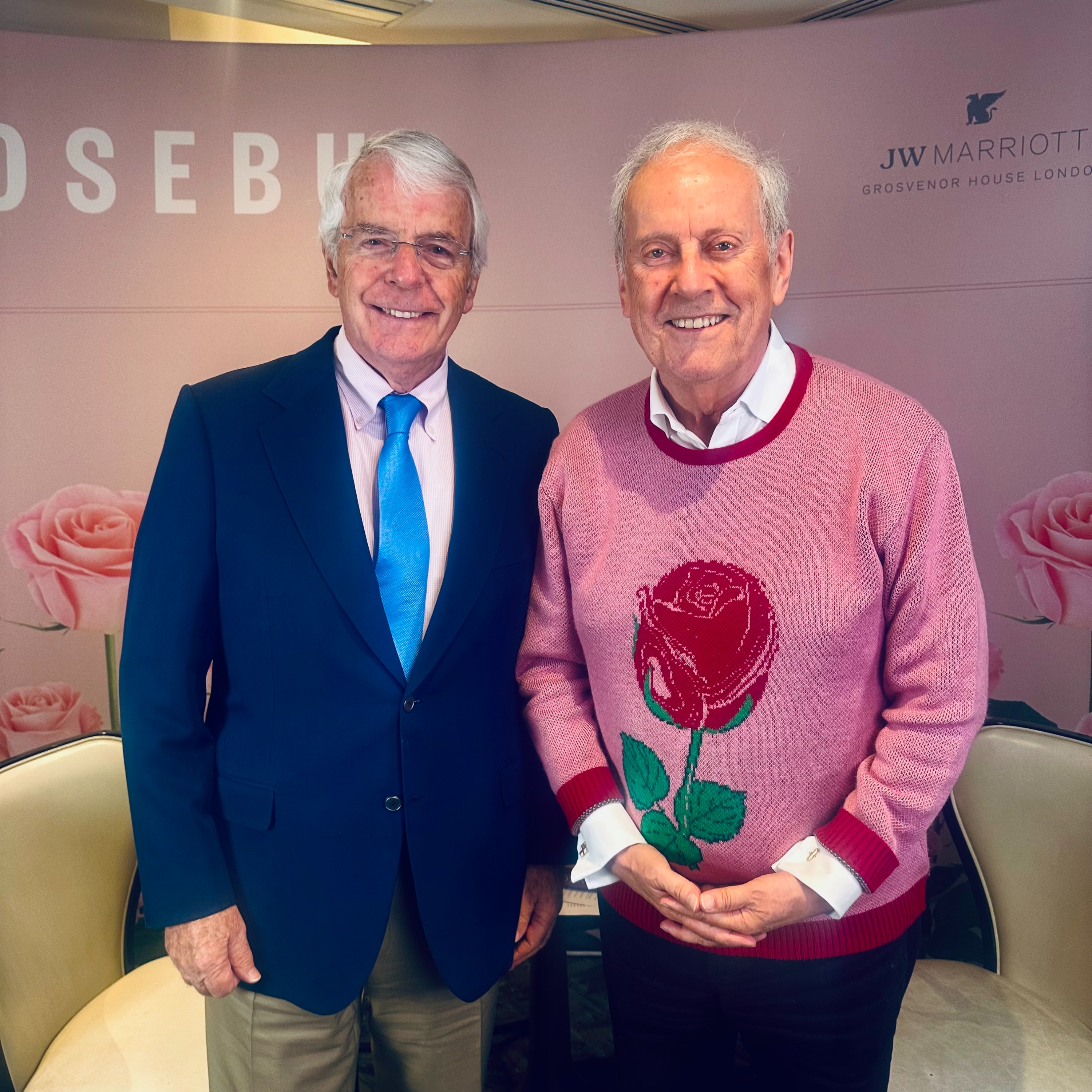
1:14:08Rosebud is a Plain Jane production produced by Harriet Jane, hosted by me, Giles Brandreth, with music by Phil Leppard, and recorded this week at the JW Marriott Grosvenor House in London's Park Lane. Room service.
Sir John Major, British Prime Minister from 1992 - 1997, is our guest today. In this deeply interesting, personal and touching conversation, Sir John talks to Gyles about his childhood in South London and about his unusual and inspiring family. Sir John's background is unconventional. His father had been a successful music hall artiste, and was a great storyteller, much older than the fathers of John's friends. His mother had been a balletic dancer, and was an extremely kind and selfless wife and parent. Both of them were role models to John; his love and admiration for them shine through in this conversation, and will move you. Sir John talks about their extremely humble home and lifestyle - the family fell into hard times and were poor - and about the anger he felt at his family becoming a subject of ridicule by the press in later years. Sir John talks about how he got into politics, about what he believes is missing from today's Westminster scene, and about how he met and married Norma.
We're extremely grateful to Sir John for speaking to us with such candour, and for his delightful company, and hope you enjoy this. It really is worth your time.
Sir John Major's book, My Old Man, which Gyles mentions, is available here.
Hosted on Acast. See acast.com/privacy for more information.


