
 Ask ChatGPT



"Rosebud" is a podcast hosted by Gyles Brandreth, featuring conversations with notable figures about their first memories and experiences. The show aims to evoke laughter, nostalgia, and memorable storytelling.
In this episode, Gyles Brandreth interviews Sir Tim Rice, a renowned lyricist known for his work on iconic musicals such as Jesus Christ Superstar, Evita, Chess, and The Lion King. Sir Tim is celebrated for his numerous accolades, including an Emmy, Grammy, Oscar, and Tony Award, and displays a charming modesty throughout the conversation.
Written by AI. May contain mistakes.

Get the gist, explore an idea or ask about something said.
 Claude
On Rosebud with Gyles Brandreth, what are the key points of this episode?
Searching your listeningAutomatic transcript. May contain errors.
0:00It's Good Friday. Good Friday because it's time for Rosebud and because it's Easter Sunday on Sunday. The lambs are mewing, the doves are cooing, the world is renewing, the music is queuing.
0:34Welcome to this week's Rosebud. I hope you were gently amused by my little introduction with the lambs mewing and the doves cooing and the world renewing. and the music cueing. I thought that was very good. That was not my work. That was the work of my producer, Harriet Jane. And, oh, I haven't got her an Easter egg. It just reminded me. Never mind. But I'm not sure that lambs do mew, do they? But it worked. She got away with it. Were the rhymes good enough? Does mewing rhyme with cooing? It certainly rhymes with renewing. That's clever. And the renewing idea is so wonderful because it's spring and also Easter is coming.
1:10All that's very, very good. But did she really need a rhyming dictionary? Or did she need to be introduced to a really good rhyme merchant? Well, I know one of the best of them, and it's Tim Rice. And as chance would have it, we thought he'd be ideal for this particular weekend, because one of his most successful musicals, the one he wrote with Andrew Lloyd Webber many years ago, was indeed Jesus Christ Superstar. So, he is remarkable, one of the most successful lyricists in the history of songwriting. Knighted in the 1990s, I think he's one of a handful of people who has won an Emmy, an Oscar, a Grammy, a Tony, you name it, he's won it.
1:55He hasn't just won one Oscar, he's won two Oscars, he's won three Oscars. He's extraordinary. He's also very self-deprecating, very amusing and I think you are going to enjoy your time with Tim Rice.
2:24Tim we always begin with the same question and it's simply this what is your very first memory? gosh i remember very vaguely being in hospital when i was three i can't remember what for but i think i got some breathing thing or something i've just had a very vague memory of being in a hospital bed not being at home i don't remember being unhappy in that hospital scene but i suppose that would be my first memory i also remember two large snails on a gate in croxley green lane quite near Radlet and that might have been 1947 that was also a very cold winter these are all very early memories and they're probably all before I was four 1947 is famously the 1947 fuel crisis the coldest winter it was very cold indeed in fact I'm a result of the 1947 fuel crisis got my parents together cosy nights were required cheaper than an electric fire you were born 1944 I was born in 1944 for end of.
3:28And your parents were who? My mother was called Joan and she was a writer. As a kind of sideline, her main career was bringing up her kids. My father was mainly in the aviation business in his career, firstly with the Havilland aircraft, who were based in Hatfield, and then Hawker Siddeley when they took over to Havillands. And they met in the war. And my father and mother met in Palestine. She was in the WAF in photographic reconnaissance. And my father was in the Eighth Army with Monty. They were both sent on a course in the war. It's been 1942 in Palestine. That's where they met. And they got married in Cairo in 1942.
4:17They've only known each other about four months. But it was love at first sight, obviously. And they stayed married and had a very happy marriage. The interesting thing was it was a marriage on the hurry up. I mean, those days you didn't know how long you're going to be around. It was a very different time, which I don't think anybody today can really appreciate. The wedding was just after Christmas, December the 27th, 1942. They asked hardly anybody because there was no one around. I mean, they each had about two or three friends. My granny and grandpa couldn't go because they were in England and it was wartime.
4:49And about 10 years later, my father was wandering down the strand and he ran into an old army friend you know i hadn't seen you hugh for years how are you and they went into a pub for a for a pint and um my father's friend said well hugh what's happened since we last saw each other and my father said well i got married and he said i know i was your best man because he was the only he was the only bloke around at the time so um what did they look like your parents? Well I have to say they were good lookers. I mean I thought as every sane child in those far off days thought that their mother and father were the most handsome most beautiful etc etc but looking back on photographs of my old man he was a good looking guy he was six foot four but quite hunky really.
5:42You say they had a happy marriage how were they together can you what's your sort of memory of them as a as a couple being together? Well I have only I mean they had the old row and that used to upset me I mean not many many rows I mean you would occasionally hear them having a row and then my role or my brothers we'd sort of go in and innocently interrupt them and that would usually shut them up but what helped in a way that my father did a lot of traveling so he was away sometimes for three months of a year he was far east representative for the Havilland aircraft in the countries such as Japan and I suppose China certainly India Burma and all that and he would go away for quite a long time.
6:19So my mum was left on her own for quite a long time and we lived on a farm after we left Radlet, which I didn't realise until I was about 19 that they didn't own. It was rented from the de Havilland Aircraft Company and it was right on the back of the de Havilland testing ground on the runway. And every so often there'd be incredible noise as some new plane was being tried out, the jets, which we kind of got immune to. It's strange, but anybody who was there at the time would go, my God, how can you live there? but it really did get used to it and your parents lived a good age my father no he died too young he was only 70 had he been a smoker no no prostate cancer oh which did him in and i've had that but i you know we're wiser now it was caught in my case in time and famous last words touch wood i'm i've been uh about six seven years ago well done and i have regular checkups my mum lived to virtually 90 Oh good.
7:17So your mother is this lovely lady. What sort of things did she write? Well she wrote a lot of short stories, not all under her own name, for women's magazines like She and the Lady. She also wrote for the Times, usually funny pieces, usually about her children. And in those days you didn't even get a byline, it was from a special correspondent. And she wrote a lot of articles for the Times. She wrote for Punch as well, which was a very humorous magazine as you know she always wanted to write a novel but never got around to it so have you got your writing ability from your mother and your six foot four good looks film star looks from your father thank god this is sound only but what did you get from each of them what did each of them give you do you think well i think my dad you know doesn't sound too arrogant about it but i think he taught me emphasized the importance of good manners and that is a killer good manners gets you a long way this all sounds a little bit arrogant I feel rather embarrassed saying it but my father was that that was what my mum said about him that was what the first thing he was so polite and did all the right things without showing off I think I've inherited and my brothers definitely as well probably better than me inherited that and for my mum I suppose the writing gene but my um father wrote as well but he didn't have much time he edited at the de Havilland Gazette which was the aircraft company's monthly in-house magazine yeah yeah so as a little boy who was your best friend outside of the family who was your first best friend my first best friend a chap called David Robbins and I'm still in touch with David I didn't see a lot of him in my sort of 30s and 40s but I'm a bit nostalgic about old friends I'm always more more interested to meet them than you know somebody in showbiz with great exceptions occasionally Charles.
9:08David and I, we meet about once a year and have a dinner or a lunch. And what do you think, what was it between you? What did you give each other? I'm not sure. What sort of little boy were you? Were you studious, adventurous? Did you share music? Did you play games together? What was it? I don't know. I think we were both interested. Eagle Comic was a great uniter. Everybody loved the eagle. That was such a big impact on kids born in late 40s. I know he had a 78 of the goons. I remember that but this was before i became hooked on pop and rock and roll and the gramophone records what else oh that's right we went once we we went cycling i mean couldn't do it today i don't think we were 12 and we hadn't yet gone to grown-up school or public school david and i were allowed to go cycling wherever and just staying in youth hospitals hospitals hospitals as one gets older Yes.
10:02I remember we went to Oxford. It was the first time I went to Oxford. And I remember going down the Headington Hill. It made quite a big impact on me. And, of course, having lived quite near Oxford for a lot of my life, every time I go down that hill I think of me and David on our bikes. And we stayed in one or two of these hostels. I'm not sure if you can do that today. How old are you? Twelve. Oh, my goodness. Yes. You went on your own on bicycles. Yes. You stayed in youth hostels. Age 12. Yes. Because we hadn't quite got to a grown-up school. So the grown-up school is a boarding school? Yeah.
10:33And which one did you go to? I went to Lansing College in Sussex. And at Lansing, what sort of a boy were you? I was a bit laid back, I think. I was bright, but a little bit lazy. I could get by. I mean, I passed all the O levels, but not huge. Actually, I don't think you had grades in those days, which was very sensible. I always think the grades are silly, because they don't really tell you all that much. and in life if you come up to any challenge you either pass it or you don't either you jump that hurdle you don't jump that hurdle exactly and very hard to find out your marks but i think you could find them out and i remember being told that i'd only got 40 percent in latin but i got the o-level if i'd got 80 i still would have only had the o-level but were you sporty at school i was keen i was keen i but then i was very keen on cricket by this point i wasn't that good and why did cricket become your obsession was it your father's interest my father liked cricket he went to lords i've discovered later on his 21st birthday but cricket had a great appeal for me it was partly the the numbers the statistics i always say that cricket it's a great thing to learn when you're young because you don't just learn the game which is a in my view a great game you also learn history and geography and mathematics and averages i mean i knew every australian city in every state i knew where they were even even sort of fairly up country places as well because I used to follow the MCC or England on tours I knew where India was I knew all the West Indian Islands I'd never been to any of these places but I knew where they were and it was also the history of cricket intrigued me because it went right back to what some people say to the reign of Edward III I think but I'm not sure how accurate that is but there was definitely cricket going full steam at the beginning of the 18th century.
12:18And you ended up, I think, as president of the MCC. I was eventually, and when you were a little boy, did you have sort of ambitions? Did you ever think when you were a 14-year-old at Lansing, enjoying playing cricket and listening to cricket on the wireless, that one day you would be the president of the MCC? No, I certainly didn't. Looking back on it, I don't think, I mean, I'm kind of not sure I actually had any ambitions. It sounds, you know, rather feeble. I used to take each day as it came, to a certain extent. I mean, I would have minor ambitions, like, you know, hoping I might get a chance to be in the school play or something like that, but nothing burning.
12:56I didn't really know what I wanted to do, and I ended up, in a way, not doing anything. I didn't want to go to university, and I didn't really know why. I wasn't a rebel, I just didn't want to go. Did you get into the school play? I did. I played a rather bad Lorenzo in Merchant of Venice. Sit, gentle Jessica was one of the lines. I can't remember much else. Well, that's good. You've got some of it. Three words. And was it a friendly school, a kind school? I think it was. Were there beatings? There were beatings, and they were sort of phased out as it happened during my time there. I mean, boys could still beat boys, which is pretty, you know, now it's absolutely shocking beyond measure.
13:31Did you ever beat a boy? No. Were you ever beaten? No. I was a bit of a coward. I thought I was going to be. The worst bit was thinking you were going to be beaten. You were told by the housemaster, come and see me at six o 'clock after chapel or whatever it was. and you thought two or three times I had the whole day, but then I got off or he thought that was enough punishment. I mean, I wasn't aware of any sadist master or boy while I was there. There were one or two slight weird ones looking back on it, but it seemed to me to be a fairly civilized place. Good. And the chapel, is the chapel famous?
14:07The chapel just finished. When I went in 1958, they wanted a quarter of a million quid to finish the chapel. A lot of money. When I left in 1962, they wanted three million to finish the chapter. And they finally finished it. It's a beautiful building.
14:28And did you have crushes on other boys? Did boys have crushes on each other? Yes, to a certain extent. But I was actually lucky in that I did my hip in. That was quite a drama, which got me a lot of sympathy. My marks went way up that year, that term, because probably the cause was a motorbike accident with a close friend of mine at Lansing called Adam Diamond, who became a very successful novelist in the 60s. And I'm still in touch with Adam. And I had a motorbike accident on his farm. I'd never ridden a motorbike before, and I kind of go as fast as I can. And I hit a post. And looking back on it, I think, yikes.
15:03But it was one of those things that happened in sort of slow motion. And I think that might have done my hip in, because you have a thing called an epiphysis. It's a sort of ball and socket bit around the hip. And when you're about 15 or 16, it solidifies. And about three or four weeks later, back at school, because that was the end of the summer holidays, I found I was walking with a limp. And it didn't hurt, but I just found I couldn't quite walk straight. and I went up to the, I said to the San, and I had my groin rubbed with some exciting exotic gel by an under matron, which was an interesting experience.
15:49But it didn't seem to fix it. So I went off to Shoreham Hotel. Hotel, I got the wrong way around again, hospital, but went up to Shoreham Hospital. And they said, oh, you've got to slip to bits. You have to have an operation. So I had an operation this is at the end of the winter term and for the next six to nine months I had to wear an iron caliper because I couldn't put weight on my hip because what they did they would push the ball and socket back into the right position and then wait for it to solidify and I was at the age where it was just about to solidify if I hadn't spotted it I would have had a limp all my life I had therefore had two terms in this iron leg as we we called it my friends brutally called it and you could wear trousers over it and I had to have a special shoe which had an inch or so thick heel and I got awful sympathy and my marks and school report was the best I ever got and one of the crimes at Lansing was being late if you were late for something you were you were in trouble and I had the perfect excuse to be late because I was poor cripple boy and often one of my friends who was late said can I come with you and I would say I wouldn't have made it to chapel sir if it hadn't been for Henry helping me you know so I became quite popular for helping people get away with being late but it was it was an interesting experience and it didn't really worry me too much and then I had to have another operation to take the pins out because I had two six inch pins I mean looking back on it it was this is 1960 and it was considered quite advanced business at that time.
17:24Had girls come into your life then did you meet girls? Yes they had. That's right you were asking about boys which never really quite came into my life but girls. Because I was unable to do very much in the sporting line I volunteered to organize the dancing classes. I couldn't really dance very well but they needed an organizer and Mrs Albright who had a dancing school would bring over three or four girls to dance real girls in the school to dance with the boys every Monday night in the two winter terms. Just three or four of them? Yes, we had to share them. Well, there weren't too many. I mean, I would say there were probably 20 boys who wanted to learn how to waltz.
18:03It was quite important, believe it or not, in those days, to vaguely have a clue about the foxtrot or the waltz or the quickstep. And I was the sort of organiser, so I got to chat to Mrs Albright and the girls more than most. One of them, who I'm still in touch with, believe it or not, Joanna. I fell wildly in love with Joanna and we how old was she how old were you I was uh this is 1961 so I would have been uh 16 17 and she was a year younger and um we went out together for quite a long time and um and kept in touch but so what what did you and Joanna do together well she lived in Haywood's Heath and her father was a doctor who smoked like a chimney and I was a bit frightened of him and I used to go and stay there and we do normally we go for walks and hold hands and um we go to the cinema.
18:50I mean we saw Blue Hawaii with Elvis in the Haywards Heath cinema at the end of her road. And was music part of what you did? By then I was very much into music. And how did that begin? Well I suppose it began way way back many centuries ago. It began really with my parents having albums. They bought a record player which was quite something to get in those days and it played 33, 45s and 78s. And the pop world was just beginning to break through in a big, big way with Elvis and Tommy Steele and all that. But my parents had lots of albums of shows, you know, My Fair Lady and, you know, Oklahoma, all the Rodgers and Hammerstein.
19:29And the actual gadget, the record player was so wonderful, just seeing it, you know, lift up and the, you know, the arm going over and the needle coming down automatically. And I used to love the records. I was far more interested in that aspect of the music. I mean, I love the music of Say My Fair Lady, but what really gripped me was the cover and the label and all that information. And I seem to remember, as is possible, there was a spoke that went up and you could put several letters. Yeah, there were 45s. And they clicked down one after the other and then it went out, the needle went out and then it came back again.
19:58Yes. That sometimes didn't work because the records would slide. And the idea was that you could therefore have up to eight or nine singles, 45. and it would be like having an LP and you would just, you know, put them on it and it was great, but I began buying What was the first one you bought? The first record was Tommy Steele, Singing the Blues which we bought on 78 78, that's a sort of shellac Yes, I've just remembered when my parents got the record player before that, I'd rather it be unfair to Aunty Gertie, my granny's sister who had an old wind-up record player and a lot of weird records I chose one of them my Auntie Gertie's records for Desert Island Discs.
20:42And it was all about reaching the age of 50. I mean, they were comic records, sort of George Formby type things, that sort of thing. But anyway, Auntie Gertie gave us this record player when Uncle Arthur left the mortal, shuffled off the mortal coil. And we inherited the records, and I wanted to buy a pop record. And I can't remember how we did it. My brothers and I bought Tommy Steele's Singing in the Blues. and we'd play that and the other side to death and then two things happened one 78s were being phased out and my parents bought a grown-up record player that played 45 so we then began buying 45s when we could afford it and it was a big event to buy one single and you what was really important was to make sure that the b side the flip was also quite good and you'd go into a record shop and say i'd like to hear the following four records please and the b sides and the bloke and the record shop would think, oh, God.
21:34You went to a booth, didn't you? Put on headphones. Put into booths. You didn't? Some of them had headphones, but the best ones were you went into a booth because you could cram four or five friends in there. Yes. Like being in a telephone box, and the record was playing for you. And if you liked it, you bought it. Yes. But we always said, I continued doing this when I was at Lansing. Five or six of us would go down to the Shoreham record shop, and a lovely lady ran it. And we could only afford, between the six of us, to buy one single a week at the most. We would all cram into the booth and listened to four or five different singles, often ones that we hadn't ever heard.
22:06We'd see they were on the charts. But in those days, there was very little radio play for pop music. It was frowned upon by almost everybody in the BBC. I mean, Elvis and Cliff were the big names when I was at school, pre-Beatles. The first Beatles single came out my last term, Love Me Do, and we thought this is an interesting record. I didn't think it was, you know, I didn't spot it as being a major breakthrough. But looking back on it, the second record, Please Please Me, was brilliant. And later, when you came to meet these people, because Cliff has sung songs of yours, did Elvis ever sing a song of yours?
22:42He did one of my songs, yes. And Andrew. That was through knowing his music publisher. But this is slightly bizarre, is it not? Or it seems to me that here you are as a boy, loving these people, buying their records. and a few years later these self-same world famous figures like the Beatles like Cliff Richard like Elvis yeah is actually I mean did you how did you when that happened respond to that or just took it in your stride well in this nice laid-back way that clearly has been the style well after leaving school I mean well I had a pop group at school and Cliff and Cliff and you performed yes I was I was lead singer with my friend Henry Henry was a better singer but I think I was a better mover on stage So put the two together and you've got something irresistible all the girls at the local school dances It was terrific.
23:30What was it? What was it called the group? Um, well, we were called the aardvarks Which was gave us top billing on any alphabetical bill. Yeah, even ahead of ABBA But we didn't really play too many professional gigs But we had great fun. So this you're 17 or 18? I was 17 And you're singing or you playing an instrument as well? I didn't really play an instrument. I held a guitar I didn't even do that because I wanted to be free to do my erotic movements. But there was a friend of mine at school, Pete Romine, and I'm still in touch with Pete. I mean, these are people who matter to me more than other people like you.
24:07And he was good. He loved Hank B. Marvin of the Shadows. And every time a new Shadows record came out, Pete would learn it pretty quick. And we had a couple of guys who could just about do the rhythm bits. And Henry and I would sing. And what numbers did you sing? What was your repertoire? Well, I think Travelling Light was one of my high spots. We used to do Michael Row, The Boat Ashore. We did Run Around Sue, which was quite daring, because that required... How does that go? And we had one guy who would do that, and then the lead vocal was, here's my story, it's sad but true. And then Henry would go, ooh.
24:43Oh, this guy takes me back. But, and when will I be loved? I love the Everly Brothers, and Henry and I were quite good at the Everly's. we used to do um bird dog and and when will i be loved great song written by phil everly who i got to know the lovely phil well you got to know them all yeah and did you at that stage think this could be what i'm gonna know you think i mean were there public school boys who became pop singers in those days yes but we didn't know that and they didn't know that peter and gordon people like that there were a lot of quite posh kids who were all obsessed with pop music especially once the Beatles got going and then the Stones.
25:20But I don't think at the time, I don't remember thinking I could make a career out of this. I think I was extraordinarily unambitious. I kind of just thought something would turn up and other people become pop stars or whatever. I don't know. Were your parents ambitious for you? I suppose. Had they hoped you'd go to university? They were a bit concerned I didn't go to university because they both wanted to go and couldn't because of the war and they thought it was terribly important that I should go to university. But I didn't really want to go. On the other hand, I didn't want to upset them. I don't know why I didn't want to go.
25:48I look back now and I think, I don't know why I didn't want to go, but I'm glad I didn't because, you know, who knows what would have happened. Anyway, I thought I'd better do something respectable, and one or two of my friends at Lansing were going into the law, and that sounded quite interesting, you know, live in London, be an article of particle somewhere. So I did that, but I was hopeless and not that interested. But I did, living in London, I met lots of interesting people, and I used to sing occasionally with the odd band, hoping to be discovered. And were you still going out with Joanna?
26:15No, Joanna and I probably split up, but I suppose 63. I do remember 63. That was my first winter at Pettiton Westlake Solicitors, 111 Baker Street. The floor above Victor Sylvester's office. Slow, slow, quick, quick, slow. That's a good name for a pharmacist. Good name for a pop group these days. Anyway,
26:42I certainly was seeing Joanna until probably, I can't remember, 63, 64, but she was doing other things. So we kind of drifted apart a bit. And I met one or two nice girls in the office. One or two not so nice ones, which is much more interesting. Was there ever a prospect of becoming a Deb's Delight? No, I didn't mix with... With those sorts of types? No, no. Given that you could dance. Did you have a dinner jacket? yes I did have a dinner jacket you kind of had to have one I think how old were you when you had your first affair as opposed to just going out briefly well it's an interesting question it depends how you define it I was 19 really and is she still a friend or has she moved on you kept in touch with everybody else I'm afraid to be honest I had slightly lost touch with her she was lovely and I haven't heard that she's no longer with us.
27:40I'm hopeful that she's around. Good. So you're a solicitor but you're finding this boring really essentially. Well I was hoping that it... And where are you living? I was living in various flats. We kept being moved on for some reason. I was with Adam Diamond still. I wanted to other friends. It was all a bit shambolic and it was probably a fiver a week each for us to... And you were still... Were you still in your band? Were you still playing occasionally? Meeting up with the boys? I used to sing occasionally when I got the chance but not really but sometime after I was lucky enough to have a bit of success in the business um I became very good friends with with well I was working for Norrie Paramore I joined EMI Records I'm jumping around a bit here I'll test you on this later but I was um after failing in the law my parents very good they said look if you're not happy do something you want to do and they could see I was obsessed by the record business and the music business and everything and my father knew someone who knew someone who was at EMI and he managed to wangle me an interview with EMI who were the big record company of the time they were where it's at they had the Beatles the Beach Boys they had Frank Sinatra you know you name it they had it Peter and Gordon Dave Club Five Herman's Hermits wonderful Hollies and a lot of classical stuff and and some show stuff and Tamla Motown I'm doing a rather good advert for EMI here who no longer exist anyway i'd had an interview and was signed on as a management trainee which is a sort of posh word for glorified office boy had to wear a suit and tie get in every morning at nine but instead of looking through probates and and conveyancing i was looking up you know what's herman's hermit's next b-side going to be and things like that and i was seconded to nori paramour's department and who is nori paramour was the great record producer just before george martin um he continued to have success after george martin and the beatles but nori discovered and produced cliff richard the shadows ruby murray helen shapiro michael holliday frank ifield in 1961 when i was singing a lot of his songs nori's songs if you like um at lansing he was number one in the british charts for something like 31 weeks out of 52 he produced them but did he also write them no he wrote one or two but he wasn't really a writer he would write the old b-side um he had a couple of hits with billy fury i think i mean he was a musician a very talented arranger and conductor and he had a good ear for what the kids might like although in a funny way his daughter had a better ear because cliff's first record which was move it um the first record he made but it wasn't the a side the a side was um a rather anodyne song called schoolboy crush which was a cover of an american hit and it was sort of baby doll when we graduate you will still be my steady date you're not just a schoolboy crush pretty awful record but the flip side one of the shadows who were then called the drifters written this rock number called move it and norrie took cliff's first record back to the family as he always did i heard this later because i wasn't working with him then and he said we played schoolboy crush and carolyn um carolyn paramore said it's okay they put on the b-side that's a hit and so EMI having promoted Schoolboy Crush briefly flipped it and move it went and that got Cliff going and that was his first big hit and it was a great record move it and had you at this stage ever written a song yourself either the tune or the words well by the time I was it being a failed solicitor yes because while I was being a failed article clerk I was trying to sing with the odd group and I and I made a demonstration tape of my voice to send to record companies so I suppose I must have had some ambition no but I wasn't trying to sell the songs it was your voice it was my voice and I sang the songs because I was slightly worried about copyright but also I didn't want people to be able to say well Mick Jagger sang that better or Tom Jones did that better because they did or they would have done so I wrote a song I wrote three songs which no one had ever sung apart from me so i was the best ever interpreter of these songs what was the first of these that's my story and it's it's not a bad song actually it's only quite a bit of money over the years because i talk about it and then people play it because what happened was i was at my lawyer's office and i got a call after having sent this tape round to emi funnily enough and decker and pie and phillips and anybody who and i got a call from a music publisher who are the guys who look after the songs in those days rather than the records um and he said we've been sent a tape with with a song on that we rather like and we like to record it with one of our groups and i thought wow he said what's the song that's my story oh yes and he said um who wrote that and i said well i did actually and i said what about the singer said no no we don't like him so i said no no we got rid of him we don't like him either and you wrote the music and the words And the words, and the music.
32:33And how does it begin, the song? Well, the first line is, I know, it wasn't a bad lyric. It came out on a record. And in those days, if you got something out on a piece of plastic, that was, you're on the bottom rung. These days, anybody can go into a studio, can do it at home, make a fantastic record, sounds like there's an orchestra with you, and you can then put it out online. So there's no quality control. Whereas in my day, back then, the fact that a pop group called the Night Shift and a record company and a music publishing company had actually bothered to spend time on this song well that was approval anyway the record came out and flopped but I had my name T Rice in small print under the title of the song that was my calling card well maybe we should discuss this now actually no how a song works well I'm not sure how a song works I think it's fairly instinctive but writing words and music together I haven't done a lot of that but the fact that I was trying to sing it as well helped so it made you think will these words sing well does this word sound okay it's because it's quite difficult sometimes when you're writing a song and indeed only the lyrics for a show or for a singer and you don't quite know whether it will sing well.
33:54It might be a brilliantly incisive lyric or a useful turn of phrase or something. But unless it sings well, it might not work. And so you have to think about things of having, especially in theatre, of having a long note can't be an E sound. You know, it should be an O or an R. And all these things didn't cross my mind when I was just writing little pop songs. Do you regret not having gone on to write words and music? I mean, Cole Porter, Am I right? Did he write all the words and all the music? Yes, an awful lot of people did that. I don't regret it in the sense that I was very lucky to be very successful and to meet Andrew, who didn't really write words, and he was great at tunes.
34:35And when I first met Andrew, I was still a failed solicitor. Even though musical theatre wasn't my number one passion, rock and roll was, I recognised how good he was. And I like musical theatre, don't get me wrong. How did you meet him? Well, through That's My Story. Ah, you see, that was very useful, because I was trying to fire on all cylinders in those days, and I had an idea for a book, which eventually became the Guinness Book of Hit Singles. And my mum, who went to lots of writing things and was a member of the Verulam Writers' Circle, and one of their meetings, there was a lecture from a book publisher who was quite successful called Desmond Elliott.
35:11And I'd been saying to my mother, you know, I've got this idea for a book, and anyway, my mum said to Desmond, would you mind seeing my son, because he's got all these barmy ideas. and he'd quite like to hear if any of them have any possibilities. So I went to see Desmond Elliott, who was very small, very camp, and very successful. And I took my record of That's My Story to show I was an established songwriter. My idea was the Guinness Book of Hit Singles. I said, what I want to do is a book of the history of the charts. And the charts had only been going for 10 years then, so it wouldn't have been quite a short book.
35:44But it was a good idea. And he said, no, I don't think it'll work. He said, I can't sell books about what Mick Jagger has for breakfast. so a list of his hits went he was saying the wrong thing i mean the list of mick jaggers hits was exactly what the public were going to want anyway he turned that down and i i thought he's a publisher i'm obviously wrong and he said what else do you do i said well i'm a songwriter and i gave him the record and he played it he must have had a record player in his office which was unusual but he i remember him playing it and he said don't like that either so i thought this meeting's not very well so um but he decided i do know a young boy called um andrew lloyd webber and he writes music and he's looking for someone to work with and maybe you'd be interested in working with him and i thought okay i'll give that a go i thought andrew lloyd webber he he ought to change his name really he's never he'll never make it with that name anyway i wrote andrew a letter and um said i heard it's possible you may be looking for a with it lyricist the very word phrase with it implied that I was not but but anyway I wrote him a letter because that was the quickest form of contact in those days and he rang me up I gave him my phone number he rang me up and I went around to see him this was almost exactly 60 years ago um April 1965 and Andrew sat down at the piano an awful lot of this is what I you know enthralled the punters with on my tour which I hope is called that's my story well it's not called that's my story actually it should be it should be it's what is it called?
37:11I know him so well. Maybe I'll change it. Well, good idea, John. But also, the show is your story. Yes, it is. That's my story. And since it's your first hit, and it's how you Well, it wasn't really a hit. Well, your first flop. Yes. All the flops and more. That's a good line. Anyway, Andrew and I, Andrew's clearly very talented. And did you like him immediately? Yes, he's great. He was so enthusiastic. He was three years younger than me, He was 20 to 17 at that point. So it was quite a difference in age, in a way. You get now looks older, how strange. On we go. I'm not sure that's true. Anyway, Andrew was writing a musical based on the life of Dr.
37:51Bernardo. And I thought Andrew knows so much about musicals. This is obviously a brilliant idea. And it was very much like Pickwick or Oliver. It was very derivative. The tunes were good. They were not in any way pinches of other tunes, but they were in the style. and Andrew hadn't really found a style of his own. And I began writing lyrics thinking I've got to try and be Lana Barta or who wrote both, by the way, or Oscar Hammerstein. And they turned out quite well. Andrew thought they were great. And the funny ones were the ones that really worked. And we made a demo record. Desmond Elliott became our manager.
38:28And he got a music publisher, Southern Music, to finance a demo album. and then that was hawked around to various theatrical producers but nobody quite liked it i think one of the people said yeah this has got something but maybe these two should try something else a different topic and i learned very early on that the story is king you've got to have a good story the bernardo i'm sure he was a lovely bloke bernardo's homes and all that but it wasn't a gripping story um you know nice guy i mean it was a bit like oliver as well i mean not half as good a story as oliver but this was very much oliver two or more likely oliver nine it was just it just wasn't very good um the music was good and the lyrics had promise and while we were waiting for this to be we were asked by a schoolmaster to write something for his who'd heard our demonstration record of the likes of us and he said well yes you know while you're waiting to be megastars why don't you write something for my school this was collie court yeah It was Paul's Junior School.
39:25Alan Doggett, yep, teacher there. And it was a bit of a, not a come down, but it was a bit sort of, well, you know, we're trying to write a mega musical, but why not? Because we'd never at that point heard our work performed live. So Joseph was performed in March 68. We'd been going for three years without much success. Can you remember the moment you first heard your lyrics being sung by... Yes, by the kids. And what was it like? Did you feel... Well, I thought it was, they were so obviously enjoying it. I still didn't think this was anything, would lead to anything, except we've written a fun, Alan Doggett, the teacher, said, if it's any good, I can get a music publisher along, and maybe it'll become a hit in schools.
40:03It'll be something that other schools could do, and you can make a few bob from sheet music and everything. And I remember the first time we went along, the first song was Jacob and Sons, and the second song, I remember that, which that was the time I remember most of all, because that's Joseph's coat. Joseph's coat was elegant, his coat was fine, tasteful style and all that. the song ended it was red and yellow and green and brown and blue finish and alan um said i hope you don't mind but we've added a few colors to the list because i'd only written red and yellow and brown and blue and when the kids sang all these other colors some of which i'd never even heard of russet things like that it really turned the song into something else and it was really quite exciting to these eight-year-old kids but that wonderful building up they were having the time of their lives seeing all these colors and sometimes i mean the financial times some years later reviewed joseph and said the genius of tim rice i think it's the only time he said it was in this wonderful list of colors so you owe it all to somebody else all somebody else yes and every so often i meet um a kid from college court school who's now 68 and with a beard and about the size of the taj mahal and um they say i was in the college school choir and i say No royalties, you're not getting royalties.
41:22And when did you realise, what was the moment that you went on working with Andrew, that everything was changing, that suddenly it was taking off? Well, I think it was Joseph getting a rave review in the Sunday Times, because we did the school concert at the school, and it went really well, and that concert was reviewed in the Sunday Times. And we thought, why? I mean, it was a rave review. You know, look out for these two young men type review. and Derek Jewell was a very distinguished critic, music critic, for the Sunday Times, you know, rock, classics, the lot. His son was in the choir. We didn't know that.
42:01And he'd come along, and without telling us, he wrote this rave review. Then suddenly we had a record deal. Norrie Paramore wanted to make an album of it, published by Novellos. I was a bit annoyed about that because they published it, Joseph Major Technicolor Dreamcoat, Andrew Lloyd Webber on the front. My name wasn't there, and I said, well, hang on. and they said well we only ever put the composer it's Mozart, da Ponte I said well this is, I had a bit of rough, it wasn't Andrew's fault No, but absolutely it's like Alan J. Lerner should rightly in my view come before Fritz Lowe Yes, technically the lyricist for most sheet music is on the left usually and the right, not that that matters but the best thing we got through Joseph was management David Land and Sefton Myers and Sefton said to David, listen to this it's brilliant and he said that it was the line about pyramids that convinced him good laugh is always good even what is the line about pyramids potiphar had made a huge pile owned a large percentage of the nile meant that he could really live in style and he did the next verse ended up with um had shares in pyramids i can't remember but it was it was i can remember it if if bush comes to sharp if i've been interrogated at gunpoint um but it was It's a good song.
43:17It's very funny. Yeah. As of it, you know, great chunks of it. And I've always said to people on the advice, if you can be funny, you know, not you want to be thigh slapping all the way through, but people react to that much more quickly. People like wit in a song. Yeah. They like wit. And I said, do your angst. You know, if you're burning with angst and the injustice of the world and how everything's on, you know, everything's awful. Save that for your second show because people will listen to it. But you even put on something as brilliant as Les Mis, you know, bloke putting on Les Mis and you get a bit heavy.
43:51Forget it. Put on Joseph and from bar one you think, oh, this is interesting. It doesn't mean to say Joseph is better than Les Mis, but it means it's a better calling card.
44:06Which of all your shows is in your head the best one? Well, in terms of lyrics, of your contribution. I think Evita had some good lines in it. Chess, I liked. And for sheer fun. I mean, the one that will go on for the longest is Joseph. They'll be doing that, you know. How interesting. The first will be the last as well. Yes. In six months' time, they'll still be doing Joseph. No, I think Joseph will be sung in... And there's talk of a new movie of Joseph. There is, yes. Which is exciting. Which would be nice. That would be good. 60 years on. Yes, extraordinary. That is extraordinary. I hope they get on with it.
44:37And which of the shows has brought you most money? Lion King. Yeah. I would think, yeah. Because that's just been all over the world. I mean, they all, he said him modestly, they nearly all have, but Lion King, the Disney machine by it. And how many did you do with Andrew? We did three big shows in the sense, Joseph, Superstar and Evita. And we've done the odd song since, including a new song for the Evita movie. And you just got tired of one another or you wanted to move on? Well, Andrew wanted to do Cats, which didn't need lyrics. No, T.S. Eliot was turning in his grave. Well, except Faber made, you know, it saved Faber, I think.
45:19I also felt that our styles were, Andrew was very traditional. I mean, Phantom of the Opera is brilliant, but it could have been written. This is not a, I'm not criticising, but in some respects it could have been written in 1940. It's brilliant. Melodies were fantastic, but that didn't quite appeal to me. If I'd done lyrics for Phantom, I don't think it'd have been very good. I suppose I was still hankering to get a bit back into the rock field a bit more. Just a few more questions. But before we get to those... I hope you've turned the tape on, by the way. Yeah. I'm not doing this again. Good warm-up.
45:54Looking back on your young years, what's the first recollection of sadness in your life? Oh, that's a good question. Wow. I don't know. Sounds like I've had the most idyllic childhood, which in many ways maybe I did. I'd had the odd... I think the odd tear was shed over the passing of a cat or something, or a dog. I can't... My grandfather died when I was four, and I do remember him. But I don't think... To be honest, I didn't think I was that sad. I didn't know him very well. Have you been sad since? Oh, yes. Yes, so many things. And what comes to mind? I'll tell you, I was rather moved by...
46:38I remember being sad when the king died you know I remember that um George VI George VI yes 1952 and um it was strange because I was at prep school and um it was obviously it was the big story of the day to put it mildly and the headmaster said morning prayers as you know boys very sad news immediately the king has died and I want you to stand and think about that for a minute and I remember standing up I was seven thinking what am I meant to be thinking it was just difficult and I don't think I was sad but weirdly many moons later when I was probably 30 something there was a clip a film of George VI waving goodbye to the queen the future queen and Prince Philip as they were going to Kenya and I found that almost tear-jerking because they never saw each other again and um i i did have a very fortunate childhood i think given that your parents were together for so long and so happily they weren't a role model to you because you had no i got distracted and over the years you had off and on relationships yes but i'm still married to jane oh good yeah yeah no she's lovely we can't be going very well it's almost i keep excellent keep keep saying it's a sort of you know the perfect marriage i mean she's you know got a delightful companion but we see each other quite a lot and you have children with her two got either either and donald excellent both of whom actually i i know and i knew jane years ago uh so she regard as say people say your how's your wife you've got an answer you can say absolutely she's fine yes she's fine and she's very happy with somebody else but it's been marvelous for the children and we're great friends exactly but Do you feel, is that a regret in your life, that that didn't work out?
48:28I think it is. But, in fact, in many ways it definitely is. But on the other hand, you know, I just don't know. It's hard to tell what would have happened. Is it easier to write love songs if you've had a troubled love life than if you've had a placid one? I don't think so. Not in my case. Because I've always been, you know, bragging alert. I've always been good at writing songs from the female point of view, which I've never actually, obviously, experienced firsthand. It's observational. So I think, in answer to your question, I think I would have written observational stuff, whether or not I'd had an up-and-down love life or not.
49:10Tell me two more things. One is, tell me about the opening night. I think it's Jesus Christ Superstar opening in Paris. And you introduced two rather unlikely people to one another. Tell me who those two people are and why you were there. Well, you were there because it was the opening night of Jesus Christ Superstar in Paris. Well, Jesus Christ Superstar was not a big hit on stage in France. Some of the songs did really well. But in Paris, it opened and it didn't do very well. And weirdly, I was asked to come in and direct it by Annie Farg, the producer, who said, you know, why don't you come and direct it?
49:46Because she knew I spoke a bit of French and I knew Paris quite well because I've been a student there briefly. And there was a launch of Superstar, and he said, we'll get some famous people along. And she'd asked Frankie Howard and persuaded Salvador Dali to come along. And I remember seeing Salvador Dali in wrapped conversation with Frankie Howard. It was a very sort of strange combination. It's a wonderful, it's a wonderful picture. Yes. Frankie Howard meets Salvador Dali. But of course, in those days, is nobody had a, you know, the ubiquitous cameras did not exist. And I would have quite liked a photograph of myself with Salvador Dali.
50:26Which performance is in your head as the most electric, exciting performance you've witnessed? Not of your own work, just of a performer. John Fogarty in Creedence Clearwater Revival at the Albert Hall in 1970 was pretty good. Cliff and the Shadows reunion concert in 1978 at the Palladium was excellent. I'm talking about the pop world. and I saw Elvis of course four times in Vegas and he was it was strange because it was Elvis so it was rather hard to have a you know sort of unbiased or starting from a clean slate opinion of it and one or two shows he went a bit off message and introduced his backing group and said they're great sing a song and one poor backing bloke had to sing a song you know which he didn't want to do and Elvis then said well it was wonderful sing another one and we were thinking we want to see you Elvis you know and he was a little bit disrespectful of some of his hits I mean he would well they all shook up and he raced through it at you know incredible speed and you thought well that was one minute 14 seconds and normally it should last two and a half but there again when he really got into something when he concentrated and sang mainly the ballads which is what he really wanted to do I mean he was more Mario Lanza really than Little Richard in a way brilliant at everything but when he sang some of those big ballads it was quite moving this tour you're doing now are you going to be telling stories of your life?
51:45what is it? I think I could just borrow this tape and send it out we'll have to go and we have songs though yes, what is it? it's me chatting in between songs I introduce there's four West End singers and a band with musical director Duncan Waugh who's done a lot of my shows and other musicals over the years and it's just the hits from the shows one or two flops and in between each number or each group of numbers, I wander on and, I mean, I'm on stage all the time. I'm sitting at the back listening to them, which is actually quite fun because you can see the audience reaction. I remember you telling me once that the really great shows have about eight hits in them, musicals.
52:25Yeah. For it to really work. And have you had a show that's had as many as that songs in it that really work, that just work? Yes, I think, well, Lion King only had five songs and four of them are incredibly popular out of context. The only one that isn't, although it's actually quite good, is the Villain Song, which is, I Can't Wait to Be King, Hakuna Matata. I never thought Hakuna Matata would be a hit, but punters love it. Superstar's got, I would say, anybody who likes Superstar would have eight or nine songs they'd love in it. When you, the final question, this really is the final question, your head hits the pillow at night And it must be quite extraordinary to be you, because I know quite a number of people who've won an Oscar.
53:12I know quite a number of people who've won two Oscars. You're the only person I know who's won three Oscars and everything else, whether it's an Olivier, a Tony, an Ivan Avello. You are one of the handful of people in the world who has got the whole gamut of the awards, including a knighthood. Absolutely. So it's nice, isn't it? well I suppose what do you think when you head hits the pillow do you ever reflect on that no not on that no I mean I might think about it in the daytime but not when I'm I'm usually listening to the radio or boom radio or something listening to the hits of the 19 of 1955 chance so um no I mean I I don't I mean it's I I do in my show and it's you know and it was a bit of a gamble but it worked I bring on an Oscar and a Tony and a oh my gosh to show people people are interested of course they are and um you bring on just one do you yeah yeah you've got to leave two at home right exactly but there's this thing called egot which is emmy grammy oscar and tony nobody had heard of egot's about and some you know wise guy invented this phrase and suddenly will so and so be an egot all they need is one tony or something and anyway andrew and i were egot's when um jesus christ superstar which got no awards at the time was awarded something for best television production or something and um so it's quite interesting for for the audiences i bring the awards on i usually tell some funny story and i say this actually we were lucky to get this one we shouldn't really have had that or and um i've got some quite funny stories about oscar ceremonies which are usually you know toe curlingly awful i mean one of the oscars everybody was thanking god or and um i thought well it's a bit arrogant to thank god because what you're saying is God preferred you to the other four people who are probably just as worthy of you know going to heaven and um I didn't want to thank God God was I think leading Meryl Streep 4-3 at that point in in in thanks so I thanked Dennis Compton who was my favorite cricketer when I was young and Dennis huge star but not in LA so I was met with a round of indifference one bloke at the back went hello you know and then backstage all the all the all the reporters that they you know they ask you fatuous questions they're not that interested in who won the oscar for the best song to be honest but i am but they're not anyway somebody said uh what what film was dennis compton in and i said well he was in a very good film script by terence ratican called the final test and who did he play he played dennis compton because he was the england team were used in that film what advice are you going to leave us with what have you learned over your 80 years and your extraordinary success well in writing musicals there are no rules nobody knows anything and write what you would like if someone else had written it that would be my advice for writing and don't preach you don't want to you know if you've got a message Don't, you know, say I'm writing a very serious thing about, you know, this terrible political situation in Waziland or whatever.
56:28You know, that won't go down well. Tell a story. I mean, there are messages, if you like, in Evita or Joseph. But I didn't sit down to write them. But if you write about believable characters, then certain messages for life will come out. And what is your lesson? What have you learned as a person over all these years? You should never take yourself too seriously. You clearly don't. You're brilliant. Tim Rice, thank you very much. That was Tim Rice. And wasn't he wonderful? Three times Oscar winner and yet totally unspoiled. He really is delightful. And if you want to catch him and his show, because he does a whole show celebrating his amazing career, it's touring the country right now.
57:12I may catch it at the London Palladium, but it's all over the place. He's not all over the place, but the show is. So online, find the details of where Tim Rice's Life in Musicals is showing right now. Where am I right now? Well, I'll tell you where I am. I'm actually coming down the fire escape at Grosvenor House because I have remembered that it's Easter weekend and I haven't yet got any of the children or grandchildren Easter eggs. And Harriet left me upstairs to record an email for you. and she's gone to the loo, so I thought I'd escape and go and get the Easter eggs. And when she gets back, she can play you the email.
57:53So this is me on the way out, well, not quite on the way out, on the way out of Grosvenor House to get the Easter eggs, wishing you a very happy Easter, thanking Tim Rice, and, well, see you very soon. Meanwhile, happy Easter.
58:17Thank you.
58:52Rosebud is a Plain Jane production produced by Harriet Jane, hosted by me, Giles Brandreth, with music by Phil Leppard, and recorded this week at the JW Marriott Grosvenor House in London's Park Lane. Room service.
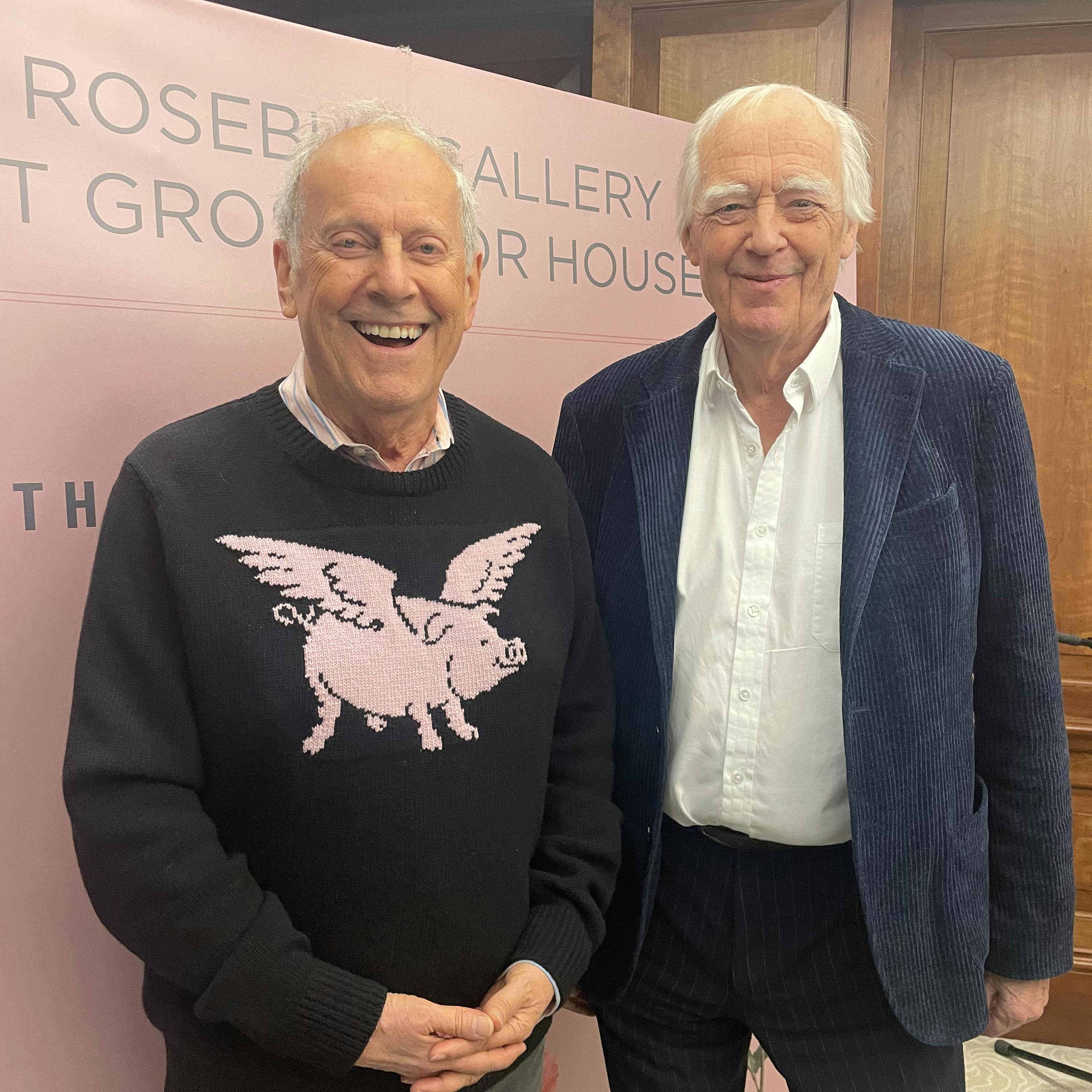
Sir Tim Rice, lyricist extraordinaire, is Gyles's guest today. Tim is one of the few people in the entertainment world to have won an Emmy, a Grammy, an Oscar and a Tony Award, and his songs for shows like Joseph, Evita, Jesus Christ Superstar, Chess and the Lion King are known and loved all around the world. And yet Sir Tim remains modest and charming, as you'll hear in this conversation - perhaps thanks to the good manners he inherited from his father. Tim tells Gyles about his childhood, his schooldays at Lancing College and how, despite his lack of ambition, he moved to London and got a job with EMI. Much of this conversation, not surprisingly, is about music: the records Tim listened to as a teenager, the band he played with at school, and the first songs he wrote and which helped him to get noticed. We find out how he met Andrew Lloyd Webber and started to make musical history. Thank you Sir Tim Rice for your warmth, wit and wonderful stories.
Tim Rice is on a nationwide tour telling his brilliant stories and featuring some of his best-known songs until the end of May, tickets available here
Learn more about your ad choices. Visit podcastchoices.com/adchoices
Hosted on Acast. See acast.com/privacy for more information.


