Ask ChatGPT
 Ruthie's Table 4
5 Oct 2026 · 33m · 13 chapters
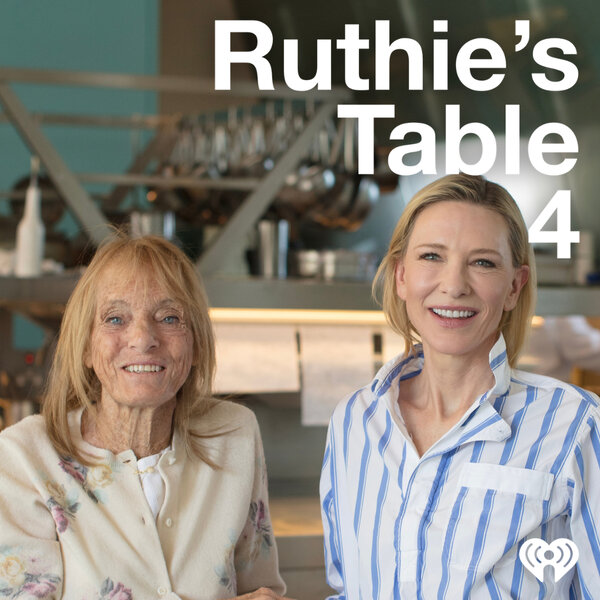
Cate Blanchett discusses growing her own food in East Sussex (bees, vegetables, walled garden), multiculturalism in Australia, arts activism and access, and personal food memories, plus a disastrous Christmas-dinner cooking mishap. She also shares a recipe for roasted Dover sole with capers and marjoram, and talks about comfort food (soup, including bread-waste tomato soup like pappa pomodoro/ribollita).
Cate Blanchett (Australian actor/director and activist; born in Melbourne; father from Texas; raised with American and Australian influences; has an older brother and younger sister; lives with her family and her mother in the countryside).
“Elite” arts aren’t for an elite; access matters. Multicultural immigration reshaped Australian cuisine. Gardening teaches humility/patience.
Thomas Ostermeyer’s six-week Barbican production of The Seagull; a Christmas goose/pheasant/pigeon/quail recipe that “shot out” and telescoped onto the wall, ruining lunch; Dover sole method (oil fish first, bake 15–20 minutes at 230°C, lemon/capers/marjoram).
Written by AI. May contain mistakes.
Ruthie introduces Cate Blanchett and sets the stage for their conversation.
“Cate Blanchett has always been top of that list, an actor, director, and a vocal activist for values and ideas close to my heart.”
Cate shares her experiences and feelings post-performance of The Seagull.
“You're right, a little piece of sunshine has come onto the table.”
Discussion on cultural priorities and the role of art in society.
“You know what's on the menu, but you don't know how it's going to unfold.”
Cate discusses her upbringing and the influence of her family on her life.
“Tell me about the early days of being in your family.”
Exploration of the multicultural influences in Australian cuisine.
“And then they decided that he'd come out and get married.”
Discussion around family cooking traditions and memorable meals.
“But at the time when I was growing up, my mother was an excellent cook.”
Cate reflects on her love for cooking and hosting dinner parties.
“Yeah, so they're wildly adventurous with their cooking.”
Explore Cate Blanchett's early cooking experiences inspired by surrealism.
“my girlfriends would all dress up and we'd all cook something and we'd, you know, I don't know who we were trying to ape or what we were trying to ape.”
Cate shares her cooking experience and a recipe for roasted Dover sole.
“Gain confidence and choose better habits this fall.”
Discussion on growing asparagus and family interactions in cooking.
“I know, but I didn't realize if you oil the fish first, of course it doesn't stick to the pan.”
Cate discusses her early experiences working in catering for film.
“But he's a sensualist, so he's very in the moment.”
Cate talks about the joys and lessons of gardening with family.
“Compounded medications are not FDA approved.”
Cate Blanchett discusses her love for sake and its connection to cuisine.
“I thought, well, Kate will come and we'll have a conversation and a sake tasting.”

Get the gist, explore an idea or ask about something said.
 Claude
On Ruthie's Table 4, what are the key points of this episode?
Searching your listeningAutomatic transcript. May contain errors.
0:00This is an iHeart Podcast. Guaranteed human. If you're ready to feel confident again, visit orderlymeds.com to learn about which GLP-1 you may be eligible for. Getting started is fast, easy, and happens virtually through telemedicine from licensed professionals. Gain confidence, choose healthy habits this fall. Check it out for yourself. Go to orderlymeds.com. That's orderlymeds.com. Taking care of yourself feels great. Compounded medications are not FDA approved. Eligibility required and determined by a licensed provider. Individual results may vary. See website for details.
0:38People always ask me who my dream guest would be on Ruthie's Table 4. Cate Blanchett has always been top of that list, an actor, director, and a vocal activist for values and ideas close to my heart. A few weeks ago, Greta Gerwig and Noah Baumbach took me to see Kate in Thomas Ostermeyer's radical new version of The Seagull at the Barbican Theatre. After a stunning performance, we all went for a small supper next door, talking about Chekhov, her role in tar, and the serpentine party that she's co-hosting this summer. And as always, family. Kate lives with purpose in the countryside in East Sussex, keeping bees, growing vegetables in her garden, cooking and eating seasonally.
1:27Here we are at the River Cafe on the beautiful first day of summer. The sun is shining, the chefs are cooking, and the garden is flowering. Kate and I are going to talk about our shared love of food, artists, children, and a lot more. A dream come true, indeed. Thank you. I'm glad I got out of bed this morning. I'm glad you did too. You're right, a little piece of sunshine has come onto the table. It's coming through. That was such an incredible night. How do you feel post-Seagull? What does it feel like? You did it for how many weeks? It was so short. We were at the Barbican, so it was six weeks.
2:04And I mean, I've known Thomas Ostermeyer for years and years and years. He's running the shower burner and my husband and I are running the Sydney Theatre Company. So our paths continually crisscrossed. But we never actually worked together. And I think the thing, maybe it's a little bit like a dinner party. When you do Chekhov, it's all about the ensemble and the alchemy that happens or doesn't between the actors. And I've always done Chekhov with a loose ensemble of actors, whereas Thomas was assembling all of us. A few people had worked together before. I'd worked with Tom Burke on Soderbergh's Black Bag relatively recently before the production started.
2:42But a lot of us didn't know one another. and he was able to bring us all together, all from totally, wildly different approaches. And the thing I miss most is the people. I love them all so much. People here are like my family. We work together, we go out or we celebrate or sometimes we also just work. But it's a very strong attachment when you're working together and creating something. Here it's every day. In a way, there are parallels. The curtain goes up at 12.30 and the curtain goes up with you at 7.30. Totally. Don't you think? There's an anticipation. You're very dependent on each other.
3:24And also I think you're part of something that, and this is what maybe the patrons don't realize, what an audience doesn't realize, is that whatever happens in the kitchen will be totally influenced by the people who come through your front door. And so the evening is a thing. You know what's on the menu, but you don't know how it's going to unfold. You don't know what people are going to order. And so it's fresh every time. And, you know, being quite shy, I mean, I don't know if you are. Yes, I am. Yeah, you get to know people by doing something together. Collaborating, being together. When we see actors on stage singing or the incredible gift that is given to us as an audience to be able to have that.
4:09And Britain has always been known for that. Exactly. Do you feel that this is something that is threatened now, that the priority of culture in this country is being lessened? There was a time when there was money for the arts. You know, there was money for building a theatre. And I know that you are an activist. I know that you're engaged in political life. And what are you feeling about right now in terms of? Well, I mean, people talk about activism, you know, that it's political. But I think it's engaging in things that have been politicized. and it always is strange to me when we talk about the arts, this word elite is used.
4:49And if you think about an elite sports person, that term means that they have spent many, many years perfecting their ability, that they are at the top of their game and that when we talk about the arts, yes, they are elite in the sense that those people who put those shows on are exceptional at what they do. It's not for an elite. I think the elite these days are the people who don't pay tax. And if they did pay tax, then all of these wonderful offerings, cultural offerings that Churchill said, what are we fighting for if we're not fighting for culture and the access to it, is that then they would be more accessible to people.
5:32And so there's this, I think it's a linguistic language division that's often created between people and culture. And I think that you, I mean, that's the joy of touring a play is that you will tour to a regional area, you'll do it in a major city, you'll do it in one country, in another country. And I think the reaction that people have in various different locations will feed the work and hopefully those people will be fed by the work. The first time I went to, you know, a gallery and saw, you know, a major work of portraiture, it changed the way, you know, at my little state primary school, the way I thought about the world.
6:14And dance does that. Music does that. But we're told that it's only for a certain set of people. And I think that's because access is not afforded them. Tell me about the early days of being in your family. Did you have sisters and brothers? Yes, I have an older brother and a younger sister. And my father was from Texas. Where were you born? I was born in Melbourne in Australia. Yeah, we were going to move to the States really early on, and they decided, I think, for our education, that they wanted us to be in Australia. So we stayed there. How did he come from Australia to, I mean, from Texas to Australia?
6:53Yeah, he was the child of two alcoholic parents, and so he grew up, I think, killing birds in a park. and it would never happen now but, you know, a gentleman saw him and took him off the streets and educated him and put him through high school and the minute he could, he wanted to get out. So he lied about his age, joined the Navy and he went to the Antarctic and I think he decided to become a Unitarian minister and my mother who was at Teachers College in Melbourne, he, well, his ship broke down, leaving the Antarctic, so they had to dock in Melbourne and there was a teacher's dance and they didn't have enough men, so they went down to the port and then he, my father came and my mother and he danced all night and then he left three weeks later and they corresponded for two years and then he decided to come out.
7:51It was quite old-fashioned. It was a little bit like this wonderful Patrick White novel called Voss where there's an explorer and I can't remember what she did. I think she might have also been a teacher. They fell in love but didn't consummate it or declaim it to one another and then they corresponded through letters and that's sort of what my mother and father did. And then they decided that he'd come out and get married. That's a story of adventure and chance and pursuing an idea. Or two lonely people who found one another. And the idea of the harbor and the meeting and the dancing all night.
8:31We celebrated Halloween and Thanksgiving. So I grew up with pumpkin pie and pecan pie. So did he make them or did he teach your mom how to make them? Yeah, both. And so we grew up with quite a lot of American black-eyed peas, all of those things. Did you ever go back to Texas? Yes, sadly. He died when he was 40. and we had planned a trip back to Texas and he died in January and we were going in May and so we made the trip anyway and went and met his sort of diaspora of his family. And so growing up there was a sense of the American influence. There was Australian influence as well. Yeah, my grandmother was I think a Scottish.
9:17And you said your grandmother lived with you? Yeah, she did. She lived with you and made the sandwiches. Made the sandwiches. I think she was a Scottish descent so everything was boiled within an inch of its life. And at that point in Australia, avocados were, you know, incredibly exotic, mangoes. What year are we talking about, Kate? We're talking about a long time ago, Ruthie. So in the... No, in the 80s. In the 80s, okay. And so because of the fruit fly, there were quite strong demarcations between what was grown in Queensland, what was grown in New South Wales. Nothing ever came over from Western Australia to Victoria.
9:52If you had fruit and you were crossing between Victoria and New South Wales, you had to leave the fruit, the vegetables at the border. So there was no tropical fruit that even came down. I mean, I have the utmost respect for farmers. I mean, in any country. But in Australia, it's really, it's very hard. It's such an ancient land. And I think because for so long we have marginalised Indigenous understandings of the way to grow and collect food. What would that be? Tell me about the Indigenous experience of... Well, I mean, there were so many hundreds of language groups and cultures that have been wiped out through, you know, a white invasion.
10:37I mean, you can't call it any other, name it any other way. but I think we've not grown as a white culture through that wisdom and understanding of the land and so the food bowl in so many parts of Australia is actually in the wrong place. Water is a scarce commodity. I mean brand Australia when I was growing up was multiculturalism and so once we really embraced the wave of Vietnamese and Lebanese and Greek and Italian immigrants and refugees, our cuisine became extraordinary and now it's been exported to the world as Pan Pacific or Asia Pacific. But at the time when I was growing up, my mother was an excellent cook.
11:18So tell me about it. So your mother was left with three children. She was what, in her 30s? She was, yeah, 39. And my brother was 11, I was 10. Was she working? My sister was 8. Did she have a job? Well, she had to go back to work as a teacher. As a teacher. So she taught home economics. So our kitchen was fantastic. Describe it. Yeah. How was it like? A lot of Italian cooking and a lot of fresh seafood and salads, and that was not what people were eating at the time. But I think the thing when there was a lot of grief in my house, so the meals were delicious, but they were silent. And that's been one of the great joys, I think, for my side of the family, but also for me, is my husband came from this enormous Catholic family.
12:07So the food may not have been... Is he British? Yeah, I know he's Australian. But they had massively noisy, loud, raucous meals. And my husband's an excellent cook. And actually the first time I met my brother-in-law was at Christmas. And I came towards the house and people were screaming with laughter. And I don't know what the meal is, but it's a medieval recipe where you stuff a goose with a pheasant, with a pigeon, with a quail. That's right. And what had happened was he'd open the oven and the thing had shot out and it telescoped out onto the wall so there goes Christmas lunch. The smallest thing that was in there.
12:50Yeah, so they were madly trying to stuff it back in. I know that recipe. I mean, I've never done it myself, but I know that. It's dangerous. Have you ever done that? Do you know that? It's really dangerous. That's so funny. Because probably as they're cooking, they... Expand. They also expand and then therefore. Yeah. That's hilarious. Yeah, so they're wildly adventurous with their cooking. How old were you when you met him? My husband and I got to, we've been married, God. We got married very quickly actually in 97. It wasn't a shotgun wedding. We didn't have children for quite some time. But I think we were 28.
13:23Yeah, so you were embraced by this family. But going back to yours, you grew up with your father in the beginning cooking. and I assume your mother both cooked and you had meals and barbecues and people. And then it became a kind of sadness. And then there was a joy. It was just very silent. Was that, yeah. And did that change? Did you? Well, I, yeah, I was thinking about it, maybe because I was coming to speak to you. But then I've always loved the dinner party. And so what I would do is I wouldn't go to a lot of parties as a teenager. I would have dinner parties. Would you? Yeah. Yeah, so I would, where everyone would dress up, my girlfriends would all dress up and we'd all cook something and we'd, you know, I don't know who we were trying to ape or what we were trying to ape.
14:09There was a lot of sorbet inside orange cups and I don't know. And I grew up with this Salvador Dali cookbook. You know, the one that he'd done and he'd done the illustrations. Yes, yes, yes. And I cooked recipes from that. Did you know what they like? Crazy. I have to admit that I didn't ever make anything from it. That was where I cooked my first snails. A surrealist cookbook, a surrealist recipe. But it was hard in Melbourne at the time to find a pheasant. But brave of you to do that. Yeah, I tried. I tried. So, yeah, I cooked and tried to decorate the dishes from the Salvador Dali cookbook.
14:42What age was this? Probably about 13. So that's young. Because I often talk to people who, when I say, okay, so you grew up in this nurturing home with a grandmother and a mother and cooking. And then what happened when you left home? And very often people say then when I had my own flat and I started buying local ingredients and I started cooking. But 13 is an early age to do that and to entertain. I think it's because it was my father's book. He worked in advertising and it must have been a gift that he was given one year. And, yeah, so it was sort of trying to. Oh, the Salvador Dali? Yeah, not that I can remember him ever cooking from it, but it was just something of his that maybe I gravitated towards that.
15:24And also the surrealism seemed to make sense to me. I had very vivid nightmares and dreams as a child. And so his work and the surrealism movement as a whole kind of really unlocked something for me. Ready to feel energized and in control again? At Orderly Meds, we have helped thousands just like you take charge of their health with a GLP-1. If you've tried dieting, exercising, and relying on willpower and nothing seems to stick, then it might be time to talk to a licensed provider about your options. That's what Orderly Meds is for. This fall, choose healthier habits for yourself with a visit to orderlymeds.com.
16:03You don't need to visit with a physician in person to become eligible. Orderly Meds has a simple virtual process. Connect with licensed medical professionals who can determine whether a GLP-1 treatment may be appropriate for you wherever you are. Getting started from the comfort of home online. Change your habits and consider a new approach to feeling your best. Visit orderlymeds.com to learn more. That's orderlymeds.com. Orderlymeds.com. Gain confidence and choose better habits this fall. Compounded medications are not FDA approved. Eligibility required and determined by a licensed provider. Individual results may vary.
16:37See website for details. Tell me about cooking the dough for sole. What was that? Well, I'd actually deboned a sole in Alfonso Cuaron's disclaimer. And I don't know whether he thought my deboning was too good or that the scene was too static or whatever, but he then threw a cat onto the bench. So I was trying to debone and cook the sole with a cat on the bench. What did the cat do? Tried to eat the fish. Tried to eat the fish. So having cooked the Dover sole, filleted the Dover sole, would you like to tell everyone listening how to make roasted Dover sole? Well, first of all, come to the river cat.
17:18Yeah, I'd have a Dover's home cooked for you. I quite agree. Yeah, why do it? And also, you know, you can change it in any way you want. People read it and add their own advice or say that. Or you can just read it, whatever you like. You know, and there's something I was thinking too about the way you cook. Someone said this, and I'm going to phrase it so badly, that Chopin apparently said that the great reward of having played many, many notes over many, many years is simplicity. And I think that is something extraordinary about the way you cook. And maybe it's for this recipe. So the more Dover Soles you cook, the better you'll cook them.
17:57Dover Sol with capers and marjoram. Two tablespoons salted capers, extra virgin olive oil, but put that on the fish before you put it in the pan. That's what I learnt today. A bunch of fresh marjoram leaves, four whole Dover sole weighing 350 to 400 grams each, scaled and cleaned by someone at the Roofer Cafe. One lemon cut in half and put in the pan eventually. Put the capers, this is the method, put the capers in a sieve and rinse under cold running water. Leave to soak in cold water for 40 minutes then rinse again. Preheat the oven 230 degrees Celsius. Brush a large flat oven tray with extra virgin olive oil.
18:46Scatter half of the marjoram leaves over the tray. Season. Place the fish on top side by side, little buddies who are about to be eaten. Season, then scatter the remaining marjoram and the capers over. Drizzle with olive oil. Bake for 15 to 20 minutes. Test with the point of a sharp knife or a fork inserted into thickest part of the soul. If cooked, the flesh should come away from the bone. Don't eat it yet. Squeeze the lemon over the fish and serve with any juices from the pan. Delicious. So simple, isn't it? I know, but I didn't realize if you oil the fish first, of course it doesn't stick to the pan.
19:27I know. And marjoram, I would have put parsley, which is a bit more, the marjoram's just so flavorsome. Yeah, it's very perfuming, the marjoram. But then, again, we do it with rosemary. Sometimes we put a whole branch of rosemary under the sole when we cook it. We do it. We do it with parsley. And then the capers, the saltiness of the capers. Yeah, that was delicious. Or maybe I'll just do an anchovy, one anchovy over it. I love anchovies. You love anchovy too. I do too. They're much maligned. I think it's probably one of my favorite fish. It's cool. We use them in Italian cooking. They are like a herb.
20:03They're like the seasoning. So we make, right now we're doing white asparagus or green, and we make an anchovy butter, and it kind of melts over it. I've never done, because asparagus is my favorite. Do you love asparagus? Yeah, I love asparagus. Do you grow it? Yes, I have been. Are you getting it now? Yeah. Although we're changing, we had a really tiny little garden. We used to have pigs, and then the pigs went, because we weren't realized we weren't pig farmers. And they're too intelligent, and there was something just, I thought. Charlotte's Web. Yeah, and actually it was my Machiavellian plan to turn my family vegetarian.
20:39I thought if we get pigs, then the children will realise that the sausages they eat, the ham, the bacon, it all comes from these pigs. And my now 17-year-old called himself the pig whisperer and he used to go up and he used to hug the pigs and stroke the pigs. And, of course, then when they got turned into sausages and, you know, ethically and as humanely as you can, I was sitting down. I was a little bit cruel. They were sitting down, putting the ketchup on their sausages, and I said, you know, this used to be Benson and Hedges. My husband called them Benson and Hedges because he said they were going to be smoked.
21:11It was a little bit off, but anyway. And they said, this is Benson and Hedges, and my now 17-year-old said, delicious. So it didn't work. So then the pigs went. I don't think I'd want to be on a lifeboat with that boy. No, he's actually incredibly kind and sweet. But he's a sensualist, so he's very in the moment. And so then that little vegetable garden where we're growing asparagus and we had raspberries, we had a whole hodgepodge, we then decided to build a walled garden. So that has gone to fallow. So the asparagus has kind of now gone to seed. So you get great fish from the coast? Yes, in Forest Row there's a fantastic fishmonger, Vezis.
21:54So we get our fish from there. And we used to live in Brighton, you know. and mushy peas that's what I discovered when I came to this I love a mushy pea I love mushy peas there was one fish and chip shop on the tram stop near my school my high school and I I discovered um I was going out with a a skinhead at the time and he took me there and I um had my first mushy peas and chips so I like yeah but you and they're not those don't need to be freshly picked peas, do they? They're better if they are, let's face it. But the first ones I had were not. Did you enjoy going out to eat? Was that something in your culture, that you'd go to eat for a special occasion?
22:39We did when my father was alive. We had a lot of Asian restaurants. And my father, I never really got to speak to him about this as an adult, but he had a lot of Japanese lithographs and books of haiku poetry. and I think he must have travelled through Japan quite a lot. So there weren't very many Japanese restaurants when I was growing up but I remember going to several with him and eating a lot of Chinese food and the first time I had fried ice cream it was just miraculous or the first time I had raw fish was amazing and I just loved the beauty and precision of the Japanese culture. And so I remember those experiences and when I went to drama school, I didn't have a penny, but a girl who was in the directing course was married to a QC.
23:27This is in Melbourne. In Sydney. Yeah, the National Institute. And we used to sneak away and go and have sake and a little bit of sashimi at lunchtime, and that seemed so chic and, you know, extravagant. Do you remember when you started acting how that married with your wife? How did that affect your food? I mean, did you eat a different way? Did you go out to more restaurants? I mean, my first job actually out of drama school, I worked in the catering truck on a television show because I wasn't working as an actor. And it was my first entry into the film world. So I didn't, it was like this distraction that was happening that was so frustrating being in the catering truck trying to get breakfast out and lunch out and, you know, in the afternoon, whatever it was called, that we had to keep stopping because they were doing this annoying thing called filming.
24:21They kept turning over. It was like, guys, how are we going to get the cheesecake ready? And then eventually I ended up on the other side. But I had a real love and respect for the difficulty of working in the catering van and how it can be thankless. Imagine a state-bottled olive oil chosen and bottled for the River Cafe arriving at your door every month. Our subscription is available for 6 or 12 months with each oil chosen personally by our head chefs and varying with each delivery. It's a perfect way to bring some River Cafe flavor into your home or to show someone you really care for them with a gift.
25:05Visit our website, shoptherivercafe.co.uk to place your order now. If you're ready to feel confident again, visit orderlymeds.com to learn about which GLP-1 you may be eligible for. Getting started is fast, easy, and happens virtually through telemedicine from licensed professionals. Gain confidence, choose healthy habits this fall. Check it out for yourself. Go to orderlymeds.com. That's orderlymeds.com. Taking care of yourself feels great. Compounded medications are not FDA approved. Eligibility required and determined by a licensed provider. Individual results may vary. See website for details.
25:46When I came here, we'd always wanted to have a garden. We'd always wanted to grow things. I've got brown thumbs. My mother and my grandmother had very, very green thumbs. And now my mother lives with us. I was saying a brown thumb is what? A green thumb is it? Being grow well and I touch something and it just goes... I bet that's not true. No, it is. But this is changing slowly. And so it's been so fantastic. I think, too, because I grew up with my grandmother. Now that my mother's living with us. How does your mom live with you? Yeah. My mother lived with us. Oh, really? It's great, isn't it?
26:20It's great having a multi-generational household. It's great. I was saying there was always, my son, when he was little, used to try and wake us up. We'd say, oh, Bo, we're going back to sleep. And then we'd hear him go downstairs. He'd say to his brother, Ruth, can you wake up? And he'd say, no, I won't go back to sleep. And then we'd hear him go all the way down to my mom. and she'd open the door and say, hi, Bo, want to make a cake? You know, it's like 7 in the morning. There's always somebody there. What every child wants to hear. But I know, you probably know this with your grandmother, is that you talk so differently to your grandparents than you do to your parents.
26:55And that you can't tell everything to one person. Sometimes, you know, we are different things with different people. But anyway, so having my mom in the house has been great. So she gardens? Yes, she does. She's got her own garden, but also together where we've just reinstated a walled garden that used to be there because the house we're living in was derelict for many, many years. And so in lockdown, we realised that under a lot of rubble and mud, there was a greenhouse. So we restored it. And then we saw an aerial shot of the house or the block of land in the 40s. And so we've rebuilt along the lines of where the walled garden used to be.
27:34And it's a learning curve. It keeps you humble. You must have a garden. What does it teach you, would you say? Humility and patience. Because you don't have control over everything and the weather. Yeah, and also, I mean, I think it's just that thing of knowing that certain moths are going to come, and so we're not having a lot of luck with broccoli and cauliflower, but Brussels sprouts are okay. Yeah. And so you cook with what you gather that day. So when you said we were going to do this today, I thought, well, Kate will come and we'll have a conversation and a sake tasting. So how did sake come into it?
28:09How did this happen? This is so cool. Well, it started a long time ago. I think, I mean, you know, my mother and father drank sake when we went out to Japanese restaurants. And that was, you know, to have a drink in a tiny little cup. I mean, I found all of the elements so beautiful. And I've always loved ceramics since I was obsessed with the accoutrement around it. And then I worked with a Japanese skincare company. This is years ago, for about 15 years, and we would go to Japan a lot. And the active ingredients in the skin care was found during the rice polishing process, you know, because obviously, and this one is a Junmai Da Ginjo, which is a highly polished rice.
28:54And that made the people who were working with the rice, their hands were just like infants' hands. Their skin was amazing. But as a result, I went to a lot of breweries and I got really fascinated with the fermentation process and the fact that sake is brewed like a beer but drunk like a wine. And I thought, well, I often drink it when I'm having Italian food because there's a purity and simplicity, you know, particularly to the way you serve it up, that also is quite twinned to the purity and simplicity of Japanese food. and I thought I would love to be part of trying to bring that to Western cuisine.
29:35I have to pour for you. You're going to pour for us? What is the ritual? Is there a ritual? Well, look, oh, it's at the right temperature. You don't drink it hot. No, but the first time I had... When we go to a Japanese restaurant, they'll say, do you want it hot or do you want it cold, right? Yeah, but the first time I had sake, it was hot, but because this is such a... The more highly polished it is, and this is really highly polished, it's polished to 35 % for what that's worth, it has such a refined flavour that you don't want to heat it because it would take all that complication away, beautiful complication.
30:12And you said to serve it in a wine glass. Well, yeah. I've always drunk it in a little vessel, the ceramic. But there's something about you can smell it better, I think, and it doesn't feel so much like a spirit. Yeah, that's nice to you. It's very fragrant, isn't it? It's so nice that you're here to Morisake together. And do you go to Japan? Do you go where they make it? Have you been? Yes. Yeah, it's been amazing actually being part of the process of seeing it made and it's aged in a very cold environment too. This is so good. It's really good. How would you describe it? I think it's fruity but it's not too sweet.
30:57It isn't sweet. It's great with asparagus, pineapple-y. I think you described the sake in very visual terms as well as taste terms. I always wanted to paint. Oh, you did? Like I always wanted to dance. By the way, can I just interrupt you for a minute and say those splits? Oh, I'm still suffering. Don't speak. No, I have no skills. The whole performance was a kind of revelation of what you could do with a part and to take it. But when you came and did those splits, you did quite a few. I did it as a joke. That was great. It was like we all gasped. What was that like? Yeah, I think I'm quite, I make more sense in movement, I think.
31:43You know, it's taken me a long time to get used to being sort of in a two-dimensional medium or being photographed as always I have to sort of trick myself into feeling comfortable. But, yeah, it ended up being quite physical. Yeah. And conducting is physical. Yeah. It's dancing, actually. And dancing, your arms, your legs, the spits. I mean, there's an amazing choreographer who also dances called Xavier Leroy. He watched Simon Rattle conduct The Rite of Spring. And when he can, I mean, every strand of hair is flying. He's such an incredible creature when he conducts. And he took that, his act of conducting and turned it into a piece of choreography.
32:30And actually when I was playing Tar in Todd Field's film. I wanted to ask you about that. I watched that piece of, that dance, and it was totally freeing. And so I saw it, the conducting as a kinetic response like dances to music or to silence. And so I found that quite liberating. When we think about food, we think about food as you talked about your father and the memory of him in Australia. Entertaining as a 13-year-old and then tasting a delicious tomato. And then what we've just said right now, food is all that, but it's also comfort. And so I was wondering if you could just tell me before you say goodbye, if you need comfort, if you do want food as comfort, is there something that you would reach for or cook or buy?
33:18I think in the end it would be a soup. It would be a soup. And I think really good soups often take time to make. So first of all, you have to do the onions and the garlic and then you have to put certain vegetables, root vegetables in first and you have to let it simmer. And I'm quite impatient, which is why I'm really relishing starting a garden because it's teaching me humility and patience. But there's something about making a soup that you just have to let it sit and you have to let it rest. And there's one soup, I'm talking about food waste, which I can't stand. and I get ribbed a lot about it by my boys.
34:03But, you know, that two - or three-day-old bread that is otherwise going to go into the bin, you chop it up and you make that fantastic soup with tomatoes and onions, and it makes the bread go quite cheesy. They call it Papa Pomodoro. Yes, I love it. It's a version of it, yeah. And I made it over the weekend because we had a lot of white bread. that was some... They do Papa Pomodoro in Tuscany in the summer when the tomatoes are very ripe. And then in the winter, they actually call it ribollita, which means a kind of basic minestrone. Very often it just has cavallo nero, which is a kind of cabbage.
34:39Yes, yeah, delicious. And beans, and then you add the bread, and then it expands, and then it's called ribollita. It's one of my favorite soups. We have cavallo nero in the garden, so I'll make it. Yeah, try it. Yeah, that's good. Thank you, Kate. Thank you. Really lovely having you. Thank you.
35:24Ready to feel energized and in control again? At Orderly Meds, we have helped thousands just like you take charge of their health with a GLP-1. If you've tried dieting, exercising, and relying on willpower and nothing seems to stick, then it might be time to talk to a licensed provider about your options. That's what Orderly Meds is for. This fall, choose healthier habits for yourself with a visit to orderlymeds.com. You don't need to visit with a physician in person to become eligible. Orderly Meds has a simple virtual process. Connect with licensed medical professionals who can determine whether a GLP-1 treatment may be appropriate for you wherever you are.
36:00Getting started from the comfort of home online. Change your habits and consider a new approach to feeling your best. Visit orderlymeds.com to learn more. That's orderlymeds.com. Orderlymeds.com. Gain confidence and choose better habits this fall. Compounded medications are not FDA approved. Eligibility required and determined by a licensed provider. Individual results may vary. See website for details. This is an iHeart Podcast. Guaranteed human.
This week, we’re looking back to the summer morning we shared with Cate Blanchett, who joined me at The River Cafe after her run in Thomas Ostermeier’s The Seagull.
We talked about the pleasures of touring a play, growing up between American and Australian food traditions, silent meals after losing her father, teenage dinner parties inspired by a Salvador Dalí cookbook, the joys of growing food, and her love of sake.
Hit FOLLOW to make sure you never miss an episode, and join the Ruthie’s Table 4 community on social.
Instagram: instagram.com/ruthiestable4
TikTok: tiktok.com/@ruthiestable4
YouTube: youtube.com/@RuthiesTable4Pod
Shop River Café Books and more… www.shoptherivercafe.co.uk
Contact us: [email protected]
See omnystudio.com/listener for privacy information.