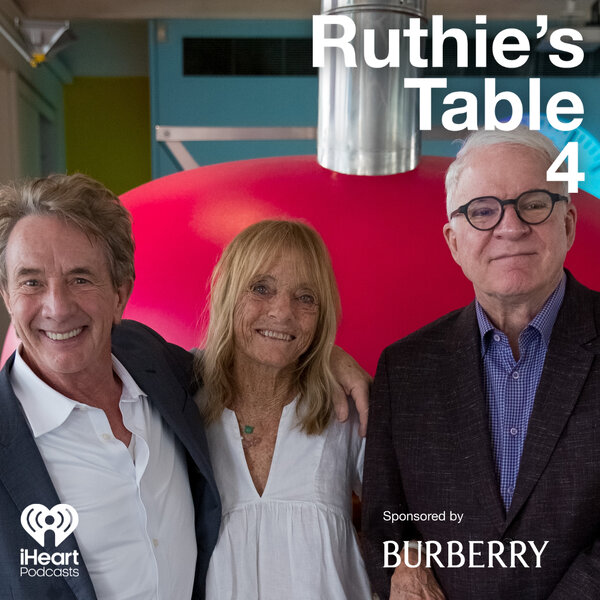
 Ruthie's Table 4
10 Nov 2026 · 42m

 Add vo to ChatGPT or Claude to ask about everything you hear
vo listened to this episode to put together the overview and transcript, so there may be the odd mistake.
Steve Martin and Martin Short discuss their long friendship, shared dinners, and how food and comedy shape their lives and work. They also talk about filming Only Murders in the Building in London, restaurant “ordeals,” and comfort foods, then end with a recipe read-aloud and banjo bit.
Steve Martin (comedian/actor/writer; known for New Yorker pieces with “exceptional” grammar; plays banjo; has worked on Only Murders in the Building) and Martin Short (comedian/actor; musician background; returned to piano lessons after his son’s death; co-stars on Only Murders).
They “fell madly in love” after meeting via Three Amigos script pickup; they’ve rarely argued—mostly professional disagreements; London filming has shorter hours and higher actor training; restaurant formality can feel like an ordeal.
Dinner with Steve playing banjo and Marty telling stories while Mark Carney called; River Cafe reservation canceled after Wikipedia lookup; poached-egg maker mishap (forgot water); comfort foods like spaghetti aglio olio, club sandwich, grilled cheese and tomato soup; recipe for slow-cooked tomato sauce.
0:00This is an iHeart Podcast. Guaranteed human. You've considered advancing your education or pursuing a new career. Rasmussen University has a seat saved for you. And with over 50 online programs, you can take a seat in your kitchen, your kids' soccer practice, your commute home, or wherever your busy schedule takes you. Plus, with a team dedicated to supporting you every step of the way, you may be online, but you'll never be alone. Find the program that fits your goals at rasmussen.edu.
0:56talking about, he, who, he, who, him. Do you know that thing that you know? I'm a writer. He's written one book. I've written 20. Yeah, but how many have been read? When did you meet? How many years ago? We bet on the Three Amigos. I went to his house to pick up a script for the Three Amigos. And then you fell in love? We fell madly in love, and then we started kissing. And then I thought, shouldn't we read the script? Wait, this is a short kiss. That's how you got the part. I know. When I started Ruthie's Table 4, one of the first names on my wish list was Steve Martin. His response was immediate.
1:34Ruthie, I don't like food, I've never cooked, and I have absolutely nothing to say about eating. It seemed I was out of luck. But then only a few weeks ago, while filming Only Murders in the Building in London, Steve brought Marty Short over for dinner. I cooked a tomato pasta, Steve played the banjo, Marty told stories, and he spoke to the Canadian Prime Minister for 15 minutes who just happened to call. As the light turned slowly into dark, Marty and I stayed up talking about life, family and shared loss. Mentioning the podcast, he smiled and said, Ruthie, let's do it. A few days later, Steve said he'd like to join as he and Marty do everything together.
2:17On the rare occasions when we've had two guests, it's married couples who are in love. Steve and Marty may not be married, but the love between them seems to be complete. So today, we're going to talk about shared dinners, shared podcasts, shared stories, and a lifetime of shared laughter. I love them both and could not feel luckier. Well, thank you very much. So there we are. Thank you very much. The only thing wrong with that was you said, I don't like food. Well, you said it. When did I say that? Like in 2021, I think I have the letter, if you want to say it. You wrote to my brother. Michael called you.
2:54Oh, I might have been. I'm sure. You said you love food. I just don't want to do your stupid podcast. And you don't cook. I do not cook. And you don't cook. No. All right. Well, we can change the introduction. We'll make it. By the way, while you were. I think it's a rather good story to say. I think it's a lovely story. When do we let truth anyway get in the face of a good story, right? No, truth only gets in the way. A good story, right? Yeah, exactly. Facts from fishing. Let's just go with I don't like food because that makes a more interesting podcast. Okay. It does. In fact, I like to wrap it up.
3:20Yeah, but you... We're done. Okay. You should start out by talking about being at that dinner. Well, first of all, what did you say to the Prime Minister of Canada, Mark Carney? Oh, I just waxed out about my admiration for him, and I thought he's a great representative of Canada and what he's, you know, cutting out his own path of... For the world. I mean, for everyone, not just Canadians. and how to deal with certain elements of your country, Steve. Did he compliment you at all? He didn't know who I was. Yeah, right. Anyway, I was a great honor to talk to him. No, I think he felt the same. I heard from him back then.
3:58It was good. By the way, you know it wasn't him. It wasn't? No. By the way, you know it's... She does this. It wasn't he. It wasn't he. It wasn't he. I'm always collecting... Oh. It wasn't he. Steve's grammar isn't... Yeah, it wasn't he. It's not... It's rural. Are you corrected a lot? I am not corrected. I'm speaking colloquially like a human. I totally understand what he's talking about. He, who, he, he, him. Do you know that thing that you know? I'm a writer. He's written one book. I've written 20. Yeah, but how many have been read? And by the way, your articles in the New Yorker are, oh, no, you didn't have that.
4:36Yeah, and you know why people love your articles in the New Yorker? Grammar. Grammar. Bad? The incorrect grammar. Exceptional grammar. It's like a circle. I get more letters from my articles. When you say, instead of I thought, I thunk. Yeah. There's a story. Two people meet at Harvard. And he says, the young student says, can you tell me where the library is at? And he said, we never, at Harvard, we do not end a sentence with a preposition. He said, OK, do you know where the library is at, asshole? So being corrected. Marty and I like food, but you do like food because, as you say. I do love food.
5:10When you came to dinner, you know, you seemed to be really happy with the food, weren't you? It's the nature of this food, your food, and this restaurant that I just walked by food and I said, look at that. Look at those beautiful. No, I think you're a little obsessed with food. Oh, okay. Like almost in a disturbing way. Oh. I'm sorry I disturbed you. They don't want to be disturbed. No, like normally you'd be living in a circus or something. And I don't mean that negatively. I mean, look at the man with no fingers. No, no, no, but he really has it. He can have a big breakfast and then two hours later say, what's for lunch?
5:49See, I think that's someone who loves food. Thank you. My granddaughter goes to bed. She said that she goes to bed every night thinking what she's going to eat the next day. Right. And I kind of do that sometimes. You wake up thinking, what am I going to eat today? Marty's joke on the set when they come in to take our orders for lunch, And she says, I'm going to be radical today and have chicken. No, it's true. I have a very, like, I have a child's palate, really. What's that? You know, I would have bologna sandwiches, but I'm told it's not healthy. When you go to a city, do you want a good restaurant or do you not really care?
6:23No, I'd rather have the restaurant not be loud and have a good hang, you know. What do you mean by that? Well, I mean, the ambiance is great. But in New York, I'll go to Orso all the time. But usually just to Orso. Because you know. I just know they have a nice chicken. I like the pizza bread. For a change. And I feel comfortable there. But I'm not going there for the food. Okay. When you go to a restaurant, do you want it to be a certain thing? I don't want it to be what I call an ordeal. What's that? An ordeal at a restaurant is the appetizers are incredibly fancy. Yeah. Then it's slow service.
7:09And everything is precious. And, you know, and then the entree is way too much. Those restaurants where you're terrified of the wine waiter, right? Is he going to make you feel stupid or is the atmosphere so formal? Oh, I have a way to order wine. Oh, what do you do? Okay. Sit. The wine list comes. Yes. and I go and I look at the prices so I go well I don't want to spend $200 and I don't want to spend $18 so I'll go so let's go with it's a special night let's say$70 Steve you know has never picked up a check in a restaurant people think no I have I've picked up and given it to you people think he has an impediment in his reach thank you so much thank you yeah okay so anyway so you look at the day let's just call it 70 so you go okay So we're between, because you may be humiliated, I will say between 70 and 90.
8:05Okay. Do I want red or white? So you decide the red or white. Now you're in a rain. You've narrowed it down to make four or five bottles. And then you pick the cutest name. Oh. Yeah. Like. Oh, so. You know, I don't know what it would be, you know. Okay. But you like to buy it. I was once at the French Laundry. That's good, isn't it? And my wife Nancy and I went, and I did a joke. The wine steward said, what would you like for the wine? And I said, oh, whatever you would think. And Nancy said, yeah, we don't know a lot about wine. And I said, as a joke, yes, in fact, I had to convince her to spit out the gum just as we were coming into the restaurant.
8:51That's funny, yeah. And then he walked away, and then Nancy looked at me and said, well, that was embarrassing. Oh. And I said, what? It's a joke. And then we got into a fight. And then I had to finally say, we can't fight because this is the most expensive restaurant we've ever been in. We've got to have a good time. Did that work? Was that a good reason not to? I'll finish my statement about an ordeal. Is that it's too lengthy. It's like a three-hour thing. I mean, I loved hanging with friends, but I just wanted to be our time, not in service. What about the waiters who talk to you a lot about the food?
9:28Does that irritate you? I don't mind that. That's okay. Can I tell you what it is? I like to know what it is. I always say it's like sometimes in restaurants, it's like let me introduce you to your carrot, you know? No, then I would say, can I have the check, please? Yeah. Thank you. Well, there's a scene in L.A. story where people are lining up at the ATM, and then there's a line of robbers waiting to take their money, and somebody gets their money, and the robber says, hi, I'm Bob, and I'll be your robber today.
9:55There's nothing wrong with saying did you enjoy your dinner, though. That's kind of charming. That's okay. I think, do you want to hear the history of the carrot? Yeah. Is where it's gone over a line, yes. What happens when you go to a restaurant? Do they go, oh my gosh, do Marty Schwartz, do they make a fuss? No. Actually, you didn't get a table at the River Cafe, did you? That's true. That was true. The first time I came here, which was a few weeks ago, Conan O 'Brien, my old buddy, was in town, and I said to the concierge, now listen, I know it's Friday and it's 2 p.m., but we'd like a 7 o 'clock table, and just remember to really use our names.
10:27Yeah. And then I was on the set and I got a message saying we couldn't get you. It didn't work. And then you got to get it. What happened was you called up, made the reservation, they took the reservation, and then they looked you up on Wikipedia. That's right. And they canceled the reservation. Based on filmography. Should you say how we met? We met when Richard was going, well, through my brother and then Michael. We should just explain the history that your brother, Michael Elias, is a fab fantastic writer and he had a hit I met him on like Smothers Brothers or something we were young young writers and then I met you and then your husband Richard and he designed a house and we went to Aspen together I remember that trip I don't remember what we ate but I remember we talked about designing a house which I have to get that drawing for you well the thing is I think he published it in a book I said I really want because I love this modern architecture and I asked him to design a house and he said, what land do you have?
11:27I said, well, I don't have it. So he designed it, called the House with No Sight and he made a house that was on poles suspended by cables. But wait a second, you couldn't have that in California because of earthquakes, could you? No, it was actually kind of earthquake proof because the house would swing. How thick were the poles? We're getting into the details. We're talking about architecture. We'll get the specs to you later. You know what? I think some story was that a client hired Frank Lloyd Wright to design a house for him. And he wrote to him and said, Mr. Wright, you know, the house is leaking.
12:02And he said, that's what happens when you keep a masterpiece out in the rain, right? So it's good. So we're going to read the recipe. Do you want to play the banjo? Well, I'll try. Let's do it to music. I had to make you get edited this out, but I did have a broken fingernail. But you know, with the banjo, you don't know if you missed a note. Oh, Marty, do not. When we were here, I've been quoting that. You said to Steve, what? We don't know if you're tuning or playing a song. That's true. Yeah. Do you play an instrument? I used to play the piano, and at 13, I could play the polonaise in A-flat major.
12:31How does that go again? No, but I mean, I used to play when I was 13, and then I stopped. So I don't really play. You should go back to it. You know, I play until I was 13. And then, you know, when my son died, I started taking piano lessons again. and when I wasn't crying I was learning how to play. What a great thing to do. It was a really nice thing to do. Well my mother was a concert violinist. She was the first female concert master of a symphony in North America, the Hamilton Philharmonic. It would be 1952 to 1963. And she was called a concert mistress. We used to obviously be the concert master.
13:08Yeah, wow. She would practice five hours a day during the season. And so when you were a kid growing up, was that... Lunch would be there and I'd hear...
13:19One time, my father opened the sunroom doors, and she was going to play a solo, and it was... And I was 10, and the first thing I said is, Mom, should your arm be flapping like that? Uh-oh. And my father said, that's all you'd say. Well, I was concerned. I thought, that's a terrible jiggle. I knew the director, Herbert Ross. Yes. And he directed a couple of movies I was in. My Blue Heaven. To Heaven, yeah, and Pennies from Heaven. Pennies from Heaven. Oh, really, two Heaven movies. No, I didn't know that he did. The stuff of podcasts. So he was married to a ballet dancer named Nora Kay. I was just going to say ballet, yeah.
14:01And she was very witty and very funny. And she had been married to Isaac Stern, the great violinist. So someone asked her, I was there. I said, Nora, what was it like being married to Isaac Stern? And she said, all day long, squeak, squeak, squeak. Hey, tell the story about when he married his second, the next wife. At the wedding, your encounter with Jacqueline Onassis. Oh. Oh. Oh, no, that had nothing to do with Herbert Ross. It's his wedding. Oh, was it his wedding? Yes, it was. Well, anyway, Lee Radswell and Herbert Ross are getting married in New York. and coincidentally Robin Williams and me and F.
14:47Mary Abraham and directed by Mike Nichols and Bill Irwin and we're doing Waiting for Godot and so I'm in the apartment and Jackie Onassis is there and I should talk to her I guess I'm a little shy What year was this? Do you know? 89 Thank you He's my calendar Just to place it where Jackie Onassis was And so she came up And she says I can't wait to see your play And I say Oh great But she said Tickets are going fast So you should get them now And she said Oh I think I'll be alright Jackie Onassis Good chance she'd get the tickets You didn't get a table at the River Cafe They watch the TV. That's true.
15:40That's absolutely true. So never assume anything in life, right? No, someone phoned back 20 minutes later. Somehow the word got out. So we're going to read the recipe. Okay, I'm going to read it. Because you know in this podcast. And you're going to play. I'm going to try and play. I was going to say I broke a fingernail, so I'm going to have to wing it. You're going to be fine. I'm going to play a slow song. That seems appropriate. What do you think goes with slow-cooked tomato sauce? Yeah. Well, I don't know. I don't know. Well, it's up to you. What do you want to play? It'll be too loud. I should actually back up about four feet if you're gonna read.
16:06No, I'm gonna project. Is that too loud? Yeah, too loud. Way too loud. Who's reading? Are you reading? No, you're reading. Oh, I'm reading. So the guest reads the recipe. I see. All right, here you are. Should I do it as Richard Burton? I'm sorry, can someone turn the radio down? Thanks. Slow-cooked tomato sauce. Serves six to eight. Here's how you make it, everyone. three tablespoons extra virgin olive oil, three garlic cloves peeled and cut into quarters, three in one kg jars, peeled plum tomatoes drained of their juices, and a handful of fresh basil. Heat the olive oil in a large pan and gently cook the garlic unit until it is soft but not brown.
17:00Now Catherine Hepburn will continue. Thank you. Add the tomatoes. Season with sea salt, which Spencer Tracell always liked sea salt, and black pepper, and cook over medium heat for at least 45 minutes. If you do it too much, you're an idiot. Stir occasionally to vent the tomatoes from sticking to the pan. They don't want them to stick in the pan. And now Richard Burton. For God's sake, heat the sauce. and be aware that the sauce is indeed ready. Eat the sauce, I pray you, as I pronounce it. I pray you, as I say, the sauce is ready when there is no juice at all. And the sauce is a deep red color.
17:44And the basil and more seasoning must be added, if indeed needed, Martha. Now it's fronk. This is delicious. With tagliatale. Beautiful. There we are. And that's what you call show business.
18:13My Italian father-in-law loved everything British, most of all his Burberry raincoat. He bought it in 1920 and was still wearing it when I first met him in 1968. So it meant a lot to me to be included in Burberry's 170th anniversary campaign, wearing a cashmere trench coat, fabulous red socks, and a bright blue shirt. This campaign is all about celebrating style in your own way. I was one of 170 people photographed on the streets of London, New York, Seoul, and Shanghai. Quality lasts forever. You've considered advancing your education or pursuing a new career. Rasmussen University has a seat saved for you.
18:58And with over 50 online programs, you can take a seat in your kitchen, your kids' soccer practice, your commute home, or wherever your busy schedule takes you. Plus, with a team dedicated to supporting you every step of the way, you may be online, but you'll never be alone. Find the program that fits your goals at rasmussen.edu.
19:46you. vehicles. So the recipe that you read, which I'm sure you'll have thousands of cooks calling you up for a bit of hints after that tomato sauce. Would that have ever been something that you would either eat or cook or had growing up? What was the food like that you had at home? Well, I was raised in the 50s in Orange County, California. So I would have been, you know, 10, whatever. And my mother's from Texas. So I would get things that I actually couldn't stand. Oh, like... Couldn't stand to even look at. What a great childhood story. Like okra casserole. Oh, that's quite... It sounds fantastic.
20:29Now I would eat it. But she would put the okras on end so it looked like little eyeballs. It was literally a casserole of Martian eyeballs. Yeah. And there was that philosophy of, you eat that, you're not leaving that table. It was that thing, you sit at the table. So would meal times be in the Martin house? Or what was it? Did you all gather around? Yeah. Who do you have, brothers and sisters? I have a sister, Melinda, a father. So the four of you would sit down. Your mother would have cooked all day. Would that be her? Did she have a job? No, she didn't have a job. She was, in those days, they would just call her a housewife.
21:04And you were on a homemaker. No, it was a housewife. On TV, if they were introducing stuff. What do you do? I'm a housewife. Housewife, yeah. Yeah, yeah. But she cooked, and then canned food came in. Canned food, like canned beans? Yeah, like spring beans. Yeah. Oh. Yeah, so it was a little different. I think it was before frozen. Oh, yeah, before frozen. So that you could buy a meal. You could buy things that were, or the idea of having something that was already. But the highlight, when I got older, highlight would be maybe once a month, would my father say, we're having TV dinners tonight. Oh, TV dinners.
21:41and that they were a little pre-cooked oh i'd love to want some tin foil over the top that's right eat them for 15 minutes yeah then you the most exciting part is getting out the tv tray which is folded on little stilts yeah and you sat in front of the tv and you're allowed to watch tv oh so that was the idea that you weren't going to have it in the in the normal place no you would be able to watch tv oh i see yeah i remember the sections i remember that thing oh Yeah, apple brown Betty. It was a little triangle. Yeah, dessert and mashed potatoes. Yeah. What was it like in your house? Well, my mother cooked, but my father was also a very good cook.
22:21What did he do? What was his job? Well, he would like cook chili all day, literally 12 hours of chili, you know, steep. And then he'd do steaks in a fry pan. But we tended to have, my brother Brian knows this verbatim, but we would kind of have the same thing every night. So in other words, Sunday night was always a roast beef. Monday was roast beef sandwiches left over from the roast beef with the gravy on top. Then we'd have chicken and lamb chops and pasta and then Catholics, so fried her fish, Saturday steaks or chili. To make up for the Fridays. Yeah, make up for the Fridays. So there was a kind of regular thing.
23:01And did you look... Very regular. Did you look forward to dinners around the table? Were they kind of things you had to get? No, mine were really fun. I was the youngest of five, so there was a lot of games and laughter and people would stay after dinner to play, you know, Password. But my father never ate with us because he kept the Irish ways. His big meal was at noon. He was still executive. So we'd sit in the nook and have dinner, and he'd just criticize us. Don't shovel the food in like an animal, Marty. And he'd drink his gin and ginger. And did your mother, she prepared everything? Yes.
23:40Yeah. What a responsibility to pass on to the female in the household to cook every meal. Well, there was your mother who was a musician. Yes. And do you think that she wanted to actually, what would happen when she played in the orchid? She had to travel. Would she ever practice and cook at the same time? Yeah, she would. I remember going to, like the first time I ever experienced the word rehearsal was seeing my mother rehearse. Your mother rehearse. Your father never went in there. Opposite of Marty's dinners. We're very silent, waspy, angry. Waspy and angry. Is that different the way you are with your families?
24:24Do you sit down with your dinners with your kids? Oh no, we have a lot of fun. Yeah, we have a lot of fun. I love our, that's my favorite dinners, family dinners. Do you? I do remember. Oh, absolutely, yeah. And I completely get it now. It's like I was maybe 12, 13, 14, and my mother would be cooking every dinner. And one time she was kind of in tears. And she said, no one ever says that was good. It was delicious, I know. Yeah. Well, everyone goes through that. We didn't even know who you were supposed to be. We had to do that. We had to do that. Oh, look, there's food being delivered. It would be like you working on a special and then showing it to you.
24:58Me. and like always, me never responding. Never saying it either. Yeah, I know. It's like after I finished playing the song when you were reading the way you looked over and you said, wow, Steve, that was really, oh wait, no, you didn't say it. No, no, no, that was me doing one of my thought bubbles. Well, what about working? How do you deal? A lot of my conversation with people who are actors or on film sets, do you stop for lunch? What is it like when you're... In America and England, it's two different things. In England, you eat on the go. And so you don't take this hour lunch break that extends the day.
25:31Is that called French hours? Yes. It's one thing. It's called French hours or it's called continuous day or something where everybody eats on the fly. And so sometimes you'll look at the camera operator and they're there and they're eating a sandwich. But it's very North American to not do that. If you're working on it, like tomorrow when you go to set, what would be your eating day? What would you do? What would you eat before? Would you have pregnant? I happen to have a very good caterer. Yes. It's like one of the best caterers I've ever had. And ecological. The food comes, it's in a brown paper bowl with wooden utensils.
26:11That's right. And everything is ecological. I really like it that way. I don't use the wooden utensils. It's a big deal. But I do. I have a regular fork. Well, then what's the point of your story? That it comes in a brown paper bag. Okay, interesting. I eat the same thing every day. I have scrambled eggs with some cheese on them and orange juice. Do you make them? At home? Oh, I'll make poached eggs. I'll make poached eggs. Marty and I realized that we both like poached eggs. And we'll go to a hotel and we'll have poached eggs in the morning. And then we'll take pictures of elegant poached eggs and post it or send them to Marty.
26:49And he goes, poached eggs are great. So then I found this poached egg maker. Electric. It's electric, and it's beautiful. And you put water in the bottom, and then you put two eggs in, and then you plug it in, and the water steams away, and it's perfect poached eggs every time. So I bought one for Marty because I knew he liked poached eggs. So I said, you know, you put the water in, and you do the thing. So a week later, after he gets it, I call him up. I say, how's it going with the egg poached? He says, fantastic. It's unbelievable. It's incredible. Poached eggs are perfect. It's so great. Then I call him like, you know, I'm pretty proud of getting him this egg poacher.
27:31So I ask him like 10 days later and I say, how's the egg poacher going? He goes, I threw it out. He threw it out. And I said, what? He said, I threw it out. It stopped working. It would just be mush. I just threw it in the trash can. And I said, well, how much water were you putting in? He goes, water. I know. I'd forgotten about the water. So you baked fried eggs, basically. No, it was just, as I said, this is so stupid. I hate when things break. That's hilarious. There are certain things that I won't eat. Oh, good. Tell me. And yet I'll eat it in a heated version. Like, for example, I have never eaten a tomato, a raw tomato.
28:10You haven't? No. Every five years, my wife, Nancy, would cut a tomato and say, I'll give you$10 ,000 to eat that tomato. And I'd say, I won't do it. First of all, I didn't need the money, you know, because I... But secondly, I won't eat a radish. Okay. I won't eat a beet. I think it's maybe red. Oh, maybe red. But I love tomato sauce. Do you like cherries? I can top you. What? What's that? I have never had a cup of coffee. Oh, wait a second. In your life? In my life. Not even out of curiosity? No. Do you like coffee ice cream? Not really. Really? But I would eat it. I know what it's like. But I've never just got, I think it was like any way I could rebel against my childhood.
28:55Yeah. And everyone was drinking coffee and I never got into hot drinks really. Which is so interesting. Don't you think that's interesting? No, I actually find it fascinating that you've never had a cup of coffee. Did you just find that out about him right now? Never. Well, I knew he didn't drink coffee. I didn't think at any point out of curiosity he might say, could I take a sip of coffee? That seems like, I'm not here to judge you, but someone who's mentally unstable. When did you meet? How many years ago? We met on the Three Amigos. I went to his house to pick up a script for the Three Amigos.
29:32And then you fell in love? We fell madly in love. And then we started kissing. Shouldn't we read the script? That's how you got the part. I know. Three Amigos. We were looking through food scenes in movies, right? So can you think of the movie scenes that you were in that had food in them? L.A. Story. Yes, there was a coffee ordering scene that was very period. You know, like, I'll have a half double decaffeinated half calf. Yeah. You know. You don't ever in a movie want to be in an eating scene. I was told very early on never to taste food on film. Martha Stewart told me that. We were both on the Today Show.
30:14And she said, Missy, never put food in your mouth and eat when you're being filmed. No, but if you're an actor in a scene you're eating, sometimes actors like to do that makes it feel very real, you know, that you're eating. But then you do 12 takes and coverage and now you need a little spit bucket. You do use a spit bucket. Yeah, you can't keep doing it. And also sometimes if you look, you watch an actor, he's had a dinner scene or a restaurant scene, and he's got his fork and he's just kind of moving the food around on the plate but never eating it. It kind of looks like he's having food, but he's not really having food.
30:48Because he just is too full. Remember the scene of Charlie Chaplin eating the boot, right? Oh, yeah, that's a great task. That's a great scene. In fact, I steal from him whenever I have to eat and only murders. I do the same thing as he does. Do you? Yeah. So let's talk about murders in films. Why did you come to London? We thought it would be a very interesting relief for the show because, you know, the premise of the show, as we said, as one of the characters said last year, he says, you've got a very bad model for your podcast. Only murder is in the building. It means you have to kill somebody in the building every time.
31:22But we figured out a way to do it this season and still be true to our premise and do it in London. We just thought it'd be a lift for the show for everybody. And I also thought that I kept thinking of I Love Lucy in their fifth season. They went to Hollywood and that was their biggest season. And then the next season was even bigger. is now they were back in the apartment again. So we would get to go after London. We would get to go back to New York and shoot another season. It would be a welcome return. But it's hard to find people to kill. Yeah, really? Yeah. And what about the difference between filming in London and filming in New York?
31:59Well, we love, honestly, because Marty's older. Yeah. Well, I'm older than he is. No, I hate that Steve is old, and I've been deemed timeless. So it's a difference. Oh, is that by the... By the press. Well, adjectives, you know. That's like legend. Do you ever get called a legend? I don't read all this stuff about me. Oh, you read time? Never. You read timeless and older, yeah. Oh, so what was I saying? Oh, so the hours here are shorter. You know, movie hours, we were making movies. I call it the period of making movies because I don't really have an interest in making movies anymore. You know?
32:36I love our TV show. That's what I love. I've worked with friends. Well, it worked out because Hollywood doesn't have an interest in hiring you. I actually wrote a little bit about it. I said I lost interest in Hollywood exactly the same time they lost interest in me. But the hours here are shorter. And, you know, in American films, you would easily work 14 hours a day. And you would be, like, looked down upon if you thought. Why is that? So expensive. And it's by the day, isn't it? It's easier to do overtime. Or sometimes the crew is just paid not by the hour, just by the day. so they'll go on and on and on.
33:09And then as I got a little more, I don't know, would you call it power or whatever, I just can't do that 14-hour day. I'd say power. Yeah. Yeah. And also the other thing that's remarkable is the level of the actors we're working with. We are so impressed. Oh, my God. We have, I mean, first, there's so many great actors in England. Yeah. When they come in and play a scene, you just feel like, you know, it's like playing tennis with someone. Yeah. Let me tell you. Some of the actors that are on scene. David Tennant. Yeah. Jennifer Saunders. Yeah, I love her. Martin Freeman. Yeah, I love him. Olivia Colman, maybe.
33:47Olivia Colman, definitely. Did a podcast with her. Sharon Horgan. Uh-huh. Peter Capaldi. Matthew Beard. Jim Broadbent. Yeah, I love her. Jodie Whittaker. I mean, it's quite... Jane Horrocks. Jane Horrocks. Yeah, unbelievable. Do you think it's the education? Do they have all been to Radha and to... I do think it has a lot to do with the actor education. I think the education generally in Ireland, in the UK, is superior. I remember, so my father was one of 11 born in Cross McLennan County, Irma, in Northern Ireland. So I would be pen pals with my uncle Patty's daughter, Mary, who became a doctor, and we were both eight, and she would write a letter, oh, I went to the bucolic mountains and saw the flowing rivers.
34:32And I would write, how are you? I played in the snow. I mean, it was not even comparing. But also the education, in my experience, of actors who went to RADA or someplace else, that their education was higher than mine just attending a college. Yeah, that's right. I also think, like Canada, the UK, because the star system isn't so, either you're the biggest, you're Angelina Jolie or not in the United States, so you do more. You do theater and you do radio. and you do television, and you do movies. So the level of hours you log just as an actor is incredible. But everyone's so good here. The concept of rep, you know, that, I mean, I remember meeting actors who were, you know, really high.
35:20They will play the West End. They'll do the Olivier Theater and the National Theater. They'll do films. But they also do Birmingham rep, you know, when their play goes around. And as a result, all these towns in Britain have theaters. We worked with an actor Tim Key yesterday. He was just a genius. Yeah, just a genius. It was unbelievable.
36:04to supporting you every step of the way, you may be online, but you'll never be alone. Find the program that fits your goals at rasmussen.edu. Chevy is called the heartbeat of America for a reason, and Silverado keeps its rhythm. You feel it in the Turbo Max engine with best-in-class standard torque, an available Z71 off-road package that keeps you rolling when the road turns rough, and the most functional truck bed with best-in-class cargo space. They're trucks that work as hard as you do. So you can do more of what you love without missing a beat. Chevrolet. Together, let's drive. Based on latest competitive information that excludes other GM vehicles.
36:49You said that if you're having a party and Marty's not coming, cancel the party? I know this is going to be a leap for you. It's just a compliment. It's a compliment to Marty. For you to sort of say something nice about each other. Oh, he has great dinner party. But at this age, you really only invite really fun people. And we live in a community of performers, comedians, musicians, art people, artists. So it's always a lot of fun. I mean, I went to a dinner party at Steve's two months ago. And there, you know, it was a typical, but there was Tina Fey and her husband, Jeff Richmond, who's a brilliant musician.
37:27I love Jeff. And Lorne Michaels and Anna Steve. and you kind of go, this is a perfect table. It's good not to have too many people. I don't like having more than that. You're a brilliant at that. I don't like to have too many. That's perfect for hearing. The round table is ideal. Yeah, Nora Ephron, who was a great chef and hostess, was always no more than 10 people, always a round table. Yeah, because otherwise you have that thing where you're talking to the person on your right and then the person on your left. I like one conversation that we had that night. But I was going to ask you about the partnership, because I had a partner, Rose, and we started this together.
38:04We had this idea that we would never have an argument. We'd never fight. We'd never have, we'd have disagreements. So we'd say, and usually she won, you know, that was fine. I'd say, you do it or I'll do it, whatever. But I think that somebody said to me, never have an argument because you might remember something mean that the other person said. Do you feel that's good advice? You know, Steve and I, I don't think we've ever had an argument. Sometimes we have disagreements. We have disagreements. Professional disagreements. But here's the thing, and we do play around with the idea of insulting each other.
38:34Yeah, I noticed. But I will say this, and people always have asked us, do you ever go too far? And I think the reality is even if you did inadvertently go too far, the other person would think it was just an accident. Yeah. So, no, you can't. I think that we also opened the River Cafe when we were both older. We'd kind of been there and done that. By the time we opened this, we were both, well, we thought we were really old. We were in our late 30s, 40s. Yeah. And it was just kind of, you get pleasure. We didn't compete. You know, we didn't care if the other person got more credit or the other person got a prize.
39:07I think you're kind of done with that. And then you just do your stuff. We don't, at our age, we just don't have time for difficult people. We don't have interest in difficult people. So if there's difficulty, it's just like whenever the opportunity is. See ya. And do you go out to eat together? Do you go to restaurants together a lot? Not a lot, but we do. Dinner meetings. If we're having a social dinner. We have lots of social. We like that, too. But also, I like dinner meetings. But I'll tell you one last story about Only Murders. When we started, we had never met. I had never met. I don't think you had Selena Gomez.
39:43Oh, yeah. Tell me about that. Because we had Zoomed. Yeah. But it was COVID. So you couldn't do readings in front of each other. Yeah. And so she was charming. But I'm driving to work the first day. I'm thinking, I wonder what Selena Gomez will be like. She could be a nightmare. She's been famous since she was 15. I thought if she's late. Yeah. If she's late, if she's someone who's just like 40 minutes late every day, Steve will want to do this show for one season and quit. Because it would drive you insane. And also, we both thought, and I thought, but it would represent you too, if she's rude to people, if she's not kind, do it one year, get through it.
40:21And then I met her in the makeup room, and she looked at me, and I thought, oh. She's an angel. And she's never been one second late. Never. And she's the kindest, sweetest. So that is also something that fuels long relationships. I always think it's good for people to work in restaurants, you know? People, these young kids, because they learn. They really learn a lot. They learn the responsibility of coming on time. You are on time, and you are responsible for your colleagues. It's not even your boss. Exactly. If you're not washing the floor, then the waiter can't lay the table. And if you haven't prepped the parsley, you can't make the sauce.
41:01If you haven't folded the napkins. And all that is a kind of collaborative thing. I think it teaches you that. I'm always asked it's the kind of thing they ask chefs what would be your last meal and I hate that because I always think I'm in a prison cell waiting for you know to be electrocuted there's a chance if I'm going to be I'm not going to ask you that question I'll have lost my appetite but I think if I had to I'd go hot pot sugar but I wouldn't ask you that question I'm not feeling well do you have any sticky toffee pudding I'm going to ask you a different question which is that food alleviates hunger.
41:38And as we said before, it's a performance or it's a way to meet people over a table and talk about politics or life or work. It's also comfort, you know, that we go to food at certain times of our life or certain times of experience. You and I've had it, which is that there's a sense of comfort when you eat something. And so if you had to say, what is your comfort food, Steve Martin? Is there something you'd go to? Gee, I mean, ideally, it would be spaghetti aglio olio with pepperoncino. Yeah. I'd say a club sandwich. Club sandwich. There you go. Is there a reason for that? Or does it have a memory?
42:15Or it's just something that makes you feel better? Again, back to Nora Ephron, she used to say the worst thing about a sandwich is that at one point you finished the sandwich. Yeah, it's the worst part. So I would, if, you know, club sandwich, a little turkey, the cranberry. Yeah. Oh, maybe Thanksgiving dinner, too. I love the idea of that. Do you do a big Thanksgiving? Do you do the Canadian Thanksgiving? Yes. I learned from the carnies because that's a month before, isn't it? It's America's Columbus dates, the first Monday in October. We do a special, like for our Christmas dinner, is grilled cheese and tomato soup.
42:46That is maybe the most eccentric Christmas dinner of any human being. It's so fabulous, you would die for it. Oh, boy. Grilled cheese and tomato soup. That's why I wouldn't have tomato soup because I don't have tomato soup. Oh, that's actually a good one. So right away, I'd eat the grilled cheese, maybe a little ketchup on the side, keep it red. Yeah. But I'd also think, gee, this is... That's the oddest. You won't heat tomato soup, but you'll eat ketchup. Yeah. But I'd also think, this is Christmas. That makes no sense. Because this is a low-rent family, I think. Yeah, yeah. How long does that take?
43:17Happy Thanksgiving. Here's your grilled cheese. Yeah. That was at Christmas, though, wasn't it? Yeah, I can't remember. I think the night before, actually, like Christmas Eve, would be caviar. Yeah, yeah. You know, something like that. I have good day. That's great. My comfort food might be a grilled cheese sandwich if I was in the United States. Oh, I love a grilled cheese sandwich. Oh, I had the greatest grilled cheese. Oh, it was at that place Selena took us to after the Emmys. Bill Rosenthal's place. I can't think of the name of it. It's a new diner that opened. I took a photo. No, no, no.
43:47Oh, it's in LA. Oh, in Los Angeles. Well, there they are waiting for lunch. Shall we go and have some lunch? Yeah, let's go. All right. Thank you. I'm looking for it. Thank you very much. Thank you. Thank you very much.
44:30We'll see you next time. dot edu. Chevy is called the heartbeat of America for a reason and Silverado keeps its rhythm. You feel it in the turbo max engine with best in class standard torque and available Z 71 off road package that keeps you rolling when the road turns rough and the most functional truck bed with best in class cargo space. They're trucks that work as hard as you do. So you can do more of what you love without missing a beat Chevrolet together. Let's drive based on latest competitive information, excludes other GM vehicles. This is an iHeart Podcast. Guaranteed human.
What happens when two of the funniest men in the world sit down to eat?
On this special episode of Ruthie’s Table 4, I’m joined by Steve Martin and Martin Short. From their early days on The Three Amigos to Only Murders in the Building, we share stories of life on and off set, comfort food and their rather particular eating habits: Steve has never had a cup of coffee, while Marty won’t touch a raw tomato. Steve brings his banjo, Marty gives a wonderfully theatrical reading of our slow-cooked tomato sauce recipe, and the laughter never stops.
This episode of Ruthie’s Table 4 is sponsored by Burberry.
If you enjoy this podcast, leave us a REVIEW, hit FOLLOW, and turn your notifications ON to make sure you never miss an episode.
Join the Ruthie’s Table 4 community on social.
Instagram: instagram.com/ruthiestable4
TikTok: tiktok.com/@ruthiestable4
YouTube: youtube.com/@RuthiesTable4Pod
Shop River Café Books and more… www.shoptherivercafe.co.uk
Contact us: Ruthiestable4pod@gmail.com
Credits
Presented by Ruthie Rogers: instagram.com/ruthierogers
Producer: Robbie Hamilton
Editor: Julia Johnson
YouTube Editor: Andrew Tsang
Production Manager: Bella Salini
Executive Producers: Ruthie Rogers, Zad Rogers
Recorded at: River Café: https://www.rivercafe.co.uk/
Ruthie’s Table 4 is an Atomized Studios production: https://www.atomizedstudios.tv/
See omnystudio.com/listener for privacy information.
Scan the code with your iPhone camera
Listen in the app.