
 Ask ChatGPT

 Scalable
5 Mar 2026 · 59m · 25 chapters
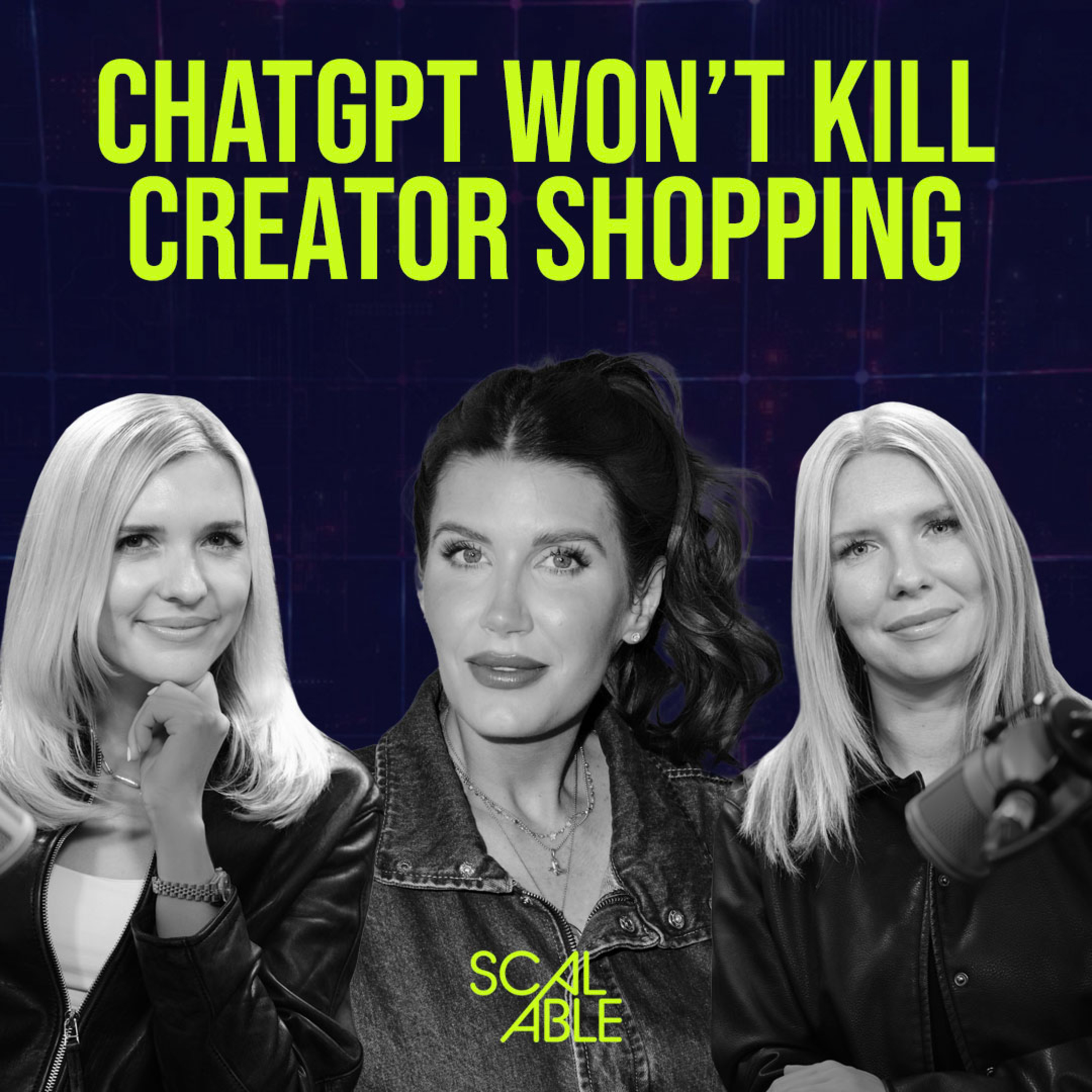
AI Transforms Creator Commerce and Dubai Influencers React to Drone Strikes
In short
The episode of Scalable covers two threads: (1) how the creator economy is reacting to the US/Israel-Iran conflict after drone strikes that hit places including Dubai and Doha, and (2) how AI is reshaping creator commerce and social shopping—especially shopping discovery, attribution, and whether AI will replace creators.
Guests and backgrounds
Amber Venn-Box, co-founder and president of LTK (creator commerce company) that launched an AI shopping chatbot trained on LTK creators’ content. Also mentioned: Kaya Yurieff and Jasmine Enberg (hosts). Other guest-like figures discussed include Jack Dorsey (Block/Square CEO) and examples from Visa’s CMO Frank Cooper and CNN Creators’ Doha-based team (journalists).
Key claims
Dubai’s “safe haven” image may be cracked by conflict and travel risk; creators often stay neutral due to legal restrictions on UAE criticism. AI will change shopping, but social/creator discovery and trust remain hard to replace. AI chatbots may worsen attribution/credit issues.
Notable examples
MoVlogs’ Dubai-based post (“hearts are with everyone”); Joelle Mardinian reposting UAE-flag support. Block layoffs (~50% staff) attributed to AI. Klarna’s “700 agents” claim then redeployment. LTK chatbot rollout (25% users then 100%); Apple screenshot partnerships where LTK is credited.
Written by AI. May contain mistakes.
Chapters
0:47
AI and the Future of Creator Commerce
Discussion on the impact of AI on creators and social commerce, featuring a lineup of speakers for an upcoming summit.
“Will AI replace creators when it comes to shopping recommendations?”
2:06
AI and the Future of Creator Commerce
Discussion on the impact of AI on creators and social commerce, featuring a lineup of speakers for an upcoming summit.
“who is the co-founder and president of creator commerce company LTK, which just launched an AI shopping chatbot that Amber says is good for creators.”
4:27
Geopolitical Impact on the Creator Economy
Analyzing the recent geopolitical tensions and their implications for the creator economy in the Middle East.
“I mean, it's much easier to get a visa to a place like the UAE than it is to the United States, for example.”
7:23
Creators' Responses to Current Events
Exploring how creators in the UAE are reacting to recent drone strikes and the political climate.
“In the meantime, though, as all of this is playing out, it's been really interesting to see how some of the region's top creators have been responding and reacting to the news.”
9:39
AI's Impact on Workforce Dynamics
Discussion about job layoffs in tech companies due to AI and its implications for the creator economy.
“including non-political creators who have been using social media to speak out against political and other social issues, including ICE aggression in Minnesota most recently.”
14:00
AI's Transformative Impact on Engagement
Learn how AI is changing online engagement, shopping, and business integration.
“the way as they make this shift toward more AI.”
17:30
The Rise of Social Commerce Conferences
Discover the significance and evolution of social commerce conferences like SOCOM.
“Yeah, I mean, it's been so fascinating to follow the evolution of social shopping.”
23:10
The Evolution and Challenges of Social Commerce
Examine the challenges and evolution of social commerce, especially with Meta's strategies.
“They have also been able to attract some major brands, including Samsung, Ralph Lauren, Disney, they're all selling on TikTok shop now.”
27:30
Shopping Mindsets: AI vs. Social Media
Understand the differing mindsets in shopping through AI compared to social media.
“But I think for the most part, the type of shopping that people do on AI isn't the type of shopping that they're doing on social platforms or with creator content.”
28:01
The Evolution of Social Commerce
Explore how social media influences shopping behavior and the challenges faced by platforms.
“But I think that's more a matter of personal taste than anything else.”
Show all 25 chapters
32:07
Interview with Amber Venn's Box
Amber discusses LTK's new AI chatbot and its impact on shopping experiences.
“And that is a perfect segue to our next segment, which is your interview with Amber Venn's box, recorded last week just after the launch of LTK's AI chat box.”
34:12
The Role of Creators in the AI Age
Learn about the unique contributions of creators in a shopping landscape influenced by AI.
“So it's unique in that it's both discovery and it's actionable and it's from a real trusted human.”
36:52
LTK's Unique Positioning for Brands
Amber explains LTK's advantages for brands compared to traditional platforms.
“I think that's why we're seeing the rotation candidly into LTK, where it's known that these are real humans with real recommendations.”
42:00
The Role of AI in Commerce Growth
Learn how AI and data are pivotal for the growth of the commerce industry.
“it future-proofs the industry, but we're able to do really cool things, like have the chatbot or to be the infrastructure in the device, in your handset.”
43:14
LTK vs. Social Media Platforms
Discover how LTK positions itself against major social media platforms for brands.
“For these platforms, LTK is actually the monetization system.”
44:29
Competitive Landscape in Creator Commerce
Discuss the challenges LTK faces from competitors in the creator commerce space.
“So it does just go to show you that, you know, their priorities are changing.”
45:15
Navigating the Creator Economy as a Female Founder
Explore the unique challenges and experiences of a female founder in the creator economy.
“That's still the ultimate goal, which is why you've seen LTK continue to innovate over time.”
47:42
The Early Days of LTK and Its Evolution
Hear about the foundations of LTK and its journey through the digital landscape.
“And so we've been meaningfully profitable for a very long time.”
50:51
Building Relationships with Retailers
Understand how LTK established connections with retailers in its infancy.
“We've continued to move through social media platforms as they've popped up and just figured out a way to make it a creative to our businesses and as a way to expand the creator opportunity.”
53:16
Challenges in Fundraising and Investor Relations
Delve into the complexities of fundraising as a female entrepreneur in the tech space.
“and that was just the timing is aligned to that.”
54:52
Successful Rebranding Strategies
Learn about the strategies behind successful rebranding in the creator economy.
“I cannot tell you, I've lost easily 20 years of my life through that fundraising round, both because I had never done it before.”
56:00
The Challenges of Business Ownership
Exploring the complexities of having control in a business after rebranding.
“and a better legal team around me and all of that stuff.”
56:27
The Evolution of LTK and Its Branding
Discussing the journey of rebranding Reward Style to Like to Know It and its implications.
“So I'm quite literal, which can serve me well and then sometimes doesn't always.”
58:24
Insights on Creator Commerce
Key observations on the needs of brands in the creator commerce space.
“So then we made the choice to rebrand globally as LTK because really there's a technology infrastructure and then there's what the consumer like ultimately sees.”
59:23
Keys to Success in the Industry
Highlighting the essential qualities a founder needs to thrive in the industry.
“I'm like, I didn't park at the mall so that I could like have to have something shipped to me.”

Ask about this episode
Get the gist, explore an idea or ask about something said.
 Claude
On Scalable, what are the key points of this episode?
Searching your listeningTranscript
Automatic transcript. May contain errors.
0:00Hi, everyone. This is Scalable, a weekly show about the business of the creator economy.
0:04Jasmine Enberg: I'm Kaya Yurieff. And I'm Jasmine Enberg. Every Thursday, we take you beyond the headlines to tell you what's happening, what it means, and why it matters.
0:29matters. Automated recovery, clean data, a business that keeps moving no matter what hits. One platform, not a patchwork of stitched together tools and gaps. Don't wait for the next attack. Secure and accelerate your business at rubric.com. Again, rubric.com.
0:47Jasmine Enberg: Will AI replace creators when it comes to shopping recommendations? If history has taught us anything, social commerce and creators will be just fine.
1:00Hi, Jasmine. Hey, Kaya. Before we get into today's podcast, we are excited to announce our second round of speakers for the Scalable Summit happening on May 6th in LA. We will be joined by Hannah Stocking, who has over 71 million followers across social platforms. She's also starred in a Netflix rom-com, an upcoming micro drama, which we also covered on this podcast.
1:23Jasmine Enberg: We're also very excited to be joined by Frank Cooper, the CMO of Visa. Visa, of course, has a really interesting creator strategy. It has also released financial tools specifically for creators, so we're super excited to hear more about that from him. Also new to our speaker lineup, we have Nishat Kurwa, an executive at Box Media's podcast network, as well as Dylan Wells, who is the Washington Post's inaugural creator host, who also just launched a newsletter about the creator economy. They are going to be on a panel talking all about how to navigate the new era of news and information. Our special early bird ticket pricing is still available, but only for a limited time.
2:01Jasmine Enberg: So make sure you go to scalablepod.com slash summit to get your ticket today. And later on in the show, stick around for Jasmine's interview with Amber Vens-Box, who is the co-founder and president of creator commerce company LTK, which just launched an AI shopping chatbot that Amber says is good for creators. I'm so excited for you all to see this interview. I mean, first it was filmed at the lighthouse in Venice, and it's so much fun to conduct these interviews in person. And also because LTK has been around for about 15 years now. And so it really has seen the evolution of social shopping, which of course has had a lot of stops and starts over that time.
2:39Jasmine Enberg: Now it does finally feel like we're in a place where social commerce has been legitimized. Of course, it's facing a new threat, which is AI. And Amber and I talked a lot about that, what AI means for a creator and social shopping, and we're also going to focus most of the episode on social commerce overall. But before we do that, we wanted to take a moment to talk about the global news that has been dominating headlines and what it means for the creator economy. Over the weekend, the US and Israel launched a massive attack on Iran and Iran retaliated with its own strikes across the Middle East, including in Dubai and Doha.
3:14As we've discussed in the past, the creator economy touches everything now from news and politics to sports and marketing and the crisis in the Middle East, which escalated over the weekend is no exception. So much news and information is playing out now on social media. And we've seen this before. In Ukraine, creators were live streaming and posting about their evacuation during the Russian invasion. And they gave us a really intimate view of the situation on the ground. And they also showed us the danger of misinformation and the ability for disinformation to go viral, especially in complicated and fast moving situations.
3:48There are so many ramifications here. I mean, we've both spent quite a bit of time this year in the Middle East. We are, of course, by no means geopolitical experts, but we have been covering how the Middle East is becoming a hub for the creator economy with cities like Dubai investing millions of dollars and bringing creators and businesses to the region. So the big question is, what happens next? And how does the conflict impact those efforts?
4:11Jasmine Enberg: It's certainly a big question that I think a lot of people are asking. But you know, To your point, we have spent a lot of time in the region recently. And, you know, from our time talking to people in the creator economy and friends who are living there, I mean, one thing we've heard repeatedly is how safe it's been and how attractive of a place the Gulf states and Dubai in particular have become as a place to raise a family. I mean, it's much easier to get a visa to a place like the UAE than it is to the United States, for example. They also don't have an income tax, so people tend to end up earning more money there than they do in their home countries.
4:49Jasmine Enberg: Things like childcare and cleaning services are much more affordable than at least what we're used to. I mean, the flip side of all this, of course, is that they do have to balance that with other restrictions in the country. I mean, it wasn't until 2020, for example, that unmarried couples could live in the same apartment or even share a hotel room in the UAE. I was surprised by walking in the Dubai Mall in January, and there's designer goods kind of on display without, you know, a huge amount of security because stealing and pickpocketing is not, you know, an issue in the region. And I think so many places you go to, when you're in that kind of setting, you see much more security on that front.
5:28And as we reported earlier this year, the UAE and the Middle East is trying to be seen as a place for innovation. That's why you're seeing so many startup founders raised there. You know, we saw Mr. Beast open that temporary theme park in Riyadh as well. So you're seeing so much investment for creators. And as we reported in January, Wuggenheim Brothers Media announced a more than$50 million fund to back creator economy companies that was in partnership with an Abu Dhabi based company. And as part of that agreement, one of the founders of the firm moved to Abu Dhabi from the US with his family.
6:01Other creator economy founders have also recently moved to the UAE, seeing it as a good place to do business. And it's too soon at this point to have any real answers for what's going to happen. But this certainly seems like it would hamper these efforts, you know, particularly in the short term and also give people pause from traveling to the region for conferences or business meetings.
6:20Jasmine Enberg: Yeah, I mean, it's certainly giving me pause. I'm supposed to go back to Dubai, in fact, for a wedding relatively soon. And I'm reconsidering whether it's, you know, worth the risk to take the trip. I mean, it may ultimately end up that I don't have a choice in the matter if the airspace is closed. But, you know, there's a lot of considerations that I need to weigh as I'm thinking about it. But anyway, I mean, I think you're right. A lot of people are in wait and see mode. It's too soon to tell what the ultimate impact here is going to be. But it certainly already has put some cracks in Dubai and other Gulf states image as a safe haven and what is otherwise a very volatile region.
6:58Jasmine Enberg: And that could have a ripple effect on their efforts to attract creators and businesses from around the world. As you mentioned, Kaya, the Dubai government has spent at least tens of millions of dollars trying to bring in international creators as well as tech businesses and build the infrastructure around the creator economy and really help to position it as this hub for the global creator economy. And all of that, of course, is in an effort to look like a modern, innovative place to do business. In the meantime, though, as all of this is playing out, it's been really interesting to see how some of the region's top creators have been responding and reacting to the news.
7:37Jasmine Enberg: So on Sunday night, in the immediate aftermath of the drone strikes, I took a peek at a few of their profiles. And what stood out to me was that many of them either said very little or played it safe, meaning that they weren't really taking sides. Now, of course, I was looking primarily at creators in places like Qatar and the United Arab Emirates here. But one example, which is Dubai-based MoVlogs, he has about 12 million YouTube subscribers. He wrote on an Instagram story, quote, our hearts are with everyone across the UAE and the region. There was also Joelle Mardinian, who is a Lebanese beauty creator and an entrepreneur.
8:13Jasmine Enberg: She also lives in Dubai. She reposted a story that said, quote, we chose this country and we stand with it. and it had a picture of a UAE flag. But that story was sandwiched between other stories that were promoting her TV show and promoting her beauty clinic. And that felt kind of jarring, at least to me, given, you know, all the images we've seen of what's been going on there. And it also started to paint this picture of, you know, everything just being business as normal. And, you know, to be fair, from many of the people that we've spoken with in the region, that is kind of how they feel as well.
8:48Jasmine Enberg: And all of this can still change. I mean, things are moving really quickly. On Monday afternoon, the U.S. State Department, for example, called for Americans to evacuate immediately from 14 countries in the Middle East due to, quote, serious safety risks. And that includes the UAE. And since then, we have seen some more influencers express shock as well as confusion. But mostly our Reels feeds up until at least Tuesday have been filled with videos trying to quell fears and paint more of a picture of calm in Dubai. One of the videos that came from someone with 10 ,000 followers said, quote, I feel safe here.
9:23Jasmine Enberg: There was another video of the president of the UAE that was making rounds on social media. It showed him in the Dubai mall having coffee amid all of this. And I think that, too, was intended to show life as normal in the city. And I think, you know, the takeaway here is that the early reaction, at least, from some of the top creators in the region does feel in contrast to what we've seen from creators in the U.S., including non-political creators who have been using social media to speak out against political and other social issues, including ICE aggression in Minnesota most recently. I do think it's worth noting, though, that criticism of the government in the UAE is illegal.
10:03Jasmine Enberg: And that might be one reason that some creators and influencers there have had some pause in speaking out about what's going on. I think to zoom out, I mean, like you said, it's very jarring to see kind of these big historical events and other tragedies play out on social media in general, you're flipping through, you know, Instagram stories, and you see news headlines and people dying in war. And then you see, you know, your friend posting a picture of their baby or an influencer with a cocktail on a Saturday night, right? So or an ad from a brand trying to sell you something. Definitely. So I think it is this, it's this weird moment to be on online looking through all these things.
10:39I think one other interesting thing to point out is that CNN Creators, which is a new show that's anchored out of Doha. And it's also part of a broader initiative from the network to tell stories that are in the zeitgeist around social trends is getting a big spotlight right now because the CNN creator hosts are on the ground in Doha, and they're doing traditional media reporting from there. Of course, it's worth keeping in mind that the CNN creators are seasoned journalists. They, you know, they were put in these roles to cover different types of topics, not just hard news. But given that they are there, it makes sense that they're tapping them for this.
11:09But the main CNN social media account has been cross posting with the CNN creator host accounts. So it was kind of interesting to see how that impacts their strategy moving forward. And we wrote more about all of this in our newsletter this week as well. Moving on to other news, Block, formerly called Square, is laying off about 50 % of staff, which is about 4000 employees due to AI. Here's what CEO Jack Dorsey wrote, quote, we're already seeing that the intelligence tools that we're creating and using paired with smaller and flatter teams are enabling a new way of working, which fundamentally changes what it means to build and run a company that is causing a lot of panic across all industries, including in the creator economy.
11:48As John who, who is the founder of creator startup Stan put it quote, it's crucial that you zoom out and think about how you want to stay defensible, defensible amidst an unprecedented paradigm shift.
11:59Jasmine Enberg: Yeah, I mean, I think the panic is understandable, right? I mean, these are people's livelihoods that are at stake here, but I do think there's also a lot of questions around whether AI is the primary reason behind the layoffs or if the company was just hiring too aggressively over the past couple of years. Either way, though, I think this is going to be a big test case for AI in the workforce, which so far actually has had pretty mixed results. If you remember back in 2024, payment company Klarna famously said that AI could do the job of 700 customer service agents and then subsequently reduced its workforce and that included a lot of customer service roles.
12:37Jasmine Enberg: Flash forward a year later, it started redeploying people from around the company to those customer service roles, according to a report from Business Insider. And the CEO also admitted that it had maybe gone a little bit too far. At the same time, though, I actually just saw an article with an interview with the CEO of Klarna and he was talking about how by 2030, the company is going to have fewer than 1 ,000 employees, which is down from about the 3 ,000 it has today and 7 ,000 it had before those workforce reductions. That is shocking too, but that's also almost four years from now, which is an eternity in the tech world.
13:15Jasmine Enberg: And I also think a lot longer than what a lot of people might imagine when they see some of these quotes from Jack Dorsey, for example. And given how fast the technology has been developing. I mean, what we have today is very different from the chat GPT already of 2024. But I have to say that it's not necessarily going to be smooth sailing for blocked. I mean, one of the other things that he wrote was that these technologies may not perform as expected, may require more time or expense to implement effectively, may introduce operational or cybersecurity risks, or may fail to enhance productivity and maintain operational efficiency as expected.
13:55Jasmine Enberg: Okay, that is a mouthful. It is a direct quote. But what it's basically saying is that there's likely going to be some hiccups along the way as they make this shift toward more AI. Yeah, but I think at the same time, like it's hard to deny that AI is not already transforming, right? How people are engaging online, including, you know, how they search, how they shop, both things can be true at once. I mean, I think we find this in our own work where we're like, oh, we wish AI could do, you know, XYZ, especially as we're, you know, a lean team of two at the moment where it's just not there yet. So both things can be true where the technology is advancing super quickly.
14:32But it's still not at that level, at least for us, where there's certain things we love AI would do.
14:38Jasmine Enberg: There's also the human aspect of it too, right? I mean, you still have to train people on AI as you're implementing it into your business. And I think that's one piece that a lot of people forget about it, because most people at these companies aren't trained or have the skill set to use AI yet, because it really truly is a skill. And it's moving so fast as well. So as these companies are trying to kind of figure out how to integrate AI internally, they're also trying to figure out how to keep up on the consumer side. So we've seen companies like Gap and Amazon launch their own AI chatbots to help people discover and buy things from their site.
15:12And now creator economy companies are also getting in on the action. LTK's Amber Vance Box actually announced the launch of that company's new chatbot on stage with you at SOCOM, Jasmine. So tell us about SOCOM for those who are not familiar with this conference.
15:27Jasmine Enberg: Yeah, so this was the second year of SOCOM, which stands for social commerce. It was also my second year speaking there, and I was very honored to have the keynote fireside chat with Amber. I think first and foremost, what struck me is that there is now a whole conference dedicated to social commerce alone. Of course, the topic has become part of larger retail conferences. I'm thinking ShopTop, for example, and NRF. But it tends to be a side note, despite there being tons of interest in the topic. And I remember once giving this seven-minute presentation on social commerce and how it's evolved.
16:02Jasmine Enberg: at one of those conferences. It was basically the only session that was dedicated to social commerce and the room was totally packed. So there's definitely been a lot of interest there, but again, it just hasn't been a big part of these conferences. And I think having this dedicated conference really shows that it's a real industry now. And more than that, it wasn't just social commerce specific companies that attended it. Of course, you had whatnot, You obviously had LTK. You had a lot of influencer marketing companies that were there. But the second keynote of the day was actually given by Amazon.
16:36Jasmine Enberg: And then you had companies like TikTok, Pinterest, Gap, YouTube, all speaking, which I think just goes to show that it's now an industry that's being taken seriously by large tech platforms as well as big brands and retailers. Yeah. And I mean, like your seven-minute presentation, which I'm sure was fabulous, you were one of the first analysts that did take social commerce seriously. And you started covering it back even before the pandemic. I think COVID obviously really skyrocketed the space because everyone was shopping online. But I know my former colleagues at The Information Often were reaching out to you for analysis, especially when Meta was backtracking on a lot of its shopping capabilities.
17:16But now if you look, social commerce is, you know, more than$100 billion industry based on estimates from eMarketer. But it's still a small slice of total retail sales. But obviously, it's grown much more quickly. And$100 billion is a massive number for a part of the retail market that has been dismissed often.
17:32Jasmine Enberg: Yeah, I mean, it's been so fascinating to follow the evolution of social shopping. And I think people have been very quick to write the obituary for social commerce many times, including when Meta was rolling back a lot of its shopping features in about 2022-2023, which you were referring to. And that included things like live shopping, its affiliate marketing program for creators. Whereas it also took a couple of steps back with Meta Checkout, which is its in-app checkout tool. But those people were kind of missing the big picture of what was going on. Because to your point, a lot of those features and tools were rolled out during the pandemic.
18:08Jasmine Enberg: Meta, as well as other social platforms, really wanted to capture a piece of the online shopping boom. But that was not the only reason. A lot of these tools and the shopping push more broadly really was a response to Apple's privacy changes that were upcoming that really threatened to hamper the ability for Meta and other social platforms to collect personal data from their users, which Meta needs in order to sell ads, which of course is its primary business. So tools like in-app checkout were a way for Meta to start to fill in some of the gaps from the potential missing data. They would have highly valuable purchase data, for example, that they could use to better target their advertisements.
18:52Jasmine Enberg: Of course, that didn't work, right? Because people did not want to use Meta Checkout. And there's a lot of different reasons why. I mean, you had trust concerns, privacy concerns. You also just had established habits. Like, it's really annoying to have to fill in all of your personal and payment information again, especially when you have it saved somewhere else. And then there was the question of customer service. Like, who do you call when something goes wrong? And all of this, I think, was really unclear to a lot of customers. It was also really unclear to a lot of brands who didn't end up signing up for MetaCheckout for similar reasons.
19:27Jasmine Enberg: I mean, one, they probably already had multiple sales channels and they didn't want to add another one, especially one where they may not have had as much control over the data or the customer experience. And so it didn't end up working the way that Meta had initially intended for it to. Yeah. And if you think back to what was happening kind of in the news cycle at that time, Meta was in so much hot water over privacy concerns that people were not comfortable. When is it not, though? Okay. But right now, its moment is teen safety. So like that's sort of the moment now, like right now. And I know those are related, but I think now it's more like we're in this like social media addiction, social media is bad, Instagram is bad moment.
20:07Whereas before it was like meta privacy was like the headline. And I think the habits also were a huge part of this, right? Like people were totally fine with shopping via an ad on Instagram, but few of them wanted to kind of check out directly, even though logically that feels easier. You don't have to like go to a separate page, even if you have, you know, your login saved there.
20:27Jasmine Enberg: Then you have to type it all in again. It annoys me. And I think also the other thing I was thinking about when when preparing for this episode is like, just because there are stops and starts doesn't mean that like the trend goes away. It's the same thing like Meta and all these companies rolled out the creator funds and then rolled them back and then brought them back in different capacities. Like all through those times, yes, maybe the internal company priorities shifted, but it doesn't mean that creators weren't important. And same thing, obviously, commerce has been a huge, huge driver for their ad business and for the company.
20:56So it doesn't mean that people were like, oh, suddenly we're not shopping from Instagram ads anymore.
20:59Jasmine Enberg: Yeah. And to that point, I mean, it's very notable that Meta did not pull back on any of its shopping ads. Instead, it pushed further into them because it recognized that shopping and product discovery, inspiration generally from creators is a really important reason why people use a lot of its platforms. At the same time, though, just back to sort of like the overall story and why some of these shopping features were rolled back by Meta, we were also in the post-pandemic ad slump. And a lot of that also had to do with Apple's privacy changes. I remember back in 2022, Meta's chief financial officer said that it could lose up to$10 billion from those changes, which ended up being just about 10 % of Meta's total ad revenue that year.
21:44Jasmine Enberg: And that was just before Meta entered its year of efficiency. Do you remember, Kaya, in 2023? It had had its first ever year-over-year decline in ad revenue, and it knew that it really needed to reorganize and refocus on the things that are bringing in money. And the shopping features, for the most part, I mean, they were resource-heavy, they were also costly, and they weren't bringing in the kind of revenue that Meta needed at this point. But again, none of this meant that people weren't shopping on social media. They were. It just meant that Meta's priorities had shifted. Yeah, and I think the other thing, too, is they often, we see these things ebb and flow depending on what their competitors are doing.
22:26So then, of course, we saw TikTok shop burst onto the scene. And there was also a lot of skepticism around TikTok shop. And a lot of it was warranted, right? Like, I think people's initial impressions were this is kind of a Timu-like, you know, Amazon ripoff, lots of low quality goods.
22:42Jasmine Enberg: They weren't entirely wrong. No. I remember ordering something for the first time and I was like, am I going to get it? And it came in this like it came four weeks later in this, you know, ripped up box and the platform, you know, had not built the trust that the items would come or that the quality would be good. But as we discussed in a previous episode, it does feel like TikTok shop finally has turned the corner. And I think we're seeing the sales figures support that as well. While there is, of course, still plenty of low priced goods. They have also been able to attract some major brands, including Samsung, Ralph Lauren, Disney, they're all selling on TikTok shop now.
23:19Plus, there's also some higher end items as well. I mean, secondhand Rolexes and designer handbags are also now being sold on TikTok for for 1000s of dollars. So that is quite the change from a few years ago. I think also the US ban threat stopped brands from moving forward. I mean, they're already kind of slow to adopt something like this. But the continued uncertainty around, you know, launching it was another hurdle. But the holiday season this year was I think the big turning point, right? It was not just the optics around TikTok shop shifting, but also the numbers. And if you fast forward to today, TikTok shop US sales are expected to be at about$25 billion in 2026.
23:57Jasmine Enberg: TikTok shop is such an interesting one, too, because even before it launched, of course, people were already shopping from TikTok. I mean, it had commerce ads. And I think the one thing that kind of has worked in TikTok shops favor and that I wrote about at the time was also that TikTok, of course, has a really large Gen Z user base. And Gen Zers, unlike, you know, baby boomers on Facebook or Gen Xers and millennials who are on Instagram, they don't have established habits in the same way with retailers. And so there was a lot more experimentation, I think, that was likely to happen there with their shopping.
24:31Jasmine Enberg: And they're also a lot more trend driven. And of course, that's what TikTok is known for. Beyond that too, I mean, I think just looking more broadly at the retail landscape, but the ripple effect that TikTok and creators have had on the shopping experience is kind of undeniable. And I think really just speaks to the overall importance and staying power that social commerce has. I mean, I was in Ulta the other day, they had this end cap of, you know, trending beauty products from TikTok. And then look at all the companies that were racing to make copies of TikTok at one point in time, you had Amazon Inspire, of course, which didn't work out, as well as all the companies, the retailers, the tech platforms that were rushing to buy TikTok amid all of the sale drama.
25:12Jasmine Enberg: Again, you had Amazon there and Walmart, right, that had, you know, reportedly made bids for the company. And so I remember at the time, too, saying that all of this really just means that you had these tech platforms and these retailers really taking TikTok and social commerce seriously, even if the narrative in the media was that it wasn't all that important. And now it's all about AI. That news cycle has been replaced by kind of chasing AI. And I think creators have always had to deal with changes on platforms, right? And the rise of new technologies. I mean, Instagram shifting from photos to video, you know, pivoting to short form when TikTok got big.
25:51And I think the savviest ones keep evolving. And all these changes also usher in new generations of creators and new types. AI definitely brings big new challenges, though, maybe bigger than any of these other shifts. I mean, I think as people search more using AI, there's a lot of downsides for creators, they risk losing visibility if they're pushed down or replaced by AI summaries. And the credit is a huge issue. I mean, we've seen this time and again, where AI is not crediting where the work is coming from. And all of this could translate into declines in viewership and engagement on their core platforms, I think, and potentially maybe people tuning in less to original content from creators, it could cut into affiliate link earnings, all sorts of things.
26:32I think obviously, these concerns are, you know, more serious for some type of creators than others. If you think about like food creators and travel creators who are curating, you know, recipes and travel guides, right? Like the links can get buried the credit, like if you're searching for a travel guide, and you're turning to chat GBT, right? And chat GBT is telling you, you know, the top destinations and where to go. But I think this is as always nuanced, right? Like people search in different ways, they make decisions in different ways. Like, yes, if you're looking for quick answers, or you're just doing research, maybe, you know, chat GBT is replacing some of that or other chatbots.
27:09But I think people are always going to search for social proof, You're still going to text your friends for travel recommendations, for restaurant recommendations, and people are still going to turn to creators who have also been to those places and whose recommendations they trust. And that's really hard for AI to replace.
27:23Jasmine Enberg: Yeah, I think that's such a good point because shopping comes in many different forms, right? And I think we kind of lump everything into this e-commerce bucket. But I think for the most part, the type of shopping that people do on AI isn't the type of shopping that they're doing on social platforms or with creator content. And Amber and I talked a lot about this too in our interview. But like if you take ChatGPT for an example, it is great when you have a product in mind or if you're looking for a deal. So, you know, that wedding that I mentioned that I'm maybe going to in Dubai soon, I'm a bridesmaid.
27:55Jasmine Enberg: So I have a color palette and I put it into ChatGPT so it could find me options for a dress to buy. And it gave me a ton. Some of them were good. Some of them weren't. But I think that's more a matter of personal taste than anything else. And it also gave me prices and discount codes. And I appreciate all of that because, you know, as it goes with bridesmaid dresses, I'm probably never going to wear this dress again. But when you're shopping from creators or on social media more broadly, most of the time you're just browsing or looking for inspiration. Or you've gone onto social media for an entirely different reason.
28:29Jasmine Enberg: And you've just stumbled across something that you didn't even know that you wanted to buy. And this is an entirely different mindset. said, I remember when I was way back when first describing social commerce to brands and marketers, the thing that I would say is that social media is like a digital shopping mall. Sometimes you are going there to buy certain goods, but it isn't always the primary reason. If you think back to the 1990s, I used to hang out in a mall. There would be concerts in a mall. I mean, there was tons of different things to do. And now you have influencers and creators who are basically like the salespeople, right, that you had in the mall before, or the ladies at the beauty counter who would help you pick out the right shade of lipstick or foundation or whatever it was.
29:11Jasmine Enberg: So that kind of paints the picture of what, you know, social media is like in the shopping experience. That also poses a lot of problems for social platforms and points to one of the reasons why they haven't been able to build social commerce to a bigger share of the overall retail market than what it is today. I mean, they've never really been able to build a search business, for example, the way that Amazon has. And there's a couple of reasons why. I mean, one, of course, their search is a mess. I think we all know that. But two, they're not able to show intent in the same way that an Amazon can, right?
29:43Jasmine Enberg: When you're going onto Amazon, again, you probably have a product in mind and you're in a shopping mindset that isn't necessarily the case when you're searching for even, say, a lipstick on Instagram. Yeah. And even like Pinterest, right, where you do have that intent has struggled also to convert that into sales. So it's been a tricky one for these platforms to crack. So do you think it's possible for AI to completely change how we shop and overhaul that? I mean, I think it is already changing the way that we shop. But I think that it's more nuanced than maybe many of us think, right? I mean, the path to purchase generally isn't linear, you might, you know, find one thing on social media, then research it on chat, at GBT or say Google and then buy it on a retailer site or even in store.
30:28Jasmine Enberg: And, you know, that poses a lot of problems for brands and retailers and creators, like you pointed out, because it becomes really hard to track and attribute those sales. But that's not something that AI chatbots are going to be able to solve magically. And, you know, again, to your point, they could probably exacerbate the problem because they're not giving credit to the original source. And that makes it even more difficult for brands to understand where that sale truly came from. I do think, you know, there are certain categories where AI could fundamentally change things, right? And people might go from discovery to purchase in a single place.
31:04Jasmine Enberg: I'm thinking, you know, I might let ChatGPT replenish my soap or my toilet paper, but I'm never going to let it. But Amazon's already doing that. Amazon's already doing that. Yes, it's so true. And it's incredibly convenient, which is why I also don't really buy the convenience argument for AI shopping. Also, because there's a joy in shopping that I think a lot of people forget. I mean, you do things that are inconvenient because you enjoy it. Like I will go to a mall, even though it means that I have to drive there, find parking, which is possible in LA, but I like being there and looking at all the pretty things in the windows.
31:39Jasmine Enberg: But back to the point of chat GPT for a second. I mean, I might let it buy toilet paper for me, but I'm not going to let it book a vacation for me. I'm also not going to let it pick and buy the outfit that I'm going to wear on stage. It can when we go later this year. So I think overall, while yes, AI is a challenge for creators, it is changing the way that they have to behave online, it is certainly not going to mean the end of social or creator shopping. And that is a perfect segue to our next segment, which is your interview with Amber Venn's box, recorded last week just after the launch of LTK's AI chat box.
32:17Jasmine Enberg: Hi, Amber. Welcome to Scalable. Hey, I'm so happy to be with you in person, finally. I know. And you're in LA, which is incredible. And you got the perfect weather for it. It's been raining. And today it's really, what did you call it? The Chamber of Commerce day for LA? It's literally perfect. The sun is out. The weather is crisp. And then I just ate really healthy food and sat next to a million stylish people. It's like a perfect LA day. I love that so much. So LTK has been around for about 15 years at this point, and I definitely want to talk to you all about your journey as well as the evolution of the company.
32:47Jasmine Enberg: But I wanted to start our conversation today with the news because you just had a big announcement. We did. So just this morning, we launched the LTK AI chatbot, which is a really phenomenal product. Every year, our creators publish 7 million pieces of content. It's original content in our app. What we've seen lately is that customers are really rotating to LTK to go search for things. So even since September, search is up 200 % in our app. They're looking for real trusted recommendations from humans. And so while our traditional search had gotten much better, what people expect today is a chat interface.
33:21They're looking for a companion that can surface the best for them. And we have the original content and the original recommendations. And so we launched that this morning. It's currently rolled out to 25 % of our users. It'll roll out to 100 % by Monday. Wow. And you can ask it anything. Tell me about fashion week. Like, what were the trends? Like, who are the top creators to follow from that? Or, hey, give me some Super Bowl content. Or, you know, I'm going to Nashville. Like, where should I eat and what creators to follow? It's all, you know, based on the unique data set that we have. And it's personalized to you.
33:48So your feed will actually be different than mine. Your conversations will be different because it learns your preferences, whether that's from a brand, a creator perspective. So it's an exciting tool to bring to market.
34:00Jasmine Enberg: That's so interesting because one of the questions I was going to ask you is what problem does it solve? Obviously, there's a gold rush for AI. Everybody is rolling out AI tools, but having a specific unique need that actually improves the experience for customers isn't always the case. So it's unique in that it's both discovery and it's actionable and it's from a real trusted human. I need to know what I'm trying to get at when I go to other chat services and they're not specifically tailored to shopping or content, right? Like they're going to search kind of what's publicly available, what they're able to have access to.
34:31And they're great at things like, I need this ski pant in a size four long, like where has it? You know, that type of stuff. Or there's other AI, you know, surfaces that we're seeing that kind of do price comparisons. That's really not the market that we're entering into. What we have is a unique data set of this original content from real trusted people. And so we're able to then surface that and make it discoverable in a conversational context. And so search has moved from keyword to conversation. And what we're trying to do is add that trust layer to AI and discovery. And creators uniquely can get you in a discovery flow where you didn't know what you actually wanted, whereas I'm finding other services are great from a shopping perspective when you already know what you want.
35:14And it's only trained on content from LTK Creators, right? LTK Creators is the only content that it's trained on, that's true. And then we are also able to pull in context from outside. So for example, when I tell it that I was coming to LA on Thursday and I have a dinner at Chateau Marmont, it actually knows that it's Thursday, it's LA, that what the weather is, it's bringing in that kind of context of what style would be expected. And so it's giving me kind of more context than LTK would have normally had as far as like weather location, personal style.
35:42Jasmine Enberg: So zooming out a little bit, because I think there's a lot of people out there who think that AI is going to replace creators in the shopping journey. I know you and I both disagree with that, but tell us why. There's a couple reasons. I think one is that creators surface the content that you never know you wanted, right? Like the places that you never knew you wanted to go or the recipes that you never knew that you wanted to try, the clothes that you didn't know were in style. For example, I wore a pillbox hat in New York Fashion Week. I did not come up with that on my own. I found that actually through a creator.
36:10And even if I then go to an AI and say, hey, give me the best price on a pillbox hat that can be here by Thursday, the discovery point is still the creator, right? And it's still a real human that I'm following because I admire or I trust in some way. And so the originating point is still kind of that human creation. Let's back up for a second because there's actually, because everyone knows now that the feeds are proliferated with AI and because then you're layering in algorithmic feeds where you no longer know whose content you're seeing, you have this real trust crisis online. 87 % of people now say that they can't tell what's real or fake online.
36:46I'm definitely in that group. I see a lot of things. And then I'm like, where do I actually go research to find out if these things are true. Like, can I go to Google? Can I go to chat GPT? Like, where do I run this through? Like, what's the truth filter, right? I think that's why we're seeing the rotation candidly into LTK, where it's known that these are real humans with real recommendations. Their reputation is on the line. Their business is in making trusted recommendations.
37:09Jasmine Enberg: I think there's also a joy in shopping that a lot of people seem to forget when they talk about AI replacing, you know, creators or even in-store shopping. You're seeing people return to malls, And of course, they're not the malls of the 1990s that you and I might remember. They're more interactive and they're bringing more of their digital experiences to life. But I think that's kind of lost in a lot of the conversation. And price isn't always the only factor, right? Even if you can get AI to give you or find you the best deal. I mean, there are so many sort of emotional reasons why people make the purchases that they do.
37:40Jasmine Enberg: At the same time, though, every time there is a new touch point added to the shopping journey, of course, it is somewhat of a threat. What are some of the ways that brands and creators need to change their strategies to make sure that they stand out in this age of AI shopping? It's really changing everything. Some of the cool partnerships that we've been working on, one is we have with Apple. They are seeing that their content is being taken across platforms of all kinds and then run through some sort of a lens or some sort of an AI filter that's saying, oh, this is what that was. And then giving that platform credit for the purchase instead of the original creator.
38:15They, in the fall, started ingesting the LTK library. So in the Apple handset, when someone takes a screenshot, you have the opportunity to see Google, LTK, and Pinterest. We're seeing that 68 % of the time, they're actually clicking through that LTK content from that screenshot and then going to that originating piece of content. So I point to partnerships like that as like the unique things that are happening that keep really the tracking such a simple word. But like the tracking intact, like the creator's getting credit. The marketer understands where it came from. The consumer is assured that actually the recommendation is coming from the originating source and not just an AI who's saying, hey, this is what I think it is.
38:51Things like that move it forward. And look, you know, I'm here in L.A. talking to marketers all day and they are thinking deeply about like what does attribution look like in this new era? And so we're we are working to make sure that the consumer has that confidence in the product that's being recommended. And it's not just a product.
39:09Jasmine Enberg: It's the product. Speaking of talking to marketers, you've also recently shifted your focus to be more on your brand platform, which is relatively new. So tell us about that and why you're so bullish on it. I'm super excited about this. It's a maverick move. It's quite rowdy. Not everyone even internally understood the thought process behind this. But for context for your listeners, you know, LTK, like you said, we've been in business for 15 years. We have scaled marketplace on all sides. So we have 38 % of Gen Z and millennial women using LTK every month. We have 400 ,000 creators running their business on the platform.
39:42We have 8 ,000 paying brands because they're receiving sales. When I looked at like, what's the next unlock for this industry? What I started to see from a marketer empathy perspective was they were licensing anywhere from three to five different point solutions in order to have the tooling for the creator marketing. They're licensing for creator discovery. They are then licensing for product seeding. They're then licensing for their tracking. And there's a million things that have to go on to connect these dots, right? And different types of creators in different places. So typically these platforms cost around$100 ,000 a year and up.
40:13And then you have to staff those platforms. That's a huge barrier to entry for some of the most amazing brands in the world. So last year we said, hey, what if we spend this whole year, we build a whole new platform. We make every drop of data accessible to everyone. We then build all those workflow tools that they've been using everywhere else, all in a single place, and we provide it for free unlimited seats. Because if we do that, every marketer in the world can come in. They can find the right people, action them quickly at low lift, totally at scale. And then basically what we're saying is we believe in our data and we believe in our scale and we think that you'll be successful because we make money when people buy and keep things.
40:50And so I'm so excited about this because it is totally radical, but it makes last year look like it was the 50s, you know, with marketers using all of these different solutions and just the heavy cost and burden of this and it just not being as efficient. I think creators win more dollars when we're able to prove value and connect the dots for large teams. We have teams of one using this platform. We have teams of 100 using this platform. And it's all free. It's all 100 % free. It's not freemium. It's free.
41:15Jasmine Enberg: Could you ever imagine a world in which you would, you know, charge to use these services? I mean, I feel like with the wealth of data that you have from LTK, I mean, this would make for a, you know, premium paid product you could sell to brands. You know, I think our approach is just a little bit different in that kind of leaning wholeheartedly into the paying for success, not access. I also think that the size and scale of our network means that we get to do really interesting things, even for the consumer, which ultimately helps these brands. Because these brands have sadly been playing ball and the creators have been playing ball on kind of like, you know, borrowed surfaces.
41:47And so we are truly built to make sure that the creator is successful, the brand is successful, and the consumer is successful. and we make money when that flywheel turns altogether. And so to have a place that's purpose-built for that, it future-proofs the industry, but we're able to do really cool things, like have the chatbot or to be the infrastructure in the device, in your handset. So it just allows us more leeway, but I think that this is how you grow the industry. I think putting up those sort of barriers now in the age of AI, really the differentiator is the data. And if we're able to put it in everyone's hands, I think that you'll see a lot more activity and a lot more successful activity in this space.
42:23Jasmine Enberg: So the other thing that's so interesting about LTK, the app, is that it's really built on creators and on commerce. And while it still, you know, competes to a certain degree with social platforms like Instagram and TikTok, you also partner with them in many different ways. But what is your pitch to brands? Why should they be on LTK versus Instagram and TikTok, which they're, of course, already on? I think they should be in all those places, actually. So it's probably misunderstood that we actually see these platforms as a complement. Social media is a qualified marketing machine. Before, it would have been so hard to find a super qualified lead.
42:56That's all I'm getting all day, every day. So the more interesting my content, the more I'm getting in front of people who would potentially like what I'm selling as a creator. But now it's my job to then just get them back to the home base. So the job to be done on social media is not build an audience. It's actually catch an audience and then bring them back home. For these platforms, LTK is actually the monetization system. By and large, these platforms are actually not paying creators at scale and certainly not a livable wage at all. But most of them, it's not a genuine statement to say that they're actually supporting the creator economy.
43:28In many cases, the feedback that you read after the shareholder calls is creators optional. AI is writing them out. Like that's sort of the narrative there. It's really actually a mutually beneficial relationship at this point. And you're right. For many of them, we have partnerships with them. And being that infrastructure layer, that's our approach. We already have 8 ,000 retailers integrated. We have 1 ,000 join our new platform in the last few weeks. Like this is a single door for all of these platforms to both access, to be the access point for the brands, but also for creators who are serious players, not the ones who are sitting and like, you know, spinning up, oh, I think TikTok shop, maybe today I'll start talking about this water glass and we'll see how it goes.
44:06People who have really built a community and an audience. And so I think being that single door is why, you know, we get to do cool things with Apple and with Pinterest and we've done great partnerships with TikTok. And I think you'll continue to see more of that.
44:16Jasmine Enberg: It's very interesting that you brought up earnings calls because we actually did an analysis right after the last earnings season, kind of looking at how many times these tech executives mentioned creators on the earnings calls. And on Meta's call, for example, creators did not come up once. So it does just go to show you that, you know, their priorities are changing. And right now it really is AI. Executives and, you know, analysts on the call mentioned AI about 50 times. So you can really see how those priorities have shifted. But one other thing I wanted to talk to you about, because of course, LTK has been incredibly successful, but that success has also inspired, you know, competitors in this space.
44:52Jasmine Enberg: Not all the businesses are exactly the same as LTKs, but you are competing for some of the same shoppers. I'm thinking about, for example, Whatnot and ShopMy. So how do you remain competitive as the market gets more crowded? I've always thought of our biggest competition as being big tech on every dimension. And so that's where we've like looked and aimed and really thought about what are the dynamics here and then how do we future proof this industry for our creators? That's still the ultimate goal, which is why you've seen LTK continue to innovate over time. As far as kind of new entrance into this space, you know, I'm sitting here today at a social commerce conference where the room is filled with high level C-suite executives that are focused on this space specifically.
45:37So there is an industry here. I will say there's some categories that I think we are conflated with that. So, for example, Whatnot is amazing business. Those people hold inventory. And so we think of ourselves entirely different in that, yes, we have talent. Yes, they're creating content. But the reason live commerce works is when you understand the inventory and you're able to say there's two left, there's three left. Or let me discount it further. Our creators don't have that level of control because they actually don't hold the inventory, their asset light. And so two very different business models.
46:08but in a space where you're using humans to compel someone to ultimately purchase. I think, you know, other point solutions we've seen pop up in the market have given us ideas. They've sharpened us. You know, I was talking to Baxter the other day, my husband and our CEO. I'm like, you know, some of our very best years are when the market fills up or there's like funding that happens because it really sharpens us and it really sharpens our team. It's like the best gift ever. It's like when you have like a super hard workout and all of a sudden you start care about your nutrition because you're like, you've got a goal and a focus.
46:37And I think about this last year is like, I don't know that I would have had serious urgency to do like major innovations like we've just done if there wasn't such momentum in the market. So in a lot of ways, honestly, our best years come out of those scenarios.
46:53Jasmine Enberg: A couple of months ago, I remember being really surprised because there was a lot of buzz, including some headlines. And people didn't really understand how big of a business LTK really was. And I was surprised at their surprise. And many of them were men. And so when you think about that, especially, you know, in terms of expanding your audience, which I imagine are primarily women, how do you sort of approach that? You're right. Our core user is largely female on really all sides of the business. We're seeing kind of growth in categories as we move into kind of like cooking and active and travel.
47:26You're starting to see more people move into our platform. But I think of many of these industries started actually female first. Even Pinterest was like largely a female platform as before it grew.
47:34Jasmine Enberg: The creator economy started with mommy bloggers. Yes, exactly. So when people aren't our core user, I'm typically engaging with them in a financing setting. And so we've been meaningfully profitable for a very long time. And so it's on me, I'm going to say, for not educating the market kind of about what's going on. It's just because we've not been in market. Investors do great when they invest in an industry they understand. Some of the biggest fails in the creator economy have been people who don't use the products and don't understand it making big bets. because they're the next LTK. I can probably name 12 companies that were the next LTK that no longer exist, including ones that had over 100 million funding in unicorn status.
48:16And so I look at that, it can be frustrating because I felt like I sat and earned every dollar being a female blogger in my 20s from Dallas, Texas, trying to raise money. And so I will say like, certainly like on a human level, like it's been pretty annoying to see people use the LTK pitch book and say, I'm just the next one, just let me be number two. and they get 50 million out the gate. And you're like, wow, I worked for over 10 years before I got that kind of funding. But at the same time, I own my business and I still exist. So there's a lot of female investors and that's a growing category too.
48:48But I just think you have to be a user of the product to understand the industry to do well in the space.
48:52Jasmine Enberg: So let's talk a little bit more about being a female blogger in Dallas, trying to make some money. Take us back to the very beginning of LTK, which was reward style first, no? Yes. So my background's in the fashion industry and in retail, I always knew I wanted to work in that space and just never knew where I'd land. So I tried it all. And, you know, I lived in LA. I was going to be the next Rachel Zoe. And then I went to New York and I was working in wholesale manufacturing because I was I actually had my own jewelry line. I was trying to learn that space as well. I unknowingly educated myself on all sides of the industry.
49:25And then I was trained in PR. So I kind of started to really understand what everyone was looking for from each other, which I found to be very helpful. And I think in any industry that you're in is a really helpful, useful thing to do is understand what drives every side of the market. And I was doing personal shopping to basically fund my jewelry line. And so I was bringing people clothes into their home, dressing them. And I was getting paid by retailers a commission for selling them clothing. In 2010, I launched a website. And this was the time when like websites cost like$20 ,000. It was like I was on like a literal payment plan for this thing.
50:01but I thought you know it was like early days of websites like Vogue didn't have a website like Neiman's didn't have social media like and that was my you know world and context not many people were online from e-commerce perspective but Net-a-Porter and Shopbop were and so I would document everything that I was doing from this personal shopping perspective and tell people like where to buy and what brands and people loved it they were like invited into my world I'm sure oh my gosh the Dallas Morning News did this article and it was like she's giving her services away for free because my services were styling and dressing people and telling them or bringing the product, you know, into their home.
50:32And they're like, this is the digital version and it's free. And I just thought they didn't understand. I was like, no, this is like a marketing tool. And then I found out very quickly they were totally right. And so I was forced to bring that analog business online and create the digital version because I'd cut myself out of my business and I now had a$20 ,000 bill and a photographer that I paid. So that was the earliest days of LTK. We've continued to move through social media platforms as they've popped up and just figured out a way to make it a creative to our businesses and as a way to expand the creator opportunity.
51:02And, you know, we've gone through different like, you know, development cycles. It was all building out the tools for creators. And then it was really building out the tools for consumer, which we felt kind of forced into because we could see the writing on the wall that social media was no longer going to be a place to house an audience. And so we said we've got to start investing very seriously. So in 2017 was our first meaningful investment launching the app. And we've been growing that just heads down ever since. Actually, over 60 % of the sales volume we drive annually is now on our own and operated.
51:30And so it's become very meaningful to this business and to our creators and our brands.
51:33Jasmine Enberg: And if you think back to those early days, how hard was it to get other bloggers and retailers on board with what you were building? Yeah. So it was hard for a number of reasons. One, well, the word blogger wasn't even in the dictionary. And there weren't many of us. And so in that way, it was fun because we kind of found each other through this. I spent hours on the phone with every single customer, both as an admirer of theirs, but also teaching them that like, hey, what you're already doing, you can make money doing what you're already doing and being like an intimate part of their lives those early days.
52:03On the brand side, it was very slow in the beginning. This was pre-LinkedIn. There was no way to find anybody within these kind of businesses. And so I'll give you an example. I always wanted to work with Nataporte because they had luxury products and I wanted to be able to like be in business and talking about these products. The way that I got to them was our intern's boyfriend. His sister lived in London. Her roommate was a web designer at Net-A-Porter. And I only found this out because everyone that I'd meet, I would bring it up in conversation. I'm like, do you know anyone at Neiman's? Do you know anyone at Neiman Marcus?
52:35Do you know anyone at Net-A-Porter? I mean, I was just constantly like, who knows retail people? And so it would be that kind of a path. And I'd get someone on Skype and sit there and kind of try to explain to them what a blogger was. Because at the time, it's all celebrity, all magazine. And so they're like, even if they took the call, they're like, hey, I mean, the conversations I had with these big department stores at the time was like, I would get fired if I paid a blogger. Like, this is a weird subculture. This is not where we are as a brand. Like, I don't understand. So, I mean, within the first year, I think it was like, we had like two retailers.
53:06By 2015, I think we had, I want to say like around 800. And at that point, it was not me out pitching globally. It was actually, we started getting inbound. So I was a keynote at South by Southwest. and that was just the timing is aligned to that. And that was when people actually, brands just started actually coming to LTK. And it's weird to think like that that was 10 years ago now, but that's when we kind of first started the flip. Which was the first retailer you worked with? Shopbop. Oh my gosh, I have a great story for this. They were a little bit easier to track down because they had contacts on their website.
53:36And so I like emailed in to the sweet man, Tim. Thank you, Tim. And he took a phone call with me and I explained what we were trying to do. and I was like, you don't have to pay us anything. It's totally free, like unless we drive sales for you and then you're, well, like we're on a commission. I talk him through this whole thing. And he actually agreed. So I remember when he said yes, I was living at my dad's house at the time, like upstairs in the game room and I ran downstairs and I was like, shop-op said yes, they said yes. I was like, we have our customer, no, no, no. And he was like, what's wrong with you?
54:06And I was in hives. I was just so stressed out because like this was corporate, like I was 20 years old. Like this was like a corporation. this was I thought of them as just like the biggest ever and like I'm talking to a real professional but I was so excited and I definitely remember that moment and then with the net-a-porter I was on Skype in front of I took okay we didn't we had no money for anything and so I took a old canvas out of my bedroom from when I was a child I painted over I painted reward style on it like hand painted it and hung it behind me and I would sit on the Skype calls and I'd pull my hair back in a bun and put pearls on and a nice shirt so that people thought that I was like older and professional.
54:42Jasmine Enberg: And I was like, here's our brand right here. Yeah. I want to talk to you a little bit about funding because you raised in 2021. Is that right? Amid the creator economy boom? We were 10 years into the business at that point. So about five years into the business, we raised a very small round. It was like$13 million. I cannot tell you, I've lost easily 20 years of my life through that fundraising round, both because I had never done it before. I was newly married. I was also newly pregnant and showing more by the day. And I was a girl with no background in anything, walking around San Francisco time when every investor was a man.
55:15And so like there was just not a lot of hope. Also, I was highly offended by the term sheets that were put in front of me. You spend a lot of time with these groups and like knowing the business and you're pouring over it day in, day out, and you're spending time away from your business to go do this stuff. And then the term sheet comes and it's a huge stack of papers. You're negotiating for months. It's expensive. It's offensive. I feel like people were trying to invest nothing. And then someone's trying to buy 10 % of the company, but they want every right. They want to basically run the entire company from, you know, from a legal standpoint.
55:44Did you feel like this was the norm or? I think people like. Look, I'm not in anyone else's term sheets. Right. I find a lot of the terms that were put in front of me to be offensive. Where we landed with our most recent partners is great, but I also have a larger business and more leverage and a better legal team around me and all of that stuff. But if I would have taken that, I would have basically had no say. Every decision through the business would have been needed approval from this group or they would have dictated. They basically, I would have no say in my own business. So one last question.
56:20Jasmine Enberg: A lot of companies try to rebrand. Most of them don't do it very successfully. You have done it successfully quite a few times at this point. Why do you think that is? Oh gosh, okay, the rebrand. So I'm quite literal, which can serve me well and then sometimes doesn't always. But that's why Reward Style started out by being called Reward Style. And it was because my thought was, if you have great taste, you will make money because people will buy the things that you're recommending. It turns out it was available on domain.com and we ran with that. That was fine as a B2B company. It was literal.
56:54It made sense to everyone. They got it. And then when we entered the consumer space is when it got a little more complicated because here's the deal. So Instagram became big and our creators were like, we want to monetize this new audience we have. But at the time, especially closed walled garden, mobile, you can't click out of it. There's no links out. Think about like 2013 Instagram. So we actually had to make a consumer product that was built in with an Instagram API that would, if you liked the piece of content, it would actually trigger an email to your inbox. so we literally went to marfa texas went and sat in the hotel and we were like we're not leaving here until we come up with a way to monetize instagram this is what we came up with we own a ton of ip around it and it was called again literal like to know it because you could like it on instagram and we would send you an email and you would find out about it we needed people to register their emails so that we could do this for them and so again we went the literal route But then we launched an app.
57:51And internally and with our clients, there were super users. It was just LTK, LTK, LTK. And that was just like the shorthand to discuss what we were discussing. And we're like, well, if we're going to like we the expense actually of creating two brands and then who is the brand that's talking to our customer? Because actually our customers, we'd have brands apply on Like to Know It. And then we would approve them from RewardStyle because that's the infrastructure layer. And they're like, I didn't apply for RewardStyle. I just want to be on Like to Know It. And we're like, well, that's the same thing.
58:19So it became too confusing. We were supporting two entirely, like two distinct brands. So then we made the choice to rebrand globally as LTK because really there's a technology infrastructure and then there's what the consumer like ultimately sees.
58:32Jasmine Enberg: Rapid fire. What was the last thing that LTK inspired you to buy? A heated chair for soccer games. What has been your favorite LTK partnership? Apple. So we have this Apple visual intelligence partnership where they ingest the library and they make it available upon a screenshot. But LTK actually invented this technology and owns the IP around it. But now Apple has built it into the handset. And I think that it's our first, it's like the biggest tech partnership, right? What's the number one thing brands get wrong about creator commerce? Some brands I've seen approach it as a subset of their creator.
59:02Creator marketing just like overall, right? And so they're like, okay, well, I have the ones that are doing like the commerce and the ones that are doing the branding. They need them all working in like a similar kind of system. In-store or online shopping?
59:12Jasmine Enberg: Online because there's nothing in-store. It's so true. I love shopping in stores because I like to try everything on if I can, but there's never any inventory. There's almost zero inventory. It's always like, let me ship it to your house. Let me get it. I'm like, I didn't park at the mall so that I could like have to have something shipped to me. What's the number one thing a founder needs to make it in this industry? Persistence, grit. There's never like a time to rest or to quit or to stop. Thank you so much, Amber. Thank you, Jasmine.
From the publisher
Kaya Yurieff and Jasmine Enberg discuss how Dubai’s influencers are responding to the unrest in the Middle East as Iran’s retaliatory strikes against the US and Israel’s attack test the UAE’s efforts to become a global creator hub. They also dive deep into the evolution of social commerce and explain why creators will survive and thrive in the age of AI shopping. Later, they’re joined by LTK co-founder and president Amber Venz Box to discuss the launch of LTK AI.
Sign up for our newsletter for free at: https://scalablepod.com/subscribe
Hosted on Acast. See acast.com/privacy for more information.
More from Scalable
All episodesWe use cookies.They keep VO running smoothly and help us improve it. Privacy policy