Ask ChatGPT
 Scaling Stateside
29 Oct 2026 · 34m · 14 chapters
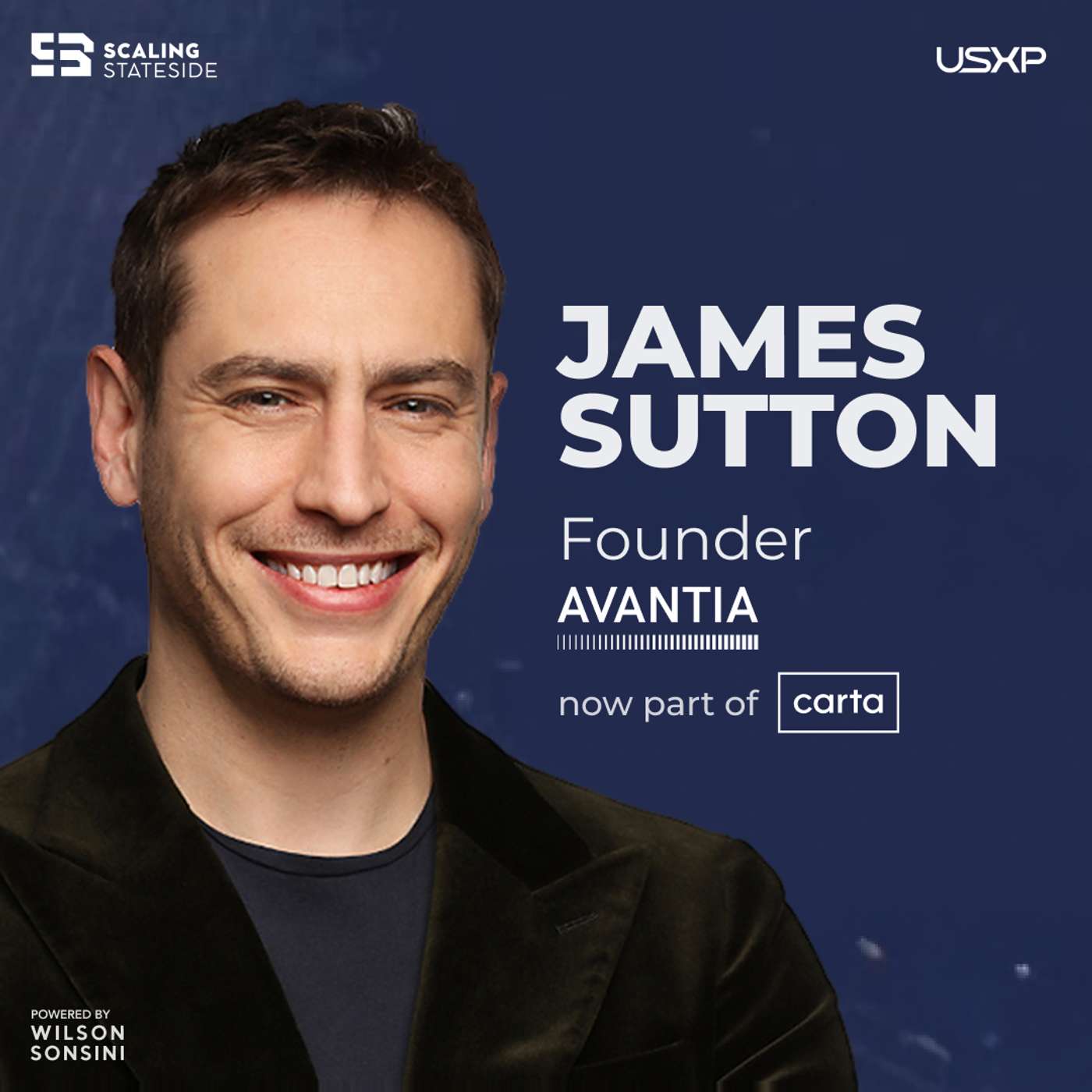
James Sutton (Avantia Law) discusses scaling an AI-enabled legal services firm from the UK to the US, including timing, go-to-market changes, founder presence, fundraising for a services+tech model, and the eventual Carta acquisition. He also emphasizes “get on a plane” market testing and iterating US sales cycles.
James Sutton is founder of Avantia Law, an AI-native law firm launched in 2019 after planning in 2018. He previously worked in big law (Herbert Smith, Slaughter and May), then at OXIF as general counsel and managing director for ~10 years, and later built Avantia, partnering with Oxford’s AI lab. Avantia was acquired by Carta.
US expansion should happen sooner than founders expect; founder presence is critical; shift US messaging beyond “London boutique”; services+AI can attract VC; US sales cycles differ.
hiring US delivery teams and a US-based sales rep; rebuilding branding/website with US imagery; early international PE customers via London; Series B with two term sheets; Carta founder Henry relationship leading to acquisition.
Written by AI. May contain mistakes.
James Sutton shares his journey from lawyer to founder of Avantia Law.
“Please introduce yourself and give us a little bit about your background.”
James discusses his unique path through law and becoming a corporate lawyer.
Sutton elaborates on the founding of Avantia Law and its AI integration.
“their general counsel and a managing director so again had in that role had become plugged into I guess you'd call it the kind of senior management team of the organization.”
James explains how he recognized the potential for Avantia Law in the US market.
“So I started the business really hatching the plans in 2018, launched in 20, quit my job in late 2018, launched beginning of halfway through 2019.”
James details the actions taken to establish Avantia Law in the US market.
James highlights the importance of founder presence and lessons from his journey.
“And we're ultimately, I think, quite slaves of action on that.”
Exploring key insights from moving to the US market and the importance of founder involvement.
Discussing the cultural contrasts between European and American business mindsets.
“You want, you know, we've got product market fit.”
Insights on fundraising strategies, especially with a services component, and finding the right investors.
Learn about the importance of finding the right investors that align with your vision.
“Obviously, if the VC, it won't necessarily be the right VC or they've already invested in something or it doesn't quite fit their risk profile that they're looking for, it doesn't mean your business is bad, right?”
Discover the background and motivations behind Avantia Law's acquisition by Carta.
“the thesis has been more than validated now.”
Understand the balance founders must strike between selling and raising additional capital.
“And you can see that they were basically doing the same thing as we were doing in fund admin, as we were doing in legal.”
Hear critical advice for European founders considering expansion into the U.S. market.
Learn how sales cycles and strategies differ between Europe and the U.S.
“They would be my major learning lessons myself.”

Get the gist, explore an idea or ask about something said.
 Claude
On Scaling Stateside, what are the key points of this episode?
Searching your listeningAutomatic transcript. May contain errors.
0:13Matt Oxley: Hi, everybody. Welcome back to the Scaling Stateside podcast. I'm David Rose, the founder at USXP. Along with my co-founder, Matt Oxley, we are on a mission to help founders from the European tech community better understand the US expansion journey, the pitfalls, the successful factors with our goal of helping them be successful in U.S. market entry. And as part of that, we're having a series of conversation with founders from Europe who've already made the journey successfully. And today, we're very excited to have with us Avantia Law founder, James Sutton. James, welcome to Scaling Stateside.
0:47Matt Oxley: Please introduce yourself and give us a little bit about your background. Yeah, hi, guys. Nice to, really excited to be on this as well. So, So as you said, I'm the founder of a AI native law firm called Avantia Law. We started about five years ago. Before that, I started life as a, I was a non-technical founder. So I started life as a lawyer, a big law firm, ended up being a general counsel for several years and then started Avantia Law. I won't go into too much detail now, but the business was always about combining the best of the new and emerging AI technology, even five, six years ago, with a traditional services or managed services business.
1:25We had a fantastic run, went through several funding rounds, and were ultimately acquired by a large Silicon Valley tech company about six months ago. Great.
1:36Matt Oxley: Excited to have you on here. So, James, let's go all the way back to the beginning, even before the Advanti Law, your legal career. Tell us about your very first paying job. Okay, great question. So mine is slightly unusual. I think my very first paying job is it was a removal uh man I actually don't know what the the relative talking about scaling states I actually don't know what the relevant word for that is in the US but I assume you don't call it that uh which is basically getting on lorries or trucks uh driving to people's houses packing up all their stuff um uh in the house putting its boxes putting in the back of the truck or the lorry and then driving it to another house and I used to do tons of stuff internationally as well so I'd like end up like moving a family from kind of Europe like the UK over to like Germany um or further afield so lots of interesting times camping out in uh lorries and trucks in the middle of motorways in Germany when I was 17 17 years old nice yeah that's the first time we've heard that that's that's a unique question it was about the best you could you used to make overnight money um when you stayed overnight in the truck um which was really for like lodgings but you obviously just slept in the truck so you didn't really need it so it's like i figured out it was the kind of best money you can make when you're 16 17 years old making money while you sleep right it is making money yeah and obviously keeps you reasonably fit and whatever else so yeah so james you also have a bit of an unusual entrepreneurial path is that you are a lawyer you're an attorney which is not the traditional path let's face it you're starts with software it kind of walk us through kind of your your legal career than how you got to you know i think you ultimately became md and general counsel can walk us through your legal career up to the starting point yeah so i in fact my first coming out of university i studied law university so that was that was me kind of deciding i guess at some early stage i thought i'd be a lawyer um the first job i had actually after that was on the trading floor at lehman brothers so in a business trading role uh that it was you know at uni as a time when like the kind of trading desk was seen as super exciting and um very cool so i wanted to want to try i only did that for um under six months uh and obviously we know how that ended with lehman brothers so decided ultimately to go back and get my legal career underway moved to start at big law firms in in london trained i thought i wanted to be a litigator trained at a firm called herbert smith at the time was the best litigation firm ended up moving to slaughter makes i realized i wanted to be a corporate lawyer and again at the time they were they were sort of seen as one of the best corporate law firms to be at great training there spent six seven years there great training learned tons they encourage you to kind of not just pigeonhole you in a certain way but encourage you to try your hand as much as you can do and you know go figure out things from first principles so i think that was a super helpful start to one's legal career ultimately if you're thinking about becoming an entrepreneur as i did that for seven years took a role at oxif or what was called oxif and at the time it was one of the largest hedge funds in the world it was kind of up there with your citadels and your millenniums they were doing some really cool stuff they had multi-strategy funds so they could do they had a huge varied mandate to invest across different geographies in a whole bunch of different asset classes and it was a super exciting 10 i was there about 10 years super exciting 10 years got to work really closely with the business team and i think that was really kind of the beginning of my entrepreneurial journey just being so exposed to the business and being taught by them to think in a different different way as you said i left there to start avantia and by the time i left i was there i'd spent sort of last five years as their general counsel and a managing director so again had in that role had become plugged into I guess you'd call it the kind of senior management team of the organization.
5:26So again, really interesting exposure to how organizations are run. And I think my team at Avantia, and it's certainly been a principle of how we built the business, one of the big learning or things I took away from that was hedge funds, particularly Oxif at the time, operated very flat structures. So there wasn't huge, big hierarchies of management that you had to like, you know, claw your way through. and it being also super political, it wasn't super political. So it was like, you know, every voice is super valued. Like you believe that even the first person in the room straight out of university at 23, 22, 23 years old, if they've got an opinion, that could be a really important game-changing opinion.
6:05And I think that was a really – and I've certainly tried to carry that through into the business we started. And look, you see it in kind of the successful founders coming out of, I think more so the US model where they can be in their early, very often, even their late teens or early 20s, there's sort of not a huge correlation with necessary experience and the ability to go and disrupt the found. So I think that was a kind of really interesting takeaway for me from the Oxif journey.
6:34Matt Oxley: In 2026, it's pretty easy for us to look around and go, oh, yeah, legal services through AI. That makes tons of sense. Of course, there's lots of people pursuing that now, but you did this way before that chat GPT was even a thing. Yeah. What did you, what was the spark for you thinking this should work? How do people react to the whole concept? Because this had to be something that almost like frontier tech, I think would be a good category for this early on. Yeah, exactly. So I started the business really hatching the plans in 2018, launched in 20, quit my job in late 2018, launched beginning of halfway through 2019.
7:11Where the thesis for it came from was I'd been general counsel of a large hedge fund and I'd run a huge range of legal and compliance services that were, you know, somewhat complex, but also very routine in nature as in like repetitive doing the same thing. over again and i was also witnessing and this is a quirk of the asset management space a shift to managers at the time opting for more outsourced business model for their middle and back offices and the reason they were doing that was you know those costs were then ultimately for the account of the investment funds instead of the manager gp i mean quite a lot of this stuff was deal related so really sat within the um really sat within the fund cost um structure so i can see this being quite an interesting trend to play into when when i set it up it was it was all about the even then particularly coming from a non-technical background i had somehow started going down my own personal reading path about learning about ai and i was reading about kind of based transformer models and i was playing around with stuff that i could get my hands on and this this is well well before large language models it was a time when people that follow legal tech will remember companies like Kira and Eigen, Kira of which I think is still around, that were doing kind of quite basic classification model, pulling clauses out of contracts and helping with due diligence.
8:28So I was getting familiar with that stuff. When we started the business, we actually partnered with Oxford University's AI Research Lab. And I was amazingly, I'd been at Oxford for undergrad. So I used my contacts I still had there. I amazingly just got on the train, started knocking on doors at university and found a professor that literally ran Oxford University's AI Research and sat down in his room and had a conversation with him he was like this is really cool you're the first law firm to um you're the first law firm to come and see me which like shocks me you know all this unstructured legal language data that like the big law firms were sat on and it took kind of i guess that's the whole point of startups right innovating and breaking them up took someone like me to get on a train and go find him and he was he was over the moon that i cared to find him So, yeah, the business was started in part.
9:16So we went through kind of a thing with the university and figuring out like IP and like equity ownership and the whole. They treated it as a bit of a university spin out. So that was really the founding story of the business. But also validates that we were it was always about combining AI and services. Look, you like to think you're like predicting the future. And when you start that and the reality was it was just two things. I was super into it's quite often the case with the founder right there's just two things I was becoming super interested in and I was like wouldn't it be cool and surely we can put these two things together obviously had no clue that LLMs were even I don't even you know come across like research and I had no clue that LLMs were about to drop or that we'd go on this rate of pay you know the rate of change that we that we had obviously scaling stateside is about supporting entrepreneurs going on the journey to to the US and obviously you created uh Avantia in in in the uk what were those first signals that you saw that the market was beyond the uk it we we were somewhat fortunate in the sense that we our first customer all of our first customers were uk based obviously um and our team was in the uk so the first team that i'd gone and hired was like lawyers within my you know i needed someone to kind of do that do the legal work and actually most of them i'm really happy so one of the proudest things we've done are still with a business that's great but some of the first customers we had were international private you know like private equity funds that you'd commonly see in new york or in boston or toronto whatever it is and then they'd have their hub in london so without naming some names but our first customers had that features and we used to work with their london office and we would we would win work from their london office um which was typically a managed legal service service and then we sort of and we'll come on to like there's a lot we'll talk about in terms of actually like lessons learn what we got right and wrong it's ultimately scaling to the u.s but it happened very quickly actually within the within the journey that we started to see like our u.s counterparties of our london companies would say hey can you actually introduce we didn't oh that's really cool what you guys are doing in london can you introduce us to this company so maybe customers zero to ten were all uk based but sort of within the 10 to 20 batch i would say 50 of that would have been us customers that had come out of the london network because they were potentially like the counterpart customer of our one of our european so they were pulling you over there so then you get this pull yeah what did you do was it right shit i've got to be there yeah okay i've got to get somebody to you know manage your like what what was going through your through your mind what was that order of operations once that whole happened so and the very honest answer that gets into your kind of lessons learned and i think certainly the british founders i know not everyone but we can be pretty bad at this is look we were just heads down folks on running and growing our business so we saw that signal and we didn't action on it i mean my my view is looking back we didn't action on that nearly as quickly as we should have like moving to the us was was another a really big endeavor at the time we hadn't raised so we started bootstrap we hadn't raised funding so you know to be able to do that was probably a funding gap beyond us at the time so when we first saw those when we first saw the um signals that were kind of you know that that it's more it's a real signal rather than just kind of early stages in like we were being told by the u.s market we should be there and now easily 80 of our revenue is u.s market based i spend much more of my time in the US than I do in the UK.
12:57So yeah, the answer to that is we just kind of heads down, continue to run our European business. And we're ultimately, I think, quite slaves of action on that. And then once you realize, okay, we've got to actually have presence here. Yeah. And it is a market that we should be looking after and focusing on. What were those steps? Did you move over there? Did you hire somebody to look after operations? Talk us through that. Yeah. so what we did the first we we did a few things so number one we started hiring the process we went through it and slight if you're a pure tech company you won't have this in the same way but the first thing we did is we started putting delivery folks out there so lawyers compliance people so allowed us to um so number one put delivery people out there and then we started changing our go-to-market messaging um so we kept hearing that like oh we know you guys but we just sort of you as like a london boutique firm like we didn't know you did stuff in the u.s so the very first thing we did was kind of shift how we presented ourselves say hey we know we've got teams in the us like we've got a team in toronto at the time we had a team in boston they were kind of our first hubs um and then we made sure like uh we i remember we built we rebuilt our website our branding and our go-to-market materials and it was you know you landed on the website and you saw the manhallen skyline versus the london skyline or whatever it was that we previously had and very soon after that we then sent we then had go-to-market press so we had like a senior sales rep in the u.s market english or u.s u.s based actually yeah a u.s national or a uk national going over u.s national that we'd hired in the u.s market and look and and i and i didn't i didn't move there and actually i didn't again this is kind of goes into more lessons learned so now we have done all those things i mean i can get into the lessons learned piece of it now if you're interested but like looking back to what we have now and um how we started that process and i do think again at least in the network that i speak to which is kind of a reasonable amount of companies i think the brits get this wrong more often than right is there's no substitute for the founder being there in my view i even see that now it's like every time like i spend probably 50 60 percent of my time in in the u.s at the moment and every time i am it's like it reinforces the fact that there's no substitute for the founder being there and there's a few reasons why it's like but i think the biggest two are number one customers want to hear from the founder of course they do like and that's in uk and it's in the us whoever it is but particularly if you're a british company like trying to get into the us market like customers are going to want to hear from the founder and then number two to create that um and i actually see that as this point is interesting on the on the europe side now i've left there but like to build that team and that momentum like there's a big thing about having the founder in the office and like as long as you're London and European team where you've got a co-founder potentially that you could leave behind in Europe and I did have that thankfully or someone that was close akin to a co-founder to me they can carry that kind of culture momentum and energy in London but I think you really really need that in the in the US market particularly if if your US if the size of the market in the US For us, it was kind of eight times the size of the European market.
16:09So it was a much bigger market presence. So I think they're the two major things. Going back to the kind of sending that you asked an interesting question around the sales represent, did we hire someone there? The person we'd hired is actually fantastic. They'd come from like an ecosystem. They'd been at some of our sort of close competitors in the US. They had that natural advantage in the market and they're fantastic. I do think there is a lot of advantage though for other companies where you don't have that access to found a go and bring your like number one or top two sales people you know you're assuming kind of you're really looking to crack the go-to-market stuff in the US I think there is a really good angle for bringing your what top one or two sales people and forming that nucleus and building building out from you know building out from there I think if we had our time again that's certainly what we'd have done and we'd have done it much sooner so they were kind of the main lessons that learned here you never same with starting a business I think most founders I to speak to on this like we'd all say we wish like you have that like jump off the cliff thing unless you've literally done it straight out of university right i think most founders i speak to say they wish they started their business two years earlier i think that's almost unequivocally the case it's like we wait so long to feel secure and i think i would say for sure the same thing about moving to us i wish we'd have done it two years earlier and i wish we'd have done it with the like accelerator like button in nine out of ten instead of like four out of ten basically i This is the number one conversation we have.
17:32It's like, when do we go? Because what you want is your European tech startup, right? You want a solid foundation, right? You want, you know, we've got product market fit. We've got go-to-market fit, right? We've got local market fit in that. At what point do we risk that and then go to the US? And then also knowing how involved and important the founder is in the business. what is the opportunity cost for moving that founder and going all right here you go go to Alabama and start selling yeah you know that I think that is a trepidation that a number of founders and businesses go through and you know my number one thing which kind of equates to what you're saying is get on a bloody plane yeah right the only way that I think you're going to experience and know what the right decision is is to be in market and test it and be there it doesn't have to be forever it can be for three months yeah i agree go meet prospects customers talent go go go and visit and absorb it come back and then make an educated decision because i think people try and perfect it yeah too much like we're entrepreneurs risk it yeah anyway so this is my podcast no look i completely i completely agree with that and like the okay flying to fly a bit west coast now that that's kind of a long flight you don't be doing that weekly but like when you get used to the run on to the east coast it's like it's really not a big deal i mean i i'm doing it three times a month kind of thing at the moment it's like literally not a big deal like you can go i've been for lunch an important lunch to new york and then come back the same day it's like literally not a big deal it's like not a long flight um as you said just get on the plane and experience it i think it talks a bit to i think that i think there is still that cultural gap with risk appetite like there's some incredible and actually I know from kind of the backing and a lot of contacts I have particularly in the VC space in the US like the UK has seen as having some extremely talented founders and companies like it's like some very huge amounts of talent here I think the big gap is like ability like willingness to take on risk versus a European or British founder versus a US founder and look we're increasingly to your point about like should I move to us should i stay in in the european market look we're increasingly in a world particularly like most recent ai stuff that's happening where i don't necessarily want to say it's a winner take all market but very often a lot of these markets have the features of winner take all which means if you don't get yourself out there before you know it the u.s equivalent to you has scaled five times the size of you because they're in the u.s market they've raised five times the capital and the next thing their flag is popping up in london and you're going to see their branding on every tube like every subway like you know in like every sporting event and you're going to be thinking oh oh how that how do we compete compete with this right you see it way too often um and then you're kind of kicking yourself and not being the person that got themselves out there first i totally agree and i think in this ai world that we are in it's speed is of essence yeah putting you know making that risk betting on yourself going into market because the number one you know i think surprise for me when i was in the u.s was just the kind of difference in hustle yeah between the americans and europeans you know we're very apologetic and harry pottery yeah they're kind of like woohoo can do you know it there is a kind of contrast between the two yeah and the way that i describe it is i had to find the american version of map and almost morph into that to meet people where they were yeah so again like how did you experience and create like the american version of james going into that because it is very very different very different yeah it's i all the thing i can go with all i agree with all the things you said look i think for me having spent 10 years at a very u.s wall street hedge fund uh including the team in the uk where you know half half of them were from the u.s and all kind of been through that like traditional high performing high functioning wall street career so i think that was kind of the beginning i'd had 10 years of that so that was kind of beginning of my um i guess americanization in terms of how i thought about stuff and opportunity and and risk i think that's helpful because we can talk about lawyers being founders but but lawyers tend to be kind of the even more conservative less likely to do it version of a founder so i think that was probably a really critical path for me to for me to go through and and and again I think to your to the point you made earlier as well Matt it's just about time spent there isn't it like if you're an entrepreneur by nature you're going to have a significant degree of hustle and get go and self-starting and you're going to figure stuff out and I think you just need time time in the market you need time networking there and you need to understand like kind of how you should treat how you should take opportunities and that's and it also is expanding the network isn't it like Like, you know, you don't realize that there's an ecosystem in places like Silicon Valley where people of all walks of life and all ages, extremely smart, like literally like they move there to raise money.
22:41Right. Like they move there for six months to raise money. They're meeting with VCs. They're pitching big ideas. They're pitching and they're pitching kind of I'm going to change the world by doing X, Y, Z. And a lot of those things will be in the space that founders in. and you know it should scare the hell out of people that if you're saying you're under an ecosystem and you're pretty comfortable like best believe there's someone in them in their mid early 20s talking to the sequoias and you know and the the axles and the indexes in in the bay area pitching your idea to them and getting all the attention as i think that should that should scare people just as you said just get on a plane and get figuring out yeah because i think once you get you land and set like like you i go there frequently i'm in the west coast probably every six weeks right so but once you land whoa right you can feel it you absorb it the conversations you're having the can do the will do you know the back like you absorb it you go down you know i5 into the city in san francisco the billboards are like in the future they're like what the hell let's go on here yeah i remember being in austin and i'm like i saw a waymo i saw a door dash delivery being automated then i saw the new um tesla kind of cab i'm like i'm like i'm like marty mcfly you know it's like i've gone into the future but that's what you're absorbing when you're over there and then and then it's the choice of like right do you kind of take that energy and that kind of yeah and then go on and advance your business or you bring it back to london and i think this is the kind of choice that they're in you know founders are in so it's trepidation it really is and you know there's just picking up on that and i certainly see it now kind of with having more and more contacts in that kind of west coast ecosystem i mean for us it for me it always made sense i don't lean technical i've got some great people that support on that side i lean more go to market customer and product so like for me all of our customers in new york so new york was the obvious place for me to be given given kind of my skill set and where i want to spend my time but like if you're the technical founder right um or even if you're you don't have that strong customer presence in in say the east coast like we had and you kind of agnostic as to where you're going to be like the the amount of the amount of like good european founders that will just move themselves in silicon valley right like they'll just rent a small place that bring four members of their team with them it's like look you're my you're my team but i know you're like living in fulham or whatever but like we're actually going to go rent a house in in silicon valley and we're going to make this happen like you shouldn't like that might sound crazy to you to hear that but there's enough people from all around the world doing that i mean i met a great swedish guy when i was out there it's super interesting i don't know if it'll work but super interesting business idea right and like you know he's just like got on a plane he's in his like he's like 23 years old and he's moved himself and he's made his co-founder move to silicon valley and they're just hanging out in the bay area trying to make trying to make things work like people
25:41Matt Oxley: are doing that um yeah james walk it walk us through your walk us through your fundraising process what i'm what i'm super curious about you did raise professional venture capital but you're also a tech enabled service and i know in my experience yeah i remember trying to raise and we had a little services component boy i caught so much flack over that little tiny piece of the business that was services like oh your services were out yeah walk us through your overall fundraising process and then how in the world did you raise professional venture capital with a services component because i tried and was never able to question so very very early days um the conversations we were having with venture was like because we were building tech as well they're like love the tech get rid of the services we might back you then so same same conversation right our first vc check shortly after that about the same time as it was a great vc called hoxton um they're kind of reasonably reasonably well known and like you know always ranks uh tier one in in the london market for early stage and they got it and they saw the like trend for like combining services and technology early so that we were somewhat fortunate to find someone that bought into the vision by the way we were super strict on like vcs even early we were like no that like i want to build services and technology i want to build like the next like deloitte i used call it deloitte 2.0 back in the day like let's re let's rethink how we build traditional services businesses that was what excited me so i just said no i didn't try and bend the business to kind of the will of the the venture community back in the day and then it was super interesting it was like the very fast 360 the industry made and then it feels like suddenly like investing in services that are going through an ai transformation is kind of the biggest the biggest and most exciting thing that's happening and is certainly certainly very mainstream and we we started to see that somewhat early we see the conversation shifting from no this doesn't make sense to me services to like oh actually we're doing an internal paper on services and software and this might be interesting and then suddenly we would like i mean i found myself going off the axles very i mean too early to raising for them but going off to the axles and the indexes and those kind of funds um and just sitting down with their like senior leadership team internally talking to them about business because they were starting to go through the kind of thought processes like is this relevant um and then and then i think the mark you know then i think it was it sequoia or a16z one of the telling sequoia a couple years ago now maybe 18 months ago published something that was like basically just like put the flag in the ground and said like services is the next big thing you need to be backing services so it's been a super interesting um it's been super interesting to watch that watch that come around look i i think you know if we were just able to like ultimately find the right investors for us even though it was a bit early and we stuck true to what we wanted to do.
28:19And I think that's important. Obviously, if the VC, it won't necessarily be the right VC or they've already invested in something or it doesn't quite fit their risk profile that they're looking for, it doesn't mean your business is bad, right? Like it's about fit of like how they're deploying capital and what you want to build. So I think it was really good for us to kind of stick true to where we thought this space was going. And I think to some what we've been, the thesis has been more than validated now.
28:43Matt Oxley: And Carta acquired Avantia Law earlier this year, obviously a super well-known brand in the tech ecosystem. How did that conversation start? And were you running a process or was it an existing relationship that just kind of grew into something else? Yeah. So I'd known Henry, the founder of Carta, for about maybe even 18 months before we sold to them. And this is somewhat featured with how we also raised capital. Like I picked pretty much every time the firm I had a relationship with and, you know, had, had somehow built the relationship. So I felt very good about that. It didn't come out. It didn't come out of nowhere.
29:22And it's certainly well before we were even looking to, there's no chance we'd have sold the business back then. Um, so I got to know the founder, uh, we'd got to, I'd got to see that it was a very shared, shared view of how services and AI were like the future of services and AI and And the Carter were building, they have a phenomenal fund admin business. And you can see that they were basically doing the same thing as we were doing in fund admin, as we were doing in legal. And there's a huge amount of overlap. So that was super interesting. And we had a lot of common ground kind of sparring over that for a period of time.
29:54We were actually raising a Series B. We'd got two term sheets at Series B. We were, all my investors were super happy we were doing Series B. They love it, obviously. and I think through the ecosystem that Carter's team found out I guess they were keeping an eye on us they found out that we were pretty close to doing a series b and then I think that prompted well I know that then ultimately prompted the call from Henry and his uh his his team who are fantastic to me to say like hey let's have a conversation like and then like it was a very very difficult decision I mean like it had it not been the kind of dynamics of getting to know Carter getting to know the team there getting to know that we're on the same aligned mission but also seeing the fact that like i think they can accelerate us they had a significant amount of capital on their balance sheet that would have dwarfed even like the biggest raise you know that we were doing as we're doing pretty pretty decent size series b would have dwarfed that entirely it it almost certainly would have been not a sell and it would have been a series b raised and we had a very difficult and balanced decision that me and the senior team um went through to work out if we thought it was the right call but ultimately decided it was the right call lessons for founders looking to go to the us i think we've we've talked about kind of founder going over there so i don't want to kind of kind of repeat that but if you were kind of to put it down to a couple of things yeah what would it be i think in danger of repeating ourselves say number one it's like starting a business right do it sooner than you think you have to just do it do it as soon as you can you may need capital to do that obviously so i think another thing that kind of european founders can sometimes do is delay raising capital i've certainly seen that so if capital is a problem go and solve that and then get it done and number three i think like founder like there's no like the reality is there will be another version of of you as founder that will make that move and will make that business succeed so if you don't do that and you think you're in a kind of somewhat winner takes all space or where like you would really feel the pressure with big us very well funded company coming into your market then you need to be very thoughtful about that because i would say actually you're running actually a lot more risk by not going than you realize by uh and certainly a lot more risk not going than if you were to actually go so speed of getting there send the founder uh i think i think of it too and if you need to raise capital to enable that.
32:21Not all businesses obviously do. They would be my major learning lessons myself. And then every business is different. If you're there and you've committed to it and you're the founder, you're going to figure out what you need to build presence there. That's awesome.
32:35Matt Oxley: James, this has been really great. Congratulations again on a phenomenal founder adventure and story. Congratulations. Looking forward to seeing what you end up doing next. is there any party words anything we haven't covered um that if there's a founder sitting in london or berlin who's thinking about coming to the u.s and you can sit the founder you really like you're in the room with them anything we haven't covered you you would give them for advice before they get on the plane as matt says no look i think we've covered we've covered the major the major points i mean the only other thing we found is that kind of the sales sales motion sales cycles all that kind of stuff is is typically different in the u.s market so even like the kind of pain points that you sell into in Europe and how you approach a sell or a go-to-market campaign, depending on how you structure a go-to-market, you may need to read, not entirely obviously, but probably that's going to be different in the US market.
33:27And so you need to start iterating that as well. It sort of feeds into the go sooner rather than later. That's kind of the only other call out that we certainly saw and I think is a reasonably common thing that I hear from other founders as well.
33:39Matt Oxley: Great. Well, again, Jane, thanks a lot. Congratulations on a great story and thanks for making time to talk with us today. We really appreciate it and we look forward to getting the episode published very soon. Thank you so much, Josh. Yeah, thank you.
James Sutton founded Avantia Law in London in 2019 to combine AI with legal services, years before ChatGPT. Among its customers 10 to 20, about half were already American. Today, he says, easily 80% of their revenue comes from the US, and Avantia Law is now part of Carta, as Carta Law.
David Rose and Matt Oxley ask him what the first US signals looked like, why a British team was slow to act on them, why there's no substitute for the founder being there, how he raised venture capital when investors said "love the tech, get rid of the services", and how Carta came to acquire Avantia while it was holding two Series B term sheets.
🤝 Thank you to Carta, a Scaling Stateside supporting partner, for making this conversation happen.
What you'll learn:
– The first US signal: about half of customers 10 to 20 were American, and they came through the London network
– Why British founders often sit on that signal, and why James says Avantia acted too slowly
– The first US steps: delivery lawyers on the ground, a Manhattan skyline on the website and a US-based senior sales rep
– Why there's no substitute for the founder being there, and why your top one or two salespeople are the next best option
– Getting on the plane: James flies to the East Coast about three times a month, and once flew to New York for lunch and back the same day
– Raising VC for AI plus services when early investors said "love the tech, get rid of the services"
– How Carta came to acquire Avantia Law, from a relationship of about 18 months to a call in the middle of a Series B
– His parting advice: go sooner than you think, send the founder, and raise capital if that's what's holding you back
CHAPTERS
00:00 Intro
00:14 Meet James Sutton, founder of Avantia Law
01:36 First job: a removal man at 17
03:00 Lehman, Slaughter and May and Och-Ziff
06:34 Building an AI law firm before ChatGPT
10:02 First US signals: half of customers 10 to 20
11:47 Feeling the US pull, and moving too slowly
13:07 First US steps: lawyers, messaging and a US sales hire
14:28 No substitute for the founder being there
17:12 Go two years earlier, and just get on the plane
19:53 Winner-take-all: before a US rival outscales you
20:30 Hustle, the Bay Area and where to base yourself
25:44 Raising VC as an AI-plus-services business
28:43 How Carta came to acquire Avantia Law
31:00 Lessons and parting advice for founders
About the guest:
James Sutton is the founder of Avantia Law and now General Manager of Carta Law. Before Avantia he was General Counsel and a Managing Director at Och-Ziff (now Sculptor) and a corporate lawyer at Slaughter and May.
About Scaling Stateside:
Scaling Stateside is the podcast for founders navigating US expansion. Hosts David Rose, Founder & CEO at USXP, and Matt Oxley, Co-Founder & President at USXP, talk to founders, operators and investors who have made the jump, surfacing the real playbooks, pitfalls and best practices.
🔗 CONNECT WITH James Sutton ⮕ https://www.linkedin.com/in/jamescsutton/
🔗 Carta Law ⮕ https://carta.com/law
🔗 CONNECT WITH David Rose ⮕ https://www.linkedin.com/in/davidbrose
🔗 CONNECT WITH Matt Oxley ⮕ https://www.linkedin.com/in/mdoxley
THE SCALING STATESIDE PARTNER NETWORK
Founding Partners: USXP and Wilson Sonsini
Supporting Partners: HSBC Innovation Banking, Frazier & Deeter, Carta, Dealroom and London & Partners
US Expansion Partners ⮕ https://www.usxp.co
Scaling Stateside ⮕ https://www.scaling-stateside.com
🔔 Follow Scaling Stateside for more conversations on scaling to the US the right way.
#USExpansion #LegalTech #AI #Startups #Founders #ScalingStateside