
In short
Podcast Notes: Screw It Just DO It with Alex Chisnall
Episode Title
Don’t Wait: How Energy, Action, and Relationships Shape Fulfilment
Episode Overview In this episode, Simon Alexander Ong, a speaker, coach, and author of *Energize*, shares insights on how energy is crucial to fulfilment, performance, and progress. The discussion emphasizes the importance of taking action without waiting for the perfect moment and building authentic relationships.
Key Themes
- The Importance of Energy
- Energy is central to achieving fulfilment and success.
- It is influenced by:
- People around us
- Our environments
- Internal narratives
- Taking Action
- Waiting for the right moment often leads to regret.
- Immediate action is required to avoid the regret of unfulfilled potential.
- Simon emphasizes the phrase "Don’t wait" as a crucial mantra for personal and professional growth.
- Building Relationships
- Relationships thrive without the burden of expectations.
- Genuine connections foster personal and entrepreneurial growth.
- Filtering Feedback
- Importance of distinguishing between valuable feedback (signal) and distraction (noise).
- Not all feedback is constructive; learning to filter can help focus on what truly matters.
Key Takeaways
- Regret from Waiting:
- Delaying decisions or actions can lead to missed opportunities and feelings of regret.
- Visualization Techniques:
- Visualizing how you want to be remembered can guide your actions.
- Use forward-thinking questions to build a compelling vision for the future.
- Practical Visualization:
- Engage in experiences that align with your goals (e.g., test drives for a desired car).
- Create a "real life vision board" by immersing oneself in experiences related to future aspirations.
Quotes
- "Don't wait. Those two words can be your greatest antidote to regret."
- "Writing is humanity distilled into ink." – Diana Chao
Discussion Highlights
- On Journaling:
- Journaling is compared to therapy, helping to reflect on life experiences and gain deeper self-understanding.
- The Book Writing Journey:
- Simon shares insights on the rewarding yet challenging process of writing a book.
- Every individual has a unique story worth sharing, but writing a book requires commitment and mindset.
- Personal Growth:
- Reflecting on personal narratives is crucial for growth, both in entrepreneurship and life.
Final Thoughts
Simon Ong encourages listeners, especially entrepreneurs and leaders, to take immediate action rather than waiting for clarity or the perfect moment. This episode serves as a motivational prompt to act on goals and cultivate meaningful relationships while filtering out unnecessary distractions.
---
Call to Action
- Subscribe to *Screw It Just DO It* for more insights and entrepreneurial conversations.
- Consider attending the Festival of Entrepreneurs on November 3–4 at NEC Birmingham for further networking and learning opportunities.
Written by AI. May contain mistakes. Listen to the episode to check what was said.
Chapters
Tap a time to open that second in VOThe Journey of Self-Discovery
0:45 to 2:25
Exploration of personal growth through writing and journaling.
“Salmon, what would you like somebody to take away from this, your first book, from your story, from your journey?”
The Message of 'Don't Wait'
2:25 to 4:53
Insights on the importance of living in the present and taking immediate action.
“Well, I think there's two thoughts I have there.”
Visualizing Your Future
4:53 to 7:43
Techniques for effective visualization and creating a compelling future.
“And that heightens your feeling of possibility.”
The Rewarding Process of Writing a Book
7:43 to 10:00
Discussion on the personal rewards and challenges of writing a book.
“in the same way that I've been helping clients and audiences through my work.”
Transcript
Automatic transcript. May contain errors.0:00What stops founders from building something meaningful isn't the lack of ideas, it's the fear of getting started. I'm Alex Chisnell and this is Screw It Just Do It, the podcast for people who are ready to stop waiting, take action and make things happen. The most rewarding part of this journey has simply been understanding myself at a deeper level. Journaling is the cheapest form of therapy. So in a way, I've had two years of therapy by writing this book. I've been able to reflect on my life in terms of how I grew up in terms of the journey from employee to entrepreneur we all have a book inside of us and the reason I say that is simply because every one of us comes from a different background so straight away if you put all that together you already have a great story you have lessons that you can share you have stories to tell don't wait those two words they can be your greatest antidote to regret and the words that set you on the path towards fulfillment.
1:02Salmon, what would you like somebody to take away from this, your first book, from your story, from your journey? What would you like somebody to take away once they get their hands on it on April the 21st? Sure. If I had to pick one message from it, it would be one of the most important life lessons that I took from the passing of my mom when I was 17, which I talk about in the second chapter of my book. And that is don't wait. Those two words, don't wait, they can be your greatest antidote to regret and the words that set you on the path towards fulfillment. Don't wait. Because when you focus on the present by not waiting, you move yourself away from the tragic scenario of living as if you're never going to die and then dying having never really lived.
2:05I love that. That's a fantastic one. And I think so many people, you know, wait for perfection, which clearly never happens for anyone or anything. And they procrastinate and then they never take that leap, whatever that might be. So really, really good answer to that question. Something I wanted to ask you as well, you know before we go to to become the best version of yourself you need to be able to visualize what that looks like what's your advice on visualizing because personally that's something that I really struggle with and I try to do more of but I don't know it's just the way that I I learn or don't learn as the case might be but that's something that I really struggle with is visualizing.
2:51Any tips on that front? Sure, Alex. Well, I think there's two thoughts I have there. One, in terms of visualizing, it's simply tapping into the idea of beginning with the end in mind. So reflecting on how do I want to be remembered? So using that as your starting point and just seeing whatever comes from there. And do keep in mind how we respond and what we see as a result of asking ourselves that question will be different to each of us. But for me, that's a great starting point, asking yourself, how do I want to be remembered? When I get to the end of my life, what are people going to say that I did?
3:27And I guarantee you, it's not going to be how many hours you worked or how much money you made. It's going to be very different things to the obvious. So that would be the first approach. The second is something I use with clients in one of our first sessions. And that is, I say to them, if you and I were to meet five years from now, and you were to say to me, Simon, the last five years were the most magnificent and incredible in every area of my life, what would be the sort of things you would be saying to me as if they have already happened or are happening? So I think those two approaches can help us begin to activate the visual cortex of our of our brain and do you think some of that you just alluded to at the end is talking as if that's already happened or it's happening like the tense is important definitely so if we look at the uh the five-year question so uh if we were to meet five years from now what would you be telling me it would be transporting the you now to that person five years from now as if we're having a conversation.
4:36So it might be, Simon, I'm in a position now where I can do X, Y, and Z. Over the last five years, I have evolved in this way. I'm now able to access this opportunity, that individual, and so on. So you're speaking as if it is already happening. And the reason for doing so is because you are amping up, if you will, that emotional intensity of that vision in the now. And that heightens your feeling of possibility. It's why when, and you might like this idea, Alex, it's why when people talk about vision boards, what I like to talk about is a real life vision board. Because for me, vision boards can be quite static.
5:15You put some pictures up on a wall and it stays there, but it only immerses part of your emotion. So a real life vision board is, for example, if you have the idea that you want to be the owner of a Tesla, why not book in a test drive at your local car dealership to drive a Tesla car? So what's happening is you are immersing your emotions in the feeling of this could be happening, that I am experiencing that vision board in the now. Or if you wanted to live in a beautiful penthouse overlooking a park, then jump onto Airbnb and see if you can rent an apartment for a day or two. So this is where I think it can become really fun, Alex.
5:56Yeah, I agree. And I think that's a really good way to look at it and something that I'm going to actively look to employ. So just a couple of last questions to finish up then and do flash your mics if you're on Clubhouse listening to this and you'd like to ask a question before we go as well. but I've got a couple more myself just to finish up that I wanted to ask would be, I know the book's not published yet that people can get their hands on, but, and you haven't finished that journey yourself, but, you know, how has the journey been with the book? Has it been the most rewarding to you? Because there must have been a lot of moments that have felt rewarding, but can you kind of drill that down into a couple of takeaways for us?
6:44sure i think the the most rewarding part of this journey has simply been understanding myself at a deeper level uh you know i often champion the activity of journaling uh and why that is so important because if if you think about it journaling is the cheapest form of therapy so in a way i've had two years uh of therapy by writing this book i've been able to reflect on my life, in terms of how I grew up, in terms of the journey from employee to entrepreneur. And I've been experiencing what Diana Chao, an individual I reference in the second chapter, in what she says in that writing is humanity distilled into ink.
7:30And so in terms of writing, I've been able to understand my own humanity at a deeper level, my strengths, my weaknesses, my experiences, and how they've shaped me. and articulating that in a way that can help the reader in the same way that I've been helping clients and audiences through my work. And they say everybody's, you know, that common question, everyone's got a book in them. But having gone through the process yourself, do you think a book is for everybody, that everybody should write a book? And I love the idea of, you know, the process of writing a book and finding out more about yourself and your beliefs and what's important to you.
8:14And it probably makes the time you have left on this planet seem really finite and maybe heighten what you'd actually like to achieve and what you'd like to get done. But interested to know your thoughts on that as well, having just gone through it. Definitely. Well, I think there's sort of two different points. I think the first part on whether people have a book in them, absolutely. absolutely we all have a book inside of us and the reason i say that is simply because every one of us comes from a different background we've all had a different upbringing we live in different parts the world we have different beliefs we have different habits we have different values so straight away if you put all that together you already have a great story you have lessons that you can share your stories to tell.
9:04And that is why for me, I love meeting new people because every new person I meet, I get to learn something new. I get to widen my perspective. Now on the second point about the process of writing a book, I don't think that's for everyone. I don't think that's for everyone because having gone through the process to write a book, market it and get it out into the world, it is like starting a new business. And just like not everybody is in the position or mindset to start a business, you have to adopt a certain mindset in order to write a book and get it out in the world. And that's why I think while everybody does have a book in them, the question is whether they are committed and desire to go to that process of putting that together onto paper and to get it out in the world.
9:56Because I think they're two different, they're two different things to me Alex so that's it for today's bite-sized episode of screw it just do it make sure you follow or subscribe for more game-changing conversations and remember the only thing standing between you and your business breakthrough is the decision to screw it and just do it
From the publisher
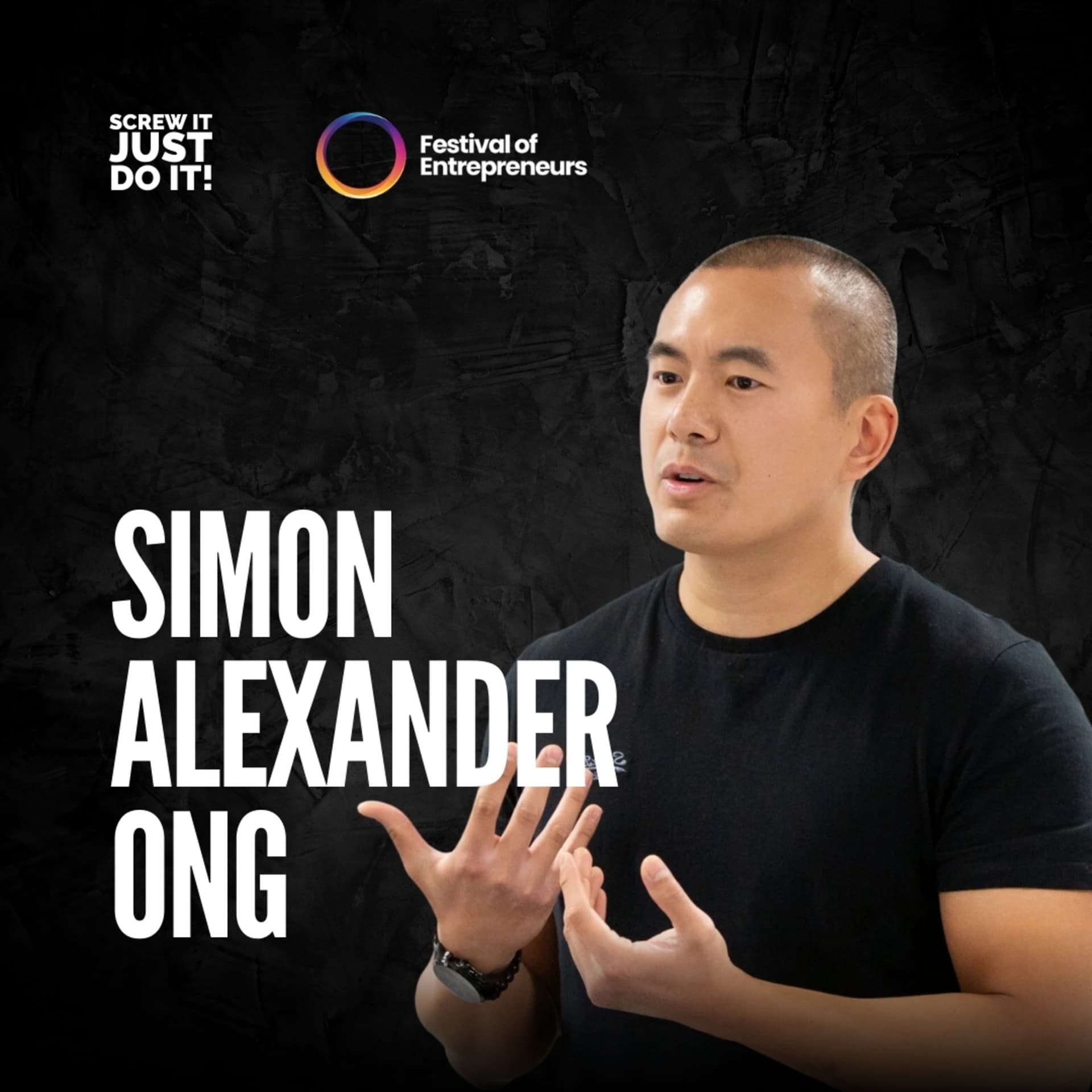
Simon Alexander Ong is a speaker, coach, and author of Energize. In this Bite-Sized episode of Screw It Just DO It, Simon explains why energy sits at the centre of fulfilment, performance, and progress.
We talk about acting before the timing feels perfect, building relationships without expectation, and learning to filter feedback properly. Simon shares the moment he realised that waiting creates regret and why fulfilment starts with decisions made in the present.
Key Takeaways
Why waiting for the right moment often leads to regret
How energy is shaped by people, environments, and internal stories
Why relationships grow stronger without expectations attached
How to filter feedback into signal and ignore the noise
This episode is for founders and leaders who feel drained, distracted, or stuck waiting for clarity.
🎧 Don’t miss a moment of entrepreneurial insight. Subscribe to Screw It Just DO It wherever you get your podcasts.
🎟️ Join us at the Festival of Entrepreneurs, November 3–4 at the NEC Birmingham.


