
In short
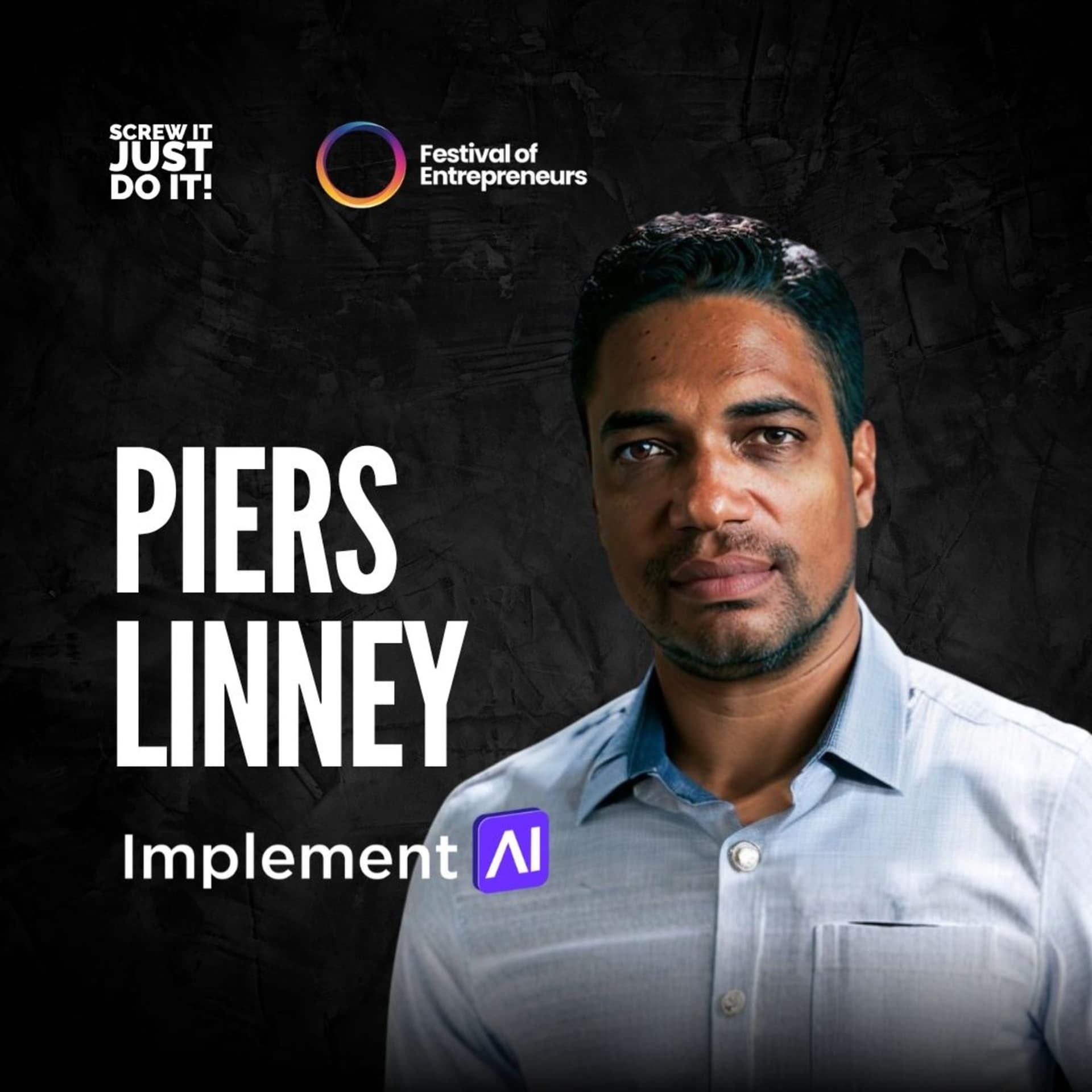
Podcast Summary: How AI Will Redefine Your Business in the Next Five Years with Piers Linney
Podcast Overview Podcast Title: Screw It Just DO It Host: Alex Chisnall Guest: Piers Linney Description: A platform for entrepreneurs and business builders to engage in discussions about overcoming uncertainty, taking risks, and building impactful businesses. New episodes released every Tuesday and Thursday.
Episode Details
- Episode Title: How AI Will Redefine Your Business in the Next Five Years
- Key Messages:
- AI is evolving rapidly and will redefine business operations.
- Businesses that ignore AI will fall behind.
- Founders must integrate AI into daily workflows to enhance efficiency and decision-making.
Key Takeaways
- AI's Evolution:
- The transition from manual to AI-driven processes is akin to the Industrial Revolution.
- AI is now capable of handling cognitive tasks, personalization, analysis, and customer engagement at unprecedented scales.
- Impact on Businesses:
- AI can increase operational capacity without additional costs.
- Personalization drives revenue; AI can enhance customer interactions through tailored content and services.
- Proactive founders who adopt AI early will gain competitive advantages.
- AI in Daily Operations:
- Incorporating AI into workflow can lead to faster, cheaper, and more accurate outcomes.
- Businesses should reassess their processes to leverage AI effectively, focusing on revenue generation rather than merely cost-cutting.
Piers Linney's Insights
- AI as a Business Augmentation Tool:
- AI should augment human capabilities rather than outright replace jobs.
- Key operational areas where AI can enhance productivity include sales, customer service, and marketing.
- Exponential Growth of AI:
- AI technologies are advancing at a rapid pace, with tools improving continuously.
- The "AI-assisted era" necessitates that businesses adapt or risk obsolescence.
- Practical Applications of AI:
- AI can analyze large datasets for insights, automate mundane tasks, and facilitate better customer engagement.
- AI's voice technology is particularly advanced, making service interactions seamless and more human-like.
Discussion Themes
- Historical Context:
- The podcast draws parallels between current AI advancements and past industrial transformations, emphasizing the rapid pace of change.
- Future Business Models:
- Businesses should consider an "AI-first" approach in their planning and strategy, reflecting on how existing systems can be optimized through AI.
- AI Misconceptions:
- Concerns about AI replacing jobs are addressed; while some roles may diminish, new opportunities will arise, and AI can enhance job satisfaction by taking over repetitive tasks.
Audience Engagement
- The episode incorporated audience questions, discussing topics like AI's limitations, concerns about job displacement, and balancing automation with brand authenticity.
- Piers Linney emphasized the importance of evolving legislation to keep pace with technological advancements.
Conclusion The conversation between Alex Chisnall and Piers Linney highlights the transformative potential of AI in business. Founders are encouraged to embrace these technologies, understanding that the future of work will increasingly revolve around human-AI collaboration. The episode serves as a call to action for entrepreneurs to rethink their strategies and integrate AI in a meaningful way to remain competitive.
---
For more updates, follow the podcast at [Festival of Entrepreneurs](http://www.festivalofentrepreneurs.co.uk) and on social media @festivalofentrepreneurs.
Written by AI. May contain mistakes. Listen to the episode to check what was said.
Transcript
Automatic transcript. May contain errors.0:00It was only really 200 years ago, and you probably heard this all before about AI, but 200 years ago the industrial revolution and we first started to be augmented with machines. They've got exponentials on exponentials. AI plus quantum. Genomics plus quantum. Blockchain plus AI. They're building on each other. Things are happening faster. Piers Lenny is a serial entrepreneur, investor, podcaster and former dragon on BBC TV's Dragon's Den. He's also the co-founder of Implement AI, helping SMEs navigate the fast evolving world of artificial intelligence and has been named one of the UK's top 100 most influential like Britain.
0:39We're now in what we call the AI-assisted era, an era where you should all be individually and in your businesses augmented by this technology. And if you're not already, and I really mean this personally, there's nothing I do cognitively, but I don't use AI at some point. If you're not doing it already, you should be. Welcome to Screw It, Just Do It, the show for those who decided to screw it and just did it. This is the podcast that brings you face-to-face with the entrepreneurs and business rebels who threw caution to the wind and built something extraordinary. Let me start with this slide.
1:13Where's Alok, my co-founder series? If Alok was doing this, you'd have a million slides thrown at you in about 30 minutes and you'd need a nap afterwards. I'm going to take it slightly slower. I'm going to talk to you about this exponential curve. Now, I can do a one-hour keynote just on this one slide by going through it. and what it all means going through time. What you've got to think about, though, is that that little zigzag there breaks the line because that line there goes past Alex, through that wall over there, and out into the car park, North Car Park 6. Because we've spent 200 ,000 years where not much has changed, to be quite frank.
1:54And it was only really 200 years ago, and you've probably heard this all before about AI, but 200 years ago, the Industrial Revolution. and we first started we augmented with machines rather than our own bare hands and simple levers and animals so you saw the steam engine is a great example of that but being a northern lad who grew up in a mill town i like to think about power looms so power looms took 150 years before they became ubiquitous or or spinning jennies choose your technology and then we got the second industrial revolution and that was really more about electrification the railways consumer technology kind of kicked in and the world began to change and you saw things like railways electrification is a great example where you saw you know railways appear but electrification whole cities within say 50 years so you've gone from 150 years to kind of 50 years now you can keep going through time we saw lots more tools come about electric tools white goods washing machines consumerization economies grew GDP grew populations grew and then what we all know and probably love is the third industrial revolution the one really that got me into sort of business and technology and that was platforms like the internet telecommunications and when a business I was in actually the tail end of that business opportunity with mobile phones for example so mobiles went from nobody had one or they were the size of a tumble dryer to everybody had 1.2 to ask for how that works everyone had 1.2 phones and that took about 20 years 150 50 20 and you start to get into the internet age where you start to see e-commerce social media you know these platform was begin to grow and they grew like Facebook probably five six years so 150 50 25 then you have things like tick-tock chat GPT get into a hundred million users in several months now that think of that curve it's steepening things are happening faster and in AI AI is its own exponential and in some ways we often talk about implementing AI, if you've got exponentials on exponentials.
4:23AI plus quantum, genomics plus quantum, blockchain plus AI. They're building on each other. Things are happening faster. And I hate to mention Covid, especially in an events company, but think of Covid, right? So you heard someone's got a cough in Wuhan. Don't worry, I will get into marketing at some point. Someone's got a cough in Wuhan. You think, well who cares, where's Wuhan? And six months later you can't leave the house by law that's exponential change it starts slowly and it's happening now you just can't quite feel it yet but it's gonna take off so we're now in what we call the AI assisted era an era where you should all be individually and in your businesses augmented by this technology and if you're not already and I really mean this personally there's nothing I do cognitively whether he's AI at some point if you're not doing it already you should be.
5:18And I'm not just standing up here trying to flog AI, I partly am, but actually I really believe this and I really really mean it. That it matters and you should be using it. And we're gonna go into a world which I was having a conversation lady at the back there about a human first world, becoming an AI sort of first world, cognitive labor and eventually physical labor robots. So it's gonna come a time very soon where this technology is not quite there yet it's better than us it's inevitable this then that everything better faster cheaper safer at all cognitive tasks within one political administration within one business planning cycle of three to five years we're gonna we're gonna kind of get there one of those tiring things in our job myself and Alok is updating our flipping slides because this moves so quickly right so this is Q2 2023, everyone's talking to ChatGPT, suddenly a diffusion model creates a video of Will Smith eating spaghetti, sort of.
6:23It was amazing at the time but it is still a bit rubbish. Fast forward to Q2 this year, suddenly what you would have heard is Will Smith eating the spaghetti. What it's now doing is HD video but also it's creating the audio HD quality video and audio you also might notice it's not quite Will Smith now because I think copy the copyright lawyers caught up but what you're now getting it beginning of this year is HD quality and it's creating the audio now you probably get the audio now no we're not it's probably too loud now this was last week literally last week Anyone hear about Sora 2? Does that mean anything to anybody?
7:14Right. So Sora was OpenAI, who made chat GPT. They created a video model. And you've seen Kling from China, VO3 from Google. And the point here is, just watch this. This was their kind of opening advert. And you might notice here, you see Sam Altman in this video, who's the CEO of OpenAI, who made chat GPT. This isn't Sam Altman. This is an AI clone of Sam Altman after he looked at his phone like that for three seconds. So this is where, and by the way, all his videos have perfect HD audio with all the sounds. Let's watch the video. What's the quality? What's the physics? What's the sand? The droplets of water?
7:55The wind? Sam Altman's face? The lighting? So what it's now doing is creating worlds. And when you think about robots, which are coming down the line, look at the sand. These are worlds that obviously don't exist. They can now be created on the fly. So when you're thinking now about marketing, when you're thinking as an entrepreneur, whether you're kind of right-brained or left-brained, and it has completely freaked out.
8:28There we go. So whether you're right-brained or left-brained, I'm very, I think in pictures, I wave my hands around quite a lot, but I'm rubbish at drawing so you would have seen here actually that elephant makes perfect noise so all of that is now capable you can have a marketing image a 3d image a video a picture anything cartoon manga whatever the hell you think of and you and I love this I can now conjure that into existence so the days of anyone anyone in a creative agency right so creative agencies you've got to start thinking about delivery because you see this stuff it's going to change you've now got to start becoming the strategy tools tools we use we all love SAS we all pay for too much software as a service because we have to use it why would you pay per seat per month because you're human to use it What's happening now though, this intelligence, this technology can use the tools.
9:34It can create the tools. It can write the code to create the tools. So this pyramid has been filled and it used to get bigger. Populations grew, GDP grew, economies grew. It's not getting bigger anymore. In fact, it's shrinking because populations are shrinking. So the pyramid, let's call it the same shape, but it's filling faster. So you, whatever you do, creative agency is a great example. all copywriters translators lawyers accountants what I used to do you've got to start moving to the top and adding value using that technology staying down here hoping it won't find you or spot you or see your business is a bad plan how do you use it a lot of what we do is voice now voices you know it's it's not quite video, video is getting there within three years easily.
10:27Who spends more time on a Friday night looking for a film than actually watching one? Yeah, feel my pain. So you're now going to be sitting in front of the TV saying, right, I want a sci-fi cowboy film with a female heroine. I want two different endings. Don't tell me which one yet. I'll choose when we get towards the end. And it will create a film for you on the fly. And your favorite actors and actresses will be in because they've sold their image their likeness to this company that's generated for you too expensive now in terms of the compute but it'll get there but voice is here today what I'm going to show you now is on my exponential chart you probably notice the red dots so the red dot is where you always think yeah but it doesn't do this yet yeah robot can't fix a car always think yet AI today is the worst it's ever going to be.
11:19So we do a lot of voice. I say they're 95 % now indistinguishable from humans. By the end of this year, by the end of Q1 next year, we won't know the difference. People don't care. When an AI calls them and they answer and they say, are you real or an AI? And the AI says, I'm actually an AI member of the Implement AI team or whatever customer has made the calls team. 99 % of humans will respond, oh wow, okay. And they carry on the conversation. and at the end they thank it, which is like thanking your toaster. Conversation is the new superpower. Record every conversation, internally, externally, every single phone call.
11:57Recorded phone calls were something for regulated companies or you picked a few to check it for the sales compliance or training or some other compliance. Now you can analyze every single phone call for all of those different dimensions, find happy customers, reactivate customers, and engage customers in new ways. So I'll just finish on this slide, really. What you do, what we find ourselves working on in Implement AI, is not getting rid of people, right? It's about augmenting yourself, augmenting your team. I always say there are... Am I going on? I'm letting you roll, man. We always say, I say there's three vectors.
12:38Variability, value, and velocity. right if you're low low to medium value AI is pretty good at that AI is not gonna sell a private jet somebody over the phone that's not gonna happen high value or edge cases someone who's vulnerable maybe a human has to do that then you've got velocity huge amounts of data so in thinking of a fighter pilot with a system tracking tuned the targets at once AI can do that humans come it can multitask men certainly can't do that then you've got value which I've that I covered, velocity, they've got variability. People often say to us, well, I've got so-and-so that does this and a bit of that and a bit of that, and on Tuesdays they do this.
13:16That doesn't work. AI is like what a lot calls a clean workflow, ideally linear with steps that are understandable. So if you've got something which is low to medium value, it is AI. If it's high velocity, lots of data, it's AI. Low variability, it's AI. tick all those boxes, get an AI to do it. Repetitive, mundane, very good at it. If it's high value edge cases, if it's low velocity, and if it's high variability, go and get a human to do it. AI is not going to be very good at doing it. Everything in the middle is a machine-human partnership. It's an augmentation. It's a teamwork. That's what we focus on.
13:59And the AI is getting better, actually. So they're going to be able to do more of what humans do over time. But focus on revenue. Yeah, you can take costs out. We'll come on to that. But revenue is the opportunity. You can engage customers, reactivate customers, listen to all your phone calls. If you've got recorded phone calls, go and analyze them all. And you will find, I'm telling you right now, tens of thousands of pounds of opportunity just sitting there. Revenue you've just missed. It's there. So revenue is where you start because that's always more exciting. But as you grow your revenue, the frustrating thing in business is your cost base follows it.
14:36And you've got that fixed margin. It's so frustrating. What you want to do is detach your cost base from your revenue growth. That expanded gap is more margin, more profit, more dividends, more valuable business. It's wealth creation, essentially. So what you have is finite resource, human resource, financial resource, whatever resource, machine resource, whatever you've got. you want to increase your capacity but it's your human workforce grow your capacity without actually growing your cost base or in some cases without growing your workforce that's what AI allows you to do so I give some examples a great example my favorite ones I'll get a number slightly but I will step in is recruitment company 200 ,000 people in their database they can contact 5 ,000 a year with a team of three or four people on the phones all day is soul destroying don't tell me humans evolved to do that job right it's soul destroying we sit in AI it makes thousands of phone calls over the 3 ,000 has a 700 600-odd conversations and books 50 jobs in three hours humans can't do that and their problem becomes too many leads a nice problem to have so we didn't start to worry about it when you're pretty a actual business is the second order level issue how do I deal with all these leads how do I deal is the revenue opportunity how do I deal having that more capacity and the last one which really where marketing comes in is if you've got a hundred thousand people on a database you can send them ten emails of ten thousand people ten different emails based on their persona I can now send that chap he was supposed to come to a property training event an email a voice note or get an agent to call him that understands exactly what his aspirations are, what he wants to do, why he wants to do it, why he didn't make it, I could send 10 ,000 of those to 10 ,000 people.
16:35When people talk about hyper-personalization we all kind of glaze over but it's here and you can do it. You've just got to think about how you go about it. So hopefully a guide there, something to think about and I'll have a We'll chat with Alex about where we go from here. What are some really good shortcuts that people can think about using AI in their business? So I haven't got all the slides, there's a lot more slides here. So the amazing thing is, we talked to a lot of people in businesses, quite well-established businesses, and what they say is, if I could start this business again, AI first, it would look completely different.
17:13Problem is what you have are systems, processes, legacy, infrastructure, commitments, contracts, mindsets, policies, SOPs. And it's very hard to move the oil tanker. So if you have started again, you've got to think about, or starting your business, what would it look like if I absolutely use this technology to the nth degree? And the point is, on the exponential curve, you might be using, it's kind of good at this, it's not quite ready yet, but in six months, it will be. So the curve, this acceleration of the technology and its advancement means that things you couldn't do or can't quite do now, you'll be able to do in six months.
17:55So the opportunity now often is to look at industries that already exists and look at what it is. It can be law, it can be manufacturing, it can be recruitment, it can be pharmacy, with all these different companies, financial services. Look at the industry and say, or do what you do, or step out of the current business you're working in, start a new one and think about how would I do this if all my we think in terms of teams if my sales team my support team my customer success team analytics team my compliance team you can keep going my computer use team it does remote work basically if they were all AIs what would it look like how much more efficient would I might be and how many how many how many fewer people I I need to employ to do the same thing.
18:42I think that's the opportunity. We often think, Alok and I, about, we understand AI, we could almost spin up businesses in different sectors, because we can see how you can automate it. We just don't have the time. Always a challenge. So how do you personally use AI tools day to day, you and Alok, in implement AI? Talk us through that. So we are, I'm going to admit it, So we are slight in the old founder syndrome. You're not always eating as much of your own thing. So what we've done is we've spent two and a half years working with businesses of all sizes. We've got companies from, I'd say, a million, two million in revenue up to FTTS 100, five billion, one of our customers.
19:26And we work with them to understand how they think about this technology, not just the technology, the internal friction, the mindset, plug it into their systems, embedding it in their current workflows. We've spent two years doing that, and from that we realized that to scale this, we could build a platform. So we built what we call the AIOS, an operating system, and that's a platform of digital workers, across different ones. They can be teams, you can have many of the same worker, or different workers working together. They've got shared memory, 600 integrations, and they can complete tasks like phone calls, email, WhatsApp, whatever you want them to do, basically.
20:04very, very powerful, highly configurable. That's what we've sort of built. And what we want to do is help organizations understand that you can pick this up and embed it into almost any business. I think I'll answer your question, though. Given you've been in this space for quite a few years now, outside of your own business, what are some of the smartest ways that you've seen AI being used beyond just, like in my industry, podcasting, creating content? So your question was actually in our business. So we are now going through our own business, looking at it and saying, right, where are... So our business is, you cannot talk to anyone and implement AI before you've spoken to an AI.
20:47Because our view is, if our AI's aren't good enough to do our sales qualification, why the hell is someone going to buy them from us? So our challenge now, our pipeline is onboarding it, getting it up and going as fast as possible. So we're looking at ways of automating that. So Alok's got flipping AIs, setting up AIs. It's like the film Inception. So we're kind of like trying to work out in our business, where the bottlenecks and where can we use AI to optimize the workflow. But there are some points in there where you can't, you need a human in the loop. So we're doing the same thing. So what was your question again?
21:21Can't remember now. I know. So, the second one. No, yeah, what are some of the smartest ways you've seen? So I'd say the smartest ways are, is just not always smart, just understanding how do I take out the mundane and then go back to that list of sales. Start with sales. How do I find missed opportunities? How do I reactivate customers? How do I personalize the approach? How do I call them and engage them in new ways? How do I increase my capacity so I can actually just grow my top line? Because that's what we're all here for. No one gets that excited about reducing costs, which you can do. And I would say that the most obvious way you could use AI is voice.
22:02Is record everything, that's one thing. Analyze everything, that's the second thing. And then start using voice to engage with customers in new ways. Engage with the out of hours is a great one, for example. Analyzing data, reactivating customers. You shouldn't have people look at FAQs and filling out forms. Just talk to somebody. And customers, don't worry about it, they don't care they're talking to an AI. The other one often is analytics. So most of our AI is, whether it's sales support, computer use, an analyst agent somewhere in that workflow, makes a massive difference. So for example, if you go to our website, you talk to Lexi, she'll do a basic BANT, sort of a qualification on you, in a nice way.
22:46She will then send you immediately a WhatsApp and email, with a summary of the call, some AI implementation ideas, all branded nice bit of collateral whatsapp email unlike the call there they can now book meetings in your gmail calendar your outlook calendar she then will pass it on to another agent they will then enrich it and look at LinkedIn companies house the internet news look at you your business fill out the blanks and then pass it to a salesperson so that when they talk to you they've got a lot more insight and context about who you are and what you're trying to with cheese. You can't do that any other way.
23:21And she will talk to you. I was sat watching a film when I did manage to choose a film at 9.42 p.m. My phone goes ping. Someone's had a conversation with Lexi and booked a meeting for the next day. Now, although we do this all day, every day, you would have thought that's not exciting. It freaks me out. I love it. It's amazing that you can do that. We couldn't do it before. Yeah, yeah. I'd like to open this up. Who's got a question? I have a question about hallucination. I know with AI, certain question, it might give you the wrong answers. What is the risk with your product on hallucination? And also more generally about AI.
24:08I'll forget. Let me do that one first. So a couple of ways I can approach that. The first one, it was just slightly lighthearted. hands up whose colleagues never mess things up and make mistakes thank you that's one answer is don't compare AI to the almighty compare it to the alternative which is us right so they don't have bad days they don't have they're infinitely patient they they understand empathy believe it or not they can be progred down into it so that's the first thing actually is that You are comparing it to humans which are not as effective now the second thing though is is that over time These AI models are gonna have to engineer these problems out So you're seeing now in chat GPT 5 Hallucinations are down 80 % So hallucination and the beginning to understand actually they're beginning to understand why they hallucinate So they're trying to they never want to say no and now they often say I don't understand rather than make it up.
25:11So they're understanding now why these things happen, and they will be engineered out. Also, don't forget, the models we're dealing with now, GPTs or diffusion models, these are probably not going to be the models or the technology that takes us to AGI, general intelligence, or ASI, superintelligence. This is just a passing technology that is showing us a path, but it's probably not going to be the one we end up using in 10 years. So as that evolves, All these issues are going to go away. And the last thing I'd say, if you're worried about it being right, don't ask it open-ended, complicated questions.
25:48Give it the right piece of data and guardrails and ask it to do things within a box so it's unlikely to end up too far outside of that box. Even then, if you think it might end up outside of that box, put a QA layer in. Have another agent check what the agent's doing and saying and reporting. I have an audit trail as well. So just like humans, you check them. You check compliance. You check they're trained properly. You upgrade them. You update them. You retrain them. So it's exactly the same. You got another question? Yeah, one more. You said that at some point that AI won't replace people when in actuality I think it would because it's so effective that people are going to hire AI agents to take calls for sales leads.
26:42I got it. So how, obviously, it's going to displace people. How, where do you see that going in the future? Because those customer service agents are going to have to go somewhere. And not everyone can convert to tech. Yeah, I've got it. I've got a, I've got a, I've got a, I've got a LinkedIn newsletter I write about this stuff. post-labor economy. So it all depends on your timeline. So let's go 30 years out. I think work is going away. Period. Not because we want it to, but I don't see why work defines us. It just happens because of the way our economies are constructed. Exactly. And the bottom line, taking out costs, making things more productive, more effective, will drive us to the bottom line using our AI.
27:31It just will. cognitively and then physically and then physical AI as well robots it's gonna happen that's 30 years out but let's come back now to five years a realistic planning horizon that's not gonna happen if AI stopped today like literally all R &D and all we had was chat GPT-5 and Claude and Sonnet all the ones we've got today are the good ones and maybe the Chinese ones and open source ones the llamas of the world probably take five years for that to really be embedded in our economy and that's enough to change things dramatically so I say in a five years planning horizon you're gonna start to see the technology improve massively the sort of frontier move out but our business says it on the shoes is implementing it if you're not implementing it it may as well not exist so in five years it'll start to change things massively I think in five years if your business isn't driven in very serious ways by AI you will not be competitive you will be out of business I don't care what you do I'm a lawyer a banker I'm gonna hedge fund manager all the jobs I did the value of them is going to zero
28:46Question at the back there. You got the mic? Hello? Okay, let's go there first, and then we'll take it back over there. Hi. This doesn't... Oh, here we go. How do you balance automation with AI with the authenticity of your brand?
29:08so the two aren't mutually exclusive that's the first thing I mean our brand is about automation AI okay I'd say our plans reasonably authentic we've got me and our locker out there doing our thing but don't confuse yourself but AI is again I also don't be a red dot always put yet so what if you say about AI today it's the worst it's ever going to be the voice models the video I showed you it's dial-up internet I always call it it literally is dial-up internet I grew up with dial-up internet I'm that old sadly and I've got a Starlink on my camper van that took 30 years right you've seen the same in AI probably three years then it'd be a year six months a month a week a day a couple of minutes seconds is evolving that quickly you've got to understand that AI will be as good as us at being empathetic at being funny all these things we think human human the human magic they're gonna be able to replicate pretty soon so if you want your brand to be empathetic or you want your brand to be a very serious and professional your AI colleagues is what we do for living they're set up to be like that I mean we I'm tell you too much Alec will kill me but we're selling our AIs now that are dynamic so they'll they'll they'll chip though I'm I'll give too much away.
30:30They'll change themselves to match you as opposed to the next person who calls is somebody else. Dynamically.
30:43A bunch of questions. Yeah, Lou, you got the mic?
30:49Awesome. Thanks, please. So the quick question, being a founder, so what one decision would you suggest, would you force every founder to take this year. Say that again. So what one decision any founder should take in terms of AI this year? So being a founder. So I'd start with yourself. I'd start with using AI. Hands up who uses an AI? Be honest. Hands up who uses the paid version? Hands up who uses the most expensive paid version? Mean that a lot. That's pretty good actually. Because it's 200 quid a month and you think 200 quid a month why earth would I pay 200 quid a month for chat GPT Pro I'll tell you why it's gonna cost you the ROI on that personally is enormous in your your cognitive ability to enhancements of it augmentation your output the quality of your output you're gonna get paid back 2 ,400 quid whatever you pay in a year you put it for your company it's tax deductible you're gonna get that back and some probably 10x in a year so you should all be if you can afford it using the pro models to do almost everything so take a linking LinkedIn article I write LinkedIn articles right so I'll have an idea I'll sit there I think okay I got some ideas here's my ideas what do you think my AI knows me pretty well because I use it all the time the way this is more you now I've got flipping chat GPT pulse I wake up in the morning it's got I was just thinking overnight that you were looking at this yesterday.
32:27So I had a little look over here and thought you might find this interesting. I'm kind of thinking, yeah, I do actually. It's nuts. So then I might look at that and think, that's quite an article. So then I'll do the research about the article. Then I'll say, okay, I don't like that. Who types when they're talking to their AI? Thank God for that. Use voice, so you're talking to it now. All right, chatting away. I don't like that. I don't like number three. That's quite good. Let's build that one out. it'll build out a sort of a framework for the article okay then I'll kind of write on there a little bit or speak to it I just talk to I dictate don't write anymore much faster and I go okay and then I'll kind of do a draft and then I'll have a go at it to make it peers and I'll go about what do you think of that I've tightened it up and tightens it up and I post the damn thing do you thank you for doing that please and thank you it's a waste of tokens I always do Sam Altman's already said that.
Read the full transcript
33:19He was worried it's going to remember you when it's embodied. Yeah, exactly. So that's one thing. I think anything you do, just get it to check it. Get it to look at it and give you feedback. I'm telling you now, if you want to be successful and you're not using your AI of choice, I don't care which one it is, to be your sidekick, your infinitely patient mentor, your friend, it could be your counsellor, it could be your flipping spiritual advisor, I don't care. literally for everything you do you are missing a trick and I find it it's mind-blowing right and I'm sort of you know educated trained I've been a law and I can lots of different things and I find it mind-blowing that the places it just takes you so that's that's what I say don't worry about your business start of yourself and once you do that okay hands up he's today I a lot again who used it in the last week to create an image create a video that's pretty good so think about images videos content marketing like I showed you there just use it and become and I really mean this become expert at it because one day your kids are gonna ask you and if you're an expert at it your chance of success in all you do in life are gonna be a lot higher I'll talk about that I'm not religious right I'm an atheist right but I've kind of I kind of grew up religious and I wouldn't say I sit there talking about it being like my like preaching to me but I do have questions and I'll bounce it off it and I'll come back and talk to me about it and I don't need to worry about who's listening that's the beauty of AI there's no one else listening it's you and the AI.
34:58Hi Piz as a predominant business owners what what do you see as the legislation that's on the horizon of this what do you see as the you know the levies because obviously we can't you know surely the government can't sit aside and see communities destroyed and jobs lost what what you see is the five to ten year levies or businesses for using this go in my article my LinkedIn about post labor economy so you've got universal basic income conditional base income universal high income dividend trust the ways which you can change the fiscal structure society to support people I got some way out the problem is I'm a qualified lawyer right and I spent I was a trustee of Nesta, the UK's largest innovation foundation.
35:40And we did a lot of research, when I say we, people working there did, not me. A lot of research on regulation, anticipatory regulation. To try to regulate for things ahead of them happening. If you imagine the amount of variables that happen as you go through time, it becomes impossible. So they kind of gave up on it, really. So the regulators and the institutions, education, government, fiscal, law, the lot, they're really going to struggle with keeping up with this technology because in a linear world they've struggled look at the child safety act right sorry our date it's up in five years to put it together now in an exponential world the regulator won't keep up the other night you love this story go on our side of dinner last week this is nice lady having dinner and she's what do you do I said I'm AI digital workers fascinating how does that work oh we do voice agents outbound inbound it's they're like humans you can't tell the difference that's amazing you should come in and talk to us about it so what do you do she goes i'm dame melanie the ceo of ofcom yeah yeah but you're going to see everything change and this is this is the big opportunity.
36:57This is the biggest opportunity I think there will ever be in economics because there won't be another one. There won't be another curve like this because there'll come a point where it's taken over by AGI, ASI, not us. So this is the last exponential opportunity I think. Whether you're in AI, genomics, healthcare is massive as well, that's changing. It's not just what we do, healthcare, space is another one, these exponential technologies are gonna change our world. We're gonna go back to your point, your question, we're gonna live longer, it'll solve aging, something probably not in my lifetime, I made my kids, it'll solve a nuclear fusion, energy is gonna be abundant and free, there will be issues about what we do all day, but I guess we're giving up that and worrying about that for the upsides.
37:49Thank you very much indeed. Thank you, Piers.
From the publisher
Piers Linney delivered a clear message. AI is accelerating faster than most founders expect and the businesses that ignore it will fall behind. He showed how AI now handles cognitive work, personalisation, analysis and customer engagement at a scale no manual process can match. His point was direct. Founders must use AI every day and redesign their workflow around the tasks AI completes faster, cheaper and with greater accuracy.
Piers Linney is an entrepreneur, investor and co-founder of Implement AI and is known for his work on BBC’s Dragon’s Den, where he helped spotlight the next generation of technology driven businesses.
Key Takeaways:
• AI increases capacity without extra cost
• Personalised content and voice agents boost revenue
• AI uncovers insights hidden in everyday conversations
• Founders who act early gain a long term advantage
🎧 New episodes of Screw It Just DO It drop every Tuesday & Thursday, so make sure you follow wherever you listen. You’ll hear real conversations with founders who’ve taken a risk, built something from scratch, and figured it out along the way.
Stay connected at www.festivalofentrepreneurs.co.uk and follow @festivalofentrepreneurs for news, updates, and future events.
Real entrepreneurs. Real stories. Real strategies.
👉 Follow the show. Keep showing up. Screw It Just DO It!
#ScrewItJustDoIt #FestivalOfEntrepreneurs #StartupLife #Entrepreneurship


