
In short
Podcast Notes: The Real Work Behind a Venture Capital Rebrand
Podcast Information
- Title: Screw It Just DO It
- Host: Alex Chisnall
- Description: A podcast for entrepreneurs, founders, and business builders, featuring honest conversations about risk, uncertainty, and building meaningful businesses.
- Episode Title: The Real Work Behind a Venture Capital Rebrand
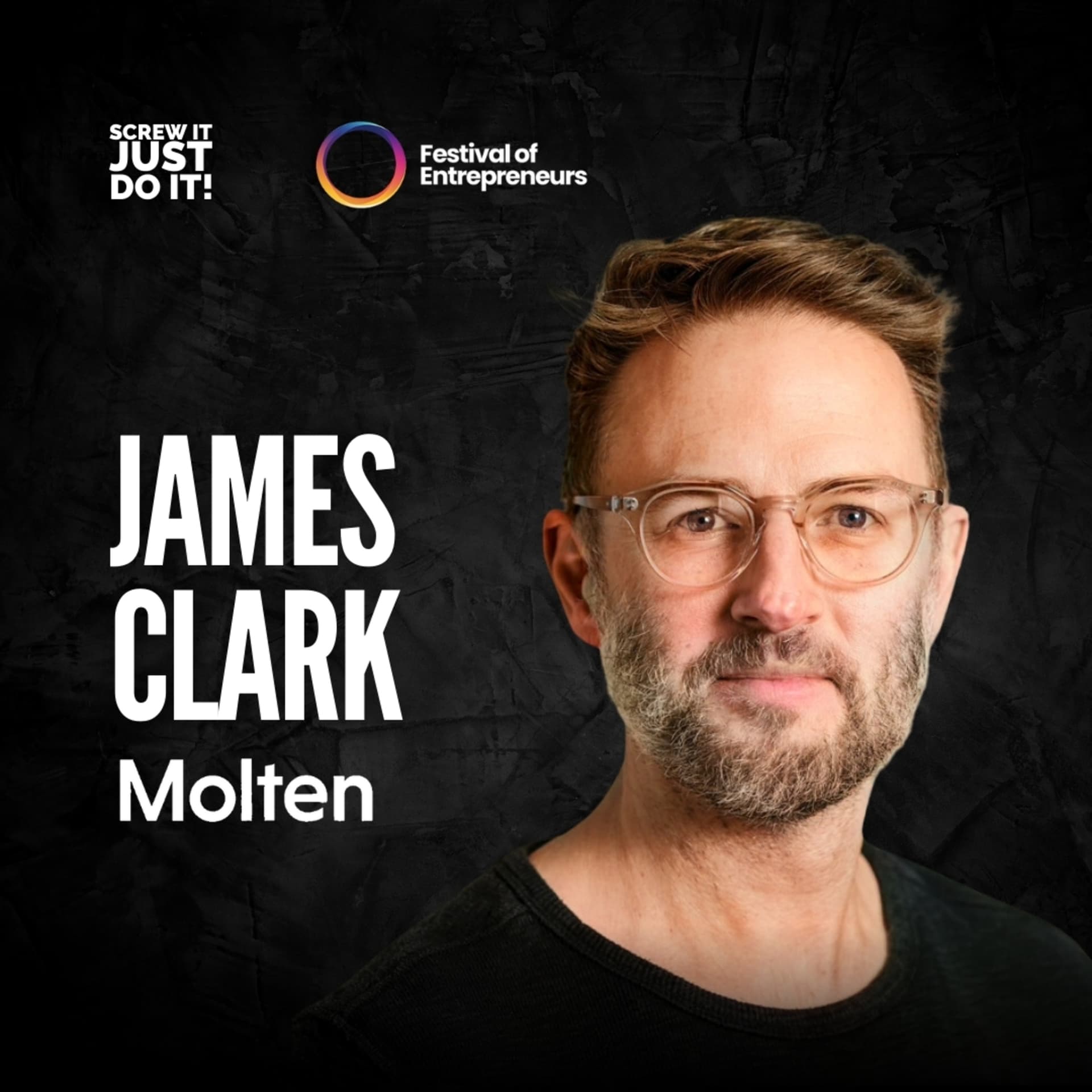
- Guest: James Clark, Marketing Director at Molten Ventures
Episode Overview In this episode, James Clark discusses the complexities and challenges associated with rebranding a venture capital firm, particularly focusing on the transition from the Draper Esprit brand to a new identity that aligns with their future ambitions.
Key Points Discussed
The Need for Rebranding
- Evolution of the Company: As Molten Ventures grew, there was a recognition that their brand needed to evolve to reflect their current and future ambitions rather than their historical identity.
- Heritage vs. Future: The Draper Esprit brand was tied to their past; the new brand had to communicate their growth and aspirations.
Challenges of Rebranding
- Internal Tensions: Changing an established name comes with pressure and resistance from stakeholders who may feel attached to the former identity.
- Stakeholder Alignment: Aligning all stakeholders on the vision of the new brand was crucial for a successful transition.
Strategic Approach to Branding
- Intellectual Coherence: A brand should have a clear proposition that is recognized not just internally, but also perceived positively by the audience.
- Risk Management: Although rebranding is risky, it also opens up opportunities to redefine the company’s market position.
Marketing Practices in Venture Capital
- Industry Standards: Clark notes that the venture capital industry has lagged behind in adopting sophisticated marketing strategies common in other sectors.
- Innovative Tactics: Molten Ventures attempted campaigns like social media advertising, which was unusual for their industry, and achieved significant metrics from these efforts.
Rebranding Process Breakdown
- Understanding the Business:
- Conducting interviews with team members, stakeholders, and even other VCs to gather insights on the company’s identity.
- Focusing on what the organization does well and how it wants to be perceived by different audiences.
- Defining Core Proposition:
- Aggregating insights to distill a singular brand proposition that resonates with both internal and external audiences.
- Creative Development:
- After defining the proposition, moving into the creative phase where visual elements—such as logos and color schemes—are developed to reflect the brand identity.
- Rapid Execution:
- The rebranding process was compressed from a typical nine months to just four months, emphasizing agility and responsiveness in execution.
Conclusion and Key Takeaways
- Future-Focused Branding: A rebrand should represent where the organization is going, not where it has been.
- Importance of Alignment: Ensuring all stakeholders share a common understanding and vision is vital for a successful rebranding process.
- Long-term Strength: A coherent intellectual foundation supports a brand's longevity and relevance in a rapidly evolving market.
- Calculated Risk: Managing risk in rebranding can lead to significant opportunities for growth and differentiation in the marketplace.
Final Thoughts James Clark’s insights provide valuable lessons for entrepreneurs engaged in branding and marketing, highlighting the importance of storytelling, stakeholder alignment, and strategic risk-taking in building impactful brands.
---
Remember to tune in for new episodes of Screw It Just DO It every Tuesday and Thursday for more insights from founders and business builders!
Written by AI. May contain mistakes. Listen to the episode to check what was said.
Transcript
Automatic transcript. May contain errors.0:00One of the first things that you need to do is to really look at how your brand communicates and talks about what you're trying to do and displays your ambitions. you know, the brand was one of the first sort of touch points that people come across. So therefore, let's look at doing brand the way any other industry would look at brand. Today's bite-sized episode is brought to you with James Clark, MBA qualified and driven by the idea that business should be bold, genuine, and built on stories, not spreadsheets. There was this recognition that as our business grew, we needed a brand that could help us grow with it.
0:33We felt that the Draper Spree brand was part of our heritage, but not necessarily part of our future. And so we needed a brand that could be recognizable and help us talk about the ambitions we had as a company to scale and go into the future. Welcome to this special bite-sized episode of Screw It, Just Do It from our back catalog of over 550 past episodes. How risky a move was it at the time and how right do you think you've got it thus far um look any any brand change is always a risk i mean you sort of you've you've built a weird built up 15 years of of i guess sort of understanding of our brands uh within our industry over that period of time and so so yeah and even though there have been sort of name changes throughout that with sort of the draper or the esprit part of the name had been involved for a long decent period of time.
1:28That said, you know, that sort of you kind of like any kind of thing, there's opportunity within that risk. And the way we looked at it was, our business had evolved a lot, especially over the last five years, we've gone public, it's a radically different thing for a venture capital firm to go public. The company has grown very substantially in the time that have been on the public markets. you know we'd sort of we'd had some new management coming we have a new ceo martin davis had joined us i think in about november 19 so there was sort of a lot of evolution within the business that was pushing for some sort of recognition around the brand as well you know we have new leadership of the investment team that there's a lot of reasons why we were trying to do this and so therefore we sort of sort of saw yes there was risk involved but there was a also opportunity around that of recognizing where the company had changed and having a brand that tried to reflect that.
2:23Other things that were a consideration for us was, we'd been listed on AIM, which is the sort of duty growth market and stock exchange. And we were considering a move to the main market. We're now on the main market, we're 4250 size. And so there was this recognition that as our business grew, we needed a brand that could help us grow with it or a brand that could go with us as we grew. And we felt that sort of the Draper Esprit brand was sort of part of our heritage, but not necessarily part of our future. And so we needed a brand that could be recognizable and help us, I guess, sort of talk about the ambitions we had as a company to scale and go into the future.
3:03And when you're working with Koto, as you mentioned earlier, were there any examples from history that they would bring out to show, you know, we believe this was a successful way to go? This was perhaps an unsuccessful route to go? Did you bring anything of that to yourself to the table as well? Look, I wouldn't put it in those terms necessarily. The way I put it is this, you know, venture capital is an industry that has changed in a staggering amount over the last 15 years. I mean, you think about how the technology, how technology has changed all of our lives in the last 15, 20 years. Well, venture capital has changed a lot in itself.
3:42And, you know, it's gone from being kind of a cottage industry to the sort of the financial engine that drives entire economies. Now, if you look at, you know, the number of just just look at all the biggest companies in the US, they're all tech companies and they're all pretty much all venture capital. So venture capital itself has changed remarkably and European venture capital, of which we are part, has changed dramatically as well. Now, one of the things that hasn't really changed is this industry hasn't really, to my way of seeing things, adopted what are fairly standard marketing practices you'd find outside venture capital.
4:18Package goods or businesses like Procter & Gamble and Unilever and sports brands like Nike and Apple and all these actually many of the companies that we invest in. And these industries have had to adopt quite sophisticated marketing strategies and techniques to sort of to continue their growth and to sort of present themselves to a public and to talk about more about who they are and what they do. And venture capital hadn't really adopted many of these practices at all. And in many ways, it was sort of it was still it still sort of felt quite nascent as a marketing opportunity. And part of the reason I joined back then, Draper Esprit, was I wanted to try and change the way marketing is done in this industry.
5:01And one of the first things that you need to do is to really look at how your brand communicates and talks about what you're trying to do and displays your ambitions. And, you know, the brand was one of the first sort of touch points that people come across. So therefore, let's look at doing brand the way any other industry would look at brand. and interested to know you know you brought up a couple of interesting points there as well with regards to you know changing the way um that your industry now venture capital you know does marketing essentially uh what other um kind of strands of marketing have you have you looked to incorporate or i'd say part of the runway this year that you're looking to to add that you can talk about obviously that i can talk about um venture capital has some things but it does a lot consistently pretty well.
5:50Things like PR and communications, events and sponsorship, content marketing, that sort of stuff. And in my opinion, you need to be able to be top level at those things so you can get permission to do the stuff that might be a little bit more different. I mean, something not long after I joined was we did a very small run, but sort of a very short, sharp social media ad campaign in sort of the autumn of 2020 that, to my knowledge, most venture capitalists have never done. You know, stuff like pay-per-click and social media advertising and all that sort of like the sorts of things that are pretty basic for almost any other industry.
6:32Most people don't do those things. And we had a very specific target we wanted to do. And we had a purpose behind what the campaign was doing. And, you know, we overachieved in terms of the metrics we were going for. And so, you know, for me, it sort of said, well, like, there's things that we're not doing that we could be doing quite differently. And, you know, if you're a venture capital firm that's done different things like being publicly listed, why don't you think about doing things differently in other parts of your business? And marketing is very much the sort of what my focus for how to do those sorts of things differently.
7:04Interesting. And I think it'd be really helpful for our audience, those who, you know, are the owners of businesses, the CEOs, the, you know, the MDs, directors, marketing directors, et cetera, to talk through the process a little bit itself when it comes to rebranding. And you mentioned, you know, who you kind of leaned on, you know, a little bit with Koto and InHash team. But we'd love to, you know, find out a little bit more about the process if you can share that with us, James. Yeah, sure. So, look, as I say, this was part of my marketing, you know, how I cut my teeth in marketing and advertising.
7:41I think the thing to bear in mind about marketing is, sorry, a rebrand, is in many ways you are trying to understand what the company does very well and what the company stands for and then kind of find a way to express that. And most people think about the logo and the colors and the fonts, you know, all that sort of stuff that is the visual expression of what a brand does. But a lot of, and to my mind, at least 75 % of the effort happens at the start of the process where you're trying to get an understanding for the business itself. It's a bit like an hourglass. You spend quite a substantial period of time and effort concentrating down all these aspects of what the business stands for down to like a single proposition that expresses that business.
8:30And so we spent probably about four months towards the year 2020 pulling together our strategy, going out, interviewing our team, interviewed everyone across the business, interviewed people in our portfolio, interviewed people not in our portfolio, interviewed other VCs that we work with, trying to get an understanding of what they think makes us us. and then what you do out of that process is you go, well, look, here is a whole group of things that could be defined as this business name to be decided. What is at the core? And then you need to sort of figure out which one of those are most salient to you as a business but also then which ones are most salient to your audience.
9:15So find a way to combine the thing that everyone in your own business agrees is an important thing to you and then find the thing that you think is going to be important to your audience. And the audience for us could be entrepreneurs. It could be other members of the tech industry. We're publicly listed. So things that would be interesting to our investor audience, to stakeholders, so that it's sort of quite a broad group. But you have to try and find that proposition that defines you as a business and then also other people see you as that thing. And if you bear in mind, a brand is not something that you can control.
9:49A brand is something that you put out into the world and it's sort of the collective knowledge of this company for everybody that comes across it. And so therefore, all you can do is influence how people think about you. You can't be too directive about it. And the things that most people think about, you know, the colors and logos and fonts and all that sort of stuff, there are ways to try and influence that. But what you have at the core is this proposition. And so we spent about four months at the start of the process pulling this information together. I have to say, it was interesting looking forward and looking back about how this is done.
10:25I mean, Koto operated at a very rapid pace of how they produce this stuff. They operate in sprints. Very different to how I used to do things back in the day. I mean, what was probably a nine-month job that was compressed down to four months. uh we came out into the brand strategy about you know what the what the business goal was what the business vision was what the business proposition was uh you know our our sort of our brand personality and then sort of the values around brand as well and we sort of got to that process by yeah by december had board approval in 2020 and the proposition that sort of we we came across um i'll come back to in a little bit but sort of that that proposition then became the sort of the inception point for all the creative work that followed everything from the name to the colorways to the visual aspects of the band to the all those sorts of things that fell out of that that that process of getting to that single point and so from sort of january 2021 onwards there was a lot of work around that that creative exposition james shows us that entrepreneurship isn't about grazing the edge of comfort it's about reshaping the field about thinking bigger than business, building your story, not just building a product and not aiming to fit in, aiming to stand out.
From the publisher
Rebranding a company is rarely neat, and James Clark makes that clear in this conversation. He talks through the pressure of changing a long established name, the internal tension that came with it and the need to build something that reflects future ambition rather than past comfort.
His breakdown of stakeholder alignment, intellectual coherence and disciplined decision making gives founders a practical view of how to manage identity change at scale. It is a calm and honest look at the work behind a brand that now represents a fast growing venture capital firm with global reach.
Guest note:
James Clark is the Marketing Director at Molten Ventures, known for leading one of the most complex rebrands in European venture capital.
Key Takeaways
A rebrand must reflect where the organisation is going, not where it has been.
Stakeholder alignment matters more than visual design.
Intellectual coherence gives a brand long term strength.
Risk is part of the process but it must be managed with structure and clarity.
🎧 New episodes of Screw It Just DO It drop every Tuesday & Thursday, so make sure you follow wherever you listen. You’ll hear real conversations with founders who’ve taken a risk, built something from scratch, and figured it out along the way.
FOE returns to NEC Birmingham on November 3-4, 2026. Stay connected at www.festivalofentrepreneurs.co.uk and follow @festivalofentrepreneurs for news, updates, and future events.
Real entrepreneurs. Real stories. Real strategies.
👉 Follow the show. Keep showing up. Screw It Just DO It!
#ScrewItJustDoIt #FestivalOfEntrepreneurs #StartupLife #Entrepreneurship


