
In short
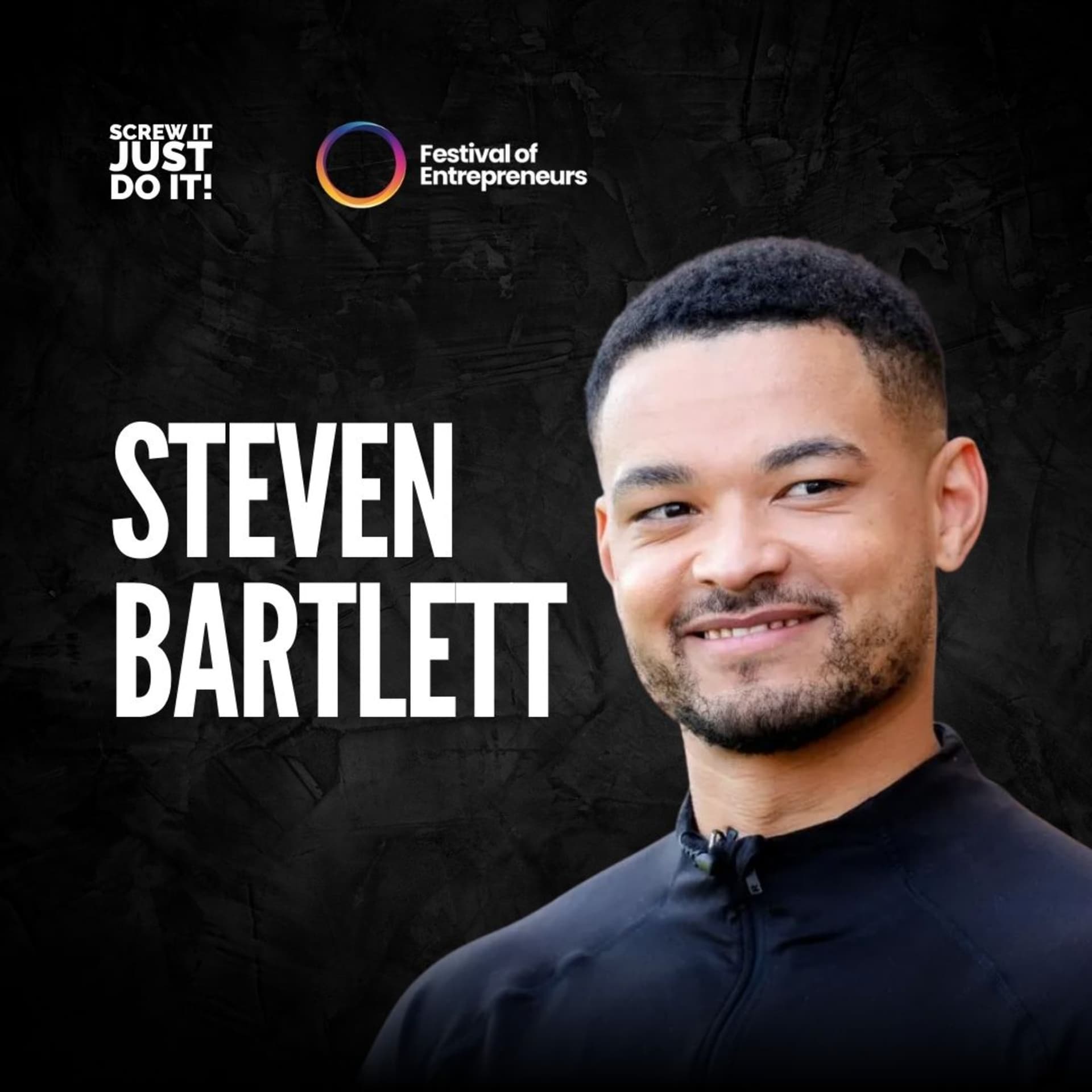
Steven Bartlett (Diary of a CEO; youngest Dragon on Dragon’s Den) discusses his path to entrepreneurship, arguing that clarity, storytelling, and discipline beat “hustle,” and that success comes from personal effort rather than external support. He also advises founders on personal-brand vs company branding, selling as a core skill, and building online communities via niche selection, content testing, analytics, and patience.
Guest backgrounds
Steven Bartlett studied business management at Manchester University but dropped out after attending only one lecture; he built Wallpark in his early 20s, then founded Social Chain at 22.
Key claims
degrees aren’t enough; entrepreneurship is learned by doing; sales is central; community growth requires trial-and-error and analytics.
Notable examples
dropping out after getting bored in the wrong lecture; starting Wallpark; founding Social Chain; early “Excite” under-18 events (e.g., repurposed birthday parties) that drew thousands; Instagram content growing followers with lower engagement.
Written by AI. May contain mistakes. Listen to the episode to check what was said.
Chapters
Tap a time to open that second in VOThe Journey to Entrepreneurship
0:55 to 1:08
Steven shares his early motivations and journey into entrepreneurship.
“If you like what you hear, don't forget to follow the show and grab your free two-day pass to the Festival of Entrepreneurs this October.”
The Journey to Entrepreneurship
1:48 to 4:36
Steven shares his early motivations and journey into entrepreneurship.
“What do you think is the key component to be a social influencer, doing it through a personal brand or through a company?”
The Early Business Ventures
4:39 to 7:24
Discussion of Steven's first business experiences and lessons learned.
“I think that's probably the easiest way to explain it.”
The Importance of Selling
7:26 to 9:36
Exploring the significance of sales skills for entrepreneurs.
Upgrading Your Network
9:39 to 10:33
Advice on building a community and network for success.
“The next 400 tweets, we got to 100 ,000 followers.”
Transcript
Automatic transcript. May contain errors.0:00I went to Manchester University to study business management and I didn't register but I went down to where I thought my lecture was meant to be and I had, I sat in the room for about half an hour, got very very bored, I was convinced I was in the wrong room. I got to the point where I realised that a degree from this university wasn't going to get me where I needed it to to become who I wanted to become so I was very very clear in the fact that I wanted to be an entrepreneur.
0:23Alex Chisnall:Steven Bartlett, the host of The Diary of a CEO podcast and the youngest dragon on Dragon's Den. He shares what's behind his relentless drive and why clarity, storytelling and discipline still trump hustle. If you want something, it's only going to be achieved through your own efforts. There's no external force, there's no mummy or daddy, there's no handout. And I also had learned that I had a pretty good talent for getting what I wanted through selling or through being quite honest, being able to convince people of certain ideas and things like that. Welcome to this special bite-sized episode of Screw It, Just Do It from our back catalogue of over 550 past episodes.
1:02Alex Chisnall:If you like what you hear, don't forget to follow the show and grab your free two-day pass to the Festival of Entrepreneurs this October. Just head to festivalofentrepreneurs.co.uk to claim yours and don't forget to dive into the back catalogue. Want to surround yourself with 5 ,000 to 10 ,000 entrepreneurs if you've already decided to screw it and just do it? The Festival of Entrepreneurs is happening October the 8th and 9th at the NEC Birmingham, and I'm giving away free two-day pass to my listeners. 200 plus speakers, 90 plus sessions, billion pound entrepreneurs sharing their real stories, not theory, but the actual strategies they use to scale.
1:36Alex Chisnall:Head to festivalofentrepreneurs.co.uk right now and claim your free pass, because the best networking happens when you're in the room with people who've already decided to screw it and just did it. Would you go personal brand or would you go company if you were advising someone starting out right now? What do you think is the key component to be a social influencer, doing it through a personal brand or through a company? It really depends on the company. Not every company may then develop your personal brand. So if you're selling computer servers, let's say, you might not make a huge amount of sense.
2:08You felt that the priority in order to grow that business shouldn't be building out the CEO's personal brand. And then the next question becomes, does the CEO or the leader or the MD have the talent to support building their brand? Because that's not always the case as well. So, yeah, and it really, really depends on the business. There are some businesses where it's very obvious that building a personal brand makes a lot of sense. Businesses in particular, like that include brands where you're selling a product, a new type of product. So that could be where you're selling a face scrub or you're selling protein shakes or something like that.
2:39Those things can be very closely attached to a person and those can live and die off the back of the face that is selling it.
2:46Alex Chisnall:Okay, very good answer. And going back to yourself when you started, what was the initial motivation? I went to Manchester University to study business management and I didn't register, but I went down to where I thought my lecture was meant to be. And I sat in the room for about half an hour, got very, very bored. I was convinced I was in the wrong room. I never went out, so I went back to my halls of residence. And about three months later, I went down to the university and dropped out. But I did only go to the one lecture. It just took me a while to officially drop out. And yeah, I had a few ideas for a few different businesses, all centered in around the student world and building a student communication medium of some type.
3:26And I ended up building Wallpark, spending the next sort of two years of my life raising investment, building a team and marketing Wallpark and learning everything I needed to learn about business, which ultimately at the age of 21 led me on to starting Social Chain, which is the company that I run now and have run for the last two years, which was established when I was 22. I was going to say your question was, what was my motivation to start my business when I was 18? I think the answer to that is I got to the point where I realized that a degree from this university wasn't going to get me where I needed it to to become who I wanted to become.
3:59So I was very, very clear in the fact that I wanted to be an entrepreneur. I wanted to run businesses. That's what excited me. that was the appealing challenge in my life always and I didn't believe three years sitting in this lecture theatre was going to teach me how to become an entrepreneur or and so and that was very quickly sort of validated that belief within three months of dropping out where I actually started learning lessons about business how to set up a company how to get invested I learned all those things just by doing it my desire to become an entrepreneur I'm not really sure where that come from I've always wanted to build things and create things and I've never seen anything that stood in the way between having an idea and making that happen.
4:38And I think that when I think about why I am here now, I think that's probably the easiest way to explain it. There's never been a barrier or a hurdle in between me thinking of an idea and the destination of it ever happening in my head. I've always believed that I can get there, even when I probably couldn't.
4:55Alex Chisnall:If you're enjoying this conversation and thinking, I need to be around more people like this, then I've got the perfect solution for you. The Festival of Entrepreneurs is where 5 ,000 to 10 ,000 ambitious entrepreneurs come together to learn from the people who've actually done it. It's on October the 8th and 9th at the NEC in Birmingham, and I'm giving my listeners free two-day passes. Real entrepreneurs, real stories, real strategies, exactly like what you're hearing right now, but live and in person. Go to festivalofentrepreneurs.co.uk and get your free two-day pass before they're gone. Going back to when you were growing up, where your purpose, where your why's come from?
5:34Alex Chisnall:I read that you wanted to create your own birthdays and your own Christmases, for example, because there was never much money going around. Can you tell us a little bit more about where that purpose, where that drive comes from? Yeah, so when I was, I think, probably about 12 to 14, we didn't get any sort of Christmases or birthdays. My family were very, we just didn't have the money, to be honest. And at the same time, my mum and dad were working such ridiculous hours that they were never really in the house. So my mum would work, she'd get up at 6am and she'd often come back at about 1 or 2am.
6:02So I really never saw her through that period of my life. I became my own boss when I was 12 or 14, I think I was about 13 maybe. I became my own boss. And what that meant was that if I was going to have the things I saw my friends have in school, I was going to get those things off my own means. And I think those four or five years of my life taught me that if you want something, it's only going to be achieved through your own efforts. There's no external force. There's no mummy or daddy. There's no handout. out. And I also had learned that I had a pretty good talent for getting what I wanted through selling or through being quite honest, being able to invent people of certain ideas and things like that.
6:38So that coupled with the fact that I had no choice led me to starting my own business when I was about 14 or 15 years old. And that was a terrible business, a terrific idea, and it failed. And then I started another one at 16. This whole time, I've been running small business. I was the kids school selling fags and i was selling sweets and things like that but and i was making good money filling cigarettes on in secondary school please don't tell my teachers i said that um but my first real business when i was 16 that's when i i had a name i had a website it was on the business directories um and that was a business i called excite which is basically an under 18 event for for young people and i was able to get thousands of young people on sometimes eight or nine days notice come to a venue and to pay five pounds to enter often those events were just my birthday repurposed as end of summer party and i if i go on the facebook page i created when i was 16 from 2000 i can't remember it was a long time ago there's 2500 people in my city saying that they're coming to this event and there's photographers there's press there's all these people and that was just that was my birthday party i called it an end of summer party and so i'd throw about three or four parties a month and the whole of the city would turn out and pay a lot
7:48Alex Chisnall:of money so yeah that's amazing do you think the key skill or one of the key skills for anybody starting out in business is that ability to sell i think fundamentally i think it's very important for entrepreneurs i think there are certain types of business you maybe don't need to sell fake face as such you're you might need to know how to sell online but i think for entrepreneurs who are building businesses and building games you are selling at all times you're selling to your team you're selling a vision every single day you're selling to your investors you're selling you'll get money you're selling to your clients in our case people like you know the biggest brands in the world convincing them to back us and go with our ideas and you're selling at every opportunity um i think single most important skill anybody to learn in their life is the ability to sell whether it's selling yourself to a girlfriend or selling yourself to employer i think sales is fundamentally the heart of everything cool and if you were giving advice on anybody starting out now and looking to build their own network from scratch what would your advice be any couple of tips that you could give if it's the case of building a big community online i would focus on finding a niche that you believe a about you're uniquely qualified to own so that it can be from experiences or a passion you you have or a job you have or something like that and then i would focus on it's a long process of trial and error when it comes to growing a community understanding what content is resonating most with but the audience i would start producing content today without any sort of real science behind it and then collect the data on how the content you're pushing out this community is performing.
9:16Because some types of content on different platforms achieve different results. So we know, for instance, that there's a certain type of content for Instagram, which grows your page the most, even though it gets less engagement. And all of the answers to all of the questions around data and what's working, what's not, can be found in the analytics section if you are caring enough to look. And you've got to have patience when building a big network or a big community online. I remember our first ever page, we'd done 400 tweets and we had 400 followers. The next 400 tweets, we got to 100 ,000 followers.
9:46But had we not done that first 400, we wouldn't have got there. And that's often been the case for a lot of our communities where, you know, you've got to put a year into it. You'll wake up in a year's time and you'll have hundreds of thousands, maybe millions of people.
9:57Alex Chisnall:That conversation just proves something. You are the average of the five people you spend the most time with. So here's my challenge. Upgrade your network. The Festival of Entrepreneurs is happening October the 8th and 9th, and I'm giving my listeners free two-day passes to get in the room with 5 ,000 to 10 ,000 entrepreneurs who are actually building something. This is where the risk-takers, the game-changers, and the people who've decided to screw it and just do it come for inspiration, education, and connection. Don't just listen to their success stories. Go meet the people living them. Grab your free pass now because the biggest risk isn't taking a chance.
10:33Alex Chisnall:It's missing the opportunity entirely. So I hope you enjoyed that episode with Stephen Bartlett. Did you know that was Stephen Bartlett's first ever, ever appearance on a podcast? 100 % true. A couple of things I want to pull out. Clarity over chaos. So Stephen's approach is far more intentional than people give him credit for, I think. It's not just hustle. It's always highly, highly strategic. Storytelling is a superpower. No surprise, eh? Diary of a CEO, huge global podcast now. Stephen's ability, whether you love him or hate him, to connect through narrative, I believe is second to none. It's something every founder should take notes on.
11:12Alex Chisnall:Still learning, still evolving. So what impressed me the most was how honest he is about what he's still working on. And that growth mindset never, ever stops.
From the publisher
What makes someone drop out of university after just one lecture, with no funding or formal plan, and go on to build a multi-million-pound marketing agency? That’s the question I posed to Steven Bartlett - founder of Social Chain and one of the UK’s most inspiring modern entrepreneurs. In this bite-sized episode of Screw It Just Do It, Steven breaks down the mindset shift that helped him scale a Twitter page into a global agency working with Apple, McDonald’s, and the BBC. It’s raw, it’s real, and it proves that sometimes your biggest leap comes when you stop planning and just start.
Key Takeaways:
- Why Steven dropped out of university after one lecture
- How spotting real problems creates real businesses
- Building a startup from a social media account
- Why personal branding and sales skills matter early on
- The power of resilience and thinking differently
🎧 New episodes of Screw It Just DO It drop every Tuesday & Thursday - so makes sure you follow wherever you listen. You’ll hear real conversations with founders who’ve taken a risk, built something from scratch, and figured it out along the way.
🔥 Want to take things further? Join me in person this October at the Festival of Entrepreneurs on the 8–9th October at the NEC in Birmingham. The Festival of Entrepreneurs is where 5-10,000 ambitious founders come together to learn from the people who've actually done it. I'm giving my listeners free 2-day passes.
Real entrepreneurs, real stories, real strategies – exactly like what you're hearing right now, but live and in person. Go to www.festivalofentrepreneurs.co.uk and grab your free pass before they're gone.
👉 Follow the show. Turn up in October. Screw It Just DO It!
#ScrewItJustDoIt #FestivalOfEntrepreneurs #StartupLife #Entrepreneurship


