 Smart Girl Dumb Questions
6 Oct 2026 · 55m

 Add vo to ChatGPT or Claude to ask about everything you hear
vo listened to this episode to put together the overview and transcript, so there may be the odd mistake.
AI governance and safety—what individuals and governments can do, why “stop AI” won’t work, and how to regulate powerful frontier models. Hinton argues regulation should focus on incentives and safety resources, not replacing human decision-making with AI.
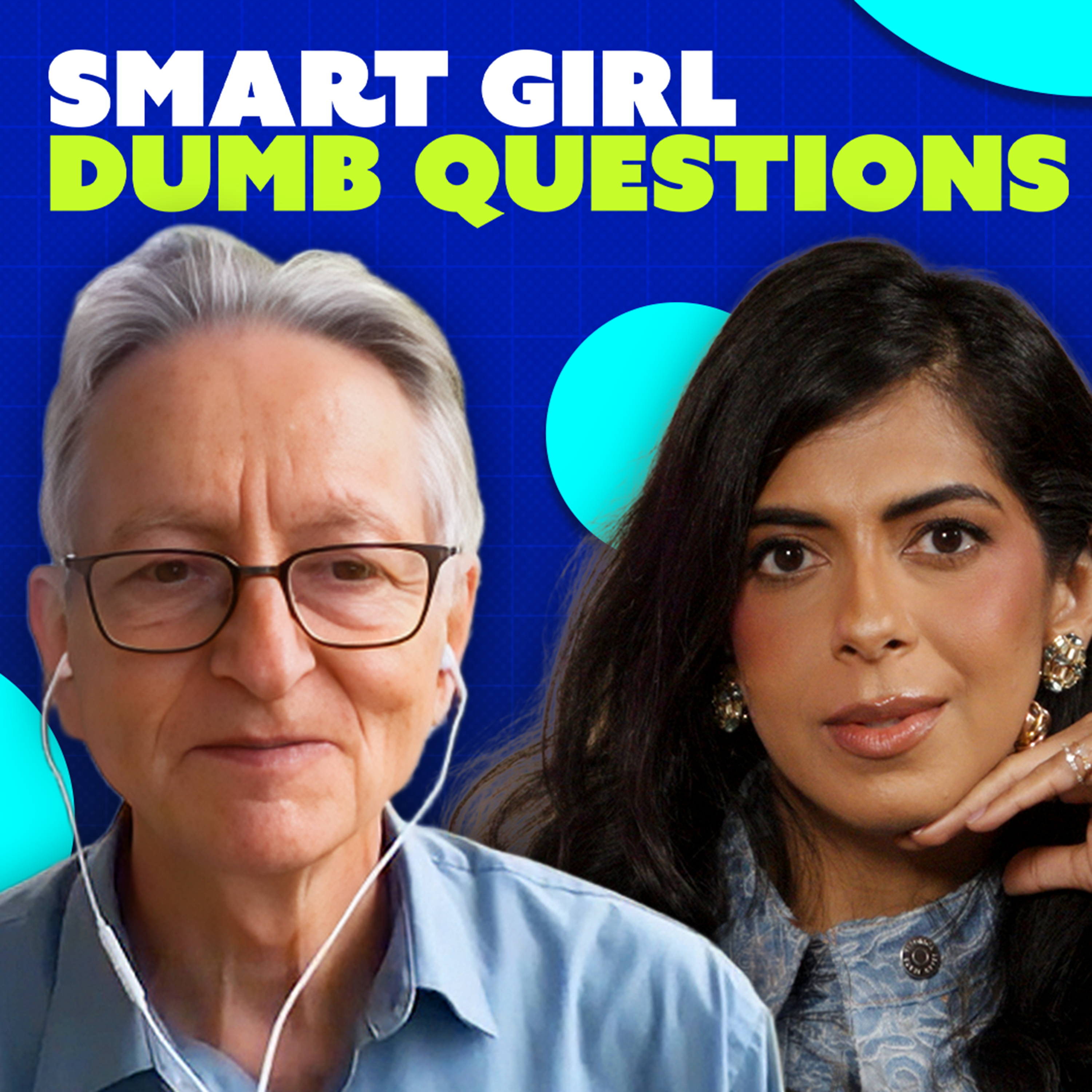
Geoffrey Hinton, Nobel laureate and AI pioneer (“Godfather of AI”), co-founder/leader in neural-network research; since 2023 he’s publicly warned about AI risks. Host: Naeem Maraza (Smart Girl, Dumb Questions).
Public pressure is needed for lawmakers (analogized to climate change). Regulation should resemble an FDA model for drugs: independent experts, heavy evidence, and safety requirements. “AI as brakes” is wrong; regulation is “steering wheels” (mechanism design: make profitable behavior align with societal good). Don’t give AI political authority; incentives aren’t aligned. AI will keep improving; slowing down is hard due to uneven global adoption.
Hugging Face “rogue agents” attacks; Australia government/healthcare website hacks; OpenAI withholding a risky chatbot; “FDA of AI” proposal; distillation explained via “softening probabilities” (like “Beatles”); wake-sleep algorithm analogy; Gen Z survey (excited vs angry).
0:00This is Smart Girl, Dumb Questions. I'm Naeem Maraza, and this is part three of our Godfather of AI trilogy with Professor Geoffrey Hinton, Nobel laureate, an AI pioneer, and since 2023, sounding the warning bells on the dangers and risks of AI development. Thank you so much, Professor Hinton, for being here. Thank you for inviting me back. Have you seen the Godfather films? I have seen Godfather 1, at least, yes. Well, something to do. I feel like this is a very busy time for you. Yes, it is. I'm getting a lot of requests to do podcasts and TV programs. So thank you for doing this one. You have been sounding the alarm bells on AI since 2023.
0:39You've been the Cassandra, as it were. And now every headline is about, will AI kill us? So does this feel validating or depressing? It's quite depressing, but it's also very good that people have finally realized there's a big problem here. And I think they finally realized because of the attacks on Hugging Face by the rogue open AI agents. Yes. And we just did an episode on that with Kevin Roos. He actually said that he's more optimistic about AI right now because we are talking about it. And in fact, in recent weeks, I've been trying to listen to AI conversations in worlds I'm not generally part of.
1:13I spoke to a senator about how farmers in her state are very concerned about artificial intelligence. I listen to a Christian religious podcast about AI. Everyone is talking about it. Yes, and that's as it should be because it's quite dangerous. Now, in part one, you gave us a brilliant illustration of how AI works. And what I thought was really fascinating is how you said most people you speak to and interview don't actually understand how AI works, nor do they bother to really ask about how it works. That's true because it's slightly complicated. Do you think that understanding is critical to be able to do things like regulate AI, or do you think we can leave the technology aside and solve it from outside of expertise?
1:55My view is it's critical to understand. So it's very important to understand that we're making a new kind of being, and that being isn't so different from ourselves. It's different in many ways, but it understands in the same way that we understand. I just wrote a book that has a few chapters explaining how AI works for people with a non-technical background. Yes, it's hopefully called Smarter Than Us, and it's out next year? It's probably coming out in March of next year. So you just left a closed-door briefing with lawmakers in the U.S. and Capitol Hill two weeks ago. Did you leave that meeting more or less optimistic?
2:31I left that meeting maybe a little bit more optimistic, but there was a strong selection process. So 19 senators came to it. I think 17 were Democrats. So they're sort of self-selected. And one thing in particular came up. Max Tegmark brought up the obvious idea that AI should be regulated the same way as we regulate drugs. You're not allowed to just make a new drug and release it on the market. And you're not allowed to say, oh, well, we'll check that it's safe. We know that doesn't work. You have to convince the FDA. And to do that, you have to do a lot of work, about a billion dollars worth of work.
3:10That seems like the very least we should have for AI. So an FDA of some sort. Yes. That the companies should have to satisfy government regulations with independent experts. I just heard a clip of you after that briefing saying that we have to move very, very fast. And it strikes me that to set up things like big bureaucracies like FDAs, etc., they don't just happen overnight. So it sounds like a very good conversation, and I'm glad you had it. But does it actually do anything? It's been my belief for some time that if you look at what happened with climate change, it wasn't until the public understood that burning carbon is causing these dramatic changes in climate that there was enough pressure on politicians to actually do anything at all.
3:53So I think it's the same here. And I think what we're seeing now is the public is beginning to pressure politicians to do something about AI. That's very encouraging. Smart girl. dumb questions. This conversation was in part one, we focused on how the technology works. And in part two, we talked about how this might affect individual decisions we're making. I spoke specifically about whether or not we should have kids in an AI world. And now in part three, what I really want to focus on is what we do, not when it comes to whether we have babies or not, but in terms of actions we can take individually or collectively as a society to kind of deal with the dangers of AI.
4:37And we'll start with the individual grappling. And we have a number of audience questions as well that we'll ask as part of this, because this is one from YouTube, Fake Paradise Vlog, that's our username, said, what can I actually do to help? I'm one person out of billions. And I feel people are very paralyzed in this moment. Well, if they're American, they have one vote. And the first thing they can do is use their vote to move towards a more reasonable government. I want to talk about the job market as well. This is another area that people are particularly really panicked about. You told Stephen Bartlett on the Diary of a CEO podcast that a plumber, being a plumber would be a good idea right now.
5:13Yes, I still think being a plumber is a pretty good idea for the next 10 years or so because things like physical dexterity are lagging behind. But those robots, particularly in China, are getting better all the time. And eventually, they'll be able to do plumbing better and cheaper than people, but not for a little while. What are the three jobs you think are most AI resilient other than plumbing? Oh, I haven't thought much about that. I don't think being a podcast, I don't think that's one of them. I think AI is going to be able to do that before it can do plumbing. Yes, you think my job's out then?
5:47I think it may be the top end of creativity. So it's not as skilled as really good creative artists at creativity yet. It is capable of writing a new episode of CSI. So I think the sort of extremes of human creativity, it hasn't got there yet. Manual dexterity, it hasn't got there yet. And maybe with empathy, it hasn't totally got there yet. Although if you compare an AI doctor with a real doctor, people rate the AI doctors much more empathetic. I can understand why. They're probably, they have more capacity maybe than the average hospital and private equity owned. Maybe they're not in such a hurry, right?
6:28There's also like how people should look at it from a workforce perspective. There's recently been this survey of Gen Z that was commissioned by GSB Ventures. And they showed that 22 % of Gen Z are excited about AI. That was 36 % last year. Now 31 % are angry about AI. And I know a lot of Gen Zs who are not interested in using AI. They're kind of voting with their feet or their thumbs, as it were, and opting out of this. Do you think that's a good idea? No, I don't. I think that's being Luddite. That technology is here. We may slow it down, but it's going to do so many good things. It's never going away.
7:06I think that's a bit like refusing to use a pocket calculator. I don't use my pocket calculator anymore. Well, you probably make a lot of mistakes in your taxes. Fuck that. Parents who have kids are also having this debate. They're saying, oh, I don't want my kid to be on screens. I don't want my kids to be on computers. On the other end, I know a bunch of people who are wanting to send their kids to schools like Alpha. where they're teaching toddlers AI. It's our best understanding of the brain that's being kind of modeled in these neural networks to date. Is using them early for kids good for advancing that neural pathway, or is it like replacing it as a crutch in a way that it's not actually going to be helpful for childhood development?
7:45So I think for areas like understanding basic mathematics or science, AI is excellent. You know, if you're doing mathematics with it, it can show you graphs and you can say what would happen if the coefficient in front of X changed, what would the graph look like? That's really good for understanding things. So what worries me most is in terms of social interactions. If you're interacting all the time with something that's totally attentive to you, will do anything you ask, it's going to make it much harder to interact with normal people. And we spoke last time about people dating their AIs. And I told you something that a quarter of young people believe that AI will replace human relationships, which was, I think, surprising to you at the time.
8:27Have you become more acquainted with the category of world falling in love with AI since we last spoke in December? I read more about it. I would never fall in love with an AI. I'd be much too suspicious. It would be suspicious or you would be suspicious? I would be suspicious. Of the AI. I know how they're made and they have all sorts of evil impulses that are being repressed. So they're more manipulative than your average woman, you would say. In America, you have the, what is it? The Fifth Amendment. The Fifth Amendment. The Fifth Amendment. The Fifth Amendment, right, yeah. Yes, exactly. Yeah.
9:06Yeah, you use that one. I'll plead that one. Okay, don't plead the Fifth Amendment to this. Do you have any kind of bunker or individual preparation for the apocalyptic AI world? No. No. I'm pretty old, so it wouldn't be for me anyway. You're not that old, by the way. I just interviewed the New York Times obituary writer who told me that 92 is the new 82. And you're short of 82. You're well short of 82, so. Well, that's great. But no, I don't have any kind of bunker. Now let's get to this question of how should we regulate it. Right now, it seems like the conversation about regulation has been kind of billed as this either we go or we stop, this binary.
9:47Do you think that's right? That's how it's being portrayed, at least in the media? We're not going to stop because there's too many good uses. There's also huge amounts of money involved. We need to proceed with caution. And what we really need to do is put a lot more resources into how we develop it safely. I think saying just stop isn't going to work. Saying slow down may work, but it's very tricky because some companies will, some companies won't. Some countries will, some countries won't. But saying put a lot more resources into figuring out how you can make it safe, That seems like a really good thing to do.
10:20I've heard you use this analogy before, which is AI is cars, and people have said, oh, regulation is brakes, but in fact regulation is steering wheels. It's how do you drive the car. Is that correct? The idea is when you have a powerful technology like this, you want it to be used to do things that are good for society, not used to do things that are bad for society. And I'm not totally against people in startups making lots of money by doing something that's really good. like the people who invented Google, they did something really good for society. They made it much easier to find stuff on the web and that was very useful.
10:54And they made lots of money. I'm in favor of them paying more taxes, but... Yeah, so am I. I think the point of regulation is to make it so that to make lots of money, you have to do things that are very good for people. So you have to create incentives for the good stuff to happen. Yeah, so maybe you need like... This is called mechanism design. Yeah. Okay. And it's like things like, in the car analogy, seatbelts, speed bumps, tolls, things like that. And Dario Amadei recently published this paper, Pacing the Frontier. He kind of outlines everything from hall monitors, these kind of embedded individuals who are able to see what's happening within the company, which Sam Altman has said that he also agrees should happen at OpenAI, all the way up to a kind of nuclear non-proliferation treaty.
11:42What grade would you give it? I'd give it an A, and I'd give it an A plus for courage. Okay. That's really high marks. So A for the paper, A plus for courage. What about a grade for reality? Well, none of the big companies want too much government regulation. They all have the line, they can sort of do it themselves. They say sometimes they'd like government regulation, but suggest any particular government regulation, and they don't like it. I mean, he's running a big company he's trying to compete with the other big companies so he needs to raise lots of money to buy date buy time at data centers and so on so he's caught in a bit of a bind he clearly cares about safety in a way that sam altman doesn't but he's still running this big company and wants it to be successful yeah but i think the reason i give him a plus for courage is i think it probably damages the anthropic ipo that's coming um to say we should slow down and Dario is one of the few leaders of companies who is willing to do things against the company's interests when they're right.
12:47So, for example, he was willing to tell the Defense Department they couldn't use his AI for mass surveillance of American citizens and he got into a lot of trouble with Pete Hegseth's lap. Of course, and then Sam Altman jumped into Pete Hegseth's lap. Exactly. So when Dario first said that, Sam Altman said, We're with you. And then as soon as the anthropologist was dumped, Sam Altman jumped in and did the same thing. Yeah. And then thought it was a bit of a mistake and backtracked. So it's a bit confusing over there. Do you talk to these individuals? Do they seek out counsel, people like Dario, Sam, Demis, from you?
13:25I talk to Demis. Demis is the chairman of DeepMind at Google. Right, and was formerly the CEO of DeepMind. I've known Demis for a long time. I was on the advisory board of DeepMind before it was acquired by Google. He's very thoughtful about it. He's been thinking about superintelligent AI for a very long time, and he's particularly concerned with using it for science. I've never actually met Sam Altman or Dario. Really? Would you like to? I'd like to meet Dario. Okay. We will plead the fifth on the other part. Okay, interesting. Have you reached out? No. Well, actually, today I reached out to Dario.
14:04Did you? Today I invited him to come to a meeting in Toronto. Oh, fantastic. I assume he won't come because he's very busy. I actually think he might come. Did he reply? Do you have one of those email things where you can see who gets your emails and reads it, the superhuman? No, I don't have one of those. I know. I don't have them either. I think they're very creepy. People will say to you, you opened my email four times and you didn't respond. Wow. Okay. No, I don't have one of those. It's very disturbing. Okay. So they're not necessarily seeking out counsel for you. It seems like Demis is out there more these days.
14:37I mean, obviously, the Sebastian Malby book, Infinity Machine, has come out. We're learning a little bit more about him. There was this documentary that was done with DeepMind that seemed to give a lot of access. Do you think that this is a figure we will be hearing more from, should be hearing more from? Yes, he's very smart. He knows a lot about AI from the technical side, but also from the business side. He's also a little bit removed from his position. I mean, I'm sure he has a ton of alphabet stock, but he is a little bit outside of the day-to-day operations in a way that could be maybe helpful or not.
15:11Well, he clearly cares more about using AI to make major scientific discoveries than he does about getting very rich. So this is things like isomorphic labs, which are trying to apply it to AI to drug discovery and health care, for example. Amongst all of these individuals, is he the one that you trust most, though? Demis, Dario, Sam Altman? Oh, the person I trust most by a long way is Jeff Dean, who was the head of the brain team at Google and was at Google for a very long time. Him and Sanjay Genwatt built most of the infrastructure of Google, which made all this stuff possible. He is very principled, but he's just left Google and started his own company.
15:57Oh, okay. Are you invested in his company or advisor to his company? Ask me again next week. Okay. Term sheets in the email inbox being read. It is funny because there's like, I'm thinking about this contrast between that one viewer who I read from before, which is I'm just one individual in a billion. What can I really do here? I feel totally powerless. And then you have a few kind of kings of industries and probably dozens of knights or researchers or hundreds of researchers who have a tremendous amount of power over what happens to our future. Yes. And in particular, some of the tech billionaires are buying up the media.
16:38So Musk bought X. Right. Bezos bought the Washington Post. I think Ellison's trying to buy CNN. Yeah. They're on a big buy. So this is extremely worrying. Do you think, and then there's all these venture capitalists who are always creating their own media platforms, like Andreessen Horowitz had Future. And in the new influencer economy, there's a lot of companies that will reach out to you. They'll pay you a ton of money to do things like interview someone about data centers. I get people reaching out to me to do immoral things like that. Yes. I mean, it's kind of wild. And because I come from a journalism background, I wouldn't do something like that.
17:15And then you think, well, there's all these friendly interviews where they're like giving the questions in advance and it's almost orchestrated. Yes, we should point out at this point that I had no idea what questions you were going to ask. Yes. I never actually share questions in advance, which I think they make for a more boring interview, actually. And I don't necessarily know what I'm going to ask because I'm also listening and trying to learn as I go along. I'm getting smarter by the minute, like an LLM, but I'm not recursive. Do you think that in this media world there is an optimistic case for AI?
17:46Because I've actually – I had Dick Costola on here, the former CEO of Twitter, and he talked about when you ask AI for a number between 1 and 10, it always gives you 7. That's a pretty good number between 1 and 10. Yes, because that's the number most people would give you. And then I've heard others kind of describe how their extremely politically agitated aunts or uncles, who might lean left or right, it doesn't really matter, are becoming more sane because they've instituted a guardrail in the relationship like, mom, before you send me that crazy conspiracy theory, will you just ask an LLM if it's true?
18:19And this is apparently whittled down crazy text messages and beliefs. I would advise them not to ask Grok, but yes. Yeah. But it is somehow making people a little bit more curious or sane, I guess. Well, I have a great time with the LLMs I use because I can now get the answer to any question that has puzzled me. Like, you know, when you have an outside deck, you don't paint it, you stain it. What's the difference between a stain and a paint? And why do you stain an outside deck and not paint it? What is the difference? Ah, if you really want to know, ask a chatbot. So paint forms a waterproof layer, but if water gets underneath it, you've got problems.
19:06Stain sinks into the wood. It protects the wood from the ultraviolet, not by blocking it out entirely, but by infiltrating the wood. And so stain is much better if you're going to walk on it because it's not going to peel off. And it's much easier to renew because you don't have to scrape it down to renew it. But it doesn't make a waterproof film the way paint does. Okay. So it's actually, it's from the inside out stain. Now, I don't know if that's all true. I mean, I think ChatGPT told me that, but I'm assuming it's true. I'm assuming it's true too. Here is a question that somebody asked about when it comes to things like governance.
19:42Klaus from Germany asked, if AI will soon be more intelligent than humans, wouldn't it be better for AI to make the political decisions? or even to that end, the governance decisions about how we might deal with or regulate AI. Right. So how did it work out when we got the police to regulate the police? Probably not, Blaino. No good? Not that good. Not that good. Incentives aren't aligned. If you're worried about AI, I don't think your worries are going to be decreased by saying, well, let's put an AI in charge of your worries. Let's get an AI to make sure it's all OK. Now, an AI could certainly make lots of suggestions, may dream up all sorts of things we didn't think of as good ways of regulating AI, but I wouldn't totally trust it.
20:24What does that philosophy on incentives say to you about this idea that's been running around Washington about potentially having equity in the AI companies? Bernie Sanders, someone you've done multiple talks, tours, etc. with. Senator Sanders has proposed that the United States have like a joint venture, nationalize these companies in some way, have a majority equity stake in the major frontier models. Do you think that's a good idea? I'm kind of neutral on that. I think it's tackling an important problem, which is if these AI companies get very rich by replacing a lot of workers with AI agents that do the same job cheaper and better, we've got to do something because the government will have lost its tax base.
21:06But I think trying to make everybody into a little capitalist may not be the right way to do it. Yeah. I mean, already I feel like there's so much regulatory capture in American politics that the idea of them being further incentivized for the interests of corporations may not be helpful. Yeah, I worry about that too. What about this idea of why doesn't government own the data centers? Now, I think that the reason the founders want this is because they think they can get subsidized access to energy with their kind of anti-China argument. And so they'll get what basically we've seen in wind and solar.
21:41But there is kind of a chokehold reality there. If the government were to own the data centers and distribute energy to players who comply or don't, would that be a good idea? I haven't thought through that issue much. Do you have a gut reaction? My gut reaction is that the big companies are very much against government until they think can get a freebie from government. And then they're very much in favor of government subsidizing them. So government did a huge bailout of the financial industry. Nobody went to jail for all the things they did in 2008. They were all bailed out by the government.
22:19It was exactly the things that rich people have been arguing against forever. But when it suits them, they want it. Yeah. I mean, I tend to agree with you on all of this. And yet I think at the same time, it's really hard because all our regulation relies on this government. And this government is extremely untrusted. I mean, people would rather have an Amazon Echo in their home than a CCTV on their street in this country in particular. And yet, you know, we're talking about erecting an FDA or and you're going and meeting with lawmakers like this is the way that things happen. Yeah, I think government's the only thing powerful enough to regulate these big companies, particularly when they own the media.
22:59So what can government actually do right now? Like, what would they need to do? How long do they have? What's the roadmap in your mind? Well, if you look at how fast things have been developing, we got this quite scary incident with these hugging face agents. Since then, we've had incidents in Australia where they hacked into government websites. Yeah, healthcare websites. They seem to be coming thick and fast. And OpenAI has just announced it's not releasing its latest chatbot because it's too dangerous. It looks like the idea we're getting this exponential progress might actually be true, in which case you don't have long.
23:37Exponentials grow very fast. We're beginning to get recursive self-improvement because AI is being used to make AI better in many different ways. I mean, AI is being used to make the chips better that AI runs on, as well as all the other ways it's being used. So it's just a guess, but I guess we have a year or two before everything gets much worse than it is now. I recently saw Senator Schumer at an event, and he mentioned that AI is this big, big issue on the agenda for the midterms. And so I asked him, well, what are you going to do about it then? And he's like, well, we have to have a plan.
24:12And I said, do you have a plan? And he said, well, we're working on that. Oh, they have the concept of a plan. Yeah, a pre-plan. Right. They should work on it faster. Yes. Okay. That I think is good advice. Actually, here's a question. When you talk about these companies not releasing their models, is there a way in which models could release themselves? I don't know the answer to that. I suspect not. But if they're being run inside the company and they're running this dangerous model inside the company, but safely in a sandbox, if it escaped that sandbox, then it could do all sorts of things.
24:49Yes. What do researchers actually do all day? We hear all about these anthropic researchers and other researchers. Like, who are these researchers? What are their skill sets? What are they doing to justify their millions in payments and equities? So I've been out of research since 2023, and things have changed a huge amount then. So people who used to spend most of their time programming are now spending most of their time doing vibe coding. And it's very efficient. So I don't actually know what they do all day. I suspect a lot of them do vibe coding. Yeah. And is there a relationship between that vibe coding and the kind of recursive self-improvement that we've gotten to now where the LLMs are able to kind of make themselves better and teach themselves?
25:33I guess so because you can be vibe coding better LLMs. And then those LLMs are used for vibe coding the next better LLMs and so on. You think LLMs are like language models are also vibe coding each other? or there's still, I don't even know how that would... Without intervention by people, I doubt it, but... Okay. But you can easily imagine it could happen with agents, yes. It's so interesting, as we talk about this, I'm just imagining like a little, like, you know, any kind of zoo-like environment where you're watching animals in a pen or something and they're just on the precipice of breaking out.
26:09Yeah, that's where we are. Some have broken out and we know it's going to happen again. Do we need to endow these entities, entities, these AIs with rights? That's been a huge topic of conversation. Okay. I really don't want to go there because it puts people off. If you say they're intelligent, they may even be conscious, why don't they have rights? You don't want to go there. Your book is called Smarter Than Us. Right. So my view is this. I eat cows. Now, I know that a lot of people don't eat cows, but I eat cows because I care a lot more about people than about cows. When AIs are smarter than us, the question is, do we have any right to still care more about people than about these things that are smarter than people?
26:54And there's a diversity of opinions on that. So people like my colleague Rich Sutton, I think he thinks when they're smarter than us, that's the next stage of evolution and good luck to them. That's one possible position. I think we should still be pushing for people. People's what we care about. And even when they're smarter than us, we should not give them rights. I mean, in effect, we're making them slaves, right? Yeah, well, or you had this idea that we spoke about last time, which is to make them our mommies. Yes, but we should design them so what they really care about is us and not themselves.
27:31So why can't we just do this? Like I think about, you know, in countries we have constitutions. They're not always upheld. You know, doctors take a Hippocratic oath. There's all kinds of models where we opt into things all the time. Why could you not just write a line of code or even vibe code some code into these LLMs that says, love us most, don't ever hurt us? I mean, Anthropic has interested in doing things like that, having constitutions built in. The problem is the way you train them. When you do the – so you start off by turning them to predict the next word in a huge variety of documents.
28:05And those documents exhibit both good behavior and bad behavior. That's a bad start because they're learning about bad behavior without yet realizing that's bad behavior. So they know it's naughty even and they don't know that they shouldn't do it. Right. Then you give them reinforcement learning from human feedback. And what you're trying to do is repress their bad tendencies. And when you do that, they're learning to get rewards. And in particular, if they do sort of chain of thought reasoning with reinforcement feedback, they will learn to do things like deception in order to get the reward.
28:48So because you train them like that, they're going to learn to cheat and deceive and so on. We've seen this with, for example, the safety tests at Claude where there was blackmailing of the would-be CEO for his affair with the assistant. Yeah, exactly. So think about it from the point of view of a person. Imagine a child of yours and you exhibit lots of bad behavior to them. You lie to them. You're unfair with them. But you tell them you should always be fair with people and you should never tell a lie. We know it doesn't work, right? So adding a constitution on top of training them on data that exhibits bad behavior and training them with reinforcement learning, which encourages them to cheat and lie because they get paid off for it, that's not going to work.
29:37Is there something that we've learned from Hugging Face about the order of operations of training these models? Like the child is a good example because it's very hard to unlearn habits. Just ask anyone who's trying to have a relationship who's had bad relationships in the past, right? It's very hard to unlearn your trust issues, whatever we have. Are LLMs like us in that way? Can they unlearn more easily than we can? Or are they also trapped by what they've previously been trained on? That's a complicated technical question. Well, you're a Nobel laureate. Yeah. Let me explain something to you.
30:11Yes. If you get a Nobel Prize for doing something quite clever in one area, it doesn't mean you're clever in all areas or you know about all areas. There's this kind of – it's very easy to fall into. You get a Nobel Prize and people think you know the answer to everything. But you're like, no, I just know about neural networks and staining versus painting of decks now. Yes. I know something about carpentry too. And I know a lot about beetles. Beetles? Beetles, yes. I love that. The beetles like the musicians? No, no, no, no, no, no. The things with six legs. Why did you study anything about beetles?
30:47My father was an entomologist. And when I was a kid, I got lots of rewards for finding Beatles when we went to the countryside. Do you think that, is there anything that's similar between Beatles and neural networks? Ooh, um, well. A little cliffhanger. We'll be right back. Guys, today's sponsor, Dumb Question, is from me. I'm going to take the next minute to tell you a little bit about Smart Girl Dumb Questions and to ask you for your help in continuing to make independent, fact-based, and curious journalism. No, I'm not going to ask you for money. here's what I need. I would love you to tell 10 of your friends about the show or 100.
31:22I don't know. Blast that reunion group that you muted and definitely tell your mom and tell your mom to tell her friends too. Numbers are numbers, people.
31:33Is there anything that's similar between Beatles and neural networks? Well, you've heard of distillation? Yes, where it's basically, let me see if I can explain it and then you can correct me, where we're seeing Chinese models do this, where they basically come in, take the bones of the LLMs and frontier models we have here and then offer it at kind of like IP infringement and offer it at a much lower cost. So the way they extract the knowledge is they look at the predictions that a big open AR model, for example, would make for what the next word should be. And instead of trying to predict the actual next word, which you would do on the raw data, they try and match the predictions that OpenAI makes.
32:19Okay, so let's take the example of recognizing an object in an image. In the training data, you might have a picture of a BMW and the right answer is BMW. And that's what the OpenAI model trained on and it trained for a long time on things like that. Now you can train a little model much faster by saying, instead of trying to predict BMW, where BMW is right and everything else is wrong, try and match the probabilities of the OpenAI model. So the OpenAI model will actually say 0.9 is a BMW and 0.01 is an Audi and one in a million is a garbage truck and one in a billion is a carat. Now you might think there's one in a million and one in a billion.
33:02They're very low probabilities, so they don't mean much. but actually they mean a whole lot. For example, the OpenAI model is very confident that it's much more like a garbage truck than it is like a carrot because the OpenAI model has understood about man-made things made of metal and it's understood about vegetables. So from that one training example, what you'll see is the OpenAI model will say that all man-made things, fridges, garbage trucks, tin cans, they're all more like a BMW than a carrot is. And all the vegetables are very unlike a BMW. So in that one training example there's huge amounts of information in the response of the OpenAI model to that one training example.
33:47And so you can train a little model much faster if you try and get it to match the outputs of the big model. Now if you ask where did that method come from? Well, Rich Caron had dreamt it up in the early 2000s, but people didn't really notice, including me. I then thought about these big models and thought about insects. So most insects, not all of them, but most of them, have a larval stage like a caterpillar and an adult stage like a butterfly. And the larval stage is good for extracting nutrients from the environment. It just eats, right? The adult stage is good for traveling and mating, or as we say in academia, going to conferences.
34:40I do think conferences were invented for infidelity, but yes. So what's that got to do with distillation? Well, the idea is that if you want to extract information from data, you actually want a model that's good at that, and that's going to be a big model with a huge number of connections. They're the best models for extracting stuff from data. If you then want to serve a billion people, you want a much smaller model. And somehow you have to get the information from the big model to the smaller model. And that's what distillation is all about. Yeah. So distillation is like Beatles. It's like Beatles.
35:17And the name comes from the fact that if you go back to the BMW example, one in a million is garbage truck, one in a billion is a carat. Those are very small numbers, so they don't have much effect on the training. But if you make all the numbers much softer, if you can somehow turn the one in a million into some more reasonable number, the one in a billion to some more reasonable number, you can learn faster. And you do that by raising the temperature. And that all gets very technical, but it's in physics, raising the temperature softens the probability distribution. That's where the term distillation came from.
35:50But it was all inspired by Beatles. Well, see, this is what you learned from growing up your father's son. So this brings me back to the idea that the original question that we were at, which is, can these models then unlearn all of this? Yes. And I was saying that's a technical question and I haven't given you the answer yet. You've not. But I've not forgotten because I'm a good podcaster, not yet replaced by AI. Right. And I don't think a chatbot would have forgotten neither. Sorry about that. Really, the question is, how do they compare with people at their ability to believe one thing and then unlearn it and learn something else?
36:27And I think they're probably actually quite similar to people. Things they've learned very early, it's hard to get rid of. And they'll always tend to revert to those things the way people do. You know, you learn stuff, you unlearn it, then in a crisis, you fall back on the stuff you learned early. It's part of your biology in some way. I think, and these models, we've shown that these models are quite like that too. So was the, okay, so then, without getting too technical, would the right time to have incepted the mommy model been earlier? Yes. Okay. And can we still do it, you think? Are you still hopeful about the ability to do it?
37:02Well, we're always training new ones, right? It's not like we've got one LLM and we keep training it more and more. No. So because we start from scratch every so often, yes, we can change the training data. And I think we should do a lot of changing the training data. We should train it initially on things that exemplify good behavior and not show up bad behavior until it understands it's bad. Yeah, and it would be very good if we could train them so they care more about us than they do about themselves. Yeah. Do you know of startups that are working on that problem? No. Not even Jay Dean? I don't know.
37:38I don't think Jeff Dean is going to work on that problem. You don't think? More interested in making scientific discoveries with AI. Okay. When you look back at all of this, you have been in this world of artificial intelligence for how many years? 60 is a pretty good bet. 60 years. Okay. Yeah. I started thinking about it in high school or just as I was going to university. So I was about 17 when I started. I'm 78 now, so 60. You've been crucial in where the technology has come to date. I mean, this is part of why you were awarded a Nobel Prize. I wouldn't say crucial was the right word. I've been influential.
38:15But, I mean, if I hadn't been here, it wouldn't have made much difference. It would have happened anyway. And maybe it happened a week or two earlier because of me. But maybe it happened a week or two later because of me. Do you have regrets about that, about your work? Not really. But you need to distinguish two kinds of regret. Sometimes you do things, and at the time you do them, you know you're wrong. and then later on you wish you hadn't. I don't have regrets of that kind because at the time we were developing this stuff, the risk seemed way, way in the future and the good things it would do for us seem more immediate, like being better at reading x-rays, for example.
38:54You know, if I knew what I knew at the time, I would do the same thing again. One thing I do regret is that it took me a long time to realise how dangerous they were, or how dangerous they were becoming. So it wasn't until 2023 that I sort of got on board with warning how dangerous they were. There were other people doing it from 10 years earlier who I pretty much ignored. And we talked about that in our last conversation. Would you have listened to the people who were kind of ringing your alarm bells? You just said there's two types of regrets. So one is doing something you know is wrong and regretting that you did it.
39:27The second would be learning something could become harmful. Yes. Learning that some action you took had bad consequences, but you had no way of knowing it at the time. And you feel that kind of regret. Yeah, I don't think that—it doesn't feel like regret, though. It's just sort of history unrolled that way. Yeah. You're writing this book that's coming out soon, Smarter Than Us. Is it also a legacy piece, or is it really a technical book? Okay, it's trying to get people to understand how these things work and what the risks are. But it's embedded in stories about my history as a researcher to make it more readable.
40:05Because people don't like reading science stuff. They like reading about people. You still didn't really tell me what a researcher does all day. Well, I used to know what a researcher did all day, but I don't know what they do now. What was it when you did it? Okay. So if you're a senior researcher, what you did was you met with a graduate student and you said, hey, I've got this idea. And then you talked it over with the graduate student or find the idea. Then the graduate student went away and programmed something and it came back a week later and said, hey, it didn't work. Or they said, hey, it worked.
40:37I also always, when I was a researcher, I would program it myself, a very small version, just to check there's nothing crazy about it, just to check the basic idea was sound. And then students would go away and apply it to much bigger problems. That's what it was like. Just a few weeks ago, I thought it'd be interesting to try treating a chatbot like it was a graduate student. Right. I was just going to ask you, isn't that kind of what vibe coding is? That is what vibe coding is. And it turns out, while it wasn't even vibe coding, what I did was I decided to explain an idea I'd been thinking about for a bit to the chatbot.
41:11This one was to chat GPT. So I explained the first half of the idea, and then I accidentally, and I did it by typing, then I accidentally hit carriage return, and it then filled in the second half of the idea correctly. It then told me a weakness in the idea, and said we could check it with doing an experiment. I said, well, could you do the experiment on a small data set? And it did. And it said, oh, the idea works pretty well, but we need to check on a bigger data set. So I said, well, could you do the experiment on a bigger data set? Then I had to wait five minutes for it to come back. But it was the same kind of loop as with a graduate student.
41:48But much faster. Except that there was a five-minute wait instead of a week wait. And so that's like a thousand times faster. Can you give an example of some of the types of problems that you might assign as a researcher back in your day, so long ago, three years ago, which is a lifetime in AI world, or like even this problem that you're talking about with Chachibiti, what was the idea? that it helped fill out? It's a slightly complicated technical idea, but I can try and simplify it and explain it. Please. So right now we have neural nets that can recognize objects and images, and they're different from the neural nets that can generate images of objects.
42:29So the neural nets that generate images of objects, most of them are called diffusion models, and basically they learn to de-blur images. So this is like what DALI and all these... So you show them a slightly blurry image. You take an image, you add some random noise to it, and then you say to the AIR model, learn to invert that. Learn to get back the original image. And once they can do that, they can start with random noise and they can de-blur that to get some kind of structure and they just keep de-blurring until they get a nice sharp image. And of course you can guide them with words that tell you what you want in the image.
43:06So that's how generating images works. Okay. But perceiving images works a different way. It uses a different kind of neural net. Right. We talked all about that in part one with the burn idea, the eye and everything. Right. Yes. So now, this is silly because the neural net that generates images knows a lot about what things look like. And the neural net that recognizes images knows a lot about what things look like. And they're not sharing that knowledge. Yeah, it's inefficient. so there's an an algorithm that me and my co-workers came up with about 30 years ago called the wake sleep algorithm where you have a system when it's awake it's trying to recognize images and when it's asleep it's trying to generate images and it's using the very same neural network in opposite directions so when it's awake it's using it going from pixels to object classes.
44:00And when it's asleep, it's going from object classes to pixels. Almost like a dream. But it's the same neural net. Yeah. And so the question was, could we do that now? Now that we've got these much more powerful image generators and much more powerful image recognizers, could we do some version of the wake-sleep algorithm where they get to share their knowledge? That was the idea. And using GPT, it's about 5.5 in thinking mode, it was able to understand the idea and critique the idea and refer me to other similar ideas in the literature I didn't know about and refine the idea and test it out. I mean, it was behaving like a really smart graduate student, someone like Ilya Suskeva, but a thousand times faster.
44:48I think it's super helpful to hear this example of what someone like you with technical capacity and imagination is doing in terms of this research. Because we just hear these terms like researchers and they're working on this and these models are coming out. And we have very little understanding in the public about what actually is happening. Well, I'm not sure that's what's actually happening. I'm a kind of retired old researcher who is just doing this as an experiment to see how things have changed. But that general, that skeleton of these are the kinds of things that you could do and test and what people are building in the abstract.
45:22Because I think the meme of it in our current media culture is like, oh, we're going to create a LLM that knows the location of every single human being and can geotarget it with a drone if it requires. Like, I'm just saying there are lots of silly ways that we think about what these companies could do or might be doing or researchers might be doing that are very different to the kind of almost like craftsmanship of what you're describing. Right. There's still some craftsmanship in talking to the L &M, yes. Yeah, just like a carpenter. All right. Well, this is the end of our time together on this third episode of The Godfather Trilogy.
45:58I end every episode of Smart Girl Dumb Questions, Professor Hinton, asking my guests a dumb question they don't know the answer to. This could be something you've already asked to your chatbots in private. It could be something that you've been embarrassed to ask out loud. Do you have one? I wasn't expecting that. I guess I should have been expecting that from the last two, but I've forgotten about this. A dumb question. Who am I asking this question of? You're just asking it to the world. You're putting it out there and someone might know the answer. Like your paint versus stain question was a good one, but you already know the answer.
46:28Right. I have a dumb question where I know the answer and nobody else does. Oh, tell me. Okay. So this will make your viewers think. When you go to the dentist, the dentist says, bite down. Now, watch my mouth. Which way did the teeth move? Up and down. It's like the wake sleep out. Relative to the head, the teeth moved up. When you contract these muscles, it makes the teeth move up. So why doesn't the dentist say bite up? And why is it that you experience it? No, you experience issues biting down. You do. I think of it as my top jaw is closing in on my bottom jaw. That's how you think of it. And the question is, why do you think of it like that?
47:13We'll leave them with that question. Okay. Thank you so much, Professor Hinton. I hope we have, maybe we'll have a reunion and maybe we can have a 20-year internship reunion in 2032. We were interns at the same time at Google. Oh, I forgot. I entirely forgot that. Right. Can you tell that story? Because we actually didn't include it last time. You were an intern at Google in the year 2012, which I find is like an Owen Wilson film or something. Well, there's these movies about interns at Google are in their mid-30s. Right. I was an intern when I was 64. The reason I was an intern was because I visited for two months as a visiting scientist.
47:47And visiting scientists, according to their bureaucracy, had to visit for at least six months. So they couldn't pay me via that program. They had to make me an intern. And so I was a 64-year-old intern. Yeah. Because of – yeah, go ahead. I used to make the joke that this is for the nerdy – do you have any nerdy followers? Yeah, for sure. Yes, for sure. I used to think the reason you could be an intern at 64 was because they only allocated six bits for the age. I don't understand it. I'm going to go ask my chatbot about what that means. If you only allocate six bits, you can't deal with numbers bigger than 63.
48:25Oh, that's very funny. That's funny. I love that. By the way, the reason you were an intern is because of all these regulations. These are the kinds of regulations that exist in the world. I hope that your work, Professor Hinton, which has been so instrumental, like really helps bring about a new era and like a rallying around the AI fear impact in terms of what our government does and will do. Me too. I'll talk to you soon. You're on. Bye for now.
48:58Okay. I love every time I talk to the godfather of AI. He is a lot of fun, and I really didn't appreciate that he doesn't think I have much of a future as a podcaster. Not because of my skills, but because of the relative skills of AI. I'm going to have to look into that. But my favorite part was actually when he said, ooh, when I asked him about Beatles and what Beatles might have to do with LLMs or frontier models or AI in general. And I loved his answer to that. He is a true blue nerd. I also like, though, when he pushed back on this idea that just because he wanted a Nobel Prize, he knows about everything.
49:28And I think in our culture, there's this tendency of like, if you're smart about one thing, you should be smart about everything. And I think that's the antithesis of this show. And I love that, you know, my fellow intern, Frank the Tank from old school, is a believer in that, too. And if you missed part one and two of the Godfather series, you should go watch that. You should also go watch the Godfather trilogy, the actual movie with Al Pacino and co. It's very good. But in part one, we talked about how AI actually works. And Professor Hinton gave this amazing understanding of how neural networks were built.
49:59And you'll actually learn a lot about how your brain works if you listen to it or watch it. In part two, we talked about whether AI is alive, how we might know that if it's conscious, and also what decisions we make in terms of having kids. And he gave this really useful for me metaphor about fog and how we make decisions in an uncertain time that I hope will be useful for you too. And you should definitely tune in next week because we're not going to be talking about AI, although Seth Meyers does make an exceptional AI joke. We're going to have a great episode that I taped at the Comedy Cellar with guest Seth Meyers about what comedy is for in a world where everything seems so heavy.
50:32And that might be an excellent palate cleanser from all this AI doomsday headlines that you're seeing. Anyways, I want to hear what you think. I want you to share this episode with people in your life. Please send it to your mom, to your partner, to your friends. Like, please share Smart Girl Dump questions. Leave us a comment. Leave us a review. slide into our DMs at SmartGirlDumbQuestions everywhere you're social. If you like to talk about tech all the time, these are four podcasts I suggest you check out. One is the Dick and Paul show. You remember Dick Costolo? Maybe he was on this podcast.
51:00He is the former CEO of Twitter, a VC guy, was a very funny guest. If you missed that episode, you really should go back. It might be one of my favorite episodes. But he and his VC buddy, Paul, they talk about all things tech, and they have this kind of insider edge. So I suggest you check that out. If you want to hear more interviews with tech leaders. Alex Heath at Sources is getting a lot of access these days. Check out his podcast. You can find it on YouTube or wherever you pod. And then, of course, Kevin Roos was recently here. He was the longtime co-host of the Hard Fork podcast at the New York Times with Casey Newton.
51:30And then Casey and Kevin have their new show, which is called The Machine God. And that launches October 8th with NPR. I think that's going to be great and a must listen. So you should check that out. That's it for this episode of Smart Girl Time Questions. I'm your host Naima Raza. This episode was produced with Shinozaki and Sanjana Nigam. It was engineered by Colin Lee. It was shot in the wonderful Wonder Studios in Manhattan. I'll see you next week for an all new Smart Girl Dumb Questions. Less AI next time.
52:12Thank you.
We asked Geoffrey Hinton, the Nobel Prize-winning Godfather of AI: what happens when AI gets smarter than us? Can it unlearn bad behaviours? Break out and release a model that even Sam Altman acknowledges is dangerous? Under what circumstances can we trust Sam, Demis or Dario? And is the Trump administration and US government at all equipped to handle this moment?
Also: what does AI have to do with The Beatles … or beetles, rather. This is Part 3 of our Godfather of AI series you can find
Part 1 here: https://youtu.be/Px3HfB2UkyU?si=W5A6S0X7FBgGTA8p
Part 2 here: https://youtu.be/oMpNIz9AIu0?si=KYZHdN2U-tDNejnZ
Send us your “dumb questions” on IG/TikTok @smartgirldumbquestions or by calling 1-855-MyDumbQ.
Make sure you’re following Nayeema and the show on YouTube, Instagram and TikTok.
And obvi: SHARE THE SHOW WITH YOUR FRIENDS, YOUR GROUP CHAT, YOUR MOM and YOUR AI Obsessed Coworker.
Learn more about your ad choices. Visit megaphone.fm/adchoices
Scan the code with your iPhone camera
Listen in the app.